GE Open Space


The Australian Bureau of Statistics has today released its data for building approvals for the July to November 2018 period. Glen Eira remains well and truly above target to meet its housing needs for population growth.

The chart below features all building approvals since the 2011/12 financial year. Please note that these figures also include building approvals for single house replacements. Thus, whilst the chart indicates that Monash has 300+ more building approvals, once the number of permits for single houses are removed, Glen Eira is streaking it in. For example: during this period Monash has had 4432 single house permits granted. Glen Eira has had 2232 – ie Monash has had double the number. Boroondara is another example where the rate of single house replacement is very high – 3547. Further exacerbating this data is the size of these municipalities. When 80 square km (Monash) is compared to the 38.9 km of Glen Eira, questions of density, open space become critical. Something our council is ignoring completely!

Given this data, it remains unbelievable that council is still committed to doubling the size of our activity centres and facilitating apartment blocks of 12 storeys and more.

PS – in order to put some of these stats into perspective we are adding the following – a list of all municipalities that had more building permits granted than Glen Eira’s for the period July to November 2018. Glen Eira had 853 permits of which only 132 were for single house replacements. The following list includes the total number of permits, plus the number of single house permits following the bracket(/).

Casey – 1983/ 1794

Greater Geelong – 1416/1246

Hume – 1615/1395

Manningham – 1109/170

Melton – 1216/1199

Monash – 1201/291

Whittlesea – 1266/890

Wyndham – 2557/2296


To begin with, wishing all our readers a safe and healthy festive season, with thanks for your input throughout the year.

2018 has in many ways been pretty momentous. There have been some governance advances but overall majority resident views continue to be ignored. Here is a summary:

THE POSITIVES

  • Telecasting of council meetings and ‘public participation’ section a continued winner
  • Heritage action(s), whilst far from complete, has at least got off the ground
  • Reform of permit time extension applications and council’s admission that it stuffed up badly on one application

THE NEGATIVES

  • Structure planning ‘consultations’ that are ‘tokenistic’ given the continued changes that have not gone out for proper consultation and when no justification is provided for the changes – ie setbacks, heights.
  • Continued delays on the introduction of parking plans, heritage overlays, open space levies
  • Local Law review still well over a year away – ie removing the ridiculous clause that those asking public questions have to sit through up to 3 hours of items before their questions can be addressed. If not present then no record of the question or response exists in the minutes.
  • Tree register still belonging in some unspecified never-never land.
  • When the city is well and truly meeting its housing needs for population growth, no justification has been provided for why so much more development is required.
  • No firm commitment to introduce structure plans for neighbourhood centres – merely ‘urban design guidelines’ that are non-mandatory. Timelines also a mystery. Yet we have seen up to 8 storeys in these centres.
  • Officers granted more power via the recent delegation resolution – ie need now for over 15 objections to a planning permit in order for it to be considered as ‘suitable’ for a full council decision – otherwise decided by the Delegated Planning Committee which consists entirely of officers. One concession – councilors now have ‘call in’ rights. How often will this be used we wonder and no guidelines/policies have been published to inform residents as to how this will work.

There are plenty of other issues we might highlight. The take home message is that planning and traffic remain residents’ major concern and this council has done very little to ameliorate the continuing damage. When the vast majority of residents are opposed to 12 storeys in Carnegie & Elsternwick, and the majority were also in favour of only 4 storeys for Bentleigh, council has shown time and time again that it is intent on ramming its agenda through despite community opposition. Until we have a group of councilors determined to listen to its residents then nothing will change.


Elsternwick is quickly emerging as Glen Eira’s high rise capital with another 14 storey application for the former Daily Planet site. Adding salt to the wounds of residents, this application:

  • Abuts the 4 storey mandatory height limit of Ross Street – where many dwellings are single storey
  • The discretionary height limit is 12 storeys but developers regard this as nothing more than a ‘minimum’.

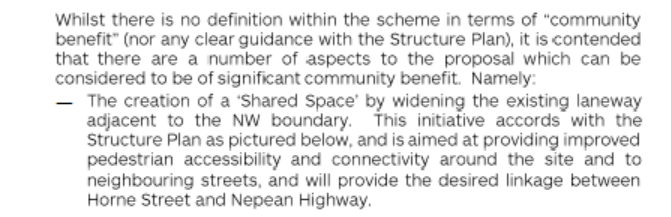
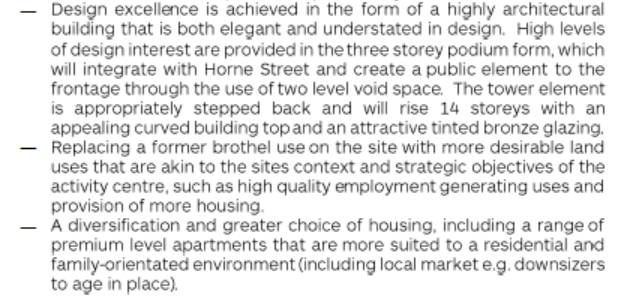
Possibly the biggest joke in this application is the developer’s claims to ‘community benefit’. Readers should remember that council decided that development could go from 8 to 12 storeys if there was ‘community benefit’. Of course there is very little definition of what this term actually means and certainly nothing worth a cracker in the eventual interim amendment. For those applications wishing to exceed the preferred height, all they have to show is (quote) – that the development includes the provision of significant community benefit. Not a single of word of definition exists; no decision criteria exist. Council should congratulate itself on producing the perfect example of waffle par excellence!

How does the developer respond to this clause then? Here’s what is claimed as ‘community benefit’ –

We get a paragraph on office space and ’employment’, then more of the same. Please note the reference to the former brothel!

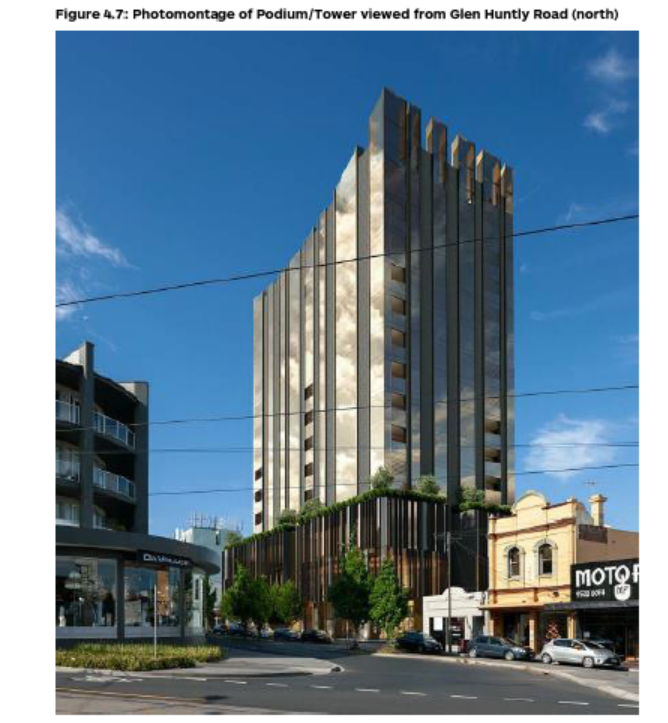
And the result will look like this:

There’s another aspect to this application worth considering. As recently as the last council meeting a resolution was passed to grant this site a permit for a drug rehabilitation unit. It had apparently been operating for some time without a permit. The current application allegedly arrived at council on the 2nd November.  Discussions prior to this date would undoubtedly have taken place with council planners. Thus, given that developers operated without a permit, did council issue any fines, or merely turn a blind eye knowing this was in the works?

Many other aspects of the application are contentious – ie overshadowing; traffic, open space. What is becoming clearer and clearer is that Elsternwick has always been seen as Glen Eira’s high rise capital and every effort has been made to further this agenda by a council that steadfastly refuses to listen to its residents!

Woolworths Elsternwick: Supermarket giant resubmits plans for high rise tower

Emma-Jayne Schenk, Caulfield Glen Eira Leader

November 21, 2018 12:00am

The battle between Woolies and Elsternwick neighbours is back on, with Woolworths pinning its hopes on a new public facility in their planned Selwyn St complex, to help quell backlash against its plan for a towering high-rise.

The supermarket giant has finalised plans for the 13-storey complex, following more than 115 objections about height and scale, traffic congestion, parking, loss of heritage, and overshadowing on nearby houses.

The former ABC building on Selwyn St, which Woolies bought for $45 million in March 2017, is currently only two storeys high.

Woolworths resubmitted plans to Glen Eira Council for the mammoth building earlier this month, which will be released to the public for feedback next week. If approved by Glen Eira councillors next year, the 80-unit complex would include a two-storey, 1000 sq m community facility on the corner of Sinclair and Selwyn streets with a small cafe, meeting and discussion spaces, and a multimedia space available for hire. The Kadimah Jewish Cultural Centre will also be relocated within the centre.

Other changes include increased setbacks and the glass exterior being replaced with brick.

But a Woolworths spokesman said the height and the scale — which is what most residents objected to — remained “very similar”.

Elsternwick resident Rosemary Scott-Thompson, who owns an apartment on Selwyn St, said while the community centre was a “nice idea”, the changes did not ease her concerns.Woolworths is hoping its new design, shown here, will quell community concern.

She said the “monstrosity” would block any direct sunlight she gets in her home, and the only opening window would be facing the underground carpark, which would “stick fumes into her apartment”.

“Unless they step the building back on Selwyn St … it’s not something I’ll ever be happy about,” Ms Scott-Thompson said.

“They stepped the building back on the other side but (because we’re in a commercial zone), it’s like they don’t care.

“From my own personal point of view, it’s just not a good idea.”The old plans, seen here, for 10-16 Selwyn St have been scrapped by Woolies.

Woolworths senior development manager Don Foulds said the revised plans came in response to community needs. “We’re confident we can deliver a development that becomes a vibrant cultural and entertainment hub for local residents and look forward to discussing our revised proposal with the council and community members,” he said.

Source: https://www.heraldsun.com.au/leader/inner-south/woolworths-elsternwick-supermarket-giant-resubmits-plans-for-high-rise-tower/news-story/089d1b38e00c44720eda19f883684576?utm_source=HeraldSun&utm_content=SocialFlow&utm_campaign=EditorialSF&utm_medium=Twitter

From today’s Caulfield Leader –

For all the spin that the Urban Design Guidelines will ensure the right buildings in the right places, recent events reveal how ineffectual such ‘guidelines’ really are. Here’s why:

  • They are ‘discretionary’ and NOT mandatory
  • They are Reference documents only and NOT part of any specific clause of the planning scheme
  • There is nothing in the recently gazetted structure plans which mandate developers to abide by the aspirations of this ‘reference’ document

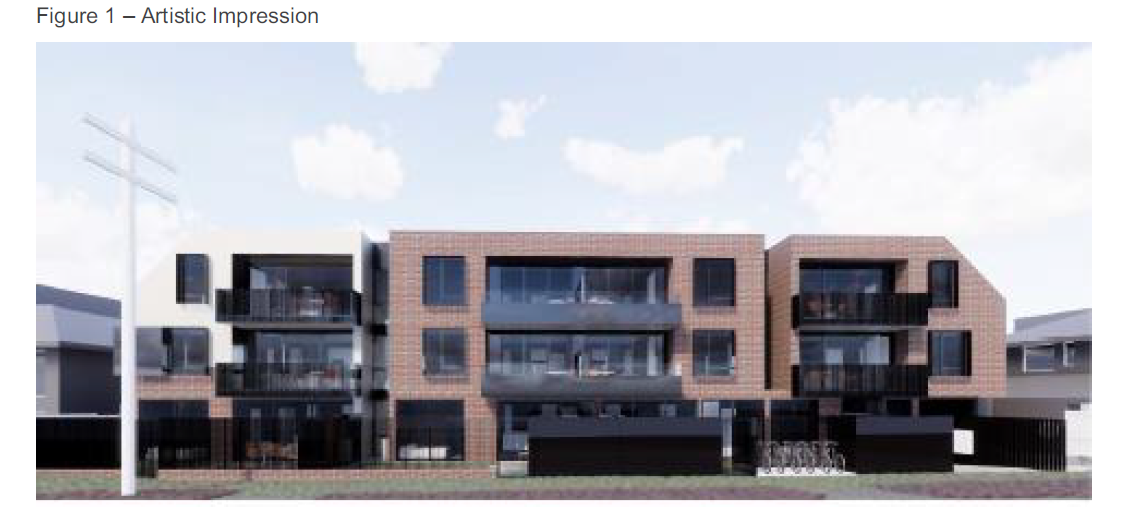
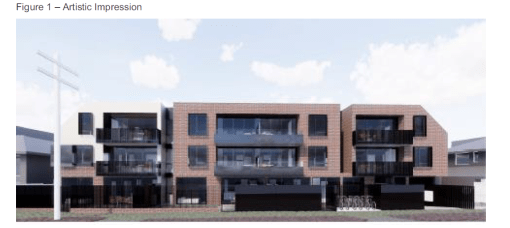
Best illustrating how council’s spin does not equate with reality, we have the example of 100-104 Mimosa Road, Carnegie. Originally an application came in for a 4 storey apartment block of 49 apartments. With the introduction of the structure plans we now have a ‘revised’ application for 3 storeys and 41 apartments. Height is the only aspect of the structure plans which are mandatory (only for Bentleigh & Carnegie), hence the removal of one storey. All well and good people might say. Except that Mimosa Road is, according to the structure plan, located in Precinct 2. And Precinct 2 is supposedly designated as ‘Garden Townhouse’ of up to 3 storeys, 11 metres. In other words, NOT an apartment block.  Yet this is what is now proposed – definitely NOT ‘townhouses’!
On the 28th February 2018, council minutes contained the following in regard to the Urban Design Guidelines –

The Quality Design Guidelines were produced to:

Respond to the aspirations of the Glen Eira community regarding neighbourhood character and to deliver on the vision for our neighbourhoods.

Encourage a high level of architectural design in new developments.

Provide clarity and certainty about Council’s expectations for new developments.

Support and supplement existing design guidance provided by the Glen Eira Planning Scheme and relevant State Government initiatives.

AND

Beyond ensuring better design outcomes are achieved across Glen Eira, implementation of the Quality Design Guidelines will deliver four significant benefits:

  1. Clarity and certainty for everyone
  2. Garden townhouses in residential streets
  3. Protection of character and human scale of shopping streets
  4. Maximising community benefit on strategic and urban renewal sites

Another ‘advantage’ of the Garden Townhouse aspiration was that –

  • Ground floor living reduces the impact of overlooking onto neighbouring backyards
  • Less dwelling density in residential streets address concerns of parking and traffic

The developer’s ‘revised’ application puts pay to all of this spin. We quote directly from the Urbis report:

…it is noted that the setback, landscaping, building design, landscaping and all other objectives are considered to be discretionary, whilst the specified height is considered to be mandatory. 

The built form currently proposed is an ‘apartment’ style building. It is considered that although a ‘town house character’ is encouraged by Amendment C157, it is noted that an apartment style character is a common characteristic within this neighbourhood setting 

It is noted that the proposed development does not provide the number of canopy trees required to be planted on the entire site and deep soil planting is restricted along the rear of the boundary and partly along the side boundaries. However, the street trees are proposed to be retained as part of this proposal and additional planting can be provided within the front setback of the development 

There are plenty of other problems with this application. For example:

Site coverage is 68%. Supposed to be 60%

Permeability is cited as 20% the required amount, but one has to query the following phrase attached to this number – ie deep soil area is 13% remains unchanged. What does this say about permeability per se, or the extent of the basement car park? Please remember that council’s ‘promise’ was to ensure that basement car parks did not cover practically the entire site!

What happens with this application will be instructive to say the least. More than anything it highlights once again the failure of this council to produce results that have real effect.

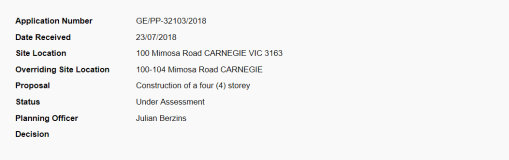
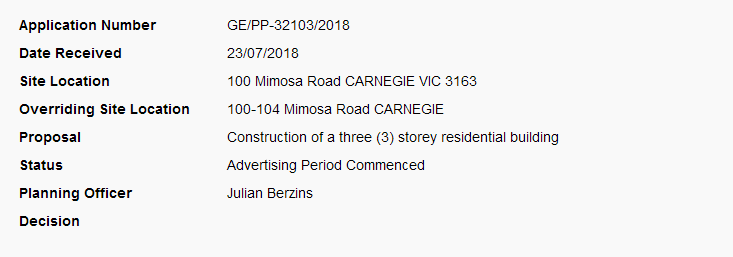
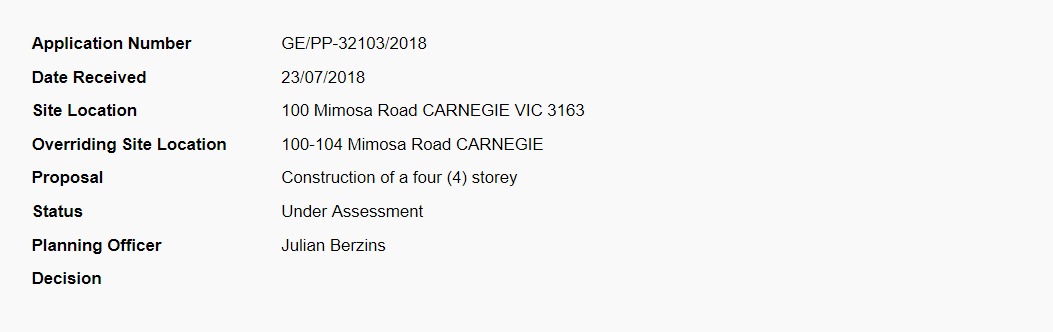
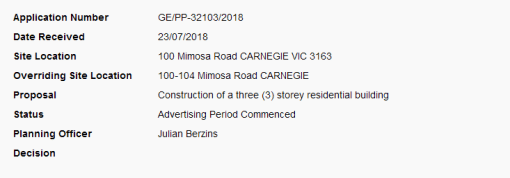
Finally a comment on governance and the continued monkey business that occurs with council’s online register. The application for 4 storeys came in months and months ago. It then disappeared entirely from the online register. Nothing such as ‘withdrawn’ was noted. It then made a reappearance as an entirely new application but still contained the SAME DATE as the original application for 4 storeys.

Online registers are required to contain information about every single application – their amendments, dates, decisions, etc. Far too often in Glen Eira inaccuracy and obfuscation replaces legal requirements!

Here are the two different applications and please note the dates:
 

We’ve received an email requesting that we publicise the following YouTube videos. The link to them is:

https://www.youtube.com/channel/UCygK9eItmUBU2aoDhnB7gGg

More videos will be posted soon we are assured.

Glen Eira features in 3 for Bentleigh, Carnegie & McKinnon. Here’s the Carnegie one.


Councillors’ performance tonight in unanimously accepting the East Virginia structure plan signals how little these individuals are willing to stand up for residents and for common sense.

Magee’s grandstanding has become habitual plus lacking all logic when he can begin his statements with –‘I will be speaking against the motion but voting for it’!!!!

Hyams continues with the old arguments that this is only the first step in the process blah, blah, blah and then spending 9 minutes on regurgitating what the documents contain but in a totally uncritical way.

The only ‘news’ that came out of Hyams’ mouth was the naming of the individuals involved in the Community Reference Group – for the very first time. How on earth a COMMUNITY REFERENCE GROUP can function without anyone knowing who they are is beyond belief. If their role was to represent the community, then it is incumbent upon council to ensure that the wider community knows who these individuals are so that they may be contacted and ideas exchanged. But that is not the way this council functions. No agendas or minutes of these meetings have ever been published. We don’t even know how many meetings occurred. As for the individuals named what is their background? How many are associated with the development industry? How many were tapped on the shoulder and asked to apply? We note, and with no intent to cast aspersions on these individuals, that the vast majority have never asked a public question, have probably never attended a council meeting and certainly are not active on social media. Thus on what basis was this community reference group selected? For all the talk about transparency and accountability the way these Community Reference Groups have been set up and function is anything but transparent and accountable. The $64 question of course remains – how many suggestions made by OUR community reference group saw its way into this final structure plan? We would hazard a guess that very little produced the desired outcomes.

As a further example of council’s failure to address the gaping holes in this structure plan we present one speaker’s question (and statements) to council from this meeting. It is significant we believe that she received not a single word from anyone in response to her comments! So much for ‘public participation’. The only saving grace of tonight’s meeting was that it only lasted about an hour!!!!!!!

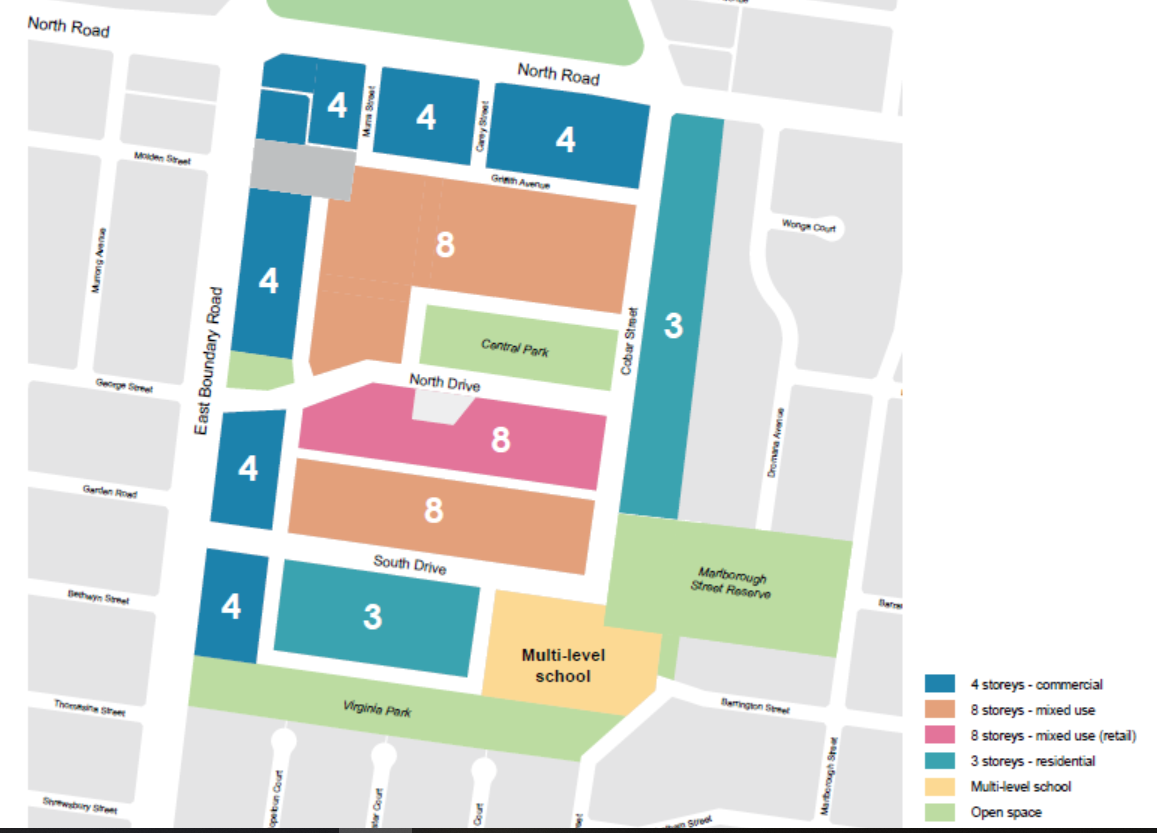
Council has released the proposed structure plan for Virginia Estate. The above map indicates the (indicative/preferred) height limits for the various precincts.

There is much in this set of documents that require comment. However, due to the paucity of detail, we can only surmise what will eventuate. One thing however is abundantly clear – once this structure plan and its accompanying Comprehensive Development Plan is passed by council, sent off to a Planning Panel, and it enters the Planning Scheme via its associated Amendment then community involvement and input will NOT EXIST. There will not be any objector review rights in exactly the same way that occurred with the Caulfield Village projects. Council is not even bound, according to the Schedule for this Comprehensive Development zone, to notify any resident. Hence, there are no guarantees that what is presented in these documents will be the final outcome.

Below we feature some points from the various documents which reveal the ‘wriggle room’ allowed to the developer.

COMPREHENSIVE DEVELOPMENT PLAN

  • Building heights are NOT MANDATORY! They are ‘preferred maximum heights’.
  • ‘SHOULD’ instead of ‘MUST’ dominates throughout all of the built form specifications. And we all know what ‘should’ means!!!!!!
  • For all the talk about rehashing the Open Space Strategy and considering overshadowing at the winter solstice, we still get the following – – Development must not cast any shadow on more than 75% of the area of any public open space described in Plan 2 of the incorporated CDP between 11am and 2pm on 21 June the winter solstice.
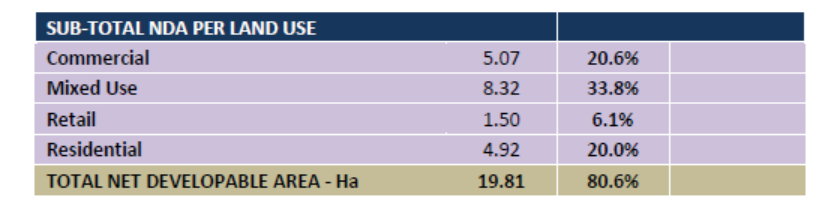
  • What is totally and deliberately misleading is the following breakdown of residential versus commercial/retail components of the site. The only areas specified as NON residential are the buildings to go along North Road, and East Boundary Road. All the rest will have residential dwellings built above the shops/offices located on the ground or several floors above. To therefore claim that only 4.92 hectares of the entire site is set aside for ‘residential’ is inaccurate and unacceptable.

THE SCHEDULE 

  • Exemption from notice and review

An application for the use of land is exempt from the notice requirements of Section 52(1)(a), (b) and (d), the decision requirements of Section 64(1), (2) and (3) and the review rights of Section 82(1) of the Act if it is generally consistent with the incorporated CDP. 

  • An assessment of the likely traffic impacts associated with the proposed development, including the ability of the Cobar Street / North Road / Crosbie Road to function effectively without signalisation. This is to include an assessment of the precinct’s existing and the proposed development traffic generation during peak AM and PM period. Where the traffic generation is expected to exceed 2,000 vehicles accessing the site in the PM peak, the Cobar Street site access intersection should be implemented. What this means is that the developer does not have to do anything UNTIL they determine that Cobar Street has 2000 cars travelling along it each day. Thus first get the permit, build and then worry about traffic and safety!

DEVELOPMENT CONTRIBUTIONS PLAN 

According to the figures provided in this document we are supposed to accept that the developer will fork out $60 million in infrastructure improvements to the site of which $16m will be for community improvements. What we query is given the flooding and drainage issues, plus contamination, that $1,199,835 comes anywhere near what the cost will be to ameliorate the potential for flooding and ensure contamination is eliminated.

On the positive side, council will get a ‘community hub’, a sports pavilion, and some open space. These will only come into operation however when ‘population growth is deemed to require the infrastructure’. So once again it is build first and then worry about the necessary infrastructure after the fact.

Even more concerning is the community infrastructure levy assigned to each dwelling of $831.65. Legislation allows a maximum of $1,150. Thus Gillon is getting a discount of $318.35 per dwelling. In total that amounts to just under a million dollars. Other councils have successfully exacted this full cost for major developments. Not so in Glen Eira!

SOME GENERAL COMMENTS 

  • Residents are presented with a 58 page Structure Plan that is so bereft of detail that it beggars belief. Of these 58 pages there are 22 that are frontispieces or pages with pretty pictures. The rest is primarily nothing more than vague motherhood statements such as this nonsense for ‘Transport’ – Explore innovative approaches to car parking and traffic management
  • No indication is provided as to how traffic and parking will be handled. Will we have subterranean car parks 3 levels down in a flooding area? Or will we have high rise car parks? Why is current traffic analysis focusing almost exclusively on PM peak periods?
  • If the proposed school is next door to 3 storey building then how high will this school be? – 3 storeys, 4 storeys, 5 storeys? And will the 1.2 hectares be sufficient to provide open space for up to 1150 students – or will they be expected to utilise fully existing open space next door?
  • The Section 173 agreement between developers and council will remain ‘secret’ according to the officer report recommendation – ie Direct officers to not commence exhibition unless the appropriate Section 173 Agreements are signed and executed by all parties and a summary of the purpose of the document is exhibited along with the planning controls. In other words, residents will not get to see the nitty gritty of this agreement we presume!
  • Affordable housing is another questionable aspect when so much of the officer’s report contains the following caveats:

One of the main difficulties with seeking an agreement at this stage, is that it needs to be ‘clear of outcome’ to enable the detail to be resolved later, while also being ‘tight enough’ to ensure it can be suitably enforced 

Past experience has demonstrated that the more restrictions placed by Council, the more difficult it is to make a project feasible. 

However, it is understood that this is an ambitious outcome to achieve, with many factors that are outside the landowners’ control. It is important that the agreement is written in a way that gives the landowners flexibility and the greatest chance to achieve this outcome.

As such it is recommended that the agreement is primarily focused on this outcome, with appropriate detailing of the mechanism only where required.

Finally, the VPA has today released another 10 updated ‘background’ documents from its 2017 versions. We will comment on these once we have had time to digest them fully. In total these documents amount to well over a 1000 pages. Yet councillors are expected to vote on these matters next Tuesday night. How many of them we wonder will have read even some of the documentation? What questions, if any, will this documentation bring to the fore from councillors?


Last night’s discussion on the Planning Scheme Review and the rehashed work plan 2018, illustrates once more how the tail continues to wag the dog in Glen Eira. Everything was passed unanimously with barely a whimper.

In theory, councillors are supposed to set priorities. They are supposed to determine policy, budgets, and overall direction for councils based on community expectations. What we find in Glen Eira is total subservience to unelected officialdom.

The discussion last night featured:

  • Some totally inane comments by Magee – ie ‘multi-racial development’ that has got nothing to do with planning per se. We do love the statement that planning policy should not be allowed to ‘stagnate’ – this coming from a councillor who has been there since 2008 and has condoned, aided and abetted the ‘stagnation’ time and time again!
  • Hyams’ deferring to the ‘experts’ that have to be trusted despite the Major Heritage review being 5 or 6 years away until full completion.
  • Delahunty’s desire to learn ‘the annoying lesson of having patience’ and it is ‘a little gut wrenching’ that heritage will be ‘drawn out over that period of time’. These words from another councillor who was quite happy that she ‘lost the debate’ in 2013 about refusing to go to community consultation for the introduction of the disastrous zones – which readers should note have now been acknowledged as failing to adequately protect residential amenity.
  • Taylor wishes to ‘surge’ ahead on ‘environmentallysustainable design’ yet votes for another ‘do nothing’ – it’s a State Government responsibility. Totally ignoring the fact that countless other councils have had such policies enshrined in their planning schemes for years and years. Nor does she mention one single word about earlier promises for increased permeability standards, etc.
  • Athanasopolous’ claim that Glen Eira is ‘leading many other municipalities’ because of its work on 3 structure plans simultaneously, in contrast to other councils who only work on one at a time! Wrong, wrong, wrong! Bayside managed to create draft structure plans for all its neighbourhood centres in one go, as did Boroondara. Further, are residents happy with the ‘outcomes’ of these structure plans – especially the 12 storey height limits in Elsternwick & Carnegie? To what extent do these structure plans reflect what the community said they wanted?

It’s also worth noting that not one councillor bothered to explain why they considered the proposed Quality Design Guidelines as a superior option to creating what was promised – ie a Neighbourhood Character Policy!

Here is the ‘discussion’, for it surely can’t be called a ‘debate’!!!!


« Previous PageNext Page »