GE Open Space


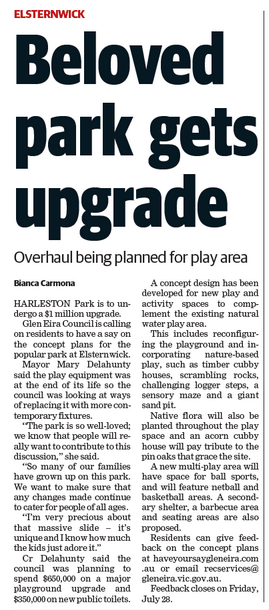
We’ve commented before on what can only be described as council’s profligacy in spending millions of dollars on ‘upgrades’ that residents have not asked for nor truly want. The latest example is the ‘upgrade’ to Harleston Park playground. The budget has set aside $650,000 plus another $330,000 for public toilets. We believe that by the time landscaping occurs, the costs will be well over a million dollars. Remember, council has yet to prove it can stick to any budget,  with major projects time and time again costing far more than first indicated.

On the one hand we have councils screaming poor because of the State Government’s rate capping. On the other hand millions of dollars are being expended on projects that are highly questionable. Recent examples of highly suspect proposals that have raised the ire of the majority of residents include:

  • The purchase of 9 Aileen Avenue, South Caulfield for $2.1m and which is now rented out.
  • The creation of a ‘park’ between Fitzgibbon and Eskdale for the stated amount of $450,000 – both of these within a stone’s throw of nearby parks
  • The expenditure of $11m that council admits to for Booran Reservoir, but which we believe is far in excess of this cost – plus an area of urban forest equalling 11% of the site that is closed off to the public entirely.

All of these projects have not been embraced fully by residents and the current feedback on the Harleston Park proposals continues this trend. The vast majority of responses question the attempt to change a passive area into another Booran Road type Disneyland. More importantly, we have to wonder at the wisdom of council’s budgeting and its agenda. For example:

  • Why is Camden Ward the flavour of the month, especially when areas such as Carnegie are experiencing the greatest amount of development and no attempt has been made to increase public open space in this precinct?
  • Council, unlike other municipalities, has no playground policy that we know of. Thus ad hoc planning again!

The central question however should be whether residents would prefer spending more of our money on expanding open space instead of pouring more and more concrete into existing open space? – remember the $282,000 for concrete plinths!

It all comes back to priorities. Yes, facilities need upgrading, and yes, this can be expensive. But we absolutely reject the over-the-top spending on ‘upgrades’ that other councils can do for a quarter of the cost because their vision and programming is so vastly different. What is needed in Glen Eira in our view is not mega palaces that cost the earth but a concentration on expanding existing open space. That is impossible when the vast majority of the open space levy is spent on proposals such as the Harleston Park redevelopment.
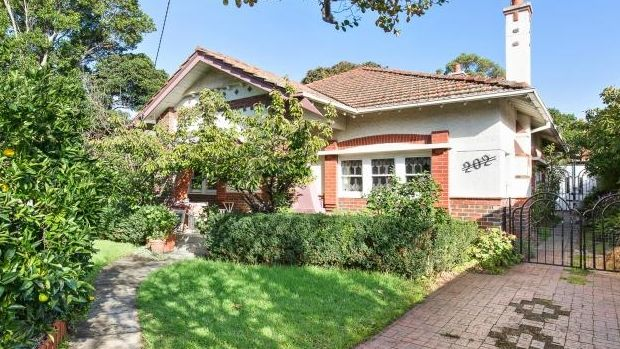
Melbourne council areas with the biggest growth in apartment projects

Christina Zhoutwitter Domain Reporter Jul 15, 2017

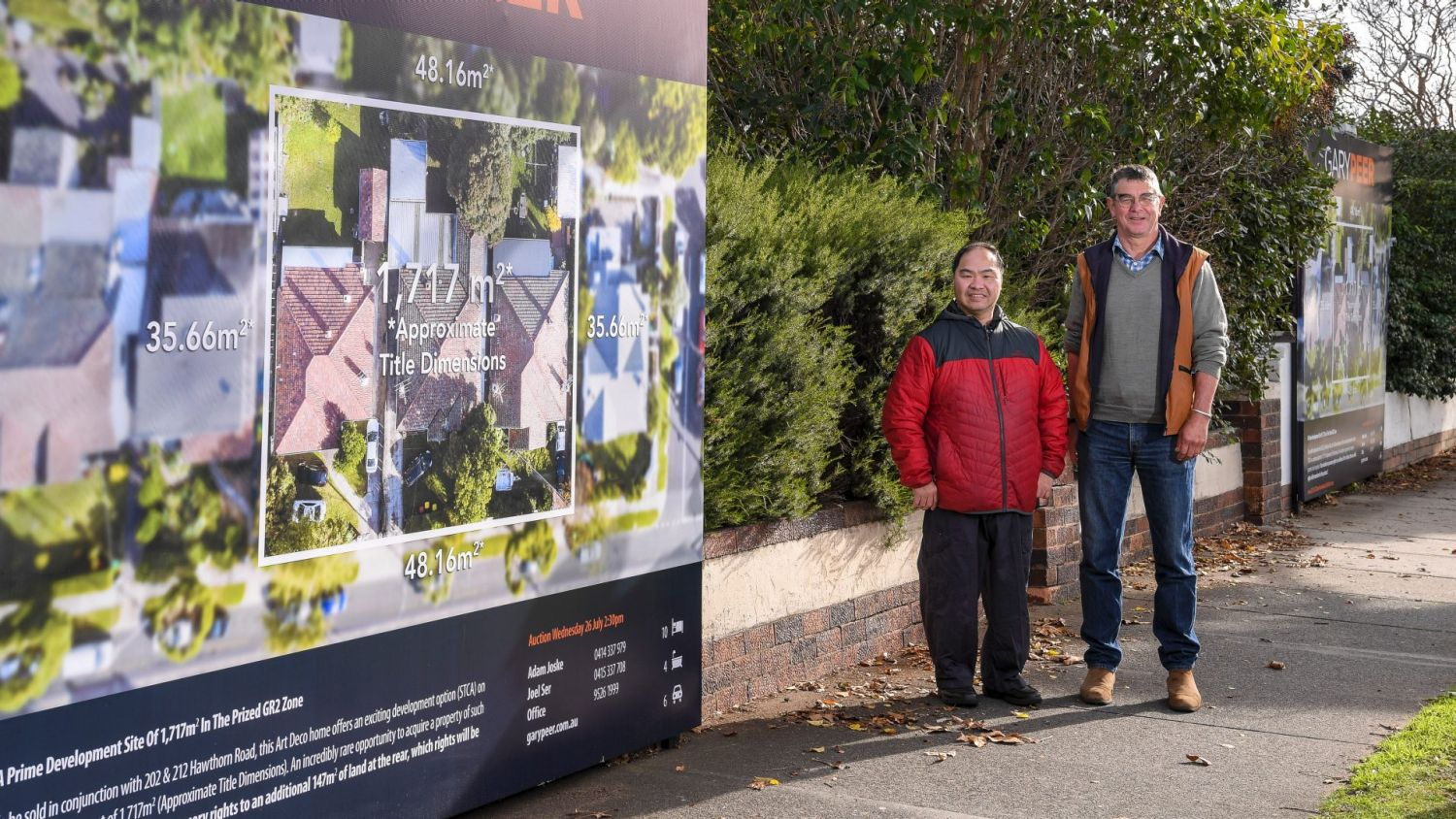
Alistair Howe was gutted when he found out his neighbours would be selling their two adjoining Caulfield North houses to apartment developers.

Within an hour, he decided to join them – spurred on by the thought of living next to a multi-storey building – and offered up his family home of 18 years for sale.

The neighbours hope their combined 1717-square-metre block on Hawthorn Road will capture increasing developer interest in Glen Eira, where significant levels of apartment construction is planned.

There were 307 units approved in projects of at least four storeys in Glen Eira during the five months to May — more than double the 135 approved at the same period last year, an analysis of Australian Bureau of Statistics building data by Domain Group chief economist Andrew Wilson showed.

The number of approvals in Glen Eira trails those given the green light in the councils of Melbourne, Stonnington, Yarra and Boroondara, which alone had 559 apartments approved — more than quadruple the 119 last year.

Greater density is generally encouraged along transport corridors to protect the character of the neighbourhoods.

Mr Howe said he raised a family with five children in his three-bedroom house, and expected to live there until he was “too old”.

He added he had “mixed emotions” about the sale, but decided to sell together because it made more financial sense.

“I felt gutted initially because I suddenly thought ‘well, I don’t want to have a three-storey apartment beside me,’” he said. “Then within an hour, I made the decision that I’d join their sale.”

The owners are hoping for between $5 million and $5.5 million for the row of three houses, and would split the sale price based on their land size.

The successful bidder at the July 26 auction would also have the first right of refusal to buy another neighbouring house, with a single dwelling covenant.

202 Hawthorn Road, Caulfield North 

Combining the properties would open up the site to larger scale developments, Gary Peer director Adam Joske said, and it could also achieve a premium of more than 10 per cent.

Although the City of Melbourne continued to record the most approvals for high-rise apartments, the number in the pipeline is weakening. There were 1357 apartments approved from January to May, almost 900 fewer than the same time last year.

Dr Wilson said there could be a perception from developers that the CBD market — where there had been record levels of development — might be over-supplied.

“But I do think it will turn around because the Melbourne market generally is still under-supplied,” he said, adding that prices were rising strongly.

Angie Zigomanis, BIS Oxford Economics senior manager, said tougher rules for foreign investors — prolific buyers in central Melbourne — could have had an impact.

Australian banks tightened lending criteria for offshore buyers against the backdrop of the Chinese government limiting the amount of money moving offshore. On top of this, the Victorian government more than doubled the stamp duty surcharge for foreign buyers last year, from 3 to 7 per cent.

UDIA Victoria chief executive Danni Addison believed it was a case of the market adjusting to changes in planning policy, including height controls and setbacks in the CBD and the new apartment design standards.

“It takes people a while to go back to the drawing board in terms of their project feasibility and work out how to recast the vision,” she said.

Ms Addison said there was also a clear correlation between the increase in planned apartments in the inner and middle rings and demand.

Boutique developments in well-serviced areas such as Boroondara and Glen Eira appealed to downsizers who wanted to stay in the area and young families who could not afford a family home, she said.

Source: https://www.domain.com.au/news/melbourne-council-areas-with-the-biggest-growth-in-apartment-projects-20170715-gxadgh/

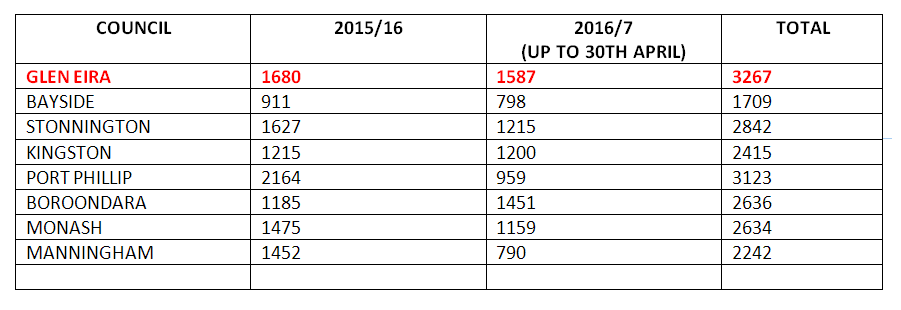
Glen Eira remains the development capital of the south east. The ABS figures above represent building permits granted this financial year and up to the end of May 2017 – ie 11 months worth.  We repeat that both Port Phillip and Stonnington are special cases given that the former has just on 25% of its municipality designated as Commercial and Capital City zoning, whilst Stonnington has triple the amount of land zoned Commercial in comparison to Glen Eira’s 3%.

The figures prove beyond a doubt that Council’s land use hierarchy has been a dismal failure in that the vast majority of development HAS NOT occurred in the Commercial areas but in quiet residential streets that unfortunately are zoned as General Residential.

Readers should also note the percentage of houses compared to units for each municipality – again showing Glen Eira’s concentration of apartments, in suburbs that are already bursting at the seams with overdevelopment. Yet the revealed housing report for the current structure planning, would appear to indicate that there is more development in council’s agenda given the upgrading of 3 local centres to Neighbourhood Centres. This can only mean one thing – more land to be earmarked as GRZ or RGZ! And of course, the above figures do not include the 1100+ apartments for Caulfield Village or the thousands that will end up at Virginia Estate.

The most essential questions remain unanswered by council –

  • What is capacity?
  • What is the maximum density?
  • What is the cost for adequate open space, drainage, etc and who will pay and when?

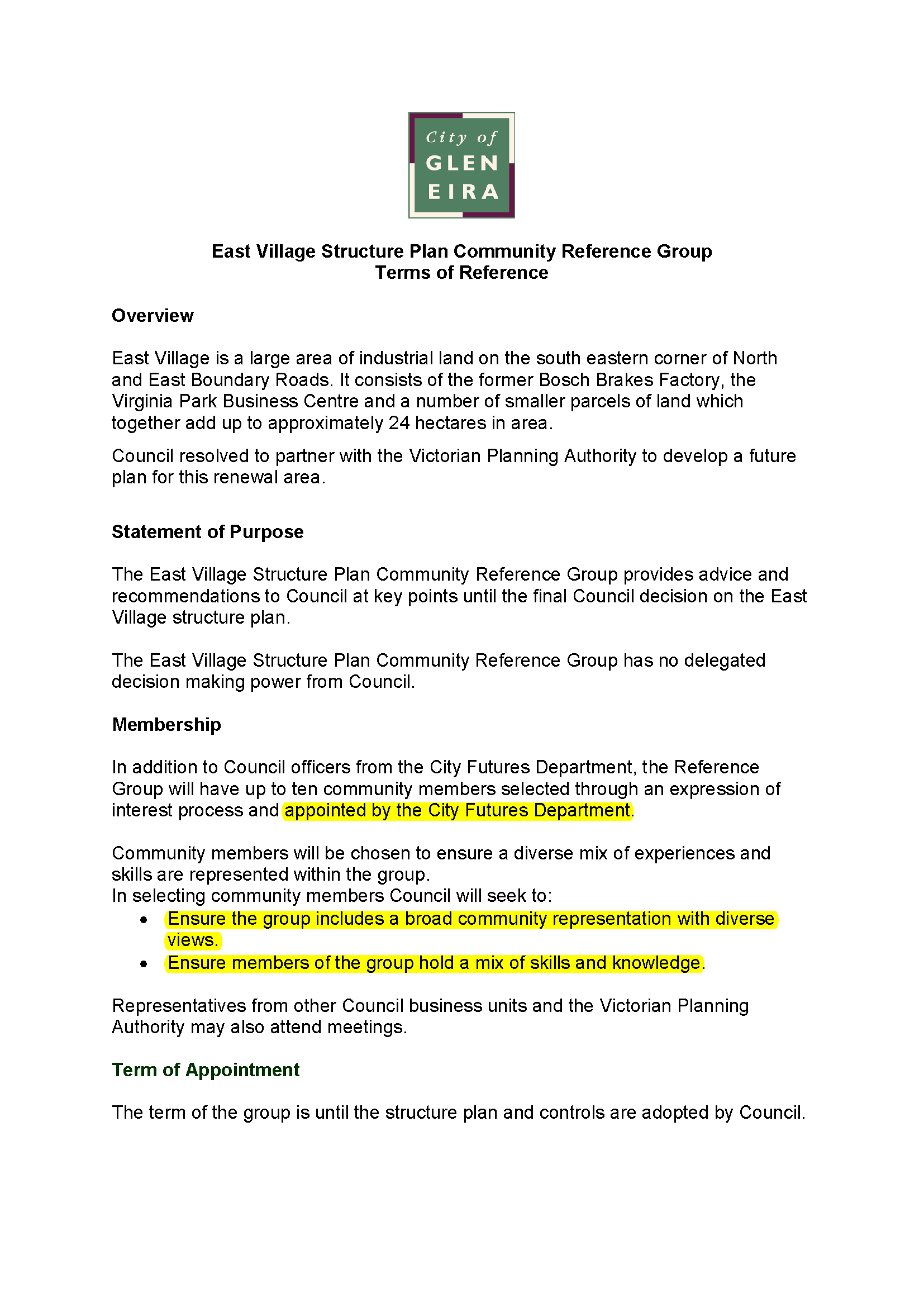
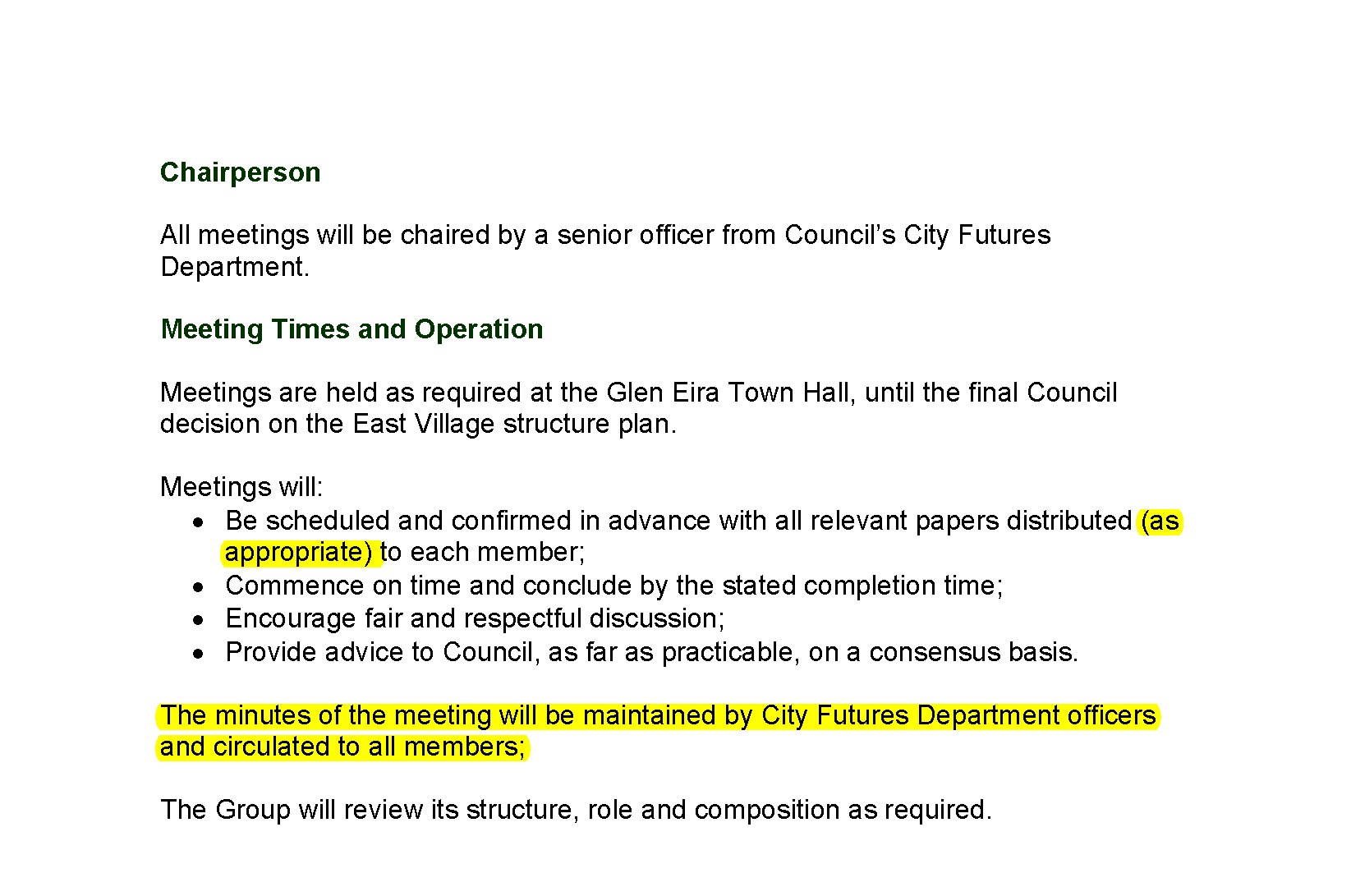
Council has published the Terms of Reference for its Community Advisory Group for the East Village project. Ostensibly, the creation of this advisory committee is a positive step, if somewhat belated in that the first draft of the resulting structure plan has already been set.

What concerns us even more than the question of timing,  is how  transparently this committee will operate, how it will report,  and how much notice will be taken of community rep views. The terms of reference (see below) do not fill us with confidence that this will be anything except another public relations exercise designed to provide the illusion of working with the community.

Please note the following:

  • No mention is made of councillors. Are they excluded entirely from any involvement in this committee – from selecting residents to actually partaking in the meetings?
  • Why is all responsibility granted to officers in terms of selection, etc?
  • Why is there no formal council resolution that endorses these terms of reference?
  • Why is there no mention of reporting requirements to the wider community?
  • Why is there the possibility that the Victorian Planning Authority and others may attend, when it was specifically stated by the Mayor that this is a committee expressly set up to work exclusively with council?
  • Given that the next iteration of the structure planning work is supposed to be in July (ie urban design/building guidelines) then how many times will this committee actually meet?

We’re repeating the gist of one of our previous posts since the Glen Eira Leader (below) provides Council’s ‘response’ through the Mayor. As we’ve stated, year after year the same poor results in planning, traffic, etc. rear their ugly heads – yet, if the survey can be ‘criticised’ because it is ‘perception based’, then surely this also applies to council’s good results regarding rubbish and the service centre? Not a word on this of course.

Readers might also find it informative to go back 5 years and see what councillors had to say (especially Hyams and Esakoff who are still on council) on equally bad results in 2012 – even before the introduction of the zones? [See: https://gleneira.wordpress.com/2012/07/26/community-dissatisfaction-survey/ ]

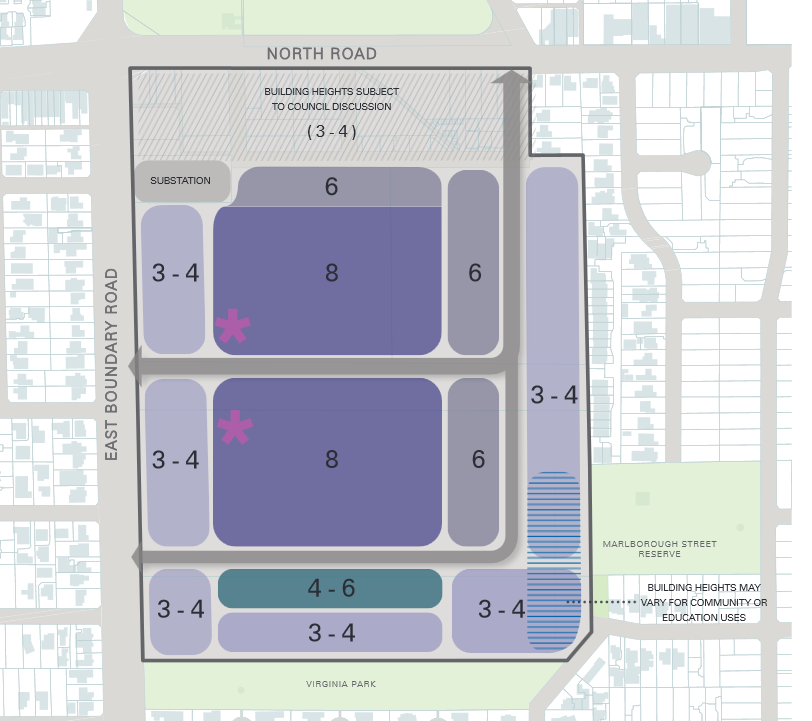
Council has published its ‘draft’ Structure Plan for the development of Virginia Estate. It has also announced that in the next few weeks it will be calling for expressions of interest for residents to partake in a Community Reference Group. A tad too late we suggest since the ‘draft’ has already been formulated and given past experience very little is likely to change.

The only ‘improvement’ that is clear is the statement that a 1 hectare public open space will be included. Issues regarding schools and transport are still being ‘negotiated’ with the State Government.

The most disturbing aspect of this ‘draft’ Structure Plan is that council’s nominated height limits are in fact even higher than the proposals from the developers. We’ve uploaded the Gillon & Co draft plan as well as the Council nominated version below. Please compare carefully!

No information is forthcoming as to potential number of residential developments, the number(s) and area of retail, etc. More to follow in the days ahead on this item.

PS: Council claims that the above draft is in response to community feedback thus far. At the May forum we reported that residents stated the following:

  • Problem with language – people did not know what ‘innovation’ referred to – far too vague.
  • More clarity required about the term ‘affordable housing’ and this should be changed to ‘diversity of housing’
  • Questions about what ‘village’ means and is this a ‘village’
  • Traffic and car parking are major problems
  • Desire for low rise townhouses. Some tables nominated a maximum height limit of 3 storeys and others up to 6 storeys.
  • Diverse views on the need for another school and whether this should be part of McKinnon High or another new school entirely.
  • Open space that wasn’t covered over in concrete
  • A new supermarket required but also not a threat to other existing businesses in the area.
  • No waiving of car parking spots
  • Environmental sustainability across the entire centre including flood mitigation

Council has now decided to amend the ‘vision’ statement. It remains full of gobbledy gook, and DOES NOT address the responses listed above. Below is the original ‘vision’ and then the latest updated version.

East Village will be a thriving, mixed use precinct with a focus on employment, innovation, education and housing affordability. (Version 1)

‘East Village will be a sustainable mixed use precinct with a focus on innovative employment and education opportunities. Enhanced by green spaces and places for people, it will be supported by a diverse range of high quality housing and retail that caters for all.’  (Version 2)

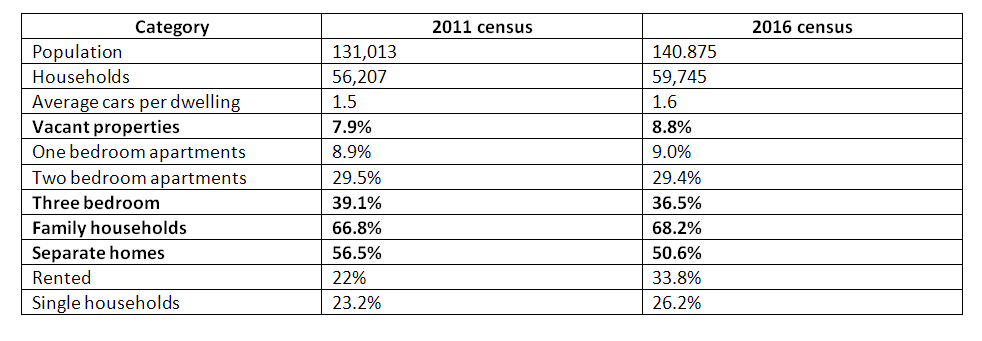
The above table proves beyond doubt what an unmitigated disaster planning has been in Glen Eira and continues to be. If our suspicions of council’s intent of facilitating more and more development bears fruit then the very fabric of Glen Eira will be destroyed even further.

Here’s why:

  • Nearly a 1% increase in vacant properties
  • Instead of a projected 148,000 population in 2016, there’s only 140,000
  • Cars per household increase – and no proper parking precinct guidelines
  • Increase in family households but significant decrease in number of 3 bedroom places and even a decline in number of 2 bedroom places
  • A population increase of 10,000 but over 8000 building permits handed out in the 5 years.
  • Well above Victorian average for apartments in the municipality. Glen Eira’s buildings are composed of 24.2% for ‘semi-detached, row or terrace house, townhouse’ whilst the state average is 14.2%. In terms of ‘Flat or apartment’ Glen Eira has 24.5% and the State average is 11.6%.

Conclusions

  • There is a vast oversupply of dwellings in Glen Eira
  • Glen Eira is well and truly meeting its population growth
  • Diversity of dwellings is declining fast

Source: http://www.censusdata.abs.gov.au/census_services/getproduct/census/2016/quickstat/LGA22310?opendocument

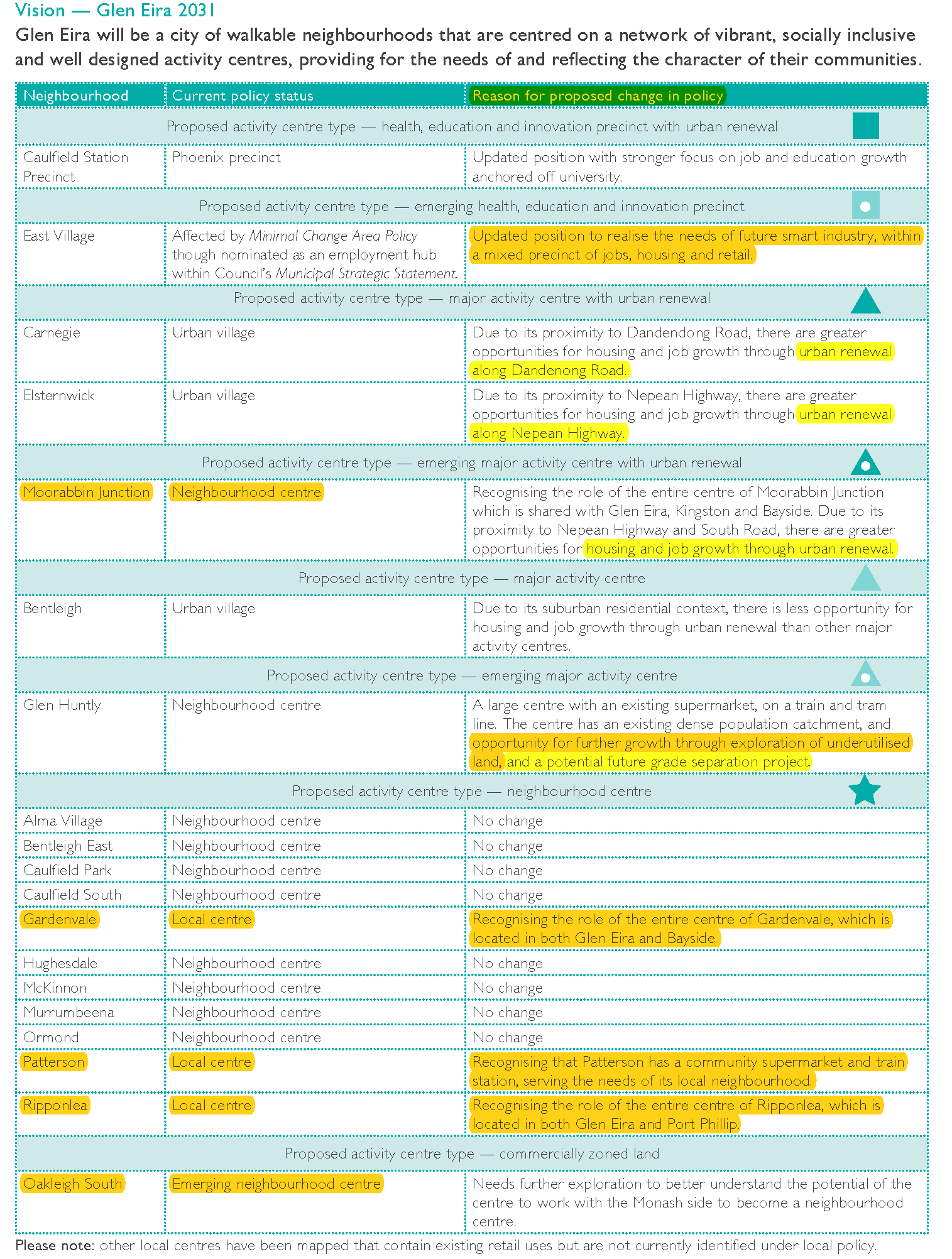
The most important page that has thus far been published by council is the following because it provides a clue as to what council is really planning and why residents across Glen Eira should be very, very concerned. Our take is that council intends to facilitate and expand development across Glen Eira – especially in those areas which happen to be close to railway stations and along major roads.

The Draft Activity Centre, Housing and Local Economy Strategy makes this absolutely clear. Here is the relevant screen dump  (page 10).  Please note the following:

  • At least 3 current Local Centres will be upgraded to Neighbourhood Centres – Patterson, Ripponlea, and Garden Vale. That means more apartments!
  • Moorabbin which is a current Neighbourhood Centre will now be a Major Activity Centre as will Glen Huntly (we acknowledge that the latter has always been seen by the Government as a Major Centre. Council has insisted on calling it a Neighbourhood Centre).
  • Caulfield and Virginia Estate are givens – just the amount of residential development is unclear. We estimate another 5000 dwellings at least on these two sites.

Council has refused to deny the possibility that properties currently zoned Neighbourhood Residential will suddenly find themselves zoned as General Residential or Residential Growth. Or those zoned as General Residential will be ‘upgraded’ to Residential Growth. Without a straight out denial, that convinces us even more that the probability of this occurring is already set in concrete. The question is how many homes will be affected? How many residents will wake up one morning to find that they can now have 11 and 13.5 metre dwellings (at best) right next door to them?

As an example of what currently exists we use Patterson as a model. Here is a map of this currently designated Local Centre. Please note that it consists of a handful of shops zoned Commercial 1, but surrounded entirely by sites zoned Neighbourhood Residential. Activity centres by definition include Neighbourhood Centres and every single activity centre contains sites zoned as either Commercial, Mixed Use, General Residential or Residential Growth Zone. They do NOT contain properties zoned Neighbourhood Residential – especially not in Glen Eira.

It is definitely time that council for once provided residents with a clear and truthful version of what is in store. A simple, unequivocal ‘no’ to our suggestion that countless properties will be rezoned to GRZ or RGZ would alleviate much angst.

Here is a table from the Australian Bureau of Statistics (ABS) recording the number of building permits granted in each municipality for the 2015/16 financial year and up to the end of April, 2017.

These figures prove conclusively that Glen Eira is the most overdeveloped municipality in the South East. As we’ve mentioned several times, Port Phillip is a very special case – ie parts zoned as Capital City status, plus a huge Commercial area (9.5%) in comparison to Glen Eira (3.1%). These figures come from the State of Play reports for the committee which reviewed the residential zones – MRDAC (Ministerial Residential Development Advisory Committee).

The figures raise countless questions that we’ve previously reported on. For instance:

  • Why, when Glen Eira is basically doubling and tripling its projected required dwelling figures to meet population growth, is there a strong possibility that council will expand the borders of its activity centres and include more sites into its GRZ or even RGZ zoning?
  • Why isn’t council screaming loud and clear about Wynne’s VC110 amendment when countless other councils are? Remember that the mandatory 2 dwellings per lot in the Neighbourhood Residential Zone is now gone and we are already seeing applications coming in for multiple dwellings in this zone? Plus the fact that the General Residential Zone will now not be seen as the area for ‘incremental’ growth, but is the target for major development? That especially hurts neighbourhood centres like Ormond, McKinnon, Bentleigh East, etc where large swathes are zoned as General Residential.
  • Why isn’t council addressing the most basic of questions – what is ‘capacity’?
  • Why isn’t council uttering a single word about ‘density’? Our calculations indicate that at the estimated population for 2016 of 148,000 people, that the municipality’s density (ie number of people per square km for land zoned as ‘residential’) will climb from approximately 3,800 per sqk to over 4,400 per sqk. How sustainable is this? How much will it cost to upgrade basic amenities such as drainage, open space, etc. And who will pay for it – developers or residents?

Item 9.8 – Environmental Sustainability Measures

Sztrajt moved motion to accept ‘as printed’. Seconded by Esakoff.

SZTRAJT: began by saying that he requested the report and that he wanted to ‘ensure’ that those who are ‘building this new generation of houses’ are being ‘compliant’ with ‘our wishes’ and ‘cognisant’ of the requirements for sustainable energy sources and urban design. ‘What’s been fantastic’ is that officers reported back to him with ‘quite a large amount of detail’ about what the ‘State Government is intending’ to do. ‘Upset’ about the ‘lag time’ before the government does anything and council doesn’t have ‘any idea’ about what they will do. This means that until then, ‘we will have a significant number of developments’ that will only be ‘considering’ the ‘current guidelines’. ‘It would have been nice for Glen Eira to take the lead here’ but the ‘reality’ is that ‘for us to put forward’ any proposal ‘would in fact take just as long’ as ‘waiting for the State Government’. ‘It’s a little bit of a missed opportunity’ but ‘we simply don’t have enough time to tackle’ the issues. Council ‘has lead the way’ in ensuring that their facilities are as ‘environmentally friendly as they can be’. ‘It would have been very nice’ with all the development going on, to have something and he is ‘hoping’ that this now ‘happens across the state’. ‘It’s a shame that between now and then nothing can happen’ and he recognises the ‘purely logistic reasons why that is not possible’. Wants council to ‘revisit’ the issue once they know what the State Government is doing. Then council can decide ‘what is the right environmental’ outcome for Glen Eira and if the state government regulations ‘fall short of our standards’ then Council can move to strengthen them for the municipality.

ESAKOFF: agreed with Sztrajt but ‘given the time constraints’ she is happy to look at the government regulations when they come through and to see what council can do then to ‘bring it up to the standard that we would like it’ to be.

TAYLOR: is ‘very passionate’ about ‘enhancing’ the environment and the ‘Integrated Traffic Management’ plan can add further on carbon emissions. If council is going to tackle co2 emissions then they ‘have to be consistent’ across the board. She is ‘disappointed that we have to wait for the State Government’ but rather than proceeding ‘head long’ once the government comes up with its plan it will be ‘easier to implement’. But that doesn’t mean that ‘we can’t revise what we are doing here and now but subject to the State Government’.

MAGEE: stated that on his recent visit to Hanover (Germany) nobidy parks their cars in apartments. It is automatically parked ‘millimetres’ from each other and takes about 42 seconds for people to retrieve their cars. This is also more ‘environmentally friendly’ because ‘there’s no lighting down there’ so if it’s all mechanical there’s also no airconditioning and electricity costs are lower. Melbourne hasn’t seen this yet. There are also trains ‘every 2 minutes’. And ‘visitor car parking isn’t considered there’ because they ‘can fit them’. He wants to see ‘things like that coming through our planning schemes’.

SZTRAJT: said there are 2 options before councillors. One is to ‘ask officers’ to do the work on an amendment for which ‘there is clearly no benefit in us doing’

MOTION PUT AND CARRIED UNANIMOUSLY

COMMENT

The most farcical aspect of the above ‘debate’ is that council has numerous times used the argument that ‘no, we can’t do that because the outcome could be worse’. Now we get the reverse – ie if the State Government amendments don’t come up to our (non-existent) standards, then we will introduce more stringent ones! On what basis does Sztrajt, Esakoff and Taylor believe that the minister will allow more stringent rules that limit developer’s options or cost them more? And what if council suddenly has a ‘born again’ conversion after the State Government’s announcements – how long will it take them to get things started? Another two years? Three years?

Clearly this is a council which has no standards, no objectives on the environment and no will to act in an environmentally responsible fashion for the benefit of the entire community. The only benefit is for developers. If it were otherwise then council would act immediately on amending its schedules to the zones by increasing the permeability requirement across the board as well as increasing the open space requirements across the board. Introducing a minimum lot size subdivision would also be of great benefit. There is absolutely no reason why these changes cannot be done now.

PS: As for ‘progress’ in Glen Eira, we recommend that readers have a read of one of our previous posts on Environmental Sustainability Measures. The refrain since at least 2008 has been the same! – https://gleneira.wordpress.com/2012/12/15/how-green-is-my-council/

« Previous PageNext Page »