GE Open Space


There is a salutary lesson for residents and council in the comparison of the Caulfield Village development process and what is fast approaching for the Virginia Estate project. Residents need to be fully aware of:

  • The impact of rezoning (ie Caulfield Village rezoned to Priority Development Zone, and Virginia Estate now mooted rezoning to MUZ and/or Commercial 1)
  • Council acceptance of an Incorporated Plan for Caulfield Village and the potential acceptance of a ‘Management Plan’ for Virginia Estate – both of which will allegedly provide the ‘conceptual framework’ for development but without real detail. No objection rights for residents – decision is made by council.
  • Development Plans (ie the details) which then follow for each precinct but which only have to be ‘generally in accordance’ with the Incorporated/Management Plan. These Development Plans can be amended time and time again, and have been for the Caulfield Village.

Readers will remember that the Precinct 2 application (just under another 400 dwellings) for the Caulfield Village was refused at ‘manager’ level by Council without Council displaying this until after the fact. The developer immediately went to VCAT, where the decision has now been handed down. Once again, the developer has basically won, and all previous promises (ie real social housing element, ‘housing diversity’ has gone).

The ‘problem’ with this entire process is that the Schedule for the Caulfield Village which Council accepted and which provides all the ‘musts’ is so vague, and basically useless,  that the developer has all the cards stacked to his advantage. Fundamentally,  council’s requirements were inadequate and our fear is that unless some real lessons are learnt the same will occur at Virginia Estate. For example, the Caulfield Village history is:

  • No on-site visitor parking required (at this stage 2063 dwellings – originally mooted at 1100 in the Incorporated Plan). Precinct 2 now has 45 on site car parking spots but this is dependent on the ‘largesse’ of the developer and not on council’s Schedule.
  • Amendment after amendment that allows balconies to encroach on setbacks
  • No definitive statements on social housing except this useless sentence in the Schedule – The provision of affordable housing in the form of social housing. No definitive statement on how many ‘social housing’ units, or how this is to be managed. Readers will remember that council wrung its hands in dismay when Precinct 1 was allowed without any social housing and the arguments of Hyams et al were that future precincts would meet this requirement. So much for promises!
  • No definitive statements on ‘housing diversity’ – thus Precinct 1 has over 40% as one bedroom dwellings and Precinct 2 will likely have 2.2% of three bedroom apartments according to the plans.

For the full VCAT decision, please see: http://www.austlii.edu.au/au/cases/vic/VCAT/2016/1965.html

As we’ve said above, unless the lessons from Caulfield Village are learnt, and learnt properly, then we fully expect that the Virginia Estate project will follow in the same manner . It is the job of this new council to ensure that every single potential gap in any Management Plan and accompanying Schedule is spelt out so that the developer has as little wriggle room as possible. If this is not done, then we can rest assured that the eventual Management Plan will not be worth the paper it is written on and the entire project will duplicate the abysmal planning that occurred and is still occurring with the Caulfield Village!

Development will happen at Virginia Park. That is inevitable. What matters is:

  • How much development is ‘necessary’ or even ‘appropriate’ for this site? 1000, 2000, 4000 or 5000 apartments?
  • What will this development look like?
  • What short and long term benefits will accrue to the community as a result?

The answers to these questions are currently unknown. What is known, is that housing brings in the money for developers and that rezoning of the land is the first step in the process. Once rezoned it is the fine print of the so called Development Plan that will reveal much of what the future might look like. Thus it becomes even more imperative that Council insists that the eventual Master Plan is more than a glossy salesman’s promotion – which it currently is!

At this stage we can only go on the published documentation and there is much to be concerned with here given the absence of specific detail and the plethora of motherhood statements.

We address some of the core issues below.

How many apartments are planned?

The developers neatly side-step this concern with this catch all statement – Final densities and dwelling numbers cannot be determined at this point as they are dependent on a number of factors such as potential heights, scale and uses on which feedback is sought as part of this consultation phase.

The intended message is that resident input will have a decided effect on the outcomes – such as ‘dwelling numbers’. That remains to be seen of course, but we are indeed skeptical. Heights for close to half of the site are already set by the existing Schedule to Amendment C75 gazetted in 2011. Plus, when it was envisaged that a 12.5 hectare site could accommodate up to 4000 apartments, it is extremely difficult to believe that a site double this size will not attempt to accommodate more!

The final number of apartments will also be determined by how many are single bedroom, double bedroom or how many are 3 bedroom apartments suitable for families. When the issue of ‘housing diversity’ is reduced to the following, as the documentation repeatedly emphasises, then this is potentially another cause for concern – ie Feedback from earlier consultation on the development of a 20 year masterplan for the precinct asked for consideration of smaller dwelling options, affordable housing and aged care and retirement options.

Housing diversity is much, much more than ‘smaller dwelling options’ or even the inclusion of aged care and affordable housing. The ‘offer’ of ‘up to 5% of total dwellings’ as ‘affordable housing’ palls when we consider the Yarra Council’s Schedule to the Alphington Paper Mill development  (16.5 hectares – 2500 units) and the imposition of an ‘unconditional’ 5% affordable housing component.  

It is therefore imperative that Councillors insist on unequivocal terms and definitions, once the final Master Plan is submitted.

Population Growth In Glen Eira

The various published documents emphasise how Glen Eira’s population is projected to grow by 2031 and the number of apartments that are required to meet this housing need. We’re told that population will increase by a third and that another 7,474 new dwellings are therefore essential – and that is throughout all of Glen Eira, not just East Bentleigh!

What the Gillon conglomerate does not tell residents is:

  • That there are already another 1500+ apartments in the pipeline due to the Caulfield Village development and these will all be completed by 2031.
  • According to Planning Permit Victorian figures for the first quarter of 2016/17 another 448 net new dwellings have been granted permits.
  • According to the ABS data on building permits for the current financial year, we can add another 420
  • On the cards is also major development projects at Rippon Lea, Ormond rail station and probably McKinnon and Bentleigh stations as well. Ormond is purported to house another 200 apartments. No information has been released for McKinnon and Bentleigh, but we can’t imagine that these stations will be left untouched. Then of course there is the recent sale of the Daily Planet and 2 surrounding properties where the developer promised ‘bay views’ to his prospective buyers.

Thus we have the situation where we already know for certain that out of the ‘required’ 7474 new dwellings, Glen Eira already has at least 2600 accounted for. This of course does not take into account the flurry of applications already in for the RGZ and GRZ areas of the municipality and those applications which will still come in. Even discounting all these latter scenarios, all Glen Eira has to achieve is another 4800 new dwellings over the next 15 years to meet its unofficial ‘quota’. Thus, there is absolutely no need for Gillon to use the excuse of a housing shortfall in order to condone the potential  (over)development at Virginia Estate. And certainly not the questionable and debated target of 4000+ that was in the first attempt at rezoning.

And all of the above ignores the major problems of traffic, parking, infrastructure, commercial viability of Centre Road shopping strip, residential amenity of neighbours, open space, walkability, transport options, blah, blah, blah. Each and every one of these concerns must be addressed – and not by motherhood statements, or vague promises. The onus is on council to do its own research and to insist that every single ‘I’ is dotted and every single ‘t’ is crossed and that clear, rational justification is provided to residents for the subsequent decision making.
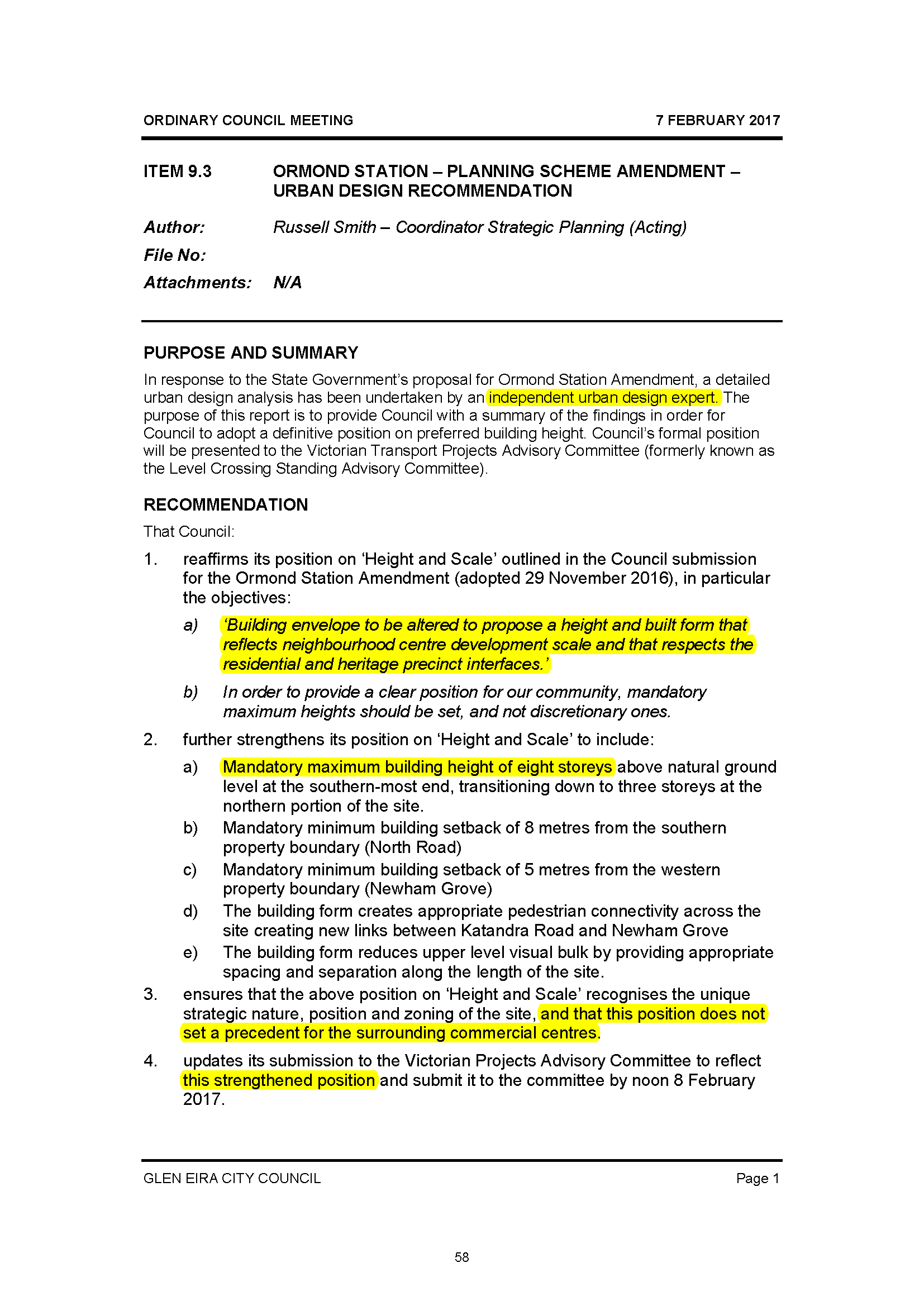
This is the first of our posts on the draft Master Plan for the development of the Virginia Estate. For this post we have simply picked out some ‘howlers’ that have made their way into the draft. A far deeper analysis will follow in the coming days.

Whilst we acknowledge that legally the developers have only to abide by the constraints of the Amendment passed in 2011 (ie C75) which constitutes the equivalent of an Incorporated Plan designed to set out some broad parameters rather than detail, the Gillon group could have, and should have, done a lot more with this draft to allay resident fears.

In a 24 page document we find:

  • Unfounded claims and statistics
  • A watering down of previous commitments on open space
  • A reliance on developer protocols on ESD, and
  • Half of the document is nothing more than a regurgitation of past documents and actions/events

UNFOUNDED CLAIMS AND STATISTICS

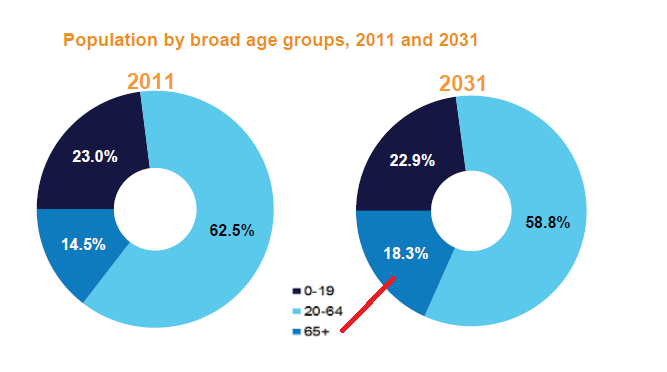
Several of the published documents make a big deal of our ageing population and the need for increased aged care. We take no issue with this. What we do object to is the deliberate obfuscation of the facts. Lumping together Glen Eira, Stonnington, Bayside, Monash and Kingston into an analysis of population without taking into account what aged care developments are happening in these other municipalities, or even acknowledging that Glen Eira residents could find themselves retiring to these other municipalities is, at best disingenuous and at worst deliberately misleading. Page 21 summarises the argument for Glen Eira alone with – “Those aged 65 years and over will make up 21.2% of the total population.”

The Victoria in Future – 2016 prognostications for Glen Eira differ markedly from this claim as evidenced below –

age-pop

OPEN SPACE

Originally, the developers were required (and we assume willing) to pay a 5.7% open space levy in cash – according to the minutes of March 17th, 2015. However, since the site has now doubled in size from 12.5 hectares to over 24 hectares, this does represent a huge increase in cash payments. Thus we get a new proposition of 3% cash and 3% in ‘land contribution’.

At a rough estimate, a 3% land contribution should be about a hectare of land. More than enough for wide open spaces within the estate. That is clearly not the aim of the developers. Going on their previous publications we fear that any land contribution will simply consist of concrete pathways and linkages between buildings and the nearby, already existing parks.  We do not envisage a grand open space area of over 1 hectares. Their proposed contribution in all likelihood will be cobbled together bits and pieces sitting between high density towers.

ESD – ENVIRONMENTALLY SUSTAINABLE DESIGN

Much is made of the use of ESD and how this will set a ‘benchmark’ for future development. The only problem with the ‘standard’ suggested is that it is owned, devised and regulated by the development industry itself – ie The Urban Development Industry of Australia. The scheme does not cover individual house construction per se. Instead it is geared towards “residential land development” and the developer’s ‘reward’ for adhering to these ‘standards’ is a ‘leaf icon’ as certification. Further, the developer does not have to abide by all the criteria listed – only one will suffice to get ‘accreditation’. We’ve uploaded a research article which compares the various ESD schemes available (HERE). The proposed one in our view falls well short of the mark in comparison.

It is also amusing to read such nonsense as – The EnviroDevelopment rating exceeds the requirements set by the Glen Eira City Council and the State Government. Anything would ‘exceed’ what council has got given that nothing of substance exists in its planning scheme!

Watch this space for more!


The purchase of this property for $2.1 million we believe raises many questions. The questions multiply when we find that council’s intention is to lease this property until community ‘consultation’ is undertaken! Here are some queries for your consideration –

  • What happens if the ‘consultation’ results in the majority of residents opposed to the idea as the recent Fosbery/St Aubins proposal showed? Are we therefore in a situation where we are again facing a Clayton’s ‘consultation’ because the decision has already been made – especially since so much money has been spent?
  • Why was this property purchased in the first place given its proximity to Princes Park? Carnegie has many more ‘high priority’ listings than South Caulfield according to the Open Space strategy!
  • Why has Carnegie and other suburbs been ignored and all open space developments have basically occurred in Camden? Given that the Open Space Strategy itself states that this area will only see a marginal increase in population due to its zoning as largely Neighbourhood Residential Zone, why has council spent millions in this ward alone?
  • If council has spent $2.1 million on a very nice looking house, and we would expect at least another half million or more to be incurred in the creation of a ‘park’, then that brings us close to $3 million. Is this really ‘value for money’ for a site that is just over 600 square metres?
  • What will be the length of the proposed lease – 6 months, one year, 2 years?
  • Since the site is on a corner, are we again facing the prospect of streets being closed off and traffic diverted?
  • Why has the purchase of the Magnolia Street house at $1.49 million not been included in the open space reserve budget, but included under the ‘capital works’ budget?

We repeat what we have previously stated. We are totally in favour of more open space throughout the municipality. However, we also desire sound financial decision making that is transparent and accountable and equitable for all residents. The rate of development in our GRZ and RGZ areas are a major concern as council admits. This is where the greatest number of new residents will live and it is in these areas that open space is most desperately required – not in quiet residential streets that are within a stone’s throw of already existing large areas of open space and which the Open Space Strategy admits to seeing only a ‘negligible’ rise in population.

A very good turnout at last night’s Camden ward ‘Meet the Candidates’ forum. Congratulations to all candidates for showing up, namely – Delahunty, Pinskier, Hermann, Sounness, Silver, Fayman and Strajt. Questions focused on the following:

  • Community safety – with some members of the audience arguing that Glen Eira is very safe. Candidates responded that crime statistics don’t bear this out and that if even some residents feel unsafe that it is council’s duty to listen and consider their concerns. Ms Pinskier said that she was opposed to CCTV cameras and ‘angry’ about guns in parks which she is absolutely against.
  • One resident from Redan Road, Caulfield East asked why Delahunty and Sounness voted against 92% of residents’ wishes in regard to council’s traffic management ‘solution’ for the street and why emails weren’t answered. Delahunty responded by saying that the measures introduced were in response to ‘safety’ issues and that she makes no apologies for that.
  • Another resident asked how much money council had raised in the past few years from the open space levy and how much of this money had been spent in acquiring new open space in Camden. Sounness replied that there is a process in place where officers look at what is available for purchase and then determine how to proceed. Given the high cost of land at the moment councillors have to decide if any purchase is ‘value for money’. Delahunty then outlined what council had spent money on – ie Riddell Parade, Eskdale Road, and the purchase of an Aileen Avenue property (to be settled in November).
  • Next question was directed to new candidates about the changes to the public questions protocols and whether they thought this was ‘discriminatory’. All new candidates stated that they were opposed to this change and Pinskier favoured full streaming of council meetings. Silver added that he thought there should be a limit on the number of questions per individual because council could then run until 3am! The resident also asked about why the ‘red fence’ of the racecourse was still up and why council allowed this. On the fence question Sounness stated that he thought it was part of the racecourse only to be corrected that it was both council’s and the MRC’s responsibility. Delahunty conceded that council should get moving on this issue and that it was ridiculous that people couldn’t ask questions like this at council instead of a forum.
  • Another resident asked the new candidates for their definitions of ‘neighbourhood character’ and ‘overdevelopment’ and how they could ‘guarantee’ (as Silver stated on his facebook page) that there would be ‘sensible development’. Silver responded that his definition of this is ‘family friendly’ development with proper apartment size to fit 2 adults and 2 children and the need for gardens. Fayman was concerned about waiving of car parking places and thought that 3 or 4 storeys along main arterial roads was justifiable as were one bedroom apartments near university. Strajt spoke about population growth and how councils that joined forces would be best placed to resist overdevelopment. Hermann called overdevelopment the most important issue facing the community and undertook to get fully ‘up to speed’.
  • There was a question on preferences and whether this was done on political grounds. Delahunty said that she put those who had real estate advertising on their boards as last. Silver thought this was a ‘slur’ and that there was no ‘impropriety’ or ‘conflict of interest’ concerns. Hermann thought it was time for fresh faces and that’s why Delahunty and Sounness were put last on her voting card.
  • Another questioner was interested in governance and brought up the issue of notice of motion, recording of council meetings and general transparency and accountability and whether the local law would be changed as ‘first item on the agenda’. Silver said it was ‘up there’ but not his first item and didn’t know whether these suggested options ‘would work’.  Sounness, Hermann, Delahunty were all in favour.
  • A further question was on the large number of developments in Elsternwick, especially the shopping strip and whether candidates felt it was appropriate that this rate of development continues. Also queried was the future of the Elsternwick library. Strajt talked about the system failing and the need for wholesale changes so that councils have more control. Sounness said he would like to see 4, 5 or 6 storey development in some areas so that people can get to know each other and that where there is ‘density’ that it has to be well designed and ‘comfortable’. Hermann was concerned about traffic in Elsternwick and overshadowing and if elected would do all she could to change this. Delahunty said that structure planning could control the ‘rate of change’ as was pointed out by Wynne. Said she will ‘wear’ the criticism as council hasn’t done any structure planning and that when the Coles development happens this will ‘stretch’ the rate of development even further. Structure planning will help and that ‘should have been done a long time ago’.

ra

Item 9.12 deals with the proposed closure of Fosbery/St  Aubins Avenue to create open space. What will be fascinating is to see whether resident concerns are acted upon by councillors or ignored entirely.

The report states that for traffic in Kambea and Otira Road – The majority of the feedback was strongly opposed to the proposal based on concerns around traffic volume, congestion and vehicle movement. Responding to this opposition we have –

The analysis of this data indicates that:

Σ There would not be any noticeable change in the daily traffic conditions in Fosbery Avenue (north of St Aubins Avenue) and at Otira Road.

Σ Daily traffic volumes in Fosbery Avenue, south of the proposed open space area would decrease by approximately 70%.

Σ Traffic volumes along St Aubins Avenue are also expected to decrease.

Σ Traffic volumes at Kambea Grove, west of Fosbery Avenue would be expected to increase by approximately 219 vehicle movements per day, and up to 44 vehicle movements in the AM peak hour.

Σ The traffic volumes are considered appropriate noting the acceptable threshold volume for a local street under State Government planning guidelines is variously 2,000 – 3,000 vehicles per day.

The most incredible paragraph in response to the potential speed of cars reads –

The location of the proposed open space was not identified in order to address a specific traffic concern, although wider streets like St Aubins Avenue and the southern section of Fosbery Avenue (south of the dogleg) can attract more traffic ‘cutting through’ and travelling at higher speeds, due to ease of access.

Surely when up to half a million dollars of ratepayer funds is about to be spent on a project, all aspects should be considered and fully investigated. We also remind readers that less than 2 years ago a tender was granted for the ‘redevelopment’ of this site for approximately $930,000. We have wondered whether this means that work previously done will now be ripped up to make way for this project?

Some further information on open space

Page 212 of the agenda states – Purchase of a property in Aileen Avenue for a potential new open space opportunity in Caulfield South.

We assume that this relates to some recent in camera items and the resolution to ‘accept’ the officer’s report presumably for purchase. Readers should note:

  • Recent sales in Aileen Avenue are listed as over $2 million
  • Council’s purchase of a property in Aileen Avenue repeats the ongoing trend of concentrating on Camden ward to the exclusion of the far more ‘high priority’ recommendations from the Open Space Strategy for the Carnegie area. Why?
  • And why oh why is council continuing to spend valuable money on new open space that is literally a stone’s throw from existing open space? – ie Fitzgibbon/Eskdale (Caulfield Park); St Aubins/Fosbery (Greenmeadows)? And now Aileen Avenue – Princes Park?

os


fairy-tales

We’ve received this email from a resident, expressing what we believe is probably a fairly common reaction to the election conundrum – who to vote for?

Good morning, 

With no shortage of evidence pointing to the incompetence of our council, the big question is…. So who do I vote for? 

For the average person it is impossible to become adequately informed about who stands for what. 

Are there any candidates with integrity or honesty? Will anyone actually have the will power, knowledge and stamina to repair our failed planning scheme, when the council blames VCAT and VCAT simply insists it is ruling according to the laws of the state?  

Quite frankly I am convinced our local government is a complete joke, without the laugh. We have experienced first-hand the incompetence and lies coming from their planning and enforcement team who are paid for by my rates. A 3 year saga that left us high and dry. 

So now it is election time and I want to make my vote count….. yet sadly I think it makes no difference whatsoever. They are all as bad as each other. 

Please tell me I’m wrong…

We do sympathise, whilst acknowledging that sorting the wheat from the chaff, the stooges from the genuine candidates, is going to be a herculean task, especially when each candidate talks in clichés, generalities, and is full of potentially hot air promises.

Our position is clear. After more than a decade of in fighting, incompetence, and abuse of power over and over again, it is definitely time for a change. These councillors have done nothing to advance planning, to secure sufficient open space, and to operate in a transparent and accountable manner. Nor have they acted on community aspirations that mean something or done this in a timely manner. Traffic, over development, open space, heritage, community gardens, tree protection are just some of the issues left untouched by this group of 9 councillors.

So now is the opportunity to change all this. And it can be changed with your vote. That means ensuring that each and every one of the incumbents are not re-elected nor those to whom their preferences are directed since the chances are that these are merely their stooges. Thus we urge all residents to MAKE YOUR VOTE COUNT and elect a council that is new, visionary, and committed to listening and working with the community and not against it. Ask each candidate the following:

  • Whether they will commit to a full and immediate review of the zones
  • Whether they will commit to changing the meeting procedures so that residents can freely ask questions and present their views
  • Whether they will commit to having community reps on all advisory committees and which are open to the public
  • Whether they will commit to online broadcasting of council meetings
  • Whether they will commit to residents having a direct input into budget priorities
  • Whether they will commit to insisting that all officer reports include costings, timelines and objectively present the pros and cons for each proposal

If the responses are nebulous, qualified, or mumbo-jumbo, don’t vote for them! The best example we have of this last statement comes in the form of Ho’s election flyer! At least he has the grace not to mention his opposition to ‘over-development’!!!!!!

EPSON MFP image

EPSON MFP image

esakoff

img001Scanned Image 122670000-1Pages from Community-Satisfaction-Survey-2016

« Previous PageNext Page »