GE Open Space


PS: It hasn’t taken the developer long to resubmit another application for Claire St., McKinnon. It is still 3 storey, and instead of 36 dwellings, the application is now for 33 dwellings. Yes, the VCAT decision certainly stymied the development, didn’t it? So much for Magee’s  faith in council’s planning scheme and its non-existent neighbourhood character statements for housing diversity areas.


  1. We are promoting additional transport options including more and better train, tram and bus services; car sharing, cycling and walking

Oh yes, Glen Eira is definitely transport conscious! That’s why the funding for bicycle paths has been cut despite budget promises. That’s why car sharing was put off and councillors never even told that a proposal had been submitted to officers years ago. When a report finally made it to council the decision was (typically) to delay for another year. The next year a tiny number of spots was set up. And how much credence do we give to council’s ‘promotion’ and ‘advocacy’ power, when they can’t even get a bus to run past East Boundary Road? Then there’s the fabulous Road Safety Strategy which lapsed in 2008 and hasn’t been updated, or newly ratified.

  1. We fine builders if they breach safety requirements on building sites

We challenge any reader to find one single vcat decision where council has sought an order against any builder for ‘safety’ breaches. There aren’t any. As for fines – well we’ve featured countless photos of unsafe and illegal works (for pedestrians) alongside development sites. How many of these have been fined – despite the fact that the offences occur day after day!

  1. We are advocating for all development costs to be paid for by developments and not fall on existing ratepayers.

Really? So is this the reason that Esakoff moved a motion at the last MAV state conference that basically asked for ‘all development costs’ – BUT ONLY FROM COMMERCIAL DEVELOPMENTS?!!!!!! Forget the fact that this was never endorsed by any formal vote much less discussed in council chamber with supporting reasoning. Commercial development almost pales into insignificance when compared to the developments occurring in GRZ and RGZ and now MUZ. Why these developments ARE NOT targeted is the $64 question?

The best of course is last –

  1. We are providing additional public open space and have imposed the highest Open Space Levy on multi-unit developments of any suburban council (estimated $5 million per annum)

Some very neat phrasing here which is technically not only untrue, but deliberately misleading. Glen Eira has NOT imposed the ‘highest’ levy on multi-unit developments. Plenty of other councils have much higher levies directed towards their activity centres, and suburbs where development is likely to occur at an intense rate. The perfect example of this is Stonnington which has the second lowest amount of public open space. In their proposed amendment they sought an 8% levy across the board in contrast to Glen Eira which has the least amount of public open space and only sought 5.7%. Admittedly Stonnington were not successful in getting their 8% for the entire municipality. However, they did achieve an 8% levy from developers in 4 suburbs, including Prahran and South Yarra. Achieving 8% from these 4 suburbs (given the size of these areas)plus the 5% from the rest of the municipality means that Stonnington is well ahead of anything that Glen Eira can achieve. Their Annual Report cites an INCREASE of $4.65 million in open space levies and this amount does not take into account the full year’s impact of the 8% in the four suburbs.

Nor is Stonnington alone. Moreland for example has had in place for years now the following levies for developments in their various suburbs –

Brunswick – 6.3%

Coburg – 6.8%

Faulkner – 5.7%

Glenroy – 6.5%

Then there’s Dandenong with 20% for this stated area – – Any residential or commercial subdivision in the area bounded by Springvale Road to the west, Cheltenham Road, Dingley Freeway Reservation, Dandenong Southern Bypass to the north, EastLink to the east and Hutton/Greens Roads to the south.

Further, whereas countless other councils included in their amendments the clause that for certain ‘significant’ sites , the levy payable be higher than the levy for other areas, Glen Eira council was quite prepared to accept the obscene figures of 4 and 5% for the 2000+ development of Caulfield Village. They were even prepared to accept the ‘normal’ rate for the Virginia Estate with its proposed 4,600+ dwellings of 5.7%.

Readers should also remember that at the 11th hour, council reneged on its two previous resolutions that all monies collected from open space levies would be used to PURCHASE ADDITIONAL OPEN SPACE. Instead, revenue is now basically ploughed into more of the same – mega palaces (ie pavilions) and car parks within parks that constitute ‘open space’. The only purchases of land in the past 12 years have been two properties in Packer Park and now one in Magnolia Road that could have been bought years ago for a much cheaper price given that there’s been the on-off-on farce with the public acquisition overlay. An appalling record for a council that has known for decades that open space is a priority for residents.

We estimate that with the population increase, open space in Glen Eira per resident will DECREASE if this current policy continues. This in fact has been admitted by the Open Space Strategy itself. So what is council doing about this? Bugger all in our view. Spending millions on ‘redevelopment’ is not the answer to the continued growing lack of public open space.

  1. While the boom is being driven across Melbourne by external factors, Council is acting to limit heights and contain development to strip shopping centres and public transport routes

More deceptive phrasing we suggest. Most people would interpret ‘strip shopping centres’ as meaning the actual ‘strip’ itself and not residential land that is some 800 metres from the street. The use of present tense is also a concern. If council is ‘acting to limit heights’ then apart from 2 amendments for MUZ there is no evidence to suggest that council is doing anything to change the zoning. Council ‘acted’ in 2013. They are now totally ‘inactive’ except to refuse application after application and blame VCAT for everything.

Finally, the fact that such a piece of shonky, deceptive and deliberately misleading (mis)information could have gone out to residents without councilors’ knowledge says much about governance in Glen Eira and the kind of leadership that has been at the helm for far too long.
Page two of council’s damage control exercise (ie the Apartment Boom letter) purportedly sets out all of the fabulous things that council is doing for its residents. It is a pity that careful phrasing and half truths dominate instead of real facts. We ask readers to consider each point. The Council statements are in italics.

  1. Council is managing the boom within the limited powers given to us by state authorities.

One might quibble as to the definition of ‘limited powers’. Whilst it is true that there is much in all planning schemes set by the government, it is also true that close to a third of all planning schemes are handed over to councils to determine – they simply must support their proposals with sound empirical evidence. Councils are free to introduce structure plans, heritage overlays, design and development overlays, infrastructure levies on developers, open space levies, parking overlays, preferred character statements, up to date housing strategies for each precinct, and of course, the schedules to all the zones, and to determine where the zones go. We note that Glen Eira (contrary to other councils) has never had anything approaching real structure planning; it has 6 piddling design and development overlays – 3 of which regulate fence heights in a handful of streets and another two facilitate higher development in 2 specific areas. The Municipal Strategic Statement dates from 1999 and now belongs in a museum! Promises made centuries ago have never materialised. For 8 years council was content to extract a pittance for open space levies, knowing full well that the municipality was highly lacking in open space. Council also never bothered to ‘renew’ its lapsed development contributions levy so that now residents are subsidising developers completely for drainage. There is thus plenty that is within the power of council to initiate and deliver. They have simply refused to do the basics that every other council has done and which the State Government expects – ie structure planning and decent strategic planning.

  1. We obtained government approval for maximum height limits over all residentially zoned land where there were no limits before.

The veracity of this statement depends on how one defines ‘residentially zoned land’. According to the planning scheme the Mixed Use zone (MUZ) is also labelled as ‘residentially zoned land’. Hence Council has not imposed maximum height limits on all residentially zoned land as they would like residents to believe. One could go even further and argue that today Commercial zones are de facto residential zoned land – especially when developers can build one or two shops and then put 100 units on top of this! It is also worth noting that Boroondara has managed to achieve a three storey height limit for its Neighbourhood Centres including the commercially zoned shopping strips and other councils are following this lead. In Glen Eira, no such thing exists, and even worse, all Local Centres are now zoned Commercial and the vast majority directly abut Neighbourhood Residential Zones.

As to the ‘no limits before’ statement – again a misrepresentation. There were limits, albeit, ‘preferred’ height limits of 9 metres. So what does council do with the zones? Accept and impose the absolute maximum of 10.5 and 13.5 metres and no height limits whatsoever for the Mixed Use Zone. A ‘one size fits all’ approach across the board. Sloppy planning indeed when seen in light of other councils and the number of GRZ and RGZ zones each applied and the height variations within each of the schedules. This of course required some hard work and a close analysis of the municipality – something entirely alien to this council.

Height limits by themselves do not of course make for good planning and protection of residential amenity. Especially not when there are no urban design frameworks to accompany the height limits and no real provision for open space, permeability, no tree protection, and no preferred character statements for Housing Diversity areas. We remind readers that other councils for both their GRZ and RGZ zones have managed to achieve far greater protections in terms of open space and permeability than Glen Eira. Some councils (ie Yarra) have even managed to have the Residential Growth Zones removed entirely and Bayside is also awaiting approval for this to happen in their municipality.

At the time of introducing the zones, Council had the choice. Schedules were there to be fine tuned. There was no fine-tuning. Simply a total cave in. Our question always remains the same – if other councils could get a better deal for their residents then why couldn’t Glen Eira? How hard did Newton, Akehurst and Hyams really try? Or were they so caught up with the self promotion of being the first council that all thought of getting the best deal went out the window?

  1. There is nothing under the new zones that could not be built before

A nice little slogan! The point is that PRIOR to the zones, developments were far more constrained and those applications which did get through (particularly in Carnegie) were also the result of a poor and ill-defined planning scheme. The loopholes that exist now, existed then. The difference however is that cometh the new zones, developers, investors, and real estate agents were given the clear signal that they could now build to their hearts content and instead of a 9 metre preferred limit, they could now literally go for 13.5 metres in RGZ and 10.5 metres in GRZ. That’s why we are now seeing amended application after application seeking the limit. One perfect example is 20 Wheeler St., Ormond. On the 21st May 2013 an application went in for 2 double storeys. On the 12th December 2013 an amended permit went in for changes to windows. Then on the 21st February 2014, a new application came in for 8 double storey dwellings. Council refused this application so we now get another application (15/10/2015) for seven dwellings on land that is roughly 760 square metres and zoned GRZ1 and this includes a combination of three and two storey buildings. Needless to say there is no minimum lot size for subdivision in Glen Eira, whilst Bayside is aiming for a minimum of 800 square metres and other councils have a range from 350 square metres per lot – ie Manningham

There’s also this beauty for 249 Neerim Road, Carnegie. In September 2011 an application went in for three storeys and 11 dwellings. It got a permit. Then in June 2015 another permit was issued for 4 storeys and 48 dwellings! Of course Council would like us to believe that this has nothing whatsoever to do with the zones

Even VCAT prior to the zones would pay close attention to the ‘preferred’ height limits. From a decision in 2011 on George St., Caulfield North –

The Council and Mr Durrell asked for the building to be lowered to 9 metres to meet Standard B7 (and consequently Standard B17 with respect to the western elevation) and to provide a better transition from the larger and higher form on the north side of George Street. ….. I consider lowering the building is a necessary together with other modifications as referred to in these reasons. I appreciate the scale of development opposite the site but am also mindful that land differs from the review site. The review site is small, has different building relationships, and has different visibility in the streetscapes and from adjacent confined lots. Further, it is influential to my conclusion that the change will assist to bring the development into compliance with Standard B17 with respect to the impact on No. 3 George Street

Compare the above (and council’s attitude) to what we now have. A VCAT decision from September 2015 –

There is no Design and Development Overlay or other overlay, or indeed a policy, to indicate the preferred heights for new multi-dwelling developments in the residential area. What guidance is available is obtained from Schedule 1 to the General Residential Zone, which specifies a maximum height of 10.5 metres for a building on this land. This height can comfortably accommodate three-storeys of residential development. Accordingly, the Council, through its Planning Scheme, has made a conscious decision to allow for three-storey development on this site. Indeed, the Council advised that it has no ‘in-principle’ objection to a three-storey building on the review site

Bent Street Bentleigh is another example of amended permits seeking an additional storey increase and more apartments to permits that had already been granted. Again, the VCAT member’s comments on what the zones really mean –

….there has been a change in planning circumstances, notably the zoning of the land has changed from Residential 1 Zone to the current General Residential Zone Schedule 1, which contemplates more intensive development where height of building can be 10.5 metres and up to 11.5 metres on a slope plus promotion of site consolidation, compared to the maximum height of 9 metres recommended in Clause 55 for the Residential 1 Zone.

The situation is even worse for some developments zoned Mixed Use and/or Commercial. Centre Road is the perfect example with applications going in for increased heights and increased numbers of dwellings. Because they can – they will! Which of course raises the question as to why Council did not at the time of introducing the zones include a height limit on MUZ? Thus, we return to the ad hoc planning that has characterised Glen Eira for well over a decade. Two recent amendments have imposed 3 storey height limit on MUZ sites. Why couldn’t this be applied to all such zoning back in 2013? Or is the truth finally dawning on council about the unmitigated disaster they have ushered in through their indecent, secretive haste and lousy planning?

  1. We refuse to give on-street residential parking permits to new nulti-unit developments

Wonderful! Except that all these cars now go into surrounding residential streets that have no parking precinct plans attached to them and no real analysis of what these neighbouring streets can cope with. Nor does the absence of a residential parking permit mean that all those cars which are parked illegally will be fined. Laws are one thing – enforcement another!

More in the days ahead!

135

278

365

end

CLICK ON IMAGES TO ENLARGE

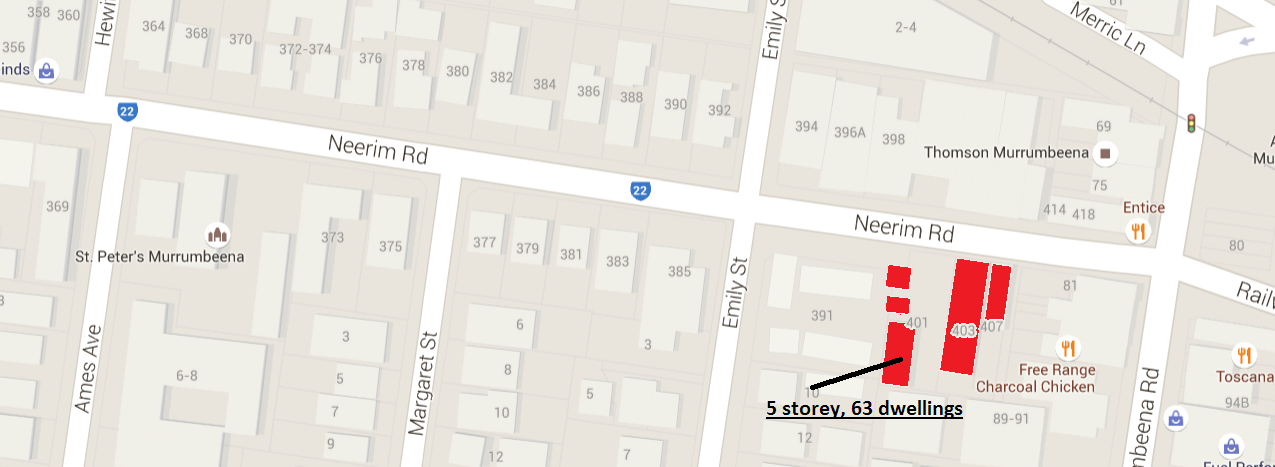
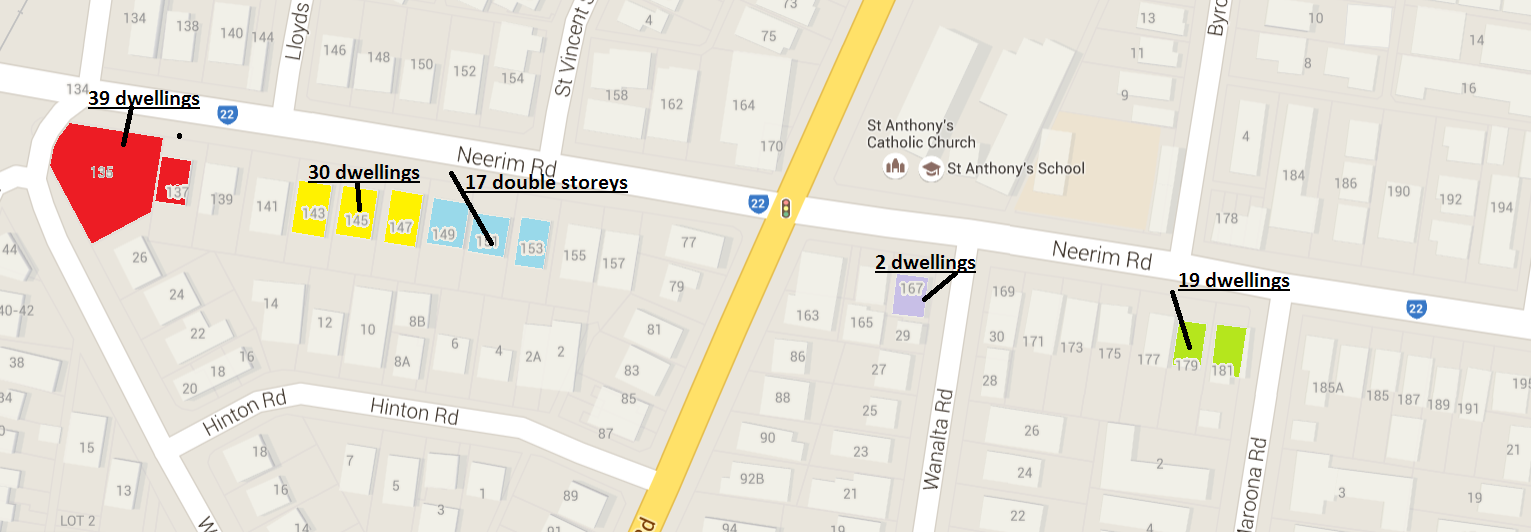
Above are 4 screen dumps of Neerim Road and what has been happening since the introduction of the zones. Each image represents a continuous stretch of road. Different colours are used for each application and indicate whether the proposed development extends over a single or ‘consolidated’ site. The numbers are for permits already granted or awaiting decision.

What is completely mind boggling is that the total number of apartments to be built along this single road since 2013 equals 548. Unbelievable! Thus, if 225 dwellings are built per year, then this represents more than 50% of what the planning scheme says is the average number of dwellings required per year until 2021! And all in one street!

How can a council allow this to happen? What studies have been done of ‘capacity’? Do they know? Do they even care? How much money will ratepayers have to fork out to supply additional drainage and other infrastructure? How much has already been spent on drainage and how much more needs to be spent? Has Council any idea or is this more pie in the sky planning based on no factual data and analysis? What guarantee do Carnegie residents have that they will not be at increased risk of flooding or that subterranean car parks will ultimately impact on the water table causing other major problems? In our view, Council’s incompetence is only exceeded by its indifference to its residents.

Here’s the full list of what’s presented in the images –

135-137 Neerim Road GLEN HUNTLY VIC 3163 – 3 storey, 39 dwellings

143-147 Neerim Road GLEN HUNTLY VIC 3163 – 3 storey, 30 dwellings

149-153 Neerim Road & 4 Hinton Road GLEN HUNTLY VIC 3163 – 17 double storeys

167 Neerim Road CARNEGIE VIC 3163 – 2 dwellings

179 – 181 Neerim Road, CARNEGIE VIC 3163 – 3 storey 19 dwellings

212 Neerim Road CARNEGIE VIC 3163 – additional dwelling to rear

247-251 Neerim Road CARNEGIE VIC 3163 – 4 storey, 48 dwellings

253-255 Neerim Road CARNEGIE VIC 3163 – 4 storey 30 dwellings

257 Neerim Road CARNEGIE VIC 3163 – 3 storey, 7 dwellings

259-261 Neerim Road CARNEGIE VIC 3163 – 4 storey 28 dwellings

276-280 Neerim Road CARNEGIE VIC 3163 – 5 storey, 48 dwellings

315-317 Neerim Road CARNEGIE VIC 3163 – 7 storey, 26 dwellings

322-326 Neerim Road CARNEGIE VIC 3163 – 4 storey, 40 dwellings

328-330 Neerim Road CARNEGIE VIC 3163 – 4 storey 16 dwellings

332-334 Neerim Road CARNEGIE VIC 3163 – 4 storey 36 dwellings

339-341 Neerim Road & 19-21 Belsize Avenue CARNEGIE VIC 3163 – 4 storey, 52 dwellings

363R Neerim Road CARNEGIE VIC 3163 – 3 storey, 4 dwellings

331-333 Neerim Road CARNEGIE VIC 3163 – 4 storey, 26 dwellings

365-367 Neerim Road CARNEGIE VIC 3163 – 3 storey, 16 dwellings

401-407 Neerim Road CARNEGIE VIC 3163 – 5 storey, 63 dwellings

479 Neerim Road MURRUMBEENA VIC 3163 – 2 double storeys

TOTAL = 548 DWELLINGS AND THIS DOES NOT TAKE INTO ACCOUNT WHAT IS HAPPENING IN ALL THE LOCAL STREETS RUNNING OFF NEERIM ROAD – IE ELLIOTT AVENUE FOR EXAMPLE!

Please consider the lists provided below which highlight the various amendments that neighbouring councils have initiated in the past 2 years – since the zones came in – in contrast to what Glen Eira has produced.

BAYSIDE

Amendments c112-115 – introducing mandatory height limits into activity centres (ie includes commercial as well)

Amendment – c121 – extending their Water Sensitive Urban Design policy

Amendment C139 – Development contributions levy

Amendment C140 – Bayside Housing Strategy of 2014 & subdivision size of land

And plenty of new heritage overlays on various properties and areas

BOROONDARA

Amendment C108 – permanent Design & Development Overlays in many areas

C109 – extends interim height controls for Neighbourhood Centres (ie includes commercial)

C139 – more structure plans and design and development overlays

C149-C152 – more heritage overlays

C152 – Maling Road ‘building form guidelines’

C229 – amends council’s LPPF (local planning policy framework)

STONNINGTON

C153 – design and development overlay

C154 – Chadstone expansion includes Incorporated plan for the land

C155 – development overlay for heights along Yarra

C168 – 2 new Neighbourhood Character overlays and development overlays

C172 – Chapel Revision Structure Plan

C175 – updates Municipal Strategic Statement plus new neighbourhood character policy

C177 – environmental sustainability design

C180 – public acquisition overlay

C181-184 – various heritage overlays

C185 – 2 new Neighbourhood character overlays, design and development overlays and their integration with zoning for GRZ sites

C186 – open space levies where 4 suburbs are paying 8% – South Yarra, Windsor, Prahran, etc

Many new heritage overlays here.

C212 – Malvern Road Neighbourhood Structure Plan

C217 – more significant character overlays

C220 – extension of structure planning controls for Windsor, Prahran, South Yarra

GLEN EIRA

C100 – Rezones Industrial 3 To Mixed Use Zone (Neerim/Emily St)

C102 – Revises Non Residential Uses In Residential Zones Policy

C107 – Neighbourhood Character Overlay (Schedule 2) To Moodie St., Caulfield East

C113 – Heritage Overlay On Some Sites In Caulfield North

C120 – Open Space Levy Of 5.7%

C121 – North Road Sites From Commercial 2 To Mixed Use Zone

C123 – Updated Child Care Policy

C130 – Environmental Audit Overlay In Glen Huntly

C135 – Public Acquisition Overlay On Magnolia Road

C139 – Rezone Glen Eira Rd/Hotham St Corner From Commercial 2 To Mixed Use Zone

C140 – Public Acquisition Overlay On Mimosa Road/Mile End Road

AND THE ATTEMPTED VIRGINIA ESTATE AMENDMENT THAT WOULD YIELD 4,600 DWELLINGS!

COMMENT

  • Rezoning to MUZ or Commercial means more residential high rise
  • Magnolia Road public acquisition overlay was gazetted in August. Three months down the track and the property still hasn’t been purchased for open space. There was a public acquisition on this property for years, then removed in 2008, and then re-imposed. Superb planning and now we fear that council simply does not have the money to purchase anything.
  • ‘reviews’ of child care policy and non-residential uses, simply changes the playing field – now making it easier for such developments to encroach into Neighbourhood Residential Zones.
  • Planning Panels have recommended a total review of Heritage. The current policy dates back to 1996. Another museum piece!

Conclusion? Whilst other councils have been busy shoring up their defences against over-development, and rejecting Planning Panel decisions and pushing ahead for Ministerial approval of their amendments, Glen Eira continues in the same old fashion – tinkering and avoiding anything that might constitute an obstacle to development.

The very expensive exercise in publishing the Annual Report is now over. Councillors ‘accepted’ the report in a record 7 minutes at Tuesday night’s Special Council Meeting! How many even read it? As with previous reports, Council is wonderful at providing mind boggling statistics so that no-one has any idea as to what they actually represent or mean. There’s one example we simply cannot pass over since it is so ludicrous. We invite comments as to what the following may mean –

“Playground inspections – 18,377” (page 101)

Council claims there are 47 playgrounds. That would mean that EVERY SINGLE playground is ‘inspected’ 1.07 times each day! But what does ‘inspection’ actually mean’? Occupational Health & Safety testing? A drive past by cleaners? An ‘inspection’ via aerial photographs? A casual walk through? Such, dear readers is the value of this figure.

Next there is the question regarding restaurants and ‘food registered businesses’. For years now Glen Eira has claimed that there are 840 registered food businesses in the municipality. We certainly doubt this given the explosion of cafes everywhere. It also doesn’t explain why council should have reaped an extra $107,000 in fees as stated in the accounts, if the number remains at 840 and registration fees have remained relatively stable.

Then there’s the promise that service levels will be maintained. Another unsubstantiated claim when the figures are looked at. Some examples: –

  • Less drains have been cleared – 32 km in 2010 and now 14.8km
  • Less footpaths fixed – 28.9 km in 2010 and now 19.61 km (and the reason given? ‘The decrease in the amount of footpaths replaced is due to a cost increase per square metre laid due to a new tender’. What does this say about the tendering process and how does it explain that for every single year since 2010 the km have dropped? Wasn’t part of this with the ‘old tender’?
  • Less roads reconstructed – 4.77 in 2010 and now 4.06
  • Mains water use in parks has doubled since 2010/11
  • Gesac has gobbled up double of water use not in parks since 2010/11

The best however, requires no commentary from us. Here are some extracts that we are confident will deliver howls of laughter!

Glen Eira City Council is committed to governing the City of Glen Eira in a democratic, open and responsible manner in the best interests of the community.

Council consults, listens and takes note of community views to determine its priorities and needs, and then acts through open, transparent processes that are financially and environmentally responsible and sustainable.

Glen Eira City Council is charging developers more than any other municipality in order to help pay for new and better parks for Glen Eira. (page 50) (Stonnington $9.634m; page 123 of their annual report and their open space reserve now stands at $36.932m).

Council will use current and emerging technology each year to provide broader opportunities for the community members to have their say about Council services and future plans. The use of sound evidence, community input and representation, and transparent decision-making processes; including follow-up and reporting will ensure Glen Eira continues to offer services that meet community needs. (page 53)

And then there’s always the ‘gunna do’ promises that never eventuate

Due to Melbourne’s building boom, Council is managing a large number of planning applications.With more development happening throughout the municipality and grade separation works commencing, Glen Eira will continue to be an attractive place to live. Council will implement further measures to reduce the amenity impact on residents as a result of this construction activity

Population and development pressures will impact particularly on parking in local streets. Council will continue to review and develop plans while working with the community, to strategically manage and accommodate for the future impact of this.

Glen Eira is experiencing extraordinary levels of building activity with many multi-unit developments being constructed. As a result, residents are experiencing substantial inconvenience such as road closures, limited parking, building noise and dust. Council’s challenge is to try to balance the needs of residents and their comfort with allowing the construction process to be completed quickly and safely.

And the best for last! –

Good governance is accountable, transparent,responsive, inclusive and efficient. Council is committed to providing good governance through its decision-making process by engaging the community, providing leadership, investing in the future and acting responsibly.

Council governs for and on behalf of the Glen Eira community. Good governance is accountable, lawful, transparent, responsive, effective and efficient, equitable and inclusive.

Elliott Avenue, Carnegie has featured prominently in the news and on this site. (See what it looked like a little while back – https://gleneira.wordpress.com/2015/02/09/one-little-local-street/). It is now utterly destroyed because of the new zones. Not only Elliott Avenue, but all surrounding areas. People are leaving in droves – not because they are after a profit in selling to developers, but because their dream home, their lifestyle, and everything they valued about this area has disappeared. Yet council has not had the guts to do a single thing about its slipshod and woeful planning. No amendments of any note have occurred in the past two years for housing diversity. No promises made ten years ago have been implemented. No concern whatsoever for the chaos caused by these developments that can take a year, so that residents can’t even get out of their driveways because of trucks in the street – many no doubt without work permits! All councillors can do is complain about not having the ‘tools’ in the planning scheme, or that they really need to look carefully at Neerim Road (Okotel). But they have not lifted a finger to get the ball rolling on anything. And what of the urban heat effect that all these dwellings will create? What of infrastructure? What of subterranean car parks that impact on the water table? What of parking? What of open space? Not a thing done!

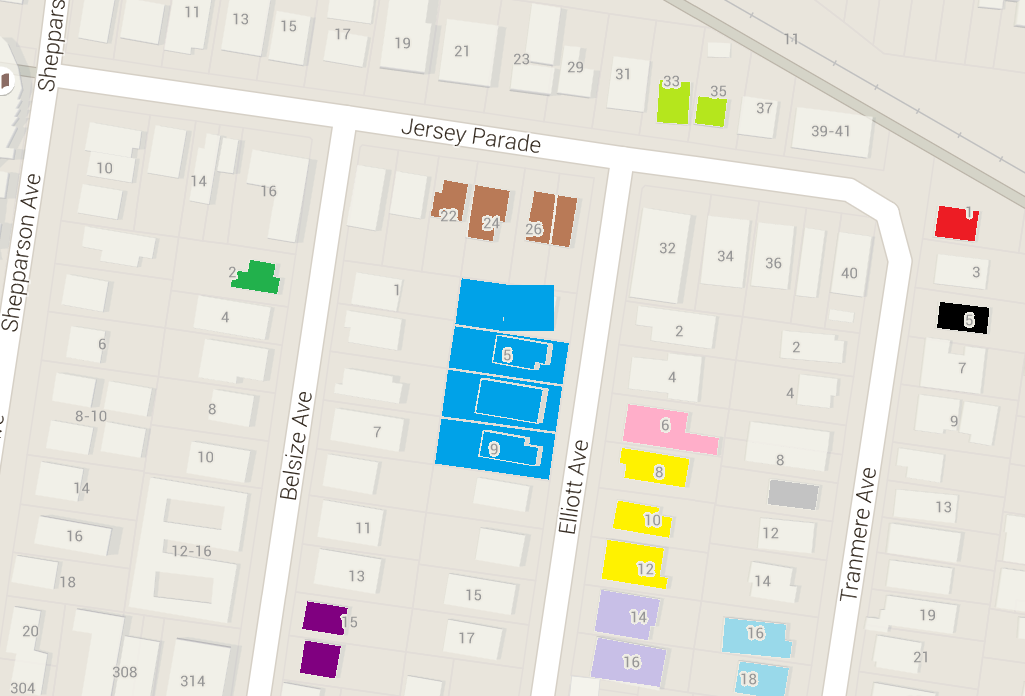
In order to give residents an idea of what is happening we’ve colour coded the following street map which shows development since the zones were introduced. Council can blame everyone else until the cows come home – but there is no denying that the zones are without doubt the impetus for all this overdevelopment. With good strategic planning and community consultation some of the damage could have been avoided – but that of course means less rates and treating residents with respect!

carnegie

3-9 Elliott Avenue CARNEGIE VIC 3163 – 4 storey, 51 dwellings

6 Elliott Avenue CARNEGIE VIC 3163 – 2 double storeys (permit)

8-12 Elliott Avenue CARNEGIE VIC 3163 – 4 storey – no number of dwellings stated

14-16 Elliott Avenue CARNEGIE VIC 3163 – 4 storeys, 21 dwellings (permit granted by council and vcat)

22-28 Jersey Parade CARNEGIE VIC 3163 – 4 storey, 39 dwellings (permit)

33-35 Jersey Parade 4 storey, 28 dwellings (permit issued by council)

1 Tranmere – 4 storey, number of dwellings not named

5 Tranmere Avenue CARNEGIE VIC 3163 – 3 storey, 4 dwellings

10 Tranmere Avenue CARNEGIE VIC 3163 – 2 storey, 4 dwellings

16-18 Tranmere Avenue CARNEGIE VIC 3163 – 4 storey, 26 dwellings (refused by council)

2 Belsize Avenue CARNEGIE VIC 3163 – 3 storey, 13 dwellings

15-17 Belsize Avenue CARNEGIE VIC 3163 & 316-320 Neerim Road CARNEGIE VIC 3163 – 4 storey, 55 dwellings (council and vcat permit)


PS: From today’s (21/10) Moorabbin Leader front page –

centre

Item 9.1 – MRC application for 30+ radio towers

Esakoff, Hyams and Lipshutz all declared a conflict of interest and left the chamber. Magee moved to accept the motion to refuse, plus that council write to the Minister & Department, plus all relevant MPs seeking permission to create 6 sporting ovals in the centre of the racecourse. Seconded by Delahunty.

MAGEE: stated that the application ‘in itself’ was fairly ‘innocuous’ but ‘far reaching’ since it ‘encroaches further and further’ onto crown land. For years there has been this encroachment by the MRC – ie ‘training track after training track being developed’, ‘large screens being built’ and application to ‘increase the size of the Tabaret’. There are 3 purposes for the racecourse (park, racing, etc) and that racing is ‘well and truly catered for’. Said that this application is to set up a ‘permanent structure on usable crown land’. Went over the lack of open space, the number of kids unable to play sport because of lack of grounds, and that ‘teams are capped’ turning away stacks of kids. There is a master plan being done and all the sporting clubs are saying this is a ‘great opportunity’ to have this open space for sport in the centre. Now council has the ‘opportunity’ to apply for use of the land. The MRC writes to the ‘authority’ and council is now wanting to do the same. Claimed that it ‘would be very hard’ for the Minister and Department to ‘actually refuse us’ given that they have approved the screens, etc. ‘We have waited far too long’ and ‘this open space belongs to you’. Said with this motion council will see who opposes them so they will have ‘someone to talk to’.

DELAHUNTY: said that it’s a ‘hard act’ to follow Magee since he is so ‘passionate’ and speaks so ‘eloquently’. Racing is already ‘well catered for’ so ‘this doesn’t meet the objectives of’ the Crown Land Grant. Council takes the Open Space Strategy ‘very seriously’ and the application ‘flies in the face of those strategic objectives’ so it behoves council to refuse the application. The motion is moving forward towards achieving sporting fields and open space.

SOUNNESS: said he wasn’t speaking against the spirit of the refusal but thought that the bit about the ‘tipping point is weak’. If this went to VCAT it would ‘prove to be a less than successful’ outcome. Endorsed the other part of the motion and there should be the opportunity for the ‘public to enjoy’ the course. Repeated that he has got ‘reservations’ about the ‘tipping point’ since there have been ‘other applications’ that were equally the ‘tipping point’.

PILLING: endorsed part 2 of the motion but on the refusal said that while he understands Sounness’ points he doesn’t agree since there will be visual impact to Queen’s Avenue since the land is already raised and did think that council ‘can justify’ the motion.

OKOTEL: supported the motion because this would create a ‘visual impact’ and park users ‘aren’t being adequately catered for at the moment’. Said that ‘at the moment’ access is ‘restricted’ and ‘what’s pleasing’ is that ‘now action is taken’ in the attempt to ‘move forward’ and ‘discover who might be responsible for that blockage’ to permission. The motion ‘will weed out’ those responsible ‘for the blockage’.

LOBO: all applications are about ‘horse racing, horse racing’ and they ‘don’t regard’ the community. They have ‘denied the rights of the community’. There is a lack of sports grounds and council even had to hire ‘independent consultants’ to work out what sporting grounds are needed. The MRC has ‘done nothing but given grief to the community’. The lease ‘has expired’ and hasn’t been ‘renewed for years’; the Auditor General delivered his report and ‘caulfield racecourse does not seem to care’. Council ‘doesn’t get a cent from huge earnings of Caulfield racecourse’ in fact they pay reduced rates.

MAGEE: said that the 2008 report from the parliamentary committee was ‘scathing’ and so was the VEAC report and then the Auditor General’s report. A year down the track and none of his recommendations ‘are yet to be implemented’. Stated that ‘in his heart’ he thought there would be ‘changes’ and that the new Minister would do her best to make things change. Said that the motion means that council is ‘moving forward’ and they can see if there is anyone who is trying to ‘stop us’. The MRC do ‘look after the racecourse very well’ and is one of the best courses in the world and council wants racing to stay but they also want to ‘share the ground’.

MOTION PUT. ONLY COUNCILLOR TO VOTE AGAINST – SOUNNESS

COMMENTS

  • We commend Cr Sounness for being the only councillor to take the officer’s report to task – however mildly and for his attempt to refer to ‘planning law’ rather than grandstanding.
  • This is a planning application, yet the only comment made in relation to planning was the dubious claim about ‘visual amenity’. For a council that continually rams down residents’ throats the idea that ‘planning law’ must apply – this so called ‘debate’ illustrates how little ‘planning law’ has been dredged up to support the officer’s recommendation and the subsequent motion. In our view, councillors, for whatever reason are going through the motions, doing as they are told, and literally scraping the bottom of the barrel to find anything of substance to say.
  • Question – why has council waited for nearly a decade before moving the motion to seek permission for sporting fields? Surely this could have been done eons ago?
  • Musical chairs on Esakoff, Hyams, and Lipshutz’s ‘conflict of interest’ continues. When it suits, there is a conflict of interest. When it doesn’t suit, this goes out the window! Consistency is definitely not a strong point within council!
  • If the Open Space Strategy is so important, then where was council when it either granted permits, or caved in, over the removal of fences, access, leases, financial payments, etc – not to mention the C60, outdoor screen, cinema, etc. etc.
  • In typical contradictory manner, council now seeks permission and then a permit to create six sporting fields – without knowing the cost. Funnily enough other items on the agenda included the arguments that council can’t do something because they either haven’t got the money and don’t know the cost so the accepted recommendation was the usual – ‘let’s do nothing’ (ie pavilions, rose gardens, depot removal from Caulfield Park).

We congratulate council for producing an agenda that will set a new benchmark for incompetence, plain old bullshit, waffling generalisations, as well as fulfilling the ‘damage control’ agenda given the looming election. We literally could not stop laughing at some of the arrant nonsense produced by so called ‘professionals’.

A caveat! We are not suggesting that the following are worthy of permits. What we are focusing on is the quality, or rather the lack of quality so evident in the officers’ reports.

Item 9.1 – MRC application for the radio (timing) towers –ie the erection of 30+ antennaes and bases on the reserve – with some on crown land. Council officer recommendation is a ‘refusal’. We draw readers’ attention to the following quotes from the Ron Torres report –

It is acknowledged that other buildings and works including construction of a permanent infield electronic screen have been approved in the past. However, these are mostly at the northern end of the Crown Land where the bulk of the Race Course infrastructure is located. It is considered that the number, location and height of the purpose built poles are contrary to the purpose of the Public Park and Recreation Zone which seeks to ‘recognise areas for public recreation and open space’. It is considered the current application represents a ‘tipping point’ where the proposed works represent on over-emphasis of the use of the land as a racecourse. It is considered that the application does not adequately respect the balance of the use of the land as a public park area or the adjoining residential interface.

COMMENT: a 4 storey screen and now an outdoor ‘gourmet cinema’ with booze is NOT the ‘tipping point’, but this application is! And, a 4 storey screen plus a cinema also meets the criteria of a ‘public park’! And naturally a falling down fence along Queen’s Avenue that was supposed to be removed eons ago does wonders for the ‘residential interface’!

The proposed works do not contribute positively to local urban character and sense of place

COMMENT: urban? Really scraping the bottom of the excuses barrel on this one! That’s why Telstra towers and others are given permits everywhere – even on top of the town hall! These surely fit in with the ‘urban character’ and ‘open space’ of the municipality!

The works do not ensure the highest possible standards of built form and architecture

COMMENT: please explain! What are the ‘highest’ architectural standards for a radio tower?!!!!!!!!

Seven (7) of the purpose built poles are proposed to be installed along the eastern boundary, having direct views to the residential properties along Queens Avenue.

COMMENT: A road separates the poles and houses plus the poles are not directly on the fence. Hence, if this were an application for a three storey building and 40 units, we guarantee that we wouldn’t have such concerns when a road intervenes between properties. Please note that the poles will have ‘direct views’ – a euphemism perhaps for ‘overlooking’ for the possums/birds?

The proposed works do not reflect the particular characteristics, aspirations and cultural identity of the community (in particular; to retain public open space that is free from visual clutter)

COMMENT: what were the ‘aspirations and cultural identity of the community’ when C60 was rubber stamped? When a permit was given for a 4 storey screen on crown land? When an outdoor cinema got the green light? We also assume that council’s penchant for felling countless trees is really to reduce the ‘visual clutter’ within our parklands.

CONCLUSION: It is going to be absolutely fascinating to listen to the inevitable squirming that comes out of the mouths of most councillors on this one, especially when there is such limited ‘planning law’ to rely upon. Will Sounness vote ‘for’ on the basis of his usual stance – ie there are not sufficient ‘tools’ in the planning scheme to reject and it will go to VCAT anyway? Will Hyams and Lipshutz be consistent and vote ‘for’ since they keep claiming they have to apply ‘quasi-judicial’ planning law? Will any of these councillors have the guts to vote for a permit when the officer’s report says ‘no’?

And what of the Torres recommendation in itself? What to make of this refusal? In our view it does not stand a hope in hell of getting tossed out at VCAT – not because of VCAT’s generosity, nor even because of the power of the MRC and its political allies. The bottom line is that the officer’s report is simply woeful and sub-standard (as shown by the above airy-fairy quotes, lack of detailed reference to the planning scheme, etc’). This is not a planning application rejection. It is passing the buck to VCAT as has now become customary for Glen Eira.

++++++++

ITEM 9.2 – planning application for 3 storey, 14 units at 86 Truganini Road, Carnegie. Torres continues the political agenda with a recommendation for refusal. The site is zoned GRZ2. We again urge readers to consider the following:

However, the policy (housing diversity) also seeks that the growth encouraged by the policy is sensitive of the interfaces with existing residential development on adjoining sites and respects the scale of existing residential development on adjoining sites.

The proposal fails to comply with several ResCode standards relating to neighbourhood character, street setbacks, site coverage, side and rear setbacks, north facing windows, design detail and front fences. The non-compliance with these standards is indicative of a design that is not site responsive and is an overdevelopment of the site.

Σ Maximum overall building height of 9.45 metres

Σ Site coverage of 60.9% per cent

Visual dominance of the development within the existing streetscape.

14 Apartments in total (12 x 2 bedroom apartments & 2 x 3 bedroom apartments)

Σ Basement car parking comprising of 28 car spaces in 14 stackers

Σ Reduction of 1 visitor car space

If the proposal is to proceed the street tree would need to be removed and replaced at cost to the permit holder. This is due to the location of the proposed crossover.

Visual dominance of the development within the existing streetscape.

We’ve refrained from commenting on each of the above, except to remind readers that:

  • There is no ‘preferred character’ statement for housing diversity in Glen Eira as we’ve shown from countless VCAT decisions. All there is the statement of ‘emerging character’ and in Trugannini Road, the ‘existing streetscape’ is already dominated by 3 storey developments.
  • How many applications have exceeded site coverage, front setbacks and other ResCode guidelines, yet still managed to get their permits? Remember Lipshutz and the ‘unimportant’ encroachment of Hawthorn Road setbacks for his ‘how to vote card’ mate?
  • Clearly a typo – ie 28 car spaces provided when all that is required is 18! Does anybody bother to proof read such material before it enters the public domain?
  • What makes this report the most laughable can be found in the list provided below. It illustrates what has been happening in Truganini in recent years. Yet, in the same breath we get the nonsense about ‘visual dominance’ and ‘existing streetscape’. Most of the following were granted car parking waivers! Those applications without any date assigned as still to be decided.

86 Truganini Road CARNEGIE VIC 3163 – Construction of a three (3) storey building above basement car park comprising of up to fourteen (14) dwellings and a reduction of visitor car parking requirements on land affected by the Special Building Overlay

90 Truganini Road CARNEGIE VIC 3163 – The construction of a three (3) storey building above basement car parking comprising of thirteen (13) dwellings on land affected by the Special Building Overlay (Notice of refusal issued – 17/4/2015)

93-97 Truganini Road CARNEGIE VIC 3163 – Construction of a three-storey building comprising twenty-eight (28) dwellings with a basement car park and reduction of the dwelling (visitor) car parking requirement on land affected by the Special Building Overlay – Amending the endorsed plans to include changes to dwelling layouts, changes to windows and building setbacks and the addition of a front terrace on the second floor level. (amended permit issued – 22/12/2014)

98-100 Truganini Road CARNEGIE VIC 3163 – Construction of a 3-4 storey building comprising 28 dwellings with 2 levels of basement car parking on land affected by the Special Building Overlay (amended permit issued – 25/11/2014)

115 Truganini Road CARNEGIE VIC 3163 – Construction of a three (3) storey building comprising six (6) dwellings (amended permit issued – 16/9/2015)

9 Truganini Road CARNEGIE VIC 3163 – Construction of a four storey building comprising up to 20 dwellings above basement car park

44 Truganini Road CARNEGIE VIC 3163 – Construction of two (2) double storey attached dwellings on land affected by the Special Building Overlay (planning permit issued – 30/4/2015)

21-25 Truganini Road CARNEGIE VIC 3163 – Construction of a four (4) storey residential building comprising forty-one (41) dwellings plus basement car parking and a reduction in the associated visitor car parking requirements on land partially affected by the Special Building Overlay (amended permit issued – 23/2/2015)

124 Truganini Road CARNEGIE VIC 3163 – Construction of two (2) double-storey dwellings on land affected by the Special Building Overlay – Amended (planning permit issued – 12/8/2014)

21-25 Truganini Road CARNEGIE VIC 3163 – Construction of a four (4) storey residential building comprising forty-two (42) dwellings plus basement car parking and a reduction in the associated visitor car parking requirements on land partially affected by the Special Building Overlay (first council refusal – vcat decision to grant permit on 6/6/2014)

The General Residential Zone, schedule 2 is, according to our wonderful council, supposed to provide the necessary ‘buffer zones’ between properties in housing diversity and minimal change (ie NRZ) because of the upper level setbacks included in the schedule. No other limitations, apart from the deficient ResCode numbers, have been enforced on this zone. For example – in Glen Eira we find:

Site Coverage – 60%

Permeability – 20%

Height – 10.5 metres

Private Open Space – minimum of 25 square metres (ResCode) and

Nothing about tree protection or landscape plans.

Other councils in their ‘negotiations’ and subsequent amendments just happened to be far more successful in introducing limits on what can be build in the GRZ2 zone. Here are some examples that are gazetted and in operation.

Banyule –

Site coverage 40%

Landscaping – Landscape plans will provide 1 tree for every 400 square metres of site area, including 1 large tree in the front setback – A Landscape Concept Plan must be submitted which considers the Banyule Tree Planting Zone Guidelines. It should distinguish landscaped garden areas from useable private open space, show tree planting locations and the extent of the mature canopies.

Geelong

Landscaping – One canopy tree per dwelling

Private Open space – An area of 60 square metres, with one part of the private open space to consist of secluded private open space at the side or rear of the dwelling or residential building with minimum area of 40 square metres, a minimum dimension of 5 metres and convenient access from a living room. It cannot include a balcony or roof top terrace.

Height – 9 metres

Knox

Height – 9 metres

Private open space – Private open space consisting of an area of 80 square metres or 20 per cent of the area of the lot, whichever is the lesser, but not less than 60 square metres. At least one part of the private open space should consist of secluded private open space with a minimum area of 40 square metres and a minimum dimension of 5 metres at the side or rear of the dwelling with convenient access from a living room.

Monash

Front setback – 7.6 metres.

Private Open Space – A dwelling or residential building should have private open space consisting of:

 An area of 75 square metres, with one part of the private open space at the side or the rear of the dwelling or residential building with a minimum area of 35 square metres, a minimum width of 5 metres and convenient access from a living room


Stonnington

Basements should not exceed 75% of the site area.

Walls on boundaries – Walls should not be located on side boundaries for a distance of 5 metres behind the front façade of the building fronting the street.

Whitehorse

Site coverage – 40%

Permeability 40%

Provision of at least two canopy trees with a minimum mature height of 12 metres. At least one of those trees should be in the secluded private open space of the dwelling. The species of canopy trees should be native, preferably indigenous.

Development should provide for the retention and/or planting of trees, where these are part of the character of the neighbourhood.

Walls on boundaries – Walls should only be constructed on one side boundary.

Yarra – height 9 metres

Whilst other councils are moving fast to shore up their defences against inappropriate development, Glen Eira sits on its hands and does nothing. We’ve already highlighted the Bayside draft Amendment C140 that is seeking to introduce a minimum size subdivision of 400sqm, plus a 40% permeability requirement in its Neighbourhood Residential Zone. Now we have Monash Council and its C125 Amendment that takes in all Neighbourhood Residential and General Residential zones. The significance of this amendment is:

  • It is based on the 2014 Housing Strategy. Glen Eira’s housing strategy is a fossil, based on data from 1998.
  • 3 new NRZ schedules are introduced, 3 GRZ schedules and 1 RGZ
  • Development in activity centres are now to pay 10% open space levy. Glen Eira pats itself on the back for achieving a paltry 5.7%
  • Subdivision in the nrz schedules 2, 3, and 4 will now have a minimum lot size of 300sqm. Glen Eira does not have any minimum. The impact of such planning is clear when there is a current application in for 363R Neerim Road (zoned grz2) for 4 townhouses on land that is approximately 310sqm.
  • Introduction of Design and Development overlays
  • 40% permeability in GRZ3 sites plus a maximum of 40% site coverage plus 7.6 metre front setback from street
  • In grz4 there is a 30% permeability requirement
  • In the NRZ, 40% permeability and site coverage
  • And even in RGZ there is as requirement of 40 sqm private open space and a balcony of 10 sqm

In every single one of the above (if the amendment is approved), residents of Monash will be far better off, than their cousins in Glen Eira. All Glen Eira does is continually pass the buck and blame VCAT for all its woes. That will no longer wash, especially when no action has taken place in either reviewing the atrocious planning scheme or even attempting to introduce amendments that will ameliorate the damage that is currently occurring through rampant overdevelopment. Every time a VCAT member makes statements such as the following, the blame lies entirely with this administration and its complicit councillors.

The Council advised that there is no neighbourhood character policy which applies to the review site and its surrounds, and no neighbourhood character guidelines to assist in determining anticipated built form outcomes. Guidance must therefore be obtained from policy within the MSS and at Clause 22.07.

There is nothing within the policy framework which would indicate that apartment-style development should not be permitted here. Rather, what is evident is an expectation of change as multi-dwelling developments replace the traditional single-dwelling housing stock. The diversity of housing types sought for neighbourhood centres indicates that apartment-style development can be contemplated. (August 6th 2015)

« Previous PageNext Page »