GE Planning


Audit Committee

There finally appears to be some ‘movement at the station’ with the following statement – The Chairman recommended that the process for the recruitment of a new Independent Audit Committee Member commence. The in camera items suggest that this process is near completion with this one liner – under s89 2(a) “personnel” which relates to the Audit Committee. Conclusion? That the reign of either Gibbs or McLean is about to end. Reasons for one of these departures is of course not mentioned, and nor has there been any public announcement that we are aware of for the advertising or recruitment of a new member.

Several other items also drew our attention –

The CEO noted that post implementation reviews of previously sub-contracted major projects, had resulted in the tender and referee evaluation process focusing more on how companies managed their subcontractors.

Following consideration of the Land and Buildings valuation paper, the Chairman requested that Council’s top ten open space assets be verified for accuracy of area size.

And from the Charter – An independent minute taker shall be responsible for keeping the minutes…… . A few sentences later there is this sentence – An appropriate officer shall act as independent minute taker to the Committee. We remind readers that for Councillor Assemblies, the municipal inspector had recommended, and council took up the recommendation (for at least some time) of obtaining a completely external minute taker.

Community Consultation Committee

Once again, two of the selected community representatives were absent! If memory serves us correctly, this would mean that only once have all four reps been present at such meetings. Hardly a result to write home about!

Amendment C120 – Open Space Levies

There is much in this item that we will comment upon in the coming days. One thing however is staggeringly clear – the inability of this planning department, plus the State Government’s offices to get something right the first time around. How an amendment can be drafted, sent off for permission to be advertised, given the go-ahead and STILL CONTAIN FUNDAMENTAL ERRORS of fact and accuracy is simply beyond belief. Who is responsible for vetting such documents? Why do these errors occur? What does this say about the entire shemozzle that is the process of drafting and implementing amendments? And most importantly, what does this say about the processes adopted by council. For example: submissions on the amendment closed on the 23rd of June. Submitters were notified on the 24th June that there would be a planning conference held on the 25th June. More indecent haste? More disregard for the public?

If anyone ever doubted that Council was the developer’s ‘friend’ then the photos below will provide plenty of food for thought. For over a decade now the issue of a significant tree register has been waltzed around by councillors and administration. In the meantime countless properties have been moonscaped and countless mature and significant trees have been butchered and removed so that another unit can conveniently be built. Technically, permits to chop down some trees are required but only if an application has gone in. If a tree is chopped down and an application goes in before a year is up then council may ‘fine’ the developer (generally a slap on the wrist) or insist that another tree is planted in its place. How ludicrous – since the original tree is already gone and no new planting can equal what 80 or 90 years of nature has produced.

The facts of this case are:

  • The property was sold to a developer in September 2013. It has been rented out since then
  • The tree is at least 70 or 80 foot high and is a major feature of this quiet residential street
  • No application for development is currently before council – that will follow. We have previously asked what happens if an application goes in one year AND ONE DAY after the tree is removed? No fine in that case according to the current ‘law’ in Glen Eira.
  • What makes this particular case even more outrageous is that the owner of the property claimed adverse possession against council to further extend his property line. In other words, there was this added bonus of additional land for literally NOTHING!

The abject failure of this council and its councillors to protect such trees, to dilly dally for a decade, to promise a local law that is still to be sighted, is in our view unconscionable. Yes, development will occur, but it must be regulated so that profit does not always come before the destruction of the environment.

P1000300  P1000297

P1000301

PS – 24 HOURS LATER!

P1000302

P1000303

Amendment C120 proposes to introduce an open space levy of 5.7%. Whilst certainly a vast improvement over the previous contribution rate, the draft Amendment is NOT the universal panacea to the problem of acquiring more open space that council would like residents to think it is!

In introducing a schedule (ie the 5.7%) council CANNOT mandate the contribution of land instead of cash – hence the deliberate terminology of ‘may’ in the map presented below. Council also states that ‘land contributions for public open space will be preferred over cash contributions…..’. But here’s the rub. According to the map practically 90% of the municipality is earmarked for LAND contribution rather than cash. Problem is, that according to the Land Subdivision Act, the ‘value’ that council can extract in lieu of cash CAN ONLY BE TO THE MAXIMUM OF 5%. Does this therefore mean that developers will again be given a bonus from ratepayers – ie instead of paying 5.7% in cold, hard cash, they will now ‘negotiate’ with council officers and at the maximum, will only have to cede land that amounts to 5% of unimproved value?

Further, there is not one single sentence in either the proposed amendment, or in the consultant’s accompanying paper that is supposed to be the ‘rationale’ for this approach, as to WHY LAND IN ALL THESE AREAS IS PREFERABLE TO CASH. Further, council’s Strategic Resource Plan, for the next ten years only designates a paltry $2.2 million in open space levy contributions each year. Given the amount of development in the municipality, this is hardly a sum to write home about.

What makes things even worse, are the stated criteria upon which land will be accepted. We quote:

Should be of a size to meet its intended purpose or be able to meaningfully contribute to the assembly of a parcel of land. Minimum size parcels for each type of open space are as follows:

– Neighbourhood open space, minimum 1 ha.

– Local open space, minimum 0.26 ha (up to 0.99 ha).

Small Local open space, minimum 0.05 ha (up to 0.25 ha) with a minimum width of 20 m in at least one direction.

Small Local Link space, with a minimum width of 5 m.

Should be accessible or have the potential to be accessible.

We cannot see any large development willingly ceding 1 hectare or even 0.26 hectares from their very valuable land. What we fear will happen is that council will make its little sweet heart deals and what will be ‘negotiated’ are pocket handkerchiefs of land abutting developments – ie 0.05 hectares is literally a joke! That is basically one house block! Surely if the average unimproved land is conservatively valued at let’s say $500,000, then 5.7% is not a negligible sum to add to the coffers!

Stonnington has disavowed this approach precisely because it becomes a higgledy piggledy, ad hoc, non-strategic process. Here’s what their current amendment (that seeks 8% for residential and more for commercial) has to say –

Cash in lieu of land provision can be useful where the council seeks to pool contributions to provide a consolidated open space network – or improve an existing network – as opposed to obtaining a disjointed series of pocket parks. This is particularly important in established and densifying areas where strategic investments are required as opposed to sporadic land contributions.

To sum up, Council has not provided any evidence-

  • As to why land contributions in 90% of the municipality are preferable to cash in hand
  • As to why the prognostications of $2.2 million in open space levies will in fact be sufficient to even purchase one block of land per year given that part of this money will still be used for ‘development’ of the open space
  • As to why no area or individual site has been earmarked for a PPZ acquisition overlay (ie eventually turning such properties into parks and open space).
  • Nor has council provided any explanation as to why the following significant clauses that are part of the existing open space schedule have now been magically removed. Again we quote:

Encourage the protection and enhancement of significant vegetation on properties abutting areas of public open space.

Requiring the provision of open style fencing for new residential redevelopment that directly abuts public open space.

Requiring the retention of significant vegetation on properties that directly abut public open

In a muncipality that is crying out for open space, especially with ever increasing rampant development going on, and which the 1998 Open Strategy so clearly identified, asking developers to contribute tiny pockets of land all over the place is not a solution, nor is it ‘strategic planning’. Instead, it has the potential to hand another gilt edged ‘present’ to developers at the cost of the community!

Pages from Glen+Eira+C120+Supporting+Documents+-+City+of+Glen+Eira+Open+Space+Strategy+Public+Open+Space+Contributions+Program+March+2014

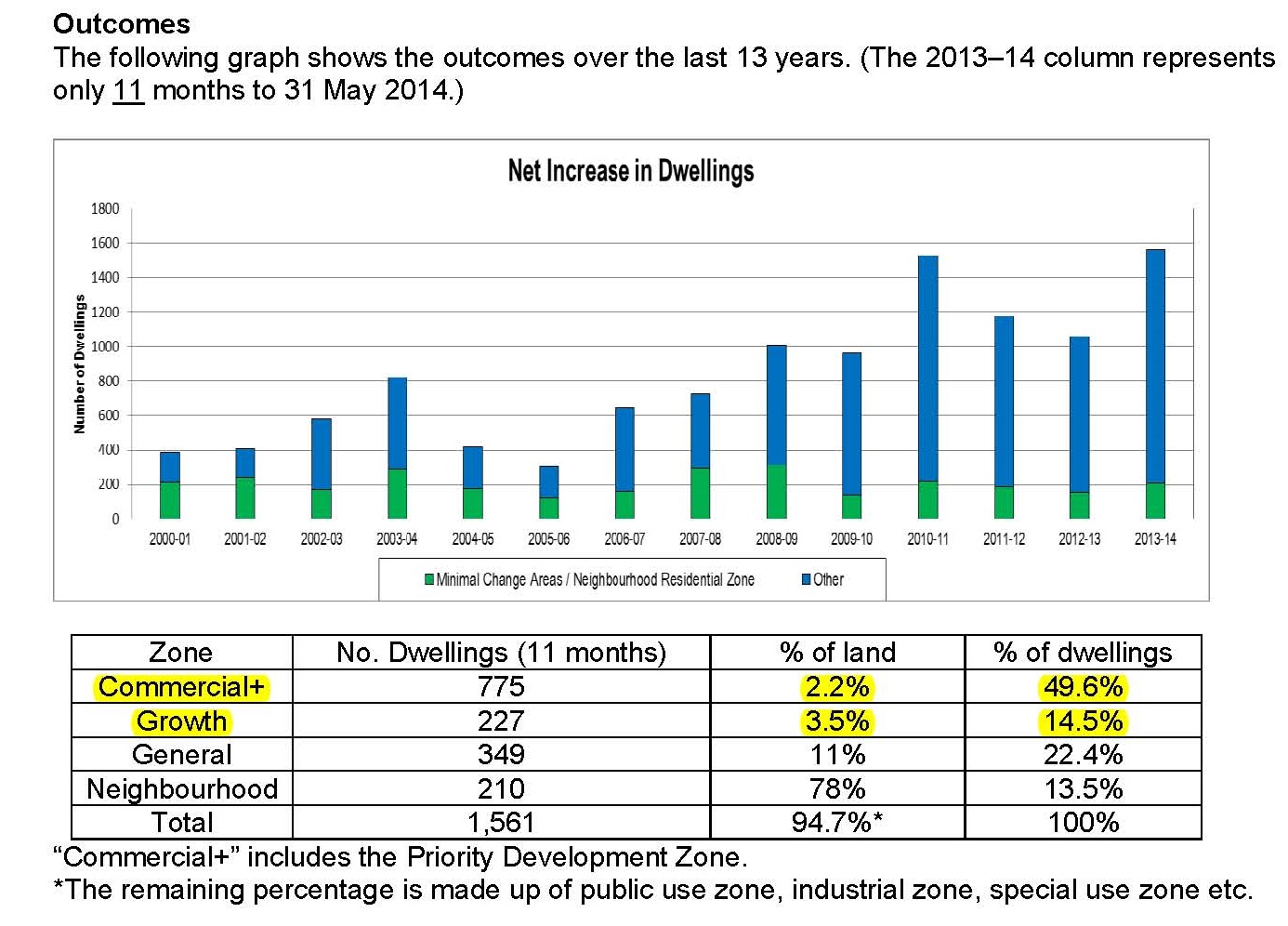
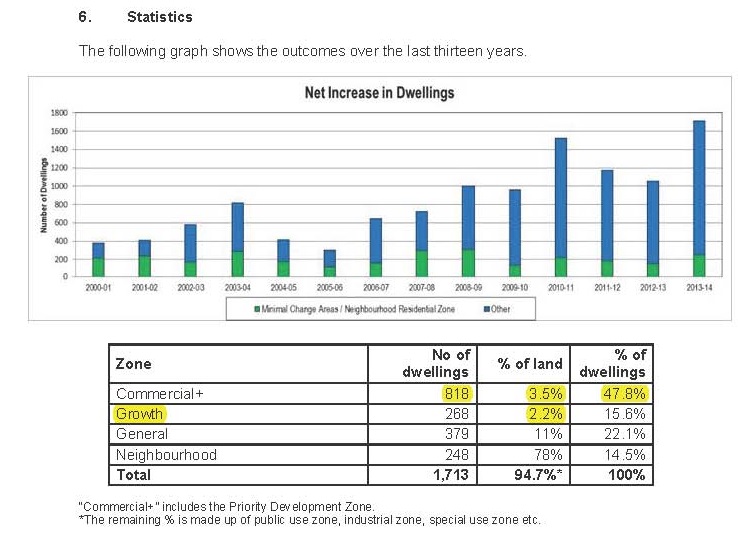
According to the State Government’s Planning Permit Activity data, Glen Eira welcomed another 237 new dwellings in the month of May alone. But there is much, much more waiting in the wings. We’ve taken the trouble of itemising some of the standout applications for the past six months. Please note – amended permit applications have been ignored, as have subdivisions, and two double attached dwellings. Hence, what is presented below is merely the tip of the iceberg! What also needs to be noted is the number of applications that include the waiving of car parking, visitor spots, or loading bays. This is now par for the course with multi-unit development. Here’s what’s on the books currently (and some have already been granted permits!). The grand total for just this smidgeon of applications is 450 apartments. How many are destined to be single bedroom units is anyone’s guess. We have no doubt that Council would be very loathe to publish full figures as to the makeup of all new dwellings since this would fly in the face of its public relations spin of “encouraging” diversity!

132 Balaclava Road CAULFIELD NORTH VIC Construction of a three storey building containing eighteen (18) apartments above a basement car park and reduction of the requirement for visitor parking
144 Hawthorn Road CAULFIELD NORTH VIC Construction of a six storey building comprising shops at ground floor and forty-one (41) dwellings above a basement car park, reduction of the car parking requirement for the shop and visitors and alteration of access to a Road Zone Category 1
383 Hawthorn Road CAULFIELD SOUTH VIC Construction of a four storey building comprising a shop and four (4) dwellings with associated car parking at ground floor
288 Hawthorn Road CAULFIELD VIC 3162 Construction of a three storey building comprising up to ten (10) dwellings above a basement car park, waiver of the requirement for visitor parking and alteration of access to a road zone category 1
251 Koornang Road CARNEGIE VIC 3163 Construction of a three (3) storey building comprising of two (2) ground floor shops, three (3) dwellings, one (1) caretaker’s house and reduction in the associated car parking requirements on land affected by the Special Building Overlay
33 Jersey Parade CARNEGIE VIC 3163 Construction of a four (4) storey building above basement car park comprising of twenty-eight (28) dwellings, reduction in visitor car parking requirements and construction of front fencing (1.7-1.75m)
30 Ames Avenue CARNEGIE VIC 3163 Construction of thirteen (13) double storey dwellings
328 Neerim Road CARNEGIE VIC 3163 Construction of a four storey residential building comprising up to 16 dwellings with associated car parking, and alteration of an accessway to a road in a Road Zone Category 1
135 Neerim Road GLEN HUNTLY VIC 3163 Construction of a three storey building comprising of up to forty (40) dwellings above basement car park and waiver of visitor car parking requirements
5 Heather Street BENTLEIGH EAST VIC 3165 Construction of a three storey building comprising of 13 dwellings above basement car park and reduction of visitor car parking requirements
14 Laurel Street BENTLEIGH EAST VIC 3165 Construction of a three (3) storey building comprising ten (10) dwellings and associated basement parking
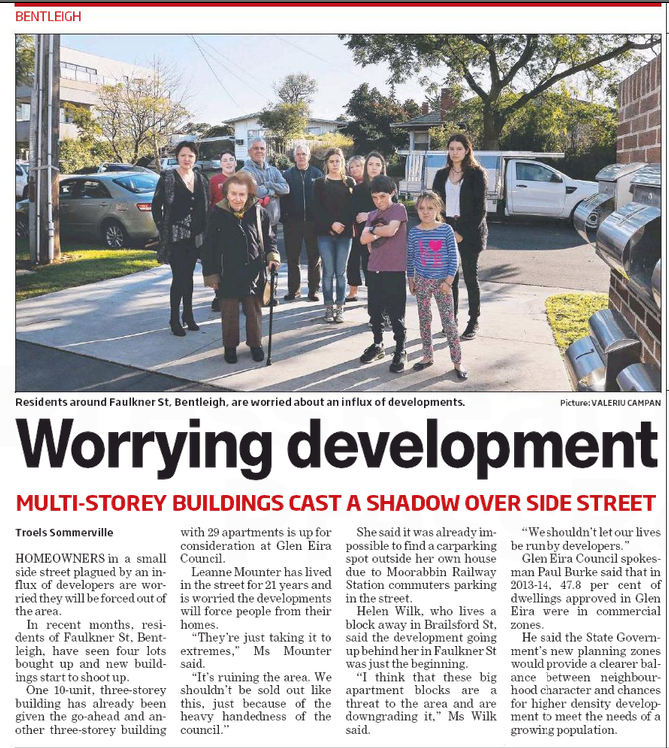
3 Faulkner Street BENTLEIGH VIC 3204 Construction of a three storey building containing twenty-nine (29) apartments above a basement car park
39 Mavho Street BENTLEIGH VIC 3204 Construction of a three storey building comprising twenty seven (27) dwellings above a basement car park and reduction of the requirement for visitor parking
348-352 Centre Road BENTLEIGH VIC 3204 Construction of a four (4) storey building comprising three (3) shops, twenty (20) dwellings and basement car parking on land affected by the Special Building Overlay
1 Faulkner Street BENTLEIGH VIC 3204 Construction of a three (3) storey building comprising up to ten (10) units
14 South Avenue BENTLEIGH VIC 3204 Construction of a three storey building (over basement car park) comprising of ten dwellings
551 North Road ORMOND VIC 3204 Construction of six (6) apartments above an existing medical clinic
7 Ormond Road ORMOND VIC 3204 Construction of a three (3) storey building comprising fifteen (15) dwellings above a basement car park
289 Grange Road ORMOND VIC 3204 Construction of a three storey building comprising seventeen (17) dwellings above a basement car park and alteration of access to a Road Zone Category 1
534 North Road ORMOND VIC 3204 Construction of a four storey building for use as 2 shops and 20 dwellings, a reduction of standard car parking requirements and waiver of loading bay requirements
115 Poath Road MURRUMBEENA VIC 3163 Four storey mixed use development (plus basement level) comprising two retail premises, two offices, thirty three dwellings (33), a reduction in the associated car parking and waiver of loading bay requirements
124 Murrumbeena Road MURRUMBEENA VIC Construction of a three (3) storey building (plus basement level) comprising fifteen (15) dwellings and alteration to access in a Road Zone, Category 1
67-71 Poath Road MURRUMBEENA VIC 3163 Construct a part six (6) storey and part seven (7) storey building comprising four (4) shops, forty (40) dwellings, and associated ground floor and basement car parking; reduction in car parking requirements for shops and visitors; and waiver of the loading bay requirement.
254 Jasper Road MCKINNON VIC 3204 Construct a four (4) storey building comprising a shop and eight (8) dwellings; reduce the car parking requirement for the shop and visitors to zero; and waive the loading bay requirement for the shop on land affected by the Special Building Overlay
224 McKinnon Road MCKINNON VIC 3204 Construction of a three storey building comprising four (4) apartments, ground floor shop and waiver of the car parking requirement associated with the shop


The future is writ large in the following article from The Leader! Not that we object to residents using their noggins and making a profit. What we most strongly object to is the failure of this administration and its councillors to do the necessary homework in order to ensure that residential streets are given the maximum protection possible. Unlike other councils’ approach to the introduction of the ‘reformed’ residential zones, we remind readers that our glorious council introduced the zones in total secrecy, with zero consultation, and with such indecent haste that there are countless stuff ups that will now take years to remedy. For example:

  • No minimum size lot for subdivision – meaning that developers can subdivide and then subdivide again
  • No dwellings cap on any lot of above average size
  • No attempt to equal permeability requirements that other councils stipulate – ie. 25% compared to up to 40% by others
  • No ‘buffer zones’
  • Dividing streets and neighbours for no logical and accountable reason. For example Mavho St. (pictured below) where there is now a new application in for a 3 storey, 27 unit development and a reduction in visitor car parking. If this property was on the other side of the street and 8 or so houses down from Centre Road, it would be counted as ‘minimal change’. Why the eighth house is designated as minimal change and the 9th house as ‘housing diversity’ boggles the mind. But that’s the planning in Glen Eira!


Melbourne homeowners team up to take advantage of law changes and net $5.76m windfall

THREE savvy homeowners joined forces to sell their properties collectively, making upwards of $1 million profit.

They took advantage of recently changed zoning laws and the growing Asian investor interest in Melbourne.

The Bentleigh trio sold their houses in an off-market deal through Savills Australia.

Neighbours at 14, 16, and 18 Bent St sold their adjoining homes to a Chinese developer for $5.76 million, up to $1.8 million more than could have been expected from separate individual sales.

The undisclosed purchaser intends to apply for permission to develop a multi-level apartment building on the combined 1985sq m site.

Savills Australia’s Julian Heatherich, who negotiated the sale, said the neighbours could reasonably have expected to fetch $1.3-$1.5 million in separate sales, but the combined property provided a much more valuable development opportunity.

“This was an exceptional result where three astute neighbours realised the opportunity they could create by combining their properties to form an attractive development opportunity and it could not have been a better result,” Mr Heatherich said.

“As far as we know this is the first sale of this type based on an opportunity created by recent residential zoning changes and the current Asian penchant for Australian and particularly Melbourne property.”

Recent zone changes allow for multi-unit development within activity centres.

City of Glen Eira implemented the changes in August with the new ‘Urban Village Policy’ allowing for multi-storey development of up to four levels.

“Glen Eira was the first municipality to implement the zoning changes and with Bentleigh one of the main high density areas in Glen Eira, it was subsequently reclassified as Bentleigh Urban Village,” Mr Heatherich said.

Bent St runs off the busy Centre Rd shopping strip and is near the train station.

PS: here’s the link for the Channel 7 News of today. Please note the mockup of what a four storey building, containing  60 units might look like next to a single storey dwelling – https://au.news.yahoo.com/vic/video/watch/24268737/teamwork-pays-in-savvy-land-sale/

+++++++++++++

And here’s the view of countless local streets carved up by whim or officers sitting at a computer and drawing lines on a map.

Untitled


From the minutes –

Crs Esakoff/Lipshutz
1. That Council appoint Fimma Constructions Pty Ltd, ACN 101 232 320 as the contractor under Contract No. 2014.036 Duncan Mackinnon Pavilion New Building including Civil Works and associated Landscape Works and demolition of existing facilities at Duncan Mackinnon Reserve, Murrumbeena for the sum of $8,185,711.67 (GST incl.) in accordance
with the terms tendered.
2. That a Contract be prepared in accordance with the Conditions included in the tender.
3. That the Contracts be executed in an appropriate manner including by affixing of the Council Seal.
4. That this resolution be incorporated in the public minutes of this Meeting.
The MOTION was put and CARRIED.

Since the public who are forking out the $8 million are once again being kept in the dark like mushrooms, we can only speculate as to what is going on with what is fast becoming the disaster of Duncan Mackinnon Pavilion. Residents deserve to know:

  • Will what is currently standing of the Maxstra work be demolished? If so, what does this do to time lines for completion of the pavilion?
  • How much has Maxstra been paid and is this amount IN ADDITION to the new figure of eight million?
  • Is there more legal argey-bargey going on, and how much is this costing?
  • Why is every single major project under this regime always late, and seemingly always running into problems? What does this say about our decision makers?
  • And, since the decision was ‘carried’ and therefore NOT UNANIMOUS what were the reasons behind the contrary views?

Tuesday night’s council meeting was replete with bouts of amnesia, inconsistencies, and some wonderful (unconscious?) irony found in the bombast of Lipshutz and his cronies – these latter examples still to come!

This was evident in the item on Amendment C102 (Non-Residential Uses in Residential Areas). Amazingly, not one single councillor referred to the watering down of conditions; not one single councillor mentioned that this was a deferred item from 2010, and not one single councillor provided any explanation as to why what was unacceptable two years ago should now be lauded as wonderful.

Motion to accept moved by Hyams and seconded by Delahunty

HYAMS: started off by saying that there’s ‘a need to update’ policies from ‘time to time’ and this is one of those times. Said that the only contentious issue was the stipulation that heights be consistent with what the current zones dictate. There had been one objection. Argued that it would be a pity if the zones provided protection elsewhere but if here ‘they were disregarded’. Said that there are ‘objectives’ and that if an application ‘basically’ complies with policy and doesn’t cause ‘undue’ ill effects on ‘amenity’ then ‘there is a bit of latitude there’. Said that council isn’t making a decision but sending it off to an ‘independent panel’ and objectors can then present their views to the panel and the report will come back to council for decision.

DELAHUNTY: agreed with Hyams about need for policy so that residents would ‘understand’ what is required and the ‘basis of how we make decisions’. Spoke about ‘measures’ and said that even if the measures ‘aren’t met’ then the application can still meet ‘the objectives of this policy’. This is just part of the ‘deliberate ambiguity that’s built into the policy’ and this allows places like schools to ‘lobby council’. There are other measures which ‘aren’t set in stone’ so it’s ‘wise’ to go onto the next step in sending it off to a panel.

OKOTEL: noted the two objections from private schools and how they were opposed to the height limits and the ‘limiting of set backs’. She agreed with the objectors. Gave an example of a doctor’s surgery opposite her parents’ house which wasn’t taking any more new patients because they were already so busy. Same applied to schools and in order to cater for the increase in population and demand that the best way to go was to ‘build up’ and this would also help people recognise and ‘see a GP practise’ from the street, rather than if it was set back. ‘It wouldn’t be set back with a garden at the front’ so people wouldn’t be able to easily identify that it was a GP practice. Therefore didn’t think that the policy should try and limit heights.

LOBO: said that he’s never been in favour of non-residential uses in residential areas because ‘everything has its time and place’. Noted Regent St application as an example. Said that this ‘was fine 15 years ago’ when population was smaller. Said that the policy has to be ‘rectified’ so that ‘no further damage is created’. Said that council need to ‘look after’ residents since they are the ones ‘who pay the rates’. Didn’t like gyms in streets, bars and that these sorts of establishments ‘shouldn’t be put in the streets’.

ESAKOFF: acknowledged that the policy came in in 1999 so it’s necessary to have a ‘review undertaken’ and that it should be ‘updated’ and to ‘conform’ to the way policies work. She has ‘some empathy’ with the objectors and had ‘concerns’ about ‘restricting the growth of schools’ and also doctors surgeries. These places don’t have a ‘lot of space’ and they can’t ‘go out’ so they ‘have to go up’. Noted that schools are ‘immune to’ council planning processes so the policy only applies to the ‘private school sector’. She didn’t want to ‘restrict’ these schools potential growth but ‘has been assured’ because of how the policy is drafted there is ‘some flexibility’ for these schools to make ‘their case’ so she’s ‘happy to take this to the next level’. Noted that the panel’s report isn’t ‘binding’ and that council can make its own decisions when the advice comes back from the panel.

LIPSHUTZ: said that there needs to be some ‘flexibility in terms of heights’. Lobo’s view about no non-residential uses in residential areas meant that he wasn’t ‘sure’ where you could then put ‘schools, churches’ and that he was ‘assured’ that if schools or churces wanted more than 2 storeys that ‘we would restrict that’. He was also ‘assured’ that these are ‘guidelines’ and ‘flexible’ so since they are ‘flexible’ he supports it.

SOUNNESS: started by saying that people who live in cities want facilities and there are residential areas and non-residential assets. Said that even living in a local street people can wander down to the corner and ‘have a coffee’ and that’s part of living in a city. The amendment is to avoid duplication and update policy according to the new zones and therefore it is very ‘reasonable’. Thought that it was good to have the ‘conversation’ about height because necessary to know what ‘the height might be in an area’. But it’s all relative and in a conversation with someone they spoke about height in relation to ‘tree height’ so if there’s is a bush close by then a ‘two storey height seems enormous’ and if there are huge gums nearby then this would ‘seem tiny’. It all depends ‘on the scale of what’s in the municipality’. And this policy ‘allows this conversation to take place’.

MAGEE: said that because there are schools and churches that ‘makes our residential zones’. Said his place was near schools and doctors and ‘two hospitals’. Change was inevitable and there would always be changes to the planning scheme. Although he doesn’t ‘particularly’ want to live in an industrial area or ‘near a beach’ and he picked where he lives ‘because of the amenity around it’. This was only the ‘first stage’ and where people live is ‘what we make it’. It’s okay to say that schools should only be 2 storeys in residential areas but ‘sometimes’ they do ‘run out of space’ and they can ‘only go up’. Gave examples of packed schools like McKinnon secondary. Repeated that this is only the ‘first stage’ of the process.

PILLING: thought that it was ‘quite reasonable’ to give ‘consideration’ to the area but as he ‘understands’ it, ‘there is nothing’ in the policy to ‘preclude schools going higher’. If there was an application for a ten storey non residential use then ‘I don’t think that’s what we want’. What council wants is ‘some form of uniformity’ and that’s why the current residential zones are ‘so unique’.

HYAMS: said that all they are talking about are schools etc. and not ‘commercial uses’. Council should protect height and also heights in General Residential Zones and Growth Zones. Said that if doctors surgeries wanted to be 3 storeys then there are areas in Glen Eira where they can build to this height.

MOTION PUT AND CARRIED – VOTING FOR – HYAMS, LIPSHUTZ, ESAKOFF, SOUNNESS, PILLING, MAGEE, DELAHUNTY.

VOTING AGAINST – OKOTEL, LOBO.

COMMENT

It’s worth asking why have policy at all, if it is ‘flexible’? Does ‘flexibility’ actually provide the ‘certainty’ to residents that this council always claims? Or is the desired ‘flexibility’ simply there to assist developers in building whatever they like, wherever they like? The problem with setting binding standards is that it leaves no wriggle room later on and commits council to a certain form of action. That in itself is anathema to the way this council operates on innumerable issues.

We also direct readers to the Okotel comments and point out the incredible inconsistencies in her logic. On the previous agenda item (9.1- the Ames St application for 13 double storeys) Okotel argued for protection of ‘neighbourhood character’. Five minutes later height limits should go. Surely height is the cornerstone of ‘neighbourhood character’? We are also really bemused by the argument that setbacks shouldn’t apply so that residents can more easily identify what is a doctor’s surgery!


The following is taken verbatim from Tuesday’s publication of Hansard.

Caulfield Park Conservatory

Mr SOUTHWICK (Caulfield)—I rise today to raise a matter with the Minister for Environment and Climate Change in regard to the Caulfield Park conservatory. The action I seek is for the minister to conditionally approve the relocation of the historic conservatory to the Rippon Lea estate, subject to the vacant space at Caulfield Park being appropriately utilised as a feature within the park. The conservatory was in fact originally located at Rippon Lea as a greenhouse, but the original burnt down in the 1920s. There has been a great level of community concern and a big local campaign to save the conservatory. Unfortunately the structure has been let to run down over the years, and the Glen Eira City Council surveyed residents to explore options of either developing, demolishing or refurbishing the site known as the conservatory. One of the proposals included a cafe, which was completely rejected by the community.

The building is in worse shape than originally thought, and even though the most preferred option from the community consultation was to refurbish the conservatory, the Glen Eira council has voted to demolish it. I am told the actual cost of refurbishing the conservatory is estimated to be in excess of $250 000, and council has only set aside $100 000 to do the work. As a result, due to the overwhelming community concern and the historical nature of the conservatory, the National Trust of Australia (Victoria) has offered to relocate the structure back to the Rippon Lea estate. I have been informed that the council supports this new approach and is willing to fund the relocation of the conservatory.

I believe this is a good option, as we will still retain the conservatory in the area and in fact return it to its original home. This also opens up the possibility of upgrading the space and better utilising it for local residents, who have been advocating for more seating for the elderly and families in Caulfield Park. I would be prepared to organise a meeting, under the minister’s direction, with council and the Department of Environment and Primary Industries to explore these possibilities and opportunities. It is on these grounds that I ask that the minister approve the relocation of the historic conservatory to the Rippon Lea estate, subject to discussion with the council, and to appropriately upgrade the vacant land and keep it as a unique feature within the park.

Caulfield Park is a great park. As I have said on many occasions, it is the jewel in the crown in our open space in Caulfield, and we are looking at relocating the depot to Booran Reserve and to be able to look at this particular conservatory as one of the key projects. It is certainly a historic building. It has historic significance, as I said, back to the 1920s. To take that building back to its original home at Rippon Lea gardens would be a great opportunity for all, and I ask the minister to consider this matter.

RESPONSE:

Mr R. SMITH (Minister for Environment and Climate Change)—I rise to respond to the members for Caulfield and Seymour. The member for Caulfield raised issues about the relocation of the Caulfield Park Conservatory. As the member representing a municipality that has the lowest amount of public open space in the metropolitan Melbourne I have to say that he has been a great advocate for the good use of the public space that is available. I have asked him to convene a group of people who have an interest in using the open space in his electorate, and he is doing a very good job in making sure that in discussing the moving of the Glen Eira council depot from Caulfield Park to the open space at Booran Road we get the very best outcomes we possibly can. In doing so he will be discussing that issue with a number of sporting clubs and other users in the area. I will certainly be happy to accommodate the meeting he has asked for to ensure we get a good outcome.


COMMENT

We note the:

  • alleged council involvement and contributing of funds – all done of course without a formal resolution, nor consultation, nor revealing the costs involved – if even known as yet. Does “council” in this instance mean officers, councillors, or a combination of both? If ‘discussed’, then where is the record of this discussion and who was involved?
  • emphases on discussion with sporting groups
  • what logistic analyses has been done to ensure that the size of Booran Park can in reality accommodate what is now the Caulfield Depot – the size of at least 8 house blocks and this land is only 984 square metres!
  • What road safety analyses has been done to ensure that trucks, etc. leaving Booran Park do not constitute any threat to traffic, pedestrians, cyclists?
  • If this becomes a depot, or even a sporting ground, what happens to those trees originally deemed ‘significant’?

All in all, lots and lots of questions and typically no answers and just more back room wheeling and dealing in secret.


Apologies for this long post – but it’s important!

Item 9.2 for Tuesday night’s council meeting exemplifies in our view the continued ‘con job’ that this administration foists on residents and probably most councillors. Here are some very illuminating facts:

  1. The bogus Planning Scheme Review of 2010 resolved to review all policies
  2. In June 2012, Amendment C102 first reared its ugly head
  3. GE DEBATES at the time provided the following commentary –

Agenda items for Tuesday night feature another 2 Planning Scheme Amendments. We will concentrate on the Non-Residential Uses in Residential Areas.

Generally when council introduces an amendment the argument is that it is necessary to fix up zoning issues, or that many of the clauses/phrases/wording in the existing planning scheme is repetitious, not clearly expressed, the legislation has changed, etc. etc. Our analysis of the proposed Non-Residential Uses reveals an entirely different picture. Yes, some changes are due to legislation but many represent nothing more than a watering down of previous conditions and thereby providing far more opportunity for developers to set up in residential areas. We have no problem with the position that amenities such as doctor surgeries, vets, etc. should be located where people live. What we do object to is the chipping away at conditions that help safeguard the existing amenity of residents.

Below we feature a table which presents side by side the current clauses and phrases from the existing Planning Scheme and what is proposed. Many of the changes are indeed subtle – just a word here and there – but the ramifications of these changes are immense. Please note that we have not covered everything – just the main concerns such as location, car parking, and protection of trees.

EXISTING POLICY PROPOSED   CHANGES
To encourage the development and location of new non-residential uses in areas   which are compatible with the residential nature of the area and comply with orderly and proper planning principles.


Proposed development sites abut a main or secondary road and have vehicular access from a service road or side.   Other locations may only be considered where it can be demonstrated that residential amenity will not be compromised.


The   proposal be located within easy walking distance of public transport.


Existing dwelling stock be retained in preference to purpose built facilities.


Sufficient car parking be provided on-site for all users.


he  standard car parking requirement will only be reduced where the Responsible Authority is satisfied that the area is supported with suitable levels of public car  parking and public transport.


The retention of any significant trees or landscape features be a high priority in the design.


Where  car parking is in the front setback, a generous landscape buffer between the car park and the street frontage be provided.


Where car parking areas abut residential dwellings, an adequate landscape buffer (suggested width of 1.5m) be provided and be heavily planted with large shrubs and trees.


Stormwater runoff directed into garden areas to reduce watering and demand on drainage infrastructure.

To  encourage the development or extension of non-residential uses, in suitable locations which comply with orderly and proper planning principles.


Encourage the   location of non-residential uses in “preferred locations” including main or secondary roads and on corner sites with vehicular access from a service or side road. Consider other locations where it can be demonstrated that residential amenity will not be unreasonably   compromised.


DISAPPEARED   and replaced with: Discourage the location of non-residential uses on local streets within Minimal Change Areas   (as defined in Clause 22.08)


Retain existing dwelling stock, where practical, and any associated extensions/alterations maintain or enhance its residential character.


To ensure that adequate provision is made for on-site vehicle parking, bicycle parking and (where necessary) drop off/pick up areas for all non-residential uses/s in a safe manner.

Car parking facilities be provided to the side or rear or basement of the premises, unless the use is in a preferred location abutting main or secondary roads (as defined in Clause 21.12) or in   a Housing Diversity Area (as defined in Clause 22.07)


Reduced on-site car parking must be supported by a Traffic and Parking Report


Retain any high priority significant trees  or landscape features within the design where possible.


Ensure that where car parking is proposed in the front setback (in limited circumstances where the use is in  a preferred location), a generous landscape buffer between the car park and the street frontage must be provided.


Where car parking areas abut residential dwelling, an adequate landscape buffer (minimum width of 1.0m) be provided and be heavily planted with large shrubs and trees.


DISAPPEARED

At the July 2012 Council meeting an unanimous resolution was passed to DEFER THE AMENDMENT. Here is the what Tang, Hyams, Esakoff, and Lobo stated at the time –

Tang moved that this item be deferred. Esakoff seconded.

TANG: Started off that the two amendments on the agenda came out of the Planning Scheme Review and that for the previous Amendment (rezoning) he was ‘satisfied’ with the ‘strategic’ justification and ‘merit’. Although ‘there may be some strategic merit in the suggestions’ for C102 there are also come ‘concerns’ and Council should be ‘prudent’ in ‘trying to address those concerns before proceeding’. Said that a resident had pointed out the ‘blog’ and that the moderators ‘were certainly very dedicated’. Tang went on to state that he was concerned about the ‘accuracy’ of the blog  and ‘balance of the views expressed’ but in a ‘democratic society’ people are permitted to express their viewpoint. He then went on to state that as a ‘community representative’ he was happy to ‘review’ those views  and if they had support to ‘bring them to council’. Said that he wanted to be 100% ‘satisfied’ about the concerns raised ‘in relation to the watering down of restrictions’….’expansion of the breadth of the policy….’and descriptions…..around significant trees’. ‘Council should consider what else it can do….before proceeding’.

ESAKOFF: Agreed but with ‘slightly different reasons’ to Tang. ‘ I would like some more time to work on this….’

LOBO: ‘it is a good idea to defer this’….’many (of the changes) are in favour of a developer’

HYAMS:  Said he understood the ‘aims in redrafting in making it more streamlined….(claimed he hadn’t read the blog) ‘for some time’ and that he’d come to the conclusion himself that ‘there were concerns with this’ such as putting in Housing Diversity as ‘preferred’ locations. Stated that he would be ‘more comfortable with some further consideration’.

TANG: ‘acknowledged’ that Hyams brought up ‘similar concerns’ to his own.  Said that the only reason he mentioned the blog is that ‘it is so often used ….as a vehicle for hate…spreads innuendo….or inaccurately assesses council’s performance….without checking the veracity of the underlying information’. Went on to state that ‘in this instance….the blog has done a good thing’ in comparing past policy with draft suggestions. ‘That’s fine and in fact very useful in the democratic debate’…..’regardless of how councillors have come to the conclusion I just hope they will take on board concerns’.

CARRIED UNANIMOUSLY

https://gleneira.wordpress.com/2012/07/03/the-whiff-of-revolution/

https://gleneira.wordpress.com/2012/06/29/chip-chip-chipping-away/

So now, AFTER A 2 YEAR DELAY, Amendment C102 makes a comeback! Has it changed? Has it addressed all the concerns that were evident in 2012? Not by a long shot. Admittedly some things have changed as a result of the New Zones – but the basics, such as protecting ‘significant trees’, setbacks, drainage, and many of the other points we raised are still valid, relevant and represent a bonus to applicants and not residents!

That of course raises the very serious question of:

  • Where is corporate memory, and especially the memory of councillors who (pretended?) at the time that they weren’t satisfied with the proposed changes? Since the 2012 and 2014 version are practically identical, and so is the officer’s report (word for word) why did they permit this amendment to be advertised as it stood? And the $64 question – how will they vote? Surely if it wasn’t good enough in 2012, it can’t be good enough now?
  • Or was this all smoke and mirrors – with knowledge of what was to come via the new zones legislation and the 100 metre extension around activity centres for uses without permits? There can be absolutely no excuse for a delay of 2 years from Version 1 to Version 2, when there have hardly been any changes whatsoever except the removal of the car parking measures and objectives.
  • Do the powers that be simply rely on poor memory so that they can ram through whatever accommodates developers rather than doing their jobs of trying their utmost to protect neighbourhood amenity? It would seem so we believe.
  • The councillors ‘excuses’ this coming Tuesday should be a highlight!

Residents and readers also need to take a very, very close look at Amendment C120 (open space levy) and how this has been manipulated. We will comment in detail on this in the coming weeks.

The agenda for Tuesday night’s council meeting is quite literally a ‘doozy’! What stands out clearly is the ceding of more and more power to unelected bureaucrats and removing the ‘influence’ of councillors even further. This has been done via suggested changes to the Planning Delegations. Councillors have never had (unlike other councils) the option of ‘legalised’ ‘call ins’. That is, if one councillor decides that an application should come before council for decision, that option is open to him/her. This does not exist in Glen Eira. What is now up for decision makes the sidelining of councillors even more ‘efficient’. The proposal is that if no more than 3 objections come into an application, then officers may decide. They may also decide if an objector has received a phone call from a planning officer and thereby had the ‘opportunity’ to voice concerns! Even worse is that the power to grant an amended permit for three storeys is now also in the hands of the unelected if they have previously been involved.

Akehurst provides SOME details of other councils’ delegations and how Glen Eira fares in comparison. For example, he cites that Port Phillip requires 15 objections, Stonnington 6 objections. However, what is conveniently omitted in relation to these other councils is the option for a single councillor to insist that the application come before council – ie. even on parking dispensations the Port Phillip delegation states: Non-compliance with residential parking requirements (except that a minor dispensation can be determined by the Manager City Development or Neighbourhood Coordinators unless a councillor requests that the application be determined by Council.

The best line however comes in the conclusion  to his report – Even with the recommended 3 objection limit our delegations would be more conservative than all the above mentioned Councils but our decision making performance would significantly improve. How effective ‘decision making’ is predicated on the number of objections is, of course, unstated and ultimately quite ridiculous.

But there’s even more of totally unsubstantiated and suspect logic. We quote directly from Akehurst’s report –

Attendees at DPC are dropping. Increasingly objectors and even applicants are not attending. This is likely the outcome of town planning rules which are now clearer.

Council also proposes to shorten the ‘lay off period’ over Christmas since this disadvantages the applicant and ‘benefits the objector’. During this time, phone calls may suffice! – On the last dot point, it is proposed that each objector has been spoken to either in person or telephone by a senior planning officer as delegated by the manager (the outcomes of which would be formally recorded on file). The senior officer will repeatedly attempt to contact an objector over a 48 hour period, after which a decision can be made.

This approach would still satisfy a fundamental principle of Glen Eira’s town planning process by allowing objectors an opportunity to elaborate on their objection with the decision maker. This would build on and follow the recent ‘consultation/mediation’ process adopted for applications with 1 objection.

Ironically we also have in this same agenda more evidence of how poorly council informs residents of what is going on in their direct vicinity. As we’ve pointed out repeatedly, the practise of minimal notification whenever many objections are anticipated, is alive and well. Item 9.1 features an application for 13 double storeys in Carnegie. Only 13 properties were notified, 16 notices sent and 44 objections received.

There is much more more that we will be commenting upon in the days ahead. However of real interest is this in camera item

12.2 which relates to the awarding of the contract for 2014.036 Duncan Mackinnon Pavilion – New Building, Civil Works and Landscaping.

Number of tenders received Four

Number of evaluation criteria tenders assessed against Three

Estimated contract value $8m

Surely residents deserve some public statement on what is happening at Duncan Mackinnon and why a project that originally was costed at 7 million has blown out to nearly ten million and now another 8 million possibly? And why the years and years of delay?

PS – UNRELATED, BUT WE’VE RECEIVED A PHOTO TAKEN TODAY BY A RESIDENT WHICH REVEALS THE CARNAGE ALREADY UNDERWAY FOR THE CAULFIELD VILLAGE. Location is corner of Bond/Station Streets.

031

« Previous PageNext Page »