GE Planning


New planning scheme speeds up planning approval in suburbs

DEVELOPERS can now build restaurants, larger shops and high-density apartments without troublesome permits.

The planning zones changes came into effect on July 1 and have split councils.

Planning Minister Matthew Guy said the changes would simplify commercial and industrial zones, provide more retail floor space and encourage investment, particularly in Melbourne’s urban fringe.

Whitehorse Council fears the changes could open parts of the municipality to uses not contemplated for these areas, and displace industrial activities.

Whitehorse city development general manager Julie Reid said the council endorsed a submission to Mr Guy in September outlining concerns with the changes.

“In particular, there is a concern with the commercial zones significantly changing the range of uses permissible in the existing zones,” Ms Reid said.

“This will have the effect of opening up parts of the municipality to a range of uses not contemplated for these areas and potentially in contradiction to many of the council’s policies for these locations.”

She said there was support for some of the changes to industrial zones.

“Council has the flexibility of being able to determine how much office floor space is appropriate in ­industrial precincts across the municipality.

“Some of the other changes to the industrial zones could, however, displace industrial activities.”

Ms Reid said it was not known whether the changes would benefit commercial and industrial property owners in Whitehorse, or whether housing demand would increase in the commercial 1 zone.

She said the changes would result in fewer uses requiring planning permission, and where a permit was required, the guidance for assessing applications had been improved.

Changes support council plans

Meantime, Maroondah Council has applauded the changes to planning zones that allow apartments in Ringwood and Croydon’s main business areas.

But council is reserving judgment on the effect of the changes on the rest of the municipality, and will spend the next 12 months working out which areas will need special protection.

Maroondah Council’s director of city development Phil Turner told the Leader because Mr Guy had only just released the zone reforms last week, council officers were still reviewing those changes.

They would make a full briefing to the council later this month.

However, Mr Turner did say that the new planning zones supported Maroondah’s plans for the Ringwood Central Activities Area and the Croydon Town Centre Structure Plan.

“Council has specifically encouraged a mix of higher density residential and commercial developments within the Ringwood Activity Centre,” Mr Turner said.

“Croydon has also been the focus of major residential development over the past few years, with high density, apartment-style living encouraged in and around the town centre.”

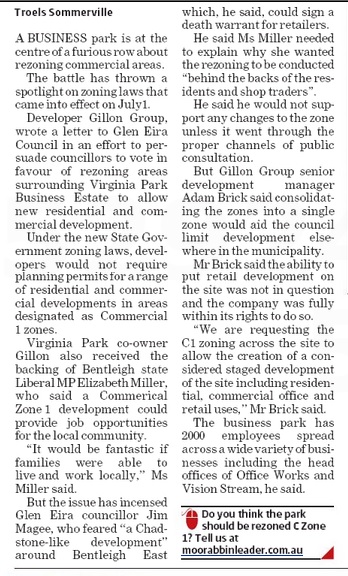
ON JULY 1, five business zones were consolidated into two commercial zones with relaxed rules on the types of businesses that could open or expand without a planning permit

VICTORIA’S three industrial zones have also been amended to remove floor space restrictions and allow small supermarkets up to 1800sq m, which were previously not allowed

CONVENIENCE shops will be allowed in Industrial 3 land to create commercial opportunities and competition

MORE information can be found on the Department of Planning and Community Development website.

– with Melanie Gardiner and Emma Hastings
zone1

zone2

Over the past week there have been numerous announcements about the Residential Zones and their implementation. First off the 7pm ABC News stated that Boroondara and Glen Eira were to be the first to introduce the new zones. Next came 2 Age articles where again Glen Eira was mentioned as being first cab off the rank. Even the Minister’s Media Release this week highlighted the fact that he thought that many councils would introduce the zones within 4 months.

We don’t for a second think that there is nothing to these stories. Such stories don’t just happen. They must have originated from somewhere! You don’t just pluck one or two councils out from 79! What irks us even more is that for the past year not a single statement has come out about the new zones from Glen Eira councillors or administrators – except for the formal submission. Residents have not been informed about a single thing. We do not know:

  • Whether there will be any public consultation – which has already been ongoing in countless other councils
  • Whether the shambles that constitutes Housing Diversity and Minimal Change will remain untouched?
  • What the available height limits will be. Remember nothing is mandatory in Activity Centres.
  • Whether Council will abide by the minimalist ResCode standards or attempt to introduce their own?
  • Or whether this council is content to rely on plans drawn up eons ago with no further local analyses and comprehensive planning – despite the burgeoning population and the growth of dwellings?

What makes us even more suspicious regarding the intent of excluding the public is that under Section 20 of the Planning and Environment Act, Council has the power to simply request the minister to authorise an amendment without formally notifying residents or seeking submissions. Further, Council’s response to 2 public questions on Tuesday night has only added fuel to the suspicion that residents will be left out in the cold and that the new zones are already a fait accompli.

One question specifically asked when council would begin its public consultation process. The answer was incredibly brief – “Council has not yet decided” and typically uninformative. The other question noted the media reports. Council’s response was that they don’t control the media. True, but when the Leader has in the past published negative articles Council was very quick to denounce and deny the articles. No denial was proffered to this question. We do not for one moment believe that nothing has been decided. And, if ‘undecided’ then what does it say about the overall planning capability of this council and getting their act together in a timely fashion? These zone reforms are important. Council has had a year to decide on the appropriate time. It is far more likely that this answer has as much veracity as countless other public statements by council. We firmly believe that:

  • This council will secretly and surreptitiously introduce the new zones
  • There will be no public consultation whatsoever
  • The anomalies and injustices of planning will continue

If we are right, then every single resident in Glen Eira should be outraged. The Minimal Change and Housing Diversity zoning is a failure. It is a myth that 80% of the municipality is protected. Housing Diversity areas have expanded and expanded to now include all major roads and those roads with trams. Activity centre and neighbourhood centre ‘borders’ have also grown – especially if they are anywhere near a railway line. Thus if anything, it is no longer 80/20 but a conservative 70/30. Furthermore, most high density is in these growing areas where we’ve had 8, 10 and 12 storeys approved. It is no longer a single application for dual townhouses. Blocks of land are now seen to quite comfortably accommodate 3-4 storeys and 30 units. And even in the much lauded Minimal Change, if the land is on a corner block, or happens to be a tad larger than the average, or lies a few hundred metres from an Activity Centre, then it’s become the norm for multi-unit development.

Our guesstimate is that as a result of this cramming, perhaps 50% of Glen Eira’s population now resides in these areas. Council of course hasn’t undertaken a ‘review’ of its Housing Strategy since the dark ages and it wouldn’t surprise us at all if they have absolutely no idea of population densities in each suburb. That’s the sort of work that needed to be going on over the past few years and definitely needs to be going on now – BEFORE any arbitrary zoning lines are drawn on the municipal map. If any of these figures are available, then we simply challenge this council to produce them and argue its case.

What is even more discriminatory is that these high density areas are not accorded the basics of social and environmental amenity according to this planning scheme. They lack adequate open space provision; landscaping; onsite car parking. They are also subject to greater site coverage and it is not considered too bad if 25% of dwelling don’t get natural sunlight. That is the legacy of this planning scheme and its creators. And this is what will continue if the zones are simply rubber stamped. In 2002 people did not realise the repercussions of the amendment which established all this (c25). Now it is clear to everyone. Residents must have a say on their future. If not, this council should be dismissed.

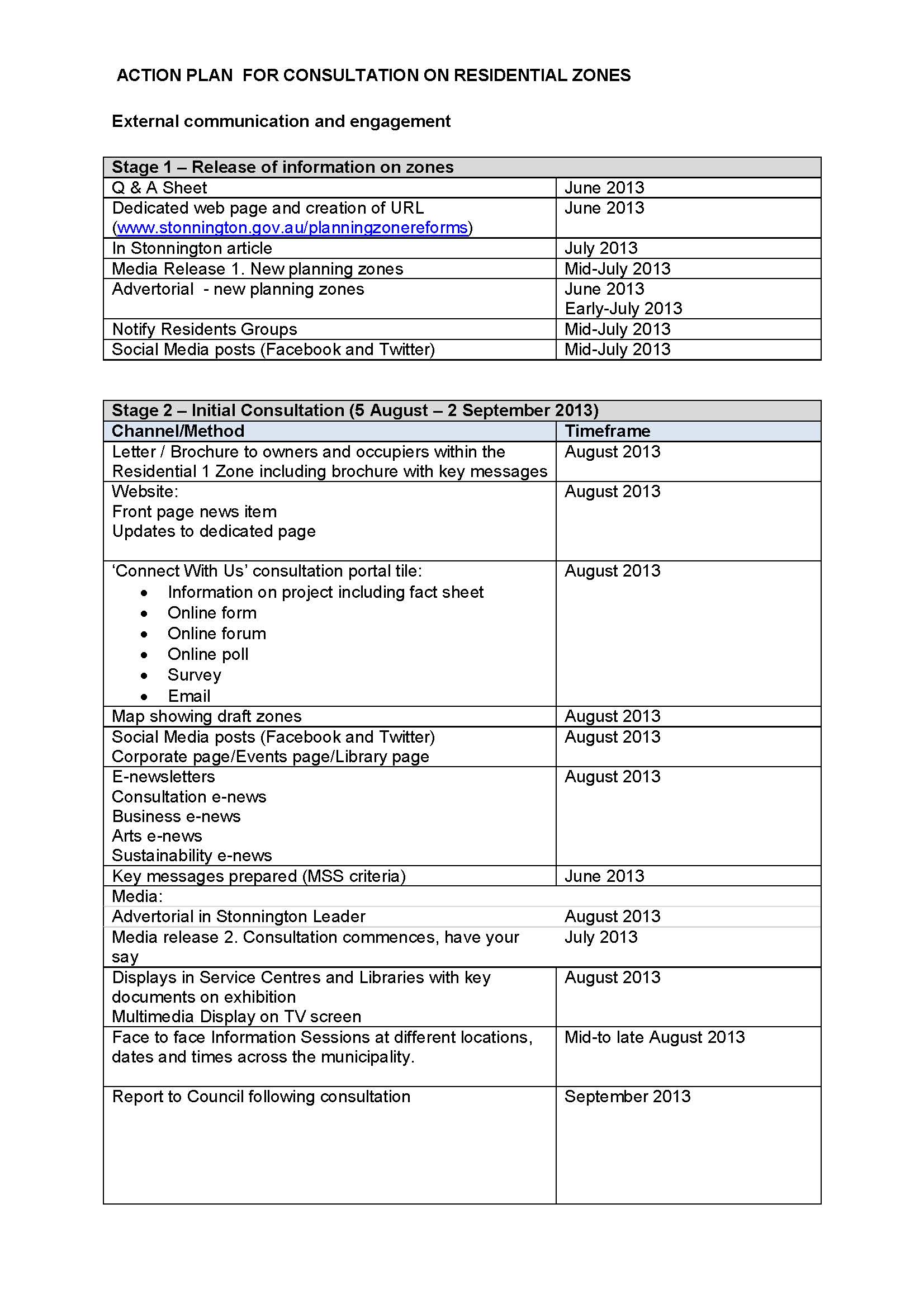
Finally, we include the consultation program that Stonnington has set out for the next few months. Its willingness to engage and encourage residents is the total reverse of what happens in Glen Eira on so many fronts.

Pages from stonnington consultation_Page_1 Pages from stonnington consultation_Page_2

A joint letter/petition containing 116 signatures was tabled at last Tuesday night’s council meeting. The letter/petition, as presented in the draft minutes, reads:

We the undersigned, supported by our concerned neighbours, pedestrians, and users of Tucker Rd Bentleigh, wish to bring to your attention the following:-

  • The above referred to property, has been left vacant for over seven years, except for the recent buildings at the rear of the property, on Box Court.
  • The original house has been, and continues to be vandalised, and defaced by graffiti. Squatters have been a regular problem.
  • The unattended plant growth is harbouring vermin (as reported by neighbours) and possibly reptiles, which could pose a threat to the health and safety of nearby residents and the many pedestrians.
  • Disregarding the recent temporary fence, it can also be a safe and welcoming haven for the unsavoury characters who may prey on the ’unsuspecting’ who frequently use the adjacent footpath throughout the day and into the late evening (anyone, from school children to the aged).
  • The site is an absolute disgrace and an ‘eye-sore’ which degrades our beautiful Bentleigh Street. Property of neighbouring houses could be devalued because of this shameful and neglected site.
  • The Old House was once a magnificent building and the garden greatly admired. It was, we believe, regarded as a ‘Heritage Listed’ property. It is such a shame to see it so dilapidated.”

 Crs Lobo/Magee

That the Petition be received and noted.

The MOTION was put and CARRIED unanimously.

All well and good. EXCEPT, that when minutes are created and parade themselves as the honest to goodness literal and verbatim truth, then they should be precisely that – accurate to 100%. These minutes are not. When Paul Burke read out the letter/petition he stated the address of the property – 150 Tucker Road, Bentleigh. This has now vanished – although there is nothing to indicate to the reader that there is anything missing. No “…..” to indicate an excision, or any comment to this effect. Without knowing any better the general public would have to assume that this is what the letter/petition stated. History re-written for the official record – and not for the first time!

But there’s more to this story than the simple omission of an address. The history of this dwelling goes all the way back to 2006 according to council’s application register. In short, this is a clear case of ‘land banking’ and permit extension after extension. The result is the ‘eyesore’ and derelict property at 150 Tucker Road.

Last year there was an agenda item where councillors had asked for a report on collecting statistics related to permit extensions.  (See: minutes of June 12th 2012). Instead of responding to the actual request the report tried its darndest to do nothing of the sort. Here are some quotes:

 Council does not currently keep statistics in relation to requests for extensions of time. As mentioned previously, a process change would be required to enable statistics to be recorded– in other words, ‘we won’t do it’.

Then there’s also this – …what is the purpose or insight provided by keeping extension of time statistics? There would appear to be limited value to be gained in extracting these statistics. It may be thought that they are some form of economic or lead indicator about development. If this is so, a better lead indicator is building approvals.

The final recommendation included: “Not commence statistic recording in relation to the requests received for extension of planning permits”.

The final resolution carried by councillors stated that statistics should START being collected. One year on there have been no reports on how many applications for extensions there have been, nor how many have been granted in this time. What should have happened is that officers be ordered to collate data for the past decade at least. In that way the true picture of what is going on in Glen Eira would be apparent.

When developers hold onto blocks of land granted a permit, or allow derelict houses to remain standing for years on end, the result isn’t merely the vandalism and eyesore of 150 Tucker Rd or the generally increased value of the land for development. Extension after extension equates to piecemeal planning all over again since there is no recognition of what is happening in surrounding properties or areas. Kingston insists that requests for permit extensions are not automatically approved by officers, but that these applications come back to councillors for re-appraisal. Six years down the track many things may have changed. Drainage, parking, noise, traffic – all may be reasons to amend the old permit and not simply rubber stamp it again with another extension.Simply rubber stamping extensions does no-one a favour except perhaps the developer.

Which takes us back to the beginning of the post and the attempt to rewrite history. 150 Tucker Rd should be visited by all those concerned with how this council deals with planning issues and how it appears to bend over backwards to support developers rather than maintain the amenity of residents. Readers should also question why the address of this property just happened to disappear from the transcript. Or is this simply another case of ‘clerical error’!!!!!!!

We have learnt that the Alma Club application has already been sent off to VCAT PRE-EMPTING, in all probability, any council resolution on Tuesday night. Why? Because Council did not finalise the application within the required 60 day limit.

This is both extraordinary and inexcusable and, in our view, raises serious questions about process, and potential secret deals that may have to ability to completely sideline both councillors and resident objectors. To refresh people’s memories here are the facts:

  • The application was received by Council on the 19th March 2013 according to the planning register.
  • It was not until EARLY MAY that the yellow notice went up. Residents had until 14th May to register their objections. That makes it roughly 6 weeks that Council sat on this application before presumably doing anything about it or informing residents.
  • A planning conference was held on the June 5th.
  • The item was set down for decision this coming Tuesday – the 2nd July.

There cannot be any excuse for this inaction, especially since Council would have been fully aware of the contentious nature of the application and its value in monetary terms. All stops should have been pulled out to ensure that the time limits were adhered to. Why weren’t they? What are the possible outcomes for the current situation – given that we’ve learnt that mediation and a 5 day VCAT hearing has been timetabled for several months down the track? Several potential scenarios now rear their ugly heads:

  1. Any possible councillor resolution on Tuesday night is now a moot point and probably won’t go ahead
  2. The developer ‘in consultation’ with officers will either submit amended plans directly to VCAT, or again in consultation with officers work out various ‘conditions’. In both cases the parameters will be set and both residents and councillors will not have a say.
  3. Since a permit has not been granted, the prospect of ‘amended plans’ coming to a full council is most unlikely.

All of these scenarios raise serious questions about governance within Glen Eira; the role of the planning department and most importantly, who knew what and when. For example:

  • When did council officers know that the developers would be going to VCAT?
  • When did officers know or decide that the 60 day limit could not be met?
  • Do councillors know? Or do some councillors know since we’ve been informed that one particular councillor has been telling objectors to forget about appealing since VCAT will overrule anyway?
  • Even MP Southwick has got in on the act with an offer of ‘mediation’! Why, and what does he know that residents possibly don’t?
  • Why didn’t this well paid planning department get its act together on time?
  • Was this ‘delay’ in fact planned right from the start?
  • What ‘discussions’ went on between developer and planners? How often? When did these ‘discussions’ start?
  • Was there ever any discussion about time lines?
  • Has any officer actually kept records of these meetings and/or discussions as required under the Records Act?

There are many, many, other such questions – all of which only cement the already existing perception that all is not 100% kosher within Glen Eira– especially when it comes to planning matters!


ALMA CLUB APPLICATION

As expected, the officer’s (Ron Torres) report recommends that a permit be issues for “up to 73 dwellings in an apartment style 3 storey building and townhouse style development of 2-3 storeys above basement car parking and a reduction in visitor car parking requirements….”. There were 58 formal objections.

It is worth commenting that this report contains much that is taken verbatim from the developer’s application. As to lighting and internal amenity there does not seem to be any problem in having people live underground – “It is considered the ground floor north facing apartments will have poor solar access as their floor level is substantially lower than the ground level at the northern boundary. Their living room windows are also substantially overhung by the balconies above. Therefore a condition is recommended to setback the first floor balconies to improve the amenity of these dwellings”.

On traffic and its impact on local and adjoining streets we have this: “…the expected traffic generation can be considered in the context of the traffic generated by the Alma Club (when it was operational). Therefore, whilst there will be a noticeable increase in traffic during residential peak times (ie weekday mornings), there will also likely be less traffic at other times when the Alma Club would have generated traffic, such as weekends. Furthermore, Council’s Transport Planning Department is satisfied Wilks Street can accommodate the traffic generated by the development. On balance it is considered an increase in traffic movements within Wilks Street as a result of this development is not unreasonable”.

Not one statistic to support any of the statements! And since when does 5 days of traffic twice a day compare to a declining club membership that is assessed only on weekends? Nor is there any mention of the major arterial roads that run off Wilks St and the safety issues involved. The only change that is advantageous to the community is the recommendation that a 5% open space levy be paid by the developer instead of the 4.75% that had been ‘agreed’ to previously.

All in all another dodgy officer’s report without substance, detail, and a far too heavy reliance on the proposal as submitted by developers. Surely when the community pays their wages it is not too much to expect that officer reports show some initiative and originality plus, providing a substantiated rationale for their decision making that is not authored by the developer.

RECORDS OF ASSEMBLY

First off we note that the online version of agenda has repeated one of the ‘minutes’ – meaning that one document is missing! The trend of secrecy continues unabated however. Notations included in these documents reveal that important issues that will have a major impact on the community HAVE BEEN DISCUSSED but not one word has come out into the public domain concerning these issues. For example:

  • Residential zones – at least 3 times
  • Referendum of Constitutional Recognition of local government
  • MAV state conference – list of motions. Again residents have no idea of council’s position on any of the proposed motions.
  • There’s another couple of interesting items that read – “Cr Hyams – letter to the editor in the Australian Jewish News from a Labor Federal member of Parliament. Need for a Council response to correct the record.” AND – “Cr Hyams – draft letter to the Caulfield Racecourse Reserve Trust relating to members of the public attending and addressing the Trust.” (Please note that Delahunty had raised this issue in a previous meeting); “Cr Hyams – a meeting of the non MRC Trustees of the Caulfield Racecourse Reserve Trust.”
  • GESAC and dispute resolution also gets a nod as well as in the Audit Committee report.

Finally it’s worth mentioning the item recommending the rescission of the Sustainability Policy and enacting a new policy. We have noted several times in the past that the arguments put forward by Hyams and Burke (when it suited them) was that nothing could be done UNLESS IT WAS CONTAINED IN THE MEETING PROCEDURES. There is no facility in the meeting procedures for a rescission of motion! If the argument is to be applied consistently, then this recommendation cannot proceed. But of course in this council we can only expect some glib sleight of hand to justify actions that suit the ultimate objectives!

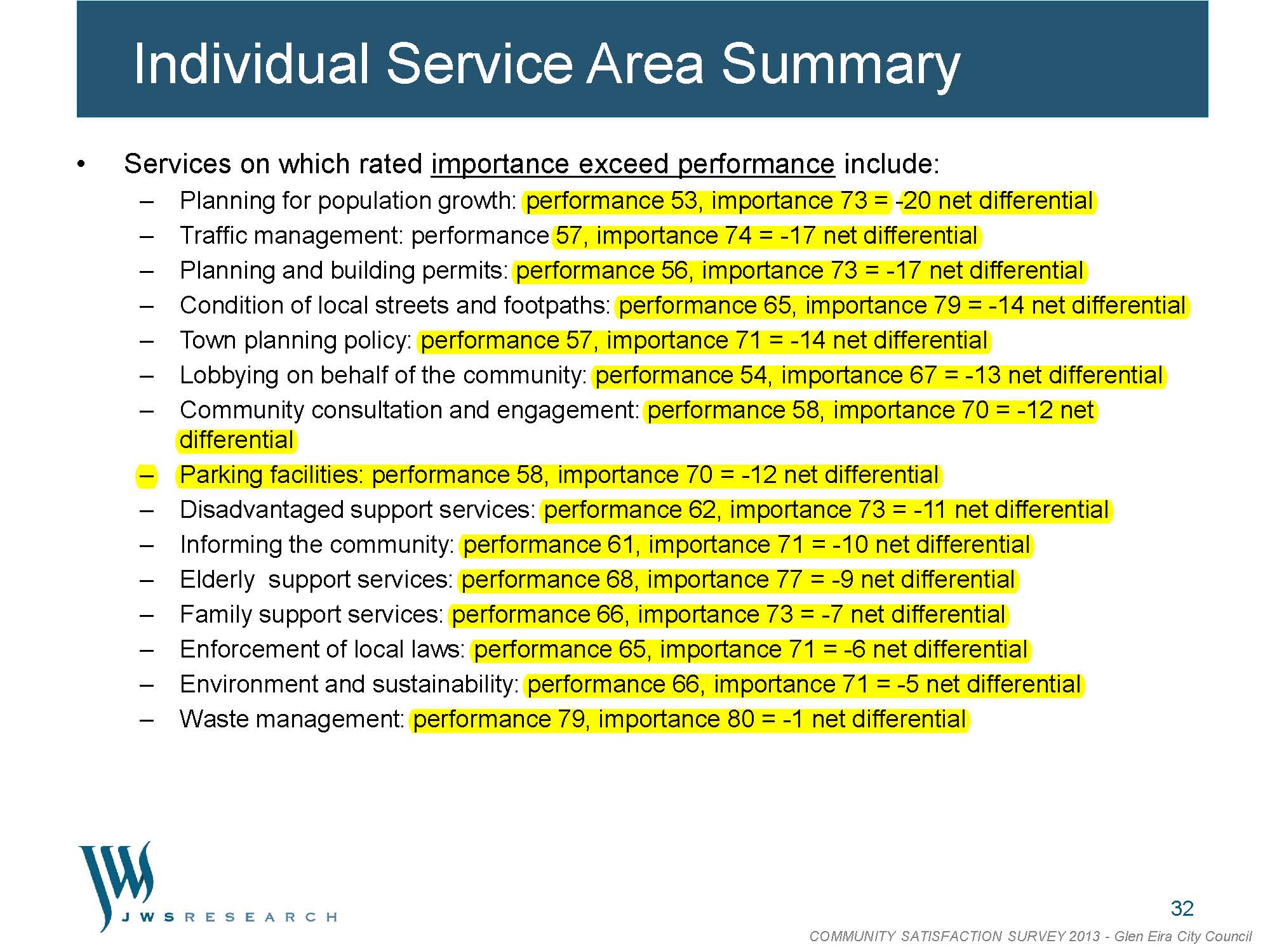
PS: Also along familiar lines there is Newton’s report on the latest Community Satisfaction Survey. The entire report is NOT included in the agenda papers. Rather we’re told that it is available on council’s website. Unfortunately to locate the report will involve a ‘hide and seek’ expedition! The vital aspect of the survey focuses on residents’ expectations as to service performance and their grading of this performance. Below is the relevant information and we point out that once again the huge discrepancy between what residents consider as important and their evaluation of the actual service.

Pages from Community_Satisfaction_Survey_results_2013 PPS: We’ve commented on this previously but given the deceptive reporting of the VCAT decisions it is worth re-iterating. For the 20 Hawthorn Rd application which was overturned by VCAT, council writes:

“Council determined to refuse the application as it failed to satisfy the intent and objectives of the Minimal Change Area Policy, in terms of excessive visual bulk and poor interface with the adjoining residential properties. The development
also failed to satisfy a number of the ResCode standards    ‘.

Not only is this entirely disingenuous, but not does represent what the member actually concluded. In fact, Council itself ‘stuffed up’ big time. It did not even know the areas that were Minimal Change as opposed to Housing Diversity. Here’s what the member concluded:

  1. There is little doubt in my mind that the subject land is in a housing diversity area under local planning policy. As the purpose of local planning policies is to give effect to the municipal strategic statement (MSS),[1] it is relevant to start with the MSS. The MSS includes a Framework Plan the purpose of which is to ‘support and promote’ specific land use outcomes.[2] The Framework Plan, although indicative, includes the subject land as an area along a tram route where ‘multi unit development will be encouraged’.[3] The MSS adopts a targeted approach to meeting future housing needs. It encourages multi-unit housing in identified housing diversity areas. Land along tram routes is a housing diversity area.
  2. The housing diversity area policy confirms the subject land is in a tram routes housing diversity area, having regard to the  Glen Eira  ‘policy framework plan’ and the Caulfield North ‘Framework Plan’.[4] I will return the specifics of the tram routes policy shortly.
  3. That the subject land is in a housing diversity area is confirmed by the minimal change area policy.[5] The policy was recently remade with amendments in Amendment C87 of the scheme (C87). The Council exhibited C87 before deciding this permit application. In the ‘Policy Framework Plan Minimal Change Areas’ map in the scheme when C87 was exhibited and in C87 shows the subject land not in a minimal change area. C87 was approved and commenced on 31 January 2013 and after the Council decided the permit application. It did not change the identification of the subject land as in a minimal change area in that map. In other words, C87 has not changed the identification of the subject land as not being in a minimal change area.
  4. I refer to this history because the Council assessed the permit application as if the relevant policy was the minimal change area policy rather than the housing diversity area policy. This was an error. The Council has now decided that the identification of the subject land as not in a minimal change area for policy purposes was a ‘mapping error within clause 22.08 mistakenly introduced in Amendment C87’,[6] and has prepared Amendment C108 to correct the ‘error’.

The Alma Club application for 75 units raises countless questions about process and the planning scheme itself. Here are a few:

  • Why should developers be allowed to submit CONCEPT PLANS that are vague and wishy-washy? Why should council planners then decide on the basis of such plans? Or could it possibly be that the developer is expecting some major changes that will then become the endorsed plans which will not be in the public domain – especially if these ‘new plans’ come within cooee (30%) of what is currently envisaged? That is, some sweetheart little deals between applicant and council?
  • Even if there is an appeal to VCAT, then there is the problem of amended plans, or council’s position – which will not feature in the public domain and certainly not go before council again. As with the C60, there is a proposal, but no real detail.
  • What also needs to be borne in mind is that if councillors agree to a downsizing on Tuesday night and objectors appeal this decision then the newly announced VCAT fees could be extremely expensive. Again, the developer is in the box seat! Councillors of course will then have their usual scapegoat – VCAT – and they come up smelling like roses instead of addressing the crux of the matter – ie the deficient and suspect planning scheme!

We’ve been forwarded these ‘concept plans’. Below are some extracts taken verbatim from these documents. The comments, conclusions and developerspeak are truly amazing!

The proposed development includes the construction of a medium density residential complex comprising a four storey residential apartment building, 17 two storey townhouses and 8 three storey townhouses with associated parking and landscaping.

The existing site levels provide the ability to achieve higher built form elements in parts of the site without any off-site amenity impacts. Different residential building typologies exist as part of the character of the area, and the introduction of an integrated medium density development would contribute to housing diversity in the area.

With regard to the relocation of the existing telecommunications facility, an indicative new location is shown on the roof of the building.

The subject site is greater than 7,000 sqm, and it is more than three times the 2,000sqm threshold noted above. The proposal also removes an existing non-residential use. For these reasons, it is considered reasonable and appropriate to pursue the type of development being proposed.

More specifically, the proposal will:

  • Deliver a greater diversity of housing;
  • Improve and protect the liveability, neighbourhood character and amenity of the area;
  • Promote environmental and social sustainability;
  • Assist in stimulating the viability of the Alma Village neighbourhood activity centre; and
  • Integrate with the existing neighbourhood

Turning to the provision of private open space, a schedule of areas is provided at Attachement 3. This demonstrates courtyard sizes for the townhouses ranging between 41.5sqm and 136sqm with the average being 61.96sqm. The Schedule to the Residnetial 1 Zone recommends provate open space provisions for dwelling in the Minimal Change Area of 60sqm, and therefore the average provision is considered acceptable.

Today’s Caulfield Leader also featured this article:

Resident ire over plans

Glen Eira residents opposed to development plans for the Alma Sports Club in Caulfield North have formed an association and are raising a war chest to take their fight to VCAT.

They have registered the name Glen Eira Residents Against Inappropriate Development Inc with Consumer Arrairs Victoria, and are looking for moral and financial support.

Committee spokeswoman Vardit Sacks-Davis said the association was formed in response to the Wilks St permit application. The group’s long-term plan beyond that was not yet clear.

“Our aim is to protect, and advocate for, the rights of Glen Eira when threatened by inappropriate development,” she said. Monark Pty Ltd lodged a permit application with Glen Eira council seeking to demolish the historic Alma Sports Club and replace it with a four-storey apartment building with 50 apartments and 25 two and three-storey townhouses. The 7100sq m site is in a minimal change area.

Director Bill Michaelides told the Leader his team had taken a “very balanced approach” but residents maintained it was inappropriate “for many reasons”.

“If this goes to VCAT we intend to fight it there as well so it could be veryk expensive,” Ms Vardit Sacks-Davis said.

Email the group at almaclubobjectors@gmail.com

Hearty congratulations to Kingston City Council on their first public forum regarding the planning zone reforms. About 35 people were present tonight including the Mayor, one other councillor, plus 3 strategic planners and a full time mapping officer. Kingston had obviously gone to great lengths to ensure that information was freely available to residents – ie. the walls were plastered with maps, full colour booklets of 12 pages, and draft amendments including the all important schedules.

The Mayor introduced the evening and his focus throughout the 5 minute talk was that NO DECISION on anything had been made. That Kingston’s intent was to firstly inform their residents of the dramatic planning changes and to seek their input. All questions would be answered and there would be multiple forms of consultation – mailouts, website, council newspapers, advertisements, online discussion forums, etc. Residents had 6 weeks to consider all the information and then council would go away and draft its amendments. Another consultation would then follow before any final decision was made.

The Manager of Strategic Planning then provided a formal presentation with Powerpoint slides. The current Kingston planning scheme was explained as well as what the proposed changes meant for the city. The most striking features of the evening, apart from the genuine desire to inform and consult, were:

  • The extent of detailed local analyses that Kingston had already undertaken. Maps showed each suburb and included a breakdown of every single development – ie single house, 2 units, multi-units etc.
  • The projected population figures and the preferred locations – for example: areas that lacked public transport would be unlikely to be included in ‘growth zones’

The real highlight was the acknowledgement that there was tremendous flexibility available to councils to determine the future of their municipalities. All would depend on the schedules that accompanied each specific zone. In other words, the devil would be in the detail. Councils had the options of:

  • Determining height limits for specific locations
  • Determining setbacks
  • Determining permeability
  • Determining private open space
  • Determining Landscaping
  • Determining site coverage

Structure plans were another tool that assisted in the protection of specific areas.

All in all, the evening was a true eye opener to how different Kingston is to Glen Eira – both in objective and in performance. Unlike Glen Eira, public comment is actively, and we believe, genuinely sought. Further, the extent of the work already done by these officers is literally mind boggling. We can only ask our illustrious lot: why the 9 months of silence and when will they let the public in on what is going on? How much work on population and available lots has been done? Will residents really be informed and consulted, or fobbed off with half-truths and waffle? We wait with bated breath!

Finally, it’s worth mentioning that Kingston claims to have very few of their planning decisions overturned. The reason? Because they have done their homework and ensured that their neighourhoods are holistically planned – in total contrast to the ad hoc and open slather approach of Glen Eira!

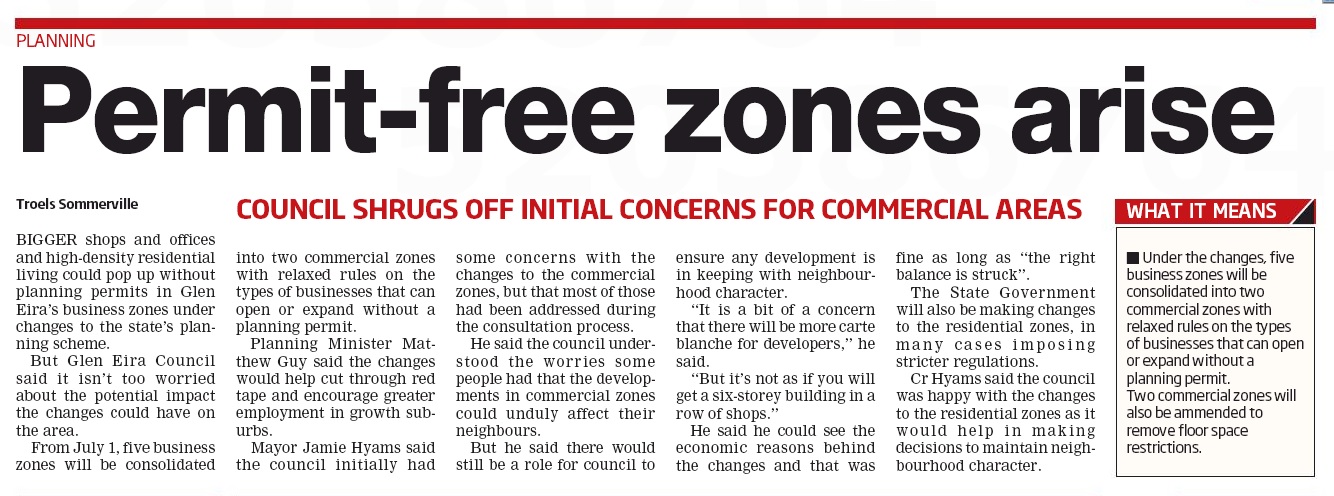
permit

The alleged comments by Hyams in this article raise major issues.

  • Why should residents believe him or his script writers?
  • Why is this council doing absolutely nothing in contrast to other councils, much less informing the public in a clear, direct and honest manner about its intentions and the real ramifications of what will happen from July 1st and in the coming year?
  • Is this the most potent example of not merely fiddling whilst Rome is burning, but the clear intention of doing absolutely nothing to review, change or modify a strategic planning approach that is clearly incapable of protecting residents?
  • Could anything be clearer than the refusal to change a damn thing, since according to Hyams, ‘council was happy’ with the residential zones?

Below we feature some extracts from the agenda items for the next Kingston Council Ordinary Meeting. Not only is there a lengthy officer report on the implications of the commercial zone changes from July 1st, but actions to try and ameliorate the potential damage (uploaded here). In Glen Eira all we get is silence, inaction, and misinformation!

With a Planning Permit previously prohibited locations can be used to create multiple Supermarket(s), shop(s) or Department Store(s).

The zoning translation, if not carefully managed at residential abuttals, also has the potential to create adverse amenity impacts with the ability of incompatible land uses to establish without a planning permit.

A Supermarket under 1800m2 or shop under 500m2 associated with or adjoining a Supermarket can be constructed without a Planning Permit. The definition of Shop also includes Bottle Shop. This would mean that beyond issues of policy matters such as loading times, hours of operation or other management issues associated with facilities that may impact on amenity of adjacent residential areas would not be able to be considered.

Businesses of all sizes have made investment decision in the City of Kingston based on the Local Planning Policy Frameowrk and the application of zones. These decisions for numerous business owners have the potential to be immediately and directly undermined through the application of the Commercial 2 Zone in location where certain activities where(sic) previously prohibited.

…it has also been necessary to consider that if the Commercial 2 zone were applied what levels of amenity protection would be provided for immediately adjacent or nearby residential areas when compared with the status quo.

The work of successive council’s (sic) in developing Structure Plans, Local Planning Policies, facilitating retail investment in planned locations and assisting diversifying its employment land will be undermined if the Commercial 2 Zone is introduced to replace the large areas in Kingston zoned Business 3 and 4.

Uses that are permissible under the Commercial 2 Zone such as Supermarket(s), Shop(s) and Department Store(s) that were previously prohibited will impact on small businesses that have invested in planned locations and on community service and infrastructure investment provided in Activity Centres.

The unintended consequence of the introduction of the commercial 2 Zone, is that land uses which Council’s Local Planning Policies clearly discourage in ‘out of centre locations’, become as of right or permissible.

abc

PS: The potential sale of the ABC studios is nothing new. In fact, it has been on the cards for at least ten years. That raises the question of what Council has been doing in the meantime? Is it another instance of too little, too late? The horse has already bolted? Below are some media reports that will interest residents. Please note one real estate agent’s comments regarding the lack of height limits set by council!

The Rippon Lea Estate point of view – http://www.nattrust.com.au/advocacy/campaigns/abc_for_rippon_lea

PLUS

ABC’s Slice of Rippon Lea Estate, Elsternwick, Expected to Sell For More than $25 Million

Written by Marc Pallisco

Monday, 26 October 2009 23:16
 

Rippon Lea

AN 8,000 square metre slice of Elsternwick’s historic Rippon Lea estate, compulsorily acquired by the State Government in the 1950s for the Australian Broadcasting Corporation – is likely to be sold to residential developers, if the ABC vacates the property in 2012.

ABC project director Ray Moore told Secret Agent it is considering selling two Elsternwick properties, currently occupied as studios and offices, including a major complex on Gordon Street abutting Rippon Lea – built on what was once the property’s southern boundary.

Moneys raised from the sales will fund the development of a new $90 million studio at 102 Sturt Street in Southbank, Mr Moore said. The Sturt Street development, which would be next door to an existing ABC office at 120 Southbank Boulevard, is subject to parliamentary approval, but expected to occur.

Sources estimate the value of ABC’s outgoing Gordon Street office to be about $25 million.

They say the land could make way for an apartment complex, similar to that being proposed around the Stonington mansion in Malvern, or a lower density subdivision, as occurred behind Canterbury’s Frognall mansion in the early 1990s.

At close to a hectare, the site could also make way for several apartment towers offering Port Phillip and CBD views, over Rippon Lea’s established gardens.

ABC offices and studios were developed on part of the Rippon Lea estate, prior to the opening of the 1956 Melbourne Olympic Games. Popular television shows including Countdown, The Big Gig and The Late Show were later recorded at what is known as the “Rippon Lea studio”.

The land occupied by the ABC is not on the Victorian Heritage Register, but a Heritage Victoria spokeswoman said the ABC could still return the land to the estate, if it wanted. The imposing Rippon Lea property is managed by the National Trust, and open to the public.

Source: http://www.realestatesource.com.au/abcs-slice-of-rippon-lea-estate-elsternwick-expected-to-sell-for-more-than-25-million.html


PLUS


ABC set to leave home

Phillip Hudson and Nathan Mawby

3 May 2013

Herald-Sun

THE ABC will be leaving its historic TV studios at Ripponlea and the valuable property may be sold for high-rise residential development under plans to build a new headquarters for the national broadcaster in Southbank.

Famous ABC programs such as Countdown were produced at the Gordon St studios, which opened in 1956 with the introduction of television.

In recent years, it has been home to programs such as Adam Hills chat show In Gordon Street Tonight and filming for the series Miss Fisher’s Murder Mysteries.

Under the plan, the ABC will build a five-storey headquarters next to its existing Southbank offices, where its TV news moved in 2001.

It will include new TV studios and a major TV production centre.

The overhaul is aimed at guaranteeing jobs and production in Victoria.

The Federal Government will loan the ABC $90 million, which it has to repay by 2020.

ABC managing director Mark Scott said the new building would be designed to put the ABC’s many services on show.

“All the plans for this area are to make it more visible, more highly trafficked by pedestrians, make it more of a centrepoint of the centre,” he said.

Communications Minister Stephen Conroy said the new building would be home to the ABC’s radio, television and digital production operations as well as its broadcasting and support services.

Senator Conroy said consolidating operations would allow the ABC to achieve operational savings and productivity benefits.

Local architect Robert Mills said the Ripponlea site’s proximity to the CBD, transport, schools and shopping meant that while a feasibility study would be done, it would likely become a residential site.

“It will be controversial, but I predict the final outcome will be a high-rise,” he said.

Mr Mills said that while the building had no council height restrictions, its height would likely be limited by shading.

The former Channel 9 studios in Bendigo St, Richmond, are being transformed into apartments and townhouses, selling for up to $1.2 million.


« Previous Page — Next Page »