GE Planning


Guy races ahead, but where’s he going?

DateApril 5, 2013

The Planning Minister ticks off huge developments without sharing his vision for the city.

Victorian Planning Minister Matthew Guy.

Victorian Planning Minister Matthew Guy. Photo: Luis Enrique Ascui

Melbourne’s future is speeding down a freeway hitched to the ideological racing car of Planning Minister Matthew Guy – where it is going is anyone’s guess. Guy (pictured) is in overdrive: 70,000 new housing lots to be released on Melbourne’s fringe this year; dozens of skyscrapers approved; the CBD expanded massively; and big changes to Victoria’s planning zones.

Guy once said a single day in government was better than every day in opposition – he enjoys power. But what will his legacy be? What kind of Melbourne is he creating?

Melbourne is living with the mistakes of the past. Docklands was hatched in a time of developer-driven policy and now planners are cleaning up the mess. Guy’s approach so far has been to treat Melbourne like one big Docklands – developer-led planning.

What has many planners scratching their heads is the speed of action by Guy in approving development and the inertia in releasing a strategic plan for the city – how it will all knit together, what sort of city we are creating and why. Despite a decade in opposition and more than two years in office, the Coalition is yet to deliver a road map on how Melbourne should develop.

Submissions on a new metropolitan planning strategy closed last month and a draft strategy will be released in the middle of the year. By that time Guy will have approved more than 40 new towers, expanded the CBD into Fishermans Bend and Carlton and moved Melbourne’s boundary outwards by 5000 hectares. Guy has been all cart, no horse.

The delay in producing a development blueprint while rapidly ticking off developments raises questions on how seriously the government is taking the strategy, and risks the final product being seen as little more than tokenism. As Melbourne University planning expert Alan March noted recently, there should be more forward planning on how the plethora of new skyscrapers will affect each other and what new services are needed.

It is difficult to find any skyscraper application Guy has turned down. Some are not even being built – lucky developers selling dirt that has gone up in value because they have been given a high-rise planning permit.

And what impact will changes to Victoria’s planning zones have?

There will be more commercial tourism development in some of Victoria’s most-loved destinations, such as the Great Ocean Road, and more development in Melbourne’s green wedge areas.

What changed residential zones will mean for the value of people’s homes remains a big unknown. The neighbourhood residential zone will have strict development controls and it is unclear if this will add or detract from the value of houses. And what impact will these no-go zones – no doubt aimed at voters in the leafy eastern suburbs – have on residents in other areas of Melbourne? Will it mean high-rise developments in their streets because some suburbs have been locked up?

Guy says he is turning planning into an economic portfolio – but Melbourne needs a planning minister, not another treasurer.

Decisions should be based on what is best for the whole of Melbourne in the long term.

Guy is moving with such haste that decisions are being made with little detail.

A new metropolitan planning authority has been announced but no one has any idea what it will do.

One thing is clear – Guy believes in the government transferring much of the responsibility for planning the future of the city to private developers. State government developer Places Victoria has been slashed to the point of extinction.

Grand plans for world-best practice developments on Melbourne’s urban fringe are being axed and land sold off to private developers. Key urban renewal sites in Footscray that Places Victoria paid top dollar for are being sold at a loss.

Why? Why not retain the sites and sell them at a profit? Why should taxpayers sell cheap land to developers?

A Places Victoria insider said it was ”a terrible time to sell – we bought at the height of the market and now we are selling at the bottom of it”.

The government is about to complete an audit of all government-owned land, driven by Treasury, to determine what can be sold.

Unlike the Kennett government, which had major assets to privatise and collect big windfalls from, there is little left to sell except government land.

The government will be careful not to spook the horses with public land sales, and it will be spread out across agencies and departments, but it will happen and the public should be concerned.

While it says there will be no fire sale, the private sector is licking its lips. But what will be the legacy of this sale? Less land for new parks, schools and childcare centres. Future generations forced to buy land at higher prices because a previous government had a cash flow problem. Guy needs to slow down a little bit – planning a great city is not a race or a sale.

Jason Dowling is The Age‘s city editor.

progress leader

PS: We think readers will find the following Kingston Council Notice of Motion of great interest given what happens far too often in Glen Eira. The following is from the minutes of  25th March, 2013.

Notices of Motion

Notice of Motion – Cr West
Moved: Cr West Seconded: Cr Ronke
That Council adopt a position for mediation of a development
application only with the support of either:
1. all three ward Councillors, or
2. a majority of all Councillors.

CARRIED

There have been 2 recent VCAT decisions that we wish to highlight. In BOTH cases council’s planning department failed in its legal obligations – namely to alert resident objectors as to the council’s position on amended plans within the required 7 day period of notice. What this means is that objectors show up to the hearing with practically no time to adjust their claims or to prepare sufficiently for what could be a completely different set of circumstances. They are left out in the cold and perhaps totally unaware of the secret deals that have been made between council and developer. Certainly without sufficient time to prepare an adequate defence or to even contact council planners.

We’ve previously featured Hyams’ pathetic response to one such objector – the officer was on holidays. (See: https://gleneira.wordpress.com/2013/01/24/does-council-support-residents-or-developers/) Not good enough! How many such ‘rare lapses’ have taken place and what steps have been implemented to ensure they don’t happen again? How often will the same pathetic excuse be used to explain sheer incompetence or indifference to residents? How much longer will councillors allow the inefficiencies and lack of accountability to continue?

What is even worse is that the VCAT Watch reports reveal nothing of these incidents. It is spin all the way. Except, that if one bothers to go to the actual judgement the Glen Eira Version of History is revealed for what it is – a total sham!

Here’s what council’s version of events regarding the 14-16 Maroona Rd hearing stated (from the minutes of 5th Feb) –

Prior to the hearing, the applicant approached Council seeking support for amended plans which satisfied a number of Council’s conditions, whilst the plans also provided for a revised design incorporating twenty six (26) dwellings. The amended plans were considered to be satisfactory and, in principle, Council supported the amended plans.

What really happened though is revealed by the member –

Prior to the hearing the Permit Applicant circulated amended plans which were intended to be a response to, though not fully comply with, many of the Condition 1 requirements for amended plans sought to be imposed by Council. Prior to the hearing, further discussions were held between the Council and the Applicant, such that an agreed position between these two parties was presented to the Tribunal as to a modified form of Condition 1 that should be applied as a result of the proceeding under Section 80 of the Planning and Environment Act.

Ms Coram and the other residents had not been part of these discussions and at the start of the hearing declined an opportunity requested by the Permit Applicant to attempt to mediate the matter.

Further, the original application was for 27 units. The original DPC decision cut this back to 24 and then lo and behold we’re back up to 26 units and a reduction in car parking. So we now have 26 two bedroom units when one of the major planks of the Planning Scheme is to ensure that there is ‘diversity’ of dwellings! We insist that no bigger hoax has been perpetrated on residents that this bit of fluff and bubble.

There are some other comments that clearly show how little effort is put in by this council to ensure the bona fides of applications. None of this of course is evident in the officers’ report. We’ll simply extract those passages.

During the course of the hearing it occurred to me (ie member) that the shadow diagrams for 9.00am had not been drawn correctly. As a result at the conclusion of the hearing I gave oral orders for an amended shadow diagram to be circulated to all parties within seven days of the date of the hearing, and for the other parties to have an additional seven days to make further submissions, if desired. At the hearing all parties agreed that these timelines were sufficient.

During the course of the hearing Ms Bowden (for developer) submitted that due to the removal of the two existing crossovers to the review site, that one additional on street visitor space is to be created. On this basis, and considering Council’s support for the proposal following the review by their traffic engineers, I cannot see any reason why I should not approve the reduction of the standard visitor car parking requirement by one space.

Ms Silveira (objector), in her concerns regarding the intensity of the development, referred to the risk caused by the increased traffic levels to be experienced in Maroona Road. At no stage during the hearing was I addressed specifically in relation to the existing or anticipated traffic levels, or any difficulties experienced by residents in exiting the street to either Neerim Road or Glen Huntly Road. Given the absence of any such detailed submission, I must give weight to the assessment of the application by Council’s traffic engineers and the support for the development as expressed by Council. I therefore cannot find any reason to refuse to grant a permit based on traffic grounds.

The questions that follow have to be addressed by councillors:

  • Why are resident objectors not always informed of amended plans nor council’s agreement to these new plans AND if they are informed why is there not sufficient notice given as required by law?
  • Why does this council so often merely accept the developer’s  assessment of various elements such as overshadowing, traffic, parking, without checking the veracity of these claims?
  • Why did council not check the accuracy of the shadow diagrams?
  • Why has traffic engineering not insisted upon the car parking standards?
  • How much longer will councillors allow residents in Housing Diversity to be the sacrificial lamb to a flawed vision that desperately needs to be jettisoned?
  • How much longer will councillors sit in silence and permit shoddy reports to pass without comment, without serious questioning, and without proper analysis?
  • Are we right in assuming that this council has no respect for residents and ostensibly no respect for the legal requirements? If they did, then such incidents would not happen or would certainly not be allowed to continue!

If you know of any other incidents along similar lines then please contact us!


This is an exceedingly long post but one which is arguably the most important we have ever put up. It features the events surrounding the planning application for an Ormond 3 storey, 11 dwelling development at the last council meeting. The officer’s recommendation was to grant a NOD for 10 dwellings.

We believe the ‘debate’ that occurred on this application epitomises all that is wrong with planning in Glen Eira. It reveals the usual bogus and contradictory claims made by all and sundry, as well as the full inadequacies of the current planning scheme and its total disregard for residents in Housing Diversity Areas. We also wonder if Pilling and Sounness in particular, have the foggiest idea about planning or they are just there to support whatever is dished up to them. We can only shake our heads at the naivety, if not straight out stupidity of various councillors.

This will become obvious upon reading. We remind residents that the Emmy Monash development mentioned throughout, involved the granting of a permit for a 4 storey development on Hawthorn Rd. Lipshutz moved the motion about removing setbacks and this was supported by the majority. It also came to light that the developer just happened to be the same individual who was handing out How To Vote cards for the gang! (No conflict of interest was declared!).

We urge all residents concerned about the future of their neighbourhoods to pay careful attention to what transpired last Tuesday night. Our ‘commentary’ on this fiasco will feature in a future post – this is just a blow by blow description of our councillors ‘at work’!

Esakoff moved to reject the application. Seconded by Okotel.

ESAKOFF: refusal based on on ‘visual bulk’, ‘excessive height’, doesn’t meet ResCode standards of the planning scheme and doesn’t respect ‘neighbourhood character’ and Housing Diversity policy. Said that there are ‘several factors’ that fail to meet requirements here and that couldn’t be addressed by merely adding conditions. Spoke about ‘amenity impact on neighbours’ and ‘intensity of development’ as well as ‘set backs’ – especially building right on a laneway where bedrooms would be overlooking the laneway. It’s an ‘overdevelopment’ and therefore not ‘appropriate’ or ‘fits into’ this position in Ormond.

OKOTEL: started by saying that everyone thinks that ‘appropriate development’ should happen in Glen Eira but that the ‘key word is appropriate’. The planning scheme she claimed ‘sets out for everyone’…..‘what is considered appropriate’ and that this application ‘doesn’t meet those standards’. It ‘falls outside the upper limits’ of height, site coverage, and neighbourhood character.

PILLING: whilst he ‘appreciated’ the arguments put up so far, he was supporting the recommendation. The property is in a neighbourhood centre and a retail centre, and ‘within a very short distance’ there’s the railway station. Policy is to ‘encourage development in these areas’ and therefore ‘not in minimal change areas’. Thought that council therefore ‘had to be consistent’ since they were ‘trying to get appropriate increased development in these areas’. The application shouldn’t be refused even though it is slightly over specifications and there are ‘some detrimental aspects’ but this still shouldn’t ‘sink’ an application ‘like this’. If the motion to refuse failed then he would be moving a motion to accept the recommendations.

DELAHUNTY: said she didn’t ‘like’ the setbacks of the proposal and ‘I’m confused by my fellow councillors’ by applying the criteria of setbacks to ‘knock back applications on the one hand’ and then ‘not in another’. Referred back to the Emmy Monash 4 storey application on Hawthorn Rd that was passed and ‘some councillors’ argued then that setbacks didn’t matter. Now they’re arguing that it does matter. Said she was ‘confused’ about the setbacks and the ‘different directions this is taking’.

MAGEE: admitted that he had ‘no idea which way I was going to vote tonight’ and was hoping ‘to get persuaded by some really good arguments’ but that ‘so far all speakers have failed to engage me’. The laneway ‘probably saves it’ and then it starts to ‘encroach’ into residential. Asked then ‘where to draw the line’? ‘If nothing else, we have to be consistent’. Was hoping that someone could convince him but he told councillors that they’d just have to wait to ‘see which way my hand goes up’.

SOUNNESS: said he’d try to be ‘inspirational’ but that Magee ‘was a hard act to follow’. From a single house ‘we’re going to stick 11 dwelling on there’..’that’s a lot’…’a big up’ in density. But he’d ‘rather have a bunch of people’ that are close to transport and shops than put ‘in the middle of minimal change areas’. Asked where all the ‘extra people’ can go and what can be protected. Here, ‘they’re next to shops, they’re next to public transport’. Further, ‘it’s not a beautiful place to live’ and he wouldn’t like to live there, but ‘it’s not meant to be a luxurious’ garden area. ‘This is a place for dense living’ and you put this where ‘services and facilities are’. This application ‘might have issues with design’ but that’s the job of council’s urban designer and there are conditions that will deal with trees and access. Said that the ‘issue’ that the application ‘fails on is height’ but the rise of the land makes this about landscaping. He supports the recommendation.

HYAMS: agreed with Sounness and Pilling that ‘this is the right place for increased development’. Overall he wouldn’t ‘have a problem’ but he doesn’t ‘particularly like’ this proposal. Said there’s a difference between saying that we can have increased development and that ‘this is the building that should go there’. Thought that ‘too many issues’ on this application ‘required rectification’. Mentioned site coverage and ‘up the road from a flood zone’. Said that ‘we have rules’ and these ‘rules say 60% site coverage’ so this should be ‘60% site coverage’. It’s also 9.6 metres high and should only be ‘9 metres maximum’. Also that it’s right on the laneway also ‘concerns’ him. Trucks use the laneway and he wouldn’t like to have trucks going ‘thundering’ down outside his bedroom window so that ‘also concerns me’. ‘Generally’ he doesn’t mind tinkering with application because individually all these things wouldn’t necessary occasion a refusal, but taken together ‘there are too many of these things’.

Said that Delahunty’s view of lack of consistency over the Emmy Monash decision but that the setbacks there were ‘the front setbacks’ and ‘still quite a few metres off Hawthorn Rd’  unlike this one which would be right ‘up against the laneway. Said that Pilling and Sounness’s  foreshadowed motion doesn’t deal with the issues he’s outlined and ‘doesn’t make those adjustments’ so if councillors want ‘adjustments’ they should vote for the motion to refuse.

ESAKOFF: ‘an application either meets policy or it doesn’t. This clearly doesn’t’. Reiterated the argument about ‘too much’ site coverage and height and said that ‘if there was a way to address this via conditions that would have been done’ but here it would require a ‘total redesign’. No application like this would come in for a minimal change area. ‘It is in the right spot, housing diversity’ but ‘it has to meet policy’. ‘Increased development is right for this street’ but ‘it has to fit’. Urged councillors ‘not to look at the address’ but as an ‘application for anywhere in Glen Eira and vote with your conscience’.

HYAMS put the motion. Voting in favour of refusal were – HYAMS, ESAKOFF, OKOTEL. Voting against – MAGEE, DELAHUNTY, PILLING, SOUNNESS, LOBO. Motion lost.

Pilling then moved the motion to accept ‘as printed’ and Sounness seconded. Neither Pilling nor Sounness spoke to the motion.

OKOTEL: said that what worries her is that this suggests that ‘it is acceptable to push the limits of the Glen Eira Planning Scheme’ and also to ‘exceed them’. Said that there’s a policy in place because after consultation with residents that ‘was seen to be what was needed’ for the area and ‘if we don’t apply and uphold our planning policy’ then the question is whether ‘we can blame VCAT for not upholding our policy’? Said that it’s important for councillors to ‘stick to our policy’ and don’t allow applications that go beyond height and site coverage or set backs. Since these standards have been set they should be supported. This application just says that ‘it is acceptable to push those boundaries’ and that ‘anything goes’ in Glen Eira. Went on to say that the planning scheme developed in ‘consultation with residents’ is ‘what they want’ and councillors should stick to that. “I think it’s a sorry day when councillors cannot uphold their own scheme’ and then ‘look to vcat’ when it says that council doesn’t care about its own scheme.

DELAHUNTY: asked Akehurst a question. Since both Okotel and Esakoff had said that the application doesn’t meet ‘planning policy’ she wanted to know whether ‘this application meets planning policy or does not meet planning policy’?

AKEHURST: said he was caught in ‘crossfire’ here and that the application ‘demonstrated’ the problems with people not understanding town planning. Stated that there’s the government code called ResCode which is how the government thinks ‘Victorians should live’ and that has ‘prescriptive standards’ and in this application some have been met which Okotel and Esakoff pointed out and some haven’t such as the 9.6 height which should be 9 metres. ‘There have been other standards which have been breached in this application’ – ie site coverage. ‘But this is where it gets difficult’ since Rescode is ‘interpreted as a guide’ and councils are being asked to ‘have overall’ views on the ‘objectives’ of each of these standards. So, ‘it is possible to say that objectives of certain measures of ResCode have been met’…’even though the prescription has been clearly breached’.

DELAHUNTY: said that she is again ‘expressing my confusion’. Quoted Okotel in saying that it would be a sad day when council doesn’t apply its policy. ‘I stood here and I argued as hard as I could about the setbacks on Hawthorn Road’. Disagreed that ‘it doesn’t affect people’s amenity’ and that people complained ‘directly to the applicant’ and to council about the setbacks ‘and we didn’t enforce’ it. ‘That was a sorry day!’ ‘This is in line with policy’.

ESAKOFF: agreed that it is a ‘sorry day when we can’t uphold our policy’ and when they do what vcat is criticised for doing.‘ Our policy is supposed to be superior to all other municipalities’ and that ‘we protect our residents more than all other municipalities’. Said there’s policy and that ‘we need to be upholding those’.

MAGEE: said that policies ‘are not laws, policies are guidelines’ and it’s up to councillors to accept, reject or modify the proposal and that ‘we’ve had several weeks to do that’. If it’s all about just policy ‘then we might as well not be here’ since they’re superfluous. Asked why councillors who ‘do not have a 4 year degree in town planning’ are necessary if the policy should dictate everything. Said councillors are just ‘mums and dads’ who ‘live next door to developments’ and the decisions are based on asking oneself whether they’d like to live next door to something like this. ‘We will always interpret a guideline the way we need to interpret a guidelines’. Rescode and the planning scheme has to be looked at by officers and then councillors. Said that councillors have to make the decision based on what they think after digesting all the information and not just according to the guildelines or policy because there’s no need for councillors if that’s all they had to do.

HYAMS: said that in planning some things are ‘objective’ and some things ‘subjective’. Some things are ‘measures’ like site coverage and ‘easy to apply’ but other things like neighborhood character and front setbacks ‘are a bit harder to apply’. Setbacks are ‘measured by the average of other houses in the street’. Emmy Monash has got one nearby property right on the street and another one across the road, ‘right back’ ‘so there’s room for interpretation’. This is also true for neighbourhood character. What councillors should be doing is that ‘where it’s prescriptive you apply it’ and ‘where there’s room for interpretation you interpret it’. Referred back to last council meeting and the sign that was applied for the Kittens car wash. Here ‘policy was very clear’ in that there was ‘nothing in planning policy that said you couldn’t have that sign’ but some councillors were worried about the content of the sign and its influence on gender issues. These arguments he claimed ‘weren’t relevant’ but that some councillors ‘used their subjectivity on that’. And ‘a couple of those same councillors are saying that we should let this’ application go through. Mentioned another decision about alcohol for lawn bowls club and some councillors again voting against this but are ‘somehow managing to vote’ in favour of the application ‘tonight’. So he doesn’t want to hear ‘lectures on consistency’ from those councillors.

MAGEE then asked ‘which ones’?

DELAHUNTY: then said ‘I think Okotel because she also voted against the sign. Is that right?’

HYAMS: said that since Okotel is opposing the motion she’s being ‘consistent’

OKOTEL: asked Delahunty to withdraw her remarks.

HYAMS: said that Delahunty’s comment ‘was out of order’ since she ‘didn’t have the floor’ but didn’t say ‘anything that goes against the Local Law’. Went on to say that there are subjective elements and that ‘it’s up to each councillor to apply them as they see fit’. This application has some breaches which ‘are a lot less’ capable of involving ‘subjectivity’ and because ‘this breaches so many prescriptive measures we should refuse it’.

PILLING: thought that everyone’s got the ‘best intentions’ and that’s why these sorts of applications come to council since there are always ‘two sides’ to the issue. ‘On balance’ he’s recommending accepting the recommendation.

MOTION PUT: Esakoff called for a division. In favour: Delahunty, Sounness, Pilling, Magee, Lobo. Against: Esakoff, Okotel, Hyams. Motion carried.

 A public question was asked at the 5th February Council Meeting. It read:

Glen Eira Council is reported as having made a submission to the Ministerial Advisory Committee investigating Development Contributions under the Planning and Environment Act. Will Council make this submission public and accessible to all? When was this issue discussed with councillors?”

The Mayor read Council’s response. He said: “In September 2012 Councils were asked a standard list of specific technical questions relating to the DPCD position paper entitled Standard Development Contributions Paper – A Preferred Way Forward.

Council officers provided answers to these technical questions in October 2012.

Councillors were informed of this during that time.

It is understood that Councils and members of the public will be given opportunities in the future to make further submissions.”

Since then there has been no public disclosure, and no further mention of this important issue. Even worse, the fact that councillors were ‘informed’ does not feature anywhere in the Records of Assembly for this period. Conclusion? Either the Records of Assembly are a total (censored) joke, the ‘informing’ was a brief verbal aside, or perhaps did not even take place?

We’re getting mightily sick of revealing how often this council is out of step with the majority of its neighbours. This is not the first time that submissions to various committees or government have not been ratified by council resolution first off (as done in other municipalities) much less made public. Residents have no idea as to how this council votes at MAV conferences; what positions will be taken, or much about anything. We even wonder if councillors get a look in, or have a say on anything. Yet they do nothing!  They allow residents to be treated like mushrooms and the disease of inaccurate reporting and secrecy continues unabated.

The development contributions is a vital issue for any municipality that is experiencing the unprecedented growth that Glen Eira is. Given that this council has REMOVED the contributions from its planning scheme it becomes even more important that residents know what council’s position is. Will Newton and his cohorts meekly accept the pro-development agenda, or will there be some insistence that ratepayers stop subsidising greed?

Below are the views of our neighbours – all made public and above board – not like Glen Eira City Council!

1. PORT PHILLIP EXTRACTS

http://www.portphillip.vic.gov.au/Report_3_-_Submission_to_Standard_Development_Contributions_Advisory_Committee.pdf


There remains a bias in the design of the proposed development contributions framework towards the establishment of development contributions in growth areas. This translates into some gaps in the frameworks application in established areas where project delivery can be much more complex and expensive that broad acre green field development. These gaps include:

• Assumptions about spare capacity in existing infrastructure to cope with development.

The suggestion that a “25% discount” be applied to standard leviesin established areas compared to growth areas.

• Failure to recognise the complexities and additional costs associated with development in established urban areas.

• The significant land cost component in the provision of new infrastructure in established areas.

Project contingencies cost allowance set at 10% of project cost. A contingency set at a standard 10 % is very low for projects, particularly in inner urban areas. This should be scaled across a range in accordance with industry best practice and be project specific.

There is no recognition in the proposed framework that additional growth in established urban areas can create “tipping points”, exceeding infrastructure capacity and rendering some types of existing infrastructure redundant. This in turn will necessitate complete replacement in order to upgrade the capacity.

The framework proposes that historical capital works expenditure and population growth over time be used as a basis to set the contribution for new development. This approach is not supported as it:

• has no direct relationship to actual need for infrastructure generated by additional growth relies on historical spending that may not be an accurate indication of either infrastructure cost or infrastructure need

• takes no account of the nature of the population increases and subsequent infrastructure needs

• does not allow for consideration of current standards and costs of infrastructure provision

• is contrary to the basic tests of need and nexus that have long been established in setting development contributions.

2. BAYSIDE

http://www.bayside.vic.gov.au/5_March_2013_Councillor_Briefing.pdf

in the councillor briefing notes under – ‘proposed submission’


3. STONNINGTON (uploaded in full here)

  • The application of the Development Levy Scheme (DLS) to only large scale Strategic Redevelopment Areas lacks the flexibility needed to respond to the various levels of development occurring and infrastructure needs across metropolitan Melbourne. The needs in the Chapel Street Principal Activity Centre are not considered.
  • That the DLS decision making process should include a Social Impact Assessment

We’ve reported ad nauseum on the failure of this administration to provide accurate, comprehensive, and timely information to both residents and councillors. This post focuses on the regular ‘VCAT Watch’ that appears in every council meeting agenda. We’ve already commented on the fact that there is no complete record of DPC decision making in contrast to what other councils provide their communities. The Glen Eira version of reporting on VCAT cases is equally deficient and misleading.

Every agenda item is entitled ‘VCAT WATCH – (monthly) Decisions’ – where the current month’s name is inserted. Any reasonable person would then expect that what is contained in this watch does in fact represent the decisions made by VCAT for that particular month. As we will show, nothing could be further from the truth! But first, here’s how some other councils do it –

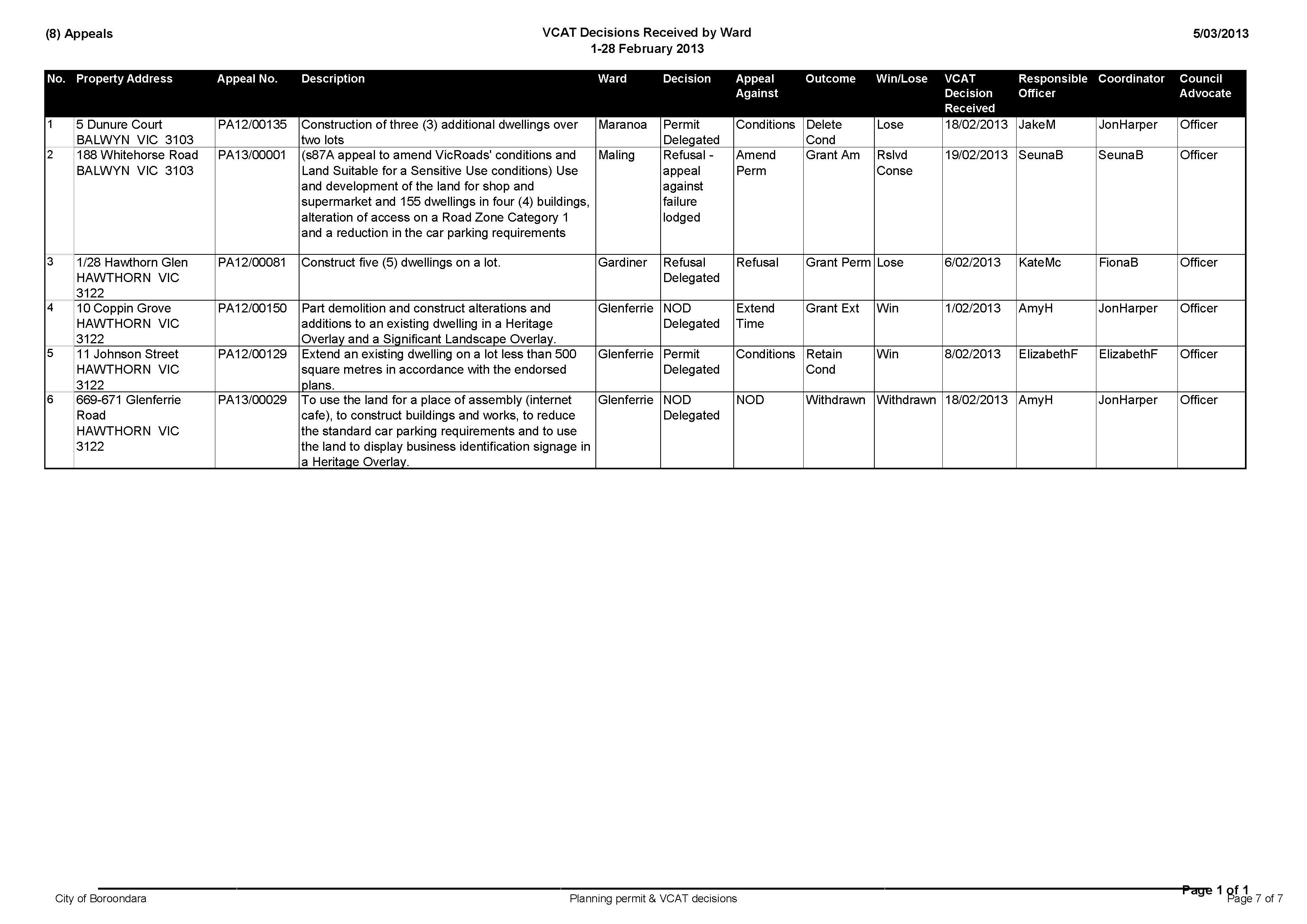
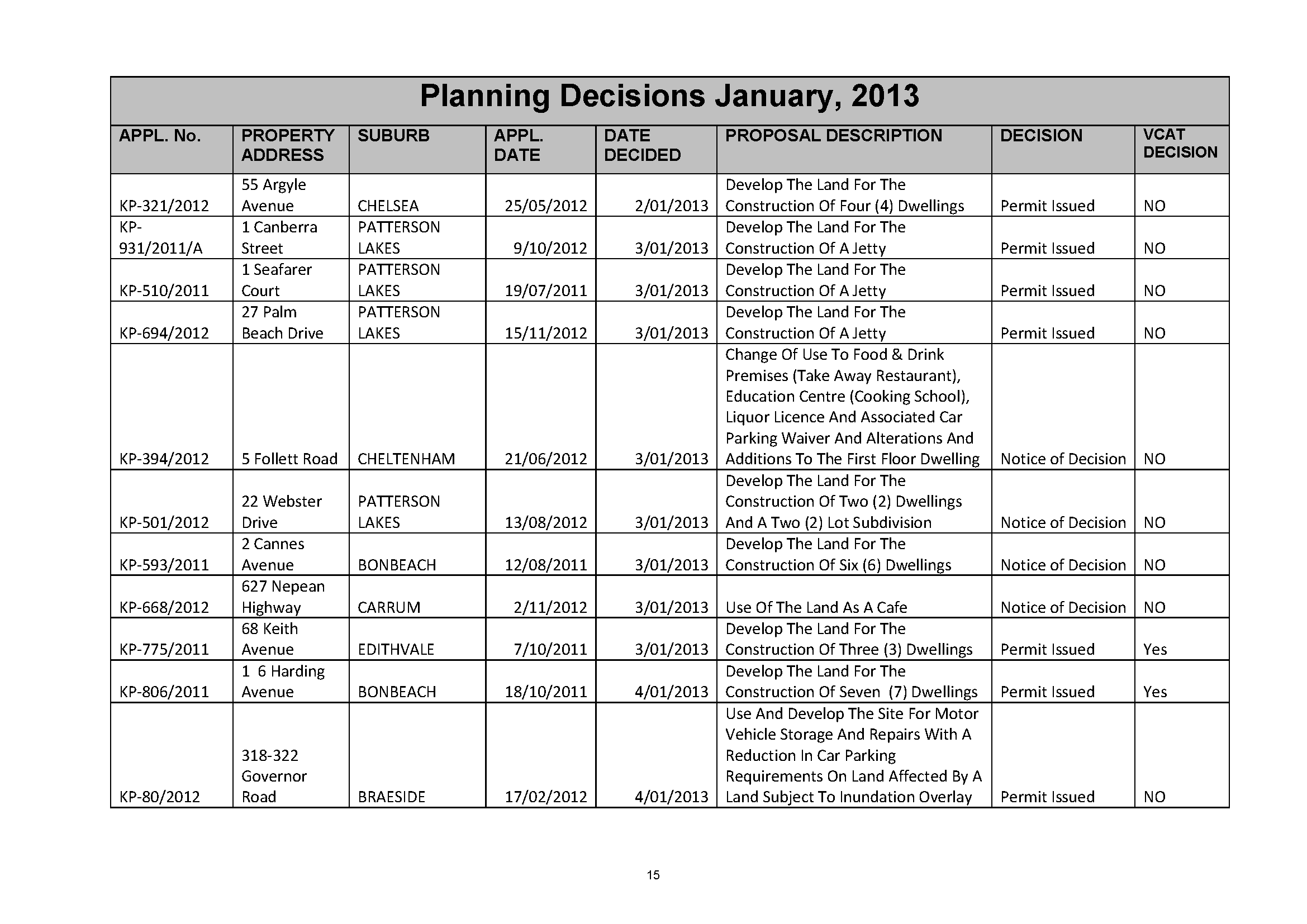
Boroondara provides regular tables outlining results according to ward. These are comprehensive, so that residents know the ‘success’ or ‘failure’ of each appearance at VCAT plus whether the decision to grant or deny the permit was made by council or under delegation. (Click to enlarge).

boroondara

Bayside also includes a list, and then a full report on each decision where residents can again see the tabulated form of success or failure.

Pages from 19_February_2013_Ordinary_Meeting_Agenda_without_confidentialGlen Eira in contrast relies on its ‘VCAT WATCH’ where often very selective editing accompanies the ‘summary’ of the VCAT decision. We’ve taken the trouble to go through all ‘VCAT WATCHES’ FROM February 2012 to February 2013. The results are fascinating in that:

  • Not one single judgement has occurred when it is stated it did occur. Once a decision has been made the applicant, council, and objectors are notified that day by email. There is absolutely no excuse that a judgement which was handed down in say November 2012, does not feature until February 2013 – even though the tag line for the February agenda item states ‘February Decisions’. Let’s have a little honesty shall we, and simply label this as ‘past VCAT decisions’!
  • Not all VCAT decisions are reported. Why not, if this is meant to be genuine and honest feedback to councillors and residents? For example: in August 2012 there are 9 VCAT decisions listed on the VCAT website. Council only reported on 4 of these decisions. What happened to the other five? Why weren’t these included and reported upon? This trend is also evident for the following months – April 2012 – Glen Eira reported on 3 out of 7; November 2012 – 4 out of 5; October – 6 out of 7.
  • Nowhere does Glen Eira report on its ‘success rate’ at VCAT. Residents do not know the total figures, as they do with other councils, nor how many decisions are upheld, set aside, varied.

Below is our table of the VCAT WATCH from council minutes. The first column lists the applicant (or objector); the second column the date the decision was handed down and the last column lists the date that Council reported the decision. In practically every case there was at least one council meeting in the intervening period when the result could have been reported upon. It shouldn’t take 3 months to get something onto the agenda and then pretend it is current!

Highland properties 15th November 2011 7th February 2012
Long plan printing 4th November 2011 7th February 2012
B Central 1st December 2011 7th February 2012
Gold investments 25th November 2011 7th February 2012
Bilic homes Not listed on vcat 7th February 2012
Healy & Gold 20th January 2012 28th February 2012
Arch 28th December 2011 28th February 2012
Blue Wolf 22nd December 2011 28th February 2012
Sharp 8th February 2012 20th March 2012
Malina 22nd February 20th March 2012
Bayside building Not on vcat website 20th March 2012
Gillon Not on vcat website 10 April 2012
Blint Not on vcat website 10 April 2012
Malina Not on vcat website 10 April 2012
Malina & business solutions Not on vcat website 1st May 2012
Imperium design 23rd March 2012 1st May 2012
Furman 22 March 1st May 2012
Pascoe 12 april 22nd May 2012
SilverArc Not on vcat website 1st May 2012
Anderson 30th April 2012 12 June 2012
Bail 15th May 2012 3rd July 2012
Perkins 7th May 3rd July 2012
Poath rd 8th May 3rd July 2012
Architecture works 17th May 3rd July 2012
Tefillah 23rd May 24th July 2012
crb 4thJune 24th July 2012
pbbs 6th june 24th July 2012
Booran rd 19th june 24th July 2012
Thermal 21st June 14th August 2012
IKONOMIDIS REID 26th June 14th August  2012
St wise 9th August 4th September 2012
Hta property 2nd August 4th September 2012
Brent Williams 8th August 24th September 2012
Smith 13th August 24th September 2012
Upside dental 4th September 16th October 2012
Vision 3 5th September 16th October 2012
284 Neerim Rd 18th September 13th November 2012
Trubuilt 24th September 13th November 2012
Hamilton 1st October 13th November 2012
Victoria Developments 8th October 13th November 2012
Malina 12 October 2012 27th November 2012
Menory 18th October 2012 27th November 2012
Supreme Property Group 18th October 2012 27th November 2012
Visionary designs 25th October 2012 18th   December 2012
campbell 26th November 2012 5th Feb 2013
sharp 27th November 2012 5th Feb 2013
pegasus 30th November 2012 5th Feb 2013
Carnegie apartments 10th December 2012 5th Feb 2013
Worotnicki 11th December 2012 5th Feb 2013
Linacre 23rd November 2012 26th Feb 2013
Mirmilstein Not listed in vcat 26th Feb 2013
Boston celtics Not listed in vcat 26th Feb 2013

What all this leads to are two possible conclusions – either there is vast incompetence or the failure to provide complete information is deliberate. Readers can make up their own minds. What is certain is that the processes and practices within Glen Eira’s reporting framework is well and truly below par and cannot be relied upon by anyone.

gesac

LETTERS TO THE EDITOR

Waiting for bus service

I remember our mayor and local member promising a bus along East Boundary to run directly to GESAC at the last election.

A regular bus service would reduce the need for the council to build more car parking spaces with ratepayers picking up the tab. It would mean more people could use GESAC. I hope the mayor is lobbying Ms Miller to honour her promises and a bus service will be travelling to GESAC very soon.

Be fair to the retailers

When I was a councillor for the City of Moorabbin (1984 to 1990), I introduced a council policy that council buildings not be allowed to be used/hired for the purpose of becoming retail outlets.

I did this because it is not fair on the ratepaying retailers, who put in all year, to have blow-ins come into your area at prime times, such as Christmas, set up shop in a non-retail building, thus taking away potential customers from the local retailers.

It would seem to me that Glen Eira Council needs to introduce a similar policy. How such places as Caulfield Race Course are allowed to become retail outlets from time to time is beyond me and in fairness to all genuine retailers in Glen Eira, it should not be allowed.

I counted 13 empty shops in Centre Rd, Bentleigh, from Wheatley Rd, to Jasper Rd. Of course, the Bentleigh Sunday Market has a huge impact on the viability of retail shop/businesses in the local area. Many of the “professional” retailers at the Bentleigh Market every Sunday do not come from Glen Eira. So what input do they have to our community? They take but give nothing back. Caulfield Race Course, seems to want to be “all things, to all people”. It is a racecourse on crown land.

Woman of fine principles

Last week I had the great privilege of attending the state funeral for the Honourable Joan Child AO. Ms Child was the first female member of the ALP to be elected to the House of Representatives and later served as Australia’s first female speaker of the House.

A long-time residents of Glen Eira, Ms Child raised five children largely as a single parent after being widowed at 42. Her much discussed campaign headquarters in Grange Rd serves as a reminder of the important role our area has played in progressive political activism.

May favourite saying of hers is “everybody counts or nobody counts” because it is a simple phrase of lofty principles which I hope to uphold in my role as a local councillor. It is why we must accept petitions, seek consultation on important issues and support strong community groups because everybody counts or nobody counts.

Vale Joan Child, life lived in pursuit of fairness.

Cr Mary Delahunty

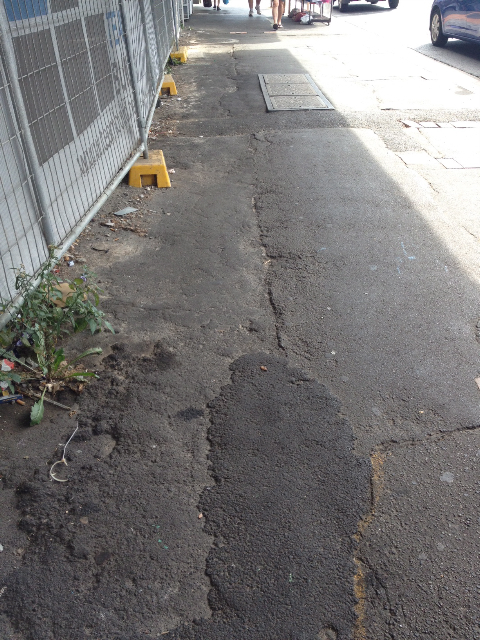
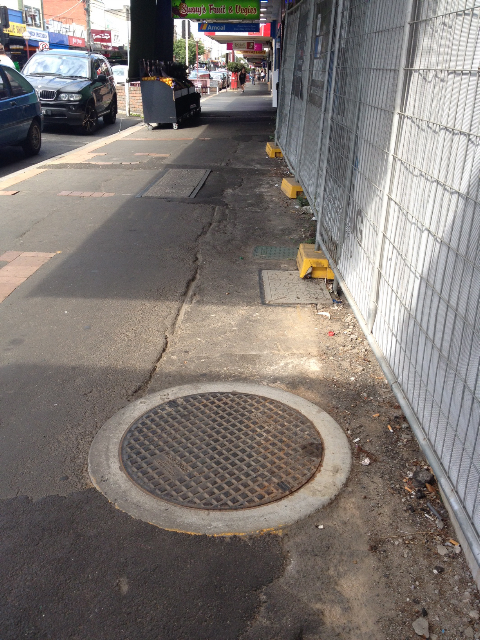
“How many years does it take for a building to be constructed?  How many times can a planning permit be issued or revised.  Why can’t the planning permit for this property be found on councils planning register? How long does a public footpath have to be unsafe before council does anything?

The multi-storey building in Koornang road which includes 26 units and shops has been under construction for years and years and years.  How can this be?  Surely building permits and planning permits must expire.  There has been so little movement with this development over so many years.

Who owns this property and why are they not forced to finish it and tidy up the site and repair the damage to the footpath?  Has anyone from council ever looked at this site? Does it comply with public safety requirements?

Should we be suspicious about this never ending construction process?  Does the owner have some special privileges that put the site outside public safety compliance?   Questions I can’t answer but maybe someone else knows what is going on and can explain why Carnegie has been blighted by an unfinished construction site for so many years and residents have had to put up with the unsightly mess and the very unsafe footpath.”

photo3

photo

photo2


The committee appointed to ‘investigate’ the proposed new zones has had its report finally made public – together with the government’s response. A quick perusal of the documents indicates that nothing major has changed. What is unique about this ‘consultation’ is that there were 2,083 SUBMISSIONS – surely a record! It’s also worth noting that at the last parliamentary sitting the government promised to table ALL submissions by February 5th. Yesterday’s Hansard records a letter from Matthew Guy which states in part: “Regrettably, the Government is not able to respond to the Council’s resolution within the time period requested by the Council. The Government will endeavour to respond as soon as possible.”!!!

We urge all residents to read the documents contained in the Media Release below since it is a foregone conclusion that Glen Eira Council’s mandatory ‘consultation’ process will be the typical rubber stamping process that has occurred time and time again.

Reformed residential zones bringing new certainty to Melbourne’s neighbourhoods

Tuesday, 05 March 2013

Sweeping reforms of residential planning zones are one step closer as Planning Minister Matthew Guy announced the Victorian Coalition Government’s final details on the reform of Victoria’s residential planning zones.

After a detailed consultation process with over 2,000 submissions from individuals, businesses, councils and community groups, the Coalition Government will now establish the three reformed residential zones on 1 July this year.

A key feature will be the new Neighbourhood Residential Zone which will be the strictest planning zone in Australia, aimed at protecting existing suburbs’ neighbourhood character.

“The Coalition Government’s reforms to residential zones reflect what communities have been calling for, for many years – certainty for neighbourhoods and protection from inappropriate development,” Mr Guy said.

“These reforms will protect what Melburnians love about Melbourne. Our streetscapes, our amenity and our liveability which are too valuable to ignore.

“At the same time the new zones will clearly define the appropriate locations where growth and density should occur,” Mr Guy said.

The Coalition Government’s Ministerial Advisory Council (MAC) on zone reform has suggested a number of improvements to the residential zones as initially proposed last year, to ensure the protection of community amenity and provide clearer rules and greater certainty for the community.

“The improvements recommended by the MAC further protect residential amenity and neighbourhood character and are supported by the Coalition Government,” Mr Guy said.

“Today’s announcement is about the right development in the right locations and the package of residential zones will deliver this for local communities.”

The new Neighbourhood Residential Zone will provide the strongest protections for local neighbourhood character for the first time in Victoria’s planning history. Key features of the zone include:

  • implementing local neighbourhood character policy to provide increased weight to local planning policy;
  • limiting increased residential development through lot size restrictions; and
  • providing an eight metre mandatory height limit.

In contrast, the Residential Growth Zone will be applied in areas determined appropriate for increased growth and density and provide for medium density developments.

Minor commercial uses will be permitted in the Residential Growth Zone to provide additional local services to the population, subject to strict conditions.

“Local communities will now know and clearly understand where growth can and will occur, unlike the previous haphazard approach that was allowed to foster under the previous Labor Government,” Mr Guy said.

“Importantly, these zones will be at the discretion of local council and it will predominately be the view of the local community that informs which zone should be applied where.”

The Coalition Government will work with local councils between March and May to further develop the implementation procedures and criteria. The Department of Planning and Community Development will also provide technical assistance to local council’s in implementing the residential zones.

Implementation of the residential zones will commence on 1 July 2013 and will be completed over a 12 month period.

A copy of the MAC report and the Coalition Government’s response can be found at: www.dpcd.vic.gov.au/planning/reszones

PS: An email from a reader –

Mailand/ Architektur/ Bosco Verticale

Only 2% of planning applications come to the full council for decision. Hence, 98% of all decisions are made by officers either through the Delegated Planning Committee or under ‘managers’. These committees are held during work hours, and officers have already made recommendations as to accepting or rejecting the proposal. Objectors are given the opportunity to attend, but we suggest that their chances of altering the recommendations at this late stage are basically buckleys and none!

The INDIVIDUAL decisions of the DPC are NOT MADE PUBLIC, except for those which result in an appeal to VCAT and are therefore listed in the regular VCAT Watch as an item on every Council Meeting Agenda. Official figures state that the number of VCAT appeals each year totals approximately 160  – that means that THE DETAILS of about 1000 decisions made by the DPC or ‘managers’ are not made public. Residents therefore have absolutely no idea why these 1000 applications were accepted, or rejected. No minutes are made public (or maybe even kept) and the criteria, decision making processes used to assess each application is also top secret. There is no tabulated, clear or regular reporting on any of these decisions. Other councils report fully every month so that residents know exactly what decisions have been made under the planning delegations. Below is just one example from Kingston which goes on for pages and pages. In Glen Eira this doesn’t happen. The ‘secret society’ of officers keeps everyone, and we believe even councillors, in the dark! If councillors do not even know what applications have come in, nor when DPC meetings will be held, nor are they invited to attend, then all pretense of these councillors actually representing their constituents is a myth!

Pages from Ordinary_Council_Agenda_25022013

At last week’s council meeting a public question on this exact issue was asked. It read:

“Currently there is no public reporting of the results of DPC meetings which do not involve appeals to VCAT. In the interests of transparency and full accountability will councillors ensure that the results of all DPC meetings, including property address, planning proposal, and decision, are included in every Ordinary Council Meeting Agenda and Minutes?”

Here is the council response to the question –

Your statement is not correct.

Council’s Planning Application Register is publicly available on Council’s website. This Register contains details of all Glen Eira planning applications lodged and the decisions made. This is a complete list and is not specific to any one decision maker.

The Quarterly Services Report for 31 March 2013 will contain information on decisions by Resolution and by the Delegated Planning Committee according to number of dwellings, number of storeys and number of objections.”

COMMENTS:

  • The statement IS CORRECT! Council’s Online Planning Register DOES NOT tell us whether decisions were made by the DPC, COUNCIL, or a ‘manager’. It also does not ‘tabulate’ any results as noted in the Kingston and other councils’ versions. A user must first enter a street name, or suburb, and then hunt through all the resulting ‘hits’. Unless someone is willing to spend hours on scouring every single entry in the database they will not know which properties are, or were up for consideration and they certainly won’t know who made the final decision to accept or reject. The question asked for links between individual planning application decisions with those responsible for making the decision. To therefore say ‘there is a complete list and is not specific to any one decision maker’ is not answering the question but just affirming the current inadequacies of the situation.
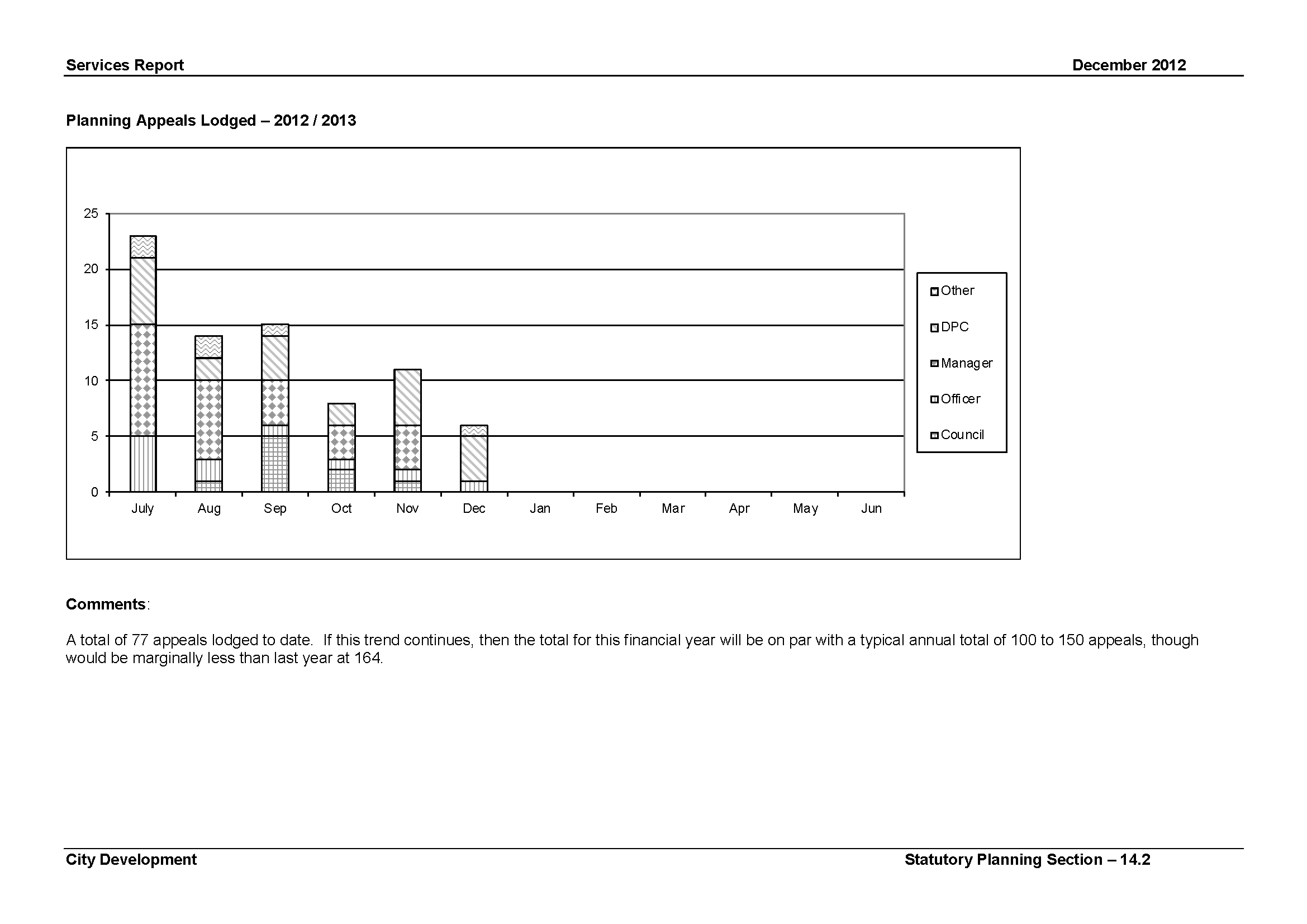
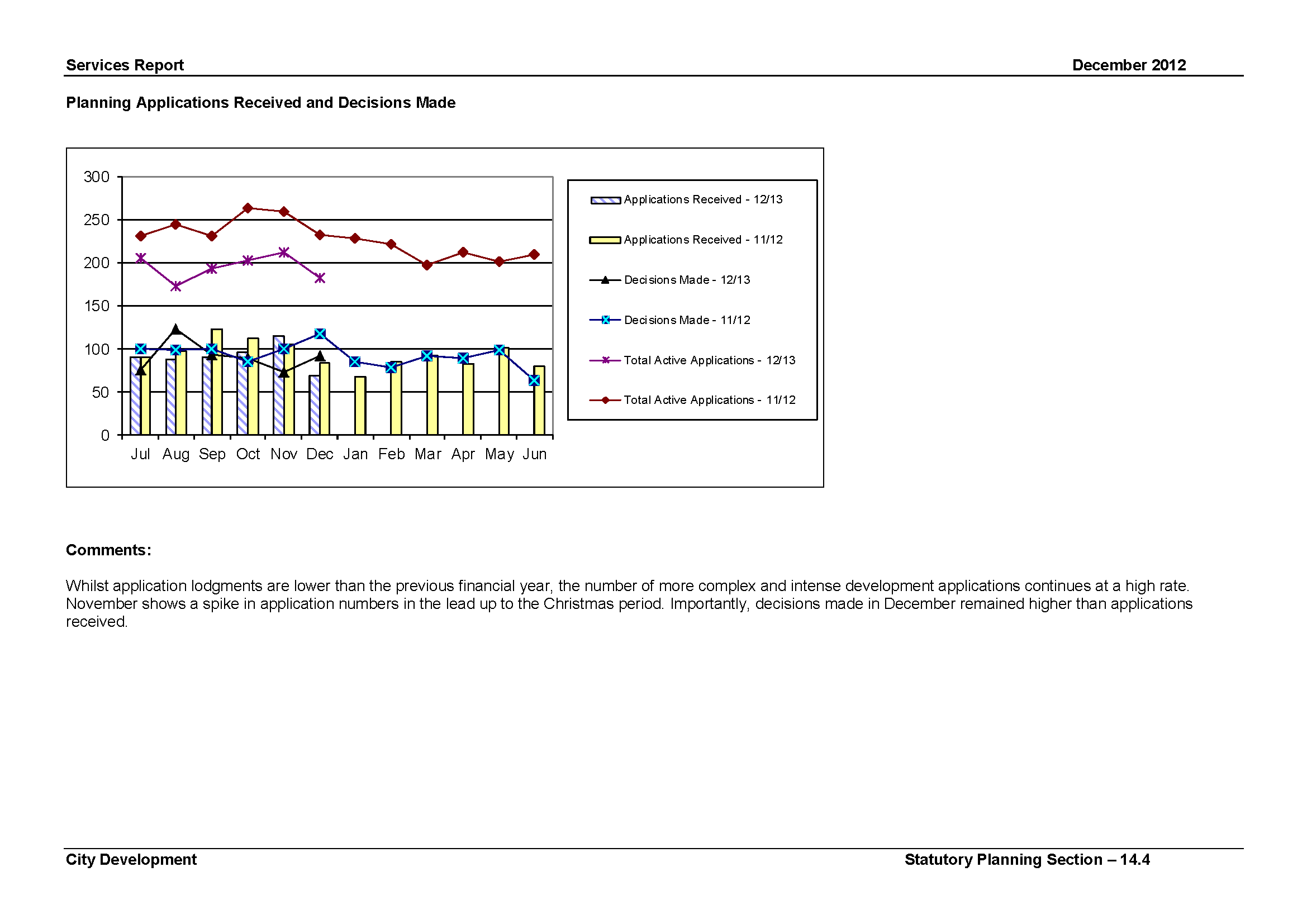
  • Again, the Services Report is a useless document that is almost indecipherable and reveals nothing in terms of what the question is asking. We challenge any reader to make sense of the following which is taken directly from the last Services Report. Not only are they illegible, but neither link individual applications to decision makers.

Pages from February05-2013-MINUTESPages from February05-2013-MINUTES-2

  • A ‘new’ version will apparently materialise in March. We do not hold out much hope that this will be any more informative, nor decipherable. Will this link property address and decision makers? Will any information of value actually be forthcoming – or will it be another exercise in sham information provision?
  • Finally, the comment needs to be made that this is the direct result of councillors signing away their oversight roles via the delegations to officers. We reiterate – there is no councillor call in; there is no clear criteria as to when applications will go to full council; no councillor attends DPC meetings; councillors we expect don’t even get a full report on upcoming applications and most importantly THERE IS A TOTAL FAILURE FOR COMPLETE AND COMPREHENSIVE REPORTING BACK TO THE COMMUNITY. This isn’t surprising. When councillors can’t even open their mouths and insist that public questions are answered appropriately then there is no reason why the ‘bullshit’ of reporting on planning applications should be any different!

« Previous PageNext Page »