GE Planning


QUESTIONS WITHOUT NOTICE 

Planning: car parking

Mr EIDEH (Western Metropolitan) — My question is to the Minister for Planning, Mr Guy. Is the minister considering any reduction to the minimum parking requirements for multistorey developments?  

Hon. M. J. GUY (Minister for Planning) — There is a review which was put in place by the previous government and went on for some period of time. Members in this chamber from the previous Parliament will remember that I asked the previous Minister for Planning, Justin Madden, about it, and he flippantly disregarded it. The review is the subject of some discussion within my  department and will be released in due course.

Supplementary question  

Mr EIDEH (Western Metropolitan) — Can the minister advise the house if the government will support councils imposing fees on new multistorey developments where there are insufficient on-site parking spaces so that councils can provide parking elsewhere?

Hon. M. J. GUY (Minister for Planning) — That is not a proposal that has been submitted to me, so it is not one that I am considering.

AND

Minister for Planning: meeting records  

Mr LENDERS (Southern Metropolitan) — My question is to the Minister for Planning. I refer to his answer to a question from Mr Tee on 25 May regarding the minister’s meetings with developers and asking if he takes a minute taker from the Department of Planning and Community Development to record minutes. I ask: since the minister’s unequivocal answer on 25 May, is that still his
practice?

Hon. M. J. GUY (Minister for Planning) — Yes, it is.

It appears that Lipshutz and Magee (and some councillors) are at it again with the request for a report on the ‘feasibility’ of extending the car park at GESAC – that is, converting open park land into more concrete. We find it exceedingly strange that after spending over $2million dollars on ‘design’, and one presumes some understanding of projected needs, that at the last moment council decides that it simply does not have enough car parking space to accommodate its anticipated 600,000 visitors to the complex. We must therefore question once again the competence of planning in this council. Caulfield Park pavilion also resulted in the ‘relocation’ of two ovals when the project was nearly complete. Why can’t they get it right first off? Why do such issues always seem to crop up at the eleventh hour? Is it intended to put pressure on councillors through the ruse of ‘if we don’t have this, the project will fail’? Below are the details of the ‘debate’ –

LIPSHUTZ: The request for a report was for officers to report on the feasibility of constructing a ‘multi level carpark’; and extension of existing carpark – but watching out for trees! ‘One of the concerns with Gesac’ is car parking and ‘need to increase that car parking to meet demand’…..at previous council meeting it ‘was discussed about having a multi level car park’ and he ‘seeks a report as to feasibility’….

MAGEE: ‘GESAC is going to be so successful ….there will almost never be enough car parking’ around GESAC ‘. ‘With the influx of…somewhere around 600,000 visitors per year parking is certainly going to be a premium…parking is something that should be increased….multi storey car park….interesting to see how that would look…..something I believe is needed….will fit nicely with the success of GESAC….

TANG: ‘some realisation that you’re never going to be able to accommodate enough people….regardless of how many extra car parks you put in…..(Lipshutz spoke about the concerns of car parking, it) ‘was a concern at the outset ….when council (supported GESAC) it knew that car parking was one of the key factors that would affect the attendances …..(visited other aquatic centres)…’planners determined that car parking was one of those big factors’…came to a balance – the site that GESAC is at ….is in a park, got to remember that…next to soccer grounds, cricket grounds, ….particularly playgrounds….and council has to minimise the impact as much as possible…as against those other uses there….think what we’ve got is an appropriate balance ….(shouldn’t use officers’ time and their workload to focus on this. There’s other important things that they should be working on such as the childcare in Elsternwick)…’I’d be seeing that as a waste of their time’….

HYAMS: although he ‘couldn’t agree more with Cr. Tang’ it’s important to remember that ‘when cricketers or soccer players….roll up to play their sport on Bailey Reserve….they won’t have anywhere to park….(and bad especially if they are carrying heavy cricket equipment)….

PILLING: ‘two bites at the cherry….I don’t agree…we seem to be trying at the 11th hour to get something up….

LIPSHUTZ: surprised that the two councillors are so ‘aggressive’…’the fact is that things change….(Tang is right in that) when we planned GESAC parking was a problem….we have now found that …demand will be greater…..and we can’t sit there and say’ (there won’t be change)…’we won’t pull down trees’…’I’m not suggesting that we build a car park….I’m suggesting we get a report to determine whether it is feasible….(I’m sure they can do the report very quickly)…we may look at other alternatives….(car parking is a problem) we need to look at it and not ignore it’.

MOTION CARRIED – TANG AND PILLING VOTED AGAINST

Gazing into our crystal ball we predict: (1) next council meeting will see the Officers’ Report ( as usual bereft of facts, details) recommending the construction of an additional car park. (2) Councillors will then be required to vote on this  and hey presto, GESAC will have its car park. BUT: where will the money come from? Is it budgeted for? how much extra will this cost?

The diagram below illustrates best practice implementation of storm water management for local councils. It features the need for the careful integration with the Municipal Strategic Statement and Planning Scheme and the formulation of policy that is based on full analyses of local conditions and requirements. Readers should ask themselves how well and to what extent our council fulfills these requirements.

Stormwater Planning Controls Diagram-2

This is a lengthy post for which we beg your indulgence. It is also the most important post we have put up, since it reveals the total lack of vision of this council as exemplified in its MSS, and the abject failure to address problems which have plagued the municipality for eons. These problems are not being addressed, remediated, nor presented in an honest and informative manner.

The fact that items 9.7 (removal of infrastructure levy) and 9.13 (flood report) both appear on the same agenda is more than simply ironic. It highlights the hidden agendas and failure to act in the best interests of the community. By removing the Infrastructure Levy which is meant to pay for drainage on new developments, council is proclaiming open slather for developers and basically ignoring the environmental impacts on drains, streets, and residents. To further compound the problem we have the 9.13 report on the February 4th floods which ultimately says nothing, proposes nothing new, and basically maintains the current status quo. Council cannot have it both ways – if flooding and inadequate drainage are real risks, then removing a vital source of income to ameliorate this risk is nothing short of madness.

Here are some of the most unbelievable statements from these two reports:

 Item 9.13 – Flood report

Council’s drains run into Melbourne Water. It follows that the effectiveness of a drainage system as a whole is the effectiveness of the local drain (Council) and the main drain (Melbourne Water).

COMMENT: Not one single word in this ‘report’ analyses the ‘effectiveness’ of council’s drains, nor provides information as to how many of its drains were involved in the February 4th flooding; when they were all last cleaned; what their condition was, etc.

“The overland flow washed soil, sand, silt and debris along its path depositing much of this material in low points. In some low points debris restricted or blocked pits and pipes so water could not drain away once the main storm surge had passed.”

COMMENT: How much of this ‘debris’ is a direct result of council’s insistence on piling mulch upon mulch in our parks and on our street trees? When were these specific pits last checked or cleaned?

“..many Council drains are laid almost flat due to the flat terrain in many parts of Glen Eira. As a consequence, leaves, soil and other debris that enter the drains tend to settle and build up in the pipes overtime. Council faces an ongoing challenge of builders washing silt and debris into Council drains. Property owners also build structures and plant trees over easement drains preventing access for maintenance and causing damage to the drains.”

COMMENT: Per usual, blame everyone else! The fact that planning law restricts building over easements is not acknowledged. Nor are any statistics provided to substantiate such claims.

“On average, Council proactively cleans about 30km of drains and 6,000 pits per annum and attends to 800 to 1,000 drainage service requests from the community. The cost of this service is about $700,000 per annum.

COMMENTS: Annual reports have shown a steady decline in ‘cleaning’ of drains.

“Council proactively attends to ‘hotspots’ and reactively to others. Hotspots are locations where flooding regularly occurs causing nuisance or damage to property. No one can guarantee that underground drains are always free of blockages. Council’s approach ensures that critical drains are generally clear of blockage prior to heavy rainfall. Council only allows for minimal maintenance of non-critical drains. A recent survey of a small proportion of the Council’s drainage network suggests that most non-critical drains are not functioning at full capacity. Council officers are currently investigating increasing Council’s drainage maintenance resources and will report on this in due course.

COMMENT: If ‘not functioning at full capacity’ then what has been done? – especially considering the Auditor General’s report of 2005 (which we’ve previously highlighted) and which placed Glen Eira near the bottom of nearly all its benchmarking performance criteria. So this is not a revelation – it has been known for years and years. Yet, nothing appears to have changed. Why? This also begs the question of how ‘non-critical drains’ are identified. Given the disasters of February 4th, how many ‘non-critical’ drains should now be included in the ‘hot-spot’ classification?

“Council contractors sweep the kerb and channel in the streets daily in shopping centres and monthly in residential streets. The primary purpose of the sweeping is to keep the streets clean but it also helps keep storm water flowing along the street and debris out of the underground drains. Council spends about $1.3 million each year sweeping its streets.”

 COMMENTS: Is ‘monthly’ sufficient, especially in Autumn and Winter when deciduous trees lose their foliage en masse. How many residents can even claim that their streets have been cleaned monthly?

“Continuing its $3 million rolling program to renew and upgrade its drains on a priority basis. Review its proactive and reactive drainage maintenance program (discussed above) to ensure that it continues to provide best value to the community.”

COMMENT: So after all this, we’re still left with the same approaches, expenditure, and vision. Nothing has changed and the potential for disaster remains ever present.

Item 9.7 Amendment C84

“It is considered that the benefit gained from a DCPO has been comparatively small compared to the cost of implementation and administration, and to annual capital expenditure for drainage.”

COMMENT: One would have thought that any money collected is better than nothing! This also ignores the vital question of how well and often this levy is being collected; is the rate high enough; why can other councils maintain this levy and Glen Eira finds it of little ‘benefit’? Does this tell us more about the pro-development stance of council, or its administrative (in)efficiency, as opposed to ensuring that the community’s interests are the first priority?

“The DCPO has been proven to be an ineffective town planning tool if one of its aims was to moderate medium density dwellings. A far more moderating influence has been (only) Glen Eira’s increased standards applying to medium density dwellings in terms of reduced site coverage, increased rear setbacks, increased private open space and discouraging double storey development at the rear of sites. Furthermore, if Council were to replace the DCPO in the future, it is unlikely that the Minister for Planning would approve fees that are significantly higher than the original fees which could meaningfully contribute to drainage infrastructure. A continuing dampening influence on any ultimate fees is Glen Eira’s reduced site coverage of 50% in Minimal Change Areas (compared to 60% under standard ResCode provisions). The starting point would need to be a revised strategic assessment which is estimated to cost upwards of $100,000, with no certainty of approval.”

 COMMENT: The primary objective of a development levy is NOT TO ‘MODERATE MEDIUM DENSITY DWELLING” – it is there to ensure that the developer pays his dues to the community via support for drainage infrastructure or money that is directed to ‘community’ infrastructure – ie kindergartens. Further, given the fortune that this council spends on concreting open space and other extravagances, then the expenditure of $100,000 is merely a drop in the ocean and far more essential than concrete plinthing in our parks and gardens.

CONCLUSION

If both of these reports are accepted by councillors then they are not only fools, but incapable of providing the vision and fiduciary oversight that they are charged with. What will they say when the next flood happens? How will they face the residents whose lives have been disrupted and their homes destroyed? When will they actually have the courage to look at the Glen Eira Planning Scheme and MSS and start to institute real reform that protects the environmental, social, and economic future of this municipality?

*************

As an afterthought, we’ve added these passages from the 2005 Auditor General’s report on Flood Risk Mitigation and ask – what has changed in the past 6 years? How many of these points and recommendations have been implemented by this council?

“Melbourne Water and Stonnington were rated as “excellent”. Both agencies clearly defined the goals of flood risk management and linked these with other planning and budgetary documents. They had a comprehensive knowledge of the flooding risks in their areas of operation and had consulted stakeholders about the implications”.

“The 4 “developing” councils (Bayside, Boroondara, Darebin, Glen Eira) had not created a focus on flood risk management with clearly communicated goals and objectives. They need to improve their performance. All councils were developing processes for this purpose, but to do so effectively they will need to set specific flood risk management objectives, gain stakeholder support for them and ensure that the objectives link to their strategy, planning and budgetary processes”.

“Bayside and Glen Eira were rated as “developing”. Both had started a program of catchment analysis studies to enable them to better understand the local flooding risks. However, neither had yet developed their detailed knowledge of drainage problems to a point where a risk assessment approach could be applied across the whole council area”.

“As most councils have not completed detailed mapping work for their own catchments, they are relying on Melbourne Water’s information about flood-prone areas. However, as Stonnington and Casey have done their own mapping, their overlays will be more comprehensive than those of the other councils we examined.”

“Agencies need to educate stakeholders about the nature and extent of flooding  risks, and their plans for, and performance in, addressing those risks. Only then will residents understand how they might be affected and how their actions could increase the risk. Education in this area should be targeted at those most at risk of flooding and those behaviours most likely to increase flooding risks”.

“At Stonnington the mapping of local flood overlays, while expensive, has been critical in raising the council’s understanding of flooding risks and performance in this area. The overlays provided a consistent and high quality information base that significantly enhanced Stonnington’s ability to prioritise and plan for these risks. Importantly, they allowed the council to introduce uniform planning system controls across the whole municipality and not just in Melbourne Water’s area of responsibility”.

“Councils did not have effective strategies to address the existing flooding risks. The number of properties subject to flooding is unknown and needs to be established. Unless councils improve their practices, most will not be able to effectively prioritise and treat existing flooding risks. Councils also need to be more proactive in verifying the effectiveness of flooding treatments”.

“That councils develop flood risk management practices consistent with best practice risk management, and that these incorporate:

􀁸 specific flood risk management goals and objectives, which are supported by stakeholders and clearly linked to the councils’ wider strategies, plans and budgets

􀁸 a risk assessment and prioritisation process based on a sound knowledge of flood exposure

􀁸 an option assessment process with clear criteria that would include costs of treatment options, effectiveness (in mitigating flooding risks), and impacts on the conservation and environmental goals of stormwater
management

􀁸 a long-term flood risk management plan to achieve the objectives of these practices

􀁸 an ongoing targeted community education program to raise awareness of flooding issues, ascertain community expectations and encourage behaviour that will limit flooding risks

􀁸 performance indicators that measure the effectiveness of flood risk management treatments in lowering flooding exposure, the results of which should be regularly reported to the community.

The following article from the Australian Jewish News is fascinating – especially in light of the fact that Glen Eira Council has no official policy on ‘affordable housing’!

Racecourse land presents housing chance

MAY 13, 2011

AN unprecedented large parcel of land has been opened for development in an area sure to attract Jewish families. While homeowners in Jewish Melbourne are sitting on veritable gold mines, those looking to enter the housing market in suburbs such as Caulfield North or Caulfield South, or St Kilda East are facing a hefty battle.

But with Glen Eira Council’s decision two weeks ago to rezone carparks owned by the Melbourne Racing Club, there is potential for new, affordable housing close to Jewish community infrastructure.

While the Melbourne Racing Club did not return The AJN’s calls, the council confirmed it had approved a substantial amount of the club’s existing space for residential use. Councillor Jamie Hyams said he supported appropriate development. “One of the council’s policies is to encourage diversity of housing to cater for different accommodation needs throughout the community,” he said.

According to preliminary plans submitted by the racecourse management to council, the land will eventually include up to 1200 dwellings – or accommodate 4000 new residents – in apartments and individual houses. The residential area, it is proposed, would blend into the existing neighbourhoods on Kambrook Road, Caulfield North. There are also plans to include shops, a new supermarket, green spaces and offices on the site.

While the first sod will not be turned for many months, perhaps even years, Jewish community figures are supportive of the plan to increase the supply of housing in Caulfield.

Local Member David Southwick, himself a young father, said the cost and availability of residential property is a problem across the whole state. “Young members of the Jewish community have expressed a keen desire to live in Caulfield, but face the issues of housing shortages and affordability,” he said.

The Caulfield MP noted he would keenly monitor development. “My view is that more sensible development is needed because our community wishes to live around the schools, shuls and communal facilities in Caulfield,” he said.

“The proposed racecourse development provides an opportunity for more affordable housing options in Caulfield, but it is important that any affordable housing be integrated into the rest of the development.”

According to figures collected by Jewish Care, proximity to kosher shops, synagogues and Jewish schools is a priority for Jewish househunters – with 97 per cent of those seeking housing assistance from the social welfare organisation looking to stay close to the Jewish community.

Worryingly, in 2008-09 – the most recent figures available – Jewish Care received a 25 per cent increase in requests for housing assistance. And it is not surprising. According to Australian Property Monitors, the median house price in Caulfield North is $1.28 million; a unit will set you back, on average, $530,000.

Down the road in St Kilda East, $931,000 is the median house price and you will just get change from half a million dollars for a unit.

Caulfield South is the most affordable of the “typically Jewish” suburbs; there the median house price is $912,000. Jewish Community Council of Victoria president John Searle welcomed Glen Eira Council’s decision to rezone some of the vacant
land for residential use.

“But for the cost of a home in Caulfield, many more young families would choose to live in the heart of our community close to shuls, schools, kosher restaurants, families and friends,” Searle said, adding that the rezoning could represent an opportunity for more families to get a start in Caulfield. “The rezoning may certainly represent an exciting possibility for some enterprising developers to provide affordable housing for members of our community.”

NAOMI LEVIN

Tomorrow night there will be a Special Council meeting to consider budget submissions. As per usual, Newton’s advertising of, and publicity for this meeting is abysmal. No link on the home page – except if you happen to go to the Public Notices section, where there is an advertisement – but placed in the May announcements! The ads in the local papers were both miniscule and appeared on pages 20/22. So much for alerting the public!

We believe that it is important that even though there were only 5 submissions, the views of residents are widely disseminated. Below are some verbatim selections from these submissions.

FRIENDS OF CAULFIELD PARK

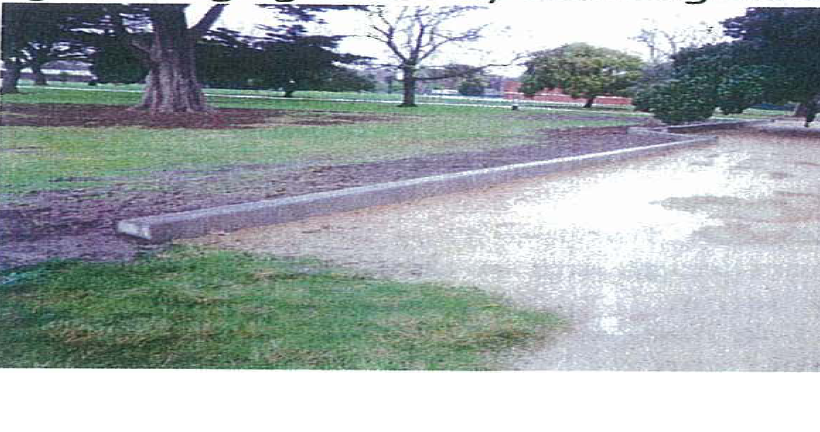
 The photo above, appears under the heading of ‘More Concrete’

“We were greatly perturbed to see the introduction of ‘tidy’ concrete kerbing instead of the friendly informal grass edging formerly abutting Inkerman Road. We cannot understand why Council appears so reluctant to engage in discussion and consultation with park users(including the Friends of Caulfield Park) prior to undertaking what appears to be non-essential cosmetic surgery. It would be far more useful to spend the money maintaining the crushed rock paths which are used and enjoyed by hundreds of people on a daily basis”.

COMMENT: Yes, and what of risk management? A lump of concrete sticking out (especially at night without lighting) when people use this path both for walking and running.

The Depot

“We firmly believe that continuing to alienate a large tract of land within our premier park for the purposes of a depot, largely to service a range of totally non-park related purposes, is a misuse and abuse of the land and the purpose for which it was given”

The Elm Avenue

“In our 2010 submission, we identified the need for urgent action. Nothing has been done as yet. A by-product of our tree identification program confirmed that whilst there is significant regrowth due to the recent rain, there is a large amount of dead peripheral growth that was scorched during the previous dry period. About half the elms are neglected and in urgent need of remedial pruning to facilitate proper regrowth.

COMMENT: The last quote can also probably be extended to every single park in Glen Eira. The lack of pruning and general maintenance endangers literally millions of dollars worth of council assets.

MR & MRS DOWD

“We note Council’s governance still intentionally, repeatedly secretive, deceptive, misleading. No real honesty, transparence, openness re Council’s informing ratepayer the real truth of Council’s share of Pensioner Rate Rebate as compared to Government share.

Councils repeatedly reduced its share as Govt. Increased its share. So intentionally shifty.

We note Council not only dissatisfied with about double CPI and inflation rise in rates, repeatedly, more rate payers will have to pay Interest for many years for Councils borrowing the maximum allowed for ever increasing extravagant spending beyond means despite all the ever increasing rates from those ever increasing over developments and congested boxes. The worst Council in Melbourne and with the least open space. Therefore the most destruction of open space and the liveability greatly reduced. Big brother knows best, using ratepayers funds against the best interest of the majority in favour of minority, also other who are not ratepayers and Government who also don’t contribute anywhere near ratepayers share”.

MRS BUTTON

“ I object strongly with being charged $55 for a green waste bin or penalized $145 P.A. as I have a 120 litre bin and no green bin.

As I am a widow 73 years retiree single, and living on my investments, in a unit without large trees and no large garden, myself and others in my situation are being unjustly discriminated against.

Glen Eira council is simply grabbing at this tax, in an unfair manner.

These charges have not bern thought out properly, and council is not acting fairly for its ratepayers.”

COMMENT: We envisage that the evening will unfold as follows. Perhaps some of these submitters will address council. They will be given their legal right of 3 minutes. Councillors will sit there mute; there will be no exchange between residents and councillors, and after a 30 minute meeting that will be the end of the story. Legal obligations fulfilled so that at the appropriate time the budget can be accepted and endorsed by council.

A very alert reader has just sent us the following –

Property Review Weekly June 10, 2011 page 20


Extract from C60 Planning Panel Report – July, 2010

Page 25, Section 3.2.2 – Overlays 

“ Two sites near the amendment land are affected by Heritage Overlays. These are No 1 Bond Street and the Caulfield Station.”

Page 131, Section 14.2 – Heritage – Evidence and Discussion

“ 1 Bond Street is a single fronted late Victorian Villa with substantial timber stables located at the rear. The house was built in 1887 and named ‘Grace Darling’ in 1910 after the winner of the 1885 Caulfield Cup. The property ‘Grace Darling’ is considered in the Caulfield Conservation Study to be of regional importance for its stables and pitched laneway;

Caulfield Railway Station Complex was constructed in 1913‐14. It is listed on the Victorian Heritage Register as a complex of architectural and aesthetic importance as an imposing Federation Free Style complex. The Victorian Heritage Register notes that the retention of the original station detail provides insights into social attitudes and railway practices immediately preceding the First World War and during a boom period in the history of Caulfield.”

Esakoff declared 3 conflicts of interest – as a director of company who owns one of the properties, and as her husband is also a director. Lipshutz Moved motion to accept/Pilling seconded

LIPSHUTZ: Reminded everyone that this had been before council previously as a result of an ‘anomaly’ in the Heritage Overlay in that 466 Hawthorn is the only property listed under the Heritage banner – thus ‘there is a mismatch between the map and the schedule’. The matter has gone to the Department and now there’s this new report where the heritage advisors state that ‘this is a property worth maintaining heritage’ over…..‘I have to respectfully disagree with them. I have been there, I have seen the property…I don’t agree’ that heritage should be kept, especially when one of these sites ‘is in a dilapidated condition’ and the owner claims he won’t repair anything. Since there were submissions the proper thing to do is go to a panel.

PILLING: Stated that he had chaired the planning conference and with the advisor’s reports, council should adopt the ‘cautious course’ and go to a panel.

TANG: ‘Imagine being a property owner’, buying the property and then years later discovering that it’s encumbered by a heritage listing and you can’t do what you envisaged that you wanted to do. ‘Put that against all the advice we’re getting’ from the heritage advisors…’it’s a difficult issue’….’there’s also a councillor involved’….’doesn’t mean that we treat them any worse than any other resident’….’I feel comfortable seeing this going to an independent panel’….’I note the heritage advice and would be prepared to see the heritage overlay clarified’ on all properties if that’s what the panel wants, but ‘in fairness to those who bought the property’ …’I think we should let this go to an independent panel’.

HYAMS: ‘This is a bit of a mess…..I don’t think we should be looking to apportion blame here…that one building would have addresses on two streets’….’owner of 2B didn’t know and ‘planning department only found out when there was an application for property next door’…’took all of our planning department by surprise’…..’several aspects that may have made it heritage worthy in the past….gone or been degraded….(gates, bricks painted)….’only two objectors neither of whom came to the planning comference’
..’and this despite the blog that likes to consider itself as influential….readers of that blog…usually the greatest sin a councillor can commit is apparently is to heed officers’ advice, especially unquestioningly….the blog is professing outrage….(that the heritage advisor’s recommendations are being ignored) …simply because a councillor has an interest ….with such breathtaking hypocrisy it’s no wonder that the people on this blog prefer to stay anonymous’. Councillors will ‘do what we always do’, look at advice …..’and make best decision’.

CARRIED UNANIMOUSLY

COMMENTS:

We assume that Hyams’ little fit of pique against the ‘blog’ to be a reference to Glen Eira Debates. That’s the second time in two council meetings that the ‘real’ Cr. Hyams has maybe stood up?  We accept this as a sincere compliment, since it indicates that we are definitely ruffling a few feathers and rattling a few cages. However, we need to correct some assertions made by Hyams. We are accused of ‘hypocrisy’ in that we have berated councillors for accepting ‘unquestioningly’ officers’ reports. If Cr Hyams would bother to look back at our post on this issue he would find the following as part of our commentary –

QUESTIONS:

  •  What is the point of council having Heritage Advisors when their professional opinion on a matter strictly to do with ‘heritage’ is overlooked and ignored?
  •  Why have Heritage listings in Diversity Areas at all if the argument is that ‘development’ should have priority?
  •  Why have Heritage Listings if the facile argument that such dwellings do not accommodate ‘modern living’ are given credence?
  •  Are the current Heritage guidelines in the Planning Scheme/MSS explicit enough to protect such properties?
  •  Is development classified as more important than ‘cultural heritage’ in Glen Eira?

This amendment is only one of a series, including planning applications, where we seriously question the content, logic, and recommendations produced in such reports and the logic then (mis)applied by councillors…….”. We continued that what we recommend is surety for all concerned. There’s also a post that we put up but did not author – it comes from a resident expressing their personal opinion.

Finally, in relation to this current item, perhaps Cr. Hyams has not read the rehashed officers’ report as closely as he should have. The report notes: “Council officers also sought the further views of four independent heritage consultants (David Bick, John Briggs, Roger Beeston and Dale Kelly). All concluded that the property is worthy of heritage protection”.

So that makes it 6 Heritage Advisors in total. How much did this recourse to ‘external’ advisors cost ratepayers Cr. Hyams? How much will referral to a Panel cost ratepayers Cr. Hyams? Why in the interests of transparency did you not once refer to this additional ‘evidence’ from ‘independent’ experts? And since it was at your urging that the current Councillor Code of Conduct contains the injunction that councillors read all material placed before them, we ask you -“Did you really read the new report?”. Or is the failure to mention these additional 4 expert opinions merely an example of ‘hypocrisy’? We welcome your response Cr. Hyams!


A few days ago we received the following email from one of our readers. We’ve been asked to maintain anonymity. Accordingly, all names have been removed.

“To whom It May Concern,

I thank you for the opportunity of this email. I have lived in McKinnon for nearly 27 years and I love the area. Issues that I would like to bring up include; the lighting in our streets at night. The lighting is very poor and it is dangerous for anyone to be walking home from the station at night. The night noise in Nicholson street on a Friday or Saturday night, (from) drunken people making a nuisance of themselves. I did call the police on an occasion and they did not follow through.

Yesterday I learnt that the controversial apartments that are to be built on the corner of Lees and Nicholson Street went to VCAT. The majority of residents did not know of this. Also my residence backs onto a laneway….. This laneway access no longer exists as (someone) has bought the lane. When decades ago….(there was the attempt)…to close the laneways the request was refused due to being on an easement. ….Currently (there is a new) two storey home on a previous existing ‘laneway’ and on an easement. I was told that (some people) had applied and bought the lane through adverse possession as there was no yellow board put up for this to occur. My neighbours have been broken into and the offenders are thought to have accessed the property from the laneway. Alcohol and drug affected persons use this laneway; young unattended children run in the laneway; drivers drive quickly through the laneway. The original purpose of the laneways was to access septic tanks (but) as these no longer exist – sell the laneways.

Regards xxxxx

A glimpse into the future for the C60?

Minister ignored advice on  tower

 Reid Sexton

May 25, 2011

Artist's impression of the new tower.

PLANNING Minister Matthew Guy ignored the advice of independent consultants  commissioned by the Department of Planning when he approved a 25-storey tower in  Footscray this week, with the development more than double the recommended  height.

The 80-metre, $90 million development on Moreland Street will dominate the  skyline of Melbourne’s inner-west when it is completed in 2013.

The Age revealed yesterday that the announcement had triggered a  bitter stoush between Mr Guy and local ALP mayor Sarah Carter, who said  Maribyrnong Council had not been consulted on the decision. She said Footscray’s infrastructure would struggle to cope with the people  who moved into the tower’s 222 apartments and flocked to its shops.

Mr Guy denied the claim, suggesting yesterday that Ms Carter may be taking  the stand to further her political career.

But a report written by urban designers SJB Urban in June last year and  commissioned by the Department of Planning and Community Development said ”the  maximum number of storeys, regardless of land use or building configuration”  should be 12 storeys on the site.

It based this recommendation on previous reports into the former industrial  area, which settled on the  12-storey limit based on transport, landscape and  economic considerations, among others.

Opposition planning spokesman Brian Tee said yesterday Mr Guy had ignored the  community, council and important advice paid for by the department. ”People  have to ask: who does this man listen to?” he said.

But Mr Guy said last night that the report was commissioned by the previous  government and was intended to provide advice only.

He said the large-scale development was necessary to cope with Melbourne’s  soaring population and would rejuvenate the former industrial area. ”The  Planning Minister is the responsible authority for this area and the development  fits with the provisions of the vision for the [area],” he  said.

ALSO FROM TODAY’S AGE

The Baillieu government has approved a 25-storey apartment tower in Melbourne’s inner-west, sparking a furious reaction from a mayor who warns it will ruin the local amenity.                       

The 80-metre, $90 million tower in Moreland Street, Footscray, will be  more than double the height guidelines for the area, says Maribyrnong  mayor Sarah Carter. It will contain 222 apartments and dominate the local skyline. It is  believed that building will start this year and be completed by 2013.

It has sparked a war of words between Ms Carter and Planning Minister Matthew Guy.

Ms Carter, an ALP member, said Maribyrnong council’s local planning  scheme recommended height limits of no more than 12 storeys because of  community concern. She said the tower would be the tallest in Footscray and would create an eyesore. Footscray would not have the transport services to support the people  the tower would bring and council would have to spend about $25 million  on pedestrian bridges, road and footpaths to cope.

The biggest shock was Mr Guy’s decision to go public without consulting the council. She said he had never indicated he was about to approve the tower despite his assurances he wanted to work with council. “He expressed he wanted to have an open dialogue with council [and] that  he wanted to work with us to get the best outcomes,” she said. “He’s indicated that’s what he was prepared to do [and] now he’s backflipped completely.”

Mr Guy said last night the council was consulted throughout planning and  that a big development was a necessary response to Melbourne’s  population growth. He said it was misleading to claim the tower would cost council millions  of dollars and he was shocked Ms Carter would reject a housing  development in an area with numerous transport options.

“I met with the mayor last week where we discussed the need for  large-scale development in [areas] such as Footscray,” he said. “At no  stage did she offer any objection to these comments [or] bother to raise  the issue of this Footscray development.

“I have never met the mayor prior to this meeting, thus her comments of me providing an undertaking to her are false.”

Opposition planning spokesman Brian Tee said: “If the Baillieu  government rides roughshod over Footscray then no community is safe.”

Planning Institute of Australia (Victoria) and Urban Development  Institute of Australia (Victoria) chief Tony De Domenico said the tower  would provide cheap housing near public transport

« Previous Page — Next Page »