GE Planning


PS: VCAT has handed down its decision on the 18 storey, 150+ student accommodation application in Derby Road, Caulfield East. A permit was refused. What is concerning however is that Monash was not opposed to the height and the member commented that anything approaching 10 or so storeys was ok. See: http://www8.austlii.edu.au/cgi-bin/viewdoc/au/cases/vic/VCAT//2017/1768.html

Officers have recommended the granting of a demolition and planning permit for 10 St Georges Road in Elsternwick. The application is for a 4 storey and 12 unit development in an area currently zoned Residential Growth Zone and is covered by a Heritage Overlay.

The report itself is remarkable. First off, we find innumerable contradictions from page to page. On page 23 of the agenda we are told that there have been 41 objections lodged. This changes to 39 objections on page 39. Next we are told (page 31) that there will be 25 car parking spaces in the underground basement. Since the proposal is for 8 three bedroom dwellings and 4 two bedroom dwellings, this should equate to 20 residential car parking spots plus 2 for visitors (at 5 per unit). We are then told that there is one shortfall in visitor car parking and that this is ‘acceptable’ from traffic management. These figures can’t both be right. Either there isn’t the provision for 25 car parking spots to begin with or someone can’t count!

The above is the mere trivia – but surely residents should be able to rely on officer reports that make sense and are accurate and non contradictory? The more important issues relate to the zoning and the actual recommendations.

HERITAGE

In the archaic 1996 Heritage Review the site is listed as ‘non-contributary’. Council’s current Heritage Advisor recommends that this be changed to ‘contributary’. We’re even told that he/she recommends that ‘Demolition of existing dwelling is discouraged’ (page 31). The Planning Department however, sees things differently and this paragraph neatly sums up council’s attitude to heritage –

Given the altered state of the existing building, its current non-contributary status, and that the replacement building will provide an additional 11 dwellings for future residents ….it is considered on balance, the demolition of the dwelling is acceptable.

Further on we get another comment that should boggle the mind – ie. a contradiction in terms – ‘modern’ versus ‘heritage’?

It is considered that the proposal has appropriately responded to the heritage context. This has been achieved proposing a modern design which does not mimic surround heritage buildings but uses materials (brick and concrete render) which reflect the surrounding buildings.

The report goes on to acknowledge that council is in the process of updating its Heritage Policy and that the building will now be classified as ‘contributary’. However, only current planning controls have statutory weight, therefore Council must consider the existing dwelling as ‘non-contributory’. Rubbish we say! Council can do what it likes as it attempted (unsuccessfully) to argue at VCAT recently regarding its future structure plans.

What should be borne in mind is that we are still waiting for a full Heritage review. Amendment C149 is only looking at existing Heritage Areas and all it will achieve is becoming a ‘reference document’ in the planning scheme. There must be countless properties that were somehow ‘missed’ in 1996. Thus for 21 years this council has been content to sit back and do absolutely nothing on Heritage.

THE RESIDENTIAL GROWTH ZONE

The fact that countless areas throughout Elsternwick, Bentleigh, and Ormond have been zoned for growth via the introduction of the residential zones in 2013, illustrates again the abysmal and shoddy planning of the time. Admittedly, council is now attempting to rezone such areas, including St. Georges. Too little, too late and granting a permit here does set a precedent. Also, we have repeatedly pointed out how many streets that are now earmarked for height reduction have already been destroyed by the number of 4 storeys contained within them. The current attempt to redress this stupidity is an admission of what a mistake the 2013 zones were!

Since there is no structure plan yet in existence, the argument presented for the heritage component remains the same. The area is zoned for 4 storeys, so it is legal and legitimate!

What is not acceptable in our view is the rationale that the planning department uses. Front setbacks are ‘reasonable’ even though ‘a mimimum setback of 8.7 metre is required to strictly comply’. Yet council is happy to accept 5.7 metres!!! Why shouldn’t developers comply ‘strictly’ with ResCode?

CONCLUSION & QUESTION

It would appear that in the battle between heritage and development the latter wins hands down. This will continue for at least another 2 to 3  years until council gets its heritage amendment up as well as its structure planning.

If council was really concerned about heritage we are certain that the recommendation could have been a refusal. At the very least this would have given time for the amendment to get up. When council is so ‘robust’ as to refuse scores and scores of applications for 2 double storeys in the Neighbourhood Residential zone, and impose these costs and time delays on applicants as they await VCAT hearings, we don’t believe that this couldn’t have happened in this case!

As a final comment, please note that the online version of the agenda was still not available at 4.30pm today. This, despite council’s promise that agendas will be available from 12pm!
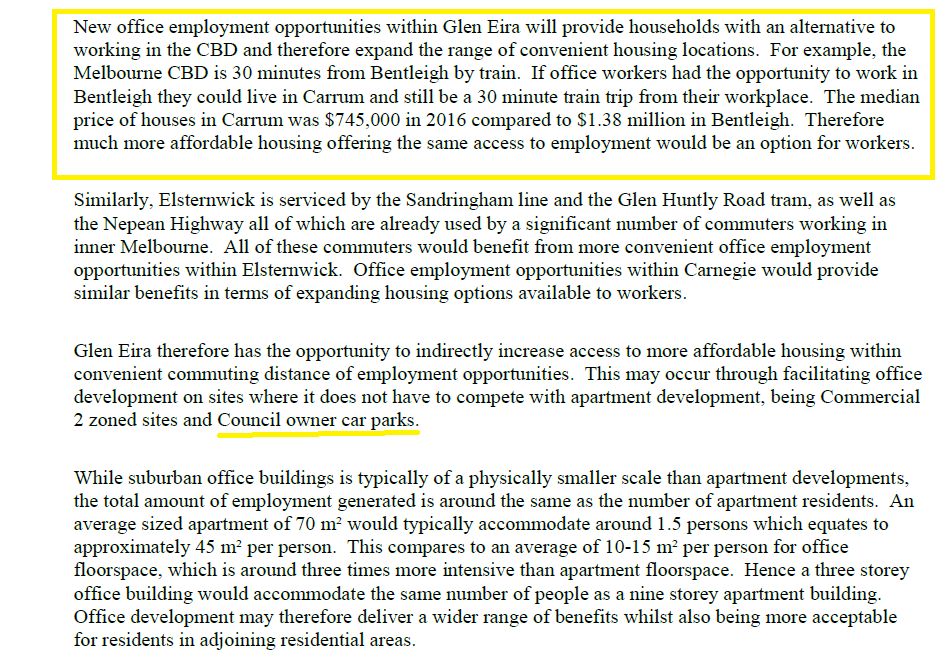

Council presumably pays big bucks for its expert consultants. Residents should therefore expect a lot more than what is ultimately produced. Featured below is an extract from page 30 of the recently released ‘economic analysis’. Putting it bluntly, we do not know whether to laugh or cry at the arguments presented and the assumptions inherent throughout.

THE ASSUMPTIONS

  • a given amount of office space in one location will equate in agglomeration benefits to the same amount of office space at a different location. And let’s not worry about car parking provisions which are far less for office space, etc.
  • The largest assumption of course is that companies will decide to rehouse to Glen Eira. In a March 2017 article written by the paper’s economic editor, the reverse was found to be the case – that companies are drawn to the CBD rather than the suburbs or regional centres. See: http://www.smh.com.au/victoria/melbourne-booms-while-the-rest-of-victoria-wilts-and-itll-only-get-worse-20170307-guslcg.html

Thus we have a 58 page document that is basically endorsing council’s proposals rather than objectively analysing and backing up its recommendations with sound data. A couple of other paragraphs from this report provide the overall tone and we believe, intent.

While there would be expected to be strong demand for office suites from various small businesses, the capacity for office development within activity centres is limited by developer‘s preference for apartment development. Council has the opportunity to facilitate office development on its car park sites through either planning controls or conditions placed on the sale of these sites.

There is the opportunity for Council to play a leading role in facilitating the development of new office space through its ownership of a number of car park sites within the Bentleigh, Carnegie and Elsternwick activity centres. This may take the form of either office suites or co-working spaces. Additional opportunities also exist within Commercial 2 zoned precincts on the Nepean Highway in Elsternwick and Moorabbin

Council‘s ownership of the two car park sites provides the opportunity to influence the scale of development and size of individual apartments in order to meet the needs of downsizers and families.


For the past year we have illustrated time and again how development in Glen Eira is at least double what is required to meet the housing needs for the various population growth projections. Residents have queried council’s reports since they all fail to answer, much less address the most crucial questions:

  • where is the justification for the claim that another 9000 net new dwellings are required in the period from 2016 to 2031?
  • Where is the existence of any calculations that include the addition of anywhere between 4000 – 6000 net new dwellings as a result of the Caulfield Village and the Virginia Estate developments?
  • Given the above, how on earth does council justify the expansion of the activity centres and the proposed rezoning of hundreds upon hundreds of properties to cater for higher, and hence denser, development?

To reiterate:

  • Plan Melbourne Refresh sets two rough targets for the Inner South Region of 4 councils – Bayside, Boroondara, Stonnington and Glen Eira. The period for this ‘required’ growth goes out to 2051 and not 2031. There is the ‘aspirational’ target of 132,000 dwellings and the other target of 125,000 divided between the four councils. Glen Eira’s ‘share’ is thus roughly either 33,000 or 31,000 over this time period. Divide these numbers by the 35 year time spread and Glen Eira’s ‘quota’ becomes a mere 942 dwellings per annum, or 885 dwellings per annum.
  • Since the zones were introduced in 2013 Glen Eira has been averaging more than double the ‘quota’ figures stated above. Last year alone the number of building approval permits granted totalled 2012. Planning permits for the first quarter of the current financial year tally 453. Thus we are looking at a full year of at least another 1800 net new dwelling permits granted. To argue as council has done that less than half will be built is sheer nonsense in our view. Once a developer goes to the expense of buying the land, hiring architects, planners, and eventually getting a permit, there is every incentive to build and sell in order to recoup his costs. Even with land banking, we would find it extraordinary for any developer to sit on his land for 35 years!

Until council and its hired guns directly answer the questions posed above (as promised), we have little faith that what is occurring is any different to what has gone before – ie a council determined to stick to its pro-development agenda to the detriment of the community.

Council has this afternoon published its draft structure plans for Bentleigh, Carnegie & Elsternwick. The East Village plans are yet to make an appearance. A quick summary of what is now proposed includes:

  • Bentleigh’s 8 storeys is now reduced to 5 storeys – although areas that were previously earmarked for a MANDATORY 4 storeys can now rise up to 5 storeys!
  • Carnegie and Elsternwick are still in line for 12 storeys but these areas are reduced.

The most disappointing aspect of these new plans is that residents are still to receive any details on:

  • Potential costings
  • Strategic justifications for heights proposed
  • No mention whatsoever of Caulfield Village and Virginia Park developments and how these might factor into council’s figures for meeting projected housing needs
  • Continual reference to ‘minimal change’ (ie NRZ) as containing 1 or 2 dwellings when council is already facing a dozen applications for multiple dwellings in the NRZ!
  • No real explanation as to why the borders of the activity centre, especially Bentleigh, has to double in size.

What irks us the most however is the question as to whether council is really committed to genuine consultation. If so, then perhaps they should explain why this advertisement appeared in Saturday’s Age on page 22 of the classified section, when we are being told that nothing is as yet set in concrete. It would appear that much is already predetermined – otherwise why spend a squillion on a tender before residents have even had the opportunity to consider much less comment upon the proposal?

We will comment in greater detail on these new plans once we have fully digested the content.

PS: we’ve neglected to mention another two major applications in Horne St. One is for 7 storeys and another for 9 storeys!

Elsternwick is, and has always been designated as a Major Activity Centre together with Carnegie and Bentleigh from the year dot. Thus when council announced its Planning Scheme Review and the start of the structure planning process, for some unaccountable reason, Elsternwick was not given a guernsey as part of the initial work plan. The excuse offered by councillors was that according to the popularity poll (aka survey) taken at the time it did not feature as prominently as Bentleigh and Carnegie. Six months later however, there was  a change of heart with no explanation. Now Elsternwick is joining Bentleigh, Carnegie and Virginia Estate as first cabs off the rank for structure plans.

The problem though is far, far worse for Elsternwick since it does not have any interim height amendments that were granted to Bentleigh and Carnegie.  Now that council has resolved to seek a year’s extension, that means that Elsternwick is open slather for developers for at least another 2 years if not longer.

It is worth speculating on the possible reasons for this situation –

  • Has council, or the department, or the minister always seen Elsternwick as fertile ground for massive high rise? What meetings, discussions, secret deals have possibly been made?
  • Have developers already come knocking on council’s doors and delaying any amendment is the result?
  • Since when does a shonky ‘survey’ constitute the rationale to overlook what the planning scheme says about ‘urban villages’? Worth remembering the outcry from Elsternwick residents when the draft concept plans (including 12 storeys) was announced and the claim was that residents weren’t sufficiently informed. If they weren’t informed about this, then what are the chances that they weren’t informed about some silly little ‘survey’?
  • And doesn’t the published draft plans substantiate council’s wish to turn Elsternwick into a high rise suburb?

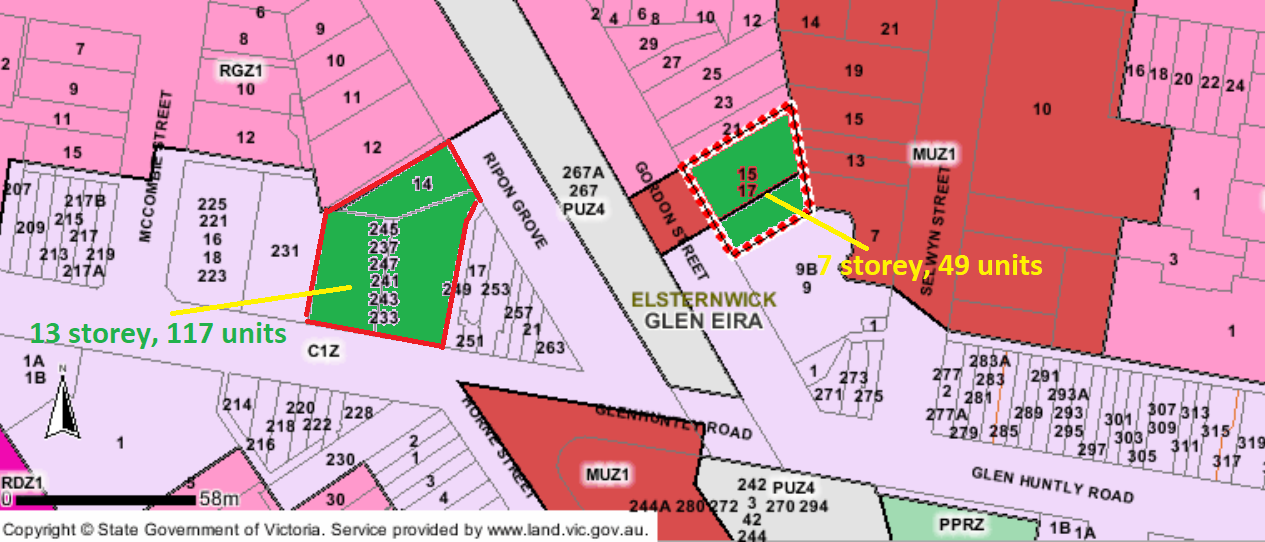
This is already occurring. Here are two current applications that have yet to be decided – but given the lack of any protection, and the unlikelihood that anything will be in place until at least 2019, Elsternwick has been left to the wolves.

15-19 Gordon Street ELSTERNWICK VIC 3185 – Demolition of existing building and construction of a seven (7) storey building containing up to 47 dwellings and food and drink premises, reduction in statutory car parking requirement and buildings and works in a Heritage Overlay

233-247 Glen Huntly Road ELSTERNWICK VIC 3185 & 14 Ripon Grove ELSTERNWICK VIC 3185 – Construction of a multi-level mixed use development including 117 dwellings, up to 13 storeys plus basement, reduction in visitor car parking and waiver of loading bay requirements

And just to add more salt into the wounds, the currently proposed change for 10 St Georges Road ELSTERNWICK from its zoning of 4 storeys down to 2 storeys has an application in for – Demolition of existing dwelling and construction of a four storey apartment building comprising twelve (12) dwellings above basement car park and reduction of visitor car parking requirements on land affected by the Heritage Overlay PLUS an application for ‘demolition’ even before heritage or the planning application is sorted out!

Readers should note that the application for 13 storeys will sit alongside what council proposes to be 2 storeys if it gets up. (See below). Much like Chestnut Street in Carnegie. There is also much more scope for development with the ABC studios/Ripponlea, Gordon Street, etc. etc. How on earth council didn’t know this was all on the cards and work diligently to ensure that Elsternwick was included in the earliest work plans is unfathomable – unless of course, collusion or straight out incompetence have played a major role here!

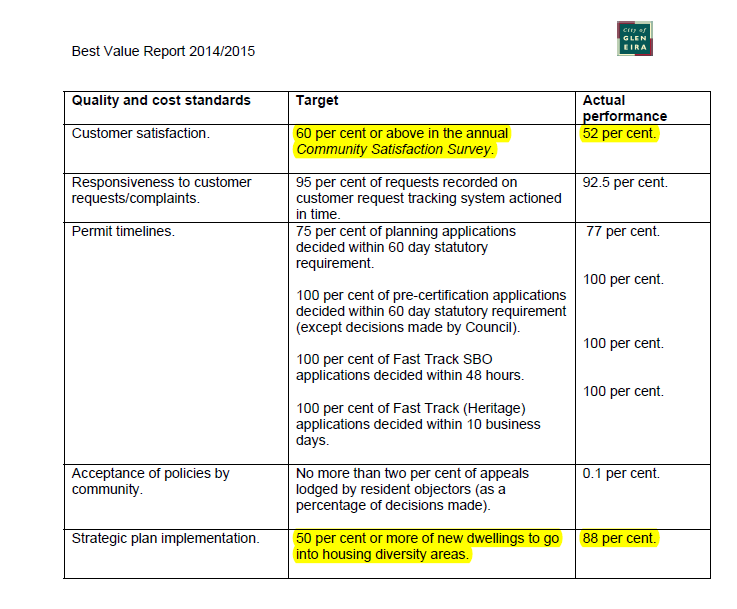
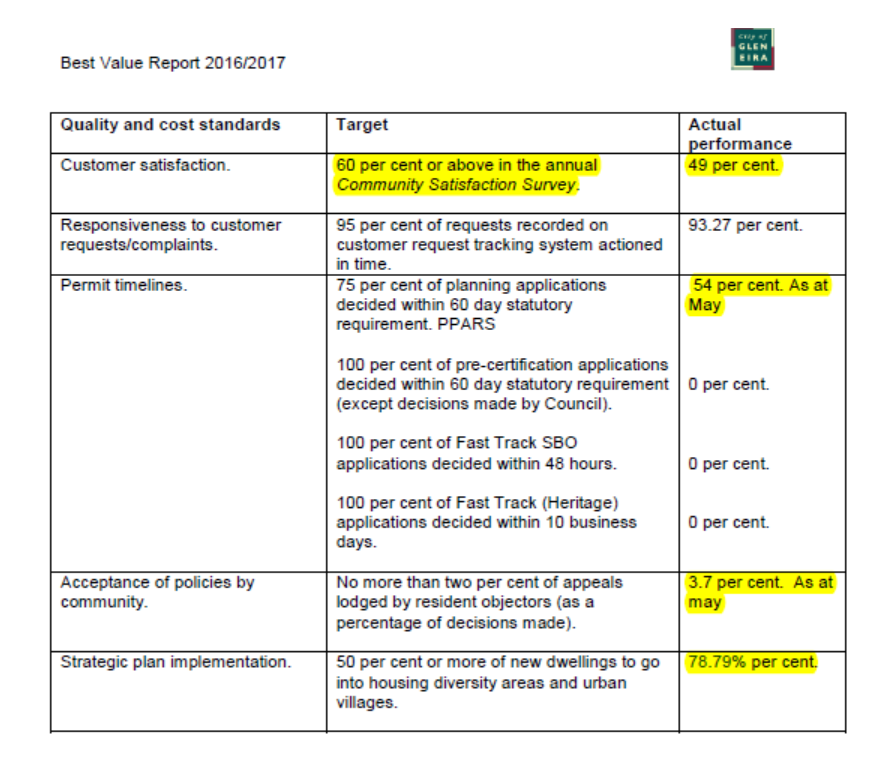
In this post we feature council’s results for Town Planning from the 2014/15 and 2016/17 Best Value Reports. Each of these reports is supposed to reveal what value for money residents are achieving from the services provided by councils. ‘Quality & Cost Standards’ are the criteria this is to be judged on. When we look at the criteria chosen by Glen Eira Council we find that they are literally meaningless and certainly do not reveal how well our hard earned money is being spent.

For example:

‘Acceptance of policies by community’ is to be evaluated by the percentage of community objections to applications. Why the ‘standard’ is set at 2 percent is anyone’s guess. More importantly, given the increased costs at VCAT, the time and effort taken to appeal, and residents’ negative perceptions as to VCAT’s ‘objectivity’, it is no wonder that there are fewer objections from residents rather than developers. But does this mean that the community ‘accepts’ council’s policies? And what of developers themselves? Some are surely locals. Why doesn’t council judge the ‘acceptance’ of its policies by the entire objector base rather than immediate neighbours? Plus, of course, the number of objections reveals absolutely nothing about the adequacy of council’s decision making to begin with. How many applicants object to council’s decisions and imposed conditions because they are in conflict with the planning scheme itself, or simply erroneous? We’ve had plenty of VCAT decisions that go in favour of the developer because of such incompetence. And then of course we get the impasse of less than half of respondents being satisfied with council’s town planning and yet the same policies remain year after year with no attempt to address the real issue – abysmal strategic planning!

Until we achieve standards that actually mean something and tell the whole story, the Best Value reports remain nothing more than another exercise in spin, self promotion, and obfuscation!

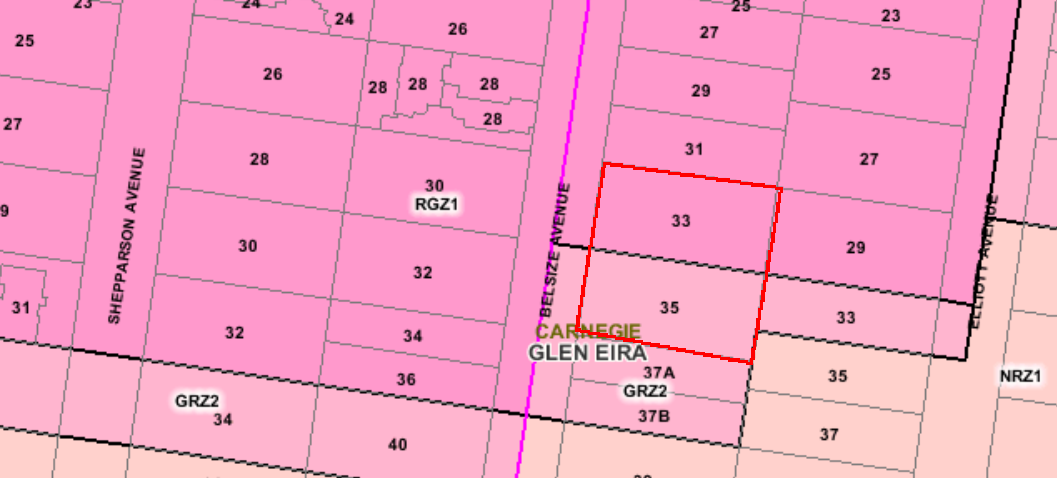
Another disappointing VCAT decision for 33-35 Belsize Avenue Carnegie. This consolidated site runs across both the GRZ and RGZ (ie 3 and 4 storey) current zoning. The applicant got his permit for these heights and 29 dwellings.

Council’s draft structure plans featured this area south of Neerim Road as being ‘downgraded’ to double storey. This decision is simply another nail in the coffin for council’s plans – exacerbated even further by the request for another year’s extension on structure planning and the interim height guidelines. By 2019, we can only speculate as to how many other such developments will occur in these streets!

Below is what the member had to say about council’s plans and their current ‘value’.

Source: http://www7.austlii.edu.au/cgi-bin/viewdoc/au/cases/vic/VCAT//2017/1399.html

There has been some recent attempt by Council to manage this rate of change including the introduction of interim height controls and the preparation of a draft concept plan. I was provided with a copy of the Carnegie Draft Concept Plans and Carnegie Background Report-Building Transition Plan both dated July 2017. These documents propose side-by-side townhouse style development of 1-2 storey scale for all of Belsize Avenue and surrounds, other than along Neerim Road where terrace/ townhouse development of 2-3 storeys is contemplated. The document states that:

Carnegie has experienced a significant transformation in recent years with apartment developments being constructed in traditionally low scale areas. Current policy supports dense apartment developments with little consideration for the area’s existing character. The scale, rate of change and quality of new building stock are all issues that have been raised through consultation.

The Building Transition Plan looks to limit the amount of four storey apartment buildings in the long residential streets of established homes in Carnegie.

Ms Maude expressed concern that if the future changes set out above are implemented that the proposal before me will stand in complete contrast to the new planning framework. I find this strategic work is in its very early stages and cannot be given weight as a seriously entertained planning proposal. I cannot speculate as to future changes in planning policy and must apply the current planning scheme that seeks increased development throughout the urban village with the scale and intensity generally guided by the differentiation between the zones. I must apply the planning scheme as I find it.

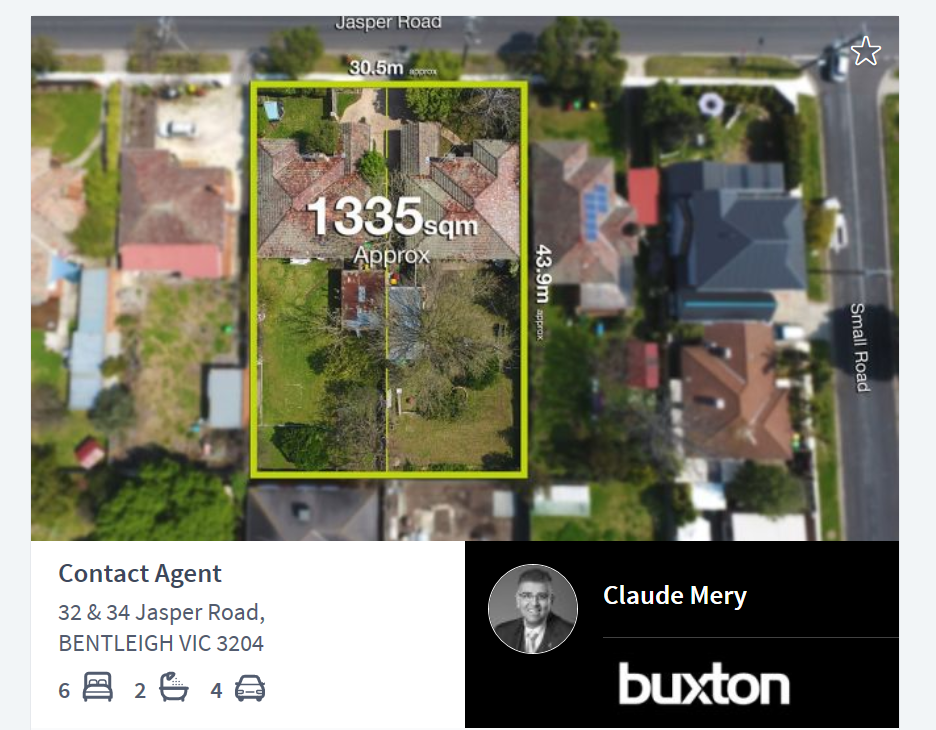
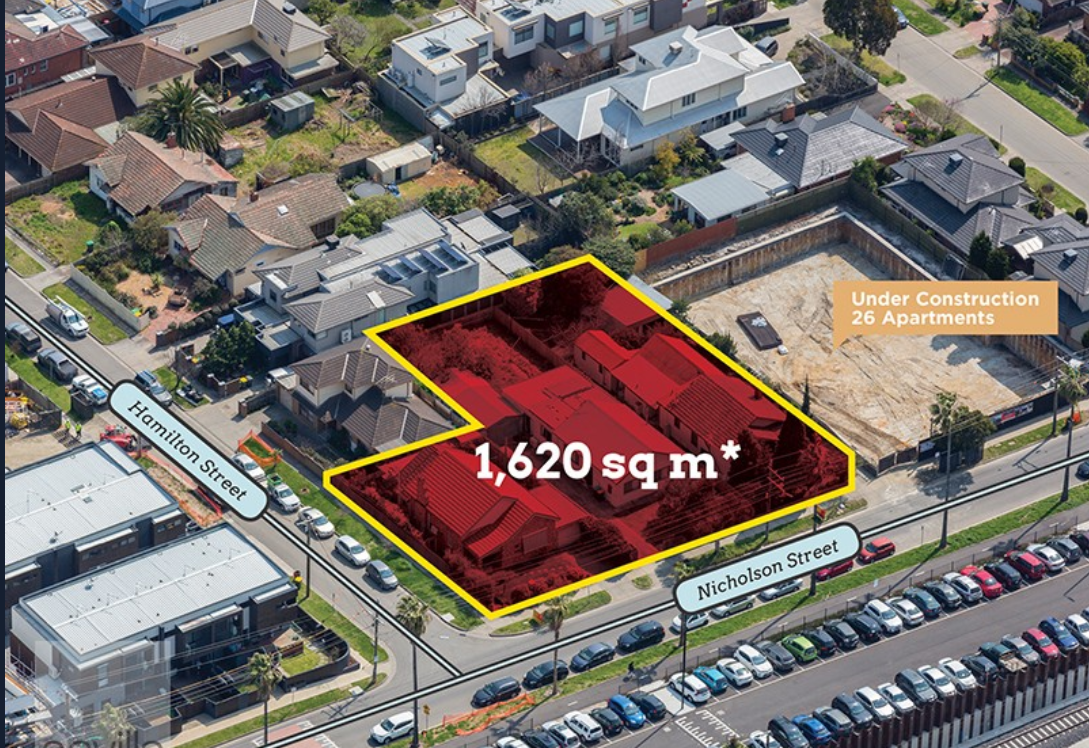
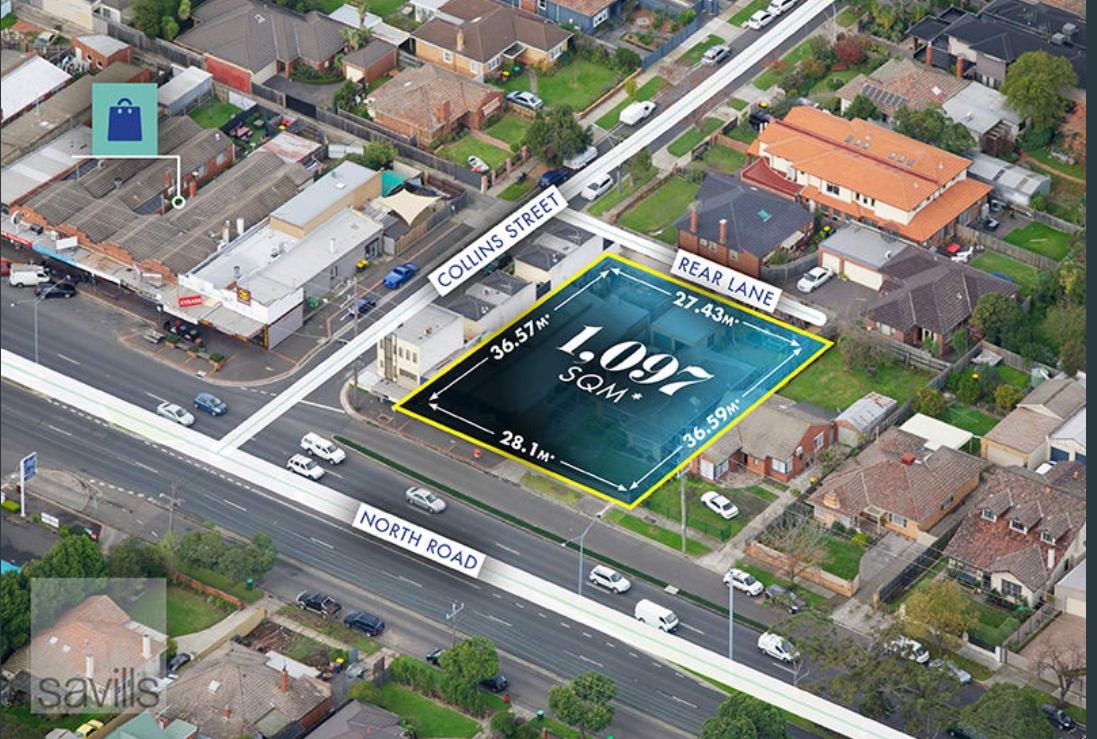
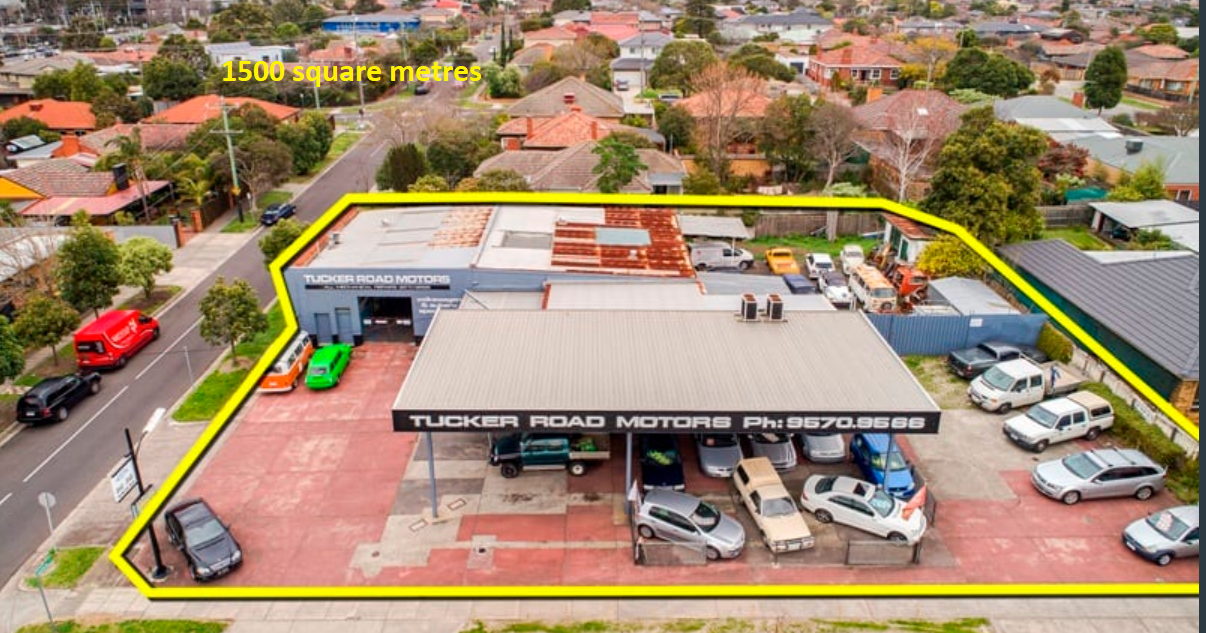
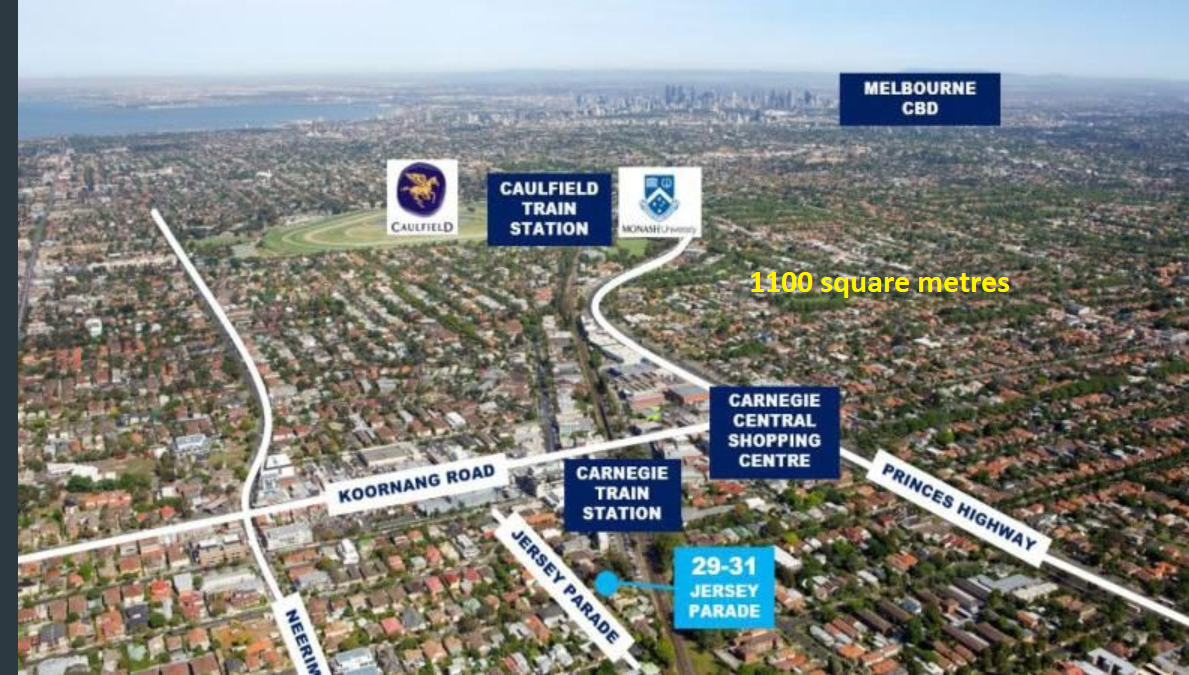
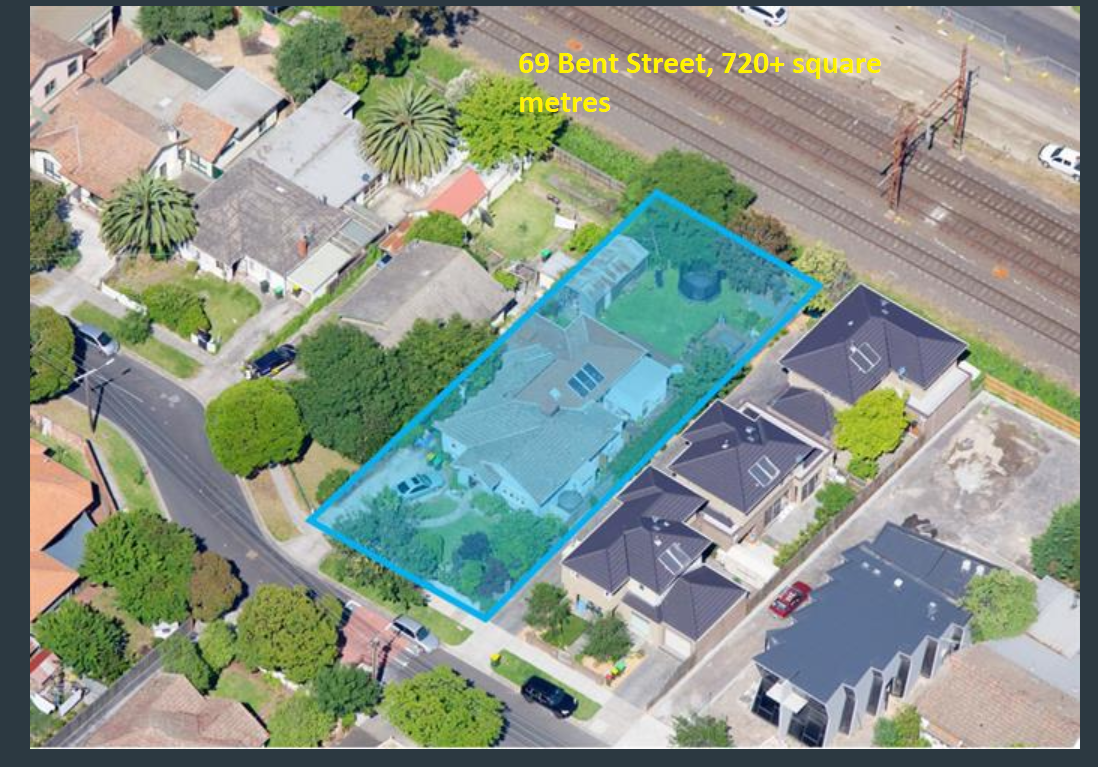
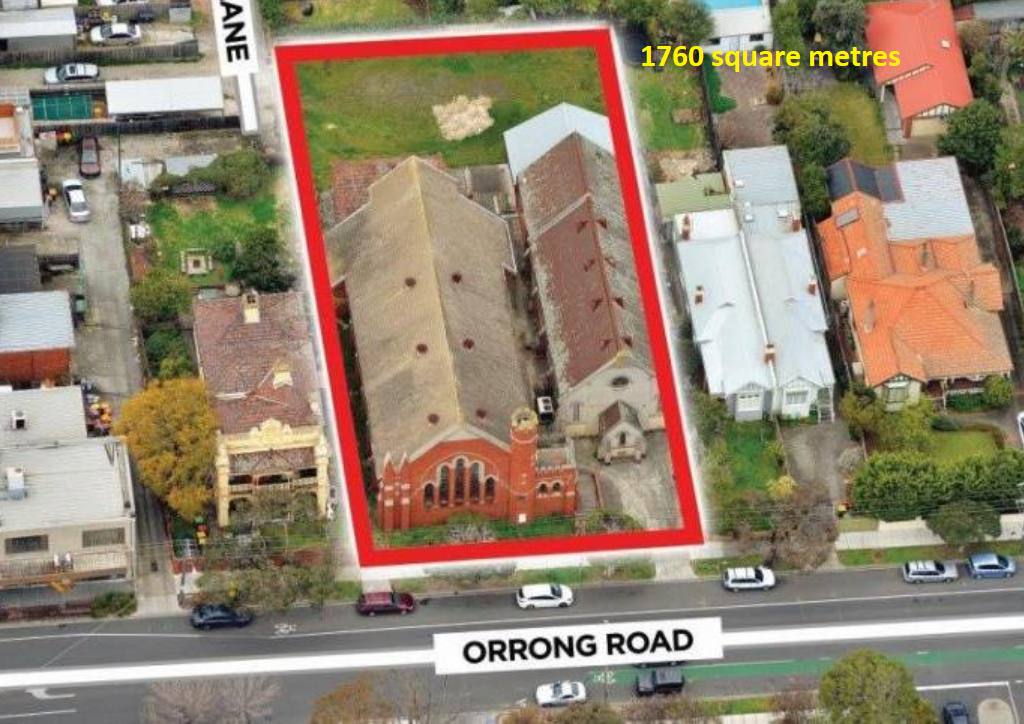
The following screen dumps feature land currently for sale. Most are within ‘neighbourhood centres’ and one is in Elsternwick. Council is now asking for a year’s extension on its interim heights amendment, with no clear dates set for its neighbourhood centres structure plans where plenty of development is occurring. The future is writ large in these shots!


Apologies for this long, long post. It concerns the agenda for Tuesday night’s council meeting. There are many items that deserve comment – some good, some bad, and some particularly atrocious and misleading!

THE GOOD

After years and years of complaint regarding council’s lack of transparency and accountability, there does appear to be some movement at the station –

  • Item 9.8 recommends a tender be decided for telecasting both ordinary and special council meetings. We certainly welcome this and hope that those councillors who previously opposed such a move will now vote in favour. One proviso however is that no mention is made of when this will be up and running (if voted in).
  • For the first time there is now a running sheet of motions to be put forward at the MAV state conference – including how council will vote on the various motions. Previously these were all decided behind closed doors, so again a welcome new initiative. However, we also note that the rationale behind council’s position on many of these motions has not been included.
  • Another item features the review of the Community Engagement Policy. One important advance is the promise to ‘monitor’ and ‘evaluate’ the outcomes. For some unknown reason however, the actual policy is not included in the online agenda!

THE BAD

The most important item for this section is council’s application for an extension on the interim height amendments for Bentleigh and Carnegie. The current amendment expires on December 31st 2017. Council is now requesting a one year extension. What this basically means is that residents will not have the structure planning work completed and gazetted for the major activity centres until at least mid 2019! Worth remembering is that there is not even any ‘interim’ protection for Elsternwick! Further, no mention is made of the current neighbourhood centres – these could be waiting well into the 2020’s! Our concern is that with the constant delays more and more development will occur that will undermine the very objectives of the structure planning work itself. For example: it will be very hard to argue for a 5 storey mandatory height limit when countless buildings already exceed this height and which leaves the door open for similar developments over the next 2 to 5 years. What is certain is that if development continues as it has, especially in neighbourhood centres, then any attempt to rein in development will be that much harder if not impossible!

The above leads onto questioning council’s whole approach to their planning process – namely:

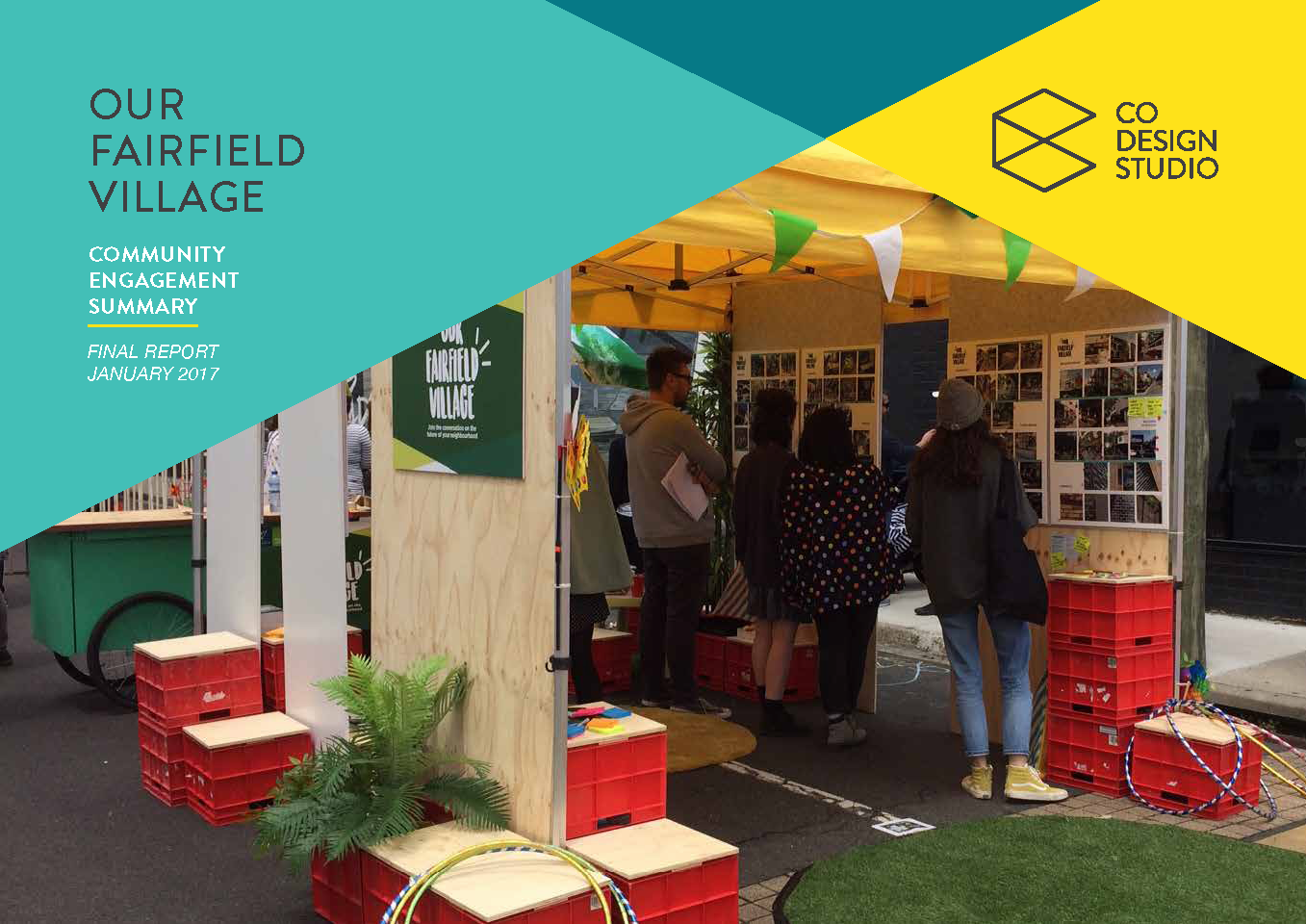
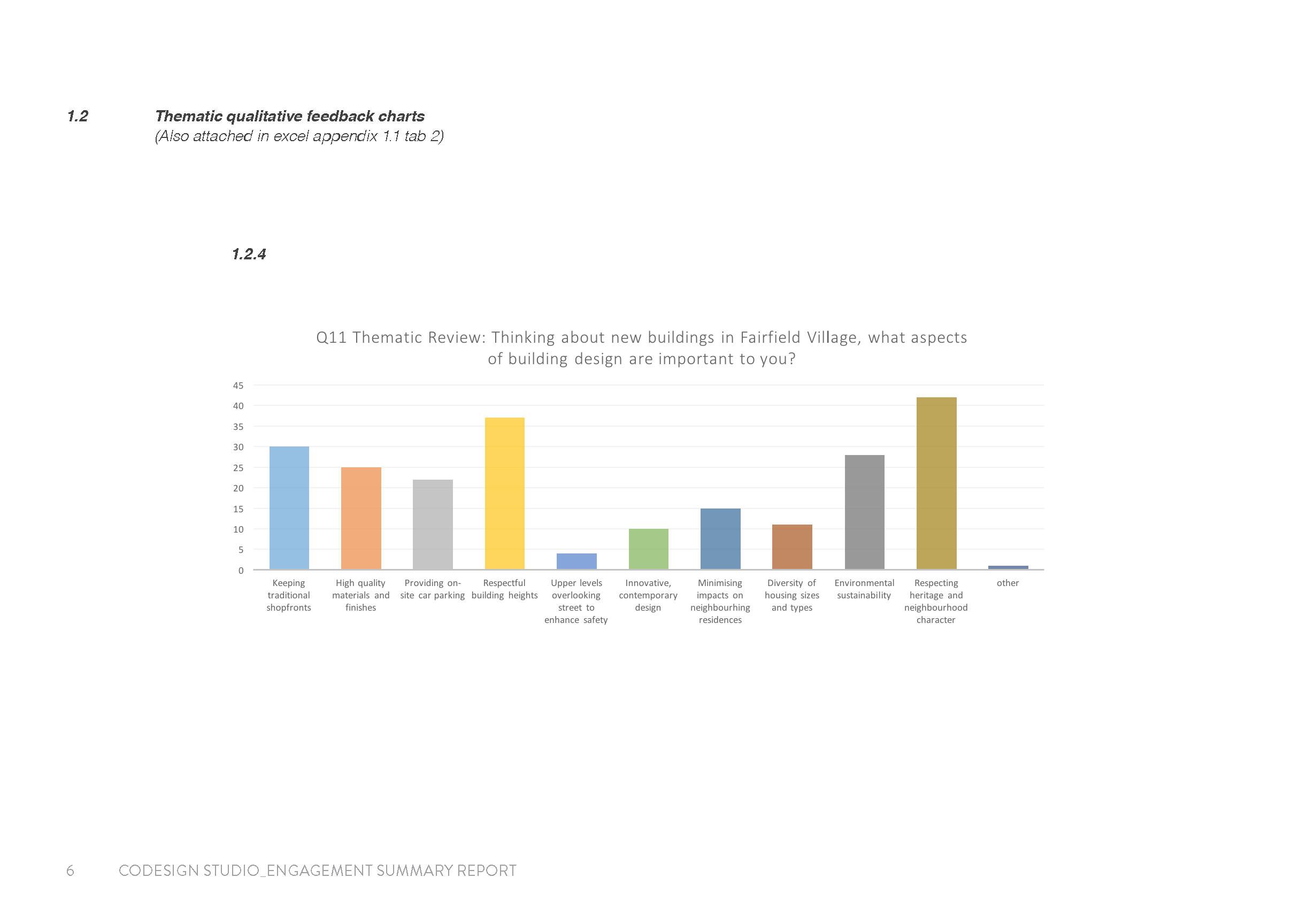
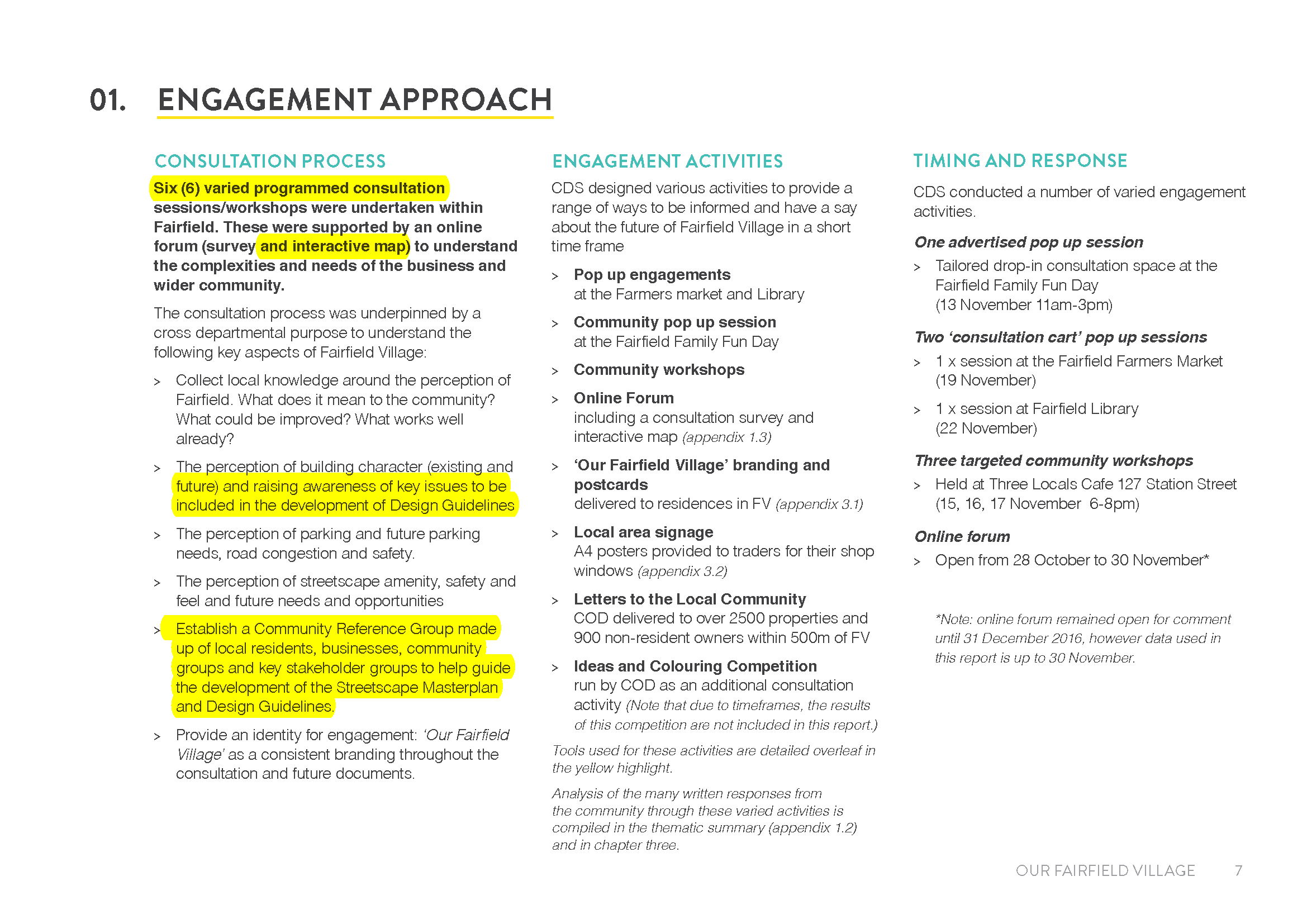
  • Why has it taken til now for those in power to realise that council’s approach to consultation has only now become ‘tangible’ to residents? What does this imply about the intent of the ‘consultation’? We have remarked previously on the lack of detail provided, the lack of strategic justification provided, the lack of genuine reporting of community feedback. From the first stage we have queried the validity of council’s approach – ie asking questions such as ‘what do you love about your shopping strip’ only serves to focus residents’ attention on the commercial strip itself. It does not guarantee that feedback will focus on the primary issues of development, open space, traffic, infrastructure, etc. As an example of what should have been done, and could have been done, readers may find the following screen dumps informative. They come from the Banyule consultation on Fairfield. Please note that the same consultants were used by Glen Eira. The difference in approach is staggering. Why is it that for the Banyule consultation this company included direct questions on height, traffic, etc. and in Glen Eira none of these queries were specifically included in the initial consultation. Surely the only reason to explain this is the brief provided to the consultants! In other words, hired guns again doing council’s bidding!


Plus some screen dumps of the initial ‘consultation’ processes employed in Banyule. Compare this with what Glen Eira did!

  • Given the amount of work required why has it taken over a year to advertise for an additional 4 planning staff (ie consecutive ads over 2 weeks). And this is on top of continued planning applications, VCAT appeals, etc. and council repeatedly bemoaning the fact that they have been inundated with applications and that more and more cases end up at VCAT. This trend has been evident since the introduction of the zones but it has taken 4 years to act!
  • Making matters even worse is item 9.2 in the agenda. For a ‘simple’ 2 double storey application in Thomas St, East Brighton, council couldn’t reach a decision in the required 60 days. This, despite the fact that they admit the following – The application was lodged on 28 November 2016. The application was advertised from 27 April until 15 May 2017 and 1 objection was received. The applicant lodged an appeal at VCAT on 6 September 2017 against Council’s failure to make a decision within 60 statutory days. Our sympathies to the developer in this instance since it is unfathomable why such an application should take forever to finalise! Of course, this means more money spent by ratepayers at VCAT! Please note we are not commenting on the merit of the application – merely on the unbelievable time lines.
  • We also observe that in the past year or so the number of refusals for 2 double storeys in the NRZ has gone through the roof. Invariably, our analysis indicates that in over 95% of cases that end up at VCAT, the applicant gets his 2 dwellings!
  • The only ‘positive’ out of all this is that council has at least had the good grace to publicly admit how inept it has been – there has been community feedback regarding the overall process including:
    • Requests for city-wide dwelling forecasts that inform the structure planning
    • Improved communication to all residents and landowners within the study area for the next stage of engagement
    • An appropriate level of detail for best consideration of positive and negative impacts of the proposals

Ensure the next round of consultation period allows affected parties enough time to read through the released information in detail, attend information sessions and provide a response to Council.

Surely this should have been a given right from the start? 

THE UGLY

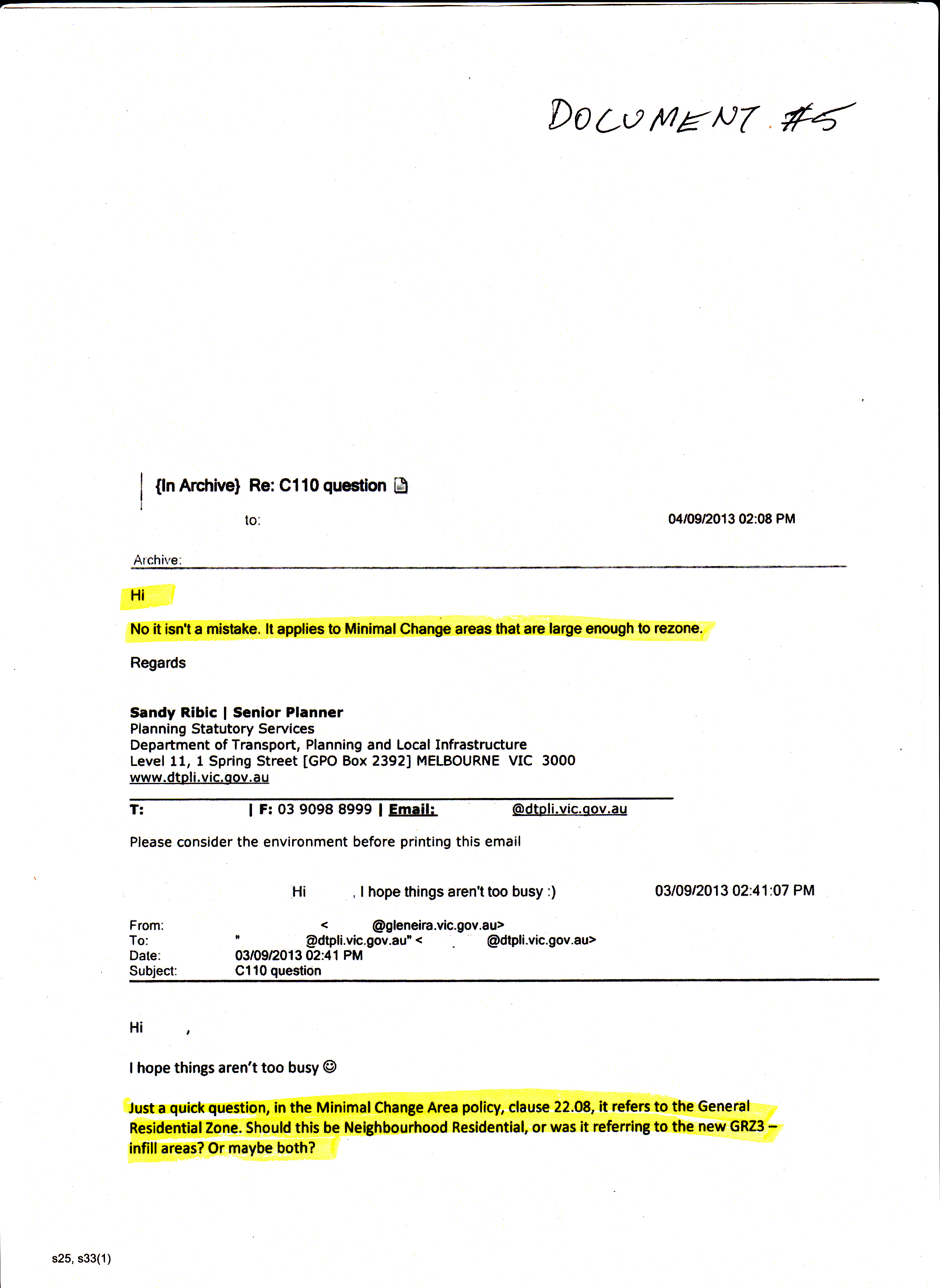
The ‘ugly’ aspect of this agenda is council’s continued inability to reveal the truth in an honest and upfront manner. Instead we are presented with the usual spin and misleading statements designed to basically cover up what actually happened. Here is the offending extract –

We have commented on this issue previously, (see: https://gleneira.wordpress.com/2014/08/19/inept-or-indifferent/) but will repeat the evidence which shows beyond any shadow of a doubt that:

  • Senior officers knew of this ‘error’ back in July 2013
  • That from the department’s point of view this was not an ‘error’ but a required trade off for the introduction of the residential zones
  • Council also knew that at least one case went to VCAT where the developer tried to use this clause to his advantage (unsuccessfully).
  • To now turn around and claim that this ‘error’ has only been ‘recently’ discovered is a blatant lie! Even if Akehurst and Camera (the ‘architects’ of the residential zones) are now gone, Torres is still at council as are many other senior planners. Where is corporate memory? Why can’t council simply admit the truth?

The decision for 277-279 Centre Road, Bentleigh has finally been handed down by VCAT. The original application for a 9 storey development was amended by the applicant to 7 storeys. VCAT granted a permit for the 7 storeys.

What is crucial in this decision is the fact that the site sits within the recently gazetted amendment for a 5 storey preferred maximum height – ie under the Design and Development Overlay (DDO8). The amendment was hailed as the ‘solution’ to overdevelopment by council and the Minister – despite residents wanting mandatory height limits for the entire area.

There are several extracts from the decision worth highlighting. They reveal once again council’s inept planning – ie almost nonsensical would be a good description of what constitutes the amendment and its decision guidelines (in bold below). It also points to the current ludicrous plans to allow 8 storeys! Finally, we also find mention of the necessity for a parking precinct plan – something that has been on council’s mind for the last 15 years! They have just never got around to doing anything of course!

The take home message is clear:

  • preferred maximum height limits are useless
  • council’s planning department is performing well and truly below standard
  • these decisions need to be addressed in any structure planning and to ensure that all the countless loopholes are removed
  • strategic justification was not in existence for the Carnegie/Bentleigh amendments. We maintain that they are non existent for the current activity centre structure planning as well!

The source for the following extracts is: – http://www.austlii.edu.au/cgi-bin/viewdoc/au/cases/vic/VCAT//2017/1656.html

It is Council’s submission that the introduction of the DDO8 was to temper expectations and outcomes during the period that the controls apply and clearly seek to limit the nature of the development proposed. What Council does not state however is that the overlay does not impose a mandatory height in ‘Area 3’ such as other ‘Areas’ have. This suggests to us that the controls allow for consideration of heights that do exceed the Preferred Maximum. We therefore look for guidance from the DDO8 in assessing the proposed development.

  • If we refer to the decision guidelines of the DDO8 as the relevant ‘test’ to assess if seven storeys, instead of five storeys is appropriate, we make the following findings.
  • Council put to us that this site fails to perform a transitional function (within the activity centre) resulting in a jarring impact at the edge of the Urban Village. We do not agree with this submission. This site is not at the edge of the Urban Village, it may be at the edge of DDO8-3 and DDO8-1. Therefore, we do not agree that it is the role of the site to perform a transitional function. There is currently a five-storey building under construction on the corner of Rose Street which is at the edge of DDO8-1. This is the site that performs a transitional role to the centre and Residential Zones beyond it. The review site is located within the retail hub of the Bentleigh Urban Village and whilst it is not located on the railway station, it is also not located at the edge on Rose Street. We conclude that we do not agree with Council that this site is to serve a transitional function.

There is nothing in the Planning Scheme to require a uniform height in this location. The decision guidelines of DDO8 question whether the proposal is compatible with and respect the character of neighbouring buildings within the same streetscape. We find this a curious guideline. How can a building ‘respect the character of an adjoining single storey neighbouring building when the preferred maximum height is five storeys? Is it to be interpreted that the DDO8 control determines that (in this case) a five storey building adjoining a single storey built form is respectful? It would be nonsensical to assume that a proposed built form even at five storeys would be considered as ‘not respecting a neighbouring building’. This is an example of where strategic work would provide for background as to what and how a guideline such as this is to be interpreted, if indeed, it remained in the overlay. We consider that it has to be the way the proposed built form responds to each interface that is most important, just as the podium base of the building is respectful of the form of built form within the street. This guideline is balanced against others including policies calling for more intense development in activity centres and urban villages.

We conclude that it is reasonable to reduce the car parking requirement and waive the requirement for the 4 residential visitor and 17 commercial spaces. The planning scheme also supports sustainable transport alternatives and the efficient use of car parking. In response to Council’s concerns regarding the future development of the centre and the potential increased car parking pressure, parking in the centre as a whole is a broad issue and one that may warrant strategic planning in the form of a car parking precinct plan.

« Previous PageNext Page »