GE Planning


The much vaunted ‘Objector’s Bill’ has been passed and is currently awaiting gazetting. Both the Liberals and the Greens did not oppose the bill; nor did they introduce any amendments – despite the countless criticisms. It remains to be seen whether this legislation will have any effect whatsoever.

Pages from DOC190815 - Planning and Environment Amendment (Recognising Objectors) Act 2015-1

Several recent VCAT decisions reveal in full, glorious detail, the utter fumbling, Keystone Cops approach by our planners, elected representatives AND the countless drawbacks (failings) of the Planning Scheme. We also draw attention to the incestuous nature of the development industry. Former Glen Eira planners are now working for private companies and appearing in the very same role they had with council (ie Andrew Bromley was council’s officer at VCAT. He now appears at VCAT for the developer. Ms Bowden is also with the same company).

There is definitely a ‘cut and paste’ mentality in many of the decisions and conditions handed down by council. Entire slabs are transferred willy-nilly from one application to another, without it would appear, having any sound basis. Conditions imposed become the modus operandi of a council fighting its own planning scheme. Often, as in the following decisions, residents have to wonder whether common sense and competence have entirely deserted those involved.

Decision #1 – 14-16 Elliot Avenue, Carnegie. The application was for 4 storeys and 21 dwellings. Officers recommended a permit and councillors decided (as per their usual tactic) to lop off one storey and increase setbacks. Lobo was the only councillor to vote against the Esakoff and Okotel motion. (Zoned RGZ1) In her decision, the member rejected most of the conditions imposed by Council and modified countless others.

The top floor required to be deleted by the contested condition is recessed from the lower floors. The setback of this floor meets Standard B17 of Clause 55.04. As an interface with its neighbours, the proposal meets the test of side and rear setbacks. If Council is of the view that a four storey presentation to Elliott Avenue is not appropriate, there are ways of managing it, such as further setting it back from the street rather than deleting the whole floor altogether, with a loss of three dwellings. On policy and emerging character basis, this condition is not justified and will be deleted.

This condition requires the basement to be setback a minimum of 3 metres from the rear (eastern boundary) and 5 metres from the front (western) boundary. The reason for this condition is to provide adequate ground soil volume to achieve the landscaping required by Condition 9. ….. Council submitted that the extent of the basement footprint would significantly constrain the ability to provide canopy trees. It reasoned that the additional setback of 2 metres at the front and 1.2 metres at the rear, (currently proposed at 3 metres at the front and 1.8 metres at the rear) would provide additional in-ground landscaping opportunities to soften the building. …..In opposing this condition, Mr. Bromley cited a number of Tribunal decisions where Council has sought permit conditions to increase setbacks for the purpose of landscaping[4] and which were rejected by the Tribunal. In fact, the depth of setback from Elliott Avenue sought by Council at No. 2 Belsize Avenue is 3 metres[5] and 2.8 metre for 330 Neerim Road[6], and not the 5 metres sought in this matter…..If a 3 metre setback was considered by Council to be adequate for landscaping elsewhere in the area, requiring a 5 metre setback in this instance is excessive. I accept Mr. Bromley’s submission that it is not necessary to further increase the setback of 3 metres from the front and 1.8 metres from the rear. This condition will be deleted.

This condition requires part of the northern bedroom of Unit 102 that cantilevers into the front setback to be deleted. Council submitted that this part of the bedroom of the dwelling cantilevers over the ground floor into the front setback area, and that removal of this part of the bedroom would reduce the dominance of the building when viewed from the public realm. A careful reading of the design of this part of the building indicates otherwise. The cantilevering of this dwelling is not confined to the bedroom, but the living and dining area of that dwelling. Even if the wall of the bedroom is recessed according to this condition, the balance of the northern elevation of that dwelling still cantilevers over the ground floor. I cannot understand the purpose of this condition. It will be deleted.

The remaining contested condition is 1q) which requires written confirmation from a qualified traffic engineer demonstrating that the basement and ramp complies with Clause 52.06 of the Glen Eira Planning Scheme, and that vehicular access is acceptable. Condition 1d) already requires the basement access and layout to comply with Clause 52.06 and to the satisfaction of the responsible authority. If it does not and is not approved by Council, such a layout does not become part of the endorsed plan. This condition is superfluous. (and deleted).

Decision #2 – 64-66 Bent Street, McKinnon – application for part 3 and part 4 storey with 31 dwellings. Council officers recommended permit. Councillors refused permit but only after Sounness and Pilling lost a motion to grant a permit with conditions. Hyams and Esakoff then moved to reject. Final vote was 5 to 4 with Magee, Pilling, Sounness and Lipshutz opposing refusal.

It is important to note that this policy is not about respecting the existing neighbourhood character. There is no preferred neighbourhood character nominated for housing diversity areas. For residential development, it is about scale relative to the commercial centre, for it not to dominate the streetscape, and promotion of site consolidation to maximise development opportunities.

It also means that the scale and building mass of a development, if it is not at the edge against a lower intensity zone such as Neighbourhood Residential Zone (a minimal change area) would not be the same as the existing low scale single storey single dwelling character of an area, if that were the current character.

Decision #3 – 1A Orrong Crescent & 632 Inkerman Road, Caulfield. 4 storey mixed use; 18 dwellings, 3 shops. Zoned C1Z. Officers recommended permit with conditions. Councillors voted unanimously for 3 storeys and 16 dwellings.

Condition 1(a) requires deletion of the third floor (top level) and the roof replaced by a style that is consistent with the architectural style of the building, and which may include pitched forms. This condition was not a recommendation of Council officer’s, and has the most severe impact on the yield of the development. Condition (d) requires additional setback of the third floor. As this condition is to require further setback of the top floor which is required to be deleted, it contradicts Condition 1(a).

As for policies, there is common ground that the site is not specifically covered by a policy that relates to a site in a Commercial 1 Zone and which is not part of an activity centre. The commercial centre in Kooyong Road just south of Inkerman Road is not contiguous to the site. That centre contains single, double, and 3 storey commercial buildings. The site is in the Commercial 1 Zone, and the existing building has been a commercial building for many years, decades before planning controls. As for the notion that the site should be treated as if it is in a residential zone such as the Neighbourhood Residential Zone as its surrounding properties, it is not so in fact or law.

How many more times must council be knocked back on attempting to include the no parking permits as a condition of a permit instead of in the ‘notes’? Obviously very, very slow learners – or do they even bother to read, analyse and assess VCAT decisions?

This condition requires the permit holder to inform all purchasers about this planning permit with regard to Note C. Note C states that residents of the dwellings in this development will not be issued Residential parking Permit (including visitor parking permits). Council explained that it is its standard practice that residents of medium density development do not qualify for residential parking permits, and that this condition will ensure that all purchasers are informed of this position. A permit condition is a requirement. Once the development is complete, there is no further requirement to be met. A ‘Note’ is information and not a requirement of the permit. It is not appropriate to make a ‘Note’ as if it is a requirement of the permit.

Decision #4 – 482-4 North Road, Ormond. Application was for 4 storeys and 24 dwellings. Officers recommended deletion of 3 dwellings and other conditions. Councillor majority voted for 4 storeys and 19 dwellings. Zoned MUZ

My discretion regarding the appropriate setbacks to the south boundary is guided by the provisions of the zone and by the planning policy framework. The land is within the Mixed Use Zone. The purposes of the zone are to implement policy, to provide for housing at higher densities and to encourage development that responds to the existing or preferred neighbourhood character of the area. There are no specific design requirements in a schedule or overlays.

I consider the local policy framework strongly encourages robust built form in the Ormond NAC. It is one of the preferred locations in Glen Eira for higher density housing that can contribute to broad housing diversity objectives. This necessarily means buildings in these areas would be taller, with greater massing and bulk than the prevailing lower density single dwellings.

I have noted above that clause 32.04-6 specifically excludes standard B20 as one of the clause 55 amenity tests to be met. I accept it must be considered as part of the overall assessment. I consider this specific exclusion was intended to convey an expectation that the bulk and massing of a building in a Mixed Use Zone could be somewhat more robust and intensive than might be acceptable in the other residential zones. This is to facilitate more intensive buildings in this zone, including commercial and industrial buildings that typically have higher floor to ceiling heights relative to residential buildings.

Finally, there is no objective or statutory basis in the scheme for the 9 and 18 metre setbacks required by Council. These setbacks are not based on any standards of clause 55. They are not derived from local policy, a schedule to the zone, a design and development overlay or an adopted urban design framework or local policy. Furthermore I note that the rear of other nearby 3 and 4 storey apartment buildings have not been required to have setbacks similar to the ones proposed in this review. I consider the setbacks are arbitrary, subjective and excessive requirements.

Glen Eira has designated Bentleigh, Elsternwick, and Carnegie as Urban Villages where the majority of new development is supposed to go. All the rest are either Neighbourhood Centres or Local Centres. There are ten Neighbourhood Centres and 23 listed ‘local centres’ in the Planning Scheme. The Phoenix Precinct has its own category as a Priority Development Zone.

According to the Planning Scheme, residential development in Neighbourhood Centres, is meant to adhere to the following:

Apartments and shop top housing is encouraged within the commercial areas of these centres. Single dwellings and multi unit development are encouraged immediately adjoining the commercial areas of these centres.

AND

Encourage a decrease in the density of residential development as the proximity to the commercial area of the neighbourhood centre decreases.

Thus, according to this prescription, multi-unit development is only to go into those areas “IMMEDIATELY ADJOINING THE COMMERCIAL AREAS”. Then why oh why has so much of these neighbourhood centres been zoned as GRZ1 – ie three storeys?

It is obvious that the zones do not match what is stated in the Planning Scheme, with the result that huge swathes of McKinnon, East Bentleigh, Murrumbeena, Ormond, Caulfield South and others, have been all given the green light for 3 storey multi-unit development.

Local centres are even worse off since these are pockets of land zoned commercial that more often than not, directly abut neighbourhood residential zones. The Planning Scheme states:

Recognise the minor role that local centres will play in providing for housing diversity by encouraging development limited to low density shop top housing

AND

Ensure that residential development (except in Patterson and Gardenvale local centres) does not exceed two storeys in height

Since there is no height restriction on land zoned commercial, this is indeed pie in the sky – as recently proved with a three storey development at 251 Koornang Road (zoned commercial 1). Why such errant nonsense still remains in the planning scheme is beyond us. Nor has Council even attempted to introduce any restrictions on its small shopping strips as Boroondara has had success with. Nor have they introduced any Design & Development Overlays as this comprehensive document from Bayside demonstrates (uploaded here). Council has done nothing except slap Commercial zoning on a handful of businesses without due regard to the fact that many of these ‘local centres’ are surrounded by residential, low rise single dwellings – all zoned Neighbourhood Residential zone.

Once again it is inept planning and a bonus to developers.

So here is a quiz on the zones that readers might like to have a go in responding to. We would bet that councillors and even officers wouldn’t know the answers to most of these queries!

  • Which suburb has the largest Commercially zoned area?
  • Which suburb has the largest percentage of its land zoned GRZ1?
  • Which suburb has the largest percentage of its land zoned GRZ2?
  • Which suburb has the largest percentage of its land zoned RGZ1?
  • Does Glen Eira really have 78% zoned NRZ1?
  • What percentage of residential land area in Carnegie is geared towards medium and high density development because of its zoning? How does this correlate with the nonsense of 80/20 – ie minimal change versus housing diversity?
  • How many streets in Glen Eira have multiple zonings (which was advised against by the C25 Panel Report)? – ie RGZ, GRZ, NRZ, MUZ, C1Z?
  • How much ‘infill’ has occurred in Neighbourhood Residential Zones – ie two double storeys per block?
  • How many sites in Glen Eira are over 1000 square metres, larger than their neighbours, and according to the planning scheme, capable of accommodating more than two dwellings – regardless of them being in Neighbourhood Residential Zones?
  • How many amendments has Council pushed through to rezone land to Mixed Use since the introduction of the zones? How does this compare with other councils? Please remember that Mixed Use has no height limits, no open space requirements, etc.
  • How many VCAT decisions that overturn council are largely due to the ‘policies’ contained in the Planning Scheme?

These are the questions we believe that residents need answers to since they go to the heart of sound strategic planning. If this council is so confident that its planning is ‘perfect’, then they need to be able to justify their planning decisions. Thus far, all residents have received are shonky figures, complete failure to fulfill the ‘promises’ of a decade ago, plus execrable statements that consulting with residents would result in worse outcomes. For any council to hold such a view is utterly abhorrent.

We’ve received the following email and series of photographs highlighting (once again) the chaos that residents have to put up with. Why this goes on and on and developers allowed to own our streets is incomprehensible. Even if fined, we’re told that either the fine is ignored, or it’s so miniscule that it is a drop in the ocean for most contractors working on multi-million dollar projects. It is our understanding however, that councils have the legal right to set their own penalties. A $200, or even $300 dollar fine is negligible. It is time that this council got off its backside and starting properly policing, fining and prosecuting each and every single developer that does not give a damn about those living next to his mess.

In order, here is:

  • The email we received
  • The photos depicting day after day

What we do not have photos of is the claim that on Friday last, there were 16 trucks parked in the Carnegie Street – three with trailers attached. The street in its entirety is approximately 200 metres long. Residents were unable to get out of their drives.

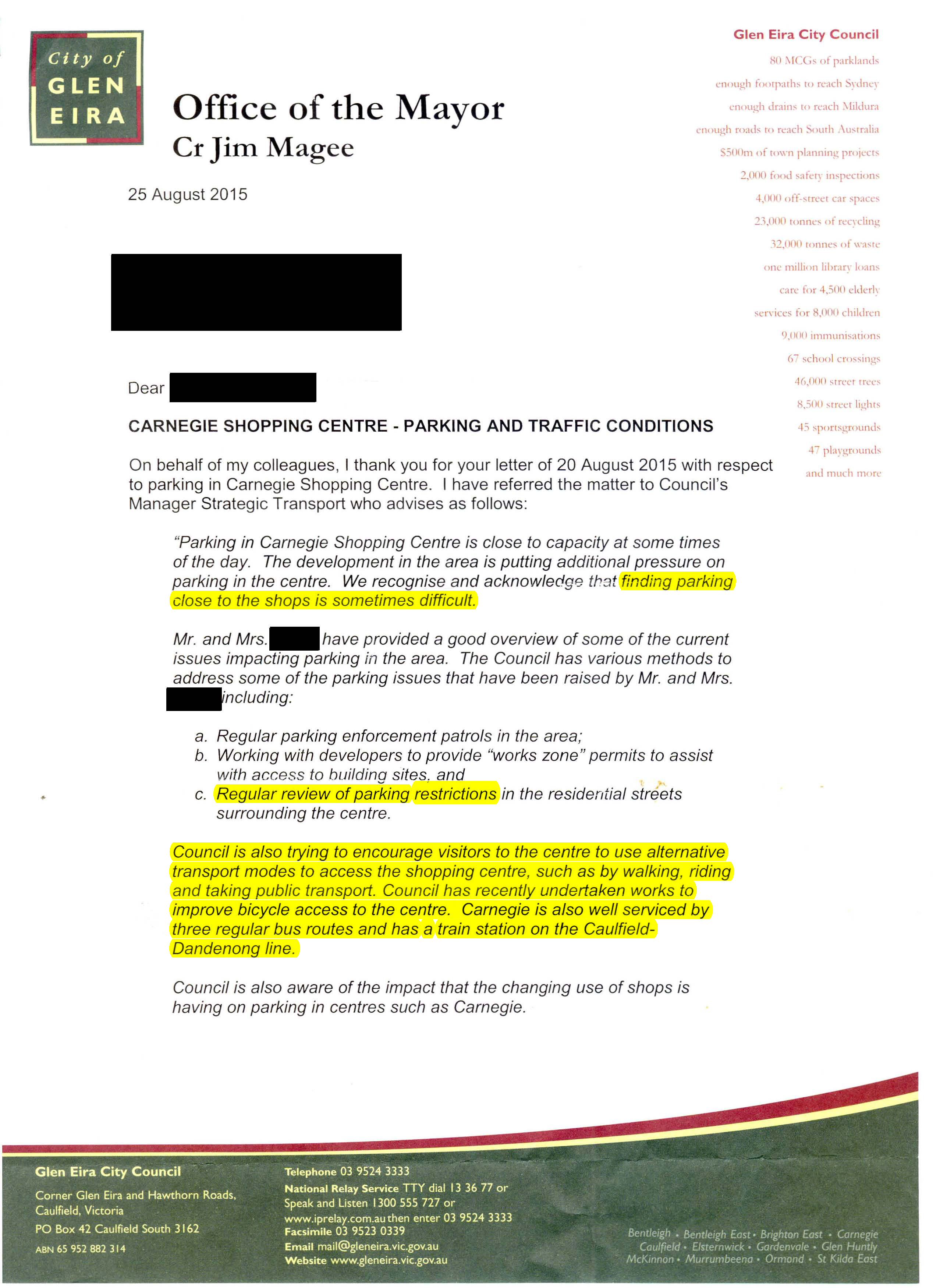
Development has a major impact on us everyday and council just doesn’t care and doesn’t have the interest in doing anything about it!! Our neighbourhood has been impacted, like so many others, by a local single block development in Carnegie. The developers and construction company have had no regard for publicly owned property, no regard for public access, no regard for neighbours and have had a number safety breaches on site that I understand have resulted in fines and orders to rectify the site. This week council has been contacted everyday to complain about the impassable footpath that has been created by the construction company. The attached photographs show the problem. The daily calls have resulted in 3 notices being issued to the construction company (Wednesday) – but the result was no change at all – the footpaths remain impassable. Calls were made again on Thursday and Friday – again no change to the footpaths at all. This morning the solution seems to have been found! ‘Use other footpath’ signs erected. So the developers get away with completely ruining public infrastructure and are not made to immediately rectify the damage – no strong action from council, nothing that does anything to protect the health and safety of residents, nothing that makes a strong statement to developers about not damaging public property. This council is shameless and completely ineffective.

138.

148

115solution

From Elizabeth Miller’s Facebook page – https://www.facebook.com/ElizabethMillerBentleigh

miller

gillon

Source: http://karl-gillon.me/

PS: The latest spruiking!

em

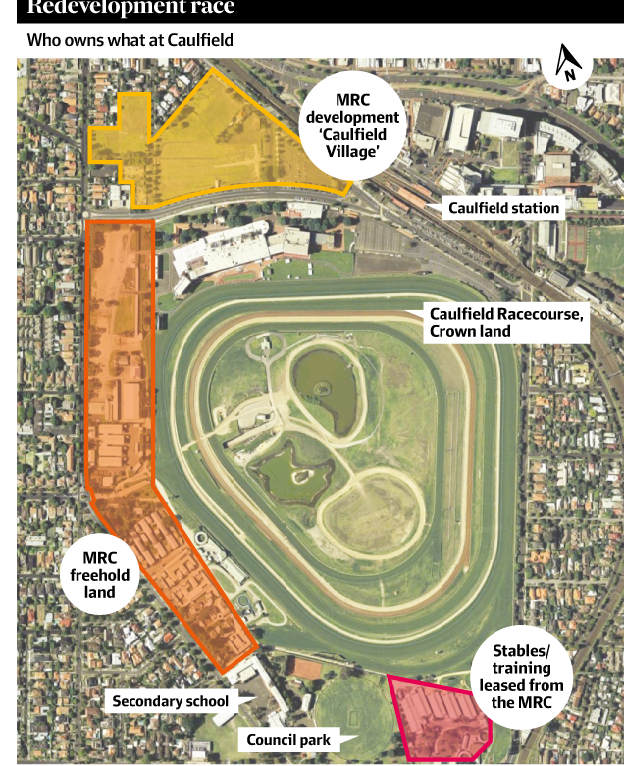
ITEM 9.7 – MRC

(ESAKOFF, LIPSHUTZ & SOUNNESS WERE APOLOGIES FOR THIS MEETING)

Delhunty moved an alternate motion that included: that the MRC has entered into a lease with the Alliance group involved with the level crossing removal project where “commuters’ will be allowed to ‘park for free’. This is a ‘sub lease arrangement’ and is ‘valued at approximately $90,000 -$100,000’ for 2 months. Motion also said that council write to the Trust to ensure that ‘they are aware’ of the arrangement. Also copies go to Minister for Environment & Climate Change, Lisa Neville, Auditor-General and members of parliament. Seconded by Magee.

DELAHUNTY: said that the report was first off about access arrangements for the public and what has been happening. Not a lot has been happening but there are ‘other current arrangments’ including a ‘commercial’ deal that has ‘been struck between the Alliance’ and the MRC ‘that values the Guineas car park, conservatively’ for $90,000 for 60 days. That’s just over $1,400 per day. In the ‘stalled’ lease negotiations between the Trust and the MRC ‘their offer and their apparent independent valuation’ is ‘offering the community 30 cents a day’. From this disparity, we ‘can see how absolutely outrageous’ the MRC’s offer on the lease is. ‘It shows what contempt they hold the community in’. ‘We won’t put up with it’ when the MRC itself values the land far more highly. Thus in the private arrangement the MRC ‘are making now what would cover’ their current lease. Even the 95,000 for the lease is a ‘poor outcome’ for the community when there is a valuation which says they should be paying closer to a million dollars for the lease of the land. Said that the starting point for any negotiations should be ‘what they have valued’ the car park land as. She is ‘hopeful’ that in passing this information on to ‘ those negotiating’ the lease that there will be ‘a better outcome for the community’.

MAGEE: started off by saying that the MRC ‘doesn’t seem able to put their hands on the agreement’ of 2011 and he suggests that ‘they look in the same filing cabinet’ where they can’t find the documents for the leases for the ‘northern stables’ and Aquinita Lodge. Ratepayers and taxpayers of Victoria are ‘paying in excess of a billion dollars’ for the grade separation but the MRC is ‘making a profit out of it’. They think that ‘you need us’ so we are ‘happy to sub-let Crown Land which you own’ and make you pay for the land that you own’. When the price they are paying for t’that small car park’ is ‘extrapolated’ across the 50 hectares of land then the ‘one million dollars is insignificant’ because it becomes more like ’40 or 50 million dollars’. Said that the MRC ‘are not what they portray’ themselves to be – they aren’t community minded nor a ‘friend of Glen Eira’. They have the ‘absolute need to profiteer’ and to ‘charge’ the taxpayers of Victoria to ‘park on their land’. ‘This is not only appalling. This is sickening’. Said that the ‘minister should be aware of this. The minister should be commenting on this’. If the MRC are ‘allowed to sublet’ the Guineas car park, then they can ‘sublet any part’ of the racecourse. Question is ‘what are they allowed to do’. Said there is ‘no lease in place’ and that it is an ‘ongoing, day by day’ process. Plus ‘anyone who sits back and accepts this’ is equally in contempt with the MRC.

OKOTEL: endorsed the motion and ‘queried how genuine’ the MRC are about ‘talking with council’. From the ‘invitation’ in the letter printed in the agenda, council has ‘sought’ a meeting with the MRC but it is ‘disappointing that they don’t seem to be able to make the time’. Said that there is no time set aside ‘as yet’. Thus, whilst the tone of the letter suggests they are ‘willing to have an open discussion’ that’s not happening but it’s important for council to ‘continue to advocate strongly’. ‘Despite’ the letters they get ‘very little progress is being made’.

HYAMS: asked for an amendment that when ‘further information’ is received that a report be tabled. This amendment was accepted by the mover of the motion and seconder.

DELAHUNTY: what needs to be finalised is the lease but negotiations ‘have broken down’ because there is ‘an incredible discrepancy between valuations’. The MRC has for the last 20 years paid about $90,000pa. They think it’s valued at $100 per year and the ‘council obviously thinks much higher’. The lease to the alliance shows that the MRC doesn’t value the land at $100 per year but much more and they are ‘trying to take the trust and the community for fools and we won’t stand for it here’. Their subletting will ‘help move the lease’ negotiations forward because it shows their own valuation of the land.

MOTION PUT and CARRIED UNANIMOUSLY


The Melbourne Racing Club is at it again – acting as if it is their god given right to do whatever they want on public land, whenever they want, and without any concern for nearby residents. This time they want a ‘timing system’ which involves the erection of 31 radio towers (height 13 metres) scattered across the racecourse and costing, they claim, $570,000. Naturally, the Department (as land manager) has given its approval (see uploaded letter here).

Throughout the application there is not a single word about environmental impacts nor potential safety concerns for residents – nor for that matter horses! Instead there is repetition upon repetition claiming ‘non-significant impact on the visual amenity of the area’. One paragraph in particular caught our attention –

3 antennas are proposed within the centre of the reserve and will be located directly adjacent to the track and existing infrastructure. The location of these antennas will ensure that the visual impact is minimal and the use of the public open space area remains unaffected.

Yes, 13 metre high poles of steel are certainly compatible with visual amenity and ball sports that council is advocating. Another nail in the coffin for more public open space if this goes ahead!

Here is what the poles will look like and where it is proposed they will go!

PS: please note that the heights will exceed 13 metres, since this calculation does not take into account the footings upon which the poles will rest.

Pages from 31_Station_Street_Caulfield_East_Vic_3145_-_Advertised_Documents

31_Station_Street_Caulfield_East_Vic_3145_-_Advertised_Plans_Page_1

The following two pages appear in the agenda items for Tuesday night’s council meeting. They pinpoint very clearly the sheer incompetence of this administration and its councillors – plus the ongoing ‘born to rule’ mentality of the MRC. Many issues need to be investigated and fully reported on – namely:

  • What has Council done in the past 4 years to ensure that the Clayton’s ‘agreement’ is in fact bona fide and worth the paper it is written on?
  • Council in 2011 published an ‘agreement’ signed only by Newton. Why wasn’t this countersigned by the MRC or Trustees? What actions, if any, did council undertake to ensure this occurred?
  • What representations, if any, has council and/or councillors made to MPs following the Auditor-General’s report?
  • Were councillors told prior to Newton signing the non-existent ‘agreement’ that this still required the MRC’s signature?
  • What further ‘information’ is likely to ‘come to hand’?
  • What is the nature of the ‘discussions’ that have taken place between Council (and whoever was involved) and the MRC in the past 2 years? Why has there not been a single report tabled in regard to such meetings?
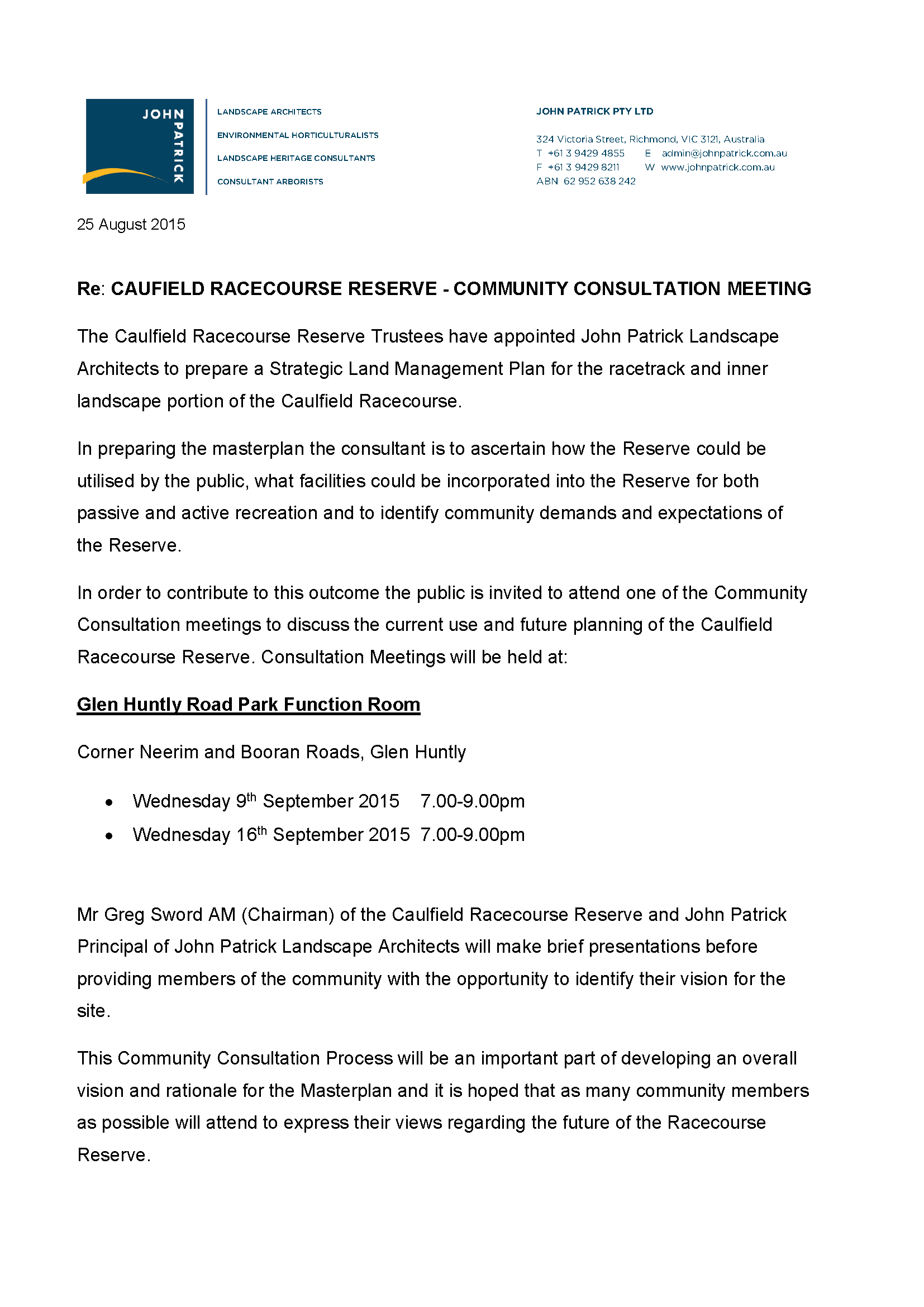
  • We have been informed that the MRC is currently creating a Master Plan for the centre of the Racecourse? What involvement has council had with this? If none, then why not? If yes, then why the ‘secrecy’?

CONCLUSIONS

We can only conclude from all this that:

  • there is NO AGREEMENT!
  • that residents have been dudded
  • that administration and councillors have allowed this situation to drag on to the detriment of all.

Pages from Agenda_11_August_Page_1Pages from Agenda_11_August_Page_2

PS: We’ve received the following email from a resident and believe it needs highlighting. We have edited out the address.

Dear gedebates.
Our street, Elliott Ave Carnegie has now lost 8 houses, between Neerim Rd and Jersey Pde (railway end) not including the corner blocks on Neerim Rd to the rampant development.  We were rezoned 2 years ago to RGZ1 and there are only 7 out of 15 remaining. We live at XXXXX Elliott and have found out the three houses next to us, to the north have been sold. We will also be facing 5 houses opposite us, all of which will be 4 stories, in a street of single dwellings. The dramatic increase in traffic, people and loss of our community is devastating after a peaceful and lovely 35 years.
I know this is happening everywhere. We feel helpless and incredibly angry with the council.
where to from here?

We featured Elliott Avenue several months ago – a street that was full of beautiful well kept homes that has now been sacrificed like much of Carnegie. See: https://gleneira.wordpress.com/2015/02/09/one-little-local-street/

Six McKinnon neighbours sell combined residential development site for $8.88 million

Untitled

Six home owners at McKinnon in Melbourne’s south-eastern bayside, have reaped a $8.88 million, off-market sale of their residential development site.

Savills Australia’s Julian Heatherich brokered the sale of the 3 to 9 Claire Street offering.

Sold at what is believed to be a record $2913 a square metre for the area, six neighbours came together with the common aspiration to create a one-off opportunity by combining their properties to form an attractive development prospect.

“Six home owners have reaped a circa 40% price windfall,” Savills Australia’s Julian Heatherich said.

The property, comprising four residential sites totaling 3049 square metres and six individual properties (six owners), is zoned General Residential, has 60 metres frontage to Claire Street, minutes walk to McKinnon Road retail strip and railway station.

Source: http://www.propertyobserver.com.au/finding/commercial-investment/reits/44120-july-15-comm-prop-six-mckinnon-neighbours-sell-combined-residential-development-site-for-8-88-million.html

COMMENTS

  • How many dog boxes will the developers have to build in order to recoup their money and make a profit? 60? 80? 100? All feasible on 3000+ square metres zoned for 3 storeys!
  • How much longer will council continue with their bullshit that the zones have nothing to do with this rampant over-development?
  • What is ‘capacity’ for a dead end street that contained 10 lots (two of which each contained 2 single storey units) making a total of 14 dwellings in the street not so long ago.
  • Since the zones have come in, this has all changed and the population of this street is set to increase by at least 1000%. That’s right – 1000%! Here’s why –

1 Claire St (with land size of just under 800 sq metres has recently been sold). A permit has been granted for 3 double storeys

6-10 Claire St is now heading to VCAT for an adjudication on a three storey development consisting of 36 units and a reduction in visitor car parking. Council refused the permit.

Then there’s 11 Claire St, with a permit for a two storey dwelling and 9 units – achieved after three VCAT visits. The first two refused permits for (a) 4 two storey dwellings in June 2012; (b) 2 storeys with ten units (October 2012) and finally in August 2013 a permit for 2 storey and 9 units. When granting a permit for this last decision the member stated – I am similarly satisfied that the design and scale of the building generally represents an appropriate response to the existing and envisaged character of the area in that the two storey scale ensures the development does not dominate the streetscape. The building includes elements that sympathetically respond to the prevailing architectural typology. These elements include wide eaves, pitched roof forms, good fenestration, basement garaging, and (subject to conditions) reasonable front, side and rear setbacks in order to provide for appropriate landscaping.

So now we’ve gone from two storeys to the blank cheque handed to developers for 3 storeys – all with flat roofs, removal of every single tree and vegetation on site, and setbacks that are a joke! And the total number of dwellings in a street barely 50 metres long has gone from 14 to possibly 130-150 dwellings. Thus hundreds of cars and all having to enter and exit onto McKinnon Road!

This is planning madness for sure and the blame must be laid at the feet of this council. The inconsistencies, the contradictions and the lack of justifiable strategic planning is unforgiveable. And what must never be forgotten is the simple fact that residents were the last to know about the zones. Like mushrooms we were kept in the dark – not worthy of being ‘consulted’, and not worthy of anything except paying rates that have been going up year after year by 6.5% – all needed to pay for increased staff and huge pay rises to the CEO! That’s the culture, the ethos, and the ethics of this administration and its lackey councillors!

Presented below are some lowlights from yesterday’s Hansard debate on the Planning & Environment Objectors’ Bill. We have admittedly been very selective in what we reproduce here – the ‘debate’ went on for ages, with many questions and responses. Readers should go directly to Hansard if they wish to read the entire debate.

Most noteworthy is:

  • Libs raise many concerns – but the Bill is not opposed
  • Greens raise many concerns – but the Bill is not opposed
  • Clearly, Dalidakis appears well and truly out of his depth!
  • Throughout the entire duration, there appeared to be approximately 15 elected members sitting in the chamber! Woeful performance from all concerned!

The Standing Committee also tabled its summary report – UPLOADED HERE

++++++

Mr DAVIS – indicate at the start that the opposition will not be opposing the bill, but we do not believe the bill achieves what the government set out to achieve. We do not believe the bill actually achieves what the government claims it achieves. We do not believe it will lead to an outcome that will see the government achieve its election commitment. It does provide some symbolic cover for the government in taking a step towards its election commitment, but it does not actually achieve the outcomes the community desires.

Let me explain to the house what this bill actually willIt will fuel community objections and it will give false hope to communities and genuine community groups that often have legitimate points to make, because if their points are not made in the way that is required by the Planning and Environment Act, they will count for nothing. The bill will give false hope. I asked representatives of one of the community groups whether this bill was in effect a hoax and they agreed that it was in effect a hoax. It is a false-hope bill, a bill that will mislead communities into believing that if there are more objections, it will make a difference. It will make a difference only if each of the objections fits within the meaning of significant social effect. I think it will lead to disharmony in communities, with no actual practical effect in the outcomes of  planning applications and objections to planning applications.

In conclusion, this bill is regarded by the government as a step towards satisfying its election commitment. I do not believe it does achieve that; I do not believe this bill achieves what it claims to achieve. It is not our intention to stand in the way of it, but I want to have my concerns, and the opposition’s concerns, recorded clearly. We believe this bill will lead to more division in the community, not better outcomes for communities. It will give false hope, and we believe there is a potential negative in terms of additional costs and additional associated legalism.

It is not a good bill. Let us be quite clear here. I have been around planning and these areas for a long time, and I have seen many bills come through this Parliament and have spoken on many of them, but rarely do I see a bill put forward by a new government that actually achieves the trifecta of having developers and builders and community groups all pointing to its deficiencies, all pointing to the fact that it fails to achieve the government’s outcome. If the government thinks this is best practice in legislation, it is very misguided.

Ms DUNN (Eastern Metropolitan)—I rise to speak on the Planning and Environment Amendment (Recognising Objectors) Bill 2015. This is a bill that promises but does not deliver. To deliver the community’s voice in land use planning would require more than a couple of puzzling ‘must’, ‘may’ and ‘where appropriate’ phrases wrapped around ‘significant social effect’. The absence of the community’s voice in the planning scheme reflects the fundamental nature of the scheme as an impenetrably complex, inconsistent and inaccessible set of rules that are subject to ministerial veto. Instead of half window-dressing the planning scheme with unenforceable provisions in the name of giving the community a voice, how about delivering real planning reform?

Much clearer definitions of land use categories are needed, as is a planning scheme that explicitly and consistently places environmental sustainability and community needs ahead of the narrow commercial interests of developers. Banning land developer donations to political parties would be a great injection of integrity into planning. The skyline is filling up with towers full of tiny apartments with little natural light and amenity, and developers continue to cash in.

Planning reform is needed to clip the wings of the all-powerful Minister for Planning, to surrender some power back to local councils and communities. This would reduce the planning minister’s ability to mash politics into planning without transparency or accountability. The planning minister has unique power in Victoria to control all planning decisions. The unchecked power is bad for democracy, bad for community engagement in local communities and bad for consistency.

The Greens will not oppose this bill, but we do have significant concerns about it. What we are concerned about is, given that it will be a numbers game and that it reads as a numbers game, whether this will be the basis for campaigns formulated on hate, bigotry and ignorance. We would hate to see this bill drive that in a community, with people believing that it is about the number of objections that you get. Some spurious link to significant social effect will drive that in our community. We do not need that moving forward.

There is a lack of definition in relation to what is proposed here. We see a new term ‘where appropriate’ inserted should the bill be successful, but we do not know what ‘where appropriate’ means. There is no definition of that, and it is a mystery to me how we will get consistency around interpreting the Planning and Environment Act 1987 if we have 79 responsible authorities and a tribunal trying to define ‘where appropriate’, when there is a lack of definition as to what that actually means.

The bill establishes the new category of ‘must (where appropriate)’ within the Planning and Environment Act. It is our contention that this in fact does not lead to clarity but to more confusion in the Planning and Environment Act. It will be difficult for communities to understand what the act seeks to achieve because of the competing policy objectives within the legislation. On the one hand the bill gives additional powers to opponents, but on the other hand it improves the ability of community to oppose inappropriate developments if they are linked to significant social effects. It is a complete competition in terms of who wins out in that space. I am concerned that the bill will add a competing policy objective particularly into something as important as community participation in the planning process and the rights of people to object to planning applications in their municipalities.

Ms SYMES (Northern Victoria)—I am delighted to speak today on the Planning and Environment Amendment (Recognising Objectors) Bill 2015, which provides me with double satisfaction in that it again proves we are a government that honours its promises and keeps its commitments alongside reinforcing the most basic of democratic principles upon which this Parliament and indeed our parties are built—giving a voice to the individual.

Ms DUNN (Eastern Metropolitan)—New section 60(1B) introduces new terms for consideration. It states: … the responsible authority must (where appropriate) have regard to the number of objectors… Can the minister provide a definition of the phrase ‘where appropriate’?

Mr DALIDAKIS (Minister for Small Business, Innovation and Trade)—The clause is effectively plain English. It allows the ruling judge in the case to use their discretion where appropriate in their judgement

Ms DUNN (Eastern Metropolitan)—I have a supplementary question: in terms of the responsible authority, how does the judge’s perception of plain English and using discretion where appropriate work in practice?

Mr DALIDAKIS (Minister for Small Business,Innovation and Trade)—The clause gives discretion to the decision-maker in terms of ruling whether or not the objections are relevant or irrelevant to the case at hand.

Mr DAVIS – I understand that the practice note will be limited to the heads of power in the act—that is, the practice note cannot advance beyond the legal position that exists in the legislation, including with respect to this objectors clause.

Mr DALIDAKIS (Minister for Small Business, Innovation and Trade)—As I am advised, the practice note is not bound by the legislation. It will be plain English advice for people.

Mr DAVIS (Southern Metropolitan)—That adds to the confusion, because if the practice note can be plain legal advice and is not bound by the legislation, I think we are into new territory. Practice notes are necessarily limited to the powers available under the act.

Mr DALIDAKIS (Minister for Small Business, Innovation and Trade)—I am not sure whether Mr Davis and I are on parallel tracks. Best practice is best practice, and so I am not sure whether we are getting stuck on semantics or whether I have genuinely misunderstood Mr Davis’s question or he has misunderstood my answer, both of which are conceivable. Nonetheless, best practice will be what is in the note for people to be able to utilise.

Mr DAVIS (Southern Metropolitan)—On topics beyond the act.

Mr DALIDAKIS (Minister for Small Business, Innovation and Trade)—In relation to the legislation.

Mr ONDARCHIE (Northern Metropolitan)—In terms of people who will be affected by these developments, the minister has not provided any clarity on how they may deal with these people. These are citizens who might not have the resources to take this all the way. Before they enter into this, can the minister give them some clarity through this bill on what a ‘significant social effect’ may be and how they may proceed?

Mr DALIDAKIS (Minister for Small Business, Innovation and Trade)—The issue of the significance of the term ‘social effect’ is that it already exists under the terms of the act, so I am not sure that I can add anything beyond that.

« Previous PageNext Page »