GE Service Performance


WHY THE DELAY?

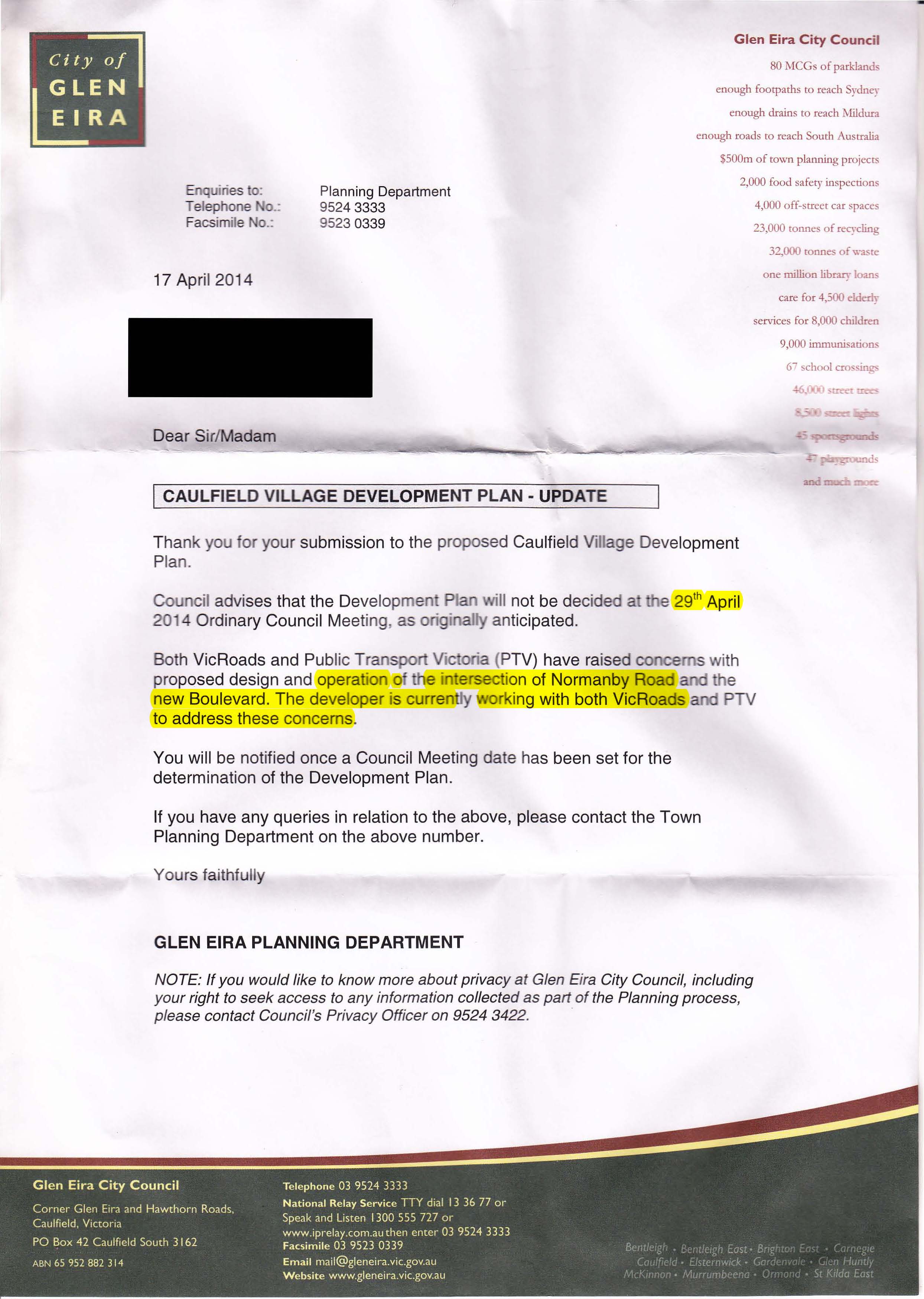
Contrary to what Mayor Pilling stated at the Caulfield Village planning conference, namely that council would make its decision on the development plan on April 8th, there is no item set down for decision this coming Tuesday night. What makes this omission even more fascinating is that Schedule 2 of the C60 amendment states – 

The responsible authority must make a decision on the development plan or amendment to the development plan within 60 days after the completion of the display.

The submission/advertising period ended on the 26th of February. The next scheduled council meeting exceeds this 60 day limit – admittedly by only one day. However, given the ‘legalities’ that this council is so keen on, we have to wonder what is really going on. Surely 4 months (at least) to ‘assess’ the submitted plans should be sufficient for our fabulous planning department? Or is there possible dissension in the ranks? Perhaps another conveniently supplied ‘loophole’ for the MRC to ‘negotiate’ to their advantage? All conjecture of course, but given Council’s track record (pun intended) on this issue we have to wonder. Perhaps council might for once furnish residents with an explanation?

RECORDS OF ASSEMBLY

The Records of Assembly make for some more interesting conjecture on the Valuer-General item from the previous two council meetings.

At the 11th March meeting both Hyams and Esakoff declared a conflict of interest. Lipshutz (who was present) DID NOT DECLARE AN INTEREST. Presumably he therefore partook in the discussion.

A week later, on the 18th March meeting on the same item, he apparently changed his mind and did declare a conflict of interest.

OPEN SPACE LEVY

Council is finally making a move after 11 years in hiking up its open space levy to 5.7% across the board by seeking permission to ‘prepare and exhibit’ Amendment C102. Whilst most welcome, and certainly a vast improvement on what the Open Space strategy initially proposed (ie 4 to 5%) we have to note the following:

  • Stonnington, which has the second lowest proportion of open space, is currently seeking an 8% levy and more for its commercial precincts. Glen Eira with the lowest proportion of open space is, in contrast, only seeking a 5.7% levy for all developments – commercial, residential or mixed use.
  • Instead of clapping themselves on the back in relation to the $4m levy achieved from the proposed Caulfield Village we have to wonder why this council settled for so little given that this 5 hectare bit of land is going to be the most densely populated area in the municipality.
  • There are claims of ‘analysis’ in a paper that is mooted to become a ‘reference document’ to the Amendment. That of course has not as yet been made public. Other councils (ie Whitehorse, Bayside) don’t seem to have had any problems in publishing their detailed analysis prior to the actual Amendment process. Even worse is that the officer’s report claims that the objective is to meld the Open Space Strategy with the proposed Amendment when there was absolutely no detailed discussion, nor analysis provided in the now accepted Open Space Strategy.

PS: And for the sheer heck of it we’ve pinched the following (slightly edited) from Abbattoir Facebook.  

fraser

110628_Guy_-_1_billion_development_approved_for_Caulfield_Page_1110628_Guy_-_1_billion_development_approved_for_Caulfield_Page_2

An astute reader has raised a very interesting point about Tuesday night’s council meeting. It concerns the little private tete a tete between Newton and Okotel when both left the chamber. Okotel was seeking ‘advice’ after being challenged by Delahunty.  Newton presumably provided this ‘advice’. This raises countless questions in itself:

  1. We do not remember such an incident ever taking place in Glen Eira before. The ‘normal’ course of events is that all ‘advice’ has been provided in chamber and usually by Burke. Why was this conducted outside of chamber?
  2. Could the question of potential conflict of interest be applied to Newton himself since he was an integral part of the ‘negotiating team’ for the ‘agreement’ which involved crown land in the centre of the racecourse?
  3. Okotel’s explanation featured conversations that took place in the pre-meeting. Council’s code of conduct precludes a councillor from making public any information from such meetings unless it has the approval of the ‘councillor group’. Since 3 councillors were not in the chamber, and others were definitely not asked for their agreement, we wonder whether Okotel in fact breached the code of conduct?!!!!!!!

What all of this shows is the circus that parades as good governance in Glen Eira.

Lipshutz moved to accept. Seconded by Okotel

Lipshutz had ‘nothing to add’. Lobo spoke ‘against’.

LOBO: said that in the past he had ‘expressed my reservations’ about the records of assembly in that the minutes are ‘altered, changed, replaced’. Agreed that there couldn’t be ‘details’ but that council shouldn’t ‘be permitted without the consensus of everyone’ to change things.Thought that ‘changing and replacing’ would have ‘implications’ down the track ‘such as conflicts of interest’.

PILLING: said that he knows that Lobo has raised this before but he was confident that ‘process’ was being followed and it’s ‘good’ to be ‘diligent in the upkeeping’ of the ‘policies’.  

LIPSHUTZ: started off by saying that ‘no one is changing these minutes’ and if they come to council ‘they are the minutes’ and if councillors decide to change anything ‘they do so at this meeting’ and ‘nowhere else’. Even though Lobo has raised the issue he agrees with Pilling that ‘process is being followed’.

MOTION PUT AND CARRIED. LOBO VOTED AGAINST.

The following is pure conjecture. We simply note the following:

  • An incredible number of mentions involving the Councillor Code of Conduct in the Records of Assembly
  • An in camera item about more ‘legal advice’ in relation to the Code of Conduct

What does all this mean? We can only surmise that some councillor, and our bet is Lobo, has fallen foul of the existing clique and more ratepayer funds are being spent on legal eagles to ramp up their power base as well as shutting up any dissenters. All this certainly makes a mockery of Newton’s nomenclature of council being a cosy ‘club’. It has always been a ‘club’ divided and nothing has changed.

Tomorrow night’s agenda features Item 9.7 – Redan Road proposed ‘restructuring’ and the removal of 11 car parking spots; installation of a bike path, and preference for “landscaped kerbs”. We have been informed of the following:

  • 92% of residents living in the street are NOT in favour of the landscaped kerbs since they argue that the street cannot afford to lose these parking spots. They are not opposed to speed humps, just the removal of invaluable parking spots. This has resulted in two separate petitions to councillors
  • The plan provided to residents is factually incorrect in terms of its measurements according to residents. Council refuses to acknowledge this.
  • Nowhere in the extant Bicycle Strategy is there any mention of the need to install bike paths in Redan St.
  • Countless other streets throughout the municipality also have cars ‘speeding’ and are hence unsafe according to council’s definition. Yet, despite numerous and ongoing resident complaints regarding countless other streets with far higher volumes of traffic, these have remained untouched for years – so why the sudden interest in Redan St?
  • Repeated letters and emails to individual councillors such as Delahunty have not been answered.
  • Pilling appears to be content to sign off on faulty and inaccurate information – raising the question as to the quality of councillors’ decision making when the information they are provided with is highly dubious.

But there’s much, much more involved in this sudden need to change Redan St and we believe it fits in very nicely with the Caulfield Village proposal. The entire emphases of the Development Plan focuses on Caulfield Park as providing the necessary open space. (The Centre of the Racecourse barely rates a mention). Hence Redan St. as access to Caulfield Park becomes vital. More questions then become necessary – ie why ratepayers instead of the MRC/developer should be footing the bill for any works that ‘complement’ the Caulfield Village proposals? We’re already witnessing millions upon millions being spent on drainage in the immediate vicinity. Is this just another ‘expense’ that has been landed in residents’ laps via a fully compliant council?


Records Of Assembly

Cr Pilling – Need to take care with Council information provided to the Councillor Group as some seems to be shared outside of the group.

Cr Hyams – Councillor Code of Conduct has a requirement that all Councillors read Council briefing and Agenda Papers.

Cr Hyams – Cr Lobo has foreshadowed a Right of Reply at the next Council Meeting. Councillor Code of Conduct regulates what Councillors can say about other Councillors.

Cr Lobo – Councillor Code of Conduct, information being passed to other persons.

Cr Lobo – Does the Councillor Code of Conduct govern behaviour outside of Council duties.

Visitor Car Parking

Car parking, which includes visitor parking and access, is often identified as a key issue. Applicants typically respond by redesigning a proposal. Those that do not amend their proposal risk having their application refused or modified by Council through conditions. This risk, in effect, encourages applicants to provide an adequate amount of visitor car parking.

Continuing this approach is preferred. This ensures that:

  • Visitor parking is not given higher priority than other valid planning matters, such as amenity impacts on neighbours, scale, and open space.
  • Visitor car parking is correctly assessed in the wider planning context, which includes consideration of the particular parking conditions in the area.
  • The integrity of Council’s fast track processes is maintained.

Consultation Committee

A paper determining community preferences for consultation using a community wide questionnaire was tabled. The committee noted that the process of sending a hard copy questionnaire to all members of the community cannot guarantee that a representative sample of the community completes the questionnaire. The statistically reliable method is stratified random sampling; different subgroups are established and a questionnaire is distributed to a random selection of respondents in the subgroup.

Council’s 2013 Community Satisfaction Survey included a question on residents preferred method of communication from Council. The results gave a clear indication that a multi method communication approach is required to ensure all sections of the population are provided with the best chance to participate in community engagement opportunities.

Racecourse

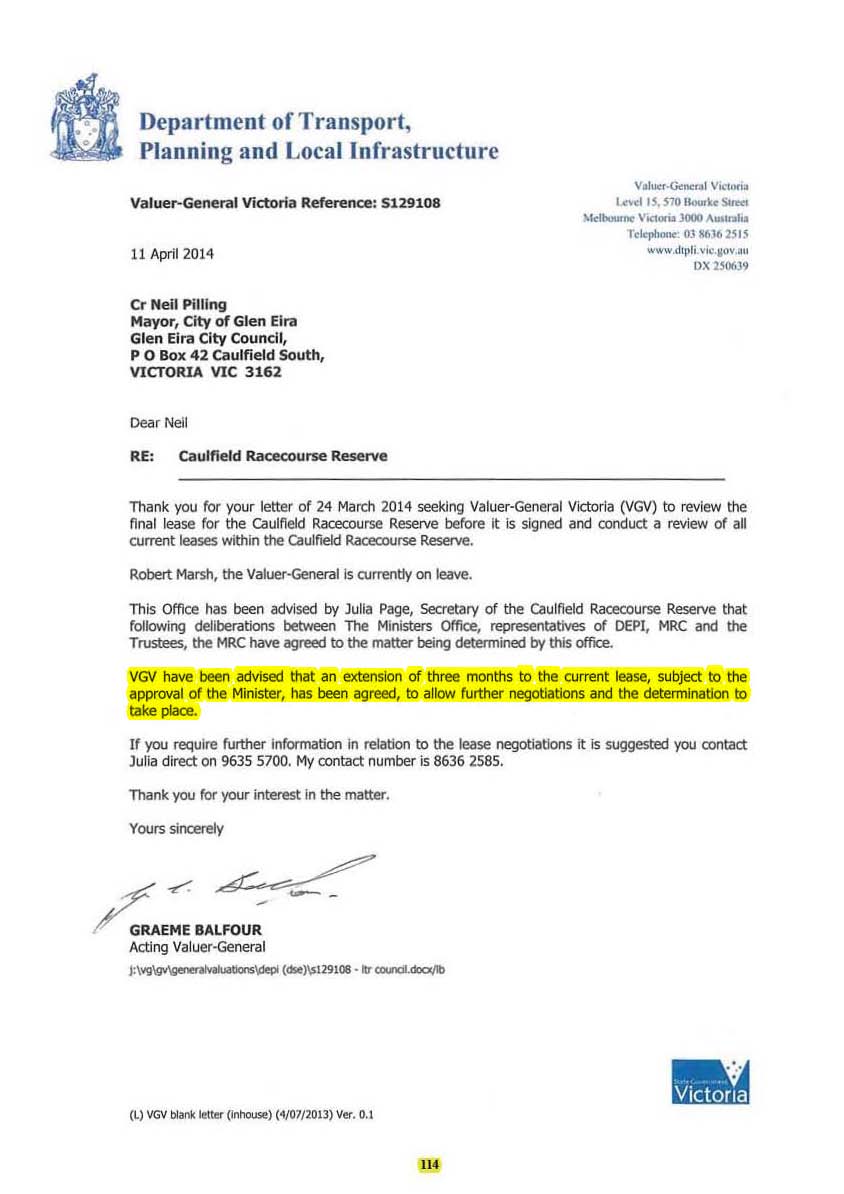
In order to encourage the involvement by the Valuer General, Council could

  • Write to the Trustees advocating for them to involve the Valuer General
  • Write to the Valuer General, including a copy of this Item
  • Write to the Minister for Crown Lands.

One must really wonder why council has spent over $100,000 of ratepayer funds on a consultancy that delivers pre-determined outcomes and maintains the status quo in all important areas. The policy contains nothing of import that is new or that will change the course of what this administration and its lackey councillors have rubber stamped for eons and eons. But the most glaring omission relates to the manner in which open space levies are to be used.

We remind readers that on June 25th 2013 council adopted a policy which stated:

Council will only spend Public Open Space contributions it receives after 1 July 2013 to acquire and improve land to serve as additional public open space.1 (including the former Glen Huntly Reservoir)

Council will not spend Public Open Space contributions it receives after 1 July 2013 to improve land which is already public open space.

From June 2013, each Council Budget, Strategic Resource Plan and Annual Report will disclose the revenue and expenditure of public open space contributions.

Suddenly this policy is ignored and morphs into the following:

As described in the Strategy and in this report, the open space contribution program is based around the provision of additional land area for open space and also for capital works cots (sic) to establish new open space and upgrade facilities in existing open space where appropriate to meet the additional needs of the forecast population. 

Use of the Reserve fund

Cash contributions toward land acquisition and open space development should be held in a Reserve fund until a suitable site is located and sufficient funds are available to assist Council with purchase or resulting capital works. Funds will also need to be held for upgrades to existing open space

As for ‘monitoring’ and ‘review’ of this long term strategy, residents should not be holding their breaths that their views will be solicited and carefully considered. It will again be more of the same as is made apparent by this one liner – Internal review the Strategy every 4 years for the duration of its operation.

Victoria’s public sector riddled with problems: Ombudsman George Brouwer

Date:March 12, 2014 – 3:23PM

The report from Ombudsman George Brouwer, tabled in parliament on Wednesday, details cases of spouses being hired for jobs by their partner, lucrative contracts being awarded to friend’s businesses and accepting gifts from companies doing work for the public sector.

The Ombudsman has conducted a number of investigations into the problem and he says that constant vigilance and attention is required to combat the problem.

“It is worrying that it occurs all too frequently in the Victorian public sector. Also, it can jeopardise the proper expenditure of significant public funds,” Mr Brouwer said.

“Allegations regarding nepotism and favouritism in procurement and recruitment arise frequently in conflict of interest complaints received by my office.”

The report was tabled in parliament on Wednesday. On Tuesday, The Age revealed that Water Minister Peter Walsh had been drawn into controversy surrounding Victoria’s new water agency after his office made a mysterious payment to a consultant 12 months before it chose him to lead the organisation without advertising the job.

The revelation of Mr Walsh’s office’s payment to former Howard government adviser Simon Want, followed an investigation by The Age that found the Office of Living Victoria had split contracts awarded to more than 10 consultants, including former ministerial staff and public servants, in a bid to keep their identities secret and to avoid public tender processes.

In Wednesday’s report, Mr Brouwer said he was also investigating a number of matters relating to conflicts in interest relating to procurement and recruitment.

Mr Brouwer said through his investigation, he found departments and agencies either had inadequate conflict of interest policies or a complete absence of policies, as well as a lack of ongoing training and education for staff.

In one case, a senior employee of a statutory body had also been a director of a private company for 10 years and had contracted the company on behalf of the authority for six years.

Mr Brouwer said the person had personally approved payments to the company totalling several hundreds of thousands of dollars.

“Non-pecuniary interests, such as personal relationships, remain a common source of conflicts of interest for public officers, particularly those involved in procurement or recruitment activities,” Mr Brouwer said.

In another case, a council officer awarded a contract to a friend’s company and in another, a council officer hired a former work colleague. In that process the officer failed to declare the relationship in the council’s register.

The Ombudsman also highlighted that there was an increased risk of conflicts of interest in rural towns. In one case the manager of a prison accepted an offer from the director of a company he had employed to perform maintenance and construction at the prison for a free asphalt driveway at his home.

The Ombudsman recommended that guidelines for conflicts of interest be reviewed and greater awareness programs for staff considered.

Labor’s scrutiny of government spokesman Martin Pakula said the recent revelations about the Office of Living Victoria were another example of how the Napthine government did not understand the issue.

“The Napthine Government has shown zero interest in dealing with conflict of interest or accountability issues more generally. In fact they’ve made an art form of conflict of interest and jobs for the boys,” Mr Pakula said.

The government has been contacted for comment.

By now residents would have made up their minds that anything that comes out from the MRC and Council should be treated with the utmost caution. Last Monday’s planning conference provided further evidence of this incontrovertible fact. Admittedly Ms Ring is not at the top of the food chain where major financial decisions are made. Nor is she on the Board of the MRC. Even granted all this, it still does not excuse the public and unequivocal utterances that were made last Monday night at the Planning Conference. The unsuspecting audience were told in no uncertain terms that the land had been ‘sold’ and that residents can forget all about the MRC and start accepting the fact that they would now be dealing exclusively with Beck and Probuild. How true is this we ask? Is it really possible that the MRC would wipe its hands of a controlling interest in the biggest development it has undertaken? Was all this nothing more than a ploy to achieve some respite from of the ever growing criticisms levelled at the MRC? And is it really possible that nobody (including Trustees and Council) knew absolutely nothing about the alleged ‘sale’?

There are undoubted advantages for the MRC to remain the title holder of this land. In the first place they will save themselves 10 years of back-dated rates as stated in the April 28th 2011 Council Minutes when the decision to accept the C60 was made – ie if the subject land is no longer rated under the Cultural and Recreational Lands Act, the owner would be liable for “back paying” rates at a higher level for ten years. Secondly, they will still have a very strong ‘bargaining chip’ for whatever happens down the track with the other two precincts. So, it should not come as a surprise that on page 5 of the MRC 2013 Annual Report we find the following:

Untitled‘Development rights’? We are now firmly in the land of legalese double talk and private hatched deals. Development rights do not equal the sale of any land. Nor do they signal the removal of the MRC’s control. $15 million at this stage is certainly a handy bit of pocket money for a cash strapped organisation, but it in no way represents the true and total value of this land. We remind readers that the Alma club which was a fraction of the size of this 5.6 hectare site went for just under $8 million. What does this make 5.6 hectares worth?

The more one dwells on the entire history of this project the more questions arise. One thing is clear though – all participants in this sorry saga have been far from straight forward in their varied pronouncements. Residents deserve straight talking rather than a chorus of forked tongues and a plethora of carefully constructed spin.

« Previous PageNext Page »