GE Service Performance


Glen Eira Council has in the past distinguished itself through its less than staggering performance in the VEAC submission on open space. Now there is the formal submission to the Minister’s Planning Zone reforms. It is barely two and a half pages long.

We are not suggesting that length is commensurate with quality but, when one reads the following submissions, the detail and arguments provided certainly put Glen Eira’s effort to shame. Further, whilst the Glen Eira opus barely mentions third party rights, this is prominent in most of the other council submissions.

Port Phillip – 39 pages

Greater Geelong – 26 pages

Boroondara – 64 pages

Maribyrnong – 12

Brimbank – 18

Casey – 27

Manningham – 23

Frankston – 14

Melton – 49

Cardinia – 31

Bayside – 45

VLGA – 37

The lack of open space in Glen Eira is continually bemoaned by residents, councillors, and when it suits, public servants. Yet, despite opportunities to purchase new land, whether this be to create new parks, or to extend existing parkland, the vast majority of monies collected via the open space levies have been used for ‘maintenance’ and ‘infrastructure’. How this money is spent, or what it is spent on, and whether this truly represents ‘value for money’ remains shrouded in mystery.

In 2009 the Auditor General (http://download.audit.vic.gov.au/files/091209_Development_Contributions_full_report.pdf) in his report on how councils spent development contributions (now gone from the Glen Eira Planning Scheme) and the Open Space levies, concluded:

“There is little assurance that the development contributions system is operating as intended across local government. A lack of effective oversight and transparent reporting remain, despite similar issues being identified in 2005. Greater accountability for what has been delivered is needed, as is a better understanding of the future obligations that arise from the contributions received.

Weaknesses in the controls and associated management practices of selected councils indicate there is insufficient assurance they have collected all contributions owed, that they have been used effectively, and that councils have met all their statutory obligations.

Each council had appropriately used development contributions to deliver infrastructure they had committed to. None, however, had a complete record that accurately linked all development contributions collected with those expended, and the associated infrastructure delivered against that planned. This meant that they were unable to demonstrate that all the funds contributed by developers had been used effectively, or that all in-kind works provided met requisite standards.

Oversight of development contributions in councils was limited. Reports to senior management and councillors focused mainly on the status of fund balances, and lacked sufficient detail to provide assurance that contributions were being effectively managed.

Similarly, public reporting by councils was insufficient to demonstrate to the community that contributions were being spent for the purposes intended, and that the associated infrastructure was being delivered as planned. While all councils identified aggregate development contributions revenue in their annual reports, it was not always possible to clearly distinguish this from gifted assets and, therefore, accurately compare councils”.

The crucial wording in the above is ‘used effectively’,  ‘transparent reporting’ and ‘greater accountability’. As the Auditor General concludes, all that councillors and residents get to see is ‘fund balances’ in Annual Reports. Hardly a satisfactory explanation, nor justification for the paltry expenditure of just under $2 million in the last decade on the acquisition of open space, yet over $12 million on ‘infrastructure’ as revealed in the response to a public question at last council meeting.

Council is about to embark on a revamped Open Space Strategy. That’s great but, we have to wonder whether this will simply be another exercise in spin judging by the actions that have failed to be implemented from the 1998 strategy. Below are some extracts from this 1998 version. Please consider how many of the following objectives/statements/promises have been translated into concrete actions and how many that were mooted 15 years ago are still to be realised!

Where open space contributions are required for multi-unit developments, Council impose the maximum monetary open space contribution about of 5% wherever possible.

A 50% split between acquisition and improvement is suggested.

Constantly review opportunities to expand open space, particularly where sites may become available adjacent to existing parks in the precinct and allow opportunities to increase the size of these parks.

Retain a Public Acquisition Overlay to no 53 Magnolia Road, Gardenvale to complete the concept plan for Gardenvale Park (shown in the City of Caulfield Local Parks Strategy, 1987) and purchase the property when it becomes available, subject to current budget priorities

Changing recreation trends and an aging population indicate that informal open space is an increasingly important component of Glen Eira’s open space system

There is community support to get involved in the planning development and management of open space

Encourage government authorities ie schools to make their open space available for community use (especially where there are identified open space deficiencies) and investigate opportunities to provide additional open space if school sites are redeveloped

There is a community perception that there is a lack of unstructured open space in Glen Eira and changing recreation trends and an ageing population indicate that informal open space will be an increasingly important component of Glen Eira’s open space system.

The general community ‘feeling ‘ is that there is adequate provision of active open space that that future strategies should focus on ensuring a balance between active and informal recreational pursuits

Some sports require additional expanded facilties but generally the provision of improved maintenance and/or upgrades to existing facilities would satisfy current and future sporting demands

Concern for traffic management within and around various parks to ensure safety for users of open space.

Investigate opportunities to expand existing open space in the Gardenvale neighbourhood of the West precinct

Increase outdoor events in Glen Eira’s open space system, ie jazz festivals, open-air movies, art/sculpture displays of local artists work, flora and fauna displays

Organise community events in Caulfield Park to coincide with and complement the Spring Racing Carnival

Capitalise on the amphitheatre in Caulfield Park for a wide range of outdoor community events

Through the statutory planning permit process support and encourage the provision of open style fencing for new residential development that directly abuts open space

Review the provision of buildings in open spaces, including the provision of scout halls and other affiliated groups, and determine their possible rationalisation/reduction as part of the process of preparing park Masterplans.

Encourage and generate ‘friends”/community groups and school children to be involved in the development and on-going maintenance of parks.

Ensure that existing informal open space is not encroached on, inhibited or placed with any further restrictions, unless some form of compensation is negotiated ie land swaps

Design playgrounds to include fences, paths, seats, shade trees/shelter to provide comfort for parents supervising children

Build on the educational programs run by Council’s Park Services unit and develop an education centre in Caulfield Park to complement the native bushland reserve and bird aviary where education programs can be run with interactive facilities provided for community members to learn about Glen Eira’s natural heritage

Work closely with the Glen Eira Environment Group and the Society for Growing Australian Plants and utilise their knowledge and expertise to continue to enhance and maintain environmental open space in the city.

Negotiate with the National Trust to allow some form o community access into the gardens of Rippon Lea ie residents could be issued with a ticket to allow them 10 free passes per year into Rippon Lea

80% of open space system functions as outdoor sports/local parks combined

Develop a Masterplan for Elsternwick Plaza keeping in mind this park potentially forms an important recreational element to the Elsternwick urban village concept. The Masterplan should open the park up to invite pedestrian activity and integrate with Glen Huntly road

Work with the Society for Growing Australian plants to develop the original route of the old Elster Creek trail into a native vegetation corridor/nature walk with interpretative signage and encourage private property owners along the route to plant appropriate native vegetation to increase havitat potential.

A dominant portion of open space in each precinct is restricted at certain periods by sports activities, with the North-East and South-East precincts having the larger proportions of their open spaces used for organised sports at certain periods.

The dominant landscape setting in all precincts is sporting which ranges between 55% in the South-West to 88% in the South East

Readers will remember the 12 storey, 173 dwelling application for Dandenong Rd. that went to council on November 13th 2012. Lipshutz, Magee, Sounness and Pilling all thought that 12 storeys was fine but the rest of the councillors reduced this to 8 storeys and 90+ dwellings. The officer’s report had the following to say about traffic –

“The proposal is considered to activate the Dandenong Road Frontage

It is acknowledged that the proposal will result in an intensification of vehicle movements in the area. This is a by-product of both State and Local Planning policies channeling more intensive development and use into activity centres such as Carnegie. An opportunity to exit onto Dandenong Road is considered to be a significant advantage for this development site.”

We’ve since come across a Youtube video created by a Monash student (see below). What is most striking about the video is the sound. Listen carefully and ask yourselves, is this really a ‘significant advantage for this development site’.

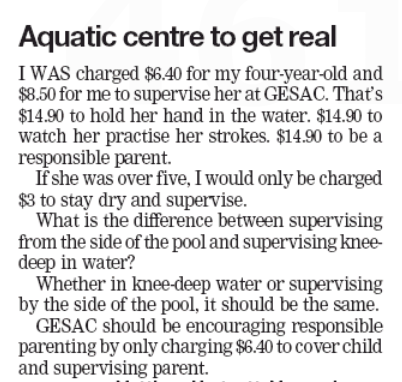
GESAC and its costs remain a mystery. We would bet that it is even a mystery to councillors. There is the incredible spin of success after success – 7,000 members, then 8,000 members, now 9,000 members (all in the space of 3 months) and the forecast of 10,000 members by the end of the month. All remains talk as far as we’re concerned. Not once has this council published a full and comprehensive list of expenses versus income. Nothing about memberships has been put in writing, such as what do these 9000 alleged members currently consist of? Are they FULL memberships? Part memberships? How many people have NOT renewed memberships? How much money has had to be refunded? How much is staff costing? How much is maintenance costing per week or month or even year?

Nor has there been any update on legal costs and the liquidated damages bills with Hansen and Yuncken. The same repetitious blurb has appeared in the monthly financial reports for the past 3 months. Hardly an ‘update’ to inform residents as to what is going on!

Nor has there been any murmur about the basketball court allocations. Burke’s report shows that the Warriors aren’t fulfilling their terms of contract as to hourly court hire. How much have ratepayers therefore subsidised the under-usage of the courts by the warriors? How much longer will this continue? What is happening now that the contract is due for re-appraisal? What are the criteria? Will councillors have the guts to insist that sport allocations become open and transparent rather than left in the hands of public servants?

All we know about GESAC are the incredible claims and the spread of bitumen and concrete for more and more car parking. Our questions are therefore quite simple –

  • If GESAC is such a raging success, then why is this council continuing to splurge money on full paid colour ads in all the local papers?
  • Why is council now offering to waive registration fees for new members if numbers are going through the roof as they claim?
  • When will these councillors insist on a full and comprehensive ledger which shows every dollar of income and every single expense?

The spin must stop and be replaced with facts, figures, and open transparent governance. Here’s the latest extravagance:

gesac

The year is rapidly drawing to a close, so we thought it would be fascinating to review what ‘progress’ has been made in the past 18 months on some of the major issues which have confronted this council. These include: C60 and the centre of the racecourse; GESAC basketball allocations, Notice of Motion. There are many others that will feature in future posts.

December 2011 Pilling (from his blog) – “In the aftermath of this year’s Gesac basketball saga feel it would be helpful to spend time in the New Year reviewing the whole EOI process and the criteria used in assessing.”

29th April, 2011- Media Release Headline – “Council places limits on C60”

Pilling on centre of racecourse – Through this agreement the ‘MRC can no longer deny the community’ its share of the racecourse. Will ‘be viewed in future years as a productive beginning…our negotiating team have done a commendable job…”

Hyams on centre of racecourse – “I think if we say no to this it is actually a loss to the community….we can look at this in a year’s time and either we’ll have a park….or we won’t and it will be our fault for saying ‘no’.”

Esakoff on centre of racecourse – The agreement will be ‘valuable’ and ‘meaningful’ to the community in terms of open space’….compared the decision making involved in this to the decision making that contestants make in game shows. ‘some take huge gambles and say ‘I came with nothing and I’m prepared to go home with nothing…in this case though it’s the community we’re playing for….we need to ask ourselves, what would the community do, what would they want. I believe they would want this win’….I don’t believe our residents would thank us if we were to say this is not enough….the risk is too great….to come home with nothing is irresponsible….I believe that this is a good outcome’.

May 2011 – Council response to submissions on local law – ““A requirement that items are included either with the specific consent or mutual agreement of the Mayor or Chairperson imposes a fetter on the CEO to discharge his duty….Additionally councillors should not be responsible for the agenda as a consequence of the governance requirements to avoid improper influence.”

Southwick, Hansard, May 3rd 2011 – “This is a great story for Caulfield: it means that for the first time the Caulfield Racecourse will not only be a racecourse but it will be a park as well. It will provide an amenity not just for the people of Caulfield to be able to share and enjoy but for the people of Victoria as well. I am very proud to have been involved in discussions to ensure that this will happen. I thank the City of Glen Eira for its negotiations and its fine work, and I also thank the Melbourne Racing Club for coming together on this very important announcement”.

June 2011 – Dropping the Development contributions levy – officer report – ““It is considered that the benefit gained from a DCPO has been comparatively small compared to the cost of implementation and administration, and to annual capital expenditure for drainage.”

Friends of Caulfield Park submission – “We were greatly perturbed to see the introduction of ‘tidy’ concrete kerbing instead of the friendly informal grass edging formerly abutting Inkerman Road. We cannot understand why Council appears so reluctant to engage in discussion and consultation with park users(including the Friends of Caulfield Park) prior to undertaking what appears to be non-essential cosmetic surgery. It would be far more useful to spend the money maintaining the crushed rock paths which are used and enjoyed by hundreds of people on a daily basis”.

Lipshutz on Heritage expert advice on Seaview property – .‘I have to respectfully disagree with them. I have been there, I have seen the property…I don’t agree’

Lipshutz on Notice of Motion – “‘That there are a majority of councillors in the state that have this Notice of Motion…..doesn’t mean that it is right, doesn’t mean that it is right for us…my view is ‘if it’s not broken don’t fix it’….I’m concerned about the mischief (of notice of motion) …we make decisions in an ill informed way….we discover afterwards that this is entirely the wrong way…..if a councillor wants to know something we ask for a report….we can put a timeline on that…..the dangers of putting a notice of motion as against not having it are….far too great.”


Another example of councillors doing nothing is evidenced by their resolution on the car sharing item from last Council meeting. Please note that the issue itself is not our focus. What is our focus is the process that this council adopts in the attempt to get anything done. Here’s the recommendation and the ensuing resolution

That Council:

i) Notes the report.

ii) Notes that car share systems could be used within new developments in the future.

 Crs Sounness/Lipshutz

That the recommendation in the report be adopted with the addition of the following:

(iii) That a further report be provided on how car sharing policies operate in other Victorian Councils (eg Cities of Melbourne, Stonnington and Port Phillip), and the effectiveness of these policies in improving public and private sustainable transport options.

The MOTION was put and CARRIED unanimously.

So, here we go again. Another report, another time lag, another example of inefficiency, added cost, and temerity. The inefficiency relates to both councillors and officers. The supposed objective of this first report was to outline the “benefits/impact’ of car sharing. What we ended up with in the Akehurst version was waffle, generalities, and the predicted recommendation to look to the ‘future’. The only other council mentioned, as we’ve already noted was Melbourne City Council. Surely any report attempting to fulfill the terms of ‘benefits/impact’ would provide a far more extensive analysis than simply looking at one council? Why didn’t Akehurst include commentary/analyses from these other councils to begin with? How about some real statistics? Our take is that when you’re trying to push a particular line you never give too much away – especially if the ‘findings’ of the analysis are all ‘positive’ and your position is one of ‘do nothing’.

Councillors should not escape unscathed either. So they’ll get another report which will undoubtedly say that although there are some positives in these councils’ plans it will cost too much; nothing is budgeted for and hence Glen Eira needs to delay until funds are available. The hidden issue of course is what this might mean for the entire parking allocation system in the municipality. When development after development is allowed to get away with waiving car parking spaces and nearby streets are permitted as surrogates, then to create car share spaces could be a major problem. Instead of looking at the entire system, we have another tinkering with the periphery and thus not even coming close to addressing the real issues.

The ‘report’ will come in at some stage and given past history councillors will meekly accept whatever recommendation is put before them. End of story!

Readers may be aware of the proposed Moonee Valley Racecourse development and that the Minister had decided to create an ‘advisory committee’ in response to a request from the racing club. Featured below is the Moonee Valley Council’s official response to the Minister. We have highlighted those sections that we believe are significant and which reveal what can happen when a council and a community work in unison – in stark contrast to the history of Glen Eira City Council and the farce that remains the C60 and the centre of the racecourse development!

mvcc_Page_1 mvcc_Page_2 mvcc_Page_3 mvcc_Page_4

As one of our final posts for the year we thought it would be helpful to emphasise again how the governance of this council is totally out of step with the vast majority of its neighbours. Last council meeting featured the incredible spectacle of several councillors attempting to justify why Gibbs and McLean have repeatedly been reappointed to their posts as ‘independent’ members of the Audit committee.

At its last council meeting Port Phillip just happened to appoint totally new members to their committee. We quote from the officers’ report:

“3.3.6 External members will be appointed for a three (3) year term, renewable to a maximum of one (1) additional term, with the terms of appointment being staggered one year apart.

3.4 Council is reminded that as the Charter states that ….. “External members will be appointed for a three (3) year term, renewable to a maximum of one (1) additional term, with the terms of appointment being staggered one year apart.” Mr Densem’s term is for an additional 3 years with no further option to renew.”

Please also note that this is tabled at an open council meeting. NO IN CAMERA SECRECY!

By sheer serendipity, Port Phillip also considered Amendment C97 – Energy Efficient Design which proposes to “include a Local Planning Policy relating to environmental sustainable design’ and to request permission from the Minister to exhibit. Readers will remember that at the last Glen Eira council meeting, the Akehurst report had stated : “Building approval is universally required for all developments. This point alone places building in front of town planning for applying any ESD standards. The Building Code of Australia (BCA) currently sets energy efficiency standards that both residential and commercial developments need to meet. These provisions were reviewed in 2011 and have been increased to require a 6 Star Energy Rating for new residential buildings and a significant increase in energy efficiency requirements for all new commercial buildings.”

Here is the Port Phillip ‘answer’ to this position:

Currently the Building Code of Australia (BCA) is limited to setting minimum standards for energy efficiency of new buildings, as opposed to the holistic elements of best practice sustainable design, which typically includes water, stormwater, transport, waste and landscape. It is considered that leaving sustainable design requirements to the building approvals stage is too late in the design process after important design decisions, such as siting, have already been made through planning approvals.”

Diametrically opposed points of view it seems! Whom would you believe?

Sadly, our Glen Eira representatives merely delayed things once again. Another report! Another do nothing action! Their resolution read:

Crs Sounness/Okotel

That the recommendation in the report be adopted with the addition of the following:

(d) requests a report on the status of Environmental Sustainable Design principles being developed for incorporation into the Building Code of Australia by the Australian Building Codes Board.

The MOTION was put and CARRIED unanimously.

Also of real interest is the BAYSIDE SUBMISSION to  a KINGSTON PLANNING AMENDMENT! Kingston has put out for consultation its proposed Structure Planning Amendment for the Moorabbin Major Activity Centre. Bayside, as the neighbouring council, has some concerns over height limits, and the need for ‘negotiation’ between these councils – AND GLEN EIRA. Strange, that we have not heard a single whisper from our planners. Even Stonnington, in one of its planning applications raised concerns about what is happening in Glen Eira along Dandenong Rd and how it will impact on its municipality. When all is said and done, our glorious council remains the lone ranger – unwilling to publicise anything, and perhaps even unwilling to work in collaboration with other councils to achieve the optimum outcome for residents. What a sad state of affairs!

In the light of what is happening in other councils, Glen Eira’s inactivity is deplorable. The status quo of open slather for inappropriate development, the lack of structure planning, and real environmental initiatives are the legacy that future generations will continue to bear.

The coming 10 months are vital for the future of this municipality. We will see:

  • Decisions on CEO appointment
  • Planning zone reforms
  • Community plan
  • Local law and probably the attempt to maintain the current abhorrent meeting procedures
  • Open space strategy

Watch this space – and be alarmed not merely alert! 2013 is certainly not going to be dull.

FINANCIAL REPORT

LIPSHUTZ: ‘excellent result’. Said that Delahunty had asked that the reports be more ‘intensive’ and they’ve now included a few additional items as a result. “Council has got a work strategy’; capital works is ‘slightly behind forecast’ and they’ll catch up by the ‘end of the year’. “Council liquidity is tracking well’ and although council has to be ‘careful’ all is going well.

DELAHUNTY: ‘great’ that there is more detail in the report and ‘helps us do our job’ so that councillors can get a ‘greater picture of the finances’. There are 1.3 billion dollars of assets so the ‘big picture’ is needed. ‘Peter’ is right about cash flow in that ‘there is a definite need for caution’. ‘Our position is strong, the balance sheet position is strong’ and GESAC is ‘an absolute standout’ and because membership is growing ‘we may not see a dip’.

LOBO: said the report ‘really shows the financial strength of this council’ and not the things ‘that come on Glen Eira Debates’. There are ‘doubting Thomases’ writing ‘day in and day out’ and they write and ‘hide’ under the ‘name of anonymity’. Said that if people really believe that ‘there is a problem put your name and address’. Went on to say that being ‘negative will not keep you in good health’ because ‘negativity doesn’t give good health of mind and body’. Concluded with the hope that ‘you can take a new leaf from this’ as well as ‘stop your Glen Eira Debates’.

MOTION PUT: carried unanimously

COMMENT

  • Caution has been urged month after month yet Lipshutz still refers to  $600,000 as ‘little’!
  • No real explanation of why capital works and other projects are so far behind schedule? It couldn’t be anything with ‘saving money’ and managing the cash flow, could it?
  • We note that $529,000 is now to be returned to the government as a result of the decision on Boyd Park water harvesting. Another ‘cash flow’ problem?
  • Previously Hyams saw no problem in calling certain councillors to account when their comments were totally irrelevant to the item under discussion. We wonder why this was not done in the case of Lobo’s comments? There was a 5 second statement about the financial report and the remainder of his ‘speech’ addressed ourselves. We are indeed flattered by the attention.

« Previous PageNext Page »