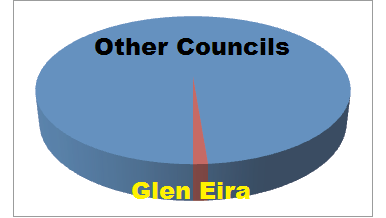
GE Service Performance


AUDIT COMMITTEE ANNUAL REPORT

LIPSHUTZ: started off by explaining the function of the committee and its duty to report annually to council. “The Audit committee does a great job’. Not an ‘oversight committee’ but ensures that risks ‘are looked at’. The ‘auditors identify areas that can be improved’ so it’s not a question of sitting on one’s laurels and officers implement the suggestions.

MAGEE: stated that Gibbs & McLean have been on the committee for ‘many, many years’ and they are ‘very, very capable and very, very professional’. Gibbs asks ‘pointed’ questions of officers. He’s ‘very straight’ and ‘takes no nonsense’ and if people saw how he operated they’d be very happy. McLean is a ‘very astute accountant’. They’ve been on the committee a long time but that ‘benefits our council’ because they ‘know our history’ and ‘they certainly know where council wants to head’. Magee is ‘very comfortable in working with those two’.

HYAMS: endorsed Magee’s comments since he’s ‘sat in’ on 4 meetings. Said that there had been suggestions that ‘external members had been there for too long’ and ‘getting a too comfortable relationship with our officers’ but if people could see what happens then they would never be ‘under that misapprehension’ because they ‘rigorously examine our officers’. ‘You replace someone if they’re not doing a good enough job….’or if you think’ there’s someone out there who is better. Hyams finished by saying ‘I’m very pleased with the audit committee performance’.

LIPSHUTZ: said he’s been on the committee since 2005 and that both Gibbs and Mclean have a terrific knowledge of council and ‘add value’. They’re ‘doing the job’ and respected and ‘should remain for some time; they are a bonus to council’

COMMENT

When the Minister issues guidelines, 99.9% of councils treat such guidelines as the Holy Bible. Not so in Glen Eira. Even council’s own charter is ignored when it comes to the continual re-appointment of Audit Committee members. Both the charter and the guidelines (plus best practice) recommend that there be a fixed term for members and that regular rotation of members is essential. Gibbs and McLean have been appointed and reappointed numerous times since at least 1998. Lipshutz has been on the committee for what will now be 8 years straight.

Other councils routinely advertise the positions. Glen Eira hides behind the veil of secrecy. These reappointments are made in camera with no public announcements. Why? Could it be that full public disclosure of what is going on might be a tad embarrassing given that the obvious intent of LGA is thus continually abused and perverted? When other councils see nothing wrong in tabling their deliberations on independent membership, then questions need to be asked as to why Glen Eira treats the issue the way it does.

We are not in any way doubting the qualifications, experience, nor professionalism of these members. We do however insist that when guidelines are promulgated they should be adhered to. Secrecy and the perception of cronyism undermines the very principles embedded in the guidelines and the committee’s own charter.

Finally we wish to note that this year at least Council has decided to adhere to the charter by tabling the Committee’s Annual Report at a council meeting. Last year this did not happen and when questioned about it the ‘answer’ was that the report was published in Council’s Annual Report. It had never been presented at a formal council meeting!

AUDITOR GENERAL’S REPORT

LIPSHUTZ: reported on the Auditor General’s visit that not only is Glen Eira the ‘template’ for other councils but in terms of ‘best practice’ it is fabulous. ‘We are outstanding….doesn’t mean we can’t improve’ but Glen Eira is probably the ‘leading council in Victoria’ on issues. Said that council went through a rigorous process on the borrowings for GESAC and council was commended by the Auditor General. The issue of ‘reserves’ doesn’t give ‘any rise for concerns’. Glen Eira is the ‘leading exponent in terms of risk’. About ‘liquidity’ Glen Eira is ‘low risk’. The previous council said ‘we’re high risk’….’problems’…’that’s all poppycock’. Said that ‘this council is doing very well’. A ‘fantastic result’. Other councils come to Glen Eira to see how it’s done and great staff are responsible. ‘We are at the top’.

DELAHUNTY: ‘a fantastic report’ and commented on Lipshutz’s statement on risk and said that when she attended the Audit Committee and saw the Operational Risk Framework that had been done by officers she thought it was ‘exceptional’, ‘I’ve never seen anything as quite as detailed’….’something to behold’

HYAMS: congratulated officers and ‘decisions’ taken by previous councils. ‘Good news…..for all the residents of Glen Eira’. People should be happy that ‘their council is regarded so highly by the Auditor General’. Unable to help himself, Hyams then said that some people would ‘scuttle off home after this meeting and portray this as negatively as they can’ but for everyone else who really cares about ‘how the council is perceived and performs’ then this is great news.

COMMENT

Corporate memory, or Lipshutz’s memory is indeed a worry. Particularly so when less than a month ago Delahunty herself referred to the Auditor General’s classification of Glen Eira as ‘high risk’! Yes, council is now deemed ‘low risk’ but the initial grading did happen. ‘Risk’ is still risk, isn’t it?

We also raise the question that why shouldn’t this ‘exceptional’ Operational Risk Framework’ be public? If it is indeed ‘something to behold’, then shouldn’t the public see it? After all, it is only a ‘framework’ – figures, names, etc. could be removed and thus confidentiality maintained.

Our final comment pertains to the efforts that go into self-promotion and self congratulations. If a fraction of the time and expense that was expended on such exercises was actually put into listening and responding to residents’ concerns then we have no doubt that this municipality would be a far better place and organisation.

GERA Inc. has a new post up on the outcome of the sale of 487 Neerim Rd. The auction was held early this evening. We remind readers that GERA had written to council requesting that serious consideration be given to the purchase of this land as it would extend the Riley Reserve and be in keeping with the priorities outlined in the Community Plan.

For a full report see: http://geresidents.wordpress.com

LIPSHUTZ moved to accept recommendations and Option A. ($600,000 Gardener’s Rd revamp) Lobo seconded.

LIPSHUTZ: “We are the victims of our success”. They did not ‘in any way imagine’ that there would be 9000 members and ‘probably growing”. He thought that by the ‘end of summer’ there would be over 10,000 members. Gesac was ‘visionary’ but ‘unfortunately’ success brings ‘car parking problems’. The car parking has been ‘extended somewhat’ but they are realising that it’s ‘not sufficient’ so ‘the appropriate course’ is to increase car parking. Best way is to do it is through extending Gardener’s Rd because this won’t have an impact ‘at all’ on residents nor the park itself. Admitted that in the end council might have to build an underground car park or above ground car park but ‘that’s for the future’. Said that ‘if people can”t get in, they won’t go’ and the ‘more car park space we have the more GESAC will be a success’. Said that Option A is the ‘appropriate way to go’. Said that $600,000 is ‘little’ and would be recouped through increased patronage.

LOBO: ‘fully agree(d)” with Lipshutz. Went on to say that currently there’s an ‘inherent risk’ for children crossing the carpark to get to the facility and also at Bailey Reserve for the soccer players. ‘We cannot afford to have a tragedy” and “delay this any more”. Went on to say that ‘someone’ has written in the newspaper that consultation should be done. ‘You can’t do community consultations all the time”. When there’s a risk, and ‘council knows there is a risk” things have to be done. Therefore he supports Option A.

SOUNNESS: Said that council is very proud of it’s ‘risk profile’ but that ‘it’s completely got car parking wrong for GESAC’. Admitted that his ‘weakness’ was that he doesn’t know the ‘history of the site’ but after 3 council meetings that he’s attended if ‘you still have to go back to the drawing board’ and it’s still not right then ‘somewhere the sums have gone wrong’. He doesn’t doubt the success of GESAC but ‘why is it that car parking was so grossly miscalculated?’. Compared GESAC to MSAC and the fact that they’ve got heaps of car parking around, plus public transport, cycle paths, etc. Said he knows he will be in a minority but that ‘somewhere in the background there’s been a miscalculation’. Stated that many things are unfeasible such as railway line and even cycle paths won’t make much of a difference. Said he’s got real doubts and wants more information and that the community can rightly ask whether the park is now ‘just a sea of asphalt’.

MAGEE: challenged Lipshutz’s statement that people didn’t envisage that GESAC would be that popular and that ‘there was never any doubt in my mind”. Talked about the 7000 signature petition and that he had “many, many” more sheets that were signed by people who now might also become members. GESAC is an ‘outstanding success”. It won’t “please everybody” but does please thousands of people. “I’m very happy to see this parking go in” and that “this is not the end of the parking”. Saw a “need” for parking in “the centre of East Boundary Rd” and hoped that Vic Roads would grant permission for this. Saw this as a “great opportunity for a staff car park” and this would ‘free up another 30 or 40 spots” in the main car park. People shouldn’t “ignore the fact that GESAC is such a success” and all that’s happening is “taking away a bit of nature strip” in order to get “a much needed car park”. Concluded that he was “happy” to debate this with “anyone who wants to take this up with me personally”.

DELAHUNTY: Said that she liked Option A and that her husband was present to “make sure” that she voted for more carparking. She particularly liked the “drop off zone” and that this would “ease congestion”. GESAC “is an incredible success” and thought has to be given to how to get 9000 people there efficiently, safely and also thinking about the environment. Urged for more advocacy to get a bus route.

OKOTEL: in favour of Option A but still did share the “concerns’ of Sounness and Magee in that “further car parking will be required”. Said that in relation to Options C and D that these were “under study” and that she would welcome the results.

HYAMS: asked the movers if they would consider adding to the motion that Option D be continued to be considered (ie median strip parking in the centre of East Boundary Rd). Both Lipshutz & Lobo agreed.

OKOTEL: if the new amendment was accepted whether there might not also ‘be support for Option C?” (ie time restrictions on East Boundary Rd). Again accepted by mover and seconder.

HYAMS: asked Burke that if time restrictions come in on East Boundary Rd and already in the Bailey Reserve carpark whether this would be a problem for those cricket administrators ‘who spend all day’ there when the teams are playing?

BURKE: said ‘yes – it’s one of the concerns”

HYAMS: then wanted to move an amendment that the wording about Option C ‘be removed”. Asked for a seconder to the amendment. Lipshutz didn’t accept so Hyams moved it as a formal amendment. Delahunty seconded.

LIPSHUTZ: ” don’t say that we shouldn’t do it’ just needs to be seen if this is viable and therefore a report needs to be asked for – like he did with the Wi Fi request for a report.

OKOTEL: said that this study is already underway regarding Option C and that since the ‘study is already being prepared” that council should wait.

ESAKOFF: agreed with Lipshutz and Okotel that ‘this needs to be investigated’ and that there could ‘be a possibility of providing exemptions’ for ‘certain officials that require them’.

MAGEE: Said that ‘this is all about going backwards with GESAC’ since GESAC is ‘about encouraging people to come’. The amendment says that if you come for sporting activity like cricket which can go on for 5 or 6 hours so with timed restrictions ‘this is not a welcoming thing’. Said that as a ‘cricketer, I need somewhere to park, my children need somewhere to park’ and the ‘only avenue’ is Next we’ll ‘be pushed down’ to using the East Bentleigh shopping centre and local streets.on East Boundary Rd.

HYAMS: said that with Esakoff statement about certain officials, there are also cricketing, and other sporting groups so hard to ‘work out a system that would also include them’. Said that asking for a report is only ‘putting fear into the people that use’ the facilities and that ‘we don’t want to add to that stress’ when people are trying to park.

AMENDMENT PUT AND LOST: voted for: MAGEE, DELAHUNTY, HYAMS.

AGAINST: LIPSHUTZ, OKOTEL, SOUNNESS, ESAKOFF, LOBO

LIPSHUTZ: said that GESAC has ‘the best consultants in Australia’ and they came to the ‘conclusion that certain parking was required’. There was also a ‘cost factor’ and safety factor and they didn’t put in an underground/above ground car park because ‘women do not like’ to use these. ‘We are a victim of our success’ and no one expected to have 9000 members. They knew it would be a success but ‘not to this extent’. Half way through building they realised that there wouldn’t be enough car parking space. So, ‘there’s no issue here of poor planning’ just a ‘huge success’ and ‘we will probably have to deal with (more) car parking in the future’. Council has to choose Option A otherwise GESAC won’t have ‘sufficient car park’ and that Option C should be ‘explored’ so as not to ‘impact on cricketers and people who use the park’

MOTION PUT AND CARRIED: For – Lipshutz, Lobo, Esakoff, Hyams, Delahunty, Magee,Okotel.

AGAINST – Sounness

COMMENTS

Once again the lack of consistency and logic in these discussions leaves much to be desired. Please note the following:

  • Suddenly there is an ‘inherent’ danger for pedestrians according to Lobo and that’s why he wants more cars on the adjacent street. Even better, he seems to have totally forgotten that on September 24th 2012 (less than 3 months ago!) a report was tabled on the ‘safety audit’ at GESAC which included the following statements:

“It is considered that the GESAC car park and Bailey Reserve provide a safe environment for pedestrians” AND

“The audit (May 2012) provided fifteen recommendations to ensure compliance. All of the recommendations have been implemented.” Lobo himself then moved the motion to accept the report’s recommendations.

There are 3 possibilities here: (1) either safety issues have suddenly cropped up which would of course make a mockery of the safety audit, or (2) the report was entirely inaccurate, or (3) Lobo’s memory is failing rapidly!

  • We also take issue with Lipshutz’s statements that the problem with car parking is not a ‘planning issue’. Surely if a project of this size and cost is correctly planned then all contingencies are considered – from worse case scenarios, to best case scenarios? Further, what’s important is NOT the number of memberships, but the number of DAILY VISITORS. GESAC was stated to attract 500,000 visitors per year. We were told recently that the centre has 1500 visitors per day. That would mean that the yearly patronage still comes in at 547,000. Hardly a huge blowout from the original prognostication. Thus the question remains – how good was the original planning? Or is this ‘staged’ increase in car parking deliberate?
  • There is not one single word  in any of this discussion (apart from Lipshutz’s aside that there are no problems) about the traffic impact in Gardiner’s Rd, or any mention of the residents that live along this road. There have already been petitions from this group of residents as well as media coverage. We’re told that ‘consultation’ took place eons ago and that their fears were allayed. We wonder how ‘allayed’ their fears are now and whether they were even informed that this is happening?
  • It is surely most comforting to have Hyams so concerned about raising residents’ ‘fears’ by asking for a report. Ignorance is bliss we guess!
  • We congratulate Sounness for at least having the courage to call a spade a shovel. There have been major ‘miscalculations’ and all the spin, smoke and mirrors, and plain old propaganda cannot hide or disguise this self-evident truth.
  • Finally, we have to ask why oh why if GESAC is so successful is there still a need to place full page colour advertisements in the local newspapers on a weekly (and expensive) basis – especially given the financial report’s continuous urging for frugality?

Murrumbeena students at risk, says mum

18 Dec 12 @ 05:00am by Donna Carton

Parents and students from Murrumbeena Primary School are campaigning for a school crossing on Murrumbeena Rd.

Parents and students from Murrumbeena Primary School are campaigning for a school crossing on Murrumbeena Rd.

WORRIED parents say busy Murrumbeena Rd is now too dangerous for schoolchildren.

They want a crossing supervisor at the busy road to allow Murrumbeena Primary students to walk to school and ease traffic congestion at pick-up and drop-off times.

A VicRoads assessment has found not enough schoolchildren cross the road to warrant a crossing.

But mum Christine Farnan said many parents drove their kids to Murrumbeena Primary, even if it’s a short journey, rather than let them negotiate the road on their own.

“For years we have been asking for a crossing to be built,”Ms Farnham said. “Parents drive their children due to the traffic dangers.”

Parents have now requested Glen Eira Council employ a supervisor to help children at the Murrumbeena and Dandenong roads lights crossing.

“It’s not ideal. That is a very busy spot, but it is better than nothing,” Ms Farnan said.

Cr Neil Pilling said he had spoken to worried parents and would ask for more council investigation.

Council should re-examine this. This is a very busy road, not helped by one of the worst level crossings (at Murrumbeena),” he said.

I will advocate for a crossing supervisor funded either wholly by council or shared with VicRoads.”

COMMENTS

Ostensibly this sounds like a pretty straight forward problem. However it reveals exactly what is wrong with the governance of this council and the temerity of many of its councillors. Instead of real action, all Pilling can do is ask for ‘more council investigation’! If this Council was really run by its councillors instead of administrators, and the Local Laws reflected this, then the solution would be simple:

  • At tonight’s council meeting Pilling would move the motion that a part time lolly pop person be employed. End of story! Or since this council has delegated practically all responsibility to officers and the CEO has control over the hiring of staff, the issue could be solved in a matter of moments – if councillors simply ‘request’ the exercise of this delegated power.
  • We are not talking huge salaries (crossing supervisors are part time, and earn about $12 per hour). This shouldn’t even descend into the farce of Vic Roads versus Council responsibility. When Caulfield Park can be earmarked for about half a million dollars of concrete plinthing then the argument of who pays becomes obscene.
  • Given the current rigging of the Local Law meeting procedures councillors have no control over the agenda; there is no notice of motion; ‘urgent’ matters have to fall within the space of agenda release and council meeting – which wouldn’t apply in this case since the issue has been ongoing for some time; and finally, councillors have been told time and time again that they shouldn’t make any decisions without the good advice provided by officers – ie reports! Thus the wheels of democratic efficiency flounder time and time again on such utter nonsense!
  • We anticipate that Pilling may ask for a Request for A Report. If so, that will now not surface until February 5th next year – at the earliest. Kids will already be back at school by then!

The agenda for Tuesday night’s council meeting is a beauty. Here are our comments on those items we’ve not yet covered.

LOCAL LAW ADVISORY COMMITTEE

After years and years and years of pussy footing around the issue of ‘organised sporting groups’ (ie permits, Frisbees, Schleppers, kids in the park, conflict of interest, and heaps of negative publicity) the issue has reared its ugly head again. Two options were presented – one which we advocated months ago – ie give priority to those groups with allocations and allow everyone else to use ovals when vacant. The committee also ‘investigated’ the inclusion of ‘guidelines’ into the Local Law and decided that this was the best option. However, the ‘action’ resulting from this reads: “The Committee agreed legal advice should be obtained on incorporation of the guidelines into the local law.” Unbelievable! Here we go again with more money being spent on ‘legal advice’ when 2 lawyers plus corporate counsel are present on this committee and the ‘solution’ would appear to be dead simple!

AMENDMENTS

3 Amendments and referrals to Planning Panels are up for decision. We note that had any of these amendments been ‘reasonable’, then there would probably not have been any submission objections and the resulting costs of thousands of dollars for 3 panel hearings and lawyers galore! The proposed amendments are:

  • Rezoning of Glen Huntly Rd PLUS application for 5 storey & 62 dwellings, offices & carpark. 10 submissions were received and the objections related to: overdevelopment; car parking, this is a flood prone area and plans have no flood mitigation proposals. Melbourne Water opposes the development. Also included in the officer’s report is this paragraph:

“It is considered that the proposed amendment should still be supported in anticipation of the draft commercial zones being introduced. Department of Planning and Community Development advice is that any rezoning requests ‘in the pipeline” should not be delayed due to the proposed new zones process”. It’s a great pity that this same argument isn’t used when it comes to height limits. On this issue the pathetic council response is ‘we’ll wait for the planning zone reforms to be in place’. Consistency, transparency, and credibility are not this council’s strong points!

  • Amendment C95 – more rezoning on Hawthorn Rd. The real purpose of this Amendment is revealed in this sentence: “enable residential development opportunities in accordance with Councils Housing Diversity Area Policy….”. Once again it’s full bore ahead with no need to wait for the zoning reforms: “The purpose of the new Commercial 1 Zone is to provide for economic growth and land use flexibility within activity centres. Advice from the Department of Planning and Community Development is to precede (sic) with amendments, such as this, not-withstanding possible new commercial zones in the near future”.
  • Amendment C98 – Tovan Akas Ave, Bentleigh. This constitutes the most objectionable of all the proposed amendments. Apart from setting the scene for more residential development this Amendment also proposes to “(Amend) the planning scheme such that selected Rescode provisions do not apply”. We find this totally unacceptable especially when it has often been argued how wonderful this council is in that their conditions EXCEED the ResCode requirements (ie private open space). It would appear that all is expendable when more and more dwellings can be crammed into various sites. In this instance building heights and front setbacks will be the casualties.

The site we’re told is just on 5,500 square metres and “is surrounded by residential land uses immediately north-east, east and south, a car sales businesses fronting Nepean Highway to the west, and an industrial site used as a training facility to the north-west.” Yet this council argues that it is appropriate to reduce the ResCode requirements because “The reduced setback is considered reasonable in this instance, as the site abuts a car sales business to the west (rather than a dwelling) and a unit development to the east with a front setback of 6m.” If nothing else, this statement alone is clear evidence of how short sighted planning policy is in Glen Eira. There is no consideration of what could happen several years down the track – ie what if the car yard goes out of business and decides to sell? Would council then go through another amendment to undo what it has put in place now? All council can say is: “Facilitating the land to be converted from industrial to residential in this location is generally considered to be a positive outcome and the departures from ResCode are considered to be responsive to the context of the site and its neighbours.” What about 2 years, 3 years, down the track? And why should any of the minimalist ResCode regulations be dwindled down any further?

It also needs to be noted that this is a MINIMAL CHANGE AREA and that submissions noted that the street is predominantly single storey. The amendment allows 4 storeys in a MINIMAL CHANGE AREA!

Once again we have the nonsense argument supporting the full steam ahead approach –

There is no impediment to considering and supporting this amendment despite the soon to be released zones. The inclusion of a detailed building envelope control (Design and Development Overlay) will provide even greater control than any replacement residential zone. In this respect the proposed Design and Development Overlay represents a safety net to ensure compatible and appropriate future development.”

Given the pre-election mantras from most councillors about opposing inappropriate development it will be interesting to hear the logic that supports (or opposes) these amendments and the huge costs of 3 Panel hearings. We remind readers that the Hawthorn Rd heritage debacle cost $9000 for one lawyer for half a day PLUS paying the panel members. Multiply that by 3 and we’re really talking big bikkies!

CAR SHARE

What a surprise! The recommendation on this issue by Akehurst reads: “Notes that car share systems could be used within new developments in the future.” Given the glacial pace at which this council moves, we envisage that this issue will crop up at least another 3 times in the next decade; it will have report after report tabled, but the outcome will still remain the same – ie NO ACTION!

It’s also worth pointing out that the only other council mentioned is Melbourne City. A quick Google search has revealed that numerous other councils have already introduced this scheme into their municipalities and that others such as Bayside have earmarked this for introduction in the next year to two. The links below will explain how other councils see their role in reducing the numbers of cars on our roads –

http://www.portphillip.vic.gov.au/car_share.htm

http://www.yarracity.vic.gov.au/Parking-roads-and-transport/Sustainable-transport/Carsharing/

http://www.boroondara.vic.gov.au/news/car-share-discount

http://www.stonnington.vic.gov.au/residents-and-services/parking-and-transport/car-share-program/

http://moreland.vic.gov.au/about-council/news-media/media-releases/2012-media-releases/media-release-Car-share-in-moreland.html

This is an exceedingly long post – so our apologies.

Item 9.8 of the current agenda concerns Environmental Sensitive Design in the broadest sense, and its application to residential and/or commercial developments. This isn’t a new issue or question that council has been asked to consider. On February 5th 2008 then councillors Robilliard and Whiteside requested a report “that clarifies the planning process in relation to Environmental Sensitive Design (ESD) principles.” On the 8th April, 2008 the officer’s response stated that despite various state government statements “encouraging ESD principles”, Glen Eira’s position was that  “If more is done preferably it should be driven as a State wide initiative rather than piecemeal by individual local Councils.” Four and a half years later nothing has changed. Once again this council revisits issues and proffers excuse after excuse for its reluctance to do a damn thing. Council’s position remains the same – “Council should not introduce more detailed Environmental Sustainable Design principles into Glen Eira Planning Scheme and instead advocate to the State Government for a state wide policy on the principles of Environmental Sustainable Design in order to ensure a consistent approach is applied by all Councils. For optimum effect, any changes should relate to building rather than town planning approval.”

The rationale that is supposed to justify this failure to move into the 21st Century is varied.

  • The requirements are onerous and insist on far too much detail. They are nothing but ‘overkill’.
  • Water Sensitive Urban Design (WSUD) has not been approved by the Minister for integration into Planning Schemes despite the bids of various councils. As local council policies only, they are not mandatory.
  • That the issue is best handled by building laws rather than planning laws.

Glen Eira’s solution and sole contribution to the issue is to produce a ‘booklet’ (only available later next year) which ‘will encourage people to implement sustainable design features in their building’!!!

Much of the current Akehurst report resorts to quotations from Government funded investigations (Local Government for a Better Victoria: Inquiry into Streamlining Local Government Regulations) whose primary aim was to investigate planning processes and how to ‘stream line’ applications. Those interviewed were primarily builders, developers and councils. Nothing wrong with that, but surely it is not asking too much that when a report comes back to council that it is  accurate, especially when citing resources or alleging certain ‘facts’. Here’s an example:

  • Akehurst states: “There are a number of Councils within the metropolitan area that have local planning policies specifically related to STEPS/SDS and WSUD. These are ‘under the counter” policies (not in the planning scheme). These policies go above the minimum requirements of the Building Code of Australia (BCA)”. We certainly beg to differ. Whilst it is true that an extraordinary number of councils have ‘local’ policies, Bayside also has such policies accepted into its Planning Scheme. The latest is Amendment C99 entitled “Water Sensitive Urban Design’ for commercial/industrial sites and is dated May 2011.
  • In 2008 the arguments presented were that ESD is only used by a handful of councils. In 2012 that argument is no longer tenable since countless councils have introduced policies that include a variety of the STEPS, ESD and WSUD principles AND not just for council facilities but for all residential developments in their municipalities. We have not gone through all councils, but some of those located thus far (plus some websites) are:

Moreland

Port phillip – http://www.portphillip.vic.gov.au/sdapp.htm

Moonee Valley

Whitehorse – http://www.whitehorse.vic.gov.au/Sustainable-Design-Assessment.html

Nillumbik

Mornington Peninsula –

Brimbank –

Yarra City – http://www.yarracity.vic.gov.au/planning–building/Environmentally-Sustainable-Design/#launch

Ballarat

Darebin

Yarra Ranges

Banyule

Boroondara –

Greater Shepparton

Maribyrnong

Baw Baw

Hobson’s Bay – http://www.hobsonsbay.vic.gov.au/Planning_and_Building/Environmental_Sustainable_Design_ESD

Manningham

Casey

We note that in Glen Eira’s Environmental Sustainability Strategy all mention of WSUD, or ESD is confined to ‘council facilities’. Not a single word is directed to private housing/commercial/industrial areas and the myriad of environmental concerns associated with development. Glen Eira’s overall contribution remains the production of a ‘booklet’.

Next, there is also Akehurst’s assertion that the STEPS program is ‘overkill’. The Municipal Association of Victoria would tend to disagree. The oft quoted VCEC report also contains this analysis from the MAV –

“The MAV commenced preliminary work in process improvement in early 2009. Both the planning scheme amendment process and the planning permit process were examined in detail. From this work the MAV highlighted the following benefits to councils (page 341):

several times (3-7) return on investment for councils within 18 months – annual average savings to councils of $150 000

removal on average of 22 days from the current planning permit application process, resulting in savings of 1per cent of project costs. For a subdivision of 2 000 lots ($100 million) this is a $1 million saving. For a smaller project of $1 million the savings are $10 000 identifying key areas for improvement – such as quality of applications being accepted and referral processes (both external and internal)

low cost methodology

higher levels of stakeholder satisfaction

better allocation of staff and skills

integration of processes and e-planning improvements

better availability of data and internal benchmarks

a culture of continuous improvement

improved compliance and risk management.”(PAGE 342)

It is also worth pointing out that the report included Glen Eira as a ‘case study’ emphasising its pre-lodgement certification and other application processes. The conclusion drawn by the authors of the report is interesting: “It is difficult to determine the costs and benefits of the Glen Eira planning improvements. While the average number of days for a decision appear to be lower with a pre-lodgement certification process, there is more time spent at the front end of the process (before lodgement), so it is unclear how much time the applicant saves overall. That said, discussions with planning consultants that have used the Glen Eira processes have been positive about the overall savings.

Likewise, the Commission heard that there are benefits to business from providing greater clarity about the areas where more intensive forms of development are preferred, and areas where such proposed developments will generally be rejected. The location of new dwellings in Glen Eira since the development of the planning scheme suggests that this clarity has influenced investment and redevelopment. The Commission has not formed a view about whether the application of Glen Eira’s minimal change areas (which cover 80 per cent of the municipality) is an optimal outcome from a metropolitan- and state-wide perspective.”

We note that no comments are recorded from the other side of the fence – ie residents and/or objectors!

Finally, whilst the report and the State government response was to emphasise the role of the Building Council above Planning, there were still some important comments made in relation to councils’ and councillors’ roles in setting overall policy and in truly working with their communities. We quote some here:

VCEC PAGE 47 – “While regulations can impose costs on businesses, the adoption of good regulatory design principles can help to ensure that the expected benefits of the regulations outweigh these costs—and that there is no feasible alternative that could yield a higher net benefit while achieving the stated objectives.

PAGE 68 – parties will have different objectives for planning regulation, or prioritise objectives differently. Divergent objectives between State and local governments are not surprising. Councils have clear obligations under the Local Government Act 1989 (Vic) to reflect the views of their communities, and have a political imperative to represent the views of those who elect them,6 whereas the State Government’s role is to serve

PAGE 117 – councillors have the opportunity of shaping decisions in other ways. For example, councillors have the opportunity to shape local policy through their municipal strategic statement and council plans required under the Planning and Environment Act 1987 (Vic) and the Local Government Act 1989 (Vic) respectively. Encouraging amenity-based policy judgements to be made earlier, preferably through planning schemes, rather than on an ad hoc basis for individual permits, is consistent with better practice processes, and likely to reduce costs (chapter 4).”

In conclusion residents have to ask themselves why this council is so reluctant to undertake reforms which are now commonplace in countless other municipalities across the state. Why is it that Glen Eira is consistently the ‘odd man out’ when it comes to innovation, and accountability?

With two Greens on Council it will be fascinating to see what eventuates from the ‘debate’ on this item!

Not only has council spent an additional and unbudgeted for amount of over $1,000,000 in the creation of more car parking space at GESAC and the ‘relocation’ of the existing playground, but it is clear that another $600,000 dollars is about to be spent on adding a further 60 to 70 car parking spaces in Gardener’s Road. We extend our deepest sympathies to those poor souls who live on Gardener’s Rd and immediate surrounds. Not only will this street descend into bedlam, but after years of ‘consultation’ with these residents it appears that all their concerns have amounted to nothing. Gardener’s Rd will now attract even more traffic PLUS the loss of the vast majority of nature strips.

All of this information is found in the agenda items for next Tuesday night’s council meeting in response to a Request for a Report dating from September. We note this date since the original request stipulated that the report be tabled at “one of the next two Council meetings”. Obviously this was not done!

More importantly, a significant aspect of the request has again been entirely ignored ie That a report be prepared on pedestrian safety at the GESAC and Bailey Reserve car park. In particular the report should investigate the safety of users of the soccer pavilion and the viability and consequences of a permanent drop off area on Gardeners Road”. Please note that the word ‘safety’ and ‘pedestrians’ is not mentioned once in the report! In fact the report has as its purpose : “To provide options for potential additional car parking following two requests by Council”. Neither of the stated ‘related’ requests for reports even mention car parking. But as per usual this administration has decided to ignore councillor resolutions and provide its own warped interpretation of plain old English. Surely it’s about time that officer reports actually stick to the topic and adhere to council resolutions?

Even so, this report again raises fundamental questions:

  • How sound was the original ‘business plan’ when ratepayers are now being forced to cough up an additional $1.6 million dollars on bitumen and asphalt to accommodate cars? What kind of planning went into car parking right from the start?
  • How many more ad hoc decisions will result in the loss of green grass and open space at Bailey Reserve?
  • Why, it would appear, has so little consideration  been given to local residents?
  • If the over-riding mentality of this council is ‘user pays’ then perhaps council should consider installing parking meters at the GESAC site?
  • How does the creation of more and more parking spaces fit in with the Transport policy and the Environmental policy whose main objectives are to lessen the reliance on cars – not as this is doing to provide more and more opportunities (excuses?) for people to use their cars?
  • Will councillors reject these reports since they don’t answer the specific resolutions?

PS: we are in error, but unlike Council we do cough up when mistakes are made! The report on pedestrian safety was tabled at the 24th September meeting.  This does not however detract from our assertions that far too often reports do not answer the requests made and it certainly doesn’t account for the potential expenditure of another $600,000!

Over time we have observed countless officer reports on planning applications that simply to not stack up in terms of:

  • Transparency and accountability
  • Providing sound justification for the recommendations
  • General professionalism

Glen Eira is currently advertising two positions for its planning department. One pays over $60,000 – the other over $70,000. With these kinds of salaries paid for by residents, then the least we should expect is the production of officer reports that are fair, unbiased, detailed, and informative. We do not believe that this is what residents are getting.

We’ve gone back over the last council meeting and looked at one major application that was before council. We’ve chosen several paragraphs from this report to highlight our concerns. Comments are interspersed with the quotations.

Gardenvale Rd – Madeleine Snell

Recommendation: “allowing the construction of a four (4) storey building comprising two (2) retail premises and twelve (12) dwellings and a reduction of the standard car parking requirements on land within a Special Building Overlay”

 Here are the officer’s comments:

On the one hand, Council’s Transport Planning Department has requested the provision of two at-grade visitor car spaces. On the other hand, the applicant’s traffic engineering advice suggests that no visitor car parking is required given the ability to accommodate this parking demand in the surrounding streets.”

COMMENT: Quite extraordinary that council’s own traffic department is over-ruled in favour of the DEVELOPER’S traffic advice! Why bother having a transport/traffic department in this case? Why not simply leave everything to the developer? Secondly how much consideration has council given to the “surrounding streets” in this instance? What surveys, data, analysis has actually been carried out – or has this also been left entirely to the developer? But, how typical of traffic management as a whole in this municipality – just shift the problem to surrounding areas and then worry about it. With no parking precinct plans, and no overall vision, just ad hoc developments again and again, this is the inevitable outcome.

“Parking in this development is provided in stacker arrangement which is unsuitable for visitor/short term users unfamiliar with stacker parking”

COMMENT: Again, the logic is incredible. Don’t worry about visitor parking because the only provisions insisted upon are stackers – as if that is a plausible excuse to ignore the requirement for visitor carparking!

“A loading bay is not considered necessary for the proposed development according to the advice of Council’s Transport Planning Department. There is no loading bay on site for the existing retail uses.”

COMMENT; More pearls of wisdom! Because something isn’t already there, it should never be there, or isn’t deemed as necessary now or years down the track?

No plausible, reasonable, nor justifiable ‘excuse’ has been provided in this officer’s report as to why the laws, regulations, and requirements of the planning scheme have not been enforced. We can only conclude that reports are not written to inform, elucidate, or alert councillors and the public to the reality of the situation. Rather, their purpose is to ensure that whatever the recommendation is (especially if it is pro-development) that this is passed. Compared to the work that goes into other council’s reports, Glen Eira remains at the bottom of the list.

Finally we wish to state that we do feel sorry for council’s planners. They are lumbered with a scheme that is deficient and as employees they are beholden to their managers and to a culture that is clearly on the side of applicants at the expense of residents.

PS: In order to provide clear ‘evidence’ of our claims above, we’ve included some extracts from the Stonnington Officer’s report on one application. In this agenda (December 3rd) there were 3 applications. These reports were: 19 pages, 21 pages and 15 pages respectively. Admittedly length is no guarantee of quality. However, readers should note that each report contains commentary on such aspects as: ‘permeability’; ‘design’; drainage/infrastructure and much more. To the best of our knowledge most of these standards have never rated a mention in any Glen Eira reports! Here are some extracts from the first application. Please note the tone, the detail, and the justification for various recommendations.

“The development proposes 2 x 1 bedroom dwellings, 14 x 2 bedroom dwellings and 1 x 3 bedroom dwelling.  Therefore the parking requirement for the development is 18 residents’ spaces and 3 visitor spaces.

Clause 55 – Two or more dwellings on a lot and Residential Buildings

A development must meet all the objectives of this clause and should meet all of the standards of this clause.

The provision of no visitor parking spaces on site cannot be supported. A development of this size should have on-site visitor parking.

Strategic Justification 

State Policy

  • The State Planning Policy Framework encourages higher densities and a range of dwelling types where they can take advantage of well established physical and social infrastructure. The proposal is consistent with these policies in that the proposal represents a net increase of 15 dwellings on a site that is located close to local shops and services and takes advantage of public transport links and a number of community services and facilities in close proximity to the subject site.
  • When considered against State housing policy objectives there is policy support for the proposed development and residential intensification of this existing site.
  • Notwithstanding the strategic housing provision objectives outlined in the State Planning Policy Framework, these must also be balanced against other sustainable design based objectives that promote new housing development to respect neighbourhood character, amenity and the efficient use of resources. With specific reference to housing, Clause 16.01-4 seeks to encourage the development of well-designed medium-density housing which respects the neighbourhood character, improves housing choice makes better use of existing infrastructure and improves energy efficiency of housing.
  • Having regard to these objectives the proposal fails to address these matters.  Further discussion of these issues are addressed later in this report.

Local Policy

  • At the local policy level, Clause 21.03 (Housing) of the Municipal Strategic Statement encourages a range of dwelling types to meet the community’s needs, including development in Activity Centre’s, providing for residential ‘infill’ development consistent with maintaining a balance of dwelling types in the area, and development that displays good design which reflects the surrounding scale, height, density, bulk, setbacks, style, form and character of buildings, fences, gardens and the streetscape.
  • It is Council policy, pursuant to Clause 22.02 (Urban Design), that new buildings not be significantly higher or lower than the surrounding buildings, parts of the building over 2-storeys be set back behind the facade to minimise impacts on the streetscape, and that developments be of a height and scale that is consistent with its particular setting and location and generally respect the one to two-storey built form character of the City’s residential areas.  At 3-storeys high, with extensive site coverage and built form and minimal setbacks, the proposed development is considered to be inconsistent with this policy direction

Permeability

  • Permeability is 7.6% and does not meet the Standard.  The applicant states that the existing site permeable area of the combined sites is 10.7% and also does not meet the standard.  The absence of existing plans prevents this figure from being verified.  Notwithstanding this, the proposal should be seeking to improve existing poor design outcomes not exacerbate them.  Given the combined site area of 806m² it is considered that this is ample opportunity to ensure the development comes close to achieving the 20% permeable area required by Standard B9.  For this reason, the proposal does not meet the objective of Clause 55.03-4
  • The shadow diagrams submitted in support of the application demonstrate that the neighbouring SPOS area at 22 Athol Street will not receive a minimum of five hours of sunlight between 9 am and 3 pm on 22 September as required by the standard.  Therefore the proposal does not meet standard B21.
  • Having regard to the decision guidelines and the objective of Clause 55.04-5 the proposal would significantly overshadow the SPOS area of 22 Athol Street and would have an unreasonable impact on the amenity of the occupants of this property, contrary to Clause 55.04-5 of the Stonnington Planning Scheme.
  • The site is not within easy walking distance of  nearby public open space to justify a variation of the standard.  It is considered that the insufficient SPOS provision is reflective of a development that is attempting to squeeze too much development onto this site.

tree

Tree’s Stay Of Execution Bid

Andrea Kellett

Elsternwick residents have banded together to save an 80-year-old street tree from the axe. Downshire Rd neighbours want Glen Eira Council to delay planned removal works of a massive liquidambar on a nature strip in the suburb.

The tree was to be removed by Christmas due to damage to a private property caused by its roots. But the affected owner has now sold the property.

News of the tree’s impending removal sparked a storm of upset in August, and the matter went to council, where it was found the affected property owner had a legal right to have the tree’s roots removed from their property.

Councillors voted to remove the entire tree and replace it with a young emerald queen, after arborists found cutting the roots at the front boundary would make it unstable.

But Downshire Rd residents Richard Noon has urged the council to give the tree another chance. “We don’t want to see this tree whipped out,” he said. He said a more creative solution needed to be found as the road was in a designated Significant Character Area. “We need a stay until the new owners move in, then they can negotiate an outcome with the council depending on their view of the tree,” he said.

Cr Mary Delahunty has asked officers to re-open the file. “This is one of Elsternwick’s most beautiful streets,” she said. Glen Eira Council did not respond to the Leader’s inquiry by deadline.

COMMENTS

We’ve taken a drive down this street and noted the following:

  • The fence/house in question has huge cypress hedges alongside the cracking fence. Nothing is stated about the cause of the cracking. It is merely assumed that the liquidambar is the culprit. What investigations have been undertaken to ensure that it is not the tree but the owner’s own hedges that are causing the damage?
  • There are many other trees of this ilk in the street – none with 10 foot thick hedges. How many other properties have been affected by their liquidambars?
  • We also note that the arborist’s report (and brief) has not been made public.
  • At least residents should be comforted by the fact that this time it is potentially only one tree to be removed rather than 178 in one fell swoop!

The Planning Scheme Review of early August 2010 promised much, but thus far has delivered very little –  apart from Amendment after Amendment which rezones land making it available for residential development – without Structure Planning of course! That has clearly been the priority of this council rather than all the other fundamental issues that were earmarked for analysis, improvement and adoption.

Whilst most of the promises were to be developed ‘internally’ according to the Action Plan, it doesn’t look like there has been much progress, if any at all. Many of the suggested ‘reviews’ are now long overdue so that Glen Eira is still dominated by planning that originated over a decade ago and is based on statistics that belong in a museum.

Two and a half years later we are still waiting for the release of the following reviews and policies:

  • Review Housing and Residential Development Strategy
  • Review Housing Diversity area policy to assess need to encourage three bedroom dwellings
  • Prepare a new streamlined MSS for Council consideration and commence the amendment process
  • Investigate need for new local policies (eg advertising signs, car parking)
  • Consider parking precinct plans for Activity Centres
  • complete an Activity Centres Review to update existing policy frameworks to provide greater direction within Activity Centres (short of Structure Plan detail).
  • Pursue approval from State Government to increase the private open space requirement from 60m2 to 80m2 and consider tree protections outlined in the Environmental Sustainability Strategy
  • Include a statement in the Heritage section of the MSS and local heritage policy about the importance of Aboriginal cultural heritage;
  • Create a tourism section in the MSS that discusses the city and statewide importance of Glen Eira’s tourist sites such as the Melbourne Racing Club and Ripon Lea;
  • Alter the ‘Transport’ section of the MSS to indicate the Principle Bicycle Network and bus routes on the transport framework plan
  • Include the Melbourne @ 5 Million ‘employment corridor’ on the Strategic Framework Plan in the MSS.
  • Integrate Environmental Sustainability, Street Tree, Transport, Bicycle, Ageing Strategies into the MSS.
  • Review/Amend: Phoenix Precinct Policy & Heritage Policy


« Previous PageNext Page »