GE Service Performance


Item 9.5 Leaf and Chipped Garden Waste

Penhalluriack left the room. Lipshutz moved and Magee seconded motion.

LIPSHUTZ: stated that this has been a ‘vexed issue for some time now’ and been dealt with by the Ombudsman. Said that Penhalluriack had raised the issue of legionella disease and potential risk to workers. Said that ‘we have a proper’ report that recommends ‘some safeguards which will protect’ users. Claimed that what the Arnold report does say is that ‘bacteria’ is ‘found in all sorts of’ gardens and waste. Went on to say that he personally was ‘not aware of any person contracting Legionnaires disease by using our mulch facility’. In these ‘circumstances it is appropriate’ to reopen the facility with the ‘safeguards as outlined’.

MAGEE: Said that last year he had no ‘hesitation’ in voting to close the facility because ‘there was a potential risk to members of our community’. But now after reading a lot more and ‘given the 6 recommendations’ by the Arnold report it was okay. Noted that there was also a letter from Arnold that came in April. Read from the letter where it was claimed that they tested ‘both the air and the mulch’ and that ‘legionella was not detected’. ‘I’m more than comfortable with that paragraph’ and together with the recommendations was happy to ‘reverse the decision I made’. Was now ‘confident’ that there isn’t any risk.

LOBO:  began by referring to what he had said at last council meeting about the Ombudsman’s title to his report and that he was ‘misquoted by the local Glen Eira Debates’ blog. Reiterated that the title is ‘not a good reflection’ on councillors when it says that governance ‘involves each and every one of us’. Defined governance in terms of ‘processes’ and ‘procedures’ and ‘accountable’. Said that he believed that ‘as councillors we have done what we could’ so therefore the ombudsman’s title should have simply said ‘poor governance…..by a councillor’… ‘it should not be a reflection’ on others. Went on to say that as soon as councillors were aware following the O’Neill report they sent Penhalluriack off to a Code of Conduct Panel. ‘Painting everyone with the same brush was not appropriate’ and all this does is ‘show the over enthusiasm of the ombudsman’.  Said that when he last raised the issue ‘I was criticised by Glen Eira Debates….(claimed not to be reading it) ‘regularly but I do go on it once a month’. There was the need for Glen Eira Debates to ‘be careful in information….particularly those (that write under) cover (of anonymity)….’they should be courageous enough to say who they are’ so that councillors could reply. Went on to say that when he ‘had the guts’ to show up at a recent community forum one ‘over enthusiastic resident’ attacked councillors who were ‘painted as useless’ and that the ‘community should get rid of all the councillors’….’ I don’t understand all this garbage’ and that Glen Eira Debates should think about the positive things that council is doing and not be ‘negative’.

ESAKOFF:  Agreed with Magee that the recommendations were ‘competent’ and that ‘there will be no issue in the area’ and that there will be ‘more than a few residents’ who will be pleased with the reopening.

HYAMS:  Said that the ‘first part’ of the motion is to note the ombudsman’s report ‘on these matters’. Agreed with Lobo’s comments that the title is ‘unfortunate and doesn’t reflect the contents of the report’ and also ‘endorsed’ Lobo’s comments on those ‘without the integrity to put their names to their criticisms’. They ‘hide behind anonymity’ and ‘cowardice’. The further letter from Noel Arnold ‘proves that contrary to much speculation’ the mulch was checked but that isn’t ‘an indication of whether the mulch facility causes a risk to health’ because there’s always ‘things in dirt’. Said that the ‘real test’ is checking the air and that was done. Officers ‘weren’t able to find’ any other location that was as good as Glen Huntly Park because of ‘the size of the car park’. Since the facility was closed there had been a lot of ‘feedback’ from people that it shouldn’t have been closed. Said that when he voted to close it his real concern was that ‘people may not handle it safely’, ‘but I guess there is only so much that you can do’ (so the recommendations and the debate would alert people. Also they might try and get it from other sites that don’t have these safety precautions).

MOTION CARRIED UNANIMOUSLY (5 councillors with Pilling, Tang & Forge absent).
A year has come and gone since the notorious ‘agreement’ between Council and the MRC and not one little peep of any substance from Lipshutz & co throughout this entire time. Not a word about the failure to adhere to the ‘conditions’ such as removal of fences or limiting the number of events. The Special Committee has not met or reported and neither has the Racecourse Advisory Committee – apart from the centre of the racecourse shemozzle.

So, has the MRC diligently been working on any of their promises? Have they successfully ‘beautified’ what was supposed to be a public park in the much heralded land swap with the State Government? Has the MRC in any shape or form fulfilled its end of the bargain? And what has our dear old Council been doing about any of this?

The slide show we present below shows the area designated as the land swap and its supposed rejuvenation into a fabulous open space/park area. Residents can see exactly how instead of a park, we have been granted something akin to a rubbish dump replete with overgrown and unkempt vegetation.

The silence from Council on any of these issues is deafening.

This slideshow requires JavaScript.

Residents have every right to expect that information provided in council reports is accurate, comprehensive, and not a misrepresentation of the facts – or worse, ‘likely to deceive and mislead’. This is not the first time that we find VCAT reports presented to Council which do not adhere to these basic principles. We believe that the reason(s) for such doctored reports are:

  • To disguise inadequacies in council’s planning scheme
  • To disguise inadequacies in council’s presentations at vcat and planning officer decisions
  • To deflect criticism onto VCAT itself, rather than the shortcomings of Council

We illustrate the above with the recent VCAT decision on 14 Holloway Rd., Ormond. Council states:

ADDRESS

44   Holloway Rd., Ormond

Proposal Construction   of 2 double storey attached dwellings
Council   Decision Refusal   (DPC)
VCAT   Decision Permit
APPELLANT Furman   Constructions (Applicant)


 The land is zoned Residential 1 and is located within a Minimal Change Area.

 The application was refused by the DPC as the development of the land would result in the removal of a mature Golden Elm located in the front setback of the site.

 Although the Tribunal recognised the Minimal Change Area Policy did support the retention of existing trees, the Tribunal considered that the tree had outgrown its setting and would be more appropriate if it was replaced with another tree after the land was developed.

As a result of finding the tree could be removed, the Tribunal determined to direct a planning permit be granted.

Reading this, most people would simply think that the only sticking point was about a tree that ‘had outgrown’ its setting and that the Delegated Planning Committee was terribly concerned about maintaining the greenness of Glen Eira. The truth of the matter however reveals a totally different story and factors. We cite directly from the judgement which can be viewed in its entirety at http://www.austlii.edu.au/au/cases/vic/VCAT/2012/309.html

“The planning scheme’s policies (clause 22.08, Minimal Change Area Policy) seek to retain the garden character of Glen Eira, which includes landscaping and trees as a major element in the appearance and character of its residential areas. Specific policy requires the retention of existing healthy and valued vegetation.

The Ormond precinct’s prevailing character elements include “well-established domestic gardens containing low and medium scale planting.”

7.              The permit applicant provided Council with an independent arborist’s report, prepared by Mr David Sampson of P. S. Tree Care. Mr Bowden did not call Mr Sampson to give expert evidence. Mr Sampson has concluded that the Elm had been in decline for some years, that its vigour is diminished, it lacks sufficient vitality to maintain itself, has a poor structure and is prone to wood decay due to various surface lesions. He concluded that the tree should be removed and, further, that its removal “would not impact on the streetscape or any form of green infrastructure within the immediate area”.

8.              Council’s Landscape Officer reviewed the P. S. Tree Care report, accepted its conclusions and agreed “that retention of the large Elm sited within the front setback is problematic” and had no objection to the tree’s removal.

In finding that the tree can be removed, I note the following points. Firstly, the tree has reached a size which in my view is quite out of scale with either the existing dwelling or the proposed new dwellings. The tree is unreasonably large for either its existing or intended setting and is of a scale that would be more appropriate to a park-like setting. Secondly, the dominant vegetation in the street is created by the reasonably sized, evergreen street trees. These are so dense that the Elm cannot be readily seen at close quarters, only in more distant views. Thirdly, I accept the view expressed by Mr Sampson and not contested by Council’s Landscape Officer that the tree is in somewhat poor condition and, by clear implication, has a somewhat reduced life expectancy.

I therefore find that there are overall advantages in relation to the longer-term neighbourhood and streetscape character in replacing the Elm with a more appropriately scaled, canopy-forming tree. In the circumstances, it would be reasonable for such a tree to be planted in a semi-mature form. That is a requirement that can be identified as part of the landscape plan”.

Council’s other contention (which is not mentioned in the VCAT report they produced) is “Council’s Delegated Planning Committee had concluded that … the proposed development will generally complement the neighbourhood character and will integrate well with the street, subject to the separation of the first floors (i.e. – providing a gap) to lessen visual bulk and mass impacts to the street (Parker Street) and to the adjoining property to the east.” The member’s conclusions on this are also worthy of citing –

“Council’s intention was that an observer should see that the two structures were clearly separated at first-floor level.

Mr Bowden submitted a plan that illustrated a 2-metre gap between the dwellings’ first floor levels, overlaid over the proposed 1.5 metre deep recess. He thereby sought to demonstrate that the visual break of the 2 metre, full-depth gap would, as seen from the street, be so little different to the proposed deep recess as to not justify the inconvenience that would be caused to the internal room layouts.

18.          I accept Mr Bowden’s submission on this point. A 2-metre gap would only be discernible as such from within a very short length of Parker Street, immediately adjoining. I find that the presumed benefits of the proposed gap in terms of the perceived scale of the whole building mass, as compared to the effect of the proposed deep recess, would be marginal at best. In effect, I find that Council’s that a full-depth, 2-metre wide gap would not “lessen visual bulk and mass impacts to the street (Parker Street)” to any significant or useful degree.

With respect to the proposal’s southern interface, the boundary setbacks of the southern two-story wall vary between about 2.2 and 2.3 metres. Mr Bowden submitted, and Mr Bromley did not dispute, that the setbacks more than satisfy Standard B17 of clause 55.04 – 1 of the planning scheme and therefore the related objective.

I accept Mr Bowden’s submission and find that council’s contentions cannot be supported in relation to the provision of the gap between the first-floor sections. Likewise, if the building’s setback from the southern boundary meets the relevant objective of clause 55, then there is no justification for requiring additional setback”.

COMMENTS

Once again, it appears that instead of honest and full reporting to councillors and community, we are subjected to nothing more than public relations exercises determined to either disguise the inadequacy of council’s policies,  planning officer recommendations, and/or performance at VCAT. In itself, this one instance may be viewed as relatively minor. However, when it happens time and time again, then it is definitely not a ‘clerical error’ but a deliberate campaign of subterfuge and obfuscation to the detriment of open and accountable government.

Item 9.7 centres on the suspect Lipshutz Request for a Report on the removal of the Caulfield Park Depot. We remind readers of the Pilling email which clearly revealed how in breach of council’s own resolution this request was. Now we have the Officers’ report which of course says nothing, so that the status quo remains. We also note that there is no name attached to this report so there is no accountability or responsibility. Another frequent and handy ploy of this administration!

The report states that  “The Caulfield Park master plan adopted by Council some years ago was premised at that time on the depot remaining where it is”. So what? Not stated is that the Master Plan dates back to the dark ages and when it suits has been changed and altered and massaged according to new circumstances – ie. concrete pathways; ‘realigning’ of ovals’; fences and now the latest craze, concrete plinthing.

The argument for non-removal then continues with an exposition of the multi-function purpose of the current depot and concludes with the simple sentences “There are few areas within Glen Eira which lend themselves to these uses. It would be undesirable to relocate the depot from one park to another park or to any other site which was capable of being used as public open space”. Note the admission that there is at least a ‘few areas’ that might be suitable. Of course, none of this is elaborated upon!

The real intended killer blow is: “Officers have previously advised Councillors of an estimated cost of not less than $3m. It is not possible to be more specific until a new site is identified and the nature of redevelopment of the existing site is known”. Surely it would not have been too difficult if there are a ‘few areas’ suitable, for some ‘specifics’ to be included for these sites at least?

Thus, in the space of one and a half pages an issue that has been of major concern for nigh on forever is thus sidelined again – indefinitely!

We urge readers to note:

  • The total lack of any financial/geographic details
  • No documentation as to which sites have been investigated
  • No detail as to why any of these alternate sites are unsuitable
  • No detail as to the arrived figure of $3 million

We can only conclude that not only is the report totally substandard, but its usefulness for any responsible decision making by councillors is non existent. We believe that this is the ultimate objective anyway – ie to do nothing but create the illusion that there has at least been the attempt to solve a festering problem and councillors, especially Lipshutz, can then proclaim to his electorate – “look, I’ve tried’.  In the end, it all depends on the gullibility and/or integrity of councillors as to whether they will accept this continual manipulation.

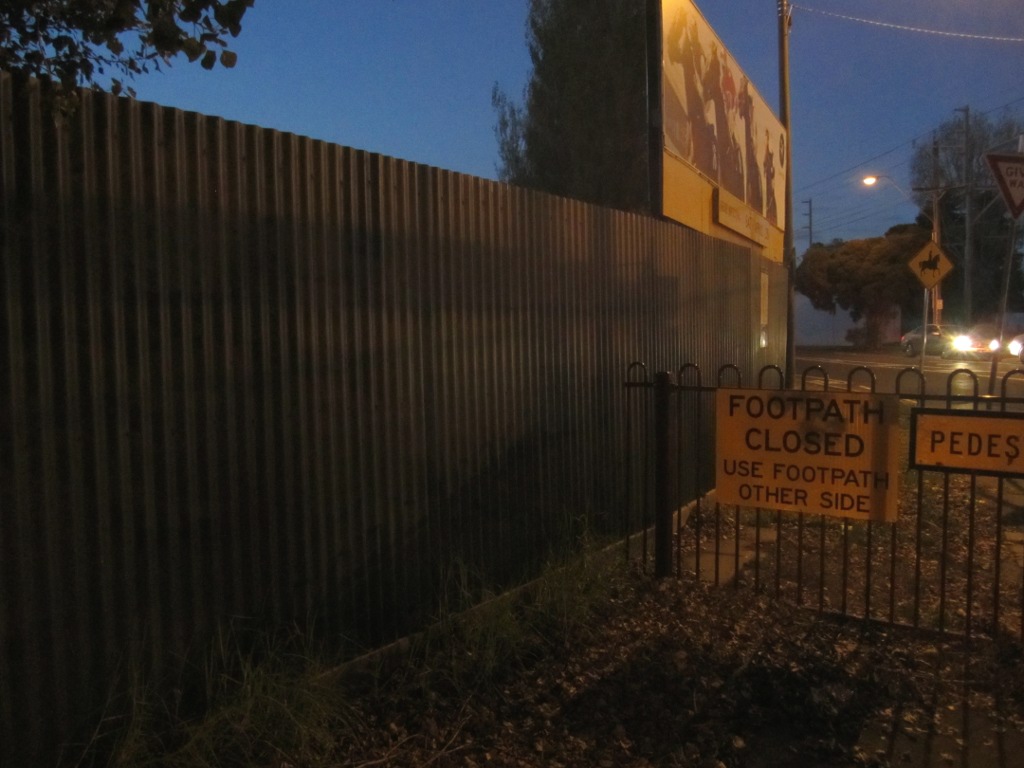
PS:  Following several comments re the MRC’s failure to put up the fence as per the ‘agreement’, we’ve received a photo of the site taken exactly one year since the signing of the ‘agreement’ (27th April). As many residents suspected, such agreements obviously aren’t worth the paper they’re written on! The weeds certainly do add a nice touch as well!

GESAC

We report that:

  • Once again no Pools Steering Committee report – even though this group are meant to meet every month and keep councillors informed as to progress
  • Of the 5 Records of Assembly (ranging over a month) GESAC is mentioned ONCE!
  • Council is still losing money hand over fist. The Financial Report lists revenue loss as now standing at $1.93 million due to the delay.
  • Also of significance is the nearly $4 million that capital works is behind schedule. Maybe the principle at work here is:  don’t spend what you promised to spend because that would drive the liquidity ratio well below the danger level of 1! Hang on to the money for as long as you can and use this to artificially boost the cash base.

RECORDS OF ASSEMBLY

5 records of assembly are provided. We have to again question the accuracy and/or selective nature of these ‘records’. Lipshutz does not rate a mention once – it’s like he doesn’t exist. Either he is not doing his job by raising issues, or those issues simply aren’t reported. We certainly do not believe that he sits in these meetings totally mute. That then raises the question of how slanted these various records of assembly are.

We’ve gone through these and noted the number of times that individual councillors get a mention (apart from the declarations of interest).  It’s therefore fascinating as to what is put in and what is left out and the bigger question of WHO DECIDES – especially when we’re told that the meeting adjourned and reassembled but only councillors are listed. Does this mean that officers departed? If they didn’t, then why aren’t they listed as present? If they did leave then who took the minutes? Was it an independent note-taker as recommended by the Municipal Inspector?

The individual councillor mentions are:

Penhalluriack – 17

Hyams – 7

Magee – 5

Lobo – 4

Forge – 7

Pilling 1

Tang 3

Esakoff was absent for all meetings; Pilling was absent for 1.

Readers are free to draw their own conclusions as to what this signifies. However, it should raise alarm bells as to the possible distortion(s) that these ‘records’ might represent.

C87

Overall recommendation is to go to a Planning Panel. However, the convoluted logic is worthy of highlighting. Apparently there were 59 submissions. Some favoured the Amendment, others opposed. What is important is that of these 59,

“27 submitters support the intent of the amendment but are “objecting” because their properties have not been included in the amendment”.

Since council did not INVITE comments from the community in preparing this amendment nor determining which areas are worthy of greater protection, they now turn around and argue – “This category of submissions request changes which go beyond the scope of this amendment in the form it was exhibited to the community. Any property that was not included as part of the exhibited amendment cannot now be included in this amendment.”

This somewhat patronising advice is then offered to those 27 submitters – “The suggested way forward for this category of submitters is to encourage them to put their views to the independent panel. The panel may, through their reported recommendations to Council, come to the view that some properties, not currently part of the amendment, are nonetheless worthy of NCO or DDO protection. It would then be open to Council to consider a new amendment process to include these properties.”

In other words, tough luck! We believe that the chances of the Panel investigating something outside their terms of reference is zero! Another Amendment must be devised, advertised, calls for submissions, Ministerial approval, etc. etc. As Hyams is so fond of saying, this could take years!

Our conclusion? Another tinkering with the edges of the planning scheme to deliver pre-determined outcomes that have deliberately excluded consideration of the majority of areas within Glen Eira. This is Sir Humphrey at his absolute best!

MULCH

Finally, there’s the recommendation to re-install the mulch facility exactly where it’s been – Glen Huntly. Residents are expected to believe that there is absolutely no other area within Glen Eira that could accommodate this facility and that relocation would probably cost $3 million!

We’ll comment on this in far greater detail in the days ahead.

From Council’s website –

Glen Eira City Council is currently finalising a proposed play space project at Murrumbeena Park on Kangaroo Road.

The proposal sees the removal of the existing playground adjacent to the main sports oval and the creation of a new play space in the eastern side of the park. The design incorporates a number of leading edge components and treatments which will make the playspace a model for future developments.

The design goes beyond any existing playground and merges traditional play equipment with interactive landscaping, family picnic areas, tree plantings and facilities. It provides areas from toddlers to more active adolescents and can be accessed by wheelchairs and prams.

In January, the Victorian Government announced a grant of $258,921 to assist in the construction of the Murrumbeena play space as part of Sport and Recreation Victoria’s Community Facility Funding Program.

The project is listed as an item for consideration as part of Council’s 2012–13 Budget.

An opportunity to view the plans will be available at Murrumbeena Park Pavilion, Kangaroo Road on Thursday 24 May from 6.30pm to7.30pm. This will include a brief presentation by the play space designer and Council officers will be available to clarify any issues and answer any questions.

If you require further information, contact Council’s Service Centre on 9524 3333 or email recservices@gleneira.vic.gov.au

COMMENTS

  • What has happened to ‘community consultation’ re the design? One hour will definitely give residents ample opportunity to view and comment on the design, won’t it? Could it possibly be that after the fiasco of Packer Park the decision was NOT TO ENGAGE with the community and seek feedback?
  • No mention of the $700,000 that will come of ratepayers’ pockets!
  • Why are all designs produced by this council so ‘cartoonish’ and lacking in detail?
  • Risk management would certainly be an issue with this design given that the goal posts sit practically on the edge of the path/play areas. Will this mean that kiddies have to dodge footballs, soccer balls, etc? Or will council suddenly decide that they have to ‘relocate’ the sporting grounds at the cost of mega bucks? Or will we now have a 20 foot wire mesh fence to cordon off the sporting oval from the ‘development’?
  • Why are we spending $1,000,000 when this council has been classified as ‘high risk’ and we are facing a ‘cash crisis’ and a playground is already in existence at the park?


From the Auditor General’s latest report

Performance reporting by councils remains inadequate. It is focused on inputs and operating activities, and offers little insight into the impact of services and the achievement of objectives.

Specifically, a meta-analysis of 16 performance audits identified the recurring themes of:

  • • ineffective planning and budgeting
  • • inadequate implementation of initiatives and adherence to policies and procedures
  • • weak oversight and monitoring of council activities and outcomes
  • • inadequate attention to addressing persistent performance issues.

These recurring issues are, in part, a by-product of a lack of accountability for performance due to weaknesses in performance monitoring and related information. No council had developed a set of indicators that adequately measured the impact of services and achievement of objectives.

Key issues compromising the effectiveness of performance reporting at councils were:

  • • poorly expressed objectives that cannot be effectively measured
  • • indicators that do not comprehensively cover all aspects of councils’ objectives and key strategic activities
  • • indicators that do not provide balanced information about quality, efficiency and outcomes
  • • a lack of adequate policies for performance reporting
  • • limited training for councillors and staff in performance measurement and management.
  • an over-reliance on limited community satisfaction metrics for assessing services, which do not provide a sufficiently comprehensive and balanced view of performance

Effective performance reporting assures councils are accountable to their local residents and ratepayers for these important obligations. It is critical for demonstrating value-for-money, the achievement of objectives, equitable access to services, and that services are appropriate, of good quality, and cost effective. 

Principles of effective local government performance reporting  

Comprehensive

To be comprehensive, indicators should be relevant to council objectives. Objectives should be clearly expressed, measurable, and there should be a clear nexus between objectives and performance indicators. Performance indicators should also cover all critical aspects of objectives and align with services.

Balanced

Performance indicators should cover the time, cost, quantity and quality of service provision, as well as the outcomes of council activity. A single indicator is typically not able to measure each of these aspects, therefore a suite of indicators is usually required to provide balanced performance information.

Appropriate

Performance indicators should be reported with appropriate context to allow community members to interpret results. Targets, trend data and an explanation of the result should be provided to allow members of the community without technical knowledge to draw meaningful conclusions about the performance of council.

…limited improvement was evident in the quality of the performance statements produced by councils, and that non-financial performance indicators are of limited relevance to ratepayers and residents. The report further noted that councils continue to adopt a ‘compliance-centric’ approach to performance information, and that they have yet to fully implement previous audit recommendations or to produce performance reports that drive council outcomes and accountability by being relevant and appropriate to stakeholder needs.

After a barrage of questions on the GESAC FACEBOOK page from residents asking for an opening date for this mega complex there has finally appeared some response from Council after nearly a month of total silence.

The straw which may have finally broken the camel’s back was this comment: “Just got a email sayhing sport stadium season starts on may 14th  Does that mean the whole centre is open then? Some communication would be helpful to those juggling memberships etc until you open.”

The answer? –“Planning for opening is well under way with GESAC staff almost complete on pre-opening activities. However, we are still waiting on the builder to provide the official date of handover so that an official opening can be communicated.”

Again we have to lament the lack of proper communication with residents by this Council. As of 5.15pm Monday the 23 April there is no word on council’s GESAC site, nor its website as to what is happening. We also deplore the fact that ostensibly it is only members have been informed via email of a ‘potential’ opening date instead of every single ratepayer in Glen Eira who is funding this centre.

Further criticism should be levelled at the content of this news and its ambiguity, if not downright contradiction. Residents have been told that there will NOT BE A STAGED OPENING because of contractual and safety issues. Now it looks like the story might have changed! But, we are still left in the dark as to whether:

1.     Has ‘practical completion’ been done?

2.     What is the definite date of opening for the entire centre?

3.     If there is a partial opening, then why were residents informed to the contrary just weeks ago?

4.     Why is Council still waiting on the ‘builder’? Surely at this late stage there should not be any uncertainty?

The entire GESAC project has been characterised by secrecy,  the appalling lack of timely information, and the failure to be fully transparent and accountable to residents.


The ‘Executive Summary’ of the O’Neill report comprises 8 pages involving 6 allegations. She concludes with 7 recommendations. The report is dated 20th June 2011. This is the first of our posts on this issue.

The following points should be carefully noted:

  • Newton’s allegations were never put into writing – they remain ‘unofficial’. There has never been a formal ‘written complaint’
  • Penhalluriack (and allegedly Newton) have only received this summary report – not the full report itself.
  • Who has read the full report?
  • O’Neill wrote the allegations herself based on the documents (and ‘discussions’?) provided to her by Newton
  • O’Neill interviewed: Lipshutz, Esakoff, Tang, Swabey, Wait, Donna Graham (Legal Counsel for council), Hyams, Magee, Pilling, Lobo, Forge. Penhalluriack asked that 6 residents be interviewed. O’Neill only interviewed 2 residents claiming that 4 were not ‘relevant’ to the investigation.
  • O’Neill NEVER concluded that Penhalluriack was a ‘bully’ in this report. Her strongest claim was that there were instances of “inappropriate behaviour”.

The following opening extracts are cited verbatim:

“In accordance with the terms of the Glen Eira Bullying Policy, the complainant, being the CEO and the person accused of bullying, being Councillor Penhalluriack should be provided with this Executive Summary. This should be raised at the earliest possible opportunity with Councillors to ensure that both the CEO and Cr Penhalluriack are given an opportunity to respond in accordance with your Policies and Procedures. This is particularly the case as Cr Penhalluriack is about to go on leave this week.

1.1           You have instructed me via Peter Jones, the responsible Officer, that the CEO, Andrew Newton (“CEO”) has raised a number of OHS concerns that he has with respect to the provision of a safe system of work. No official written complaint has been made by the CEO.

1.2           As there was no written complaint in this matter, I met with the CEO to ascertain what his OHS concerns were. Following my meetings with the CEO, I drafted a Table of Allegations  which was approved by the CEO

1.3           Cr Penhalluriack has been given every possible opportunity to respond to the allegations. Ultimately, Cr Penhalluriack chose not to meet with me to allow me to put the allegations to him. Instead he provided me with a written submission. It should be noted that in some cases these written submission to me do not address the allegation, but instead he responds to each of the incidences that are referred to in the allegations. By declining to meet with me and let me go through the submissions with him, I have been unable to provide him with information provided by other witnesses so that he could respond to those matters or discuss with him in more detail the issues.” 

COMMENTS

We find this whole process extraordinary for the following reasons:

  • No attempt at mediation as a first port of call as recommended by Worksafe and Council policy.
  • Nothing in writing from Newton – just the handing over of a (selective?) bunch of documents
  • As the official ‘author’ of the subsequent allegations, O’Neill becomes both ‘accuser’ and ‘judge’ – a process that is highly suspect professionally and legally.
  • Why Newton’s reluctance to put anything down on paper? Another ploy to ensure that his hands are clean?
  • O’Neill’s logic is incomprehensible – ie. conclusions of guilt surely are made on the bases of the ‘incidents’ recorded and their overall credibility.  Penhalluriack is criticised for challenging these ‘incidents’ head on. Yet what else is he supposed to do – especially if such ‘incidents’ demand debunking? Common sense tells us that if the ‘incidents’ are spurious and would never hold up in a court of law, then conclusions as to ‘inappropriate behaviour’ or ‘bullying’ are highly suspect. Understanding this basic principle appears to have been beyond O’Neill. The question then arises as to what weighting O’Neill gave to Penhalluriack’s submission.
  • Finally, we’ve learnt that this ostensible ‘objective’ Executive Summary does not contain one single word that emanated from the interviewed residents. Were their comments irrelevant, or perhaps, deliberately overlooked? 

The Auditor General tabled his report on FOI and Public Sector bodies several days ago. We’ve copied some extracts from his findings below. The full report may be accessed at: http://www.audit.vic.gov.au/publications/20120418-FOI/20120418-FOI.pdf

“Freedom of information (FOI) is a cornerstone of a thriving democracy. FOI upholds the public’s fundamental right to access information held by the government. The community’s ability to scrutinise public sector activities and hold the government of the day accountable for its decisions is affected by the transparency and accessibility of government information. 

Since the Freedom of Information Act 1982 (the Act) was introduced, both the number and the complexity of requests for information have increased considerably. In 2010–11 there were 34 052 FOI requests, compared to 4 702 requests in 1984–85, the first full year the Act was in operation……

Since FOI legislation was introduced 30 years ago, Victoria has gone from being at the forefront of FOI law and administration to one of the least progressive jurisdictions in Australia. Over time, apathy and resistance to scrutiny have adversely affected the operation of the Act, restricting the amount of information being released. As a result, agencies are not meeting the object of the Act, which is ‘to extend as far as possible the right of the community to access information’.

The public’s right to timely, comprehensive and accurate information is consequently being frustrated. The Victorian public sector’s systemic failure to support this right is a failure to deliver Parliament’s intent.

The prevailing culture and lack of transparent processes allow principal officers— secretaries and chief executive officers of agencies—to avoid fulfilling their responsibilities. Principal officers are not being held to account for their agency’s underperformance and non-compliance.”

+++++++++++++++++++++++++++++++++++++++++++++++++++++++++

Given recent events at VCAT, and Council’s repeated failure to answer public questions directly and comprehensively, we believe that many of the Auditor General’s findings are also applicable to Glen Eira.

The 2010/2011 Annual Report contains some revealing statistics –

In 2005/6 the number of FOI requests totalled 13. Of these, 3 were granted full access and 5 partial access.

In 2010/11 the number of FOI requests burgeoned out to 37 (with council claiming that 10 were ‘determined’ not to be FOI requests) and only one application was granted full access.

It is at least encouraging that residents are beginning to exercise their rights in applying for FOI when they are not satisfied with council responses to their questions. It is, however, concerning that the culture that is currently attributed to state agencies also appears to be alive and well and thriving in Glen Eira. Hardly surprising we say, when so much relies on secrecy and behind closed doors decision making!

« Previous PageNext Page »