GE Transport


When vitally important decisions are being made, we believe it is incumbent on councillors to proffer statements that are accurate. Everyone is entitled to their opinion of course, but espousing unfounded views and presenting them as ‘facts’ is unacceptable. Even if ignorance is partly to blame for such announcements, it does not absolve councillors from their duty of proper oversight.  Their role is to analyse, question, and provide a rationale that will stand up to full scrutiny. This has not been done – especially at the last council meeting.

Two important items were presented at the last council meeting – the draft Housing Strategy and the Caulfield Station Structure Plan. Both items have the potential to dramatically change residential amenity and the environment in Glen Eira and thus affect every resident.

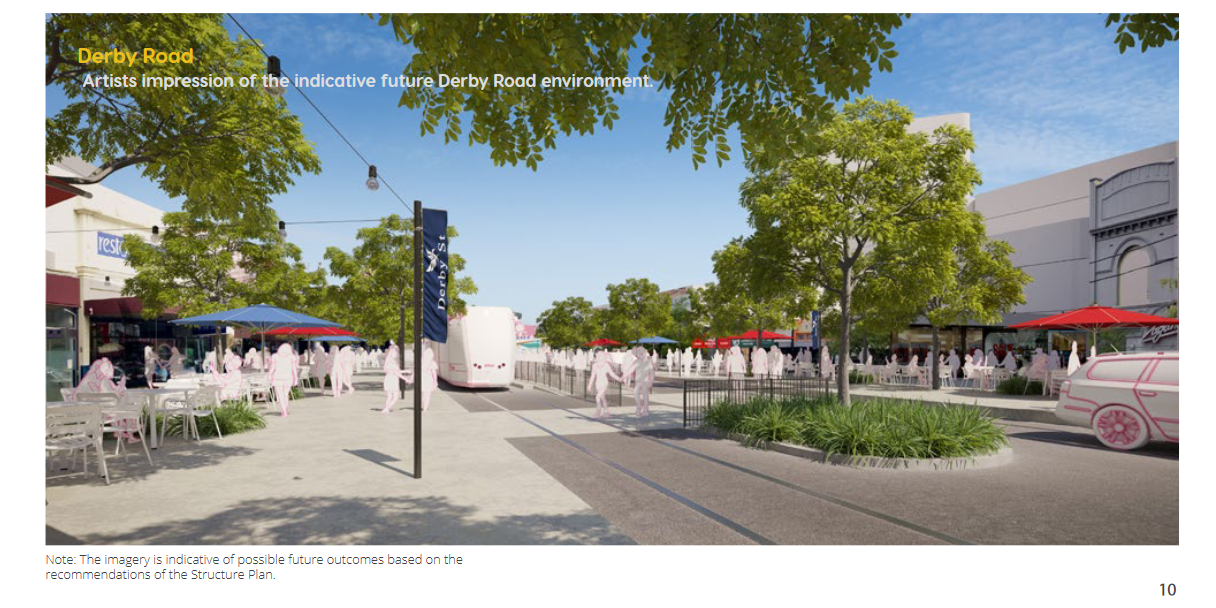
In regard to the Caulfield Structure Plan the draft proposes one height of 25 storeys, and for the MRC freehold land 12 storeys. All heights are discretionary rather than mandatory which of course means that they could ultimately be higher! No urban design evidence, nor overshadowing impacts were provided for this item. Even in the heritage precinct of Derby Road, the proposal is for a discretionary 8 storey limit. This of course begs the question as to why other heritage commercial zones in Bentleigh, Elsternwick and Carnegie were allocated a mandatory four storey height limit. Are we to assume that some areas are more ‘heritage worthy’ than others?

We take particular issue with some of the comments made by Athanasopolous and Zyngier as outlined below:

ATHANASOPOLOUS:  on the issue of heights in commercial areas this councillor argued that Glen Eira has little chance of achieving mandatory controls in commercially zoned land and certainly not in areas zoned Activity Centre Zone. Conclusion? – that discretionary heights are better than nothing – thus absolving council for even trying! He went on to challenge anyone to come up with ‘evidence’ that this was not the case when he stated that people: Can’t come up with where mandatory controls have been given for 12 storeys in an activity centre structure plan. People can’t even provide that evidence.

ZYNGIER: basically reiterated this line of argument and said that council has no control over commercial zones.

Both statements are factually incorrect! Other councils have been successful in acquiring mandatory height limits for their commercial strips and are nowhere near 25 storeys as proposed in this draft structure plan. Whilst it is true that ultimately the Minister must sign off on such amendments, the primary question should be: WHY HAVE THESE OTHER COUNCILS BEEN SUCCESSFUL? Clearly councils do have ‘control’ over what they propose and what they pursue or are willing to accept. In Glen Eira, we start from the proposition that worse could be imposed so let’s go for 25 storeys as a starter!

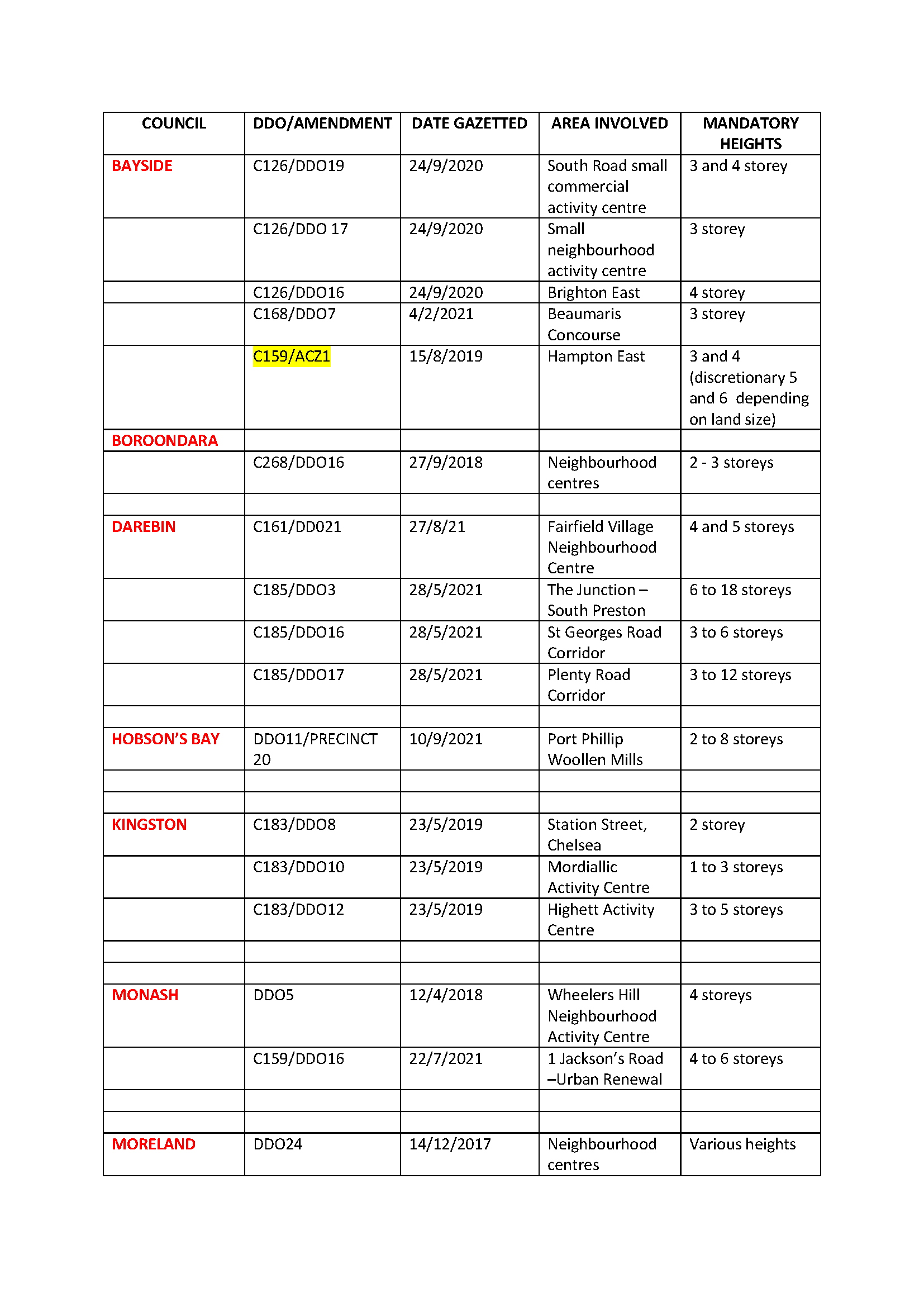
We have taken the time and trouble to go through gazetted amendments from other councils which have all had mandatory height controls enacted in their precincts. All of these are well within the 10 year limit that Athanasopolous asked for. They even include some Activity Centre Zones, where none of the heights come close to what Glen Eira is asking for.

Please consider the following table carefully and then reflect on Glen Eira’s approach and the validity of what some councillors espouse.

As we stated in our previous post, the lack of detailed analyses by those councillors who endorsed the housing strategy is simply mind boggling. Not one of them mentioned or analysed any of the following:

  • Land capacity out to 2036 estimates that the municipality has scope (available land) for  50,000 net new dwellings. Housing projections state that all we need are approximately 13,000.
  • They simply accepted the assumption that more dwellings means greater affordability.
  • Removing the mandatory garden requirement will be ‘compensated’ by the landscape requirements – which of course aren’t specified in any document. All that we have is waffle and generalisations.
  • How increasing site coverage in the NRZ will ‘fit in’ with the climate emergency, urban forest strategy, etc.

By way of contrast, the best summation on the evening came from Esakoff. We have uploaded her statements and urge all residents to listen and consider what this means.

To further illustrate what is in store, here is part of the Housing Framework Plan. We’ve chosen the GRZ areas in East Bentleigh. All the streets presented in the darker orange now find themselves in the Substantial Change Area 2. This means: no mandatory garden requirement; tree canopy retention only where ‘practical’; reduction of rear setbacks and potentially lessening of onsite parking requirements. In other words, cramming more and more into these sites.

Finally, Athanasopolous cited the changes as only impacting a ‘small’ amount of properties. A public question asked on Tuesday night provided the answers as to the number of sites that will be affected by these proposals. In the GRZ Substantial Change Area 1 the answer provided was 7,624! The sites impacted in NRZ were said to be 3,075. That’s a grand total of 10,699 that will be severely impacted by the proposed changes. Glen Eira currently has 65,000 residential properties, but far less sites – since many are multi-storey containing many apartments. This is also true for the current dwelling proportion in GRZ but at a lower scale than the commercial areas. Even accepting this, we still estimate that roughly 15 to 20% of Glen Eira residents will face potential developments without the necessary strategic justification. Furthermore, if we assume that only 10% of these 10,000+ sites will increase their net dwellings by one (ie from 2 dwellings to 3 dwellings) that equates to another net 1000 plus dwellings. This is of course a very conservative estimate since the prognostications for ‘take up’ far exceed 10% and the likelihood of only a one net dwelling increase is again highly conservative. These proposed changes alone could deliver thousands upon thousands of net new dwellings with absolutely no guarantee that they will be cheaper, will assist in increasing our tree canopy, or assist in fighting climate change.

These figures also need to be seen in the context of what else is planned for Glen Eira. We should add in another 3000 at least for East Village, another 4000 under the Caulfield Station structure plan as stated in the Charter housing analysis. None of these account for what else might be in the pipeline throughout Glen Eira.

The pro-development agenda of these 5 councillors and this administration is continuing to destroy this municipality!

Our plaudits must go to Esakoff, Parasol, Cade and Szmood following last night’s council meeting. These are the four councillors who voted AGAINST the current draft Housing Strategy and highlighted the issues that were unacceptable with what was being proposed. Sadly, the pro-development lobby (aka, Athanasopolous, Magee, Zyngier, Pilling and Zhang) carried the vote 5 to 4.

It’s not simply that the latter voted in favour of putting the housing strategy out for consultation. It is that their arguments in favour of the draft were superficial, misleading, inaccurate, and deliberately avoided mention of the most contentious aspects of the draft. All of this leads us to question whether any of these 5 councillors actually bothered to read the relevant 589 pages. We doubt it!

Cr Zyngier didn’t even utter one single word about the CONTENT of the draft or its recommendations. His focus was improving ‘consultation’ recommendations. All terrific, but how about an analysis of what is being proposed and commenting on those things in order to provide residents with the rationale behind the vote? Magee of course used the old heart strings ploy of ‘where will my children live’ totally ignoring the fact that the consultants provided their estimates of an existing land capacity for 50,000 net new dwellings when our projected housing needs were 13,000 by 2036. Pilling and Zhang merely mumbled their way through the obvious – again without once mentioning the potential negatives.

Athanasopolous was the major culprit. Either he has never bothered to read the Glen Eira planning scheme in order to understand what is currently permitted in NRZ zones, or he follows the strategy of never let the truth interfere and derail the spin. We will provide an indepth commentary on his efforts in our next post. At best, they displayed sheer ignorance. At worst they were deliberate attempts at deception and camouflage.

In contrast, the opposing councillors highlighted the actual detail contained in the draft and the impacts these proposals would have on residents and their amenity in the years to come. They also questioned the underlying assumption and justification for the proposed rezonings and schedule changes  – ie build more and there would magically be housing affordability!

When something as important as this document is up for decision it is incumbent that all councillors consider the full implications. Residents need to hear the reasoning behind the votes. They need to be convinced that something which is going to affect their lives has been given due consideration and is not a vote that follows any state or federal political party agenda. Most importantly, they need to be convinced that councillors have actually read what has been put in front of them and questioned vigorously the data, the conclusions, and the assumptions. This we maintain was not done by the 5 councillors in question.

Watch this space for a detailed analyses of what happened last night.

Council has finally released its draft Housing Strategy. The proposals will impact hundreds upon hundreds (if not thousands) of residents – without the necessary justification or evidence. Why do we think so?

  1. The various documents state over and over again that Glen Eira has the land CAPACITY to meet our projected housing needs of roughly 13,000 net new dwellings by 2036. If this is the case, then why do we need to rezone and facilitate more and more development?
  2. Much of the data provided is highly tenuous and conflicts with both Victoria in Future prognostications, as well as the Bureau of Statistics data.
  3. The assumption that building more and more will reduce prices is a fallacy and there is plenty of published evidence that would refute, or at least challenge this claim.
  4. Council has an Urban Forest Strategy, a declining tree canopy,  and a Climate Emergency policy, yet paradoxically is prepared to reduce setbacks, remove mandatory garden and parking requirements, and tellingly, instead of attempting to reduce the height island effect, council is prepared to reduce permeability so that more dwellings can occupy certain sites.
  5. Our conclusion is that this Housing Strategy is Amendment C184 in disguise – except that it will now extend to all of the municipality instead of only Bentleigh and Carnegie.

The important detail is presented below.

What the above implies about the potential zoning and schedule changes are:

  • Currently land zoned NRZ has a 50% site coverage, a 25% permeability requirement and a 4 metre rear setback. The above screen dump makes it clear that the new NRZ zone will in all probability become 60% site coverage, 20% permeability, and a removal of the 4 metre setback entirely.
  • The current GRZ zoning allows an 11 metre height maximum plus various setbacks for the upper second and third level of the buildings. There is also a mandatory garden requirement of 25% to 35% depending on the size of the property. Again, council is proposing to remove this so once again we can have more development on the site. Rear setbacks are also likely to go.

Council has provided the following map that is now the Framework Plan. Surely far more detail could have been provided such as clear differentiation of colours rather than what is shown as gradations of pink. Why not clear blues, greens, yellows that stand out? Or would this reveal too much to residents?

From this map it would appear that all Neighbourhood Centres zoned GRZ will have the mandatory garden requirement removed. Please consider the above map carefully and try to decipher whether you will be impacted by these changes.

There is much, much, more that could be said about this and council’s overall approach to consultation.  4 weeks is not enough to plough through 589 pages on the housing strategy itself. Consultation requires more than a ‘survey’ that in the past has not asked the right questions. Nor is it appropriate that council publishes a 1000 page agenda several days before vital decisions are to be made. How many more times will it be necessary to remind this council that the ombudsman recommended at least 5 working days for the publication of agendas?

We urge all residents to contact their councillors and to lobby hard for the rejection of this Housing Strategy!

At last night’s council meeting, it was revealed that over 600 trees will be removed by LXRA in order to complete the Glen Huntly station development.

With their typical lack of sufficient detail, the LXRA webpages only provide very scant detail. Please see this link: https://levelcrossings.vic.gov.au/media/publications/glen-huntly-factsheet-vegetation-removal

The promise to plant 2 trees for every one removed would mean that at least 1200 new trees are planted. We won’t hold our breath, and we also have to wonder whether a 3 foot sapling can in any way be equated with what is about to be destroyed. The onus is thus on council and residents to ensure that as many trees as possible are saved.

Source: https://www.planning.vic.gov.au/resource-library/planning-permit-activity-in-victoria/planning-permit-activity-quarterly-report#Reports-tabs2

If anyone had any doubts about the rate of development in Glen Eira, then the above graph should provide plenty of food for thought. This municipality is grouped together with Bayside, Boroondara and Stonnington in the State Government’s planning agenda. The figures clearly show that we are far outstripping even Stonnington which is really an ‘inner’ municipality rather than a ‘middle’ council such as Glen Eira.

The numbers in the graph represent approved subdivisions from January to December 2021 and hence are a far more reliable figure than simply building permits. Each subdivision means that a new ‘lot’ has been created – whether this be for single blocks being subdivided to accommodate 2 dwellings, or apartment blocks being subdivided for each new unit. Reliability is also greater than for the building permits, since the subdivision process in the vast majority of case comes after the planning permit has been granted, and after the building permit has also been granted. Subdivision is usually near the completion of the building – either to sell off the plan, or to sell upon the completion of construction.

The subdivision figures from 2016 onwards are also frightening in that Glen Eira has consistently recorded well over 1200 net new dwellings per year. Council’s annual report in fact recorded 6343 additional ‘rateable properties’ for these 5 years – an average of 1269 completed homes per annum.  So again, we have to question the strategic planning of this council when we have consistently exceeded the Victoria in Future ‘required’ net new dwellings of 900 per annum. But this seems to have fallen on deaf ears in this council with structure planning that continues to encourage and facilitate more and more development.

Even more concerning is that all of the above figures do NOT include what is to eventuate at East Village (at least another 3000 apartments) and at Caulfield Village (precinct 3) another 1000-1500 with a height of 22 storeys being mooted. We are also still awaiting the release of the Caulfield Station structure plan. We have no doubt that this will feature a total indifference to heritage and will provide the green light for heights approaching 15 to 20 storeys.

Thus council keeps forging ahead with amendment after amendment PRIOR to the completion of a housing strategy. The fundamental question remains ignored: do we need the heights proposed in these various structure plans when our projected housing needs will have been well and truly exceeded? How does this benefit the community? Or, does it only benefit developers?

With another year almost gone, it is perhaps a good time to reflect on what has happened throughout this period. What, if anything, has improved? What has gone backwards? What has remained static? Have the new councillors performed well? Have the old councillors ‘improved’?

There have been some positive steps, although we must admit they are tiny baby steps compared to what is required. We finally, after 18 years of talk, got a significant tree register. However, the roll out of this program is well and truly behind schedule and ultimately will take another few years to reach even the miniscule figure of 250 trees given the current rate. More disheartening is the fact that the tree register remains part of council’s Local Law, rather than being enshrined in the planning scheme itself. A recent VCAT hearing had the member make this comment which reveals how important it is that controls are included in our planning scheme. We quote:

The site contains five (5) trees that are proposed to be removed as part of the car park development. All are of exotic species and the planning scheme does not have any tree removal controls. Hence, their removal is acceptable.

(SOURCE: – https://www.austlii.edu.au/cgi-bin/viewdoc/au/cases/vic/VCAT//2021/1549.html)

Whether or not one finds the conclusion valid, is a moot point. If council did have a planning scheme which sought protection of ALL trees meeting certain criteria, then perhaps such judgements would be far less frequent.

We have been told again and again that councillors are determined to address the municipality’s lack of public open space, sustainability, increase our canopy cover, and take real action on climate change. All well and good and to be applauded. However, when such aspirations are not backed up by sufficient funding, then we have to query whether anything will really improve over the next few years. The Open Space Strategy states that at least 150 hectares of additional open space is required to meet the community’s needs. The long term financial plan allocates roughly $7M per annum for each of the next four years. This is just enough to purchase roughly 1500 – 1800 square metres of property per annum. Even with the current proposal for an 8.3%  open space levy (when other councils are looking at 10%) this will still not be sufficient to come even close to the ‘required’ 150 hectares.

The above comments can also be applied to council’s action plan on increasing the canopy cover, and acting on reducing carbon emissions. Unless such policies are backed up by sufficient funding, then we can only anticipate a further loss of important canopy trees, and little improvement in climate management strategies. This of course goes to the heart of priority setting by this administration and its elected representatives. When council is committed to massive spending on infrastructure projects such as the Carnegie Pool, to the tune of now $52M (up from the budget forecast of $51M), and when no business case has been made public, we have to doubt the efficacy of such decisions – especially when countless comments from residents wanted the ambience and the foot print of the current pool retained. Very few desired another (mini) GESAC. 

Planning in Glen Eira remains as it has for decades – pro development, and lacking in enforceable strategies and policies. It is quite unbelievable that after the mandated Planning Scheme Review of 2016 we still do not have:

  • Permanent structure plans for Bentleigh, Elsternwick, and Carnegie
  • After being promised structure plans for our neighbourhood centres, we only have ‘guidelines’ (ie Built Form Frameworks) for three neighbourhood centres which are not as yet even in the planning scheme. No indication has been given as to what to expect for the remaining centres.
  • No developer contributions on parking as promised in 2016
  • No Water Sensitive Urban Design (WSUD) policy
  • No review of the residential zones and their respective schedules since 2013
  • And the most damning fact – no housing strategy since 2002 and council steam rolling ahead with amendment after amendment all PRIOR to the completion of an essential housing strategy.

Politics has continued to play an important role in many councillors’ decision making as evidenced by the car park issue and the acceptance (or not) of the $18M funding from the Federal Government. Politics is also evident in the alacrity with which some Labor aligned councillors so heartily support draft structure plans and applications that include heights so out of keeping with resident wishes.

Council signed an ‘agreement’ with several other councils this year to demand greater community and council input into the State Government’s planning agenda. Thus far, we have heard nothing back.  Have discussions been ongoing between councils and the department? If so, why not some updates?

We must also comment on the volume of useless community consultations. We maintain that they are indeed ‘useless’ when the questions on surveys are simply designed to elicit certain responses, and when councillors and the community consultation committee has no input into the final product. Residents are often faced with planning jargon that most will not be familiar with, or with hundreds upon hundreds of pages to plough through in order to come up with some decent submissions. The absence of Discussion Papers that are truly objective and informative is a major failing of this council. Surely a brief document that accurately summarises the issues would not go astray.

Several councillors have bemoaned the fact that the response rate on various issues is poor. Perhaps council needs to start asking why this might be the case. Is it simply because residents are apathetic? Or perhaps it might have more to do with the fact that so many people believe that their views will not be acted upon? Or maybe, the manner in which consultations are carried out, and the ‘useless’ questions are seen as a complete waste of time by residents?  Then again, people are simply tired no doubt, and flooding them with mock consultation after mock consultation is simply demoralising and counter productive. Perhaps more people would respond if more information was included that meant something. For example: pretty pictures of draft designs is not enough. Why not include some basics like -size, cost, footprint? Surely this would elicit some very relevant and greater feedback. The greatest fallacy however would be for this council to assume that because the response rates might not be up to par, that means that the majority of residents are in FAVOUR of the various projects. In our view, nothing could be further from the truth. Disquiet is growing and until this council addresses the fundamental issues of housing, open space, and sustainability, we will continue to head backwards. It is the role of councillors to ensure that this trend is reversed.

Our best wishes to all for a much healthier and far more fulfilling 2022.

Last night’s council meeting included another first – the refusal to allow a councillor his requested time extension. This occurred on the ‘debate’ for progressing the multi-storey car parks in Bentleigh and Elsternwick to the next stage – ie design, background reports, feasibility studies etc.

Zyngier rose to speak against the motion to proceed. He spoke for his 3 allotted minutes and then requested a time extension of 6 minutes. Magee replied that he would consider another 3 minutes first and then see how far Zyngier had got with his statements. The motion to allow the three minute extension was put and voted down. Those opposing the time extension were: Esakoff, Cade, Parasol, and Zmood. Given that Pilling and Athanasopolous were absent, these councillors constituted the majority.

Only Zhang later in the ‘debate’ commented how disappointing it was that this occurred.

It is indeed another sad day for Glen Eira when a councillor is denied his right to speak for more than 3 minutes. To the best of our knowledge, this has not occurred previously. Whatever Zyngier had wanted to say is not the issue. Nor is the final voting the issue. What is the issue, is how politics has come to play a major role in many council decisions and this applies to both sides!

Since none of the above 4 councillors provided reasons for their decision to disallow Zyngier his requested time, we have no idea why they voted the way they did. Simply not good enough.

On another matter, it seems that McKenzie has adopted the Paul Burke method of reading out public questions as fast as she possibly can in a steady monotone, making it difficult to follow the intricacies of the question for those listening or viewing. This was not the case 6 months ago!

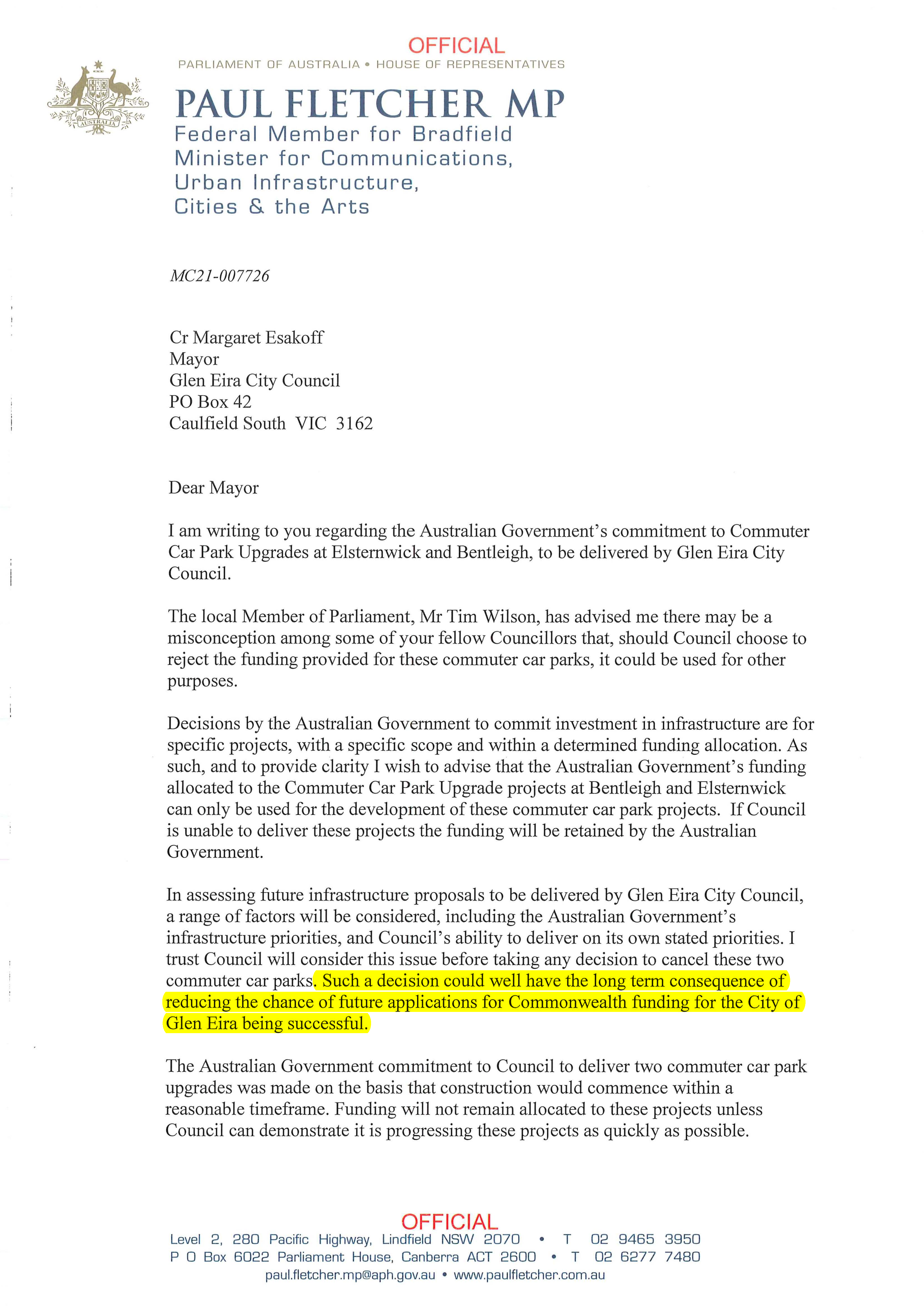
The Age has today published a letter from the Commomwealth Minister for Infrastructure in relation to the multi-level car park funding. It is presented below:

Whatever one may think of the entire car park issue, there have been plenty of ‘wrongs’ committed along the way by council and government.  Consider the following:

  • The first real inkling that residents had of council’s possible intention to built high rise car parks came with the structure planning for Bentleigh & Carnegie. At no stage were residents provided with the opportunity to say ‘yeeah’ or ‘naay’ SPECIFICALLY to these structures. An earlier background report for Bentleigh even suggested that two such car parks be erected and that council owned land could be sold off.
  • Now that there has been plenty of adverse criticism for the funding, a ‘consultation’ is finally taking place. But like most Glen Eira consultations, it is far from acceptable. (See: https://gleneira.blog/2021/10/13/multi-storey-carparks/
  • If council are so fantastic in their strategic planning, then why didn’t they get the proposed locations right the first time around?  Why were residents told that a 6 and 5 storey construction was required, to now have these heights reduced – without of course informing us as to the new proposed heights!
  • As for the Minister’s letter, thinly veiled threats are far from acceptable. Nor do we really know whether council was ‘tapped on the shoulder’ (as claimed) for these grants, or whether there was a formal submission. Perhaps if such a document exists, it could be placed in the public domain?

In our view none of this would have happened if a logical and clear process was followed. Namely:

  1. First the decision is made AFTER community consultation that such multi-level carparks are required.
  2. Consultation provides all the necessary detail – ie costings, design, etc.
  3. Government grants and the rationale for decisions are made public

So we are now really and truly in the proverbial! If for example the community is in favour of only one of these car parks, will council receive half the money, or none? Will council react to this clear intimidation, or meekly cave in? If this letter was sent in September, when were councillors informed as to its receipt? Or did they only find out today?

And when will politics finally keep its grubby little hands out of local affairs? Labor and the Greens are keen to use the ‘tainted’ nomenclature to earn some brownie points against Morrison’s gov , whilst the Libs are also not averse to screaming ‘community benefit’.

It will be very interesting to see which way this council jumps – assuming of course that residents will be informed of everything leading up to the final decision!

Readers may remember the recent application for a 9 storey development at 217 Nepean Highway, Gardenvale. This was supported by officers, but rejected by councillors. The ensuing VCAT appeal by the applicant was refused. We now have the second attempt. This time for a six storey development and 18 apartments. The plans are not yet available.

Gardenvale presents a fascinating insight into the council agenda. According to the CURRENT planning scheme, Gardenvale is deemed a LOCAL centre. With the arrival of the City Plan, it has been upgraded to a Neighbourhood Centre and earmarked for “substantial’ development. The current Planning Scheme Rewrite seeks to enshrine this new designation. City Plan proposes that commercially zoned sites be set at the preferred height of 5 storeys. This application, whilst lower than its predecessor, is already seeking something higher. It will undoubtedly be recommended for a permit by officers, given that they were in favour of 9 storeys.

Yet, we cannot find one single word anywhere which justifies the re-classification of Gardenvale as a Neighbourhood Centre from a Local Centre. Nor can we find any logic behind the failure to treat each activity centre as an individual entity with its own height nominations. Time and again we are told that locations should be assessed on their unique characteristics, but what we have are strategic plans which treat all neighbourhood centres as mirror images of each other – ie 5 storeys for anything zoned as Commercial – regardless of their residential surrounds or various transport options.

More concerning is the failure of council to safeguard all of our neighbourhood and  local centres. Will all of these be candidates for structure plans, or will residents have to be satisfied with meaningless built form frameworks that are nothing more than ‘guidelines’? And what is the time frame for any other work? Another 5 years of nothing, 10 years?

This current application will probably be determined well and truly before anything is finalised in terms of the current planning scheme rewrite, and the adoption of the city plan. It will set a precedent and that means it will be too late to halt other, and probably higher applications.

Finally, we present below, the VCAT decision which rejected the original 9 storey application. The comments relating to the wisdom of designating Gardenvale as a neighbourhood centre instead of its current local centre status are worth reading. The comments are still very relevant. How does council answer these judgements? Where is the justification and the strategic work that should underpin such changes? It is non-existent, we assert!

·  The provisions relating to the scope for Patterson and Gardenvale local centres to have more intense development are however quite limited in scope because the policy encourages only gradual changes in building heights between existing buildings and new developments. Where building heights are above the prevailing height of existing development, policy encourages the building design to reduce the visibility of the additional storey(s) by either;

  • Incorporating the additional storey(s) into roof space (attic style).
  • Limiting the additional storey(s) to an envelope that is significantly less than the floor immediately below and is significantly set back from the front and rear of the site to limit visibility from the street in front or the properties to the rear.

·  I was referred to the Council’s City Plan[8] which was adopted by the Council in February 2020. By virtue of having been adopted by the Council, this is a document to which I may have regard as appropriate[9], but it is not part of the planning scheme. City Plan includes the review site in a Substantial Change Area 3 in which development up to 5 storeys is contemplated. Structure plans for activity centres are to be prepared.

·  With respect to the applicant submission that the proposal should be assessed on the basis that Gardenvale is akin to a neighbourhood centre or even an urban village, the submission ignores the fact that Council has had ample opportunity to change the local centre designation for Gardenvale but has not done so. I must apply the planning scheme’s provision as they exist, and it would be inappropriate to accord a different status to that which appears in the planning scheme.

·  I have also commented previously that Gardenvale is a small, confined centre surrounded by Commercial 2 zoned land that extends north and south along Nepean Highway and by residential areas predominantly zoned Neighbourhood Residential. I am not persuaded that Gardenvale is anything other than a local centre with very limited capacity to expand beyond that designation. This application must therefore be assessed having regard to the policy settings established for this local centre.

Source: https://www.austlii.edu.au/cgi-bin/viewdoc/au/cases/vic/VCAT/2021/263.html

« Previous PageNext Page »