GE Transport


The officer’s recommendation for the Woolies site in Elsternwick is available in the current agenda. The recommendation is for a refusal. The application is for:

  • Two towers – one of 10 storeys and one of 14 storeys
  • 181 apartments
  • Large supermarket and 3 ‘kiosks’

There were 187 objections and an opposing petition with 1787 signatures. One letter was in favour!

The recommendation for refusal is not a surprise given the vast community opposition. What is a surprise is some of the nonsense and misleading statements contained in the officer’s report.

Mention is made several times of council’s ‘preferred character’ for this activity centre, and especially this site – for example:

The height, form, scale and design detail of the building is not sufficiently resolved and therefore the proposal does not appropriately respond to the existing low rise heritage character of the area or the preferred character envisaged as part of Schedule 10 of the Design and Development Overlay.

Readers should note that THERE IS NO SPECIFIC PREFERRED CHARACTER STATEMENT in DDO10. Instead, we get vague generalities and motherhood statements that make up the ‘decision guidelines’ for increased height  –

Whether any building in Precinct 5 or 6 that exceeds the maximum preferred building height

Demonstrates that the development includes the provision of significant community benefit; and

Does not create unreasonable impacts on the amenity of sensitive interfaces as a result of additional height; and

Demonstrates architectural design excellence.

The officer’s report also cites just one VCAT decision to reject a Monash application for a 7 storey building in a 4 storey preferred height limit. Hardly the same as a 14 storey building in a 10 storey limit! The argument presented in the officer’s report is that

The Victorian Civil and Administrative Tribunal (VCAT) has also issued decisions, stating that departures from the preferred height limit should not be treated as expected, but rather only in exceptional circumstances such as those outlined above (Boneng (Portman) Pty Ltd v Monash CC [2017] VCAT 797).

Furthermore, the Monash DDO contains far more ‘guidance’ than anything in the Glen Eira DDO10. In place of the above ‘permission’ for applications to exceed the preferred height limit, Monash includes this paragraph –

A building should not exceed the Preferred Building Height (in metres and storeys) specified in the built form precinct provisions of this Schedule unless particular site conditions warrant an alternative design response and that design response demonstrates a respect for, and significantly contributes to, the preferred character of the Oakleigh Major Activity Centre. (refer Figure 2 in this schedule

AND the ‘objectives’ for this precinct state:

To retain and enhance the pattern of urban development in the core centre that is characterised by small lot frontages, two storey federation and inter-war buildings, steeply pitched roofs and architecturally detailed upper storeys

Glen Eira’s ‘objectives’ for this precinct is simply – To encourage developments in urban renewal areas and on strategic sites that provide a significant benefit for the Elsternwick community.

There are also countless VCAT decisions that would fly in the face of this ‘exceptional circumanstances’ view including a centre road Bentleigh application – http://www.austlii.edu.au/cgi-bin/viewdoc/au/cases/vic/VCAT//2017/1656.html

As well as these –

http://www.austlii.edu.au/au/cases/vic/VCAT/2016/2104.html

http://www.austlii.edu.au/au/cases/vic/VCAT/2016/1833.html

http://www.austlii.edu.au/au/cases/vic/VCAT/2016/1477.html

http://www.austlii.edu.au/au/cases/vic/VCAT/2016/1088.html

http://www.austlii.edu.au/au/cases/vic/VCAT/2016/254.html

More worrying is the implicit acceptance in the officer’s report that a 12 storey building would be okay! –

The applicant’s own Urban Design Strategy prepared by MGS Architects does not support a building height of 14 storeys. Rather, it identifies that a 12 storey height limit should be adopted. This is more towards what is suggested as being the appropriate height for this strategic site and recognises the community benefit contribution included as part of the proposal.

What is not acknowledged here is that council’s resolution of February 2018 designated this area as suitable for a 6-8 storey building. Wynne gazetted 10 storeys. There is no excuse therefore for the comment that at even 12 storeys this is ‘more towards what is suggested as appropriate’.

When this goes to VCAT will council cave in on 12 storeys or will they fight this tooth and nail?

There are plenty of other issues such as traffic, heritage, overshadowing, setbacks that we will refrain from commenting upon. All in all this application was doomed to failure and will certainly test council’s commitment to the community once this ends up at VCAT.


The rise of resident action groups across Melbourne

Allison Worrall Jan 21, 2019


The genteel streets of Elsternwick are not usually the scenes of a protest but on Saturday, more than 150 disgruntled residents, many with children in tow, marched with placards.

The rally was to highlight the community’s opposition to two apartment towers of 10 and 14 storeys proposed after supermarket giant Woolworths bought the site of the former ABC studios.

The resident action group behind the march is in its infancy; members banded together just weeks ago. “I’m a complete novice,” said organiser and veterinarian Karen Boyd-Jones. “I didn’t realise it was going to be all day, every day – lucky I’ve just retired.”

While resident action groups are not new, their prevalence, profile and role in Melbourne has grown as the city’s population has boomed. Social media has been harnessed to raise awareness, attract new members, co-ordinate campaigns and share information.

In Brunswick in the inner north, an established and well-organised action group with more than 1000 members is gearing up for the eighth day of hearings at the state’s planning tribunal.

Protect Park Street Precinct formed two years ago in response to the proposed 13-storey development of 333 apartments overlooking Princes Park. The application has since been revised to 14 storeys, 255 apartments and 12 townhouses.

To date, the group has raised more than $100,000 to mount a comprehensive legal case against the large legal team hired by developer JW Land Group, which paid $32 million for the site.

Members include former La Trobe University chancellor Professor Adrienne E Clarke, who said the group wanted to see “an appropriate building, respectful of heritage values” on the site.

The rise of resident groups has seen thousands of Melburnians, many with little or no experience in politics or lobbying, become resolute activists in recent years.

“I don’t think it’s any secret that the way the planning scheme operates at the moment tends to be quite pro-development and favours the big end of town,” says Glen McCallum, the president of Protect Fitzroy North, a powerful group that campaigned against a sprawling 16-storey apartment complex on Queens Parade proposed by developer Tim Gurner.

In that case, planning minister Richard Wynne controversially intervened to place a 10-storey limit on the site, which ultimately led to the project being greatly scaled back. Mr Gurner defended the project at the state’s planning tribunal and welcomed the approval when it was granted.

Since then, Mr McCallum’s organisation has offered assistance and fielded enquiries from resident groups in Collingwood, Alphington, Ivanhoe, Heidelberg and Brunswick.

“The pace of development has stepped up,” Mr McCallum says, “and the regime the councils operate under hasn’t changed since way back in the ’90s.”

With or without the support of councils – many of which have been inundated with development applications and are simultaneously juggling dozens of proposals and appeals – resident action groups are regularly taking on multi-millionaire developers in the Victorian Civil and Administrative Tribunal.

When a case reaches the tribunal, developers will often hire high-flying legal teams consisting of a QC, a junior barrister, several solicitors and a stream of other consultants and experts.

Meanwhile, residents may not have any legal representation or, if they have successfully fundraised, may hire a planning barrister like Daniel Epstein, who charges community groups a reduced fee.

“It’s absolutely a David and Goliath battle,” Mr Epstein admitted but added that resident groups had repeatedly proven effective. “It might be that the development goes through but is much more considered and restricted because of what the community did.”

Most resident groups vehemently reject the NIMBY label, and Mr Epstein agreed it was not the right description. He stressed that the dozen groups he had worked with were not anti-development, but against developments that were ill-considered or too large.

Those involved in planning disputes say it is arduous work entailing countless hours of research.  “Our little structure plan for Elsternwick had approximately 19 documents, over 1000 pages,” said research scientist Jacinta Smith, who attended Saturday’s march.

“How do people cope with that? Only ridiculous people like me think ‘I’m going to read this with my highlighter’.”

Ms Smith said she had never stepped foot inside a council meeting until 18 months ago when her land was rezoned. “I, like many people, was ignorant and apathetic on local council issues,” she said. “We assume the professionals and experts will handle this for us.”

Glen Eira council will hand down its decision regarding the Woolworths development next month.

Source: https://www.domain.com.au/news/the-rise-of-resident-action-groups-across-melbourne/?utm_campaign=strap-masthead&utm_source=the-age&utm_medium=link&utm_content=pos2&ref=pos1

PS – From today’s Caulfield Leader

tw

The Australian Bureau of Statistics has today released its data for building approvals for the July to November 2018 period. Glen Eira remains well and truly above target to meet its housing needs for population growth.

The chart below features all building approvals since the 2011/12 financial year. Please note that these figures also include building approvals for single house replacements. Thus, whilst the chart indicates that Monash has 300+ more building approvals, once the number of permits for single houses are removed, Glen Eira is streaking it in. For example: during this period Monash has had 4432 single house permits granted. Glen Eira has had 2232 – ie Monash has had double the number. Boroondara is another example where the rate of single house replacement is very high – 3547. Further exacerbating this data is the size of these municipalities. When 80 square km (Monash) is compared to the 38.9 km of Glen Eira, questions of density, open space become critical. Something our council is ignoring completely!

Given this data, it remains unbelievable that council is still committed to doubling the size of our activity centres and facilitating apartment blocks of 12 storeys and more.

PS – in order to put some of these stats into perspective we are adding the following – a list of all municipalities that had more building permits granted than Glen Eira’s for the period July to November 2018. Glen Eira had 853 permits of which only 132 were for single house replacements. The following list includes the total number of permits, plus the number of single house permits following the bracket(/).

Casey – 1983/ 1794

Greater Geelong – 1416/1246

Hume – 1615/1395

Manningham – 1109/170

Melton – 1216/1199

Monash – 1201/291

Whittlesea – 1266/890

Wyndham – 2557/2296


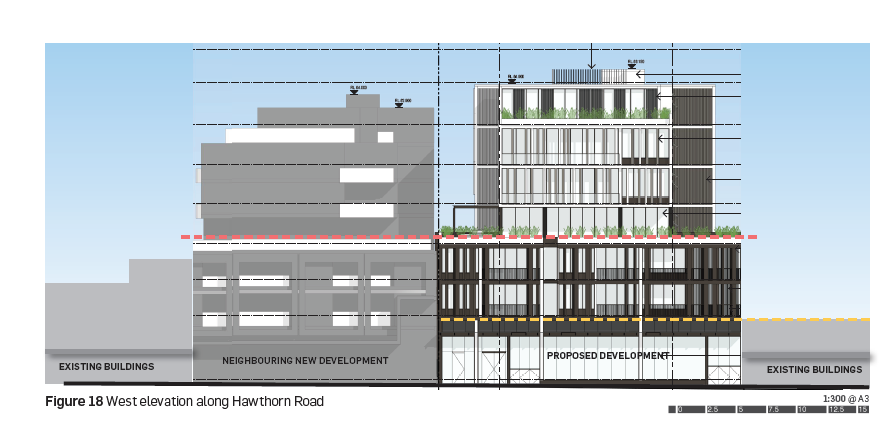
Neighbourhood centres in Glen Eira have been totally ignored for years despite the fact that development is proceeding at a great pace and with ever increasing heights and density. The latest result of council’s failure to introduce any planning controls for these areas comes with a new application for a 7 storey development at 75-85 Hawthorn Road. This will sit directly alongside another 7 storey building and opposite a 6 storey building.

McKinnon now has 6 storeys. Glen Huntly has multiple sites with 6 storeys. East Bentleigh the same and will soon have at least 8 storeys. Murrumbeena and Hughesdale also feature 6 storey permits. Ormond will have 10 storeys and currently has several 5 storey permits. Each and every neighbourhood centre will now become another de facto high rise area.

So what is council doing about this? Very little it would seem. This stands in stark contrast to other councils who have refused to be so compliant and pro-development.  Boroondara through its C229 Amendment managed to ensure mandatory height limits for all but its 3 major commercial shopping strips where the majority were of a maximum height of 3 storeys and only 1 was for 5 storeys. (See HERE). Bayside has also worked tirelessly to shore up protection for its neighbourhood centres. In Glen Eira we still await any indication as to:

  • Will these neighbourhood centres also have structure plans?
  • When will council get around to introducing any real protection for these centres?
  • Will council be fighting tooth and nail for mandatory height limits as Boroondara did?
  • With the stated ‘upgrading’ of Bentleigh East and Caulfield South, what will council decide as an ‘appropriate’ height for these centres? – 8 storeys? 9 storeys? And how much land will be rezoned to either RGZ or GRZ that is now zoned Neighbourhood Residential?

True to form, council’s modus operandi remains the same – keep the plebs ignorant until it is too late!

To begin with, wishing all our readers a safe and healthy festive season, with thanks for your input throughout the year.

2018 has in many ways been pretty momentous. There have been some governance advances but overall majority resident views continue to be ignored. Here is a summary:

THE POSITIVES

  • Telecasting of council meetings and ‘public participation’ section a continued winner
  • Heritage action(s), whilst far from complete, has at least got off the ground
  • Reform of permit time extension applications and council’s admission that it stuffed up badly on one application

THE NEGATIVES

  • Structure planning ‘consultations’ that are ‘tokenistic’ given the continued changes that have not gone out for proper consultation and when no justification is provided for the changes – ie setbacks, heights.
  • Continued delays on the introduction of parking plans, heritage overlays, open space levies
  • Local Law review still well over a year away – ie removing the ridiculous clause that those asking public questions have to sit through up to 3 hours of items before their questions can be addressed. If not present then no record of the question or response exists in the minutes.
  • Tree register still belonging in some unspecified never-never land.
  • When the city is well and truly meeting its housing needs for population growth, no justification has been provided for why so much more development is required.
  • No firm commitment to introduce structure plans for neighbourhood centres – merely ‘urban design guidelines’ that are non-mandatory. Timelines also a mystery. Yet we have seen up to 8 storeys in these centres.
  • Officers granted more power via the recent delegation resolution – ie need now for over 15 objections to a planning permit in order for it to be considered as ‘suitable’ for a full council decision – otherwise decided by the Delegated Planning Committee which consists entirely of officers. One concession – councilors now have ‘call in’ rights. How often will this be used we wonder and no guidelines/policies have been published to inform residents as to how this will work.

There are plenty of other issues we might highlight. The take home message is that planning and traffic remain residents’ major concern and this council has done very little to ameliorate the continuing damage. When the vast majority of residents are opposed to 12 storeys in Carnegie & Elsternwick, and the majority were also in favour of only 4 storeys for Bentleigh, council has shown time and time again that it is intent on ramming its agenda through despite community opposition. Until we have a group of councilors determined to listen to its residents then nothing will change.


Elsternwick is quickly emerging as Glen Eira’s high rise capital with another 14 storey application for the former Daily Planet site. Adding salt to the wounds of residents, this application:

  • Abuts the 4 storey mandatory height limit of Ross Street – where many dwellings are single storey
  • The discretionary height limit is 12 storeys but developers regard this as nothing more than a ‘minimum’.

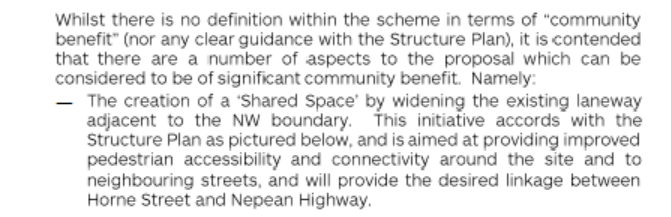
Possibly the biggest joke in this application is the developer’s claims to ‘community benefit’. Readers should remember that council decided that development could go from 8 to 12 storeys if there was ‘community benefit’. Of course there is very little definition of what this term actually means and certainly nothing worth a cracker in the eventual interim amendment. For those applications wishing to exceed the preferred height, all they have to show is (quote) – that the development includes the provision of significant community benefit. Not a single of word of definition exists; no decision criteria exist. Council should congratulate itself on producing the perfect example of waffle par excellence!

How does the developer respond to this clause then? Here’s what is claimed as ‘community benefit’ –

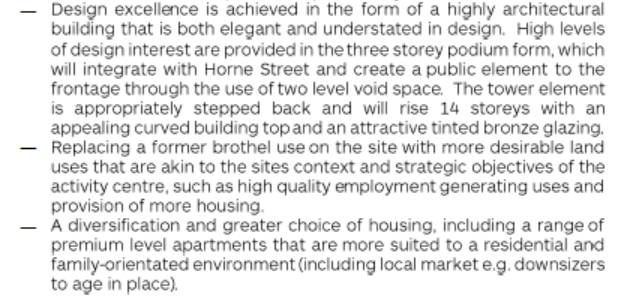
We get a paragraph on office space and ’employment’, then more of the same. Please note the reference to the former brothel!

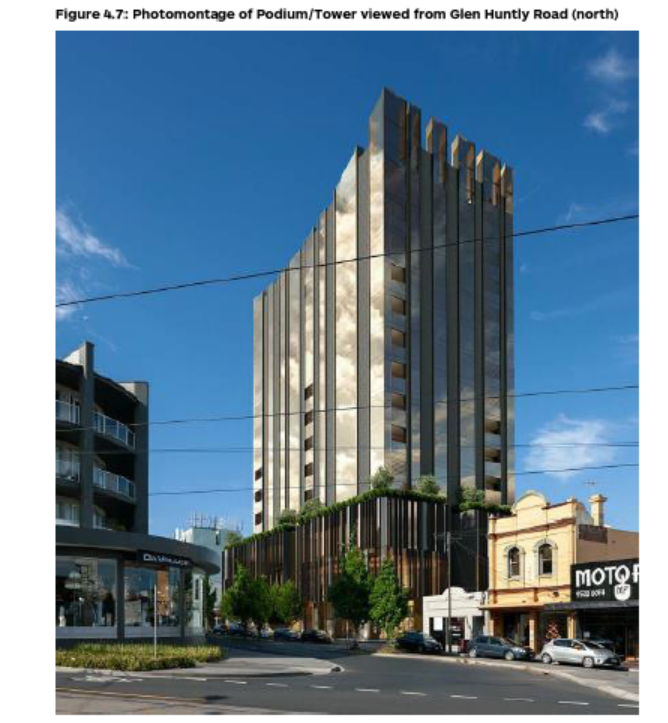
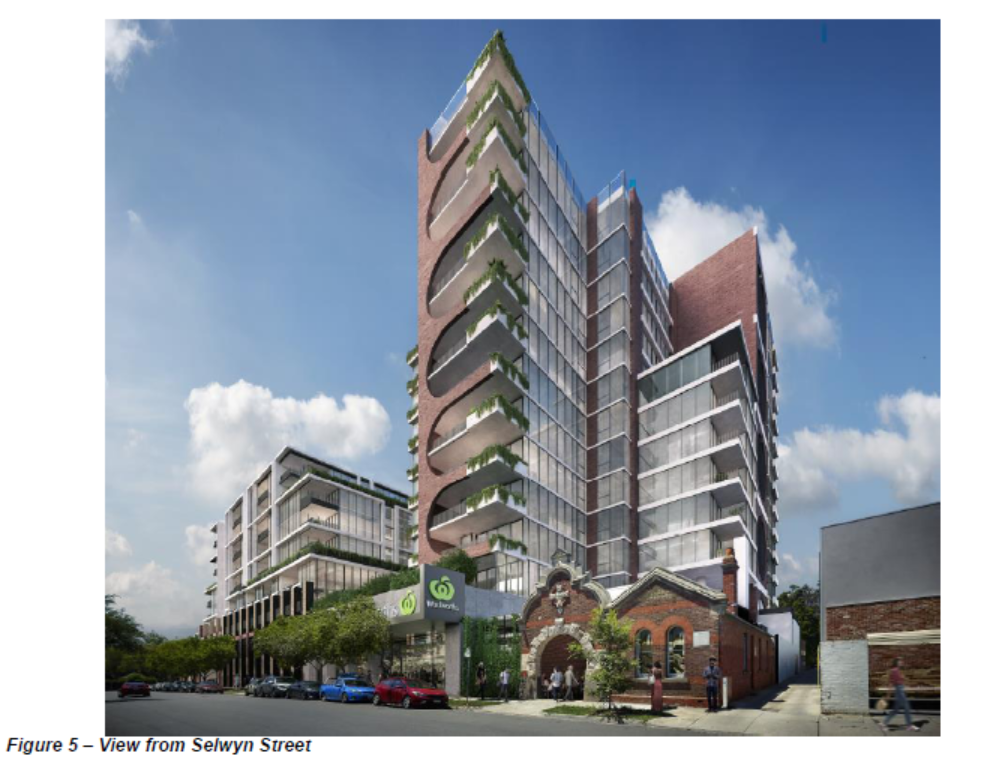
And the result will look like this:

There’s another aspect to this application worth considering. As recently as the last council meeting a resolution was passed to grant this site a permit for a drug rehabilitation unit. It had apparently been operating for some time without a permit. The current application allegedly arrived at council on the 2nd November.  Discussions prior to this date would undoubtedly have taken place with council planners. Thus, given that developers operated without a permit, did council issue any fines, or merely turn a blind eye knowing this was in the works?

Many other aspects of the application are contentious – ie overshadowing; traffic, open space. What is becoming clearer and clearer is that Elsternwick has always been seen as Glen Eira’s high rise capital and every effort has been made to further this agenda by a council that steadfastly refuses to listen to its residents!

Woolworths Elsternwick: Supermarket giant resubmits plans for high rise tower

Emma-Jayne Schenk, Caulfield Glen Eira Leader

November 21, 2018 12:00am

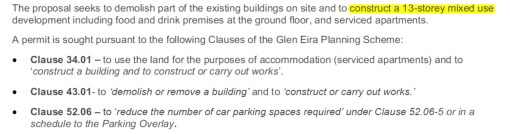
The battle between Woolies and Elsternwick neighbours is back on, with Woolworths pinning its hopes on a new public facility in their planned Selwyn St complex, to help quell backlash against its plan for a towering high-rise.

The supermarket giant has finalised plans for the 13-storey complex, following more than 115 objections about height and scale, traffic congestion, parking, loss of heritage, and overshadowing on nearby houses.

The former ABC building on Selwyn St, which Woolies bought for $45 million in March 2017, is currently only two storeys high.

Woolworths resubmitted plans to Glen Eira Council for the mammoth building earlier this month, which will be released to the public for feedback next week. If approved by Glen Eira councillors next year, the 80-unit complex would include a two-storey, 1000 sq m community facility on the corner of Sinclair and Selwyn streets with a small cafe, meeting and discussion spaces, and a multimedia space available for hire. The Kadimah Jewish Cultural Centre will also be relocated within the centre.

Other changes include increased setbacks and the glass exterior being replaced with brick.

But a Woolworths spokesman said the height and the scale — which is what most residents objected to — remained “very similar”.

Elsternwick resident Rosemary Scott-Thompson, who owns an apartment on Selwyn St, said while the community centre was a “nice idea”, the changes did not ease her concerns.Woolworths is hoping its new design, shown here, will quell community concern.

She said the “monstrosity” would block any direct sunlight she gets in her home, and the only opening window would be facing the underground carpark, which would “stick fumes into her apartment”.

“Unless they step the building back on Selwyn St … it’s not something I’ll ever be happy about,” Ms Scott-Thompson said.

“They stepped the building back on the other side but (because we’re in a commercial zone), it’s like they don’t care.

“From my own personal point of view, it’s just not a good idea.”The old plans, seen here, for 10-16 Selwyn St have been scrapped by Woolies.

Woolworths senior development manager Don Foulds said the revised plans came in response to community needs. “We’re confident we can deliver a development that becomes a vibrant cultural and entertainment hub for local residents and look forward to discussing our revised proposal with the council and community members,” he said.

Source: https://www.heraldsun.com.au/leader/inner-south/woolworths-elsternwick-supermarket-giant-resubmits-plans-for-high-rise-tower/news-story/089d1b38e00c44720eda19f883684576?utm_source=HeraldSun&utm_content=SocialFlow&utm_campaign=EditorialSF&utm_medium=Twitter

We’ve received an email requesting that we publicise the following YouTube videos. The link to them is:

https://www.youtube.com/channel/UCygK9eItmUBU2aoDhnB7gGg

More videos will be posted soon we are assured.

Glen Eira features in 3 for Bentleigh, Carnegie & McKinnon. Here’s the Carnegie one.


This is what council is recommending for a planning permit at 9-13 Derby Road, Caulfield East. Instead of 15 storeys we are supposed to swallow 12 storeys in a heritage precinct surrounded by 1 and 2 storey significant heritage buildings. This is the second application by this developer. The first was for 18 storeys and 158 student accommodation cubby holes. It was rejected by both council and VCAT. So we now have this new attempt for 15 storeys and 49 short term accommodation units. Council’s ‘solution’ is to lop off 3 storeys and reduce the number of units.

What is particularly disturbing about the accompanying officer’s report is the failure to fully acknowledge the comments made in the original VCAT decision PLUS the fact that council’s own urban planning advice together with the Planning Scheme requirements of the Phoenix Precinct are totally ignored. The only detail we get for the proposed southern setbacks is this vague sentence –

Setbacks have also been provided from the southern boundary to allow for future development of the adjoining site to the south. 

The report also relies heavily on a throwaway line in the 2017 VCAT judgement that a 10-14 storey development MIGHT be appropriate for the western site. This of course raises the issue of why council is determining applications on the basis of what VCAT MIGHT SAY, or what it has stated in the past. Planning decisions are meant to be determined on an individual case basis and NOT what might happen at VCAT!

More infuriating is that readers are not told that the member repeatedly stated that heritage and the low rise surrounding buildings should be the focal point of any proposal. More importantly we are not told that when council attended the 2017 VCAT hearing, their position at that time was (and we quote from the judgement) – The council felt something in the order of ten to twelve storeys would be acceptable provided that the tallest part of a new building above the existing level is located towards the rear of the site. (para.58) 

Thus over a year ago, council was prepared to accept a 12 storey building in its heritage area. Nothing has changed then. We are simply provided with a fait accompli.

Readers might be interested in the following statements from the 2017 VCAT decision. The full decision is available at – http://www8.austlii.edu.au/cgi-bin/viewdoc/au/cases/vic/VCAT/2017/1768.html 

A predominantly Edwardian shopping centre associated with the Caulfield Racecourse and having a distinctive urban form determined by its short length and accentuated by a double line of electric tramway. Its architectural significance is established by the diversity of its street architecture and railway station and is enhanced by their substantially intact state.

Council’s Planning Scheme/Phoenix Precinct states:

Encourage development no higher than the predominant existing height in Derby Road  and retain the scale and form of places in the Derby Road heritage overlay area

Encourage the design of new buildings in a contemporary style that respects the height, scale, rhythm of and proportions of the heritage buildings when adjoining buildings are located in a HO (Clause 22.06)

Member’s comments:

Paragraph 78 – While the building complies with the broad objectives of the State Planning Policy Framework and the Phoenix Precinct, we have decided that the building fails because of its height and detailed design execution. We are not persuaded that 18 storeys (or 19 storeys to the rear lane) is the appropriate height. We think that while the heritage fabric along  Derby Road  is of local heritage significance it is sufficiently intact and significant to temper the design response.

We are not persuaded that inclusion of the site within the Phoenix Precinct and its proximity to Caulfield train station are sufficient reasons to entirely disregard the local policy. The Phoenix Precinct is very large and has considerable development capacity. Not every site has to be maximised.

Paragraph 82 – We also think that at the height proposed, the tower will be visually dominant from important vantage points, including the station entry and the rail line itself. We think the building will be very prominent from the station entrance and from vantage points along Sir John Monash Drive, to a much greater extent than envisaged by planning policy.

Paragraph 93 – We are persuaded that the tower is too tall, and would result in an excessively bulky appearance that would be out of balance with the scale of  Derby Road . We are satisfied that with a significant setback from  Derby Road  and subject to an appropriate architectural expression, a tower higher than the existing form should be acceptable but scaled so as to reduce its visual impact from key vantage points.

Paragraph 101& 2 –  We encourage the council to complete the necessary strategic planning/urban design work to provide a coherent framework for decisions on new developments in this area.

  • Until that work is completed, we think a preferred approach to this site is to retain the two storey built form along the Derby road  frontage, a four to five storey podium with the setback to Derby Street increasing with height, and significantly more than the five metres proposed in this application. We think the tallest built form at the western end of the site could be in the order of ten to fourteen storeys, depending on architectural expression.

PS: An explanation is also required as to the following:

1. Council’s online register states that it received the above application on the 30th May, 2018.

2. The Urbis planning report is dated August 2018 AND IT IS FOR A 13 STOREY DEVELOPMENT AND NOT A 15 STOREY DEVELOPMENT AS PRESENTED.

3. Thus why the difference and how much faith can be placed in council’s online register? Or is it simply that there has been an amended permit put in? If so, then this should be highlighted? If not, is it council playing funny buggers with the facts?

We’ve uploaded the following from the August 2018 Urbis report –

13


Councillors’ performance tonight in unanimously accepting the East Virginia structure plan signals how little these individuals are willing to stand up for residents and for common sense.

Magee’s grandstanding has become habitual plus lacking all logic when he can begin his statements with –‘I will be speaking against the motion but voting for it’!!!!

Hyams continues with the old arguments that this is only the first step in the process blah, blah, blah and then spending 9 minutes on regurgitating what the documents contain but in a totally uncritical way.

The only ‘news’ that came out of Hyams’ mouth was the naming of the individuals involved in the Community Reference Group – for the very first time. How on earth a COMMUNITY REFERENCE GROUP can function without anyone knowing who they are is beyond belief. If their role was to represent the community, then it is incumbent upon council to ensure that the wider community knows who these individuals are so that they may be contacted and ideas exchanged. But that is not the way this council functions. No agendas or minutes of these meetings have ever been published. We don’t even know how many meetings occurred. As for the individuals named what is their background? How many are associated with the development industry? How many were tapped on the shoulder and asked to apply? We note, and with no intent to cast aspersions on these individuals, that the vast majority have never asked a public question, have probably never attended a council meeting and certainly are not active on social media. Thus on what basis was this community reference group selected? For all the talk about transparency and accountability the way these Community Reference Groups have been set up and function is anything but transparent and accountable. The $64 question of course remains – how many suggestions made by OUR community reference group saw its way into this final structure plan? We would hazard a guess that very little produced the desired outcomes.

As a further example of council’s failure to address the gaping holes in this structure plan we present one speaker’s question (and statements) to council from this meeting. It is significant we believe that she received not a single word from anyone in response to her comments! So much for ‘public participation’. The only saving grace of tonight’s meeting was that it only lasted about an hour!!!!!!!

« Previous PageNext Page »