GE Transport


To what extent is council’s planning department in cahoots with developers? A recent application renders this question very, very relevant. The application is for an 8 storey student accommodation building  in Dudley Street, Caulfield East. The proposal is to house 104 students, a shop at ground level and a car parking waiver of 31 spaces. The application is currently being advertised.

All well and good – perhaps. Except that:

  • The site is zoned as Neighbourhood Residential – ie a MANDATORY HEIGHT LIMIT OF 9 METRES OR 2 STOREYS
  • The site is NOT PART of the Phoenix precinct which is (partly) geared towards accommodating student housing.

Yet, this application is now being advertised. Why? Why hasn’t it been refused outright given the above? Secondly, why when the developer admits to ‘pre-application’ meetings with the planning department has council allowed this application to reach this stage of advertising instead of refusing it outright under delegation? Doesn’t the planning department know its own zoning or its own planning scheme?

Regardless of whether Dudley street should have been rezoned eons ago given that there is now 5 storey buildings in this street, the fact remains that it hasn’t been rezoned. So what conclusions can we draw from this? It is clear that council and the VPA intends to expand the Phoenix Precinct. That residents of the area can expect more and more high rise development. This however does not excuse the planning department’s failure to enforce the current planning scheme or to insist that the ‘errors’ contained in the application are removed. For instance: we are repeatedly told that the site is in ‘housing diversity’ area. It is NOT. We are also repeatedly told that the site is part of the Phoenix precinct. It is NOT. Time and again council’s officer reports tell us that it is the current planning scheme that matters and that council’s draft structure plans therefore play no part in the decision making since they are not approved parts of the planning scheme. Surely the same should apply to this application? The fact that it hasn’t, that the developer has been allowed to get away with blue murder, raises fundamental questions about governance, ‘favouritism’, the sheer competence of the planning department and of course, council’s hidden agendas!

We’ve uploaded the current zoning (below)  that clearly shows the NRZ status of the land –
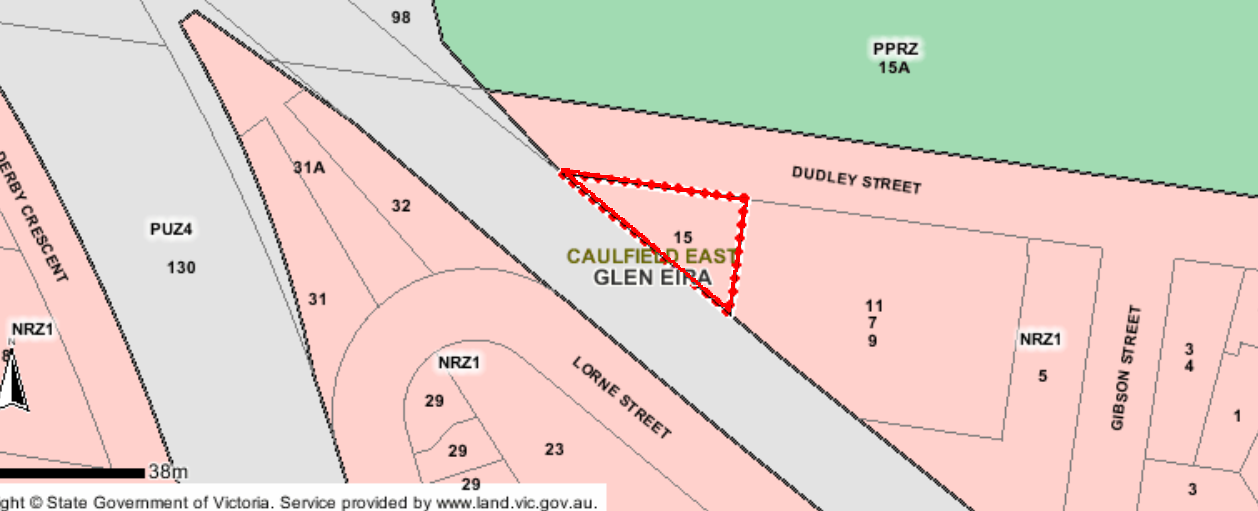
It will be fascinating to see the officer’s report (if we get one) and the rationalising that will undoubtedly attempt to excuse the inexcusable. What is at stake here is the community’s faith in the integrity and objectivity of planning in Glen Eira.

The two tables presented below are from the latest ABS building approvals. (uploaded HERE) The first table features the total number of building permits granted per year for the past 6 years and 9 months – ie until March 2018. Glen Eira is still ahead of the pack in unit development, plus the fact that Stonnington is a special example – ie three times the commercial zoning that Glen Eira has, whilst Port Phillip is in a league of its own with over 15% of its land mass designated as ‘capital city zone’ plus its large quotient of commercial zoning plus tourism. Monash is double the size of Glen Eira and has double the number of houses built compared to Glen Eira. Boroondara is also well ahead of Glen Eira in the number of houses versus apartments erected in that municipality.

So, once you add in the following, then the ‘damage’ done to Glen Eira is evident:

  • Small size of municipality
  • Least amount of open space
  • High population density and increasing
  • Dwellings per hectare
  • Lack of any traffic plans
  • No developer contributions for drainage, community infrastructure, parking waivers
  • Small commercial zoning which means development is occurring in local streets (approx 3% compared to Stonnington’s 8%)
  • Money squandered on open space ‘improvements’ instead of the purchase of more and more open space
  • No local environmental or water policy in the planning scheme
  • No local policy regarding tree protection in the planning scheme – and a mooted ‘significant tree register’ which will probably total only about 150 trees. This won’t go far enough by a long shot to halt the rampant moonscaping that has been plaguing Glen Eira for decades.
  • Most importantly, these figures make a mockery of council’s prognostications. Our supposed 13000 net new dwellings by 2031 will be here within the next few years – especially with a mooted 4500 net new dwellings for East Village and precinct 3 for Caulfield Village. Thus, why are hundreds upon hundreds of properties being rezoned? Why are activity centres being doubled in size? And why oh why does council refuse to address and answer these fundamental questions?

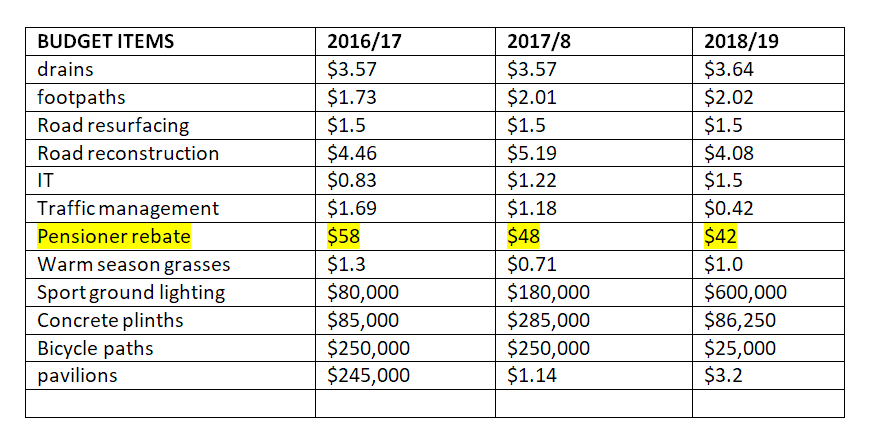
Some enlightened councils have set up ‘citizen juries’ in order to work on budget priorities each year. In Glen Eira there is no such thing. Residents get no say in how they would like their money spent. Thus year after year we find the lion’s share of expenditure going the same way – more fancy ‘redevelopment’ of open space instead of the purchase of additional open space. More and more staff (from 810 EFT last year to 829 EFT for 2018/19). More and more money going to ‘consultants’ and ‘contractors’, etc.

We provide the following table which lists the proposed expenditure on various items for the last 3 years. Readers should note:

  • The consistent decline in expenditure for traffic management
  • With development at an all time high, drainage funding has basically remained constant
  • The consistent reduction in council’s contribution to the pensioner rebate. By way of contrast we note that the following councils all provide a far greater rebate:
  • Port Phillip – A pensioner rebate that will increase by 3.1 per cent to $165 in 2018/19.
  • Monash – $50
  • Manningham – $50
  • Darebin – $150
  • Kingston – $100

Readers should ask themselves if this table is in line with their thinking on how our money should be spent –

We’ve received the following email from the BHCAGROUP and uploaded the VCAT decision HERE 

Hi All,

I am not usually in the habit of looking back, but as we have learned of VCAT’s decision, I remember that horrible sinking feeling that we all experienced when we learnt of Calvary’s proposed 19/20-storey tower.  While everyone recognised that the Bethlehem hospital site was ripe to be updated and improved, we all understood the deep impact that development on the scale proposed would have on the neighbourhood character and the direct effect on surrounding properties.

The community knew that this proposed development needed to be resisted.  It was with your support – moral, practical and financial, that we, as a community, forcefully expressed our objection in this administrative VCAT process against the high-powered team of barristers and experts engaged by Calvary.

The decision issued by VCAT has not stopped the redevelopment of the Bethlehem Hospital by Calvary.  It has, however, fundamentally reshaped it.

VCAT has directed the Glen Eira City Council to issue a permit for the redevelopment of Bethlehem Hospital that is now 10/11 storeys.  The appearance of the buildings is more articulated with a finer grain exterior.  The retirement village, aged care and ancillary uses are now more evenly spread over the site.  The 90 place childcare centre has been abandoned.  The inadequacy of the car parking arrangements were acknowledged and the at-grade car park on the corner of Saturn Street and Kooyong Road reserved, as a condition of the permit, as a permanent carpark, serving to somewhat alleviate the pressure on the surrounding streets.

I hate to think what might have been the outcome of the VCAT process without the local community’s engagement of strong legal representation and expert witnesses.  Attending each day of the hearing demonstrated to me that this was the right approach and that our well-argued objection contributed to a revised development that is substantially reduced in scale.  It also confirmed to me that had we relied solely on the promises of our elected councillors and allowed the Glen Eira City Council to prosecute our objections alone, it would have been a major folly. (our emphases)

Significantly, and notwithstanding our expertly constructed legal arguments about the application of height limits on retirement villages, VCAT determined that retirement villages are exempt from height limits, setting a new legal precedent that I am sure will be adopted by other developers throughout the suburbs of Melbourne.  (Incidentally, it appears that VCAT’s decision has introduced an even bigger loophole to the planning regulations for applications made prior to the current act – time will tell what impact this has).

For those that wish to read the VCAT decision, it is attached.

As the spokesperson for the BHCA Group and the local community, and in what will be the last communication to the group, I would like to thank everyone for the energy, financial contributions and support to defend the character of our local streets and the amenity of our own properties.  I am firmly of the view that without it, we could not have achieved any amendment to the original scheme.

Kind regards

Kelvin Cope

PS: The latest figures for planning permits for the third quarter (January to March 2018) were released today. Glen Eira has granted permits for 1002 net new dwellings in the space of nine months. The figures for Bayside and Stonnington are not yet available. Still way ahead of council’s prognostications and hence continues to throw major doubt on council’s planning and the justifications provided.

The following interview took place on Triple R yesterday morning.

No one expects council to complete its proposed infrastructure works in the space of a year or two. That does not mean that essential projects be held off for nearly a decade whilst developers get the go ahead to literally reach for the skies.

Council’s draft Strategic Resource Plan/Budget has some startling figures. We quote directly from these documents and ask that residents carefully consider the consequences of what this means.

ELSTERNWICK

  • Elsternwick Community Hub & Park – $32.45m (majority of spend in 2024-25 -to 2026-27).
  • Stanley Street East Multi-deck Car Park – $18m (majority of spend in 2023-24 – to 2024-25).
  • Selwyn Street Cultural Precinct – $1.2m (to be completed in 2023-24).

BENTLEIGH

  • Eat Street (Rotunda) – $2.55m (to be completed in 2020-21).
  • Bentleigh Library Upgrade – $2.9m (to be completed in 2023-24).
  • Horsley Street Multi-deck Car Park – $14.05m (majority of spend in 2027-28).

CARNEGIE

  • Koornang Road Streetscape Upgrade & Pedestrianisation – $6.45m (majority of spend in 2023-24 to 2025-26).
  • Shepparson Avenue Market Development – $2.95m for design, concept plans and initial consultation.
  • Kokarib Road Park – $50k for design works.

What these figures reveal is that residents will have to wait at least 10 years for most of these things to be completed. Given council’s track record on time lines and budget blowouts we expect the time lag and cost to be even more than indicated here.

No information is provided on:

  • Business case(s)
  • How costings were derived
  • Reasons for delay(s)
  • Percentage of third party involvement and their ‘contribution’

Even more discouraging is the fact that no dates are provided anywhere in the SRP or the Community Plan for the completion and introduction of such vital amendments as:

  • Car parking overlays
  • Infrastructure levies on development
  • Increase of open space levies

Much of what is proposed has not been ‘endorsed’ by residents. Do residents really want to spend $14m for a high rise concrete car park in Bentleigh or $18m for one in Elsternwick? What ‘evidence ‘ is there that this will solve parking problems in these areas? Is this really ‘value for money’ or simply ‘value’ for developers when council land will be sold off? And do residents really want to be in hock again to the tune of an additional $30m  that council wants to borrow?

PS: As an example of what can be achieved right now (if there’s the will) the following Kingston amendment was gazetted a few days ago.

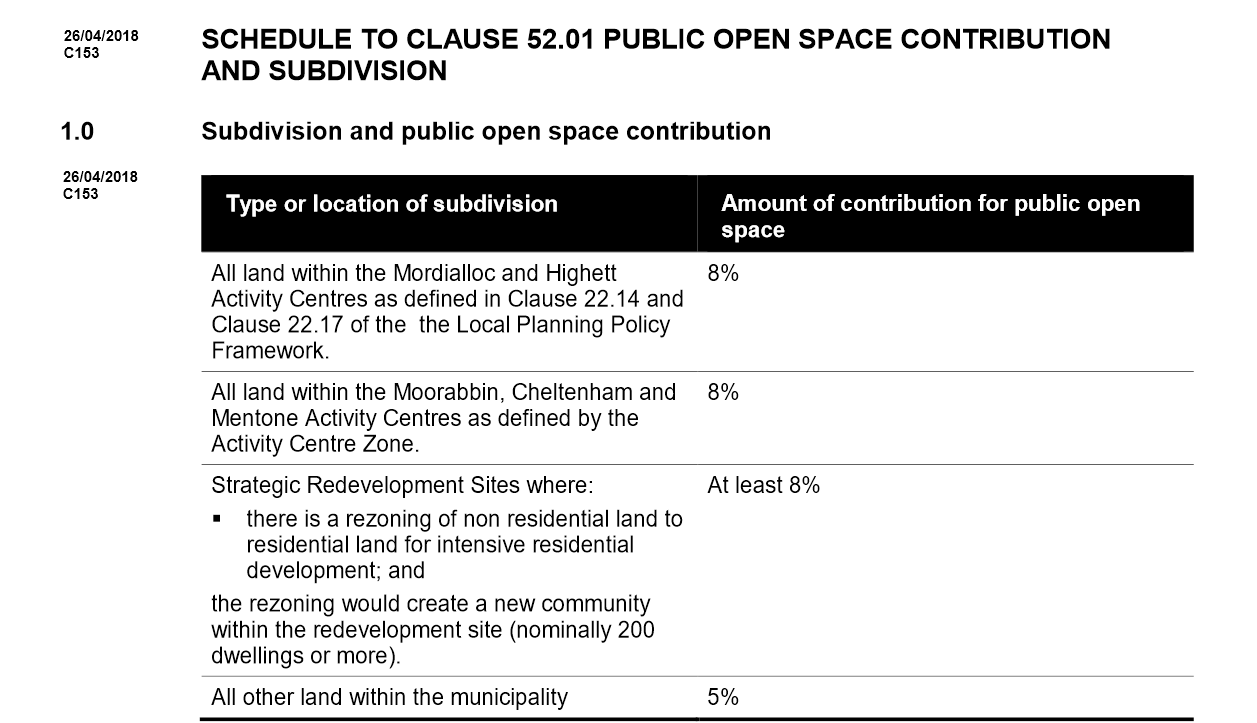
At Tuesday night’s council meeting the two most contentious applications (Belsize Avenue & Hamilton Street) got their permits – both voted in unanimously. Hyams and Esakoff moved and seconded motions for increased setbacks and full visitor parking spots. The requirement for Construction Management Plans was also ‘tightened’ in the face of much community backlash recently. The thrust of councillor arguments was that applications should be ‘compliant’ with ResCode – especially visitor car parking.

Ostensibly these resolutions sound reasonable and justified. However, when we look at the bigger picture, we can only wonder what on earth is going on. All of council’s published documents on traffic and parking reveal that what is likely to happen is a REDUCTION IN CAR PARKING REQUIREMENTS in our activity centres. We repeat the relevant page from the recently published Integrated Transport Strategy. Please note these ‘recommendations’:

  • explore a reduction in the statutory parking requirements for office use.
  • Where it is demonstrated a public parking availability is underutilised during the evenings, explore a reduction in the statutory parking requirements for these commercial uses.
  • allowing these commercial parking spaces to be shared by multiple users.

The writing’s on the wall! Council’s ‘parking’ strategy will include a REDUCTION in the current requirements. We will get parking overlays that will see waiver after waiver of both visitor and resident car parking or making the requirements for single, double, or triple bedroom places so minimal, that they amount to multiple waivers.

The relevance of councillors’ arguments on the Belsize Avenue and Hamilton Street applications become significant in the light of the above draft proposals. Both streets form part of the Carnegie and Bentleigh Activity Centre. Both are zoned Residential Growth Zone. Council’s consistent argument has been that shops can’t accommodate the necessary parking requirements, but neighbouring streets can. That means streets such as Hamilton and Belsize Avenue. So, if the eventual parking overlays adopt this approach and reduce the current regulations for offices, shops, and apartments, then these side streets will be chocka block full of parked cars.

Going a step further, we then have to ask, are the conditions placed on the Hamilton Street and Belsize Avenue permits nothing more than sheer hypocrisy and/or total ignorance by our councillors? For example, how can they in the same breath vote for a (draft) transport policy that REDUCES PARKING REQUIREMENTS, and also vote that applications in the activity centre ADHERE TO THE CURRENT SCHEDULE OF PARKING ‘STANDARDS’? Was all the chest thumping on Tuesday night nothing more than grandstanding? Will our local streets now become parking lots?

With every monthly release of new housing data, Glen Eira’s ‘projections’ are shown to be so out of kilter with reality that it calls into question every single aspect of their current structure planning. Council has based its planning on the allegedly required 9000 new dwellings by 2031. This is supposed to be the full justification for doubling the size of activity centres, ‘upgrading’ hundreds upon hundreds of properties to 3 and 4 storey height limits, and proposing 12 storey apartment blocks adjacent to heritage properties. Building approvals reveal that in the past 2 years alone (and we still have 3 months to go for 2017/18) 4000 permits were given out. Even if we subtract the roughly 17% that were for single house replacements that still leaves well over 3000 new apartments in the space of 21 months. Add in the fact that the overwhelming majority will be completed by 2031, then the alleged target of 9000 net new dwellings will be here in the next 3 years at this current rate of development. And even if development slows the number of permits still coming in will ensure that our 9000 is a reality well before 2031.

The ABS has released its latest building approvals this morning for the current financial year. (UPLOADED HERE). We’ve summarised the data for various councils. Only Monash exceeds Glen Eira’s numbers. However this municipality is also double the size of Glen Eira and has double the number of replacement single houses. In short, Glen Eira is still ‘leader of the pack’!!!! Why? And why is council continuing to support this unsustainable level of development and in fact, encouraging more?


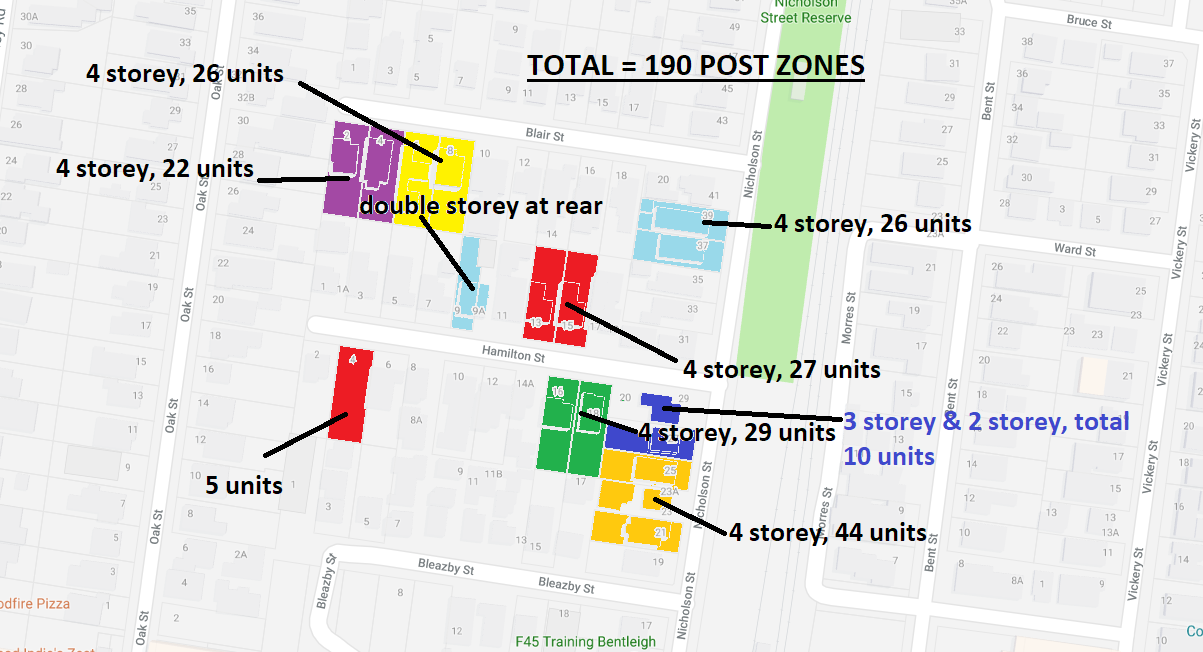
The 13-15 Hamilton Street, Bentleigh application (4 storey, 27 units and a visitor car parking reduction of 4 spaces) features some of the most incredible officer comments ever printed. Of course, the recommendation is to grant a permit!

We are literally gobsmacked by the following paragraph:

Officers have balanced both the positions of Councils Transport Planning Department and the views of the applicant and consider that, on balance, one visitor car parking space on site is sufficient and would not have an unreasonable impact on the availability of on-street car parking.

Innumerable questions arise from such a ‘conclusion’ –

  • Why is the developer’s position given more credence than council’s own traffic department which wanted 3 visitor car parking spots (instead of the required 4)?
  • Where is the data that justifies one space for 27 units?
  • Who is this planning department really working for – the community or the developer?

As with the Belsize application noted in our previous post, this officer report again fails dismally:

  • No breakdown of apartments (ie, 1, 2, or 3 bedrooms)
  • No mention of permeability
  • Site coverage is 62%
  • The side setbacks ‘generally comply’ with ResCode but that’s okay since ‘these minor deviations are considered acceptable’

As for front setbacks we get –

Front setbacks do not comply with the numerical standards in the Planning Scheme, which requires 7.3 metres, based on the average setback of the two adjoining dwellings.The proposed front setbacks are between 4.9 metres and 6.1 metres at ground floor,approximately 6.8 metres at Levels 1 and 2 (with balcony encroachment) and approximately 8.6 metres at Level 3 (with balcony encroachment). 

AND THE ‘EXCUSE’ FOR ACCEPTING THIS LACK OF ADEQUATE SETBACKS? –

There is a four storey building under construction at 16-18 Hamilton Street (to the south-east of the site). The approved setbacks of that building are similar to that of the proposal being between 4.3 and 5.5 metres at ground floor, 6.8 metres at Levels 1 and 2 (with balcony encroachment) and 9 metres at Level 3 (with balcony encroachment). 

So we now have the situation where one lousy decision means that future decisions are also lousy! Brilliant planning all round!

PS: It’s also clear that the planning department has absolutely no idea of the parking situation in these streets. A trip down Nicholson street at 12.45 this afternoon had cars parked everywhere along Nicholson, Blair, Hamilton, etc. To then present the argument that street parking is available is an utter nonsense.

Since the zones were introduced there has been over 190 new apartments built in these few streets. Here’s a visual image of exactly what’s occurred – how many car spots have been waived we wonder?

In an extraordinary VCAT Watch report Councillors have been severely wrapped over the knuckles and by implication, from the unelected bureaucracy. In short, the message appears to be – DON’T VOTE AGAINST WHAT OFFICERS RECOMMEND!

The issue concerns the VCAT permit granted for a 6 storey development in McKinnon Road. We have repeatedly , and over several years, highlighted the fact that councillors consistently lop off a storey or two, plus some apartments from applications and in the end, VCAT always grants the developer exactly what he wants. Our criticism isn’t solely that councillors have been grandstanding to the gallery, or being ‘populist’. It’s that this tactic has never worked and that councillor energies should have been directed at ‘reforming’ the planning scheme. Not continually knocking off a floor or two only to have VCAT grant the permit. The ‘fault’ as always has been with the planning scheme and VCAT itself. Councillors of course ignored this fundamental aspect of their decision making or simply didn’t have the balls, or the will, to initiate major changes in the planning scheme.

Having said all that, in a democracy, which we’re supposed to be living in, councillors have a duty to represent their constituents. It is these 9 men and women who set policy, direction, expenditure, and who are supposed to listen and act in accordance with the majority of residents’ views. It is NOT FOR THE ADMINISTRATION TO determine how councillors should vote. Their role is to provide the information, make recommendations and then leave it to the good sense (hopefully) of councillors.

The officer report represents a new line in the sand, and a public one at that, between councillors and administration. The tone is uncompromising and in fact quite insulting in our view. Here are some examples and our interpretation of the ‘message’ –

The officer recommendation was to approve the development at six storeys, however the Council decision was to delete the upper two storeys

COMMENT – laying the blame!

In reaching the decision the VCAT member was quite critical of Council’s approach in seeking a development of 4 storeys……..The Member agreed with the position of the planning officer and the expert evidence of the application

COMMENT –  to the best of our knowledge, no report has ever contained this unequivocal support for the ‘planning officer’ and the explicit ‘criticism’ of Council – ie councillors!

The best bit however relates to car parking:

The decision places the onus on Council to fulfill its responsibility to undertake the required analysis of car parking requirements based on the planning scheme provisions and not apply a blanket approach in requiring the statutory provision of car parking. 

COMMENT- There’s a wonderful irony here. Council does NOT undertake its own ‘analysis’ of car parking. Most of the time it blithely accepts the developer’s data without blinking an eye. Secondly, the ‘planning scheme provisions’ are there for a purpose aren’t they? So how can we have in the same sentence a reference to the planning scheme and then dismissing its ‘standards’ by stating that a ‘blanket approach’ on the statutary requirements is not on? This is nothing more than another below the belt attack on those few councillors who repeatedly vote for the required number of visitor car parking in permits.

We definitely live in interesting times when the tail continues to wag the dog! Whether our councillors will now have the balls to assert their rightful authority is open to question. They haven’t thus far!

« Previous PageNext Page »