GE Transport


Council has consistently claimed that ‘evidence’ is the basis of all their decision making. Two items from tonight’s council meeting focus on this claim. We feature two recordings:

  1. Council’s response to the Mitchell Street residents’ letter, and
  2. A public question on the Elsternwick structure plan in the ‘community consultation’ phase of the meeting.

We urge all readers to listen carefully and to decide how well these councillors addressed what was being sought and asked.

MITCHELL STREET

  • Does Hyams’ motion change a single thing?
  • If parking/traffic changes are suggested then one should assume that officers did the necessary research to begin with and that their ‘evidence’ for the proposed changes are beyond question. Thus saying “’if this motion gets passed our traffic officers will examine the street and see what they can do there’ implies two things – (1) either no real ‘investigation’ was done PRIOR to changes being suggested, or (2) placating residents with vague, airy-fairy promises
  • Why can’t the results of this further investigation be tabled at council? What are the chances that the residents’ stated concerns will be taken on board?

ELSTERNWICK STRUCTURE PLAN

  • Has any councillor satisfactorily answered the allegation that decision making is ‘anecdotal’ and far from ‘evidence based’. We remind readers that Delahunty called the published shadow drawings as ‘rudimentary’!!!!!! Hardly the basis for informed decision making!!!!!
  • Not one single councillor, nor any published document has as yet presented any ‘evidence’ as to why 12 storeys is necessary.

The Glen Eira version of ‘evidence’ is let’s make it up as we go along to support the conclusions we arrived at from the beginning!


The following letter features in the agenda papers for Tuesday night:

Of concern is the recommendation – once again to merely ‘receive’ and ‘note’ the letter, which will then disappear into the ether no doubt and not be heard of again. Council is duty bound to do far more. Residents are entitled to be provided with solid ‘evidence’ for the proposed changes. For example: has there been a traffic count taken in the past few years? If so, when was this done and what are the results? If in the past there was the decision to erect a ‘no standing zone’ outside 86-90 Mitchell Street, what was the reason and what is the reason now for proposing to change this? And the $64 dollar question of course is that council’s policy is to conduct surveys of local residents before the implementation of changes. Will these 40 residents now be listened to?

The crucial question is- will council now turn all our local streets into parking areas given its statement in the Transport Strategy that they will explor(e) the reinstatement of lost street parking where required. And if council is determined to introduce parking overlays that reduce even further the ‘standards’ set out in Clause 52.06, then should residents expect more and more parking overflow from the commercial centres into their streets?

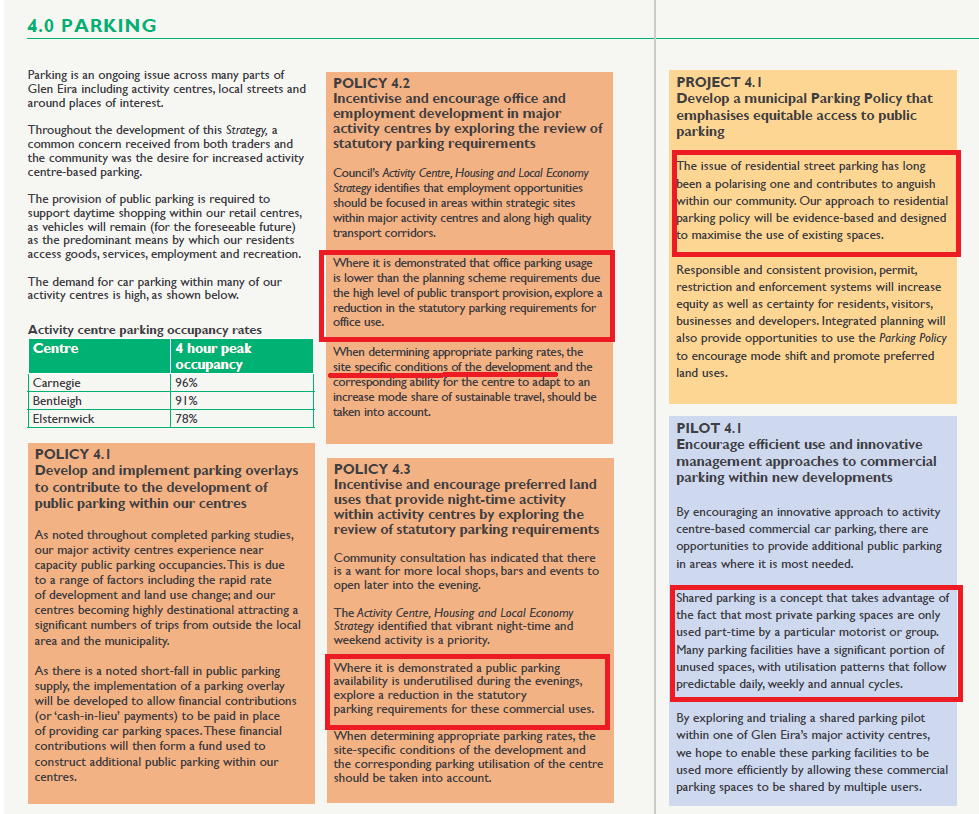
We urge all readers to take careful note of the following from the Integrated Transport Strategy.

This makes it absolutely clear that council’s intention is to:

  • Reduce the required parking provisions for ‘office space’.
  • ‘Site specific conditions’ can only mean more ad-hoc decision making – especially for restaurants
  • ‘maximise the use of existing (car parking) spaces’, can only augur more of the Mitchell Street example
  • ‘Shared parking’ translates into less car parking spaces provided by developers and residents parking in multi-level car parks largely paid for by ratepayers.

Finally, the Mitchell Street example is the perfect illustration of council’s disastrous planning. Next to a heritage area, and within a flooding zone, Mitchell and its surrounding streets were zoned RGZ in 2013 – ie 4 storeys. Now 5 years later, council is attempting to undo the damage it has created. Too late we say!!!!!! The draft structure plan now wants the WESTERN side of Mitchell street reduced to 2 storey height limit (ie NRZ) and six properties on the EASTERN side of Mitchell Street, reduced to 3 storeys (ie GRZ).  But given what has already happened, and what will still happen until council achieves the gazetting of its amendments, this is literally pie in the sky planning. The horse has already bolted. Yet council has known this for years and nothing was done!

Here is the current state of affairs in Mitchell and Robert Streets. The yellow markings indicate developments granted permits.

The tally thus far is –

77 Mitchell – 3 storey, 7 units

82-84-  4 storey, 23 units

79-83 – 4 storey, 41 units

77 Robert Street, -7 units

Residents of local streets anywhere within cooee of our activity centres have much to fear we forecast!

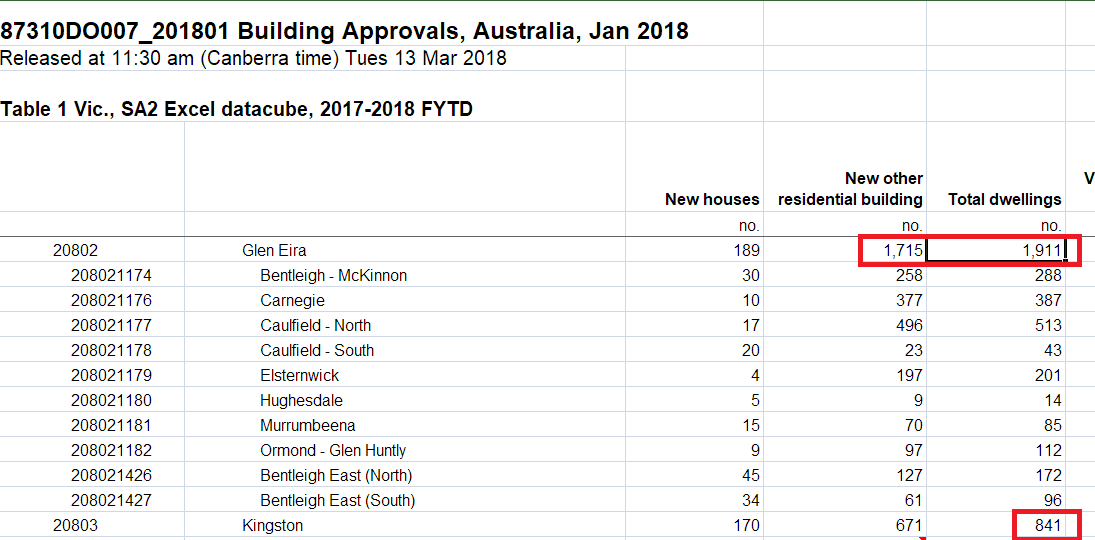
The ABS has today released its building approval figures for local areas. The data depicts approvals from July 1st, 2017 to the end of January 2018 – a period of 7 months. We’ve uploaded the full file HERE and present a screen dump for Glen Eira below. Unfortunately some suburbs are linked together (ie Bentleigh/McKinnon). However what these stats reveal is that development in Glen Eira is still way ahead of council’s predictions, raising the same old perennial questions –

  • Why do we need to double the size of our activity centres?
  • Why do we need to rezone areas to accommodate more dog boxes?
  • Why is council failing to respond to these essential questions?

‘Community’ responses to the Urban Design Guidelines have made a belated appearance on council’s website. Several factors are evident:

  • The overwhelming majority of submissions come from developers/planners representing clients. Some submissions would appear to be duplicated – mainly from the earlier submission(s)
  • These submissions invariably argue for less ‘prescriptive’ guidelines including no mandatory height provisions and the ability to go beyond 12 storeys in some cases. Only 2 specifically mention the originally suggested 6 metre setback that has now been reduced to 5 metres.
  • Resident views highlight the length of the document (167 pages) and how inaccessible it is to those without any planning knowledge.
  • Both developers and residents abhor the lack of definition, analysis, and the clear lack of quantifiable, strategic justification.

We thought it worthwhile in this post to focus on how developers view the guidelines as a planning document and what they basically think of council’s performance in this endeavour. Surprisingly perhaps, we feel that many residents would agree with the concerns raised – if not the conclusions (ie pro-development & less constraints). The following extracts reveal once again the shoddy, knee-jerk planning that is the hallmark of Glen Eira Council – and this comes not from residents but from the development industry. Yet this document was passed by councillors with very little change from the first version and once again basically ignoring community concerns. Nor did any councillor, claiming that they had read the submissions, bother to address ANY OF THE CONCERNS listed below!

Here is what developers think:

It is our submission that a definition of Strategic and Urban renewal Areas should be included in the QDG (Quality Design Guidelines). It is also requested that the information listed under Preferred Locations throughout the QDG be clarified, since it often overlays and/or is unclear.

Under Shared Side Boundaries development for Shop Top in commercial Strips areas the QDG states that when  abutting a heritage residential precinct or building, all upper levels must be recessive when viewed from nearby heritage street scapes. This is a vague and unhelpful statement, which does not explain what constitutes recessive, or from where within a heritage streetscape a view should be cast.

The Guidelines should be prepared to be read as a standalone document, yet key information required by readers is not provided. There is a lack of clarity around the identification of a site’s location.

We do not believe the process for community benefit has been appropriately defined nor strategically justified in the documentation provided. Such a proposal is in our view inappropriate and inequitable, particularly in the context where increased density will deliver on metropolitan policy objectives. The idea that scale can be agreed subject to community benefits (“cash for height”) does not represent orderly and proper planning. The processes of negotiation with Council has not been explained. It is our view that surety around this concept is required before it is adopted as part of the Quality Design Guidelines and certainly before it is sought to form part of the Planning Scheme. In our view, a more appropriate process is the use of a Development Contribution Plan Overlay rather than a piecemeal negotiated approach where only some developments contribute to the required community facilities and services.

The prioritisation of commercial land uses in strategic/urban renewal sites requires more consideration. The documentation does not provide any justification for this. The commercial viability and/or economic impact of introduction of so much retail and commercial space into mixed use precincts (if all developments are to utilise the lower three floors for non-residential uses) does not appear to have been assessed. To make the guideline meaningful, such a proposition may be justified if Glen Eira has an acute shortage of commercial or retail floorspace and an assessment exists (by suburb) to demonstrate this.

The guidelines identify “no additional overshadowing of identified key public open space” and yet do not provide the reader any indication of what the key public spaces being referenced are. Other sections also call up access to ‘winter sun’ but again no parameters are provided as to the key hours.

Clearly, additional work to the document is required in order to clarify how preferred building types will be applied and ensure that the guidelines can be read as a standalone document.

The seventh principle relating to the notion of ‘community benefit’ is subjective and does not provide quantifiable guidance to assess a ‘community benefit’….In our previous submission we strongly suggested that future Quality Design Guidelines include quantifiable criteria as to what defines ‘community benefit’. Such criteria would minimise uncertainty surrounding this principle.

We note that the preferred building typologies are not responsive to the actual context of each neighbourhood centre, nor do they permit site and context-responsive design. The preferred building typologies will introduce conflict with the design principle of the QDP which offer a greater degree of flexibility for great design, and provides a more performance based framework to assess design.

The guidelines do not provide any methodology as to how the Strategic Site typology would be identified through the municipality…..We suggest that a precinct analysis is undertaken for all neighbourhood activity centres and transport corridors to determine the locations of strategic sites and precinct specific requirements.

We suggest that upper level setback be considered at a precinct level. This is to ensure the existing character and role of precincts is considered in full

policy change. Overall, the challenge in this policy is that a proper review of the neighbourhood character has not taken place to accommodate the recent variation by the State Government. The review seems to rely on the existing character study, which could be outdated. Additionally, basic considerations  as the average lot size, lot depths and frontages should be properly reviewed to inform such a substantial

The guidelines are highly arbitrary and the level of rigour/technical justification behind many of the guidelines is not clear.

CONCLUSION

What is evident from these comments is that council simply has not done the strategic work necessary to justify any of the proposals contained in the document – including the proposals in the various structure plans. As with the introduction of the zones, what we have is another ‘one size fits all’ approach coupled with meaningless waffle.

Mr SOUTHWICK (Caulfield)

My question is to the Minister for Planning. Minister, many residents in Elsternwick have expressed concern over the impact of overdevelopment on their local amenity and liveability. The Elsternwick structure plan projects a 20 per cent increase in population and responds to the expectation in your government’s Plan Melbourne  Refresh that will require 22000 residents to be accommodated in Glen Eira in the next 15 years.

The plan, which has been approved by the council, will now go to a planning panel and ultimately you as the minister will be responsible for any changes in the Elsternwick precinct. As the structure plan outlines no measures to cope with this densification and will lead to the loss of established houses in the area, Minister, what is the government doing and what are you doing  to prevent local families losing their homes and to protect the liveability of Elsternwick and the surrounds?

With an election around the corner, it is the opportune time for residents to gain the most leverage. It is also time to bypass council completely and head straight to those who have the ultimate power to make decisions.

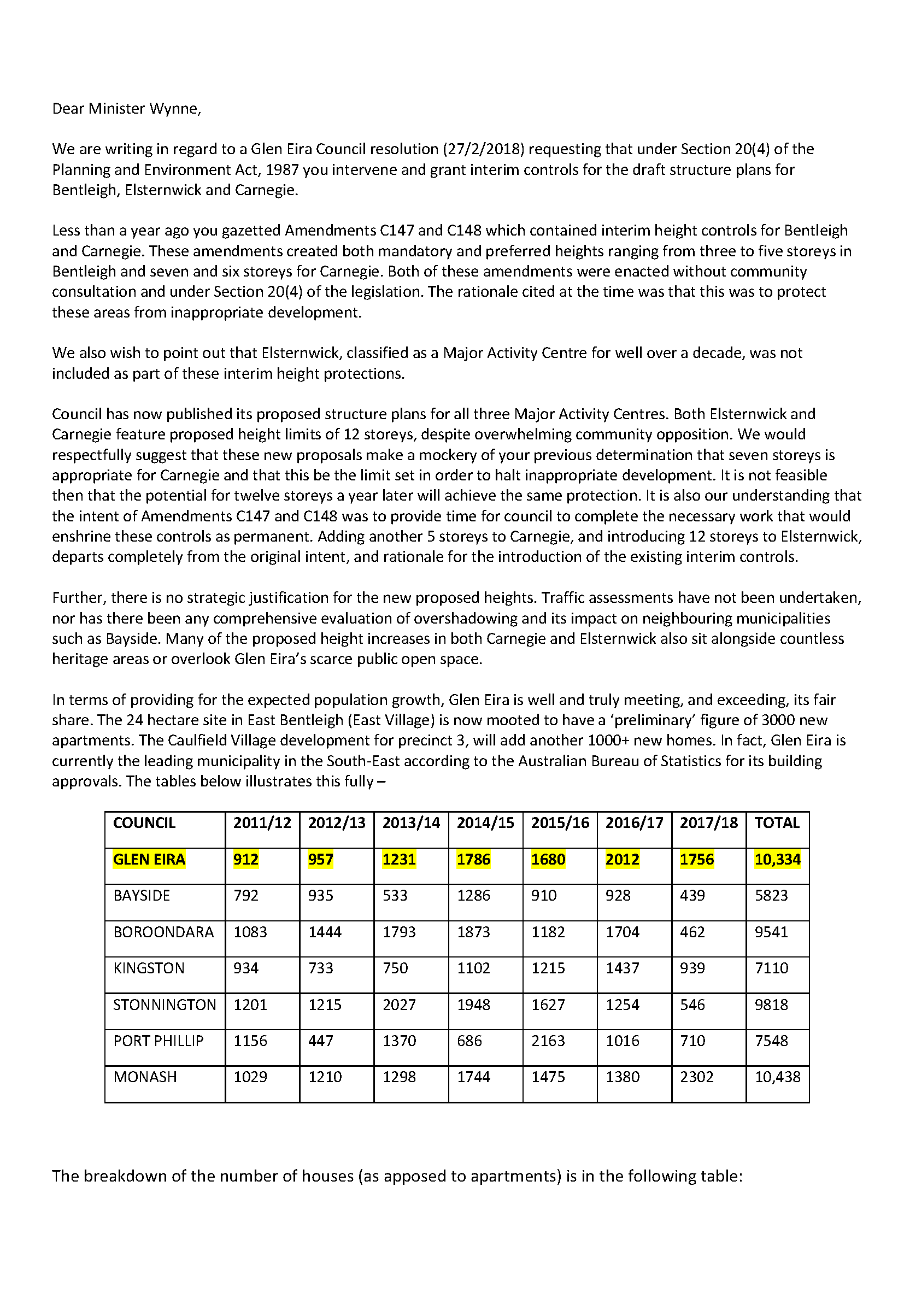
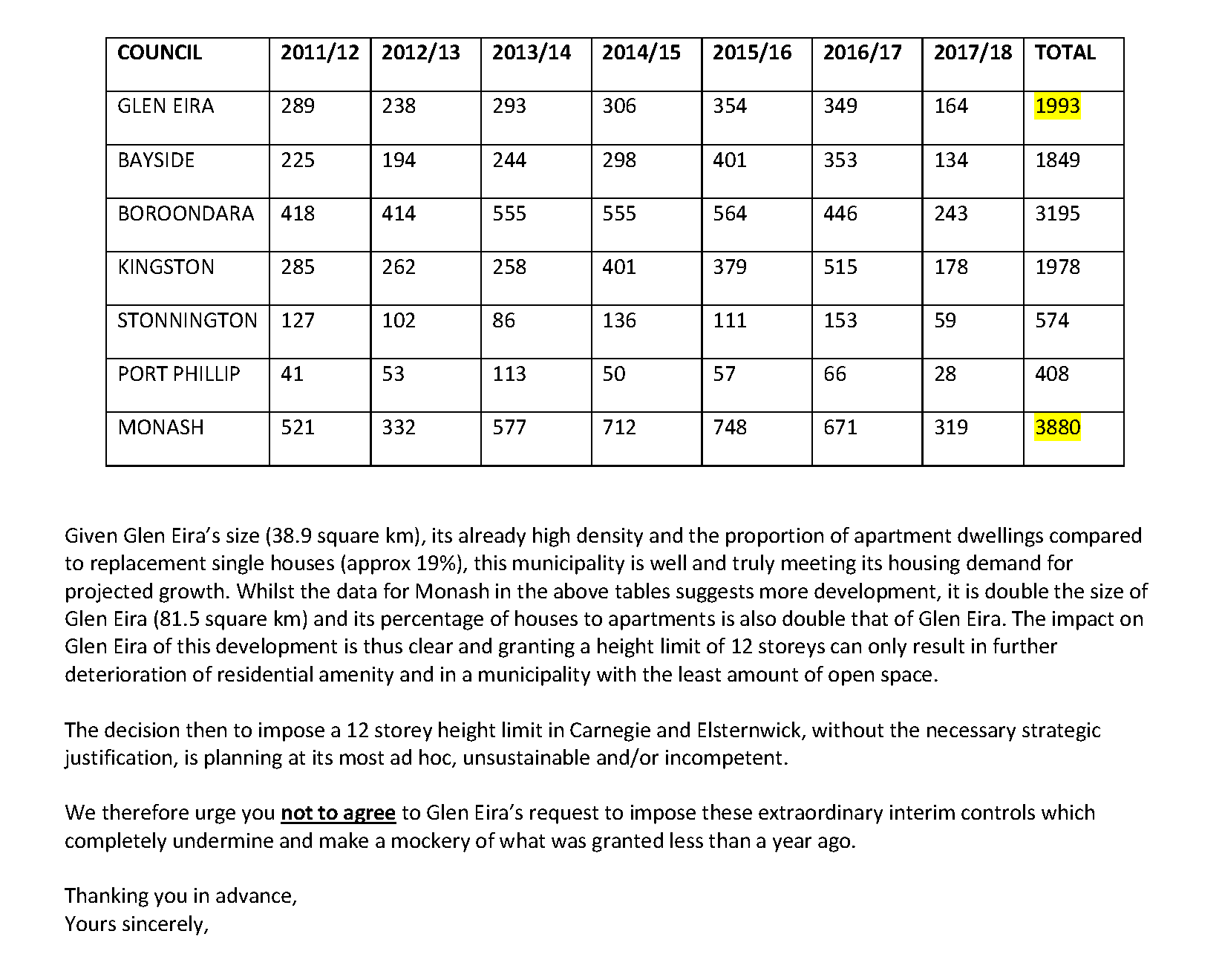
We have sent off several versions of this letter (below) to all sides of the political spectrum. It is clear that council cannot be trusted to work in the best interests of its residents. We therefore urge all concerned residents to join us and lobby local and state politicians to ensure that council’s plans for the 12 storey interim controls are thwarted.

CLICK TO ENLARGE

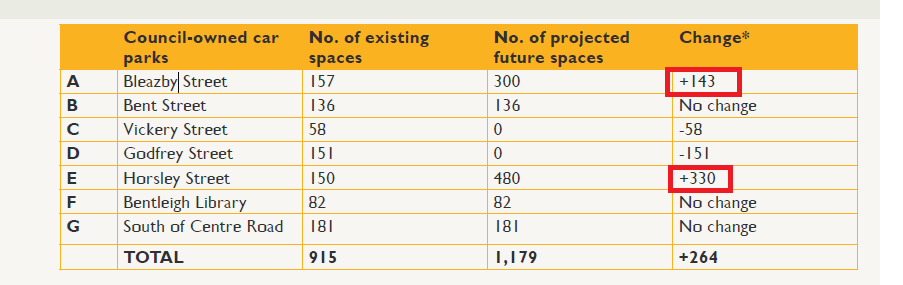
Council is gearing up to erect at least 5 multi-level car parks throughout Glen Eira – with the possibility of more. Bentleigh alone is to cop 2 according to the recent response to a public question. Yet, the published draft structure plan only admits to ONE multi level car park. We therefore have the ridiculous situation where a response to a public question can state:

The structure plan proposes to increase the parking throughout the centre by 264 public spaces. To increase the parking numbers Council will need to construct two multi deck car parks. (Page 9 of the minutes) 

Whilst the ‘endorsed’ draft structure plan only focuses on the Horsely Street recommendation: 

Development of a new multi-level car park with provision of retail activity at ground floor. (Page 41 of Structure Plan) 

No mention is made of the possibility of two multi-level car parks! 


The table below summarises council’s car parking proposals.

  • How can the Bleazby site suddenly provide an additional 143 spots – unless the intent of course is to erect a multi level car park? Wouldn’t it be lovely if for once council was honest and informed residents clearly and precisely what it had in mind!

Thus we have to ask:

  • Is council deliberately obfuscating and hiding its intentions?
  • How much will all this cost and when will it be completed?
  • How much public land will be flogged off to developers or leased to them?
  • What Parking Precinct amendments will be introduced and will the levy be miniscule?
  • Can you really cram 480 car parking spots into 3 levels or will this end up being more like 5 or 6 levels?

The following recording features part of the ‘community participation’ segment from last night’s council meeting. Please listen carefully to wonderful address by the resident, the applause for his comments, and in particular the unbelievable claims made by Ron Torres.


Torres is part of the ‘old guard’ – a senior member of council having begun his career at Glen Eira in 1996. As Director in charge of Planning & Place, Torres  has been intimately involved with all aspects of planning in Glen Eira for just on 20 years. Yet he claims that a planning scheme review was carried out with full ‘community consultation’ four or four and a half years ago! That, dear readers, is a blatant lie!!!!

The last Planning Scheme review took place in 2010 and council repeatedly asked for extensions so that they would not have to fulfill their legal obligations and review the scheme every four years as required. They were granted these exemptions until Wynne put his foot down and refused the final request. Council in fact did everything it could to delay the inevitable!

More to the point, as recently as August 2016, council’s own report on the 2016 Planning Scheme Review, show Torres’ comments to be dead wrong. There can be no excuse for such incompetence at best, or as we believe, the attempt to deceive and mislead!

Here are the relevant extracts from the minutes of 9th August 2016 – less than 2 years ago!

How much faith should residents therefore have in these so-called ‘professionals’ and ‘experts’ when pronouncement after pronouncement is designed to deceive we believe, and at best, to pretend that good process and proper governance is inherent in everything this council does!

Tonight’s council meeting represents nothing less than a complete betrayal of resident views. Each structure plan was voted in with arguments that are disingenuous and basically incompetent.

The central issue of officers employing Section 20(4) of the Planning & Environment Act and thereby bypassing the community was voted in with Delahunty’s motion that this apply only to Commercial zones, Mixed Use Zones, and tellingly, to all residential areas where the existing interim control is more restrictive than what is proposed in the new versions of the structure plans. In other words, Urban Renewal areas in Carnegie and Elsternwick will now be rezoned to 12 storeys and the Mixed Use zones in Elsternwick will get their 6 or 8 storeys. All without the opportunity for the community to formally object. Good luck we say in removing these ‘interim’ heights when the full amendment goes out for consultation!

It is really laughable that Delahunty admitted that the recently released shadow drawings for Elsternwick were ‘rudimentary’ and is now calling for more detailed shadow analysis and traffic analysis. Yet, these 9 individuals pass these structure plans BEFORE this research is put before them and the public. Surely this information is vital to informed and sound decision making. Not after! (Silver was the only councillor to vote against the Elsternwick plans – but he voted for the other two).

We are also dismayed at the repetition of all those old irrelevant and erroneous shibboleths that have been trotted out for years and years – ie

  • Magee and Sztrajt blaming VCAT when a decade of a planning scheme that had more holes in it than a swiss cheese was, and is, the problem
  • The setting up of false dichotomies again and again – ie Glen Eira can’t say no to development or structure planning. No one that we know of has argued against development or against structure planning. Residents have been opposed to inappropriate development and for a decade have desired a structure plan that achieves at least a modicum of residential protection. It is council that has refused to even entertain the idea of a structure plan until ordered to undertake the work by Wynne!
  • Appalling arguments of ‘we can’t say 4 storeys because VCAT and the Minister will not give us this, so let’s go for 12’!!!! We simply ask – on what basis was 12 storeys plucked out of thin air? How many units is a 12 storey building likely to house and what does this do to dwelling projections? What of communal open space and doesn’t council’s Urban Design Guidelines therefore not meet recent legislation on this issue if there happens to be more than 40 units? Where is this factored in? Or has it been conveniently forgotten?

To put it bluntly, we are having a hard time in deciding whether these 9 councillors are merely incompetent, ignorant, or mere mouth pieces of Torres, Mullen, McKenzie and developers who have undoubtedly already come knocking. Also worth pointing out that Torres claimed that 4 and a half years ago there was a planning scheme review with community consultation. There wasn’t. Council claimed that it had undertaken an ‘internal review’ and of course nothing changed. In fact the last review really occurred in 2010 and if council had their way would not have happened in 2016. They had applied for several extensions which was finally refused by Wynne and he ordered them to undertake the 2016 review. Torres should be reprimanded (again) for providing both incorrect and misleading information!

We urge all residents to listen to the recordings of this meeting and to carefully consider what was said, by whom, and to remember this when it comes time to vote!

Apparently not all residents fully understand the significance of the officer recommendations for Tuesday night’s vote on the structure plans.

We reiterate: every single major planning issue has been done under Section 20(4) of the Planning & Environment Act, 1987 – thereby excluding residents from the right to have any input, plus practically removing the possibility of major change down the line!

Leopards clearly don’t change their spots, so here we are again – going down the same anti-democratic, anti-community pathway. Here’s the sad history of 20(4) –

  • The introduction of the residential zones in August 2013 – in total secrecy, without consultation, and now acknowledged as a complete disaster
  • The introduction of the ‘interim height’ amendments for Bentleigh & Carnegie in 2016. Again no consultation.
  • Now the recommendation for a resolution that endorses the ‘built form measures’ etc. That means 12 storeys for Elsternwick & Carnegie and rezoning of heaps of other properties and doubling the size of activity centres! – all without an iota of strategic justification!

Only a fool would believe that if Wynne says ‘yes’ to 12 storeys in Carnegie & Elsternwick for these ‘interim controls’ that when council finally gets around to a full amendment (in a further couple of years at best) he is likely to reduce these heights and zonings.  Council knows this fully well. Plus they will be able to argue that 12 storeys is now an ‘established’ reality so no point in seeking to reduce height years down the track. This is just another example of sheer bastardry, sleight of hand, and the attempt to camouflage what is really going on. If it wasn’t, then the significance of 20(4) would be clearly explained and justified. It wouldn’t be buried in a wordy, vague, and ultimately reprehensible recommendation!

« Previous PageNext Page »