GE Transport


Today’s published report by the ANU confirms what many residents already know but which our council, hell bent on facilitating more and more (expensive) development, refuses to acknowledge much less accept. As a further example of what’s happening in Glen Eira, the state government’s Planning Permit Activity report for the single month of October has Glen Eira providing permits for another 248 NET NEW DWELLINGS!

Here is the ABC’s report on the ANU study –

House prices based on undersupply myth, ANU says

By business reporter Michael Janda

Australia does not have a housing shortage, with inner-city areas of Sydney, Melbourne and Brisbane some of the nation’s most oversupplied regions, according to new research from ANU.

Key points:

  • Australia has built 164,000 more dwellings than it needs to cater for a growing population
  • Inner-city areas in Australia’s three biggest cities have the greatest oversupply
  • Outer suburban areas and central Adelaide had some of the most significant housing shortages

The analysis estimates the nation’s housing oversupply at 164,000, or 32,000 if the significant increase in unoccupied dwellings is excluded.

The study by associate professor Ben Phillips and researcher Cukkoo Joseph from the Australian National University shows that between 2001 and 2017 Australia built more homes than it needed to house the growth in population over that period.

The academics’ findings tally with other recent research showing that Australia has a moderate housing oversupply.

However, this research used a relatively sophisticated methodology that accounted for demographic changes.

Additionally, it accounted for an increase in people residing in “non-private dwellings” — such as student accommodation or nursing homes — that are often excluded from housing supply-demand analyses and tend to exaggerate an apparent housing shortage.

This report has also gone below state-level analysis to regional calculations.

It found that the inner-city area of Sydney had the nation’s largest housing oversupply, at just under 6,000 dwellings.

That was in contrast to areas in the mid and far-west of Sydney, which generally had moderate undersupply, as did Wyong on the Central Coast.

Inner-Brisbane had the nation’s second largest oversupply of around 4,500.

Melbourne CBD and surrounds had the fourth highest oversupply of just under 4,000 excess dwellings.

Outside the inner-urban areas, where oversupply was mainly driven by the nation’s record high-rise apartment boom, the other main areas of oversupply were in regional areas, particularly those exposed to the resources sector where the mining downturn has caused populations to shrink.

While these mining areas had generally witnessed large property price falls, Mr Phillips said some of the other oversupplied areas had actually experienced strong price growth.

“We haven’t found a particularly strong relationship between the balance of supply and demand and house price growth,” he told the ABC.

“We did find a very small correlation, but it was less than 10 per cent, so what that tells us is that there is perhaps some impact from housing supply but, by and large, what’s driving house prices in Australia, particularly in our capital cities, is a whole range of other factors.”

Housing boom story ‘falls over’ in light of oversupply

The significance of this finding is that increasing housing supply by itself is unlikely to put significant downward pressure on prices.

Given that increasing supply has been the almost exclusive housing affordability focus of the current Federal Government and most of its state counterparts, Dr Phillips said it is no surprise that affordability has not improved.

“What this research shows is that that’s not necessarily going to be as helpful as what many would hope,” he said.

“Perhaps what it actually means is that we should be focussing our attention more on the demand side of the equation.”

Mr Phillips said that means looking at whether interest rates have been too low for too long, and also reviewing “generous” tax breaks for property investors, such as negative gearing and the 50 per cent capital gains tax discount.

There’s been an important assumption that’s been made – not just by the Reserve Bank but also by government in general – and that is that to a certain extent low interest rates are justified in Australia, and the impact on house prices is justified, because we’ve got a so-called housing shortage,” he said.

“That supports house prices growing, it suggests there are fundamentals that are driving house price markets, so it’s not necessarily loose monetary policy that’s driving that.

“But, if our findings are correct in that actually we’ve got a housing surplus, then that argument does actually fall down somewhat.

“It is concerning that without the housing shortage you don’t actually have a lot of basis for the house price growth.”

Although, Mr Phillips also pointed out that Australia’s housing surplus was much smaller than markets such as Ireland and Spain that experienced dramatic home price collapses during the global financial crisis.

Source: http://www.abc.net.au/news/2017-11-20/house-price-growth-based-on-undersupply-myth-anu/9167688

The Davis motion to revoke the Ormond Tower Amendment was passed in the upper house today. The vote was 21 for and 16 against. The Greens voted with the Liberals.

We’ve uploaded the document HERE. Please turn to page 7 to start reading – that is, if you have the stomach for the political games on display here from all sides!

By way of summary here is a list of points –

  1. All seemed to believe that council’s position on eight storeys had community support – that council had in fact ‘consulted’ with its residents!
  2. Hypocrisy all round – as pointed out from both sides of the political fence
  3. Asher Judah’s previous role on the Property Council highlighted by Labor
  4. Nick Staikos’ silence and no such developments proposed for Bentleigh & McKinnon seen by the Libs as protecting a marginal seat. (Seems that Council is doing the govt’s dirty work on this one via their draft structure plans!)
  5. The total inconsistency of the Greens – on the one hand arguing that 13 storeys is too high for a Neighbourhood Centre and this would be even higher than what exists in the Urban Villages, but then arguing that 8 storeys is fine!

The level of debate that exists in our parliaments and council chambers is frankly appalling. The only winners are lawyers and the development industry. Certainly not communities!

Property Council attacks opposition for seeking to block controversial Ormond tower

The Property Council of Australia has accused the state opposition of manufacturing investment uncertainty for politician gain, as the party seeks to block a controversial 13-storey tower planned for the top of Ormond train station.

The Andrews government has approved plans for Ormond’s first high-rise – a 233-apartment tower above the station on North Road – that is set to dwarf surrounding buildings.

It was opposed by local residents and Glen Eira Council, which pushed for an eight-storey structure, but was approved by a planning panel in March for 13 storeys and supported by Planning Minister Richard Wynne who outlined proposed changes to the Glen Eira planning gazetted last month.

But the project could now hit yet another roadblock as the opposition moves to disallow the proposed amendment in the upper house on Wednesday.

If the opposition is successful, this would take the project back to the drawing board, potentially unravelling an extensive planning process.

The opposition would need the support of the Greens or the full crossbench to halt the development.

The Greens are yet to form a position, while Vote 1 Local Jobs James Purcell and Australian Conservatives’ Rachel Carling-Jenkins said they were undecided.


The Sex Party’s Fiona Patten also said she was undecided, but was open to hearing the opposition’s arguments in Parliament. The two Shooter, Fishers and Farmers MPs did not respond to calls.

Opposition public transport spokesman David Davis said he was not opposed to “sensible value capture”, but described the tower in the low-rise area as “inappropriate planning”.

“The opposition is deeply concerned with the government’s approach to its massive and inappropriate tower in the local Ormond shopping centre,” said Mr Davis.

“The opposition supports sensible transport orientated development but does not support riding roughshod over local communities as occurred in Ormond.”

The Coalition has also flagged another revocation motion of the controversial Markham Estate – 1.4 hectares of prime Ashburton land the Andrews government wants to develop for both private and public housing.

Both of these motions have been slammed by executive director of Property Council Australia’s Victorian branch Sally Capp​, who accused the opposition of creating planning uncertainty to benefit their own political purposes.

She urged other parliamentarians to reject Mr Davis’ proposals.

“This is not a political game,” she said.

“We are disappointed, concerned and frustrated. One of the main things that really drives affordability and supply of housing is planning certainty and these motions against Ormond Station and Markham Estate … will throw everything up in the air.

She said the project was a “poster child” for urban property development, “at a time when we absolutely have to address more housing supply in the middle ring”.

“Urban density in places that are close to jobs, public transport and other services will bring jobs into the area in terms of building, construction; it will bring new opportunities for the local community in terms of the sort of amenity it is going to offer.”

Mr Davis’ moves come despite Opposition Leader Matthew Guy approving thousands of apartments in Melbourne’s CBD when he was planning minister – including in what he claimed was first 100-storey building in the southern hemisphere – earning him the moniker “My Skyscraper”.

In 2014, he approved a 31-storey tower in South Yarra, despite Stonnington Council’s preferred heigh limit of 13 storeys.

Public Transport Minister Jacinta Allan said said Mr Davis was a “loose cannon” who was “threatening jobs and investor confidence”.

“The Liberals spent four years selling Melbourne’s skyline to the highest bidder, and now they want to play petty politics with a vital project that delivers safer streets, more trains and new homes,” she said.

Glen Eira mayor Mary Delahunty​ said the council engaged experts to decide on the appropriate type of building for the area, and while she believed it would still be too high, the community now wanted certainty.

“It would be disappointing if we see this drag on any longer, and still have the same outcome. It is being used as a political football and that’s not fair to the residents, they need to know what’s going on in their neighbourhood,” she said.

The development will have street-level retail, and office and apartments above the station that was revamped under the government’s signature $6.9 billion level crossing removal project.

Source: http://www.theage.com.au/victoria/property-council-attacks-opposition-for-seeking-to-block-controversial-ormond-tower-20171114-gzkuqm.html

In recent times Council has made much of heritage such as correcting the errors from 2013 by proposing to rezone these sites from their current four storey zoning to two storey. Yet when it comes to Carnegie, we find the same lunacy applies as happened in 2013 – ie no respect for heritage, for neighbourhood character overlays or Design and Development Overlays. We are of course speaking of Chestnut Street!

In the latest draft structure plans residents are offered two equally inappropriate choices in regard to this street and its surrounds. These are –

  • Option 1 — Retain the existing Neighbourhood Character Overlay and further protect Chestnut Street by providing a clear transition to Chestnut Street by stepping down in height, building type and zoning.
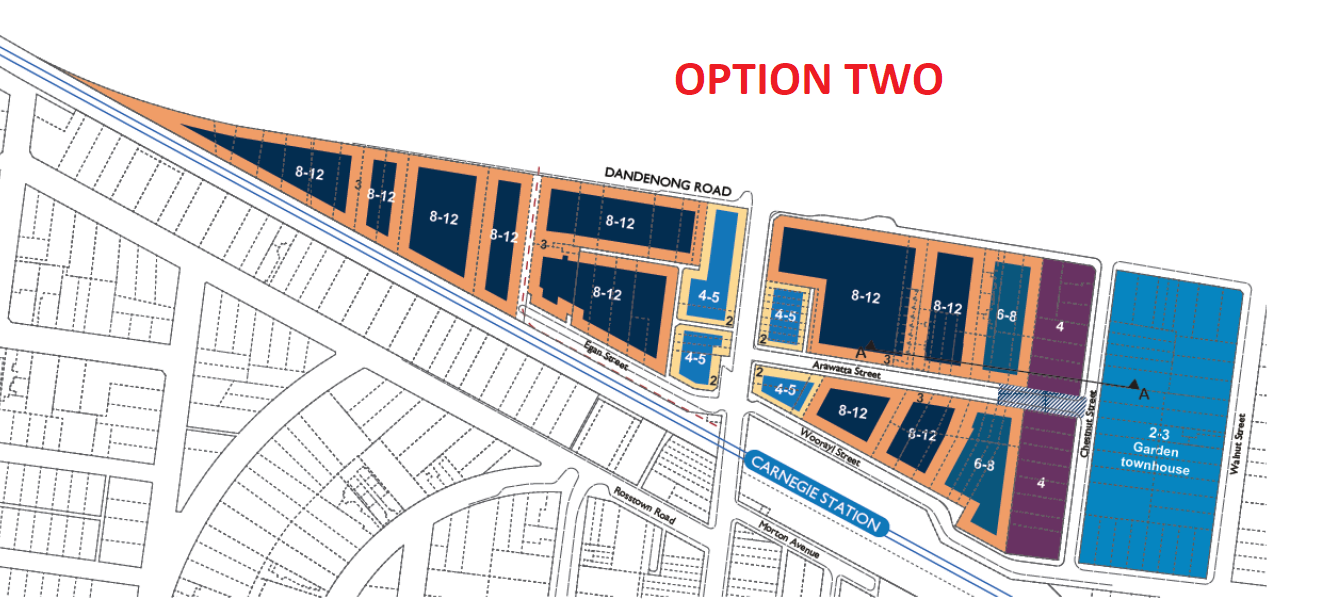
  • Option 2 — Remove Neighbourhood Character Overlay (NCO) in Chestnut Street and include the west side of Chestnut Street in urban renewal area and seek to extend Arrawatta Street

Here’s the ‘visuals’ of what’s proposed –

The lowlights of this ‘choice’ are:

  • Potential 4 storey development backing onto rear back yards of single storey places
  • Moving further west, the heights range from 4-8 to 8-12 storeys – surely visible from Chestnut?
  • Questions of overshadowing not addressed – especially since the sun sets in the west.

Option 2 lowlights are quite incredible –

  • The total removal of any heritage, neighbourhood character overlay on both sides of Chestnut
  • To be replaced by rezoning to three storeys to the east and 4 storeys on the western side of Chestnut
  • Maintaining the range of heights envisaged for the western sections of the area.

We find both of these options as simply mindboggling and inexcusable and standing in stark opposition to what the planning scheme and the proposed heritage updates state.

Council’s planning scheme states categorically at Clause 22.01 that the objectives are –

  • To recognise and preserve the aesthetic and cultural characteristics of heritage places which are held in high esteem by the community of Glen Eira.
  • To protect places identified as having architectural, cultural or historic significance and which demonstrate the various eras of Glen Eira’s development.

Next, we have the relevant Design & development overlay (DDO9) that covers Chestnut Street. It states:

To ensure that development along any residential interface be sympathetic to the scale and amenity of the residential area

With the introduction of Amendment C87 which created the NCO9 we are told that:

Chestnut Street and the McPherson Avenue Area, Carnegie are characterised by their many larger scale Edwardian era dwellings and several early California Bungalows. The key components of the character of these areas are the consistency of building forms and materials, the spacing between dwellings and the established planting themes (2013).

The 2014 Planisphere Updated report commented that there was a High degree of neighbourhood character significance. Additional controls warranted.

The Planning Panel Report of the time, and for which there were no objections submitted, also stated that –

Chestnut Street has a high degree of neighbourhood character significance and is distinct from surrounding residential areas.

It is recommended that Chestnut Street is maintained as an area of neighbourhood character significance and afforded statutory protection via Local Policy and NCO, thereby requiring a permit for demolition and construction of all buildings, including single dwellings. The NCO for Chestnut Street should highlight the distinct Edwardian era character.

So how does council arrive at the above options given its position on heritage? Here’s the ‘answer’ –

CHESTNUT STREET

The majority of submissions received related to the proximity of urban renewal area to Chestnut Street with calls from residents of Chestnut and surrounding streets to remove the Neighbourhood Character Overlay and incorporate the western side of Chestnut Street into the urban renewal area. It was thought that neighbourhood character in this area has been significantly compromised already and would be further compromised by the urban renewal behind, that many homes had deteriorated beyond repair and that the area can accommodate growth. In contrast there were also submissions requesting to retain the neighbourhood character protection. Some residents would like to see images to illustrate how the transitions may look.

The various submissions to the previous round of ‘consultation’ do include a score of identical proforma requests for removal of the NCO from the western side of Chestnut Street. The logic however is far from convincing. We are told that –

If the GECC is to meet the stated objectives of the Draft Concept Plan and key outcomes stated within the Building Transition Plan the NCO2 on Chestnut Street should be removed and the western side of Chestnut Street should be incorporated in the Urban Renewal Development area.

Surely the answer can’t be to simply remove the NCO so that it fits in more neatly with Council’s expansionist/prodevelopment plans? Wouldn’t a more logical response be that instead of giving the green light to anything from 4 to 12 storeys, that this ‘objective’ be curtailed and heritage maintained as stated in the planning scheme?

We also take issue with council’s apparent ‘endorsement’ of the idea that the ‘area has been significantly compromised already’.  A check of council’s planning register reveals that very little has been done to Chestnut street itself. In fact, the only applications coming in from 1999 are the following. Hardly a destruction of what was thought to be an area deserving of heritage and an NCO plus DDO!

13 Chestnut Street CARNEGIE – Partial demolition and alterations and additions to a dwelling on land affected by a Neighbourhood Character Overlay

8 Chestnut Street CARNEGIE –  Demolition and construction of front fence on land affected by the Neighbourhood Character Overlay and the Design and Development Overlay

7 Chestnut Street CARNEGIE- Demolition of existing dwelling and construction of a two storey dwelling on land affected by the Design and Development Overlay and the Neighbourhood Character Overlay. (refused)

1 Chestnut Street CARNEGIE – Partial demolition and construction of alterations and additions to the existing dwelling on land affected by the Neighbourhood Character Overlay.

20-22 Chestnut Street CARNEGIE – Construction of alterations and additions to the existing dwellings and buildings on common property (refurbishment of the existing apartment building)

Unit 1 16 Chestnut Street CARNEGIE – ALT/ADD TO DUAL OCC (CAR PARKING )

We should also point out that one resident’s wish to remove his/her property from the heritage/ddo/nco overlays was because it didn’t face Chestnut street and  – Given its position and the nature of the new planning overlays that surround our property, we believe we are now seriously exposed and financially disadvantaged by its inclusion.

CONCLUSIONS

Chestnut Street proper contains 23 properties.

  • The only ‘modern’ building is ON THE EAST SIDE OF CHESTNUT STREET.
  • THE DOUBLE STOREY BLOCK OF 1960’S FLATS IS ON THE EAST SIDE OF CHESTNUT STREET
  • SO HOW ON EARTH CAN WE HAVE A RECOMMENDATION TO REMOVE PROTECTION FROM THE WEST SIDE OF THE STREET AND THE ARGUMENT STILL CLAIM THAT THERE HAS BEEN MUCH CHANGE!

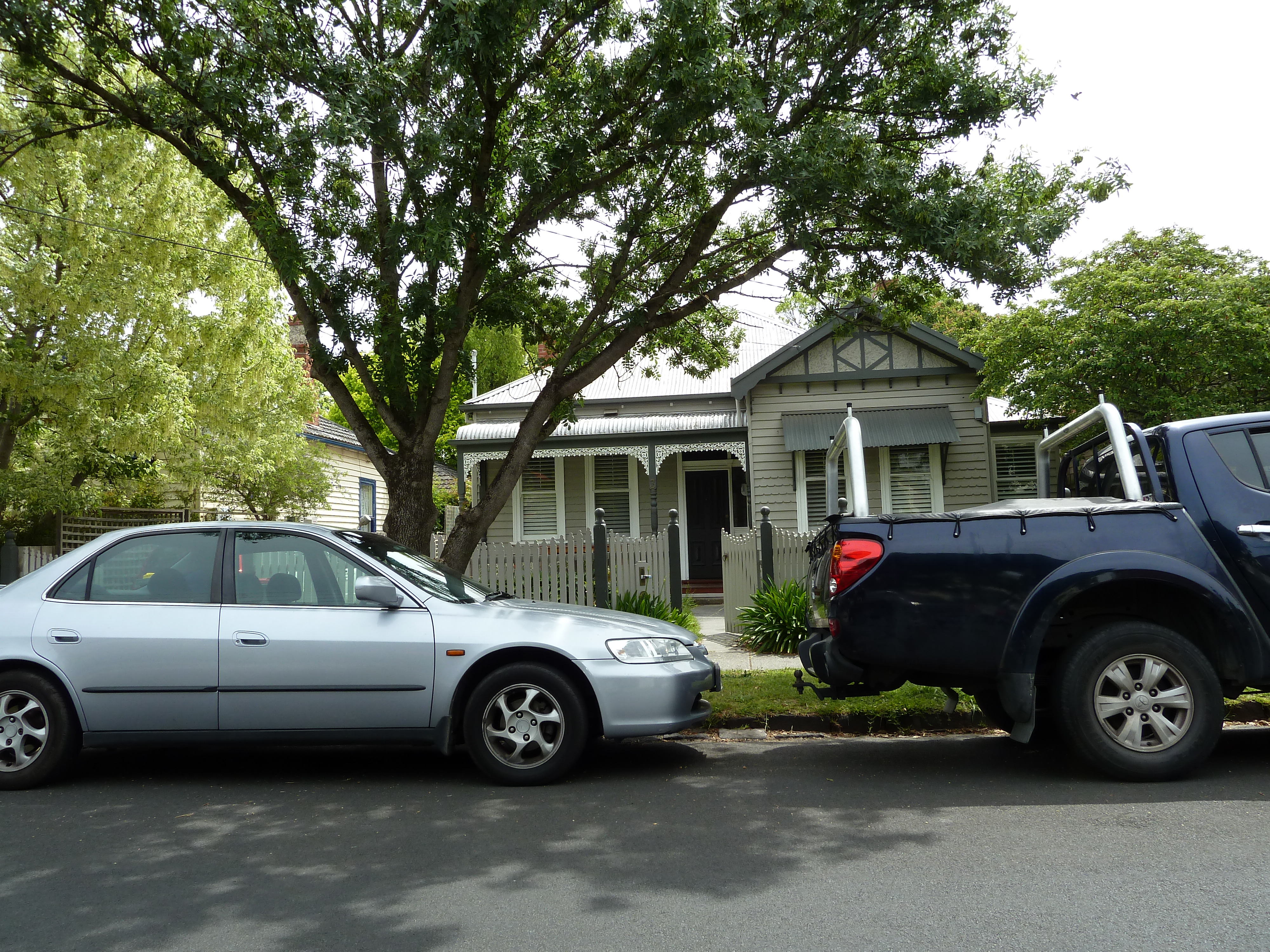
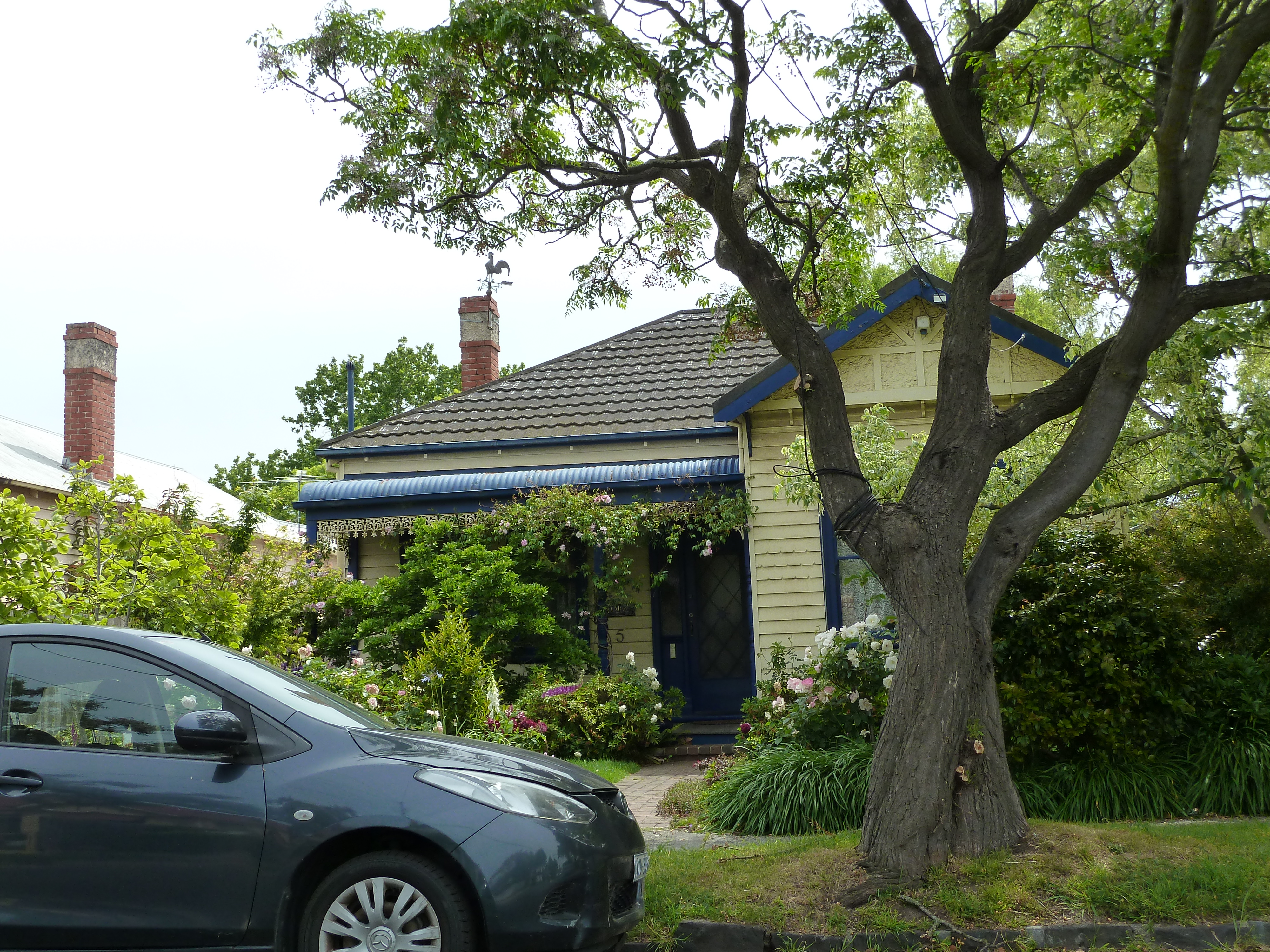
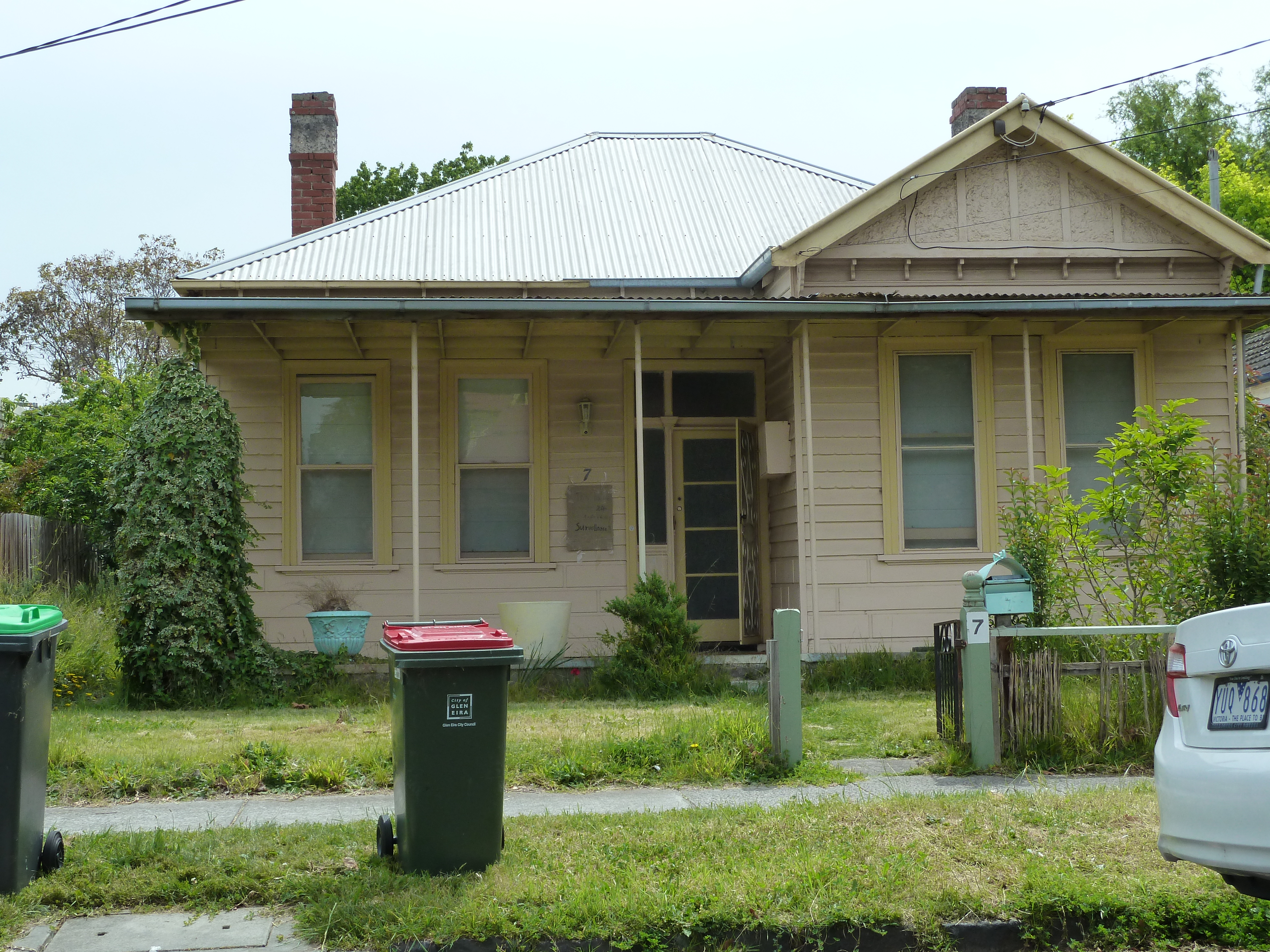
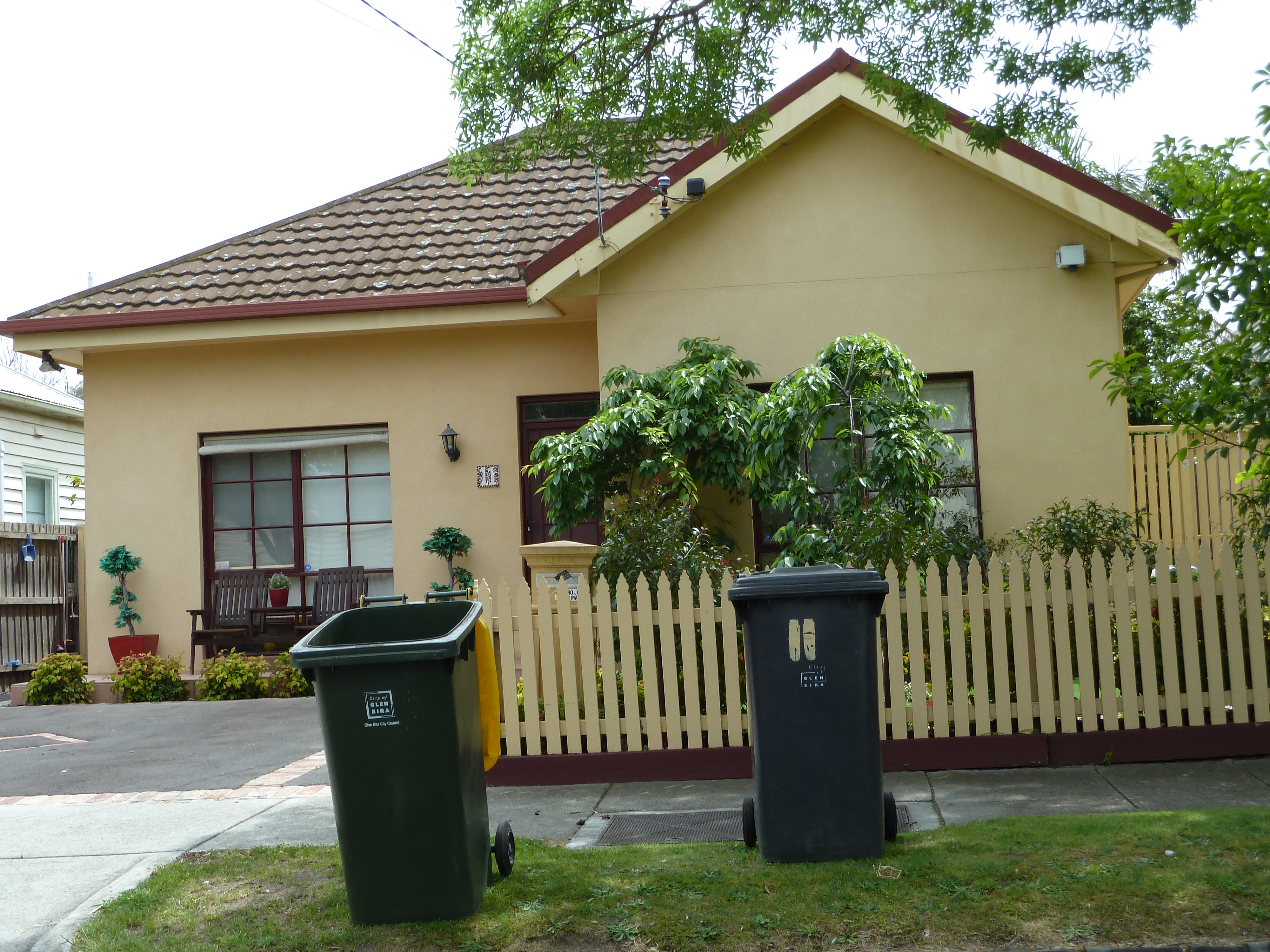
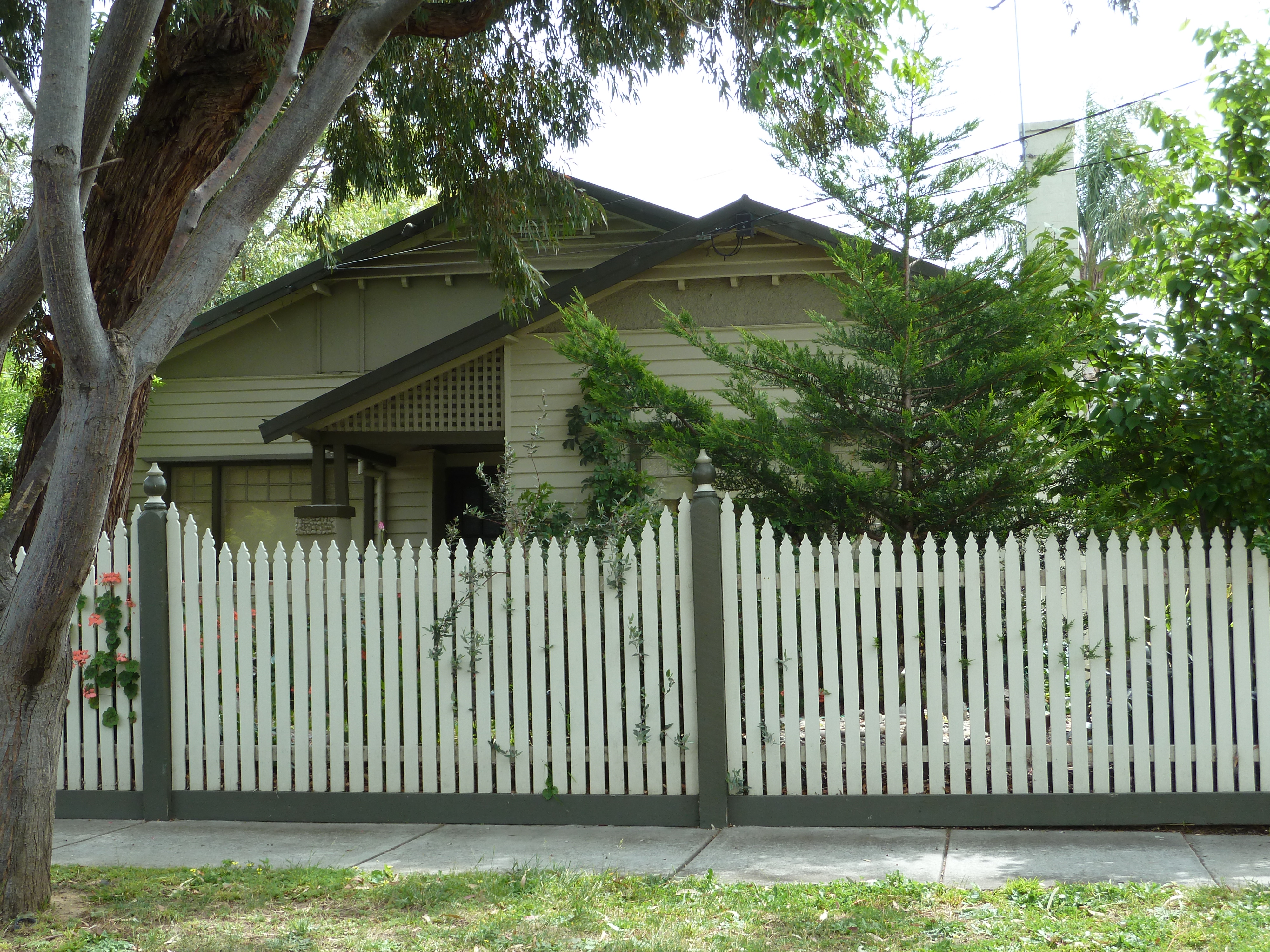
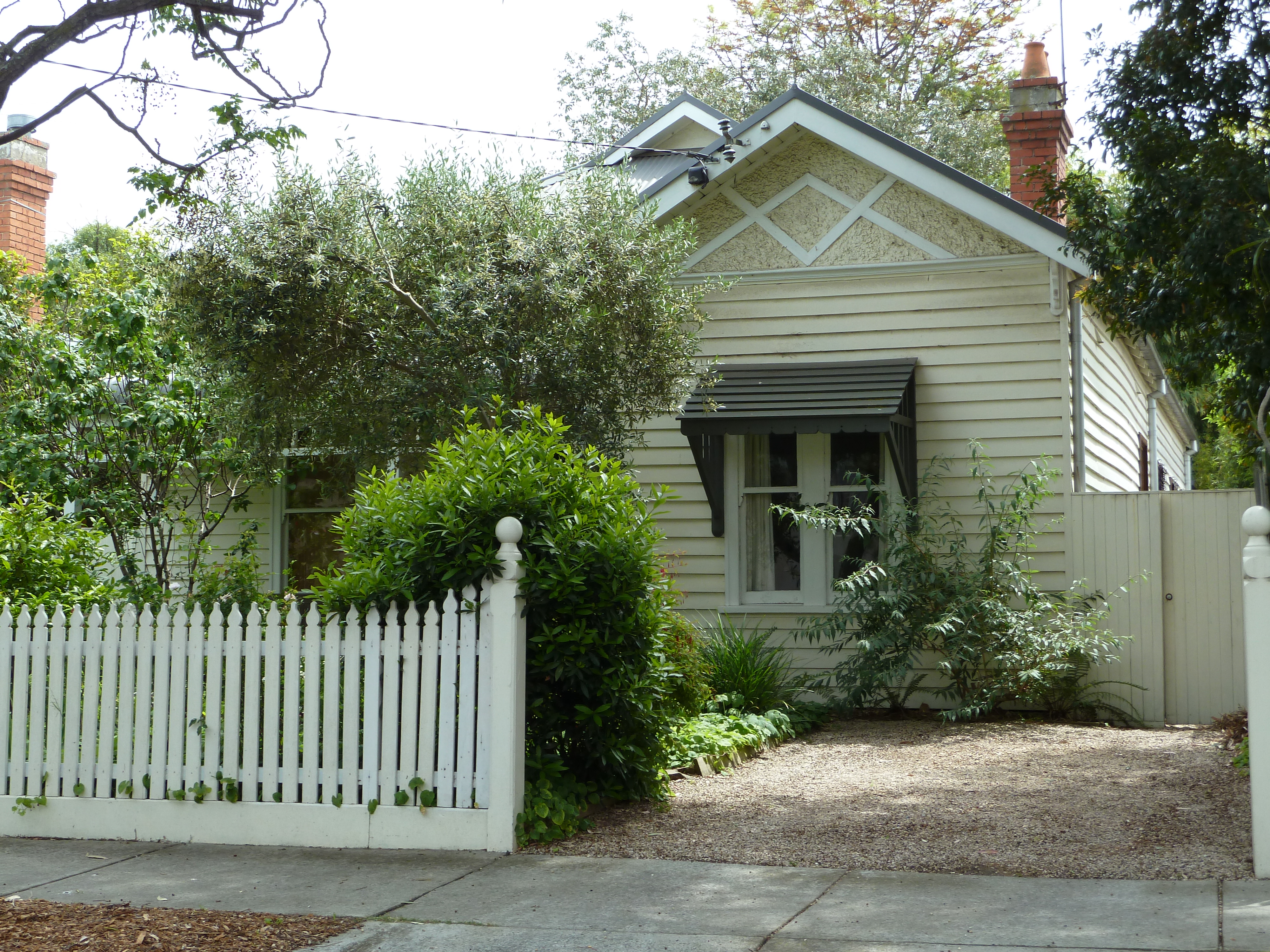
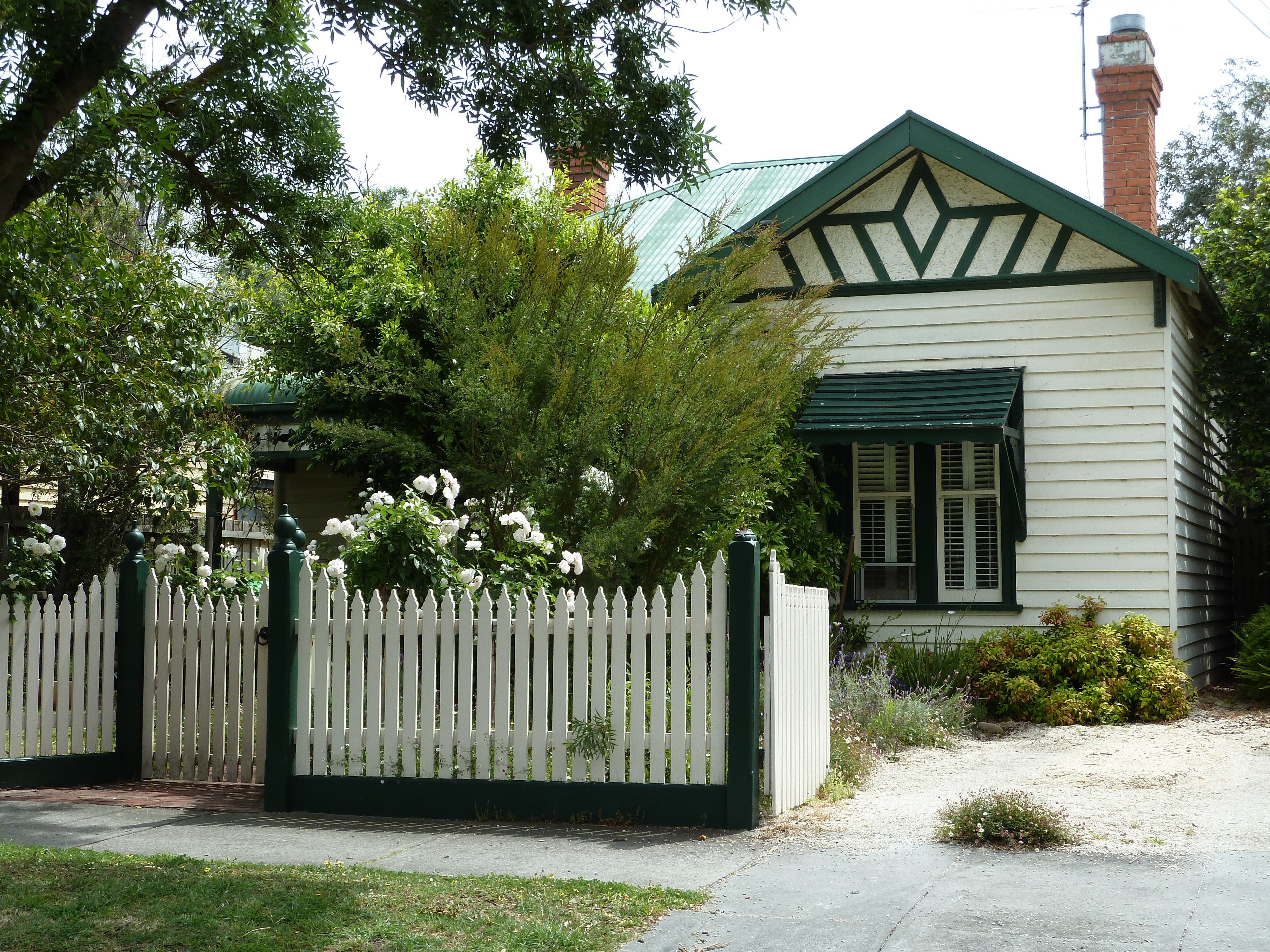
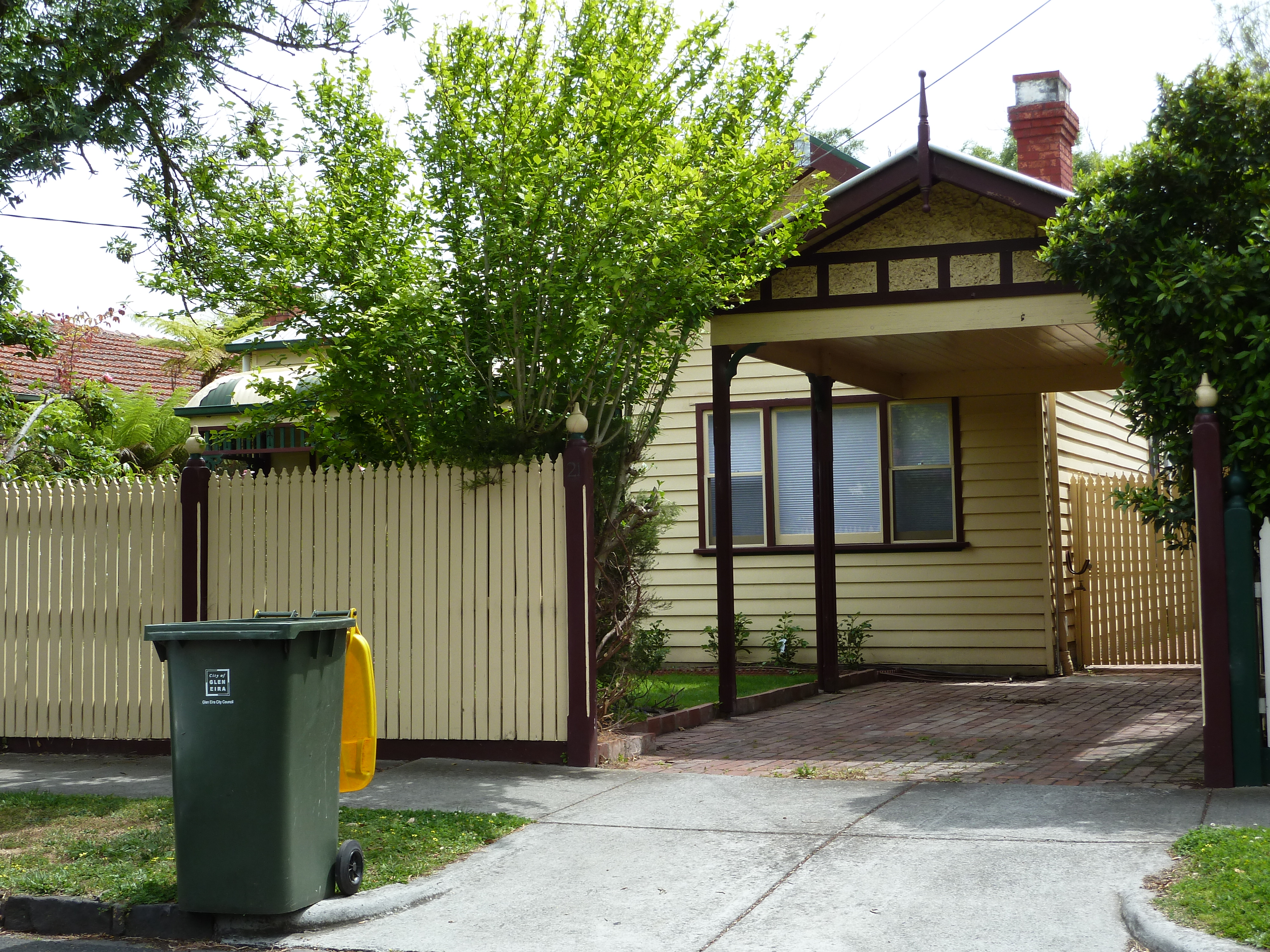
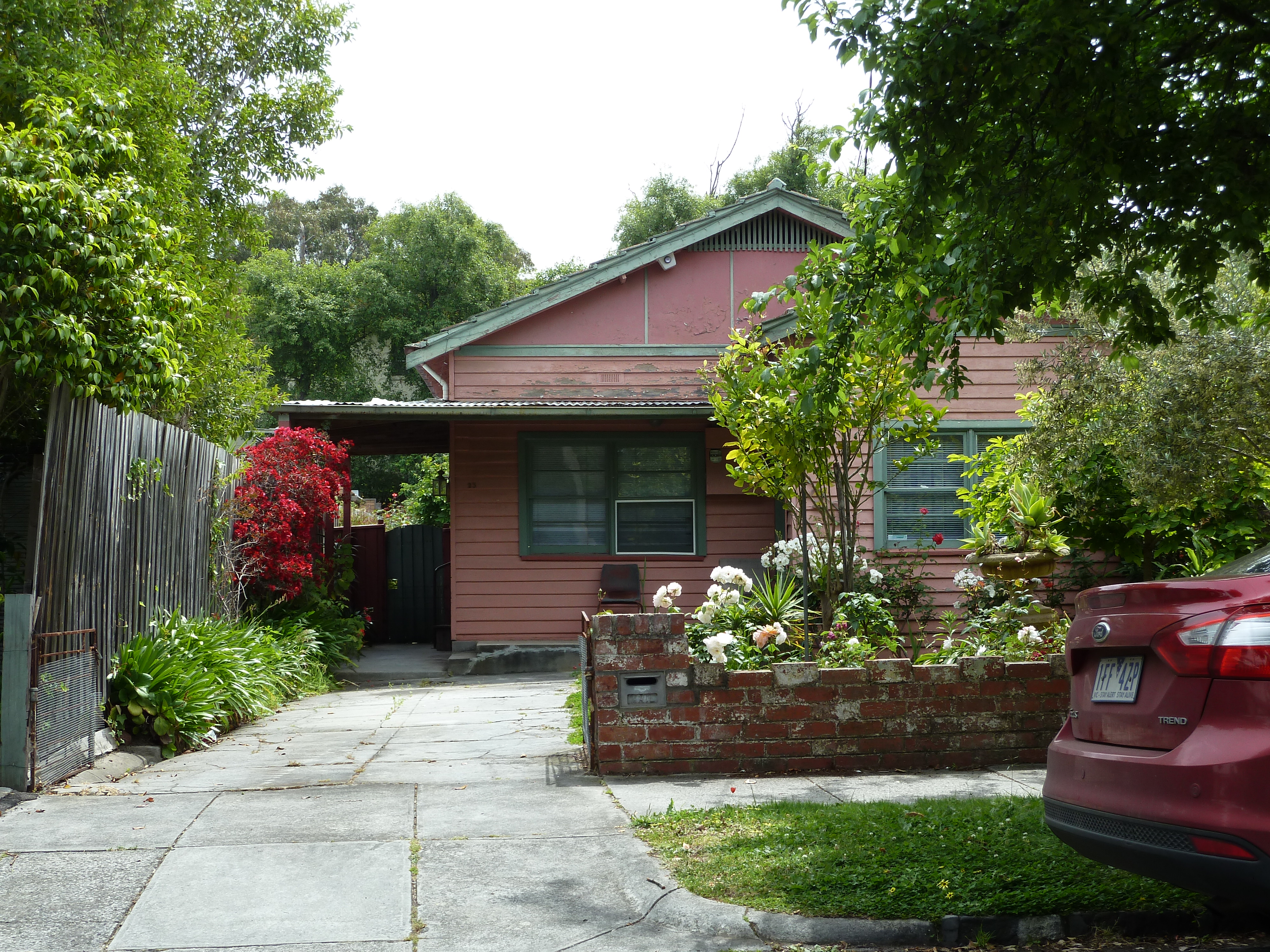
To prove our point here is the entire WEST section of all of Chestnut Street. Photos were taken today!

Whilst there are undoubtedly some improvements to version 2 of the Bentleigh Structure Plan, it is still a long way off from meeting residents’ expectations and previous feedback. Council is now conducting another ‘survey’. How valid any results gleaned from this latest ‘consultation’ is definitely open to question, especially when only half the story is revealed to residents.

Here’s the first part of the ‘consultation’ and residents are then asked to rate council’s proposed actions based on these select statements:

CLICK TO ENLARGE

Council has finally released version 2 of its draft structure plans – together with a bevy of other documents. The result is that residents are literally drowning in paper – much of it repetitious, uninformative, and still failing to present information that justifies what is proposed.

In summary, here is a breakdown of what was published together. The total number would apply to all of Glen Eira and not just the individual activity centres. If a resident wanted to glean what was proposed for the entire municipality then they would be facing the herculean task of reading all the documents.

Residents can make up their own minds as to why documents which carry dates of July couldn’t have been made public earlier but had to be consigned to this single inundation. We certainly doubt that many residents would have the time, energy, or even willingness to plough through so many pages. As for councillors themselves – our bet is that none of them would bother either! That perhaps is the plan anyway?

Bentleigh Concept Plan consultation responses – 85 pages

Draft Bentleigh Structure Plan – 67 pages

Bentleigh Draft Activity Centre Structure Plan – Background Report –  93 pages

Bentleigh Transport Analysis & forecasting – 61 pages

Analysis of Housing Consumption & Opportunities – 103 pages

Peer Review – Urban Design Guidelines etc. – 77 pages

Planisphere Urban Design Guidelines – 50 pages

Community Benefits Discussion Paper – 19 pages

Assessment of Economic Impacts – 58 pages

Planning Strategy Impacts on Housing Opportunity – 35 pages (no links on Bentleigh site)

TOTAL = 648 pages!!!!!!

CARNEGIE

Draft structure plan – 65 pages

Background report – 94 pages

ELSTERNWICK

Draft Structure Plan – 71 pages

Background Report – 100 pages

TOTAL 978 PAGES

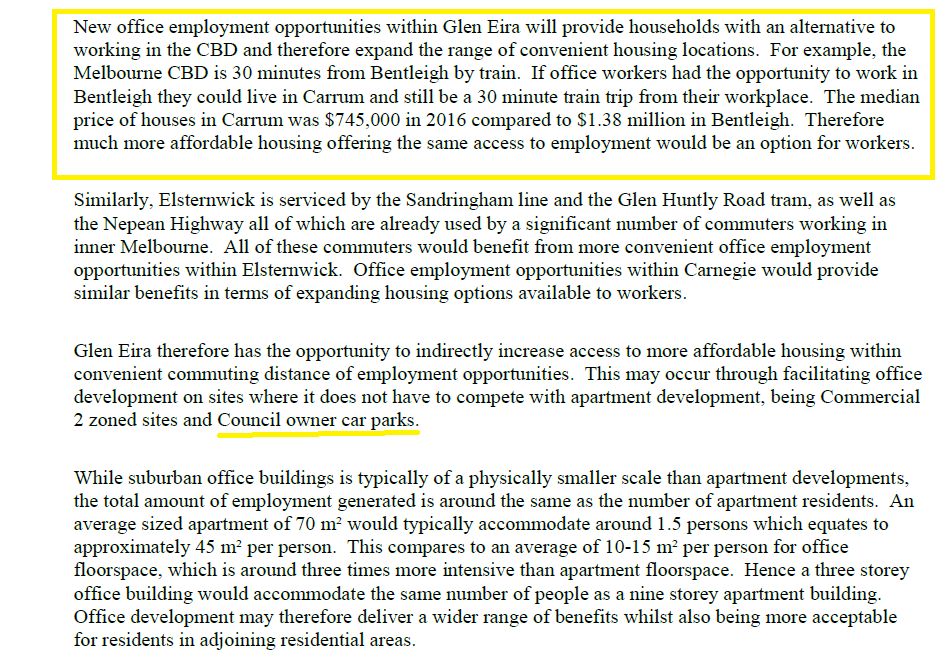
Council presumably pays big bucks for its expert consultants. Residents should therefore expect a lot more than what is ultimately produced. Featured below is an extract from page 30 of the recently released ‘economic analysis’. Putting it bluntly, we do not know whether to laugh or cry at the arguments presented and the assumptions inherent throughout.

THE ASSUMPTIONS

  • a given amount of office space in one location will equate in agglomeration benefits to the same amount of office space at a different location. And let’s not worry about car parking provisions which are far less for office space, etc.
  • The largest assumption of course is that companies will decide to rehouse to Glen Eira. In a March 2017 article written by the paper’s economic editor, the reverse was found to be the case – that companies are drawn to the CBD rather than the suburbs or regional centres. See: http://www.smh.com.au/victoria/melbourne-booms-while-the-rest-of-victoria-wilts-and-itll-only-get-worse-20170307-guslcg.html

Thus we have a 58 page document that is basically endorsing council’s proposals rather than objectively analysing and backing up its recommendations with sound data. A couple of other paragraphs from this report provide the overall tone and we believe, intent.

While there would be expected to be strong demand for office suites from various small businesses, the capacity for office development within activity centres is limited by developer‘s preference for apartment development. Council has the opportunity to facilitate office development on its car park sites through either planning controls or conditions placed on the sale of these sites.

There is the opportunity for Council to play a leading role in facilitating the development of new office space through its ownership of a number of car park sites within the Bentleigh, Carnegie and Elsternwick activity centres. This may take the form of either office suites or co-working spaces. Additional opportunities also exist within Commercial 2 zoned precincts on the Nepean Highway in Elsternwick and Moorabbin

Council‘s ownership of the two car park sites provides the opportunity to influence the scale of development and size of individual apartments in order to meet the needs of downsizers and families.


For the past year we have illustrated time and again how development in Glen Eira is at least double what is required to meet the housing needs for the various population growth projections. Residents have queried council’s reports since they all fail to answer, much less address the most crucial questions:

  • where is the justification for the claim that another 9000 net new dwellings are required in the period from 2016 to 2031?
  • Where is the existence of any calculations that include the addition of anywhere between 4000 – 6000 net new dwellings as a result of the Caulfield Village and the Virginia Estate developments?
  • Given the above, how on earth does council justify the expansion of the activity centres and the proposed rezoning of hundreds upon hundreds of properties to cater for higher, and hence denser, development?

To reiterate:

  • Plan Melbourne Refresh sets two rough targets for the Inner South Region of 4 councils – Bayside, Boroondara, Stonnington and Glen Eira. The period for this ‘required’ growth goes out to 2051 and not 2031. There is the ‘aspirational’ target of 132,000 dwellings and the other target of 125,000 divided between the four councils. Glen Eira’s ‘share’ is thus roughly either 33,000 or 31,000 over this time period. Divide these numbers by the 35 year time spread and Glen Eira’s ‘quota’ becomes a mere 942 dwellings per annum, or 885 dwellings per annum.
  • Since the zones were introduced in 2013 Glen Eira has been averaging more than double the ‘quota’ figures stated above. Last year alone the number of building approval permits granted totalled 2012. Planning permits for the first quarter of the current financial year tally 453. Thus we are looking at a full year of at least another 1800 net new dwelling permits granted. To argue as council has done that less than half will be built is sheer nonsense in our view. Once a developer goes to the expense of buying the land, hiring architects, planners, and eventually getting a permit, there is every incentive to build and sell in order to recoup his costs. Even with land banking, we would find it extraordinary for any developer to sit on his land for 35 years!

Until council and its hired guns directly answer the questions posed above (as promised), we have little faith that what is occurring is any different to what has gone before – ie a council determined to stick to its pro-development agenda to the detriment of the community.

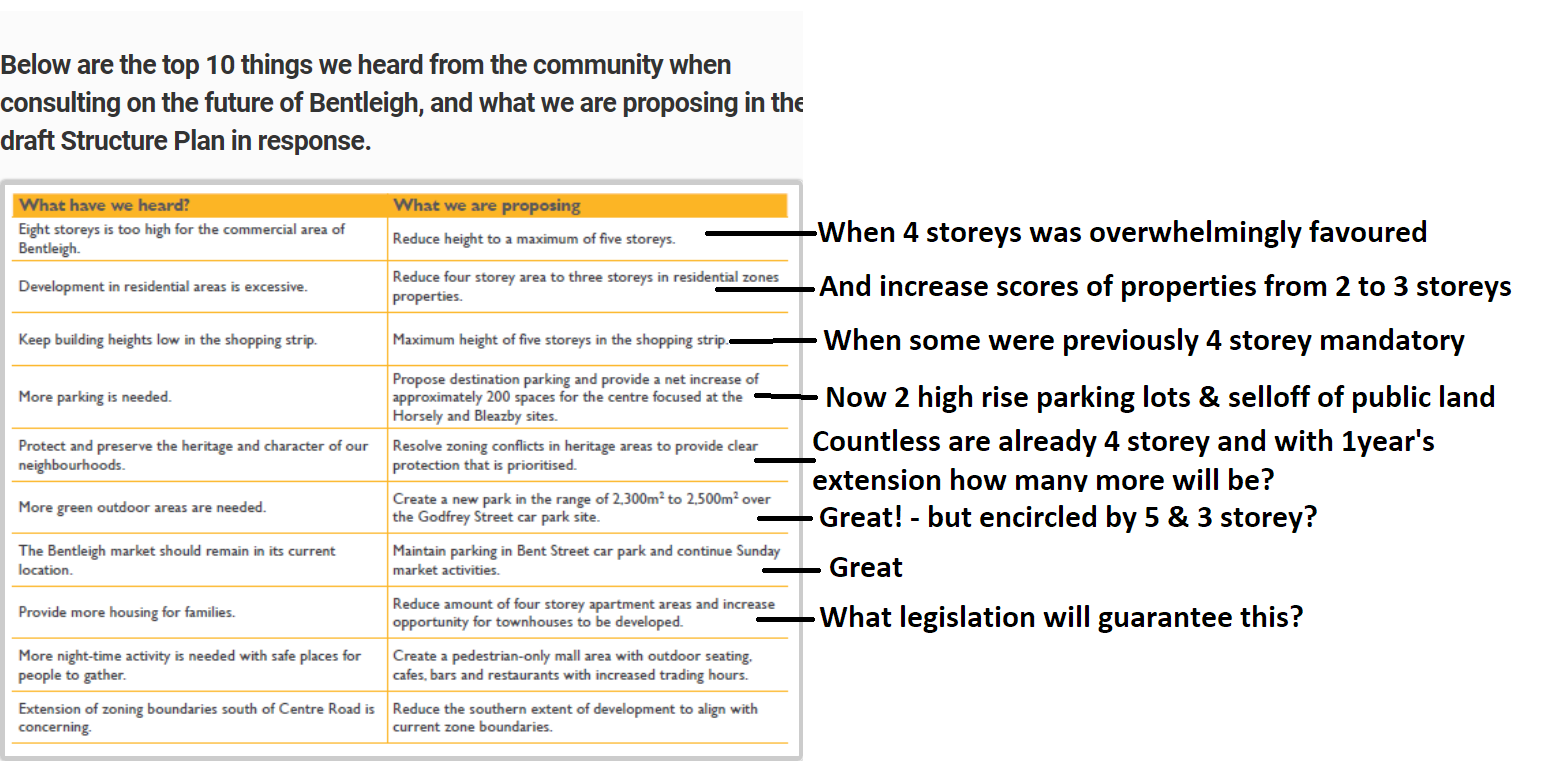
Council has this afternoon published its draft structure plans for Bentleigh, Carnegie & Elsternwick. The East Village plans are yet to make an appearance. A quick summary of what is now proposed includes:

  • Bentleigh’s 8 storeys is now reduced to 5 storeys – although areas that were previously earmarked for a MANDATORY 4 storeys can now rise up to 5 storeys!
  • Carnegie and Elsternwick are still in line for 12 storeys but these areas are reduced.

The most disappointing aspect of these new plans is that residents are still to receive any details on:

  • Potential costings
  • Strategic justifications for heights proposed
  • No mention whatsoever of Caulfield Village and Virginia Park developments and how these might factor into council’s figures for meeting projected housing needs
  • Continual reference to ‘minimal change’ (ie NRZ) as containing 1 or 2 dwellings when council is already facing a dozen applications for multiple dwellings in the NRZ!
  • No real explanation as to why the borders of the activity centre, especially Bentleigh, has to double in size.

What irks us the most however is the question as to whether council is really committed to genuine consultation. If so, then perhaps they should explain why this advertisement appeared in Saturday’s Age on page 22 of the classified section, when we are being told that nothing is as yet set in concrete. It would appear that much is already predetermined – otherwise why spend a squillion on a tender before residents have even had the opportunity to consider much less comment upon the proposal?

We will comment in greater detail on these new plans once we have fully digested the content.

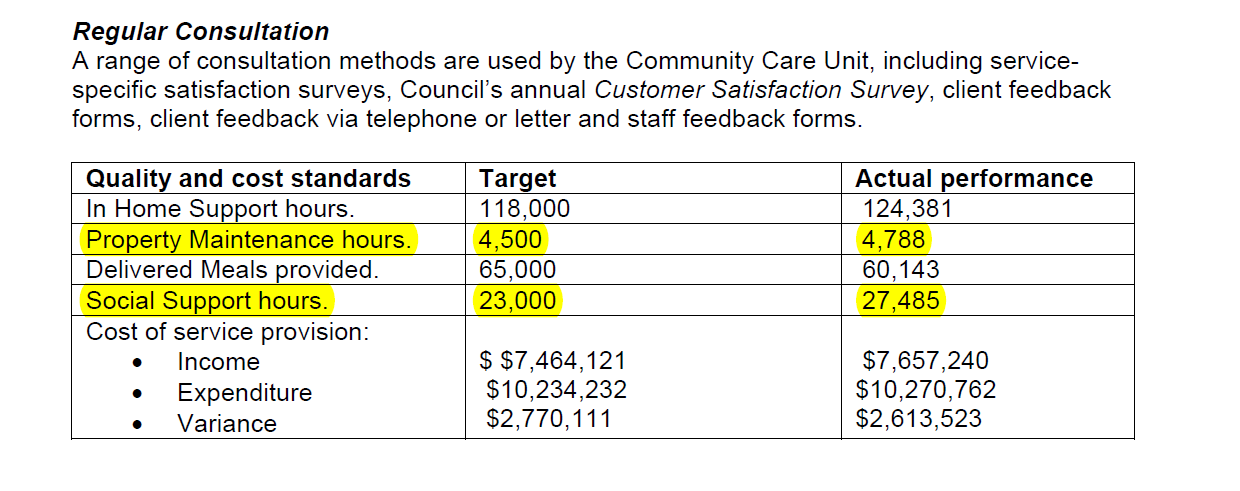
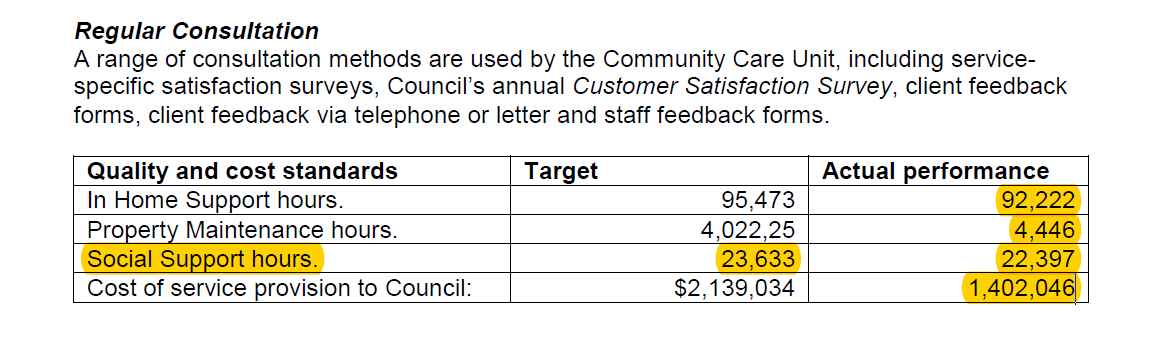
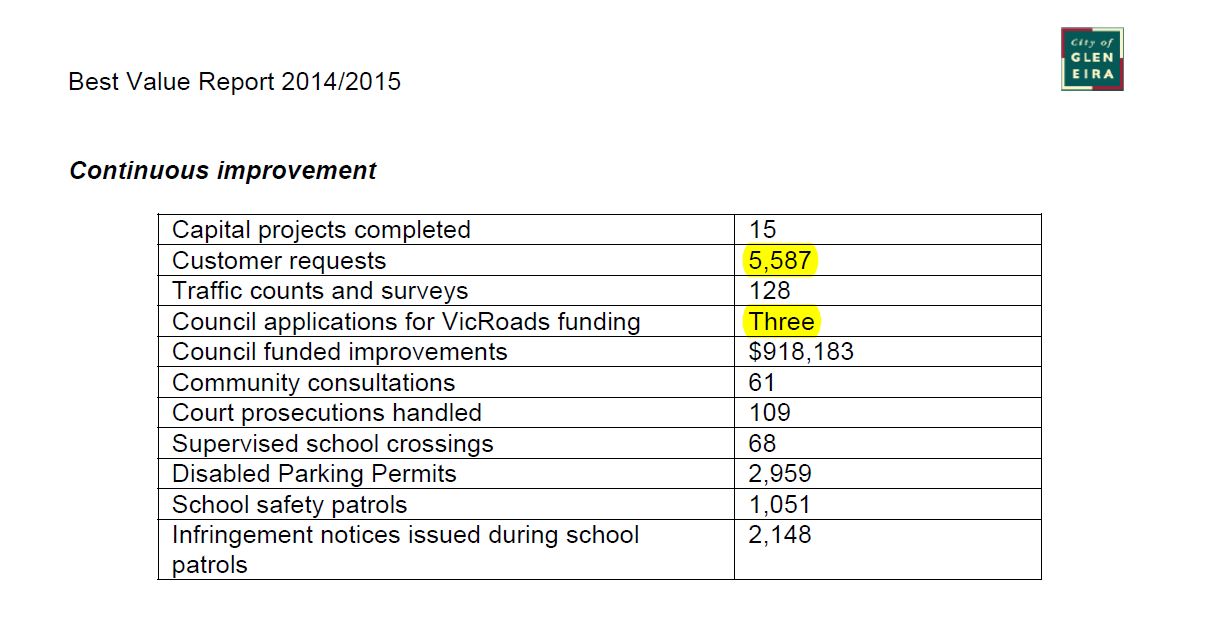
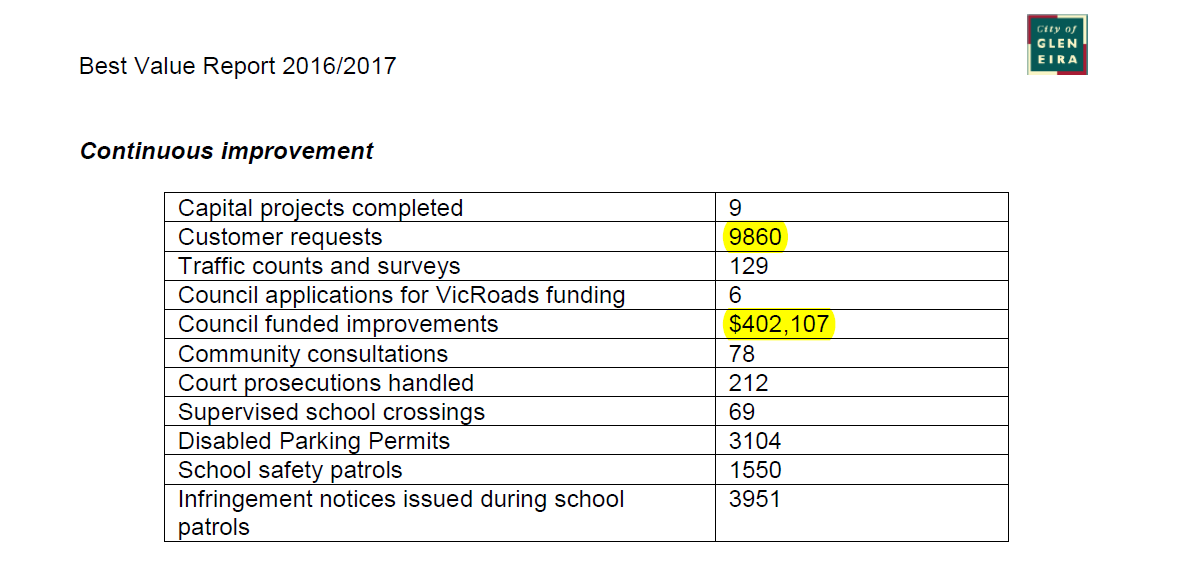
Words are not really necessary for this post. Readers should merely compare the results from 2014/15 to 2016/17 and assess whether these Best Value reports do reveal ‘continuous improvement’ by council and as mandated by the Local Government Act. We have chosen Traffic/Parking and Home Care . The 2014/15 reports are presented first.

Click on each image to enlarge


« Previous PageNext Page »