GE Transport


Figures detailing the number of net new dwellings granted permits for the second quarter of the 2016/17 financial year has just been published. Glen Eira continues to quadruple what is stated as required with a yearly average of 2000+ net new dwellings. We remind readers that the 11,000 dwellings required to meet population growth by 2031 will be reached at the latest in 2020 at this rate!

Unfortunately the complete data for Port Phillip, Bayside and Stonnington is not available.  Even if the data were available we remind readers that both Port Phillip and Stonnington are ‘special cases’ in that the former is a major tourist centre and hence it has several ‘capital city’zonings. Stonnington, according to the State of Play Reports has over 10% of its municipality zoned as commercial and development is concentrated in these areas. Glen Eira has a bare 3% of its land zoned as Commercial. In Glen Eira development occurring in the commercial areas is minimal, compared to the damage done in local residential streets zoned as GRZ and RGZ and yes, even NRZ.

Based on these figures alone, there is no reason why the zones cannot be reviewed and the extent of GRZ and RGZ areas reduced. If council is serious about implementing structure plans that take account of resident views, then the borders of the so called ‘activity centres’ and their respective zoning must be the foundation of any such review.

Here is the data and please keep in mind the question of ‘density’ when municipalities such as Monash, Kingston, Manningham, etc are double and triple the size of Glen Eira. What impact does 2000+ new dwellings per annum have on density, infrastructure, open space, traffic and transport on a municipality that is only 38.9sqk in comparison to these other councils?

untitled

lxraCLICK TO ENLARGE

Delahunty moved a motion for a Request for a Report on the Caulfield Village. Her request was that the report include ‘planning options’ available to council on the social housing issue for the Village. Taylor seconded.

DELAHUNTY: said that the VCAT decision on Precinct 2 was that council was ‘unsuccessful’ in the attempt to ‘require’ the developer to include social housing. Called this a ‘surprising judgement’ and wondered whether the member had ‘actually seen or heard of’ social housing. Said the judgement was ‘so far removed from the way social housing operates’. Claimed that for the member to state that the ‘requirement to provide social housing’ is ‘financially prohibitive is rather surprising’. Said that ‘of course’ there’s a financial ‘imposte’ but ‘that’s what it is’. Called it an ‘incredibly disappointing result’ and when you have such a massive development almost like a ‘new suburb’ that there should be ‘some proper social housing provider attached to it’. Acknowledged that the developer ‘came up with their own scheme’ but this ‘doesn’t meet anyone’s definition of social housing’ and this looks like a pay later ‘lending scheme’. ‘It was an attempt to circumvent this requirement’ and all it would do would be to ‘help people access deposits’ or ‘get their hands on the deposit faster’.  Claimed that this doesn’t ‘address disability at all’ but helps the developer ‘sell their properties faster’. Said she ‘doesn’t understand at all’ how the judgement ‘was made’ and ‘won’t let this rest’. The report is asking for help to ‘understand what levers, what tools’ can be used. Said ‘noise’ is ‘available, appealing to the hearts of the developer is available’ but there ‘must be some planning levers that we can still pull’. ‘It’s unconscionable to let this go’.

TAYLOR: thought about the cost and ‘access to public land’ and ‘it’s not all about take, take, take’. The developer ‘can’t have it all one way’. On accessing a ‘social housing organisation’, ‘how difficult is this?’ Said there are ‘at least 39 social housing providers’ and it’s a ‘matter of liaising with them’. It’s ‘not onerous’ and a few meetings or emails can set this up. This ‘didn’t sit well with me’ so she ‘highly commends this report’.

ATHANASOPOULOS: started by saying that ‘we live in a society that is very inclusive’. Said he had visited a family member in London who lived in a property bought from the government and it was ‘very nice’ in an allotment of ‘maybe another 30’ units in a village that ‘probably had another 100’ units. Said it was ‘great’ that this ’90 year old lady’ could walk everywhere and there was a ‘sense of community’. If it can happen in a ‘massive city like London’ then ‘why can’t we create’ something similar here? They need more ‘than vcat on our side’ but also ‘local members’ and ‘ministers’ in order to ‘get something better than this’ because ‘people deserve it’.

SILVER: asked that the motion also include ‘examples’ of social housing from other municipalities and their major developments. Went on to say that the judgement was from a ‘legal member’ and ‘whether something is regarded as reasonable is a matter of policy’ ‘rather than planning scheme’ so it’s not necessarily ‘fair to the tribunal to say’ that it’s a bad decision because they have to ‘implement the law’ even though council mightn’t like the decision.

Delahunty then asked Torres whether this amendment would ‘slow down our efforts’ on advocacy? Torres said ‘no’ in that there ‘are other examples in other councils’. Delahunty accepted the amendment.

HYAMS: said ‘there is also a matter of principle here’ because VCAT was supposed to ‘apply the objectives’ of the Incorporated Plan and the ‘objective is social housing’. ‘They are now saying they are not going to have social housing’ and he ‘can’t see’ how this is in keeping with the plan. Claimed that another objective was ‘that there be no loss of on street parking’ and the VCAT decision means that they are losing car spaces to the ‘net loss of 45’. These are mostly metered parking spots, so ‘it will be a cost to the community’. Hoped that they would ‘also be looking’ to see ‘how we can reverse that’.

MOTION PUT AND CARRIED UNANIMOUSLY

COMMENTS


The history of Caulfield Village is literally the history of utter failure by Council to do its job of land management competently, transparently, and for the benefit of residents. Over the years, every single aspect of this project has been mired in controversy, lies, and repeated cave-ins. The machinations go back right to the beginning with the establishment of a Special Committee to decide on the C60 and which consisted of Hyams, Lipshutz, Esakoff and Pilling. These 4, together with Newton and this administration did everything in their power to accede to every MRC demand.

Not surprising that the developer keeps winning when the Incorporated Plan is literally such a joke and should never have been accepted by the 4 councillors involved. The municipality is now paying the price for this collusion and incompetence.

Admittedly, Delahunty was not part of these earlier decisions and to her credit she, Magee and Lobo have been consistent on their demands for social housing. The same cannot be said for Hyams and Esakoff. Here is what the former said when the first amended Development Plan for Precinct 1 came in – ie more dwellings and reduction in 3 bedroom apartments leading to more single bedroom apartments.(taken from our post of May 3rd, 2015)

HYAMS: said there will be more apartments, thus more people, but the ‘building still stays’ within the parameters of the incorporated plan. Said that objectors raised the issue of ‘lack of diversity’ but ‘I don’t know that there needs to be that diversity in every site – there needs to be diversity across Glen Eira’. So even though there will be many one and two bedroom places there are ‘family sites around the area’ so that’s the diversity. As for social housing ‘that is a requirement’ for the end of the development but ‘I don’t think there was a requirement’ for social housing in ‘every single part’ of the development. Didn’t think that it was ‘appropriate’ for council to ‘move the goal posts’ now in regard to social housing. He was ‘sure this would be enforced in due course’.

As for the role of the administration and its planning department, the following quote from the Camera report on the first Development Plan should be enough to convince readers of either how incompetent they are, or how committed they are to basically duping residents.

This document gives certainty to the local community by precisely stipulating building envelopes; their heights, setbacks, and siting. It can be said that the Caulfield Village development is one of the most planned development sites in the municipality. The future development of this land has been “locked in” following a rigorous community consultation and amendment process, the community now has a high level of certainty in what to expect at Caulfield Village

Finally, a word of warning to residents on the Virginia Estate proposals. Their draft ‘management plan’ is basically a duplicate of the MRC plan for social housing. They have undoubtedly witnessed the successes of the MRC and are employing identical tactics. We can only hope that with this new council, they will have learnt the lessons of the past when it comes to deciding on the Virginia Estate development – which we believe will dwarf what is occurring in the Caulfield Village.

Readers might also like to revisit one of our earlier posts – https://gleneira.wordpress.com/2016/06/21/are-we-about-to-be-screwed-again/

There is much in the current agenda for Tuesday night’s council meeting that residents need to be aware of and to actively lobby the new council on. Whilst there are clearly some major improvements in terms of community consultation, and a more ‘up front’ approach to letting residents know what is on the drawing board, vigilance by residents is still required. Plus of course the demand that council is explicit and precise in all its communications with residents.

This last point is crucial, especially as it applies to Item 9.7 of the agenda – ie ‘city strategy’ and the work council is proposing to undertake in the next 18 months on planning. The item basically promises 3 things:

  • To update the 2005 Activity Centres Strategy
  • To complete structure plans for Bentleigh, Carnegie and Elsternwick, and
  • To continue and expand the ‘engagement’ practices currently initiated for the shopping strips

Whilst this all sounds wonderful, there are some real concerns as exemplified by this sentence – The revised Activity Centre Strategy will inform Building and Development (or Urban Design) Guidelines which will guide the design of future developments within all commercial areas.

And

Community feedback will be sought on built form controls across all commercial areas with a more detailed focus on Urban Villages.

We remind readers that an ‘activity centre’ is much, much more than the ‘commercial’ areas. It also incorporates the surrounding residential areas that are currently zoned either Residential Growth Zone, and/or General Residential Zone (ie 4 and 3 storeys respectively).

Then there is also this nebulous sentence  – This work will manage development in key sensitive areas whilst also aiming to strategically unlock some key sites close to train stations for redevelopment. Exactly what does this mean? Which sites are in the firing line?

Until council is prepared to commit to a full and comprehensive review of its residential zones, then no amount of structure planning, or urban design frameworks alone will ameliorate the damage that is currently continuing to occur in our local residential streets. The real questions that residents should be demanding answers to are:

  • If the major shopping strips can provide enough housing to cater for the population growth, then does Glen Eira really need 40+% of Ormond, for example, zoned as General Residential Zone?
  • Why do so many streets have 3 distinct zonings when the recommendations from the Minister’s Standing Committee on the new zones recommended against this practice?
  • Why have so many heritage areas been included as part of growth zones and others haven’t? What is the logic and the consistency behind the new zones and does this stand up to scrutiny?

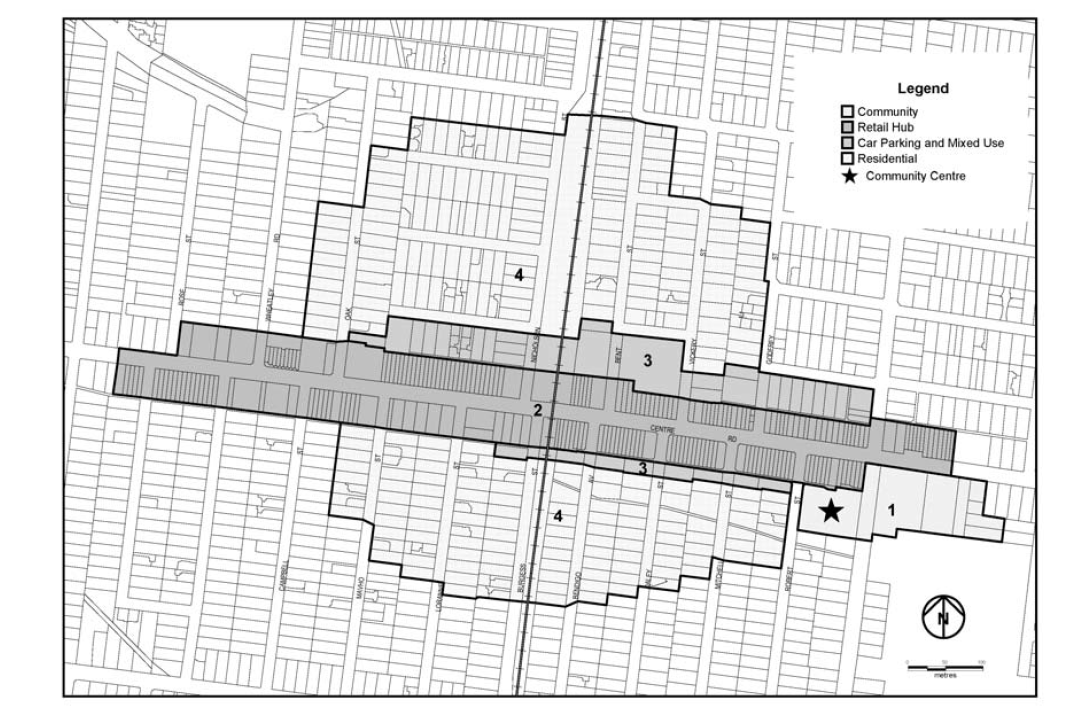
The following screen dump from the current planning scheme will show why we are concerned about the potential direction of planning in Glen Eira if the intention is to only concentrate on the commercial areas and totally ignore the surrounding residential streets that are part of all activity centres. The shaded areas largely represent the commercial and mixed use zonings in Bentleigh. The darker single lines represent the ‘circumferance’ of the Bentleigh activity centre. Most of the activity centre is comprised of nearby streets and therefore housing.  To ignore these countless streets which are zoned GRZ and RGZ and to only concentrate on the commercial zoning as the draft Amendments C147/8 do is to wash one’s hands of protecting neighbourhoods and undertaking planning of the highest order. In the meantime of course, officer recommendations are to grant permits for another 61 units over 3 locations of 3 and 4 storey heights!

untitled

There is a salutary lesson for residents and council in the comparison of the Caulfield Village development process and what is fast approaching for the Virginia Estate project. Residents need to be fully aware of:

  • The impact of rezoning (ie Caulfield Village rezoned to Priority Development Zone, and Virginia Estate now mooted rezoning to MUZ and/or Commercial 1)
  • Council acceptance of an Incorporated Plan for Caulfield Village and the potential acceptance of a ‘Management Plan’ for Virginia Estate – both of which will allegedly provide the ‘conceptual framework’ for development but without real detail. No objection rights for residents – decision is made by council.
  • Development Plans (ie the details) which then follow for each precinct but which only have to be ‘generally in accordance’ with the Incorporated/Management Plan. These Development Plans can be amended time and time again, and have been for the Caulfield Village.

Readers will remember that the Precinct 2 application (just under another 400 dwellings) for the Caulfield Village was refused at ‘manager’ level by Council without Council displaying this until after the fact. The developer immediately went to VCAT, where the decision has now been handed down. Once again, the developer has basically won, and all previous promises (ie real social housing element, ‘housing diversity’ has gone).

The ‘problem’ with this entire process is that the Schedule for the Caulfield Village which Council accepted and which provides all the ‘musts’ is so vague, and basically useless,  that the developer has all the cards stacked to his advantage. Fundamentally,  council’s requirements were inadequate and our fear is that unless some real lessons are learnt the same will occur at Virginia Estate. For example, the Caulfield Village history is:

  • No on-site visitor parking required (at this stage 2063 dwellings – originally mooted at 1100 in the Incorporated Plan). Precinct 2 now has 45 on site car parking spots but this is dependent on the ‘largesse’ of the developer and not on council’s Schedule.
  • Amendment after amendment that allows balconies to encroach on setbacks
  • No definitive statements on social housing except this useless sentence in the Schedule – The provision of affordable housing in the form of social housing. No definitive statement on how many ‘social housing’ units, or how this is to be managed. Readers will remember that council wrung its hands in dismay when Precinct 1 was allowed without any social housing and the arguments of Hyams et al were that future precincts would meet this requirement. So much for promises!
  • No definitive statements on ‘housing diversity’ – thus Precinct 1 has over 40% as one bedroom dwellings and Precinct 2 will likely have 2.2% of three bedroom apartments according to the plans.

For the full VCAT decision, please see: http://www.austlii.edu.au/au/cases/vic/VCAT/2016/1965.html

As we’ve said above, unless the lessons from Caulfield Village are learnt, and learnt properly, then we fully expect that the Virginia Estate project will follow in the same manner . It is the job of this new council to ensure that every single potential gap in any Management Plan and accompanying Schedule is spelt out so that the developer has as little wriggle room as possible. If this is not done, then we can rest assured that the eventual Management Plan will not be worth the paper it is written on and the entire project will duplicate the abysmal planning that occurred and is still occurring with the Caulfield Village!

Development will happen at Virginia Park. That is inevitable. What matters is:

  • How much development is ‘necessary’ or even ‘appropriate’ for this site? 1000, 2000, 4000 or 5000 apartments?
  • What will this development look like?
  • What short and long term benefits will accrue to the community as a result?

The answers to these questions are currently unknown. What is known, is that housing brings in the money for developers and that rezoning of the land is the first step in the process. Once rezoned it is the fine print of the so called Development Plan that will reveal much of what the future might look like. Thus it becomes even more imperative that Council insists that the eventual Master Plan is more than a glossy salesman’s promotion – which it currently is!

At this stage we can only go on the published documentation and there is much to be concerned with here given the absence of specific detail and the plethora of motherhood statements.

We address some of the core issues below.

How many apartments are planned?

The developers neatly side-step this concern with this catch all statement – Final densities and dwelling numbers cannot be determined at this point as they are dependent on a number of factors such as potential heights, scale and uses on which feedback is sought as part of this consultation phase.

The intended message is that resident input will have a decided effect on the outcomes – such as ‘dwelling numbers’. That remains to be seen of course, but we are indeed skeptical. Heights for close to half of the site are already set by the existing Schedule to Amendment C75 gazetted in 2011. Plus, when it was envisaged that a 12.5 hectare site could accommodate up to 4000 apartments, it is extremely difficult to believe that a site double this size will not attempt to accommodate more!

The final number of apartments will also be determined by how many are single bedroom, double bedroom or how many are 3 bedroom apartments suitable for families. When the issue of ‘housing diversity’ is reduced to the following, as the documentation repeatedly emphasises, then this is potentially another cause for concern – ie Feedback from earlier consultation on the development of a 20 year masterplan for the precinct asked for consideration of smaller dwelling options, affordable housing and aged care and retirement options.

Housing diversity is much, much more than ‘smaller dwelling options’ or even the inclusion of aged care and affordable housing. The ‘offer’ of ‘up to 5% of total dwellings’ as ‘affordable housing’ palls when we consider the Yarra Council’s Schedule to the Alphington Paper Mill development  (16.5 hectares – 2500 units) and the imposition of an ‘unconditional’ 5% affordable housing component.  

It is therefore imperative that Councillors insist on unequivocal terms and definitions, once the final Master Plan is submitted.

Population Growth In Glen Eira

The various published documents emphasise how Glen Eira’s population is projected to grow by 2031 and the number of apartments that are required to meet this housing need. We’re told that population will increase by a third and that another 7,474 new dwellings are therefore essential – and that is throughout all of Glen Eira, not just East Bentleigh!

What the Gillon conglomerate does not tell residents is:

  • That there are already another 1500+ apartments in the pipeline due to the Caulfield Village development and these will all be completed by 2031.
  • According to Planning Permit Victorian figures for the first quarter of 2016/17 another 448 net new dwellings have been granted permits.
  • According to the ABS data on building permits for the current financial year, we can add another 420
  • On the cards is also major development projects at Rippon Lea, Ormond rail station and probably McKinnon and Bentleigh stations as well. Ormond is purported to house another 200 apartments. No information has been released for McKinnon and Bentleigh, but we can’t imagine that these stations will be left untouched. Then of course there is the recent sale of the Daily Planet and 2 surrounding properties where the developer promised ‘bay views’ to his prospective buyers.

Thus we have the situation where we already know for certain that out of the ‘required’ 7474 new dwellings, Glen Eira already has at least 2600 accounted for. This of course does not take into account the flurry of applications already in for the RGZ and GRZ areas of the municipality and those applications which will still come in. Even discounting all these latter scenarios, all Glen Eira has to achieve is another 4800 new dwellings over the next 15 years to meet its unofficial ‘quota’. Thus, there is absolutely no need for Gillon to use the excuse of a housing shortfall in order to condone the potential  (over)development at Virginia Estate. And certainly not the questionable and debated target of 4000+ that was in the first attempt at rezoning.

And all of the above ignores the major problems of traffic, parking, infrastructure, commercial viability of Centre Road shopping strip, residential amenity of neighbours, open space, walkability, transport options, blah, blah, blah. Each and every one of these concerns must be addressed – and not by motherhood statements, or vague promises. The onus is on council to do its own research and to insist that every single ‘I’ is dotted and every single ‘t’ is crossed and that clear, rational justification is provided to residents for the subsequent decision making.

Ormond ‘sky tower’: call to cut car parking from project to boost train use

Adam Carey

A 13-storey tower proposed to be built on top of Ormond railway station could have minimal car parking to encourage its expected 600 residents to use public transport.

The car park would also be designed so that it could one day be converted to other potential uses, such as housing or office space, planning documents for the “vibrant transport hub” in Melbourne’s south-east show.

Level crossing removal fast tracked

The removal of level crossings is fast tracked just one day after the Victorian government received a huge cash boost.

The Andrews government wants to build the first high-rise building in low-rise Ormond, on railway land freed up by the recent removal of the North Road level crossing, to recover some of the costs of its $6 billion grade separation project.

The proposed high-density apartment, office and retail development is the first of several such projects likely to spring up along Melbourne’s rail lines in the next few years, as an add-on to the government’s program of 50 level crossing removals by 2022.

New details about the Ormond development have been published ahead of a planning panel hearing scheduled for February.

The hearing will give the public and the project’s proponent, the Level Crossing Removal Authority, the chance to debate the final form the project should take before approval is granted.  A deadline of December 9 has been set for submissions.

The proposal has not been universally embraced by Ormond residents, some of whom have set up a lobby group against it.

No Ormond Sky Tower spokeswoman Vivian Shannon said the government had alienated residents by failing to be up front about its plans for the site.

“If they had been transparent and said at the start, this is what we’re proposing, I don’t think they would have the backlash that they are going to get now,” Ms Shannon said.

The government did not announce its plan to build above Ormond station until after it had removed the North Road level crossing, leaving it to eagle-eyed observers to notice a large concrete deck being constructed over the tracks.

“We understand it makes sense that along the rail corridor that is where you’re going to have most development, but 13 storeys and access only from the two side streets is completely inappropriate,” Ms Shannon said.

The LXRA has contracted property developers DealCorp to produce a proposal for Ormond station.

The building is slated to have about 220 apartments that will house about 600 people, plus a supermarket and a handful of smaller businesses. An adult book shop has been ruled out in the proposal.

Construction of the building is due to start in 2018 and finish in 2021, the documents state.

It would generate between 660 and 800 extra car journeys a day, according to traffic modelling, and traffic speeds along North Road would be expected to slow by about 4 km/h as a result.

The traffic analysis, by GTA Consultants, also recommends that the development should break with statutory car parking requirements and have a “lower than standard” number of spaces, given it will sit above a station on the busy Frankston line.

Instead, 650 car parks would be included across four levels, with 120 of those reserved for commuters using Ormond station.

The building would be tallest at its southern end, facing North Road, and would taper down to five to six storeys at the northern end of the site, which would face onto quieter streets with detached houses.

The development will also generate 285 new jobs and about $67 million in retail sales in 2021-22, the first full year it is expected to be open, according to analysis for the project.

Traffic queues as a train crosses North Road in 2015, before the level crossing was removed. Photo: Simon O’Dwyer

But one expert on railway stations criticised the Ormond proposal for being “underwhelming” in its intention to encourage its residents to use public transport, given it would still have hundreds of parking spaces.

Chris Hale, a sustainable transport consultant, said that given billions were being spent removing level crossings, communities and local governments “are rightly expecting meaningful outcomes in the realms of local transformation and urban renewal”.

“Passengers want better station facilities and more convenient access to rail, beyond parking,” Dr Hale said.

Source: http://www.theage.com.au/victoria/ormond-sky-tower-call-to-cut-car-parking-from-project-to-boost-train-use-20161110-gsm7e9.html

We’ve received this email from a resident asking for Tucker Ward candidates’ responses –

Dear Candidates,

As you are a candidate for Tucker Ward, I would like to hear your views about the following local problem.

If you visit Mckinnon station and walk along Nicholson street, you will see exposed pilings, both within the station and external rail corridor. The job to rebuild Mckinnon station and reinstate appropriate aesthetic finishes to the rail corridor is clearly unfinished and not done to an equivalent standard as Ormond Station.

Since the beginning of the level crossing removal, we have been asking what the final structures will look like. Early on, we were told there would be a concrete wall with additional fencing for safety and screening. This has not been the outcome.

In the rush to re-open McKinnon station first, the completion of the concreting and aesthetic finishes were not completed. Not only are the exposed pilings and partial concreting unsightly, but the incomplete nature of the works appear to be unsafe (e.g., the exposed sharp edges of the metal pilings). This will inevitably encourage vandalism, which has already started.

However, the job is finished according to the Level Crossing Removal Authority, with the exception of some revegetation along parts of the rail corridor. They claim that Glen Eira Council have signed off on the “design”, including the exposed pilings and partially concreted beams. This clearly contradicts the concrete covering of these same structures that have been done at the Ormond location.

Most of Bent Street and Nicholson Street have already been sold for development. There are simply not enough long-term residents left to garner interest in this local issue.

So my question to you is: What will you do, if elected, to ensure the Level Crossing Removal Authority really finish McKinnon station and the surrounding rail corridor?

Kind regards,

xxxxxxxxx

Resident of Nicholson Street McKinnon, Tucker Ward

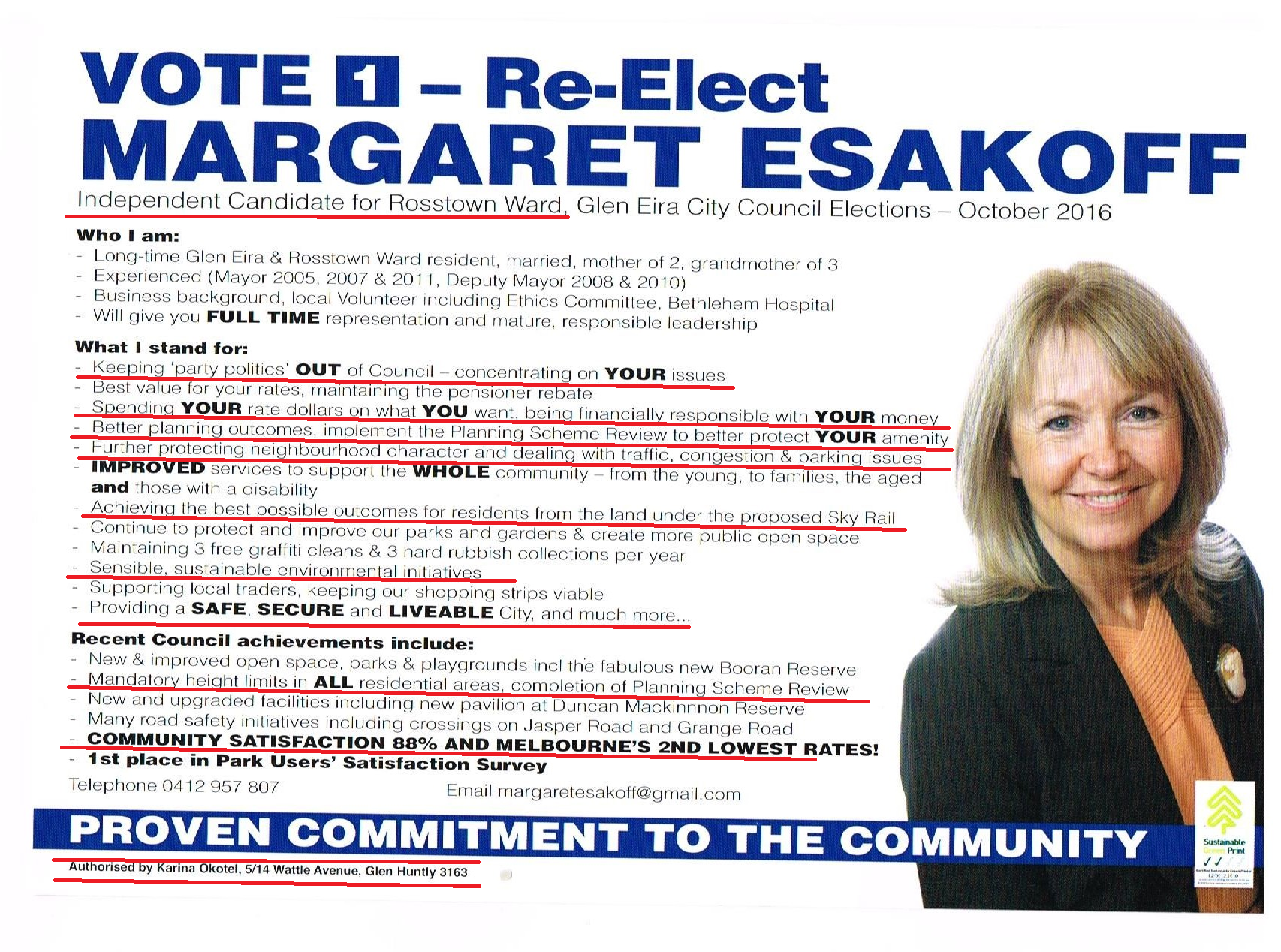
esakoff

Here’s what Magee said Tuesday night –

MAGEE: said he wanted to ‘show great respect’ to all those residents who put in submissions and showed up to the meetings. Claimed he was ‘very enthusiastic’ at the start about the review being a ‘great opportunity’ but ‘the more I read the report the more disappointed I became’. Although ‘I’ve never been a fan’ of structure planning he does ‘understand’ that this is a ’significant piece of work that planning departments do’. The time for it to be developed and its vision for 10 or 20 years is too long because he sees his Tucker ward area being ‘destroyed’ each day. So he is ‘so concerned and worried’ that ‘by the time we’ve done the structure plan it will be too late’. Claimed that ‘we know right now’ what is needed.

He had hoped to see the ‘neighbourhood character’ retained as with the 2013 Neighbourhood Character Overlays where ‘a whole host of properties’ were added to the list. Felt that ‘we should be concentrating more on Neighbourhood Character Overlays’ and Design and Development Overlays (DDO) rather than structure planning and controls which would ‘make VCAT actually apply those controls’ instead of merely ‘considering them’. Stated that ‘the minister has asked us to do this’ but our letter to him of last year asking of him ‘one single little thing’ – to change the law regarding VCAT ‘which would give us our protection’. Council wanted legislation so that ‘VCAT had to apply our planning scheme’. If this was done then 500 apartments ‘approved by VCAT’ wouldn’t have got through. So ‘that could have been one interim protection that could have been put in last year’.

With growing population of 1600 every year in Glen Eira and by 2031 a population of 170,000. ‘We can only put them up’ since we can’t spread out. The issue is then density and the pressure this is putting on commercial zones. ‘If we can’t have mandatory height limits as soon as possible’ then this issue ‘will drag’ on for the next 10 years. Council hasn’t ‘even addressed what’s going to happen to Virginia Park’ and the ‘railway corridors’. ‘We haven’t really addressed the transition’ zone issue especially in Bentleigh because this is ‘one of the only ones’ where commercial directly abuts Neighbourhood Residential. This means going from ‘no height limit at all to a two storey height limit’. Said that the planning scheme ‘talks about transition’ from 5, to 4, to 3, to 2 and ‘we haven’t got that’.

He was very ‘excited’ when he got the report and understands that structure plans can be ‘important’ because they allow ‘controls’ and with controls you can ‘have some meat’ that ‘VCAT then has to apply’. However, what VCAT applies is ResCode and ‘VCAT doesn’t apply the Glen Eira planning scheme’.  Didn’t think that people really understand the planning scheme which is ‘something that was put together over many, many years with the involvement of the Glen Eira community’. ‘The Glen Eira community said what the planning scheme should be’ and this was approved by the minister ‘yet VCAT have the right to totally ignore that’. VCAT apply precedent (ie existence of a 6 storey building already there) but it was VCAT who gave the permit and not council. He was ‘hoping to see these DDO’s and Neighbourhood Character Overlays’ to ‘give us the protection we desperately need’. Structure plans will in ‘four years time tell us what we know today’.

 ‘A great disappointment is that we are not reviewing those zones’. Claimed he had ‘thought about this for a long time’ even though he was  ‘one of those who didn’t want the zones reviewed’ because ‘the risk’ of doing this is ‘that they could be bigger’ (ie the growth zones) and ‘neighbourhood residential could shrink’. Now however he thinks that ‘it’s worth a crack’. Thinks that the minister is ‘only doing this because of the pressure that’s on the minister’ to be doing this. He’s not picking on Glen Eira, but it’s part of his ‘normal structure’ calling on Glen Eira to ‘review’. ‘To not review the zones is a missed opportunity’. ‘We need interim protection right now’. ‘When you can’t drive in or out of your driveway, that is bad planning’. ‘When you walk into your back yard and you see 11 or 12 balconies, that’s bad planning’. ‘Five years of having our planning scheme ignored by VCAT’ means that there will probably be 2000 minimum approved by VCAT and this doesn’t include Virginia Park. Finished off by saying that he is ‘incredibly disappointed that we haven’t seized the opportunity’.

COMMENT

Upcoming elections obviously do very funny things to councillors. They not only play to the gallery, but all logic, consistency, and we might add, integrity in presenting the truth, flies out the window. Magee’s comments presented above illustrate this fully. Here’s why!

  • Over the years we have presented countless VCAT decisions that keep telling council to get their act together. VCAT has also made it clear time and time again how little ‘guidance’ on heights, on urban design, on anything, is present in the planning scheme.This has got nothing to do with VCAT and everything to do with Council and its negligence over a 13 year period. It is surely time that council stops using VCAT as a scapegoat for all the ills of planning in Glen Eira.
  • Magee should also get his facts right prior to opening his mouth and grandstanding for public consumption. His comments reveal either a total ignorance or the deliberate attempt to deceive and mislead. His statement that – VCAT applies … ResCode and ‘VCAT doesn’t apply the Glen Eira planning scheme’ is literally unbelievable. Firstly, ResCode is the most minimalist set of figures available. They are nothing more than Clayton’s ‘standards’ – often ignored by VCAT and council itself. But the most damning aspect of this statement is that the Glen Eira Planning Scheme itself uses ResCode when it could have had far more stringent requirements via its schedules to the zones. It was council who decided that GRZ1 AND RGZ should not attempt to provide greater protection via the schedules as other councils have achieved. Thus, VCAT can only apply what is in the planning scheme. If there is nothing there, or only the minimalist ResCode standards, then the developer is provided with all the advantages. That, in our view, has been the council agenda for ages!
  • ‘The Glen Eira community said what the planning scheme should be’. What absolute bunkum given that the zones were introduced in secret and without any public consultation and he was in favour of no consultation.
  • At least there is the admission that council hasn’t got ‘transition zones’ or parking policies and that this is ‘bad planning’. Of course it is abdominal planning, especially since these issues were known way back in 2003 (ie the community plan) and have been brought up time and time again by residents. Magee has been on council since 2008. What has he done about this ‘bad planning’? What pressure has he exerted to ensure that these problems are dealt with? What else has he done except to play the populist card several months out from an election? And if he is so concerned about the destruction of neighbourhood character in Tucker Ward and especially in Bentleigh, then why has he voted to grant a permit for all of the following applications in Bentleigh.
  • 15-19 Vickery Street, Bentleigh – 4 storey, 47 units
  • 11 – 13 Bent Street BENTLEIGH – 4 storey, 34 units
  • 37-39 NICHOLSON STREET BENTLEIGH – part 3 and 4 storey, 10 units
  • 670-672 CENTRE ROAD & 51 BROWNS ROAD BENTLEIGH EAST – 3 & 5 storey, 67 units
  • 23 Bent Street BENTLEIGH – 4 storey, 34 units
  • 817-819 Centre Road BENTLEIGH EAST – 3 storey, 26 units
  • 27 and 29 Jasper Road BENTLEIGH – 3 storey, 25 units
  • 64-66 Bent Street MCKINNON – part 3 and part 4 storey, 31 units
  • 14-18 Bent Street BENTLEIGH – 4 storeys, 55 units
  • 29-33 Loranne Street BENTLEIGH – 4 storeys, 42 units
  • 22-26 Bent Street BENTLEIGH – 4 storeys, 41 units
  • 24-26 Mavho Street BENTLEIGH – 4 storey, 28 units
  • The best is the sudden epiphany that the zones should have been reviewed. Perhaps Magee has not read the Planning Scheme Report since it states on page 108 – Glen Eira has completed its review of the new residential zones. Really? When? Why isn’t this ‘review’ public? What were the conclusions?  We also wonder what Magee means when he states that he has thought about this for a ‘long time’. Does this mean a week, a month, a year? If so, then residents need to be reminded of his comments which follow. The dates are from our postings. Incredible that as recently as February Magee could say that ‘we have a very, very good planning scheme’. Clearly a man who is consistent in his inconsistency!

‘I think the outcome for Glen Eira is superb’ (13/8/2013)

Said that 97% of the municipality has got height limits and 3% commercial with no height limits. Putting height limits on commercial areas has to be done through an overlay, and then community consultation, ‘permission from the minister’, and ‘through a long and detailed process’. ‘If council decides at some point in the future’ to do this, then he would ‘welcome that’ but to do ‘that we would need legal opinion, planning opinion’ and the Minister’s approval. There are some other things that might be done with the commercial zones but he is ‘very, very happy that’ the zones ‘cover 97% of our municipality’. This ‘in conjunction with our planning scheme’ is what ‘makes it work’. (25/11/2015)

‘We can sit up here and refuse it because we don’t like it’ but that would be ‘stupid’ since they know that it ‘already complies’ with ResCode and the planning scheme which was ‘put together with great community consultation with our residents’ who together with ‘council decided what can be built in what streets’ (30/6/2016)

‘I believe we have a very, very good planning scheme’. Last year ‘VCAT approved 582 apartments’ that had been refused by council and that was because ‘it wasn’t consistent with our planning scheme’. ‘Our planning scheme is what our residents said they wanted’. Council ‘went to the community’ and asked ‘Do you approve?’ and residents said ‘yes’. The minister then approved but VCAT ‘only have to consider it’. So when council consider buildings of 9 or 2 storeys ‘we look at residential building codes’, and the planning scheme. Councillors ‘sometimes’ give a permit to ‘buildings we don’t like’ mainly because ‘there are no grounds for refusal’. ‘It is wrong to say we want this and then to vote for something different’. Council and community has ‘asked’ for this planning scheme and that is ‘what is so disappointing about VCAT’ (4/2/2016)

Claimed that if council wanted VCAT to do anything then ‘it would have to be in the form of an overlay’. Overlays need a panel assessment and they could end up saying that ‘Carnegie is quite suitable for 13 storeys’ and Bentleigh ‘quite suitable for 6’. Council would then ‘have to argue against that’, then the Minister would ‘have information’ saying the opposite. S0 ‘there is a risk in asking for something’ that ‘you don’t get what you want’.(25/11/2015)

MAGEE: only the Minister ‘can do anything’ about the zones. When in opposition, Labor was ‘very clear’ that they were going ‘to review zones’ but haven’t done ‘anything about it so far’. He ‘believes’ that ‘we’ve got a very good system’ . In 2009/10 there was a ‘public review’ of the planning scheme and three things emerged that residents wanted – height limits, buffer zones, and ‘less discretion at VCAT’. ‘That’s exactly what the zones are doing’. Regardless of council ‘advocating for this change or that change’ or whether ‘we want a review the minister at any time can review’. Said that MPs are asking the minister to review zones in their electorates. Said that council was’ criticised at one point for not consulting’ but he thought ‘we very much did’ and now to ‘do a review of our consulting’ they would be ‘accused of doing the very same thing’. Glen Eira’s ‘system puts development’ where he thinks ‘it should be’ – in activity centres and along transport routes. Said that there are 3 Residential Growth Zones and the rest of the residential zones are in ‘shopping strips’. Thought that Glen Eira ‘is very, very lucky to have what it has’. If the minister ‘wants to tinker with that and reduce that’ then no council would have room for residential growth zones. If councils all got what they wanted it would all be neighbourhood residential zones. This would be ‘totally inappropriate and disrespectful’ to the 1000 people a year who come to live in Glen Eira. They have to be ‘accommodated somehow’ and currently council has got a ‘system that I certainly won’t be voting to change’ until the minister tells them ‘what that change will look like’. Was worried that if council ‘opened this up’ that the growth zones would increase and ‘neighbourhood zones would decrease’. (30/4/2015)

Apart from commercial zones, there is now a ‘sense of security’ for developers because they know what they can do and get a loan easier. Developers can therefore plan better. Said that the 4 storey buildings around tram lines is only 2.2% ‘of our city’ and ‘you might actually struggle to find a block big enough’ to build 4 storeys because of ‘setbacks’ on top floor. So a lot of these could ‘end up being 3 storeys’. Said it was a ‘really good outcome for the residents of Glen Eira’…..Congratulated officers on ‘getting this through’ and didn’t think it ‘was a surprise because that’s the sort of work we do here’…’we are very good at what we do’. In the future council can say ‘no, it’s wrong’ and ‘go away’ to developers because they haven’t got it right. Also have to thank the state government in ‘being proactive and helping us get this in place’. ‘I think the outcome for Glen Eira is superb’30/12/2014)

CONCLUSION

Not much needs to be said. We will merely ask this simple question – can anything that comes out of these councillors’ mouths be believed? Think of this when you vote!

« Previous PageNext Page »