CLICK ON IMAGE TO ENLARGE
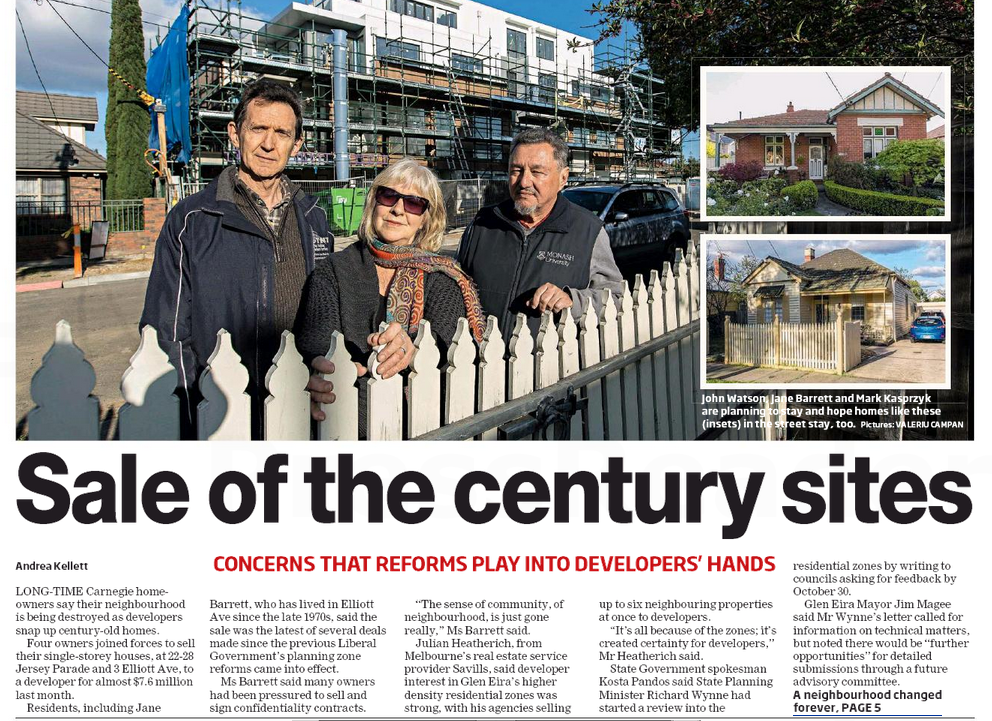
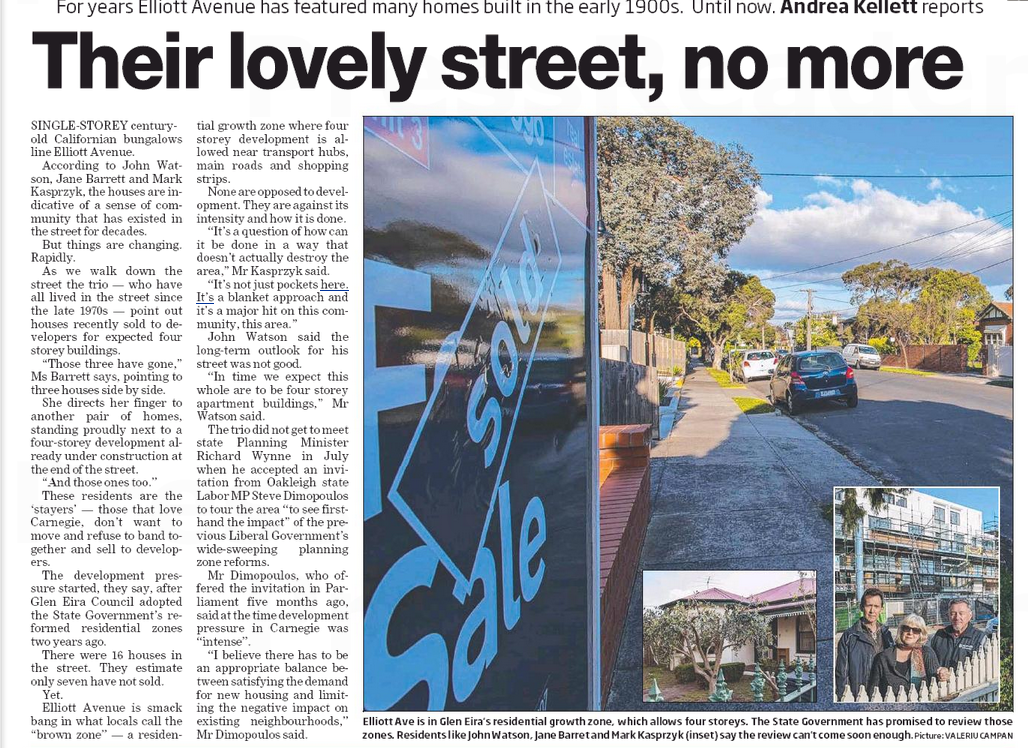
September 29, 2015
CLICK ON IMAGE TO ENLARGE
September 26, 2015
At last council meeting one public question was declared ‘inappropriate’ and not read out. It related to the role of councillor representatives on the Caulfield Racecourse Reserve Trustees. Before we publish the question and the answer, some history.
In the discussion that took place, both Hyams and Lipshutz declared their role as trustees to be one of working, representing, and advancing the cause of their constituents. Here is what they said –
HYAMS: thought that the petition was ‘pathetic’ and didn’t want to ‘set a precedent’ where ‘we’re rehashing council decisions because some people don’t like it’ and that would lead to petitions on all council decisions.Said that the government appointed the 3 councillors ‘who came first in their wards’. Read out the numbers of first preference votes for each of the three councillors that people ‘are happy to have those councillors representing them’ and ’64 people come along and think they are more important’ and this ‘shows at the very least an exaggerated sense of their own importance’. Went on to say that it was ‘very sad’ that people can be ‘so spiteful’ and that he knows what’s ‘behind it’ and the ‘people behind it’ and it doesn’t ‘surprise’ him at all.
LIPSHUTZ: said the petition was ‘ridiculous’ but that ‘when any member of this council’ is appointed that they’re appointed as ‘representatives of council’ and ‘we in fact act on behalf of the community’. Spoke about the Leader article and Magee and ‘what he tried to achieve’ and that was following council policy and he’s (Lipshutz) asked for the same things since ‘2005’. This wasn’t ‘something new’ it was what ‘council has approved’. Council doesn’t want training at the racecourse which is what Magee was advocating and it’s what council wants too. The petition is ‘ridiculous’ and just ‘shows the small minded people’…’we’re councillors and we’re here for the benefit of the community’. People mightn’t like every decision but the choice is ‘vote us out’. Voters had ‘confidence’ about all 9 councillors and even though they’ve got different views on things ‘we are a councillor group as one’ and as trustees they ‘will be there to support the community’
So to the inadmissible public question –
If councillors on the Board of trustees for the Caulfield Racecourse Reserve Trust do not represent the council, or the citizens of Glen Eira, who do they represent?
Response: On the basis of your own statement in part 3 of your Public Question Part 3 is deemed inappropriate pursuant to Clause 12 (b) of Council’s ‘Guidelines for Public Question Time’ and clause 232(2)(j)(ii) of the Local Law which states: “does not relate to the business of Council or otherwise relates to a Councillor or staff member other than in their Council capacity;”
CONCLUSION
The make-up of the trust enables MRC, Glen Eira City Council and state government views to be considered as part of its decision-making processes. Until recently, however, members of the local community had no direct means of engaging with trustees on matters of importance to them. They had to rely on council representatives to present their views.
Within the trust, there have been differing views about how these competing uses can be reconciled. More recently, this has created tensions between trustees representing the Melbourne Racing Club (MRC) and those representing the government and Glen Eira City Council.
September 22, 2015
The General Residential Zone, schedule 2 is, according to our wonderful council, supposed to provide the necessary ‘buffer zones’ between properties in housing diversity and minimal change (ie NRZ) because of the upper level setbacks included in the schedule. No other limitations, apart from the deficient ResCode numbers, have been enforced on this zone. For example – in Glen Eira we find:
Site Coverage – 60%
Permeability – 20%
Height – 10.5 metres
Private Open Space – minimum of 25 square metres (ResCode) and
Nothing about tree protection or landscape plans.
Other councils in their ‘negotiations’ and subsequent amendments just happened to be far more successful in introducing limits on what can be build in the GRZ2 zone. Here are some examples that are gazetted and in operation.
Banyule –
Site coverage 40%
Landscaping – Landscape plans will provide 1 tree for every 400 square metres of site area, including 1 large tree in the front setback – A Landscape Concept Plan must be submitted which considers the Banyule Tree Planting Zone Guidelines. It should distinguish landscaped garden areas from useable private open space, show tree planting locations and the extent of the mature canopies.
Geelong –
Landscaping – One canopy tree per dwelling
Private Open space – An area of 60 square metres, with one part of the private open space to consist of secluded private open space at the side or rear of the dwelling or residential building with minimum area of 40 square metres, a minimum dimension of 5 metres and convenient access from a living room. It cannot include a balcony or roof top terrace.
Height – 9 metres
Knox –
Height – 9 metres
Private open space – Private open space consisting of an area of 80 square metres or 20 per cent of the area of the lot, whichever is the lesser, but not less than 60 square metres. At least one part of the private open space should consist of secluded private open space with a minimum area of 40 square metres and a minimum dimension of 5 metres at the side or rear of the dwelling with convenient access from a living room.
Monash –
Front setback – 7.6 metres.
Private Open Space – A dwelling or residential building should have private open space consisting of:
An area of 75 square metres, with one part of the private open space at the side or the rear of the dwelling or residential building with a minimum area of 35 square metres, a minimum width of 5 metres and convenient access from a living room
Stonnington –
Basements should not exceed 75% of the site area.
Walls on boundaries – Walls should not be located on side boundaries for a distance of 5 metres behind the front façade of the building fronting the street.
Whitehorse
Site coverage – 40%
Permeability 40%
Provision of at least two canopy trees with a minimum mature height of 12 metres. At least one of those trees should be in the secluded private open space of the dwelling. The species of canopy trees should be native, preferably indigenous.
Development should provide for the retention and/or planting of trees, where these are part of the character of the neighbourhood.
Walls on boundaries – Walls should only be constructed on one side boundary.
Yarra – height 9 metres
September 19, 2015
Whilst other councils are moving fast to shore up their defences against inappropriate development, Glen Eira sits on its hands and does nothing. We’ve already highlighted the Bayside draft Amendment C140 that is seeking to introduce a minimum size subdivision of 400sqm, plus a 40% permeability requirement in its Neighbourhood Residential Zone. Now we have Monash Council and its C125 Amendment that takes in all Neighbourhood Residential and General Residential zones. The significance of this amendment is:
In every single one of the above (if the amendment is approved), residents of Monash will be far better off, than their cousins in Glen Eira. All Glen Eira does is continually pass the buck and blame VCAT for all its woes. That will no longer wash, especially when no action has taken place in either reviewing the atrocious planning scheme or even attempting to introduce amendments that will ameliorate the damage that is currently occurring through rampant overdevelopment. Every time a VCAT member makes statements such as the following, the blame lies entirely with this administration and its complicit councillors.
The Council advised that there is no neighbourhood character policy which applies to the review site and its surrounds, and no neighbourhood character guidelines to assist in determining anticipated built form outcomes. Guidance must therefore be obtained from policy within the MSS and at Clause 22.07.
There is nothing within the policy framework which would indicate that apartment-style development should not be permitted here. Rather, what is evident is an expectation of change as multi-dwelling developments replace the traditional single-dwelling housing stock. The diversity of housing types sought for neighbourhood centres indicates that apartment-style development can be contemplated. (August 6th 2015)
September 15, 2015
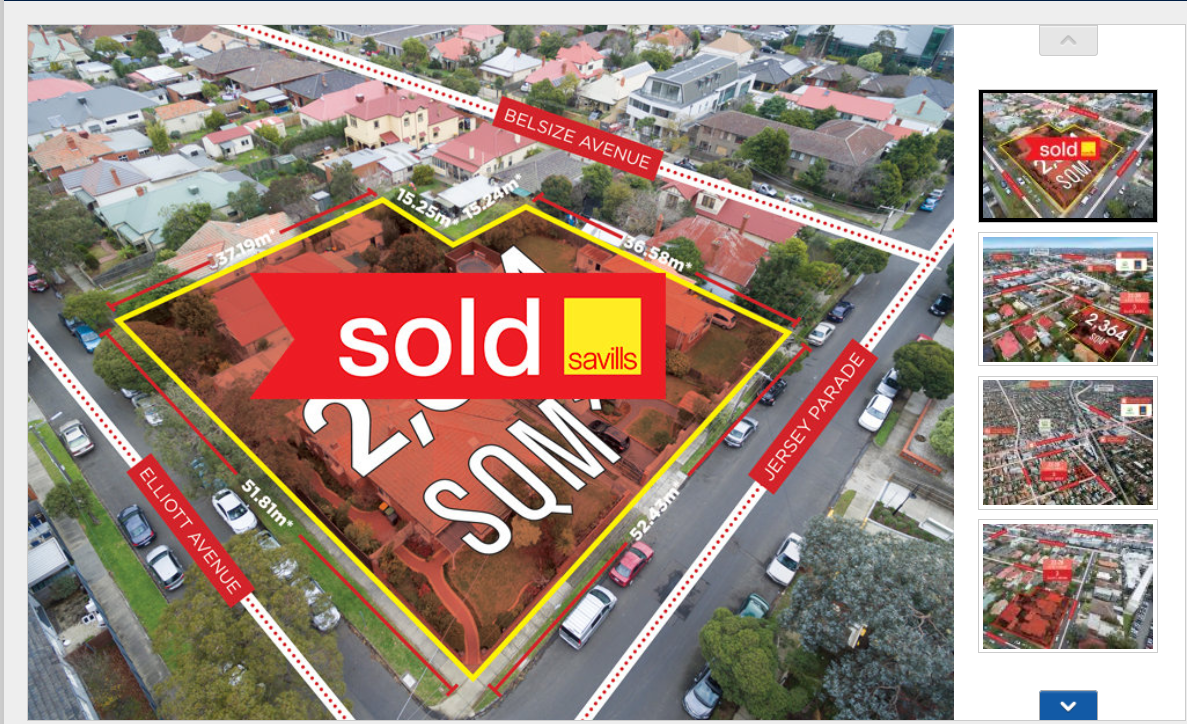
September 11, 2015
Confidential plans for multi-billion dollar residential, commercial and retail property developments at Caulfield and Sandown race courses are being considered by the Victorian State Government.
The ‘master plans’, which have been commissioned by the Melbourne Racing Club, one of the nation’s most powerful sporting bodies, are expected to involve joint ventures with development and property companies to design, build and run the projects.
But the plans are likely to become another flashpoint between the MRC, state government and some councils about the impact of high density developments on local communities and public amenities.
Sandown Park, about 30 kilometres south-east of Melbourne, is a 112-hectare horse and car racing track located in a major growth and transport hub that is fully-owned by the MRC, a not-for-profit organisation.
The park is in the electorate of Premier Daniel Andrews.
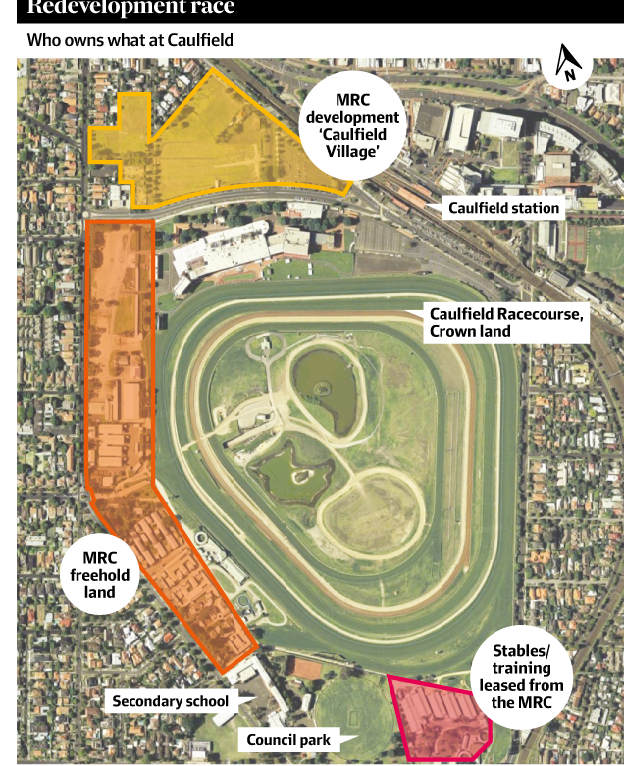
The MRC also owns more than 152,000 square metres of land surrounding the Caulfield Race Track, 13 kilometres south-east of central Melbourne, in addition to leased stable and training areas within the race course.
It is already undertaking a controversial $1 billion development opposite the entrance to the racecourse and close to a railway station that has been rezoned from a car park to 1200 apartments, 10,000 square metres of office space and 15,000 square metres of retail space.
“We are aiming to develop a plan for land-use, upgrades and development for the next 15-20 years,” said Josh Blanksby, general manager of the MRC, about the redevelopment plans.
Mr Blanksby said the racing club was looking at the “best ways to utilise its strong assets”, which in addition to hosting meetings was expanding into other forms of entertainment, gaming and property development.
He said no decision has been made.
State government officials have been briefed about the proposals devised by Hassall, a global consultancy and architecture group.
But the MRC, which leases the Crown Land occupied by Caulfield Race Course, is under fire from the local Glen Eira Council and landlord, Caulfield Racecourse Reserve Trust, for failing to consult.
“It is totally inappropriate that the tenant is proposing a master plan for what is probably one of the biggest development sites of prime inner-Melbourne land,” said Jim Magee, a former racecourse trustee and current mayor of Glen Eira, the local council for the area surrounding the course.
Mr Blanksby said the council was approached but declined to comment.
The trust, which is chaired by Greg Sword, former national president of the Australian Labor Party, has launched a separate ‘master plan’ into the use of the 54-hectare site that is legally meant to be divided between public recreation, a public park and the racecourse.
“The balance is a little skewed,” Mr Sword told a local community last week about the MRC’s influence over the use of the site.
The business of running racing clubs has been rapidly evolving in recent years from hosting race days into a multi-billion entertainment, gaming, land development and hotel business.
In the past four years MRC’s revenues from course admissions have remained static around $1.5 million as gaming revenue more than doubled to $34 million and telecasting rights rose 20 per cent to more than $9 million.
Victoria’s Attorney-General and Racing Minister Martin Pakula is among those reviewing the plans. Developments involving Caulfield Racecourse will also need the approval of the board of trustees, which has six council appointed members, six MRC members and three independents.
It is 12 months this week since the state’s auditor-general recommended full disclosure of the MRC’s benefits from the course, criticised the state government’s oversight and recommended improved disclosure of finances, performance and management of ‘perceived conflicts of interest’ in the course’s management.
Read more: http://www.afr.com/news/secret-plans-to-develop-caulfield-and-sandown-race-courses-20150911-gjkcac#ixzz3lQ9uUhtG
September 9, 2015
About 50 to 60 people showed up for the Caulfield Racecourse Trustee Community Consultation evening. In short, it was a total farce and far from being the open and ‘progressive’ change that many residents hoped for. Here’s why –
Greg Sword’s final comments are of great concern. He several times stated that the Trustees basically have no control over the MRC. It would seem that the Auditor General has different ideas about the role and function of the Trustees, who are charged with the management of the reserve. The department has oversight of the trustees. Here are some extracts from the Auditor General’s report that clearly show the role of the trustees –
sections 17B and 17D (of the Crown Land Reserves Act) provide the trustees, with the approval of the minister, with the power to grant licences/leases, enter into tenancy arrangements, and to reach agreement to operate services and facilities
The Crown grant, clause 21, states ‘that no improvements shall be effected on the site by the said Club without first obtaining the approval of the trustees’. However, there is no documentary evidence that certain works undertaken in recent years were approved by the trustees
Section 13 of the Crown Land (Reserves) Act 1978 provides the trustees with the power to make regulations for the care, protection and management of the Caulfield Racecourse Reserve with the approval of the Governor in Council. The Crown grant also allows trustees to create regulations over the reserve.
Finally, we reiterate, that if the Trustees were really that keen to receive input from the COMMUNITY, then why was it only sports clubs (via council), schools, and aged care facilities who were ‘invited’ to attend? Surely a decent advertisement in the Leader would not have gone astray? And since council is spruiking for the Trustees via their letters to sporting groups, it also would not have been amiss for council to place an announcement on their website – especially when council can write to sporting groups and state-
Caulfield Racecourse is Crown Land reserved for recreation and is the only significant opportunity to provide more sports grounds in Glen Eira. It is assumed that any Club which intends to seek any increase in ground allocations at any time in the future will take part. A few years ago Council produced a concept plan of how sports grounds could be established on the Crown Land in the centre of the racecourse. The concept plan appears on page 10 of Council’s ‘Community Sport – Management of Grounds Policy’. The page is attached for your convenience.
Sadly both Council and the Trustees would appear to have a very limited definition of ‘community’.
September 9, 2015
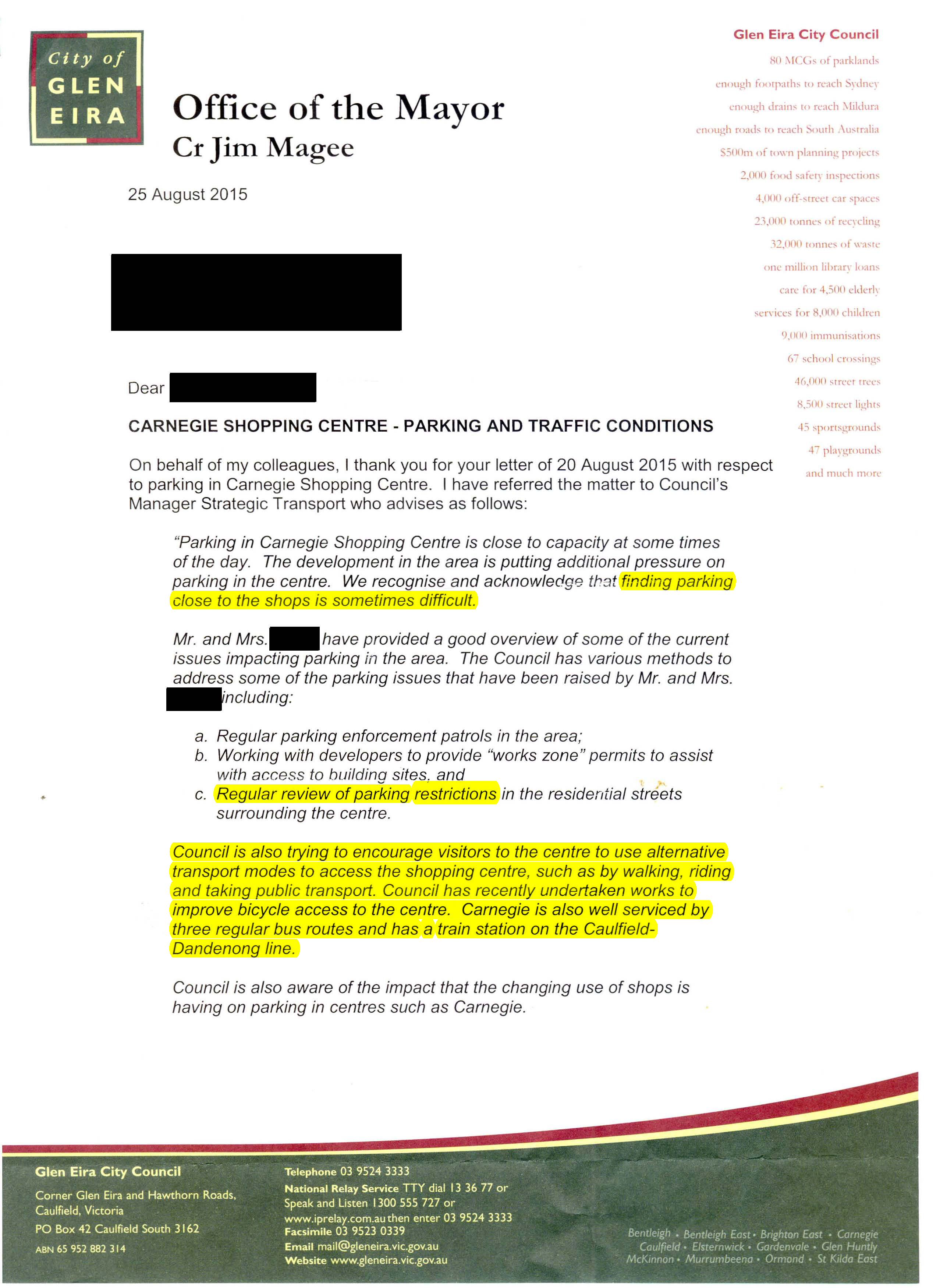
A resident wrote to all councillors complaining about the lack of adequate parking in the Carnegie shopping centre. Issues highlighted were:
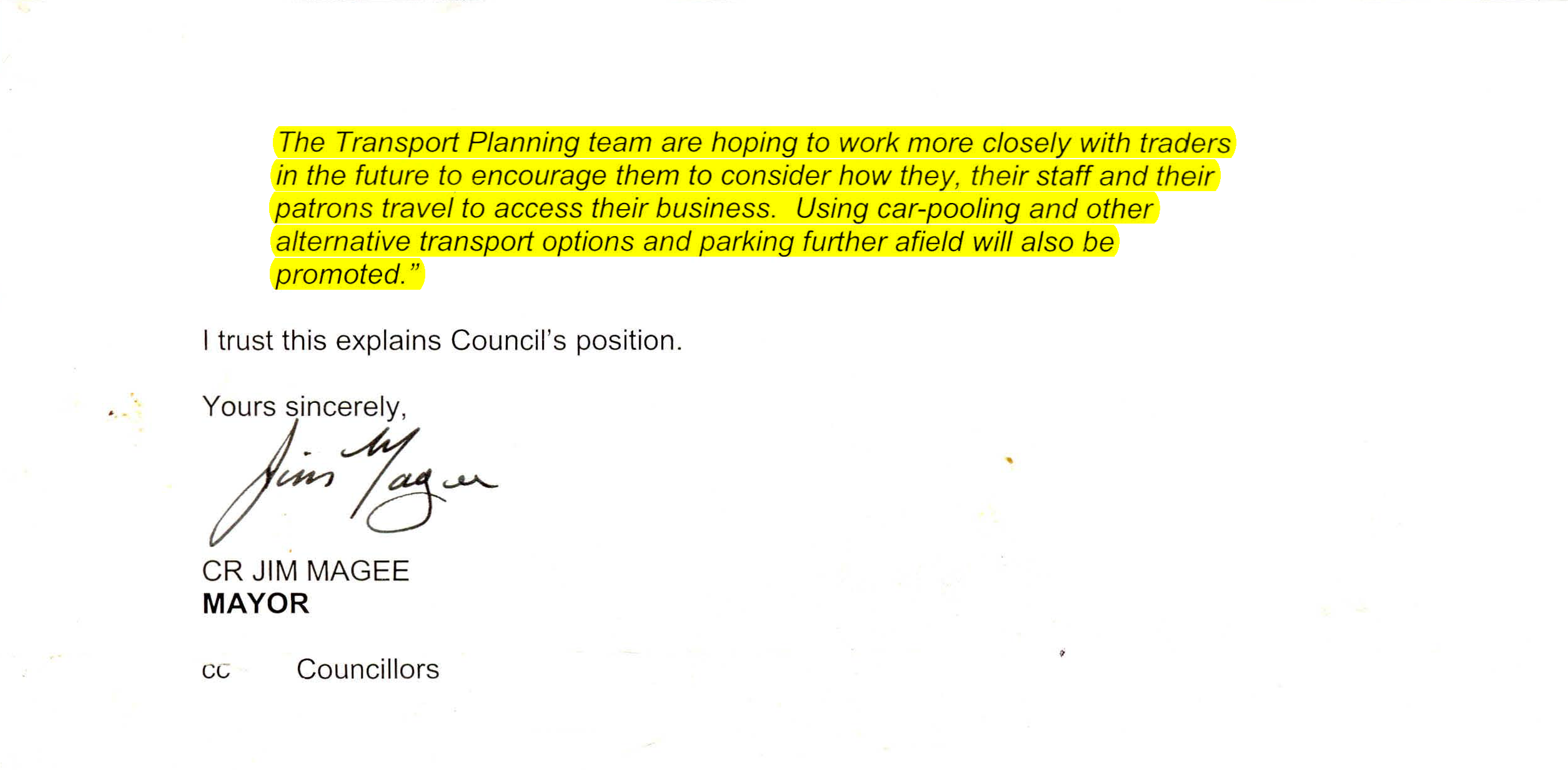
Council, via Mayor Magee, provided the following response. Please note carefully:
Some other considerations:
September 7, 2015
Announcing Plan Melbourne, Mr Guy promised 50 per cent of suburbs would be protected from development. Glen Eira got much more. Nearly 80 per cent of the city, which includes Bentleigh, McKinnon, Ormond, Elsternwick and Carnegie, would be protected from apartment and unit-style development, Ms Crozier declared, setting an ”enormously positive example for other councils to follow.
Source: http://www.theage.com.au/victoria/not-all-going-to-plan-in-tale-of-two-cities-20140628-3b0pj.html#ixzz3kxUMrkZ0 (June 29th, 2014)
So much for the spin, the propaganda, and the misinformation. We certainly take issue with the 80% of Glen Eira as ‘protected’. But even more offensive is the claim that ‘Bentleigh, McKinnon, Ormond, Elsternwick and Carnegie’ would not suffer from ‘apartment and unit-style development’. The reality is that huge swathes of these suburbs are now geared towards facilitating 3, 4 and even higher storey developments – and it’s all thanks to the new residential zones and council’s woeful record in strategic planning.
Ormond, in particular, is testimony to the falsity of the above claims. The suburb is barely 2 square km in its entirety. Exclude those areas designated as ‘parkland’ or public utilily zones, then the area available for development shrinks to about 1.83 square km. Then there’s another 25 or so hectares zoned Heritage, but this hasn’t stopped council from giving the green light to development by zoning large parts of such areas as GRZ1. In addition, large sections of these areas are also under a Special Building Overlay because of flooding concerns. What all this means is that in Ormond, just under 42% of the suburb is zoned as appropriate for 3 storey dwellings. Another 8% of land is zoned either C1Z or MUZ with no height limits at all. That makes Ormond the most potentially overdeveloped suburb in Glen Eira with over 50% of its land designated for 3 storeys or higher.
Readers also need to remember that Ormond is NOT an Urban Village. It is a Neighbourhood Centre, where there is supposed to be less development. How that is possible with such zoning beggars belief. But this is planning in Glen Eira – inept, pro-development, and with no thought as to the long term impact on people’s lives. When over 50% of a suburb (which is not a major activity centre) is geared towards high density development, then there’s something drastically wrong with planners, and the councillors who allowed this to happen.
Here are the figures upon which the above calculations have been derived –
C1Z – 54,329 sqm
GRZ1 – 745,837 (THE LARGEST GRZ1 AREA IN GLEN EIRA)
GRZ2 – 21,182
MUZ – 10,113
RDZ – 97,740
September 4, 2015
Bayside City Council is attempting to protect and preserve its existing neighbourhood character via draft Amendment C140 which is now out for consultation. In short, the amendment proposes to:
Add on the number of Design & Development Overlays that exist in Bayside, an updated Housing Strategy, plus tree protection clauses, and Bayside is streaks ahead of Glen Eira in strategic planning. Of course, this proposed amendment does not sit well with the development industry, real estate agents, and others.
Thus we have this publicity campaign by Takle Developments – who also happen to have an office in Centre Road. Clearly such a campaign is largely unnecessary in Glen Eira, since this council has bent over backwards to facilitate development via its inaction and sub-standard strategic planning.

 Glen Eira Debates