MR PAKULA — To move —

That this House notes that —

(1)     the claim of the Member for Caulfield, Mr David Southwick, MP, in a media statement released on Friday 16 November 2012 was that he was only informed on that day that he did not complete all the points required for his Post Graduate Diploma in Marketing from Monash University;

(2)     on Mr Southwick’s personal website, http://www.davidsouthwick.org, the entry of 16 October 2010 contains the claim that he graduated from Monash University with a Graduate Diploma in Marketing;

(3)     on 19 October 2010, the same website had been altered, removing the claim to graduation and replacing it with a statement about having studied business and marketing at Monash Caulfield;

(4)     the Member for Caulfield’s embellished claims continued to appear on the Liberal Party website and in the Parliamentary Handbook;

(5)     the alteration to the Member for Caulfield’s personal website between 16 October 2010 and 19 October 2010 suggests that the Member has known for at least 2 years, and not for less than 2 weeks, that his claim to have graduated in marketing from Monash University is false; and calls on the Member for Caulfield to immediately stand down as Chair of the Education and Training Committee of the Parliament.

[Notice given on 27 November 2012 — Listed for 4 days].

487     MR BARBER — To move —

That this House requires the Minister for Planning to table in the Legislative Council by 12 noon on Tuesday, 5 February 2013, a copy of all public submissions received by the Department of Planning and Community Development in relation to the Reformed Zones for Victoria planning zones review.

[Notice given on 27 November 2012 — Listed for 4 days].


tree

Tree’s Stay Of Execution Bid

Andrea Kellett

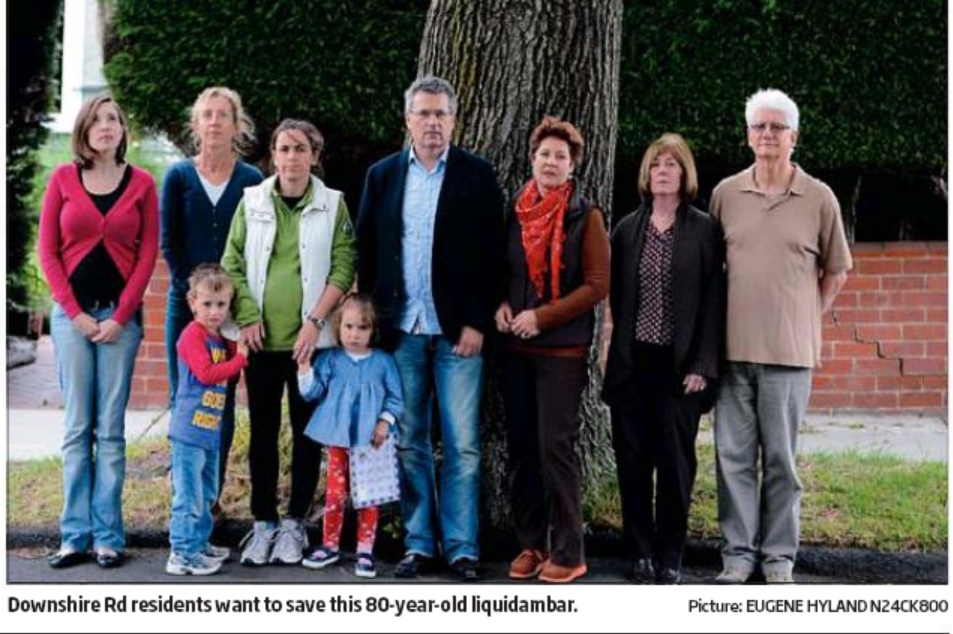
Elsternwick residents have banded together to save an 80-year-old street tree from the axe. Downshire Rd neighbours want Glen Eira Council to delay planned removal works of a massive liquidambar on a nature strip in the suburb.

The tree was to be removed by Christmas due to damage to a private property caused by its roots. But the affected owner has now sold the property.

News of the tree’s impending removal sparked a storm of upset in August, and the matter went to council, where it was found the affected property owner had a legal right to have the tree’s roots removed from their property.

Councillors voted to remove the entire tree and replace it with a young emerald queen, after arborists found cutting the roots at the front boundary would make it unstable.

But Downshire Rd residents Richard Noon has urged the council to give the tree another chance. “We don’t want to see this tree whipped out,” he said. He said a more creative solution needed to be found as the road was in a designated Significant Character Area. “We need a stay until the new owners move in, then they can negotiate an outcome with the council depending on their view of the tree,” he said.

Cr Mary Delahunty has asked officers to re-open the file. “This is one of Elsternwick’s most beautiful streets,” she said. Glen Eira Council did not respond to the Leader’s inquiry by deadline.

COMMENTS

We’ve taken a drive down this street and noted the following:

  • The fence/house in question has huge cypress hedges alongside the cracking fence. Nothing is stated about the cause of the cracking. It is merely assumed that the liquidambar is the culprit. What investigations have been undertaken to ensure that it is not the tree but the owner’s own hedges that are causing the damage?
  • There are many other trees of this ilk in the street – none with 10 foot thick hedges. How many other properties have been affected by their liquidambars?
  • We also note that the arborist’s report (and brief) has not been made public.
  • At least residents should be comforted by the fact that this time it is potentially only one tree to be removed rather than 178 in one fell swoop!

The Planning Scheme Review of early August 2010 promised much, but thus far has delivered very little –  apart from Amendment after Amendment which rezones land making it available for residential development – without Structure Planning of course! That has clearly been the priority of this council rather than all the other fundamental issues that were earmarked for analysis, improvement and adoption.

Whilst most of the promises were to be developed ‘internally’ according to the Action Plan, it doesn’t look like there has been much progress, if any at all. Many of the suggested ‘reviews’ are now long overdue so that Glen Eira is still dominated by planning that originated over a decade ago and is based on statistics that belong in a museum.

Two and a half years later we are still waiting for the release of the following reviews and policies:

  • Review Housing and Residential Development Strategy
  • Review Housing Diversity area policy to assess need to encourage three bedroom dwellings
  • Prepare a new streamlined MSS for Council consideration and commence the amendment process
  • Investigate need for new local policies (eg advertising signs, car parking)
  • Consider parking precinct plans for Activity Centres
  • complete an Activity Centres Review to update existing policy frameworks to provide greater direction within Activity Centres (short of Structure Plan detail).
  • Pursue approval from State Government to increase the private open space requirement from 60m2 to 80m2 and consider tree protections outlined in the Environmental Sustainability Strategy
  • Include a statement in the Heritage section of the MSS and local heritage policy about the importance of Aboriginal cultural heritage;
  • Create a tourism section in the MSS that discusses the city and statewide importance of Glen Eira’s tourist sites such as the Melbourne Racing Club and Ripon Lea;
  • Alter the ‘Transport’ section of the MSS to indicate the Principle Bicycle Network and bus routes on the transport framework plan
  • Include the Melbourne @ 5 Million ‘employment corridor’ on the Strategic Framework Plan in the MSS.
  • Integrate Environmental Sustainability, Street Tree, Transport, Bicycle, Ageing Strategies into the MSS.
  • Review/Amend: Phoenix Precinct Policy & Heritage Policy


Council has published Candidates’ Summary of Returns’.

The majority entered ‘no gift disclosed’. Those candidates who listed donations are:

Thomas Sounness – $3,654.30 – Australian Greens

Neil Pilling – $3,654.30 – Australian Greens

Rose Read – $3,654.30 – Australian Greens

Brett Hedger – $3,654.30 – Australian Greens

Karina Okotel – $500 – Donald Towns Pty Ltd & $1,000 (Frank Greenstein)

Kelvin Ho – $500 – Yabo Global Pty Ltd

Oscar Lobo – $5000 – CK Foods and $5000 (Dr Suresh Chandra)

John Barry Myers – $1,250 – Henry Buch

ALL OTHER CANDIDATES HAVE DECLARED NO GIFTS. IT SHOULD ALSO BE NOTED THAT THE FOLLOWING HAVE NOT SUBMITTED THEIR RETURNS –

Joshua Spiegel

Wilmars Mikelsons

Michael Caspi

Rodney Andonopoulos

This is a long post on the Planning Zone Reforms, but we believe an exceedingly important one. We urge readers to carefully consider the contents and to compare this Stonnington effort (Council meeting 3rd December) to what is occurring in Glen Eira. A few things require highlighting:

  • Glen Eira Council is yet to publish its FINAL submission to Government. All that is available on council’s website is the draft proposal tabled at council and not the final submission. This has never been made public!
  • No update or progress report has emanated from council. There is also no mention of the ‘metropolitan strategy’.
  • Stonnington held community forums and information evenings. No such events occurred in Glen Eira.
  • Council writes of ‘smooth transitions’ to the new zones. Our interpretation of this is simply that Glen Eira will steam roll ahead with what currently exists. Information will be minimal and consultation outcomes eventually ignored as per usual.
  • Please note the tone of the Stonnington report and their concerns. These are sure to be similar in Glen Eira.
  • Bolded sections are our emphases.

‘PLANNING ZONE REFORMS

Manager:  Stephen Lardner

Executive Manager: Karen Watson

Purpose

The purpose of this report is to update Council on the planning zone reforms released by the Minister for Planning.

Background

The proposed zone reforms released by the Minister for Planning in July 2012 represent a significant change to the Victorian Planning System. The consultation period for the planning zones ran for 2 months from 11 July until 28 September 2012 (this was extended from the 21 September 2012). A discussion paper, fact sheets for each zone and an online form (all available on the DPCD website) were released for the public and Councils to utilise throughout the consultation period.

The Minister has indicated that the objectives of the proposed zone reforms include simplifying requirements and providing greater certainty, to allow a broader range of activities to be considered (in support of improved economic performance) and to improve the range of zones to better manage growth. However no explanatory report to justify or outline how the new zones will achieve these objectives and outcome was made available, nor has one been released since the close of consultation.

The reforms propose three new residential zones, a new commercial zone and a change to the mixed-use zone and an industrial zone relevant to Stonnington. The key features and issues of the proposed zoning reforms that will impact on Stonnington can be found in Attachment 1.

Officers assessed the changes in detail and sought clarification and justification where possible to enable an informed consideration of how the planning zone reforms will impact on the Municipality. In response to requests for further information by community groups and individuals, Council held a community information session on 30 August 2012.  Peter Allen, Executive Director of Statutory Planning Systems Reforms, Department of Planning and Community Development and local Member for Prahran Clem Newton-Brown both presented on the reforms. The event was received well with approximately 60 residents and stakeholders in attendance.

On 10 September 2012, Council adopted the submission in response to the Planning Zone Reforms consultation as outlined in Attachment 2 to this report. Officer’s assessment of the implications of the new zones identified major concerns.  The main issues identified are as follows:

  • A lack of strategic justification, identification and understanding of the economic and social impacts of the reforms.
  • The negative impact of Activity Centres from the proposed expansion and dispersal of commercial uses into adjoining residential areas.
  • Reduced residential amenity from ‘as of right’ commercial uses in residential zones and the intended expansions of Activity Centres into residential zones.
  • The reforms encourage high density housing in all Activity Centres, without context or control.
  • There is no economic study, no housing strategy, no capacity assessment or targets to provide the context which justifies the reforms.
  • A lack of detailed information on key issues including transitioning to the new zones, consultation, resourcing, strategic context, current planning applications and VCAT appeals.

Discussion

It was initially stipulated that after the Government’s consultation period concluded in September 2012, the reformed commercial and industrial zones would be automatically implemented and local planning scheme schedules would be adjusted to align with the changes required. In its submission, Council raised concerns about the timing and resources of converting the zones.

Councils were to be given 12 months from the finalisation of the zones, to consider and apply for a conversion of existing residential zones. There were no criteria available to assist with this conversion process during the consultation stage. It is anticipated that the transitional process for the residential zones will require a major Planning Scheme Amendment process which would take up significant Council resources. Following the State Planning Scheme Amendment process, this would be both costly and time consuming and would well exceed the 12 months allowed.

On 14 September 2012 the Minister for Planning announced an advisory committee with Geoff Underwood as Chair and Chris Canavan QC and Liz Johnstone of the Planning Institute of Australia will provide advice about the final form of the proposed zones and how they should be introduced (see Attachment 3 – Terms of Reference). They will recommend a set of criteria to help determine the appropriate application of the reformed residential zones

The Committee has been asked to submit its findings and recommendations in relation to:

  • the reformed residential zones and their criteria in December 2012
  • other zones in February 2013.

Submissions to the reforms will be available to view on the DPCD website in December 2012.

One of the key deficiencies with the reforms is that it has been released and potentially will be implemented before the development of the new Metropolitan Strategy.  The zones are a strategy implementation tool and the strategy does not yet exist. On October 26 2012 the Minister for Planning launched ‘Melbourne, let’s talk about the future’, a discussion paper to inform the development of the new Metropolitan Strategy and to seek further public consultation into the development of the strategy. This is the subject of a separate report on this agenda.

The identification of Council’s new Neighbourhood Character Overlay areas and existing Heritage Overlays will assist in clarifying the most sensitive areas within residential zones in Stonnington and will facilitate the translation of appropriate areas to the new residential zones. The proposed new residential zones also provide an opportunity to transfer general neighbourhood character objectives for the City into the applicable new residential zone.

At this stage, there is no updated advice from DPCD on the transition process and the status of other initiatives such as new policies or the application of other controls.

Policy Implications

Objectives of Stonnington’s Municipal Strategic Statement (MSS) will be challenged by the introduction of high density residential development in all Activity Centres including Neighbourhood Activity Centres. Many policies in the MSS will become redundant without triggers for a permit.

Maintaining the hierarchy of commercial development is a policy objective for the existing Metropolitan Strategy “Melbourne 2030” specifically;

“The viability of many existing activity centres is threatened by retail and commercial developments that are set up some distance from them, particularly stand-alone developments such as corporate offices, strings of super-stores along main roads, or clusters of highway convenience retail outlets. Often these have poor accessibility to public transport and rely on car-based transport.

In aiming to maintain a hierarchy of centres, activity centre policy has given clear direction for a number of larger activity centres but limited direction for mid-sized and neighbourhood centres.”

Financial and Resources Implications

An assessment of the financial implications to Council will be undertaken following the release of the conversion and strategic justification criteria. The process may take several years to implement largely at the cost of the Council and local community.  It will also require a major commitment from community groups and individuals responding to the wide-spread impacts of these changes. 

Legal Advice and Implications

Legal advice may be sought for the next stage of the process.

Conclusion

These proposed reforms change the fundamental principals embedded in the planning scheme, without the necessary detail to understand and assess these changes.

The political purpose of these reforms is to provide developers with greater opportunities for development and stimulate economic activity. The other purpose is to give residents greater certainty and stop redevelopment in select residential areas. In doing so, it potentially fails to address the broader planning, economic and social consequences of only considering these two interest groups.

The combined impact of these changes will have a significant effect on the future character and liveability of Melbourne and its long history of community participation in planning. Further reports will be made to Council as the reforms progress.

Human Rights Consideration

This recommendation complies with the Victorian Charter of Human Rights and Responsibilities Act 2006.

There are potential issues within reforms including changes to Third Party Appeal Rights and the established understanding of allowable uses which can occur within Residential Zones which could be considered as impinging on Human Rights.

Recommendation

That Council note the update to the Planning Zone Reforms.


Knowledge is power. That’s why we need the Ministry of Truth – (ie Paul Burke and the Gobbledygook Department) to ensure that only the ‘right’ information is disseminated, and only that information which fulfills all legal obligations but does not necessarily inform, educate, or (god forbid) empower residents. After all, a savvy, questioning and demanding community signals disaster to the powers that be. The other advantage of minimal/selective disclosure is that the more information that is let out, the greater the chance to uncover a major stuff up, thereby quashing the illusion of the perfect council. When people don’t know what the rules are, or what to expect, or what is right or wrong, they can be fobbed off much more easily. Information thus provides the tools to question and object and thus forces greater accountability and transparency.

Our last few posts have concentrated on planning and the almighty spin that is associated with every single aspect of this area in Glen Eira. Akehurst’s recent report purports to portray this council as very ‘community minded’. In our view nothing could be further from the truth. Every obstacle is put in the way of residents when it comes to planning applications – from the timing of meetings, to advertising, to ‘advice’, right through to formal decision making by bureaucrats.

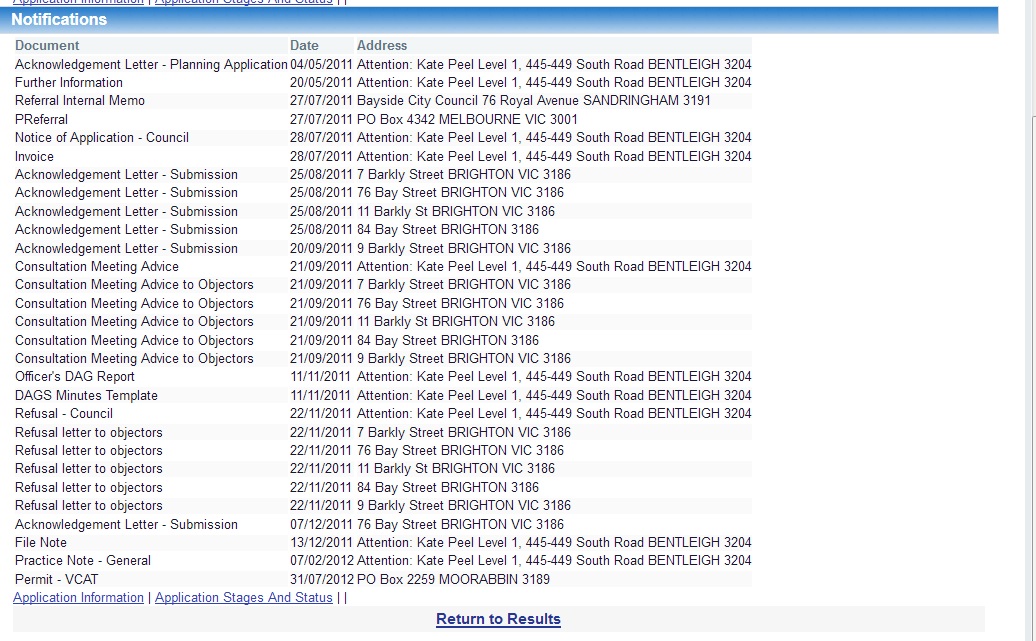
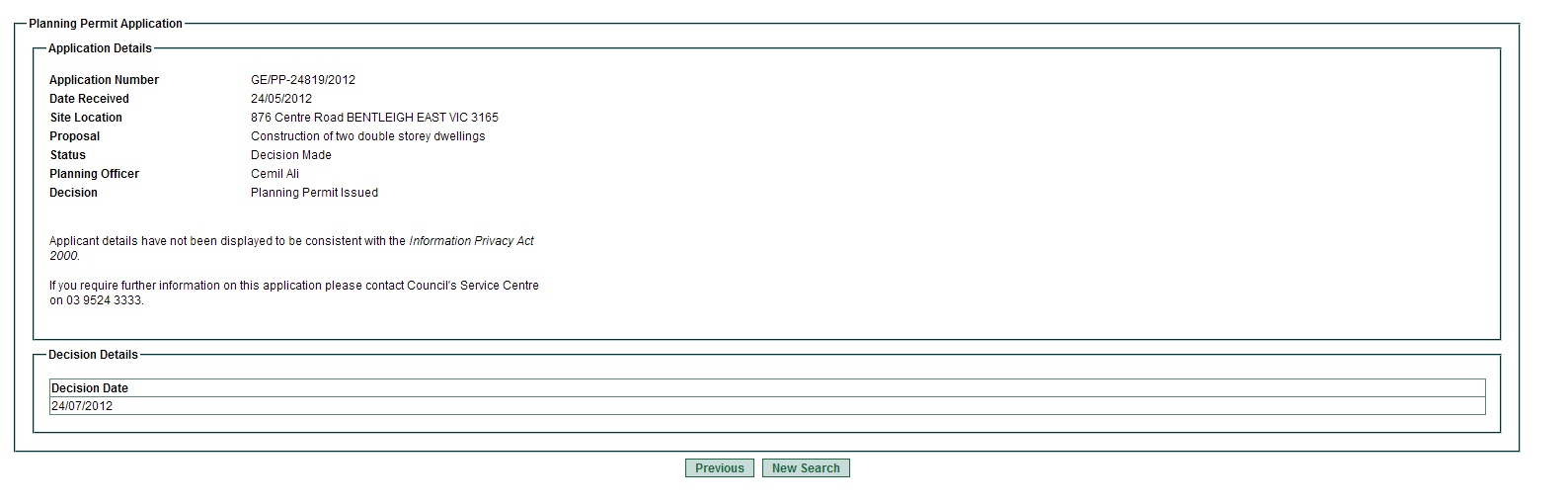
Council clings to the letter of the law repeatedly. They fulfill the legal requirements. But, they also have discretionary powers to go well beyond the letter of the law if they so wish. This is perfectly exemplified via the Online Planning Register. Here is a tool that residents can use to look up applications across the municipality. It has the ability to save time and footwork. Information can be retrieved at no cost in a timely and accessible fashion.

Below is an image taken from the Glen Eira Planning Register following a search on numerous street names. Readers should note the claim that ‘privacy’ prevents the listing of applicants’ names. Funny, how other councils do not have this same problem! Further, the amount of information provided is minimal. We do not know how the permit was issued – ie. via council decision, manager, DPC, etc. Nor are we told if the application went to VCAT; nor if there were any objectors. As for the actual plans – well they just aren’t there!

glen eira


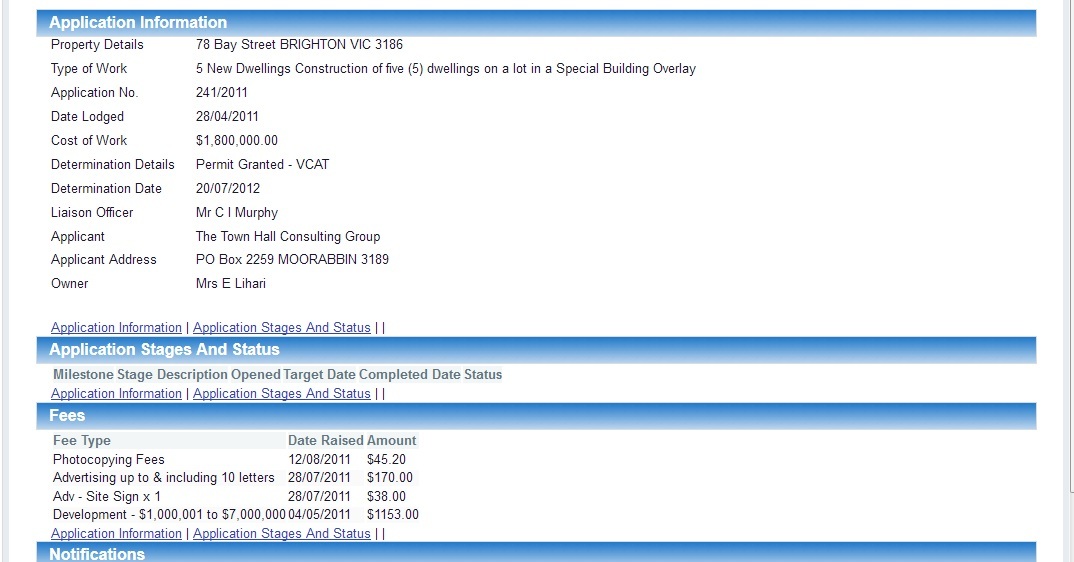
By way of comparison, here’s a screen shot of one application from Bayside’s Planning Register. Please note – names of applicants, dates of all letters/submissions; those responsible for decision making, and the addresses of objectors. All the information is listed in one single, easily accessible place – totally unlike what happens in Glen Eira.

bayside2bayside


Then there’s the Stonnington version. Their register is also chock full of information. In addition they also have an entire webpage devoted to all the applications which have started the advertising periods. Users can click on the links and actually get to see the full application – including architect drawings and plans.

http://www.stonnington.vic.gov.au/residents-and-services/planning/planning-news/advertised-applications/

Our conclusion is simple. We live in a technological age. 87% of residents in Glen Eira now have access to computers according to the 2006 census figures. Yet the systems in place in this municipality are archaic, outdated, and definitely not ‘user-friendly’. In our view, this is deliberate since a little information can be a dangerous thing. Residents must be kept ignorant at all costs!

At the last council meeting officers provided a report in response to the motion moved by Okotel and Esakoff.

“In the interest of transparency and demystifying the planning process for residents and ratepayers, I request a report on:

(a) The information provided to applicants and objectors in relation to Council’s procedures in dealing with planning applications; and

(b) If and how applicants and objectors are informed about the points along the process where they can be involved or express their views.

The MOTION was put and CARRIED unanimously.”

In accepting this report both councillors praised its ‘fulsome’ and ‘comprehensive nature’ although Okotel did comment on several ‘misprints’ that managed to worm their way into official documents. Sadly she did not elaborate! We beg to differ on these  evaluations of the report.

The entire report, presumably by Jeff Akehurst since his name is provided for ‘enquiries’, is merely a regurgitation of the current provided information, and the usual litany of self-congratulatory statements. For example, one sentence claims that both the DPC and the Planning Conferences are a result of Council choos(ing) to have these public forums in the interest of broader community involvement in town planning decision making.” “Community involvement’ is a wonderful catchcry. It is however illusory in Glen Eira when the implementation of these committees are examined in detail.

The DPC meetings are far from encouraging ‘broader community involvement’ for the following reasons:

  1. Objectors, if they’re lucky, receive only 5 days notice! Further it is not clear whether this means that letters are posted 5 days earlier, or whether council ensures via earlier posting, that objectors have the full 5 days notice. It is even conceivable that if the letters are posted on a Friday, and the DPC meeting is arranged for a Tuesday or Wednesday, that objectors would only receive the notification on the Monday. Hardly a full 5 days notice. Surely if ‘broader community involvement’ was the real objective, Council would inform objectors far earlier of the set dates.
  2. DPC meetings are scheduled DURING OFFICE HOURS. Hardly an appropriate time for resident objectors to attend such a conference if they work. Once again, this would limit and hinder full participation by all objectors. Since community forums and other countless meetings are held in the evening, and if the desire for ‘broader community involvement’ was genuine, then DPC meetings would also be held in the evenings when a far greater number of residents would be likely to attend.
  3. No councillor is granted decision making authority for these meetings. We even wonder whether councillors know which applications are being considered by the DPC, or more significantly, when they find out. Before the fact, or after the permit has been granted or refused? In this instance, councillors are sidelined as effectively as residents. All committee members are officers and the meetings generally go for about one hour. It is further not compulsory for applicants to attend. No minutes or records of DPC decisions are available for public scrutiny. Hardly a transparent and accountable process!


PLANNING CONFERENCES

Whilst a councillor is chair of such meetings, and planning conferences usually go to council for ultimate decision making, the procedures are again non conducive to ‘broader community involvement’. Some of the reasons are the same as those outlined above –

  • The lack of sufficient notice
  • The repeated gagging of objector comments and questions (ie Mahvo St is the perfect example)
  • Applicants often do not attend and hence are not available for questioning and ‘compromise’ with residents

The greatest drawback however is that NO OFFICER recommendations are available until the application appears as a report in council agenda papers. This is made public on Friday – usually late in the afternoon on Council’s website. It should again be pointed out that most people work. Most people would also be respectful of councillors’ weekends. So that means that objectors only have 2 working days in order to analyse the officer’s recommendations, contact their councillors and attempt to achieve some favourable outcomes. Timing is everything. Why aren’t the officers’ recommendations reported back to objectors well before the item surfaces as a council agenda item? The 64 dollar question would be – are developers notified of officer recommendations in the same manner or do they get a look in well before objectors find out the fate of the application?

The entire planning processes in Glen Eira are designed to favour the applicant rather than the resident objector. Okotel and Esakoff may continue singing the praises of officer reports, but in doing so they fail to address the central concerns of how such information is disseminated and what protocols are in existence to ensure a fair hearing for both objectors and applicants.

Here’s the unbelievable response to a public question asked at last council meeting. We draw readers’ attention to:

  • The waffle & irrelevance
  • The failure to address the major concern of the question – ie why officer reports do not directly engage (and hence answer) the questions raised via the Request for a Report
  • The unnecessary length

Subject: McKinnon Reserve fence.

The McKinnon Reserve fencing report does not provide Council with an opportunity to decide if gates should be installed at the McKinnon Reserve or if no gates are more appropriate in a fenced reserve. Surely when there are a number of residents requesting gates be returned to the reserve, it is for Council not Officers to decide if the community’s wishes are to be heard? The complete removal, rather than the careful management of the so called ‘dangerous’ Cypress trees along Tucker Road remains a mystery to many residents as the Cypress trees inside the reserve itself remain (although whats done is done). When will this Council provide local residents with an on-going opportunity to have their say in the improvements and changes made in our local reserves?

The Mayor read Council’s response. He said:

“Council dealt with this matter earlier in the meeting at Agenda Item 9.4 and you will be able to find Council’s resolution in the Minutes of the meeting.

Your assertions are not correct. The report at Agenda Item 9.4 presents the Council with the opportunity to make whatever decision it wishes to. Had Councillors chosen to have gates installed, we could have passed a motion to that effect. It is the Council and not as you assert Council Officers that decide resolutions of Council.

It is Council Policy to remove trees in only a limited number of circumstances. Such circumstances include a tree being dead, close to death or structurally unsound.Residents whose properties back on to the Reserve and users of the reserve had expressed ongoing concern about the Cypress trees at the southern end of the reserve. Concerns included the declining appearance of the trees and the increasing number of limb failures.

Council’s records indicate that between January 2008 and April 2009 alone, twelve structural branches fell. The electricity company had also been in contact with Council and required Council to prune the trees to comply with the Victorian Government’s new Electrical Line Clearance Regulations (2010).

In response to the community’s concerns and the electricity companies’ direction, Council commissioned an independent arboricultural report of the trees. Key findings were:

 The trees would no longer be viable if pruned to the extent the new Regulations required

 The trees had reached the end of their safe useful life

 The risk of further limb failure was high

 The trees should be removed

The Cypress trees in the north of the reserve were not identified as a risk at that time. Given the findings of the report, there was no other option but for Council to remove the Cypress trees in the south of the reserve.

To inform the community of this, Council’s Parks Services Department:

 Hand delivered letters to 186-236 Tucker Rd, 197 Tucker Rd, 17-25 St James Ave, 2 and 2A Osborne Ave, and

 Erected nine A3 size signs in the reserve: four along the Tucker Road frontage; two at the front entrance; two at the cricket practice nets; and one at the rear entrance.

The letter to residents was dated 22 August 2011 and read as follows:

“TO THE RESIDENT AN IMPORTANT MESSAGE FROM YOUR COUNCIL

Dear Resident

Re. McKinnon Reserve – Tree removal works

Council recently commissioned an arboricultural report on the health and condition of the rows of Cypress trees located in McKinnon Reserve.

The report identified that the Cypress trees along the southern boundary and eastern boundary (Tucker Road frontage) of the reserve are over mature, have poor structure and the likelihood of significant limb failure is high. As a consequence the risk to people, powerlines and property is high. The report recommends the removal of the entire southern and eastern rows of 178 Cypress trees.

Council plans to commence removing the trees on Monday 29th August 2011. The immediate area around the affected trees will be fenced off during works to ensure the safety to park users. Replacement trees will be planted later in 2011.

If you need any further information on this matter please contact Council’s Tree Maintenance Coordinator Mr David Edwards on 9524 3333.

Yours sincerely,

Laurie Unwin

Manager Park Services”

The nine signs that were erected around the Reserve read as follows:

“PUBLIC NOTICE – Tree Removal Works

An independent arborist has identified the need to remove the southern and eastern rows of over mature Cypress trees in McKinnon Reserve (178 trees in total).The trees are in poor condition, have poor structure and many have had branches fail and fall.

To eliminate the risk to people, powerlines and property Council will commence removing the trees on the southern and Tucker Road boundaries on Monday 29th August.

To ensure safety, Council will fence off the effected trees before starting works and request that park users do not enter these areas. Council is planning to plant new trees later in 2011.”

The independent arborist who is professionally qualified in these matters did not regard the trees that required removing as ‘so called dangerous’.

This Council has always provided opportunities for input into the development of our City. Public consultation is a feature that has informed Council’s development of park masterplans and strategies and the elected Councillors will be continuing with this feature. Previous examples include:

 Boyd Park Management Plan

 Caulfield Park Masterplan

 Bentleigh Hodgson Masterplan

 Packer Park Masterplan

 Princes Park Masterplan

 The Glen Eira Sports and Aquatic Centre (GESAC)

 The Dog off leash review

 Bicycle Strategy

 Packer Park West development

 Duncan Mackinnon Reserve Masterplan

 Murrumbeena Play space redevelopment

 Former Booran Road Reservoir Redevelopment.

A forthcoming example will be the Open Space Strategy review that will commence in the near future. This will involve wide consultation.

Of course, residents can also always contact Council or Councillors about any concerns they have in relation to any park and these will be examined and considered.”
This post attempts to tie together 3 consistent themes and to ask the basic question: are pavilions that cost millions a greater priority in Glen Eira that the creation (and preservation) of open space?

This question is the result of MP Miller’s announcement in Hansard (29th November) that a $500,000 grant has been awarded by the State Government for the development of a ‘brand new pavilion, including changing rooms and clubhouse facilities” at Centenary Park. In 2007, according to the ‘Priority List’ established for pavilions, the estimated cost was ‘more than $2,000,000”. The Duncan McKinnon development at the time was listed as ‘more than $6,000,000’. That means that council will be forking out at least a few million for another pavilion!

Let us state clearly that we are not against the (re)development of existing pavilions. What we question are the priorities of this council when literally millions upon millions are poured into very questionable taj mahals and practically nothing is spent on what residents and some councillors have identified as a major need in Glen Eira – the acquisition of more open space.

Opportunity after opportunity to acquire more land has gone begging. Even when land is available council does nothing about it – ie. the Booran Rd Reservoir will stand untouched for another 4 years. What a disgrace that no funding has been allocated to this important potential source of open space when the issue has dragged on for nearly 10 years. We also remind readers of the recent debacle over the Alma Club when for $3 million council could have acquired property that eventually sold for just under $8 million.

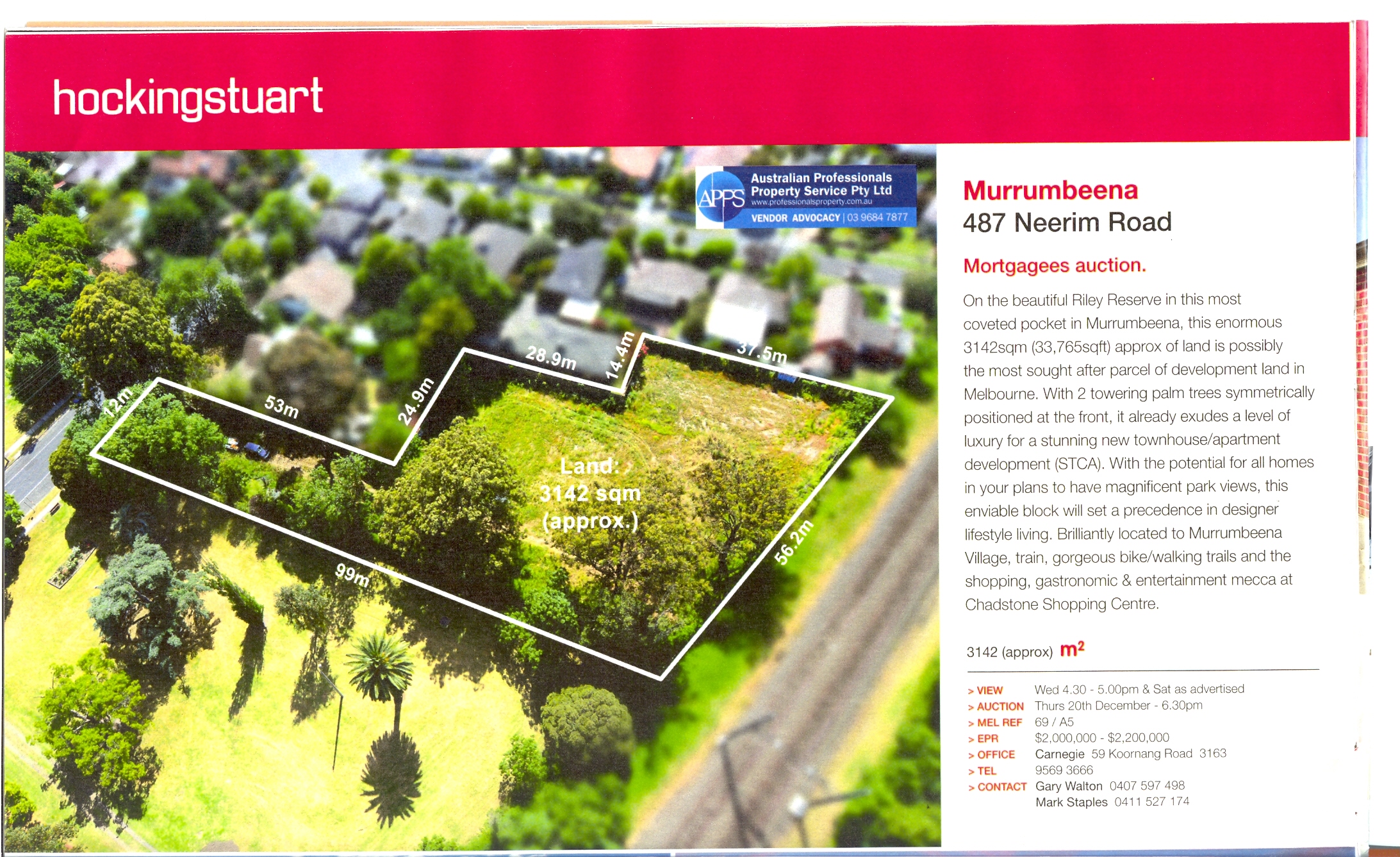
Now there is another opportunity – the sale of 487 Neerim Rd. The real estate advertisement (below) shows that it is right in a reserve. Why can’t this be purchased? Why must new pavilions be built year after year (rather than upgraded) at the expense of what residents have repeatedly highlighted as one of the three major concerns – overdevelopment, consultation and lack of open space. Why must this perfect potential for more passive parkland be ignored so that more units, and cars can clog Neerim Rd which is already a disaster? Why has nothing been done about the Open Space Levy and its ridiculously low cost to developers – especially since this was mooted to be ‘looked at’ nearly 3 years ago and especially since other councils are applying a 5% levy across their entire municipalities? And why, oh why, aren’t the funds collected from this levy used in the manner that the legislation primarily intended – the acquisition of public open space?

Finally, we wish to point out the obvious. The delicate position of MP Miller in Bentleigh leads to all kinds of pork barrelling by the Libs. But $500,000 doesn’t just appear out of nowhere. It has to be asked for, and a project nominated. Council obviously asked for the Centenary Park funding. They could just as easily have applied for anything else. The priorities of this administration and some of its councillors needs to be questioned and they need to justify why sporting facilities are continually more important than plain old open space. And open space that is likely to shrink even further once the footprint of these pavilions encroaches on parkland, car parks are extended and concrete, yellow brick roads continue to overtake green parkland.

PS: We’ve done some further homework on this site and there’s a long history associated with 487 Neerim Rd. None of it flatters our administration! Here are the facts:

  • In 1985 there was a subdivision for 2 houses to be subdivided
  • In 2005 an application went in for 9 double storey dwellings (refused)
  • In 2008,3 storey dwelling; 26 dwellings (refused)
  • In 2009, the officers recommended a permit for two storeys and 23 dwellings. Councillors refused a permit
  • In 2009 VCAT (on amended plans) accepted 3 storeys and 28 dwellings (See:http://www.austlii.edu.au/au/cases/vic/VCAT/2009/2529.html)
  • THE AREA IS MINIMAL CHANGE!

So what does all this mean? First off, it tells us that the saga of 487 Neerim Rd. has been on the horizon for nearly 20 years and not once has council apparently thought of purchasing the land even though it has a Special Building Overlay and is prone to flooding. Secondly, if officers recommended 2 storeys eons ago, the likelihood is that this will now occasion at least a 5 storey development. Thirdly, given this history, it is most likely that there is an existing permit on this land – something council clearly would know about. Again, they have been quite content to sit back and allow it to go to developers! So much for the empty refrain of lack of open space, the protected nature of minimal change areas, and the danger of flooding. What should be open space will likely become a living nightmare for residents of Murrumbeena.

PS: By way of contrast we’re adding this titbit of news from the Port Phillip Council Meeting Minutes of 27th November 2012, Page 3. The difference to the way things are done in Glen Eira is, of course, staggering.

“A petition was received from 14 signatories in relation to parking on Bridge Street between Lyons Street to Esplanade East, Port Melbourne.

MOVED BY CRS TOUZEAU/VOSS

That Council:

Receives the petitions and refers it to officers for investigation. A proposal will then be developed for possible new parking restrictions. A subsequent survey/questionnaire will be distributed to properties adjacent to Bridge Street Port Melbourne seeking feedback.The survey will inform any new parking restrictions that may be implemented.

A vote was taken and the motion was carried”


COMMENTS

We find it most refreshing that councillors actually TELL officers what to do! We also find it most refreshing that decisions are made on the spot, not a year later. We also find it most refreshing that transparency and consultation is an integral part of a response. The take home message for our councillors is that where there’s a will , there’s definitely a way!

++++++++++++++++++++++

The minutes of 7th February 2012 recorded this petition from residents:

A petition co-signed by 23 signatories was tabled which read as follows:

“This petition of certain residents of the City of Glen Eira draws to the attention of the Council our wish that there be trees planted on Murray Road, Mckinnon/Ormond. Prioritising tree planting on our street will help realise the Glen Eira Community Plan, Street Tree Strategy and Environmental Sustainability Strategy. We believe that this action will significantly improve the psychological, social and environmental quality of our street. We understand that trees would have to be planted on the road and that there will be some associated loss of car parking space. Your petitioners therefore pray that trees are planted on Murray Road, Mckinnon/Ormond as soon as possible.”

The petition, as per normal was ‘received and noted’ unanimously.

Now, 9 months later at Tuesday night’s council meeting Pilling submitted a request for a report on the planting of street trees in Murray Rd. This was seconded by Esakoff. Pilling said that it’s a narrow street and lacks trees and there was the need to improve the ‘amenity of the street’. Esakoff agreed that ‘the street could certainly do with some greening’. Okotel  was ‘pleased’ because this issue was ‘long overdue’ and that concerns of residents ‘are being heard’ and that the report will be the means to ‘ensure that (the issue) ‘will be addressed without further delay”.

We highlight this Request for a Report because it again illustrates the failure of this council and its councillors to institute processes that respond in a timely fashion to resident concerns. We note the following:

  • In other councils petitions are not merely ‘noted’ – they are immediately passed on to the relevant department for action. In Glen Eira petitions generally disappear into the ether and unless residents keep the issue up front, they are invariably ignored and forgotten.
  • Now we have the farce of waiting for another officer’s report. With NO NOTICE OF MOTION available to councillors, the community is again in the hands of officers who may take months and months to report back and then possibly another major time lag before anything is actually planted.
  • The ‘solution’ is very simple it would seem to us. Councillors must ensure that when petitions are tabled they are acted upon, or responded to immediately. It is literally a joke that it takes 9 months, and another officers’ report in order to get anything done in Glen Eira. Not only is this a slap in the face to residents, but it also means more time and expense wasted on unnecessary paper work by officers.
  • Further, if councillors were so concerned about ‘greening’ Murray Rd. did the thought ever occur to them that a simple resolution which stated ’30 street trees to be planted in Murray Rd’ might have sufficed? That is of course, if such a motion passed the ‘no surprises’ component of the Meeting Procedures of the Local Law and if it could somehow be squeezed into an agenda set by Newton!