Almost half of the 2010 Municipal Inspector’s report concerned itself with council ‘minutes’. Councillors were cautioned to ensure that an independent minute taker was present at councillor only meetings; that all minutes include resolutions. The drawback was that there was no ‘breach of the Act’ even though minutes were doctored, changed, amended repeatedly.

Two years later, nothing much has improved in this area. If anything it has got worse. Advisory committees now often come under the umbrella of ‘records of assembly’ so all that is legally required is noting those present, the subjects discussed and if there are any conflict of interest declarations. The Pools Steering Committee is the perfect example of this. Even worse is that a perusal of the records of assembly feature numerous ‘amendments’ and the deletion of phrases. The most frequent advocate for this is Hyams. The Sport & Rec meeting of several years ago is clear testimony to how much is censored and left out.

Then there’s the question of consistency of reporting. The Environment Committee has arguably the most ‘extensive’ minutes, although when a community rep on this committee lamented that the minutes needed to be far more expansive, she was told that minutes aren’t Hansard. In contrast, other committee minutes such as the Pools Steering Committee are lucky to consist of 100 words most of the time. There simply is no consistency, no procedures, and no mechanism within Council’s Local Law Meeting Procedures which ensures full transparency and accountability for all meetings.

One way of doing away with this problem of accurate reporting is simply not to hold any committee meetings. The Finance Committee has been allowed to evaporate, as has the Roads Special Committee, the Racecourse Advisory Committee, the Animal Management Committee, and so on and so on. The latter 2 have not met for over a year we believe.

Such is governance in Glen Eira. Secrecy is all and accountability the poor relation. What minutes are published admittedly do not have to be the equivalent of Hansard, but they must be a truthful and accurate account of what went on. We assert that this principle has been flagrantly abused.

Residents’ rat-run rage

Andrea Kellett  

COUNCIL CHALLENGED OVER TRAFFIC AND PARKING ISSUES

GLEN Eira residents fed up with rat runs and limited parking have gathered to vent their anger and discuss change. The Glen Eira Residents Association held a forum in Elsternwick last week titled ‘‘Rat runs and no parking — a feature of life soon. What’s the alternative?’’

President Don Dunstan said it was the association’s first forum on the issue and 50 people turned up. He said the association had surveyed residents and found traffic and parking were causing angst. ‘‘People are fed up,’’ Mr Dunstan said. ‘‘There are quite a few streets where, at night, you can’t get parking because there isn’t any.’’ Rat runs had formed in Elsternwick as a result of lower speed limits in Glenhuntly Rd. ‘ ‘ The only way to get change is to change the council in October,’’ Mr Dunstan said.

The association said speed cushions on McKinnon Rd were also causing problems. Traffic and parking management were common concerns raised as part of Glen Eira Council’s 2013- 2017 community plan consultation early this year. Mayor Jamie Hyams said the council was ‘ ‘ aware these are issues of great concern’’.

+++++++++++++++++++++++++++++++++

City picks up super shortfall  

Donna Carton  

OPERATOR NEED PAYOUTS TO FINANCE PENSIONS

GLEN Eira Council is still waiting to hear how much it must pay out in extra super payments.

Local governments are reworking t heir 2012- 13 budgets as they anticipate the extra payments, likely to be in the millions of dollars. Super fund operator Vision Super last month confirmed it needed significant additional payments from councils to meet pension needs. There is speculation that the shortfall in its defined benefits scheme could be bet ween $ 5 0 0 million and $750 million.

Glen Eira community relations director Paul Burke said the council was ‘‘awaiting notification of the figure’’ but that it would be spread out over a number of years. ‘‘It will be factored into council’s existing planning and budgeting cycle and incorporated in the 2013 strategic resource plan that will go out for community consultation,’’ Mr Burke said.

Port Phillip estimates it will have to pay $4 million over five years, but mayor Rachel Powning said it was budgeted for. Mornington Peninsula Shire fears it is facing a $10 million superannuation shortfall. Vision Super chairman Rob Spence said the global financial crisis had hurt its performance and council payments must increase.

The minutes from last week’s CEO Special Committee have been published. The relevant motion reads:

Crs Magee/Pilling

That the meeting be now closed to members of the public under section 89(2) of the Local Government Act 1989 in order to consider Agenda Item 6.1 which relates to the review of the performance of the Chief Executive Officer and is confidential pursuant to section 89(2)(a) ‘personnel’ and (d) ‘contractual’ of the Local Government Act 1989. 

The MOTION was put and CARRIED unanimously.

Forge and Lipshutz were absent and Penhalluriack obviously excluded. Several observations are necessary:

  • Newton’s latest contract officially began in April 2012. Hence less than three months into this new contract we have a performance review? Why? Local Government Victoria recommends one performance appraisal per year. Even if Newton’s contract varies these terms, it is still most unusual to conduct this appraisal so early into a new contract. We surmise that these tactics are due to the upcoming election and the real possibility of a different group of councillors. It would thus make sense to bank some brownie points whilst the gang is still in office.
  • It should also be asked why the meeting went ahead when two councillors were absent – leaving only 6 to adjudicate. Surely no catastrophe would have occurred if the meeting was several weeks later when all councillors were present?
  • The continued secrecy of this council in all matters dealing with the CEO is unacceptable. Other councils appear to have no problem with making public the performance criteria that is used to assess their CEOs. In Glen Eira, nothing is public. The following links provide clear examples of how other councils choose to operate –

http://www.mornpen.vic.gov.au/Files/CEOPerformanceReviewCriteriaAppointmentReappointment2011.pdf

http://www.portphillip.vic.gov.au/Report_13_-_Chief_Executive_Officer_Annual_Review.pdf  AND http://www.portphillip.vic.gov.au/Report_13-_Attachment_1_-_Achievements_Against_2010-11_Council_Plan.pdf

When salaries of well over $300,000 (PLUS POSSIBLE BONUSES) are paid to individuals, it behoves organisations to ensure full transparency and accountability. Note, we are not suggesting that performance reviews be done under the full glare of public scrutiny. What we are suggesting is that it is imperative that residents know precisely HOW and against what targets performance is assessed.

Planning for disaster

July 15,  2012
 
Michael Buxton

Melbourne already has 30 years of land supply but Ted Baillieu  and Matthew Guy want more.

Illustration: Matt Davidson.Illustration: Matt Davidson.

HOPES have faded that the Baillieu government would continue the moderate  approach to land use of former premier Sir Rupert Hamer. Instead this is  government in the Jeff Kennett style.

The Baillieu administration is rushing to change the Victorian planning  system, with radical deregulation changing Melbourne irrevocably for the  worse.

Planning Minister Matthew Guy has advantaged a select group of landowners by  adding their 6000 hectares to the recent 43,000-hectare increase in Melbourne’s  area. Guy cynically dubbed this process ”Logical Inclusions” but it is wholly  irrational.

A land glut has been created as demand for outer urban housing has crashed.  Developers quickly added new home subsidies to the price of housing. Subsidies  encouraged new home buyers to borrow heavily in the belief that land prices  would always rise. Now they are falling, potentially trapping the most  vulnerable in a debt crisis.
Melbourne has 30 years’ land supply at world’s lowest densities. Yet Guy  perseveres, adding land to potentially enrich a few at the expense of the many.  Melbourne cannot afford premiers and planning ministers who get land markets so  disastrously wrong.

Almost every outer urban council has chronicled a growing catastrophe of  inadequate infrastructure and jobs. Governments cannot afford to meet the rising  costs of outer urban infrastructure. This failure and car-dependent urban design levies crippling running costs on to many outer  urban householders.

Baillieu and Guy show a single-minded intent to finish the job Kennett and  his Planning Minister, Robert Maclellan, started. This is part of a systematic  confrontation. Melburnians should get ready for a rough ride – the planning  battleground until now will be just a skirmish to this coming war.

New planning zones will protect relatively small areas of historic housing,  open up other residential areas to major growth and leave much of Melbourne with  little protection against piecemeal redevelopment. The government clearly thinks  it is clever to satisfy some influential resident groups while giving the rest  of Melbourne and Victoria over to developers.

New commercial zones will lead to a retailing and commercial free-for-all.  Much of Melbourne’s historic strip shopping centres will be demolished or  distorted to facades in front of medium and high-rise development. Struggling  centres will feel additional pressure from a broad range of allowed uses and  expanded bulky goods complexes.

Another blow is directed at Melbourne’s green wedges and rural areas. The  government will allow large-scale commercial development through hotel,  conference and restaurant complexes in beautiful places such as the Upper Yarra  Valley and Mornington Peninsula. An extended range of accommodation types will  be allowed.

Rural subdivision will be encouraged, creating thousands more small rural  lots on some of the world’s most fire-prone land. Already, well over 50,000  allotments exist in Melbourne’s hinterland. Why do we need more?

Matthew Guy’s new planning system will also allow the unrestricted expansion  of industrialised farming on rural land. There is a need for such massive  structures, but the previous farming zones tried to confine them to acceptable  areas.

The process this government is following in introducing its changes is also a  concern. Guy withheld the details of new zones to sell his message before its  full impact is realised  hoping that bad news in the fine print will be  overlooked when eventually revealed. This is a cynical attempt to manipulate  public opinion.

This government revels in its blatant advantaging of vested interests. It  provides unrestricted access to property groups and openly panders to them. Many  of the new uses and developments will be allowed without the need for planning  permits with no right of resident notification, objection or appeal. There are  going to be a lot of very unhappy Victorians.

What could have been done instead of assailing the last vestiges of the Hamer  legacy? Most people agree the Kennett planning system is a disaster, one of the  world’s largest, most complex, costly and uncertain. These problems can be fixed  by rules that state clearly what is and is not allowed. Prohibitions for  inappropriate uses as much as allowing minor uses without the need for permits  provide certainty.

Like most of the world’s planning deregulators, the Baillieu government says  it will provide certainty for ”mums and dads” and small businesses. But this   is a smokescreen for pandering to big business. Rewarding the powerful and  connected is the real motivation. Allowing developers to build dysfunctional  suburbs, big retailers to destroy small business and big agriculture to ruin  landscapes will advantage only them, at massive cost to everyone else. There is  nothing rational about this unless you are a recipient of the largesse.

The cities that  survive this century will be those that protect their vital  resources. Melbourne’s greatest long-term assets are its people and its  environment. Amenity is almost everything to a city. It is right to intensify  mixed-use activity centres near public transport nodes but not at the expense of  our built heritage. It is madness to even contemplate the destruction of our  Victorian and pre-war strip shopping centres. These are among the city’s  greatest economic assets, attracting innovators, investors and a broad range of  economic drivers.

The natural resources and environment of Melbourne’s hinterland similarly are  vital to the city’s future prosperity and success. We destroy them for the  short-term gain of a few at our peril.

■Michael Buxton is environment and planning professor at RMIT  University.

Read more: http://www.theage.com.au/opinion/politics/planning-for-disaster-20120714-222v5.html#ixzz20eFXXTd5
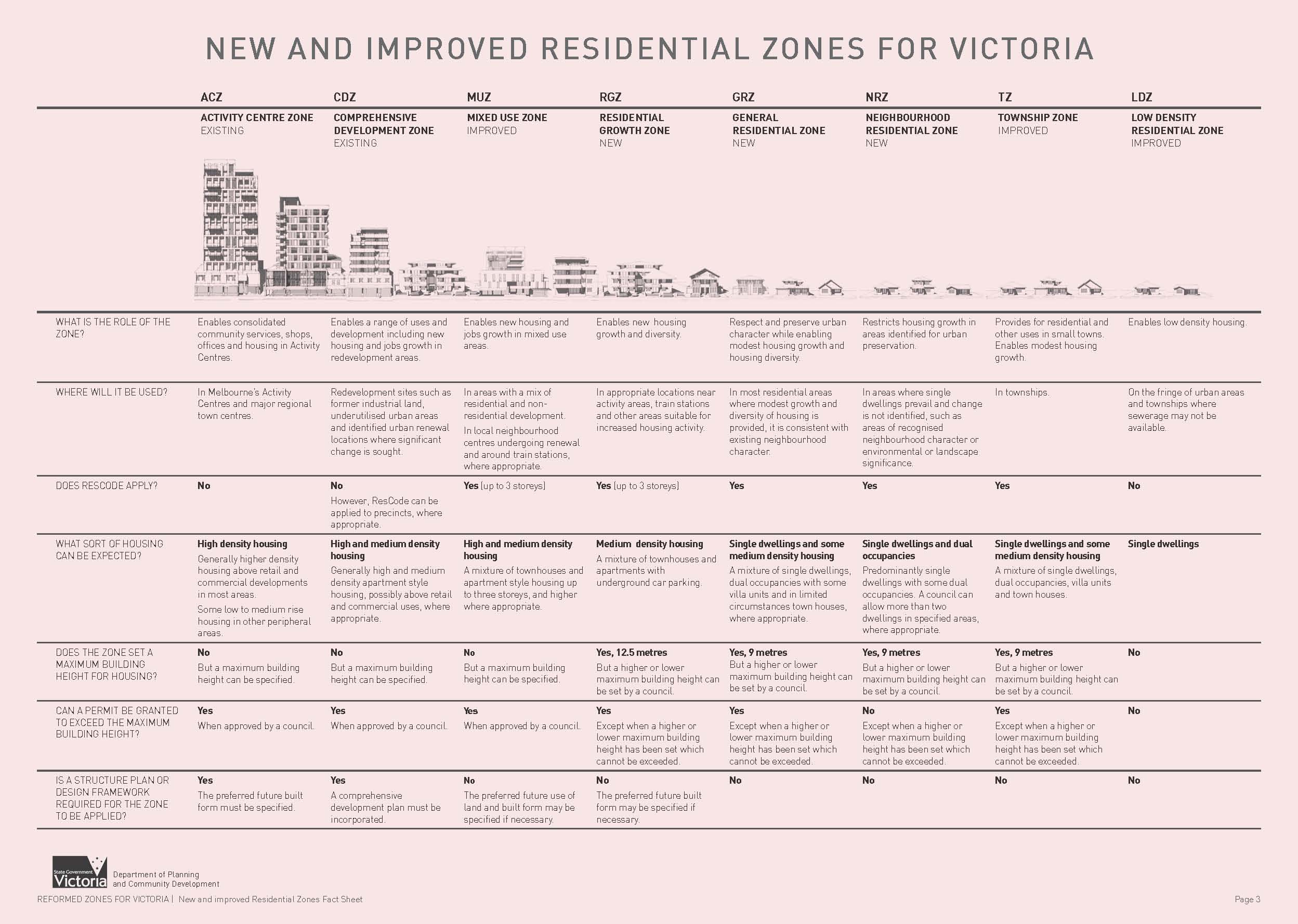
Matthew Guy and the Department have released what can only be euphemistically called a ‘discussion paper’ (uploaded here). Short on details, but big on generalities and promises, the paper is anything but what most reasonable people would consider to be an objective and informative outline of the proposals, and the potential benefits and drawbacks.

Most concerning is that ‘feedback’ is required by late September, yet full details will only be released in October. In other words, the public is expected to comment blindly on something that they have limited information on. We suggest that readers pay particular attention to the following table extracted from the ‘fact sheet’. Please click on the image to enlarge.


Approximately 50+ residents showed up to last night’s commununity forum to hear the latest on traffic management and parking. First cab off the rank was Dr. Bruce Corben who emphasised the importance of speed reduction in local residential streets and arterial roads and the health and environmental benefits this would achieve. Research revealed that pedestrians were at greatest risk even when cars were travelling at 30km per hour. He commented that the objective of all street calming projects was to lower car speeds and that roundabouts were the most effective in achieving this aim.

Cr Narelle Sharpe outlined the holistic 8 step program that Moonee Valley Council is employing. The beauty of this scheme was that it included in-depth research and analysis of entire areas resulting in 22 precincts that were ‘weighted’ according to various criteria such as traffic volume, speed, surrounding facilities, and most importantly, community consultation. The plan for each precinct cost in the vicinity of $45,000 and Moonee Valley had undertaken to complete 2 precincts per year. It was therefore a long term vision based on a thorough understanding of the needs of each local area rather than a single street.

Cr Serge Thomann highlighted Port Phillip’s approach and the pressures that this municipality faced in terms of incredible high density, tourists and visitors, as well as the ensuing parking problems. The strategy adopted by council was: (1) a hierarchical road strategy that placed pedestrians at the top followed by cyclists and then cars. (2) council’s refusal to issue residential parking permits for new developments; (2) extensive community bus services; (3) different street calming measures that varied across the municipality – ie raised pedestrian crossings in line with footpaths.

Whilst each municipality is unique, it is obvious that common problems exist. How these problems are approached by decision makers is what is important. We maintain that in Glen Eira the approach is haphazard, and lacks a truly integrated vision. If safety is the most important criterion then councils must be pro-active as both Moonee Valley and Port Phillip appear to be. It just is not good enough for residents to be told that your street is within the 85th percentile on speed and traffic volume so we won’t do anything! The old adage that prevention is better than cure certainly applies in this domain.

Zone reforms to return planning certainty

Wednesday, 11 July 2012

The Victorian Coalition Government’s sweeping reform of planning zones will return certainty to our suburbs and towns and in particular to councils, residents and the development industry.

“Planning zones are the greatest indicator of the style of development for any area. The Coalition Government’s sweeping zones reform package aims to give certainty for areas that deserve protection and those identified as growth nodes,” Mr Guy said.

“The Coalition Government’s zone reforms reflect what communities have been crying out for, for many years – clear identification of areas that can grow and strong protection for areas that are designed to be low rise, low density neighbourhoods,” Mr Guy said.

“These reforms will protect what makes Melbourne great – our streetscapes, our amenity, our liveability, while encouraging density and growth in clearly defined areas,” Mr Guy said.

The Coalition Government’s zones reform package features three new residential zones:

  • Residential Growth Zone;
  • General Residential Zone; and a
  • Neighbourhood Residential Zone.

“The new Neighbourhood Residential Zone will be an instrument that can be adopted by councils to protect existing amenity of suburbs and towns.

“It will give many areas the protection they deserve and will be the strongest residential protection zone ever offered in the Victorian planning system,” Mr Guy said.

This zone will include a number of features including mandatory height controls, stricter regulations around subdivision and the consideration of minimum lot sizes. The Neighbourhood Residential Zone will also be able to protect existing streetscapes and amenity with clear guidelines on what can be supported by a planning permit application.

In order to support integrity of the new Neighbourhood Residential Zone the Coalition Government has also introduced a number of complementary residential zones that will support development of medium and higher density housing in appropriate locations.

The new Residential Growth Zone will provide for a clear level of growth and change in identified areas that have clear targets for greater density. Councils will be able to use this zone to provide a new incentive to direct density and built form change in areas that are well known and identified.

“Importantly, these zones will be at the discretion of the local councils. It will ultimately be the view of the community that will inform which zone best fits where,” Mr Guy said.

“Victoria’s economic integrity is at the forefront of its planning decisions and these reforms are no different. The residential zone reform package supports Victoria’s economy by clarifying where development can occur and what can be built,” Mr Guy said.

“Importantly, it returns a level of planning certainty that has been sorely missing for the past decade,” Mr Guy said.

Under the Coalition Government’s planning reform agenda, plans for new outer urban growth have been released as well as the identification of Australia’s largest inner city, urban renewal project in Fisherman’s Bend.

These projects, combined with planning law changes and planning zone reform represent a major overhaul of the Victorian planning system since the change of government in November 2010.

“The time is right for planning reform and the Coalition Government is getting on with the job of delivering it.”

The key features of the reformed planning zones will be issued for feedback for a period of 2 months from Monday 17 July until Friday 21 September.

Council policy detrimental 

IT’S no wonder the blocks in Glen Eira get smaller and the growth gets higher. Glen Eira Council continues to operate planning policy to the detriment of residents.

It will soon get to the point where there are as many amendments to their scheme as there are applications.

A number of voters are calling on the council to review its entire planning scheme and introduce structure plans that can identify density and heights before applications are received.

Newton Gatoff

++++++++++++++++

Bitter blow to residents  

NEWS of the Caulfield racecourse development proceeding is a bitter blow to local residents.

While the development will be almost a billion dollars itself, little, if any, infrastructure will be provided to cater for it. This will see both road and rail networks overwhelmed, along with drainage and parking. Open space will also be reduced. Given the chorus of community opposition, you really have to wonder if we are living in a developers’ dollar-dazzler democracy.

Matthew Knight

Today’s Melbourne Bayside Weekly –

Sporting chance for parkers  

bridget.fitzgerald@fairfaxmedia.com.au  

A SHORTAGE of car park space at the new Glen Eira Sports and Aquatic Centre is causing problems for users of a neighbouring sports ground.

Soccer club members who use Bailey Reserve, on East Boundary Road, are being forced to park in neighbouring streets because of a lack of spaces.

Glen Eira Moorabbin Softball Association president Ian Bahn believes the problem will worsen when the softball season starts in October. “Our season hasn’t started yet, but we have been down to Bailey Reserve to have meetings, and seen that it [parking] is going to be a problem,” Mr Bahn said. “Come summer, when it gets busier with people using the pool and the ground, it’s going to be very interesting.”

GESAC opened on May 7. Despite opening four months late because of building delays it reached a membership of 4000 on its first day. Glen Eira council spokesman Paul Burke said limited parking was proving to be an issue. “We now have about 5700 members. The problem is that these members are still getting used to how they use the facility and are still creating a routine,” Mr Burke said.

Adding to the shortage, some Bailey Reserve car park spaces were lost during construction of the new facility. East Bentleigh Soccer Club is the primary winter tenant of the ground. Club secretary Chris Loose said parking was an issue. “We have had members of our club making other arrangements, parking in surrounding streets, on East Boundary Road, or walking – but that is obviously not so desirable in winter,” he said. Mr Loose said the club had notified the council of the issue and believed GESAC and Bailey Reserve tenants could work together to find a solution.

The Glen Eira Residents’ Association has organised its second community forum for the year. This time on something we know is dear to all residents’ hearts – traffic and parking. It looks like they’ve got a handy group of speakers as well. An academic and two councillors from different municipalities. Should be interesting to hear how other councils approach these issues in contrast to our lot. See their website (http://geresidents.wordpress.com), or the details are:

WHERE:         St Mary’s Anglican Church, 281 Glen Eira Rd.

DATE:            Wednesday, 11th July

TIME:             7pm for 7.30pm start

SPEAKERS:      Dr Bruce Corben (Monash University)

Cr. Narelle Sharpe (Moonee Valley)

Cr. Serge Thomann (Port Phillip)

ENTRY: Free for members; others, coin donation at door.