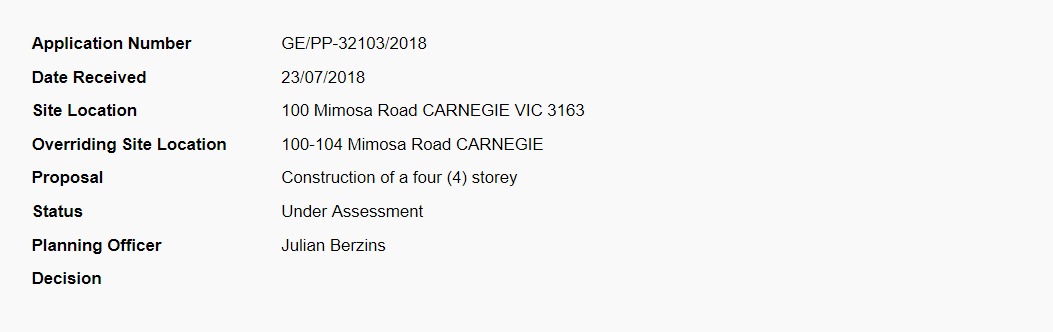
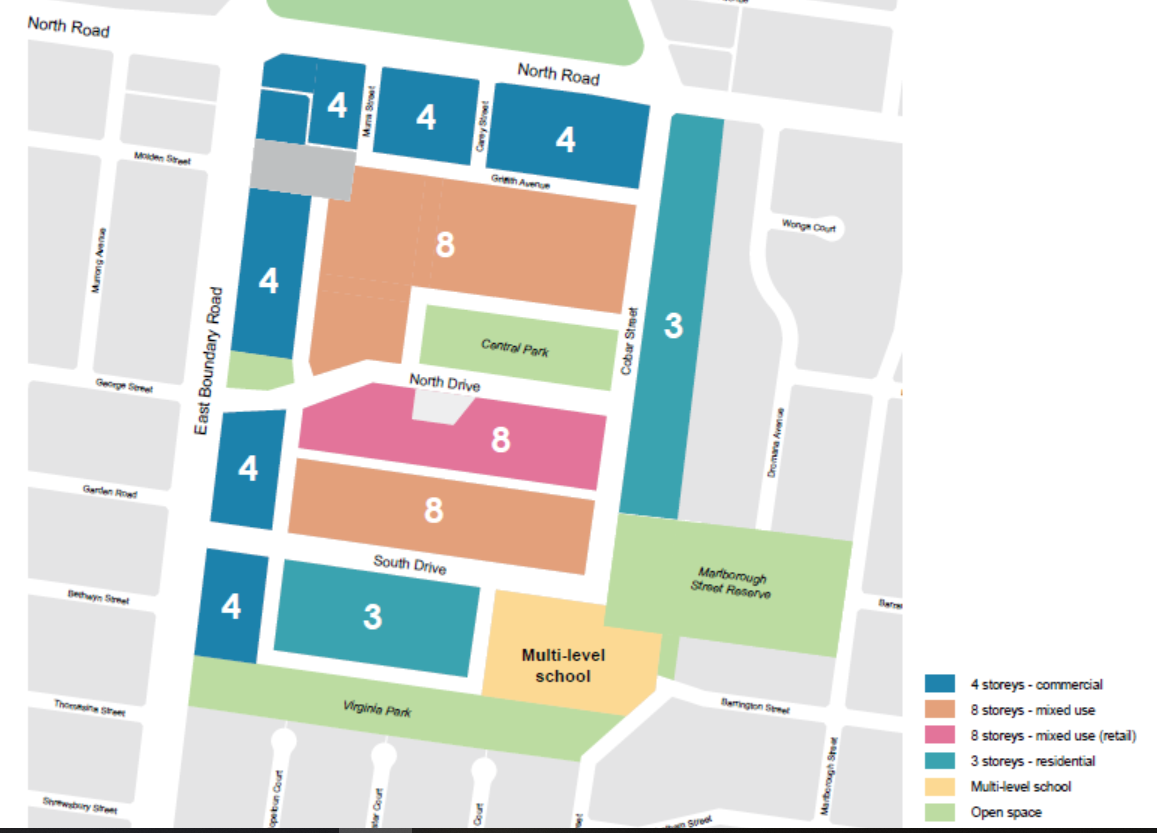
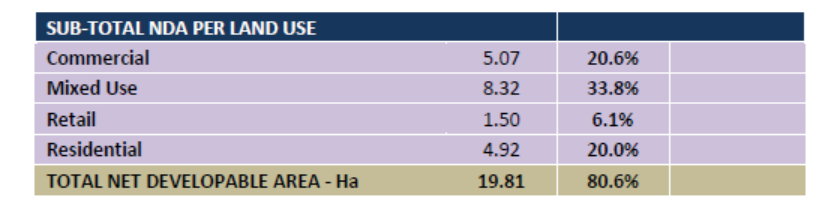
PS: Announcement today of a second campus for McKinnon High at Virginia Estate. A $70m, multi level school catering for 650 students. Whilst this is definitely needed we have to ask: is the site 1.2 hectares only? how high is multi level? will these 650 students be using the adjoining open space of the reserve and hence letting Gillon et al off the hook from providing sufficient open space for the proposed burgeoning population at the site? Plenty of other questions too regarding traffic, drainage, etc.

Another month and another set of figures that show no sign of a development downturn in Glen Eira. If anything, the number of building permits granted is increasing rather than decreasing. Thus even if we accept the figures that council relies upon so heavily to push their pro-development agenda, Glen Eira is maintaining its record of being far ahead of all required net new dwellings to cater for population growth.

Council keeps spouting the Victoria In Future (VIF) 2016 projections that an additional 9000 dwellings are necessary by 2031. Inexplicably, the government or the DWELP has failed to come up with Victoria in Future 2017 and neither have they produced Victoria in Future 2018. Promises to provide new Planning Practice Notes following VC110 on how to apply zoning, have yet to materialize – 18 months later! An abysmal record of planning all round!

Even if we accept that between 2016 and 2031, Glen Eira should produce an additional 9000 net new dwellings that means a lowly average of 600 net new dwellings per year. Glen Eira is currently TRIPLING THIS NUMBER and then some.

The tables below reveal the latest ABS stats published today. We have combined the totals from the year 2011 onwards, for our surrounding municipalities, as well as indicating the numbers of single houses. If we subtract the house numbers from the overall totals for the 2016/17 period up to the present, then we find that in Glen Eira, there have been 4,365 building permits granted for net new dwellings – in the space of 26 months! That’s an average of 2014 net new dwellings per annum! More than triple what VIF 2016 projected and more than double what Plan Melbourne Refresh indicates! Yet council still seems hell bent on more and more development according to its doubling of activity centre areas and believing that 12 storeys in Elsternwick and Carnegie are required.  Isn’t it time that council stopped with its propaganda and finally admitted that they see more and more development as their goal and raison d’etre!!!!

Please peruse the following tables carefully. We’ve uploaded the ABS stats HERE

Here’s a resident’s summary of last week’s meeting for the Caulfield Racecourse Reserve.

+++++++++

There were many empty chairs at the meeting, on account of the meeting not being well advertised
Proceedings were opened by Interim Administrator David Bird, speaking from the lectern.

He announced the Trustees present, who were sitting in a row at the front of the room –

Sam Almaliki > Chair of the new Trust – not a local – lives South Melbourne – sports administrator – former head of community engagement Cricket Australia

July Busch > lives Elsternwick – background in shopping centre development, is on a cemeteries trust, and has interest in sports facilities

David Mandel > business in international manufacturing – a company director – president of a squash club – and on the Cth Games committee

Joanne Butterworth-Gray > from Gippsland – has 6 kids – background in regional development – interest in commercial opportunities

Danni Addison > not a local – president of the Urban Development Institute

Peter Watkinson > Haines Racing – planning

Greg Sword > (not present at the meeting) – ex member of the old untrusted trust

Sam Malakikiannounced the new trust is free of bias, will operate in the best interests of the community, will be transparent, collaborative and act consistently with the 3 purposes, as well as be dedicated to ‘community health and well being.’

The main problem with all this is that a new lease will be signed with the MRC behind closed doors and with no public input, before there is a management plan in place or any allocation to respective uses. The reason offered was was that the incoming trust has inherited arrangements and ongoing negotiations with previous trust.

Questions from the floor following the briefing raised issues of access to the reserve (who will hold the key), to which the response was that the reserve was open 9.45 am to sunset. The primary use of the reserve is racing.
Some asked when the tin fence will go, questioned the signing of a lease with MRC of unknown proportions before there was public input.  One questioner presented a copy of a previous masterplan to the new trustees.
How will the trust and MRC communicate? Response was communication will be direct engagement at board level, but such negotiations will not be minuted. Will passive open space include the lakes and native vegetation and environmental sensitivity to wildlife.
The new Trust came into effect on August 1 and will set up comprehensive online information in due course, when some funding and resources become available.
COMMENT
We find it incredibly disappointing that there is not one single ‘community rep’ on the new Trustees. Even the ‘locals’ are linked to the development industry.
Nor is there any guarantee that agendas and minutes will be published.
Yes the legislation has made changes. Whether or not the community will be the ultimate beneficiary of these changes remains to be seen. On the whole it is not an auspicious start!
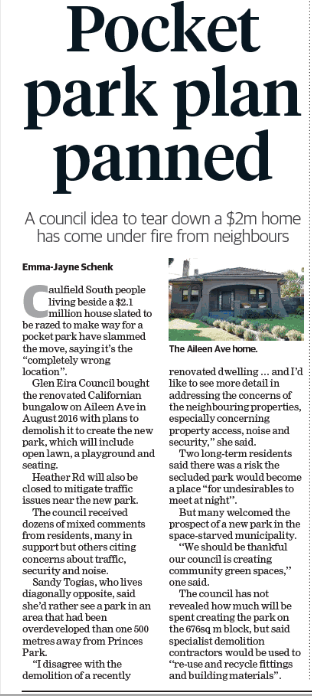
AND FROM THE Caulfield Leader (9th October) –
sky

From The Age – Sunday, 7th October.

CLICK TO ENLARGE

In another round of meaningless legislation that promises the earth and delivers nothing, we now have Wynne’s Amendment VC149 (gazetted today).

The accompanying Explanatory Report states:

Amendment VC149 also provides guidance on the assessment of planning applications where rooftop solar energy facilities exist on abutting residential properties, as well as direction on the assessment of new solar energy facilities in heritage areas. This guidance is required to address the absence of a clear and consistent framework within the VPP for the assessment of the impact of development on solar energy facilities

Clause 15.02-1 seeks to encourage land use and development that uses energy efficiently and minimises greenhouse gas emissions. Amendment VC149 will ensure that new building designs minimise the impact of overshadowing of existing rooftop solar energy facilities on adjoining lots, enabling more efficient residential energy use.

Far from ENSURING anything, this piece of legislation can only be described as another instance of spin, tokenism and the failure to insist on standards that will place a check on development that ignores the issue of solar panelling, wind tunnelling effects, etc. It mirrors the gutless refusal to introduce proper standards for apartment sizes, and the dilution of the required garden areas and parking numbers.

Readers should carefully review the following screen dump from the legislation. In order for the legislation to have any real impact then SHOULD would be replaced with MUST. Further, exactly what does ‘unreasonable’ mean? Then we also have the ‘get out of jail clause’ such as ‘if practicable’.

As for the Decision Guidelines themselves, we get the following waffle –

The extent to which an existing rooftop solar energy facility on an adjoining lot is overshadowed by existing buildings or other permanent structures. 

Whether the existing rooftop solar energy facility on an adjoining lot is appropriately located. 

The effect of overshadowing on an existing rooftop solar energy facility on an adjoining lot. 

The second sentence is remarkable. Does this mean that someone who has spent a fortune on installing solar panels will now be ‘guilty’ of councils and VCAT deciding that they weren’t ‘appropriately located’ – whatever this might mean. Does this then give the developer the all clear and occasion further cost on the neighbour to move his panels? We have already had instances in Glen Eira where this has occurred!

In our view, another piece of legislation that is all about pretense and nothing about curbing inappropriate development.

To their credit, councillors last night voted to refuse (unanimously with Esakoff absent) the two controversial planning applications – ie 300 Glen Eira Road, and Wattle Grove McKinnon. Much was made of site coverage and permeability and the fact that the McKinnon application would directly overshadow a memorial park.

Yet, there was not one single word from any councillor regarding the ‘quality’ of the officer’s report. The most fascinating aspect involved several councillors claiming that the McKinnon plans did not meet the ‘standards’/’guidelines’ set down in the Open Space Strategy for developments abutting open space. The officer’s report on this component stated –

In relation to the assessment criteria in this strategy, the proposal:

Σ Fosters good access to the open space

Σ Provides passive surveillance over the open space

Σ Presents an appropriate residential interface envisaged under the strategy

Σ Maintains an appropriate level of direct sunlight during the winter solstice and equinox

Overall, it is considered that the proposal is consistent with the guidelines for development nearby open space

How the planning department can see something as ‘consistent’ and ‘appropriate’ with the ‘standards’/’guidelines’ and councillors the opposite needs investigation. Either the guidelines are so vague that they are useless, or there are plenty of hidden agendas.

One further question requires consideration. When council officers produce sub-standard reports who should be held accountable?  Who signs off on the report? Torres? McKenzie?

TREE PROTECTION (MAYBE?)

Following last night’s discussion on the consultation feedback on the significant tree register, we have major doubts as to whether this will eventually get up, or if it does, whether it will be so emasculated as to be practically worthless.  Magee, Strajt, and based on historical record, Esakoff, are firmly opposed to protecting trees on private land. This was made abundantly clear last night.

ABC STUDIOS

Another extraordinary motion put up by Delahunty and voted in unanimously regarding the ABC studios and council’s desire that the land not be sold and instead utilised for ‘community benefit’ – ie open space, affordable housing, heritage protection, etc.

Part of the motion included council’s possibility of employing the ‘compulsory acquisition’ component of legislation. Bluff and bluster in spades here and it certainly does not excuse years and years of inaction.

Council knew in 2013 and maybe earlier, that the site was up for sale. Where were Delahunty, Magee, Hyams and Esakoff then? Why has it taken 5 years for council to suddenly decide there is heritage value in the property? How on earth would council even dream of compulsory acquisition when it is forecast that the land will sell for $40 million?  The Commonwealth provided the ABC with $90 million for their relocation. The sale will recoup some of this money. If council proceeds with the threat of acquisition, then council is liable to pay the land value to the owners. Currently council is in hock up to its ears. The prospect of paying the land valuation price, plus legal fees is a pipe dream. So is, we suspect, the hope that either the federal or state government will forgo millions in handing over the land.

Bluff and bluster indeed. The tragedy is that for years and years this council sat on its backside and did nothing – as is so often their want!

Residents really need to ask what is the point of having a planning scheme when council planners repeatedly chose to ignore its provisions and recommend approval of permits. The latest example concerns Item 9.1 in the current agenda.

Whether it is sheer incompetence, deviousness or simply the desire to advance the pro-development agenda is debatable. What is not debatable is the repeated ignoring of what the planning scheme actually states.

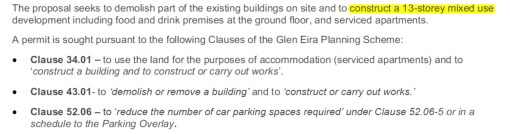
The application under consideration is 300 Glen Eira Road, Elsternwick. The proposal is for a 2 storey building contained 6 two bedroom apartments. The site is zoned Neighbourhood Residential and following Wynne’s C110 amendment, the mandatory number of 2 dwellings per lot is now removed. The officer recommendation states, with its usual waffle and imprecision – …the proposal is considered on balance to be generally in accordance with requirements of the Glen Eira Planning Scheme”.

Of significance is the following:

Proposed site coverage is 63%. Council’s schedule to the Neighbourhood Residential Zone requires a site coverage of 50%

Proposed permeability is 16%. Again, council’s schedule demands 25% – but officers believe that 20% is okay!

Here is the ‘justification’ for this largesse –

Several council meetings ago, we had Esakoff espousing the importance of adhering to site coverage in an application that had 63% coverage as opposed to the ‘standard’ of 60% (in housing diversity area). Now we have the situation where 13% over the standard is deemed ‘acceptable’ and instead of demanding the 25% for permeability, officers regard 20% as ‘satisfactory’. Compounding the issue even further is this sentence – Whilst the proposal does not meet some of the ResCode standards, the variations to the standards can be justified based on the immediate character of the neighbourhood. Permeability and site coverage have nothing whatsoever to do with Rescode. They are part of the schedules and hence should be adhered to in any recommendation.

We also have to query why council officers do not really know whether or not the plans meet the required garden area component of the planning scheme. If they did know, as they should prior to making any recommendation, then there would be no need for this paragraph in the imposed conditions

A survey plan prepared by a suitable qualified land surveyor demonstrating that the site has a minimum of 35% garden area in accordance with the definition of garden area within the Glen Eira Planning Scheme 

The site is 890 square metres. According to the legislation this requires 311.5 square metres of ‘garden area’. Surely it is not too hard to look at the plans and determine straight off whether this mandatory requirement has been met from the outset? Of course, the recommendations overall make a mockery of what is currently in council’s planning scheme when we find the following clauses and then consider the recommendations.

Ensure that site coverage is low to reflect the garden character of Glen Eira’s residential areas

To ensure that site coverage reflects the differences in character between housing diversity areas and minimal change areas

To maintain the open landscaped front yard which is a strong characteristic of Glen Eira.

Consider developments of more than two dwellings provided it is clearly demonstrated that the standards for site coverage, rear setback and private open space in the Schedule to the Neighbourhood Residential Zone have been met.

There are plenty of other things that could be said about this officer’s report and the recommendations – ie child care centres do not operate under the NRZ schedules. They have their own far more ‘liberal’ policy. Neighbouring dwellings (ie Garden Street) date back to 1996 and are hardly a feasible benchmark given the changes to planning since then. All in all, this report reveals what a disastrous state planning is in Glen Eira!

Alarm bells should be ringing loud and clear following council’s report in the current agenda on results of the significant tree register consultation. Yes, there is acknowledgement that the vast majority of the feedback supports tree protection on both private and public land. The problem lies in what council proposes to do with this feedback and how it will be implemented, overseen, and what results are likely to emerge. Of course, the next question is WHEN will anything be done and will it be worth a cracker?

The recommendations read as follows:

That Council:

  1. notes that community consultation indicates support for tree protection on both public and private land.
  2. commits to developing controls to protect trees on private land.
  3. notes that officers have formed a set of objectives in response to community feedback to protect trees.
  4. requests officers to present a report with options for controls that best protect trees in line with the set of objectives.

All well and good (perhaps), until we get to the ‘objectives’ that have been set.

OBJECTIVE 1

Seek to strongly protect significant native trees on both public and private land as a matter of priority. 

At no stage throughout this consultation was there any mention of protection FOR NATIVE TREES ONLY! Glen Eira abounds with a multiplicity of ‘foreign’, introduced species. Does this mean that they will be ignored? That any ensuing tree register will only accept ‘natives’? If this isn’t the intent, then why is this word so deftly and innocuously placed in this objective?

OBJECTIVE 2

Seek to provide a review mechanism for removal of large trees on private land which takes into consideration both value of tree and reason of removal. 

Does this objective only apply to ‘large’ trees? And what is a ‘large’ tree anyway? And who decides? Strange indeed, especially since we are told that there were 18 ‘tree attributes’ that might be considered for the register. This is now reduced to the one criterion of ‘large’!

Given other comments in the officer’s report, the language of ‘review mechanism’ is also cause for concern. On the potential appeal process we get this:

The second round of consultation signals strong support for some type of limited appeals process. However, careful reading of Community Voice survey questions and responses indicates the community feel strongly about having an opportunity to speak publicly about the removal of significant trees, particularly those on public land. This may be able to be achieved through an alternative to an appeals process. 

Other councils (Bayside, Stonnington, etc) have no problem with a straight forward appeal process. Yes, it would cost the owner and council some money. These councils work on the basis that (1) a permit is required to remove or lop a tree on private land. If refused by council an arborist’s report accompanies the refusal. The developer/owner can then appeal and provide his own arborist’s report. Council then makes the final decision in an open and transparent way at a full council meeting! Hardly rocket science!

OBJECTIVE 4

This objective is the acme of gobbledygook plus inserting all those necessary loopholes that would actually limit consultation. Further, the question needs to be asked – why do we even need community consultation on separate, individual tree issues? If the process is in place (as outlined above for appeal matters) then there should be no need for any more ‘consultation’!

Explore the possibility of a mechanism for the community to voice opinions about proposed tree removal, including who, when and why feedback can occur, noting certain controls may have limitations regarding community input.

OBJECTIVE 6

Define the relationship between tree protection and land development  

Readers are free to read as much, or little, into this sentence as they like. It is a catch all, meaningless statement – especially since the report confirms that the majority of responses deemed trees more important than (over)development! It also ignores the fact that once again other councils such as Monash, Whitehorse have as part of their Planning Scheme a Tree Conservation Policy that establishes clear parameters for when trees may be removed from development sites.

There are many other points that could be made about this report and what it suggests about council’s overall intent. Here are some further comments to consider:

  • The report states that 93% of respondents were in favour of a tree register and that “no alternatives to a tree register were suggested”. Since residents weren’t informed about possible alternatives, then it is not surprising that this is the result. You get what you ask for! If the consultation was intended to be ‘comprehensive’ and open-ended, then why weren’t residents informed that:
  1. Tree registers generally only include between 100-250 trees
  2. That tree registers can be included in the planning scheme itself, rather than remain as part of the less powerful Local Law.
  3. Will residents be given the opportunity to nominate those trees they wish to see on any list or will this be the exclusive domain of officers?

The report concludes with – The next step is to pursue options for tree protection controls in Glen Eira that meet the objectives. But if the objectives are so limiting and vague, then we can only conclude that tree protection in this municipality still has a million miles to go before residents get what they’ve been asking for since at least 2003!!!!!!!!

Households win right to fight for sunlight on their solar panels

By Adam Carey & Benjamin Preiss

11 September 2018 — 6:34pm

Homeowners with rooftop solar systems will be protected from neighbouring property developments overshadowing their roofs under changes to planning rules the Andrews government has introduced.

The new residential planning rules, to be brought in later this month, will mean that overshadowing of existing solar panels and hot water systems will have to be considered in residential planning decisions.

While the new planning regulations will not give homeowners any automatic veto over high-density developments next door, it will increase protections for the solar panels just as the Victorian government promises large subsidies for uptake of the technology.

A number of rulings from the state planning tribunal have called for a Victoria-wide law for overshadowing of panels, as up until now access to solar power has been largely decided on an ad hoc basis.

There will also be new guidelines for solar panels installed in heritage listed neighbourhoods, specifying appropriate colours, positioning and design.

Source: https://www.theage.com.au/politics/victoria/households-win-right-to-fight-for-sunlight-on-their-solar-panels-20180911-p50355.html

The latest ABS building approvals show Glen Eira still well ahead of all dwelling projections. These figures simply make a mockery of council’s claims that there is the need for doubling the size of activity centres and the newly introduced height limits of 12 storeys in Carnegie and preferred 12 storey height limits in Elsternwick.

We remind readers that Plan Melbourne Refresh includes projections from 2015 to 2051.

Council insists on using figures that ignore the 2015 projections and start from 2016. Even granted this sleight of hand, Glen Eira is well and truly meeting its obligations . Plan Melbourne Refresh sets an aspirational figure of 125,000 net new dwellings in the 4 municipalities (Bayside, Boroondara, Stonnington & Glen Eira). Even if Glen Eira is supposed to accommodate 30% (rather than 25%) of these new dwellings, that means 37,500 dwellings by 2051. Thus 2015 to 2051 equals 36 years and produces a requirement of 1041 net new dwellings per year.

The ABS building approvals reveal that Glen Eira is tracking on average at close to double those figures. Furthermore, the overwhelming majority of these permits will have been enacted well before 2051!

For the last 3 years alone (ie 2015-July 2018) Glen Eira has had 6424 building permits issued. When we remove the ‘houses’ numbers (ie no net increase) then the figure for this period is 5430. That’s an average of roughly 1750 for this entire period and Plan Melbourne Refresh data requires only a tad over 1000 net new dwellings per year.

We’ve uploaded the ABS data HERE and ask that residents pay careful attention to the following tables that capture the long-term dwelling increases.

The figures that council produces simply don’t add up. And, as we have repeatedly stated, if the figures are awry, then all that follows is also awry. Council is yet to produce one single scrap of hard evidence that supports 12 storeys nor the doubling of activity centre sizes.

We’ve received the following email from a resident –

There is very little transparency or accountability in Glen Eira. Most decisions are made by Council officers, possibly under delegated authority, but with little public evidence about who made what decision, why they made it, or what relevant considerations were actually considered.

14-22 Woorayl St is a case in point. I was an objector to a permit amendment request. There was no record in the Planning Application Register of a permit extension, so I went along to the Planning Conference to find out why the original permit hadn’t elapsed after some years. It was only at the conference that I was told, verbally, that an extension had been granted.

I asked whether the extension request had been assessed against the Kantor principles. Council claimed it had. That was extremely unlikely given the circumstances so I asked for a copy of the report that should have been written documenting the assessment. The council officer refused, but the Mayor in his role as chair said it would be made available to me.

Also at the meeting a lady asked why it was acceptable for her elderly parents to be in permanent shade on an abutting property. Council couldn’t explain why but the applicant expressed the pious hope that “it would have been carefully considered at VCAT”. The published VCAT decision makes it clear it wasn’t carefully considered.

Eight minutes before the Council meeting to consider the amendment request I received an email from the Mayor making a half-hearted attempt to explain the decision to grant an extension. There was an attached document, written only a few hours earlier. No officer was identified as making the decision, there was no date on the document, but there was metadata in the PDF identifying the author and creation date.

Critically the document didn’t mention Kantor principles, nor the “seriously entertained planning proposal” principle. It argued that policy hadn’t changed and therefore the outcome was likely be the same if a fresh application was lodged. That was far from truthful. Council had resolved to request Amendment C148 5 months earlier. It was a seriously entertained planning proposal, it was public knowledge, it changed planning policy, and as we now know, it did become part of the planning scheme. It introduced height controls to the Scheme that 14-22 Woorayl didn’t comply with.

I don’t support the officer recommendation to give officers unlimited freedom to undermine Council policy. There’s a lot of things that need to change about the culture first. The Planning Application Register should contain details of all decisions, including permit extensions. It should contain the date when each Permit expires, and be updated when extensions are granted. There should be a publicly accessible record of reasons for decisions made under delegated authority. There should be checklists of all matters that must and should be considered when making planning decisions, and those checklists used to verify compliance. Delegated authority should be constrained or limited to implementing Council policy. If there are inconsistent policies, get Council to resolve them.

For more information about Kantor principles and the role of seriously entertained planning proposals:
http://blog.vgso.vic.gov.au/2015/01/running-short-on-time-seven-key.html
http://clause1.com.au/seriously-entertained/
http://www.austlii.edu.au/au/cases/vic/VicSC/1997/167.pdf
http://www.austlii.edu.au/cgi-bin/viewdoc/au/cases/vic/VCAT/2003/448.html
http://www.austlii.edu.au/cgi-bin/viewdoc/au/cases/vic/VCAT/2014/993.html

+++++++++++++++

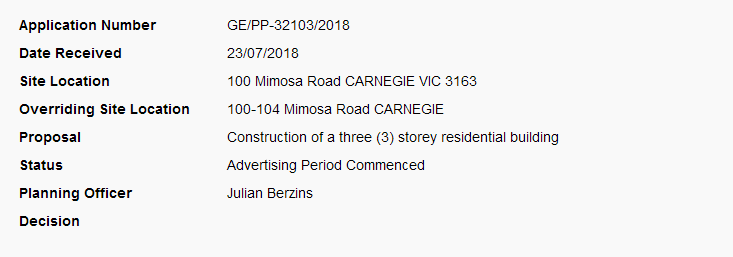
Council’s planning register is the perfect example of the lack of transparency. It fails to:

  • pinpoint who made any decision (ie delegate, council or VCAT)
  • provide details of amendments
  • collate all information pertaining to the site in one record
  • and certainly no indication as to any payments made

By way of contrast and what can and should go into a planning register, we present one example from Bayside. Readers should note the final permit is available; reasons for refusal are available; dates and times for every single action are provided.

Even more interesting is the following example from Stonnington where the amount paid in the Open Space Levy is there for all to see. Given that Glen Eira council has admitted that not all levies are paid (as they should be) such information becomes essential –

In Glen Eira the philosophy is to make it as difficult as possible for residents to have any idea as to what is going on – particularly when it comes to planning and finances!