It looks like all chickens have finally come home to roost with VCAT’s decision to allow the Elsternwick 10 storey development to go ahead. Readers will remember that:

  • Lipshutz’s argument was that if council doesn’t approve 8 storeys instead of ten, that the developers will go to VCAT AND GET WHAT THEY WANT
  • Tang equivocated by arguing that 7 storeys is better than 8
  • Magee said that he wouldn’t like to live anywhere near the development but still voted for it
  • Lobo called it a ‘monstrosity’.

The sheer stupidity (and we use this word advisedly) of such arguments has finally been shown up for what they are – vapid, empty rhetoric with no foundation in law, fact, or good planning policy. Councillors should be ashamed of their efforts on this one and the ramifications of such decision making. Will they now, on the 14 storey application, vote in favour of 12 storeys and use the argument that since VCAT has approved the Ripon Grove development we can’t do anything?

The VCAT member made the point clearly and logically when he stated:

“Council recognised the importance of this key site in granting a conditional permit, however restricted the height of the building to eight storeys rather than the ten storeys applied for. One need to ask what difference either eight or ten storeys would make to the locality or the broader context of the major activity centre of Elsternwick”.

What this decision demonstrates is not the arbitrary nature of VCAT, but the failure of council planning policies (NO HEIGHT LIMITS, NO PRECINCT PARKING PLANS, NO STRUCTURE PLANS). Councillors have now successfully opened the flood gates in Elsternwick and they will bear the brunt of resident disaffection.

We highlight one recent VCAT judgement   where the application for a three storey extension to a shop and the waiving of car parking was accepted by the member. Council’s position was that the fronting car park should not be utilised as car parking for the development, and that there be onsite parking. 

This sounds reasonable – on the surface! Closer examination reveals the flaws in current planning policy and the agendas which guide such policy. In the end it’s all about leaving as many options open as possible for future development. Structure plans, height limits, and precinct car parking policies would in effect limit such development. The members judgement below makes this absolutely clear – 

“The Council’s opposition to the proposed rear shopfront also appears to be partly based on a potential future scenario where the car park may be redeveloped in an intensive manner. The concern is that any such redevelopment may be constrained by the fact that the shop has its only access and outlook to this area, and/or that any such future development will detrimentally affect the visibility and viability of the shop by effectively concealing it from view. While I can understand Council’s concerns, it is highly relevant that there are currently no plans to redevelop the car park.

There is no Structure Plan for the activity centre, no planning policy in the Planning Scheme which identifies this as a potential outcome, nor any Council-adopted strategy or other policy which nominates the public car park as a redevelopment site within the centre. It appears to me to be a case of the Council, somewhat understandably, wishing to ‘keep its options open’ but there is no evidence that this potential outcome will, in fact, materialise. The necessary strategic work has not been undertaken, and to constrain the redevelopment of neighbouring sites on the basis of something that ‘may’ happen some time in the future (in the absence of any policy or strategy) does not seem to me to be reasonable.” 

The following section also raises questions as to how well council prepares in its VCAT defence. The lack of logic, shown up by the member, speaks for itself –

“I was advised that the Council’s Building and Properties Department does not recognise any carriageway rights the review site may have over the laneway. It is noteworthy that the Certificate of Title identifies the laneway as a ‘Road’. I was not provided with any evidence to demonstrate that the review site does not have a legal right of carriageway over this road. Nonetheless, I perceive an inherent contradiction in the Council’s position on this issue. It is willing to support the proposal subject to the provision of four car spaces on the land (as I will detail in the following section of these reasons) and therefore acknowledges rights of carriageway over the laneway for the purposes of accessing these desired car spaces, but it is not willing to acknowledge these carriageway rights for pedestrians accessing the proposed shop. As I see it, the review site either enjoys carriageway rights over the laneway, or it does not. I was not referred to any document which states that the review site can rely on the abutting road (laneway) for vehicular access, but it cannot do so for pedestrian access”.

Conclusion? We merely repeat the member’s comments – ie. ‘necessary strategic work has not been undertaken’; ‘no evidence; ‘contradictory’ and so on……..

How good is Glen Eira at running commercial enterprises? How good are their business plans? How good is their homework? How comprehensive is their analyses of current commercial climates and how good are they in estimating where a dollar could be made? Looking at history, we have to conclude that their track record on commercial endeavours is exceedingly poor. GESAC is starting to sound like it might be the latest white elephant.

Most landlords (and that’s what council is when we consider GESAC) will have ironclad contracts in place. They simply hire out space and it is up to the tenant to outfit the place, provide staff, and do whatever is necessary to make a buck. The owner is simply there to ensure that everything is safe and above board.

GESAC has been calling for ‘expressions of interest’ for potential tenants for several months. The propaganda machine has been in full swing. We’re told that everything is on budget, that 5 zillion tons of concrete have been laid, etc.etc. What we haven’t been told is how many commercial operators have actually shown any interest whatsoever? And of those that might have applied, how many have been deemed as ‘suitable’? This Saturday’s Age Tender advertisement has given us further cause to doubt the business acumen of Glen Eira. Here’s the ad –

“Reference No.: 2011.034
Provision of Gymnasium Equipment to Glen Eira Sports and Aquatic Centre

Requirement: Provision of a suite of gymnasium fitness equipment including installation, ongoing maintenance and centre staff training.”

One very feasible conclusion that could be drawn from this ad, is –

  • There has not been any expressions of interest (or at least not considered viable)
  • If, as a last resort, council is contemplating ‘managing’ this itself, then what’s the cost?
  • Does this mean that instead of rent coming in, council will be forking out to guarantee that all premises are occupied?
  • Where will this added ‘cost’ be itemised in budget figures, and will the final figures really reveal the truth? Will we still be told that the ‘cost’ is $41.2 million?
  • How well did the ‘business plan’ foresee the possibility of commercial disinterest?
  • How many actual ‘expessions of interest’ have there been overall? Are we dealing with something that will end up costing the community millions and millions simply because planning, strategising, and other considerations are proving to be inaccurate? Who should take the blame for this?

The bottom line is clear. Organisations only go to tender, and pay for services themselves, when they have to – that is, when no-one is interested! Of course we could be wrong in all of the above, as so many Anonymous responses tell us. So, what’s everyone elses take on that tender advertisement?

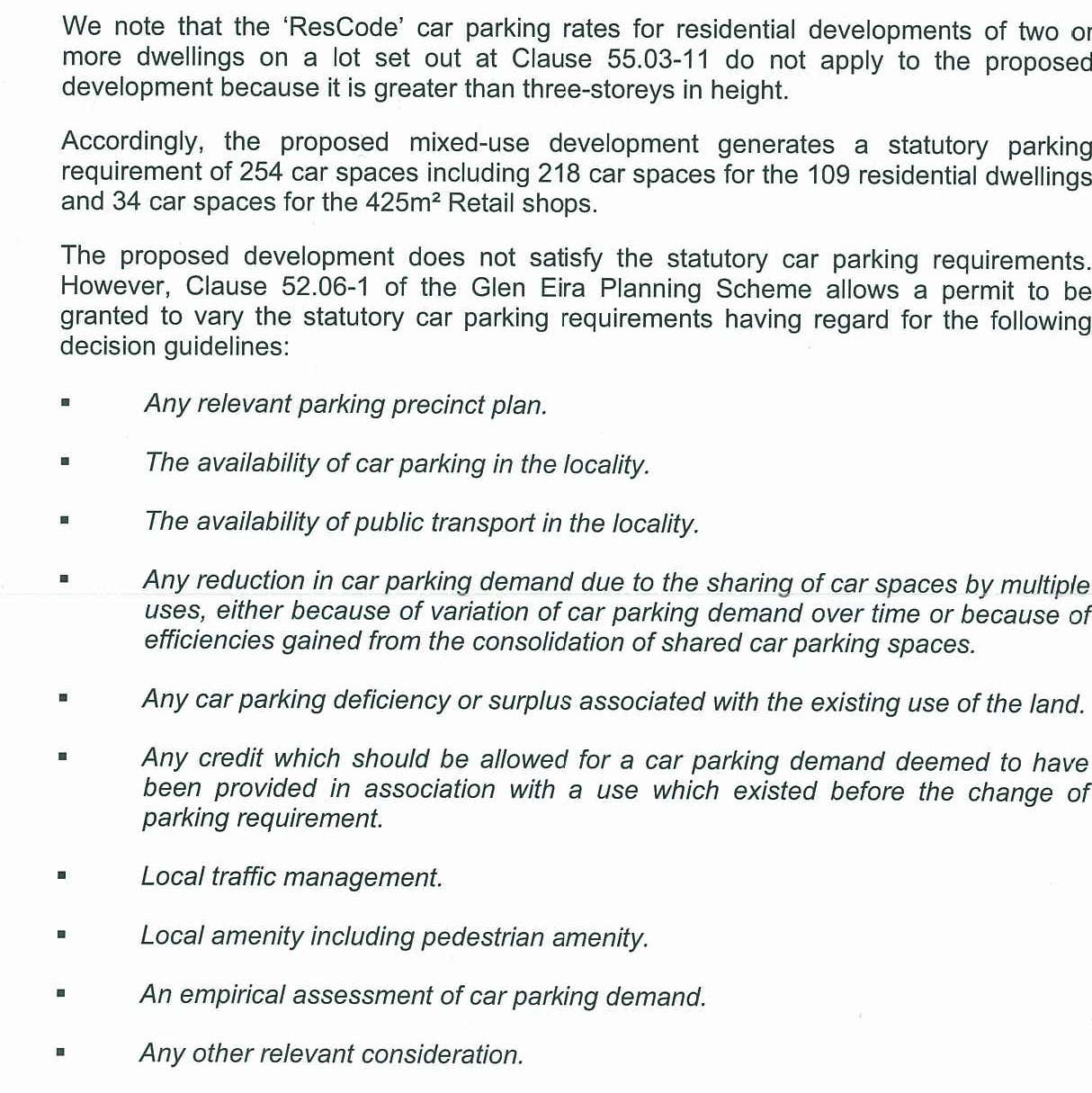
Our rumour was correct. An application is in for a fourteen (14) storey development almost next door to the 10 storey development in Glen Huntly Rd., Elsternwick.

To view the full details of the plan, see: http://www.gleneira.vic.gov.au/Page/page.asp?Page_Id=1759&h=0

Lowlights include:

  • Waiver of carparking and loading
  • 109 residential apartments
  • Developer’s traffic engineer states: “there were at least 162 vacant spaces within the survey area from 7pm onwards”. Other conclusions of note in regards to parking are:

From Council’s Website:  
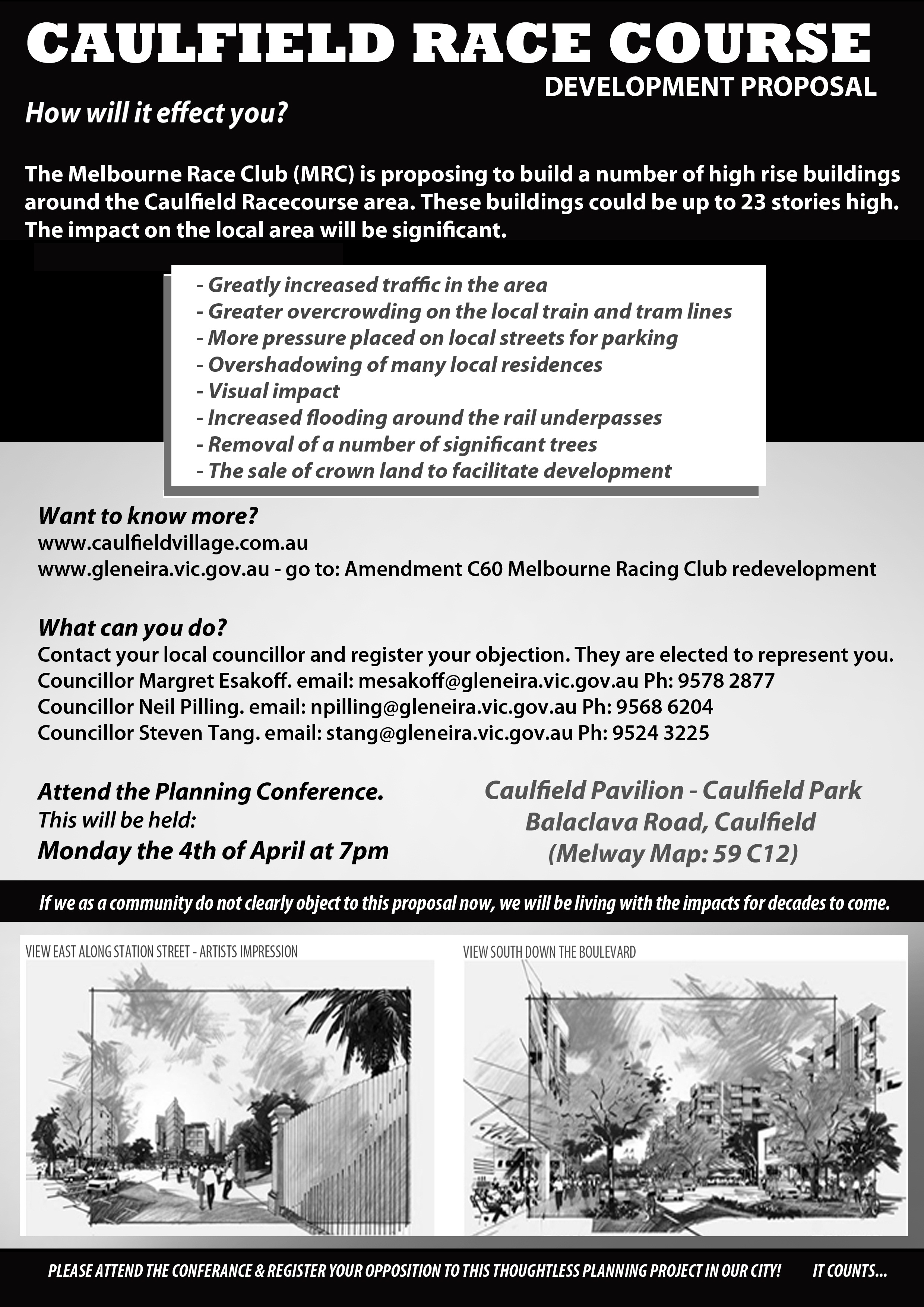
On 23 March 2011, the MRC contacted the Council and requested that the Planning Permit Application for “Works in the centre of the Reserve for the construction of a carparking area, fencing, amenities, playground equipment and sporting/fitness equipment” (Planning Permit Application No.: GE/PP-23061/2010) be placed on hold until such time as the MRC has concluded its discussions and negotiations with Glen Eira Council in regards to the extent of these works.

Accordingly, this planning application is not before the Council and will not be considered at the Meeting on 4 April. The only item will be Amendment C60.

Secrecy is of course appropriate in some cases. But not when it denies residents access to vital policy documents, strategies and plans. Glen Eira is unique in its commitment to provide as little information as possible to its residents and if it is provided, to hide it away so that access and easy retrieval requires the skill of a Sherlock Holmes, together with the nose of a trusty bloodhound! Why?

We’ve written that secrecy and transparency do not mix. Secrecy invites speculation; it encourages distrust; and it reinforces a siege mentality – all counterproductive. Yet this is the way that this council has been perceived for years. Residents are not viewed as colleagues and/or collaborators in planning, setting visions for the future, or merely partaking in democratic processes. They are viewed as troublesome cash cows that need to be managed, sidelined and ignored whenever the legislation unwittingly allows for such manoeuvres.

The availability, or lack thereof, of major policy documents is a case in point. In contrast to neighbouring councils, Glen Eira’s website is deplorable in its content and design. No direct links on the home page to ‘policies’, ‘strategies’ or ‘plans’; searches under ‘policies’ lead to planning documents that are archaic, dating back as far as 1999 and so on…..

This we suggest, is more than poor web design but intended to make things as difficult as possible for residents AND to possibly cover up the fact that in contrast to other councils, Glen Eira is really bereft of up-to-date policy development that matters. For example: there is no sustainable design strategy; there is no transport strategy; there is no gambling strategy that we could find and it goes on and on. Our point is simple: all policies, all strategies should be out in the open and easily accessible.

Below are the policies/strategies from other councils, all accessible via direct links from the home page. Those with an asterisk indicate the areas that we believe Glen Eira does not have any official policy. Council plans, budgets, codes of conduct, etc. have been omitted from the list.

BAYSIDE:

Cultural collection and management policy

Cultural collection policy*

Economic development strategy*

Electronic gaming policy*

Municipal Emergency Recovery Plan – Municipal Arrangements

Municipal Emergency Recovery Plan – operational Arrangements

Register of significant trees policy*

Sports facility policy*

Tourism strategic action plan*

Whistleblowers/Improper conduct

Youth policy

PORT PHILLIP:

Heritage recognition program policy and strategy

Sustainable design policy*

Waste wise strategy

Youth framework

Playground strategy

Memorials and monuments*

Port Phillip Collection Management Policy

Festivals Framework*

Urban History consultative committee*

Inner Melbourne Action Plan*

Climate Change Commitment*

Active and Creative City Framework*

St. Kilda Botanical Gardens Future Directions Plan

Fisherman’s Bend Planning and Economic Development Strategy

Greening Port Phillip: An Urban Forest Approach 2011*

Industry and Business Strategy*

Housing Strategy 2007

Beacon Cove Planning

Activity Centres Strategy

Ormond Road Urban Design guidelines

Governance Statement*

Good Governance guide

KINGSTON:

Alcohol and Other Drugs Action Plan*

Fire Prevention Plan

Gambling (Poker Machines) Strategy*

Graffitti management Plan

Guide to Business Conduct*

Open Space Strategy

Public health Plan

Whistleblowers Act

Kingston Biodiversity Strategy*

Kingston Industrial Strategy*

Investment Policy*

Pandemic Influenza Plan*

(http://www.kingston.vic.gov.au/Page/Page.asp?Page_Id=2394&h=-1 – Policy Manual)*

STONNINGTON: 

Art Acquisition Policy*

Caretaker Policy

Cultural Diversity Policy*

Disaster Relief donations Policy*

Key to the City and Freedom of Entry Policy*

Responsible Gambling Policy*

Road Safety Policy*

Sustainable Transport Policy*

Stormwater Environmental Management Plan*
Today’s Caulfield Leader Advertisement (tiny) on Page 12 –

CAULFIELD RACECOURSE PRECINCT

SPECIAL COMMITTEE MEETING

4 April 2011

Notice is given pursuant to Section 89(4) of the Local Government Act 1989 that a meeting of the Glen Eira City council Caulfield Racecourse Precinct Special Committee will be held on:

  • Monday 4 April 2011 in the Caulfield Pavilion, Caulfield Park, Balaclave road, Caulfield commencing at 7pm.

The business to be transacted at this meeting will be:

  • Melbourne Racing club (MRC) Planning Scheme amendment C60 and a planning application for works in the centre of the reserve – to hear oral submissions from interested parties (a maximum of three minutes per submission)

The Glen Eira Audit Committee Charter (Council Minutes: 22nd July, 2008) states:

Term of Membership
Independent members of the Committee are not officers or employees of Council and have no executive powers. Independent members shall be appointed for an initial term of three (3) years after which time they will be eligible for reappointment. No independent member is to be appointed for more than two consecutive three year terms unless Council resolves otherwise. Terms will be scheduled to facilitate continuity of the Committee such that no more than one Councillor and one independent member’s terms cease within the one year”

The current independent members of the Audit Committee (Gibbs and McLean) have been on the committee since at least 1997 in Gibbs case, and McLean possibly soon after. That makes it roughly 14 years straight – and now it looks like they may have been granted another 3 year ‘extension’ bringing the grand total of consecutive service to close on 17 years! Even more disquieting is the way in which these reappointments have been handled – all executed via single, camouflaged one liners in Council agenda items.

The in camera items of February 22nd,  2011 read: “under s89 (2)(a) “personnel” which relates to Audit Committee Membership”. Identical items are noted in the minutes of: 22nd May, 2006; 8th April, 2008; 24th February, 2009 and the 17th March, 2009. So it appears that each time either Gibbs or Mclean’s term of service is close to finishing, there appears this single innocuous and buried item that is voted on in camera. Yes, this fulfils the legal requirements of a ‘council decision’, but we have to ask:

  1. Why is this done in secret? Why is there no public announcement of reappointment? Why is there no recommendation from the audit committee that is minuted? Why on earth does such an item deserve the classification of ‘confidential’ unless the intention is to keep this from the public?
  2. Why does every other council we have looked up include such items in their Audit Committee minutes (ie. recommendation to reappoint or advertise) and some even issue a media release on the subject. Yet, Glen Eira is always silent, always secretive.
  3. Why does Newton insist on this practice – since he alone declares an item to be ‘confidential’ and determines that it be listed for in camera discussions?
  4. What of all the other councillors? Do they question? Do they want to know why the reappointment is so ‘secret’? Does anyone even think that 17 years of the same independent members of an Audit Committee is not according to current best practice and especially the recently released Minister’s Guidelines? Or is the simple fact that amidst the mountain of papers landed in councillors’ laps, this one single sentence is somehow engineered to escape notice?
  5. What does Newton have to gain by such secrecy? And what does this do to the public’s perception of the governance practices within Glen Eira?

Perhaps a few interesting examples from the minutes of Glen Eira’s Audit Committee meetings require reflection by residents –

Feb 5th, 2008 – “Mr McLean suggested that for future audit reports the internal auditor’s comments could be more positively stated. For example, under item 1 “Total purchase from vendors” on page 2 of the report, the wording “all the above appeared to be reasonably justifiedbe changed to all the above were justified

14th December, 2010 – “The Chairman stated that he and Mr McLean would meet separately with Management to discuss further enhancement of the BCP (Business Continuity Plan) documents.” 

Secrecy is the hallmark of Glen Eira and as we’ve said, the modus operandi of its administration. But it relies on complicit and compliant councillors in order to succeed. The result is to the detriment of the community and to the principles of accountability, transparency and good governance.

We have long maintained that the modus operandi of Glen Eira Council is secrecy and more secrecy.  In particular, there appears to be a distinct lack of ‘openness and transparency’ between administration and councillors. At last council meeting, our suspicions were verified.

In response to Cr. Penhalluriack’s question to Newton regarding the potential risk associated with the Glen Huntly mulch facility, Newton responded:

“The report that Cr Penhalluriack is referring to went to the Audit Committee at the Audit Committee’s request on the 24 February which is three weeks ago. All recommendations are being implemented. Had I been given notice of these questions I would have answered them tonight but I was not given any notice. I’ll have to take them on notice for later reply.” 

Now why on earth should the audit committee have to ‘request’ anything? If the organisation is at risk, then it is absolutely incumbent on Newton to table that information asap. This was obviously not done, and it appears that ‘action’ was initiated only as a consequence of Penhalluriack’s urging. 

This is not the first time that we have had to query exactly what information is disseminated to committees and councillors by the administration. There was the recent instance where Glen Eira faced over 40 criminal charges over the Clayton tip and a potential fine of millions. Nothing was published, and we suspect, that perhaps none, or very few councillors knew this was happening. Then there is also the MRC and Newton ‘negotiations’ where another ‘request for a report’ had to be turned into a formal Council resolution before any information was forthcoming. 

To make matters worse, the audit committee’s charter omits practically all reference to administration. Port Phillip on the other hand, makes it abundantly clear what it considers to be the role of administrators and their duty to keep committee members informed and cognisant of any potential risks. We quote:

“The Committee is to be kept informed by Council management regarding financial reporting, risk management and risk exposures of the organisation”.

Nothing like this appears in the Glen Eira charter, leaving councillors, committees and others, literally with their pants down! 

Newton must be accountable to council and he must explain:

1.    Why the report was not provided to the audit committee without being ‘requested’

2.    How long did it take for councillors to be made aware of the potential risk?

3.    Which delegated authority allows Officers to deal with such risk matters without reference to the Audit Committee and/or Council?

4.    Who are the Policy Officers who  administer risk matters of such nature?

6.    When will the charter be tightened up so that administrators are mandated to fulfil their obligations and cannot escape scrutiny because of poorly worded policies and documents?