September 23, 2014
September 21, 2014
Please read the following extracts from Item 9.9 of the current agenda (open space levies) very, very carefully. We believe that it shows in spades:
Continuation of the policy of 25 June 2013 could potentially undermine Amendment C120 in so far as it directs the expenditure of all funds on the provision and capital works improvements to new open space rather than also improving existing open space which will be used by the future population. Councillors have received an independent briefing in relation to this advice.
And the ‘recommendation’ –
Abandons the policy introduced before the 2014 Open Space Strategy entitled ‘Use of Public Open Spaces Contributions Policy’ dated 25 June 2013.
In case people have forgotten what this council policy promised we reiterate –
Council will only spend Public Open Space contributions it receives after 1 July 2013 to acquire and improve land to serve as additional public open space.1 (including the former Glen Huntly Reservoir)
Council will not spend Public Open Space contributions it receives after 1 July 2013 to improve land which is already public open space. (25th June, 2013)
With much fanfare, beating of the chest, and promise after promise, March 18th 2014 saw the following resolution (and promise) repeated –
Crs Pilling/Lipshutz
That Council;
So what does all this mean?
September 20, 2014
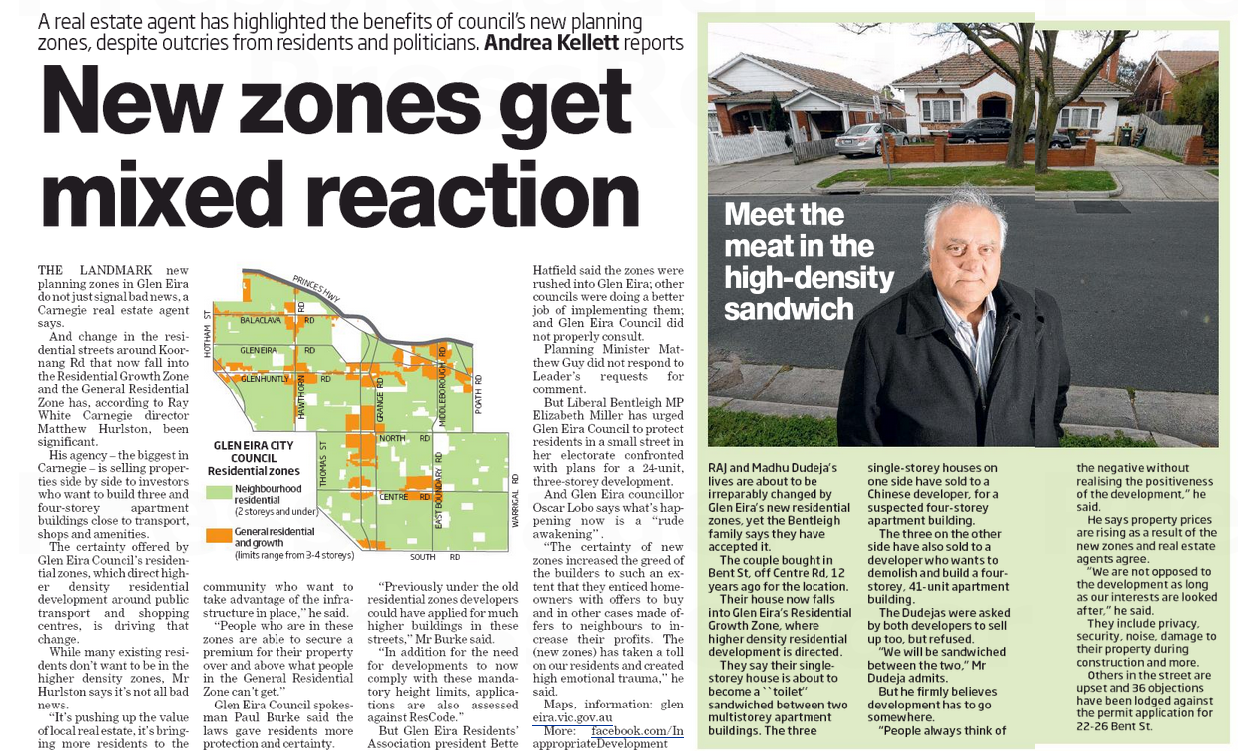
The rush for ‘larger than conventional lots’ in quiet residential streets is gaining momentum. Readers should note the sales pitch that is now standard – ie. ideally ‘zoned’ for ‘density’. From this week’s offerings!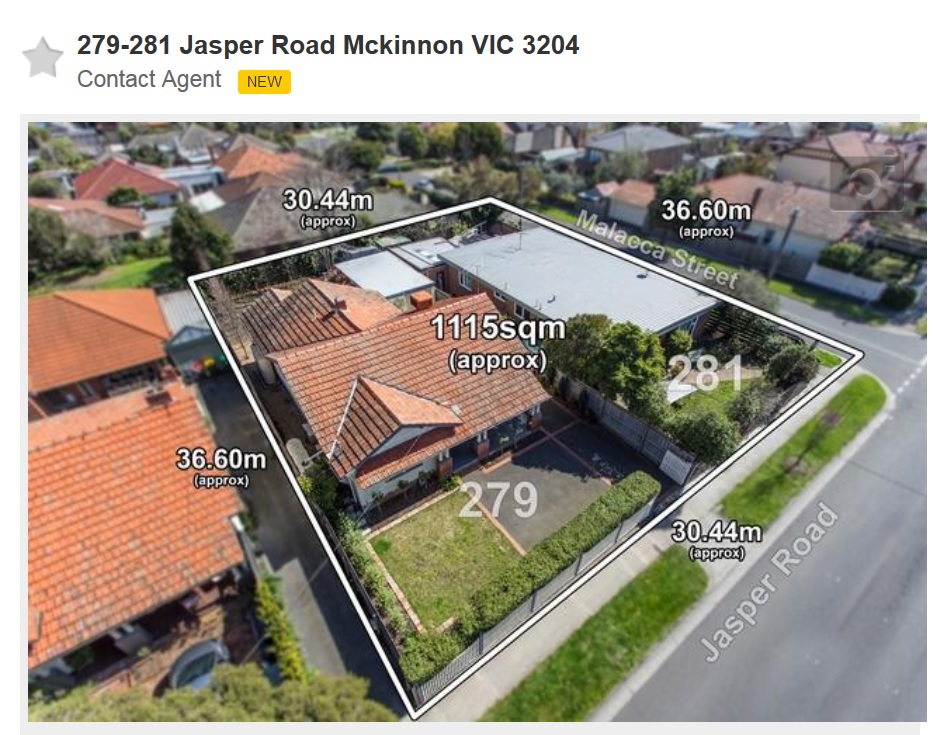
And the accompanying blurb for this Jasper road ‘combo’ reads –
Exciting development opportunity in the Residential Growth Zone
2 adjacent dwellings offered together
Site area of 1,115m2 approx.
Great development opportunity (STCA)
Versatile opportunity for development: boutique apartment block, townhouses, childcare / early learning centre (STCA)
Build either a multi – storey, multi – dwelling development, in the newly zoned ‘Residential Growth Zone’ in the heart of the of McKinnon College Zone
The two adjoining properties are being sold together and provide 1,115m2 of land area (STCA)
Flexible settlement terms available
Surrounded by excellent retail and lifestyle amenities, including the cafe culture of McKinnon village, McKinnon station, schools & parklands
279 & 281 Jasper Road, McKinnon is for sale through an expressions of interest campaign closing Tuesday 21st October at 5pm
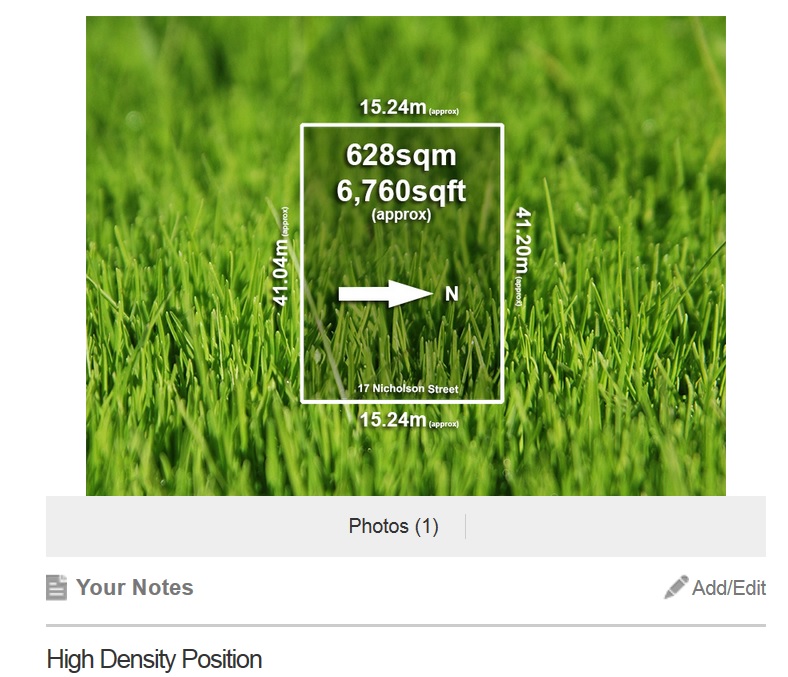
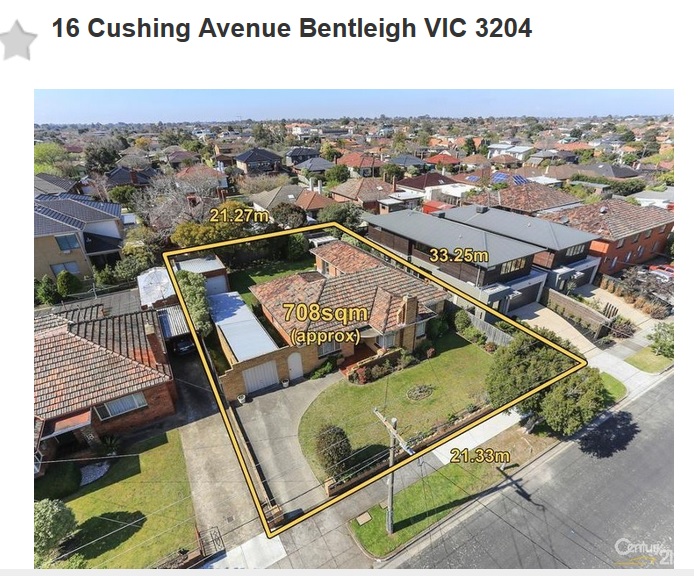
Blurb for this one –
bring your vision for prestige development (subject to Council Approval) and build wide to maximise streetfrontage, stand tall to capture views and add prestige to capitalise on an off-Centre, in-Zone address!
PS: We also remind readers that with the new zones that are so ‘developer friendly’, this Council refused to introduce a MINIMUM size for lot subdivision as most other councils have done. What this means is that properties can be subdivided and then subdivided again. A 650sqm block of land can feasibly result in 3 or 4 properties going up and that includes the supposedly ‘protected’ Neighbourhood Residential Zones!!!!!!!!!
September 19, 2014
We are becoming increasingly concerned over what, to all intents and purposes, appears to be the social divide that is occurring within the municipality. Whilst Bentleigh, Carnegie, and other areas are allowed to go to the dogs, certain areas appear to have the ‘protected species’ assigned to them – many being in Camden Ward!
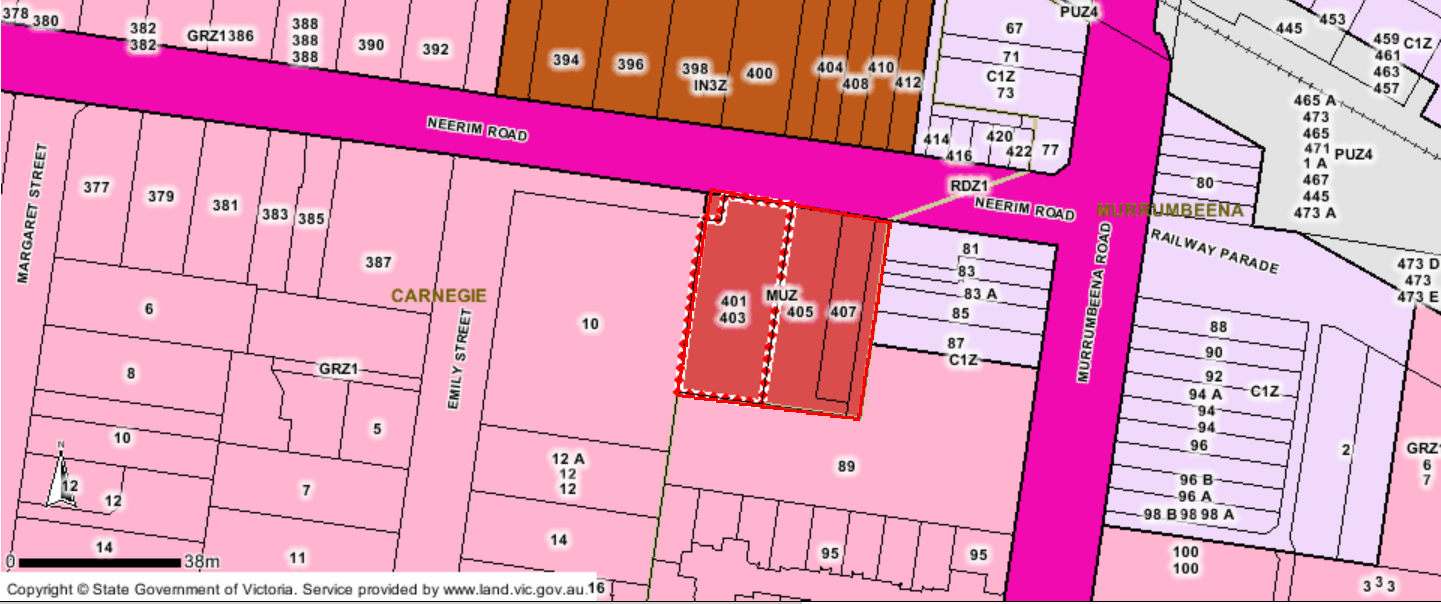
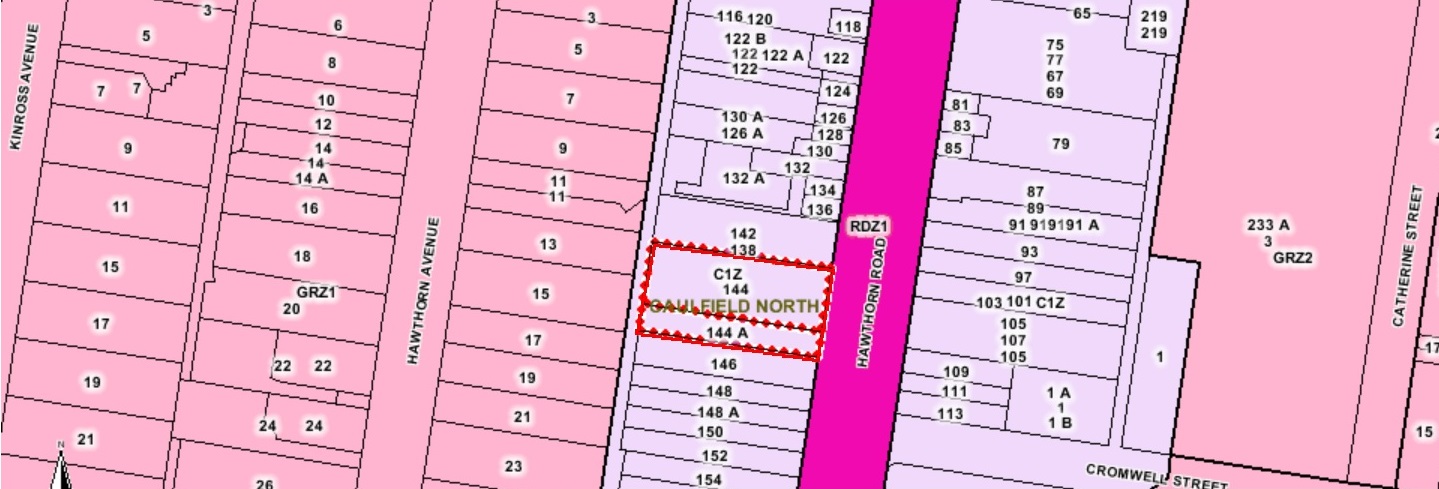
The latest agenda features 2 applications that would seem to endorse this view. One is for a 5 storey building of 3 shops and 57 dwelllings in Neerim Road, Carnegie. It is zoned Mixed Use (ie no height limits) and located in the Murrumbeena Neighbourhood Centre. Officers recommended a permit and the waiving of 4 visitor car parking spots.
The second application is Hawthorn Road, North Caulfield. It is zoned Commercial (again no height limits) and is seeking a permit for 6 storeys, shops and 40 dwellings. Both applications are surrounded by other Commercial zones and the General Residential Zone. Yet, officers decided to reject this second application outright and to pass the Neerim Road one.
It should also be borne in mind that council’s approach is often to chop off one floor and a handful of apartments and hence grant approval. This hasn’t been done for the Hawthorn Road application. So whilst the application seems to meet all the planning scheme requirements in terms of zoning, height, and even ‘mass’ it doesn’t get the nod. Instead we find some remarkable statements that are applied to one site, which didn’t enter council’s consciousness on applications in other areas. For example: council now appears worried about setting a precedent! They are also concerned about drainage, when countless applications are passed in Carnegie resulting in basement car park flooding – and this is when this report contains an engineering recommendation that the developer pay for extra drainage. No such additions have appeared in the countless officer reports for these other areas!
Thus we have to ask:
Finally, we’ve uploaded the two zoning maps for these applications and ask residents to ponder the ‘differences’ which results in one application being granted a permit and the other one a rejection by planners. We also wish to state that we are NOT endorsing either application. We make no comment on the quality of the proposed plans. We are simply concentrating on the officer comments and the resulting recommendations.
September 18, 2014
Caulfield Racecourse Reserve
Mr SOUTHWICK (Caulfield)—The matter I raise is for the Minister for Environment and Climate Change, and the action I seek is that the minister adopt the recommendations outlined in the Victorian Auditor-General’s Office report entitled Management and Oversight of the Caulfield Racecourse Reserve.
The report outlines that the trust has not been an effective manager of the reserve and that insufficient attention has been paid to fulfilling the potential for community use of this reserve.
It is important to mention that Caulfield Racecourse is one of most prestigious racecourses in Australia. It brings significant revenue into the state through racing and events. It hosts significant racing events, including the Caulfield Cup and the Caulfield Guineas, and was a training home of the legendary Black Caviar. In addition to a racecourse, the 1949 Crown grant designated the land as being for two other purposes: for public recreation and as a park. It would be fair to say that, despite the efforts of many, the trust has failed to deliver on the recreation and open space benefits to our community, which the report highlights. Without elaborating on the failure by the Labor government to properly administer land swaps and to take up recommendations from previous reviews, we are now in a great position to finally implement a management plan by taking up these recommendation to the benefit of both racing and community use.
Members would have heard me advocate in this place for more community use of the 54 hectares of land. We have seen racecourses, such as Happy Valley Racecourse, also having strong sporting facilities and golf courses in the middle of their reserves. We are perfectly placed to do a similar thing at Caulfield. I place on the record acknowledgement of the efforts of the current Melbourne Racing Club administration, which has demonstrated a willingness to adopt a plan that incorporates better public use of the facility. In 2012 I worked with the club and the City of Glen Eira to deliver a $1.8 million upgrade of the centre, including barbecue and jogging facilities. That project was funded by the racing club to encourage community use of the reserve.
Despite having done all of that, as we have known and as this report highlights, the community does not fully utilise this space because it is hard to get to. Caulfield Racecourse Reserve is desperately calling out for an active space plan to bring people into the centre of the reserve. We could do this through proper community consultation, which this report also suggests. I thank the minister and the current Department of Environment and Primary Industries administration for their commitment to fixing the inherent problems in managing this reserve and the work they have done so far with the trust.
The recommendations of the report include more rigorous oversight of the Caulfield Racecourse Reserve; adopting a governance framework consistent with contemporary standards, determining the trust’s responsibilities, powers and obligations; a community engagement strategy that can identify the needs and will ultimately result in a land management strategic plan that contains a clear and measurable outcome for use of Crown land consistent with the grant; and the exploration of alternative management arrangements for the reserve so it can be better placed to meet the needs of the racing and local community into the future.
Ultimately we are looking for the best outcome for all—the best outcome for residents and the community while keeping in mind that it is a racecourse.
I call on the minister to adopt all of these recommendations in this report. This is a once in a lifetime opportunity to get things right in this unique and valuable space known as the Caulfield Racecourse Reserve. I will give the community my undertaking to continue to fight for better community benefit in this great space.
September 17, 2014
The more we dissect Glen Eira Council’s new zoning, the more convinced we become of its total ineptitude. The latest atrocity is the manner in which the zones have been applied in relation to Heritage Overlays. The Planning Scheme contains the following statements in relation to Heritage – whether these overlays be in the equivalent of minimal change, or housing diversity. Here are some quotes –
The policy recognises that some locations in housing diversity areas may be constrained by their heritage significance or local flooding and that this could reduce their development potential.
Recognise that these areas may have a limited capacity for multi-unit development.
Ensure that residential development respects the scale, form and setbacks of buildings on properties affected by the Heritage Overlay and does not compromise heritage values.
Even the State Government’s Practice Note 78, makes it very clear what should be included in Neighbourhood Residential Zones as shown by the following –
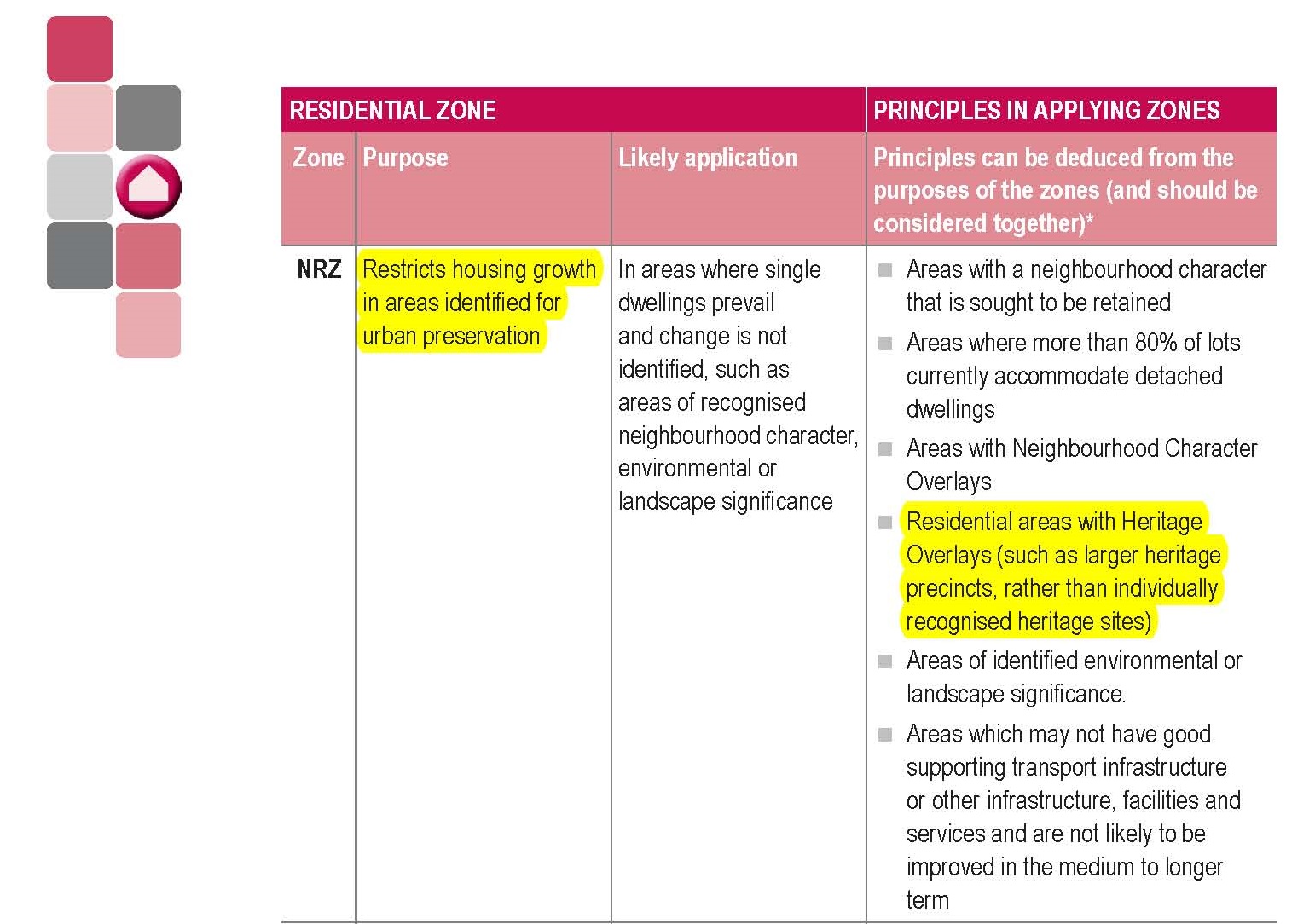
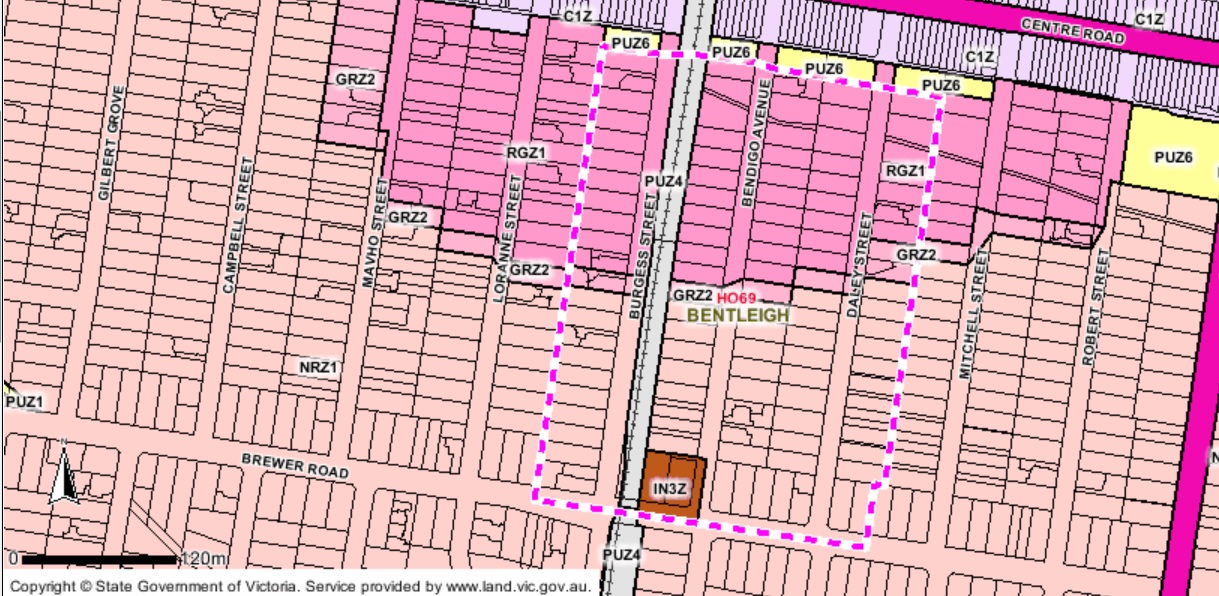
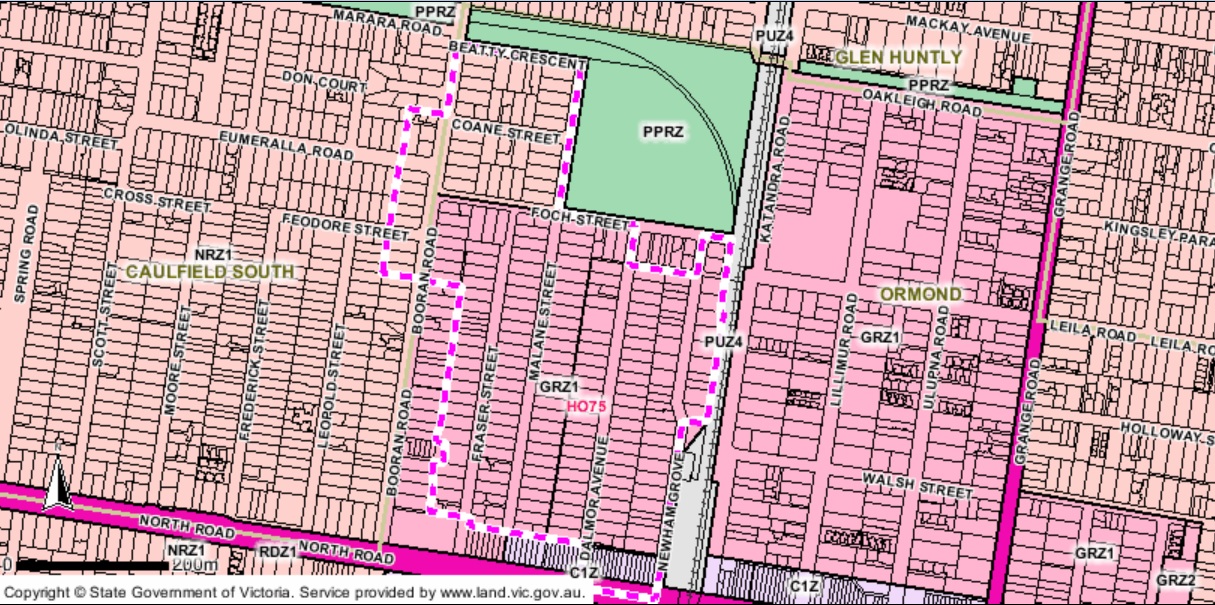
So what has our wonderful planning department done and which councillors have ticked off? Large areas that are included in Heritage Overlays have now been zoned as GRZ1 and even worse, RGZ– suitable for 3 & 4 storey developments respectively. The fate of these areas is now sealed. The pink lines in the maps below are the overlay borders for individual heritage overlays. Residents need to start asking how something like this has been allowed to occur?
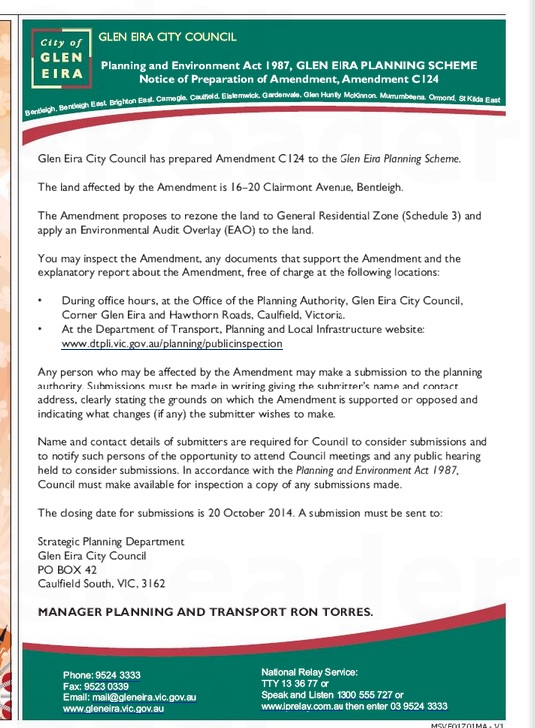
PS: The following appeared in today’s Moorabbin Leader. Questions need to be answered on this latest use of GRZ3 – ie the Alma Club current zoning.
September 15, 2014
The following extracts are taken verbatim from the MAV’s (Municipal Association of Victoria) guide to councillors on planning. (Uploaded HERE). Readers need to keep in mind that in Glen Eira:
“Planning for the future needs of the community is a challenging and vital councillor responsibility. Planning decisions shape communities and influence the physical environment and quality of life. They have long term consequences and can affect people’s livelihoods and amenity. A councillor needs to understand the important opportunities that the planning system provides to shape the future of the local community.
Councils also have a key role as representatives of the local community to advocate on the community’s behalf, particularly in the assessment of projects of state significance or proposed changes to state policy.
Generally speaking it is the role of councillors to set planning policies and direction, and the role of officers to carry out the administrative functions of the council at the direction of the councillors acting as a collective body.
Councillors have broad and active involvement in the planning system
It’s a good idea to participate in consultation to have a full appreciation of the proposal and the objectors concerns and often councillors can play a useful role in mediating solutions, where all parties are willing.
A councillor has a responsibility to be informed about planning permit applications that are presented to a council meeting for decision. The council planner’s report is essential reading and should be discussed with council colleagues and the council planner well in advance of the meeting so as to have a full understanding of the relevant planning issues and any limits around the decision to be made
A councillor can initiate changes to the existing local policies in the planning scheme and request the development of new policies if required. If you are dissatisfied with the content or operation of an existing policy, discuss the concerns with council colleagues and identify options to improve the effectiveness of the policy with council management. A council resolution may be necessary to give the review or project a priority in the administration’s work program.”
And on the mandatory Planning Scheme Review:
“As the date for the review approaches, councillors should discuss with the planner an appropriate structure and process for the review. It may be appropriate to establish a small working group of councillors to develop a revised draft MSS. The review should involve consultation with stakeholders such as resident groups, government agencies and representatives of professional groups.”
September 13, 2014
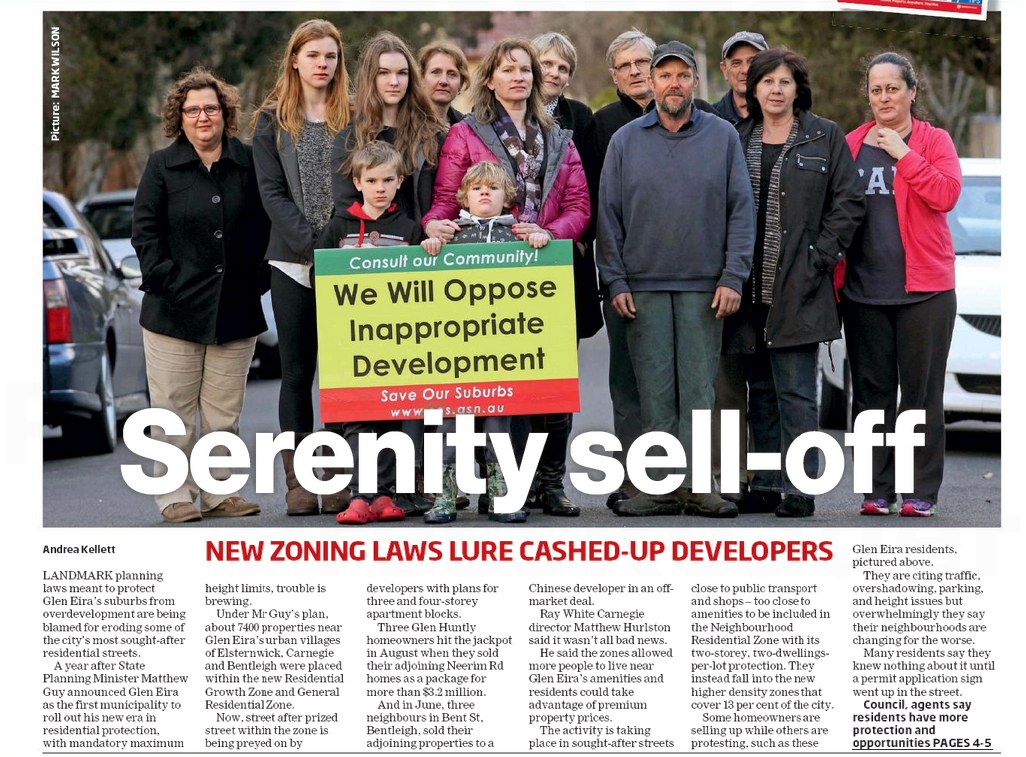
The reality of what’s happening to our neighbourhoods is evident in the following data. In the space of just 9 weeks, there have been planning applications for well over 600 dwellings. Given the current zoning and council’s pro-development stance, combined with VCAT’s endorsements, we estimate that probably 95% of these applications will be rubber stamped. We also suspect that councillors don’t have a clue as to most of these applications!
Featured below are just those multi-unit proposals. We ignore the countless double storey attached that is rampant throughout all areas.
1170 Dandenong Road, Carnegie – 3 storey – 27 units
15 Belsize Avenue, Carnegie – 4 storey – 52 units
93 Truganini Road, Carnegie – 3 storey – 28 units
98 Truganini Road, Carneig – 4 storey – 29 units
401 Neerim Road, Carnegie – 5 storey – ???? units (Your guess is as good as ours!)
254 Jasper Road, McKinnon – 4 storey – 7 units and shops
45 Ulupna Road, Ormond – 3 storey – 11 units
630 North Road, Ormond – 4 storey – 14 units
482 North Road, Ormond – 4 storey – 23 units
269 Grange Road, Ormond – 3 storey – 13 units
2C walsh Street, Ormond – 3 storey – 12 units
85 Robert Street, Bentleigh – 3 storey – (again, your guess is as good as ours!)
75 Patterson Street, Bentleigh – 3 storey – 5 units
2 Tovan Akas Avenue, Bentleigh – 3 storey – 8 units
455 South Road, Bentleigh – 6 storey – 10 units
29 Loranne Street, Bentleigh – 4 storey – 42 units
22 Bent Street, Bentleigh – 4 storey – 41 units
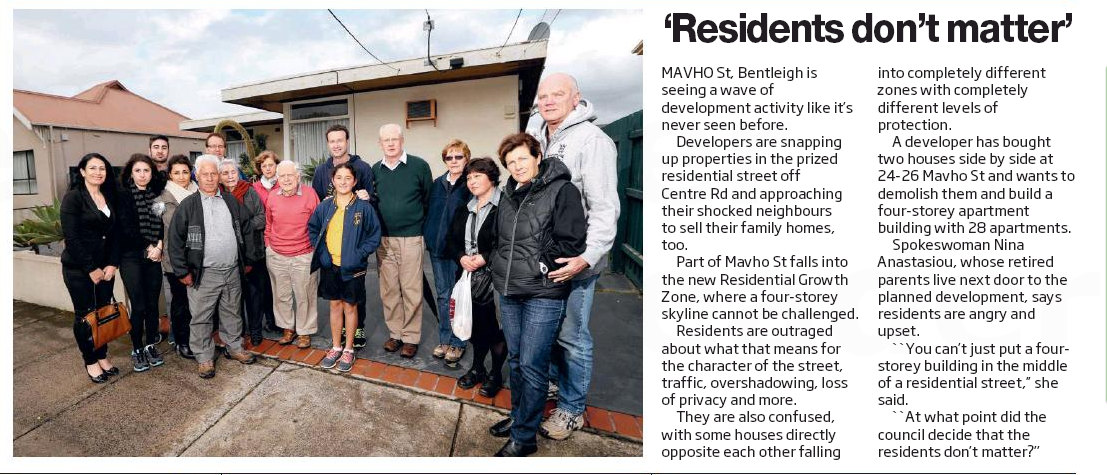
24 Mavho Street, Bentleigh – 4 storey – 28 units
150 Tucker Road – 3 storey – 23 units
188 Tucker Road, Bentleigh – 3 storey – 10 units
PS; TO RUB MORE SALT INTO THE WOUNDS HERE IS THE LATEST APPLICATION BY THE MRC FOR THE RACECOURSE!
Use of land for a place of assembly (Outdoor Cinema)
So, what was supposed to be used for racing has now become another money making venture for the MRC. What was supposed to create no noise, will now be blaring out movies at all times presumably of night and day. What was supposed to be the end of the MRC’s manoeuvring according to some councillors is still well and truly alive. And naturally residents are still being kept in the dark as to what occurred at the VCAT mediation regarding the objection to council’s miniscule conditions on balconies and parking for the C60. We’ve learnt that the VCAT member has made an order! When will council divulge whether they’ve caved in again or not?
September 11, 2014
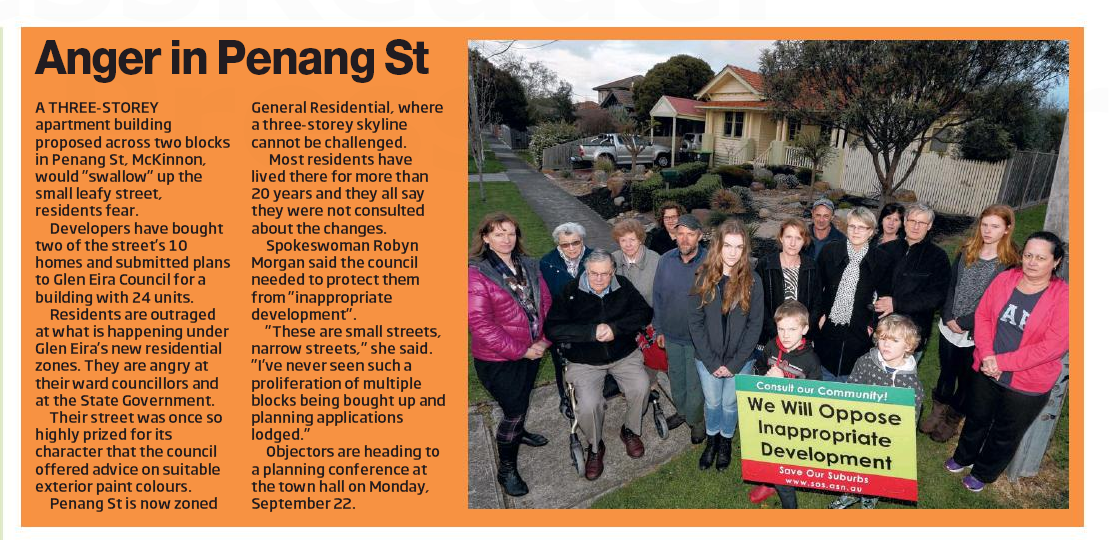
We’ve received a comment from a resident concerning the Penang Street application and think it deserves to be put up as a post for 2 reasons:
Here’s the comment.
Well, the mayor came to Penang Street to listen ( I use the term loosely) to residents’ concerns about the development at 2-4 Penang Street. He clearly has not read or has chosen to ignore this decision. Made it very clear that traffic considerations would not be taken into account. Just one in a long list of things he said were not Councils’ concern or responsibility (eg drainage which he admitted has not been upgraded to cope with another 2011 incident). Completely dismissive of any prospect of revisiting or even tweaking the current scheme to provide additional protection for residential amenity. Said at least three times that we should keep “the politicians” (ie state representatives and candidates) out of it, notwithstanding that he simultaneously played the powerless Council card (ie it is all the state government’s planning scheme). I have read some of the material on here and thought it must be an exaggeration. But we got the same routine I have read here about consultation in 2002 and 2010, outcomes could have been worse if had consulted, how council has protected us all from unlimited height, blah, blah. Just as well he has resigned from the Greens, there must be a lot of grassroots members regretting campaigning on his behalf. Riding a push bike to the meeting really isn’t enough. Very disappointed by it all – not that I expected his to agree – but his complete dismissiveness of the concerns of those who put him in power was very disheartening.
PS: The Planning Scheme MUST be reviewed every 4 years, and within one year of the acceptance of the Council Plan. The Glen Eira Planning Scheme was last reviewed in 2010, and the Council Plan was last voted on at the Council Meeting of 10th June 2014. Previously it has been voted on at the 11th June 2013 meeting. Throughout this period, no planning review has been undertaken in the public limelight; no documents tabled as to findings of any such (internal) review, and certainly no public consultation.
The consistent and bogus claim by Council that residents were very well informed as to housing policy (ie minimal change and housing diversity) and that ‘extensive consultation’ took place in 2010 is literally laughable. We’ve uploaded here the euphemistically entitled ‘Discussion Paper’ on the Planning Scheme Review of 2010. Readers need to ask themselves several basic questions:
September 11, 2014
For the past 5 or 6 years residents have made it abundantly clear that their top priorities and dissatisfaction with council, as stated in the annual Community Satisfaction Surveys, revolve around three basic issues –
Without a Notice of Motion, the only way to get something onto the agenda is via a Request for a Report. So, how industrious, relevant, and conscientious have our elected representatives been in making sure that the above 3 issues are addressed and improvements made?
We’ve gone through this year’s listing of all Requests for Reports and find that of the 18 voted upon (with one being rejected) a mere 1 or 2 could in any way be seen as addressing the issues that residents have nominated as their priority. Mind you, this is not to say that we are against social housing, gay rights, etc. We simply cannot believe that councillors see these as the most important issues which continue to confront the municipality. So far this year, we’ve had reports on foxes and other vermin, sister cities overseas, and so forth. Really earth shattering issues! Even when something comes up that could be seen as important (such as minimum sizes for apartments) the officers’ reports invariably recommend a ‘do nothing’ approach and this is blithely accepted by councillors!
Surely it is time that councillors turned their minds to actually serving the community and demanding action on all those things they were elected to achieve instead of either playing politics and bagging Labor or the Libs, or actually doing something that will redress the inequities of the planning system and the chaos that is parking and traffic. When development applications take 5 minutes to decide, and discussion on requests for reports drag on interminably because of cheap point scoring, then there is something drastically wrong.
Below is a list of the reports voted upon – in no particular order. Combined, these surely make for some pathetic reading!
Federal Auditor-General Investigation
Crs Delahunty/Lobo
That the Glen Eira City Council file of relevant correspondence regarding the ‘Safer Streets Program’ be forwarded to the Federal Auditor-General Ian McPhee to assist his review.
Crs Okotel/Hyams
That a report is prepared that provides information on how Council supports community groups including information on:
Crs Lobo/Okotel
That a report be prepared on what help is available in Glen Eira to support and help those in our community suffering from alcohol and drug addictions.
Crs Delahunty/Lobo
That a report be prepared detailing the methods that other Victorian Councils, particularly the Greater Geelong City Council have sought to support and advocate for marriage equality for Gay, Lesbian, Bisexual, Transgender and Intersex (GLBTI) people and how the City of Glen Eira may seek to do the same for the GLBTI people in our community.
Crs Hyams/Lipshutz
That a report be prepared on the likely effects on Glen Eira of rate rises being capped at the CPI, as the State Opposition has announced it intends to do should it win government.
Crs Magee/Hyams
That a report be prepared on:
(1) The possibility of Council acquiring the vacant land at 846-848 Centre Road, Bentleigh East directly adjacent to the Centre Road Kindergarten.
(2) The potential impact to families in Glen Eira of a change in funding of Kindergarten hours in the recently released Abbott budget.
(3) The projected need for Kindergarten places in Glen Eira in the next 10 years including an estimate of which areas of the municipality this need will fall in.
(4) An assessment of potential expansion sites within the municipality and the potential to forward plan for these expansions.
Crs Sounness/Delahunty
That a report be prepared on the mechanisms available to Council to improve the provision of affordable and accessible social housing.
Crs Lipshutz/Hyams
That a report be prepared on the benefits of whatsoever kind (if any) in establishing and maintain sister city relationships. The report should identify any obligations and costs that may be incurred by the Glen Eira City Council in establishing and maintaining such relationships.
Crs Lobo/Sounness
That a report be prepared on the potential to establish a sister city relationship with a city in mainland China given that in the Indian/Pacific Century Australia sits astride both the Indian and Pacific Oceans and given that China is a major importer of Australian primary products compared to any other countries. (motion lost)
Crs Okotel/Lipshutz
That a report be prepared addressing;
Crs Delahunty/Magee
That a report be prepared to council with information on the proposed privatisation of the Alfred Health provided aged care facilities in Caulfield. The report to specifically note the number of public beds currently provided by the state funded facilities and the potential impact on the Council’s aged care facilities of the privatisation.
Crs Sounness/Hyams
That the City of Glen Eira request the Executive of the Metropolitan Transport Forum (MTF) to reverse it’s decision to exclude the Victorian Greens from participating in the Super Forum at the Melbourne Town Hall on 14 August 2014.
Crs Sounness/Okotel
That a report be prepared on the statistics and trends in observed off leash dog walking occurring outside declared dog off leash walking areas.
Crs Okotel/Esakoff
That a report be prepared detailing:
(a) What measures Council takes to address dumped rubbish in “hot spots” within high density areas; and
(b) What measures Council can take to address dumped rubbish more efficiently and effectively in existing and new anticipated hot spot areas including additional costs associated with these measures if any.
Crs Okotel/Magee
That a report be prepared that explores:
(a) Minimum floor space requirements for dwellings in other jurisdictions including internationally and what benefit or detriment is created by these requirements;
(b) How minimum floor space requirements could be beneficial for Glen Eira in the case that such requirements are adopted by the Victorian state; and
(c) How Glen Eira Council could advocate for state-wide minimum floor space requirements such as through a planning amendment.
(d) The report by the City of Melbourne on its Unit developments and liveability as it may apply to the City of Glen Eira.
Crs Delahunty/Lobo
That a report be prepared to determine what role if any the Valuer General could play in determining the land valuation for the Crown Land at Caulfield Racecourse Reserve currently leased to the Melbourne Racing Club. I request that the report contain any previous information or correspondence received by Council or by individual Councillors if known, from the Valuer General about the subject land. I request that the report advise on the methods to engage the Valuer General, the Trustees, the State Government and the MRC so that further lease negotiations are held in full knowledge of the value of the land. The report be presented to the next Council Meeting.
Crs Hyams/Magee
That a report be prepared on the extent to which vermin, including foxes and Indian Myna birds, are causing problems in Glen Eira and what Council can do to deal with these problems.
Cr Sounness/Okotel
That a request be prepared on the general health of the aboreal environment in Glen Eira to discuss the general health of park trees the possible need for tree irrigation or watering practices and the strategic implications of the long term climate projection made by the Bureau of Meteorology.
 Glen Eira Debates