Councillor Performance


The following Media Release in our view exemplifies everything that is wrong with Glen Eira City Council. It typifies the secrecy, failure to inform much less consult, and the complete over-riding of resident aspirations. The inequity which is the Housing Diversity and Minimal Change areas are now ostensibly cemented via this announcement and it has been done without even the courtesy of informing the public. At the time of writing there is nothing on Council’s website. Councillors who silently sat by and allowed this to happen must be called to account.

PS: As an example of the deviousness of this council, we alert readers to the public questions which raised these issues and the blatantly dishonest answers. It is inconceivable that Council did not know what it claims not to have known, designed, and implemented.

“This evening 1 July, 2013 there was a news item on the 7p.m. news which featured a story about the new residential zone reforms in this state. It was stated that the Boroondara Council along with Glen Eira were the first two councils to be implementing these new residential zones.
Could you please explain to me why residents in this municipality have to learn these things via the media?
1. Has this council already submitted an amendment of the draft to the Minister? If this is the case then why were residents not told anything of the change?
2. The City of Boroondara has had this amendment C108 for discussion since March. What consultation is this council planning to carry out?”
The Mayor read Council’s response. He said:
“Council is not responsible for what is broadcast on any news program. Council does not know why the ABC reporter chose to mention Glen Eira, any more than we know why a similar story in today’s Age nominated neighbourhoods in Stonnington and Boroondara as the first to come under the new zones but did not mention Glen Eira. It demonstrates that you can’t always fully trust what you hear or read in the media, although, of course, the media is far more reliable than an anonymous blog.

Council has not submitted an amendment of the draft to the Minister. Boroondara City Council’s Amendment C108 proposes to apply planning controls to neighbourhood activity centres, which are shopping strips, and to enterprise
corridors, which are mixed commercial areas. It implements strategies and plans adopted or amended in 2011, and has nothing to do with the new residential zones. Council has not yet decided what consultation will be carried out in relation to the residential zones.”

Question 2 – “Given the significance of the proposed Residential Zone Reforms, when will council begin its public consultation on the introduction of the zones into the Glen Eira municipality?”

“Council has not yet decided.”

Question 3: (July 23rd, 2013)

“Will Council be undertaking community consultation on the residential zone reforms?”
The Mayor read Council’s response. He said:
“The extent of consultation would depend on the extent of any departures from the current Housing Diversity/Minimal Change arrangements and that is not known at this time.”
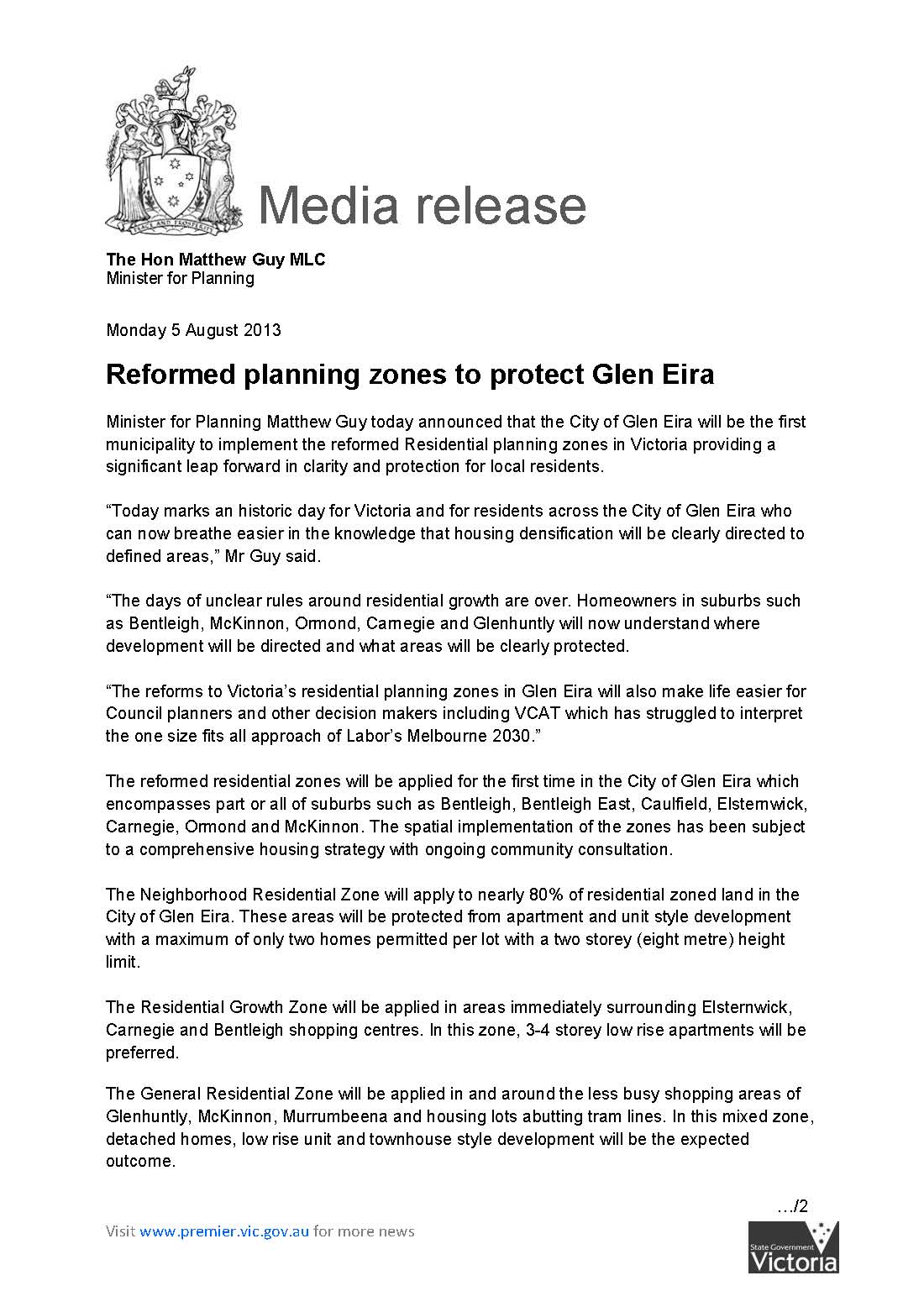
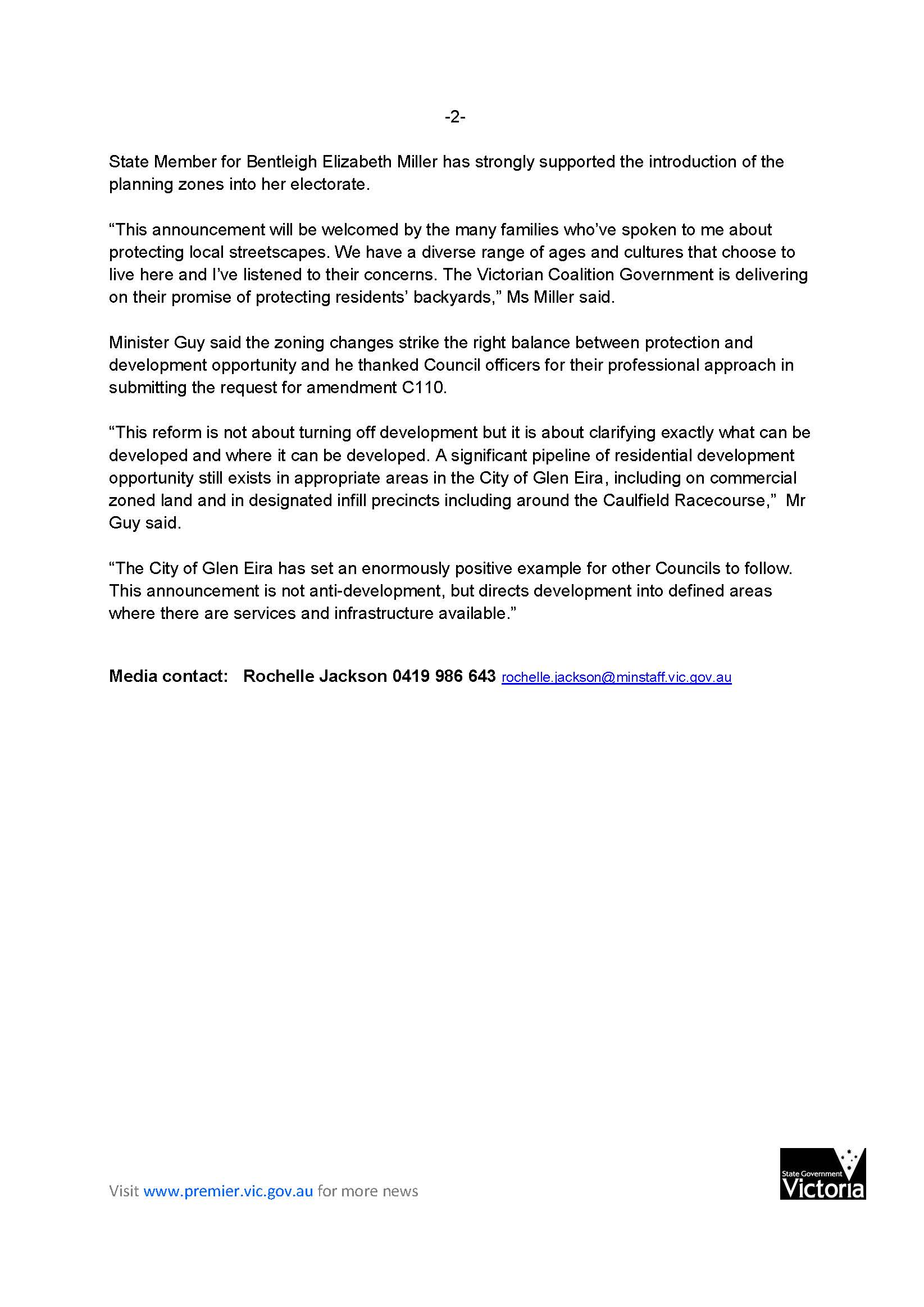
130805 - Guy - Residential planning zones bring protection to Glen-Eira_Page_1 130805 - Guy - Residential planning zones bring protection to Glen-Eira_Page_2

We found that CEO tenure affects performance through its impact on two groups of stakeholders—employees and customers—and has different effects on each. The longer a CEO serves, the more the firm-employee dynamic improves. But an extended term strengthens customer ties only for a time, after which the relationship weakens and the company’s performance diminishes, no matter how united and committed the workforce is.

But as CEOs accumulate knowledge and become entrenched, they rely more on their internal networks for information, growing less attuned to market conditions. And, because they have more invested in the firm, they favor avoiding losses over pursuing gains. Their attachment to the status quo makes them less responsive to vacillating consumer preferences.

These findings have several implications for organizations. Boards should be watchful for changes in the firm-customer relationship. They should be aware that long-tenured CEOs may be skilled at employee relations but less adept at responding to the marketplace; these leaders may be great motivators but weak strategists, unifying workers around a failing course of action, for example. Finally, boards should structure incentive plans to draw heavily on consumer and market metrics in the late stages of their top executives’ terms. This will motivate CEOs to maintain strong customer relationships and to continue gathering vital market information firsthand  (http://hbr.org/2013/03/long-ceo-tenure-can-hurt-performance/ar/1)

A weak board will often after a period of seemingly successful management, effectively abdicate power to a CEO whose drive, charisma and ruthlessness have contributed to the earlier success. Lulled into a false sense of security by rising share prices and earnings, the board becomes reluctant to challenge the CEO’s judgement and falls into the habit of rubber-stamping his decisions. It stops scrutinizing detailed performance indicators, may allow executive compensation to spin out of control, and be content to accept management figures and explanation without serious question. Bruggisser, the CEO of Swissair, is a case in point. Here, a board of distinguished businessmen failed to challenge the flawed strategies that led to Swissair’s collapse. At the same time, as his power base expands, the dominant CEO begins to behave as though the company is his own creation, believing his own PR and no longer distinguishing between personal ambitions and those of the company. Senior management becomes packed with like-minded executives who owe their position to the CEO, and who are unlikely to challenge him. This compounds the lack of scrutiny and debate. The problem is exacerbated if the CEO role is combined with that of Chairman, removing another check and balance (http://www.imd.org/research/challenges/TC053-08.cfm)

…most evidence shows that CEOs stay too long, and can end up destroying value in a company. (http://www.ceoforum.com.au/article-detail.cfm?cid=6174&t=/Claudio-Fern%E1ndezAr%E1oz-Egon-Zehnder-International/The-timeserving-trap)

….after about 5 years, many execs start doing what they like to do and not what the organization needs them to do (http://www.transitionceo.com/news.php?id=41)

CEOs who also chair their boards naturally invite their cronies to serve on the board. Eventually you have a CEO surrounded with puppets who are only interested in preserving their board pay and privileges. They are not likely to welcome disruption or innovation, because that might mean more work.( http://www.lindabernardi.com/2011/10/03/when-should-a-ceo-leave)

The following is taken from the Moonee Valley Council website. Comparisons between Glen Eira’s and Moonee Valley’s attempts to safeguard social amenity for residents is self-evident.

Planning & Building

Draft master plan and rezoning for Moonee Valley Racecourse

Moonee Valley Racecourse

29 July update

The State Government’s Advisory Committee has commenced a six week consultation process on the Moonee Valley Racecourse revised Master Plan and Council’s proposed heritage controls for the site. Residents living around the site would have received something in the mail from the Advisory Committee.

The community is encouraged to view the documents and put in a submission to the Advisory Committee.

Council is currently working on its own submission as part of this process.

Information sessions

To help the community stay informed and to understand the process, we are holding information sessions at the Clocktower Centre on Mt Alexander Road Moonee Ponds.

Sessions are:

  • Sunday, 11 August, 2pm-4pm
  • Thursday, 15 August, 6.30pm-8.30pm

To RSVP contact 9243 8888 or email mvrcmasterplan@mvcc.vic.gov.au

Council continues to be concerned about the major information gaps in the revised version of the Master Plan. These gaps and concerns are summarised below in the 18 June update.

More information on consultation process, how to have your say as well as copies of the Master Plan and heritage amendment documents can be found on the DPCD website.

18 June update

Council has responded to the questions asked by the State Government’s Advisory Committee about the revised racing club’s master plan.

While the revised master plan does make some concessions in terms of the scale of the proposed development, it still does not address some key issues that Council previously raised with the club. There are still concerns that the proposed master plan does not provide enough detail. Some of the gaps include:

Car parking and traffic congestion
The revised plan does not adequately show how the substantial increase in vehicles in the area will be managed. This includes both daily vehicle movements and vehicle movements when events and races are taking place.

Public access and safety
Council has concerns over the proposed access to the racecourse, where the majority of patrons would be funneled through a single entry point.

Layout of the site, new residential buildings and the new grandstand
Council doesn’t feel that the proposed layout is the best outcome for the site, and it is of concern that there would potentially be a negative impact on neighbouring properties.

Lack of significant open space
The location and size of open space within the site is insufficient.

Public transport capacity
The revised plan has still not addressed how the significant increase in demand for public transport in the area would be managed.

Drainage and infrastructure impacts
The site has significant drainage issues that have not been considered in the design of the master plan.

Heritage and significant trees
The proposed development would not retain any important heritage features of the site.

We are now waiting for the Advisory Committee to confirm the next stages in the process and dates of when they will undertake community consultation.

Kingston Council applies for more CCTV funding

1 August 2013

Kingston Council will seek State Government funding for more CCTV cameras in up to five sites designated by police as potential trouble spots.

A Special Meeting was held by Councillors on July 29 to allow a decision to be made before the Government’s August 2 deadline for funding applications.

Councillors voted to seek $225,000 for up to 17 CCTVS to be placed in:

• Mordialloc

• Cheltenham

• Carrum

• Chelsea.

These were the priority sites recommended by local police as good locations for CCTVs, based on factors including need and the technical difficulty of installing the recording devices.

The decision follows Council accepting $125,000 last month for CCTVs to be installed at the foreshore car park off Gnotuck Avenue, Aspendale, the bus interchange off Station Street, Moorabbin and the exterior of an affordable housing complex on the Nepean Highway in Moorabbin.

This left $225,000 available from the total pool of $350,000 the Government had offered for CCTV installation applications from Kingston Council.

As with the Government’s previous offer, Council will be responsible for the management and maintenance of the CCTVs. If the estimated cost of $225,000 is exceeded after more detailed examination of the sites, the locations ranked as the highest priority by police will be implemented.

Kingston Mayor Cr Ron Brownlees OAM said CCTVs fitted within Council’s Community Safety Strategy.

“While CCTVs are not a guaranteed anti-crime measure, we have applied for more as our community overwhelmingly supports their installation and the cameras will act as an additional crime prevention tool for police,” Cr Brownlees said.

– See more at: http://www.kingston.vic.gov.au/Lists/News/Latest-News#sthash.cswP8rht.dpuf

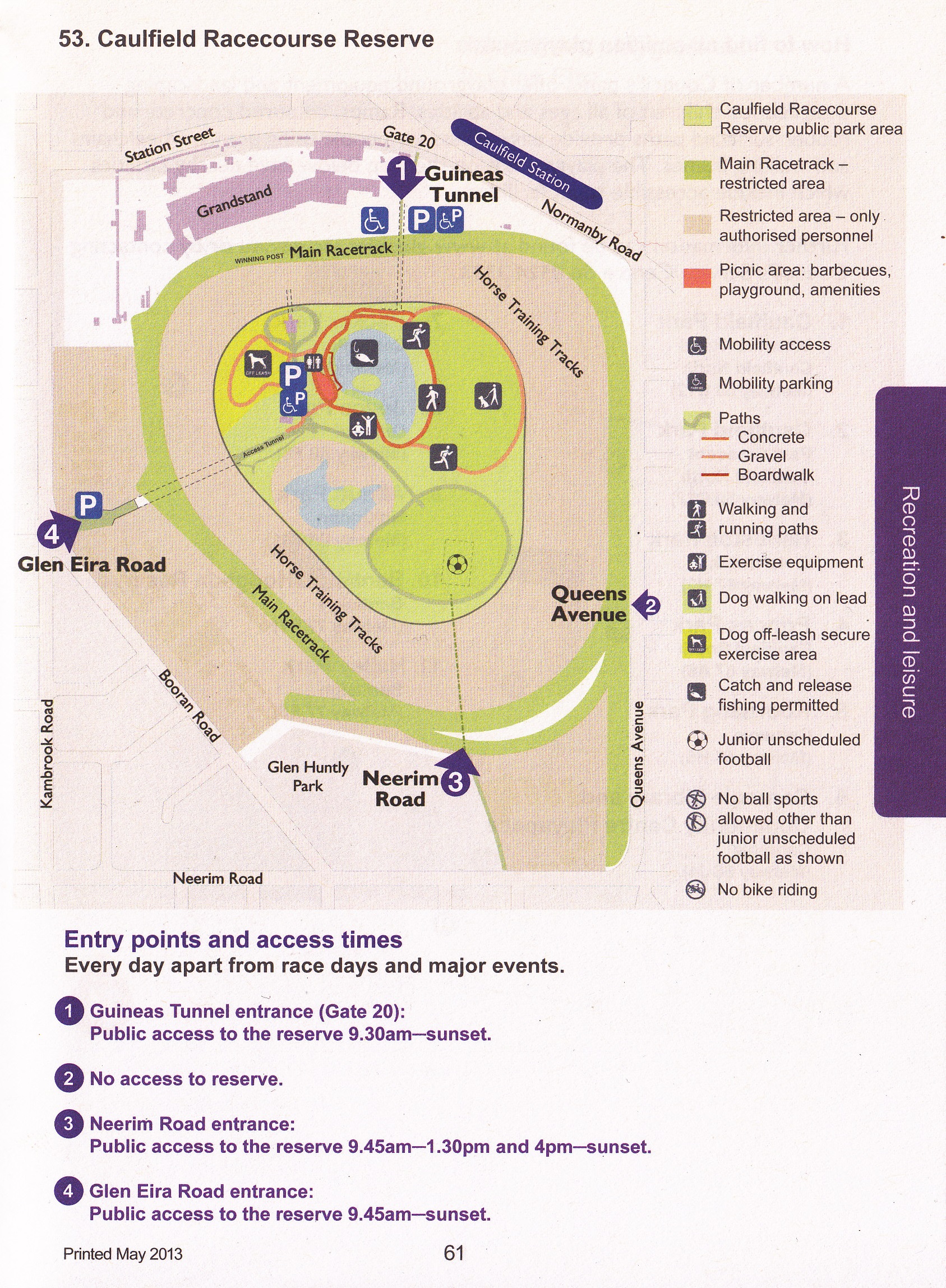
Featured below is the centre of the racecourse manifesto published by the MRC. That this features prominently in Council’s Resident’s Handbook is literally astounding given that:

  • Most of the ‘agreement’ terms are not being met – ie times of access
  • The number of days open to public
  • The area now declared as off-limits to residents due to the synthetic track
  • The countless fences that were not in the original submission

That council sees fit to publish this version is to endorse the MRC completely and to abandon, we suspect, all attempts to ensure that the Melbourne Racing Club adheres to the terms of the original ‘communique’. Surely council could have refused to publish this document at the very least?

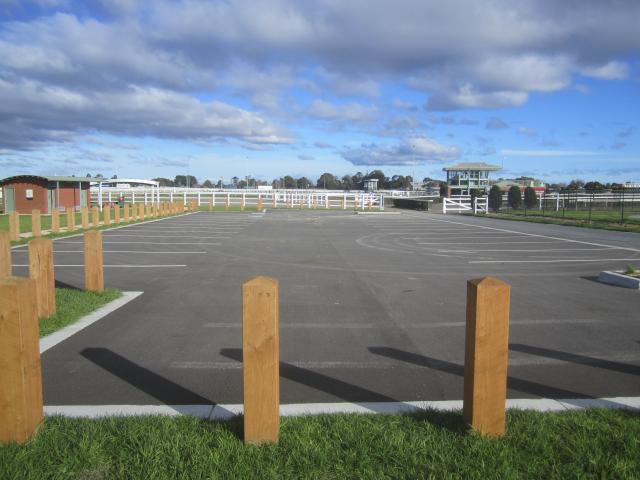
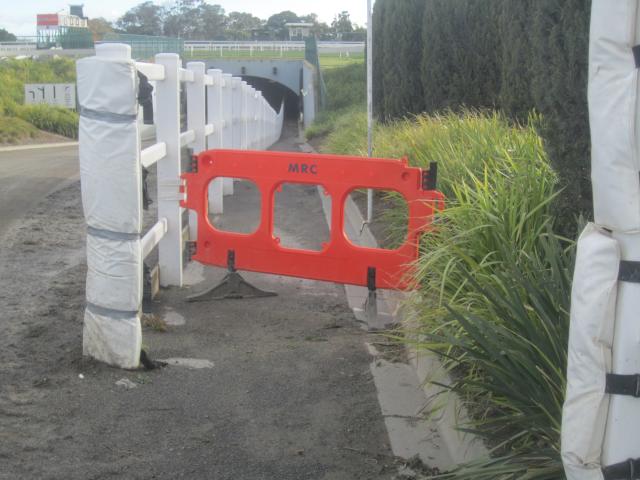
racecoursePS: Here are some photos that we’ve received from a resident that shows just what a waste of space this so-called ‘development’ has turned out to be. The photos we’re told were taken Sunday last in the mid afternoon.

car park

access

Council has mastered the technique of not answering all aspects of a public question. What is responded to often becomes a game of semantics, half-truths and not so subtle acts of omission. We illustrate this from the following examples of public questions tabled at last week’s council meeting. The bolded sections represent those aspects that have been entirely ignored.

QUESTION: The residential development at 175 Balaclava Road, North Caulfield, is a toxic site which was not comprehensively remediated. The amount of permeable surface, if any, is much less than the minimum required. There is zero setback from Balaclava Road where the standard is six metres. There is zero setback from the side street, Elmhurst Street. Balconies and awnings extend from this development over both Balaclava Road and Elmhurst Street, and no fees, rents or other charges are applied to this occupation of public space. How does council account for this generous flexibility in application of the planning rules, and what is the estimated financial benefit that has accrued to the developer from this?

ANSWER: “The Town Planning Application in relation to the residential development at 175 Balaclava Road which incorporated balconies that extended beyond the title boundary was refused by Council. An appeal against Council’s decision to refuse the application was lodged at the Victorian Civil and Administrative Tribunal (VCAT). VCAT directed the grant of a permit which retained the balconies beyond the title boundary. This was not Council’s preferred town planning position given that Council had refused the application. However, VCAT did apply a permit condition requiring the applicant to enter into an agreement which, amongst other things, acknowledges Council’s ownership interests and would absolve Council of any risks associated with the balcony overhangs.

A condition of the VCAT directed permit related to the provision of a Statement of Environmental Audit prior to the commencement of the development. In order to comply with this condition, the Applicant was required to submit a Statement of Environmental Audit that confirmed that the site is suitable for the use and development allowed by the planning permit. In December 2008 the Statement of Environmental Audit was received and, as a result, the abovementioned condition was met.”

COMMENT: What is not stated is that the VCAT order was not the result of the first appeal, but the result of ‘mediation’ between Council and the developer. In other words the VCAT decision merely formalised what council agreed to previously.

++++++++++++

QUESTION: What is Glen Eira Council’s current policy on rooms, balconies, and awnings that extend over public space from a/. residential buildings, and b/. commercial buildings? Is the public space so occupied leased or sold or is it a gift of space to developers? What legal liabilities might accrue to ratepayers from this use of public space? 

ANSWER: Council does not support developments with balconies and rooms that overhang the title boundary. However, as was the case with 175 Balaclava Road, Council does not always make the final decision in relation to these matters. In those situations, it is Council practice to advocate for VCAT to require, via a permit condition, that the applicant enter into a Section 173 agreement with Council.

Section 173 agreements apply in those circumstances where controls are required outside title boundaries. Typically Section 173 agreements address property rights and protect Council, and in turn ratepayers, from risk.

A Section 173 agreement in such cases would explicitly state that ownership of the area outside the title boundary does not pass to the owner of the land being developed. The agreement also sets out restrictions on the owner’s use of the balcony /encroaching area. These restrictions allow Council to tightly control use and minimise risk. Generally, Council does not charge owners for use of the airspace, unless there is a commercial use. Owners are required to have appropriate insurance for public liability in relation to their use of the airspace. Section 173 agreements are placed on the title of the property and bind current and successive owners of the property.

Section 173 agreements are not required for awnings.

Council may enter into a licence or lease of the airspace above Council land.

Decisions of this nature are made on a case by case basis.”

COMMENT: what a wonderful word ‘generally’ is. It can encompass a multitude of sins without disclosing a single thing. This response makes it clear that:

  • There is no formal policy on gifting the public realm to developers
  • Nor are they asked to always pay for this largesse
  • Contradictions do not appear to worry Council either – for example, please compare the opening and penultimate sentences in this response (underlined)!

++++++++++++

QUESTION: Will Council be undertaking community consultation on the residential zone reforms? 

ANSWER: The extent of consultation would depend on the extent of any departures from the current Housing Diversity/Minimal Change arrangements and that is not known at this time.”

COMMENT: Here is further evidence that there will NOT BE ANY PUBLIC CONSULTATION on the residential zones, except in the most trivial and unavoidable areas such as amending the East St.Kilda student housing areas from Minimal Change to Housing Diversity since this is already fait accompli with 5 storey permits granted and Council’s failure to adhere to its own policy as pointed out several times by VCAT members. As for the rest of the municipality it is clear that council intends to rubber stamp the current  scheme without community input!

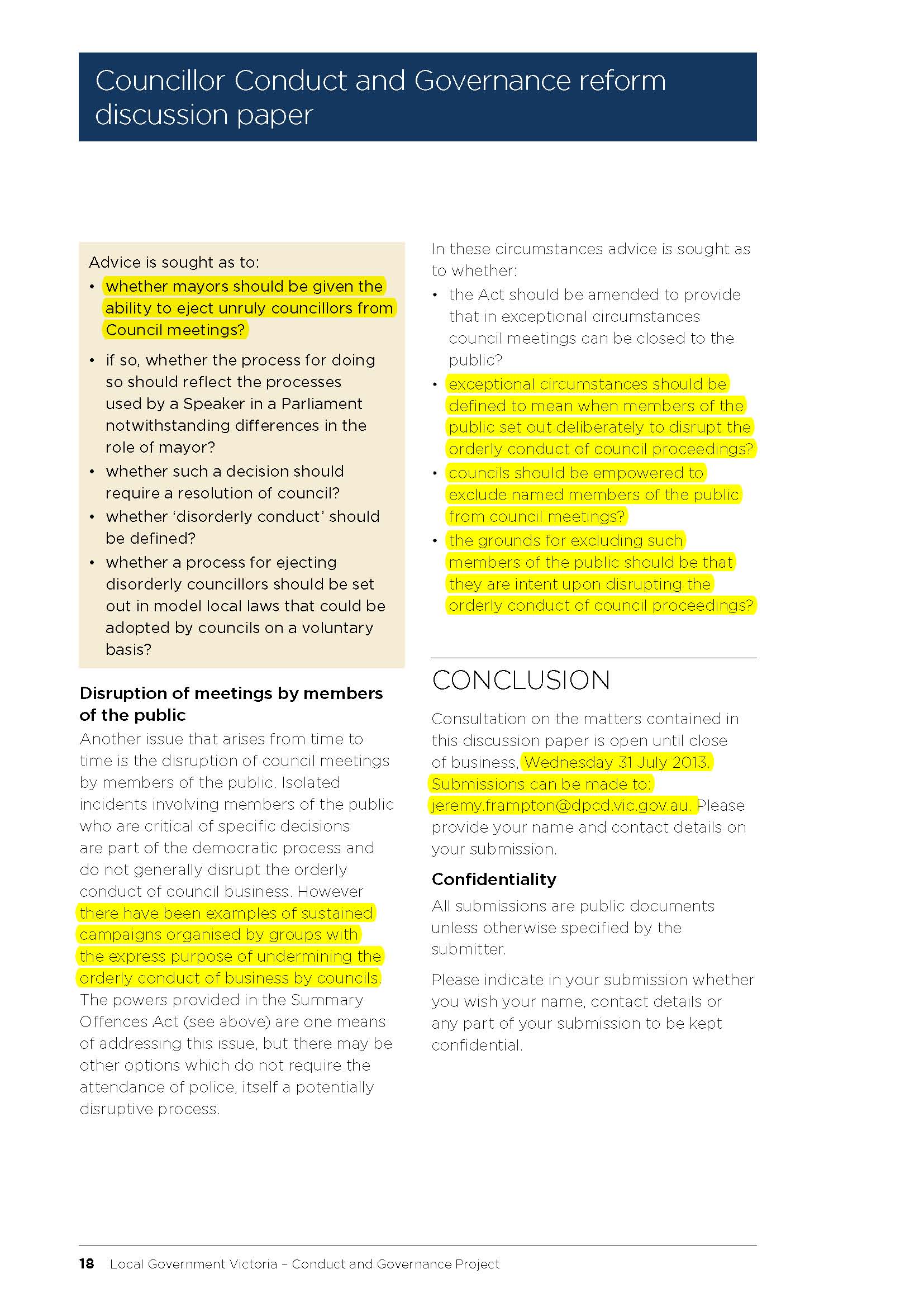
In what must be considered the most reactionary and one sided ‘discussion paper’ that this government has ever produced we now have the Councillor Conduct and Governance Reform effort. Public submissions are called for – yet we note that the submission period is less than 3 weeks; that the ‘call’ received practically no publicity; and that the authors of the report are most likely to be CEOs and other bureaucrats.

We have uploaded the full paper and the relevant link to the department’s site may be accessed at: http://www.dpcd.vic.gov.au/localgovernment/news-and-events/news/conduct-and-governance-discussion-paper

A taste of what is ‘suggested’ follows:

Pages from Conduct_Discussion_Paper_PDF-2

Item 9.8 involved the terms of reference for the community consultation committee. We urge all readers to pay careful attention to the stated ‘function and role’. It reads:

“To make recommendations to Council in relation to the ways in which Council consults with residents,ratepayers and other stakeholders in the community to ensure maximum participation, communication and value to the community”.

In other words, the committee’s function is basically to partake ONLY in the mechanics of consultation, rather than providing direct input into any form of decision making as to the outcomes of these consultations. This important area of course, will be left first to the administrators and then councillors we presume. Thus only the first step in the ‘consultation’ continuum is being met and that is how to ‘engage’ with people – full stop. This committee is not granted any powers beyond that. It will presumably have no say in assessment, review, or participation in any decision making on the results of the ‘consultation’.

Nor do we believe it’s an ‘accident’ that the very important word REVIEW is now missing from these new terms of reference. The term was present in the original 2011 version. Also gone is the requirement that the committee meets at least 4 times a year. This has now been replaced with “as and when required”. Not that most committees do meet 4 times a year, but the omission we believe is significant in that it further erodes any formal structures and rules that should govern the running of such committees. Finally, as we’ve already noted, there is mention of ‘agreed criteria’ for the selection of community reps, but these are not provided, and definitely not made public. We can only speculate as to whether or not they even exist!

Following is the actual ‘debate’ on this item. Readers should carefully consider comments made by councillors and how the very notion of ‘consultation’ is watered down to practically nothing. Hyams’ hallmarks of ‘success’ such as the e-newletter and the notice boards are damning in themselves. Residents are lucky to receive 2 newsletters per year, and as a previous post pointed out, the notice boards were discussed, and discussed, and discussed for at least 2 years before little plastic boxes appeared in Glen Eira streets. Great achievements we say in open consultation, transparency and accountability!

Delahunty moved the motion and Lobo seconded.

DELAHUNTY: said that they had ‘long discussions’ about the number of community reps. She would like to ‘see more’ but happy with the current recommendation of 4. Went on to say that the ‘role and function is quite important’ in that recommendations about ‘the way we talk to residents’ is included and can then become the basis for ‘conversations’ with a ‘broad range of people’. Thought that ‘this is great’ and will help keep things ‘relevant’.

LOBO: couldn’t add much to Delahunty, and said this was ‘just streamlining’ of the terms of reference. Noted that the only thing that’s changed is ‘that the chair does not have the extra vote’. ‘So that will be a very interesting committee meeting’. Hoped that once the community reps were appointed they would be able to ‘steer this committee to heights that” the community would like in ‘the name of transparency’.

SOUNNESS: asked whether the terms of reference have ‘to follow certain forms’ and why this seemed to be different?

WAIT: answered that ‘they don’t’ have to follow any form and that each committee’s terms of reference can be different.

HYAMS: said that the committee began in ‘last term of council’ ‘at my suggestion’. Said that ‘most issues were decided by consensus’. Said that it’s important to ‘consult with the community’ but also that they ‘do so effectively’ and keep on improving. Claimed there were a ‘number of good initiatives’ from the committee  such as the ‘e-newsletter’ and ‘community notice-boards’ and hoped to see ‘future improvements’.

MOTION PUT AND CARRIED UNANIMOUSLY

Below is the ‘debate’ on accepting the various committees’ ‘minutes’ and their recommendations. We’ve focused on the Community Consultation ones.

Delahunty moved to accept and seconded by Lobo.

DELAHUNTY: stated that the consultation committee ‘sets the standards‘ for consultation and seeks to ‘widen, broaden, deepen’ and make consultation ‘appropriate’ so it’s an ‘important committee’. Related what had been discussed: terms of reference; and EOI from  people wanting to be community reps as well as reviewing engagement strategy. Said that one submission from a resident was ‘very helpful’ (on disability). Vouched that this ‘was a true and accurate’ record of what happened at the meeting.

LOBO: said that 4 EOIs had been received by council. One was from a ‘very senior’ and ‘experienced resident’ and was in the ‘format’ that they were asked to submit. Went on to say that there were no ‘qualifications’ or ‘requisites’ given to people. Claimed that the committee decision was to ‘hold the applications on ice’ until advertising again. Said that in his view it’s the ‘right of ratepayers’ to both ‘represent the community’ and ‘contribute to a council that they finance and pay our salaries’. People who apply are community minded and spend ‘their own time’ in the effort to ‘make a difference’. Re-advertising creates the impressions that ‘we are not a transparent council’. Community reps for this committee is different to the environmental one where some professional expertise is required. Quoted Ghandi about ‘greatness’ and no correlation to  ‘education’ and that these applications should be ‘viewed’ in the same way. “Barriers’ to ‘perceived transparency’ have to be removed. Asked the rhetorical question as to precisely what they’re looking for – ‘a rocket scientist’, ‘psychiatrist’ or ‘a doctor of philosophy’. The Local Government Act compels councillors to act ‘impartially’ in carrying out their duties. Said that these would be ‘just words’ if not acted upon.

OKOTEL: spoke about the Violence against Women day and how council supports two groups in this area.

HYAMS: told the gallery that with this motion it’s not just about receiving and noting the minutes but also ‘adopting the recommendations’ so if councillors agree with Lobo that council shouldn’t be readvertising for community reps ‘they would vote against this motion’. Said that he didn’t think that readvertising was a ‘slight’ on those who applied and that they had hoped to ‘attract a slightly broader range of applicants’. Readvertising was ‘just a way of trying to achieve a broader range’ and doesn’t mean that those who already submitted won’t be selected. Went on to discuss the grants committee.

DELAHUNTY: endorsed Hyams comments on the Legal Service then went on to say that the minutes ‘tell the story’ of how council is ‘spending your money’ and they also tell the story about issues being discussed and ‘values and how we impart those values onto things we deem to be important’. People need to ‘keep track of these minutes’ and ensure that councillors are ‘held to account’ and ‘not discussing ourselves’ in these meetings and ‘not having a go at each other’. All that’s happening is ‘we’re discussing the issues and doing what local government’ should be doing. Finished by saying that some of the things she isn’t proud of but others she is and urged people to read the minutes.

MOTION PUT AND CARRIED UNANIMOUSLY (NOTE: Lipshutz and Magee were absent)

Residents have every right to question why we are paying over $300,000 per annum for a bunch of councillors who continually fail to fulfil their legal and representative roles. Glen Eira councillors, as evidenced at tonight’s meeting are entirely superfluous to the running of council.

Tonight was an absolute talk fest. Phrases such as ‘transparency’ and ‘accountability’ were repeated ad nauseum – perhaps in the false belief that repeating such terms has some correlation to the lack of transparency and accountability that is the hallmark and most distinguishing feature of this council.

We will report in detail in the days ahead. However, the lowlights are:

  • Not one single word about delegations and how councillors are literally unnecessary appendages in the entire process when all control and power is delegated to officers. Not one word about councillor ‘call-in’ and not one word about how nebulous and vague the criteria which govern decision making for the Delegated Planning Committee is.
  • Public questions and the non-answers were again allowed to go through to the keeper with no councillor making any comment on any of the responses
  • No questioning of the community consultation terms of reference, except for Pilling’s aside that it appears to be different to other committees’ terms of reference. Lobo waxed lyrical regarding the selection of the community reps, implying that he was opposed to re-advertising, and then voted to accept.
  • An admission that the Open Space Review has not yet landed in the arms of councillors, but officers somehow manage to include some points from the review in the report on the ABC potential land sale.

« Previous PageNext Page »