Councillor Performance


Finally some potential action on flooding and the Elster Creek catchment area! But what is so disappointing is that residents have to find out about this initiative not from their own council, but from the agenda items of Port Phillip! Given that the first meeting occurred in March, that surely provided enough time for some Glen Eira Council comment, or even a media release. Instead there has been silence.

This will also have major significance for Glen Eira which is ‘home’ to about 70% of the Elster Creek catchment – and that includes the upcoming Virginia Estate development. How much this will all cost the individual councils remains to be seen. But wouldn’t it make a great change for once if residents were informed as to what was happening and the likely costs – instead of being always kept in the dark like mushrooms!

We’ve uploaded the full Port Phillip officer report HERE

A couple of basic questions to start with:

  • How much does it cost ratepayers to defend the indefensible at VCAT?
  • How ‘competent’ are our planning staff, or
  • Are we witnessing the expansion of council’s agenda that is designed to reinforce the image of VCAT as the awful ‘villain’?

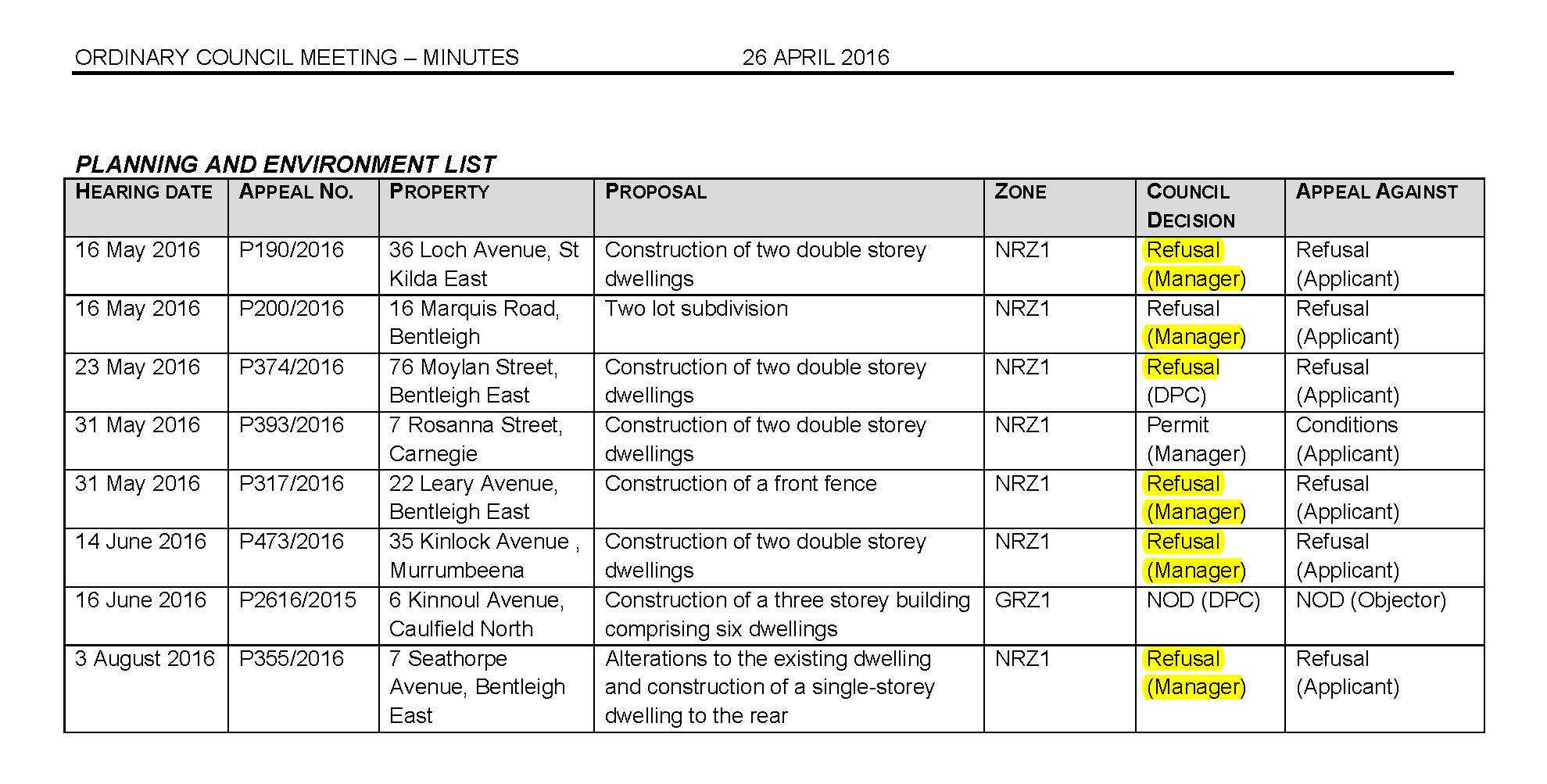
For the past year or so, council via ‘manager’ has refused an extraordinary number of planning applications for 2 double storeys in the Neighbourhood Residential Zone. These applications then invariably head off to VCAT and we estimate that over 90% are granted their permit and council’s refusal is set aside.

Here is a sample and the full summary for the past year is uploaded HERE

The applications in this image are all well and truly over 600 square metres and one is over 700 square metres. Surely, any ‘transgressions’ could have been remedied via thoughtful conditions rather than incurring the costs of going to VCAT  for both the developer and council.

What is literally staggering is the quality of the council arguments that then occurs at VCAT. A recent VCAT decision must surely take the cake for the most inept and farcical attempt to defend council’s refusal. We quote:

  • The responsible authority’s key concern focused on the rear of the site and what it considers to be an open backyard character of the area. In particular, it was concerned that the rear setback of the first floor of the proposed dwelling 1 would be closer to the rear boundary of the subject land than the rear setback of the older dwelling at number no.16 Molden Street. It submitted that the rear setback of the first floor of the proposal should not extend deeper into the review site than the rear setback of the existing dwelling at no.16 Molden Street.
  • We do not agree with the responsible authority that it is appropriate the prevailing setback to the rear boundary of a dwelling built some seven decades ago should prescribe the rear setback of one or two new contemporary dwellings. Simply ruling a line across the subject land aligned with the setback of the existing older dwelling on no.16 Molden Street does not comprise site and context responsive design. It is a very blunt tool to use to determine whether a proposal is respectful of the existing character of the area. More importantly such an approach has no basis in the scheme.

So the questions remain:

  • Why are so many applications in NRZ being refused? Surely they can’t all be that poor? and especially when they meet all the NRZ schedule requirements for site coverage, height, permeability, setbacks as the one cited above has done?
  • Why is council content to waste its planners’ time and effort in defending the indefensible?
  • How much is this costing ratepayers – especially in an era of supposed cost cutting and pressures on councils to be far more frugal and proficient in what they do?
  • We suggest that instead of spending tens of thousands on such cases, that council should employ far more competent planning staff to deal with the current planning chaos that is Glen Eira!

PS: in order to provide a little more context to the above we add the following – a list of all published VCAT outcomes from January 2016 to the present day. All decisions involved 2 double storey applications in the Neighbourhood Residential Zone. Council’s record as revealed below is literally appalling with only one ‘refusal’ upheld and only several ‘varied’ – ie council’s conditions chucked out. More applications are awaiting decision.

8 Bokhara Road, Caufield South – set aside

45 Mortimore Street, Bentleigh – affirmed

285 Alma Road, Caulfield North – set aside

20 Cushing Avenue, Bentleigh – varied

40 Fromer Street, Bentleigh – set aside

19 Thomasina Street, Bentleigh East – set aside

12 Anarth Street, Bentleigh East – set aside

20 Begg Street, Bentleigh East – varied

1 Heatherbrae Avenue, Caulfield – set aside

6 Glenmer Street, Bentleigh – set aside

309 East Boundary Road, Bentleigh East – set aside

6 Burreel Avenue, Elsternwick – set aside

3 Malcolm Street, McKinnon – set aside

1 Jane Street, Bentleigh East – set aside

633 Warrigal Road, Bentleigh East – set aside

7 East Boundary Road, Bentleigh East – set aside

1A Osborne Avenue, Bentleigh – varied

8 Murrong Avenue, Bentleigh – varied

34 Omar Street Caulfield South – set aside

25 Coates Street, Bentleigh – varied

2 Draper Street, McKinnon – set aside

5 Lord Street, McKinnon – varied

3 and 4 Beatty Crescent, Bentleigh – set aside

18 Richard Street, Bentleigh East – set aside

30 McArthur Street, Bentleigh – set aside


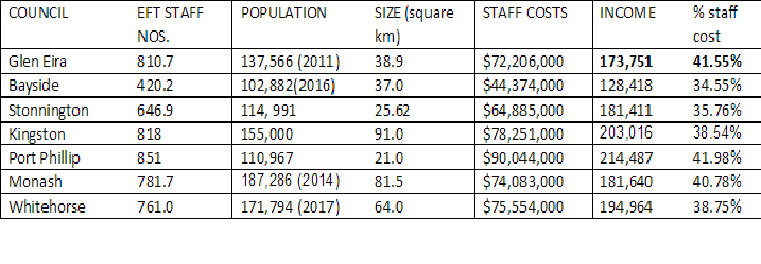
One way of determining the performances of a council is via a comparison with others. This admittedly throws up many challenges since categories and definitions are vague and elusive. However, there are some basic figures that can be compared so that we know for sure that we are not looking at apples versus oranges! Staffing and staffing costs provide a way in.

In the 2017/18 draft budget, Glen Eira announces a $4.18 million increase in staff salaries plus a $2.38 million increase in contractor costs. For staff expenditure, this means nearly a 6% increase on the 2016/17 budget figures. We’re also told that the total staff cost is $72 million and total income for council is roughly $174 million. Staff numbers are also projected to go up by just under 20 EFT for the upcoming financial year making a grand total of 810.7 equivalent full time staff. Please remember that ‘contractors’ are not considered as ‘employees’!

So how does all this compare with other councils? Glen Eira, despite ‘restructuring’ its directorship numbers, still remains top heavy in our view. Here are some stats from other councils according to their budgets –

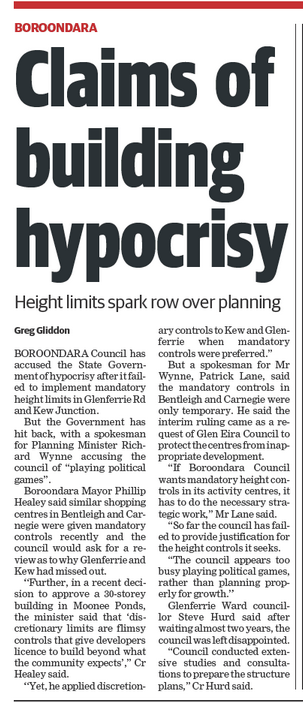
The following image comes from the Progress Leader of the 9th May, 2017. It raises innumerable questions as to whether what we are currently witnessing throughout Victoria and in local councils is truly good strategic planning, or straight out political machinations.

Here’s our take on recent events:

  • Wynne’s intervention in Yarra in slicing a proposal down to 10 storeys? It’s his seat and the Greens are on the march
  • Staikos is vulnerable – holding the seat by the skin of his teeth
  • Dimopolous in ‘danger’ also following the outcry against Skyrail and lack of consultation (now confirmed by the Auditor General in his latest reports)
  • Boroondara – strongly Liberal

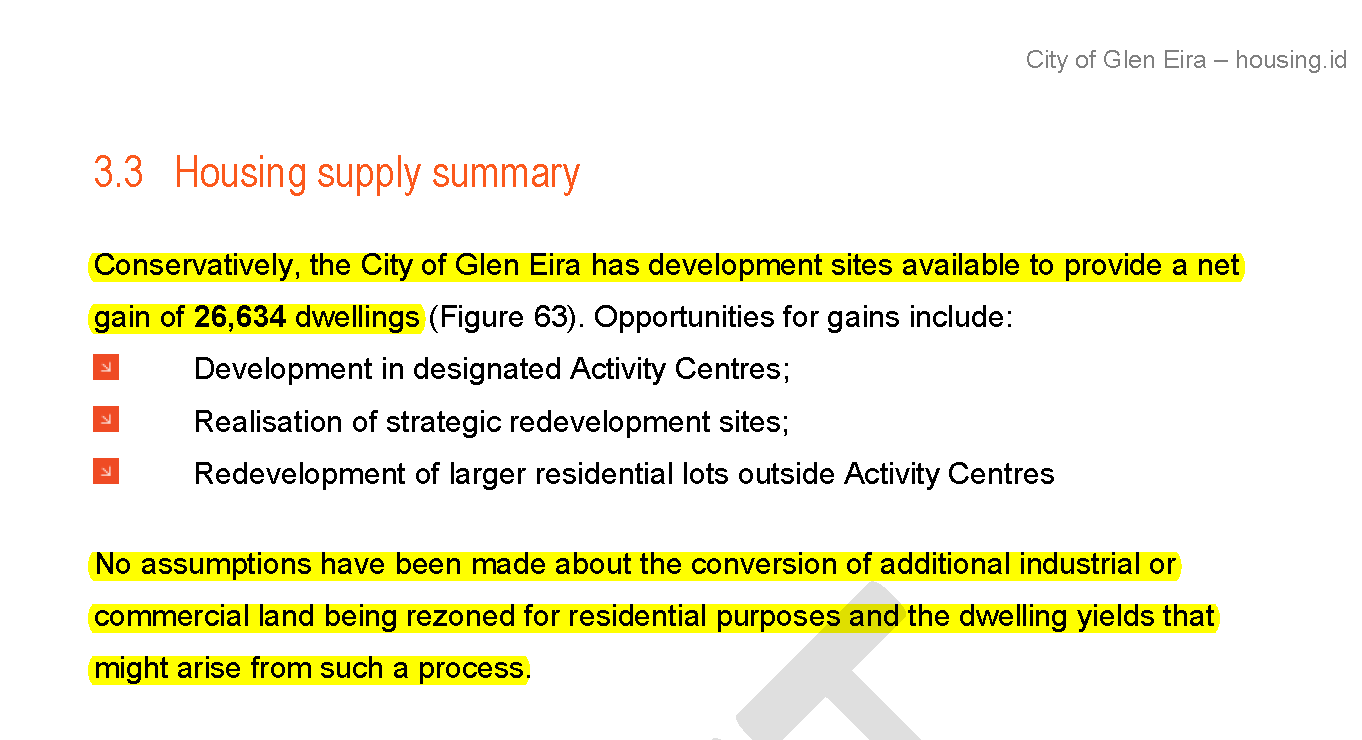
Thus we get politspeak in spades from the department and the Minister’s office. Please note the comments on Glen Eira carefully!

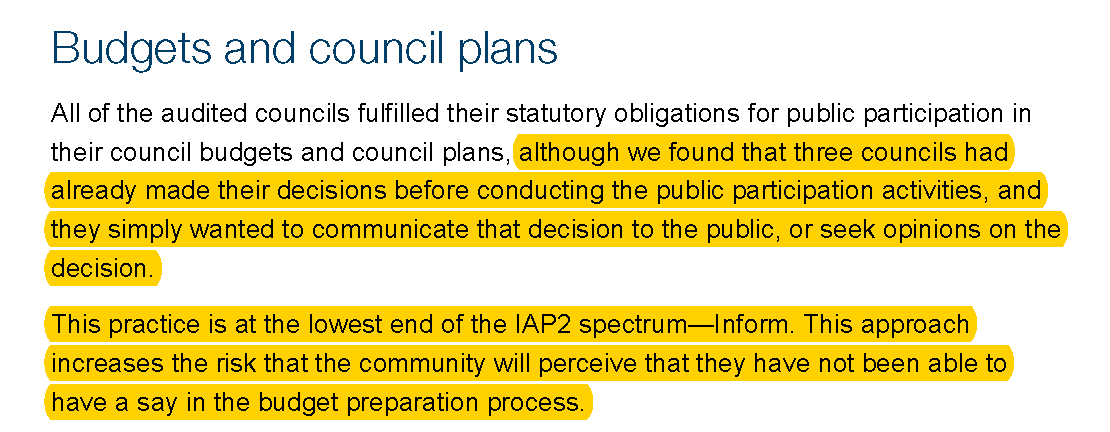
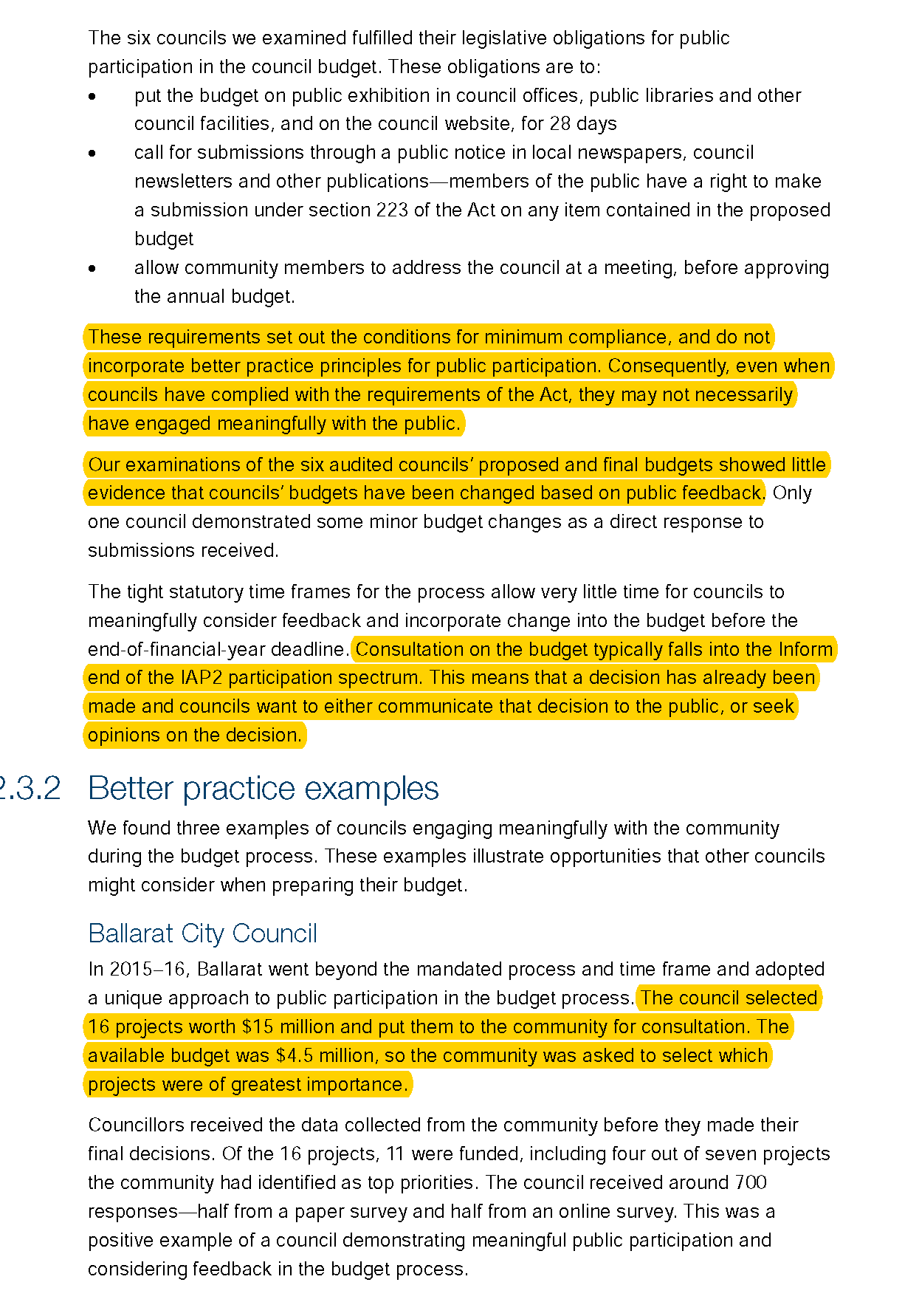
The Auditor General yesterday released his report on consultation practices in local government. Glen Eira was not audited for this report. However, the comments would still be relevant – particularly in regard to the processes for determining budgets and council plans. The full report is available from – http://www.audit.vic.gov.au/reports_and_publications/latest_reports/2016-17/20170510-pp-local-gov.aspx

Here are a couple of screen dumps that readers might like to consider –

Council has indeed perfected the art of camouflage in its production of the annual budget. Broad categories that are not defined become the perfect tool for obfuscation and lack of accountability. Figures, prognostications, and actual business plans seem to be nothing more than works of fiction. A few examples should suffice.

Readers will remember the fuss that Delahunty initially made in regards to the GESAC Wellness Centre – that it was lacking in ‘social responsibility’ and had the potential to damage local businesses. The image below comes from the minutes that gave the go ahead for the completion of this facility. Please note the figures –

Now, less than a year later we find on page 223 of the draft budget – The Wellness Centre is expected to generate income of $434k and incur costs of $405k for 2017-18.

How on earth can the ‘cost calculation’ skyrocket to this extent in less than a year? And what happened to the $120,000 profit once operational?

There are other issues with this centre too. The 2016/17 budget allocated $250,000 for ‘completion’ of the centre. Yet on the 21st March Council Meeting the following tender for the Wellness Centre was included for the in camera discussions

That Council:

  1. appoints Ducon Maintenance Pty Ltd, ACN 150 941 174 as the contractor under Tender number 2017.013 for an amount of $499,273.00 exclusive of GST.

GST would add approximately another $50,000 hence we are looking at well over $500,000 before the first penny comes in. In other words, the centre will not be running at a profit – it will be running at a loss once all the figures are added up!

Other figures for GESAC are also questionable. For instance the current draft budget provides us with these statements-

Addition of fans/chiller to the stadium, outside gym area on the first floor outside the group fitness area and replacement of pool equipment – $210,000 (page 90)

Then a few pages later we have the identical ‘explanation’ but the cost suddenly becomes $40,000 less!

Addition of fans/chiller to the stadium, outside gym area on the first floor outside the group fitness area and replacement of pool equipment – $170,000 (page 93)

One and one never seems to add up to two in Glen Eira! Statements and figures should be crystal clear to even primary school children – unless of course the objective is to camouflage the truth!


We’ve featured the above 2 videos because we simply cannot understand why 2 playground ‘upgrades’ should cost $650,000 (video no.1) and $350,000 (video no.2) according to the budget!!!!! Nor can we understand how council is willing to spend $285,000 on installing more concrete plinths into our parks – plus another $90,000 to pour more concrete into the Heritage area of Caulfield Park! Surely this million and a half can be put to far better use such as – drains, traffic management, bicycle strategy, etc. etc. etc?

In an era of cost cutting and councils crying poor, it is unacceptable that so much money be poured into what we believe many residents would regard as ‘non-essentials’!


A fairly good turnout of residents (approx. 45) at tonight’s Bentleigh Forum on the structure planning process. Introduced again by the facilitator Jane Nathan, who then handed over to Aiden Mullen – the officer in charge of all the current activity centre work.  Mullen summarised the results council had obtained thus far. Significantly missing from the presentation was resident concern with overdevelopment. This morphed into the somewhat simplistic categorisation as concern over heights!

Residents were asked to sit at the various tables and a planning officer was assigned to each table. One person from each table was asked to take notes and report back to the entire gathering. More disconcerting was that each officer had a prepared list of specific questions to ask – ie how many people in your household? How many bedrooms? How many onsite car parking spots? Where would you like to live in 15 years? etc. Basic demographics which in our view are both meaningless (given the sample available) and secondly far more precise figures are available from various sources.

A ‘vision statement’ was then put up as an overhead and residents asked to comment on whether or not they agreed with the statement. It basically went along the lines that Bentleigh needs to retain its ‘village’ feel as well as provide for a safe, diverse, and inclusive community. The majority of feedback indicated that people were in disagreement with calling Bentleigh a ‘village’ given the amount of high rise development and the promise of more intense development. Several residents were highly critical of council, claiming that they simply are not listening to what residents are saying and that council needs to inform people prior to asking Dorothy Dix type questions.

It would be fair to say that most residents wanted:

  • Adequate parking
  • More open space
  • Mandatory height controls
  • Protection of heritage
  • More safe bicycle and pedestrian paths
  • More community facilities

Our view is that council desperately needs to alter its approach to these events. Otherwise they are nothing more than a self-fulfilling prophecy. Instead of motherhood statements that can hide a multitude of sins, residents need to be provided with real information as a starting point. For example: council writes that it is investigating the borders of the activity centres, yet many residents believed that the exercise involved only the commercial centres. Secondly, Mullen kept praising the interim height guidelines without informing residents that they included 5 storeys as ‘discretionary heights’. Thus we have the near oxymoron of in the one breath talking about the ‘village feel’ of Bentleigh, without all residents being aware that 5, 6 or 7 storeys is now a possibility in Bentleigh. This height certainly does not gel with the idea of a ‘village’.

We simply ask:

  • Why can other councils produce reams of information that is posted to all residents explaining exactly what a ‘structure plan’ is? What it can do and what it can’t do? And what are the overall planning constraints, or advantages?
  • Why can other councils produce structure plans that contain data that goes beyond the 2011 census and Glen Eira City Council can’t do the same?
  • Why can’t Glen Eira City Council simply ask a direct question such as – what do you think is the appropriate height limit for Bentleigh, Carnegie, McKinnon, Ormond, etc etc etc

If the aim is to produce work that is truly based on community views, then the community must be given all relevant information up front. It must also stop resorting to language that is far from appropriate and present findings that are indeed an accurate record of what residents say they want, need, and aspire to. Thus far, this has not happened in our view.

PS: As illustrations of how other councils go about conducting their structure planning consultation, we’ve uploaded part of the first survey conducted by Stonnington (late 2016 and another one from late 2015). Compare and contrast this with the kind of questions asked of Glen Eira residents and the information provided in both instances.

Below is another extract from an initial ‘survey’ done by Stonnington –

For once it appears that common sense has prevailed! Councillors voted unanimously to reinstate the 2 hour parking restrictions on both sides of the streets surrounding the Caulfield Hospital and the townhall. That this could have dragged on for so many months is unacceptable. What is also unacceptable is the inconsistency with which council handles all the parking issues – ie Phillip Street for example where exactly the same thing happened over a year ago and nothing has changed. It should not take a concerted and consistent effort by residents to ensure that something is done to address problems. Nor should it take countless thousands of dollars to initiate a traffic survey that ends up reporting that there is no parking problem, or that cars are parking safely, when countless residents report the exact opposite.  This is bureaucracy and bloody mindedness gone mad.

Here is the discussion on the issue –

Silver moved motion to reinstate 2 hour parking on both sides of the street, plus continued monitoring and in future that before any changes to parking restrictions are made that the matter be referred to a full council meeting. Seconded by Sztrajt.

SILVER: thanked residents and apologised for ‘it taking so long as it has’ to restore the previous parking restrictions. Said these are narrow streets and when people park ‘close and opposite’ to driveways it makes it hard for people to ‘get out’ of their driveways. History involves hospital introducing parking costs and that council made a ‘decision internally’ to change the restrictions to all day parking on one side of the street. ‘That has caused problems’. Said he has visited and ‘saw the problems there’. Said it’s ‘not about parking availability’ but the ‘impact of parking’ and the problems caused. Residents have told council that they want their ‘legitimate concerns’ taken into account. It is ‘challenging’ because there are 2 major employers in the area – council and the hospital. ‘We can’t deny that there is a need for staff parking’ in both areas and in the ‘future’ there will be ‘challenges’ for both institutions. So this definitely will be an issue for ‘future consideration’. He hoped to hear that ‘residents’ lives have improved by next week’.

SZTRAJT: asked what the cost is for staff parking at the hospital. Delahunty responded that staff pay $2 per day and visitors $6. Sztrajt then queried whether staff could claim this as a tax deduction and Delahunty replied that it comes out of their ‘pre-tax salary’. Sztrajt then said that his question was to determine whether staff who can spend roughly $1.20- $1.30 a day refuse to park in the onsite car park and use the gate to get to the hospital to ‘save $1.30 a day’ so they park in ‘narrow residential streets’. This has ‘created an unfair circumstance’ for residents. The hospital had to ‘take the matter all the way to the CEO’ of Southern Health about whether to close a gate or not. Said that ‘with the best of intent’ by council, residents have been ‘upset’ and council’s attempts to find a solution by closing the gate ‘have just been delayed’ and residents have ‘been put out’ by the time lag. He now thinks that ‘we are not in a position to wait for the hospital’. ‘We are now in the situation where we will do what our residents asked us to do’. Residents ‘have spoken’ and ‘spoken loudly’. They’ve emailed all councillors, and he ‘commends’ them for taking up the issue and ‘using local government’ in the way it was intended – ie letting residents have ‘an avenue’ to ‘contest issues’. Council can change the restrictions and he is regretting that ‘it has taken us a long time’ to ‘do the right thing here’.

DELAHUNTY: said that council ‘shouldn’t have taken the decision to remove parking restrictions without consultation’. Even though it ‘wasn’t in contravention of our policy, it is not in keeping with the spirit of it’. Said the report stated that there is ‘sufficient on street parking’ and changing will force cars into nearby streets but ‘I don’t think you can have both of those positions’. If ‘reinstating the original conditions will reinstate the original complaints we had’ then council would get zero complaints. Didn’t think there would be any issues with reinstating ‘while officers continue to work on the closure’. Said that it is ‘mindboggling’ that this ‘very minor’ issue has to go all the way to the CEO of Southern Health.

SILVER: said that he is also amazed at the protocols and still feels the decision by the hospital could have been ‘made faster’. The hospital is a ‘neighbour’ and would want a ‘good working relationship’ with everyone.

MOTION PUT AND VOTED IN UNANIMOUSLY

PS – AND JUST A REMINDER ABOUT PHILLIP STREET THAT SURELY FALLS INTO THE SAME CATEGORY OF LACK OF CONSULTATION AND LACK OF JUSTIFICATION?

Item 9.10 features the ongoing saga of parking around the town hall and Caulfield Hospital. After months of supposed ‘negotiation’ with the hospital to close a gate, there is still no outcome. Councillors have thus been offered 3 choices. They are:

  1. Continue With The Current Restrictions – since (a) there is plenty of available parking in the streets and (b) that time should be given for council to complete its ‘municipal wide’ parking strategy in order to reach a ‘more balanced and consistent framework’.
  • Reinstate The Previous Restrictions (pre-June 2016) – this would however force cars to park in nearby streets so the ‘problem’ would only be passed on to surrounding areas. One paragraph from this option deserves citing in full –

Community criticism over the lack of consultation in the recent parking restriction changes is acknowledged. Given the potential for increased parking demands on Glencoe Street, Garrell Street, and Dunbar Avenue, it is recommended that the residents of these streets be consulted prior to any decision to remove unrestricted parking from: Hillside Avenue, Harcourt Avenue, Gerard Street, Hartley Avenue, Sylverly Grove, and Alfred Street.

  • The third option involves having small sections of the street (ie 4 car spots) earmarked for unrestricted parking – but this also requires consultation.

The upshot of all this is, let’s do nothing, or let’s delay some more. Council keeps presenting the argument that it is working on a ‘precinct wide’ traffic management plan. The Planning Scheme review stated that parking precinct plans would be introduced for its activity centres. The streets mentioned above ARE NOT included in any major activity centre, nor are they part of any neighbourhood centre. All council comments related to parking apply only to their ‘structure planning’ – ie As part of the structure planning process, parking and traffic movement will be reviewed with the potential for new traffic measures and controls to be introduced. (April, Glen Eira News).

No specific timelines are provided. Since only structure plans for Bentleigh, Carnegie, Elsternwick, and now Virginia Estate will be done in the next 18 months we have little confidence that parking will get a look in elsewhere – especially since council is now not promising structure plans for its other districts but an ‘Activity Centre Strategy’!

Residents are being given short shrift in our view. Council needs to be upfront and inform residents exactly what it plans to do about parking everywhere. Timelines are required as is a waterproof policy that is up-to-date and which initiates action now and not years down the track.

« Previous PageNext Page »