Councillor Performance


City of Boroondara demolishes Kew townhouses after ‘gross’ permit breach

Dec 15, 2016 Denham Sadler

Two brand new townhouses in Kew have been demolished by the local council after the developer “grossly” exceeded the planning permit. The new development on Normanby Road was ruled to have breached the Boroondara Council’s planning permit by VCAT including by height and its boundaries and was demolished this month. The two townhouses were constructed at 11.5 metres and 12.15 metres high, well above the council’s nine metre height restriction, Boroondara Mayor Phillip Healey says.

“They weren’t missing by millimetres or centimetres, they were missing by a lot,” Cr Healey said. “This wasn’t marginal, this was grossly over where it should be.”

The original building permit to construct the two townhouses was obtained by Nicholas Pantas in September 2012. After a planning officer visited the construction site, an investigation found that Mr Pantas had made “numerous unauthorised changes” to the development.

This decision was then appealed at Victorian Civil and Administrative Tribunal in August 2015, where the developer was given until February this year to amend the developments or have them demolished. The City of Boroondara also took action against Mr Pantas in the Magistrates Court in December last year; he was fined $8000 in penalties and costs.

The National Australia Bank then took possession of the property but were unable to meet the permit and the townhouses were subsequently demolished this month.

“The builder’s action was downright illegal,” Cr Healey said. “This is a costly reminder that planning permits and approved plans must be complied with.”

Kosa Architects helped the developer to obtain the permits and designed the building, but principal Stephen Kosa says the drawings weren’t followed. “The builder didn’t follow the town planning permits or building planning permits,” Mr Kosa said. “Unfortunately the builder decided to try to maximise what he thought to be the end outcome and didn’t follow the approved drawings. We end no involvement in the end construction.”

Despite attempts, Mr Kosa said it was impossible to alter the buildings so they would meet the permits. “The buildings were virtually irretrievable and to bring them back into compliance would virtually be a demolition,” he said.

Cr Healey said the move had enjoyed strong support from the local community. “It’s very pleasing to get supported because we are given the task of managing this and enforcing it, but we don’t always get this level of support,” he said. “We have a responsibility.”

With the two townhouses now completely gone, a new permit will be submitted for the Kew property, and Cr Healey urged the developer to work with the council, not against it. “Work with us – don’t come to us after you’ve done it,” he says. “Work with the process and then these sort of things don’t happen.”

The City of Boroondara has had several recent wins against developers and landowners in court, with a Kew landowner fined $13,500 in May for attempting to remove native trees without a permit, and a builder in Balwyn North fined $6500 for failing to protect two trees during construction.

Source: http://www.domain.com.au/news/city-of-boroondara-demolishes-kew-townhouses-after-gross-permit-breach-20161214-gtas2a/

Over the past year the number of applications for 2 double storeys that have ended up at VCAT is remarkable. We would even go so far as suggest that objections in Neighbourhood Residential Zones are now outpacing  objections for the so-called ‘growth zones’. Most are not due to resident objectors, but to the developer either contesting council’s refusal, or contesting the myriad of imposed conditions.

The mantra of council has always been that the NRZ is ‘protected’ and that the zones bring ‘certainty’ to both developers and residents. The exact opposite appears to be happening. More to the point, every single appearance at VCAT is costing ratepayers money. We remind readers that the so-called ‘protection’ in the Neighbourhood Residential zones date from 2004. Nothing much changed with the new zones of 2013, except for mandatory height and mandatory 2 dwellings – only on ‘average’ sized blocks that is! The Planning Scheme thus basically remained unchanged over this period and onwards to now. Setbacks, permeability, site coverage, etc. all date from 2004!

Thus, if the planning scheme has remained the same for 12 years in relation to Minimal Change areas, then why oh why do we have instances after instances where council fronts up to VCAT with a series of conditions that do not have a hope in hell of getting passed by VCAT given what the planning scheme says? The latest example involves an application in Cushing Avenue Bentleigh. Council sought to impose 6 conditions initially – all of which were either ‘deleted’ or rejected by the Member. And we can’t blame him given the reasons provided below. When ‘standards’ are met, then the developer is home and hosed. What is the point of arguing for conditions that are not supported by the very planning scheme that is the basis for decision making? And what is the point of continuing to ignore the problems with minimal change and expecting to front up at VCAT and win? There is nothing from council to indicate that improvements to the Minimal Change zoning are even on the horizon according to the planning scheme review. Unless this area is addressed, we should expect more of what is shown below.

This condition sought a setback of 3.75 metres from the southern boundary for the length of the elevation, pursuant to standard B10 (Energy Efficiency Objective). The Council officer report indicated that this setback is required to ensure the efficiency of the solar panels located on the adjoining dwelling at 18 Cushing Avenue.

  • At the hearing, the Council confirmed that it no longer wishes to pursue this condition, as standard B20 (Energy Efficiency Objective) is the relevant standard in that instance and that this has been met by the proposed design.
  • While we understand the concerns of the owners of 18 Cushing Avenue with respect to the impacts on their solar panels, I accept the Council’s position that the relevant standard has been met and overshadowing will not unreasonably impact upon their efficiency.

From the submissions presented, the increased upper level rear setback required by the condition is not based on any standard or specific policy requirement. Nor is the increased setback required to achieve the improvement of amenity of neighbouring properties with respect to matters such as daylight or overshadowing

  • I find that the condition is unwarranted for the following reasons:
  • The upper level rear setback, at 5.6 metres, exceeds that required under standard B17 (Side and Rear Setbacks Objective) as modified in the Schedule to the zone (4 metres).
  • The setback proposed allows ample opportunity for the planting of canopy trees which is an outcome desired by policy. The proposed upper level will not impede the canopy of such trees.
  • The upper levels are well setback from the side boundaries. They are stepped in from the ground level footprint, with the setback exceeding the requirements of standard B17 (Side and Rear Setbacks Objective).
  • The upper levels as proposed results in compliance with the requirements of clause 55 with respect to daylight, daylight to northern windows and overshadowing of neighbours.

Source: http://www.austlii.edu.au/au/cases/vic/VCAT/2016/2047.html

We’ve been sent the following announcement. The email to contact the group is – bhcagroup@gmail.com

invitation-2

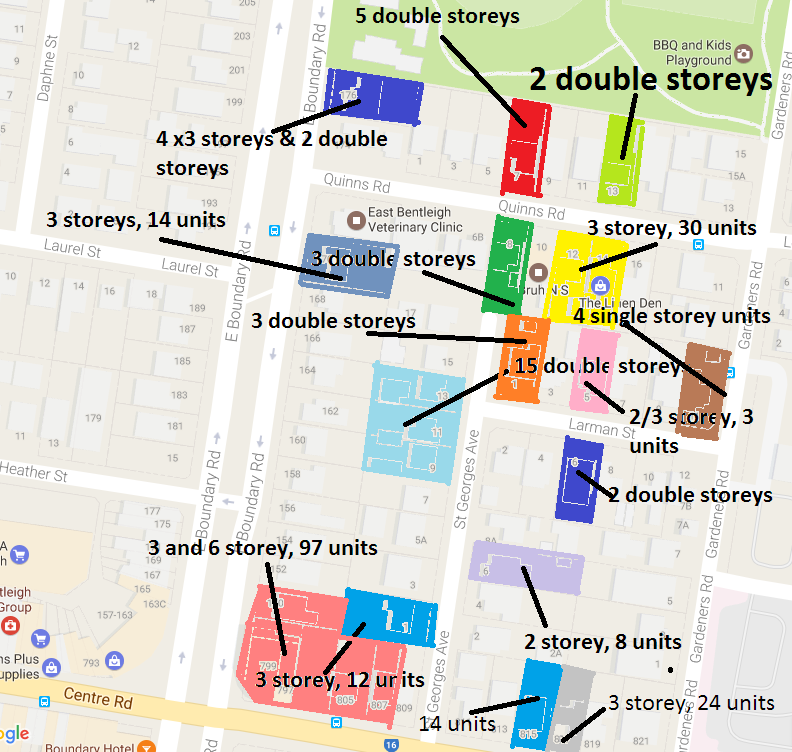
The best illustration of how woeful council’s planning scheme is, together with its recently completed ‘work plan’, comes from the following screen dumps of developments in East Bentleigh. These are significant since:

  • East Bentleigh, plus another 9 suburbs, are classified as ‘neighbourhood centres’ and therefore lower down in the ‘hierarchy’ for development that council stipulates in its planning scheme.
  • Yet, council saw fit to impose a 5 storey preferred height limit for Bentleigh (an ‘urban village’) when East Bentleigh is already undergoing major 6 storey developments.
  • Since the introduction of the zones, developers have had a field day. Amended applications keep coming in to increase either heights or the number of apartments. The latest is for the Browns Road/Centre Road site where the developer wants a 5 storey permit changed to allow 6 storeys. Given the countless loopholes in the planning scheme, and other 6 storey buildings in the area, he will no doubt be successful.
  • East Bentleigh is already seeing countless 5 storey permits being granted, as are other neighbourhood centres. Caulfield North already has a 6 storey permit and there is an application in for 8 storeys! If the workplan stays as it is, then residents in these areas can expect to wait at least another decade before council gets around to addressing the development pressures in its neighbourhood centres. Not good enough!
  • Residents may wish to consider the possibility that this inaction is perhaps deliberate? Or is it due to a lack of money or expertise to do the necessary work? Why when other councils can produce amendments that cover all their shopping centres (ie Bayside, Boroondara) has Glen Eira decided to concentrate on only Bentleigh and Carnegie and in a stated time frame of 4 years?
  • Neighbourhood centres cannot afford the luxury of being left behind

bebe1be2

Tonight’s forum was unfortunately very poorly attended by residents. Nor did the developer reps fill us with confidence that the upcoming amendment will resolve all of the community’s concerns.

The major points to come out of tonight were:

  • The Education Department is ‘investigating’ the need for additional educational facilities in the area. No ‘answer’ as yet. The developers would be prepared to sell the land to the department/government. This could be in the vicinity of 1 hectare. If not a school, then possibly a ‘community centre’. We assume that this would involve council perhaps purchasing the land.
  • The possibility of a commercial car parking venture on site
  • The area currently zoned Commercial 1 would remain. The rest of the site rezoned to Mixed Use
  • The project life is up to 15 years
  • No solution to traffic, apart from advocating for car-share, more traffic lights and buses to run through the site
  • The developers have been in constant contact with council’s various departments
  • One mention of 5000 new residents. How many apartments does this mean?

All in all it is practically impossible to comment on what will eventuate given the lack of detail on just about everything. We simply urge residents to be wary of any amendment and Schedules that are not spelt out to the nth degree.


A long post, but an extremely important one.  We urge readers to note:

  • The new (ill applied) language of ‘evidence based’.
  • The political grandstanding
  • The possible influence that Wynne’s ‘rejection’ of amendments C147/8 has had where no strategic justification was submitted!
  • The implicit admission that council’s planning for the past decade is abysmal and actually non-existent
  • And much, much more!

Item 9.3 – Council submission on Ormond Tower proposal

Motion to accept submission moved by Athanasopoulos  and seconded by Davey.

ATHANASOPOULOS: said that council needs to ‘hold’ a ‘very strong position’ and the submission does that.

DAVEY: thanks officers for their submission on something as ‘vast’ as the proposal. Said this was an opportunity for council to represent what ‘the community wants’ on this site. Officers had ‘raised’ what they saw as issues – ie ‘height and scale’ and 13 storeys is ‘huge’ and ‘we need to consider something smaller’. The suggestion of a supermarket is ‘also quite significant for that area’ because of its impact on the shopping centre and also ‘traffic’. Impact on Katandra which is used by commuters and school is also significant. Said she was pleased that the officers recommended that the State Government also consider some form of ‘social housing’.

ESAKOFF: moved an amendment that a five storey mandatory height limit be proposed and then scaling back to no more than 2-3 storeys at the back. Said that council would provide justification for this when they appear at the hearings of the advisory committee in February. Seconded by Hyams. Said that there was much ‘concern’ in Ormond and surrounding areas about ‘this proposal’. She was asking for councillors’ support and said ‘I am taking a firm stand on what is appropriate in Ormond’ and she didn’t want to be ‘wishy-washy in our response’. Said the proposal was ‘completely out of sync’ with the planning scheme and ‘community expectations’. Quoted from the actual submission on height and ‘scale’ that is ‘beyond that of urban villages’. This is not in accord with council’s housing diversity policy that designates neighbourhood centres to be of less density than the urban villages. Since Ormond is a neighbourhood centre, she couldn’t see how council can accept anything above 5 storeys.

HYAMS: explained to the gallery the formalities of motions and amendments. Supported Esakoff’s amendment because council has to give the community some idea of where they stand and the submission is ‘very good’. His opinion is ‘that we need to be consistent across Glen Eira’ and council has asked for interim height restrictions and in Bentleigh which is an urban village they’ve asked for 5 storeys. Thought that if council is to be taken ‘seriously’ then 5 storeys ‘also applies to Ormond’. Stated that people might be asking why 5 storeys in Bentleigh and then being ‘less’ concerned when ‘it comes to Ormond’.

MAGEE: said that there already are 5 storeys in the area and that ‘one could argue’ that ‘this is the appropriate height’ but that means that the developer is saying 13 storeys and council is saying 5 storeys. The result would be that council would ‘lose a lot of credibility’. Council would be better of by saying ‘let’s look at parking, let’s look at traffic’ and ‘amenity’. ‘How many floors are going to be parking’ and how many accommodation and ‘start building the profile of how that affects’ the area. If council simply says 5 storeys then this makes it ‘hard for officers’ when they ‘go and do their presentation’. Once they’ve done the traffic and parking it immediately starts ‘putting the negative tone’ and through consensus ‘you reach a common ground’. This ‘could be 5 storeys’ and ‘it might even be 6’. To now say ‘we don’t want anything’ but 5, is a ‘very negative path’ and is ‘very hard to argue that ongoing’. Said this was only the ‘beginning’ of the process and they’ve got the opportunity to ‘sit down and present our submission’ and ‘we have to back that up with figures’. It’s very ‘hard’ to simply ‘go in’ with 5 storeys. It ‘has to be backed up’ with data. Didn’t want ‘them on the back foot’ and ‘saying they just want 5’ and there’s ‘no justification for it’. Magee would prefer that ‘they listen’. Said that council isn’t accepting 13 storeys. Council is merely saying here’s what ‘we think’ and this is based on ‘very sound logic’ and ‘every department’ involved with planning at council ‘will have input into this submission’. ‘It is dangerous to simply say 5 storeys maximum’. He can’t ‘support the motion’ because ‘it doesn’t give us the strongest argument’.

DELAHUNTY: said she thought that council had a better chance of a good outcome if ‘we used an evidence based’ approach. Said councillors know the area and ‘we kind of know what would be appropriate there’ but that ‘we would make a better argument when we do the strategic work’. Therefore ‘I would like not to have a height named in the submission’ because ‘it doesn’t use an evidence based method’. The proposed submission makes a ‘good argument about the height and the scale’ and its ‘relationship to what is currently in Ormond’. Said that council has made some suggestions for planning in Glen Eira over the past 6 months and this ‘suggests that we need time and space’ to do ‘strategic evidence based work’ to justify their recommendations so ‘I am worried about the inconsistency of now putting a height on it and what political mileage’ could be ‘gained out of that’. When they go to the panel in February, ‘we will have some evidence collected by then’ which they can present to the panel about ‘what our preferred height will be’. Said that it’s now council’s preferred height but ‘your preferred height because it is evidence based’. Thought that the ‘stronger position’ as a council is to ‘do the work first’. The community asked for feedback so if council is a ‘strong’ community voice they have to do better than propose something that is ‘not evidence based’. Thought they will get to a ‘height argument’ but only after they’ve done the ‘strategic work’. That will be done by February and because of that she thought ‘it will be stronger’.

TAYLOR: said that ‘we all want to take a position of strong advocacy’ and agreed with Esakoff that none of them ‘want to be equivocal’ and that through their campaigning they are aware of residents’ concerns about height. Agreed with those opposing the amendment that if they could ‘pack’ more ‘evidence’ behind their position they would be better off.

SILVER: thought that listening to the community and then ‘going bang’ in February is ‘the strongest way possible’ of achieving something.

AMENDMENT PUT AND LOST. VOTING FOR – Hyams and Esakoff.

Voting against – Magee, Taylor, Delahunty, Davey, Athanasopoulos

ABSTAINED – Silver

ESAKOFF: said she was ‘disappointed’ about the amendment being lost and that she was a ‘little confused about the arguments’ and that the ‘authority’ will decide ‘regardless of our submission’. Thought that on ‘behalf of the community’ that ‘we’ve made a stand’. As for ‘evidence’, she thought that council’s ‘heirarchy’ of urban villages and neighbourhood centres is ‘evidence’. Summed up by going through submission again – ie traffic, impact on local schools, shopping centre, etc. Wanted a more ‘transparent process’ that allowed for meaningful ‘community input’. Said she would ‘get over’ losing out on the amendment but ‘the community mighn’t’. If council suggested 5 or 6 storeys then ‘we wouldn’t have the multiple levels of car parking’ since ‘it would reduce the need for it’ so Magee’s earlier arguments would now be ‘all irrelevant’. ‘This is our submission. This is our chance’. Even though they will have a hearing ‘this is our submission’ in what ‘our community is going to see us standing up for them’.

SILVER: thought this was an ‘unfortunate situation’ in that before the level crossing works they had land ‘subject’ to the same conditions as elsewhere but the Minister changed the legislation and the government is now using this ‘opportunity’ to ‘make a bit more dough’. The ministerial amendment ‘wiped the slate, carte blanche and the government could do whatever it wants’. Ideally council should be the decision maker, but that’s not happening since all they are doing now is telling the government what they think ‘should be the standards’. Didn’t know ‘whether this is a genuine form of consultation’ but seemed like ‘just another way for the government to make more money’.  Council ‘has a standard’ and it’s up to the government to adhere to this standard ‘or ignore it’. That’s why he didn’t support the amendment because he is ‘uncomfortable with the entire sky tower’.

MAGEE: even though he agrees with ‘everything’ Esakoff said thought that they are ‘trying to get to the same position in a different way’. They don’t want 13 storeys but ‘there isn’t even an opportunity for an appeal to VCAT’. The Minister ‘will decide’ on the basis of the reports submitted to him. Council’s just is to put ‘forward a submission based on evidence’. ‘It can’t be an emotional response’. Said that local MPs are ‘on our side’ and they are saying ‘give us the tools, give us the reasoning’ so it’s not 13 storeys. So even though the ‘community may be disappointed that we didn’t put in a blanket 5 storey maximum’ the important ‘part’ is ‘where this will end up’. Didn’t want the ‘negative feel right from the start’. Thought that it had to be ‘evidence based’ and not emotion based.

HYAMS: even though he would have preferred the amendment to be passed, this is still a ‘very good submission’. Thought that it was ‘fair enough that the government does go for some value capture, but it has to be reasonable’. This will be a ‘stand alone building’ and so won’t ‘integrate with the shopping centre’.

DELAHUNTY: thought that what is likely to be ignored is ‘our role’. Planning isn’t simply about height or overshadowing, it is ‘more nuanced’ and how a ‘building might add to a place’ and council is ‘best placed to make those decisions’. Was ‘disappointed’ that council wasn’t the ‘decision maker’. Didn’t ‘want to see lazy planning from the state government’. Council needs to ‘keep up our efforts’  in terms of ‘more than just heights and more than just shadows’ and ‘talk more about Ormond’ and the people and ‘the way the village and the people interact’. Supported the ‘strong submission’ and didn’t think ‘it’s our only chance’ because they will ‘front up again’ in February.

ATHANOSOPOULOS: thought the submission was ‘very strong’ and important to have such debates. Thought that a comment from the gallery earlier about going to VCAT and ‘not having the right evidence’ was important. So this is setting the ‘bar’ and saying ‘we are no longer unprepared’.

ORIGINAL MOTION PUT AND CARRIED UNANIMOUSLY.

There is a salutary lesson for residents and council in the comparison of the Caulfield Village development process and what is fast approaching for the Virginia Estate project. Residents need to be fully aware of:

  • The impact of rezoning (ie Caulfield Village rezoned to Priority Development Zone, and Virginia Estate now mooted rezoning to MUZ and/or Commercial 1)
  • Council acceptance of an Incorporated Plan for Caulfield Village and the potential acceptance of a ‘Management Plan’ for Virginia Estate – both of which will allegedly provide the ‘conceptual framework’ for development but without real detail. No objection rights for residents – decision is made by council.
  • Development Plans (ie the details) which then follow for each precinct but which only have to be ‘generally in accordance’ with the Incorporated/Management Plan. These Development Plans can be amended time and time again, and have been for the Caulfield Village.

Readers will remember that the Precinct 2 application (just under another 400 dwellings) for the Caulfield Village was refused at ‘manager’ level by Council without Council displaying this until after the fact. The developer immediately went to VCAT, where the decision has now been handed down. Once again, the developer has basically won, and all previous promises (ie real social housing element, ‘housing diversity’ has gone).

The ‘problem’ with this entire process is that the Schedule for the Caulfield Village which Council accepted and which provides all the ‘musts’ is so vague, and basically useless,  that the developer has all the cards stacked to his advantage. Fundamentally,  council’s requirements were inadequate and our fear is that unless some real lessons are learnt the same will occur at Virginia Estate. For example, the Caulfield Village history is:

  • No on-site visitor parking required (at this stage 2063 dwellings – originally mooted at 1100 in the Incorporated Plan). Precinct 2 now has 45 on site car parking spots but this is dependent on the ‘largesse’ of the developer and not on council’s Schedule.
  • Amendment after amendment that allows balconies to encroach on setbacks
  • No definitive statements on social housing except this useless sentence in the Schedule – The provision of affordable housing in the form of social housing. No definitive statement on how many ‘social housing’ units, or how this is to be managed. Readers will remember that council wrung its hands in dismay when Precinct 1 was allowed without any social housing and the arguments of Hyams et al were that future precincts would meet this requirement. So much for promises!
  • No definitive statements on ‘housing diversity’ – thus Precinct 1 has over 40% as one bedroom dwellings and Precinct 2 will likely have 2.2% of three bedroom apartments according to the plans.

For the full VCAT decision, please see: http://www.austlii.edu.au/au/cases/vic/VCAT/2016/1965.html

As we’ve said above, unless the lessons from Caulfield Village are learnt, and learnt properly, then we fully expect that the Virginia Estate project will follow in the same manner . It is the job of this new council to ensure that every single potential gap in any Management Plan and accompanying Schedule is spelt out so that the developer has as little wriggle room as possible. If this is not done, then we can rest assured that the eventual Management Plan will not be worth the paper it is written on and the entire project will duplicate the abysmal planning that occurred and is still occurring with the Caulfield Village!

Resident #2 – began by asking whether the ‘new council is doing all it can to ensure it has all the information’ to ‘bolster its position at VCAT?’. Said he had been an objector to VCAT several times and ‘last week’ attended the hearing for a development on Neerim Road, Carnegie. Went on to say that it ‘breaks his heart’ to see council representatives trying to ‘argue a case’ when they don’t have ‘much to stand on’. Gave the example of internal amenity where the developers argued that it is ‘not mentioned in the planning scheme’. On car parking there were many permits granted where waivers were granted but ‘there is no evidence of how many car parking waivers have been granted’. Went on to say that ‘unless there is other evidence provided’, then the ‘evidence of the applicant stands’. Stated that the member asked about the draft Amendment on height limits, but the council rep ‘wasn’t able to provide an update on that’. The speaker claimed that this ‘would have had a big impact on the outcome of the case’. The question then is whether they can ‘invite’ these people who ‘act for council’ to present to council a report on ‘what are the gaps’ ‘whilst the whole process’ of implementing the work plan for the planning scheme review is going on. Also asked how council can ‘accelerate’ the Minister’s approval of the draft amendments.

DELAHUNTY: said that council were doing the ‘strategic work’ that she thought would ‘bolster’ council’s position at VCAT. Also stated that ‘arguably’ this strategic work should have ‘been done some time ago’ but they’ve ‘made the decision to do it now’. Thought that the questioner’s point about council reps reporting back to councillors ‘might have some merit’.

TORRES: said it wasn’t an ‘easy’ situation and that council gets a ‘high number of VCAT appeals’ and ‘many’ that council ‘defends’ are changed or ‘overturned by VCAT’. Claimed that ‘council is running’ on an average with ‘other similar councils’. Stated that the VCAT reps include ‘senior staff’ and consultants who were chosen because of their ‘experience and expertise’ including one who was previously a VCAT member himself.

DELAHUNTY: repeated the question that they use the reps to ‘figure out what are the hot issues at the time’ and that this ‘suggestion’ has ‘merit’. Informed the gallery that the VCAT Annual Report has been published and that there was ‘some discussion’ about the number of Glen Eira appeals. Admitted that it was a ‘high number’ and the cost for ratepayers. Again thought questioner was right in that they had to listen to reps ‘in order to figure things out’.

QUESTIONER #2: said there was ‘urgency’ because there’s a ‘gap’ between ‘what the representatives have to argue’ and they could be the ‘best representatives’ but ‘if there’s no basis for their arguments’ and therefore ‘no results’.

SILVER: said he was ‘satisfied’ that officers are ‘taking the appropriate steps to incorporate our policies’ into the planning scheme and that there’s a difference between ‘policies’ and the current legislation. Said he would like to see more lawyers on the panels.

COMMENT

Readers should find the following statistics from the VCAT Annual Report very interesting. Not only do they reveal that Glen Eira has had the highest number of appeals to VCAT in the last year, but that East Bentleigh appeals have gone through the roof (a 90% increase). These statistics put pay to the myth that under the new zones, VCAT appeals would be reduced. It also reveals the impact the zones have had in East Bentleigh where the overwhelming majority of cases are developer initiated precisely because of the zoning!

vcat1vct2


This is just a very brief report on tonight’s council meeting. A detailed summary of some of the items will follow in the next couple of days.

  • Delahunty again moved the motion to suspend standing orders and to take questions from the gallery. This time around Esakoff voted in favour of the suspension of standing orders, whilst Hyams voted against. There were three questions – one on an empty fish and chip shop in Bentleigh and how it is now representing a health hazard. Promises were made to investigate. Another question involved planning and whether council’s consultants at vcat could present reports to councillors on the ‘gaps’ in the planning scheme that prove problematic at vcat. (full detail to come on this one).
  • Item 9.2 on council’s ‘advocacy’ to change VCAT was passed as written – ie the council ‘acceptance’ of do nothing until 2018! (again details to come)
  • Council’s submission on the Ormond rail development was the most interesting item all night. What we witnessed here was politicking on a grand scale in our view, plus Wynne’s reputed demands for some decent ‘strategic planning’ having a major impact. Consistency from Hyams and Magee was non-existent – as per usual!
  • Three public questions – but since the questioners were not in the gallery, the questions and answers were not read out and neither will they be minuted!

If the persistent and strong rumours prove correct, then Council has again been ticked off by Minister Wynne in relation to their draft amendments for the Bentleigh and Carnegie activity centres. We suspect that council has been ordered once again to pull its finger out and do some decent strategic work which would justify him gazetting the amendments.

As we’ve said in previous posts, the draft amendments:

  • provided no strategic justification for the stated interim height levels
  • FOI documents revealed no data that was worthy of that name was submitted by council
  • all council has done is draw a few lines on some maps and this is meant to constitute ‘strategic planning’

All of this means, if true, more delays upon more delays in introducing some measures which help protect residents against over-development. We simply ask the question – when will this continued incompetence stop?

« Previous PageNext Page »