GE Consultation/Communication


Our apologies for this incredibly long post, but its importance we believe justifies the length since it goes to the heart of what constitutes full transparency and accountability and council’s unwillingness to be completely up front with its residents.

In keeping with its recent practice of refusing to publish the full feedback on its consultations, council has released its ‘summary’ on the draft Elsternwick Structure Plan. In the report we find little that would convince us that the presented analyses reveals an accurate and complete picture of what respondents wrote. So why is council insisting on mere ‘summaries’ rather than publishing the full data as it has done on numerous previous occasions. Why is council fighting tooth and nail to refuse FOI access on its bogus claims that requested documents are ‘voluminous’ and meeting the application would entail a severe imposition on council resources? The refusal to allow residents to come to their own conclusions as to the feedback can only lead to the perception that there is much to hide.

The summary report listed in the current agenda consists of 25 pages. Within these pages we find the following frequency of terminology used to report on the outcomes. Words such as ‘several’, ‘many’ and ‘some’ in relation to respondent answers are used without any clear indication of what was actually stated or the nuances and variations between respondent comments. The frequency in relation to respondent comments is:

Several – used 8 times

Many – used 21 times

Some – used 18 times

Another telling example of the inadequacy of the report comes from page 4 –

Many respondents supported protection of the centre’s heritage and were often concerned that increased built form would deteriorate the centre’s heritage value and village feel. Some participants considered the general lowering of permitted building heights to be the appropriate response.

What is the numerical difference between ‘many’ and ‘some’?  Does the differentiation between the ‘many’ and ‘some’ indicate that the ‘many’ were not supportive of a decrease in height limits or that this was simply not mentioned? Did any of the responses really affirm or agree that Elsternwick has a ‘village feel’ or is this simply terminology assigned by the authors of the report?  And how should ‘increased built form’ be interpreted anyway? Does it refer to the paltry set backs? The heights? Their discretionary nature instead of mandatory, or their overshadowing potential? Ultimately such statements are meaningless and certainly open to a multitude of interpretations. Without access to the actual comments, there is no way of telling and according credibility and value to the summary report.

We also have to take issue with the manner that the so called topics are presented and their accompanying tables purporting to reveal the ensuing ‘themes’.  The survey questions focused on topics predetermined by council such as: vision and objectives; heritage; traffic; etc. Accompanying each topic, respondents had the choice of downloading what one can only assume to be information that would provide greater understanding of the topic. We repeat some of the comments we made in an earlier post (See: https://gleneira.blog/2022/11/04/elsternwick-another-shonky-consultation/) –

  • The draft structure plan proposes to allow up to 6 storeys for heritage listed sites along Glen Huntly Road. Not once is this mentioned throughout the document that is supposed to provide respondents with information on this important aspect of the structure plan.
  • Jargon predominates. What on earth does ‘rich materiality’ mean and how would respondents interpret this?
  • Why aren’t we told that the heritage listed church is likely to be surrounded by 12 storey towers? And yet, given the above, we are still meant to believe that council  takes great care to ensure the heritage fabric of Elsternwick is protected

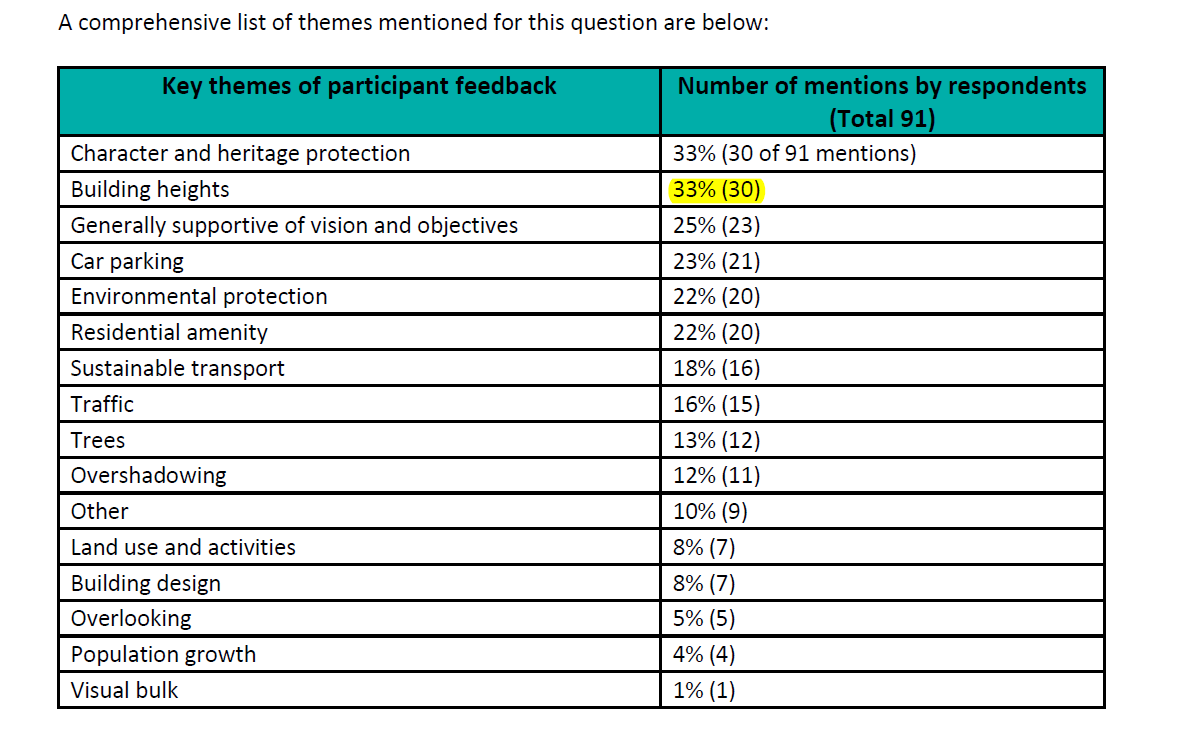
As for the accompanying table on the vision and objective question we find this:

The above table reveals absolutely nothing about the views for or against – ie how many were opposed to the proposed building heights and how many were arguing for increased building heights or perhaps that the proposed heights were appropriate? Simply providing the number of times something was mentioned does nothing to convey what the community thought and how this was expressed in the feedback.

The value of any survey is 100% dependent on the quality of the questions asked. Are the questions open-ended and objective, or written with a specific end in mind? Are they free of ambiguity? Are they mere motherhood statements that would be hard to disagree with? Are respondents provided with enough specific detail to respond meaningfully, or do they have to plough through hundreds upon hundreds of pages in order to glean what is really proposed? How many respondents have actually bothered to do this if details are buried and does this potential lack of knowledge invalidate their answers? Council’s approach has always been to proffer questions that are nothing more than feel good statements, or rhetorical flourishes that no-one would or could disagree with. For example: the significance of heritage and the need for protection.  Yes, residents would agree with the importance of protecting heritage, but does this then lead to the ‘support’ of what is proposed – especially when the mechanisms for achieving this aim are so vague and ill defined.

How many of these surveys are road tested prior to being inflicted on the community? Were there focus groups prior? Were their responses analysed? Did councillors have any say in the creation of these questions? What about the Community Consultation Committee? And who actually drafted the questions?  

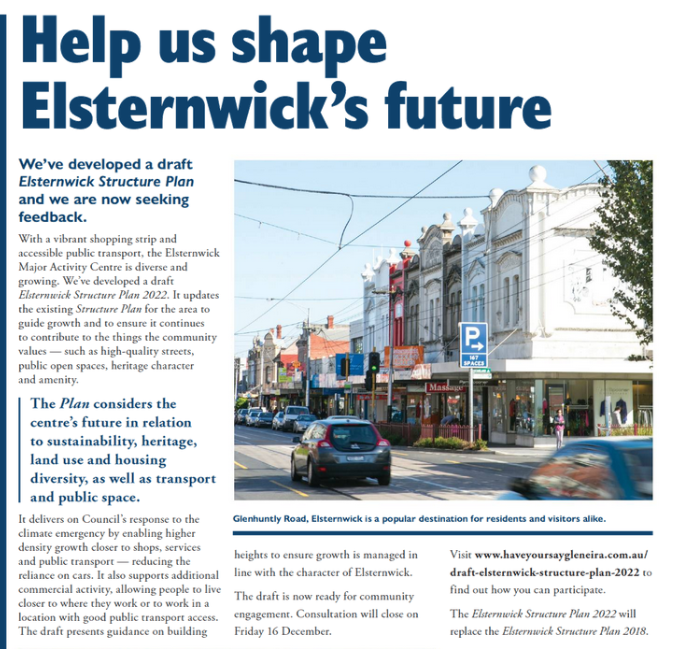
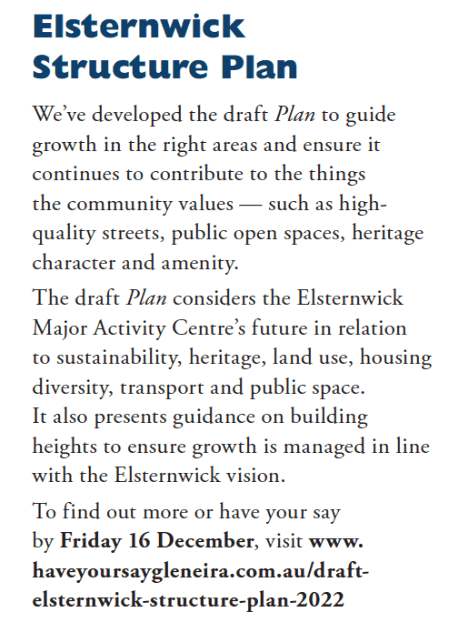
And how well has council advertised its surveys and their significance and ramifications? What follow up has council undertaken to analyse what could be considered as poor response rates? Did council really attempt to engender a huge response or the reverse – ie downplay the significance of the consultation? For the Elsternwick Structure Plan we are told that there were articles in the Glen Eira News informing residents of the consultation. The claim is that information was present in the November and December editions. The first screen dump is what appeared in the November issue followed by the December insert that came in on page 9.

The above calls for participation leave a lot to be desired. Instead of ‘facts’ such as: proposed heights; rezoning of some properties; onsite car parking reductions and of course open space/environmental proposals, there is nothing in this first article that would provide residents with a clear vision of what the proposals entail. Nor does the December version elaborate on anything further. And is it sheer coincidence that the inserted photograph only features 2 storeys along Glen Huntly Road, instead of the monsters that are already in existence? Jargon, generalities, and platitudes epitomise the article instead of the transmission of real information. And when will council refrain from such nonsense as calling Elsternwick a ‘village’ when we already have 13 storey buildings going up!!!!

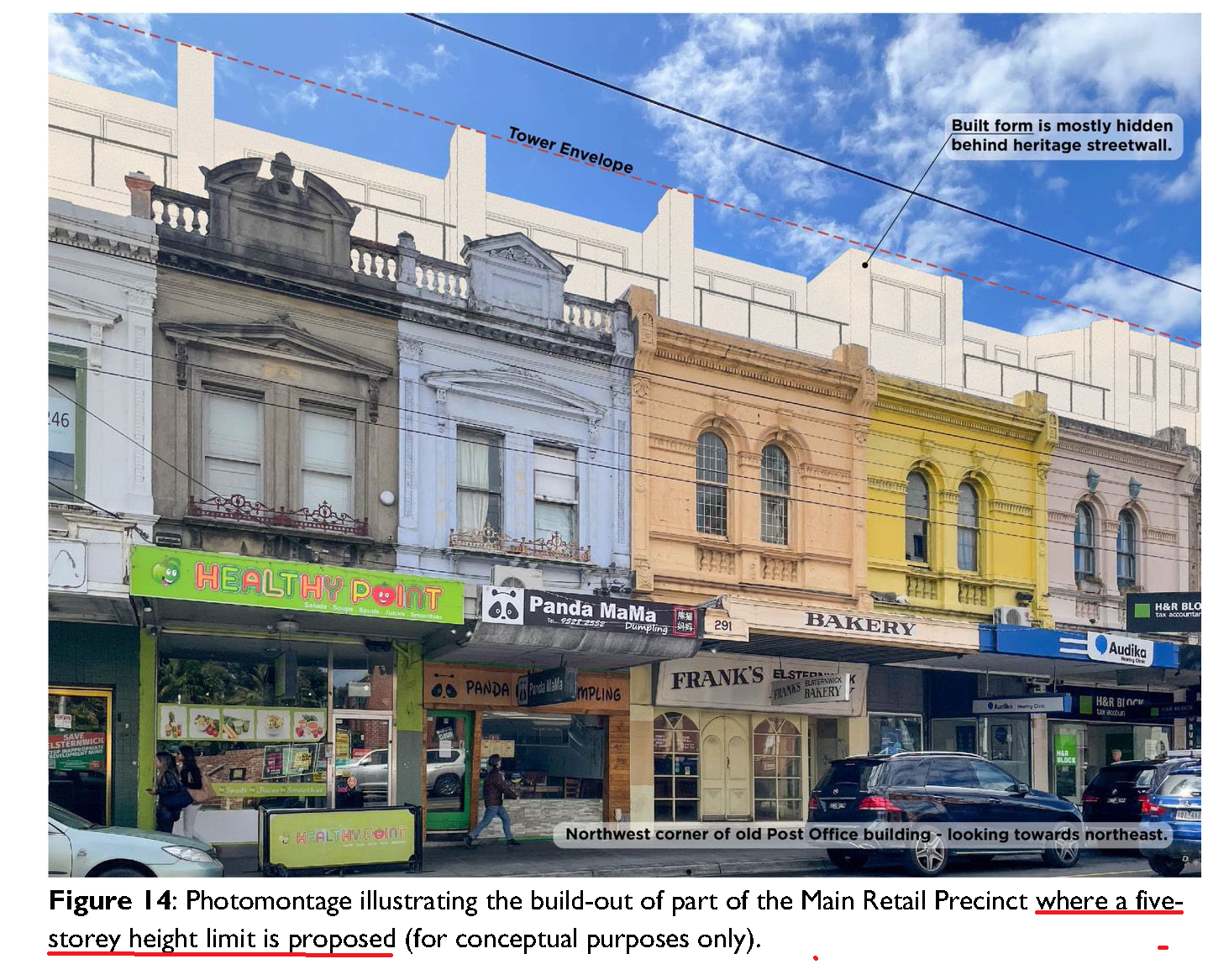
There are countless errors (falsehoods/deceptions?) in much of what council has presented in the accompanying ‘information’ sheets. For example the following image from the Buildings document showing the montage of what a 5 storey height might look like. Even if we accept the accuracy of this image (which we believe is highly suspect) it does not explain why council chose NOT TO DEPICT the opposite side of the street that has a 6 storey discretionary height limit as well as the neighbouring properties further up along this side of Glen Huntly Road that are also under heritage overlays.

Despite all this, council has been forced to reveal that on a ratio of close to 2:1 residents were opposed to most of what the draft structure plan envisioned. What happens now should be of utmost concern to all residents, especially in Elsternwick and Bentleigh. Will councillors insist that this draft goes back to the drawing board? Or will we merely have a minor tinkering around the edges and it is voted through? When something is so strongly opposed then the only solution should be that councillors listen and act in accordance with community sentiment!

Another year is fast drawing to an end with very little ‘progress’ in most major areas of council business. 2023 will undoubtedly be crucial in setting the foundations of what Glen Eira will become over the next 20 years.

2022 was basically very disappointing. Following the Wynne letter of December 2015, which basically ordered council to pull its finger out, 7 years later we still do not have:

  • Permanent structure plans for our major activity centres
  • Any comprehensive reviews of the residential zones (circa 2013)
  • A developer contributions levy
  • An ESD (Environmental Sustainability) policy in the planning scheme
  • A WSUD (water sensitive urban design) policy in the planning scheme
  • Parking precinct plans – promised at least 15 years ago

In many ways transparency and accountability have also gone backwards. For example:

  • No longer is there publication of all community consultation feedback. Instead we get carefully manipulated ‘summaries’.
  • The Annual Report now no longer publishes data that fully explains everything. We are told that council planted 2000 trees but are not given any indication of how many were ‘replacement’.
  • Important background documents such as traffic analyses are not provided in many cases PRIOR to the call for community input. In other words, residents are asked to comment on something that is vague and lacks the strategic justification for the recommendations – literally making consultations practically meaningless for residents. Even councillors don’t get to see all the data prior to their important decision making.
  • Nothing of real consequence for tree protection. It will not be part of the planning scheme.
  • No update on flooding since 2006 when climate change is central
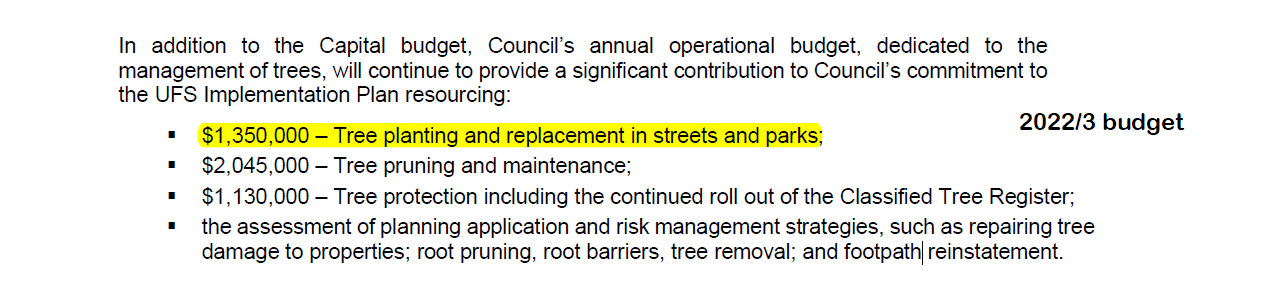
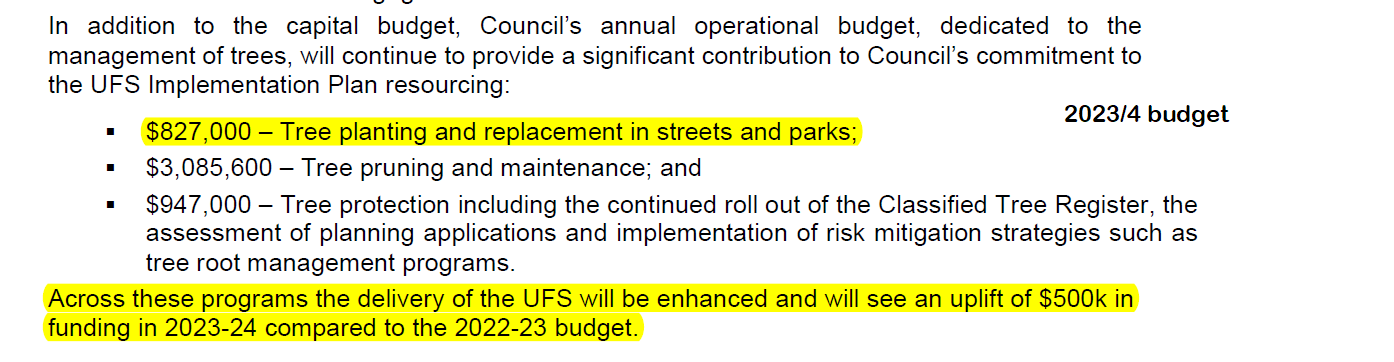
  • Urban Forest Strategy that lacks sufficient funding
  • Probably hundreds of thousands of dollars spent on glossy planning documents and consultants that amount to nothing – ie car parks; Inkerman Road bicycle path etc.
  • FOI applications fought tooth and nail by this administration to prevent full disclosure

So, are there any good points that featured in 2022? There are a few in that it is clear that some councillors at least are not enamoured with the way this council conducts its strategic planning. The very fact that the notorious Housing Strategy was voted in by 4 to 3 means there is division. Had both Esakoff and Cade been present at this meeting then we have no doubt that the Housing Strategy would have been voted down. Maybe that’s why it wasn’t put back until the next council meeting when these 2 councillors would have been present?

2023: The year ahead

The coming year will be pivotal in setting the scene for the next 20 years. Up for decision we will have:

  • Bentleigh, Elsternwick structure plans and the accompanying DDO’s.
  • Review of the Planning Scheme. Whether or not this will incorporate a review of the actual zoning everywhere is anyone’s guess.
  • What happens to the remaining 10 neighbourhood centres that are currently without any DDO’s or Urban Design Frameworks, and definitely no structure plans? Will they be left untouched for another decade?
  • Will community consultation come close to genuine consultation where councillors and the community consultation committee have direct and influential input into the survey questions?
  • Will we ever get decent parking policies and parking precinct plans?
  • How much funding will go to our declared climate change policy and all its attendant duties – ie Urban Forest strategy and real protection for trees on private property?

As stated earlier, it’s now been seven years since the Wynne letter to get things right and we’re still waiting. No other council that we know of has taken this length of time to produce some decent strategic planning. What is wrong with Glen Eira?!!!!!! Until there is a major change in council personnel, and in culture, we believe that the pro-development of this council will remain.

Finally, we wish all our readers a fantastic festive season and a healthy and fulfilling 2023. We also thank readers for their continued support and encouragement.

Council has finally put up its responses to the questions asked at the Elsternwick Zoom Meeting. The document may be accessed via this link: https://www.haveyoursaygleneira.com.au/81078/widgets/391968/documents/248250

We ask residents to pay particular attention to the following question and the ‘answer’ –

What justification is there for 8-12 storeys?

Elsternwick is growing and there is demand for new dwellings and employment space into the future. State planning policy directs growth to activity centres. The draft Structure Plan aims to balance growth with protecting heritage and other characteristics valued by the community. While there are areas proposed to allow 8- 12 storeys to accommodate some of this growth, taller built form is restricted to a small part of Elsternwick, close to the train station and Nepean Highway. At the same time, the draft Structure Plan is proposing a considerable amount of down zoning from 4 storeys to 2, to protect residential heritage. Most of Elsternwick is proposed to remain low-scale.

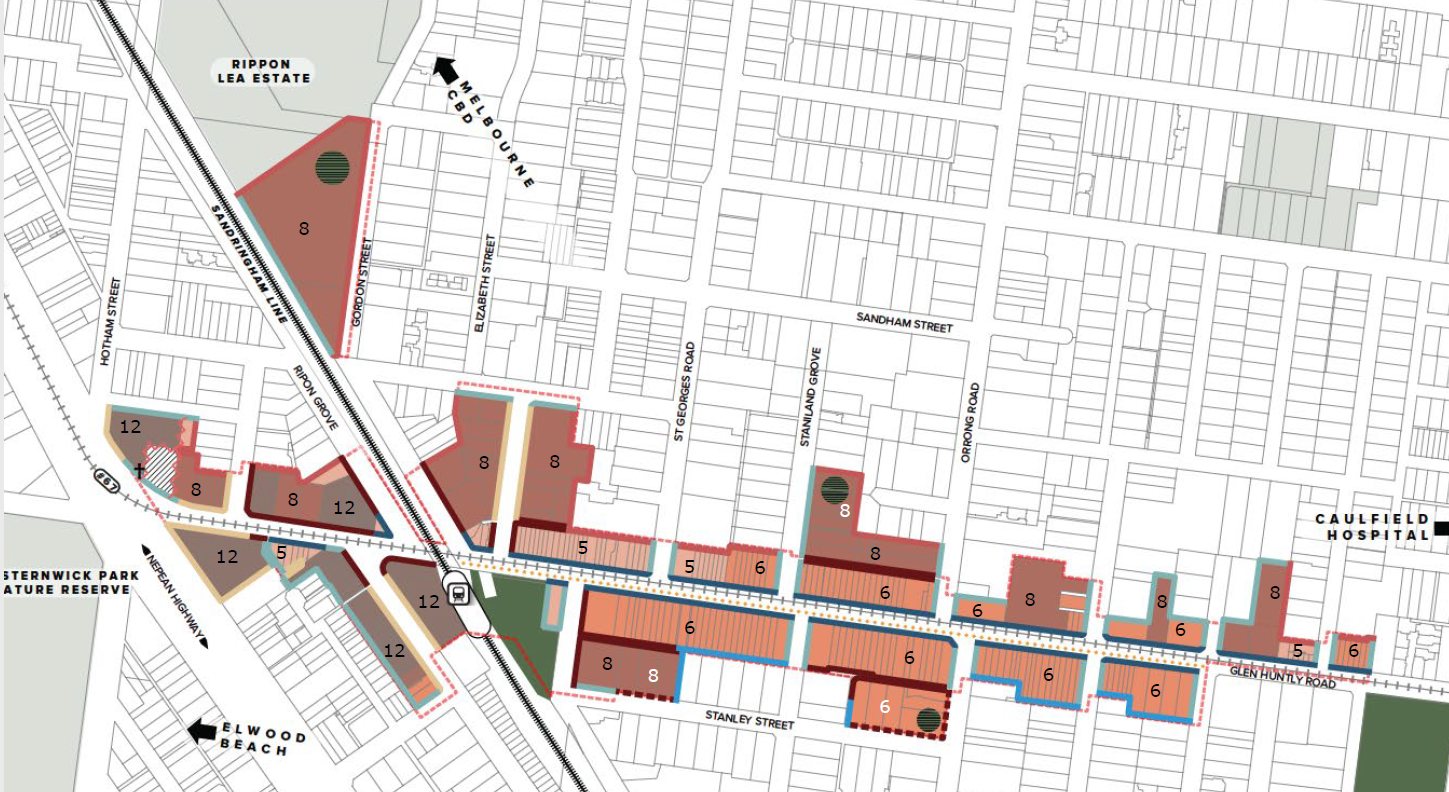
 The claim that the decision to allow buildings of 8-12 storeys is ‘restricted to a small part of Elsternwick, close to the train station and Nepean Highway is not only inaccurate but wilfully misleading – especially when this statement is compared to the actual proposed heights along all of Glen Huntly Road.

It’s clear that a vast amount of sites will now be liable to accommodate a DISCRETIONARY height limit of up to 12 storeys! And many of these sites are nowhere near Nepean Highway or even the train station. Which leads to the most important questions:

  • When will council have the courage to call a spade a spade?
  • When will councillors insist that spin and obfuscation are not the hall marks of every single council pronouncement?
  • When will residents stop being treated as idiots unable to understand anything about sound strategic planning?

CLICK TO ENLARGE

Somewhere between 90 and 100 residents showed up Wednesday night for the Elsternwick Structure Plan ‘face-to-face’ meeting with the Camden Ward councillors. Crs Szmood and Zyngier were present whilst Cr Parasol was an apology.

The night was extremely valuable in that residents could directly address councillors with their concerns, their views on the draft structure plan, and how they generally perceive officers’ attitudes to residents and their aspirations for the suburb.

We present below a selection of comments that were made throughout the 2 hour meeting. It was very clear that there was much dissatisfaction with the structure plan itself, but also the entire consultation process, and how little heed council pays to resident views.

Some of the following audio is not crystal clear. It was a very large room that often sounded like an echo chamber. So please bear with us and listen to these comments.

PS: It’s also worth mentioning that council stated that the audio of the recent Zoom meeting on Elsternwick would be published. It was also promised that all questions would be answered. It is now over 2 weeks since this event and we still have not been provided with this audio or the responses to the queries. Perhaps officers are simply hoping that residents would forget?!!!!!

Last evening’s zoom ‘information’ session on the draft Elsternwick Structure Plan was a small improvement on previous sessions held by council. At least participants could see who was present, could use the chat function, and could ask questions directly or via the chat component. It was also good to see 4 councillors present – Szmood, Zyngier, Pennicuik and Parasol. But, what hasn’t changed are the officer responses to residents’ queries and/or statements. Everything basically boiled down to the Urban Design Frameworks – which surprisingly are now up on the Have Your Say webpage together with the transport analysis.

This is surprising because previously in response to a public question the answer had been – They haven’t been put on the website because the amendment is yet to be authorised by the Minister for Planning. Once Ministerial authorisation is received, the full suite of reports and information will be made available as part of the formal amendment exhibition. So what has caused this change in ‘policy’? Perhaps the knowledge of resident opposition and continued criticism of how this council operates. However, we still have the situation where councillors vote on major strategic planning documents, and in all probability haven’t been provided with access to the foundational documents that are meant to justify the recommendations. In other words – they vote blindly and nothing approaches what we would regard as ‘evidence-based’ decision making.

Provided below are the questions/comments taken directly and verbatim from the chat function. Not a happy bunch of campers! Council stated that they would put up the audio on their website. We urge all residents to listen carefully to the responses provided to these queries/comments.

12 storeys is way to high for Elsternwick

The yellow section is not right. It is 12

You have also rezoned a heritage listed building – Caulfield Scout Hall, which is

I don’t believe the Council has a role in developing affordable housing, especially using precious open space. What precedent is there for that?

You 12 storey and 8 storey building heights opposite St Clements Church devalue Elsternwick. In this area you are creating a future ghetto that has not considered infrastructure support

St Clements Church is also heritage listed

Please explain your rationale for 1 and 8 storey building heights

The City Futures referral document 4th Jan 2019, (quote) ‘ in relation to housing need, the Elsternwick structure planning process population modelling found that housing targets for the area could be achieved with less intensive development 6-8 storeys with greater setbacks and fewer dwellings’. So why are you allowing higher, and mandatory or discretionary?

If bike paths are being installed which is a good thing, which streets will take the delivery trucks going for the new supermarket

You do realise what this building is – the scout hall? It is of high community value. your rationale for developing the scout hall is stupid. Do you value community space

allowing these enormous heights totally changes the landscape of Elsternwick and only result in over crowding and totally agree with above

Affordable housing should be the responsibility of all levels of government and society

Katie, you do realise that you are adding 8 and 12 storey building in a very small area. Where is the infrastructure. The step backs are also not right compared to other

Were there any homes in C239 now shown in this draft E’W structure Plan, this is a current request for heritage overlay to the Minister? Has this progressed, councillors voted on this to go to the minister for planning in Feb or March 2022

How much of this is depends on which government we have?

What can the Council do to actually protect or enhance the heritage value of the activity centre – which would protect it from overdevelopment? Many shops are in a poor state of repair, don’t remedy graffiti etc.

Katie, you may not be aware but there is signficant objection for 8-12 storey heights. You are not respecting the heritage of Elsternwick.

OBJECTIVE 5.1.3 of the Urban Design Guidelines for Victoria

OBJECTIVE 5.1.3

To ensure buildings in activity centres provide equitable access to daylight and sunlight

Locate and arrange the building to allow daylight and winter sun access to key public spaces and key pedestrian street spaces.

Question: what protection will there be to avoid blocking of winter sun from the southern footpath of Glen Huntly Road?

The new building on Glenhuntly rd across the street from Horne st is HUGE far too big for this area. I think its 13 storeys and has a huge footprint, one of the “exceptions” Katy mentioned.

One ideal for open space  in higher density urban development is 2 hectares per 1000 people or 25% of the development land – both primary and contributory – how does this structure plan allow for ideal open space provision?

i am told other nearby suburbs have restricted their heights why has Elsternwick done nothing and 5-6 storeys are far too high to retain the village concepts and we don’t want to be surrounded by forest of high rise buildings instead of trees

The rationale for 12 storey heights on the west of the railway line was stated as that “it could not be seen from the east side of the railway line:. This is not a valid reason for creating 12 storeys

Has the Council made any enquiry or planning to perhaps roof/cover the railway channel to either create open space or strategic parking? if not, why not?

We have not seen the urban design document. However the peer review of the earlier version (circa 2017) (quality design guidelines) stated: Mid-winter overshadowing controls limit

development envelopes to the north of spaces

severely with the need for setbacks that are equal to

approximately 2.5 times the overall height of the

building.

As an example this would require a 12 storey built

form to be setback over 90 metres from the northern

edge of a public open space.

My question relating to the above is therefore: has council chosen by introducing 12 storey height limits (discretionary) to ignore the previous findings and to ensure that development can proceed with no consideration for overshadowing at both the summer equinox and winter solstice?

Has the Council made any enquiry or planning to perhaps roof/cover the railway channel to either create open space or strategic parking? if not, why not?

The focus on removing cars from Carre St lacks logic and rationale – the access the street provides for residents south of the shops to G’huntly Rd is essential to ease load on Riddell Pde & Orrong Rd traffic. Also the 2 disabled parking spots are absolutely critical for disabled residents to easily access the shops, doctors, gyms, post office etc. The disabled spots in Stanley St carpark are too far away and its not possible to put disabled spots on G’huntly Rd. As a pedestrian area Carre St is unattractive as it is over-shadowed for much of the day & year – the parklet outside the café there is virtually unused as a result and is a waste of space.

the practical issues are not being considered  that these huge buildings will house large increase in people causing congestion and in my opinion we are already at capacity . We should focus on improving the current building and preserving open space and car parking

Why so much “discretion” in the Plan?  Developers will seek the maximum and beyond, and ratepayers – either personally or via Council – end up financially burdened by the VCAT process

The doc I referred to is City Futures referral, application # GE/PP-31572/2018 04.01.2019.

Has anyone studies the effect on the Trees

Its not a village any more, its a “hub”. All we have is village shops, one supermarket and a station..

Why should we think this plan will achieve anything given that the Elsternwick South plan which consumed huge amounts of time and no doubt money – and caused a lot of grief for residents at the time – is now apparently in the bin. Any hope of that plan helping with the imposition of height limits – which was a big part of the justification for it at the time – has proven to be fanciful given what has happened  in last few years.

and old trams! We need new trams. Council needs to demand it from Yarra Trams if we are getting ‘000s of people here

Please take the community feedback on reducing building heights seriously.  Innovative town planning would be able to find a way to achieve your objective without having to allow this. I am particularly concerned about your plans for St Clements Church and the Caulfield Scout Hall but also for Elsternwick as a whole.

totally agree our council representatives should be fighting for us to retain the village concept and avoid overcrowding and totally unreasonable to have 12 storeys

The advisers probably don’t live in wonderful Elsternwick , nicely put tracey

planning panel report for Melbourne city council c278 included this comment/recommendation for winter solstice standards for public open space – The Panel supports the shift to winter based controls. Winter sun access plays an important role in

providing high amenity in Melbourne’s parks year round, and in ensuring park health. The move

to winter sunlight protection is supported by high level policy, as well as community sentiment.

The Panel supports the proposed hours of protection. They reflect a more holistic understanding

of how people use parks for diverse reasons and through the day. People who wish to access

sunlight in parks and the amenity and warmth it provides should be able to do so when it is

convenient for them, provided it does not result in an unreasonable impact on development

potential. The shortened hours of protection for Type 3 parks are a reasonable and sensible

response to the existing shadow conditions in those parks.

Higher density residential development Guidelines-for-Higher-Density-Residential-Development-2.pdf (planning.vic.gov.au) – which was a subset of the Urban Design Guidelines states: local policy : where a shopping centre currently enjoys sun at mid winter there would usually be  a reasonable presumption that sun access will be preserved” (note this is now replaced by the words: provide winter sun – within State Govt Guidelines.  I will be documented this within a separate submission – we need the sun shine access on the south side for the trees (in a high priority Heat response area) and also for retail activity.)

We continue to be appalled at the manner in which this council conducts its business and its total disregard for residents and their views. The latest example comes in the agenda for Tuesday night’s council meeting and involves the Inkerman Road ‘Safe cycling corridor’.

Some preliminary observations:

  • The item consists of 510 pages out of a 1309 page agenda
  • The agenda was published around 10am on Friday morning – literally 4 days before the council decision (and this includes a weekend) – hardly enough time to read, digest, analyse, and comment by residents. Some of the associated documents date from August 2022 whilst one is from April 2022. Why couldn’t these have been published earlier so that residents can get their heads around them? When were councillors themselves provided with access to these documents?
  • From a very brief scan of the associated documents, nothing is definitive and recommendation after recommendation includes the need for further research once the project is given the go ahead – despite the plethora of caveat after caveat stating how difficult it is to provide real data and projections for increased cycling numbers, etc.  Nor do we know how much all of these consultant reports cost!

What is the most staggering aspect of this item is the following recommendation:

That Council:

1. Adopts Option 2 (Attachment 3) as the preferred corridor design for the purpose of community consultation, once the following pre-conditions have been met:

a) Funding to deliver the project is confirmed through Council’s future budget allocation process.

b) The City of Port Phillip resolves to proceed to wider community engagement on its section of Inkerman Road / Street.

2. No further design work and/or community consultation is to commence until pre-condition a) and b) have been met.

3. Informs community and stakeholders of Council’s resolution.

COMMENT

  • Why on earth would you commit council to an estimated expenditure of $14M+ before you undertake further (and hopefully genuine) community consultation on the actual options provided?
  • If voted in, then what impact on other projects does the $14M have? What would be abandoned or delayed – especially if no state or federal funding was received?

WHAT WE ARE TOLD

  • Option 2 is preferred even though it means that only 47% of current car parking will be retained. How many car parking spots will thus be lost?
  • Currently the estimated average daily cycle numbers for the Glen Eira sections equals 163 cyclists. The claim is that the increase in cyclists would fall ‘somewhere’ between 84% – 207%. Hell of a range forecast upon which to spend $14+M!!!!!!! and we’re even told that estimating cycling demand is exceptionally difficult
  • In terms of cycling instead of using the car the result is likely to be only about 6-8%!

Even if the number of cyclists along this stretch of road increased to 800 per day, that is still an expenditure of $17,500 per cyclist!!!! Nor is there any guarantee that this is money well spent in terms of overall safety – ie

The Independent Safety Review found that for both design Option 1 and 2, due to the bi-directional bicycle lane, there are expected risks for cyclists given the high number of intersecting driveway crossovers on the south side of Inkerman Road, largely applicable to westbound cyclists as departing vehicles may not expect a cyclist to arrive from this direction.

To address this the design includes the provision of bicycle line markings and surface treatments at the crossovers which serves to advise the presence of bicycle lanes. With the report concluding, “nonetheless, the prevailing issue is the unexpected arrival of a bicycle in the eastbound direction. As a primarily residential area, it is anticipated long-term residents will quickly adapt to the proposed design, and the risk associated with this item will reduce over time”.

On a wing and a prayer the above quote, rather than any assurance that in the early stages cyclists and motorists will be ‘safer’!!!!!

CONCLUSION

Glen Eira City Council is clearly addicted to grandiose projects that cost the earth and will look good on certain CVs. Whether or not the projects represent real value for money, or even achieve the desired outcomes is seemingly immaterial. All that matters is that agendas are rammed through and virtue signalling becomes the modus operandi for all council decisions.

Finally, we very much doubt that this important item is listed at the end of the obscenely long agenda by accident. What that means is that there will probably be very little time for ‘robust’ debate/discussion!!!!!

Please consider carefully the above table. It provides a breakdown of what’s been happening between the 2016 census and the 2021 data. ‘Medium density’ is defined as townhouses, attached dwellings, units, etc. High density is apartments over 3 storeys. Profile id. has used the 2021 census and compiled these figures for each municipality. You can access the individual data sets from this link and then type in the required council – https://profile.id.com.au/glen-eira/dwellings?WebID=10

We already know that Glen Eira is the 5th DENSEST municipality in the state – behind Melbourne, Yarra, Stonnington and Port Phillip. All of these councils are ‘inner Melbourne’ and most importantly, they include heaps more land zoned as Commercial – and that’s where most development has occurred in these municipalities. Glen Eira has about 3.3% zoned commercial compared to Stonnington which has 10% and more industrial land to boot. What this means is that development in Glen Eira has occurred everywhere in our quiet, residential streets. This has been further advanced by Glen Eira’s lack of any development levies on developers, ill considered zoning, no real tree protection to speak of, incomplete heritage protection, and a low open space levy especially for activity centres. All of these factors have accelerated overdevelopment in Glen Eira.

Yet the question of density remains irrelevant to our council. Given that we have the lowest amount of public open space per capita in the state, a drainage system that includes 100 year old pipes, 40% of the municipality covered by the Elster Creek flood plain, a pathetically low canopy tree cover, Council still wants more and more inappropriate development as evidenced by our recently adopted Housing Strategy and various structure plans.  All this when research clearly shows that high rise development has only one advantage – it is cheaper for developers to build whilst at the same time is less energy efficient and certainly does nothing for essential open space.

Remember that council plans to:

  • Increase site coverage in NRZ areas
  • Decrease permeability in NRZ areas
  • Remove the mandatory garden requirement in ALL GRZ areas
  • Reduce the open space requirement in various areas
  • Remove the 4 metre setback in NRZ areas
  • Upzone scores of residential streets from 2storey to either 3 or 4 storeys
  • Allow (as it stands at the moment) up to 20 storey ‘discretionary’ developments in certain areas
  • Reduce onsite car parking requirements in various spots
  • Allow 6 and 8 storey heights in heritage overlays

The Glen Eira planning department is god’s gift to developers as it has been for eons. Nothing has changed except that our density is going through the roof and will continue to do so if these strategic planning documents are allowed to go through without a whimper from our residents.

A long, but critical post.

An article in today’s Age features two paragraphs which could also apply to Glen Eira City Council where ‘political expediency’ or bureaucratic expediency, usurps the ‘public interest’ time and time again. The paragraphs read:

Redlich last month delivered the John Barry Memorial Lecture at Melbourne University. Titled simply: “Governing with Integrity”, the lecture provides a disturbing summary of what Redlich has observed from his vantage point atop Victoria’s peak anti-corruption agency. He laments the way power is concentrated in the premier’s office in Victoria and other jurisdictions and how the unregulated influence of political advisers is circumventing important safeguards.

These are not arcane concerns about bureaucratic conventions. They go to the heart of whether the Andrews government – or indeed any government – is there to serve us or themselves. As the eminent jurist told The Age earlier this year, once governments start bypassing processes that are intended to protect the public interest, once political expediency becomes the driver of government decisions, “we’re on a slippery slope” to the latter.

https://www.theage.com.au/politics/victoria/ibac-probe-uncovers-a-troubling-picture-20221104-p5bvnb.html

As we’ve said countless times, residents and councillors are basically superfluous to the running of local government in Glen Eira. At best, compliant councillors become the rubber stamp for bureaucrats, or at worst they are viewed as impediments to achieving the bureaucratic vision. Residents simply don’t count unless there is massive negative publicity. All of this can be illustrated with one single example – the refusal to publish the complete set of responses to the Housing Strategy and the subsequent reliance on the most tenuous and laughable excuses for this decision.

We ask that you listen carefully to the following exchange which occurred at Wednesday night’s council meeting between a resident, the CEO and the Mayor and contemplate what this signifies in the context of the above Age paragraphs.

COMMENT

  • What kind of honesty do we have when the CEO can state –it isn’t our practice to release public submissions when this HAS BEEN a consistent practice until recently. A previous post listed examples (apart form Local Law, council plan submissions) where the complete set of responses were published and even included some Facebook comments. See: https://gleneira.blog/2022/10/18/will-the-bullshit-ever-stop-2/
  • She also says our response….was certainly consistent with council’s policy in terms of community engagement. Council’s Community Engagement Strategy (page 25) lists as one of its objectives to improve the way we report the outcomes of community engagement back to the community. There has certainly been no ‘improvement’ over the past few years as outlined above. Also as part of the ‘priority actions’ we have this promise – Increase transparency about what the community feedback was, how it was considered and how it has influenced the decision. There is a mighty chasm in the feedback report on how feedback was considered, and the precise outcomes that were influenced by this feedback. Basically, if we accept the feedback report, residents have absolutely no idea why things were changed as a result of feedback, and why things remained the same. This does not equate with increased ‘transparency’and certainly does not come close to the following ‘outcome’ listed in the strategy – The community will be able to see how their feedback has or has not influenced Council’s decisions.
  • McKenzie’s concern about identifying respondents is another lame excuse. The Have Your Say survey responses have ALWAYS BEEN and remain anonymous and published as responses with no names attached. Even published emails have had the writer’s name and email address redacted. This has not been a problem in the past. To suddenly turn it into a major concern is nothing more than a desperate scramble to hide the truth in our view.
  • No previous Have Your say surveys included the notation that responses would be made public. To suddenly claim that anonymous responses would ‘breach confidentiality’ is simply unbelievable. Furthermore, in order to cover up, council is now committed to spend more ratepayers’ money on sending out letters to all respondents asking for their permission to publish. This argument belongs in the world of Monty Python and illustrates the extent this administration is willing to go to in order to protect themselves, and hide the truth.
  • McKenzie also claims that council’s approach was ‘compliant with our policy’. No it wasn’t! Please refer to council’s ‘Transparency Policy’ for starters. (See:https://www.gleneira.vic.gov.au/media/7298/public-transparency-policy.pdf

MAGEE

  • Magee’s pathetic intervention shows how little he knows of council’s own policies, or how unwilling he is to adhere to the policy if the situation gets a little uncomfortable for the powers that be. There is NO REQUIREMENT that the public participation component be restricted to simply the asking of a question. Council’s own ‘guidelines’ (https://www.gleneira.vic.gov.au/media/5986/public-participation-covid-guidelines.pdf) make it clear that residents are free to either ask a question or make a statement –

Public participation at Ordinary Council Meetings is subject to the discretion of the Chairperson, available if you wish to ask a question or make a statement relating to Council’s role, functions or business.

So what does all this mean? It is clear that council has much to hide. Otherwise why wouldn’t the complete set of responses be made available?  What is in the responses that could possibly cast doubt on council’s decision making? What does this say about integrity, transparency, and basic down to earth honesty of this administration and its lackeys? And surely when something as important as the adoption of a housing strategy that will set the scene for the next 2 decades is up for decision, this MUST BE IN THE PUBLIC INTEREST! And please remember, even councillors were denied access to the complete feedback for quite some time.

It is abundantly clear to us that the warnings given by Redlich in the Age article apply in spades to Glen Eira City council!

Council has released its Have Your Say survey questions for the Elsternwick Structure Plan. True to form, what is asked and presented leaves us questioning the value of any responses and what interpretations could be drawn from these responses.

The questions are very basic. They ask residents to assess whether or not council’s proposals would meet the stated ‘vision’ or ‘objectives’ for the area. This is broken down into distinct categories such as ‘heritage and character’; ‘transport’. Most simply ask respondents to click on one of several options (ie agree, disagree, etc). Accompanying the question there are separate documents awaiting download so that respondents may read and then answer the query.

One would assume that these documents highlight the key elements of the proposal and provide enough detail so that respondents have a clear idea of what the issues are. Not so. Instead we find that most of these accompanying documents are bereft of detail and instead filled with jargon and meaningless waffle. Here’s just one example on Heritage and Character.

COMMENTS

  • The draft structure plan proposes to allow up to 6 storeys for heritage listed sites along Glen Huntly Road. Not once is this mentioned throughout the document that is supposed to provide respondents with information on this important aspect of the structure plan.
  • Jargon predominates. What on earth does ‘rich materiality’ mean and how would respondents interpret this?
  • Why aren’t we told that the heritage listed church is likely to be surrounded by 12 storey towers? And yet, given the above, we are still meant to believe that council  takes great care to ensure the heritage fabric of Elsternwick is protected

Given that this is the first question asked by the survey, residents are literally answering blindly – UNLESS THEY HAVE BOTHERED TO PLOUGH THROUGH the 70+ pages of the 2/11 agenda.

It appears that council is not interested in eliciting genuine feedback. It if were then surveys would ensure that:

  • There is a BRIEF listing of all major proposals up front
  • Jargon and waffle would be avoided
  • Questions would be open-ended

The crucial question then becomes, how will council ‘interpret’ responses when they are designed to be meaningless!

« Previous PageNext Page »