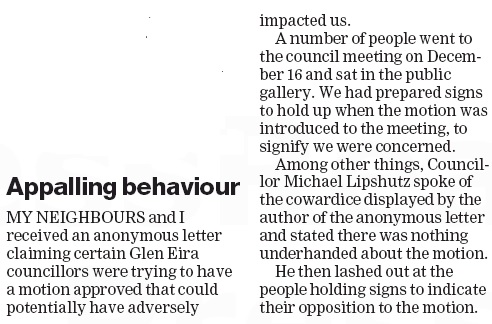
GE Consultation/Communication


We thought it fitting that for the final post of 2014, we revisit the secret introduction of the new residential zones. Fifteen months down the track readers can judge for themselves the total ineptitude and complicity of councillors in the duping their community.

The following extracts all come from statements made on the 13th August 2013 Council Meeting.

HYAMS – Went on to speak about the 3 new zones and that together they ‘will cover 95% of Glen Eira’ and ‘every resident of those zones will have their amenity protected better than before’.

LIPSHUTZ – Glen eira is the first council to ‘adopt these plans’ and that’s because they have ‘vision’ and that’s because years ago Akehurst and ‘his team’ saw that ‘we neeed to have distinct areas to protect our suburbs’. Because these plans already exist they were ‘able to translate very quickly’ into the new zones ‘and that’s a credit to our officers’….The zones are ‘protecting our neighbourhood, we are protecting our municipality and that’s important’.

MAGEE: Apart from commercial zones, there is now a ‘sense of security’ for developers because they know what they can do and get a loan easier. Developers can therefore plan better. Said that the 4 storey buildings around tram lines is only 2.2% ‘of our city’ and ‘you might actually struggle to find a block big enough’ to build 4 storeys because of ‘setbacks’ on top floor. So a lot of these could ‘end up being 3 storeys’. Said it was a ‘really good outcome for the residents of Glen Eira’…..Congratulated officers on ‘getting this through’ and didn’t think it ‘was a surprise because that’s the sort of work we do here’…’we are very good at what we do’. In the future council can say ‘no, it’s wrong’ and ‘go away’ to developers because they haven’t got it right. Also have to thank the state government in ‘being proactive and helping us get this in place’. ‘I think the outcome for Glen Eira is superb’

DELAHUNTY: ‘generally’ supports that this is a ‘good outcome’ but the ‘Minister sought different zoning’ for the Alma Club site and ‘that was done without any consultation with Council’ and she ‘finds this a little bit disappointing’ because he zoned differently there and could have also looked at the ‘old Open Space Strategy’. ‘It would have been a fantastic opportunity to have had that conversation’ with the Minister. The same goes for the ABC site. Also ‘at the start’ she had ‘reservations’ about the ‘lack of public consultation’. She ‘lost the argument’ on that one but ‘I have to say I deserved to lose the argument’ but since she wasn’t part of the 2010 consultation and ‘that doesn’t mean that the community’s views have necessarily changed’ so people got what they wanted. She’s just left with the ‘inkling of bad taste’ about the Alma Club and ABC sites

OKOTEL: congratulated for the ‘very hard work’ by Newton and Akehurst and team. It was a ‘very quick turnaround to make sure this happened’. The old system was ‘plagued by inefficiencies and uncertainties’ for planners and residents so it’s ‘pleasing’ that there are now height limits and that will ‘certainly’ eliminate the uncertainty. This is ‘exciting and well overdue step’. Said that she ‘maintains’ that a ‘consultation process would have been appropriate’ and that since this was in 2010 this wasn’t the direction prior to the  ‘submission being made to government’ and it ‘was a submission put to government and ultimately it was the government’s decision in terms of what the new zones look like’. But ‘despite that’ the decision is ‘very pleasing’

AND HERE’S PART OF COUNCIL’S RESPONSE TO A PUBLIC QUESTION

It is our firm belief that further consultation could not have resulted in a better outcome, and may well have had the opposite effect.!!!!!!!!!!!!!!!!

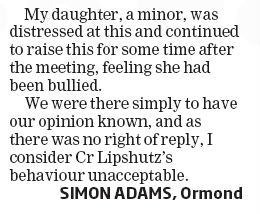
lp1lp2


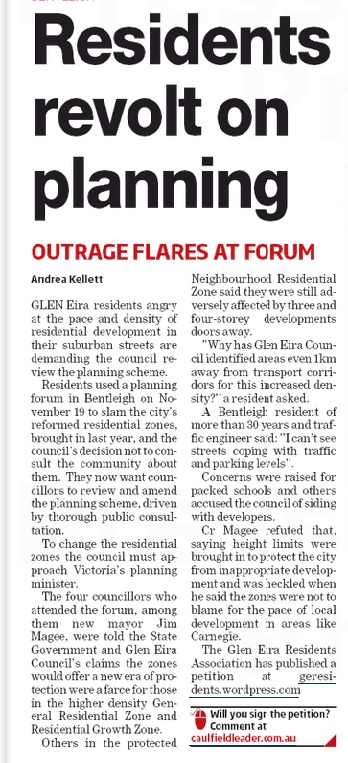
Untitled

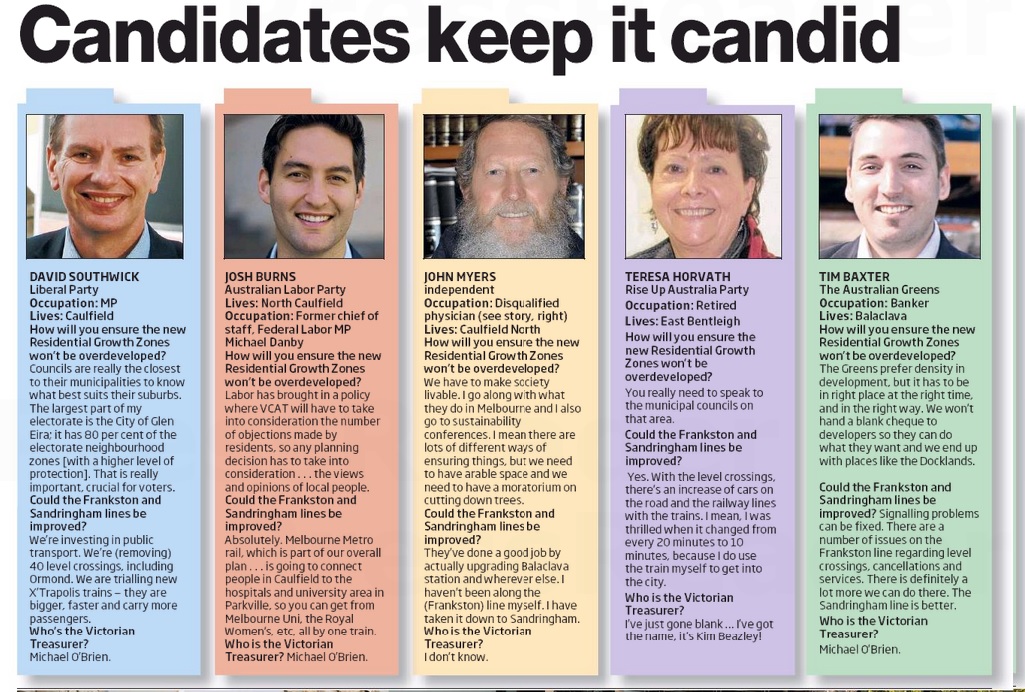
Untitled2

Last night’s GERA’s forum was illuminating for several reasons:

  • The anger of residents was palpable
  • The impotence and unwillingness of the four councillors (Lobo, Okotel, Hyams and Magee) to commit to any possibility of change was damning
  • The most outrageous comments by these councillors included:
  1. The zones were a ‘neutral translation’ based on data dating back to 1996
  2. The minister would only make things worse if council attempted to amend anything
  3. Residents should ‘advocate’ to councillors about their concerns (never mind that 150+ people were already expressing their views directly!)

We’ve uploaded the audio of the Q and A session and ask that you listen carefully to the ‘answers’ provided by councillors.

PS: BAYSIDE CITY COUNCIL THROWS OUT ITS RESIDENTIAL GROWTH ZONES. WATCH THE SPECIAL COUNCIL MEETING AND RESIDENTS ADDRESSING COUNCIL AT – http://stream.bayside.vic.gov.au/archive/video14-1118-1.php#placeholder

Also refreshing to hear councillors apologising to their community for inadequate consultation. Pity it doesn’t happen from too many councillors in Glen Eira!

Another objective of Council is to promote the integrated planning of the city. Integrated planning involves working with the community, residents, traders, service providers and other stakeholders to enhance the quality of Glen Eira’s suburbs and their environmental, economic and social sustainability. Integrated planning involves looking beyond traditional town planning solutions. It is important to encourage people to participate in the development of their city and to develop overall visions and plans for areas. It involves holistically looking at a wide range of issues in the local community including; infrastructure, social planning, economic development, recreation and capital works.

The above quote comes from Council’s Planning Scheme. Given recent history and the manner in which the new residential zones were introduced, we decided to see what other fiction the scheme contained.

Councils are meant to ‘regularly review’ their schemes and this basically means every four years following council elections. The purpose of such reviews is to determine whether the schemes are up-to-date; whether they are aligned with council’s strategic direction, and whether they are in keeping with state provisions.

Glen Eira’s planning scheme has not been genuinely ‘reviewed’ for eons. It is a ‘fossil’ parading as a robust and contemporary document. Featured below are extracts from the scheme. It is frankly incomprehensible how a document of this importance is allowed to exist when so much of what it contains is:

  • Decades out of date
  • Full of promises that have not been fulfilled, and perhaps were never intended to be actioned.

The document itself is a damning indictment of this Council. Reference documents go as far back as 1996 and have not been touched since; data is obsolete; motherhood statements abound and most importantly, nearly everything that is promised under the guise of ‘further strategic’ actions has simply not been done – especially in terms of protecting trees, parking precinct plans, structure plans, etc. In short, the planning scheme is worthless as a document that provides a clear vision and action plan that residents can have full confidence in.

Here are some of the empty promises quoted verbatim –

There have also been growing resident concerns over loss of trees associated with multiunit development. Despite Council’s efforts to encourage tree retention and adequate landscaping, planting is generally limited and has little consideration for the character of gardens within the street/neighbourhood. The cumulative effects of adjacent, multi-unit development have been a loss of the tree-filled semi-private spaces that contribute towards Glen Eira’s image as a garden suburb.

Minimising the demolition of buildings/site clearing prior to seeking development approval.

COMMENT: No local law on tree protection; no significant tree register after at least a decade of public outcry; and when this issue came up at a council meeting, councillors resolved to do nothing since the planning scheme, it was claimed, provided sufficient protection.

See: https://gleneira.wordpress.com/2013/10/16/still-going-round-the-mulberry-bush-10-years-on/

https://gleneira.wordpress.com/2013/10/14/the-saga-of-the-tree-register/

https://gleneira.wordpress.com/2011/10/04/the-non-existent-tree-protection/


STRATEGIC FRAMEWORK

The Glen Eira Community Plan identifies the corporate direction of Council over a 3 year period (2001-2004). Many of the objectives and strategies identified in the Municipal Strategic Statement have originated from actions identified in the Community Plan.

To ensure integrated neighbourhood planning of Glen Eira’s suburbs.

Facilitate high quality urban design and architecture that will enhance neighbourhood Character

Identify a preferred future character for housing diversity areas.

Ensure residential development in commercial areas does not contribute to traffic and car parking problems.

Ensure that the community is involved in decision making about their neighbourhood.

Ensure that the traffic impacts are adequately addressed when considering new residential development.

FURTHER STRATEGIC WORK

Developing local structure plans / urban design frameworks to guide development in the neighbourhood centres.

Investigating a vegetation management program which considers appropriate controls and guidelines to ensure vegetation protection.

Developing “suburb” plans for each suburb which integrate land use and development planning, with planning for infrastructure, capital works, recreation, parks and gardens, street trees and business development.

Developing local area traffic management plans and parking precinct plans to control the effects of parking and traffic intrusion in residential areas.

Investigating mechanisms which require developers to undertake street tree planting.

Ensure that adequate standards are set for on-going maintenance of public space at commercial centres.

Levying development contributions to finance improvements and additions to physical infrastructure including drainage and public open space, where new development is likely to impact on the capacity of existing infrastructure.

Ensuring that impervious surfaces are minimised in areas which are prone to flooding.

Investigating the development of additional development contribution mechanisms based on accepted principles of need, equity, nexus, accountability and timing.

Preparing a Municipal Stormwater Plan incorporating a Drainage Framework Plan.

Parking precinct plans

The City of Glen Eira recognises the special and often conflicting parking needs of its numerous commercial centres. Further strategic work is necessary to develop Parking Precinct Plans to:

􀂃 Maximise the supply and usage of parking for customers and traders of the centres.

􀂃 Limit the requirements for car parking for new development, whilst minimising adverse parking and equity consequences of new developments.

􀂃 Guide Council in the provision of public car parks.

Applying the Public Acquisition Overlay to properties identified by Council as being necessary for the provision of off street car parking in order to reserve land for that purpose and to ensure that changes to the use or development do not prejudice the purpose for which the land is to be acquired.

􀂃 Preparing Parking Precinct Policies for the following neighbourhood centres:

􀂂 Alma Village, Caulfield Park, Caulfield South, Bentleigh East, Glen Huntly, Ormond.

􀂃 Investigating the need for a cash-in-lieu policy to fund new car parks in various commercial centres.

MONITORING AND REVIEW

A review of this planning scheme will be undertaken at least every three years.

++++++++++++

And here are the ‘reference documents’ included in the scheme. Please note the dates.


Housing and Residential Development Strategy, Glen Eira City Council, 2002

Urban Character Study, Anne Cunningham & Anne Keddie, 1996

Urban Village Structure Plans, Glen Eira City Council, 1999

Phoenix Precinct Urban Design Framework, Gerner et al, 1998

Glen Eira Neighbourhood Character Review Final Report (March 2011), Planisphere

Economic Overview, Henshall Hansen & Associates, 1997

Glen Eira Retail/Commercial Strategy, Essential Economics, 1998

City of Glen Eira Business Development Strategy, 1998

Urban Village Structure Plans, Perrott Lyon Mathieson P/L, 1997

Phoenix Precinct Urban Design Framework, Gerner et al, 1998

Glen Eira Heritage Management Plan, Andrew Ward & Associates, 1996

Melbourne Water Drainage Survey, Melbourne Water, 1998

Glen Eira Drainage Strategy, 1998

Glen Eira Furniture Strategy, 1997

Undergrounding Infrastructure Policy, 1997

Glen Eira Traffic Management Strategy, 1995

Revised Warrants for Local Area Traffic Management Measures, 1998

Draft City of Glen Eira Parking Policy, Andrew O’Brien & Associates, 1998

Review of Car Parking Provisions in Victorian Planning Schemes –Final Report. Car Parking Advisory Committee, 1996

Urban Village Structure Plans, Perrott Lyon Mathieson, 1997


Labor to review Coalition residential zones overhaul

Date:November 6, 2014 – 6:51AM

Planning Minister Matthew Guy’s revamp of Melbourne’s residential zones could be overturned if Labor wins this month’s state election, with the opposition promising a major review of the new rules.

Mr Guy warned the review would be the first step in Labor tearing up the new zones in a bid to “bring back Melbourne 2030“, the controversial planning doctrine rolled out by the Bracks governments from 2002.

Mr Guy has approved new planning zones for 22 of Melbourne’s 31 councils.

The new zones divide suburbs into streets deemed “no-go”, where nothing over two levels can be built, “slow-go” where up to three levels is permitted, and “go-go” areas where up to four levels is allowed.

Councils have put forward their plans for where high-density development should be banned – but those in the city’s leafiest suburbs have had greater success in convincing Mr Guy to sign off on their proposals.

Glen Eira Council covers suburbs including Elsternwick, Bentleigh, Caulfield and Ormond. It has had 80 per cent of its municipality placed in the “no-go” zone where only two-level development was allowed.

Darebin Council, by comparison, asked for 36 per cent of its suburbs to be placed in this “no-go” zone – but last week learned it had got only 10 per cent.

Labor will on Thursday pledge to review what it says is the “botched” process of rolling out the new zones across Victoria.

Labor’s planning spokesman Brian Tee said Darebin showed decisions on the new zones had been heavily politicised.

The new zones had, he said, “distorted growth and planning by forcing intensive high-rise development in some areas, while locking up leafy Liberal suburbs”.

He said Labor’s review of the planning zones would include an examination of the consultation process and the role of Mr Guy and his office in it, and how the new zones had looked at the housing needs of the state.

But Mr Guy said Labor’s “review” would see the zones already rolled out, which had protected suburbs like never before, thrown away.

“Labor wrecked our suburbs when last in government, and by ‘reviewing’ the Neighbourhood Residential Zone, they’ll do it all over again under Daniel Andrews,” he said.

Labor’s pledge to review the zones came as a Greens candidate for the inner Melbourne seat of Northcote said the new planning rules had treated suburbs in Melbourne’s less conservative suburbs differently to those in Liberal electorates.

Trent McCarthy, who is also a Darebin councillor, said Mr Guy had played a “cruel joke” on residents by rejecting the controls proposed by Darebin Council. It had left many neighbourhoods exposed to “over-development”, he said.

Planners though were circumspect about Labor’s pledge to review the zones.

A group of high-profile planners have opposed the new zones because they restrict development and force medium and high-density housing into smaller pockets of Melbourne.

One outspoken planner, Colleen Peterson from Ration Consulting, said there was “every chance Labor’s proposal will make it worse not better”.

“This isn’t the great salvation – it’s going to play more into the common public perception that residential development is a bad thing,” Ms Peterson said.

She said planning a city should be “just like collecting taxes and building roads – governments have to make decisions for the greater good. It’s not a popularity contest”.

Swinging voters could knock Denis Napthine out in Melbourne’s planning zones

Date
November 6, 2014 – 7:06AM
Concerns: Danita Tucker in Jasper Road, McKinnon, where residents are dismayed by developers' plans to build three-storey apartment blocks. Concerns: Danita Tucker in Jasper Road, McKinnon, where residents are dismayed by developers’ plans to build three-storey apartment blocks. Photo: Penny Stephens

She doesn’t look scary, but there are few people the Napthine government should fear more than someone like Danita Tucker. “I’m a swinging voter,” says the mother of two who lives with her family in a quiet Bentleigh street.

It’s a marginal electorate, held by the Liberal Party by just 0.9 per cent, and one that helped deliver government to Ted Baillieu in 2010.

Bentleigh is among a clutch of seats that could help hand power back to Labor this month.

If the electorate does switch to Labor, the new government will have planning – the perennial debate in Melbourne’s suburbs – to thank for it.

Like the seats of Mordialloc, Carrum and Frankston, Bentleigh is one four marginals strung along the Frankston train line. The suburbs within these seats are not normally known for their political combat.

But, thanks to changes Planning Minister Matthew Guy started putting through last July – and still far from complete – there is an increased focus on urban development.

The new residential zones Guy has begun ushering in have been planned by consecutive governments over the past decade, and have now been introduced to 22 of Melbourne’s 31 council areas. The rollout has been messy, confusing, and has sparked anxiety for many residents.

But the three new zones were an attempt to drastically simplify the planning system and provide certainty – so residents know exactly what’s allowed in their street.

Glen Eira, the council covering Tucker’s area, was the first cab off the rank in Guy’s rezoning of residential areas into three zones: “no-go”, “slow-go” and “go-go”.

The “no-go” zones are called Neighbourhood Residential Zones. They restrict housing development in areas deemed urban preservation zones, and limit development to just two storeys.

Glen Eira had a remarkable 80 per cent of the council’s areas deemed worth preserving.

It compares with just 11 per cent on the other side of the city, in Darebin Council in the city’s north that covers areas including Northcote, Thornbury Preston and Reservoir.

The “slow-go” zones were applied to areas like Tucker’s, where “moderate housing growth” would be allowed, with buildings up to three levels.

In the seat of Bentleigh, the zoning has caused an outcry. Suddenly, residents in the streets surrounding the train line have found themselves pitted against developers wanting to build three-storey apartment blocks.

The new  rules theoretically changed little from existing land zoning. In reality, they removed any uncertainty about what a developer would get, either from the council or the state planning tribunal.

Newly formed resident groups say the changes are now having significant a impact. In a fortnight, Save Our Suburbs will hold a specially convened forum in Bentleigh on the zones.

Residents are concerned because, in the year since the new rules came into the area, several single-level, post-war cottages that have long defined the character of suburbs such as Bentleigh have been bought by developers.

They are to be replaced by townhouses and apartment blocks to house some of the 1.6 million extra dwellings the government’s Plan Melbourne strategy says will be needed by 2050.

“Developers weren’t really interested in this area until they saw there was a set height limit,” says Tucker, who is watching in amazement as her neighbours houses sell for medium-density housing. Every day flyers come through Tucker’s letterbox from real estate agents.

She says there is “an annoyance at our local member because she has not been looking after the needs of her local community”. The zones, Tucker says, were “just imposed upon us without any engagement”.

That local member, the Liberal Party’s Elizabeth Miller, supported the zones for Bentleigh.

She argues the changes have meant councils are now truly the planning authority for their area, deciding where development is appropriate.

“Glen Eira Council has identified 80 per cent of the municipality is now protected from development under the council’s own planning guidelines,” she says. “Under the former Labor government of 11 years, there were no clear guidelines to planning, which was done on an ad hoc basis.”

Labor’s candidate for the area is Nick Staikos. He says the zoning changes have turned Bentleigh “into a honey pot for developers”.

Staikos is doing a lot of door-knocking and jokes that the zones have had an upside for him in the development rush: “I’m finding there’s a developer or a real estate agent who’s been here just before me – residents are relieved I’m a politician.”

Glen Eira is among a lucky few councils – Bayside and Boroondara are the others – that were major beneficiaries of the zoning changes, with Guy locking up all but 20 per cent of each of the well-to-do councils’ suburbs from developers wanting to build anything above two levels.

While other councils like Darebin, Moonee Valley, Darebin and others were less fortunate, Guy boasted last week on ABC Radio he had introduced the toughest zoning laws in the country.

“Around 80 per cent plus [is] in the most restrictive zone in Australian residential zoning history, the government’s new neighbourhood residential zone.”

Guy wasn’t so keen to talk about the small pockets in places such as Bentleigh, Moorabbin, Highett and Cheltenham now facing what is known as the “go-go” zoning – the Residential Growth Zone.

These are areas where residential streets near train lines and busy shopping strips have been, or are to be, rezoned to allow developments of at least four storeys. There aren’t many in the marginal Bentleigh electorate affected by this.

But across the rail line from Bentleigh is the far safer seat of Sandringham, held by Murray Thompson – son of a former premier Lindsay – by a margin of 15.6 per cent.

It is in the council area of Bayside. There, while the richest suburbs like Brighton and Sandringham have largely received the highest level of protection from “over-development” available in Australia, the less wealthy have been put into this pro-development category.

A drive around the streets affected by these proposed new zones in Cheltenham, Moorabbin, Highett and near the long-promised new Southland railway station shows why many residents are anxious.

Typical is Highett’s Major Street, a quiet dead-end so narrow the rubbish truck can’t turn around and has to reverse out each week. It has a few new two-storey townhouses, but most of its 20 houses are single level.

On one side of the street – the side to be rezoned for up to four-level development – every house bar one has a sign Melbourne has seen before: “We Will Oppose Inappropriate Development.”

Gary McCulloch bought in Major Street two years ago “because it was a very quiet, family-oriented street that was organically regenerating”, and now fears he will soon have an apartment tower looming over him.

McCulloch doesn’t know who to blame for the zoning that could soon be finalised on his street: Bayside Council or the minister. They blame each other.

But he’s sure of one thing: “None of this is based on sound planning principles, and it is a result of political interference from the state government – there are no votes for them here or in Cheltenham. They wouldn’t dare upset their blue-blood constituents in Brighton.”

Bayside mayor Laurie Evans says the council was forced to choose the high-growth zones after Guy’s chief of staff demanded the council select areas along the Frankston railway line.

Guy argues the zones have provided people with certainty, protecting large areas of Melbourne from inappropriate high-rise development.

He says Labor had never accepted responsibility for some of the problems created by the “anything-goes Melbourne 2030 policy”. He argues its push to consolidate Melbourne into its existing boundaries fuelled inappropriate overdevelopment.

Labor, for its part, on Thursday revealed that if it was elected it would complete a major review of the zoning changes.

“Communities right across Victoria are complaining that they were not consulted,” Opposition planning spokesman Brian Tee says.

“Outcomes have been forced on them with many residents believing the changes to what can be built in certain areas is political – some suburbs have been protected and development has been pushed elsewhere.”

Perhaps most surprisingly in the debate around the zones in the bayside areas is that, while residents are unhappy, developers are equally dissatisfied. A group of them, represented by high-profile planning barrister Nick Tweedie, SC, last month told a planning department committee considering the new high-growth zones that they would have preferred them to be in more affluent bayside areas.

James Larmour-Reid is president of Victoria’s Planning Institute, which backs the new residential zones as a means of managing growth and change across Melbourne. Larmour-Reid says the new zones, after a decade of debate, have provided a method of implementing “go-go”, “slow-go” and “no-go” areas in council housing strategies.

But he says that missing from the plan to push forward with the residential zones was “an overarching metropolitan housing strategy”. It was also unfortunate that the government’s Plan Melbourne strategy had been released only after the new residential zones had started to be rolled out.

Larmour-Reid says it is  “too early to make a call on whether or how the new zones are shaping development proposals in particular locations” because the housing market is constantly evolving.

Questioned over suburbs such as Bentleigh seeing a surge of applications for medium-density development, he says these sorts of projects were always possible under the old zones.

And, he says, medium-density development might just be something Melbourne has to start getting used to.

“Apartments are now being constructed at greater distances from the CBD in places like Mitcham, Glen Waverley and Preston.”


PS – and the Labor Party Media Release –

LABOR WILL TAKE THE POLITICS OUT OF PLANNING

 An Andrews Labor Government will review the botched planning zones imposed on councils and allow communities to have their say.

The Napthine Government has distorted growth and planning by forcing intensive high-rise development in some areas, while locking up leafy Liberal suburbs. Under Labor’s plan, new planning zones will be reviewed with a full report tabled in Parliament. The review will examine:

• The Napthine Government’s consultation process •
  • The role of Planning Minister Matthew Guy and his office in that process
  • • Departmental advice on zone application and what weight is given to heritage, local character and the housing needs of the state
  • • The impact of the zone changes on our suburbs
  • • Alternative ways to meet our housing needs
  • • How the zones can better fit within the framework outlined in Plan Melbourne Quotes attributable to Mr Tee “The Liberals can’t say they support growth and development in Melbourne if they target suburbs based on their politics.” “Under the Liberals, local councils are getting trampled over, the community doesn’t have a say and some of our oldest and most vibrant neighbourhoods are facing the wrecking ball.” “Labor will take the politics out of planning. We’ll meet the housing needs of our future but we’ll take communities and councils with us.”
  • Key Facts
  • • Plan Melbourne, the Napthine Government’s vision for Melbourne to 2050, outlined the need for 1.6 million houses to keep pace with population growth.
  • • The Napthine Government’s new zones were released before Plan Melbourne was released.
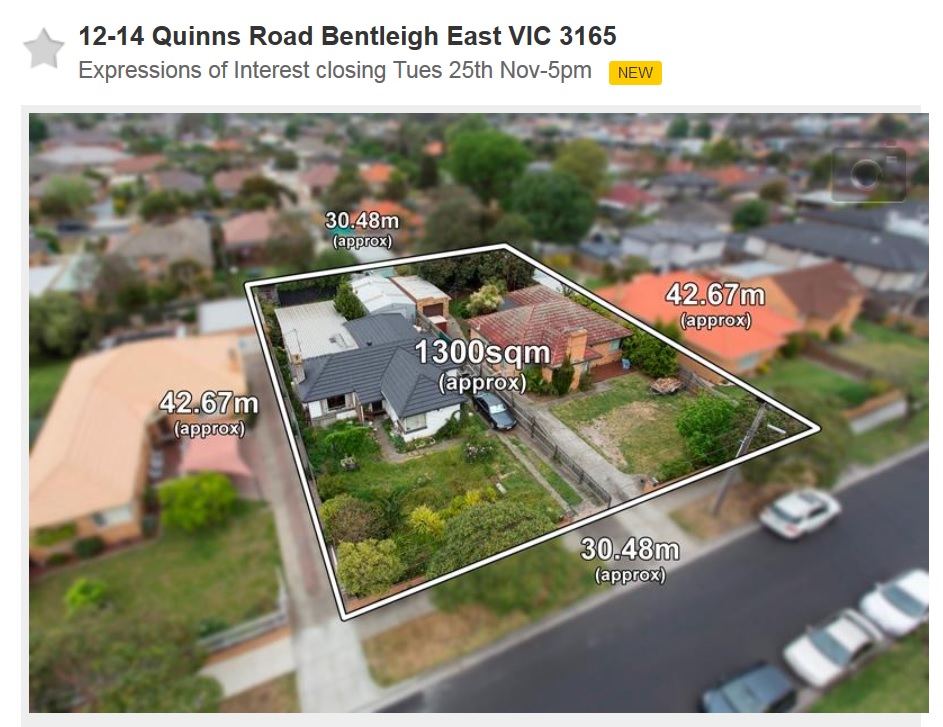
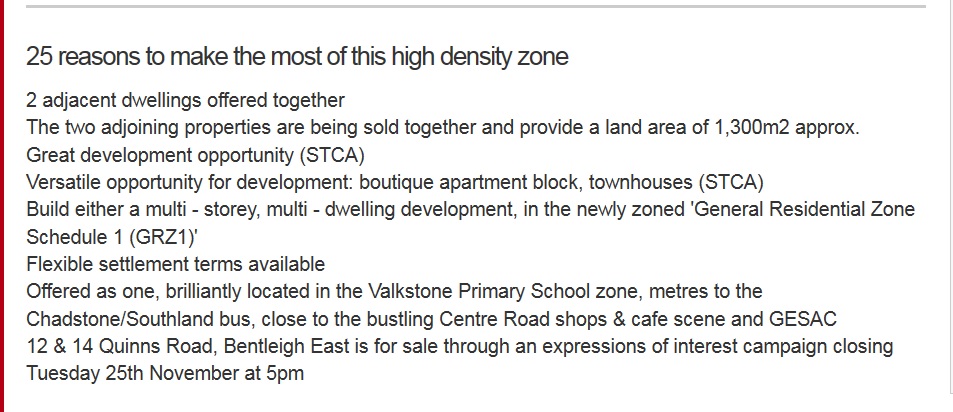
quinnsblurb

At last council meeting Hyams let slip the fact that developers were in the know well before residents had any clue as to what was going to happen on August 5th 2013 – ie the introduction of the new zones.

Here’s some further evidence to substantiate our claim that it is developers who get the ‘inside information’ and residents are the ones left out in the cold – despite numerous public questions as to what was going on in early July 2013.

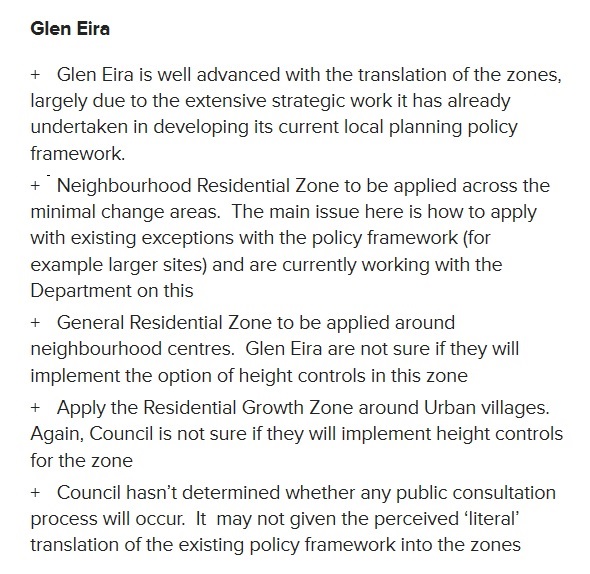
The screen dump below comes from Ratio Consulting – a big firm that has done plenty of work for developers and has undoubtedly got many ‘friendly’ contacts within council. In a posting dated 30th July 2013 they state the following:

To keep our clients in the loop, here is a summary of what we know so far.  We are mindful that the following information is gathered from verbal discussions from various Department and Council officers as there is little official feedback.  Things are moving quickly so we strongly advise you to make additional enquiries that relate to you and your circumstances.

Many Councils are currently reviewing the zones and the implications and we would expect substantial movement in the next 2-3 months.  We will keep you posted of progress in these municipalities.  The municipalities we do mention below are those we and our clients work with on a regular basis, and/or have information to share.

Source: http://www.ratio.com.au/ratio-news-planning-zones-update

Here’s what is stated about Glen Eira, before the Minister’s announcement on August 5th. We conclude that developers knew more about what was going on within Glen Eira, than residents. Readers will remember that whilst other councils were busily organising their processes for consultation, Glen Eira’s residents had a year of stunning silence. The only item relating to the zones was Council’s submission to the Minister’s draft in 2012 – just on a year before the March 2013 Minister’s announcement that the zones were now set and that they would come into effect on July 1st 2013. This would give councils a year to implement and consult on their proposed zones. For Ratio to therefore state that Glen Eira “is well advanced with the translation of the zones” and that council is ‘working’ with the Department shows exactly how much the big end of town was in the know and how little the ratepayers knew!

ratio

Hyams moved to accept the Akehurst report on the new zones ‘as printed’. Sounness seconded.

HYAMS: began by quoting the figures on the influx of new people to Victoria and that ‘obviously they need to go somewhere’. Said that the zones were introduced in 2013 and that Glen Eira had its minimal change/housing diversity from 2003 and that was after ‘at least two years of consultation’. ‘The new zones exactly mirror the old zones’ ‘except for one property in North Caulfield’. Claimed that all that is different is that because of the schedules council has ‘increased the protection to any resident who lives in those zones’ (ie Residential Growth, General Residential Zone and Urban Villages). Repeated that the there’s nothing that developers couldn’t do before. Gave example of an old application in Mavho street that council refused but it went to VCAT and got a permit. But what might have got built before ‘now can’t be built’ because of the height restrictions. Also said that even though there’s a height limit that doesn’t mean that everything will be built ‘to that height’. Therefore there are plenty of developments that previously got permits but now they wouldn’t with the new zones and that includes the RGZ and GRZ zones. Went on to say that there are lots of people blaming the zones for all the new applications but that’s not true because ‘Carnegie has had this sort of stuff going on for a while’ and the same holds for Murrumbeena and Elsternwick where an 8 storey building went up. So all this was happening before and even though ‘they have accelerated’ it isn’t ‘because of the new zones’. But it’s only ‘now that they have reached Bentleigh’ and he thought that it was ‘inevitable that they have spread out from the centre’.

Referred to the argument that council should have ‘consulted’ before ‘bringing in the new zones’. But council wanted to ‘achieve the best possible results’ for the municipality , Claimed that in ‘all’ the discussions with the government it was about ‘convincing them not to expand the high density zones’ and even though they might have wanted to make them smaller ‘no government from either side’ would allow this ‘no matter how much we consulted’. Said that ‘I haven’t heard anything from the ALP on the new zones’ so Labor has ‘no interest in challenging or changing those zones’.

Admitted that post zones there was criticism but this came from the ‘development industry’ about how restrictive the new zones were. Quoted various sources. So by ‘getting in early’ council was ‘able to achieve these height limits’ and ‘other councils haven’t been so lucky’ and Kingston has had their 13.5 metre height limits ‘preferred’ and they are ‘not absolute as they are here’. Government now looks like it’s ‘leaning’ towards higher limits so Glen Eira has ‘done very well’. Thought it was important that people understood the zones and not what some people are saying about ‘encouraging sales’.

SOUNNESS: Said that the report is ‘brief’ but identifies that there are opportunities for development but also ‘tools’ to ‘limit inappropriate development’. Sadly they ‘have to allow development to take place somewhere’ like urban villages and close to transport.

DELAHUNTY: wanted to ask Akehurst a question because the report was basically about neighbourhood residential zones and there were plenty of people ‘here’ who are facing applications not in the residential zones. So she wanted Akehurst to explain how those zones came about and what they mean.

AKHURST: admitted that the paper he wrote was basically about the Neighbourhood Residential Zone but that there are other zones. Said that the Mixed Use Zone is common to all councils and is determined by the government as is the Commercial zones. Neither have height limits and the commercial zones have different uses and explained how these changed with the introduction of the zones.

LOBO: said that height limits ‘sounds good’ but that it is ‘an umbilical cord to the residential zones’. Hyams explained ‘nicely’ how the zones had been ‘transcribed’ from the old zones but in the old zones with minimal change and housing diversity ‘councillors had the option of either accepting or refusing’ as they did with 32 Mavho street where council refused and vcat gave the permit. Said that VCAT doesn’t always ‘get it right’. Said that there is ‘certainty’ but that ‘this certainty is for the builders’ and for ‘real estate agents’ both of whom are ‘laughing to the bank’. (applause). Said that residents vote councillors in and that their role is to uphold what it says on the front of every agenda. Read out the blurb about working in the best interests of residents. Said that he recognises that Ministers have been given ‘carte blanche’ about planning but that ‘we should have gone to consultation’ and at ‘least give a chance’ to people. Said that ‘I asked for it’ and that he ‘voted to be part of the team’ when he was ‘deputy mayor’ and he now thinks ‘I have done wrong’ and ‘mea culpa’. Thought that ‘now we have to do something about it’ and for the next government to ‘do something to repair this damage’. (applause)

OKOTEL: ‘acknowledged’ what Hyams said about ‘direct translation’ of what was there before. However her position was that instead of ‘simply adopt policy’ that ‘council should have engaged in community consultation before making a submission to the planning minister’. (applause) This was because the consultation goes back to 2003.

ESAKOFF: point of order that ‘when I asked about consultation’ she was told that it wasn’t 2003 but 2010.

PILLING: said that the review of the Planning Scheme was in 2010. Said there were 2 consultation: one in 2003 and the last in 2010.

OKOTEL: said that she ‘didn’t feel comfortable’ about not consulting but that she notes that the new zones’ do preserve 78% of the municipality’ and that she does support the report and its comments that ‘compared to other councils’ that Glen Eira’s ‘protections’ are far more than these other councils. But she is also ‘sympathetic’ to the remaining 22% of the municipality ‘which don’t have those protections’ and ‘weren’t invited for consultation’. Even though there are the new zones council still has to ‘refer’ to its policies that ‘require us to look at’ things like Neighbourhood Character. Read out part of a VCAT judgement on an application for Prince Edward Avenue where the member rejected it and said that in terms of Neighbourhood Character it didn’t fit the street even though it was zoned for medium density. Okotel then went on to say that even though there are height limits council still needs to consider policy.(applause)

DELAHUNTY: said she was ‘confused’ about what’s going on. Referred to Hyams and his views about Labor. Said that Brian Tee has made a public statement on the zones and so has the current Labor candidate Nick Staikos who was in chamber. Said that there were ‘conflicting views’ ‘around this table tonight’ and that she was ‘confused’. Said that when they ‘discussed going to consultation’ on the zones and ‘bringing them in quickly’ and ‘with some certainty’ she was ‘certainly on the side of some public consultation’ and ‘I thought I was very much alone there but I’ve got some friends tonight’. Said that the information she got was about the consultation of 2010 and that ‘the arguments’ that were put up then ‘won me over’. Said that in 2010 people wanted ‘height limits and they wanted certainty’. So if the community ‘hasn’t changed’, with the new zones she thought that they were giving people what they had asked for. Post the new zones at a public forum held by LARGE she thought it would be a ‘good idea’ for council to have some public meetings to explain the zones and she remembers ‘being friendless at that time too’. So ‘I am very confused about the sentiments’ being expressed tonight. Wants sensible decisions on the applications before council tonight and hoped that the group could do that. ‘We have to be very careful about saying one thing inside and another thing outside’.

PILLING: supported Hyams and said that ‘these are the correct analyses’. Reminded councillors that ‘this was a unanimous decision a year ago’. The time ‘was to speak out and vote then’ so ‘trying to rewrite history now is a bit rich’. Repeated that it was ‘a unanimous decision fully supported by every councillor here’. Said that 97% of the municipality is protected except for the commercial zones by height limits and Glen Eira is probably ‘the only council in Victoria to have that’. Said that council had been ‘vilified’ by developers and academics but when ‘you get attacked’ by these people then ‘you’ve got the balance about right’. The zones have ‘restricted development into certain areas’. Thought that over time there would be ‘less intense development in these areas’. Said that in Murrumbeena they were applying for 5 storeys and above but now ‘you can only get four’. Repeated Hyams’ words about taking a while to get to Bentleigh but it was inevitable that it would also ‘happen in those areas as well’. Thought that council had done ‘the right thing by the community’ and that ‘we should stand by that decision’. Said that other councils are struggling and that for many it’s a ‘mess’. Said that they had given protection and that it’s something that council ‘should be proud of’ ‘I certainly am’.

Calls from gallery ‘’There’s no democracy’

HYAMS: their aim was to get ‘the best result’. Said that they could have ‘consulted until the cows come home’ and could ‘have gone to the government with anything’ and they would have knocked it back. If they had gone to consultation they ‘would have taken so long to get around to it’ that ‘other councils’ would have got in before them to show how ‘great they were’. If council had waited then ‘we would have got the deal that Kingston or Bayside’ got with ‘larger residential growth zones’. Even though people mightn’t like it ‘we got you the best deal’ and that was by ‘putting popularity’ aside unlike other councils who tried to be popular. He prefers ‘sticking to our decision’ and ‘acknowledging’ that they did the ‘best we could’. Said that in 2010/2011 there was consultation about the whole planning scheme and the results were that people wanted neighbourhoods protected and this was achieved with the Neighbourhood Character Overlays; height limits ‘which we now have’ and ‘transition zones’ and ‘we now have that as well’ via the ‘schedules to the new zones’.

Said that his ‘memory’ is different to Delahunty because he remembers Okotel also arguing for consultation. He also was persuaded that consultation wouldn’t get them a ‘better deal and might get us a worse deal’. Said that there was a ‘rush of applications’ last ‘July and August’ and the reason for this was that ‘all the developers knew that we were about to put these new zones in’ and they knew that what they could get before the zones they couldn’t get with the new zones. So they ‘rushed their developments in’.

GALLERY : how did they know in July when the zones didn’t come in until August?

HYAMS: referred to Lobo’s comments about options to refuse previously. Said he ‘doesn’t follow that’ because they ‘still have all the options that we previously had’. Picked Lobo up about VCAT ‘answering to the Government’ but VCAT ‘independent from the government’. Said that councillors have to carry out their ‘functions’ and that means ‘applying the planning law’. ‘We did the best we could’ and those people who are criticising the zones are doing it for ‘legal purposes’ or ‘have a lack of understanding of planning law’.

OKOTEL: asked a question about ‘adopting the new zones were not unanimous’ and reiterated that ‘my position has always been that we should have engaged in consultation’ and she was never ‘persuaded otherwise’. Said that looking at the minutes of 13th August the ‘achievements’ about height controls ‘was not carried unanimously’ and said that she can’t find ‘the minutes’ relating to the ‘adoption of the zones other than that’.

PILLING: said he would be ‘happy to get the details’ and that it was an ‘unanimous decision by council’

OKOTEL: said that the decision to ‘ratify them’ was unanimous but that the ‘decision to put them to the Minister without consultation was not unanimous’. ‘I did not vote in favour of that’ and repeated that her position was that there should be consultation. (applause)

PILLING: said he would take her question on notice..

MOTION PUT. ONLY LOBO VOTED AGAINST.

Below is our analysis of the first two planning applications and the officers’ reports. We have for ages lamented the quality of such reports, their lack of detail, lack of cogent reasoning and overall lack of consistency from application to application. For example: one application might rate a mention of ‘internal amenity’, another might skip this altogether. But the overriding characteristic of all the reports is the failure to quantify, explain, and to insist on the adherence to council’s own standards – time and time again.

For these two reports we’ve extracted some sentences and then provided our comments. The extracts do not constitute everything we could have said. Otherwise this post would definitely turn into a major opus of interminable length. So, please read and try not to laugh too loudly!

22 Mavho St, Bentleigh -14 properties notified and 30 objections

A recommended condition is included to increase the front setback by 1.5m to bring the proposal closer to full compliance with ResCode and improve the streetscape appearance of the proposal.

COMMENT: what a nebulous airy fairy comment. What does ‘closer to full compliance mean’. If it’s not compliant then why accept it? And how much out of compliance is the final recommendation?

The plans lack sufficient detail to demonstrate that neighbouring properties will be protected from overlooking. A recommended condition requires privacy protection measures to be added to the plans and elevations.

COMMENT: if there is a ‘lack of sufficient detail’ then why assume that screening will solve the problem? Did council bother to check to see if it would?

The recommended increases in basement setbacks (or basement size reduction) can reduce car space numbers, and therefore dwelling numbers or the mix of dwelling sizes. However, the ‘lost’ spaces can be regained by the use of car stackers, or a second basement level, or a combination of the two. That is, the proposed dwelling yield will not necessarily change.

COMMENT – Not only does council worry about the developer losing a few units because he hasn’t supplied enough basement setbacks, but they are even providing him with the ‘answer’ to leapfrog their conditions. What a wonderfully kind council this is! And so blithely to recommend a second underground level of car parking without even considering what this does to neighbouring properties. Sink holes here we come perhaps!

Council’s Transport Planning Department is satisfied that each dwelling has satisfactory car parking. It accepts the provision of three visitor spaces, acknowledging that parking guidelines suggest five. The removal of a redundant crossing will provide an additional on-street space, and the site has good access to public transport.

COMMENT: another visitor car spot gone. As for on-street car car parking space please note that no statistics, no traffic counts are provided. As for ‘good access’ to public transport – only if you want to park  in a two hour zone throughout most of the area, or if for longer then the hike to the station is much longer.

Council’s Transport Planning Department has advised that the increase in traffic generated by the proposal is unlikely to have any significant adverse impact on the current operation of Mavho Street or the surrounding road network

COMMENT: ‘unlikely’ – does that mean that Council really doesn’t know? That they haven’t done the proper and necessary research? And exactly how is ‘significant adverse impact’ defined? Is there a difference between ‘significant’ and plain, old ordinary ‘adverse impact’? To quote Ms Hansen – PLEASE EXPLAIN ON EVERYTHING! and a few statistics to back up such unsupported statements wouldn’t go astray either!

Create a gentler transition to the rear of the site.

 COMMENT: oh, the language is sublime. Straight out of Shakeseare no doubt. Again, what does ‘gentler transition’ really mean? Are we talking 4 storeys down to 2? What’s ‘gentle’ about a 4 storey building sitting alongside single storey dwellings?

AND OF COURSE THERE’S NOT A SINGLE WORD ABOUT INTERNAL AMENITY, SUNLIGHT, ETC. to be found anywhere in the report.

Application NO.2 – 2-4 Penang St McKinnon – 12 properties notified – 48 objections + petiti0n with 34 signatures

Recent developments of three or more storeys in scale have been constructed on McKinnon Road in close proximity to the subject site.

COMMENT: McKinnon Road is a main street with buses, and a railway station. It is not a quiet residential street consisting of a handful of dwellings. To compare McKinnon Road to Penang St is like comparing Jack the Ripper with Little Orphan Annie!

An emerging new character is evident in the neighbourhood which varies from single to three storeys in scale. It is considered that the proposed development adequately respects the existing and emerging character of the neighbourhood.

COMMENTS: language, language that says absolutely nothing. What does ‘adequate’ mean? More importantly there are no three storey developments in any residential side street close to Penang. How can something ‘respect’ the existing neighbourhood (when there aren’t any 3 storeys) and then in the same breath claim that it ‘respects’ emerging character. What this report doesn’t state is that the emerging character is based on this application – it will set the precedent for what comes after – as is intended no doubt!

The overshadowing of adjoining properties satisfies Res Code requirements. The relevant standards ensure a minimum level of sunlight for adjoining secluded private open space areas.

COMMENT: ‘minimum level of sunlight’. Welcome to the world of the mole!

One dwelling at first floor (Apartment 14) is considered to have poor internal amenity, by virtue of its undersized balcony and south facing orientation. It is recommended that this dwelling be deleted (which will allow for the additional visitor car space within the basement).

COMMENT: Thank god – the ‘problem’ of car parking is solved. But since when is a balcony part of ‘internal amenity’?

Street tree at the front of 4 Penang Street can be removed as it does not meet with current Council Strategy

COMMENT – we simply adore this comment. Trees can be destroyed because they (poor things) don’t happen to fit in with what council decided should only be planted two years ago. Never mind that the tree is in good health, at least 15 years old, provides shade, and aesthetic ‘ambience’ to the street. It has to go because the developer needs a crossover! And council might just make some money out of the deal!

Landscape Assessment Officer

Σ It appears that there are trees to be removed at the rear of 4 Penang Street

Σ Advanced tree requirements in post construction landscape

COMMENT: ‘it appears’ – don’t they even know?!!!! What trees? Are they healthy, large, ‘significant’? The best is that ‘advanced tree requirements’ only get a look in after the fact. Surely this is Monty Python at their absolute best?

The applicant commented that they would check the accuracy of the shadow diagrams and ensure there are no other errors on the plans. Council’s Town Planning Department also commented they would check the shadow diagrams to ensure their accuracy.

COMMENT: so it’s been ‘checked’. What are the outcomes? Do they ALL comply? Could the poor paying public please be let in on the little secret with some facts, some figures, some real information?

« Previous PageNext Page »