GE Consultation/Communication


Hyams moved to accept the Akehurst report on the new zones ‘as printed’. Sounness seconded.

HYAMS: began by quoting the figures on the influx of new people to Victoria and that ‘obviously they need to go somewhere’. Said that the zones were introduced in 2013 and that Glen Eira had its minimal change/housing diversity from 2003 and that was after ‘at least two years of consultation’. ‘The new zones exactly mirror the old zones’ ‘except for one property in North Caulfield’. Claimed that all that is different is that because of the schedules council has ‘increased the protection to any resident who lives in those zones’ (ie Residential Growth, General Residential Zone and Urban Villages). Repeated that the there’s nothing that developers couldn’t do before. Gave example of an old application in Mavho street that council refused but it went to VCAT and got a permit. But what might have got built before ‘now can’t be built’ because of the height restrictions. Also said that even though there’s a height limit that doesn’t mean that everything will be built ‘to that height’. Therefore there are plenty of developments that previously got permits but now they wouldn’t with the new zones and that includes the RGZ and GRZ zones. Went on to say that there are lots of people blaming the zones for all the new applications but that’s not true because ‘Carnegie has had this sort of stuff going on for a while’ and the same holds for Murrumbeena and Elsternwick where an 8 storey building went up. So all this was happening before and even though ‘they have accelerated’ it isn’t ‘because of the new zones’. But it’s only ‘now that they have reached Bentleigh’ and he thought that it was ‘inevitable that they have spread out from the centre’.

Referred to the argument that council should have ‘consulted’ before ‘bringing in the new zones’. But council wanted to ‘achieve the best possible results’ for the municipality , Claimed that in ‘all’ the discussions with the government it was about ‘convincing them not to expand the high density zones’ and even though they might have wanted to make them smaller ‘no government from either side’ would allow this ‘no matter how much we consulted’. Said that ‘I haven’t heard anything from the ALP on the new zones’ so Labor has ‘no interest in challenging or changing those zones’.

Admitted that post zones there was criticism but this came from the ‘development industry’ about how restrictive the new zones were. Quoted various sources. So by ‘getting in early’ council was ‘able to achieve these height limits’ and ‘other councils haven’t been so lucky’ and Kingston has had their 13.5 metre height limits ‘preferred’ and they are ‘not absolute as they are here’. Government now looks like it’s ‘leaning’ towards higher limits so Glen Eira has ‘done very well’. Thought it was important that people understood the zones and not what some people are saying about ‘encouraging sales’.

SOUNNESS: Said that the report is ‘brief’ but identifies that there are opportunities for development but also ‘tools’ to ‘limit inappropriate development’. Sadly they ‘have to allow development to take place somewhere’ like urban villages and close to transport.

DELAHUNTY: wanted to ask Akehurst a question because the report was basically about neighbourhood residential zones and there were plenty of people ‘here’ who are facing applications not in the residential zones. So she wanted Akehurst to explain how those zones came about and what they mean.

AKHURST: admitted that the paper he wrote was basically about the Neighbourhood Residential Zone but that there are other zones. Said that the Mixed Use Zone is common to all councils and is determined by the government as is the Commercial zones. Neither have height limits and the commercial zones have different uses and explained how these changed with the introduction of the zones.

LOBO: said that height limits ‘sounds good’ but that it is ‘an umbilical cord to the residential zones’. Hyams explained ‘nicely’ how the zones had been ‘transcribed’ from the old zones but in the old zones with minimal change and housing diversity ‘councillors had the option of either accepting or refusing’ as they did with 32 Mavho street where council refused and vcat gave the permit. Said that VCAT doesn’t always ‘get it right’. Said that there is ‘certainty’ but that ‘this certainty is for the builders’ and for ‘real estate agents’ both of whom are ‘laughing to the bank’. (applause). Said that residents vote councillors in and that their role is to uphold what it says on the front of every agenda. Read out the blurb about working in the best interests of residents. Said that he recognises that Ministers have been given ‘carte blanche’ about planning but that ‘we should have gone to consultation’ and at ‘least give a chance’ to people. Said that ‘I asked for it’ and that he ‘voted to be part of the team’ when he was ‘deputy mayor’ and he now thinks ‘I have done wrong’ and ‘mea culpa’. Thought that ‘now we have to do something about it’ and for the next government to ‘do something to repair this damage’. (applause)

OKOTEL: ‘acknowledged’ what Hyams said about ‘direct translation’ of what was there before. However her position was that instead of ‘simply adopt policy’ that ‘council should have engaged in community consultation before making a submission to the planning minister’. (applause) This was because the consultation goes back to 2003.

ESAKOFF: point of order that ‘when I asked about consultation’ she was told that it wasn’t 2003 but 2010.

PILLING: said that the review of the Planning Scheme was in 2010. Said there were 2 consultation: one in 2003 and the last in 2010.

OKOTEL: said that she ‘didn’t feel comfortable’ about not consulting but that she notes that the new zones’ do preserve 78% of the municipality’ and that she does support the report and its comments that ‘compared to other councils’ that Glen Eira’s ‘protections’ are far more than these other councils. But she is also ‘sympathetic’ to the remaining 22% of the municipality ‘which don’t have those protections’ and ‘weren’t invited for consultation’. Even though there are the new zones council still has to ‘refer’ to its policies that ‘require us to look at’ things like Neighbourhood Character. Read out part of a VCAT judgement on an application for Prince Edward Avenue where the member rejected it and said that in terms of Neighbourhood Character it didn’t fit the street even though it was zoned for medium density. Okotel then went on to say that even though there are height limits council still needs to consider policy.(applause)

DELAHUNTY: said she was ‘confused’ about what’s going on. Referred to Hyams and his views about Labor. Said that Brian Tee has made a public statement on the zones and so has the current Labor candidate Nick Staikos who was in chamber. Said that there were ‘conflicting views’ ‘around this table tonight’ and that she was ‘confused’. Said that when they ‘discussed going to consultation’ on the zones and ‘bringing them in quickly’ and ‘with some certainty’ she was ‘certainly on the side of some public consultation’ and ‘I thought I was very much alone there but I’ve got some friends tonight’. Said that the information she got was about the consultation of 2010 and that ‘the arguments’ that were put up then ‘won me over’. Said that in 2010 people wanted ‘height limits and they wanted certainty’. So if the community ‘hasn’t changed’, with the new zones she thought that they were giving people what they had asked for. Post the new zones at a public forum held by LARGE she thought it would be a ‘good idea’ for council to have some public meetings to explain the zones and she remembers ‘being friendless at that time too’. So ‘I am very confused about the sentiments’ being expressed tonight. Wants sensible decisions on the applications before council tonight and hoped that the group could do that. ‘We have to be very careful about saying one thing inside and another thing outside’.

PILLING: supported Hyams and said that ‘these are the correct analyses’. Reminded councillors that ‘this was a unanimous decision a year ago’. The time ‘was to speak out and vote then’ so ‘trying to rewrite history now is a bit rich’. Repeated that it was ‘a unanimous decision fully supported by every councillor here’. Said that 97% of the municipality is protected except for the commercial zones by height limits and Glen Eira is probably ‘the only council in Victoria to have that’. Said that council had been ‘vilified’ by developers and academics but when ‘you get attacked’ by these people then ‘you’ve got the balance about right’. The zones have ‘restricted development into certain areas’. Thought that over time there would be ‘less intense development in these areas’. Said that in Murrumbeena they were applying for 5 storeys and above but now ‘you can only get four’. Repeated Hyams’ words about taking a while to get to Bentleigh but it was inevitable that it would also ‘happen in those areas as well’. Thought that council had done ‘the right thing by the community’ and that ‘we should stand by that decision’. Said that other councils are struggling and that for many it’s a ‘mess’. Said that they had given protection and that it’s something that council ‘should be proud of’ ‘I certainly am’.

Calls from gallery ‘’There’s no democracy’

HYAMS: their aim was to get ‘the best result’. Said that they could have ‘consulted until the cows come home’ and could ‘have gone to the government with anything’ and they would have knocked it back. If they had gone to consultation they ‘would have taken so long to get around to it’ that ‘other councils’ would have got in before them to show how ‘great they were’. If council had waited then ‘we would have got the deal that Kingston or Bayside’ got with ‘larger residential growth zones’. Even though people mightn’t like it ‘we got you the best deal’ and that was by ‘putting popularity’ aside unlike other councils who tried to be popular. He prefers ‘sticking to our decision’ and ‘acknowledging’ that they did the ‘best we could’. Said that in 2010/2011 there was consultation about the whole planning scheme and the results were that people wanted neighbourhoods protected and this was achieved with the Neighbourhood Character Overlays; height limits ‘which we now have’ and ‘transition zones’ and ‘we now have that as well’ via the ‘schedules to the new zones’.

Said that his ‘memory’ is different to Delahunty because he remembers Okotel also arguing for consultation. He also was persuaded that consultation wouldn’t get them a ‘better deal and might get us a worse deal’. Said that there was a ‘rush of applications’ last ‘July and August’ and the reason for this was that ‘all the developers knew that we were about to put these new zones in’ and they knew that what they could get before the zones they couldn’t get with the new zones. So they ‘rushed their developments in’.

GALLERY : how did they know in July when the zones didn’t come in until August?

HYAMS: referred to Lobo’s comments about options to refuse previously. Said he ‘doesn’t follow that’ because they ‘still have all the options that we previously had’. Picked Lobo up about VCAT ‘answering to the Government’ but VCAT ‘independent from the government’. Said that councillors have to carry out their ‘functions’ and that means ‘applying the planning law’. ‘We did the best we could’ and those people who are criticising the zones are doing it for ‘legal purposes’ or ‘have a lack of understanding of planning law’.

OKOTEL: asked a question about ‘adopting the new zones were not unanimous’ and reiterated that ‘my position has always been that we should have engaged in consultation’ and she was never ‘persuaded otherwise’. Said that looking at the minutes of 13th August the ‘achievements’ about height controls ‘was not carried unanimously’ and said that she can’t find ‘the minutes’ relating to the ‘adoption of the zones other than that’.

PILLING: said he would be ‘happy to get the details’ and that it was an ‘unanimous decision by council’

OKOTEL: said that the decision to ‘ratify them’ was unanimous but that the ‘decision to put them to the Minister without consultation was not unanimous’. ‘I did not vote in favour of that’ and repeated that her position was that there should be consultation. (applause)

PILLING: said he would take her question on notice..

MOTION PUT. ONLY LOBO VOTED AGAINST.

Below is our analysis of the first two planning applications and the officers’ reports. We have for ages lamented the quality of such reports, their lack of detail, lack of cogent reasoning and overall lack of consistency from application to application. For example: one application might rate a mention of ‘internal amenity’, another might skip this altogether. But the overriding characteristic of all the reports is the failure to quantify, explain, and to insist on the adherence to council’s own standards – time and time again.

For these two reports we’ve extracted some sentences and then provided our comments. The extracts do not constitute everything we could have said. Otherwise this post would definitely turn into a major opus of interminable length. So, please read and try not to laugh too loudly!

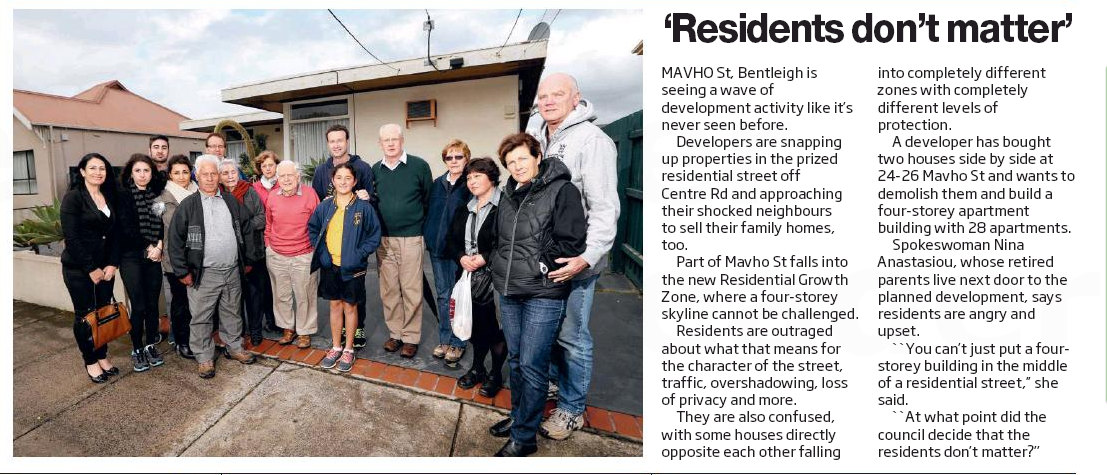
22 Mavho St, Bentleigh -14 properties notified and 30 objections

A recommended condition is included to increase the front setback by 1.5m to bring the proposal closer to full compliance with ResCode and improve the streetscape appearance of the proposal.

COMMENT: what a nebulous airy fairy comment. What does ‘closer to full compliance mean’. If it’s not compliant then why accept it? And how much out of compliance is the final recommendation?

The plans lack sufficient detail to demonstrate that neighbouring properties will be protected from overlooking. A recommended condition requires privacy protection measures to be added to the plans and elevations.

COMMENT: if there is a ‘lack of sufficient detail’ then why assume that screening will solve the problem? Did council bother to check to see if it would?

The recommended increases in basement setbacks (or basement size reduction) can reduce car space numbers, and therefore dwelling numbers or the mix of dwelling sizes. However, the ‘lost’ spaces can be regained by the use of car stackers, or a second basement level, or a combination of the two. That is, the proposed dwelling yield will not necessarily change.

COMMENT – Not only does council worry about the developer losing a few units because he hasn’t supplied enough basement setbacks, but they are even providing him with the ‘answer’ to leapfrog their conditions. What a wonderfully kind council this is! And so blithely to recommend a second underground level of car parking without even considering what this does to neighbouring properties. Sink holes here we come perhaps!

Council’s Transport Planning Department is satisfied that each dwelling has satisfactory car parking. It accepts the provision of three visitor spaces, acknowledging that parking guidelines suggest five. The removal of a redundant crossing will provide an additional on-street space, and the site has good access to public transport.

COMMENT: another visitor car spot gone. As for on-street car car parking space please note that no statistics, no traffic counts are provided. As for ‘good access’ to public transport – only if you want to park  in a two hour zone throughout most of the area, or if for longer then the hike to the station is much longer.

Council’s Transport Planning Department has advised that the increase in traffic generated by the proposal is unlikely to have any significant adverse impact on the current operation of Mavho Street or the surrounding road network

COMMENT: ‘unlikely’ – does that mean that Council really doesn’t know? That they haven’t done the proper and necessary research? And exactly how is ‘significant adverse impact’ defined? Is there a difference between ‘significant’ and plain, old ordinary ‘adverse impact’? To quote Ms Hansen – PLEASE EXPLAIN ON EVERYTHING! and a few statistics to back up such unsupported statements wouldn’t go astray either!

Create a gentler transition to the rear of the site.

 COMMENT: oh, the language is sublime. Straight out of Shakeseare no doubt. Again, what does ‘gentler transition’ really mean? Are we talking 4 storeys down to 2? What’s ‘gentle’ about a 4 storey building sitting alongside single storey dwellings?

AND OF COURSE THERE’S NOT A SINGLE WORD ABOUT INTERNAL AMENITY, SUNLIGHT, ETC. to be found anywhere in the report.

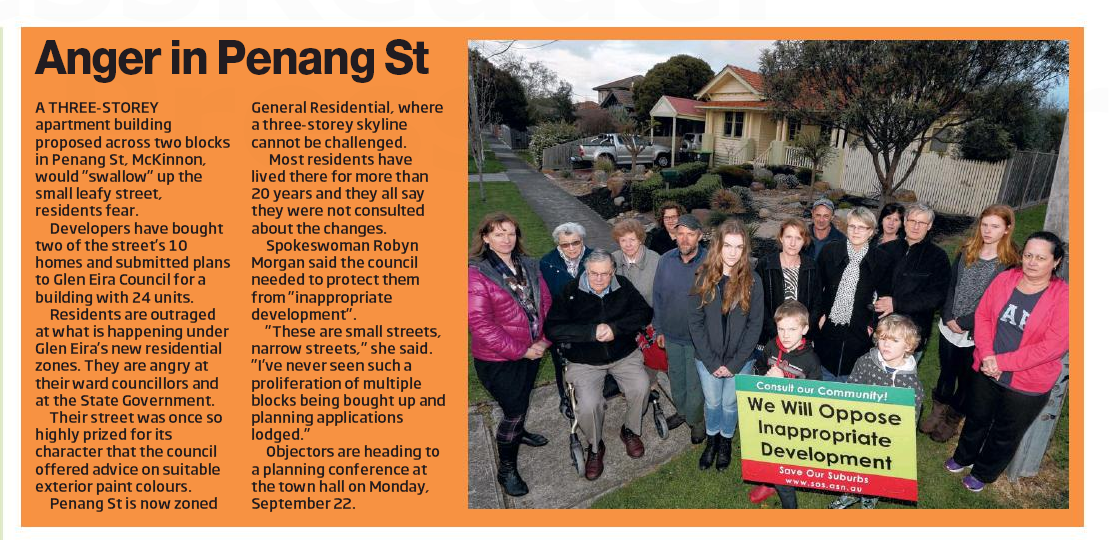
Application NO.2 – 2-4 Penang St McKinnon – 12 properties notified – 48 objections + petiti0n with 34 signatures

Recent developments of three or more storeys in scale have been constructed on McKinnon Road in close proximity to the subject site.

COMMENT: McKinnon Road is a main street with buses, and a railway station. It is not a quiet residential street consisting of a handful of dwellings. To compare McKinnon Road to Penang St is like comparing Jack the Ripper with Little Orphan Annie!

An emerging new character is evident in the neighbourhood which varies from single to three storeys in scale. It is considered that the proposed development adequately respects the existing and emerging character of the neighbourhood.

COMMENTS: language, language that says absolutely nothing. What does ‘adequate’ mean? More importantly there are no three storey developments in any residential side street close to Penang. How can something ‘respect’ the existing neighbourhood (when there aren’t any 3 storeys) and then in the same breath claim that it ‘respects’ emerging character. What this report doesn’t state is that the emerging character is based on this application – it will set the precedent for what comes after – as is intended no doubt!

The overshadowing of adjoining properties satisfies Res Code requirements. The relevant standards ensure a minimum level of sunlight for adjoining secluded private open space areas.

COMMENT: ‘minimum level of sunlight’. Welcome to the world of the mole!

One dwelling at first floor (Apartment 14) is considered to have poor internal amenity, by virtue of its undersized balcony and south facing orientation. It is recommended that this dwelling be deleted (which will allow for the additional visitor car space within the basement).

COMMENT: Thank god – the ‘problem’ of car parking is solved. But since when is a balcony part of ‘internal amenity’?

Street tree at the front of 4 Penang Street can be removed as it does not meet with current Council Strategy

COMMENT – we simply adore this comment. Trees can be destroyed because they (poor things) don’t happen to fit in with what council decided should only be planted two years ago. Never mind that the tree is in good health, at least 15 years old, provides shade, and aesthetic ‘ambience’ to the street. It has to go because the developer needs a crossover! And council might just make some money out of the deal!

Landscape Assessment Officer

Σ It appears that there are trees to be removed at the rear of 4 Penang Street

Σ Advanced tree requirements in post construction landscape

COMMENT: ‘it appears’ – don’t they even know?!!!! What trees? Are they healthy, large, ‘significant’? The best is that ‘advanced tree requirements’ only get a look in after the fact. Surely this is Monty Python at their absolute best?

The applicant commented that they would check the accuracy of the shadow diagrams and ensure there are no other errors on the plans. Council’s Town Planning Department also commented they would check the shadow diagrams to ensure their accuracy.

COMMENT: so it’s been ‘checked’. What are the outcomes? Do they ALL comply? Could the poor paying public please be let in on the little secret with some facts, some figures, some real information?

IMG

IMG_0001

Untitled

penangbent

mavho


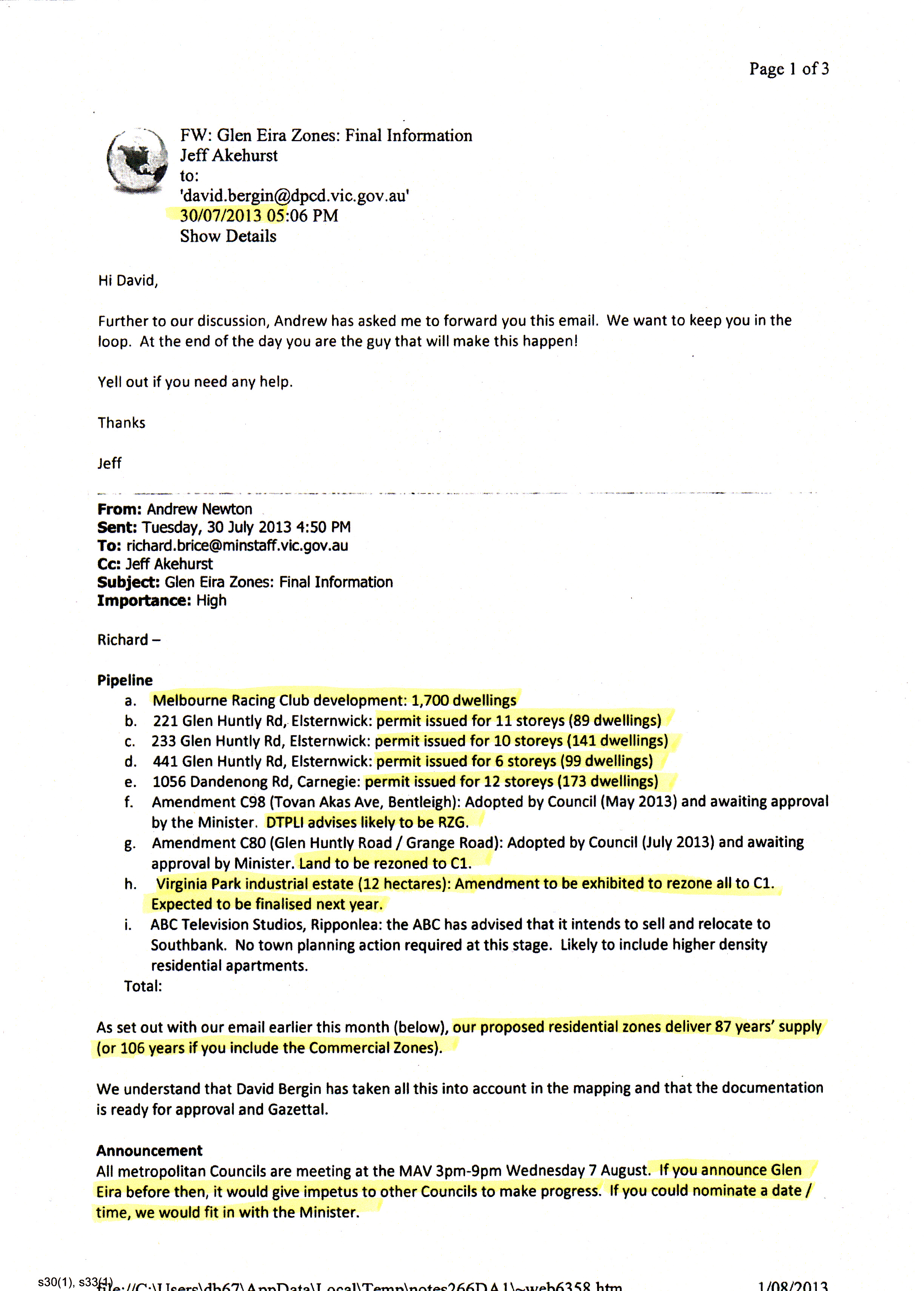
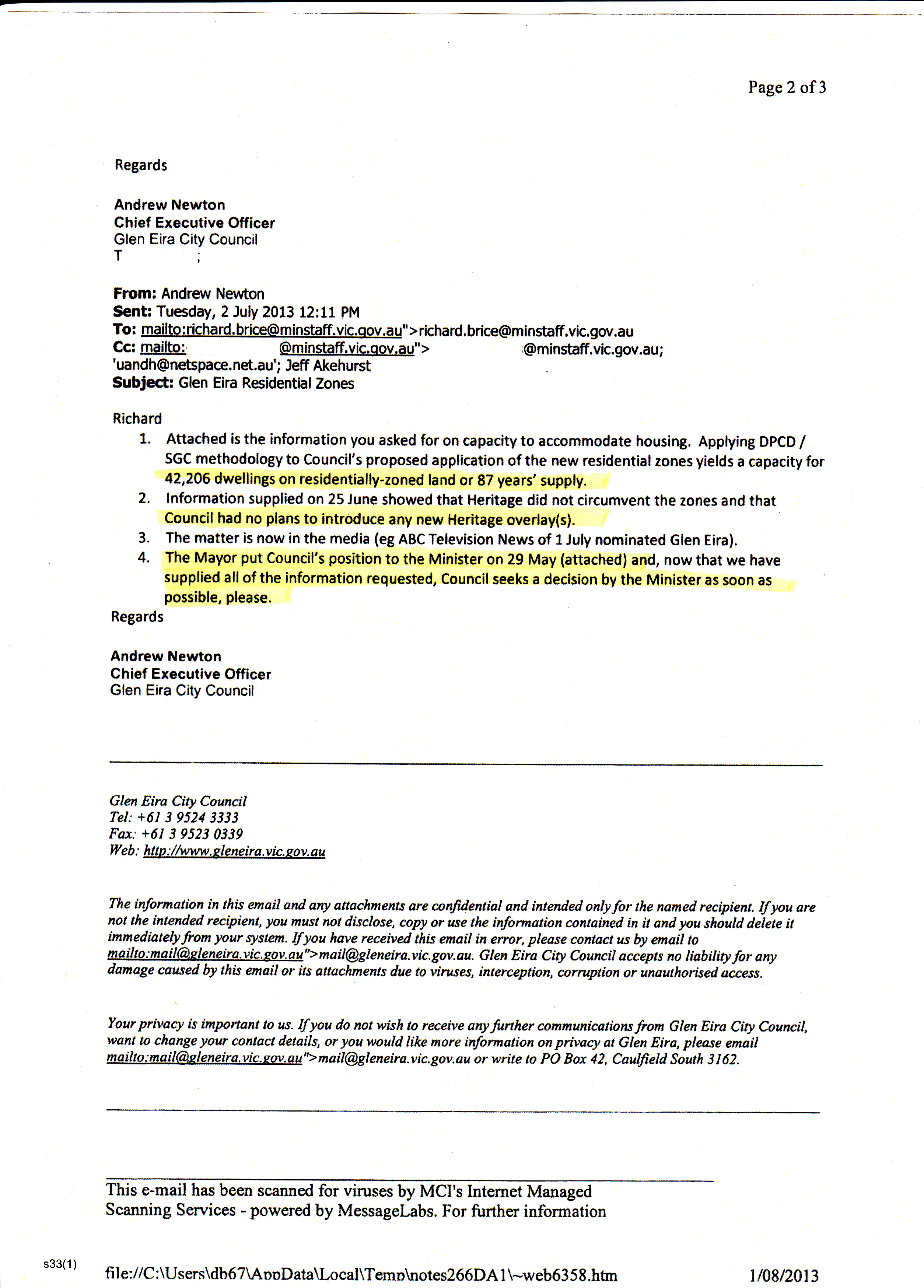
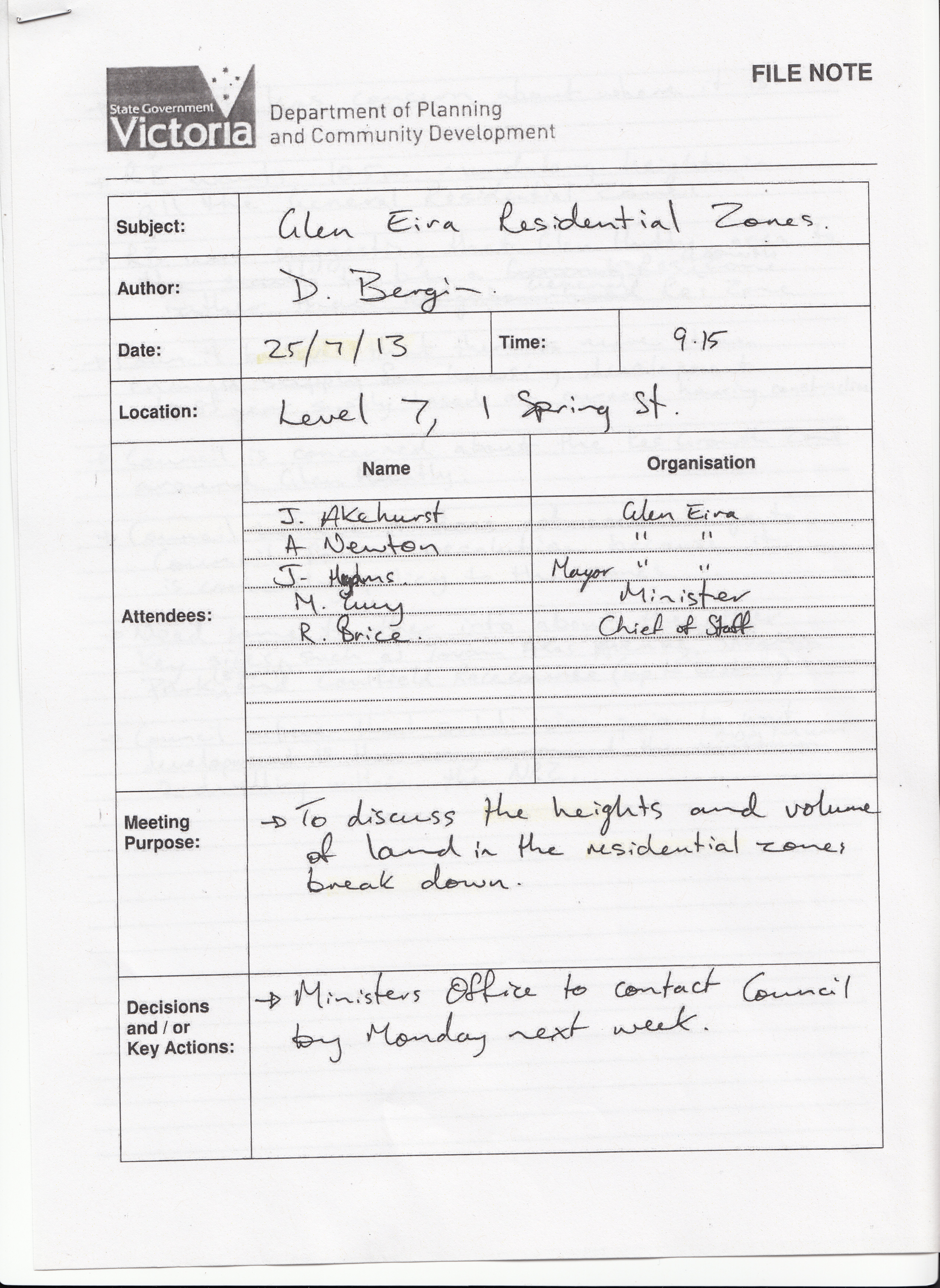
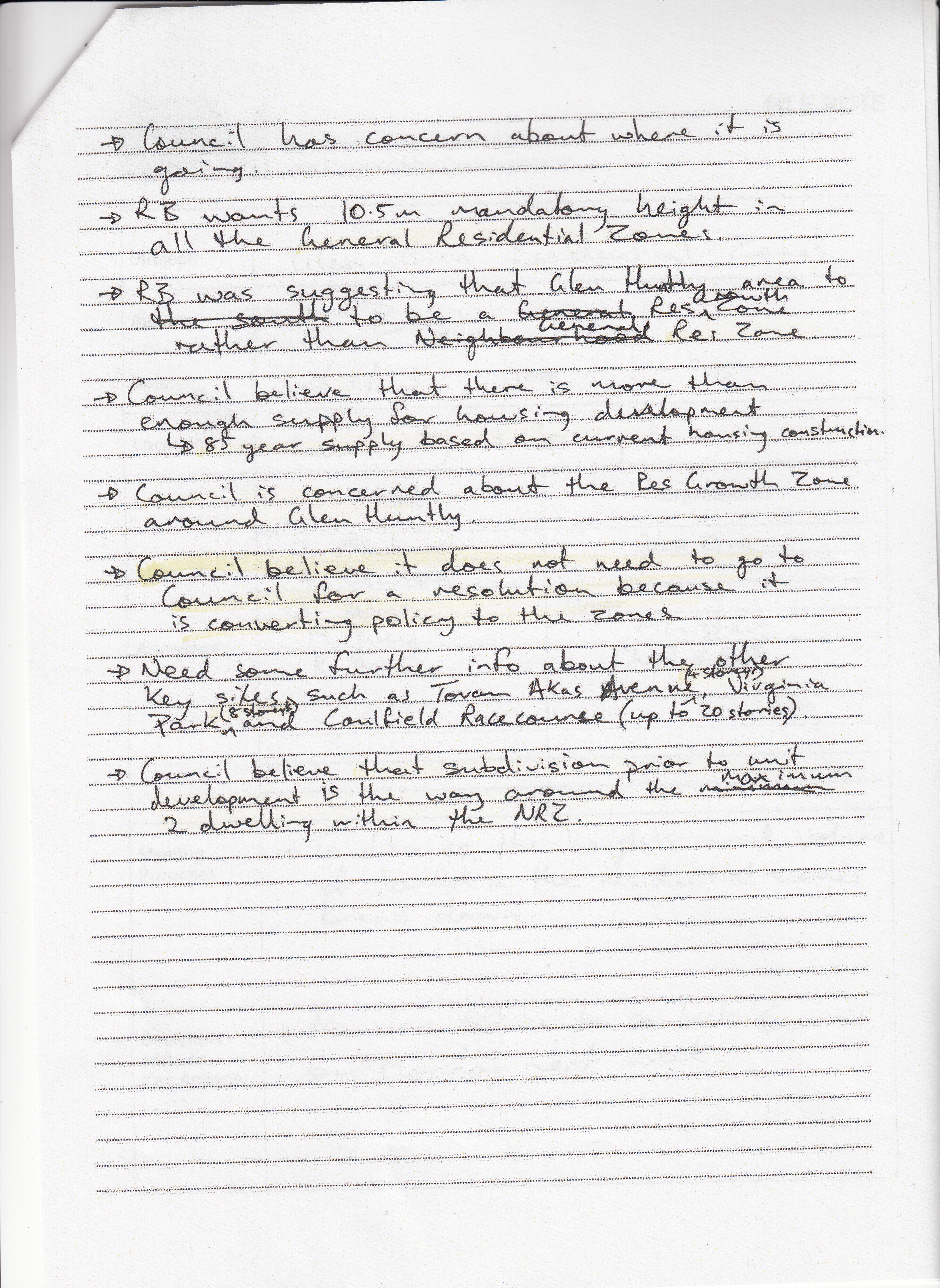
Below we feature two pages of meeting notes that occurred between the Minister, Newton, Hyams, and department reps. We urge all readers to pay particular attention to the last 5 paragraphs of Page 2. These paragraphs reveal plenty about the manner in which this council operates and its hidden agendas!

IMGIMG_0001

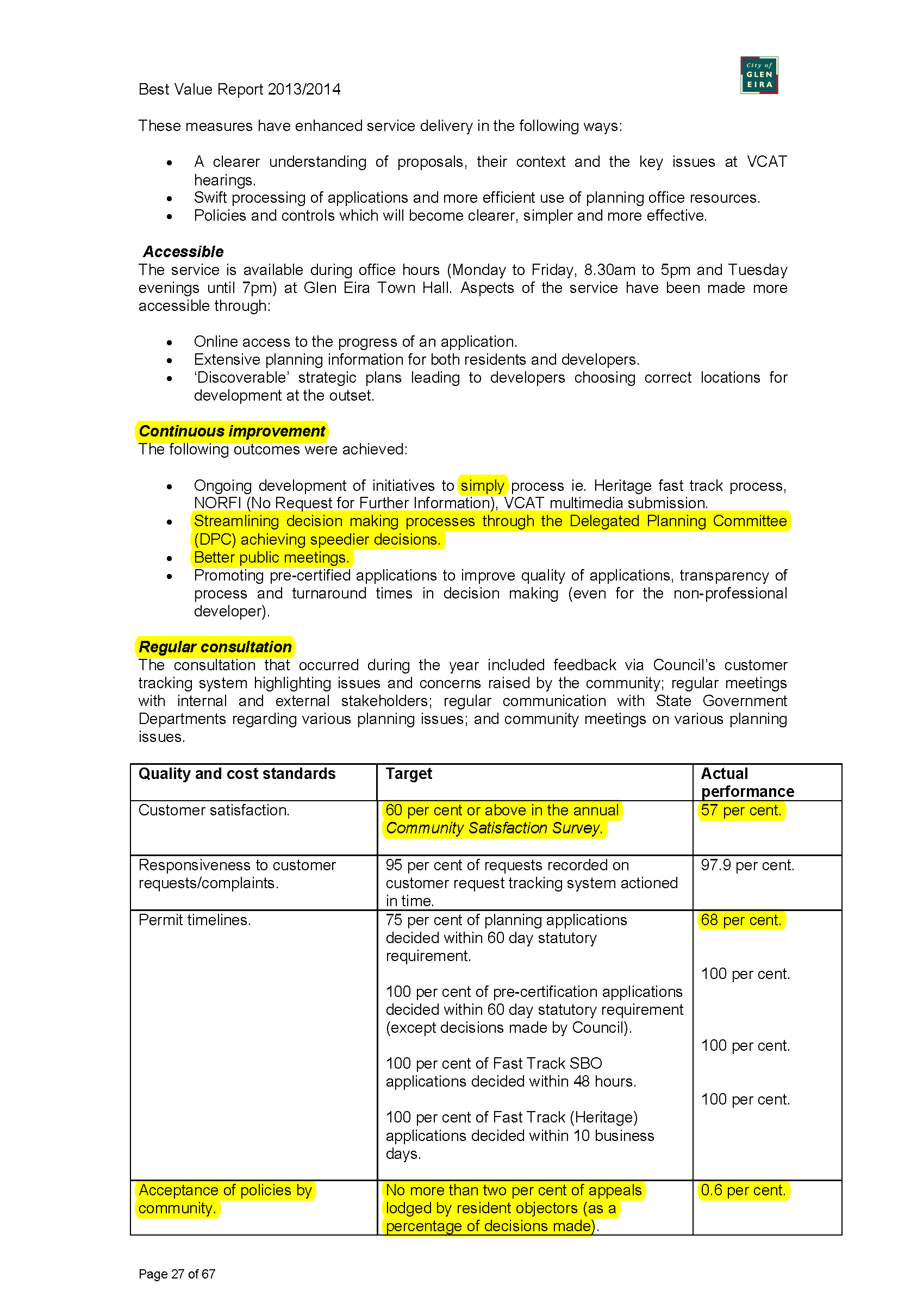
Council is required by law to report back to its residents on its performance throughout the year. This comes under the umbrella of Best Value, and the objective is to provide quantifiable measures which would indicate whether council is actually improving in its performance in all service areas. The legislation basically requires a council to ensure that:

(c)     each service provided by a Council must be accessible to those members of the community for whom the service is intended;

        (d)     a Council must achieve continuous improvement in the provision of services for its community;

        (e)     a Council must develop a program of regular consultation with its community in relation to the services it provides;

        (f)     a Council must report regularly to its community on its achievements in relation to the principles set out in paragraphs (a), (b), (c), (d) and (e)

Given this, we have to ask:

  • Why does council remove the previous Best Value reports from its website, so comparisons from year to year become impossible?
  • How well do any of the stated Quality & Cost Standards actually provide real evidence of continued service improvement?
  • How can the quoted CPI figures be so different throughout one single document when the Best Value Report is supposed to be an analysis for the entire year? For example: on page 47 we are told it is 3%; on page 13 it becomes 2.8% and on page 15 it is 2%. Since increased costs are ‘justified’ via applying CPI increases, we have to wonder whether higher CPI rates are used to camouflage what’s really been going on!

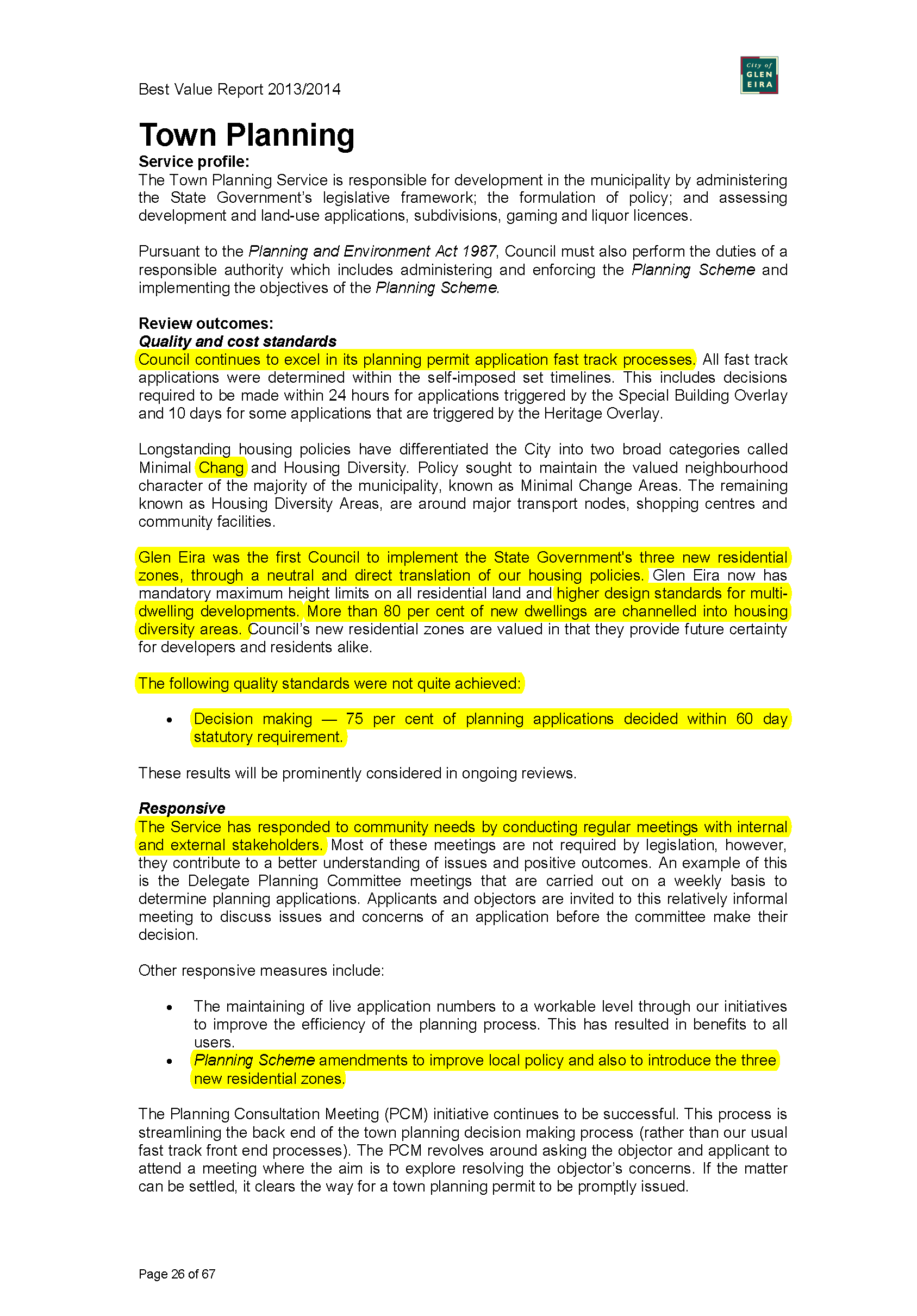
We’ve uploaded the full document HERE, and ask residents not to laugh, especially at the following – the Town Planning ‘evaluation’. Please note:

  • That of a 3 page report, 2 pages are devoted to self congratulations!
  • And, whether the ‘standards’ are really revealing what they should reveal. For example: ‘Acceptance of policy by community’ is ‘measured’ by the number of alleged resident objections. Of course, in Glen Eira speak, VCAT hike rises has nothing to do with residents thinking twice about objecting. Nor does the prospect of facing a panel of developer ‘experts’ and barristers, etc. etc. etc.
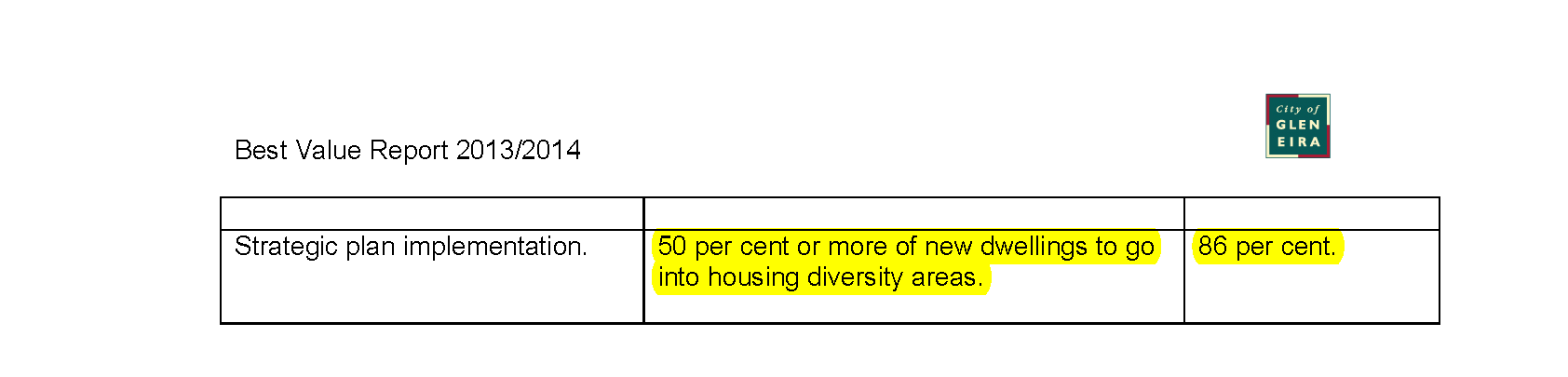
  • We also have serious doubts about any of the figures cited, especially when the last three Service reports stated that only 56%, 67% and 70% of new dwellings were sited in Housing Diversity. Of course this new figure of 86% is nothing but an aberration due to the 442 apartments that will constitute the first part of the Caulfield Village – a Priority Development zone!

We finally remind readers that year after year the 400 survey results that constitute the Community Satisfaction Report, have highlighted planning, traffic and consultation as the major failures of this council. Nothing in the Best Value report changes anything, nor even indicates ‘progress’ and ‘continuous service improvement’.

Again, we ask that readers refrain from laughter when perusing the following:

Pages from Best_Value_Report2_2013_-_2014_Page_1Pages from Best_Value_Report2_2013_-_2014_Page_2Pages from Best_Value_Report2_2013_-_2014_Page_3


CCTV cameras canned: Bentleigh big brother gets the chop by Glen Eira Council

GLEN Eira Council has won the battle to reallocate State Government funding for CCTV cameras in Bentleigh to community safety programs throughout the suburb.

The $150,000 had originally been set aside to pay for the installation of cameras in Centre Rd, Bentleigh, but will instead be used for projects such as locking bike cages and community education programs.

Bentleigh’s Liberal MP Elizabeth Miller has chosen which community safety projects get funding.

Glen Eira Council was the only council in the state to turn down the money, as it didn’t want to pay for the continued upkeep and monitoring of the equipment.

Crime Prevention Minister Edward O’Donohue took a swipe at councillors when he made the announcement last week.

The statement released by Mr O’Donohue’s office ­labelled Glen Eira’s councillors as “ideologically preoccupied … with scandalous disregard for the safety of ratepayers”.

Mr O’Donohue said: “It would not have been fair for the Bentleigh community to have missed out on this money just because of the council’s disgraceful decision.”

In ­November the council voted to ask the State Government if part of the money could pay for the continued cost of the cameras, but that was rejected by the minister.

Glen Eira Mayor Neil Pilling said the comments were out of line.

“The Minister and local member’s comments are totally unnecessary and disrespectful to democratically elected local councillors who, by a strong majority, made an informed and considered position on CCTV cameras in Centre Rd, taking into account the needs, costs and benefits to the Bentleigh community,” Mr Pilling said.

“Minister O’Donohue seems to believe Bentleigh is a crime hotspot which is in full contradiction to what both Victoria Police and council understand to be the true situation.

“Rather than resorting to these types of negative political comments, in my view, Mr O’Donohue and Ms Miller should be more focused on working with all groups in the community to deliver much needed and improved facilities and services.”

Among the 18 local community safety proposals to receive funding there are projects to install locks, lights and alarms on community facilities, secure bike sheds for nine local schools, and education programs about crime and anti-social behaviour.

There’s much in the current agenda that deserves comment. The most significant is that the MRC or their developers have lodged an objection to the miniscule conditions imposed by council on the Caulfield Village development. What a surprise! The VCAT hearing is set down for September.

It is also important to note that the public relations arm (via Newton) is out in full force with reports designed to both gild the lily, and to obfuscate the real issues on Amendment C120 (open space levies) and housing approval statistics. We will report in detail on both these matters in the days ahead.

Staying true to form, there is another report on what council could do regarding apartment sizes. Again, no surprises from this ‘do nothing council’. The recommendation is that regulating size is a state issue and all council should do is ‘advocate’ via the Municipal Association and have ResCode updated.

Readers also need to have a close look at the Advisory Environment Committee’s set of minutes. The trend to ensure that as little as possible is made public continues. Advisory committees should never be the place for important policy discussions, especially where officer reports remain secret, and the public is barred from attendance. This transgresses all notions of transparency and good governance, especially when many committee recommendations are then simply accepted by council without any open debate, or very often without the accompanying data to justify those recommendations. Here are some items from these minutes that readers might like to ponder:

That the Chair of the Environment Advisory Committee write to Vision Super to ask for information on their Ethical Procurement Policy and practice.

3.5.3. A letter was sent on 15 April 2014.

3.5.4. ACTION: Officers will seek an update on whether there has been a response to the letter and follow up if necessary

5.1. Car sharing

5.1.1. Traffic Department have advised that there is a trial underway (MS).

5.1.2. ACTION: Officers will provide further update on the current trial at next meeting.


5.2. Glen Huntly Reservoir Proposed Park

5.2.1. JD raised the question of whether a community garden should be trialled at the new park.

5.2.2. Discussion included that the proposed park is currently out for community consultation which has been informed by several consultations to-date.

5.2.3. JD plans to put in his own submission to the Booran Road Consultation process.

5.2.4. ACTION: Officers will seek clarification about the timing of Open Space Strategy action to investigate potential locations for community gardens in Glen Eira.

Last, but not least, there’s this from the in camera items – Under Section 89(2)(f) ‘legal advice’ which relates to ‘Code of Conduct – Possible Additions’. Residents should expect more ‘tightening’ (ie nooses) placed around the necks of councillors we predict, with this one!

As a result of objections, council has gone out of its way to fudge the facts and to assert what can only be described as unreasonable ‘pressure’ on two objectors to withdraw their concerns and thereby avoid a Panel hearing. The argument as presented in the officer’s report is simple: cave in, don’t object, or you will cost the community $2 million. Utter rubbish we say! Some basic facts:

  • The cited $6 million dollars as ‘revenue’ is NOT cash in hand. This includes the so called estimated land contribution value. Council’s Strategic Resource Plan provides figures of a paltry $2.2 million in cash for the next ten years. We also remind readers that when council was granted the status of ‘manager’ of the Booran Road Reservoir it entered the ‘value’ of this land ($24m) onto its books but it was made absolutely clear that this had NO IMPACT on its financial and operational base. See the minutes of 3rd November 2010.
  • Here’s another incorrect assertion – Public Acquisition Overlays are more likely to be disputed. It would be unfortunate if an Amendment was not supported by a Panel because of a proposed acquisition but the Amendment also included the higher contributions rates which were, as a result, not approved. A panel can disagree with one or two points and still make its recommendations to accept the amendment overall. Many panel decisions include some rejections or modifications of council proposals. It then comes back to council and they have the choice of accepting the panel’s full recommendations as they stand, abandoning the amendment, amending the amendment, etc. It is never an ‘either/or’ situation as these sentences pretend. Ultimately, this is nothing but scare-mongering.

There’s much, much more we could comment upon based on this agenda item. We will conclude with the view that every single resident has by law the option of objecting to amendments. Every resident also has a right to expect that when an amendment is advertised, it is devoid of errors, widely available, and easily accessible. None of these fundamental aspects of process have been carried out by council. The C120 Amendment (that is an actual draft of the amendment) has NEVER been included in council’s agenda papers, nor in its minutes – unlike some of the less contentious amendments! Even for tonight’s decision, the amendment itself is not available in the online agenda items. Residents would be hard put to find any announcements on council’s website for example or, if they happen to have missed the one and only advertisement in the local paper, then they also wouldn’t be any the wiser. Being hidden away behind the desks at libraries also does not fulfill our expectations of fully ‘engaging’ the public. So much for the Community Engagement Strategy with its empty promises and motherhood statements. Actions always speak louder than words and that remains the only worthwhile standard of evaluation.

Council has had years and years of doing nothing about its open space levies. Now suddenly, amendments are rushed through and, as so often happens, are full of errors that can only be ‘fixed’ up later. Instead of thorough planning that looks ahead and avoids countless further amendments to rectify anomalies or gaps, this council appears content to allow such poor practice. The residential zones and lot sizes are the most recent examples of inadequate planning. Other councils like Kingston for example, saw this ‘problem’ straight off and included lot sizes in their first draft of the schedules. Not Glen Eira! Not good enough we say. And to then blame residents for holding up ‘progress’ simply does not wash.


Audit Committee

There finally appears to be some ‘movement at the station’ with the following statement – The Chairman recommended that the process for the recruitment of a new Independent Audit Committee Member commence. The in camera items suggest that this process is near completion with this one liner – under s89 2(a) “personnel” which relates to the Audit Committee. Conclusion? That the reign of either Gibbs or McLean is about to end. Reasons for one of these departures is of course not mentioned, and nor has there been any public announcement that we are aware of for the advertising or recruitment of a new member.

Several other items also drew our attention –

The CEO noted that post implementation reviews of previously sub-contracted major projects, had resulted in the tender and referee evaluation process focusing more on how companies managed their subcontractors.

Following consideration of the Land and Buildings valuation paper, the Chairman requested that Council’s top ten open space assets be verified for accuracy of area size.

And from the Charter – An independent minute taker shall be responsible for keeping the minutes…… . A few sentences later there is this sentence – An appropriate officer shall act as independent minute taker to the Committee. We remind readers that for Councillor Assemblies, the municipal inspector had recommended, and council took up the recommendation (for at least some time) of obtaining a completely external minute taker.

Community Consultation Committee

Once again, two of the selected community representatives were absent! If memory serves us correctly, this would mean that only once have all four reps been present at such meetings. Hardly a result to write home about!

Amendment C120 – Open Space Levies

There is much in this item that we will comment upon in the coming days. One thing however is staggeringly clear – the inability of this planning department, plus the State Government’s offices to get something right the first time around. How an amendment can be drafted, sent off for permission to be advertised, given the go-ahead and STILL CONTAIN FUNDAMENTAL ERRORS of fact and accuracy is simply beyond belief. Who is responsible for vetting such documents? Why do these errors occur? What does this say about the entire shemozzle that is the process of drafting and implementing amendments? And most importantly, what does this say about the processes adopted by council. For example: submissions on the amendment closed on the 23rd of June. Submitters were notified on the 24th June that there would be a planning conference held on the 25th June. More indecent haste? More disregard for the public?

« Previous PageNext Page »