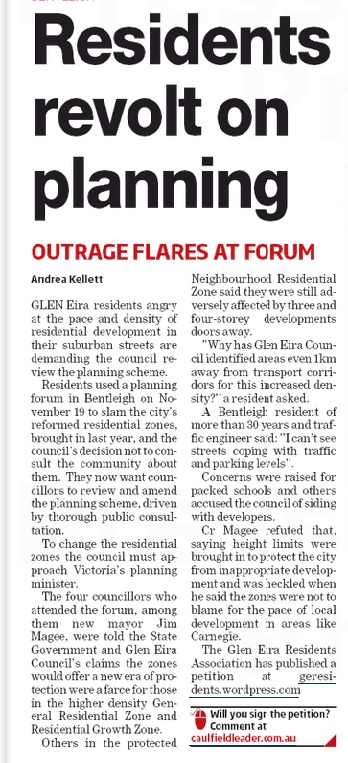
Another very, very long post so our apologies. However, the significance of the issue, and what occurred is we believe deserving of a full and comprehensive report.
The following discussion on the Lobo request for a report on the impact of the new zones is quite astonishing. It is replete with:
- Incorrect information and countless bogus or misleading statements by councillors
- The non–existence of good governance revealing clearly how decisions are made behind closed doors and that council meetings themselves are only the ‘public performance’ of these pre-determined decisions.
We ask readers to keep in mind the following:
- Labor pre-election only committed to reviewing the PROCESSES involved in the IMPLEMENTATION of the new zones – not the zones themselves or where they are placed. On this alone Glen Eira should be condemned for its failure to inform, much less ‘consult’ with residents!
- Lobo’s request for a report said nothing about the ‘building boom’ – yet what is produced is a document that seeks to divert the focus with page after page of ‘discussion’ on the ‘building boom’. Extraneous but self-serving!
- Hyams’ and the report’s dissembling and deliberate obfuscation of the ‘facts’. Building approvals are NOT the same as planning permits for new dwellings – which we have no doubt he and the administration is well aware of.
- Magee either does not know about the spread of the zones or he simply does not care. There are NOT 3 RESIDENTIAL GROWTH ZONES in Glen Eira as he claims. In fact there are 5 – two of which are NOT in Activity Centres or anywhere near railway loops.
- Lobo’s motion does NOT state that the minister should review ‘where the zones’ were put as some councillors inferred!
- The most crucial and telling point that is missing in all that follows is the continued refusal of this council to be proactive and begin to investigate first off, if anything needs changing, and then going about the processes to implement those changes. The first step in all of this is the amendment process. Countless other councils (post zones) are still consulting, still putting up amendments, and still fighting for better outcomes for their residents. They are not sitting back and saying ‘we could be worse off’ or leaving (review) decisions to ministers. These councils are doing the work themselves in consultation with their constituents. There is no scare mongering, no delays, and no waiting on ministers to initiate anything! Amendments originate first from councils. But that requires the will, the work, and the possible admission that perhaps ‘we were wrong’. All not part of the Glen Eira ethos and culture!
+++++++++
Lobo moved motion which was an ‘alternative’ to the recommendation(s) – (1) council notes the report and that there has been a ‘development boom in Victoria’. (2) that monthly figures show an ‘upward trend’ in Glen Eira (3) March 2015 data hasn’t ‘been included (4) there has been an ‘extraordinary increase’ in Carnegie, North Caulfield and Bentleigh (5) new zones don’t permit anything more than the ‘former arrangements’ (6) new zones ‘provide certainty’ (7) there are height limits (8) new zones have ‘directed developments to where it should be’ (9) development in General Residential Zones is ‘changing the neighbourhood’ and placing ‘some pressure on current homeowners’ (10) Council to write to Minister and ask him ‘what he would like to do’ in regards to the new zones. Delahunty seconded.
LOBO: said that the ‘data’ showed an increase in the number of new dwellings post zones – 744 after and 426 prior to the introduction of the zones. Said that it is true there is a development boom and more people arriving. Said that two main things had changed when looking at the old and new zones. Previously councillors ‘had the authority to take into account’ objections and with the ‘planning policy in place we would make the proper decision’. With the new zones there is ‘certainty to the builders’ where they can build and ‘thus the council power is limited’. Council ‘has to follow the law’ of the government. In all of this, ratepayers are ‘subsidising property developers’ as shown by the application fees discussed in Item 1. Therefore ‘we need to graciously accept that there is a need to go back to the drawing board’ since there is ‘always room to review’. Said that ‘we have heard and saw placards in the gallery’. He accepts that council sought ‘the best possible outcome’ from the government but ‘it would have been safer’ if they ‘had gone to the community’ and ‘showing them the new zones’. Claimed that the ‘new government’ takes ‘a different approach’ and is having a ‘review’. Wanted to ‘use that opportunity to obtain a far better outcome’ and to ‘leave a legacy’ that council has gone to government and it will help ‘mitigate the growing concern’ of residents. Said he checked with Bayside and that they will have 0.02% as a Residential Growth Zone; and 1% of Boroondara is a Residential Growth Zone whilst Glen Eira has 2.2% as the growth zone. Asked councillors to ‘put their differences aside’ and to ‘get the state government to rewrite the history on residential zones’ and to ‘protect the residents’.
DELAHUNTY: said she supports Lobo but would ‘like stronger language’ about what council writes to the Minister. Stated that it’s a ‘worthwhile report’ and shows increased development which isn’t ‘unexpected’ and has ‘gone into areas that we almost predetermined that it would go’. ‘We did seek an arrangement with the former government’ but not sure if ‘that is currently the best deal on the table’ given that other council have got improvements. So the motion is basically a ‘due diligence exercise’ to ensure that what Glen Eira has ‘got at the moment is the right thing’. Said she would like the Minister to ‘have a good look at East Bentleigh’ and she’s not sure about the ‘piece meal planning’ they go through with every application that the ‘zoning is correct’ especially since there is a ‘lack of public transport’ . She also met Elsternwick residents who were advocating for more growth zones in that suburb’s commercial area. Council has always said that if they say where development can’t go, it is their responsibility to say ‘where it can go’. As an Elsternwick resident she ‘supports that – yeah it can go there’ since ‘it’s on top of a train station’. Council can’t do anything about transport in East Bentleigh ‘but we can certainly have a look’ to see ‘if the zoning is right’. She ‘hopes that the Minister will do that’ and if the residents support increased development ‘in that little pocket of Elsternwick’ then that should also occur. Said it’s ‘not a statement that we did the wrong thing’. ‘We all stood here and talked about whether we were doing the wrong thing at the time’ and ‘whether or not we took that to the people’ . She is ‘convinced that the consultation we did prior’ ‘informed how we went about seeking those zones’. Also, since other councils have ‘differences’ in what ‘they were able to achieve’ so it’s ‘really an exercise’ to ensure that ‘we’ve got the best outcome’. Perhaps the Minister might come back and say ‘yes, you’ve got the best outcome’ or maybe he might come back and says ‘we need to pull it back here, we need to put a schedule there’.
PILING: thanked Lobo for requesting the report and that there is ‘some good information here’ although ‘not surprising’ that Carnegie and other suburbs have had ‘more development’. Said that ‘the problem’ with Lobo’s motion is that it ‘draws the inference’ about Glen Eira but that the ‘whole of Melbourne’ needs to be looked at in order to ‘see what is happening’. Said that they are being asked to ‘adopt a policy position’ in saying that ‘the present zones aren’t working’ but ‘I think they are’. He also wasn’t happy with ‘some of the language’ of the motion such as ‘extraordinary increases’ and this isn’t ‘reflective of where this council is’. Claimed they ‘did a lot of work 18 months ago’ and it gives ‘surety’ to developers and residents. Agreed with ‘part’ of the motion that there is development in areas where ‘it should go’. Said that Lobo mentioned Bayside and the current government’s promise to ‘review the zones’ but in his view these are both ‘politically expedient’ and Bayside has got an ‘unusual arrangement’ whilst the review was promised under ‘political pressure’.’I am not in favour of a review’ and although not against talking about ‘improvement’ didn’t think that ‘this was the place’ to ‘set upon a ‘policy position’.
LIPSHUTZ: agreed with Pilling and it was a ‘great report’. Read out Lobo’s clause about ‘extraordinary’ development in Carnegie, etc and then asked ‘what’s so extraordinary’ about this given the ‘boom throughout Victoria’? Said that there’s ‘nothing extraordinary about this’ since development is going on ‘everywhere’. Said that Lobo ‘talks about the old ways’ but ‘now we have certainty’ for ‘everyone’. Previously there was ‘policy that VCAT ignored’ but now ‘we have law’ and ‘people know exactly what can be built and what can’t be built’. He has difficulty with the item where Lobo wants council to ‘write to the minister and see what he wants’. Couldn’t ‘understand’ this. Asking him what he wants means ‘don’t worry what we want’. It should be council that ‘sits around’ and ‘talks’ about whether ‘there are improvements’ that could be made. Then after they’ve decided they ‘advocate to the minister what we want’. You don’t go to the minister and ask ‘what do you want’ – ‘that isn’t the way this council ever operates’. Lobo also talked about ‘pressure on homeowners’ next to developments but ‘ultimately you’re looking at the building boom’ and with development ‘suburbs are changing’. Today things aren’t all ‘triple brick veneers or Californian bungalows’. ‘We are looking for development’ and because of the zones ‘we have certainty’ about ‘what we want to do’. Thought the ‘intention’ of the motion was ‘good’ but ‘analysing’ it, ‘it is wrong’.
SOUNNESS: wanted Lobo to clarify part of his motion about writing to the Minister and Lobo said ‘I have changed that. I have left it out’.
Lobo then read out the clause again and this time said that since the new government had ‘promised’ to ‘have a look at the new zones’ that council writes to Wynne to ‘comment’. Several councillors then commented that this is now different to what the original motion stated.
MAGEE: ‘that is quite different’.
LOBO: ‘that’s right’ because ‘when we had the discussion inside we changed it’.
LIPSHUTZ: ‘point of order’ about the different motion.
MAGEE: asked Lobo if there ‘was a different document’ that he was ‘reading from’
LOBO: said he changed it because in the ‘pre-meeting we had some disagreement’ and that ‘people were not happy with my words’ so ‘I changed’ it.
MAGEE: told Lobo that councillors now ‘didn’t understand what the motion is’. Lobo claimed ‘it was the same one’ but Magee said ‘I don’t believe it is’.
SOUNNESS: proposed that what Lobo read out the second time is different and that the second version should be the motion.
LOBO: said that he had to ‘change’ things because of ‘some words’ which were part of the ‘internal document’ that ‘didn’t go to the public’. Lobo read out this part of the motion again that council writes to the Minister to ‘see what he wants to do’.
LIPSHUTZ: commented that that was what Lobo read out the first time.
Magee asked Sounness if ‘he was happy’ and Sounness said he was.
SOUNNESS: said he’s got an issue with several item in the motion. Sounness ‘didn’t feel’ that the development in Carnegie and Bentleigh was ‘particularly extraordinary’ and it was all ‘part of the general boom’. Problem with paragraph j is that it makes it sound as ‘if we’re advocating for change’ but what council is doing is just enquiring about the ‘review process’ and that they are not ‘asking for anything particular to be done’. Another problem is that the document ‘hasn’t spoken about Bayside’ or other municipalities. ‘Knows’ that there’s development ‘generally speaking’ everywhere but the report doesn’t cover this and how people will be ‘fitted in’. Said that there have been comments that what is occuring in Glen Eira ‘is unfair’. Said that ‘there are processes to go through that’ and asking the minister isn’t the right process because the ‘process should be’ for ‘all of Victoria’ to ask how the growth can be accommodated. ‘What can Melbourne do’ and how Glen Eira ‘would fit into those elements’. Acknowledged that others had ‘received good outcomes’ from their rezoning. Glen Eira in their ‘negotiation’ received ‘greater permeability’ and setbacks.’Some councils have won and some councils have lost’ as a result of their ‘negotiations’. In terms of voting on the motion he would ‘have to think about things as they progress’.
HYAMS: agreed that council should write to the minister. Said people could read the figures and because there is more development come to the conclusion that ‘the zones must be the cause’. Said this isn’t ‘necessarily the truth’ because other factors are involved. What’s important is ‘whether there have been more approvals in Glen Eira’ compared to other similar council areas. ‘Given the building boom it’s very unlikely that that’s the case’. The ABS table in the report shows that building approvals have increased ‘across the board’. Said that the new zones aren’t stopping people building anything ‘they couldn’t build before’ but ‘there’s plenty’ that could have been built previously but now ‘can’t be built’. This is especially true of the Neighbourhood Residential Zones where there is ‘far greater’ protection than before but ‘also true’ for RGZ and GRZ zones because of ‘height limits’ and setbacks. Claimed there was a ‘rush’ to beat the implementation of the zones. Said that ‘there are some who keep saying that the zones allow more’ but for him these people fit into 3 categories – to make money; playing politics and those who ‘who are being mislead by the first two’ categories. Said that ‘without the zones’ there still would have been an ‘increase’ but council ‘wouldn’t have had tools as good to deal with the increase’. Further, it ‘doesn’t mean’ that maximum heights are always granted. Council ‘still takes into account neighbourhood character’. Said that the zones were ‘overall a positive’ but if the government wants to review, that ‘doesn’t mean’ that council wouldn’t be ‘seeking an even better outcome’. But he doesn’t want to ‘suggest’ that the ‘new zones weren’t a good idea’ because he is ‘adamant that they were.’
OKOTEL: Stated that she in asking the government to ‘review where the zones are placed’ she ‘maintains’ her position on consulting with the community and that council should have consulted before bringing in the new zones and the ‘proposal they put’ before government. Felt that ‘the proportion’ of neighbourhood residential zones to general residential zones ‘is a good outcome’. Worried that by asking ‘the minister to review these zones’ then ‘we are allowing open slather for the minister’. Said that ‘again we are not consulting’ before ‘asking for a review’ and that this is ‘highly inappropriate’. Thought that ‘we should always consult with our community’ prior to ‘putting forward such a major proposal’ that ‘the zones be reviewed’. This becomes even more important since council doesn’t ‘know what this review looks like’ and they haven’t had a response to their letter. So now going ‘to the minister and asking for a wholesale review of our zones’ and especially ‘not knowing what implications there are’ is a ‘huge, a massive risk’. Council could lose ‘that 78 protection’ or maybe ‘gain greater residential zone coverage’ but if council loses then ‘it would be a devastating outcome’. Thought that if ‘asking for a review’ then council should ‘first consult with our community’ instead of ‘providing open slather for the minister’. Councillors ‘have a responsibility to ensure best outcomes’ and ‘not pass the buck to the State Government’. Wanted council to ‘keep advocating’ for residents.
MAGEE: only the Minister ‘can do anything’ about the zones. When in opposition, Labor was ‘very clear’ that they were going ‘to review zones’ but haven’t done ‘anything about it so far’. He ‘believes’ that ‘we’ve got a very good system’ . In 2009/10 there was a ‘public review’ of the planning scheme and three things emerged that residents wanted – height limits, buffer zones, and ‘less discretion at VCAT’. ‘That’s exactly what the zones are doing’. Regardless of council ‘advocating for this change or that change’ or whether ‘we want a review the minister at any time can review’. Said that MPs are asking the minister to review zones in their electorates. Said that council was’ criticised at one point for not consulting’ but he thought ‘we very much did’ and now to ‘do a review of our consulting’ they would be ‘accused of doing the very same thing’. Glen Eira’s ‘system puts development’ where he thinks ‘it should be’ – in activity centres and along transport routes. Said that there are 3 Residential Growth Zones and the rest of the residential zones are in ‘shopping strips’. Thought that Glen Eira ‘is very, very lucky to have what it has’. If the minister ‘wants to tinker with that and reduce that’ then no council would have room for residential growth zones. If councils all got what they wanted it would all be neighbourhood residential zones. This would be ‘totally inappropriate and disrespectful’ to the 1000 people a year who come to live in Glen Eira. They have to be ‘accommodated somehow’ and currently council has got a ‘system that I certainly won’t be voting to change’ until the minister tells them ‘what that change will look like’. Was worried that if council ‘opened this up’ that the growth zones would increase and ‘neighbourhood zones would decrease’.
LOBO: said that if there were ‘second thoughts’ then they shouldn’t have asked for the report. Said Okotel was ‘right 50%’ but ‘it doesn’t mean that our realisation’ since the introduction of the zones ‘should be just kept under the blanket’. Stated that his intention was ‘to pin down the minister for just making promises’. Lobo ‘wanted to check if he meant what he said’.
MOTION PUT: VOTING IN FAVOUR – LOBO, DELAHUNTY.
VOTING AGAINST: LIPSHUTZ, PILLING, HYAMS, OKOTEL, SOUNNESS,ESAKOFF
MOTION LOST.
Hyams then moved motion that council write to the minister and ‘enclose’ their letter of December 23rd and telling him that council hasn’t as yet got a response to that letter. Lipshutz seconded.
HYAMS: given the four months for no reply, it is worthwhile resending letter and will be ‘useful to know’ the ‘form the review may take’. Thought it was a ‘good report’ and disagreed with Lobo that ‘we didn’t see things the way that he wanted to move his motion’.
Lipshutz didn’t speak to the motion.
DELAHUNTY: thought the report was ‘useful’ and thought that what Lobo was trying for was to ensure ‘that we still have the best deal’. Said that there is ‘hand wringing every time there is an application in front of us’ especially along Neerim Road – ‘oh what can we do?(sarcastically)’ ‘well what we can do is ask for a review of the zones!’. Said that there ‘no harm’ in asking for a response from the minister to an earlier letter. Said that judging by the previous comments from councillors and the focus on consultation she asked Hyams to include an amendment in the letter that insisted on ‘community consultation prior to any changes’. Hyams agreed to the amendment.
Lobo then wanted Hyams to ‘read out’ the letter sent to the acting planning minister of the time. Hyams told him it was ‘in the agenda’. Lobo asked again if he would read it out for people ‘in the gallery’.Magee said the gallery has got the agenda and that ‘we are pressed for time’.
LOBO: said that his role was to give council the chance to ‘be transparent’ because ‘we are all the time accused that this council is not transparent’.
MAGEE: asked Lobo if ‘you feel that this council is not transparent’?
LOBO: ‘it is not what I believe – it is what people say’
HYAMS: said that those complaining about council not being transparent are ‘themselves very transparent’. Thought that ‘it is our role to get the best deal we can’ and ‘if it becomes possible to get a better deal maybe we should go for that’. First council needs to ‘know things the way they are’ and write to council for this information.
MOTION PUT AND CARRIED UNANIMOUSLY