GE Consultation/Communication


leader

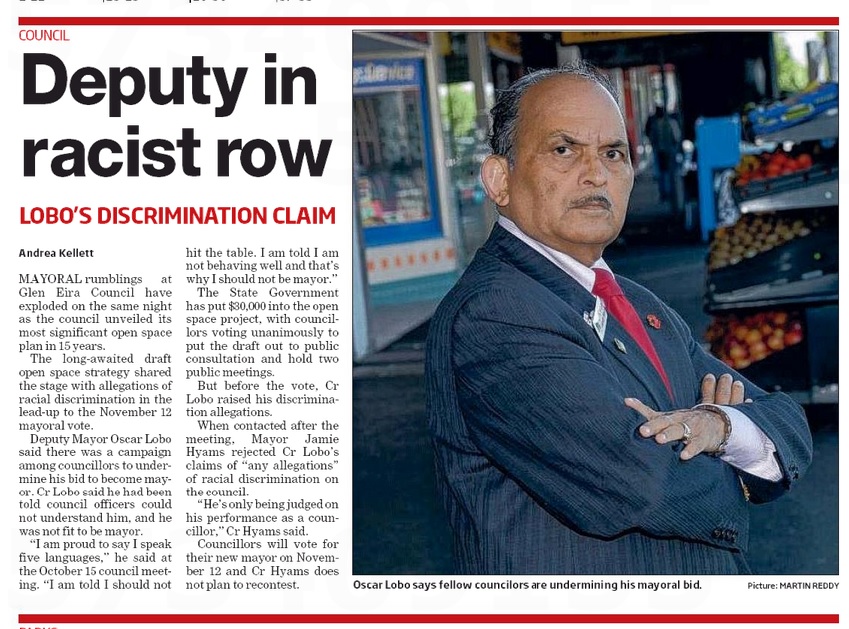
Several crucial facts have not been included in this Leader article.

  • Lobo’s outburst had nothing to do with the Open Space Strategy but everything to do with the Community Consultation Committee and its nomination of 4 community reps. Readers should note that Delahunty is chair of this committee and it includes Hyams, Lobo and Esakoff as the other councillors.
  • Lobo was the only councillor to vote against the recommendation to accept the nominees. He questioned the process and the decision saying that councillors should be exercising their ‘conscience’ and ‘loyalty to residents’.
  • Lobo claimed that since the committee’s formation in 2009 there was no process involved which ‘showed transparency and democracy’ since ‘there’s nothing in writing’.
  • Lobo wanted the report to go ‘back to the drawing board’.
  • Council re-advertised its call for community reps following the applications by 4 residents. The spin was that council wanted a ‘broader’ representation.  Esakoff moved the motion to accept, claiming that these 4 new people were ‘most appropriate’ and represented a ‘broad spectrum’.
  • Lobo also revealed that one of the arguments for not appointing an individual from the first round of applications was that he would be using the committee for ‘election purposes’ in 2016!!!!!! We assume this was a reference to Newton Gatoff.
  • Without pre-judging the performance of these 4 new community reps we have to ask: were they ‘requested’ to apply and if so, by whom? Were the original group of applicants rejected because they were perceived to be knowledgeable on council affairs and would question too much?

PS: More grist to the mill comes from Whitehorse City Council on the residential zones. In the extract below this council makes it absolutely clear why CURRENT ANALYSIS is required in order to obtain maximum benefit from the new zones. They are currently undertaking full community consultation on: Housing and Neighborhood Review; Drafting new Urban Design Guidelines and reviewing the Whitehorse Housing Study. Only then, will they embark on shaping the residential zones. We repeat – when is the last time that Glen Eira undertook any analysis, any genuine consultation? Here’s what Whitehorse has to say. The full explanation is available at: http://www.whitehorse.vic.gov.au/hanc.review.html

Why do we need the Whitehorse Housing and Neighbourhood Character Review 2013?

Council currently has two main studies that guide decisions on housing development:

  • The Whitehorse Neighbourhood Character Study 2003
  • The Whitehorse Housing Study 2003

Both documents were prepared some time ago, and there have been changes both in terms of the housing development which taken place since the studies were prepared, and the needs of the residential community into the future.

Council faces changes in its future housing demand, with a trend towards smaller household sizes, a more diverse mix of household compositions and backgrounds, and an ageing population. The number of households to be accommodated is expected to grow.

The review seeks to ensure that Whitehorse can cater for these changing needs, while still ensuring the City’s preferred future neighbourhood character can be maintained and enhanced. It is also important that the new strategies and corresponding controls (including designating substantial, incremental and minimal change areas) reflect changes that have occurred over the past 10 years and provide opportunities to meet the future needs of Whitehorse residents.

There have also been a number of developments within some of Whitehorse’s smaller shopping centres, referred to as Neighbourhood Activity Centres. To provide greater direction in determining the form of development which may be suitable for these locations, draft Urban Design Guidelines have been prepared for most centres

+++++++++++++++++++++++++


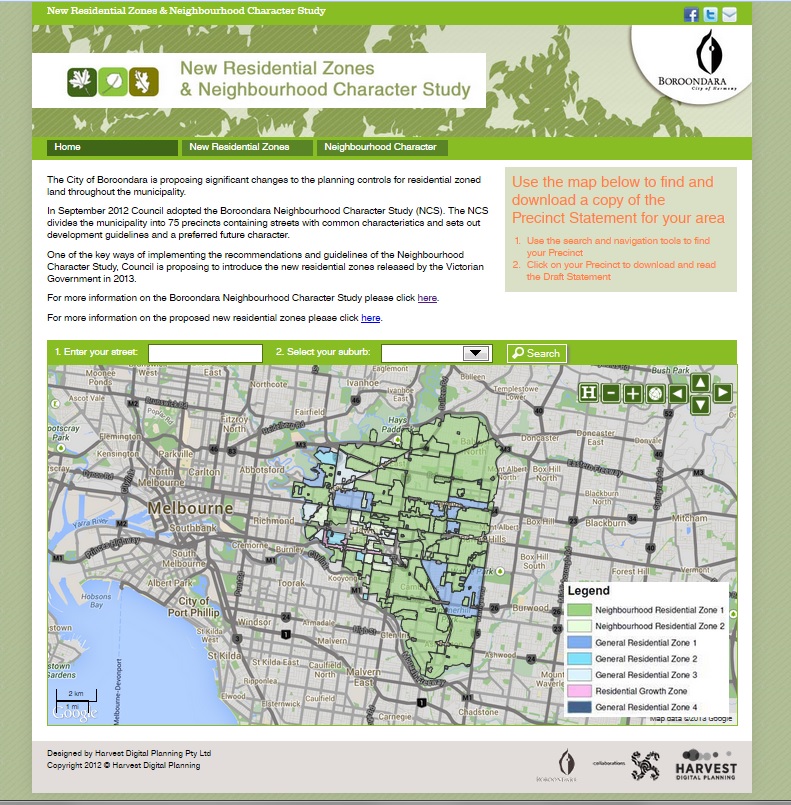
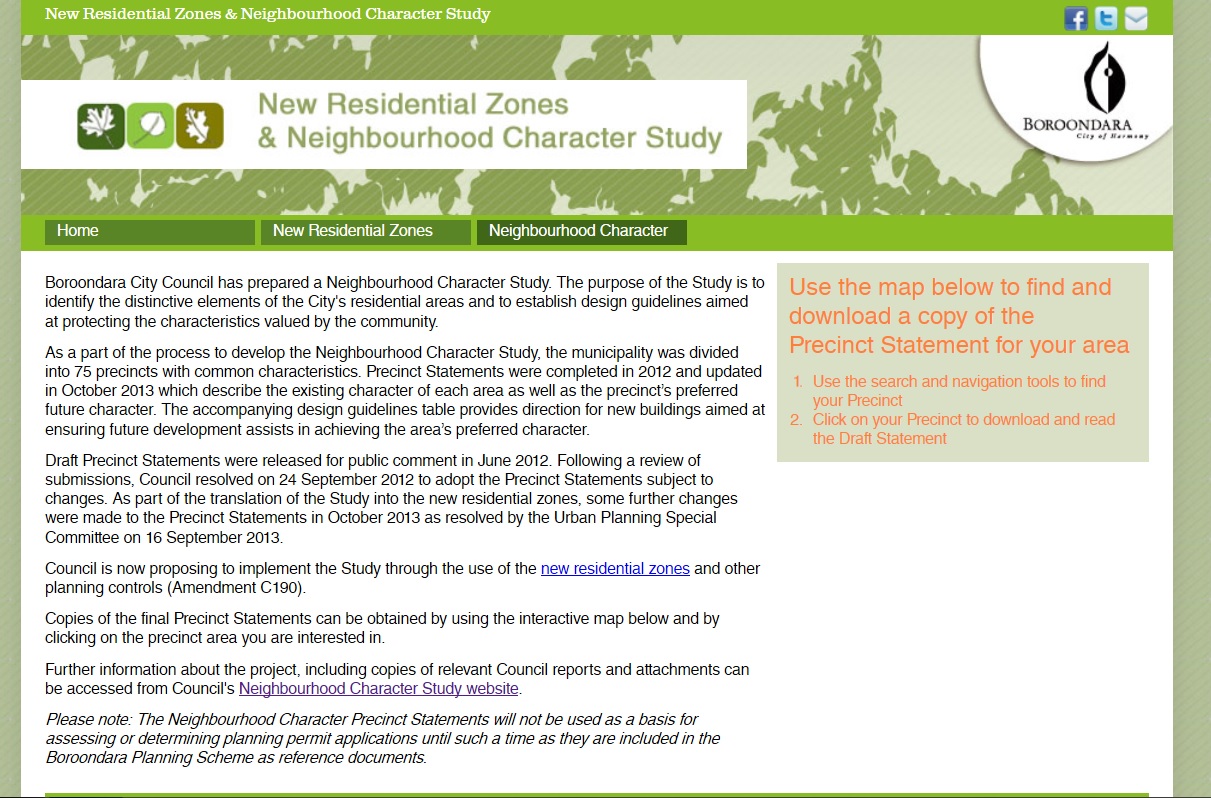
The contrast between Glen Eira Council’s secrecy, lack of up-to-date planning, and total disregard for residents is becoming more and more evident when compared to what lengths other councils are going to in order to both INFORM and CONSULT with their residents on the residential zones. Below we feature two screen dumps from the Boroondara Council’s website on the issue. Please note that their draft document is:

  • Going out to full consultation
  • Is based on years of local analysis (Neighbourhood Character Study) and research where their municipality was divided up into 75 individual precincts. The document was only finalised as recently as this month. When did Glen Eira last perform such a study that covered the entire municipality?
  • The expense and technological wizardry that Boroondara has gone to should be applauded. Residents are able to use the ‘interactive’ maps to locate their homes and immediately see the proposed zoning, and the statements on ‘preferred character’ for that area, as well as the related schedules. Glen Eira in all its documents has no ‘preferred character’ statements for ANY of their zones – that would only handicap future development if actually expressed in black and white.
  • We’ve already noted the schedules and how vastly different they are to the Glen Eira ones in an earlier post.

The Boroondara effort can be viewed in detail at: http://www.boroondara.characterstudy.com.au/

boroondara

boroondara2

It is our firm belief that further consultation (on residential zones) could not have resulted in a better outcome, and may well have had the opposite effect. Our concern, on this as in all matters, was to achieve the best possible result for the Community. (13th August, 2013)

Thus spoke Council as part of the answer to a public question! The villainy is further compounded by the Minister’s mandatory release of his ‘reasons’ for approving Amendment C110 under Section 20(4) – that is, without public consultation. We’ve uploaded the complete Ministerial statement here and highlighted some choice sections below. What is absolutely clear is:

  • Council’s continued responses to public questions were at worst entirely dishonest and, at best, deliberately evasive and disingenuous
  • ‘Negotiations’ between the department, minister, and Council had been ongoing well before the announcement of August 5th 2013
  • The Minister’s statement reads exactly like something that would have been composed by the public relations arm of Council and he merely signed off on it.

Here are some extracts and residents should question the failure of governance that has spawned this amendment  –

The Glen Eira City Council has requested that I prepare, adopt and approve Amendment C110 to the Glen Eira Planning Scheme, with exemption from the notice requirements under section 20(4) of the Planning and Environment Act 1987 (the Act).

The Glen Eira City Council gave effect to its Housing and Residential Development Strategy (Strategy) with the introduction in 2004 of Amendment C25. Work on the Strategy commenced in October 2000, and included a community notification and consultation process. Nine community workshops attended by approximately 50 people also contributed to the development and refinement of the Strategy. The Strategy was adopted by the Council in 2002.

Exemption of the amendment under section 20(4) will enable a prompt decision on the adoption and approval of the amendment and will allow for the orderly application of residential zoning controls for this planning scheme, based on previous strategic work. It will avoid the need for a further notification, exhibition and consultation process, which is considered unnecessary given the strategic basis for applying the new zones can be found within the existing planning scheme.

As the Glen Eira City Council has requested the amendment, the support of the Council for the amendment is evident.

I consider that further notification through the formal statutory process is unnecessary. Consultation has been conducted during the development of the Housing and Residential Development Strategy and in relation to Amendment C25, which introduced the local policies upon which the application of the new residential zones is based.

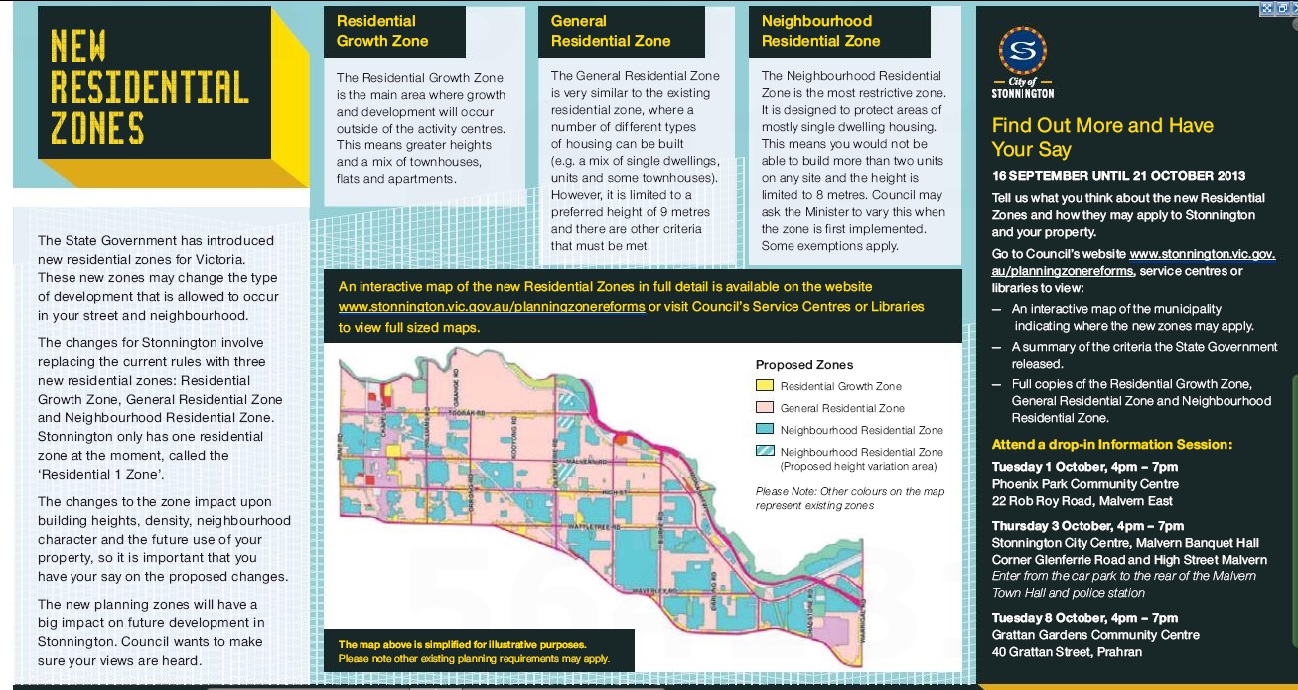
stonnington

The Phoenix Precinct has been moribund for years. Now it is officially dead with council’s proposed Amendment C109 in Tuesday night’s agenda. What was envisaged as a ‘grand plan’ that would look at an entire area (Caulfield Racecourse & Monash, plus surrounding areas and plan appropriately) has been hacked to pieces. The C60 was just the beginning of the dismantling. Now there is the Monash proposal (nothing definite of course!) and Council once again rolling over and complying with all developer requests – this time our old friend Urbis rather than Equiset.

The Amendment proposes to remove the Priority Development Zone and vest control in Council – which would have happened anyway with the demise of Priority Development Zones under the new planning laws.  However, there will not be the NEED FOR ANY PLANNING PERMIT and that probably means no public input into the eventual plans. Worse is that the officer’s report only tells half the story. Reading this document we could be forgiven for thinking it is only about Derby Rd and a few shops. Hardly! The Monash Plan is now reinvigorated and will include – 800 student residences; retail, cafes, etc. (See: http://monash.edu/about/who/ambition/masterplan/). Yet all of this barely rates a mention. Why?

Just for a taste of what is to come, here is the award winning entry for a new building on Dandenong Rd – Source: http://www.australiandesignreview.com/news/26244-mcbride-charles-ryan-to-design-monash-uni-complex

monash

Other Monash sites providing information on the development may be accessed at:

Your Rates At Work!

Our questions are straight forward –

  • What are residents not being told?
  • Will this be another C60 that excludes community input?
  • Has everything already been decided in those ivory towers?

This afternoon’s LARGE Community Forum had a terrific turnout and very informative speakers. Apparently all Glen Eira councillors and some senior planning staff were invited. To their credit the only councillors to show up were Lobo, Delahunty and Magee. No officer turned up and no other councillors.

Since the afternoon was videotaped we’re assuming that LARGE will upload a full record of the formal presentation on their website (http://www.largeinc.com.au) so we won’t comment on this aspect of the event. Instead we will focus on some of the questions or comments that members of the audience made and the remarks made by the above councillors in response.

One resident asked that the map of the new zones be put up on the screen. He was from Wheeler St., Ormond which is a ‘purple area’ (4 storeys). He expressed ‘sorrow’ for anyone who lived in such areas because they were ‘high density zones’. His problem was that it was also a ‘flooding zone’ and there had been some progress with melbourne Water and council about upgrading drains but ‘without upgrades of infrastructure’ council is ‘still approving development’. They went to VCAT opposing a 3 storey development and they won. But that was several months ago, before the introduction of the zones, so the resident wanted to know what this means for the new development now – ie could there be another application and a permit granted because this is now a higher density zone. The resident asked if ‘council is stronger than VCAT?’

Professor Buxton explained that there are other forms of control via layers of overlays and if there is one he felt that VCAT would uphold it – although he didn’t know the extent of Glen Eira’s overlays. Delahunty then said that council is continuing to ‘look for new areas to apply neighbourhood character overlays’ and these are ‘primarily in the green section of the map’ (minimal change). Said that with permeability controls, height controls and other things that ‘we are quite proud of’ and that ‘VCAT cannot overturn’. She didn’t forsee any change to the current flooding zone.

Another member of the audience then began her question by saying that the data that the residential zones are based on comes from figures of the nineties. Things have changed a lot since then and the floods of 2011 impacted on a huge area near her. Yet council still grants permits and hasn’t taken into account ‘greater surface’ for buildings which means ‘greater flooding’ and all this whilst there’s been ‘limited infrastructure upgrades’. Said that she lived in the ‘purple zone’ and that council has been ‘quite remiss’ in blocking themselves off from the community. (applause). ‘there is definitely no regard for us living in this area’. Claimed that she had spoken with planners at council and asked what consideration was given to ‘infrastructure’ and their response was ‘oh, we looked at it in 2000’ and that she should take it to council. Mentioned ‘schools bursting at the seams’ and whilst a state responsibility, council still has to advocate but it ‘seems that our rights in Glen Eira have been overlooked’. Schools and kindergartens are ‘bursting at the seams’ and whilst there is a train station there is no bus service’. Talked about traffic and that ‘yes’ 3 storey limit is great’ but it’s not enough.

Another speaker then said that she finds the ‘of right uses’ (ie no permit required) ‘abhorrent’ since it removes her rights as a resident to object, ‘voice my concern, to be heard’. Asked if this is in fact an abuse of administrative and legal power as well as a ‘denial of natural justice’ (applause). Buxton answered that the government has justified this by granting ‘certainty’ and removing delays therefore saving money for everyone. Said irony of all this is that there are heaps of Section 2 uses (service stations etc.) that can then get permits. Government hasn’t prohibited anything and there are no height controls for commercial areas and will be a huge problem because these of right uses don’t have height limits applied to them.

Buxton also stated that the criteria to assess these uses in residential areas are ‘very vague’ so anything could go into a residential street. Said that these ‘criteria’ are supposed to be ‘performance measures’ but they are anything but performance measures – ie will they cause ‘detriment’ to someone. These are vague and all subjective. Buxton then went on to say that a planning scheme is a legal document and people’s rights are either ‘given’ or ‘taken away’ via the planning scheme.

Several residents then gave examples of battles they had won elsewhere and the call was for ‘people power’.

Another residents asked whether VCAT could still ignore ResCode standards if councils simply defaulted to these in its schedules since VCAT often ignored ResCode in the past. Buxton responded that if specified in the schedules such as height then this was mandatory but it was vital that councils apply ‘the maximum powers they have under the schedules’. Gave the example that council could have stipulated one dwelling per lot but Glen Eira didn’t – they’ve allowed 2 dwellings per lot. Where there is medium or high density and there is no specifications by council then they will be assessed under ResCode. Problem is that ResCode only applies to 3 storeys so applications for 4 or more storeys  in Residential Growth Zones won’t even have these ‘standards’. ‘No developer in his or her right mind is going to apply for a 3 storey development in a commercial zone when there’s no height control’. Also the guide that assesses higher density is ‘even less strict than ResCode’. So ‘not only do you get an incentive to go over 3 storeys but you’re being assessed against a weaker code’…’you’d have to be nuts not to do it’.

One ‘brown zone’ resident said she was ‘shocked’ by what has been said. Asked if it’s true that those living in these areas have no rights and no protection and that the lovely heritage places around her have no value whatwoever except for developers. Buxton said that ‘you lose rights if application relates to Section 1 uses’ otherwise people can still go to VCAT. (SECTION 1 INCLUDES ‘food and drink premises’ within 100 metres of commercial zones; shops, medical centres, places of worship etc.) Many of these are ‘high impact’ that people won’t be able to do anything about. The other problem here is that there are no height limits on such uses so a hypothetical could be a 9 storey application with no rights to objection next door to a single storey.

Comments from Backlash about population growth and no planning for infrastructure – transport. Buxton claimed that no government is confronting the planning for a city of 6.5 million people by 2050 because it will cost 25 to 50 billion just in transport.

LOBO then spoke saying that ‘it’s a pity the other 6 councillors did not turn up’. Said that Labor lost ‘because of Justin Madden’ at the last election and now we’ve got Matthew Guy ‘who became mad’ and is ‘on his way out’. Told residents that they should ‘go to the State Member of Parliament’ and that when councillors promise to stop development so that the ‘next time’ they come to ‘your house’ asking for your vote ‘throw a bucket of water on their face’. He then said that ‘personally I have to go with the council decision’ and that he doesn’t ‘agree’  and that ‘I made that very clear’ and as he’s already said that ‘Melbourne is going to be like Calcutta’.

After a few more questions and comments on community activism and networking Magee spoke.

MAGEE: said he wanted to bring the discussion back to ‘some basic’ facts. Said that previously they only had ‘policies’ and not ‘zones’ and the former weren’t ‘enforceable’. This meant that ‘quite often’ at VCAT the ‘developer would win’. Claimed that ‘now’ the green areas were about ‘78% of Glen Eira’ and that developers therefore know that 2 dwellings is the maximum and that 2 storeys is the maximum. ‘that is not arguable through VCAT’. The blue zones are ‘a maximum of 3 storeys’ and the light blue is also 3 storeys and has ‘the greatest setback between the light blue and the green’. Brown is another zone with 4 storey maximum. Said that even with permitted uses in Glen Eira ‘not a lot has changed’. Said that in 2010 there was ‘quite significant’ consultation althought people might disagree with this. So all that’s happened is that the policies have ‘been changed over to zones’.

Another resident then stated that the spin doctors were outin force because the zones were rushed through and therefore they didn’t have time to consult with residents. Said that previously there were transition areas between the brown and blue zones and now there isn’t any. Asked if you own a house in a green zone and next door in the brown zone someone builds a 4 storey and blocks your solar panels what rights do residents have?

MAGEE: conceded that buildings could be 4 storeys but that ‘have to set back from 4 to 3 to 2’ and said this was a ‘natural setback’ and even in the growth zones (brown) these are ‘bordered by general residential zone’ (light blue)

DELAHUNTY: said that council had tried to have ‘transition zones in the past. Now we actually have transition zones’ and that ResCode could be applied to 4 storey buildings and council was trying to make transition zones enforceable whereas before they weren’t and now they are.

One resident got up and asked that those councillors who are present take back to their groups the community feeling that community consultation is what is needed and that rather than having the plans ‘left at the library where someone has to go with a magnifying glass’ to make head or tails out of it.

MAGEE: said that Glen Eira has the least amount of open space and that ‘there is no way that we are looking to encroach on open space’. The white areas on the maps are open space but ‘predominantly commercial zones’. Said that the first test is ‘about to come up’ in regards to the Virginia Park industrial site. Claimed that the Minister was approached by the developer to rezone without public consultation. Said that MP Miller had written to council and ‘endorsed’ the Minister’s  position ‘not to go to public consultation’. Said that ‘council has actually fought that’ and will be putting it out under normal amendment processes which means public consultation. ‘These things are not debatable in council’. Said that council and ‘i’m one of them, I’m very proud of these zones’. Said that nothing has changed except that they have ‘guaranteed’ ‘maximum height limits’ in 98%’ of the municipality.

One of the range of videos created by Moreland City Council on their proposed implementation of the new residential zones. Please note a couple of stark differences:

  • 10 information sessions for residents
  • An online survey
  • 2 months of public consultation
  • TWO STOREY LIMIT FOR GENERAL RESIDENTIAL ZONE (Glen Eira has decided that 3 storeys are fine!)


Here is a very real scenario that has now descended onto residents as a result of Amendment C110. To illustrate our argument the picture below features the Bentleigh carving up of streets PRIOR to the current Amendment. Readers may well ask themselves:

  1. Why the jagged lines everywhere? Why should a property that is 11 houses from Centre Rd be included in Housing Diversity and the house that is 12th be designated as Minimal Change? What is the strategic justification for such demarcation?
  2. Why should one side of a street be designated as Housing Diversity and the other side of the same street as Minimal Change? Again, questions about the efficacy of strategic planning and justification come into it. See map below taken from the OLD VERSION of the planning scheme.

bentleigh

With the new Amendment c110 ALL AREAS ARE NOW DESIGNATED AS worthy of 4 STOREY DEVELOPMENT (IE BROWN)

bentleigh2

Almost by stealth, residents in these areas now face the real possibility of waking up to find that their residential streets have suddenly become fair game for 4 storey apartment blocks and heaven knows how many units. But that’s if you happen to live in the 11th house along Mahvo for example and on a certain side of the street. If you reside in the 12th house on that side of the street then you are technically in minimal change. However, you do face the prospect of having a 4 storey place smack bang next to you cutting out light, overlooking, and not a peep about traffic management plans anywhere within this amendment. There’s also the prospect of 8 or 10 or 12 storeys in the commercial centres just up the road, since this is open slather with no designated height limits, structure plans, or anything for the area.  Please remember that all of this has been achieved WITHOUT PUBLIC CONSULTATION AND WITHOUT ANY ADEQUATE  EXPLANATION TO RESIDENTS. It still remains to be seen how much of this amendment will stand up to the machinations of developers and the rulings of VCAT  – and last but not least – how well this council will actually enforce its own planning scheme. We are not very optimistic on this final point.

Pages from Kingston-Your-City-KYC-August-2013-WEB

The infamous C110 is now available. We will be commenting on this amendment over the next few postings. This post concentrates on the Housing & Residential parameters as stated. All extracts are verbatim quotes from the document and uploaded here.

This amendment has been prepared by the Minister for Planning who is the planning authority for this amendment.The amendment has been made at the request of the Glen Eira City Council.

COMMENT: So much for the myth that Council did not know well and truly beforehand that community consultation would not be occurring. Nor does it excuse the fact that the date submitted to the department was well before the public questions on consultation were tabled at council meetings. The responses were thus untruthful and deceitful.

The amendment applies the NRZ to the Minimal Change areas, the RGZ to the Housing Diversity areas and the GRZ to the small areas around the periphery of the Housing Diversity areas and along transport routes.

COMMENT: Nothing could be clearer than that HOUSING DIVERSITY HAS EXPANDED! Yet Council, apart from admitting changes to the Alma Club site and one other, still maintain that nothing much has changed and that the amendment is simply a ‘translation’ of current zones.

Another objective of Council is to promote the integrated planning of the city. Integrated planning involves working with the community, residents, traders, service providers and other stakeholders to enhance the quality of Glen Eira’s suburbs and their environmental, economic and social sustainability. Integrated planning involves looking beyond traditional town planning solutions. It is important to encourage people to participate in the development of their city and to develop overall visions and plans for areas. It involves holistically looking at a wide range of issues in the local community including; infrastructure, social planning, economic development, recreation and capital works.

COMMENT: So much for the spin versus the reality! So much for ‘integrated planning’ that involves the community. To include such blatant propaganda in an official document that has no relationship to actual events is both insulting to residents and says much about the workings of council.

  • Facilitate high quality urban design and architecture that will enhance neighbourhood character.
  • Encourage the retention of existing vegetation, in particular vegetation and trees which contribute to the City’s tree canopy.
  • Encourage energy efficient housing design, landscape design, construction materials and techniques that will minimise environmental impacts in residential developments.
  • Encourage residents and developers to adopt more environmentally friendly practices such as reducing water usage, recycling and reducing energy use.
  • Encourage rainwater retention and usage in larger developments.
  • Ensure that the community is involved in decision making about their neighbourhood.
  • Ensure that the traffic impacts are adequately addressed when considering new residential development.
  • Ensure that where new development places an increased burden on infrastructure it contributes to the upgrading of infrastructure. 

COMMENT: All motherhood statements that have lacked and continue to lack strategies and policies to enforce these objectives. We have commented numerous times on council’s refusal to introduce Environmental Sustainable Design, water saving design, traffic management precinct plans into its planning scheme. These sentences merely continue the moratorium on action. They are intended to sound good, but are meaningless. How wonderful too that ‘infrastructure’ gets a mention when council REMOVED ITS DEVELOPMENT CONTRIBUTIONS LEVY. Ironically, they may now be forced to re-introduce it!

  • Using the Commercial Centres Policy to strengthen the core of strip shopping centres, identify declining centres and identify new opportunities for non-retail functions. 
  • Using the Monash Medical Centre Precinct Structure Using the Non Residential Uses in Residential Zones Policy to provide some certainty when planning to establish non residential uses in residential zones (eg medical centres, childcare centres).
  • Using the Heritage Policy to manage new development (including additions, alterations and demolition of all or parts of a heritage place) in all areas covered by the Heritage Overlay.

COMMENT: These sentences are possibly the most damning in the entire document since they exhibit for all to see the sheer incompetence of council’s and the minister’s planning department(s). It simply reveals that Glen Eira council either does not check its work carefully enough, or that it does not even know what is in its own planning scheme. PLEASE NOTE: Council does not have a ‘commercial centres policy’ – that was removed over a year ago as was the Monash Medical centre (and it was never a structure plan!). Childcare centres are lumped together with medical centres. It seems that Glen Eira planners don’t know that they introduced a separate ‘childcare’ policy and removed it from the ‘non residential uses’ quite recently. Sloppy, inept, and totally unprofessional!

FUTURE STRATEGIC WORK

  • For housing diversity areas, in conjunction with Melbourne Water, further investigating the capacity of drainage infrastructure to accommodate multi-unit development.
  • Developing local structure plans / urban design frameworks to guide development in the neighbourhood centres.
  • Investigating a vegetation management program which considers appropriate controlsand guidelines to ensure vegetation protection.
  • Developing environmental sustainability guidelines for residential development bydrawing together the best practice in this area to ensure that new residential development is more environmentally sustainable
  • Developing “suburb” plans for each suburb which integrate land use and developmentplanning, with planning for infrastructure, capital works, recreation, parks and gardens,street trees and business development.
  • Developing local area traffic management plans and parking precinct plans to control the effects of parking and traffic intrusion in residential areas.
  • Implementing local area traffic management changes in existing areas in consultation with communities to improve safety and amenity and discourage use by inappropriate traffic.
  • Investigating mechanisms which require developers to undertake street tree planting.

COMMENT: Promises, promises which we believe will never be introduced or undertaken given the record of this council over the past decade and its abject failure to make a move on most of these aspirations. The 2010 Planning Scheme Review, plus the 2011 Planisphere report recommended reviewing Heritage Areas. This hasn’t been touched since 1996! Readers also need to note that the accompanying ‘policies’ in this document go as far back as 1999. The promises of years and years ago remain the unfulfilled promises of today. This does not fill us with confidence that any of these ‘future’ plans will be acted upon – but they sure as hell sound good for any resident who might decide to actually read the amendment and/or the planning scheme.

« Previous PageNext Page »