GE Council Meeting(s)


An application to amend a planning permit is up for decision at next Tuesday’s council meeting. The site is at 285/7 Neerim Road, Carnegie. Why this application is significant is that it highlights how council has repeatedly eroded residential amenity (especially in Carnegie) and how its strategic planning has gone from bad to worse.

The first application for 5 storeys on this site was submitted in 2015 and rejected by councillors. The developer appealed to VCAT, but prior to the case being heard, Wynne gazette council’s interim amendment in early 2017. The site was in the only precinct which then was granted mandatory height limits of 4 storeys. The developer subsequently amended his application from 5 storeys to 4 storeys and at a compulsory conference, agreement was reached and a permit granted. The other two precincts had discretionary heights of 7 and 6 storeys in 2017. Then in its wisdom, council in February 2018 decided that the 7 and 6 storey discretionary become up to 12 storeys and the applicant’s site be assigned a 5 storey height limit. Thus we have the developer asking for this height limit again plus the addition of another 5 dwellings, a reduction in retail space and the removal of visitor car parking spots in line with Wynne’s Amendment Vc148.

Council has never justified why it deemed it appropriate within the space of a year to go from 7 storeys to 12 storeys, or from 4 mandatory to 5 storeys. Even worse, we now have this application and an officer’s report which includes the most laughable comments. For example:

..it is considered that this addition (ie height) will be an improved outcome on the overall design response as it crowns the building, which previously appeared unfinished.

Question: if the design was so poor previously, then why did council’s delegate at the compulsory conference agree to the permit?

What residents are now seeing are applications for amendment after amendment where height is increased as a result of council’s structure plans, or where no structure plans or Design & Development overlays exist, literally reaching for the skies.

A recent VCAT decision for 1207 Glen Huntly Road, Glen Huntly repeats the long standing refrain:

  • There are no built form controls affecting the review site such as a Design and Development Overlay or similar, which might provide more specific guidance or requirements as to the built form expectations for the review site.
  • This activity centre is identified in Plan Melbourne 2017-2050 as a Major Activity Centre, subject to local strategic planning.
  • The Council stated that strategic planning for the future of this centre is in early stages, with no proposed planning scheme amendments yet afoot.(http://www8.austlii.edu.au/cgi-bin/viewdoc/au/cases/vic/VCAT//2019/709.html)

With years to go before anything concrete materialises for our neighbourhood centres, or the disasters of the current structure plans for our major activity centres are open to full scrutiny, residents have much to fear as to council’s agenda, its planning competence and its genuine desire to listen and act upon residents views.

For those who think that a tree register is now a done deal, then last night’s council meeting is a rude awakening. The sticking point, as it has always been, is the issue of whether or not there should be controls placed on private land.

In a series of claims intended to wrench at the heartstrings we had Magee, Sztrajt, Esakoff and Cade stating that they were against laws that applied to private land, or which enabled neighbours to nominate trees on another’s land. Other spurious arguments like emergency situations, costs for home owners, etc. were also brought up.

Interestingly, Hyams was silent. His eventual vote therefore becomes crucial. Four out of the nine councilors have now made it clear that they will not support a tree register which covers private land, or at best which permits anyone from nominating a tree not on their own land. All it will take for this latest attempt to enter the 21st century is one more councillor to vote it out!

Most of the above arguments revolved around ‘individual rights’ over properties. These councilors seem to have forgotten their previous mantras that council works for the best interests of the entire community! We had this with the Elsternwick structure plan, with the current fiasco of the Inkerman bike path, and many other issues.

The motion eventually passed unanimously with that old argument that more reports are still to be presented to council before a final decision is made. We will not be holding our breath that after at least 15 years of dithering there will be something to celebrate for residents who care about what is happening on private land.

The agenda for Tuesday night features the 2019/20 Budget and Strategic Resource Plan. The latter encompasses a ten year timeline.

Whilst most budgets are admittedly subject to change and at best are often educated ‘guesstimates’ the changes in council’s plans from 2018/19 to the 2019/20 financial year are quite staggering. Please note the following:

  • Further delays in the implementation of major strategic planning projects
  • The huge blowout of costs on some of these. Even where the costs have been cited as a reduction, given that they are delayed we wonder how accurate these projections are since prices are sure to rise with delays and not reduce!
  • With $11.8 million still owing by the end of the next financial year, council is gearing up to borrow another $30 million!
  • Costs for rubbish, child care have gone up marginally, ie about $3 to $5 per item/day.
  • Council’s subsidy for pensioner rebates continues to decline. In 2016/17 council provided $58; in 2017/18 it went down to $48; in 2018/19 it was $42 and now for 2019/20 it is at an all time low of $36!
  • Council’s projected rate revenue is again based on 800 to 1000 new rateable properties. This is a repeat of last year’s budget and raises the question again of why we need 12 storeys and massive overdevelopment when council’s own documentation states that in order to meet forecast housing demand 800 dwellings per annum will suffice.

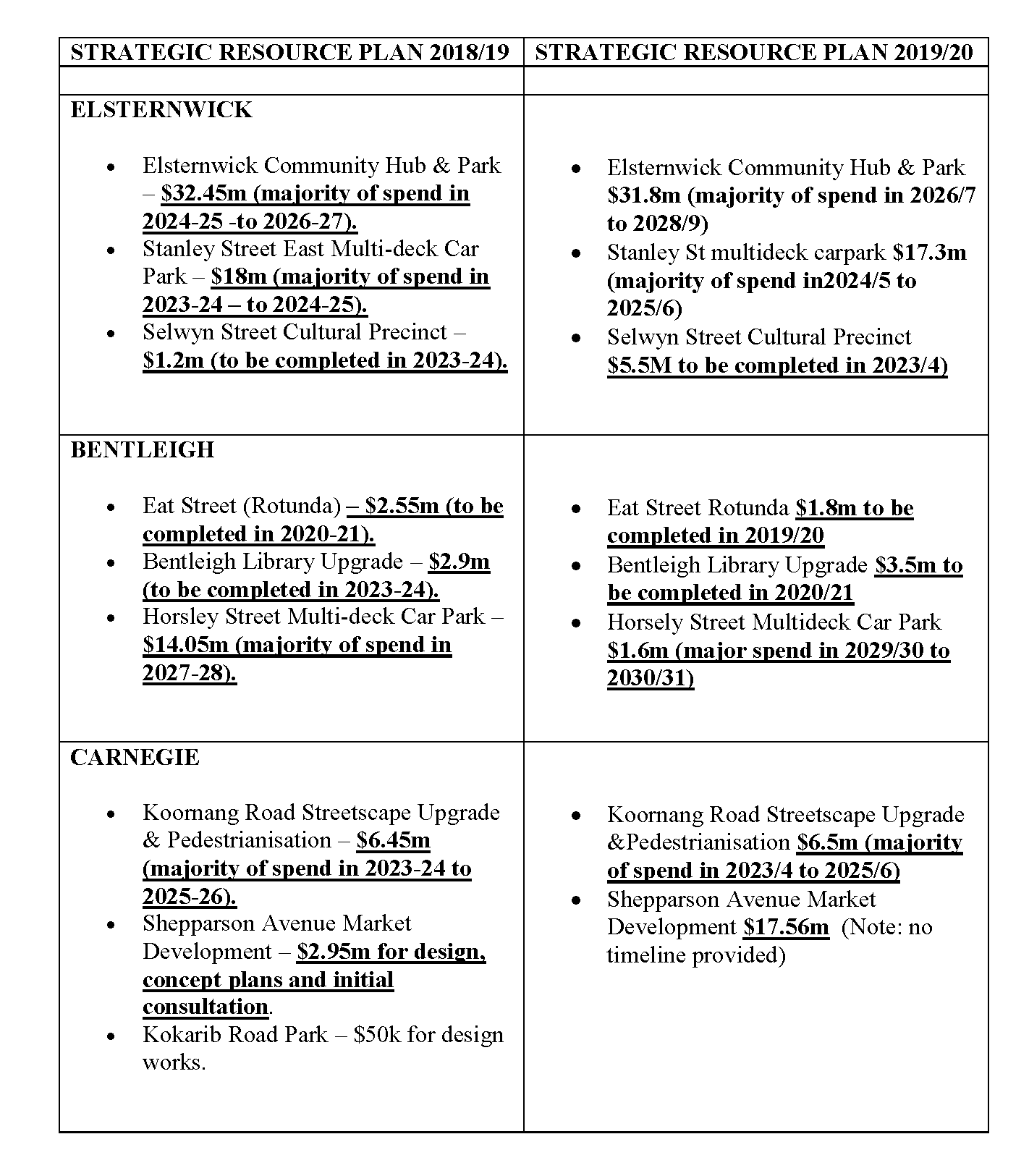
For ease of comparison, we present below a table that outlines the stated expenditure for the Bentleigh, Carnegie and Elsternwick structure plans. Of concern is:

  • The massive increase in cost for some of the items
  • The massive delay for implementation of car parks (ie 3 years for Horsely)
  • Why Bentleigh appears to be favoured overall in time lines when compared to Carnegie and even Elsternwick

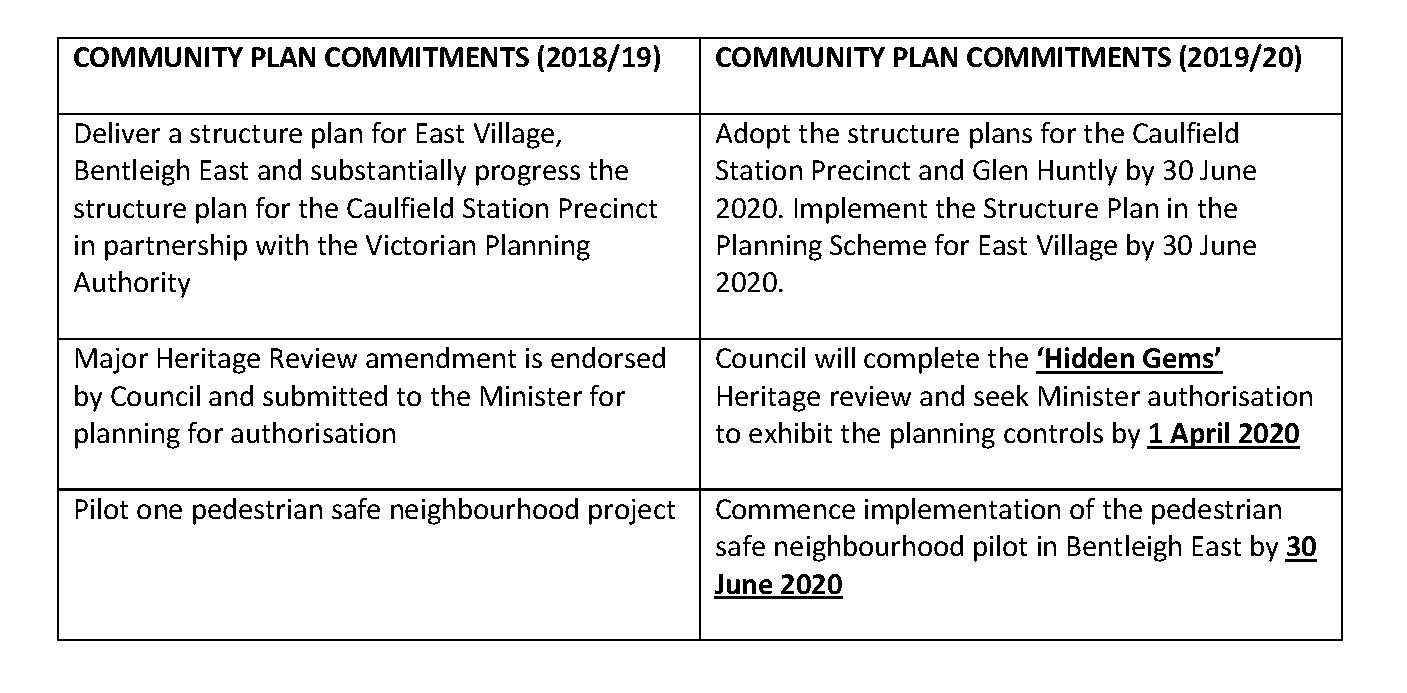
There are also changes to Council’s ‘commitments’ in the Community/Council Plan that should be noted. We now have new jargon such as ‘Hidden Gems’ to replace the Major Heritage Review. Again this is put back years as has the promised ‘safe pedestrian pilot’. Other changes also exist and we urge residents to peruse these items carefully.

What remains a constant in Glen Eira is increasing staff. We will now have 860.19 Equivalent Full Time (EFT) an increase of close to 40 EFT. Also worth asking is why we could not find any mention of the projected sale of our aged care facilities and what this means to the budget, loans, etc?

The Good

The significant tree register issue is on the move. Item 9.6 of the current agenda proposes to:

  • Implement a tree register for both public and private land
  • Residents will have the opportunity to nominate trees
  • Review or objection rights will be included
  • Specific criteria based on the National Trust’s ‘standards’ will be applied

And the ‘drawbacks’?

  • Potential fines are miniscule
  • Not part of the planning scheme but only constituted as a Local Law
  • No indication as to the potential number of trees making it onto the register?
  • No indication of appeal rights for those who nominated a tree and then refused by council
  • No indication as to whether an application to remove a tree on the register will be decided by a full council hearing or left in the hands of officers? (Note that Bayside, Stonnington, etc. require such applications to go to council)
  • No time lines for completion

Overall, this is something that residents have been advocating for since at least 2003. It does represent a positive move by council.

The Bad

Selwyn Street Closure

We now have another  version of the proposed Selwyn Street closure. Please note that Gordon street does not change.

Below is the latest tinkering. Clearly the overwhelming opposition to the previous drafts have caused council to rethink the issue.

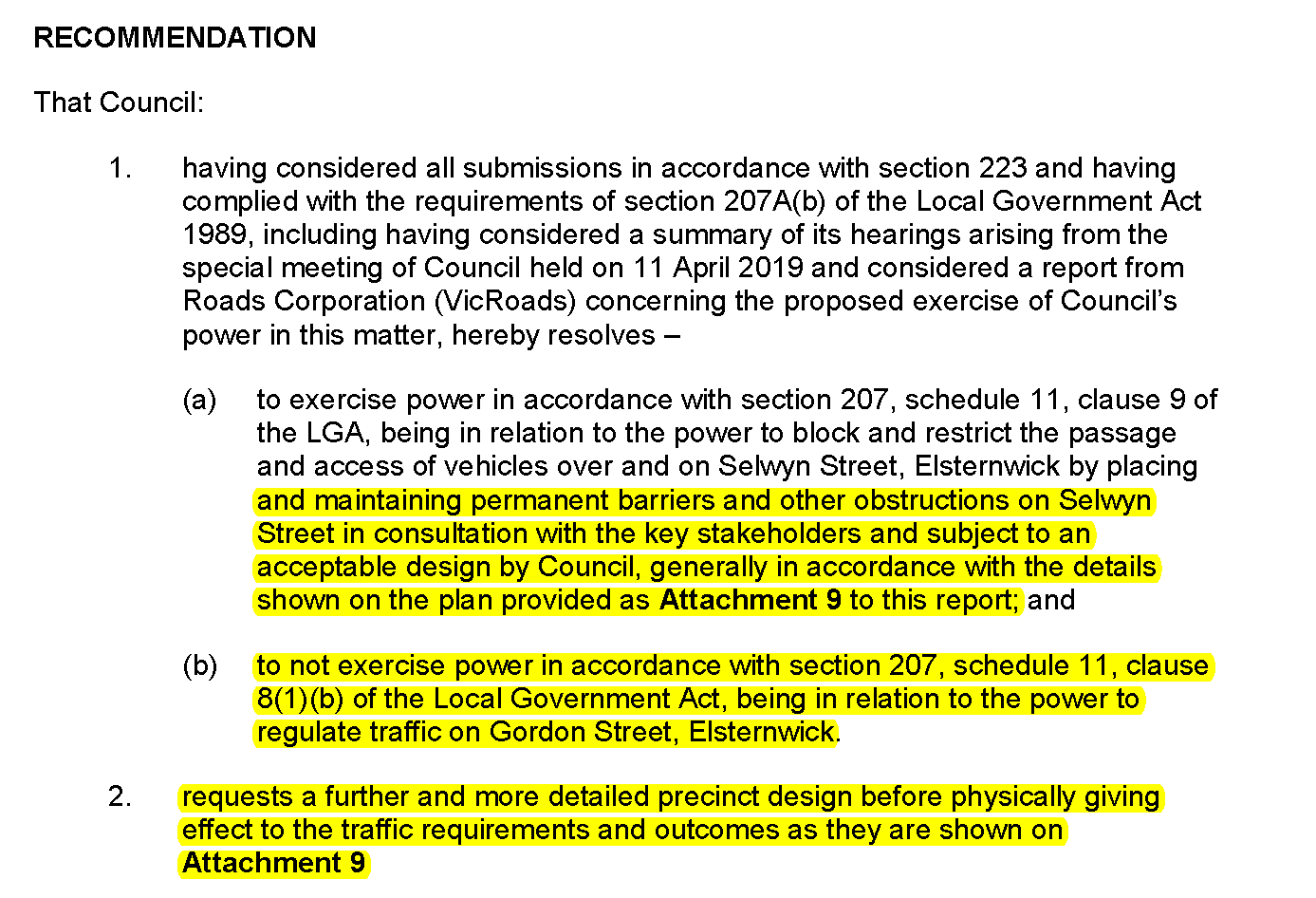
Here are the officer’s recommendations.

Please note the following:

  • Part 1(a) of the motion recommends that councilors approve the closure as ‘generally in accordance’ with the new design
  • Part 1(b) presents the option of not “exercise(ing) the power”, meaning do nothing and a refusal of the design.
  • Part 2 of the motion is the most fascinating. Another more ‘detailed’ report is to be made some time in the future but prior to closure of the street. If councilors vote for Part 1(a) does this mean that ‘detailed’ analysis will be conducted post closure of Selwyn Street?

The argument for acting now and doing the research later is lamentable in our view.  We’re told that closing Selwyn Street first is

essential to be undertaken prior to a full and detailed design process commencing, and before significant time and resources are spent on developing a design of the cultural precinct. It is crucial that the process to effect traffic changes precedes any further design work to ensure that the precinct design is being developed to an operational and functional framework that is able to be implemented, where the key parameters are known and have been decided by Council 

This is nothing but hogwash. Surely it is incumbent on council to ensure that whatever it does is in the best interests of the community and that this be based on sound technical and detailed analysis. Instead council’s approach to everything it seems has been to produce half baked ideas based on substandard plans that lack empirical justification and achieve nothing except to alienate most in the community. We have seen this time and time again with the Inkerman Road bike paths, playground upgrades, and street closures for so called ‘open space’.

Perhaps residents should start querying the capability of our designers, planners, traffic management people and ask how much each design and accompanying reiterations have cost in terms of production, staff time, consultants, etc? We have no doubt that any changes council produces is NOT the result of their technical know how, but simply the outcry from residents. It is a sad state of affairs when rates pay so much for so called ‘expertise’ and all we continue to get is second rate planning with no thought to curbing expenditure.

And talking of expenditure, we urge all readers to have a look at the budget and the Strategic Resource Plan. Page 5 of this document tells us that council is looking to spend $90 million on Bentleigh, Carnegie & Elsternwick over the next 10 years. Not a word about neighbourhood centres or structure plans for these areas!

We will comment on the budget and the SRP in our next post.


Tonight’s speakers on the Selwyn Street/Gordon Street closures had one thing in common. Each and every speaker was strongly opposed to council’s plans. What came through clearly was:

  • Council’s failure to consult with the major stakeholders, including some of the Jewish organizations.
  • No real consideration for businesses in the area and the imperative to provide loading zones
  • How the neighbouring streets would cope with increased traffic
  • How a reduction in parking spots will only exacerbate the already limited parking
  • The failure to provide decent traffic analysis of wider area prior to deciding on the current design

Questions remain as to what will now happen. For example: councilors can accept the current plan, reject it, or will we find that some modifications are made and this will be decided on at the April 30th Council meeting? If changes are made and a decision is also expected at the end of April, then does this mean that the community will not have the opportunity to comment on the changes?

This issue is another example of not only poor consultation, but poor planning. When will this council learn that they cannot produce half baked plans devoid of all essential data to justify their plans and expect residents to swallow this hook line and sinker. How much has this fiasco cost thus far? How much have the hired guns cost? Has any officer actually set foot in the area or has this design been done via a desktop analysis? And why can’t these councilors put a stop to this nonsense right now and order officers back to the drawing board and insist that proper consultation begin immediately with all those impacted?

We urge all readers to listen to what was said. It is illuminating and a harsh indictment of a council that has no idea of how to inform, consult, and listen to its residents.

Another Special Council Meeting is set down for this coming Thursday (6.30pm) in order to hear submissions on the proposed partial closures of Selwyn Street and the one way redirection of traffic in Gordon Street.

What we have here is another appalling example of council’s failure to adhere to its own resolutions, its abject failure to advance ideas based on comprehensive analysis of the wider area, and to provide the community with consultation information that is consistent, accurate and timely.

We acknowledge that these latest plans (an earlier version was first published) are probably an attempt to put a spanner in the works of the proposed Woolworths development. However this does not excuse a council that is reactive rather than proactive. We repeat some of our previous comments:

  • Why was Elsternwick left out of the interim amendments for Bentleigh & Carnegie in 2017 when it is also a MAJOR activity centre?
  • The ABC Woolworths site was purchased in March 2017 for $45m. Council knew what was about to happen! You don’t spend that amount of money and only go for a supermarket!
  • The idea for a Jewish Cultural Centre has long been on the cards. Being granted at least $1m by government mandates some decisive action! The problem with the ‘action’ is that it is ill conceived, poorly researched, and as always, bereft of empirical justification.
  • Where is corporate memory in all of this? One submission from the Holocaust Centre complains bitterly that council’s plans fly in the face of the permit conditions granted to the Centre less than a year ago.
  • Why can council resolutions disappear into the ether and not be enacted? For example, the council resolution of 27th November made specific reference to the following: that Council receive a further report on the draft detailed design prior to community consultation. This has not happened! Nor has the following been produced: a comprehensive traffic impact assessment and mitigation strategy based on the endorsed Precinct Plan. Most reasonable people would expect that a ‘comprehensive traffic impact assessment’ would include far more than Selwyn Street, Gordon St, and Glen Huntly Road. As many of the submissions point out, ramifications for St Georges, Glen Eira Roads, etc. are not even mentioned.

Of the submissions themselves, the overwhelming majority are opposed to the closures, especially in turning Gordon Street into one way. Even more telling is that many businesses oppose these designs and the Jewish organisations themselves aren’t happy.

What sway this opposition will have remains to be seen. Will councillors have the guts to order the planners and traffic management staff to go back to the drawing boards and start again? We doubt it! What is clear however is that council has a lot to learn in terms of its consultation practices, and the professionalism of its planning/traffic department.  It would appear that council first makes the decision then scrounges around for anything that would support the decision. The cost in terms of money, and community angst is never considered.

Permits for:

  • 68 Bevis Street, Bentleigh East. 3 storey, 22 dwellings
  • 554/556 Inkerman Road, Caulfield Noth. 3 and 4 storey, 24 dwellings

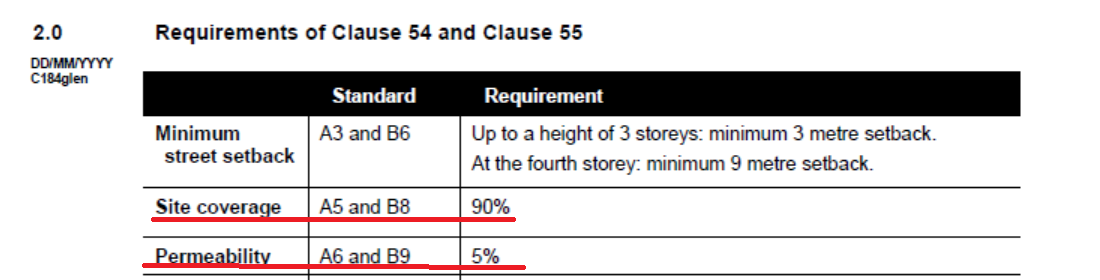
The Inkerman Road application is interesting since the site is zoned GRZ1 (ie supposedly 3 storeys and a 10.5 metre height limit). Since council’s schedules do not specify the number of storeys, and the land slopes, this application for a part 4 storey was deemed to be okay. We point out again that for all of council’s structure planning and quality design guidelines, the schedules largely remain intact. No changes to site coverage, permeability, etc.

Worthy of keeping a close eye on, is the following from the minutes of the Local Law committee. This could be ‘positive’ or ‘negative’ for residents.

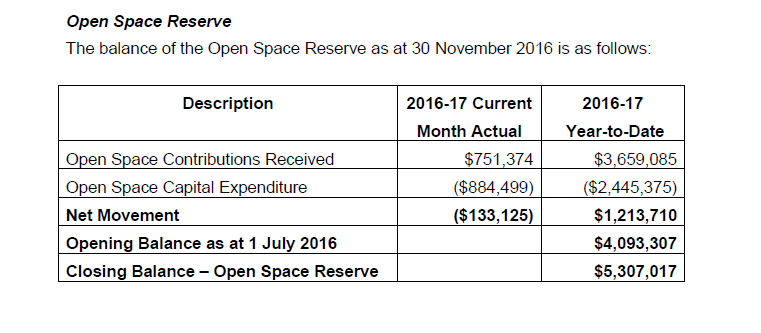
For quite a while now, council’s reporting of the open space reserve in the monthly financial report has opted to camouflage what is really happening. This can only be deliberate and is another example of the lack of transparency in Glen Eira. We are supposed to believe that the ‘kitty’ currently contains $20m. Yet, we are not privy to how much of this total has been spent on ‘development’/’upgrade’ of open space. Hence how much is really left in the open space reserve?

By way of contrast and transparency, we highlight how these figures were reported previously and ask why the change?

Finally, here is what we don’t know about the Open space levy:

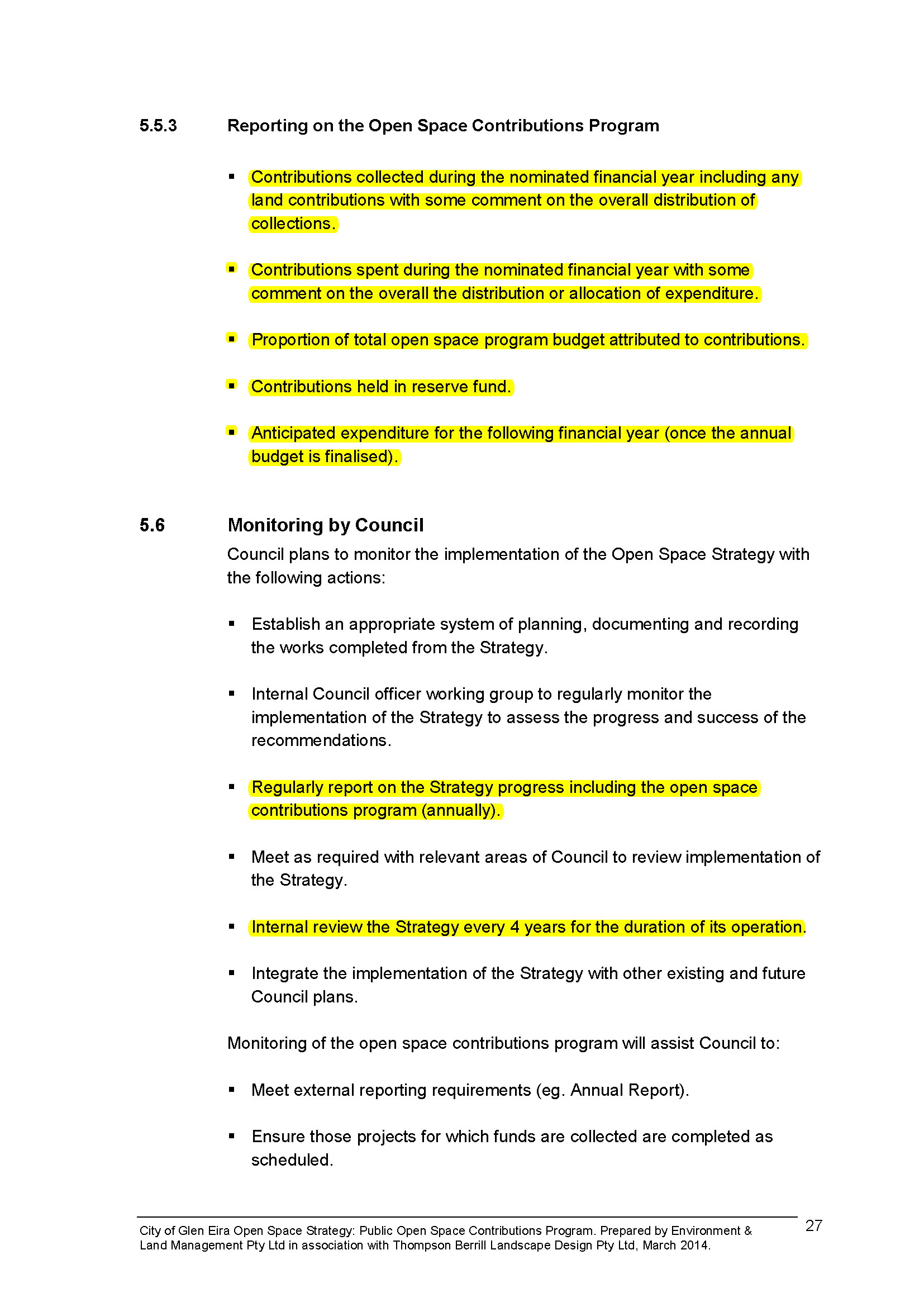
  • Has the levy been insisted upon for every application for 3 or more subdivisions? If not, why not? See one of our earlier posts https://gleneira.blog/2018/06/08/open-space-favours/
  • What percentage of the levy has been spent on the acquisition of new open space and what percentage has been spent on ‘development/upgrading’?
  • What ‘land contributions’ has council accepted instead of a financial payment and where are these located?
  • How much of the following ‘promises’ has council kept and why can’t this be disclosed to the public?

Tonight’s Special Council Meeting on the aged care sell off voted 5 to 3 (Esakoff absent) to proceed with the Expression of Interest process. Those supporting the sell off were: Hyams, Silver, Sztrajt, Cade, Athanasopolous. Delahunty, Davy and Magee voted against. Remarkably, Magee spoke for the process continuing, then voted against!

Several things should be noted and we urge all residents to carefully listen to the ‘debate’.

  • The con job was in full swing with Hyams, Silver, Athanasopolous, Sztrazjt, Cade and even Magee, now arguing that the resolution was NOT TO SELL, but merely to test the waters as it were, in order to see if there’s anyone out there who could provide a better service! Time and again the gallery was assured that if no such organization was found then there would be no sale. That old council shibboleth of ‘first step in the process’ was repeated ad nauseum.
  • Hyams merely summed up the officer’s report but without a single word on financials. He did however comment that council had undertaken a comprehensive ‘communication and consultation’ program via its advertising, letters to residents, media releases, etc.
  • The only councillor to even come close to addressing the lack of open and transparent consultation was Athanasopolous. His argument was that when Monash and Kingston decided to sell their facilities and engaged in an ‘open’ consultation process with their residents, that this lead to a ‘ton of anxiety’!!!!!!! How much ‘anxiety’ has council produced by its secrecy when residents and workers are notified by an impersonal email?
  • Athanasopolous also distinguished himself by arguing that for the past 15 years council had not in its budget processes made any financial provision for the long term management of its aged care facilities. Such a statement could be interpreted in several ways of course. Either council has never placed aged care high on its list of priorities or, it has failed in its duty to consider long term outcomes given that its strategic resource plan has a ten year time span. There is another possibility here too. Maybe, just maybe, if residents had a say on what should be the priorities for council budgets, aged care would have been high on their list?
  • Delahunty and Davey did argue that the potential findings of the current and ongoing Royal Commission were important and until council had the final recommendations how could they possibly know which provider would be the ‘best’? They advocated that the Expression of Interest process be delayed until the findings were made public . These are expected to be delivered in mid 2020. Hardly a long time to wait we suggest!

There was much said by the various councilors which was literally cringe worthy. If anyone truly believes that council is only ‘testing the waters’, then they have no idea of how this council operates. You do not go to the expense of lawyers, committees, probity auditors, valuations, etc. unless you know damn well you will sell. All the rest is sheer garbage designed to cover their arses for the lack of proper consultation. For example: the gallery were informed that several of the facilities required major physical upgrades. So? Perhaps the community should be asked whether or not they believe that a certain amount should be spent in order to maintain these facilities? When millions are spent on playground upgrades that the majority don’t want, or concrete plinths in parks that amount to hundreds of thousands of dollars over the years, then questions as to waste, incompetence, and priorities, deserve an airing!

Please listen to the statements once they come up on council’s website.

Council has published the agenda for next Tuesday night’s Special Council Meeting. The recommendation is to ‘sell’ by proceeding with the Expression of Interest process. What a surprise!

Issues invoked by the submissions are ostensibly ‘answered’. For example:

  • On the lack of community consultation, we are told: Officers have set out in this report the communication and consultation process conducted which included extensive advertising and opportunities to discuss the sale issues. The process undertaken also meets the statutory requirements for the sale of Land as outlined in the Local Government Act. Thus, no explanation, no apology, no justification as to why community consultation was not undertaken prior to any decision!
  • On whether the new owner will provide the same quality of care, we are told: Officers note in this report some of the constraints that are likely to impact on the future provision of quality care in Glen Eira’s aged care service. Officers are aware of many other aged care providers that provide quality at an equivalent or higher level than Council’s current service. Council’s commitment is that Council will only sell to a quality aged care provider that has a proven ability to provide quality aged care with high employee and resident satisfaction levels. In short, a regurgitation of previous generalities.
  • On the impact on current aged care residents, we are told: Officers are mindful of the potential impact on residents during this process. Council has committed to keep all 173 beds within the municipality and any new provider will be required to uphold the current residency agreement. Impact on residents can in part be mitigated by a strong transition process and the selection of a quality provider. In addition the option for staff to remain with the new provider may also assist in ensuring continuity of care. We note the lack of ‘guarantee’ on future staffing, nor how many current staff will be employed by the new owner. Also not a word about any new residency agreements.
  • On potential Royal Commission findings, we are told: Officers consider that while it is likely that the Royal Commission will publically identify poor performers, the quality of a rigorous assessment processes will ultimately provide Council with sufficient information to make a sound selection decision. Literally an incredible statement given that council has no idea what the findings will be and how these findings may impact on all providers!
  • On loss of community amenity and ownership, we are told: Officers are aware of the range of community views in regard to Public or Private ownership of many services. Officers note, however, that many submitters assume that Council will sell to a ‘for profit’ provider, however, many aged care providers are not for profit providers. The assessment panel will assess each provider against a comprehensive set of assessment criteria and choose the provider that most closely meets the criteria.The problem with this answer is that one single not for profit provider will not be able to afford to purchase all three facilities. That means that at least one, if not two, and probably all three, will go to those private FOR PROFIT businesses!
  • On including a ‘resident representative’ on the sale process, we are told: Officers have discussed with legal and probity advisors the potential of having a family or resident involved in the process or on the evaluation panel. Advice provided is that this will give rise to probity and conflict of interest concerns. This says it all, despite the possibility of including resident ‘expertise’ prior to the finalisation of the detailed assessment criteria. In other words, no resident in on selection and worse still, no ‘detailed assessment criteria’ still exists. If this isn’t putting the cart before the horse, we don’t know what is!

Following this attempted response/rebuttal to issues raised in the various submissions we get a long diatribe on current conditions in aged care. We are informed that:

  • Aged care will become increasingly more ‘complex’
  • There will be increased ‘scrutiny and regulation’ so only larger and ‘highly specialised’ carers can cope mainly because they have ‘economies of scale’.
  • Another ‘reason’ why council can’t continue is that they don’t have an aged care board or specialist aged care finance staff to assist in management and governance arrangements. Perhaps council could answer how an ‘aged care finance staff’ is different to the systems and financial oversight that currently runs open space levies for example? In addition council has risk management policies, fraud policies, etc.etc. How have they managed for 40 years? Besides, maybe if council wasn’t so top heavy with ‘directors’ and the public relations staff, then more staff could be hired in those areas that residents consider vital?

Basically we’re told that council doesn’t have this and doesn’t have that. Plus extraordinary claims are made for existing ‘specialist’ private providers such as: Many areas of research in palliative care including conducting translational research projects to embed evidence into practice, including the development of sophisticated pain guidelines, anxiety and depression pathways and advanced care planning. Of course not one such provider is mentioned and neither is the fact that dementia care research is, to the best of our knowledge, not the current or primary function of our three facilities.

Nor do the financial stats provided tell even half the story. It is significant that this section of the report is a bare 2 sentences and the figure of a $1.88 million loss in 2017/18 is only the tip of the iceberg, since this figure EXCLUDES on costs such as corporate overheads. Nor does it tally with the Annual Report where a loss of $3.1 million was cited. Our belief remains that the sell off is nothing more than a cash grab.

If as certain councillors have argued, no decision has as yet been made, then why have legal and commercial firms already been appointed?

Finally, the listed criteria is a hodge podge of jargon and generalities. Residents still do not have a clue as to what these conditions will be, nor in fact, the real reasons behind the decision to sell.

In the end we still have no answers to the following:

  • What guarantee can council give that all staff who want to remain will be able to do so?
  • What guarantee can council give that in 5 or 10 years time these properties will not be turned into apartments?
  • Will the criteria and the tender offers be made public?
  • How much of the sale monies will go into general revenue and how much will actually be spent on the ‘disadvantaged’ in our society?
  • And the most crucial question: Why can’t the community decide whether or not it wants to subsidise aged care? When other councils now include resident juries in determining budget priorities, Glen Eira remains determined to exclude and ignore the community as much as possible.

We urge everyone to read this document since it encapsulates everything that is awry in Glen Eira. 

This isn’t the first time that the issue of overshadowing of residential properties, especially during the winter months, has come up. Council’s Planning Scheme Review of 2016 acknowledged that this was a major concern for residents and is only exacerbated with council’s decision to seek approval for 12 storey apartment blocks in both Carnegie and Elsternwick.

One public question from last week’s council meeting, returned to this question of what council intends to do to ensure that adequate controls are implemented. Below is the query and the response.

In the above council claims to have “proposed winter shadow controls” for public open spaces. Not a word about residential sites! One must also wonder exactly how the following may be interpreted as ‘controls’.The only mention of overshadowing in the Design & Development Overlays that relate specifically to the 3 activity centres are:

Buildings should minimise overshadowing impacts on existing and future open spaces, commercial footpath-trading areas and existing residential sites. 

AND in the decision guidelines we get this ‘criterion’.

The impact of overshadowing to the public realm.

None of the above are ‘controls’ in any shape or form. Nor do they even mention the winter solstice. The emphases remains firmly on public open space.

Even in the adopted structure plans there are not ‘controls’ mere motherhood statements such as:

Ensure overshadowing from new buildings and works does not result in significant loss of sunlight to future and existing public open spaces.

Ensuring adequate sunlight provision and minimising overshadowing of future plaza space.

Consideration of Council’s Open Space Strategy in the design and function of the new park, including minimising any overshadowing.

The Elsternwick Structure Plan sets out clear key design principles, including:

Σ minimise overshadowing to existing residential sites

ensure no overshadowing of residential areas between 9am and 3pm at the September Equinox,

Minimise overshadowing to existing residential sites

The form and scale of new development must be guided by minimising overshadowing impacts on existing residential sites. Development must satisfy the overshadowing objectives and standards of the Glen Eira Planning Scheme and may need to step down in scale towards residential sites in order to minimise overshadowing impacts

Principles have also been included in the new Carnegie Structure Plan that address concerns such as overlooking, overshadowing and traffic impacts on existing residential areas.

Protect the future open space at Egan and Woorayl Streets, in accordance with Council’s Open Space Strategy, with no overshadowing for a minimum of 5 hours at the September Equinox (9am to 2pm achieved) and 3 hours at Winter Solstice (11am to 2pm achieved).

Ensure no overshadowing of residential areas between 9am and 3pm at the September Equinox.

As can be seen from the above quotes, the only time that the winter solstice is specifically mentioned relates to Egan & Woorayl Streets in Carnegie, and even this does nothing to extend the hours. Further, given that this section of Carnegie is now geared towards highrise, then why oh why wasn’t the same consideration given to Elsternwick?

Telling residents to go off and advocate to the State Government does not abrogate these councillors’ responsibility to do everything they can to implement adequate controls. Given the history of this issue, council has not even been able to come up with official support for Melbourne City Council’s proposed amendment that would extend the winter solstice hours for planning applications. Overshadowing of public open space is important. But equally as important is to ensure that council is doing everything it possibly can to halt the plunging into darkness of those residents who find themselves within the shadow range of 12 storey apartment blocks. This, council has steadfastly refused to do and the reason is obvious. If planning applications have to adhere to winter solstice controls then that means that permits for 12 storeys would be jeopardised and would undermine council’s prodevelopment agenda. Worthy of note is that even the commisioned Peer Review of the Urban Design Guidelines had this to say:

Mid-winter overshadowing controls limit development envelopes to the north of spaces severely with the need for setbacks that are equal to approximately 2.5 times the overall height of the building.
As an example this would require a 12 storey built form to be setback over 90 metres from the northern edge of a public open space.

Overshadowing impacts to Woorayl Street Park would likely to substantially decrease the
overall height and development yield of sites between Woorayl Street and Arawatta Street
(to 5-6 storeys) if June 22 shadows are adopted in Guidelines, while September 22
shadows are more easily reconciled with the maximum height (with community benefits) as
shown in Figure 20. This model has assumed an adoption of September 22 shadow.

« Previous PageNext Page »