GE Council Meeting(s)


Residents need to take careful note of what happens tomorrow night, especially what councillors say and how they vote on the so called Planning Scheme Review. If this is passed as it stands, then it is a clear message that councillors are not the community’s real representatives. They have to be gone in October!

The euphemistically entitled Planning Scheme Review, is anything but a professional and comprehensive review. It continues the tradition of pro-development, anti-community, and the ‘ let’s do nothing’ mentality that has so bedevilled this council since its inception.

Here are our reasons why this document is not worth the paper it is written on:

  • Does not meet the legal requirements associated with planning scheme reviews (ie the relevant Practice Notes and the ‘continuous improvement kit’.
  • Does not present full and comprehensive figures (ie very selective editing)
  • A work plan that is literally ludicrous and designed to only delay and then delay some more
  • The absence of any data in this review which assesses the actual performance of the planning scheme.

Questions that should be answered of councillors:

  1. Why is it that practically everything is lumped together under the umbrella of a ‘structure plan’? Plenty of actions can be taken without the need for a structure plan! Parking overlays can achieve the same result. Council had no trouble with Amendment C99 that introduced another student parking overlay to assist the Caulfield Village! No structure plan was needed here!
  2. Why is it that the issue of basement car parking is lumped under the ridiculous category of Water Sensitive Urban Design? Again, a simple amendment to increase basement car park site coverage can be done immediately via a change to the schedules – ie. Stonnington for both its Residential Growth Zones and General Residential Zones has this Basements should not exceed 75% of the site area.
  3. Why is it that the zones themselves do not rate a mention when this has been the constant cry from residents? Why is nearly half of Ormond zoned as GRZ1 – telling developers they can put in 3 storeys to their hearts’ content? Why aren’t the zones themselves a priority for ‘review’ – especially since Glen Eira has quadrupled its population and housing targets? This of course is not mentioned anywhere!
  4. Why does the section on Local Policy simply state ‘develop new policies where gaps are identified’ and the time span is given as 2 to 3 years? Any decent ‘review’ should already have identified all the gaps!
  5. Why is there no mention of Mixed Use Zoning, or Local Centres, where there are no height limits? Will council only look at Activity Centres and nothing else? Why isn’t this spelt out fully?

There is plenty more that could be said about this effort. We will desist and simply urge all concerned residents to write to the Minister and local politicians and demand that this Planning Scheme review be consigned to the rubbish bin and that Minister Wynne intervene directly and bring in interim measures. If council is incapable or unwilling to do its job properly, then the State Government needs to know and to act now. Glen Eira simply cannot afford another 3 to 4 years of doing nothing!

All Planning Scheme Reviews are basically an audit of how well councils are performing in land management and how efficient their various departments are. The objective is ‘continuous improvement’ backed up by statistical analysis of progress. The Glen Eira review does not meet these requirements. Not only does this review lack real data, but like everything else council produces it is full of misleading and untrue statements.

The best way of illustrating this is to compare the December 2015 Bayside Planning Scheme Review with what is before us from Glen Eira. Councils are required to report on ‘progress’ made from their last review – such as: how many of the proposed actions have been carried out? Bayside reveals the following:

Pages from 23_June_2015_Draft_Bayside_Planning_Scheme_Review_Report_Item_10.8In contrast, here is the Glen Eira version of ‘reality’ –

Pages from Agenda-Tuesday-9-August-2016Pages from Agenda-Tuesday-9-August-2016-2

COMMENT

The difference between the two councils is staggering. In Glen Eira there is no overall data presented and the statements are false. Two examples should suffice:

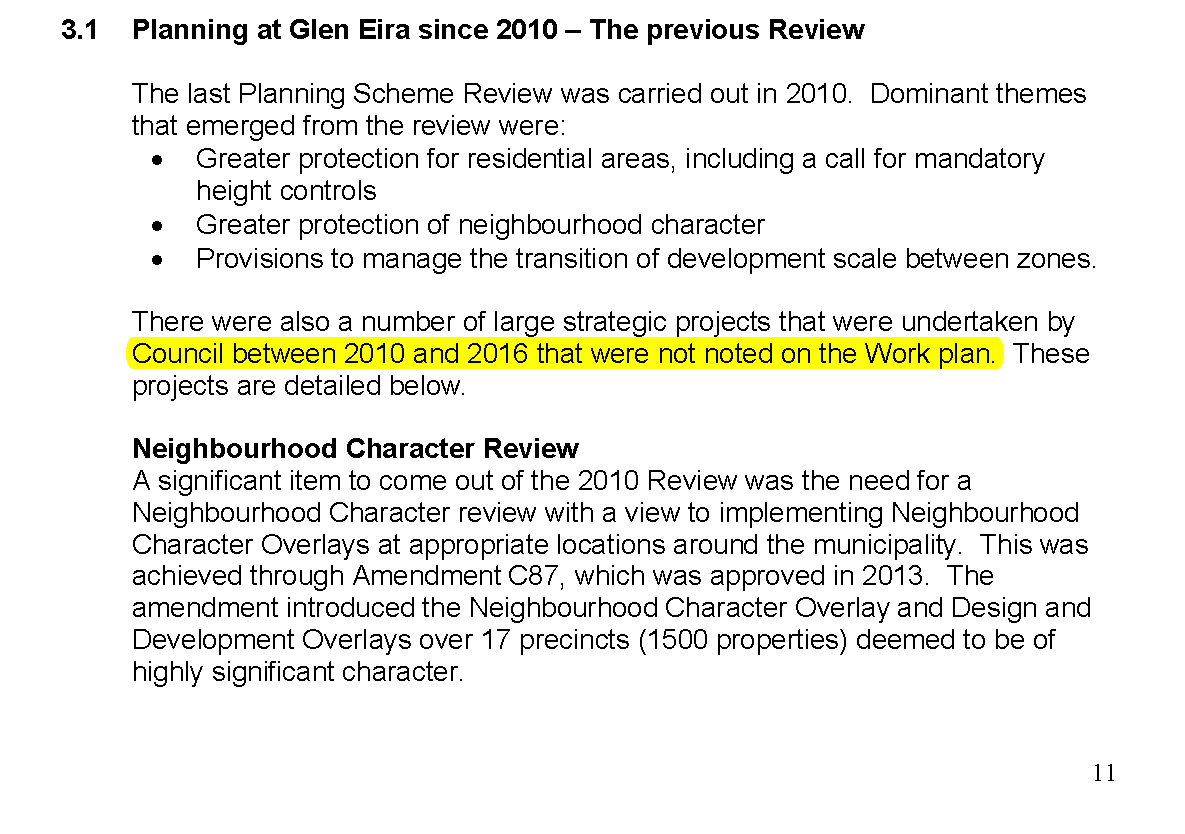
  1. When council writes that “There were also a number of large strategic projects that were undertaken by Council between 2010 and 2016 that were not noted on the Work plan. These projects are detailed below”. Council then list the Neighbourhood Character Review as part of this ‘non-workplan’. Yet the minutes of 10th August 2010 contain the resolution that Council “ Complete review of Significant Character Areas as prelude to the introduction of a Neighbourhood Character Overlay”.
  1. Council continues with another furphy on the Municipal Strategic Statement claiming that – “Council commenced a review of the MSS but paused it in anticipation of the release of the State Government review into the Planning Policy Framework. Council’s review was commenced in 2013. Since no outcomes or further direction has been provided by the State Government on its Planning Policy Framework project, it is now imperative that Council completes a full review of the MSS. The latest ABS statistics on population and housing will contribute to this review, together with the latest Glen Eira Community Plan.” An extraordinary excuse for doing nothing, especially when the State Government recommends ‘annual reviews’ of the MSS and the minutes of 2010 (that is 3 years before council decided to get started on any review) contained the resolution that  council Prepare a new streamlined MSS for Council consideration and commence the amendment process.
  1. To repeat what we’ve previously stated – countless other objectives from 2010 have failed to materialise (ie parking precinct plans; tree/vegetation protection; review of Activity Centres, etc. etc.) Why aren’t these listed? Why can’t council provide an honest and comprehensive account instead of its continual spin, obfuscation, and to be blunt – lies via the crime of ‘sins of omission’!

As expected, the long awaited Planning Scheme Review, will NOT BE REVIEWING THE RESIDENTIAL ZONES as demanded by so many residents! Nor does the proposed work plan fill us with confidence that the municipality overall will greatly benefit from what is mooted – especially when suggested time frames go out to 4 years down the track. In this first of our posts we simply summarise sections of the suggested work plan and the  stated time for completion.

Structure Plans – Complete first 3 within 4 years. Ongoing, continue with structure plans each taking 1-2 years to complete. (Comment – given that there are 10 Neighbourhood centres – that is a time frame of between 10-20 years!)

Neighbourhood Character Policy – 2 to 3 years.

Heritage Internal Review – 3 to 12 months

Heritage Major Review – 2 to 3 years

Municipal Strategic Statement – 1 to 2 years

Local Planning Policy Review – 2 to 3 years

Development contributions levy – 2 years

Parking Provisions – 3 to 4 years

Open Space – 2 to 3 years

Sustainability Policy – 2 to 3 years

Water Sensitive Urban Design – 2 to 3 years

Transition between zones – 2 to 3 years

Special Building Overlay – 2 to 3 years

Tree Protection Policy – 2-3 years

COMMENT

We acknowledge that due to council’s failure to act on planning issues for the past decade, there is now a huge backlog of work that is required.  Having said that, residents should not be prepared to sit back and wait for another 2 to 3 years for changes to eventuate. The Minister’s directive to start work came in December 2015. Exactly what has council done in the past 8 months? How much money has been set aside in the budget to hire consultants to undertake the necessary work? How much of the upcoming work will remain ‘internal’ and secret – such as this statement from page 106 – Glen Eira has completed its review of the new residential zones. Though some community feedback is calling for Council to review the residential zone boundaries, particularly at ‘transition areas’ where two different residential zones meet, it is prudent to wait for the State Government to release its findings before any decision is made about reviewing our own locations.

And if council is so overwhelmed with the task ahead, then there is always the alternative of pinching what other councils have already successfully introduced into their planning schemes. Tree protection is the perfect example. Why this should take 2 to 3 years is laughable and says much about the underlying intentions of this council and its inept planners and councillors.

The minutes of the July 19th council meeting deserve close attention. We have focused on the Public Questions fiasco as well as Requests for a Report

Public Questions

“In light of ratepayers’ concerns regarding Skyrail and lack of transparency to date ,and Council’s unanimous motion seeking information from the State Government,how can Council justify charging exhorbitant fees in relation to FOI’d information?”

The Mayor read Council’s response. He said:

The Freedom of Information Act 1982 (Vic) provides the public with a right to access documents in the possession of agencies such as Council, subject to the exemptions in Part IV of the Act and subject to the payment of charges which are required to be paid by the applicant before access is granted in accordance with the Freedom of Information (Access Charges) Regulations 2014 (‘Regulations’). When processing requests under the Act, Council is bound by the requirements set out in the Act. Regulation 6 provides that an applicant who has made a request in accordance with section 17 of the Act is liable to pay charges set out in or calculated in accordance with the Schedule to the Regulations.

The Schedule to the Regulations sets out ten items together with the respective charges which agencies are required to charge applicants for particular services as part of processing their requests. These include the reasonable costs incurred by the agency in providing copies of documents. This is calculated by multiplying the relevant officer’s hourly salary by the hours spent in producing the relevant documents.

Council receives many requests under the Act every year and has limited resources available to process these requests. Requests made under the Act can be broad and require many hours of officers’ time to process. This can put a substantial burden on Council’s resources and cost ratepayers thousands of dollars. It also impacts on the provision of other services which Council provides to the community. It is therefore Council’s responsibility to accurately calculate and impose the charges payable under the Regulations for requests made under the Act to ensure that ratepayers are not disadvantaged by the processing of such requests, some of which can be significant in terms of officers’ time.

In most cases, charges calculated by Council under the Regulations are lower than the true cost incurred by Council in processing requests under the Act.”

COMMENT

There is much to quibble with in the above. We have uploaded the ‘regulations’ (here) so that readers may see for themselves what they state and the charges they include. For starters:

We do love the following questions and the ‘responses’ –

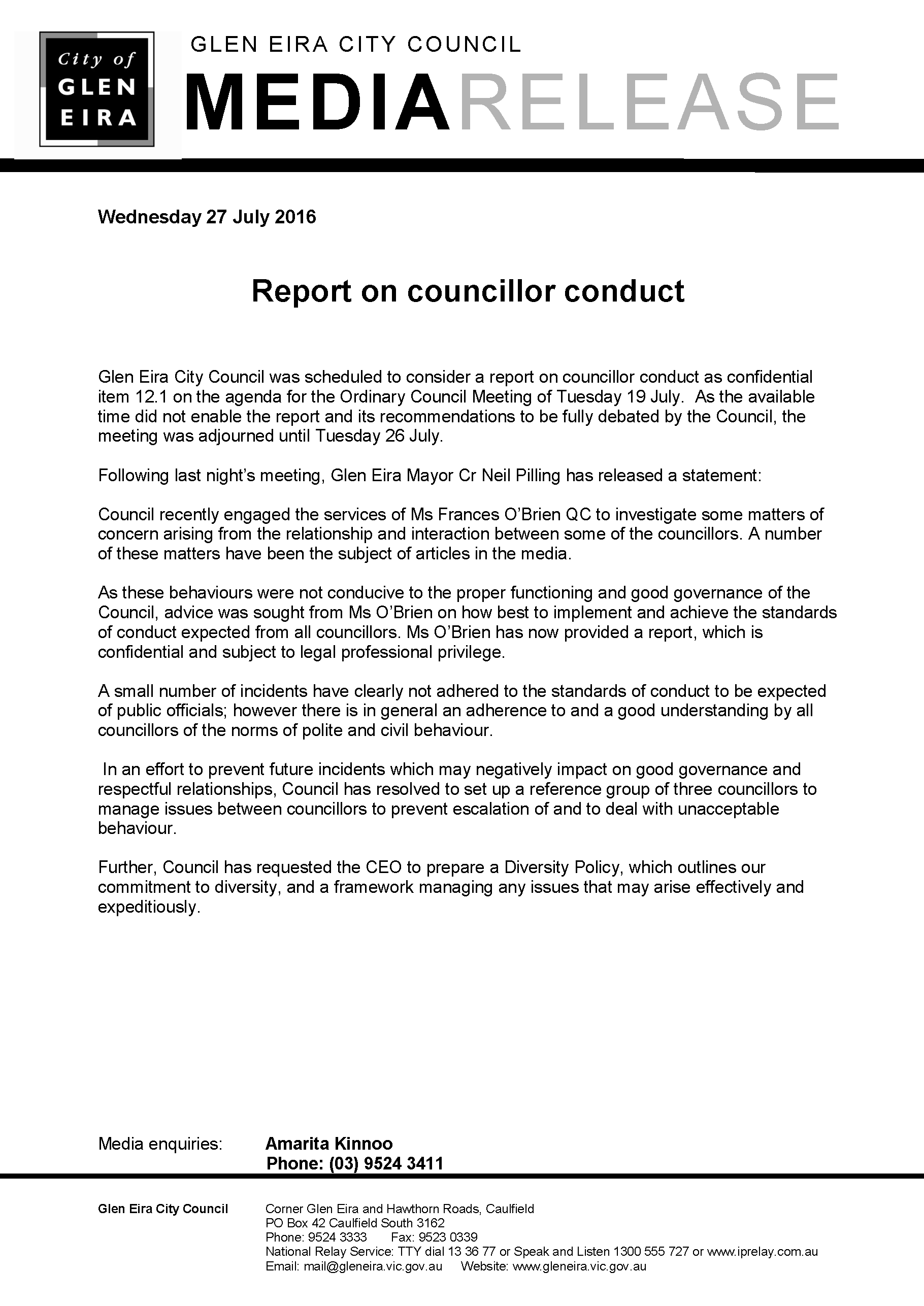
“Given council have spent in excess of $40k isn’t it time for the likes of councillor Hyams and Magee to stop with this childish behaviour towards Councillor Lobo and get on with the job of running the council not on public attacks within the council. I also believe we the rate payers are entitled to see what the QC thought in her report to council- this is public property not confidential; we paid (the rate payers) so we are entitled to be part of the evaluation process. A closed door mentality smacks of a boys club which is far from good corporate governance. The state government needs to watch this council closely.”

The Mayor read Council’s response. He said:

The Transport Planning department undertook observations of the parking demands prior to the restrictions being introduced in Phillip Street, Bentleigh. At that time, high,long term parking demands where being experienced along both sides of the street from Patterson Road to approximately No. 16 Philip Street. After the restrictions were introduced, the long term parking demands on the western side (i.e. the restricted side) of the street reduced considerably. The Metro Train Network Map (available on the PTV website) confirms that Patterson Station is located within Zone 2, as previously stated. However, since January 2015 commuters travelling across Zone 1 and 2 are only charged a Zone 1 fare (rather than both a Zone 1 fare and Zone 2 fare).

It is suggested by Mr Searle that the 2-hour parking at the off-street car park be converted to all day parking. It is considered that there currently exists an appropriate balance between the various car parking demands in the area. Converting short term, shopping centre customer parking to long term, commuter parking within the off-street car park could have a negative impact on the ability for shopping centre customers to find convenient car parking.

Council Policy Exclusion of Specific Developments from the Residential Parking Permit Scheme was adopted on 26 May 2013. After this date, new developments in local shopping centres have been excluded from the residential parking permit scheme. The list of properties excluded from obtaining residential parking permits within the municipality is available on Council’s website.

Council has received 17 enquires from residents of the Caulfield streets where parking changes were recently made. Residents of these streets have been advised that the new conditions will be reviewed in February 2017. However, ongoing feedback from residents will be sought to inform the review. Council has also this evening received a petition signed by 63 Caulfield residents. Finally, under Item 9.5 this evening Council resolved to review our Parking Restrictions Policy and review parking in Growth Zones, General Residential Zones and Neighbourhood Residential Zones.

++++++++++++

“Now the QC’s investigation is over and the report is in on councillors behaviour when will this be made available to the public and if not why not?”

The Mayor read Council’s response. He said:

Council will consider the report under Item 12.1 Confidential Business this evening. At that time Council will resolve what, if any, further action will be taken, and whether the report will be released publicly.”

+++++++++++

“Council will consider the report under Item 12.1 Confidential Business this evening. At that time Council will resolve what, if any, further action will be taken, and whether the report will be released publicly.”

The Mayor read Council’s response. He said:

“The only transcript of the meeting is the official minute which you will be able to access at the following link : http://www.gleneira.vic.gov.au/Council/Meetings-and-agendas/Council-meetingminutes?dlv_OC%20CL%20Public%20Meetings=(pageindex=2)

+++++++++++++++++++

The best ‘response’ however is –

Given council have spent in excess of $40k isn’t it time for the likes of councillor Hyams and Magee to stop with this childish behaviour towards Councillor Lobo and get on with the job of running the council not on public attacks within the council. I also believe we the rate payers are entitled to see what the QC thought in her report to council- this is public property not confidential; we paid (the rate payers) so we are entitled to be part of the evaluation process. A closed door mentality smacks of a boys club which is far from good corporate governance. The state government needs to watch this council closely.”

The Mayor read Council’s response. He said:

“Council welcomes your comments, however as they are not a Question, they do not satisfy the provisions under point 232 (Public Questions) of the Glen Eira City Council Local Law. If you would like to rephrase your comments as a Question and resubmit them we would be happy to consider them at a future meeting of the Council and respond accordingly.”

Request(s) for a Report

Crs Hyams/Magee

That Officers prepare a report into the potential for Council to collaborate with schools in Glen Eira to utilise their open space and grounds for use by sporting clubs and the wider community.

The MOTION was put and CARRIED unanimously.

This request for a report sounds very similar to another request dating back to 2008. The eventual Newton report, tabled months later, recommended the ‘revolutionary’ tactic of writing a letter to all schools and the Education Department. Of course, nothing positive eventuated from this rather lame attempt. Newton’s report was more of the same – schools are not our responsibility but the Government’s, etc. Thus, instead of offering schools real incentives (such as payment), the idea lapsed. And so typical of this council – no corporate memory, no real follow up, and no results over 8 years. Politically though, it sounds mighty fine to regurgitate something that was first mooted 8 years ago and then sank into oblivion.

Here is what the record states from 2008 –

Crs Esakoff/Whiteside

That a report be prepared into any opportunities that may exist for Council in the provision of additional/improved areas of open space that could be used for both passive and active recreation within Glen Eira’s existing school network.

The MOTION was put and CARRIED unanimously. (minutes of 26th February 2008)

Report by Newton tabled 20th May 2008. Council resolution read –Crs Esakoff/Spaulding

That Council write to all primary and secondary schools in Glen Eira along the lines of Attachment A and send a copy to the Victoria Department of Education

The MOTION was put and CARRIED unanimously

Of far more significance is the following request –

Crs Delahunty/Magee

That a report be prepared showing the expenses and expected revenue of the Wellness Centre at GESAC and that the report also show options for a social venture element and potential community or business partnerships that can be explored to deliver a social outcome

The MOTION was put and CARRIED unanimously.

Readers will remember that this issue was part of the budget ‘debate’ and was ultimately carried in the face of strong opposition from Delahunty, Sounness and Lobo. We make no comment on the Wellness Centre per se. What concerns us is the politics involved and the apparent lack of due diligence when councillors vote for something and the abysmal lack of information that is presented to both councillors and the public.

When tens or hundreds of thousands of dollars are earmarked for what some may see as ‘dubious’ ventures, then surely the rationale (including facts, figures, projections) should be automatically provided and disseminated. The reasoning behind the expenditure of public money should never be an ‘afterthought’ seeking political vindication or a cheap point scoring exercise.

THE SHIRE’s chief executive, mayor and governance manager have been questioned over transparency issues and council decisions made behind closed doors.

The revelation that the Victorian Ombudsman’s Office recently interviewed CEO Carl Cowie, mayor Graham Pittock, and governance manager Joe Spiteri came at last week’s council meeting after a member of the public gallery, Suzanne Kepert, asked what was discussed at the recent visit.

“Were questions raised about matters not being properly discussed in open council meetings, and councillors’ use of, or overspending of, allowances, or are matters raised in the Ombudsman’s visit another secret to be kept from ratepayers?” Ms Kepert asked.

Mr Cowie replied that the visit was “around transparency in local government and the decisions made ‘in camera’ versus those in the open public meetings”.

“Mornington Peninsula Shire is around 10 to 15 per cent in camera compared to some other large municipalities which are up to over 35 per cent in camera, so we can draw some comfort we are as transparent as possible and aim to do better than that in the future,” Mr Cowie said.

Governance manager Joe Spiteri said the discussion was not specific to the shire.

“The Ombudsman was simply looking at best practice in processes rather than anything to do with councillor expenditure.”

The Victorian Ombudsman takes complaints about actions, decisions or conduct of staff at government authorities, including local councils.

The Ombudsman, Deborah Glass, is able to investigate actions by councils such as planning permits, advertising and zoning, contracts, building, enforcement of parking, building or planning regulations, rate and service charges, and road building.

In March, the Ombudsman — who said that secrecy in government could fuel suspicions and mistrust — began investigating the transparency of local government decisions after a pattern of complaints.

Shire spokesman Mark Kestigian said the Ombudsman’s report would seek to find out more about issues including how often council and special meetings were closed, processes regarding confidential matters, the handling of delegations, and the quality and availability of record keeping.

Mr Kestigian said the shire was one of many councils interviewed.

The Ombudsman declined to comment on the visit.

Source – http://www.heraldsun.com.au/leader/south-east/ombusdaman-discusses-transparency-with-mornington-council/news-story/562ffdfd32d6719d3dbf75efd6f95ef0

COMMENT

The Ombudsman is currently investigating ‘transparency’ in decision making by local councils. Glen Eira should and must be one of those investigated given recent events and the lack of accountable governance that has gone on for years in this municipality. The ratio of agenda items discussed in open chamber and those hidden away under ‘confidential’ is unacceptable. Worse still, is that a quarter of decisions made behind closed doors are never revealed! This is an abysmal record.

Here is the data which we have collated on council decision making from 2014 onwards.

in camera


Pages from GECC-Report-on-councillor-conduct

A petition was tabled with 63 signatures on ‘parking in Caulfield’. The petitioners stated that they didn’t ‘want 2 hour parking on one side of the street’ only and that council ‘reverse’ this decision because it ‘was done without hearing first’ what residents wanted. They asked council to introduce 2 hour parking on both sides of the street. They listed quite a few streets where this should happen.

Delahunty moved motion to ‘note and accept petition’ plus that officers ‘provide an update on preliminary and final findings’.  Lipshutz seconded.

DELAHUNTY:  acknowledged that there’s been an increase in parking issues and ‘that no area is safe’ from this. Thought it right that council is petitioned, but that it comes in the middle of a process ‘that we’re undertaking to gather some more thoughts’ and that the public will be ‘updated’ when the process is ‘done’.

LIPSHUTZ: claimed that because of the parking policy at Caulfield Hospital that what is happening is that ‘the nurses who are employed by the hospital are now parking in these streets’. But if there was 2 hour parking on both sides of the street ‘all that would happen is that the parking would shift’ to other local streets. Thus what ‘has to happen is a concerted approach and a total review of parking in the area’. That’s happening through ‘the review’.

TORRES: said that council is ‘reviewing broad areas’ and that ‘car parking can’t be looked at on a street by street basis’ and that restrictions in one street ‘has the potential to displace parking’ in another street’ so the issue has to be seen in a ‘broader area’.  Also said that ‘we are going to consult with the residents in this area after one month’ in order to ‘obtain preliminary feedback and findings on the effect of the changes’.  After the ‘prelimary findings’ council would ‘continue to receive feedback and engagement’ with residents and then they will have a ‘far more comprehensive review to report’ at the end of February.

LIPSHUTZ: he supports council in reviewing ‘overall parking’. ‘There is a problem, there’s no doubt there is a problem’ for people living on the south side of Glen Eira Road and people are now parking on the north side as well. Thus ‘there needs to be a concerted approach’ and that is ‘the right way to go’.

LOBO: said this is the second petition within 4 weeks – another one from Bentleigh. Agreed that cars might shift from street to street but residents pay their rates and council needs to start thinking about building ‘3 or 4 parking storeys’. Claimed that this ‘is a result of the developments taking place’ and that ‘infrastructure will not be enough if we are going at the rate we are going’. Wanted council to ‘get our wheels in motion’ to have ‘3 or 4 storey’ parking facilities in Bentleigh and Caulfield and ‘particularly 2 or 3 in Carnegie’.

DELAHUNTY: said that in the area of the petition there is the impact of ‘local employment’ and this is something they ‘want to encourage’. But ‘how do you do that in a hospital setting’ when you’ve also got shift workers. Claimed the ‘solution’ was to ‘listen to the residents’ and that the petition ‘forms part of the consultation’. Acknowledged that it is an ‘incredibly difficult’ issue.

MOTION PUT AND PASSED UNANIMOUSLY

COMMENTS

There is much here that is unacceptable in our view –

  1. Why weren’t residents consulted first before any action was implemented?
  2. On what statistical basis were these changes made? Why hasn’t the evidence been provided?
  3. Torres’ claim that council can’t look at parking ‘street by street’ is surely open to challenge. Moonee Valley Council seems quite capable of investigating its municipality street by street. Why can’t Glen Eira?

FYI – we urge all readers to consider the Moonee Valley approach in terms of direct community input, comprehensive community consultation, and real street by street evaluation. It is also worth taking a look at the links to the documents provided in this URL – http://mvcc.vic.gov.au/for-residents/parking-and-transport/current-transport-projects-and-studies/local-area-traffic-management-plans/buckley-park.aspx

For Residents

Buckley Park Local Area Traffic Management Study

We have been undertaking Local Area Traffic Management (LATM) studies in selected precincts within the municipality in order to manage vehicle movements, review parking restrictions and improve the residential environment.

In 2015/16, we are undertaking a LATM study of the Buckley Park precinct as part of this ongoing LATM program. The study area (pdf, 222KB) is bounded by Keilor Road, Lincoln Road, Buckley Street and Hoffmans Road in Essendon.

The study includes an extensive community consultation process to involve the local community in identifying traffic and parking issues and provide opportunities for community feedback on the developed traffic and parking proposals.

Working group

We have formed a working group comprising 10 community volunteers, Ward Councillors, Council officers and traffic engineering consultants.

The role of community volunteers is to provide local information, act as a contact for the local community and to provide feedback in the development of traffic and parking management plans for the area.

View the Terms of Reference for the working group.

Initial community questionnaire – traffic and parking issues

A questionnaire on traffic and parking issues in your local area was posted to properties in the study area in August 2015.

The closing date for questionnaire responses was Monday, 14 September 2015. Thank you to everyone who responded. The information you provided has helped to identify problem areas and assist us to develop draft traffic and parking management plans for the area.

Draft traffic management plan

A draft Traffic Management Plan (pdf, 1.1MB) setting out recommended solutions to traffic issues has been developed and circulated with a questionnaire to all properties and property owners in the study area for community comment.

The draft plan aims to address the key issues identified by the community in the initial questionnaire on traffic issues distributed to local properties in August 2015, as well as feedback from the Working Group.
The proposal has been considered on an area wide basis to minimise any adverse impacts on adjacent streets.

The objectives of the draft plan are to:

  • Reduce the incidence and potential for vehicle and pedestrian crashes in the local area.
  • Improve the safety of local streets by reducing traffic speeds.
  • Discourage through traffic from using the local area.
  • Develop proposals that address traffic concerns raised by the community, while maintaining adequate levels of accessibility for local residents, local businesses and emergency services.
  • Maximise the safety benefits with the available funding (with priority given to reported crash locations and those streets with the greatest level of community concern).

The closing date for questionnaire responses was Friday, 1 April 2016. Thanks to everyone who responded.

The community response to the draft plan is being reviewed by the Working Group, prior to presenting a recommended Traffic Management Plan in a report to Council.

Draft parking management plan

As part of the LATM study, the existing parking conditions within the local area have been reviewed. A draft Parking Management Plan (pdf, 340KB) setting out proposed changes to the parking arrangements in the Dean Precinct local area has now been developed.

This component of the project has involved the collection of an extensive set of parking occupancy data in addition to community and Working Group feedback. 

Using the parking occupancy data, the streets where parking changes are warranted have been determined based on our Parking Demand Management Framework.

Our Kerbside Road Space User Hierarchy was then used to determine appropriate parking restrictions in each street.

Below are streets which have proposed changes to existing parking arrangements along with the general location of the changes:

Street    Location
 Collins Street  Queen Street to Market Street
 Cooper Street  Spencer Street to Buckley Street
 Gilbertson Street  Keilor Road and Market Street
 King Street  Collins Street and Lincoln Road
 Lincoln Road  Queen Street and Market Street
 Queen Street  Lincoln Road to end
 Spencer Street  Collins Street to Lincoln Road
 William Street  Collins Street to Lincoln Road
 Keilor Road  McCracken and Collins Street

Residents and property owners in the streets that are directly affected by the proposed parking arrangements have been sent a questionnaire survey to seek their views on the proposals. Alternatively, community members can also provide their views on the proposals via an online questionnaire (external link).

The closing date for responses was Friday, 1 April 2016.

The community response to the draft plan is being reviewed by the Working Group, prior to presenting a recommended Parking Management Plan in a report to Council.

++++++++++++++++++++++++++++++++

We make no comment on the outcome for Moonee Valley – ie how ‘good, bad, poor, inadequate’, etc. their plans are. What we wish to highlight is the PROCESS. How one council can, if there is the will, to involve its community before decision making, rather than after the fact which is what Glen Eira consistently does. That means that ‘consultation’ is nothing more than a token exercise when the decision has already been made. Nor are those councillors who consistently endorse such a top-down approach doing anything to engender real confidence that resident views will be listened to and acted upon. Ultimately, drastic and dramatic change is required!


Below are some incredible statements that were made on Tuesday night by Lipshutz and then Hyams on the Council Watch item. Please note carefully:

  • The Lipshutz sudden change of heart with his admission that council policy is ‘deficient’.
  • The Hyams counter that it is still VCAT’s fault!

LIPSHUZ: On the McKinnon application he said that ‘VCAT held again’ on the grounds of ‘policy direction’ in a housing diversity,  decided that in ‘the absence of any neighbourhood character guidelines, there was no requirement to respect this neighbourhood character’. Said that they would be looking at ‘the issue of having guidelines so that VCAT can’t necessarily refuse us’. Said that council is looking at ‘mandatory issues rather than discretionary’ but VCAT in a ‘discretionary situation can look at our policy’ and ignore it. Said ‘we haven’t got mandatory requirements detailing height limits, neighbourhood character, those sorts of things, VCAT will ignore those issues’.

Called the results a ‘mixed bag’ and the reason why vcat decided against council was ‘deficiencies in policy’. Said that council was aware of this and ‘improved’ their situation with the zones but ‘we need to do more than that’ and ‘hopefully that will be addressed in the planning review’. Said that when it comes through ‘everyone will have a chance to speak’ and council will then ‘go to the minister and seek changes’. Claimed that ‘as a council we will be listening to our residents’ and ‘will make sure there are stricter policy guidelines in place’.

HYAMS: said when an application is refused at manager level that means it is ‘so unreasonable’ and therefore more disappointing that it is approved by VCAT which does ‘happen from time to time’. Lipshutz said ‘it’s our policies that are deficient’ but he takes ‘a slightly different view’. Said that VCAT appears ‘to have changed the goal posts’ in that ‘unless you’ve got prescribed neighbourhood character for an area, all of a sudden neighbourhood character doesn’t apply’. Wished that if the ‘goalposts’ were changed that VCAT ‘gave us a couple of years notice to rewrite our policies so we could do what they say’. So ‘neighbourhood character seemingly doesn’t apply’

COMMENT

For Lipshutz to admit that council’s policies are ‘deficient’ is indeed a remarkable first. Sadly, it has only taken him 11 years to come to this realisation! As for his ‘promises’ that council will ‘listen’ to residents, that remains to be seen.

What is even more telling is Hyams refusal to side with his colleague. The same line of defense is used – it is VCAT’s fault and never, ever, his and council’s. However, what irks us most is the continued spouting of untruths by Hyams. He would have residents believe that VCAT has ‘changed the goal posts’ and that council should have been given a ‘couple of years notice’. Utter bullshit as he probably well knows. VCAT has NOT changed the goal posts and council has had at least a decade of VCAT decisions which highlighted the deficiencies of their planning scheme. Council has had plenty of time to address all of these loopholes – especially in relation to housing diversity prior to 2013 and now the new zones. They have steadfastly refused to do a single thing until ordered to by the minister.

As proof of the falsity of Hyams’ statements we cite some extracts from VCAT decisions going back years where ‘neighbourhood character’ and the shortcomings of the planning scheme were referred to time and time again – most clearly for applications involving housing diversity. We could have cited scores and scores of judgements but feel that these examples suffice. The only conclusion possible is that council has known for years that its policies are ‘deficient’ but has simply turned a blind eye to this reality.

No particular neighbourhood character study applies. No relevant overlays or R1Z schedule applies. The surrounding neighbourhood has a relatively wide variety of dwelling types. Haycox v Glen Eira CC [2011] VCAT 1384 (19 July 2011)

+++++++++

Ms Hanson submitted the proposed building did not adequately respond to local policy to facilitate high quality urban design that enhanced neighbourhood character and promoted good streetscape design. …. In this regard she submitted a four storey form would be uncharacteristic of the area which was predominately single storey to the east and two to three storey elsewhere nearby. …..·  All parties acknowledged that local policy 22.07 was not clear in its direction to assess proposals in a Mixed Use Zone. MIG Pty Ltd & Ors v Glen Eira CC [2010] VCAT 1954 (8 December 2010)

+++++++++++

The thrust of the Housing and Residential Development policy is that sites in Urban Villages can expect a higher order and density of development. Sites in a Housing Diversity area can expect some change, but less than in the Urban Villages whilst sites in Minimal Change areas can expect a smaller amount of development, such as dual occupancy development to protect the neighbourhood character. The policy does not really deal with differences in extent of development at the interface …..I acknowledge the concern about the building mass impacting on properties in the Minimal Change Area behind the site in Yendon Road but there is little guidance in the planning scheme or the local policy to categorically define the level of acceptability. Perkins Architects v Glen Eira CC [2009] VCAT 437 (19 March 2009)


PS: In order to clarify why this entire application has been so disastrously botched by Council we ask readers to contemplate the following and to have a close look at the zoning shown in the image. In the first place:

  • Council argued that this triple block site was ‘transitional’. The map shows it is smack bang in the middle of the RGZ
  • Council’s conditions included increased setbacks. Again ridiculous when the schedules don’t include this, plus there are already 4 storeys backing onto this site from Bent St and soon no doubt across the road.
  • The 3 block site is over 2000 square metres – positively encouraged by the planning scheme- even in the Neighbourhood Residential Zone
  • How many more times must councillors be hit over the head and realise that they haven’t got a hope in hell when they lop off a storey or two, or a handful of apartments and expect VCAT and the developer to accept this? The fault isn’t with VCAT. The fault lies with the planning scheme and lousy decision making that costs ratepayers a fortune to defend!
  • When some planner sits at a desk and draws circles on a map then insanity reigns supreme. That’s why one side of Godfrey Street will have 4 storeys opposite and other parts of Godfrey Street will have 2 storeys. As we’ve said, this isn’t planning, it is incompetence and indifference.

vickery

PPS: we are in error below. VCAT did order that council pay the developer’s appeal costs of $2,086.20

It is surely incumbent on every council officer to ensure that when a report is tabled, or a councillor says something that it is accurate, and not misleading. The number of times that Glen Eira City Council produces reports that are deceptive, lacking in complete information, and designed to portray only the ‘positives’ and these are then repeated by councillors is extraordinary. If a councillor does not know the facts, then it is his/her duty to find out. He should not as Lipshutz, Esakoff and some of the others invariably do, just regurgitate what has been put in front of them.

Our current case in point concerns Item 9.3 from Tuesday night – the so called VCAT WATCH. In the report on the decision for Vickery Street, Bentleigh, the Michael Henderson report states:

The Tribunal held that the interface between the building and the street was ‘urban’ rather than ‘suburban’, and that consequently hard surfaces, fences and limited landscaping along the front boundary are considered to be part of that ‘urban’ character.

Either this is a deliberate misrepresentation of the member’s judgement, or it reveals a total lack of understanding by our supposed ‘VCAT representative’. The full judgement can be accessed at: http://www.austlii.edu.au/au/cases/vic/VCAT/2016/920.html

Whilst it is true that the member does use the terms ‘urban’ and ‘suburban’, it is clear that his use of this terminology is based on the simple fact that COUNCIL ITSELF REFERS TO BENTLEIGH AS AN ‘URBAN VILLAGE’!!!!! He uses the term ‘suburban’ to differentiate this from the Minimal Change Areas or the current NRZ. It is NOT the member’s fault that Council’s planning scheme still contains the outdated terminology of ‘urban village’ when  the 2010 Planning Scheme Review reported that it should be removed! 6 years on, it is still there!

More to the point, the member does not simply proffer a personal opinion that says ‘urban’ areas can have ‘hard surfaces, fences and limited landscaping’ because that is part of the ‘urban character’ as opposed to a ‘suburban’ character as Henderson would like to portray. The quoted sentence appears only AFTER the member has gone through all of the policy and zoning statements on height, etc and focuses simply on fence heights . It is Council itself, which has determined via its zoning of RGZ, what is acceptable in these areas. The member is merely adhering to the schedules, or the lack of differentiation, that council in its wisdom imposed. He is thus following council policy and what the zones tell him and what the developer is permitted to exploit!

Here is some of what the member actually wrote.

In the past few years multiple planning approvals have been granted for four storey apartment buildings in and around the Bentleigh urban village. One such development is under construction on the land adjoining to the west. This and other similar proposals respond to the site’s proximity to the activity centre and the planning policy context.

Schedule 1 to the Zone applies to the review site. It limits the height of a new building on this site to 14.5 metres, as its slope exceeds 2.5 degrees over an 8 metre cross section. No clause 55 standards are varied by the schedule. In addition to the purposes of the zone, intensive development is clearly encouraged by planning policy.

The Glen Eira local planning policy framework directs the most intensive development to the Phoenix Precinct at Caulfield and urban villages such as Bentleigh. These areas are to experience the most change. Housing diversity areas adjacent to the urban villages are to accommodate incremental change….

There is strong policy support for the development of apartment style buildings in urban villages, in a manner that will result in significant levels of change. This is a deliberate and considered policy outcome sought by Council.

I am not persuaded that one storey should be removed from the proposed building. Firstly, while all of the Bentleigh urban village is identified for substantial change, opportunities for intensive development within the centre are constrained. Heritage Overlays, Special Building Overlays, small lot sizes along Centre Road, four storey building heights and fragmented ownership all constrain to varying degrees the opportunities for Bentleigh to play the role envisaged by policy. Consequently I consider that weight has to be given to using the unconstrained sites efficiently so the urban villages can contribute to broader housing diversity and compact city objectives. Opportunities should be realised, unless there are particular site constraints or unacceptable amenity impacts that arise from an intensive development. I have noted above this site has no constraints and is well located to the core of the centre

  • In the absence of specific directions in the Scheme regarding massing, site coverage or setbacks for this site (the applicable schedule does not vary an clause 55 standards), I consider any transition in height and massing is confined to the boundary of the zone where it interfaces with a zone where less intensive development is to occur.
  • Consequently I see no reason to regard the review site as being within a transition area. Rather, as I have noted I think sites that are consolidated and unconstrained should be developed efficiently, given the relatively limited opportunities in Glen Eira as a whole and in the Bentleigh urban village.

I agree with the parties the development does not comply with standard B6. I must therefore turn to the objective of clause 55.03-1, which is: To ensure the setbacks of buildings from a street respect the existing or preferred neighbourhood character and make efficient use of the site. I give limited weight to the prevailing character, and note that the scheme provides little specific guidance to a preferred character.

I also think the proposed setback can take its cues from the activity centre to the south rather than the suburban character to the north and because of the type of building that is proposed. The somewhat lesser setbacks to the street will be more consistent with the supermarket and shops within the centre that are built close to their boundaries. I consider that this built form that provides a context for the emerging character, rather than the suburban setting of detached dwellings further north along Vickery Street.

I think it is entirely reasonable that a development in an area of substantial change has a higher site coverage and less permeability than a two dwelling development in a local suburban street in a minimal change area. The responsible authority was unable to provide a basis in policy or context to justify these requirements.

Conclusions

  • Once again councillors’ grandstanding by lopping off a storey has been truly routed by VCAT because of council’s deficient planning scheme.
  • If council really wanted these properties to be ‘transition’ then why zone them RGZ? Remember that in Glen Eira there really is no ‘transition zone’ just a one house ‘interval’ between the growth zones!
  • Henderson’s report is entirely disingenuous. Almost none of the negatives noted above re council are reported and this is regurgitated ad nauseum by the likes of Lipshutz, Hyams and Magee. Either they have not read the actual judgements themselves, or they are willing to sacrifice ‘truth’ in order to maintain the myth of how wonderful Glen Eira’s planning is.
  • Council should finally thank its lucky stars that the member did not grant the developer’s wish that ratepayers fork out their costs because of council’s failure to determine this application in the requisite time!

Finally, with the current Planning Scheme Review to be produced at the next council meeting, we can only hope that for once there is a comprehensive and honest analysis of all VCAT decisions over the past 6 years. Anything less, is totally unacceptable.

Item 9.9 – Local Law Public Question Changes

Lipshutz moved motion to accept ‘as printed’. Esakoff seconded.

LIPSHUTZ:  started off with the less ‘controversial’ aspects of changing the local law such as defining the meaning of ‘drones’ and ‘urgent business’. On public questions repeated the changes – ie questions have to be 150 words or less; submitted 24 hours earlier than currently; 2 questions per person and ‘if present at the meeting the questions will be read out’.  If not present then answers ‘will be forwarded to him’ but ‘not minuted’. Claimed that he received ‘numerous’ questions ‘every day of the week’ up to 3 or 4 a day. Those he can’t answer he ‘refers to an officer’. Said that ‘today’ with emails, phones, etc. it is ‘pretty easy to ask a question’ and to contact councillors. ‘So why do we need public questions’ even though it ‘is important to have some public questions’.  In his time on council there has been a ‘diminution’ of the aspect of public questions. Claimed that people ask public questions ‘not because’ the ‘answers they really want to know’ but because ‘they are simply out to embarrass councillors and council and that is inappropriate’.  Councillors job is to ‘make decisions’ for the benefit of the community and ‘all of us work very hard on that’ and what they get paid doesn’t compensate for the ‘many hours’ they put in. They don’t do it ‘for the money’ but for the community. People might think they do the wrong thing but the ‘way to handle that is at the election’. So they are trying to do ‘the right thing’ and ‘when you get questions that are seeking to embarrass the council’ then ‘that is inappropriate’. ‘If you want to have a question answered come to the council meeting’. ‘Many questions are being asked’ by residents who ‘have no interest in the council meeting at all’. They send a question in because ‘they want it in the minutes’. Went on with changes to Right of Reply where there now didn’t have to be a written statement provided to all other councillors beforehand but this was ‘subject ‘ to councillors being given notice ‘by 12 noon of the day’. Thanked submitters and said that these ‘had been considered’.

ESAKOFF: said that Lipshutz ‘had covered every single point’ so she didn’t have anything to add.

DELAHUNTY:  whilst she ‘agreed with some of the changes’ she was voting against the motion. Thought that  the proposed changes to public questions ‘ actually diminishes the participation’ of residents. Said that ‘the submissions we received endorsed my views on this’. Said she would like to see ‘public questions spoken here in the chamber’. Agreed that councillors get phone calls so ‘what happens here in the chamber should actually reflect real life and not seek to distance ourselves from it’. Said she’s got a ‘great respect’ for Local Government and its ‘proximity to people’ and the ‘participatory element’ and ‘would hate to see that diminished in any way’. Stated that ‘the more’ the chamber becomes ‘about us talking and not residents talking’ and if you’ve got questions then you ‘are seeking to embarrass people’ then ‘that’s a lack of respect’ and ‘the more we show that lack of respect’ the ‘more distant we become’ from residents. Gave an example of going out to consultation on raising rates for the budget and said ‘we don’t engage enough’ with residents and that this ‘chamber should be your chamber’ and people should be able to ‘walk in and ask questions’. Thought that all councils ‘should be the same across Victoria’ in terms of meeting procedures. Thought the motion was a ‘retrograde step’ in community participation. Found it all ‘quite insulting’.

MAGEE: said his email and phone is ‘advertised widely’ and he does get questions. Said that public questions have included getting ’16 to 20 questions from one person’ and ‘we do have the responsibility to conduct council business’. Said that ‘most of the questions’ are about ‘questions that were asked at the previous council meeting wanting clarification’ because either the questioner ‘didn’t understand or didn’t get the answer they were looking for and wanted clarification’.  ‘But to wait half an hour’ before times for questions are closed before submitting the question , and they’ve got 26 questions tonight so to ‘try to answer on our busiest day’ in the three week period between council meetings is unacceptable because ‘these questions could have been asked 2 weeks ago’. Said that ‘there’s never been a question asked of myself that hasn’t been answered’. To say ‘you didn’t answer my question’ properly at the council meeting and then to ‘discover that the question came in at 2 minutes to 12’ so he ‘understands’ why Lipshutz is ‘bringing this into the local law’.  Told people to ask their questions as ‘early as possible. You will get an answer’.

HO: said that he would ‘take’ questions from the public at his ‘consultation’ meetings at the café and they can also email him. His ‘consultation’ time would be 10am Tuesday.

SOUNNESS: also has ‘concerns’ with the motion. He feels ‘fairly strongly but not massively strongly’ about the public questions aspect. Acknowledged the submission from the Glen Eira Environment Group.  Wasn’t sure whether the 150 words per question should be ‘limited’. ‘Personally I do feel that we should have a record’ of every decision made by council as to who voted for what rather than waiting for a division. Also wanted ‘conversations’ with residents.

LOBO: agreed in part with Lipshutz that sometimes questions ‘can be a nuisance’ but ‘we need to think why would the person come back again?’ ‘Just because we don’t like letters after letters doesn’t mean that all letters are rubbish’. In a democratic society we ‘need to give the public the authority to work in the chambers’. Said state and federal governments have to explain why the public ‘isn’t given a chance to talk’. Stated that ‘it is important that we should not be seen in any way as gagging’. ‘That’s not our job’. Residents are paying councillors and ‘we need to look at the relationship as masters and servants’. Said he would be a ‘hypocrite if I can’t give my residents the chance to talk’.

DELAHUNTY: wanted to ask Magee and Ho on ‘their thoughts about mismatch’ between questions in chamber and questions via letter or email. Wanted ‘for example’ 15 minutes at the start of council meetings for residents to stand up and ask questions in the chamber and ‘would that be an acceptable change’?

MAGEE: said he would ‘encourage that’.

HYAMS: said that Delahunty’s view wasn’t what was advertised, so this would mean that if they were going to change things the proposed amendment would have to be readvertised. He also ‘disagrees’ with the ‘principle as well’. They have rules about questions being out of order ..

DELAHUNTY: raised a point of order. Said she asked for ‘clarification’ only and is ‘not seeking’ anything, just asking a question.

HYAMS: said that ‘leads’ onto the submissions where there are a few good ideas and ‘to adopt them now we would need to put them out to public consultation and start the whole process again’. As for having recordings of council, that ‘would require a change of the local law’. On public questions ‘you don’t want to throw the baby out with the bath water but when something has been abused solidly for ten years’ then ‘you do perhaps want to limit it a little’.  People send in public questions and ‘you’ve got no idea who they are because they never show themselves’ and they ‘barrage’ you with questions or ‘ask a majority of questions’ with ‘allegations’.  And people ask public questions ‘if they want to get something on the agenda’ and ‘there is a place for that’ like with skyrail and people wanting that on the agenda to have council’s position made clear. But when ‘abuse’ happens ‘more often than not, then we need to act’. So if people want to ask public questions and ‘get it on the record, come and show yourself’. ‘Let us see who you are’. Thought that ‘this strikes the right balance’.

DELAHUNTY: said she wasn’t suggesting that we ‘now alter’ what was advertised. Asked Pilling that according to the current local law it was up to his ‘discretion whether or not you allow questions to come from the public’. Given this, she thought there was room to ‘move an amended motion that we strongly encourage you to use your discretion’ to allow public questions at the start. Didn’t think that this would ‘require any sort of re-advertising’.

PILLING: said he was aware of this clause but was ‘happy to take advice’. Delahunty then read out the section of the Local Law which covered this.

LIPSHUTZ: interrupted with a point of order saying that her question was ‘not pertinent to the motion at hand’.

Extended discussion between Pilling and the CEO.

PILLING: said he wasn’t ‘going to break long standing protocols’. ‘We haven’t done this in the past’ and they’ve considered this in a ‘measured way’ at assemblies and ‘I’m not prepared to make a judgement on the run here’.

DELAHUNTY: then moved an amendment that ‘the chair use the discretion afforded him’ to ‘open the meeting to public questions’. Sounness seconded.

HYAMS: point of order, asking whether it is ‘proper for council to direct’ the mayor to use his discretion.

DELAHUNTY: point of order saying she didn’t ‘direct’ she sought to ‘encourage’.

PILLING: again wanted advice from the CEO.

CEO: said it would not ‘be proper for council to direct the Mayor’ but as Delahunty says she is merely ‘requesting that the council encourage’ the mayor.

HYAMS: point of order saying that this isn’t an amendment ‘but a new motion’.

DELAHUNTY: said that this wasn’t grounds for a ‘point of order’ according to the Local Law

PILLING: ‘I will determine that’. Another long delay and discussion with the CEO. Finally said that he will ‘uphold the point of order’ quoting clause 236

DELAHUNTY: wanted ‘clarification’, saying that the proposed motion is about public questions and that her motion is about public questions, how can it be deemed as ‘irrelevant’.

PILLING: ‘that’s my ruling’

DELAHUNTY: said ‘she knows’ but ‘I am seeking clarification on how you come to that ruling’.

PILLING: said it was irrelevant because it didn’t ‘go to the spirit of the motion’ and ‘that’s my ruling’.

SOUNNESS: asked whether the chair would ‘consider’ another discussion at assembly and then ‘bringing it back to a future council meeting’.

PILLING: ‘no, my ruling still stands’. Claimed ‘we’ve discussed this many times in assemblies’.

LOBO: said that ‘we would like to know clearly from the residents if they really want to do this’.

PILLING: raised a point of order that Lobo hadn’t asked his question

LOBO: ‘we need to ask them, and how can we ask them that?’

PILLING: said it wasn’t a question.

DELAHUNTY: point of order – ‘that was quite clearly posed as a question’.

Hyams then wanted the motion put.

DELAHUNTY: said that ‘I raised a point of order and you were about to rule on that point of order’ and that ‘I am interested in the answer to it’.

PILLING: he didn’t think that Lobo’s question was ‘relevant to the motion at hand’.

LOBO: said he didn’t agree.

PILLING: that’s ‘your prerogative’.

LIPSHUTZ:  quoted Delahunty as wanting process to be like ‘real life’

DELAHUNTY: point of order that she didn’t say that, she said that process should ‘mirror real life’.

LIPSHUTZ: said that councillors are ‘available many hours a day’ and ‘many of us are out there’ consulting with residents. We ‘respect our residents’. ‘Public questions is not real life’. They don’t ‘distance themselves’ because people ‘ring up’ and they ‘talk to people’. ‘we are as close to the public as we can be and public questions have nothing to do with that’.

MOTION PUT. VOTING IN FAVOUR – LIPSHUTZ, HYAMS, ESAKOFF, PILLING, MAGEE, HO

VOTING AGAINST: SOUNNESS, DELAHUNTY, LOBO

« Previous PageNext Page »