GE Council Meeting(s)


There are 3 significant planning applications in for decision tonight. Each is for multi-unit development and each has been recommended for approval. The details in brief are –

  1. Four storey, 33 dwellings, 2 retail, 2 offices and reduction in carparking and waiver of loading bays
  2. Part six and seven storey, 39 dwellings, 4 shops, reduction in car parking and waiver of loading bays
  3. Two storey child care centre for 118 children in a minimal change area.

Council’s recent trend of NOT DISCLOSING how many proposed units will be one bedroom should be deplored, especially when residents are continually fed the rubbish about creating ‘diversity’ in the municipality. What is even more deplorable is the continuation of officer reports that are entirely bereft of sufficient detail, though replete with waffle, repetition, generalities, and plain old humbug. ‘Clerical errors’ still manage to creep in – ie Council has labelled one zone as operating under Schedule 1 whereas it is in fact designated as Schedule 2. It would be wonderful if planners actually knew their own planning scheme or at least double checked what went out!

Here are some of the most memorable lines from the various officer reports –

Guidelines suggest 6 car spaces for the proposed shops. Four are proposed. Council’s Transport Planning Department has not raised any concern with the reduction of car parking for the shops, given that two spaces have been provided for each tenancy. Given the size of the shops, this will cater for the likely staff demand.

All habitable rooms will have access to daylight either directly through windows facing the front, side and rear boundaries or light courts which will provide an acceptable level of internal amenity.

Here’s a quote from the second application which is for the 6/7 storey building –

Furthermore, the architectural quality of the building is considered to be of a high standard. This is demonstrated in the level of visual interest exhibited in the facades, which feature balconies, balustrades, glazing and a mixture of materials that moderate the effects of visual bulk.

By way of comparison, the following quote is from the first application (ie 4 storeys). Please note the repetition with no explanation of why one design is deemed to be ‘high standard’ and the other application is only of ‘relatively high standard’ –

Furthermore, the architectural quality of the building is considered to be of a relatively high standard. This is demonstrated in the level of visual interest exhibited in the facades, which feature balconies, balustrades, glazing and a mixture of materials that moderate the effects of visual bulk.

There are further gems as well! We especially love the logic that since there already are 3 and 4 storeys in another municipality, that a six and seven storey building is therefore acceptable!

In light of the emerging built form in this centre (up to 5 storeys has been approved to the south at 77-79 Poath Road), and opposite in the City of Monash (3-4 storeys) the scale of the building is considered suitable.

State Government guidelines suggest seven (7) on site visitor car spaces as a “starting point” (1 space for every 5 dwellings). Council’s Transport Planning Department has not raised any concern with the on-site visitor car space provision. On balance, this is considered reasonable in this instance given: Visitor parking is most common after normal business hours…

There are countless other examples we could have provided, but we believe these will suffice in order for residents to come to some conclusions as to the quality and transparency of planning application reports.

Residents Beware! We are about to be dudded by this administration and its developer friends and councillors in the very near future in relation to the Virginia Estate site. Item 9.14 of today’s agenda tells us:

  • An amendment is in the pipeline to rezone all of the 12 hectares into Commercial 1 zone. Currently only the centre of this site is suitable for residential development and not its ‘ourskirts’ that abut residential streets.
  • No detail is provided by the Akehurst report as to the precise nature of this proposed amendment and its potential ramifications
  • There is absolutely no sense in rezoning this land unless the objective is to cram more residential units onto the land. Currently up to 10 storeys is mooted. How many units will 12 hectares hold we wonder?

What we do object to most strongly however is the entirely devious, disingenuous and ultimately misleading information that is contained in the Akehurst report. Readers are told –

The amendment seeks a rezoning of the land only. No development application has been received. Any future development will be subject to a town planning permit process which will be advertised to the public. VCAT appeal rights, including to the community, would also apply to any planning permit application. 

What Akehurst does not fully reveal in this report, and instead resorts to totally incorrect language of ‘town planning permit process’ is that Amendment C75 passed in 2011 comes with a specific Schedule that demands the submission of a DEVELOPMENT PLAN. In other words, whatever planning processes will evolve over time will follow the same course as the Caulfield Village fiasco – ie an Incorporated Plan that residents did not see prior to the Panel hearing, then a Development Plan where all residents could comment upon were heights and setbacks with NO APPEAL RIGHTS. In this instance however, there is not even an Incorporated Plan.

Below we quote what was written at the time of the original Amendment and these quotes come directly from the minutes –

8th June 2010 –

The schedule to the DPO, introduces a requirement for Council approval of a Development Plan (i.e. the “detail”) to be submitted down the track when the specific design of a particular building/s is known. The Development Plan must be generally in accordance with the Precinct Plan, however, no third party appeal rights apply at this stage. This is a similar approval mechanism as proposed by Amendment C60 (Melbourne Racing Club). It allows community input at the broad conceptual level. At the detailed level, Council must seek community feedback by advertising the development plan. However, there are no third party (residents) appeal rights. This approval process is becoming common in cases like this where there is no actual development currently under consideration.

It is recognised that this amendment does result in some uncertainty about “what” is being proposed and the ability for the community to have a say when the detail is known. To this end, the requirement for a Development Plan to be submitted when the detail of development is known should give some comfort to the community. Development Plans are required to be submitted on a precinct by precinct basis and are required to provide detailed information on likely traffic impacts and the traffic management works which may be necessary to accommodate the predicted traffic generated by the development. Council is also required to display these plans and seek community views. It is important to note, however, that third party appeal rights will not apply at this stage. This is a similar process to that adopted by the Melbourne Racing Club with its masterplan amendment.

Following the Panel Hearing, council had to decide what to do with the amendment. On 5th March 2011 the following appears in the minutes –

Does not forward the adopted Amendment to the Minister for Planning for approval until the Gillon Group enters into a Section 173 agreement with Council for the provision of infrastructure works.

The one issue where the Panel disagrees with Council is in relation to the extent of the landscaped setbacks to the south and east of the site. Council proposed an 8 metre setback to accommodate substantial canopy trees. The Proponent argued that 5m was sufficient. The Panel agreed with the proponent and accepted the evidence given on this issue on behalf of the proponent.

It is recommended that in this instance, Council should accept the ‘umpire’s decision’ and adopt the amendment with reduced landscape setbacks to the south and east.

Crs Lipshutz/Magee

That Council:

  1. Adopts Amendment C75 in the form recommended by the IndependentPanel with the following change:

(a) The exhibited setback of 8 metres to the southern boundary (Virginia Reserve Interface Precinct) and eastern boundaries (Third Avenue Precinct) is adopted.

  1. Does not forward the adopted Amendment to the Minister for Planningfor approval until the Gillon Group enters into a Section 173 agreementwith Council for the provision of infrastructure works.

The MOTION was put and CARRIED.


Please note that the final gazetted version of the Amendment includes the following in the Schedule –

West boundary (East Boundary Road Precinct): 8m landscape setback.

 South boundary (Virginia Park Precinct): 5m landscape setback

 East boundary (Third Avenue Precinct): 5m landscape setback for a 4 storey building from a public open space, or 5m landscape setback for a 3 storey building from interface with any residential use.

 More questions are therefore needed:

  • Given the above council resolution NOT TO ACCEPT the panel’s recommendations on site setbacks, why was this resolution not adhered to? Who made the decision to accept a 5 metre setback? And why was this never reported back to the public and/or council?
  • If a Section 173 agreement is in existence, then why has this never been made public – especially since East Boundary Road is already a nightmare?
  • Why is this Akehurst report so bereft of real detail? Are residents and councillors simply being sold more furphies and the ultimate agenda is to grant the developer everything he wants – aka the MRC?
  • Whilst this practice of Development/Incorporated Plans is certainly ‘legal’, residents need to start asking whether the manner in which this council accommodates such practices is indeed in the very best interests of the community.

Finally, we deplore the failure of officer reports to include:

  • All relevant information
  • The use of language that can only be seen as deliberately misleading

The Open Space Contribution Levy has featured prominently at the last two council meetings. At the July 1st meeting the claim was that with objectors going to a Panel this is estimated to add approximately 7 months and that revenue ‘foregone’ during this time could be of the order of $2m. At last night’s council meeting the $2 million suddenly morphed into this (from the officer’s report) – At the 2013-14 rates, that would be a difference of about seven months or around $700k. Lipshutz even made up his own figures and spoke of a million dollars! The best lines however came from Hyams with his assertion that the objectors had a ‘tribal distrust of council’ and this was their ‘motivation’ for lodging objections.

Perhaps a far more reasonable take on council’s approach to collecting money from developers would be to calculate how much money has been LOST over a period of 11 years. Perhaps residents should also be seeking answers as how much land council has sold, as opposed to how much land has been purchased in order to meet the open space demands – first identified in 1987.

Even on the new ‘transparency’ so lauded by Delahunty, the figures provided in the officer’s report are fascinating – and of course entirely begs the question as to why such data is only made available now and not on a regular basis! More telling is the fact that council states that the range of rates currently applied are – 2.25% to 5.0% (maximum). So how come, when the supplied list is analysed NOT ONE SINGLE DEVELOPMENT IN THIS LIST OF 54 HAS PAID 5%? Further questions should also be asked. For example:

  • If this is truly a complete list of all payments received, then given that council admits to roughly 350+ subdivisions (according to the State Planning Activity Permit Reports for last year) and if even half are for 2 lot subdivisions and therefore exempt, what has happened to the other 175 subdivisions? Did council collect a cent? Or were all of these subdivision payments waived?
  • If on the other hand this is not a complete listing, then why hasn’t this been stated upfront?

For eleven years now (since 29/5/2003) council has done nothing to up its open space levy – even though it has been fully cognisant of the fact that open space is a premium in Glen Eira. How many millions have been lost during this time? And how much money has been lost by not even applying the full 5% that council could legally apply?

Compared to the 11 years of doing absolutely nothing, a delay of even 7 months, seems very worthwhile in order to ensure that an amendment is passed which will truly benefit the community!

Untitled

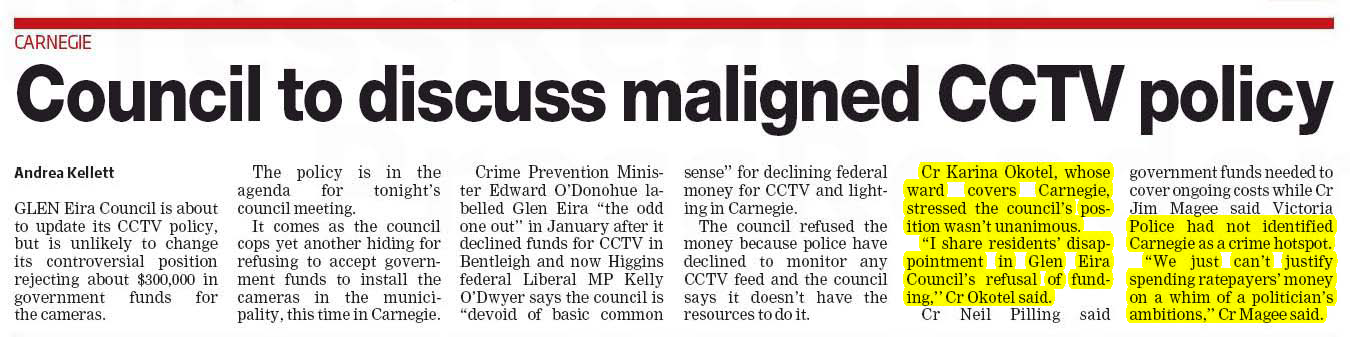
Tonight’s vote on the CCTV policy should be very entertaining if nothing else. The policy itself (in stark contrast to other councils) contains the following paragraph –

Council will not operate CCTV where the primary purpose is enforcement of the criminal law. Enforcement of the criminal law is the responsibility of law enforcement agencies. If such agencies wish to install and operate CCTV systems on Council property, Council will not unreasonably withhold consent

And just for the record, we invite readers to compare what Jim Magee is cited as stating above, and what he said in December, 2013. This is taken from our post of the time –

MAGEE: said that cctv is ‘now a necessity’ and claimed that in 2010 he had called for a report on this. Even though Glen Eira isn’t a ‘hot bed of crime’ it’s important because ‘a lot of people take comfort’ and the cameras give a sense of security to people. Repeated that cameras can detect crime and prosecuting people. Thought that the Bentleigh rotunda would be ‘one of the first places’ where they could put the cameras. Thought it was also ‘incumbent’ for council to ‘do things’ for all those people likely to commit a crime in order to ‘discourage the anti-social behaviour’. Said that ‘this would probably be a large part of council’s operations’ in the future. This would be the role of policy in identifying ‘how to manage that in the future’. ‘This is the beginning, this is the first step’. He commends the motion.

Consistency is, of course, none of these councillors’ strong point!


Item 9.8 – Minimum floor space requirements

This item is in response to a Request for a Report from the previous council meeting. On par with so many other potential initiatives, Glen Eira’s response is to sit on its hands and do bugger all. Everything is always someone else’s problem to solve! Below is what was asked and the underlined sections are what we believe has not been satisfactorily responded to in the officer’s report.

Minimum floor space requirements for dwellings in other jurisdictions including internationally and what benefit or detriment is created by these requirements;

How minimum floor space requirements could be beneficial for Glen Eira in the case that such requirements are adopted by the Victorian state; and

How Glen Eira Council could advocate for state-wide minimum floor space requirements such as through a planning amendment.

The report by the City of Melbourne on its Unit developments and liveability as it may apply to the City of Glen Eira.

The report starts off with a full page of philosophical waffle that works to deflect attention from the questions asked and instead resorts to the usual ruse of how good the current planning system is in that setbacks and height limits do the job of helping to determine the size of apartments and even internal amenity. Setbacks and height limits (if they are applied that is) only determine overall site coverage. They don’t determine how many units the developer can cram into the resulting available space.

More waffle and unsubstantiated opinion then follows – It is likely that if a minimum dwelling size is dictated, it would tend to become the default size and counter productive to dwelling diversity.

Really! Then the City of Melbourne’s research must all be nonsense for them to claim the exact opposite — The predominance of high-cost, one and two bedroom, small and inadaptable apartments is driving the establishment of a homogenous population in regards to household income, age and employment of our residents (City of Melbourne, 2013b). (page 41).

The truth of the matter is that Glen Eira already has a defacto ‘default’ size of one and two bedroom dwellings that contribute nothing to housing diversity. If council was truly concerned about ‘liveability’ and ‘diversity’ then it would publish figures on: how many 1 bedroom apartments have been built in the past 3 years? How many two bedroom apartments have been built in the past 3 years? What is the average size of these apartments? On this point, we note that the Caulfield Village development of 442 units (8 of which are town houses) contains over 200 units of less than 60 square metres in size with quite a few well under 50 square metres! Yet, there was not one single word in any of council’s documentation about this issue and not one word issued from any councillor. Total silence about access to sunlight, access to public open space, and ‘internal amenity’. Size was a taboo subject altogether. When asked at the planning conference, residents were told that these aspects would be ‘investigated’ and put into officer recommendations. We challenge anyone to find a single sentence in the resulting report that focuses on these questions, and therefore ‘social amenity’ and ‘liveability’!

We then find another gem in the officer’s report – It is considered that it is difficult to argue that town planning is best placed and therefore should intervene in dwelling size to a greater extent than it currently does. Why is it ‘difficult’ to argue when countless cities worldwide are doing exactly this? Moreland City Council in fact has introduced a draft Amendment (uploaded here) which attempts to set specific standards for size, environmental design, open space, etc. Strange isn’t it that the officer’s report just happens to overlook this important fact? The reason of course is that council intends to do absolutely nothing that might impinge on development and rate revenue. So without any shame we’re back to the old chestnut of ‘leave it to government’!

And let’s also forget all those essentials of ‘liveability’ that the Melbourne City Council defines quite clearly – The size of an apartment is often fundamental to achieving good levels of amenity. New homes must have enough space for basic daily activities, be able to accommodate standard sized furniture, have storage space for everyday items and be adaptable and flexible in their layout to allow for different lifestyles and users. (page 36)

The most hypocritical statement in this entire report comes with reference to ResCode and the assertion that the ‘standards’ set by this protocol ‘must be met’. We ask residents to consider how many planning applications come before council and do NOT ADHERE to the standards are granted permits. Time and again officer reports are stacked with such comments as no ‘unreasonable impact’ and so on. Council can’t have it both ways. Either the standards should be applied wholeheartedly, or they are not worth the paper they are written on.

We would also like to point out a recent disturbing trend in officer reports on planning applications. Not too long ago the reports would very clearly ennumerate the NUMBERS of 1 bedroom, 2 bedroom and 3 bedroom units proposed. That is now gone and readers are left to decipher from the car parking standards what is what – an impossible task since both one and two bedrooms are required to have the same number of car spaces allotted. Please make up your own minds if such omissions are deliberate or simply an ‘oversight’!

Finally, we have uploaded the two relevant City of Melbourne’s documents (here & here) and urge readers to compare what is stated in these documents as opposed to council’s once again ‘do nothing’ report. And just for the record, readers may also find the following extracts from the Melbourne efforts very enlightening –

The trend in the City of Melbourne, however, is for increasingly small apartments with 40 per cent having less than 50 m2 of floor space, the minimum size for one bedroom apartments in Sydney, Adelaide and London. Consumer research in London (Bartlett K et al, 2002) shows that space is high on the list of priorities of the increasing number of one-person households and that criticism about lack of space is expressed by all groups of home buyers with singles just as vociferous as families. (page 36)

Evidence on attracting and retaining families in inner urban, mixed income communities (Silverman E. et al, 2005) reviewed several London case studies and found that these communities work best when the homes are designed with families in mind, with adequate storage, ample kitchens, family bathrooms and access to outdoor space where possible. (page 36)

Fundamental to a resident’s quality of life is the size and layout of an apartment. No amount of sensitive or innovative design can compensate for apartments that are too small to meet the basic living requirements of the household. (page 48)

And from the discussion paper –

The evidence suggests that letting the market create diversity is unrealistic and that it is impossible to predict or fully anticipate market tendencies, particularly as the housing market is now operating within a global context. (p.51)

In Victoria, apartments are primarily designed to meet the national Building Code of Australia (BCA) standards which is driving a minimum compliance approach. It is understood that the BCA standards were not prepared with consideration for the type of higher density development currently being constructed and are therefore met too easily. The case study analysis concluded that a lack of clear planning policy outcomes together with current BCA requirements is resulting in poor apartment quality in Melbourne. (p.70)

There’s much in the current agenda that deserves comment. The most significant is that the MRC or their developers have lodged an objection to the miniscule conditions imposed by council on the Caulfield Village development. What a surprise! The VCAT hearing is set down for September.

It is also important to note that the public relations arm (via Newton) is out in full force with reports designed to both gild the lily, and to obfuscate the real issues on Amendment C120 (open space levies) and housing approval statistics. We will report in detail on both these matters in the days ahead.

Staying true to form, there is another report on what council could do regarding apartment sizes. Again, no surprises from this ‘do nothing council’. The recommendation is that regulating size is a state issue and all council should do is ‘advocate’ via the Municipal Association and have ResCode updated.

Readers also need to have a close look at the Advisory Environment Committee’s set of minutes. The trend to ensure that as little as possible is made public continues. Advisory committees should never be the place for important policy discussions, especially where officer reports remain secret, and the public is barred from attendance. This transgresses all notions of transparency and good governance, especially when many committee recommendations are then simply accepted by council without any open debate, or very often without the accompanying data to justify those recommendations. Here are some items from these minutes that readers might like to ponder:

That the Chair of the Environment Advisory Committee write to Vision Super to ask for information on their Ethical Procurement Policy and practice.

3.5.3. A letter was sent on 15 April 2014.

3.5.4. ACTION: Officers will seek an update on whether there has been a response to the letter and follow up if necessary

5.1. Car sharing

5.1.1. Traffic Department have advised that there is a trial underway (MS).

5.1.2. ACTION: Officers will provide further update on the current trial at next meeting.


5.2. Glen Huntly Reservoir Proposed Park

5.2.1. JD raised the question of whether a community garden should be trialled at the new park.

5.2.2. Discussion included that the proposed park is currently out for community consultation which has been informed by several consultations to-date.

5.2.3. JD plans to put in his own submission to the Booran Road Consultation process.

5.2.4. ACTION: Officers will seek clarification about the timing of Open Space Strategy action to investigate potential locations for community gardens in Glen Eira.

Last, but not least, there’s this from the in camera items – Under Section 89(2)(f) ‘legal advice’ which relates to ‘Code of Conduct – Possible Additions’. Residents should expect more ‘tightening’ (ie nooses) placed around the necks of councillors we predict, with this one!

The officer’s report –

A recent example was the Alma Club where Council officers attempted to secure land for an additional local open space in Caulfield North but, owing to the impact on the design, suitable land could not be made available and a cash contribution was made instead.

The Public Question –

Item 9.8 of the agenda cites the Alma Club site as an example of a cash rather than land contribution. For this site, I ask:
1. What was the undeveloped land value placed on the site?
2. What was the full cash contribution that council received?
3. Was this amount paid in one lump sum?
4. Why was any contribution paid prior to subdivision and as stipulated by law?

The ‘Answer’ –

The report at item 9.8 was correct in saying that Council tried to secure agreement to an open space contribution of land at the former Alma Club. It was right to say that, following a period of negotiation, that was not feasible and the open space
contribution will be in cash.

The report was mistaken to say that the contribution had been paid. What has been paid is back rates of $67,430. That was paid on 30 May 2014. (Back rates are payable when a property ceases to be eligible to be rated under the Cultural and Recreational Lands Act and becomes rateable under the general rating system. )

The misunderstanding between the payment of the back rates as opposed to the open space contribution was made during the writing of that section of the item between the Planning Conference on the evening of 25 June and the Item being finalised on 26 June. Council apologises for the mistake. The open space cash contribution will be payable in cash at the time of subdivision and calculated according to the value of the land at that time. If Amendment C120 is in effect, it would be 5.7% and could not be appealed to VCAT. While Amendment C120 is not in effect, it would be 5% or less and could be appealed to VCAT.
A difference of 1% would equate to approximately $75,000 for this one subdivision.

Sounness moved the motion to accept and added the clause that the financial report ‘disclose’ open space contributions. Delahunty seconded.

SOUNNESS: said that the amendment ‘follows on’ from the Open Space Strategy. Acknowledged the ‘problem’ of lack of open space and that with new development people should have access to ‘new public open space’. Went through some features of the Open Space Strategy such as biodiversity, and how to ‘fund these developments’. Importantly the amendment wants to increase these contributions. Said that the ‘standard rate is 4% and lots of councils have 4%. When there were greenfields developers may have been happy to give a bit ‘of dirt’ but in developed residential areas they wouldn’t want to give up a ‘unit 2 of the third storey’ and so prefer to pay cash. Spoke about the objections and ‘some very good points were put forward about transparency’ and consequently there has been a ‘robust conversation’ amongst councillors and there’s been a ‘number of conversations’ about ‘what’s fair, what’s reasonable’ and comparing to other councils and how all this ‘refers to our future expectations’. Asked a question of Akehurst about why under this amendment the contributions wouldn’t ‘be appealable to VCAT’?

AKEHURST: said that currently there’s a ‘base rate’ based on numbers and that ‘other factors can add to tne percentages’ and these are ‘subjective’ and so can be challenged. He gave the example of ‘proximity’ to existing open space. Went on to say that council assesses one cost and the developer assesses this differently and figure that the money spent on challenging council is worthwhile. This also costs council money in going to VCAT. With the C120 there’s no sliding scale and there’s one rate for ‘every case’ and everywhere and the developer doesn’t have ‘grounds to argue for a discount’. Said that the amendment was there to give ‘more certainty’, more ‘revenue’ and without the associated costs of going to VCAT.

SOUNNESS: said that one of the objections had noted how the money was ‘expended’. He gave the example of the alma club developer paying money and asked how this money was spent in helping achieve open space around the Alma Club. Wanted to know if the amendment ‘speaks’ to the ‘direction’ of expenditure of the levy.

AKEHURST: said that the amendment was ‘about how you raise revenue’ and that the amendment ‘optimises that collection’ and then it becomes ‘up to council how it is spent’. That is then ‘expenditure’ and ‘council has a policy’ that stipulates spending the money on acquisition of ‘new open space’. Council would also have to spend money outside of its collected levies to bring these places ‘up to standard’.

SOUNNESS: then asked that when the amendment goes to the panel whether they have ‘the capacity to direct expenditure’?

AKEHURST: ‘no’ – the panel is bound by the law which says that money raised is ‘spent on land acquisition and improvements to existing public open space’. Said that every council then makes up its mind about spending on existing and additional open space and repeated the policy about spending 100% of the levy on ‘additional open space’ in Glen Eira and ‘zero’ of these contributions on ‘existing open space’. Went on to say that the policy is ‘binding on all staff’ and the use of the ‘revenues’. There will be accounting of the money in ‘each budget and each annual report’ and that ‘there is nothing that council could do’ which isn’t ‘already in place’.

SOUNNESS: reiterated that the amendment basically ‘seeks to increase the revenue’ and that there’s ‘only so much that can be done’ with how the money is spent. Summed up that the amendment wants to implement what the community has ‘endorsed’ in the Open Space Strategy. Said that the objections had ‘raised some issues that have been quite valuable’ and like the landswap it’s ‘very good to see where the money goes’ and that’s why he’s added the clause about reporting in the financial review.

DELAHUNTY: said that open space issues has ‘occupied a lot of councillors’ time’ and that when she first thought of becoming a councillor, open space was one of the ‘platforms’ that she wanted to run on. As a parent she sees ‘how important’ even ‘small pockets of green’ is. The problem is big and it will take a ‘step by step’ process and this included the Open Space Strategy and ‘getting the right people to write the strategy’ and have the ‘public contribute’ to the strategy. Council also ‘took a policy change initiative’ to ‘fence off the funds’ that would be received from contributions. The amendment is now the ‘next really important piece’ in the process. This is the end result of a long ‘calculation that is done by the right people’, and had public consultation. There is now the motion to put this to a panel and she asked Akehurst ‘what does this mean’?

AKEHURST: said that the Minister ‘appoints a panel’. Council and the objectors then ‘put their view’ before the panel. The panel then reports back to council ‘in the form of a recommendation’. Their recommendations could be that the amendment be adopted by council as exhibited, or ‘in some other form’. Council doesn’t have to accept the panel’s recommendations ‘but it would need to have serious reasons not to do that’. It then goes to the minister for approval if council has adopted the recommendations of the panel.

DELAHUNTY: ‘What’s the downside risk’?

AKEHURST: said that the panel might think that the 5.7% ‘is too high’.

DELAHUNTY: councillors had read the submissions and thought that many of the points ‘were correct’. Other things could be ‘clarified’ but she again asked Akehurst ‘what this would do to the process’?

AKEHURST: said that there were a ‘couple of errors’ and these were corrected. Amendments are a ‘statutory process’ and that council can’t change things in any ‘material way’ if it’s already gone on public exhibition. So even if there are submissions that ‘have merit’ but weren’t ‘part of the exhibited’ amendment ‘they could not be incorporated into’ this amendment because they would ‘depart’ from what’s already been exhibited.

DELAHUNTY: then asked whether Akehurst ‘was surprised’ that there were no objections to the 5.7%

AKHURST: ‘yes’

DELAHUNTY: said that she was ‘surprised and delighted’ and that at ‘heart’ everyone ‘understands’ that there are challenges that have to be fixed and she was pleased with community involvement because it’s an ’emotive issue’ but council wants to ‘move on’. Said that Sounness’ amendment will increase ‘transparency’ in ‘making sure they are reported upon’ in a ‘separate and visible line item’ in the financial report. Thought this was good and ‘goes some way’ to answering the submitters ‘concerns’. Said that the submitters ‘did a good job in pointing out those errors’ and that they are ‘pleased that we could provide a stronger submission’ as a result.

OKOTEL: glad that council is a ‘step closer’ to raising the contribution levy. Said that the 5.7% levy is one that was ‘supported by the Open Space Strategy’ and that this provided for a ‘strong reference base’ for this amount. The rate is ‘evidence based’ and she hoped it ‘would be accepted’. She then asked Newton a question about the officer’s report stating that 7 months would be added to the process if it went to a panel and that around $2 million would be lost from revenue and whether projects set down for implementation ‘would be impacted’?

NEWTON: said that when exhibited they estimated that the ‘revenue’ would rise from $2.2 million a year to $6.1 million. Continued that the Strategic Resource Plan is ‘based on current arrangements’ and the ‘extra revenue’ hasn’t been ‘taken into account’. Said that the current budget is resourced but what’s planned for the future in open space will only happen if the ‘amendment is put into effect’ and ‘the longer it takes the less money we will have’ for ‘next year and every other year’.

OKOTEL: then asked what council ‘mightn’t be able to complete’

NEWTON: gave two examples. One was the Booran Road Reservoir which is a ‘very expensive project’ and ‘because the meeting went so well’ council was thinking of ‘accelerating’ the works such as ‘demolishing the walls this current year’ and that’s ‘not budgeted’ but they could with the extra revenue and ‘complete the work earlier’ ‘if the money is available’. The second example was ‘another road intersection’ in North Caulfield and would be ‘similar’ to the Gisborne St/Riddell Parade closure. ‘At the moment there is no money in the ten year plan for that’ but if the amendment came in quickly ‘there would be more money’ so that ‘next year there would be more open space’.

MAGEE: said this could be a very ‘happy story’ that everyone wants. If developers pay the 5.7% then the money will ‘accumulate very quickly’ and council could implement the things listed in the Open Space Strategy. Referred to Newton’s examples and how important the Reservoir is given that council has been ‘talking about this for at least 5 years’. Said that it’s about ‘communities coming together and working together’. Stated that there could be times ‘when processes’ are different and other times when people can say ‘I don’t agree with you but I should work with you’. The amendment ‘benefits all of Glen Eira’ and council is ‘very passionate about’ this. The money isn’t from residents but ‘developers’ and the ‘cost to us is open space’ which council has to keep improving the open space. They can’t do this ‘by procrastinating’. Individuals might have ‘issues’ but the ‘overall good’ is for the community. ‘I’m saying don’t hold it back, don’t stop us’. Some people might say they ‘don’t like’ how council operates, but ‘suck it up’. ‘we need the money’ and it’s the ‘number one issue’ for Glen Eira that everyone should be ‘working towards’. ‘The process we can argue about’ but ‘let’s move on’.

DELAHUNTY: asked Sounness as a green, what the Greens would ‘say’ about the Open Space Strategy and the levy.

SOUNNESS: said that with open space then it’s about ‘improving, expanding’, ‘community access’, ‘equity and fairness’, letting people access a ‘safe, healthy, clean’ space,   so the greens and every party would support this.

DELAHUNTY: then asked that since there’s all this ‘passion’ and ‘feelings around the table’ whether there is ‘another path’ that could be taken so that the projects and money ‘could happen quicker’.

NEWTON: said that there’s ‘only one option’ if there are submissions and that’s to appoint a Panel. There would be a Panel in October and they’d report back to council which council would then consider and report back to Minister. ‘That’s a long time’ and council ‘would not be getting 5.7%’. He was like Delahunty ‘surprised and delighted’ that no one had objected to the 5.7%. Went on to say that if there hadn’t been submissions then council could have ‘adopted’ the amendment ‘tonight’ and written off to the minister tomorrow and it could have been in operation by August.

DELAHUNTY: since there are admissions, then the whole process has to be gone through – ie panel, report back to council, decision by council, sending off to minister and waiting for his approval.

NEWTON: so ‘if the submissions remain, the panel remains’ and all the other processes have to take place.

ESAKOFF: said it was ‘disappointing’ when this is on the agenda and the added costs that will happen. So there will be ‘delays’ or the inability to ‘accelerate’ projects. ‘It’s very disappointing’.

HYAMS: was ‘very p0leased’ that no submissions came from developers but thought that ‘once they cotton on’ to this that they may go directly to the minister and ‘try not to give us as much money’ as council is asking and others might be ‘rushing their applications through’. Said that consultants did ‘the strategic work that justifies the 5.7%’ so they are ‘pretty confident’ that even if developers object they would still get this rate. Perhaps even the developers looked at the ‘documentation’ of the amendment and ‘realised that we do have a solid case’ and they didn’t want to ‘waste their time’ on this knowing that ‘it was going to get through’. Sumbissions pointed out ‘2 errors in the documentation’ which might have ’caused confusion’ so ‘it’s good’ that this has been fixed. Thanked submitters and said that the submissions also ‘raised a number of policy’ questions. Hyams then ‘sought clarification’ from Akehurst by asking whether Public Acquisition Overlays are something that council ‘could or should do as part of this amendment’?

AKEHURST: said ‘no’ that it wasn’t ‘lawful’ and that ‘no council could do it’. Said that public acquisition overlays can only happen by ‘amending the planning scheme’ and to ‘identify the land to be applied’ and the ‘purpose for which it is being acquired’. The minister would have to approve exhibition and wouldn’t get the go ahead if council asked for more ‘land than required’. Council would also have to prove that ‘it has the financial resources to buy the land’ and this is ‘accepting financial responsibility’. If this is in the planning scheme then ‘council can be asked immediately to buy the land’. It can also cause anguish to the owners and that’s why councils only have ‘small numbers of overlays’. Councils generally start by getting the money from levies and then being in a position to buy the land, put in acquisition overlays.

HYAMS: stated that as one submitter said that it’s ‘unreasonable’ that all the money coming in would go to ‘catering for new residents’ and that the ‘140,000 people currently living in Glen Eira miss out’. Asked Akehurst whether it would be applied in this way.

AKEHURST: said council has go ‘not choice’ and that’s why it’s phrased as it is. Said that the amendment isn’t ‘justified if it’s not raising money for future residents’. Claimed that this ‘isn’t bad news for existing residents’ since the Open Space strategy has got projects where the money will be spent and apolicy that council will spend money ‘by other means’

HYAMS: asked Akehurst about the choice of ‘acquiring land or acquiring money’ and that the amendment only has 3 areas for cash contributions listed as preferable, so how is getting a ‘little’ piece of land at the back of a development ‘better than getting money’?

AKEHURST: said that ‘it’s not better’ and that council would be very stringent in what land it accepted and this would really only be if there was a ‘significant development’ and that this wouldn’t ‘happen very often’ because ‘Glen Eira is substantially developed already’.   Council would get cash mainly because development is generally on ‘small to medium sized lots’.

HYAMS: repeated how pleased he was that there weren’t any developer submissions and he thought that the two objectors would have thought that there would be others so they wouldn’t have expected that their submissions would be holding up council. Said that if the submissions ‘are withdrawn we can go straight to the minister’.

SOUNNESS: said this was ‘all about money’. Didn’t want to ‘see concrete’ but ‘useful’ parks, and gardens and the amendment want to ‘seek the mechanism for improving that capacity’. Said councillors ‘elswhere would love to get 5.7%’. Whitehorse is 4% and their plan was done by the same consultants and they’ve now bought 3 residential lots over time. Getting the cash means that council ‘can adjust to cicrumstances’. In western Australia there’s 5% and ‘compulsory acquisition overlays’. When this happens ‘people go nuts’ and say ‘my home is being removed’. Thanked submitters because ‘it’s a champion thing that democracy does’ but was worried that developers will now see that ‘there’s a cut off time’ and will take advantage of this by council getting a ‘rush of subdivisions’ and therefore receiving less money.

MOTION PUT AND CARRIED UNANIMOUSLY
 

Delahunty moved to ‘note the report’ and added that council seeks information about the money that was paid by the MRC to the government and that this include ‘advice’ from the Valuer General about the ‘reasons’ for the landswap and the amount paid, when the money was received, how much and ‘the Department that received the funds’. She also asked for a ‘copy’ of documents that the then Minister Gavin Jennings spoke about in parliament at the time. If necessary, council should use FOI to get the information ‘if required’. Sounness seconded.

DELAHUNTY: Began by saying that the landswap was before her time but clearly something that’s grated on people. Said she was surprised that the money paid was so large when it was claimed to be ‘compensation’ for the ‘inequity of the swap itself’. She wanted to know more ‘about that money’ since the MRC’s last 3 annual reports writes about $8 million being set aside for the buying of land and this could be the buy out of private properties but also contain the money paid to the government. Therefore no one knows how much they actually paid and what they thought it was for. Hansard mentioned this several times in response to members asking questions. Said that David Davis was asking whether the swap was equitable and he referred to the panel he was chairman of and that he was ‘still uncomfortable’ about the Trust and land swap. Sue Pennicuik has also been a long time advocate and been a ‘great help’ for the community. She also asked ‘a lot of questions at the time’ from Gavin Jennings and wanted to ensure that the community could ‘derive’ some benefit. Jennings answered that the land would be valued, and that this then would be approved by ‘the Government Land Monitor’. This would ‘ensure’ that the government isn’t ‘disadvantaged’. Jennings then went on to say that the swap was contingent on the approval of these bodies and that there would be commercial rates paid for the land. The act was then passed. Delahunty then said if these assurances ‘were given’ but the public still doesn’t know the details such as ‘where the money went’ and ‘what it should have been used for’ so that when the vote was taken in parliament they voted on the assumption that things would happen, but none of this has happened. She ‘presumes’ that the money went into general revenue. Thought that ‘this money should come back to provide the community’ with the ‘equity it was supposed to deliver’. Said that council was ‘more than happy’ to move the depot to the Booran land site which ‘we never wanted in the first place’. Council would need to spend ‘residents’ money’ or ‘get residents’ money back’ from the landswap. Summed up by saying that want to restore Caulfield Park, and get the ‘best use’ out of the Booran site and for ‘the money that is owed to the community’ to be returned. Thought that 2012 was when the money was handed over and that it was intended for ‘the people of this community’. They want all the information to ‘inform the public debate’ and that people should know ‘where their money has got to’.

SOUNNESS: said the the whole issue including racecourse, c60 etc. can ‘fire up’ people and that the best option for getting to the bottom of things is to ‘follow the money’. Pennicuik tried this. Said there was ‘still a long path to go down’ and they’re trying to find ways to ‘move the depot’ and find ‘better array of services’. Good that council is trying to ‘achieve a better outcome’ for residents.

MAGEE: said this would be ‘win-win’ for everyone in that the depot would be moved, and that so far there ‘is no community benefit’ from the landswap and the money which was paid by the MRC. This money could be used to achieve this. Said that government’s job is to ‘assist the community’ and for Glen Eira with the least amount of open space, that the government should ‘give it to us’ (the money). SAid this was a ‘great opportunity’ to get a good result and ‘banging on forever’ about the landswap, trustees is useless. This is positive and they will ‘keep the pressure on’ both government and Southwick. Wanted everyone to ‘work together’ for a ‘community benefit’.

OKOTEL: reiterated that this was an ‘important issue’ and that Pilling had already met with government and that council would continue to ‘agitate’ on the issue.

HYAMS: said this was a ‘mess’ from the start and council wasn’t happy from day one but that both sides (Liberals and Labor) voted the landswap in. The Trust also voted for it and of the 3 council reps ONLY 2 VOTED AGAINST IT, which is ‘disappointing’. Council never wanted it and from the start they wanted a depot but the MRC said ‘no’ they didn’t want a depot and the department put it aside for ‘recreation’. Buildings also went which is ‘unfortunate’ because they ‘might have been useful’. Said that now government has given permission to put the depot there and that for once it’s ‘good to see that the MRC’ isn’t having it all it’s own way but, that council ‘needs the money’ for this to occur. Asked Delahunty what she ‘expects’ the ‘legally binding document’ to contain. Delahunty said ‘I don’t know’ and that this was mentioned in the actual debate in parliament but that she expects to find ‘some wording about the exchange’ and whether the money was to ‘come back to the community’.

DELAHUNTY: said it’s a mess and was ‘outside the control’ of council. But the ‘opportunity’ is now due to Media Release by Southwick where he claimed that he was ‘excited’ to be ‘able to reinvigorate’ Caulfield Park. With this there’s Hansard where Davis ‘sought assurances’. So ‘there’s no better time’ to get things done than ‘right now’. To succeed they ‘need to understand all the information’. All this can ‘put to rest some of the ill will’.

Delahunty then went on to say that the letter published in the agenda which was sent to Southwick ‘some time ago’ had as yet ‘not reached his office’. On Twitter, Southwick claims that he first saw it with the agenda.

MAGEE: asked that if council doesn’t get the money ‘can we still afford to do the landswap’?

NEWTON: according to the Strategic Resource Plan ‘there’s no money in any of the ten years to do this’ and the ‘only way you could do this is to lower the priority of some other projects’.

MAGEE: summed it up by asking ‘No money, no move’?

DELAHUNTY: answered and repeated ‘no money, no move’.

MOTION PUT AND CARRIED UNANIMOUSLY.

A brief note on tonight’s meeting. Lobo, Pilling and Lipshutz were all absent. This inevitably lead to the circus of musical chairs, and three separate motions nominating individuals to attend a councillor ‘weekend’. Since nominated councillors had to declare a conflict of interest, and leave the chamber, there would not have been a quorum – hence the repeated motions/resolutions and the musical chairs.

Just how orchestrated council meetings are, how carefully scripted, was in full evidence tonight with countless Dorothy Dixer’s thrown at both Akehurst and Newton in the context of the ‘debate’ on Amendment C120. The dead give-away, was that Akehurst on numerous occasions read his answers from a prepared script! So much for impromptu ‘councillor questions’ that arise directly from the ‘debate’.

A public question on the assertion within the officer’s report that the Alma Club site had paid its open space levies, rather than a land allocation, was admitted to be ‘in error’ and an apology was tendered. Perhaps a council first, but again, this shows not only another stuff up, but that in all likelihood the offending paragraph was intended to mislead and deceive!

On the Caulfield Park depot removal to the Booran Rd/Glen Eira Rd, the infamous landswap was the primary feature with Delahunty moving a motion that if necessary council apply under FOI to see the legal documents involving the landswap, the valuation of the land, etc.

More on all of the above in the next day or so.

« Previous PageNext Page »