We are committed to facilitating genuine debate within Glen Eira. Your views on planning, environment, open space, CEO and councillor performance matter.
The current agenda includes an item that purports to be a response to resident views on the draft budget. Yet, readers would have no inkling whatsoever, whether their views have had any impact on the final version of the budget. This says heaps for transparency, accountability, and adhering to the adopted IAPP2 principles of reporting back to the community on how their views influenced the final decision. Yes, council did go through the legislated requirements of ‘deliberative engagement’ but in this officer report very little detail is provided. Nor do we get the complete record of the various survey responses.
What we do have is short summaries that highlight some resident priorities such as:
Stage 1 consultation: The overall allocation of spending by the participants was very similar to our 2021-22 Budget proportions. The main differences were to decrease spending on Capital Works and increase spending on Sustainability. (page 21)
Online survey: The survey group would like to see more spending on Sustainability and Climate Change, Parks and Recreation, and Economic recovery from the pandemic.
Have your say survey: ▪ This survey group would like to see more spending on Sustainability and Climate Change, Parks and Recreation, Open Space and Waste and Recycling.
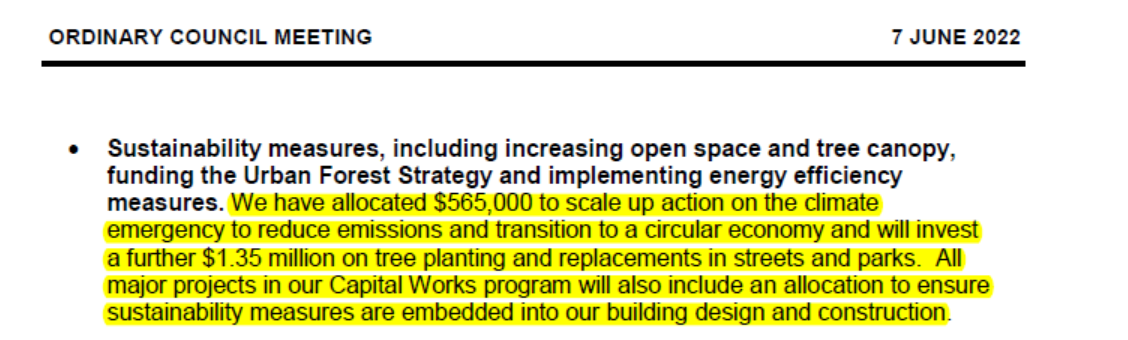
Deliberative engagement: priority – Sustainability measures, including increasing open space and tree canopy, funding the Urban Forest Strategy and implementing energy efficiency measures. (page 22)
There is no definitive response to the above views. What we do get is:
Does this mean that council has acted on these concerns and increased its spending on the Urban Forest Strategy, climate, sustainability? We simply do not know given that the final budget that councillors are expected to vote on is NOT INCLUDED in the report. The result? – your guess is as good as ours!
What we do however know, if that what is included in the above screen dump is identical to what was contained in the first draft of the budget – meaning that nothing has changed.
Conclusion? For all the talk about listening to the community, being transparent, and keeping residents informed, we are still looking at a council that simply goes through the required legal motions and resident views continue to be ignored.
Council’s current agenda includes the Design & Development Overlay (DDO) for Caulfield North. This follows the previous ‘consultation’ on the Built Form Frameworks for Caulfield North, Caulfield South and Bentleigh East. We have previously commented on the value of the ‘consultation’ and its drawbacks. (See: https://gleneira.blog/2021/05/12/is-this-fair-dinkum-consultation/)
There are very few changes from the originally advertised documents. So much for ‘listening’ to residents. Worth noting that the officer’s report, as is typical, fails to even make mention of the feedback, and how this has ‘influenced’ or not, council’s current version.
In summary, the DDO will:
NOT have mandatory height limits except for the sites in a heritage overlay. The majority of the precinct will have 6 storeys discretionary. The City Plan has 5 storeys. No explanation provided in anything we’ve seen as to why these Neighbourhood Centres should be 6 AND NOT THE 5 STOREYS recommended in the City Plan.
Overshadowing to the public domain relies only on the summer solstice – no consideration given for the winter solstice. Plus, overshadowing is said to be avoided for the most ‘active’ parts of the day. For one area this is equated to 10am to 12 pm!!!!!
Rear laneways of 3m are deemed appropriate for egress and ingress! This means that two cars travelling in opposite directions cannot pass each other.
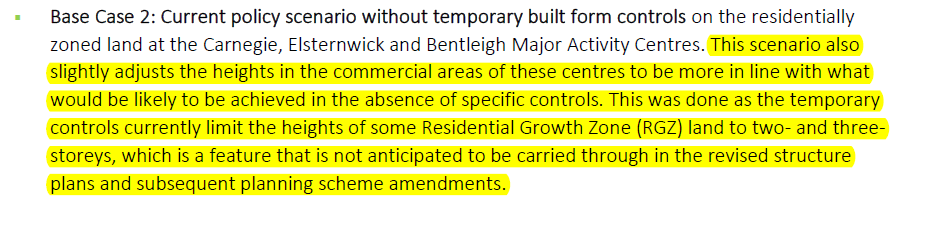
We’ve highlighted some of the paragraphs from the officer’s report and ask readers to consider them carefully – as this, presumably, is supposed to be the rationale and justification for the proposed DDO.
Proposed DDO12 will apply to all commercially zoned land within the centre. The introduction of these planning controls will ensure Council can regulate growth and change at an appropriate rate and manage the competing priorities of the community, and the development industry. The proposed controls are not seeking to increase the rate of development within the centre, rather they introduce standards to manage development when it does occur.
COMMENT: What does ‘appropriate rate’ mean? 100 new apartments per annum? Or 200 per annum? The use of the word ‘rate’ is a neat sleight of hand designed to avoid the conclusion that once you raise the allowable height of a building, then it becomes more tempting and profitable for a developer. It has very little to do with the ‘rate’ or presumably ‘speed’ of development which council has no control over anyway.
Mandatory controls are not considered necessary for street walls along this section of Balaclava Road and may even be to the detriment of good development outcomes (for example, preventing on-site outdoor dining terrace areas at the front of cafés). No heritage or character overlay controls affect this section of Balaclava Road and the mandatory requirement has therefore been changed to a preferred setback requirement. This will make it consistent with the Caulfield South Activity CentreDDO.
COMMENT: Since when does a mandatory street wall height prevent ‘outdoor dining terrace areas’? and how will a discretionary height which could allow a four storey wall height contribute to ‘good development outcomes’? Here are some quotes from the original Urban Design doc:
A two to three storey building height at the street is recommended for the Caulfield Park NAC, which will maintain a scale that is both compatible with existing heritage and non heritage shopfronts, and does not overwhelm the streetscape. This has been evidenced with recent developments in the NAC that provide a three storey street wall.
As for the proposition that this is fine given it is ‘consistent’ with what has already been approved for Caulfield South is not a justification. Each Neighbourhood Centre is unique, as admitted even by council. There is no demand for ‘consistency’. Instead each area should be evaluated for what it is, rather than how it can fit into the ‘one size fits all’ model so preferred by this council.
The proposed planning controls only focus on the commercial zones within the centre, a key growth area which places less pressure on our residential areas where tree retention/planting and maintaining site permeability is important.
COMMENT: if the objective is to protect the surrounding residential environment as claimed above, then perhaps council needs to explain why the Housing Strategy is advocating the removal of the mandatory garden requirement, reducing permeability, and doing nothing specific about tree retention. The entire area surrounding the commercial land is zoned GRZ, where all of the above changes will impact directly on these properties. Coupled with the impacts of these changes, we will now have a minimum of 6 storeys abutting a mandatory 3 storey zone. And that’s okay for this council.
Here’s a map of the current zoning. Please note the extent of GRZ (3 storeys) and their connection to the commercial sites.
CONCLUSION
Once again we find that council has failed to live up to its so called ‘engagement strategy’. We do not know:
How and where community feedback influenced the final decision
Why the heights are increased despite the approved council City Plan
And finally, ‘consultation’ in name only given the pathetic survey questions
We have to continually scratch our heads and ponder exactly what this administration is doing in terms of open space purchases. Are they simply wasting the monies set aside for open space, or are their purchases really adding anything to the municipality’s desperate need for more usable and effective open space?
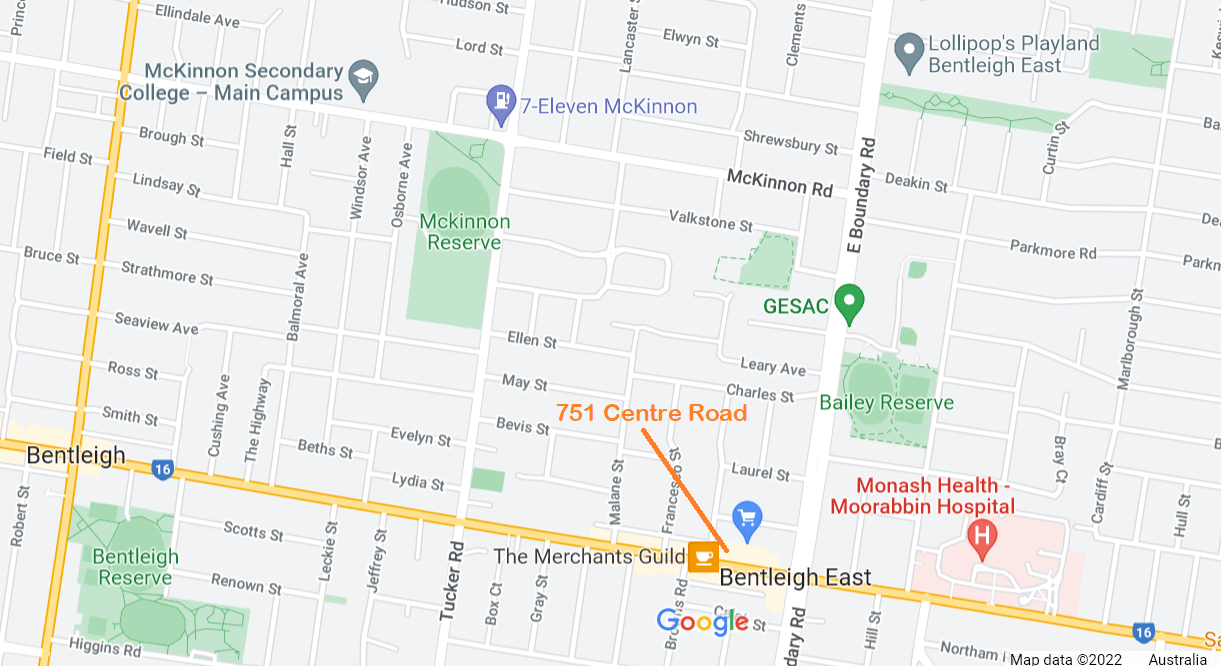
We ask, because in the latest agenda we are told that Council has purchased the commercial property at 751 Centre Road, East Bentleigh. Sounds great, but once people delve into this purchase, there appears to be no valid and cost benefit justification for this purchase.
Here are the details:
Site Area – 237 square metres
Sold – 27th October, 2021
PRICE – $2,227,500
Surely this is a massive overspend on a property of this size? Will we again learn that this property will be leased out for another 2 to 3 years before anything happens? Why this position anyway? When we look at the map (below), surely there is already existing open space well and truly within 400 -500 metres of this site.
Other questions come to mind. Since the 1988 Open Space review, council has known that the areas of open space deficiency are in Camden Ward, as well as in the major activity centres of Carnegie, Bentleigh and Elsternwick. Glen Huntly and Gardenvale are also fairing very badly. So why on earth spend this amount of money for a site that doesn’t add to already existing major deficiencies?
Council will no doubt argue that this is in one of the gap areas identified in the latest Open Space Strategy (OSS). This still doesn’t justify the purchase and the neglect of the areas which need it most. The OSS even has this comment on page 48 –
This table highlights the difference that urban density can make to overall provision ofopen space. For example, Bentleigh East has less open space relative to the overallsuburb area (3.8 per cent) but a higher proportion of open space relative to populationdensity than Carnegie and Caulfield South
So, in terms of ‘need’, East Bentleigh is behind other suburbs.
Next on page 135 we find this recommendation: Provide a new Local Open Space close to, but not facing Centre Road. The purchased property faces Centre Road!!!!!! In addition the OSS’s definition of Local Open Space is: from 0.26 hectares to 1 hectare (page 34). This purchase doesn’t even come close to the recommended size! More illuminating are the examples provided for the purchase of Local Open Space. We quote: Examples include Gardenvale Park, Memorial Park Caulfield North and Springthorpe Gardens Murrumbeena. Each of these examples are triple the size of what has been purchased.
Summing it all up, we seriously question how this council is spending money on open space. Why aren’t they targeting the areas that are continually identified as having shortages or have the highest population density? If the OSS is the gospel, then why ignore its major recommendations? Why spend a fortune on a block of land that you couldn’t swing a cat on? Who makes these decisions?
Council has decided to cave in on the 10-16 Selwyn Street application for two 10 storey towers, and a major supermarket. All done in secret at the last council meeting. The minutes did not record the vote. This decision flies in the face of what has been determined over the past few years. Please note:
2 unanimous councillor decisions to refuse the permit
VCAT refusing the first permit
Council’s refusal to employ anything ‘higher’ than a solicitor for this second VCAT hearing
May street status still left uncertain and council unwilling to share their legal advice on this issue
For all the talk about the Jewish Cultural Centre, and access to this ‘pedestrian’ mall, council has (deliberately?) dragged its feet in its stated objective of closing off part of the street. Two years down the track, we still have the same traffic conditions.
As far as we know, the only ‘concessions’ made by the applicant are to remove one storey from the proposed 10 storey tower, and to increase setbacks for this tower. At best this is likely to be nothing more than a 3 metre reduction. Nothing has been stated on traffic, the objective of pedestrianising Selwyn Street when there is an admitted potential for 5,000 additional cars in the street, the loading bay directly opposite a primary school level crossing, etc. etc. etc.
The end result is that objectors will be fighting both council and the applicant at the upcoming VCAT hearing. Why these new plans were agreed to by council remains secret. We can only conjecture what occurred last Tuesday night, but it is worth remembering that:
Only 7 councillors were in attendance – Zhang and Pilling were absent
We very much doubt that the decision was unanimous. Hence a minority of Glen Eira councillors decided council’s position on this application.
What arguments were used by the pro permit lobby – ie costs involved for council? Heritage can be ‘sacrificed’ as has happened plenty of times before? Some secret deals involving May Street – maybe a section 173 agreement where council is paid off?
Whatever the reasons and the arguments, we maintain that the lack of transparency and accountability by this council is unconscionable – as is their responsibility to ensure that ‘net community benefit’ is the result of all major planning decisions. This cave in benefits no-one except the developer and those parties who were provided with a so-called ‘discount’ of millions by supporting the application.
The following audio is from last night’s council meeting where one resident addressed council basically telling them how inadequate strategic planning has been and the consistent refusal to incorporate years of community feedback into the draft housing strategy. Please listen carefully:
Residents must really wonder what is the point of council creating and endorsing policy and strategy documents, when these are all ignored when it comes to development. Either we have policy or we don’t! The latest example of this is an application for 93-101 Poath Road, Murrumbeena. The applicant wants 8 storeys, 77 apartments, and a reduction in onsite car parking as well as some upper level setbacks of a miniscule 3 metres. There will be 6 shops, and the apartments are designated as: 29 one bedroom; 40 two bedroom and 8 three bedroom. That’s a ratio of 90% one and two bedroom apartments and the majority of these apartments will be less than 60 square metres in size.
More disturbing is the fact that in the past we have been told ad nauseum that if a policy is not enshrined in the planning scheme, then it bears little or no weight in the final recommendation. Whilst this officer report does repeat this mantra in reference to the proposed Planning Scheme Rewrite (C220) by stating: Council can have regard to the amendment as part of the assessment of this application but can only give it limited weight – we then have a full 2 pages and a bit, itemising what this amendment proposes as justification for recommending a permit! We repeat: this proposed Amendment is yet to go through a planning panel. It is yet to be independently assessed and reported on. Yet, we have an officer’s report which bases much of the argument for a permit on something which does not as yet exist in the planning scheme.
There is much to challenge in this report. Some examples:
Neighbourhood centres are areas where substantial built form change is anticipated. Really? That’s not what the various versions of City Plan state, nor the Urban Design Guidelines!!!!
The subject site and broader commercial areas of the Hughesdale activity centre are not subject to specific building height controls within the Scheme, nor are there any proposed by way of overlay controls such as a Design and Development Overlay as can be seen in other centres across the municipality.
Thus the truth (inadvertently, we suspect) comes out. Council has absolutely no intention of ensuring that all commercial centres have appropriate height limits assigned to them. What does this augur for Ormond, McKinnon, Patterson, Gardenvale, etc. just to name a few neighbourhood centres currently without any controls in the commercial areas?
And since when does any report include such garbage as found in the Urban Design report:
Try to redesign the top edge of the building…….
Try to design the western side of the building…..
Try to prevent overlooking…..
Try to ensure that no additional service cabinets…..
Why ‘try’? Either the recommendation is that something doesn’t comply with current planning controls or it does, or whether these aspects of non-compliance may be addressed by conditions. Yet, none of this has occurred. Who is to ‘try’? and what if they don’t?
The bottom line, as we read things, is that council will bend over backwards, to ensure that developers get their permits – regardless of existing council policy, and what the current planning scheme states.
If you happen to live in any of the sites highlighted in the light blue, then beware! Council has earmarked these sites as Substantial Change Area 1. This means:
You will go from a 2 storey mandatory height to 3 storeys
The mandatory garden requirement ranging from 25% to 35% of land size will be removed
Rear setbacks will in all likelihood also be removed.
Retention of trees will only be ‘encouraged’ where ‘practical’
As for the commercial sites themselves, these will also be changed to greater heights if the following, taken from the Housing Capacity Analysis (page 52) is any guide –
Bentleigh is thus in the firing line for major changes that in our view will do nothing except impact incredibly on residential amenity, on the environment, and on issues such as parking and traffic. We repeat ourselves, but given that we have capacity for 50,000 dwellings and only require 13,000 until 2036, it is simply unconscionable for this council to even contemplate further ruin of our suburbs.
Readers may also remember that over the past few years council conceded that the Residential Zones introduced in 2013 were inadequate on several levels – ie heritage properties were included in the Residential Growth Zone (4 storeys) and many streets had multiple zonings which simply didn’t make sense. Well, given the above mooted zonings, it doesn’t appear as if council has learnt from its past mistakes. Take Whitmuir Street for example. Only half of this street is to be rezoned. Why? Especially when this proposed rezoning includes about 24 houses on both sides of the street and all are either single or double storey. There are 2 blocks of flats (one of 9 apartments and two storey) and another contains villa units. The street itself is narrow making it impossible to pass if there are parked cars.
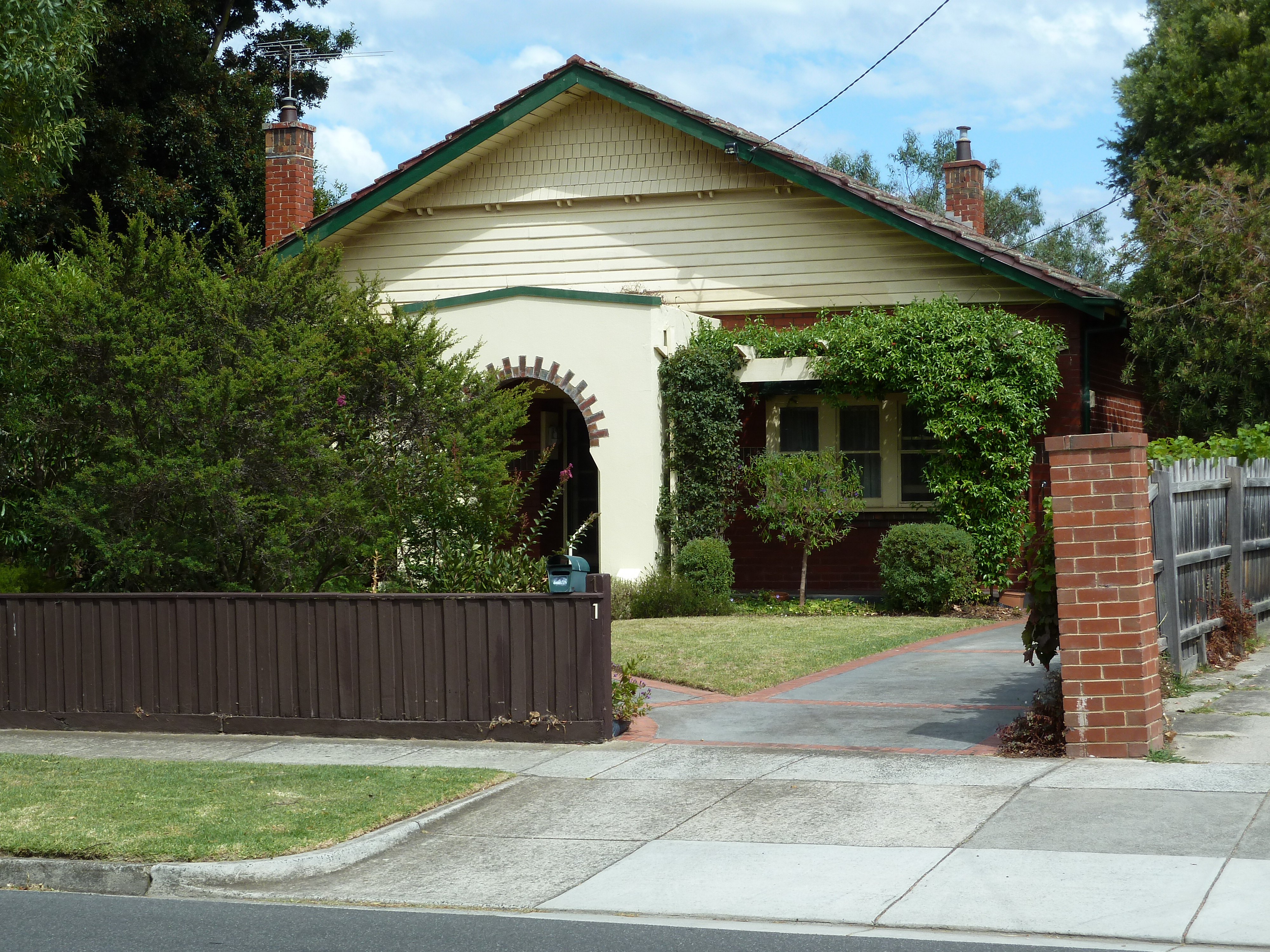
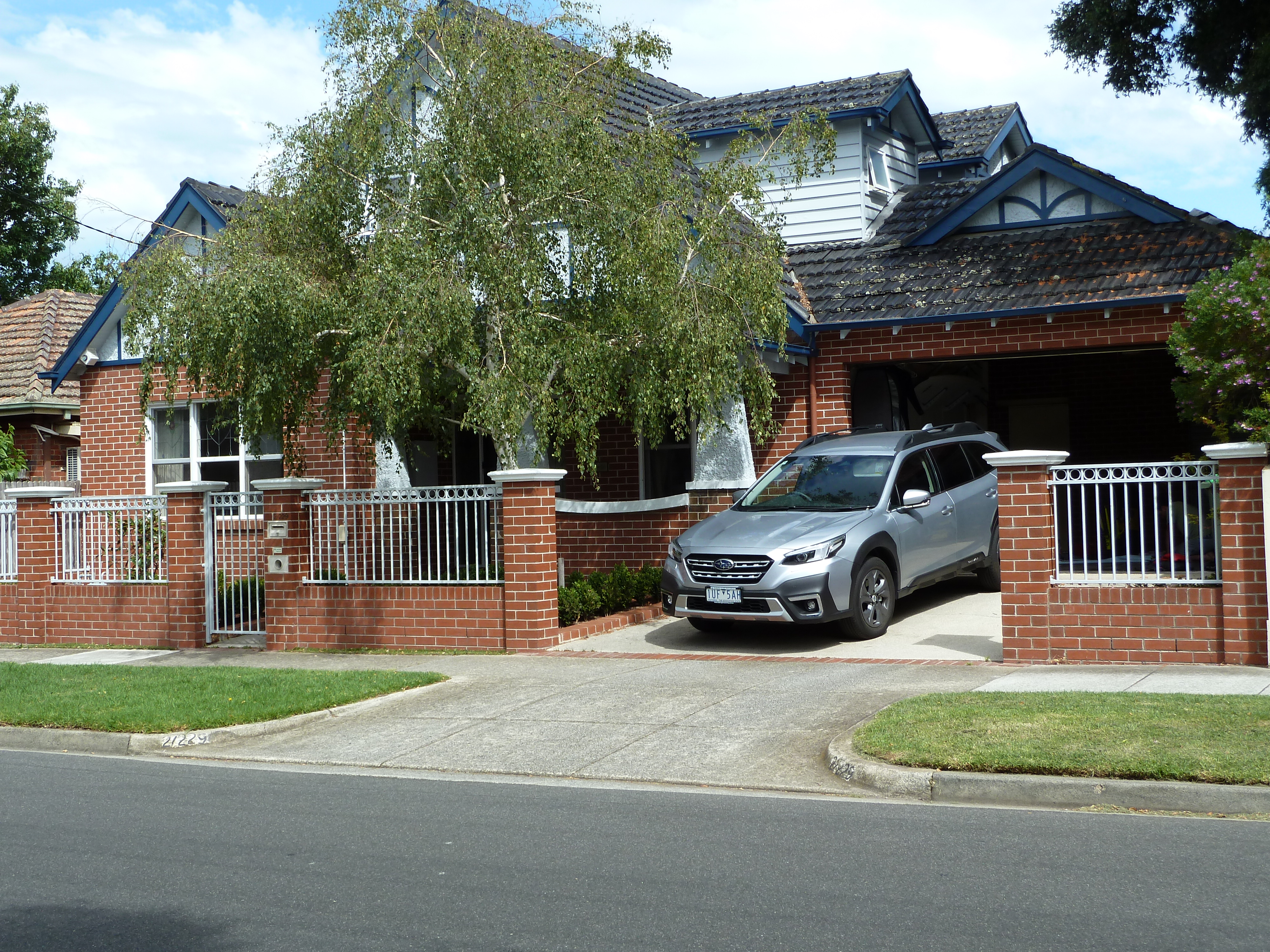
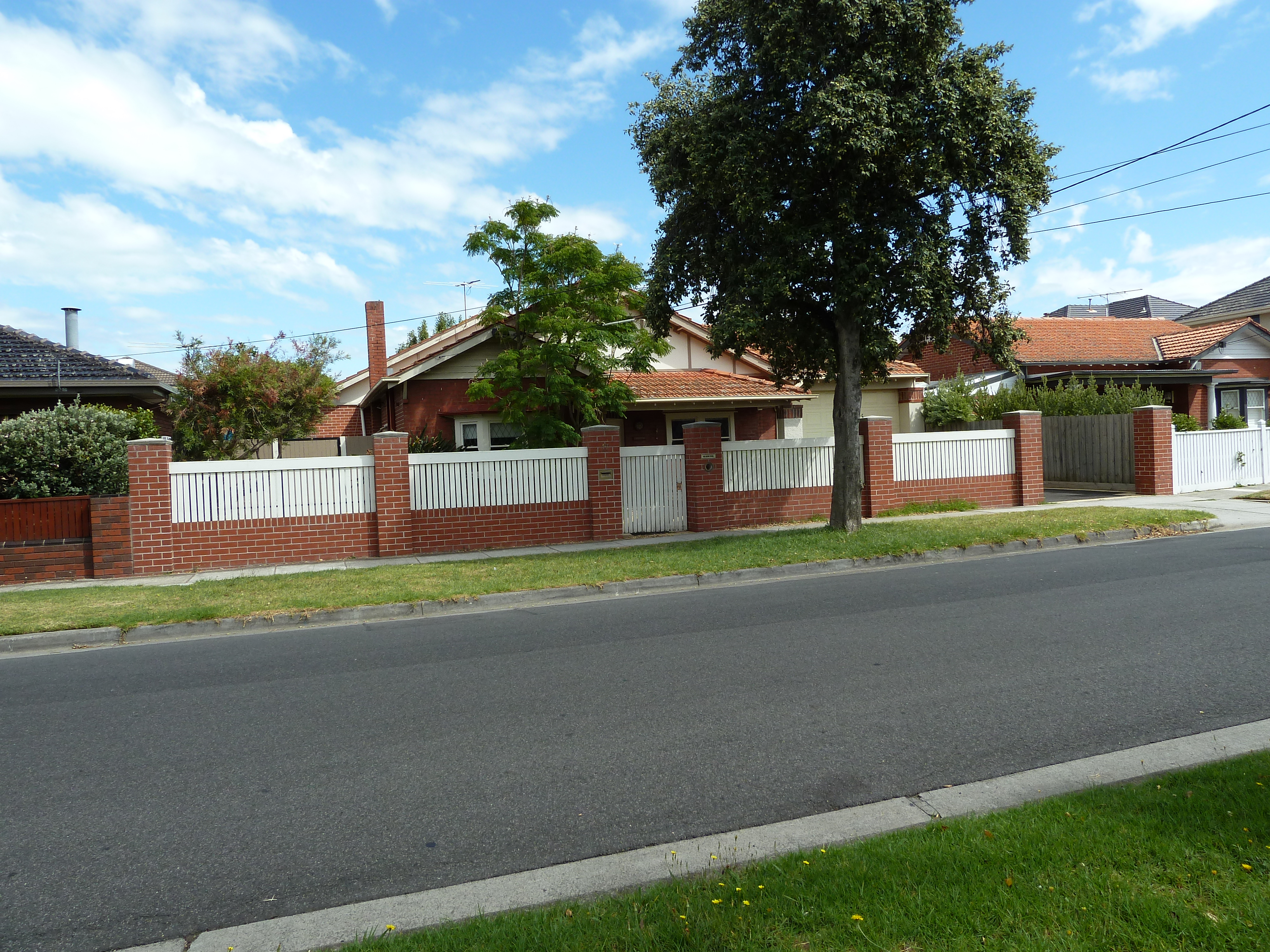
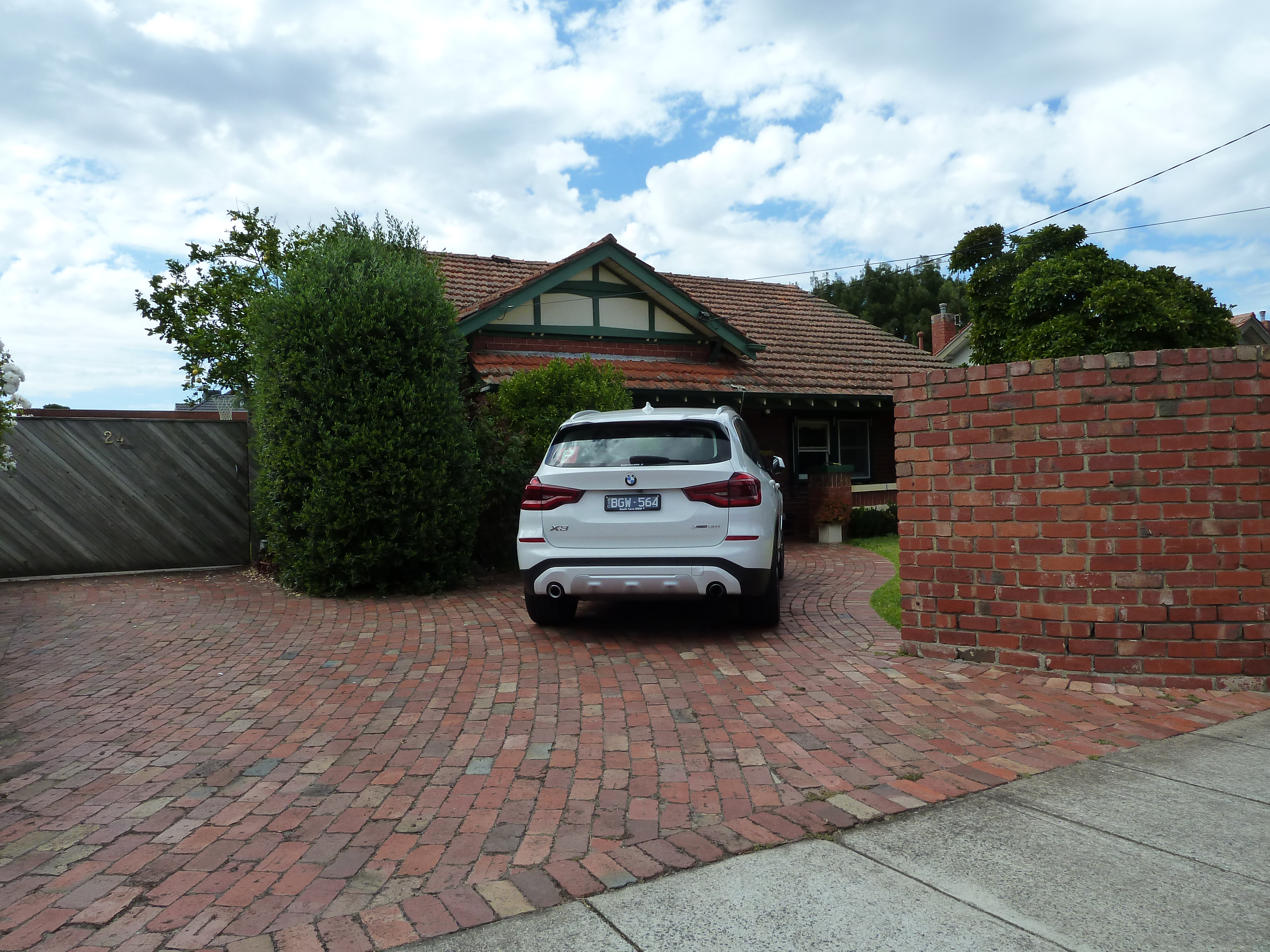
We have visited this street and taken the photographs at the end of this post. Many are beautiful Californian bungalows that if anything, should be under a heritage overlay, and not offered as fodder to developers. Even more disheartening is that we have not been provided with any valid justification as to why streets like Whitmuir are on the chopping block. Remember Bent Street that is now a canyon of apartment blocks? The same could happen to Whitmuir!
We urge all residents, and especially those who reside in these targeted sites, to write to councillors with their views as well as commenting on the so-called ‘consultation’ from the Have Your Say website. Things will only change with massive community opposition. Make your voices heard!
When vitally important decisions are being made, we believe it is incumbent on councillors to proffer statements that are accurate. Everyone is entitled to their opinion of course, but espousing unfounded views and presenting them as ‘facts’ is unacceptable. Even if ignorance is partly to blame for such announcements, it does not absolve councillors from their duty of proper oversight. Their role is to analyse, question, and provide a rationale that will stand up to full scrutiny. This has not been done – especially at the last council meeting.
Two important items were presented at the last council meeting – the draft Housing Strategy and the Caulfield Station Structure Plan. Both items have the potential to dramatically change residential amenity and the environment in Glen Eira and thus affect every resident.
In regard to the Caulfield Structure Plan the draft proposes one height of 25 storeys, and for the MRC freehold land 12 storeys. All heights are discretionary rather than mandatory which of course means that they could ultimately be higher! No urban design evidence, nor overshadowing impacts were provided for this item. Even in the heritage precinct of Derby Road, the proposal is for a discretionary 8 storey limit. This of course begs the question as to why other heritage commercial zones in Bentleigh, Elsternwick and Carnegie were allocated a mandatory four storey height limit. Are we to assume that some areas are more ‘heritage worthy’ than others?
We take particular issue with some of the comments made by Athanasopolous and Zyngier as outlined below:
ATHANASOPOLOUS: on the issue of heights in commercial areas this councillor argued that Glen Eira has little chance of achieving mandatory controls in commercially zoned land and certainly not in areas zoned Activity Centre Zone. Conclusion? – that discretionary heights are better than nothing – thus absolving council for even trying! He went on to challenge anyone to come up with ‘evidence’ that this was not the case when he stated that people: Can’t come up with where mandatory controls have been given for 12 storeys in an activity centre structure plan. People can’t even provide that evidence.
ZYNGIER: basically reiterated this line of argument and said that council has no control over commercial zones.
Both statements are factually incorrect! Other councils have been successful in acquiring mandatory height limits for their commercial strips and are nowhere near 25 storeys as proposed in this draft structure plan. Whilst it is true that ultimately the Minister must sign off on such amendments, the primary question should be: WHY HAVE THESE OTHER COUNCILS BEEN SUCCESSFUL? Clearly councils do have ‘control’ over what they propose and what they pursue or are willing to accept. In Glen Eira, we start from the proposition that worse could be imposed so let’s go for 25 storeys as a starter!
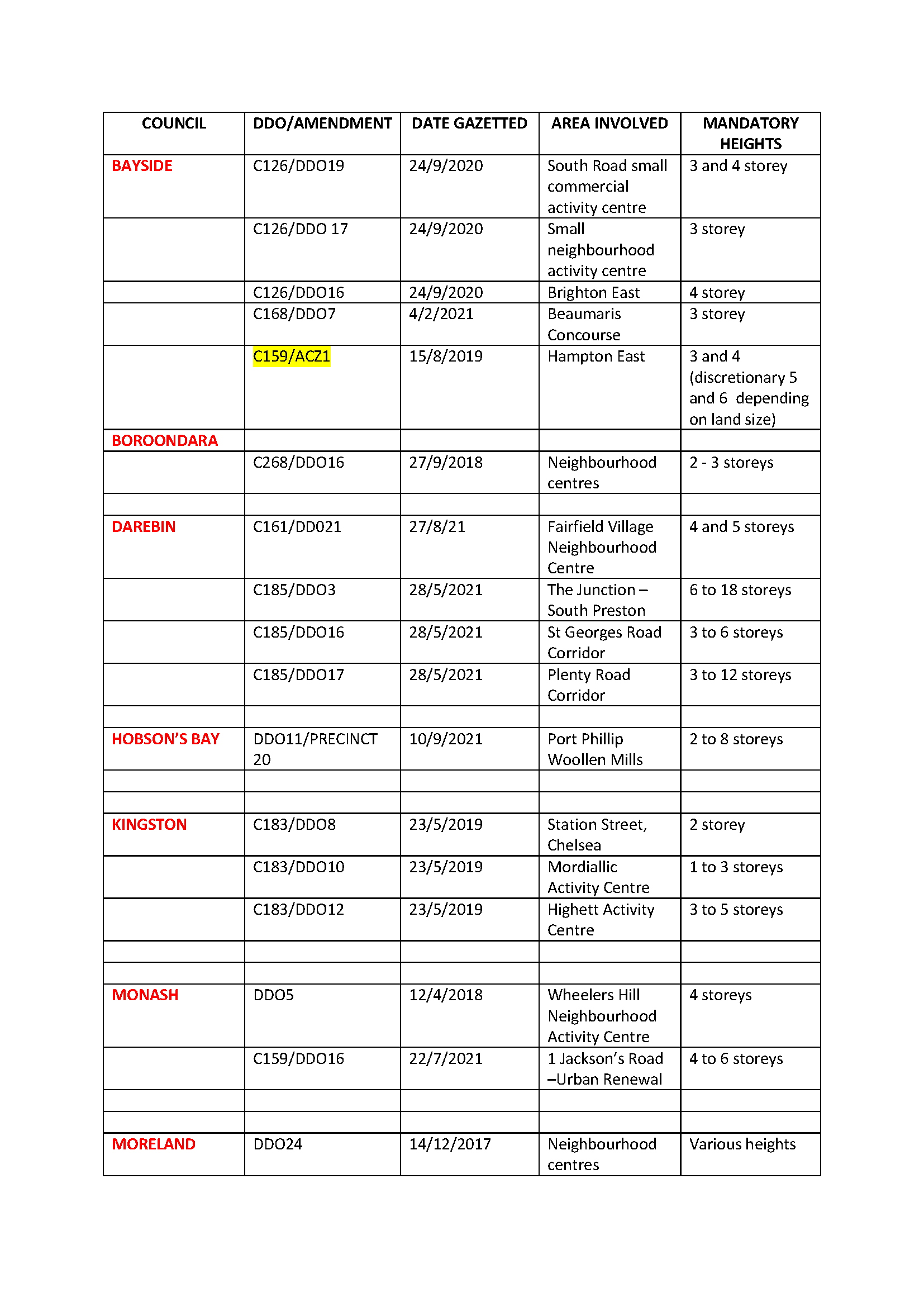
We have taken the time and trouble to go through gazetted amendments from other councils which have all had mandatory height controls enacted in their precincts. All of these are well within the 10 year limit that Athanasopolous asked for. They even include some Activity Centre Zones, where none of the heights come close to what Glen Eira is asking for.
Please consider the following table carefully and then reflect on Glen Eira’s approach and the validity of what some councillors espouse.
As we stated in our previous post, the lack of detailed analyses by those councillors who endorsed the housing strategy is simply mind boggling. Not one of them mentioned or analysed any of the following:
Land capacity out to 2036 estimates that the municipality has scope (available land) for 50,000 net new dwellings. Housing projections state that all we need are approximately 13,000.
They simply accepted the assumption that more dwellings means greater affordability.
Removing the mandatory garden requirement will be ‘compensated’ by the landscape requirements – which of course aren’t specified in any document. All that we have is waffle and generalisations.
How increasing site coverage in the NRZ will ‘fit in’ with the climate emergency, urban forest strategy, etc.
By way of contrast, the best summation on the evening came from Esakoff. We have uploaded her statements and urge all residents to listen and consider what this means.
To further illustrate what is in store, here is part of the Housing Framework Plan. We’ve chosen the GRZ areas in East Bentleigh. All the streets presented in the darker orange now find themselves in the Substantial Change Area 2. This means: no mandatory garden requirement; tree canopy retention only where ‘practical’; reduction of rear setbacks and potentially lessening of onsite parking requirements. In other words, cramming more and more into these sites.
Finally, Athanasopolous cited the changes as only impacting a ‘small’ amount of properties. A public question asked on Tuesday night provided the answers as to the number of sites that will be affected by these proposals. In the GRZ Substantial Change Area 1 the answer provided was 7,624! The sites impacted in NRZ were said to be 3,075. That’s a grand total of 10,699 that will be severely impacted by the proposed changes. Glen Eira currently has 65,000 residential properties, but far less sites – since many are multi-storey containing many apartments. This is also true for the current dwelling proportion in GRZ but at a lower scale than the commercial areas. Even accepting this, we still estimate that roughly 15 to 20% of Glen Eira residents will face potential developments without the necessary strategic justification. Furthermore, if we assume that only 10% of these 10,000+ sites will increase their net dwellings by one (ie from 2 dwellings to 3 dwellings) that equates to another net 1000 plus dwellings. This is of course a very conservative estimate since the prognostications for ‘take up’ far exceed 10% and the likelihood of only a one net dwelling increase is again highly conservative. These proposed changes alone could deliver thousands upon thousands of net new dwellings with absolutely no guarantee that they will be cheaper, will assist in increasing our tree canopy, or assist in fighting climate change.
These figures also need to be seen in the context of what else is planned for Glen Eira. We should add in another 3000 at least for East Village, another 4000 under the Caulfield Station structure plan as stated in the Charter housing analysis. None of these account for what else might be in the pipeline throughout Glen Eira.
The pro-development agenda of these 5 councillors and this administration is continuing to destroy this municipality!
Our plaudits must go to Esakoff, Parasol, Cade and Szmood following last night’s council meeting. These are the four councillors who voted AGAINST the current draft Housing Strategy and highlighted the issues that were unacceptable with what was being proposed. Sadly, the pro-development lobby (aka, Athanasopolous, Magee, Zyngier, Pilling and Zhang) carried the vote 5 to 4.
It’s not simply that the latter voted in favour of putting the housing strategy out for consultation. It is that their arguments in favour of the draft were superficial, misleading, inaccurate, and deliberately avoided mention of the most contentious aspects of the draft. All of this leads us to question whether any of these 5 councillors actually bothered to read the relevant 589 pages. We doubt it!
Cr Zyngier didn’t even utter one single word about the CONTENT of the draft or its recommendations. His focus was improving ‘consultation’ recommendations. All terrific, but how about an analysis of what is being proposed and commenting on those things in order to provide residents with the rationale behind the vote? Magee of course used the old heart strings ploy of ‘where will my children live’ totally ignoring the fact that the consultants provided their estimates of an existing land capacity for 50,000 net new dwellings when our projected housing needs were 13,000 by 2036. Pilling and Zhang merely mumbled their way through the obvious – again without once mentioning the potential negatives.
Athanasopolous was the major culprit. Either he has never bothered to read the Glen Eira planning scheme in order to understand what is currently permitted in NRZ zones, or he follows the strategy of never let the truth interfere and derail the spin. We will provide an indepth commentary on his efforts in our next post. At best, they displayed sheer ignorance. At worst they were deliberate attempts at deception and camouflage.
In contrast, the opposing councillors highlighted the actual detail contained in the draft and the impacts these proposals would have on residents and their amenity in the years to come. They also questioned the underlying assumption and justification for the proposed rezonings and schedule changes – ie build more and there would magically be housing affordability!
When something as important as this document is up for decision it is incumbent that all councillors consider the full implications. Residents need to hear the reasoning behind the votes. They need to be convinced that something which is going to affect their lives has been given due consideration and is not a vote that follows any state or federal political party agenda. Most importantly, they need to be convinced that councillors have actually read what has been put in front of them and questioned vigorously the data, the conclusions, and the assumptions. This we maintain was not done by the 5 councillors in question.
Watch this space for a detailed analyses of what happened last night.









 Glen Eira Debates