GE Governance


This item must surely win the award for obfuscation and keeping everyone in the dark. Here we have a 2 page officer’s report proposing the removal of the Commercial Centre Policy from the Glen Eira Planning Scheme. One page is fully taken up with the processes involved in seeking an amendment – ie. permission to advertise, submissions, perhaps a panel, etc. The first page is nothing more than waffle, and we believe a deliberate attempt to disguise what is really going on and the motives behind such a move. When any amendment is proposed, residents have every right to expect the following:

  • Clear, comprehensible, and comprehensive information as to the reasons which justify the amendment. In this case, all the rationale states is that the original policy dates from 1998 and is ‘redundant’. Not good enough we say. What’s wrong with updating and improving a policy rather than removing it entirely?
  • No explanation is given as to the potential ramifications if the policy is removed. What will it mean to traders? To residents? To the neighbourhood? To those little shopping strip centres that are already struggling against the big ones, Chadstone and now the C60 stores? Where are the statistics, planning strategies – in short, where is the evidence that this policy is now ‘outdated’ as claimed and that the municipality will be better off without Clause 22.04 remaining in the Planning Scheme?
  • We also wonder whether the removal of the Commercial Centres policy is simply one way of declaring open slather for all  forms of (residential) development and council washing its hands of all strip shopping centres except for the big three – Centre Rd, Carnegie & Elsternwick. So much for enhancing, developing, and maintaining local strip shopping! So much for looking after this sector of the community!

If councillors pass this as stands then we believe they are again not fulfilling their obligations as councillors. They must question in depth this proposal and not simply sit there and rubber stamp everything that is stuck under their noses. Such a report should never be accepted. It is bereft of detail, logic, and argument. It remains a ‘report’ in name only and certainly a below par effort. But then again, perhaps this is the objective – to get something through with as little fuss, furore, discussion and debate as possible? Rule by stealth perhaps? Make up your own mind when you read these paltry few pages.

We urge all readers to pay careful attention to the various Records of Assembly and the range of topics that are discussed behind closed doors, in secret, and which never seem to make it into the council chamber. The Pools Steering Committee Meeting Minutes is of the same ilk. For example: for months and  months now Cr. Lipshutz has been spruiking how wonderfully well GESAC is going –  apart from rain delays it seems. Only at the last council meeting was it  disclosed that tiling was somewhat behind schedule. Now we have mention of ‘liquidated damages’. According to Wikipedia, the definition of this  term is:

“Liquidated damages  (also referred to as liquidated and ascertained damages) are damages whose  amount the parties designate during the formation of a contract for the injured  party to collect as compensation upon a specific breach (e.g., late  performance).

en.wikipedia.org/wiki/Liquidated_damages

Do these damages apply to the tiling or are there other aspects of this extravaganza that are not going all that well? And how much are  the ‘damages’ actually worth? Are we talking a paltry few thousand or do the  figures run into hundreds of thousands – thereby signalling some major hiccup and placing many of Lipshutz’s early claims into the very doubtful basket. Of  course, it would be too much to ask that council is upfront and fully  forthcoming on these issues!

Tang also appears to have great difficulty in showing up to meetings – he missed the August 2nd August, 9th  & the 16th August meetings!

Councillor Assembly for the 9th August includes the  following: “Confidential – ‘contractual’, ‘legal advice’ and ‘may prejudice the  Council or any other person’ which relates to GESAC. Cr Magee – access to two  other legal opinions and his conversation with the Ombudsman. Section 3 of the  Whistleblower Protection Act and S. 76D of the Local Government Act.”

Two things to notice: (1) more money is now being spent on lawyers and the GESAC allocations stuff ups and (2) the whistleblowers act does not enforce the stipulation of ‘confidential information’ whilst the Local Government Act does. So what has all this to do with Magee? Is he being read the riot act by Newton and Burke and accomplices over his support for the McKinnon basketballers? We can only speculate of course, since all of this is carried on behind closed doors. And again, we are expected to believe that NO DECISIONS are being made – only continual straw votes it would appear!

We do however discover that on the 23rd August there WAS a draft submission  to the Ministerial planning Review – it even went to 8 pages. Again we ask: where  is it? Why isn’t this public? Why do such important discussions and decisions which impact on the entire community only occur behind the closed doors of Assembly Meetings? If other councils can publish their submissions and have councillors debate the drafts, then the question must be asked as to why Glen Eira is again the odd man out?

Last but not least there is  again an ‘OH &S’ matter where Penhalluriack leaves the room. We can only  assume that this is again related to Newton’s bullying charges. Oh what  wonderful games are played out in these meetings and how little the public is  informed as to what is really going on and how their monies are being spent.

Below are two extracts from the Auditor General’s Report that are critical of Whittlesea and Hepburn. It’s curious that: 

  • Whittleseas’ acquatic centre comes in for special mention, yet there is not one single word about GESAC in the entire report. Readers will remember the original cost estimates for GESAC and what we’re now saddled with. Further, there is no mention of the additional $450,000 for a car park nor any investigation as to why this wasn’t included in the original ‘business plan’ or design.
  • One would reasonably expect that when a municipality binds itself to a $40 million plus infrastructure project that it would at least deserve one sentence in any report. The fact that there is total silence, makes us scratch our heads and wonder what on earth is going on?
  •  Hepburn also comes in for criticism about its site selection and the additional funding that was required. We should keep in mind the Caulfield Park relocation of ovals as a result of the pavilion construction. Again, not a word from the Auditor General on this little ‘alteration’ after the fact.

Figure 3A

Redevelopment of Thomastown Recreation and Aquatic Centre – Whittlesea

Whittlesea’s redevelopment of the Thomastown Recreation and Aquatic Centre was adversely affected because a robust business case reflecting the project’s final design was not sufficiently developed.

A feasibility study was completed in January 2007 that identified the project’s need, various delivery options and an initial budget estimate of $17 million. However, the design of the preferred option was not sufficiently developed at the time construction started in mid-November 2008. The decision to start the project in the absence of a robust business case was not consistent with good business practice.

The design was changed substantially prior to, and during, the construction phase following consultation with various stakeholders. The ongoing design changes meant that the initial feasibility study was no longer relevant as it did not examine the impact of these changes.

The design changes led to the project’s budget being revised to $24.6 million, and to a dispute and negotiated financial settlement with the contractor who was paid a further $570 300 in additional costs incurred as a result of the incomplete design at the start of construction.

The project is presently around $12.9 million (75 per cent) over the initial budget and $5.3 million (21 per cent) over the revised budget.

Figure 3B

Construction of elderly persons units – Hepburn

Hepburn’s decision to invest in the construction of three elderly persons units without a business case resulted in it committing $591 000 in its 2010–11 capital budget to a project that it later discovered was not feasible on the selected site.

The risks and costs associated with the project were not sufficiently considered in identifying the preferred option, resulting in the need for an additional $150 000 for unforeseen remedial works on the chosen site rendering the project impractical.

The initial proposal was not soundly based, and to date Hepburn has spent $15 000, including staff time, on the original plans.

Hepburn has since decided to carry forward the project’s budget into 2011–12 and to explore alternative sites. A comprehensive business case developed at the outset could have averted this situation.

Council  biometric scanning plan slammed

September 8, 2011 – 11:35AMA digitial scanner used to collect fingerprints.

A union has slammed as an invasion of privacy a move by a local  Melbourne  council to introduce biometric scanning for library workers.

Under  the plan, Monash City Council would require library staff to provide   DNA samples in order to scan workers’ veins using pattern recognition   technology when they clock on and off for a shift.

Australian  Services Union (ASU) assistant branch secretary Igor Grattan says  members have expressed concerns about the security of personal  information and  its storage.

He said swipe cards or PIN codes are preferable methods for workplace  timekeeping or security purposes.

“It’s  got to be easier than storing people’s personal information,  especially  when we don’t know what it all means in the long term,” Mr Grattan  said. “You’ve just got to take a deep breath and think about people’s privacy.”

Mr Grattan said his members have been advised not to comply with the  plan.

Victorian  Privacy Commissioner Helen Versey said in a statement any  organisation  considering the introduction of biometric technology should  conduct a  thorough assessment of privacy implications.

“The collection of  biometric data by the Victorian public sector, including  local councils,  is subject to the Victorian Information Privacy Act 2000 and   organisations proposing to introduce such a system would be well advised  to  seek advice from my office,” Ms Versey said.

Comment is being sought from Monash City Council.

Read more: http://www.theage.com.au/technology/technology-news/council-biometric-scanning-plan-slammed-20110908-1jyok.html#ixzz1XN1DRRns

COMMENT:

It would be fascinating to know exactly how much and what kind of information councils collect about their residents – especially in Glen Eira. Rumours have continually cropped up that in this municipality a tight watch and dossier is kept on:

  • individuals
  • blog sites
  • letters to the editor
  • complaints
  • correspondence

In addition, we wonder whether the following technologies are employed:

  • reverse telephone directories which identify callers (even if they wish to remain anonymous)
  • website tracking
  • files on individuals (usually classified as ‘activists’)

All of the above can of course be explained away as enhancing ‘business processes’ such as improving customer service, improving website navigation, legal obligations, and so on. Wouldn’t it be terrific if residents knew exactly whether or not the above tactics were being employed and, more importantly, for what purpose? Now that would be real transparency and openness!

The question of whether Andrew Newton will have his contract renewed, or whether the position will be advertised, will be answered shortly. If the position is to be advertised, then Councillors must decide in October.

Newton has presided over a traumatic period in Glen Eira’s history. He has been the common denominator in 3 Municipal Investigations, (and we learn that there is another one in progress). Numerous incidents have also revealed how this council remains divided and how little trust or goodwill, exists between administration and councillors. When we look over the history of Newton’s reign, these have been the defining characteristics with each group of different councillors. He is obviously an individual who incites either loyalty or condemnation. In our view, this history does not augur well for a municipality that requires strong leadership and commitment from all.

The past year has seen countless ‘stuff ups’ in a whole variety of areas. GESAC allocations, and then the fiasco of having to increase car parking space; next there’s the whole issue of the C60 and centre of the racecourse; various ‘clerical errors’ have even been admitted and to top it off claims of harassment and bullying against Penhalluriack. None of these events show an administration functioning well and on top of its game. Nor does it reveal an administration that is working in unison with its entire group of councillors.

In our view, to reappoint Newton is to short change the Glen Eira community. Surely it is no coincidence that since his arrival this council has been embroiled in continual governance issues including one sacking. How much more does the community have to endure? It is time that new blood and an entirely new vision was brought in to manage Glen Eira. It’s also time that a new culture that acknowledges the importance of accountability, transparency and openness was created and fully implemented. These principles have been the casualties in the past decade.

Pilling has already gone on record that the position should be advertised. We can only hope that other councillors follow suit. The slate must be wiped clean and a new administration brought in that embraces diversity of views, accepts challenges, and accords the community the respect it deserves.

Council’s  heritage decision panned

Jason Dowling

September 6, 2011
A COUNCIL decision to reject heritage protection for three homes in Caulfield  South – one owned by the mayor  – has been  rebuffed by an independent planning  panel.

Glen Eira councillors ignored the advice of  the council’s own heritage and  planning advisers, and additional advice from independent heritage experts, to  extend heritage protection to all three homes.

In a sharp critique of the council’s decision to push to have the three  maisonette dwellings on the corner of Hawthorn Road and Seaview Street not  heritage protected, the panel found ”there should be good reasons when officer  and expert advice is disregarded but none were provided in this instance”.
When asked by the panel why it had not accepted the expert advice, the  council stated that ”council may form its own view”.The heritage dispute arose when the council discovered a heritage planning  anomaly for the three dwellings.

While the entire building containing the three dwellings was included on a  heritage planning map, only the address of one of the three individual dwellings  was recorded for heritage protection.

One of the two dwellings (2B Seaview Street) in the building not currently  heritage protected is owned by Glen Eira mayor Margaret Esakoff and her husband,  Jack.

Cr Esakoff has declared a conflict of interest and removed herself from  council meetings discussing the issue.

When council staff discovered the heritage anomaly, they recommended  extending heritage protection to all three dwellings. But Glen Eira councillors  rejected the advice of its own heritage staff on two occasions and voted to  begin a process to remove heritage protection from the entire site.

The matter was referred to an expert planning panel and the panel’s findings  were released publicly on Friday.

The panel’s report recommends the council’s attempt to remove heritage  protection from the building be dismissed and calls on the Planning Minister to  extend heritage protection to all three dwellings.

The panel said it was not provided with any justification to disregard the  view of heritage experts that the  entire apartment building deserved heritage  protection.

Read more: http://www.theage.com.au/victoria/councils-heritage-decision-panned-20110905-1jua1.html#ixzz1X5YPNCID

The Panel Report on proposed Amendment C83 has been released. Below are edited highlights –

The Panel is satisfied that the significance of the entire apartment building supports its inclusion in the Heritage Overlay. The Panel does not support the deletion of HO114. Rather, the Panel recommends a Ministerial amendment to correct the description of HO114 in the schedule to the HO which omitted 2A and 2B Sea View Street in error. This will ensure that the protection of heritage values is taken into account in future planning decisions.

The Panel is satisfied that the Amendment C83 process, including the Panel process, has provided the affected landowners with an opportunity to make submissions with respect to HO114 and for the merits of the Amendment to be evaluated. This addresses the mistake made when notice was given of Amendment C19.

‘In my opinion, all three apartments should be included in the Heritage Overlay. In fact, the rear two apartments are perhaps slightly more intact than the front apartment, as tapestry brick embellishments remain unpainted (these have been over‐painted on the front apartment).’  (Council’s current Heritage Advisor‐ Gabrielle Moylan 27 July 2010)

‘I would agree (with the Statement of Significance) that this apartment block, clearly influenced by the architecture of Frank Lloyd Wright, is unusual in the context of this municipality, and even beyond, and I think individual protection of the site is warranted.” “ Property is significant and will not write any strategic justification for removal of this overlay‘ (John Briggs 15 November 2010)

‘This building justifies the current Heritage Overlay….The two rear dwellings are integral parts of the whole, the building being basically symmetrical on the Sea View Street façade (which is somewhat unusual as side street frontages of such buildings are often simpler). This building is of unusually good quality’ (David Bick 26 November 2010)

‘In my view, both publicly visible facades, while different from each other in composition, are integral to the strong overall design, and hence to the heritage value of this prominent building. I do not believe it would be appropriate to remove the current heritage protection.’ (Dale Kelly 14 December 2010)

‘The site is clearly worthy of heritage controls…further research might be undertaken which would have the likely effect of amplifying the heritage attributes of the place’. (Roger Beeston 14 December 2010)

It was Council’s decision not to call expert evidence and this limited the ability to test at the Hearing the expert advice provided to Council. This does not mean that the views and the consensus opinion of these experienced heritage experts should be disregarded. Nothing was presented to the Panel that would justify setting aside the views of any of these heritage experts.

The Panel accords significant weight to the consistent expert view that the heritage value of the Site warrants the application of the HO. There has been no expert view to the contrary.

Council responded to the query from the Panel about why the Council did not accept the expert advice provided by stating that Council may form its own view. These responses do not support removal of HO114. Planning authorities have a responsibility to ensure that planning schemes have a sound basis. There should be good reasons when officer and expert advice is disregarded but none were provided in this instance.

The Panel does not accept the argument put by Council that removal of HO114 is justified by the fact that one quite different example of development influenced by Frank Lloyd Wright will be retained and all examples would not be lost.

The Sea View Street properties are in a Minimal Change Area, whereas 466 Hawthorn Road is in a Housing Diversity Area, which identifies areas suitable for more intensive housing development. These strategic designations do not override or take precedence over all other planning objectives.

The Panel agrees with ….(objector)… that it would set ‘a dangerous precedent’ if a strategic designation for more intense redevelopment was deemed sufficient justification for removing heritage overlays. The protection of heritage values remains a valid planning consideration in planning decisions. It could even be argued that heritages places make a particularly important contribution to the urban fabric in areas undergoing significant change, such as along Hawthorn Road in the vicinity of the Site.

The Panel was not provided with any justification to disregard the clear view of heritage experts that the significance of the entire apartment building, in its current condition, supports its inclusion in the HO.

The Glen Eira Planning Scheme includes 466 Hawthorn Road in a Housing Diversity Area, which identifies areas suitable for more intensive development. This strategic designation does not override or take precedence over all other planning objectives. Rather, where the Heritage Overlay applies in a Housing Diversity Area, local policy (Clause 22.07) highlights the continued relevance of heritage considerations and makes it clear that development should not compromise heritage values.
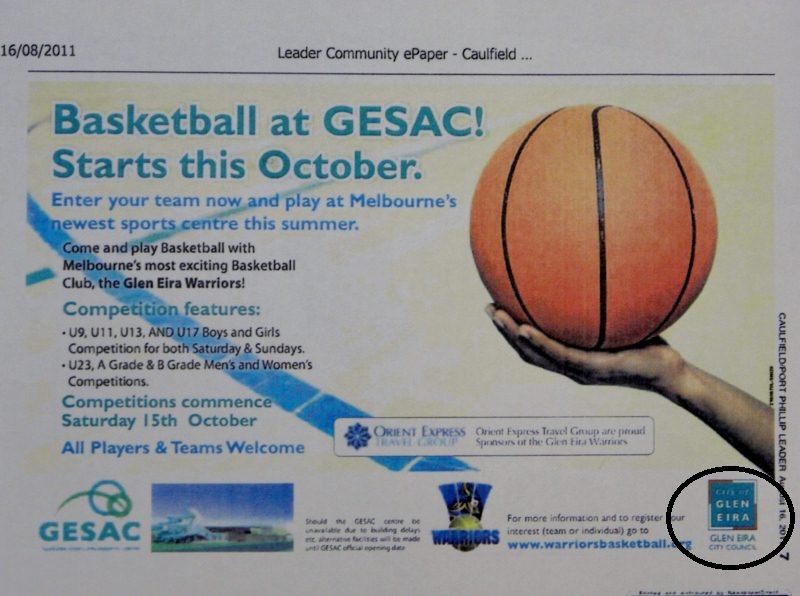
We’ve had a few comments regarding the use of the Glen Eira Council logo in the recent Warriors advertisement in the Leader newspaper. Several public questions were asked on Tuesday night regarding the allocation of basketball courts to the Warriors instead of the McKinnon Basketball Association. One of the questions specifically mentioned the use of council’s logo.

This is an important issue. It’s even more important since council is expending ratepayers’ monies on ‘legal advice’ to sort out the mess. Judging by the in camera items, this issue remains unresolved after weeks and weeks. If this is the case, then answers to the tabled questions are vitally important in terms of transparency and good governance. We are still awaiting the minutes of the meeting in order to cite verbatim the response to these public questions. However, the following is an approximation of what was asked and the response:

To the question of who gave permission for the use of the logo the response went along these lines – (a) Groups using GESAC are ‘expected’ to show the logo and that anyone who receives a grant must also ‘enclose’ the logo

‘Expectation’ is such a wonderful weasel word. Does this mean that the Warriors weren’t ‘ordered’ to use the logo? That their letter of offer even mentioned logos? That by osmosis they realised that this was ‘expected’ since we believe they are not recipients of any grant for GESAC use? It also neatly sidesteps the core of the question – did any individual(s) inform, tell, advise, instruct, insist that the logo be used? If so, then implicit permission was granted without formal council approval and without the issue of who uses the courts having been resolved.

We would also suggest that the appearance of such an ad (with the logo) in effect undermines the very deliberations that are currently ongoing. Any reasonable person seeing the advertisement and the logo, could only assume that (1) the Warriors have the full imprimatur of Council for their use of GESAC and (2) that a decision has already been made. We doubt whether this is the case.

This is what happened at the Panel Hearing yesterday.

  • Chair outlined the rules for the hearing but also noted that she had received an email from council the previous Friday correcting the Housing Diversity information – ie. that this did not apply to Seaview St. The report would be completed in about 4 weeks and Council had to make the report public within 21 days of their receiving it.
  • Council (via a lawyer) made its submission. Powerpoint presentation showing Housing Diversity areas and Minimal change areas. Admitted that report was wrong in that Seaview St is not in Housing Diversity but in Minimal Change Area. Stated that this is a ‘peripheral’ issue and doesn’t have any bearing on the heritage question. Showed photos and highlighted development in area surrounding the property – that is heaps of developments. Also showed photo of another building in Caulfield similar to 466 Hawthorn Rd. Talked about ‘administrative anomaly’ and owners not notified.
  • Officers sought authority to rectify this but councillors voted against recommendation. Said that submissions supporting removal of heritage had argued that building wasn’t ‘sufficiently notable’; building has deteriorated and cost to refurbish is astronomical; ‘restricts development; unfair that people weren’t notified; two objectors to removal and their arguments that this property is worthy of preservation and enhances area; removal would allow development and further traffic congestion.
  •  A planning conference was held and there were two objections one of which was queried because the person lived far away. Chair asked if objectors were notified. Council rep said ‘yes’ but objector at hearing said that no notification arrived.
  • Council rep then argued that council does support heritage but only if the property is ‘worthy’ of heritage protection. In this case council doesn’t think that this property is that significant and thus heritage should be removed. Repeated time and time again that the property doesn’t have sufficient architectural, cultural or social significance. Because of the Housing Diversity then the development of 466 Hawthorn Rd is ‘unnecessarily constrained’. Minimal change area is meant to protect neighbourhood character but allows some development.
  • In regard to objectors, said that no experts were present; no development plans had been submitted; since there are 3 owners then redevelopment would be harder and ‘more complex’. Also a restrictive covenant exists. So objections are ‘premature’ and people don’t have to worry about a 5 storey residential development occurring.
  • Ended up by showing photos of 445 Balaclava Rd (another Frank Lloyd Wright influence) and thus removal of heritage from this site wouldn’t remove Wright’s presence in Glen Eira – even though the Balaclava Rd property is different!!!!
  • Chair commented on the fact that council hadn’t called expert witnesses and that the reports she’d read had all recommended maintaining heritage listing, so why is council considering ‘otherwise’?  Answer was that council thought it was ‘appropriate’ for its view to be heard.
  • Chair asked that if the Panel found that there was heritage significance then the development argument of council would be down the drain and council rep answered that it would be ‘compromised’.
  • Since council didn’t call any expert witnesses and neither did objectors Chair then explained that a report is one thing but that the best way to test the report was to have the expert there for questioning. This would carry ‘greater weight’.

Mayor’s husband lobbied on  heritage listing

Jason Dowling

August 18, 2011

Art-deco maisonette at 2B Seaview Street  Caulfield South.

Art-deco maisonette at 2B Seaview Street  Caulfield South. Photo: Gary  Medlicott

A COUNCIL in Melbourne’s south-east is pushing to reject heritage protection  for three homes – one owned by the mayor – despite four independent heritage  experts and the council’s own heritage adviser recommending the houses be  protected.

A planning mistake recently identified by Glen Eira City Council showed that  while all three maisonette dwellings in the one building on the corner of  Hawthorn Road and Seaview Street, South Caulfield, were included on a heritage planning map, only the address of one home was recorded for heritage  protection.

When the heritage anomaly was discovered, council staff last year recommended  extending heritage protection to all three dwellings. But Glen Eira councillors  rejected the advice and voted to begin a process to remove existing heritage  protection from the entire site.

In a subsequent report to councillors in June, council staff advised  emphatically that the building should be protected. ”Both past and present council heritage advisers have reviewed the site and  concluded that it is worthy of heritage protection,” the report said. ”Council  officers also sought the further views of four independent heritage consultants …  all concluded that the property is worthy of heritage protection.” The state planning department also advised the council it was concerned about  ”the lack of the strategic justification” in removing heritage protection. But the councillors disregarded the officers’ advice and voted unanimously to  send the heritage removal proposal to an independent panel, which is now  considering the issue.

One heritage expert consulted by the council, John Briggs, said he would be  amazed if the panel did not recommend heritage protection for the three  dwellings.

One of the two dwellings (2B Seaview Street) in the building not currently  heritage protected is owned by Glen Eira mayor Margaret Esakoff and her husband,  Jack.

Cr Esakoff, who did not return calls yesterday, has declared a conflict of  interest and removed herself from council meetings discussing the issue.

Jack Esakoff told The Age  they bought the home before the council  identified it for heritage protection. Protecting it retrospectively would  penalise them, he said.

Mr Esakoff said he had lobbied Glen Eira councillors on the issue and taken  them to inspect the building.

But he said he had not discussed the matter with his wife.

”It is something that we haven’t even discussed at home,” he said.

Deputy mayor Jamie Hyams said the councillors also had not discussed the  issue with Cr Esakoff.

”She [the mayor]  has also made the point of not talking to any of us about  it,” he said.

He said the fact that one dwelling was owned by the mayor had not influenced  councillors and it was not unusual for councillors to reject recommendations  from council officers.

The Bracks government sacked Glen Eira Council, including Cr Esakoff, in 2005  after a report found the council was ”very badly governed”.

Read more: http://www.theage.com.au/victoria/mayors-husband-lobbied-on-heritage-listing-20110817-1iy85.html#ixzz1VKkI0FOw

« Previous Page — Next Page »