GE Governance


Quite a few interesting items in the agenda papers for Tuesday night.

Item 9.3 – Visitor Parking for Residential & Mixed Use Developments

No surprises here. The recommendation is to do nothing again and wait until the Integrated Transport Strategy is completed. Part of the ‘let’s do nothing’ justification rests on council’s: acknowledge(ment) that there are planning tools available to Council to manage car parking provision but the implementation of these tools requires a lengthy planning scheme amendment process underpinned by strong strategic justification 

As a result of the above the conclusion is:

The planning scheme sets out a basis upon which to assess car parking provision for new developments in Glen Eira. Given the complex pressures the municipality is facing with population growth and the resultant traffic congestion and parking demand, a more sophisticated approach is needed. This will likely involve a move from the current ‘one size fits all’ approach and one which uses a combination of planning policy and parking overlays.

To do so requires a planning scheme amendment, and the requisite strategic justification. The current structure planning program and the upcoming Integrated Transport Strategy will form an important part in the strategic justification that is required. Once this is completed, more detailed preparation of the necessary planning tools can commence. 

Our conclusion? At least another 2 years, if not more, before any thought of parking overlay amendments are introduced – and this despite the fact that residents have been screaming about the lack of adequate parking for at least the past decade!

Item 9.5 – 282 Centre Road, Bentleigh

This involves an application to extend liquor hours to 10pm Tuesdays & Wednesdays and until 1am on Thursday, Friday and Saturday. There were 17 objections highlighting noise, parking, impact on residential amenity, etc. Council’s ‘solution’ was –

It is also proposed to include a new condition that advises patrons to respect the neighbours and minimise noise when leaving the premises.

We question first of all the legality of such a ‘condition’ and secondly even if legal, how effective it would be? Is this ‘condition’ merely there to placate objectors?

Item 9.8 – Harleston Park Basketball Court 

We’ve now expended further ratepayer funds on a second consultation on the proposed basketball court in Harleston Park. Again no surprises in that the recommendation is basically to ignore the majority of respondents and to go ahead with installing the court. So much for ‘community consultation’!!!!!!!

Item 9.10 – Access to Ripponlea Gardens 

A good outcome in that Glen Eira residents will now have free access to the Ripponlea Gardens area. It will however cost council $250,000 per annum over the next 3 years. We do not bemoan this funding. What should however be acknowledged is the fact that:

  • This issue is not new. Now we learn that the reason it did not come about years ago is because Council’s previous position has been that it would not provide funding.
  • Last council meeting resolved NOT to appoint extra staff to insist on building/parking/construction compliance by developers because the monies had not been budgeted for. The recommendation was do nothing until the funds are possibly made available in the 2018/19 budget. Strange then, that we now have the ability to miraculously find $250,000 for Ripponlea and don’t have to wait for another year before something eventuates!

Finally a few minor points worthy of consideration:

  • The McKinnon Basketball Association’s winning of the GESAC basketball courts allocations until April 2018. This of course begs the question of why they didn’t get their lease years ago and how much the Bob Mann group (now gone bust) might still owe council given that the ‘reason’ for the choice of the latter was that they ‘guaranteed’ up to $98,000 per annum to council.
  • Talk of ‘refreshing’ the Open space strategy but not a word about the promised increase in the levy!
On its Have Your Say webpage for the Virginia Estate development, council tells us –

So far this year we have undertaken three rounds of consultation. The feedback we received for round three clearly stated that the community required more detailed information in order to provide feedback. We have listened to this feedback and the VPA has engaged independent expert consultants to provide advice on a number of topics including urban design, parks and open space, traffic, employment and drainage. (Source: http://www.haveyoursaygleneira.com.au/east-village)

According to this blurb, residents should expect:

  • Comprehensive and detailed reports. The vast majority of these reports are anything but ‘comprehensive and detailed’. Further, why council couldn’t provide the documents in question on its own site instead of referring residents to the Planning Authority site via a link that requires further searching is open to question.
  • That what council writes is unambiguous, accurate and transparent. It isn’t! For example the impression created is that the VPA has engaged (read ‘paid for’) consultants’ reports that are ‘objective’ and ‘independent’. Far from it. The Urban Design report on page 4 states –

MGS Architects Pty. Ltd have been engaged by The Gillon Group, Make Property Group and Abacus Property Group to develop an Urban Design Report to inform the East Village development in Bentleigh East, Victoria. (page 4)

The same is true for Environmental Conditions report –

Senversa Pty Ltd was engaged by MAKE EBRB Dev Nominee Pty Ltd. (MAKE) to prepare a summaryof environmental conditions for the proposed East Village Precinct, Bentleigh East, a 24 hectare parcel of land (with multiple titles) on the corner of East Boundary and North Roads, Bentleigh East (thePrecinct) (page 1)

Reading the Urban Design effort we find that many sections are nothing more than a regurgitation of the original Gillon propaganda, practically verbatim, that came out a few years ago. (By the way, the East Village Gillon site has suddenly disappeared!)

More importantly the VPA website doesn’t include as yet the most contentious documents – ie commercial assessment and social infrastructure. (See: https://vpa.vic.gov.au/project/east-village-strategic-site/p/east-village-key-ideas-objectives/). If these appear in December/January, then that means residents will not have had the opportunity to read, much less digest the so-called ‘information’ before this consultation concludes. Hardly an ideal situation!

As a brief overview of what we’ve gleaned thus far, please note:

  • Of 400 trees reviewed on the site, only 5 are deemed to be of ‘very high value’ and only another 73 are categorised as ‘high value’. Another 150 are seen to be of ‘medium retention value’. Sadly the gate is left wide open when this evaluation is followed by – “If designing around these trees is not feasible or practical, removal and replacement would be an acceptable compromise”. Bye, bye trees!
  • It is now mooted to be at least 2 supermarkets and no mention of size, capacity, etc.
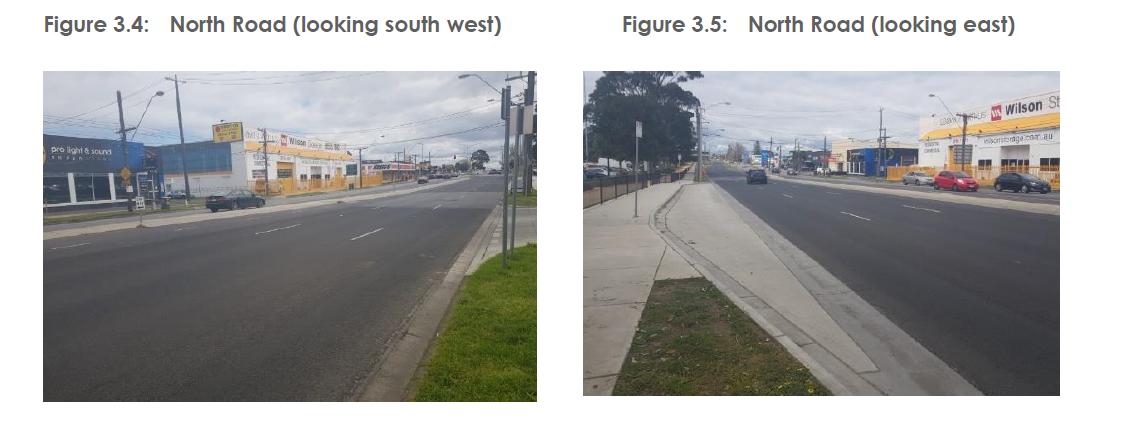
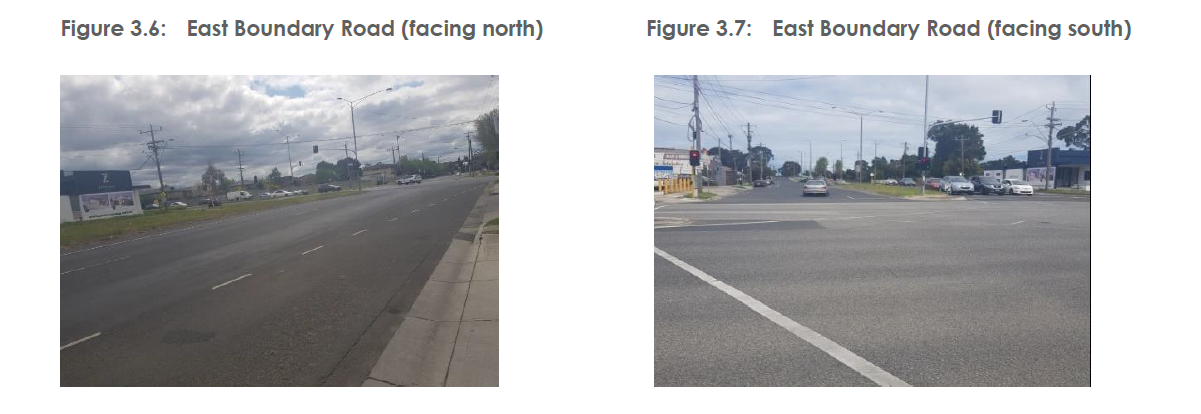
  • The so called traffic report only looks at the current state of affairs – not what it will be like with another 3000+ apartments and hundreds upon hundreds of additional cars clogging the roads. Readers should also take note of the photographs that are supposed to represent traffic conditions on North Road and East Boundary Road. We can only suppose that there has been some good Photoshopping, or that these images were snapped in the middle of the night or daybreak!

There is much, much more that could be said – and we will in ensuing posts. We repeat that in our view this is not consultation. Until residents are provided with realistic data that is justified, explained, and open to debate, then we are simply being lead down the garden path to an amendment that will leave little room for change and community input! It will be a mirror image of Caulfield Village – a fait accompli!

Council has finally published what is supposed to be the latest version of a draft structure plan for Virginia Estate. It is anything but a comprehensive and detailed set of proposals. At the time of writing no other documentation has been forthcoming – ie no traffic report, no economic analysis of impact of surrounding businesses, no urban design guidelines, no indication of setbacks, nothing on environmental sustainability and drainage. In short, another exercise in pretty pictures (all of which fail to present one image of an 8 storey building!) and grandiose, unproven statements that ultimately boil down to spin and more spin.

All that we are told is that the prospect is for another 3000 dwellings. Since this will ultimately become a ‘development plan’ akin to what happened at Caulfield Village, we won’t hold our breaths that the final figure will remain at 3000. Remember that the MRC started out with 1100 dwellings. It is, after 2 approved development plans for the first two precincts now standing at about 2063 dwellings in total. What precinct 3 will come up with is yet to be seen. We do not see why this project will be any different!

Some changes are apparent from the July version, namely – East Boundary Road developments go from 4 storey to potentially 6 storeys; the area of 8 storey development is slightly decreased.

Finally, until council releases all of the necessary documentation, this is anything but a genuine community consultation. People can only comment once they have been provided with the necessary information. This effort fails dismally on this important step!

We’ve uploaded the full document HERE AND PRESENT BELOW THE DIAGRAM OF PROPOSED HEIGHTS.

Today’s published report by the ANU confirms what many residents already know but which our council, hell bent on facilitating more and more (expensive) development, refuses to acknowledge much less accept. As a further example of what’s happening in Glen Eira, the state government’s Planning Permit Activity report for the single month of October has Glen Eira providing permits for another 248 NET NEW DWELLINGS!

Here is the ABC’s report on the ANU study –

House prices based on undersupply myth, ANU says

By business reporter Michael Janda

Australia does not have a housing shortage, with inner-city areas of Sydney, Melbourne and Brisbane some of the nation’s most oversupplied regions, according to new research from ANU.

Key points:

  • Australia has built 164,000 more dwellings than it needs to cater for a growing population
  • Inner-city areas in Australia’s three biggest cities have the greatest oversupply
  • Outer suburban areas and central Adelaide had some of the most significant housing shortages

The analysis estimates the nation’s housing oversupply at 164,000, or 32,000 if the significant increase in unoccupied dwellings is excluded.

The study by associate professor Ben Phillips and researcher Cukkoo Joseph from the Australian National University shows that between 2001 and 2017 Australia built more homes than it needed to house the growth in population over that period.

The academics’ findings tally with other recent research showing that Australia has a moderate housing oversupply.

However, this research used a relatively sophisticated methodology that accounted for demographic changes.

Additionally, it accounted for an increase in people residing in “non-private dwellings” — such as student accommodation or nursing homes — that are often excluded from housing supply-demand analyses and tend to exaggerate an apparent housing shortage.

This report has also gone below state-level analysis to regional calculations.

It found that the inner-city area of Sydney had the nation’s largest housing oversupply, at just under 6,000 dwellings.

That was in contrast to areas in the mid and far-west of Sydney, which generally had moderate undersupply, as did Wyong on the Central Coast.

Inner-Brisbane had the nation’s second largest oversupply of around 4,500.

Melbourne CBD and surrounds had the fourth highest oversupply of just under 4,000 excess dwellings.

Outside the inner-urban areas, where oversupply was mainly driven by the nation’s record high-rise apartment boom, the other main areas of oversupply were in regional areas, particularly those exposed to the resources sector where the mining downturn has caused populations to shrink.

While these mining areas had generally witnessed large property price falls, Mr Phillips said some of the other oversupplied areas had actually experienced strong price growth.

“We haven’t found a particularly strong relationship between the balance of supply and demand and house price growth,” he told the ABC.

“We did find a very small correlation, but it was less than 10 per cent, so what that tells us is that there is perhaps some impact from housing supply but, by and large, what’s driving house prices in Australia, particularly in our capital cities, is a whole range of other factors.”

Housing boom story ‘falls over’ in light of oversupply

The significance of this finding is that increasing housing supply by itself is unlikely to put significant downward pressure on prices.

Given that increasing supply has been the almost exclusive housing affordability focus of the current Federal Government and most of its state counterparts, Dr Phillips said it is no surprise that affordability has not improved.

“What this research shows is that that’s not necessarily going to be as helpful as what many would hope,” he said.

“Perhaps what it actually means is that we should be focussing our attention more on the demand side of the equation.”

Mr Phillips said that means looking at whether interest rates have been too low for too long, and also reviewing “generous” tax breaks for property investors, such as negative gearing and the 50 per cent capital gains tax discount.

There’s been an important assumption that’s been made – not just by the Reserve Bank but also by government in general – and that is that to a certain extent low interest rates are justified in Australia, and the impact on house prices is justified, because we’ve got a so-called housing shortage,” he said.

“That supports house prices growing, it suggests there are fundamentals that are driving house price markets, so it’s not necessarily loose monetary policy that’s driving that.

“But, if our findings are correct in that actually we’ve got a housing surplus, then that argument does actually fall down somewhat.

“It is concerning that without the housing shortage you don’t actually have a lot of basis for the house price growth.”

Although, Mr Phillips also pointed out that Australia’s housing surplus was much smaller than markets such as Ireland and Spain that experienced dramatic home price collapses during the global financial crisis.

Source: http://www.abc.net.au/news/2017-11-20/house-price-growth-based-on-undersupply-myth-anu/9167688

The Davis motion to revoke the Ormond Tower Amendment was passed in the upper house today. The vote was 21 for and 16 against. The Greens voted with the Liberals.

We’ve uploaded the document HERE. Please turn to page 7 to start reading – that is, if you have the stomach for the political games on display here from all sides!

By way of summary here is a list of points –

  1. All seemed to believe that council’s position on eight storeys had community support – that council had in fact ‘consulted’ with its residents!
  2. Hypocrisy all round – as pointed out from both sides of the political fence
  3. Asher Judah’s previous role on the Property Council highlighted by Labor
  4. Nick Staikos’ silence and no such developments proposed for Bentleigh & McKinnon seen by the Libs as protecting a marginal seat. (Seems that Council is doing the govt’s dirty work on this one via their draft structure plans!)
  5. The total inconsistency of the Greens – on the one hand arguing that 13 storeys is too high for a Neighbourhood Centre and this would be even higher than what exists in the Urban Villages, but then arguing that 8 storeys is fine!

The level of debate that exists in our parliaments and council chambers is frankly appalling. The only winners are lawyers and the development industry. Certainly not communities!

Property Council attacks opposition for seeking to block controversial Ormond tower

The Property Council of Australia has accused the state opposition of manufacturing investment uncertainty for politician gain, as the party seeks to block a controversial 13-storey tower planned for the top of Ormond train station.

The Andrews government has approved plans for Ormond’s first high-rise – a 233-apartment tower above the station on North Road – that is set to dwarf surrounding buildings.

It was opposed by local residents and Glen Eira Council, which pushed for an eight-storey structure, but was approved by a planning panel in March for 13 storeys and supported by Planning Minister Richard Wynne who outlined proposed changes to the Glen Eira planning gazetted last month.

But the project could now hit yet another roadblock as the opposition moves to disallow the proposed amendment in the upper house on Wednesday.

If the opposition is successful, this would take the project back to the drawing board, potentially unravelling an extensive planning process.

The opposition would need the support of the Greens or the full crossbench to halt the development.

The Greens are yet to form a position, while Vote 1 Local Jobs James Purcell and Australian Conservatives’ Rachel Carling-Jenkins said they were undecided.


The Sex Party’s Fiona Patten also said she was undecided, but was open to hearing the opposition’s arguments in Parliament. The two Shooter, Fishers and Farmers MPs did not respond to calls.

Opposition public transport spokesman David Davis said he was not opposed to “sensible value capture”, but described the tower in the low-rise area as “inappropriate planning”.

“The opposition is deeply concerned with the government’s approach to its massive and inappropriate tower in the local Ormond shopping centre,” said Mr Davis.

“The opposition supports sensible transport orientated development but does not support riding roughshod over local communities as occurred in Ormond.”

The Coalition has also flagged another revocation motion of the controversial Markham Estate – 1.4 hectares of prime Ashburton land the Andrews government wants to develop for both private and public housing.

Both of these motions have been slammed by executive director of Property Council Australia’s Victorian branch Sally Capp​, who accused the opposition of creating planning uncertainty to benefit their own political purposes.

She urged other parliamentarians to reject Mr Davis’ proposals.

“This is not a political game,” she said.

“We are disappointed, concerned and frustrated. One of the main things that really drives affordability and supply of housing is planning certainty and these motions against Ormond Station and Markham Estate … will throw everything up in the air.

She said the project was a “poster child” for urban property development, “at a time when we absolutely have to address more housing supply in the middle ring”.

“Urban density in places that are close to jobs, public transport and other services will bring jobs into the area in terms of building, construction; it will bring new opportunities for the local community in terms of the sort of amenity it is going to offer.”

Mr Davis’ moves come despite Opposition Leader Matthew Guy approving thousands of apartments in Melbourne’s CBD when he was planning minister – including in what he claimed was first 100-storey building in the southern hemisphere – earning him the moniker “My Skyscraper”.

In 2014, he approved a 31-storey tower in South Yarra, despite Stonnington Council’s preferred heigh limit of 13 storeys.

Public Transport Minister Jacinta Allan said said Mr Davis was a “loose cannon” who was “threatening jobs and investor confidence”.

“The Liberals spent four years selling Melbourne’s skyline to the highest bidder, and now they want to play petty politics with a vital project that delivers safer streets, more trains and new homes,” she said.

Glen Eira mayor Mary Delahunty​ said the council engaged experts to decide on the appropriate type of building for the area, and while she believed it would still be too high, the community now wanted certainty.

“It would be disappointing if we see this drag on any longer, and still have the same outcome. It is being used as a political football and that’s not fair to the residents, they need to know what’s going on in their neighbourhood,” she said.

The development will have street-level retail, and office and apartments above the station that was revamped under the government’s signature $6.9 billion level crossing removal project.

Source: http://www.theage.com.au/victoria/property-council-attacks-opposition-for-seeking-to-block-controversial-ormond-tower-20171114-gzkuqm.html

We admit that we are not statisticians, planners, nor demographers. We’re just ordinary residents with some modicum of intelligence trying to understand the inconsistency and unexplained assumptions in so much of council’s data.

Council admits to basing its current planning on prognostications about future housing needs. They are basically working on a formula which states that roughly another 9000 net new dwellings are required by the end of 2031 which becomes an average of 600 per year – totally ignoring of course the fact that for the past 3 years at least this figure has been close to triple!

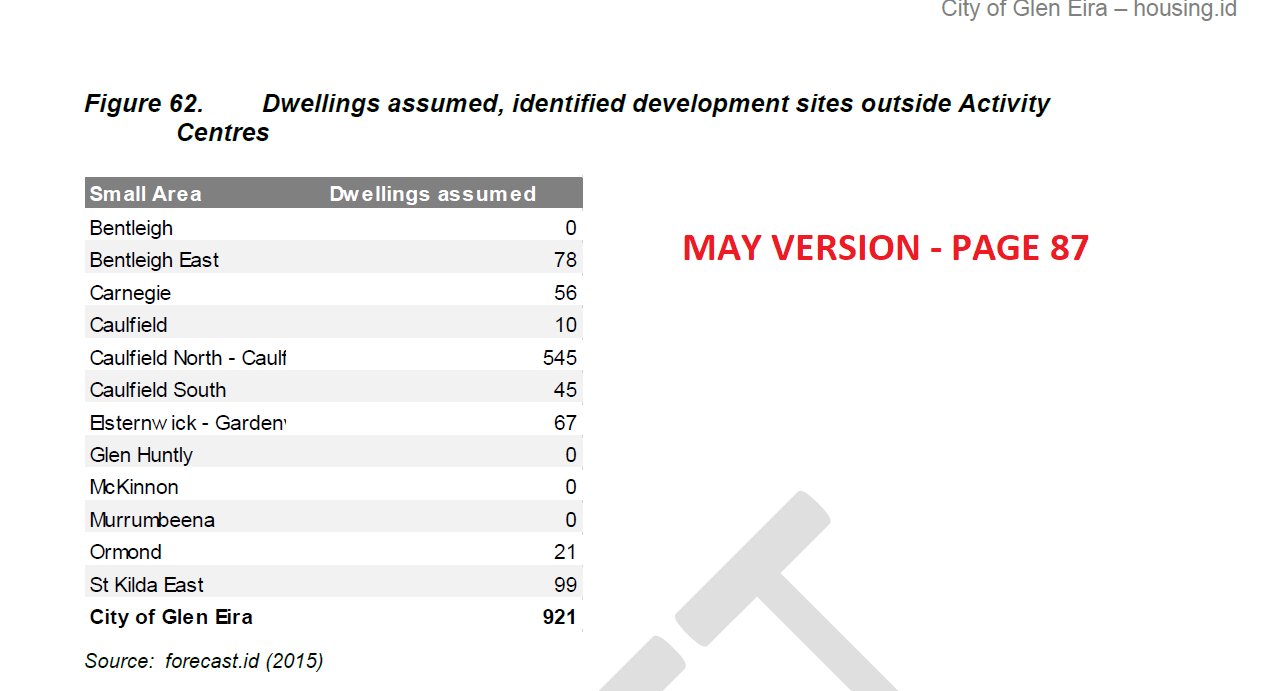
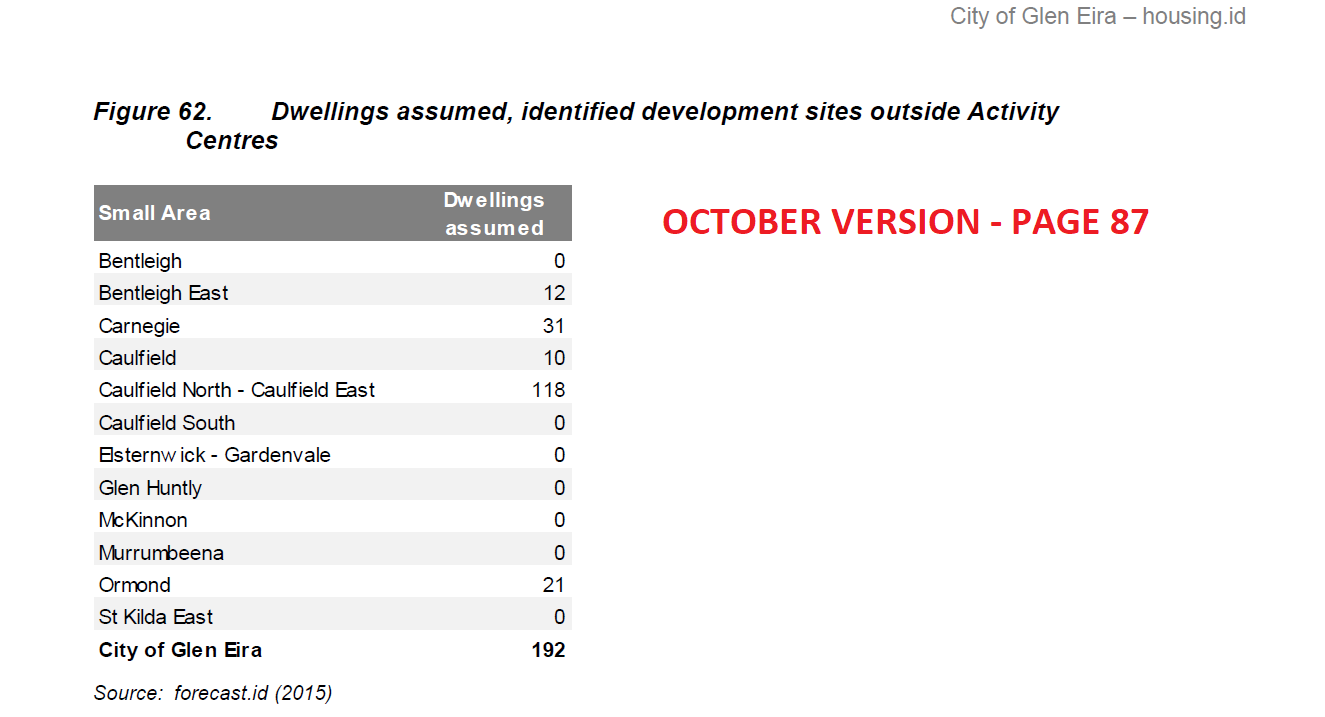
Confounding the analysis even further we find that figures over a period of 5 months are indeed very ‘flexible’ – again with no explanations proffered. Below are a couple of screen dumps from the Housing Id reports. The first one is dated as May 2017 and the second one is dated October 2017.

When comparing these two sets of figures, please consider:

  • The criteria for both sets of figures are identical (ie 2015) – so why the difference?
  • The ‘study areas’ are identical
  • Since nothing has changed in the planning scheme (ie no new amendments apart from Wynne’s VC110 and those applications coming in post VC110 are still to be decided) – why the difference?
  • If we accept 500 for Caulfield Village as now developed, then why not add in another 1000 plus as ‘development sites’ for the rest of Caulfield Village?
  • ‘outside activity centres’ would basically mean minimal change areas. Have we really had major multi unit development so that in 5 months we find Bentleigh East for example going from 78 sites down to 12?

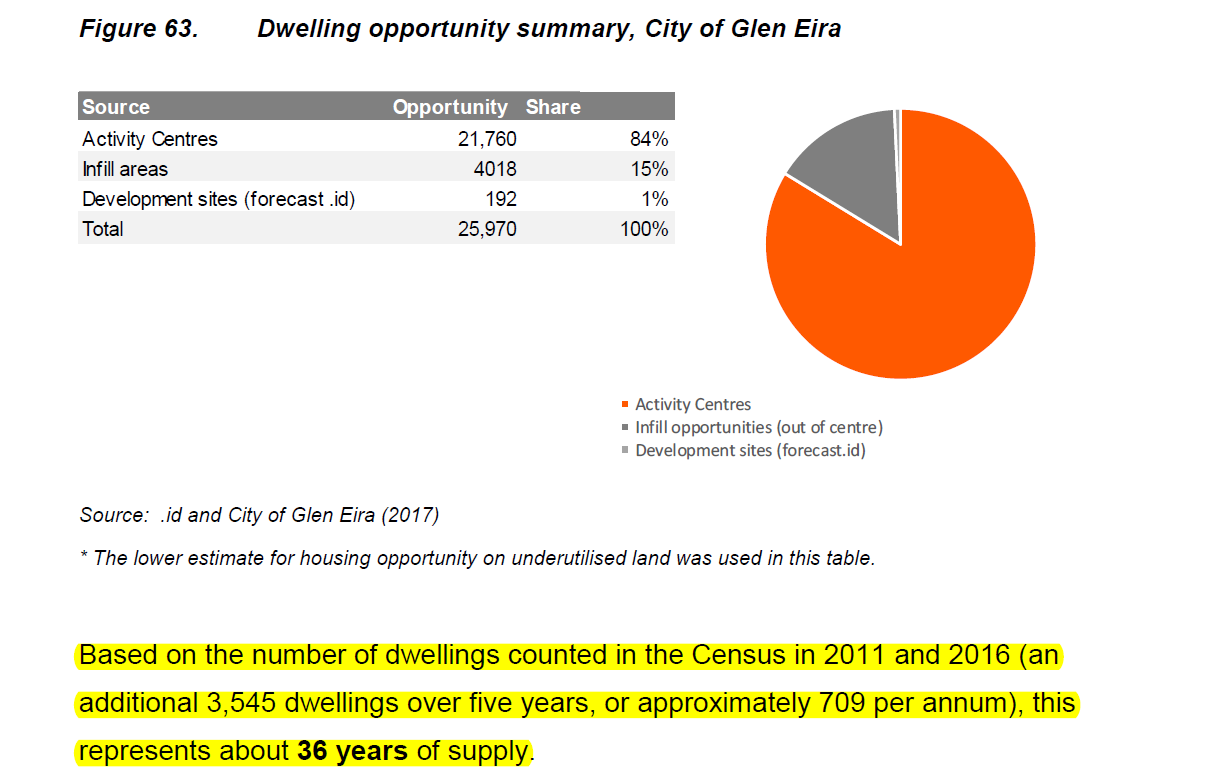
The most questionable aspect of all the above is to be found in the differing May and October conclusions. Note that we’re told that there is capacity for 4018 dwellings as ‘infill capacity’. In May this was given as only ‘outside’ activity centres. The October version figure is identical. So what’s happened to all those potential areas outside the expanded activity centre zones? Or was the May figure already a clear sign that council intended to double the size of activity centres but without being upfront about this to residents?

More unfathomable is the claim that even with the admitted 3000 (preliminary) figures for Virginia Estate, this only reduces the ‘years of supply’ by 1 – from 37 years in May, to 36 years in October! Plus, how can the May figure tell us that there is an average of 713 dwellings per annum which equals 37 years supply and the October figure tells us that there is now an average of 709 per annum but the supply has dropped by a year? Surely if the average per year goes down, then the overall years of supply must go up not down?

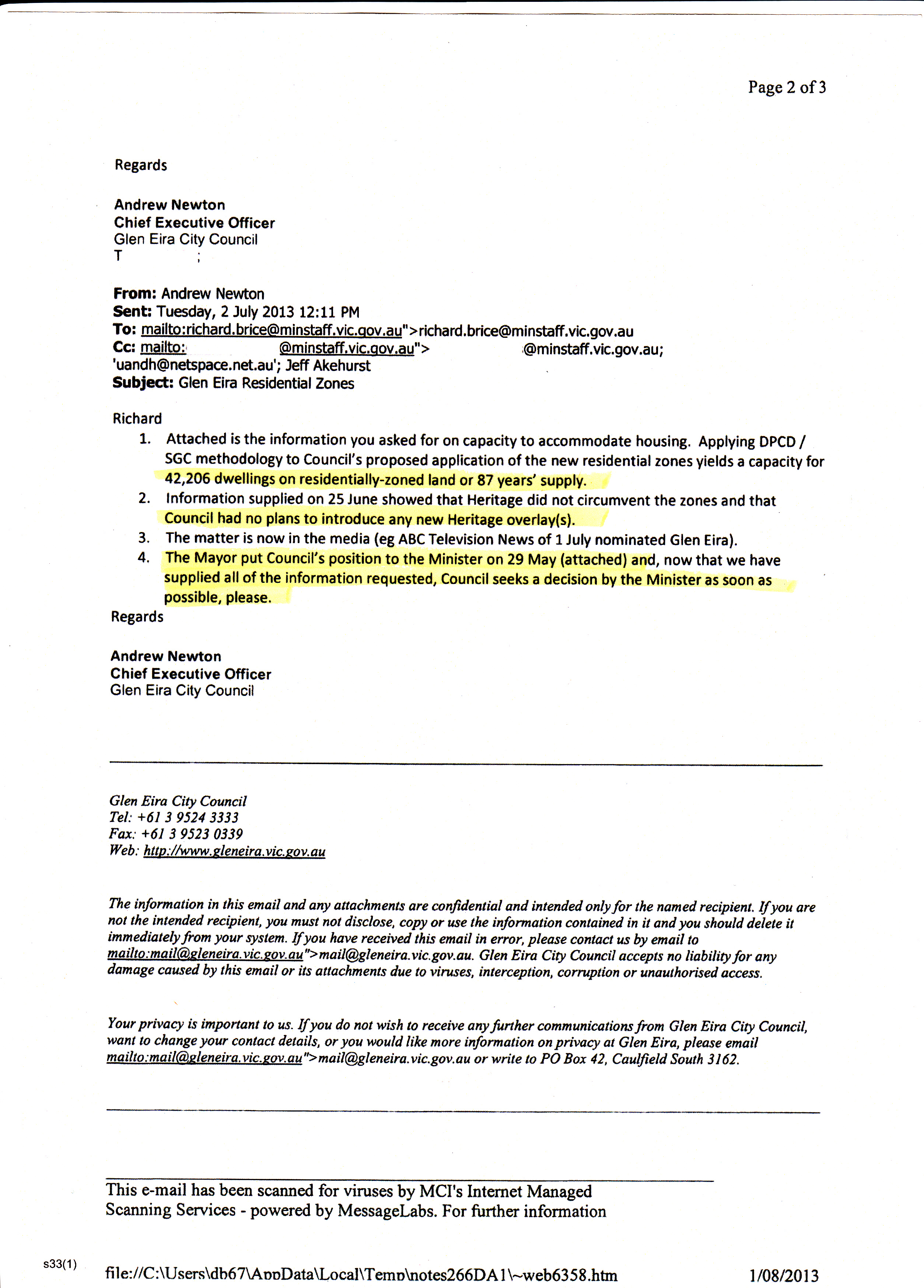
To show how rubbery every single figure is, we republish an email from Newton to the Department written in July 2013 – before the zones were gazetted. The claim then was that with the new zones Glen Eira would have 87 years of supply and over 100 years once commercial was included. With the new zoning, Newton trotted out a figure of a 42000 dwelling supply. If true, does this therefore mean that since 2013 Glen Eira has experienced the equivalent of 14000 dwellings in the space of 4 years? Certainly not! So how much faith can be placed in anything that council produces? And why is council even considering 87, 37, or 36 years down the track when no government is doing this with housing!

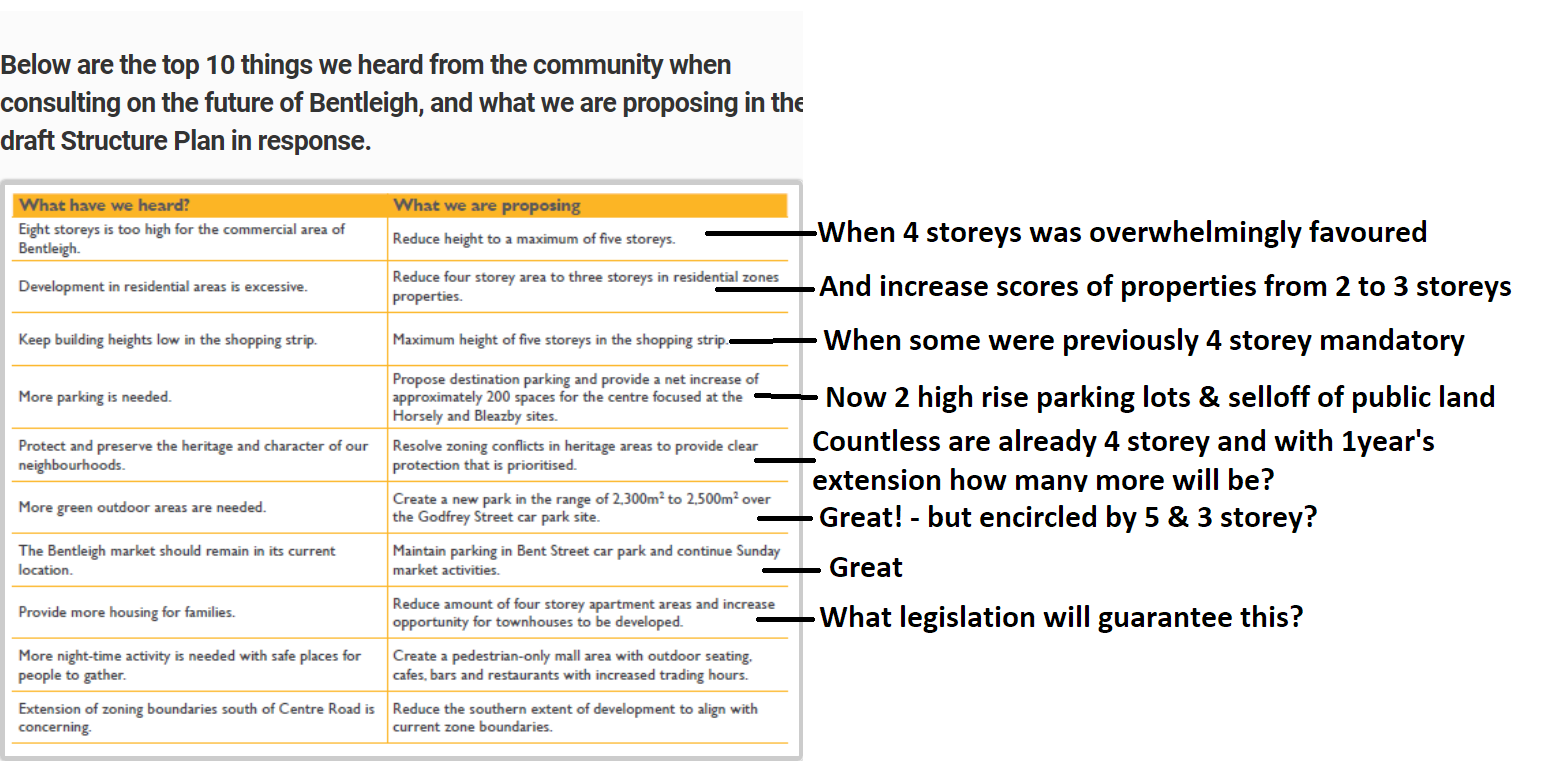
Whilst there are undoubtedly some improvements to version 2 of the Bentleigh Structure Plan, it is still a long way off from meeting residents’ expectations and previous feedback. Council is now conducting another ‘survey’. How valid any results gleaned from this latest ‘consultation’ is definitely open to question, especially when only half the story is revealed to residents.

Here’s the first part of the ‘consultation’ and residents are then asked to rate council’s proposed actions based on these select statements:

CLICK TO ENLARGE

PS – WE FORGOT TO MENTION THAT COUNCIL NOW ADMITS TO A ‘PRELIMINARY’ FIGURE OF 3000 DWELLINGS FOR VIRGINIA ESTATE! WE FORECAST AT LEAST 3500 BY THE TIME ANY OFFICIAL PLANS COME IN!

This is a long and complicated post so we beg your forbearance.

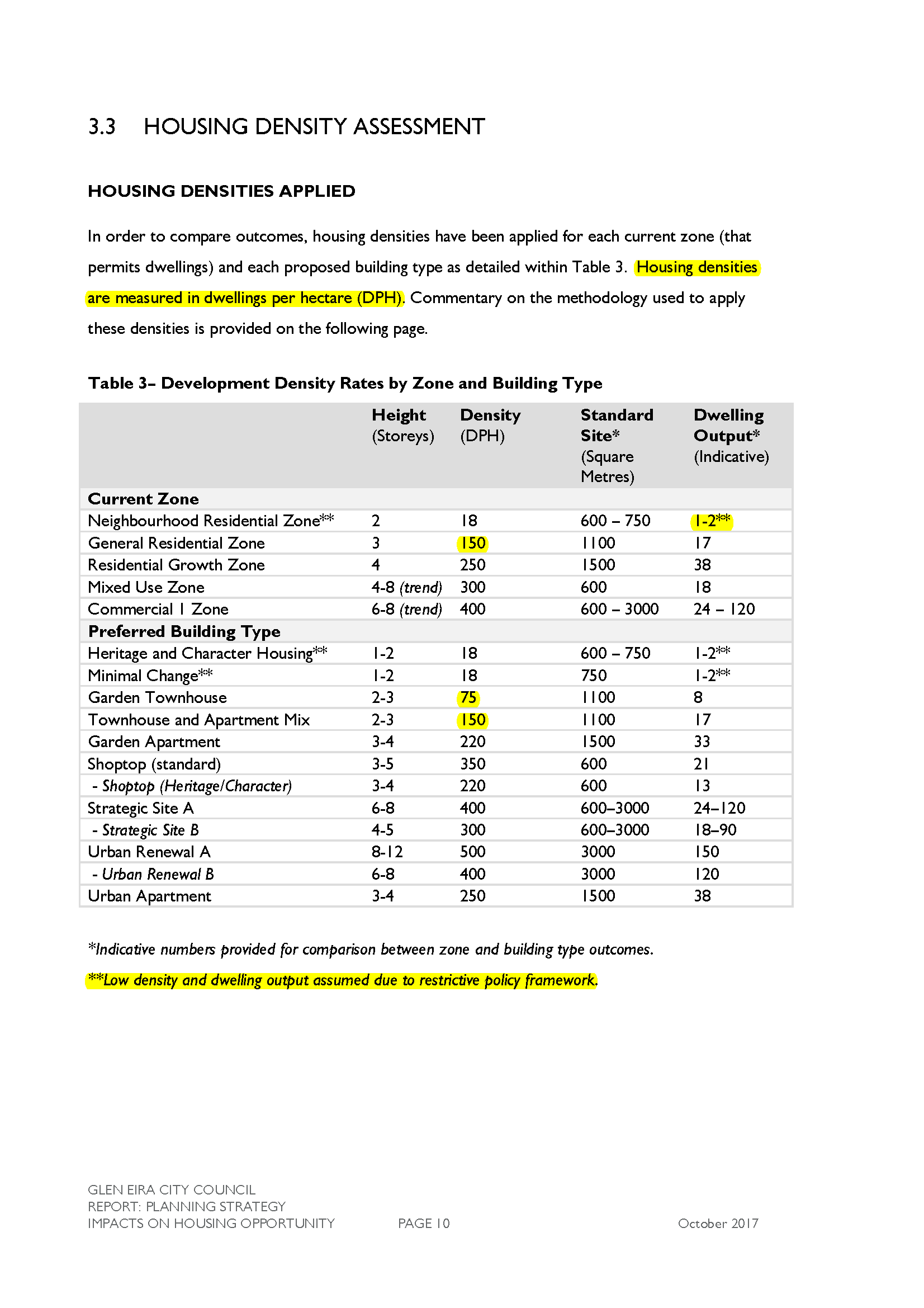
Council’s planning is largely based on the projected population figures plus available ‘developable’ land as stated in the Housing id reports. We then get a few draft scenarios that seek to apply the new housing styles (ie garden townhouse, garden apartment, commercial, etc) to the various zones such as Neighbourhood Residential (minimal change), General Residential (3 storeys) and Residential Growth Zone (4 storeys).

As we’ve stated previously, some mention is made of Wynne’s introduction of Amendment VC110, but this is almost exclusively related to the requirement for the ‘garden areas’ in the General Residential Zone. No specific mention is made of the impact of removing the 2 dwelling mandatory condition for the Neighbourhood Residential zone. From what we can tell, this does not even feature in the multitude of so called ‘calculations’ council uses to justify its draft position.

Worse still is the Housing Report’s and council’s claim that areas zoned NRZ will in all likelihood achieve a dwelling capacity of 18 dwellings per hectare. The areas zoned GRZ are forecast to achieve a dwelling density of  anything between 75 if it is designated as a ‘garden townhouse’ to 150 dwellings per hectare if it happens to be labelled ‘townhouse and apartment mix’.

Both of these calculations are so off the mark, given recent trends, that it is not funny. Thus, if we can’t trust the data, how can we trust the recommendations and the overall planning decisions that are being made?

NEIGHBOURHOOD RESIDENTIAL ZONE (POST VC110)

Below is a list of the first 9 applications to have come in following the gazetting of Amendment VC110 in March 2017. Assuming that all will receive a permit, the results indicate that instead of a dwelling density of 18 per hectare, these 9 applications alone will bring in a dwelling density of 38 dwellings per 0.8 hectares!!!!!! We must then ask – what does this do to council’s planning? If the NRZ is now set to become a pseudo GRZ, do we need to firstly expand the activity centres and secondly have vast swathes zoned GRZ in all our neighbourhood centres?

Here are the figures for these 9 applications. Please bear in mind that we followed the ‘methodology’ used by council and the Housing report! Also worthy of noting is that Council’s document where the above table came from (UPLOADED HERE) does not include NRZ examples in its appendices!

76 Bignell Road, Bentleigh East – 3 units, 600 sqm

27 Draper St., McKinnon – 3 units, 1010 sqm

4-6 Hudson St., Caulfield North, 1300, 8 units

36 Mawby Road, Bentleigh East – 4 units, 700sqm

2 Newman Ave., Carnegie – 6 units, 1033sqm

22 North Ave., Bentleigh – 3 units, 777sqm

1 Ridell Parade, Elsternwick – 3 units, 700sqm

2 Shanahan Cresc., McKinnon – 3 units, 778sqm

3 rigby Ave., Carnegie – 5 units, 1134sqm

38 UNITS ON = 8032SQM = 0.8 HECTARES!!!!


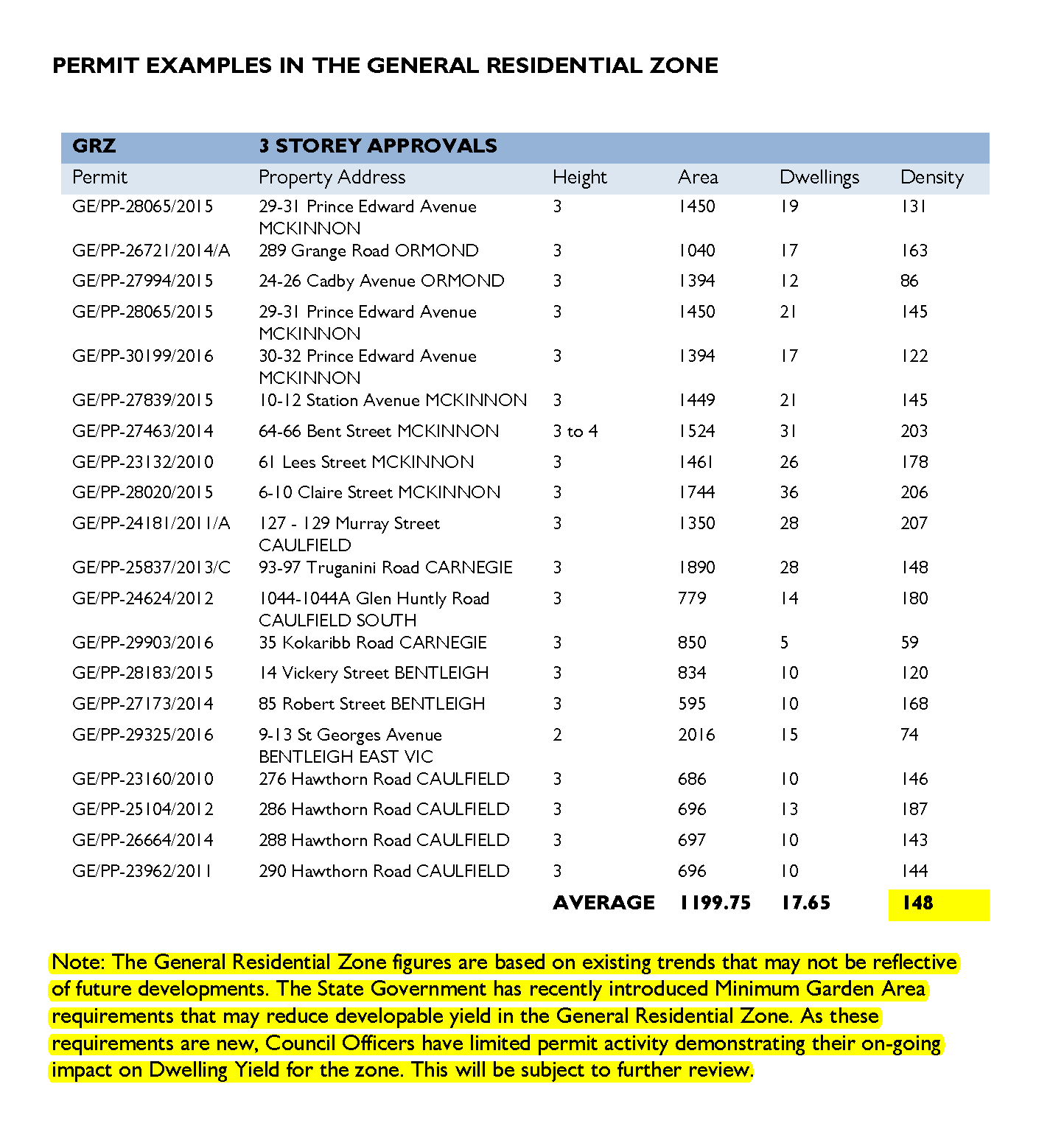
GENERAL RESIDENTIAL ZONE (3 STOREYS)

Council does include some ‘sample’ permits granted in this zone. Why these specific ‘examples’ were selected, we have no idea, and nor was any explanation provided!

We have tried to be far more ‘objective’ and the list below is the outcome from consecutive VCAT decisions in descending order. Only 2 are identical to the ‘examples’ provided by council. The site coverage cited come directly from the VCAT decision itself.

In complete contrast to council’s prognostications, we find that the GRZ establishes an average of just under 195 dwelling per hectare – well and truly above both figures that council provides. We are yet to see what real impact Wynne’s mandated ‘garden area’ will have on the GRZ. We are not hopeful given that anything above 1 metre in width can be deemed as part of the garden area and if land is subdivided first and is less than 400 square metres, then there is no need for garden area at all! So we again have to ask what does this mean for our overall planning if these figures are so off the mark?

33-35 Belsize Ave, Carnegie – 29 units – 1357sqm

291 Grange Road and 4 Walsh Street, Ormond – 23 units -1254

27 Elizabeth Street, Bentleigh East – 10 units – 878

137-139 Murrumbeena Road, Murrumbeena – 27 units – 1629

6-10 Claire Street McKinnon – 33 units – 2053 (council notes 1744sqm)

19-21 Rothschild Street, Glen Huntly – 23 units – 1366

466 Dandenong Road, Caulfield North – 14 units – 800

132 Hotham Street, St Kilda East – 16 units – 964

12-14 Quinns Road, Bentleigh East –  22 units -1276

10-12 Station Avenue, McKinnon – 21 units – 1449

1 St Georges Avenue, Bentleigh East – 12 units – 822

817-819 Centre Road, Bentleigh East – 24 units – 1231

2-4 Penang St., McKinnon – 22 units (1388sqn)

143 – 147 Neerim Road, Glen Huntly – 32 units – 1672

130 Murrumbeena Road, MURRUMBEENA – 16 units (883sqm)

91 McKinnon Road, McKinnon – 10 units (566sqm)

64-66 Bent Street, McKinnon. – 31 units (1371.29 sq m – not the 1500+ recorded by council)

2 Ormond Road, Ormond – 15 units (846sqm)

90-92 Hawthorn Road, Caulfield North – 24 units (1240sqm)

135 – 137 Neerim Road, Glen Huntly – 39 units – 1654

4-6 James Street and 14-16 Etna St., Glen Huntly – 45 units (2462sqm)

UNITS – 488

Area = 25,161sqm = 2.51 hectares. = 194.42 DWELLING PER HECTARE.

Council has finally released version 2 of its draft structure plans – together with a bevy of other documents. The result is that residents are literally drowning in paper – much of it repetitious, uninformative, and still failing to present information that justifies what is proposed.

In summary, here is a breakdown of what was published together. The total number would apply to all of Glen Eira and not just the individual activity centres. If a resident wanted to glean what was proposed for the entire municipality then they would be facing the herculean task of reading all the documents.

Residents can make up their own minds as to why documents which carry dates of July couldn’t have been made public earlier but had to be consigned to this single inundation. We certainly doubt that many residents would have the time, energy, or even willingness to plough through so many pages. As for councillors themselves – our bet is that none of them would bother either! That perhaps is the plan anyway?

Bentleigh Concept Plan consultation responses – 85 pages

Draft Bentleigh Structure Plan – 67 pages

Bentleigh Draft Activity Centre Structure Plan – Background Report –  93 pages

Bentleigh Transport Analysis & forecasting – 61 pages

Analysis of Housing Consumption & Opportunities – 103 pages

Peer Review – Urban Design Guidelines etc. – 77 pages

Planisphere Urban Design Guidelines – 50 pages

Community Benefits Discussion Paper – 19 pages

Assessment of Economic Impacts – 58 pages

Planning Strategy Impacts on Housing Opportunity – 35 pages (no links on Bentleigh site)

TOTAL = 648 pages!!!!!!

CARNEGIE

Draft structure plan – 65 pages

Background report – 94 pages

ELSTERNWICK

Draft Structure Plan – 71 pages

Background Report – 100 pages

TOTAL 978 PAGES

« Previous PageNext Page »