GE Governance


A long post, but an extremely important one.  We urge readers to note:

  • The new (ill applied) language of ‘evidence based’.
  • The political grandstanding
  • The possible influence that Wynne’s ‘rejection’ of amendments C147/8 has had where no strategic justification was submitted!
  • The implicit admission that council’s planning for the past decade is abysmal and actually non-existent
  • And much, much more!

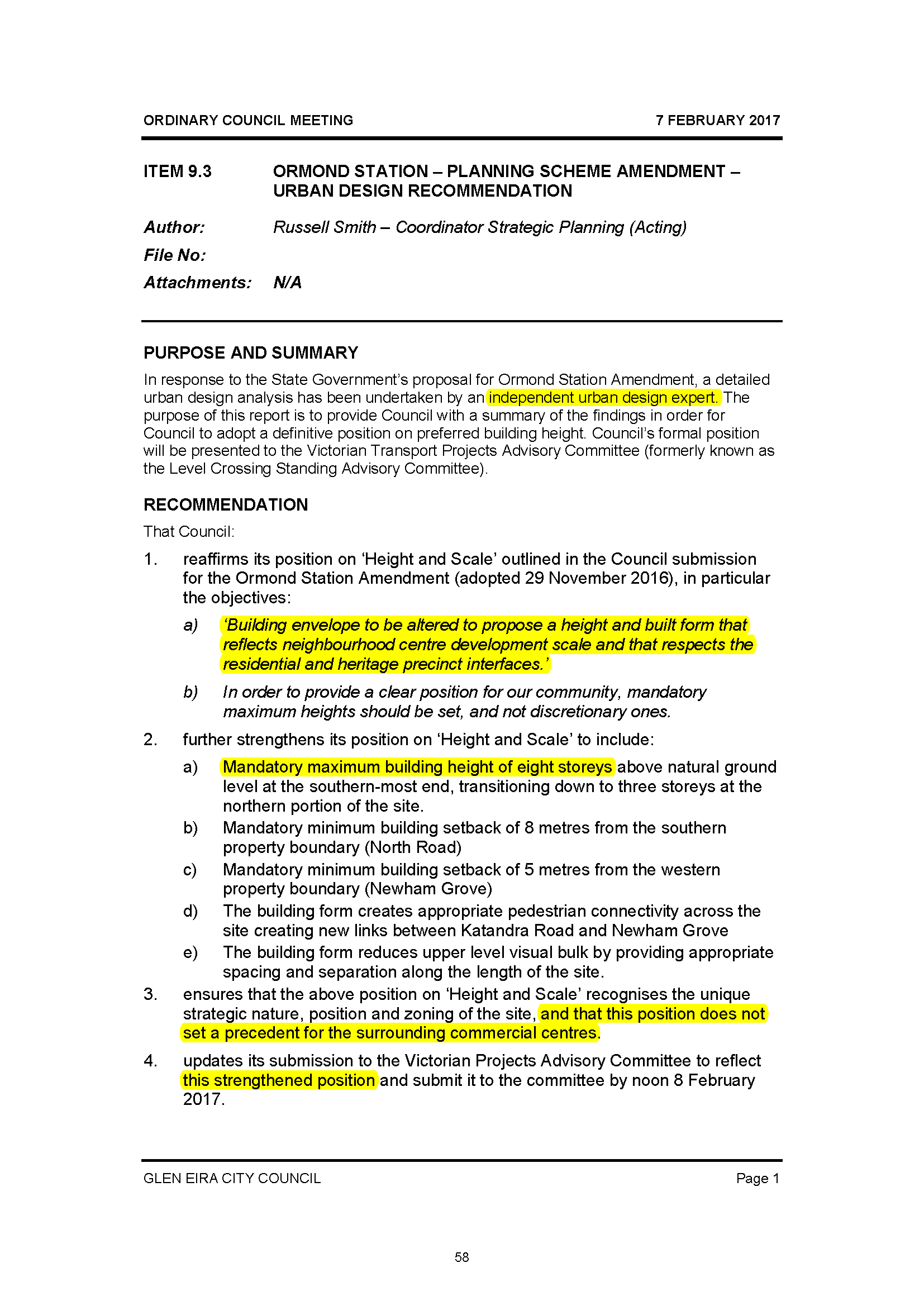
Item 9.3 – Council submission on Ormond Tower proposal

Motion to accept submission moved by Athanasopoulos  and seconded by Davey.

ATHANASOPOULOS: said that council needs to ‘hold’ a ‘very strong position’ and the submission does that.

DAVEY: thanks officers for their submission on something as ‘vast’ as the proposal. Said this was an opportunity for council to represent what ‘the community wants’ on this site. Officers had ‘raised’ what they saw as issues – ie ‘height and scale’ and 13 storeys is ‘huge’ and ‘we need to consider something smaller’. The suggestion of a supermarket is ‘also quite significant for that area’ because of its impact on the shopping centre and also ‘traffic’. Impact on Katandra which is used by commuters and school is also significant. Said she was pleased that the officers recommended that the State Government also consider some form of ‘social housing’.

ESAKOFF: moved an amendment that a five storey mandatory height limit be proposed and then scaling back to no more than 2-3 storeys at the back. Said that council would provide justification for this when they appear at the hearings of the advisory committee in February. Seconded by Hyams. Said that there was much ‘concern’ in Ormond and surrounding areas about ‘this proposal’. She was asking for councillors’ support and said ‘I am taking a firm stand on what is appropriate in Ormond’ and she didn’t want to be ‘wishy-washy in our response’. Said the proposal was ‘completely out of sync’ with the planning scheme and ‘community expectations’. Quoted from the actual submission on height and ‘scale’ that is ‘beyond that of urban villages’. This is not in accord with council’s housing diversity policy that designates neighbourhood centres to be of less density than the urban villages. Since Ormond is a neighbourhood centre, she couldn’t see how council can accept anything above 5 storeys.

HYAMS: explained to the gallery the formalities of motions and amendments. Supported Esakoff’s amendment because council has to give the community some idea of where they stand and the submission is ‘very good’. His opinion is ‘that we need to be consistent across Glen Eira’ and council has asked for interim height restrictions and in Bentleigh which is an urban village they’ve asked for 5 storeys. Thought that if council is to be taken ‘seriously’ then 5 storeys ‘also applies to Ormond’. Stated that people might be asking why 5 storeys in Bentleigh and then being ‘less’ concerned when ‘it comes to Ormond’.

MAGEE: said that there already are 5 storeys in the area and that ‘one could argue’ that ‘this is the appropriate height’ but that means that the developer is saying 13 storeys and council is saying 5 storeys. The result would be that council would ‘lose a lot of credibility’. Council would be better of by saying ‘let’s look at parking, let’s look at traffic’ and ‘amenity’. ‘How many floors are going to be parking’ and how many accommodation and ‘start building the profile of how that affects’ the area. If council simply says 5 storeys then this makes it ‘hard for officers’ when they ‘go and do their presentation’. Once they’ve done the traffic and parking it immediately starts ‘putting the negative tone’ and through consensus ‘you reach a common ground’. This ‘could be 5 storeys’ and ‘it might even be 6’. To now say ‘we don’t want anything’ but 5, is a ‘very negative path’ and is ‘very hard to argue that ongoing’. Said this was only the ‘beginning’ of the process and they’ve got the opportunity to ‘sit down and present our submission’ and ‘we have to back that up with figures’. It’s very ‘hard’ to simply ‘go in’ with 5 storeys. It ‘has to be backed up’ with data. Didn’t want ‘them on the back foot’ and ‘saying they just want 5’ and there’s ‘no justification for it’. Magee would prefer that ‘they listen’. Said that council isn’t accepting 13 storeys. Council is merely saying here’s what ‘we think’ and this is based on ‘very sound logic’ and ‘every department’ involved with planning at council ‘will have input into this submission’. ‘It is dangerous to simply say 5 storeys maximum’. He can’t ‘support the motion’ because ‘it doesn’t give us the strongest argument’.

DELAHUNTY: said she thought that council had a better chance of a good outcome if ‘we used an evidence based’ approach. Said councillors know the area and ‘we kind of know what would be appropriate there’ but that ‘we would make a better argument when we do the strategic work’. Therefore ‘I would like not to have a height named in the submission’ because ‘it doesn’t use an evidence based method’. The proposed submission makes a ‘good argument about the height and the scale’ and its ‘relationship to what is currently in Ormond’. Said that council has made some suggestions for planning in Glen Eira over the past 6 months and this ‘suggests that we need time and space’ to do ‘strategic evidence based work’ to justify their recommendations so ‘I am worried about the inconsistency of now putting a height on it and what political mileage’ could be ‘gained out of that’. When they go to the panel in February, ‘we will have some evidence collected by then’ which they can present to the panel about ‘what our preferred height will be’. Said that it’s now council’s preferred height but ‘your preferred height because it is evidence based’. Thought that the ‘stronger position’ as a council is to ‘do the work first’. The community asked for feedback so if council is a ‘strong’ community voice they have to do better than propose something that is ‘not evidence based’. Thought they will get to a ‘height argument’ but only after they’ve done the ‘strategic work’. That will be done by February and because of that she thought ‘it will be stronger’.

TAYLOR: said that ‘we all want to take a position of strong advocacy’ and agreed with Esakoff that none of them ‘want to be equivocal’ and that through their campaigning they are aware of residents’ concerns about height. Agreed with those opposing the amendment that if they could ‘pack’ more ‘evidence’ behind their position they would be better off.

SILVER: thought that listening to the community and then ‘going bang’ in February is ‘the strongest way possible’ of achieving something.

AMENDMENT PUT AND LOST. VOTING FOR – Hyams and Esakoff.

Voting against – Magee, Taylor, Delahunty, Davey, Athanasopoulos

ABSTAINED – Silver

ESAKOFF: said she was ‘disappointed’ about the amendment being lost and that she was a ‘little confused about the arguments’ and that the ‘authority’ will decide ‘regardless of our submission’. Thought that on ‘behalf of the community’ that ‘we’ve made a stand’. As for ‘evidence’, she thought that council’s ‘heirarchy’ of urban villages and neighbourhood centres is ‘evidence’. Summed up by going through submission again – ie traffic, impact on local schools, shopping centre, etc. Wanted a more ‘transparent process’ that allowed for meaningful ‘community input’. Said she would ‘get over’ losing out on the amendment but ‘the community mighn’t’. If council suggested 5 or 6 storeys then ‘we wouldn’t have the multiple levels of car parking’ since ‘it would reduce the need for it’ so Magee’s earlier arguments would now be ‘all irrelevant’. ‘This is our submission. This is our chance’. Even though they will have a hearing ‘this is our submission’ in what ‘our community is going to see us standing up for them’.

SILVER: thought this was an ‘unfortunate situation’ in that before the level crossing works they had land ‘subject’ to the same conditions as elsewhere but the Minister changed the legislation and the government is now using this ‘opportunity’ to ‘make a bit more dough’. The ministerial amendment ‘wiped the slate, carte blanche and the government could do whatever it wants’. Ideally council should be the decision maker, but that’s not happening since all they are doing now is telling the government what they think ‘should be the standards’. Didn’t know ‘whether this is a genuine form of consultation’ but seemed like ‘just another way for the government to make more money’.  Council ‘has a standard’ and it’s up to the government to adhere to this standard ‘or ignore it’. That’s why he didn’t support the amendment because he is ‘uncomfortable with the entire sky tower’.

MAGEE: even though he agrees with ‘everything’ Esakoff said thought that they are ‘trying to get to the same position in a different way’. They don’t want 13 storeys but ‘there isn’t even an opportunity for an appeal to VCAT’. The Minister ‘will decide’ on the basis of the reports submitted to him. Council’s just is to put ‘forward a submission based on evidence’. ‘It can’t be an emotional response’. Said that local MPs are ‘on our side’ and they are saying ‘give us the tools, give us the reasoning’ so it’s not 13 storeys. So even though the ‘community may be disappointed that we didn’t put in a blanket 5 storey maximum’ the important ‘part’ is ‘where this will end up’. Didn’t want the ‘negative feel right from the start’. Thought that it had to be ‘evidence based’ and not emotion based.

HYAMS: even though he would have preferred the amendment to be passed, this is still a ‘very good submission’. Thought that it was ‘fair enough that the government does go for some value capture, but it has to be reasonable’. This will be a ‘stand alone building’ and so won’t ‘integrate with the shopping centre’.

DELAHUNTY: thought that what is likely to be ignored is ‘our role’. Planning isn’t simply about height or overshadowing, it is ‘more nuanced’ and how a ‘building might add to a place’ and council is ‘best placed to make those decisions’. Was ‘disappointed’ that council wasn’t the ‘decision maker’. Didn’t ‘want to see lazy planning from the state government’. Council needs to ‘keep up our efforts’  in terms of ‘more than just heights and more than just shadows’ and ‘talk more about Ormond’ and the people and ‘the way the village and the people interact’. Supported the ‘strong submission’ and didn’t think ‘it’s our only chance’ because they will ‘front up again’ in February.

ATHANOSOPOULOS: thought the submission was ‘very strong’ and important to have such debates. Thought that a comment from the gallery earlier about going to VCAT and ‘not having the right evidence’ was important. So this is setting the ‘bar’ and saying ‘we are no longer unprepared’.

ORIGINAL MOTION PUT AND CARRIED UNANIMOUSLY.

There is a salutary lesson for residents and council in the comparison of the Caulfield Village development process and what is fast approaching for the Virginia Estate project. Residents need to be fully aware of:

  • The impact of rezoning (ie Caulfield Village rezoned to Priority Development Zone, and Virginia Estate now mooted rezoning to MUZ and/or Commercial 1)
  • Council acceptance of an Incorporated Plan for Caulfield Village and the potential acceptance of a ‘Management Plan’ for Virginia Estate – both of which will allegedly provide the ‘conceptual framework’ for development but without real detail. No objection rights for residents – decision is made by council.
  • Development Plans (ie the details) which then follow for each precinct but which only have to be ‘generally in accordance’ with the Incorporated/Management Plan. These Development Plans can be amended time and time again, and have been for the Caulfield Village.

Readers will remember that the Precinct 2 application (just under another 400 dwellings) for the Caulfield Village was refused at ‘manager’ level by Council without Council displaying this until after the fact. The developer immediately went to VCAT, where the decision has now been handed down. Once again, the developer has basically won, and all previous promises (ie real social housing element, ‘housing diversity’ has gone).

The ‘problem’ with this entire process is that the Schedule for the Caulfield Village which Council accepted and which provides all the ‘musts’ is so vague, and basically useless,  that the developer has all the cards stacked to his advantage. Fundamentally,  council’s requirements were inadequate and our fear is that unless some real lessons are learnt the same will occur at Virginia Estate. For example, the Caulfield Village history is:

  • No on-site visitor parking required (at this stage 2063 dwellings – originally mooted at 1100 in the Incorporated Plan). Precinct 2 now has 45 on site car parking spots but this is dependent on the ‘largesse’ of the developer and not on council’s Schedule.
  • Amendment after amendment that allows balconies to encroach on setbacks
  • No definitive statements on social housing except this useless sentence in the Schedule – The provision of affordable housing in the form of social housing. No definitive statement on how many ‘social housing’ units, or how this is to be managed. Readers will remember that council wrung its hands in dismay when Precinct 1 was allowed without any social housing and the arguments of Hyams et al were that future precincts would meet this requirement. So much for promises!
  • No definitive statements on ‘housing diversity’ – thus Precinct 1 has over 40% as one bedroom dwellings and Precinct 2 will likely have 2.2% of three bedroom apartments according to the plans.

For the full VCAT decision, please see: http://www.austlii.edu.au/au/cases/vic/VCAT/2016/1965.html

As we’ve said above, unless the lessons from Caulfield Village are learnt, and learnt properly, then we fully expect that the Virginia Estate project will follow in the same manner . It is the job of this new council to ensure that every single potential gap in any Management Plan and accompanying Schedule is spelt out so that the developer has as little wriggle room as possible. If this is not done, then we can rest assured that the eventual Management Plan will not be worth the paper it is written on and the entire project will duplicate the abysmal planning that occurred and is still occurring with the Caulfield Village!

The following was provided for the gallery at tonight’s council meeting –

img007

Delahunty began the meeting with some explanatory comments regarding the above sheet outlining  ‘Request to Address the Council’.

DELAHUNTY: started by saying that at the appropriate time in the meeting she would call for the suspension of standing orders, so that people in the gallery who had filled out the sheet could address council either with a question or a statement. Said that either she would answer the question or direct the question to the ‘most appropriate person’. There will be a 15 minute time limit. This is ‘trialing one method’ and could change depending on ‘how this goes’ but the aim is ‘greater public consultation’.

Delahunty then proceeded with the traditional oath, accepting previous minutes, reading of petition, etc.

When reporting on the Community Consultation Committee minutes, Hyams made the comment that what Delahunty is proposing is that her motion is ‘fine but that local law is sacrosanct’ and that her proposal goes ‘outside’ the law so he won’t be supporting the motion to suspend standing orders.

Delahunty then explained that if her motion to suspend standing orders is successful, that the questions asked by the gallery is different to the public questions process in that the question and answers won’t be minuted. Public questions will continue at the assigned agenda item (ie at the end of the public meeting). Delahunty then moved the motion to suspend standing orders. Seconded by Magee.

MOTION PUT – VOTING IN FAVOUR – TAYLOR, STRAJT, SILVER, MAGEE, DELAHUNTY, ATHANOSOPOULOS, DAVEY

VOTING AGAINST: HYAMS, ESAKOFF.

MOTION CARRIED.

1st question – asked about the Ormond development proposal and the construction of the platform for the development whether this ‘breached’ any council planning laws. If it didn’t breach any planning laws then under what authority was this done?

ANSWER: Delahunty referred this on to Torres who reported that the Minister for Planning ‘changed the town planning controls’ to ‘facilitate the removal’ of the crossing and to ‘facilitate the development of the railway station’. This meant that ‘no planning permission was required’ from council for these two things. ‘We understand that the deck is an intrinsic part of the redevelopment’ and therefore council has no authority over this since ‘it is a structural requirement’ for the trench and ‘didn’t need planning permission’.

2nd question – asked how council is going to stop this development.

ANSWER: Delahunty said that ‘vision’ that council and the community has for the streets will involve strong lobbying. Council does want to see the area ‘enlivened’ but acknowledged there would be concern over ‘what precedent is set’. Residents should be ‘assured’ that ‘we are determined to do some strategic work’ that residents can ‘tell us’ what your vision is for the area. The CEO then spoke about council’s ‘shopping strip initiative’ which would ‘help form our activity’ as a result of the planning scheme review. Torres also said that they’ve started the process to ‘help inform’ our ‘future activity strategy’ such as questions like ‘what do you like about your shopping centre’. This might seen a ‘simple question’ but is important for ‘creating a vision for the centre’.

3rd Question – whether council would consider working together with other councils to ‘enable a more cost effective delivery of services’.

ANSWER: Delahunty said this was a good point about the need for ‘developing partnerships’ and she’s in favour of it as is the CEO. Because of ratecapping this becomes inevitable and they will have to think ‘more collaboratively with our neighbours’. Hyams also said it’s a ‘good idea’.

4th question – will council provide a date for live streaming of meetings?

ANSWER: Delahunty said that she couldn’t provide a date but that it is definitely on the agenda. They are waiting on a report to come back to council. Magee spoke that he’s in favour but the heritage of the building was a consideration but he didn’t like just one camera focused on the mayor. Privacy issues also needed to be addressed.

Question 5 – whether council would change the order of business so that public questions aren’t at the end of meetings and that the time for questions be extended to 30 minutes?

ANSWER: Delahunty said they would look at this but it’s ‘set out in the local law’ which council can change.

Other questioners were invited to speak to councillors at end of meeting since the 15 minutes was up.


The purchase of this property for $2.1 million we believe raises many questions. The questions multiply when we find that council’s intention is to lease this property until community ‘consultation’ is undertaken! Here are some queries for your consideration –

  • What happens if the ‘consultation’ results in the majority of residents opposed to the idea as the recent Fosbery/St Aubins proposal showed? Are we therefore in a situation where we are again facing a Clayton’s ‘consultation’ because the decision has already been made – especially since so much money has been spent?
  • Why was this property purchased in the first place given its proximity to Princes Park? Carnegie has many more ‘high priority’ listings than South Caulfield according to the Open Space strategy!
  • Why has Carnegie and other suburbs been ignored and all open space developments have basically occurred in Camden? Given that the Open Space Strategy itself states that this area will only see a marginal increase in population due to its zoning as largely Neighbourhood Residential Zone, why has council spent millions in this ward alone?
  • If council has spent $2.1 million on a very nice looking house, and we would expect at least another half million or more to be incurred in the creation of a ‘park’, then that brings us close to $3 million. Is this really ‘value for money’ for a site that is just over 600 square metres?
  • What will be the length of the proposed lease – 6 months, one year, 2 years?
  • Since the site is on a corner, are we again facing the prospect of streets being closed off and traffic diverted?
  • Why has the purchase of the Magnolia Street house at $1.49 million not been included in the open space reserve budget, but included under the ‘capital works’ budget?

We repeat what we have previously stated. We are totally in favour of more open space throughout the municipality. However, we also desire sound financial decision making that is transparent and accountable and equitable for all residents. The rate of development in our GRZ and RGZ areas are a major concern as council admits. This is where the greatest number of new residents will live and it is in these areas that open space is most desperately required – not in quiet residential streets that are within a stone’s throw of already existing large areas of open space and which the Open Space Strategy admits to seeing only a ‘negligible’ rise in population.

Gary Max interview with 2 Glen Eira Residents on elections, and council performance

PS: The minutes for Monday night’s special council meeting have now been published on council’s website. We believe that an all time record has been set in that the meeting lasted exactly 3 minutes to ratify the most important document that a council can produce – the Annual Report! Both Delahunty and Lobo were absent.

The stuff ups with minutes still continue however. Item 4.1 states that the item under consideration is the Councillor Code of Conduct. Yet when it comes to the actual nominated 4.1, it is on the Annual Report. Would whoever is doing the minutes please, oh please, proof read and ensure that  what goes out to the public is accurate and a true record of what occurred!

Residents will remember the GESAC basketball allocation fiasco where the Oakleigh Warriors were given the lease of the newly created basketball courts instead of the local McKinnon Basketball group. The arguments presented by Paul Burke at the time were that the Warriors had promised council more money and about 120 hours filled in court time. We also believe that the ombudsman became involved in this decision. Public questions followed, none of which were satisfactorily answered –  for example: are the Warriors paying their weekly rental? are they meeting the stated court hours?

Well now it appears that:

  • Council could be owed thousands and thousands of dollars that the Warriors have not paid on their weekly rent
  • Bob Mann is now gone
  • McKinnon Basketball has been granted access to GESAC
  • Does any of this account for GESAC’s stated loss of $340,000+ from the anticipated income?
  • What does this say about the ‘business plan’ instituted by Newton, Burke and the councillor group? What ‘evidence’ was supplied at the time to ensure that the Warriors could afford what they promised? and
  • How much have residents forked out over the years in subsidising another woeful decision from this administration and councillors?
  • Will this council produce figures that clearly reveal all income and expenditure on GESAC? If not, why not?

Here is the Leader’s version of events –

Oakleigh Basketball Association slammed by messy off-court chaos

OAKLEIGH  Basketball Association is in tatters with financial and governance issues meaning hundreds of children have been forced to leave the league.

The association, which last year had more than 500 junior players, has had its operations put on hold by Basketball Victoria after an inquiry.

Some players have been transferred to the McKinnon Basketball Association, while representative players had the option of trying out with other associations or establishing an Oakleigh team in the McKinnon or Port Phillip associations.

Glen Eira Council reached a deal with McKinnon which will see the association have use of the Glen Eira Sports and Aquatic Centre basketball courts this season; the courts would usually be used by Oakleigh.

Basketball Victoria manager Stephen Walter said he initially stepped in to resolve a governance issue as two committees had claimed control of the ­association.

“There were lot of families leaving the club or they just weren’t re-registering; the club had lost critical mass to run a domestic competition,” Mr Walter said.

Tony Pitara, who was president of one of the club committees, said he had identified a tax debt at the club, dating back to 2009 and that was being addressed.

Mr Pitara said he respected Basketball Victoria’s decision, but was confident that had the club sorted out its internal “politics”, it could have found a solid financial footing in two to three ­seasons.

Karen Wilson, vice-president of the newer committee said she had been informed the debt was in the region of a “manageable” $70,000.

But she said the sacking of the head of coaching had created dissatisfaction and prompted the establishment of the second committee.

Cheltenham mum Rosey Cooke, whose son Andrew had played at Oakleigh for five years, said parents weren’t consulted.

“The kids don’t understand all this business — they just want to play ball,” Ms Cooke said.

Source: http://www.heraldsun.com.au/leader/inner-south/oakleigh-basketball-association-slammed-by-messy-offcourt-chaos/news-story/5e556fc1430a1dbbaa4f4e27ccc34a23

We’ve received this email from a resident asking for Tucker Ward candidates’ responses –

Dear Candidates,

As you are a candidate for Tucker Ward, I would like to hear your views about the following local problem.

If you visit Mckinnon station and walk along Nicholson street, you will see exposed pilings, both within the station and external rail corridor. The job to rebuild Mckinnon station and reinstate appropriate aesthetic finishes to the rail corridor is clearly unfinished and not done to an equivalent standard as Ormond Station.

Since the beginning of the level crossing removal, we have been asking what the final structures will look like. Early on, we were told there would be a concrete wall with additional fencing for safety and screening. This has not been the outcome.

In the rush to re-open McKinnon station first, the completion of the concreting and aesthetic finishes were not completed. Not only are the exposed pilings and partial concreting unsightly, but the incomplete nature of the works appear to be unsafe (e.g., the exposed sharp edges of the metal pilings). This will inevitably encourage vandalism, which has already started.

However, the job is finished according to the Level Crossing Removal Authority, with the exception of some revegetation along parts of the rail corridor. They claim that Glen Eira Council have signed off on the “design”, including the exposed pilings and partially concreted beams. This clearly contradicts the concrete covering of these same structures that have been done at the Ormond location.

Most of Bent Street and Nicholson Street have already been sold for development. There are simply not enough long-term residents left to garner interest in this local issue.

So my question to you is: What will you do, if elected, to ensure the Level Crossing Removal Authority really finish McKinnon station and the surrounding rail corridor?

Kind regards,

xxxxxxxxx

Resident of Nicholson Street McKinnon, Tucker Ward

A very good turnout at last night’s Camden ward ‘Meet the Candidates’ forum. Congratulations to all candidates for showing up, namely – Delahunty, Pinskier, Hermann, Sounness, Silver, Fayman and Strajt. Questions focused on the following:

  • Community safety – with some members of the audience arguing that Glen Eira is very safe. Candidates responded that crime statistics don’t bear this out and that if even some residents feel unsafe that it is council’s duty to listen and consider their concerns. Ms Pinskier said that she was opposed to CCTV cameras and ‘angry’ about guns in parks which she is absolutely against.
  • One resident from Redan Road, Caulfield East asked why Delahunty and Sounness voted against 92% of residents’ wishes in regard to council’s traffic management ‘solution’ for the street and why emails weren’t answered. Delahunty responded by saying that the measures introduced were in response to ‘safety’ issues and that she makes no apologies for that.
  • Another resident asked how much money council had raised in the past few years from the open space levy and how much of this money had been spent in acquiring new open space in Camden. Sounness replied that there is a process in place where officers look at what is available for purchase and then determine how to proceed. Given the high cost of land at the moment councillors have to decide if any purchase is ‘value for money’. Delahunty then outlined what council had spent money on – ie Riddell Parade, Eskdale Road, and the purchase of an Aileen Avenue property (to be settled in November).
  • Next question was directed to new candidates about the changes to the public questions protocols and whether they thought this was ‘discriminatory’. All new candidates stated that they were opposed to this change and Pinskier favoured full streaming of council meetings. Silver added that he thought there should be a limit on the number of questions per individual because council could then run until 3am! The resident also asked about why the ‘red fence’ of the racecourse was still up and why council allowed this. On the fence question Sounness stated that he thought it was part of the racecourse only to be corrected that it was both council’s and the MRC’s responsibility. Delahunty conceded that council should get moving on this issue and that it was ridiculous that people couldn’t ask questions like this at council instead of a forum.
  • Another resident asked the new candidates for their definitions of ‘neighbourhood character’ and ‘overdevelopment’ and how they could ‘guarantee’ (as Silver stated on his facebook page) that there would be ‘sensible development’. Silver responded that his definition of this is ‘family friendly’ development with proper apartment size to fit 2 adults and 2 children and the need for gardens. Fayman was concerned about waiving of car parking places and thought that 3 or 4 storeys along main arterial roads was justifiable as were one bedroom apartments near university. Strajt spoke about population growth and how councils that joined forces would be best placed to resist overdevelopment. Hermann called overdevelopment the most important issue facing the community and undertook to get fully ‘up to speed’.
  • There was a question on preferences and whether this was done on political grounds. Delahunty said that she put those who had real estate advertising on their boards as last. Silver thought this was a ‘slur’ and that there was no ‘impropriety’ or ‘conflict of interest’ concerns. Hermann thought it was time for fresh faces and that’s why Delahunty and Sounness were put last on her voting card.
  • Another questioner was interested in governance and brought up the issue of notice of motion, recording of council meetings and general transparency and accountability and whether the local law would be changed as ‘first item on the agenda’. Silver said it was ‘up there’ but not his first item and didn’t know whether these suggested options ‘would work’.  Sounness, Hermann, Delahunty were all in favour.
  • A further question was on the large number of developments in Elsternwick, especially the shopping strip and whether candidates felt it was appropriate that this rate of development continues. Also queried was the future of the Elsternwick library. Strajt talked about the system failing and the need for wholesale changes so that councils have more control. Sounness said he would like to see 4, 5 or 6 storey development in some areas so that people can get to know each other and that where there is ‘density’ that it has to be well designed and ‘comfortable’. Hermann was concerned about traffic in Elsternwick and overshadowing and if elected would do all she could to change this. Delahunty said that structure planning could control the ‘rate of change’ as was pointed out by Wynne. Said she will ‘wear’ the criticism as council hasn’t done any structure planning and that when the Coles development happens this will ‘stretch’ the rate of development even further. Structure planning will help and that ‘should have been done a long time ago’.

We’ve uploaded several pages from a secret report by Charter Keck Cramer. The report was obviously commissioned well before July 2013 (the date the report was completed). The report is courtesy of the Department and its objective was to use GLEN EIRA AS A MODEL for the introduction of the new zones. Thus Council was well and truly up to its eyeballs in secret meetings with Guy, and the department in order to be the ‘first’ council in the state to introduce the new residential zones.

What is significant in the following pages (obtained under FOI) is:

  • The emphases on state revenue via property tax and stamp duty
  • Job creation for the construction industry, and
  • Housing supply

There is not one word in this analysis regarding impact on existing neighbourhoods or the deterioration of residential amenity. No mention of required infrastructure; no mention of open space and no concern about transparency and community consultation. Even more astounding is that Glen Eira claimed to have 85 years worth of development potential and 89 years worth once the commercial areas were included! Notes of meetings between the parties reveals that ALL COUNCILLORS were in favour of the introduction of the horrendous zones.

The crucial questions here are:

  • Were all councillors provided with a copy of this report? If so, what questions did they ask? If not all councillors were provided with the report, then why not?
  • Exactly what were councillors told about the secret meetings between Guy, Newton, Akehurst and Hyams?
  • What role did the Liberals on Council (ie Hyams, Lipshutz, Esakoff, Okotel, ‘Pilling’) have in endorsing this secrecy and collusion with Matthew Guy and his bureaucrats?

As we have repeatedly stated, there is no excuse for responses to public questions being lies. There is no excuse for the failure to inform the community as to what is about to happen. There is no excuse for appalling planning and definitely no excuse for failure to implement planning controls for the past decade. All current councillors are responsible for these failures and the damage they have caused to countless residents.

pages-from-charterkeckcramer-report0001_page_1pages-from-charterkeckcramer-report0001_page_2

PS: An update on this afternoon’s Tucker Ward ‘Meet the Candidates’. Those present were: Magee, Lobo, Taylor, Searle, Brewster, Mackie, De’Arth.

ABSENT: Hyams, Okotel, Bonney, Elliott, Karlik, Cade and Andonopoulos – the last with apology due to family wedding.

We have reported on planning decisions made by these councillors over the past 4 years. (See: https://gleneira.wordpress.com/2016/09/28/for-the-record-2/). This post we concentrate on the area that has bedevilled this council for over a decade – governance and how community aspirations have been continually ignored and/or thwarted.

THE INTRODUCTION OF THE RESIDENTIAL ZONES

Councils had until June 30th 2014 to introduce their individual versions of the new residential zones. Glen Eira was the first, with Guy’s announcement on August 5th 2013 followed by official gazetting on 23rd August 2013. Countless other councils held extensive community consultations. Glen Eira did not. Even those councils which applied for the ‘fast track’ ministerial intervention under Section 20(4) of the Planning and Environment Act, tabled their intentions and the relevant details of the proposed zonings at formal council meetings. This was then voted on by councillors in an open and transparent fashion at their respective council meetings. Thus their citizens could see what was to occur and had the opportunity to at least contact their representatives. Glen Eira did not, thus being the only council in the state which did not provide its residents with any information and any opportunity to voice an opinion.  There was no council resolution and no official ratification of anything. Another example of decision making behind closed doors!

Add to this various public questions dating from July 2013 asking when council would begin its community consultations and we find responses that were blatantly untrue and designed to mislead and deceive. There was never any intention to alert the public or consult with them. We know this because as far back as 2009 Akehurst had written an officer’s report that said there would be no community consultation if the zones, as they were proposed in 2008 were ever to come in. We also know that Guy, the department honchos, Hyams, Newton and Akehurst had been busy meeting since at least April 2013 and spending taxpayers’ money on getting legal advice as to how best to thwart any potential legal challenges and, we assume, whether or not a formal resolution had to be tabled at council meetings. The intent was always to avoid public consultation and accountability. We, the residents, were irrelevant to the devious and secret collusion going on between Matthew Guy, the department and council.

The following comes from the documents obtained under FOI and reveals the full treachery that all the present councillors allowed to occur and some positively encouraged –

image0059

NOTICE OF MOTION & PUBLIC QUESTIONS

Notice of motion is an essential element of good governance  and community representation since it allows a councillor (once seconded by another councillor) to have an item placed on the agenda for full and open debate and decision. Glen Eira is the only council in the state that has repeatedly refused to grant this right to councillors – and therefore residents who request a councillor to initiate some action on an issue. It has come up at least twice in the past 4 years and been defeated by the conservative faction led by Hyams, Esakoff, Okotel and Lipshutz.

Adding insult to injury, the recent changes to the public question format means that unless the questioner is present in chamber the response will not be recorded in the official minutes. The result? No public record that will provide interested residents with any idea of what council’s position is and what the issues that concern some residents are. With no public record there is no accountability and certainly no transparency.

Those councillors who vetoed these democratic rights are: LIPSHUTZ, HYAMS, ESAKOFF, PILLING & HO

GUNS IN THE PARK

Readers will remember the furore created by this secret (and potentially illegal) in camera vote that permitted private security guards to carry guns in local parks. Those responsible for keeping this secret and deciding that this was in the best interests of the entire community were – PILLING, ESAKOFF, HYAMS, LIPSHUTZ, OKOTEL, MAGEE

FROGMORE

When Council had the opportunity to proceed to a Panel Hearing over the application to build a Jewish Care aged care home at Frogmore, the proposed heritage amendment was abandoned. This meant that the developer  moved in overnight and demolished the building and removed nearly 90 trees – 4 of which were categorised as ‘significant’. Over 1000 signatures on a petition had requested council to implement heritage protection and another 200+ submissions had gone in anticipating a formal panel hearing where residents would get the opportunity to have their say and to present their well researched evidence. Esakoff and Delahunty conveniently declared a ‘conflict of interest’ and Magee was absent. Pilling used his casting vote to ensure that Frogmore was no more. Those who voted against going to the panel were: PILLING, HYAMS, LIPSHUTZ. Thus 3 councillors (a minority) thwarted the stated wishes of over a 1000 residents!

CONSERVATORY

Two expensive community consultations, plus several council resolutions, made it clear that the conservatory at Caulfield Park be maintained and restored. Not satisfied with the results, there was another go to get rid of the building. This time it worked. Those councillors who ignored community views, their own previous resolutions and succeeded in removing the structure were: HYAMS, LIPSHUTZ, ESAKOFF, DELAHUNTY, PILLING

CONCLUSION

These examples are only some of the outrages that have occurred during this council’s term of office. If residents want more of the same, if they want to be continually ignored and told fairy tales, if they want more internal strife and division, then they should retain the incumbents. However, if residents feel that Glen Eira must change and improve their overall performance in so many areas, then these sitting councillors have to go.  Most of them have been there for 8 years. They have achieved very little except to alienate countless residents, each other, and cost ratepayers a fortune in legal fees  – which by the way is far from over given this statement from the 2015/16 Annual Report just published –

Contingent liabilities

(a) Arising from legal matters

Council is presently involved in several confidential legal matters, which are being conducted through Council’s solicitors.

As these matters are yet to be finalised and the financial outcomes are unable to be reliably estimated, no allowance for these contingencies has been made in the Financial Report. (page 214)

Open and transparent governance is dead in Glen Eira thanks to those councillors named above. Glen Eira desperately needs new councillors who put community, honesty and fiscal responsibility first!

« Previous PageNext Page »