GE Governance


We feature an extract from this morning’s Jon Faine program where Cr Jim Magee was interviewed regarding the makeup of the Caulfield Racecourse Reserve Trustees and the potential conflicts of interest involved. The issue was also debated at last night’s council meeting which we will report on in a separate post. Suffice to say that both Pilling and Okotel in our view should hang their heads in shame for their performance on this matter!

Our many thanks to the resident who typed up the transcript for us!

FAINE: ….threw into doubt the future development of the Caulfield Racecourse. For years this has been a sore point  for the local community. It is a massive chunk of land. How best to use it. Councillor Jim Magee is a member of the Glen Eira council and last night there was a vote 4 – 2 in favour of a resolution to refer the redevelopment for further investigation. Cr Magee, good morning to you.

MAGEE: Good morning Jon

FAINE: why is this still being debated out in Caulfield?

MAGEE: Because it’s not sorted Jon. There are too many issues in Caulfield regarding the racecourse. One issue is that community use of community land within the centre of the racecourse and the second issue is the makeup of the Board of Trustees.

FAINE: the Board of Trustees of?

MAGEE: The Caulfield Racecourse Reserve. Well the board are made up of 15 members, 6 of whom are from the racing club, the Melbourne Racing Club, 6 are appointed by the State Government and 3 are appointed by Glen Eira Council. Now currently there are lease negotiations within the Trust, to lease for a 21 yer period, up to a 21 year period, the whole racecourse reserve to the Melbourne Racing Club. One of our issues is that 6 members of the club are actually on the board of Trustees who in fact are adjudicating the lease for the club – for which they are the committee.

FAINE: so, it’s not quite but nearly half the members of the Trustees board ..

MAGEE: yes, yes

FAINE: voting to lease to themselves in another entity a public asset.

MAGEE: yes, they are leasing to the club. Now we also know, we believe, that at least 2 of the government appointed trustees are also members of the Melbourne Racing Club.

FAINE: does that represent a conflict of interest then?

MAGEE: look, I believe it does represent a conflict of interest. I’m a past chairman of the board of Trustees and I raised issues at many meetings as a trustee chairman I asked the Trust to consider conflict of interest. The Trust wrote to the Vcitorian Government’s solicitors office and got advice from the government solicitor’s office on conflict of interest and he gave us advice and his advice is, it was very clear that there was a perceived conflict of interest.

FAINE: what are the terms of the lease being proposed between the Melbourne Racing Club and the Caulfield Racecourse Reserve Trustees?

MAGEE: Jon, I can only speak on the past. I wrote in 2012 to the Premier asking for advice as to the, as the chair of the Trust, and I have concerns about conflict of interest, I –

FAINE: is it a commercial transaction?

MAGEE: Well at the moment we don’t know because I’ve been a feather duster, I’m no longer  on that trust , so I can only talk about what I was advocating at the time and what the trust was advocating for at the time. The main uses of the racecourse are commercial uses. There is a Tabaret on the racecourse. The Melbourne Racing Club, their offices,  their corporate offices are on the racecourse. Now they own 11 hotels which they administer from the racecourse. Now the Trust at the moment gets a return of around $80,000 a year for the whole racecourse reserve.

FAINE: $80,000? For all that land?

MAGEE: yes, and keep in mind the Tabaret that sits on that land I think took in 12 million dollars last year alone.

FAINE: so effectively the community is subsidising the Tabaret and 11 hotels run by a racing club that’s not paying a commercial rent.

MAGEE: and it’s all been conducted on Crown Land, land that belongs to you and me Jon.

FAINE: and yet the age of entitlement is over Jim!

MAGEE: look, I believe it is. But Jon there is a bigger, broader issue happening here. The centre of the racecourse , now the City of Glen Eira last year could not accommodate 20 sports teams. That’s over 200 children that we had to say to their clubs ‘you cannot play sport in the city of Glen Eira’ because we did not have enough grounds for them  to play on. The centre of the racecourse  there is locked up 15 MCG playing fields, 15. Imagine if we could open  up just 3 of them or 4 of them to soccer, footy, cricket . At the moment I invite anybody driving past the Caulfield racecourse around Glen Eira road, after 9.45  when the gates should be open to drive in and have a look at their public park. Now the racecourse was set aside – it is designated for racing, recreation and public park.

FAINE: isn’t there a lake in the middle?

MAGEE:  there is a lake there in the middle which is there to irrigate the racecourse. There’s a second lake which is a man made lake  which is bore. They’re all operated from bores, again to water the racecourse. Everything about the racecourse is about racing. The recreation and public park are non existent.

FAINE: no. they’ve got it stitched up.

MAGEE: yep. They’ve got it, yeah – your words.

FAINE: There’s two separate issues here. One is why aren’t they paying a commercial rent as opposed to getting a subsidy from the people who own it  which are the residents of the area.

MAGEE: yes, yes

FAINE: and if they are indeed as commercially sustainable and  viable as they say then why  do they need an $800,000 subsidy. And the second one is why can’t the land be more shared other than locked up?

MAGEE: Jon, no one at Glen Eira Council wants racing ever to finish at Caulfield. We’re not interested in training leaving Caulfield. What we’re asking for is a share of  the public open space. We’re asking that the MRC pay a commercial rate for the land that they’re renting. That can, commercial amount which would be held by the Trust can go  into developing sports fields and recreation in the centre of the racecourse. We share it. We all share it. And last night we called on the Minister to get involved –

FAINE: The state government minister?

MAGEE: The Minister Brian Smith

FAINE: the minister for Crown Lands. But the Minister for Racing of course is the Premier.

MAGEE: look, the Premier, it’s a hard gig for the Premier. He wears many many hats and he’s probably not totally over what’s happening at the racecourse. The local member for Caulfield David Southwick, we sat in his office, we talked about this. He was going to go down there, he was going to do this, he was going to do that and all he’s done so far is organise a fun run.   Now I don’t mean to be flippant in saying that but  that’s all he’s done.

FAINE: okay. Can you keep us posted? Let’s see what response you get and we will follow this one through. Councillor Jim Magee from Glen Eira Council.
The following is pure conjecture. We simply note the following:

  • An incredible number of mentions involving the Councillor Code of Conduct in the Records of Assembly
  • An in camera item about more ‘legal advice’ in relation to the Code of Conduct

What does all this mean? We can only surmise that some councillor, and our bet is Lobo, has fallen foul of the existing clique and more ratepayer funds are being spent on legal eagles to ramp up their power base as well as shutting up any dissenters. All this certainly makes a mockery of Newton’s nomenclature of council being a cosy ‘club’. It has always been a ‘club’ divided and nothing has changed.


Records Of Assembly

Cr Pilling – Need to take care with Council information provided to the Councillor Group as some seems to be shared outside of the group.

Cr Hyams – Councillor Code of Conduct has a requirement that all Councillors read Council briefing and Agenda Papers.

Cr Hyams – Cr Lobo has foreshadowed a Right of Reply at the next Council Meeting. Councillor Code of Conduct regulates what Councillors can say about other Councillors.

Cr Lobo – Councillor Code of Conduct, information being passed to other persons.

Cr Lobo – Does the Councillor Code of Conduct govern behaviour outside of Council duties.

Visitor Car Parking

Car parking, which includes visitor parking and access, is often identified as a key issue. Applicants typically respond by redesigning a proposal. Those that do not amend their proposal risk having their application refused or modified by Council through conditions. This risk, in effect, encourages applicants to provide an adequate amount of visitor car parking.

Continuing this approach is preferred. This ensures that:

  • Visitor parking is not given higher priority than other valid planning matters, such as amenity impacts on neighbours, scale, and open space.
  • Visitor car parking is correctly assessed in the wider planning context, which includes consideration of the particular parking conditions in the area.
  • The integrity of Council’s fast track processes is maintained.

Consultation Committee

A paper determining community preferences for consultation using a community wide questionnaire was tabled. The committee noted that the process of sending a hard copy questionnaire to all members of the community cannot guarantee that a representative sample of the community completes the questionnaire. The statistically reliable method is stratified random sampling; different subgroups are established and a questionnaire is distributed to a random selection of respondents in the subgroup.

Council’s 2013 Community Satisfaction Survey included a question on residents preferred method of communication from Council. The results gave a clear indication that a multi method communication approach is required to ensure all sections of the population are provided with the best chance to participate in community engagement opportunities.

Racecourse

In order to encourage the involvement by the Valuer General, Council could

  • Write to the Trustees advocating for them to involve the Valuer General
  • Write to the Valuer General, including a copy of this Item
  • Write to the Minister for Crown Lands.

One must really wonder why council has spent over $100,000 of ratepayer funds on a consultancy that delivers pre-determined outcomes and maintains the status quo in all important areas. The policy contains nothing of import that is new or that will change the course of what this administration and its lackey councillors have rubber stamped for eons and eons. But the most glaring omission relates to the manner in which open space levies are to be used.

We remind readers that on June 25th 2013 council adopted a policy which stated:

Council will only spend Public Open Space contributions it receives after 1 July 2013 to acquire and improve land to serve as additional public open space.1 (including the former Glen Huntly Reservoir)

Council will not spend Public Open Space contributions it receives after 1 July 2013 to improve land which is already public open space.

From June 2013, each Council Budget, Strategic Resource Plan and Annual Report will disclose the revenue and expenditure of public open space contributions.

Suddenly this policy is ignored and morphs into the following:

As described in the Strategy and in this report, the open space contribution program is based around the provision of additional land area for open space and also for capital works cots (sic) to establish new open space and upgrade facilities in existing open space where appropriate to meet the additional needs of the forecast population. 

Use of the Reserve fund

Cash contributions toward land acquisition and open space development should be held in a Reserve fund until a suitable site is located and sufficient funds are available to assist Council with purchase or resulting capital works. Funds will also need to be held for upgrades to existing open space

As for ‘monitoring’ and ‘review’ of this long term strategy, residents should not be holding their breaths that their views will be solicited and carefully considered. It will again be more of the same as is made apparent by this one liner – Internal review the Strategy every 4 years for the duration of its operation.

Victoria’s public sector riddled with problems: Ombudsman George Brouwer

Date:March 12, 2014 – 3:23PM

The report from Ombudsman George Brouwer, tabled in parliament on Wednesday, details cases of spouses being hired for jobs by their partner, lucrative contracts being awarded to friend’s businesses and accepting gifts from companies doing work for the public sector.

The Ombudsman has conducted a number of investigations into the problem and he says that constant vigilance and attention is required to combat the problem.

“It is worrying that it occurs all too frequently in the Victorian public sector. Also, it can jeopardise the proper expenditure of significant public funds,” Mr Brouwer said.

“Allegations regarding nepotism and favouritism in procurement and recruitment arise frequently in conflict of interest complaints received by my office.”

The report was tabled in parliament on Wednesday. On Tuesday, The Age revealed that Water Minister Peter Walsh had been drawn into controversy surrounding Victoria’s new water agency after his office made a mysterious payment to a consultant 12 months before it chose him to lead the organisation without advertising the job.

The revelation of Mr Walsh’s office’s payment to former Howard government adviser Simon Want, followed an investigation by The Age that found the Office of Living Victoria had split contracts awarded to more than 10 consultants, including former ministerial staff and public servants, in a bid to keep their identities secret and to avoid public tender processes.

In Wednesday’s report, Mr Brouwer said he was also investigating a number of matters relating to conflicts in interest relating to procurement and recruitment.

Mr Brouwer said through his investigation, he found departments and agencies either had inadequate conflict of interest policies or a complete absence of policies, as well as a lack of ongoing training and education for staff.

In one case, a senior employee of a statutory body had also been a director of a private company for 10 years and had contracted the company on behalf of the authority for six years.

Mr Brouwer said the person had personally approved payments to the company totalling several hundreds of thousands of dollars.

“Non-pecuniary interests, such as personal relationships, remain a common source of conflicts of interest for public officers, particularly those involved in procurement or recruitment activities,” Mr Brouwer said.

In another case, a council officer awarded a contract to a friend’s company and in another, a council officer hired a former work colleague. In that process the officer failed to declare the relationship in the council’s register.

The Ombudsman also highlighted that there was an increased risk of conflicts of interest in rural towns. In one case the manager of a prison accepted an offer from the director of a company he had employed to perform maintenance and construction at the prison for a free asphalt driveway at his home.

The Ombudsman recommended that guidelines for conflicts of interest be reviewed and greater awareness programs for staff considered.

Labor’s scrutiny of government spokesman Martin Pakula said the recent revelations about the Office of Living Victoria were another example of how the Napthine government did not understand the issue.

“The Napthine Government has shown zero interest in dealing with conflict of interest or accountability issues more generally. In fact they’ve made an art form of conflict of interest and jobs for the boys,” Mr Pakula said.

The government has been contacted for comment.

By now residents would have made up their minds that anything that comes out from the MRC and Council should be treated with the utmost caution. Last Monday’s planning conference provided further evidence of this incontrovertible fact. Admittedly Ms Ring is not at the top of the food chain where major financial decisions are made. Nor is she on the Board of the MRC. Even granted all this, it still does not excuse the public and unequivocal utterances that were made last Monday night at the Planning Conference. The unsuspecting audience were told in no uncertain terms that the land had been ‘sold’ and that residents can forget all about the MRC and start accepting the fact that they would now be dealing exclusively with Beck and Probuild. How true is this we ask? Is it really possible that the MRC would wipe its hands of a controlling interest in the biggest development it has undertaken? Was all this nothing more than a ploy to achieve some respite from of the ever growing criticisms levelled at the MRC? And is it really possible that nobody (including Trustees and Council) knew absolutely nothing about the alleged ‘sale’?

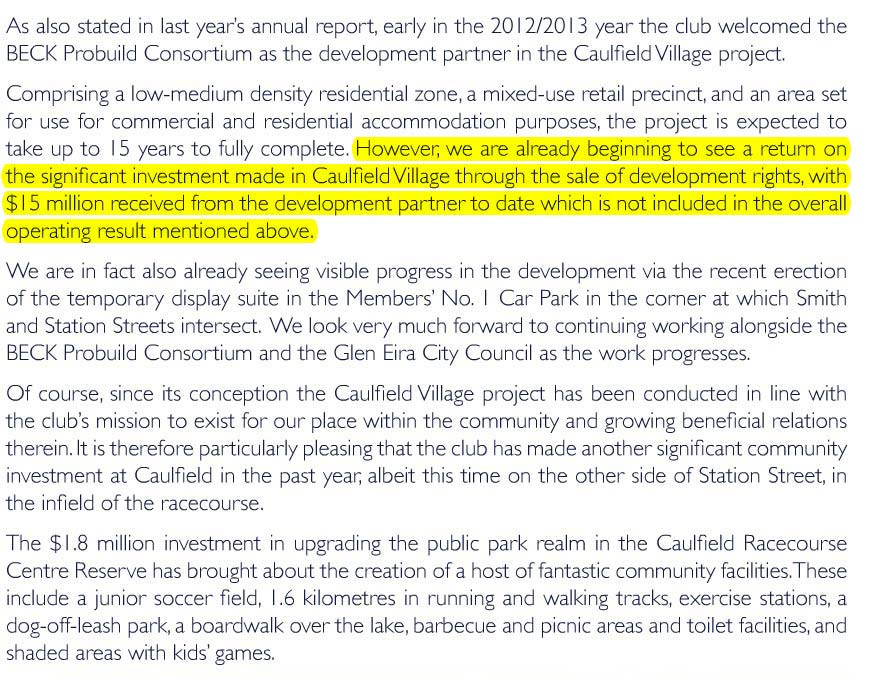
There are undoubted advantages for the MRC to remain the title holder of this land. In the first place they will save themselves 10 years of back-dated rates as stated in the April 28th 2011 Council Minutes when the decision to accept the C60 was made – ie if the subject land is no longer rated under the Cultural and Recreational Lands Act, the owner would be liable for “back paying” rates at a higher level for ten years. Secondly, they will still have a very strong ‘bargaining chip’ for whatever happens down the track with the other two precincts. So, it should not come as a surprise that on page 5 of the MRC 2013 Annual Report we find the following:

Untitled‘Development rights’? We are now firmly in the land of legalese double talk and private hatched deals. Development rights do not equal the sale of any land. Nor do they signal the removal of the MRC’s control. $15 million at this stage is certainly a handy bit of pocket money for a cash strapped organisation, but it in no way represents the true and total value of this land. We remind readers that the Alma club which was a fraction of the size of this 5.6 hectare site went for just under $8 million. What does this make 5.6 hectares worth?

The more one dwells on the entire history of this project the more questions arise. One thing is clear though – all participants in this sorry saga have been far from straight forward in their varied pronouncements. Residents deserve straight talking rather than a chorus of forked tongues and a plethora of carefully constructed spin.

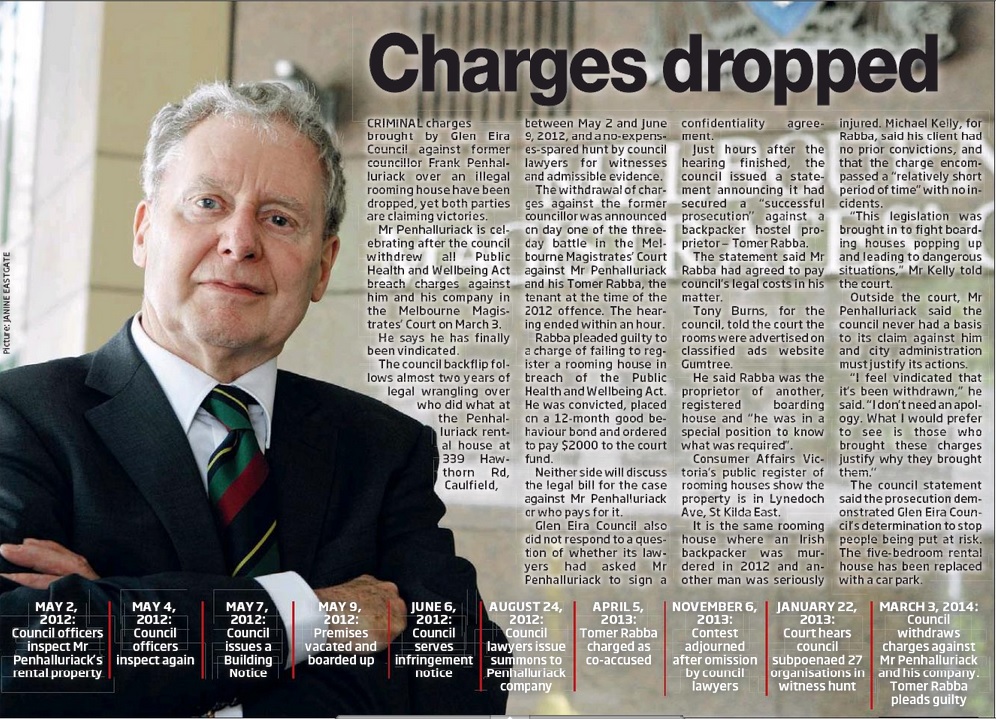
charges

Neither side will discuss the legal bill for the case…….Glen Eira Council also did not respond to a question of whether its lawyers had asked Mr Penhalluriack to sign a confidentiality agreement. ‘No Comment’ or both sides refusing to answer questions can only mean one thing in our view – there is a confidentiality agreement and these usually involve some kind of ‘settlement’. The only ‘settlement’ that would make any sense in this case would be if council, after withdrawing its charges, has decided to hand over some money to Penhalluriack.

village

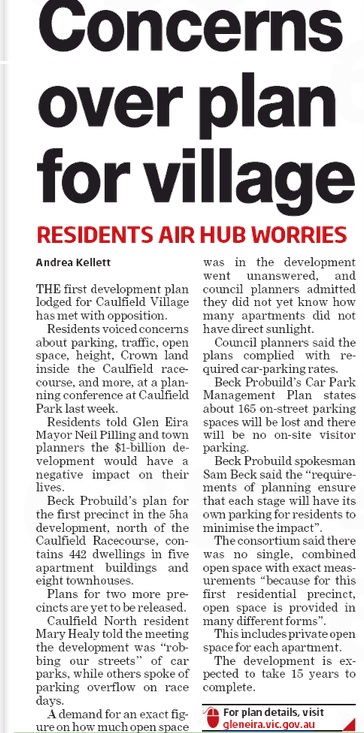
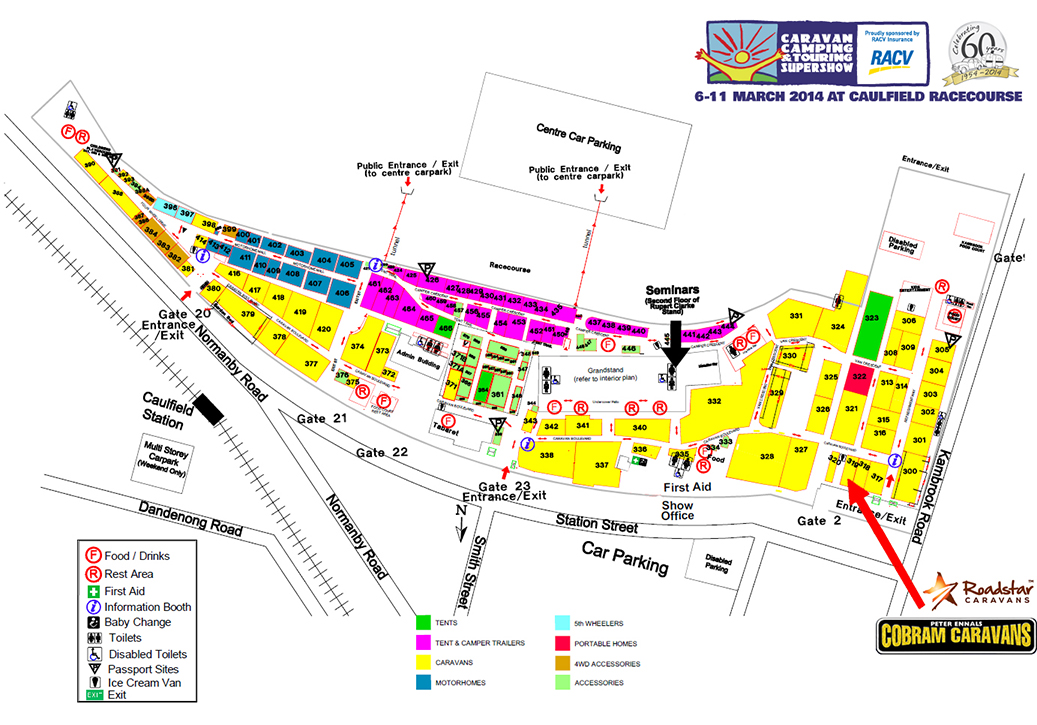
The Car Parking Management Plan for the whole of the land states that for major events the following car parking spots within the racecourse are available (from page 6 of the Plan) – Kambrook Road entrance (674 spaces); Guineas Car park (536 spaces) and centre of the racecourse (3000 spaces). The claim is that all of these are sufficient to cater for demand – especially for the Caravan and Camping Show which draws the largest crowds and puts the greatest demand on car parking spaces.

It’s a pity that the consultants haven’t included a full and accurate picture of what actually happens with the Kambrook and Guineas car parks during the Caravan and Camping Show. They disappear and are replaced (of course) with caravans and camping gear. That means that 1210 sp0aces that the MRC is banking on to support its unsupportable claims do NOT EXIST. Where these 1210 cars end up is obvious – in all quiet surrounding residential streets!

The map below (for all those who haven’t driven past the grounds) provides a clear picture of the nonsense that is contained within the Parking Management Plan.

Edited_map_smaller

The following summary was in many respects the ‘highlight’ of the evening. It involved the developer’s representative (Amanda Ring) who did not ‘speak’ but rather read out a prepared statement.

AMANDA RING: introduced herself as a planner with SJB Planning and that she was ‘speaking on behalf of the developer of the land’. Said that the ‘MRC is not the developer of this land’ and that they have ‘effectively sold the land’ to Beck and Probuild so ‘the community is no longer dealing with the MRC’. Went on to say that as the ‘new owners of the land’ Beck and Probuild were looking ‘froward to being part of the community for the next 10 to 15 years’. The aim is ‘to integrate’ a site that is currently ‘grossly underused’ and to develop this land ‘consistent with government policy’. Said that she ‘gathered’ that people don’t support ‘intensification’ of housing in the neighbourhood but the ‘reality’ is that the ‘decision has been made with the approval of amendment C60’. Whilst Beck and Probuild weren’t involved at that stage they now share the hope that the controls set by the Amendment and the incorporated plan will be ‘implemented’ appropriately. Said that they and council would now be ‘working together’ to ensure that the outcomes are of ‘high standard’. Admitted that the neighbourhood would change and that it would become a ‘thriving mixed use centre’. Said that the ‘consortium is committed to keep you up to date with its development activities’. Introduced ‘George’ as the place manager and who would be dealing with all public liaison issues. Went through the basics of what the Development Plan proposes. Then said ‘I’ve noted your point that there has been a change to dwelling numbers’ but that this has been ‘offset’ by reduction in commercial ‘floor space’ because they couldn’t be ‘confident in putting that into a future plan’. Admitted that there ‘has been change to dwelling numbers’ but that the traffic engineering ‘outcome is absolutely minor‘ and as ‘Rocky pointed out‘ if there are other changes then there will have to be another submission plan to council. Went on to say that the consortium ‘to the best of its ability’ is trying to ‘predict’ how the land can ‘feasibly’ be developed.

Said that these plans have taken about 9 months to ‘pull together’ since the C60 ‘sets high standards for building design’ and ‘as of right height and setback controls’. These controls (plus landscaping, etc)of the C60 set the standards so that large projects like this can be undertaken properly. Whilst council hasn’t yet decided anything Camera’s ‘job is to ensure that’ the development plan is ‘generally in accordance’ with the C60 demands. Said that incorporated plans give the ‘parameters’ of the project but ‘not to the extent that every t is crossed and every i is dotted’ – that’s the job of the development plan. They are ‘confident’ that all the issues have been addressed in the documentation and they concede that ‘not everyone is going to be happy with the plan generally’ or even with some aspects of it. Accepted that some people will continue to be ‘unhappy’ especially about the MRC and the ‘land at the north of the course’ but the developers are not the MRC now and both are ‘highly regarded’ for their ‘residential work’. They’re looking forward to council ‘considering’ the plans and work starting ‘later this year’.

Pilling then asked for questions but Ring said she wasn’t ‘planning to take questions this evening’ and was ‘fearful’ that it would end up in a ‘debate which is not going to end anytime soon’. Pilling said he would be happy to facilitate and that people ask questions and not make statements.

Questions then came about about childcare and what they would do with their children, tradesmen and how they would manoeuvre in and out without parking on carriageways.

MAGEE: ‘as soon as my heart stops beating…..from what I’ve just heard’. Asked Ring to ‘explain to us when the Melbourne Racing Club sold the property?’

RING: said she ‘can’t answer but probably about 12 months ago’.

MAGEE: ‘was council aware of that?’ and ‘how much did the MRC get for the land?’ No real response so Magee said ‘so it’s a secret’. Pilling then intervened and basically wanted Magee to stop, saying ‘these are the applicants’. Magee responded by saying that he’s ‘too angry’ to continue with ‘the debate’. Pilling said it wasn’t a debate but about asking ‘courteous questions’ . Magee claimed that he thought it was a fair question and apologised if he offended.

Another member of the audience then asked if it’s already been ‘established’ that the development plan is in ‘accordance’ with the Incorporated pLan.Pilling replied that it’s still to be ‘determined’. They will consider everything and the officer’s report will be available on the Friday before council decides (April 4th)

Another member quoted from the Town Planning Assessment document that wrote about street frontages being ‘articulated by strong vertical elements to reflect the rhythm of neighbouring residential landscape’. Resident asked how this reflects neighbouring residential landscapes that are basically single storey. Said he objects to this development that doesn’t ‘make any attempt to blend’ in with the residential landscape.

RING: said she would ‘like to answer that’. Acknowledged that many people were ‘expressing’ concerns about height and intensity and she ‘understands that’ but people need to be ‘mindful’ of the fact that ‘strategic decisions how this land will be developed’ (ie height and intensity) ‘were made a long time ago’.’The decision has been made’. Even though people might think they got ‘short shrift’, ‘the reality is the Minister has approved a planning control’ that will mean major change and high rise buildings. Resident interjected and said that she isn’t answering the question. Ring responded by saying ‘I believe I have’. ‘As a result of strategic decisions to develop this land’, the end result will be ‘typological variation from single dwellings’. The resident again insisted that his question hasn’t been answered. Pilling intervened saying that ‘Amanda has’. Resident went on to say that he doesn’t ‘care about strategic planning’ but wants an answer to how a ‘6 storey building blends into a landscape of one and two storey’ buildings. ‘It’s language, it’s rubbish’. Another resident said that if these planners have ‘written those words they should be able to explain them’.

Another resident asked for the number of on street car parking spaces are available within the site. 164 are ‘being removed’  but there are no figures for numbers of on street car parking. A mumbled answer from planners that they haven’t got the figures. Another resident asked ‘you haven’t got them now, or you haven’t got them full stop?’

Cheryl Forge then said as a former Trustee the land sale had never been discussed up until 2012 and she wanted to ask the current trustees if and when  they knew about the land sale.

HYAMS: said that the ‘land in question’ isn’t under the Trust so it didn’t come up and he’s only been a trustee since April 2013 so wouldn’t know what happened before. Said that everyone knew that there had been a partnership between Beck & Probuild and the MRC but that he wasn’t aware of the ‘exact details’. Questions then arose from audience as to whether this was sold or a ‘partnership’. Answers were that this was ‘commercial in confidence’. Hyams then said that the Trust governs crown land and this was ‘land owned by the MRC’ and ‘none of the land comes under the jurisdiction of the Trust’.

FORGE: noted that 8 members of the Trust are also members of the MRC.

HYAMS: repeated that ‘it doesn’t come under land governed by the trust’.

There were several more questions about car parking and renting of car parking. One resident wanted to know if Council was going to do something about the MRC using the centre for car parking more than 5 times a year and whether council was going to charge them for this since it was ‘land that belongs to us’. More questions started coming up and Pilling then wanted to close the meeting, claiming that ‘we’ve all had a good say’. People disagreed and wanted to continue but Pilling closed the meeting.

SPEAKER 11: worried about traffic and parking and what happens on event days like the Caravan and Camping show. Didn’t think that the traffic studies gave ‘due attention’ to these problems. Raised a possible legal issue about staging and said that councillors should be worried about letting stage 1 happen before the Smith St precinct and was worried if council could be sued in the future for its bad decisions in that buyers of stage one might find themselves overshadowed by what ultimately happens with the towers of the Smith Street area. Wanted developers to put this section up first or both together to avoid future ‘legal liabilities’.

SPEAKER 12: also worried about parking on major event days and thought there was a ‘miscalculation’ since the report didn’t include the Guineas and Kambrook Road car parks that are not available when big events like the Caravan and Camping shows are on.  Spoke about the environmental aspects and the ‘benchmarks’ that were in the development plan. Said that the sustainable design elements such as the STEPS guidelines are ‘minimal’ and have been around for some time. Didn’t think that ‘this meets the standards that we should be setting for this development’. The development will be finished in 2017 and the current standards will then be well out of date. So even if criteria are met now, they won’t be met for the criteria that will be in in 2017. Asked if the standards set can be ‘rectified’ in future development plans and ‘set higher’. Pilling responded that this depends on what the State Government ‘does in the future’. Camera then added that if things change ‘in the future’ then ‘there might be a need’ for the developers to also change but all they have to do is meet the current standards. The Speaker then asked if state amendments are needed first off. Camera replied ‘yes’ and that the building code would have to include these new standards. The speaker also asked about Water Sensitive Design Standards that other council have been introducing. Pilling again responded that it’s a state matter.

SPEAKER 13: queried the 5 days centre of the racecourse parking since ‘it’s far more than 5’. 3 of the 5 ‘would have to be this weekend’ with the Caravan & Camping show. The car parking analysis ‘rested on the heroic assumption’ that the MRC car parks ‘satisfy the total demand for cars’ but residents would say something different because ‘there are hundreds of cars parked’ in ‘restriction free residential areas’. Queen’s Avenue residents are ‘hit’ with race days and Monash Uni development and there will be ‘major traffic congestion problems’. Wanted council to be ‘proactive’ and make streets 1 hour parking on race and major event days. Said the racecourse was a ‘parking lot’ and that’s ‘what it’s there for, that’s what it’s become’. Wanted council to ‘draw a line in the sand’. The MRC ‘got what they wanted’ with the C60 so now council shouldn’t ‘go for any compromises’ because residents will be the ones to bear the ‘enrionmental and social costs’.

SPEAKER 14: wasn’t sure how 8 stages would proceed and queried whether ‘sewerage and water’ can be done bit by bit or ‘the whole area before it starts’.

SPEAKER 15: attended the panel hearing and ‘we gave the MRC far too much then’. Pilling then interrupted and said ‘we’re not talking about the past’. Speaker said that after spending days listening to the panel that the ‘documents meant something’ but now ‘it’s all changed’ and the ‘scales’ have grown. Asked that if the development is ‘self sufficient why are they robbing street car parks’. Spoke about the importance of open space for ‘human needs’ and the ‘con’ about the open space levies is evidenced tonight ‘sitting’ in the pavilion because ‘this is how open space’ is viewed (ie as a building) and car parks. Council has lost any idea of ‘what open space means’ and that the levy isn’t what open space is about.

SPEAKER 16: said that the developer had ‘no rights at all to the Guineas car park’ and the centre of the racecourse. ‘That is crown land and they cannot use that for private parking’. Council ‘must take a stand’ on this.

SPEAKER 17: worried about lack of open space and that ‘at least one’ of the building shouldn’t ‘be allowed’. Also racecourse ‘access’ is ‘only in daylight hours’. Said that during the ministerial enquiry the car parking couldn’t be talked about becuase it was ‘obvious’ that everyone assumed that the centre of the racecourse ‘would be made available’.

SPEAKER 18: was ‘right next to Building B’. Asked why if the incorporated plan said that this was a ‘typical 3 storey building’ and now it’s ‘four storey’ so there will be a ‘huge amount’ of extra ‘windows overlooking me’. Said that speaking to council and asking about overlooking the response was that ‘balconies would have to be 1.7 metres’ and windows frosted glass, ‘but in the plans I see nothing like that’. In the plans there is a drawing of a ‘huge tree’ there to ‘shield my property’ but that’s in 20 years and the area ‘is narrow’ so ‘they are never going to be that big’. Asked if it’s ‘right’ that the balconies would be 1.7 metres. Pilling then said that this would be what’s ‘considered’ by Camera in his ‘recommendations’ to council. Council ‘don’t just accept’ but they can make ‘modifications’. Pilling went on to say there had been ‘some changes’ from the Incorporated Plan but it would need to be ‘evaluated’ whether these were still ‘generally in accordance’. Speaker then said that 6 apartments ‘have a secondary entrance onto the lane’ and therefore people will be using this for ‘walking up and down’ so it becomes ‘a roadway’.

SPEAKER 19: couldn’t understand why townhouses weren’t extended along all of Kambrook Road so 2 storey would front an area that is ‘predominantly single storey’. So what is there now is some townhouses and then the developers have ‘simply chucked a 1970’s style 4 storey block of flats’ behind these townhouses. Said this showed that all developers want is ‘more money’ instead of thinking about ‘impact on the environment’ and streetscape. Spoke about a VCAT decision for 2-4 Station Street where the decision said that 5 visitor car parking places had to be provided for 54 units. That means that for the Caulfield Village site there would need to be at least 45 on site spots and ‘478 spots isn’t going to cut it’. Said that if only 15% of units have visitors that means 64 car parking spots ‘are gone’ and these will go into residential streets. Said there were many ‘false assumptions’ such as parking on Station Street which will become a ‘feeder lane’ into Bond St. Some of the plans show Bond St. as ‘open, but it is going to be cut off at Heywood St.’ so car parks in Bond St. will be gone. Said that for all the wonderful talk about access to transport there was nothing in the plans about pedestrian access to the racecourse. ‘You just can’t get to it from the village development’. There’s ‘lack of detail’ about waste collection and the plans state a 2.1 metre minimum height for the basement car park. Problem is that the plans say ‘they need a minimum of 2.2’ clearance so ‘someone’s got the maths wrong’. As for the traffic analysis it was ‘conveniently terminated’ at Kambrook Road and didn’t look at the impact on surrounding streets on such days when caravan and camping shows are on. Said that the statistics are ‘irrelevant’ and that a ‘lot more care and consideration’ is necessary. Wanted a kilometre diameter around the development to be timed parking.

SPEAKER 20: concerned about amenity and that the Incorporated Plan had very little to say about ‘amenity standards’. So it becomes difficult to ‘assess’ any application against ‘standards which haven’t been specified’. Wanted council when it’s dealing with such big developments to ‘make clear upfront what their minimum amenity standards are’. ‘In this development there are none, or very few’. Asked if a balcony went out over the setbacks in the Incorporated Plan, whether ‘a permit would be required’. Was confirmed by Camera. Said that putting 5 or 6 storeys next to a ‘street edge isn’t satisfactory’ and that council can ‘refuse’ the plan and ‘argue for increased setbacks’.

SPEAKER 21: ‘was horrified’ to learn that ‘open space can be traded off for money’. Said that 63 perimeter trees would be lost and that this was ‘completely unnecessary’. Might look good on paper but it’s a ‘waste of perfectly serviceable trees’ that have existed for over 30 years so ‘for the sake of a few metres and a few more dollars’ these trees will be removed. Also huge trees inside the development that would be perfect to have surrounded with open space. Wanted to ‘keep the existing trees that are serviceable’.

PS: We’ve received several emails and photos from residents living near the proposed Caulfield Village (see below). The issues they raise are significant and also have implications especially for all Housing Diversity Areas within Glen Eira. The first photo depicts a notice placed on a rubbish bin outside a block of flats several weeks ago. A car was parked along the kerb. The result is that an entire block of flats did not have their rubbish removed for two weeks. Secondly, why should residents be held responsible for drivers who park in their streets? Residents aren’t police who can tell drivers where to park. Thirdly, is it beyond reason that the driver of this garbage truck could have jumped down and moved the bins so that they could be emptied? After all, putting a cross on a notice and taping it carefully to the bin has already meant that the driver had to exit his truck and spend time on doing the ‘bureaucratic’ nonsense that this illustrates. What could also be asked is whether being forced to keep household rubbish in a plastic bin over the hottest part of the year does in any way constitute a health risk? Given the number of multi-unit dwellings and the number of cars, then this is a problem that Council needs to sort out immediately.

bin

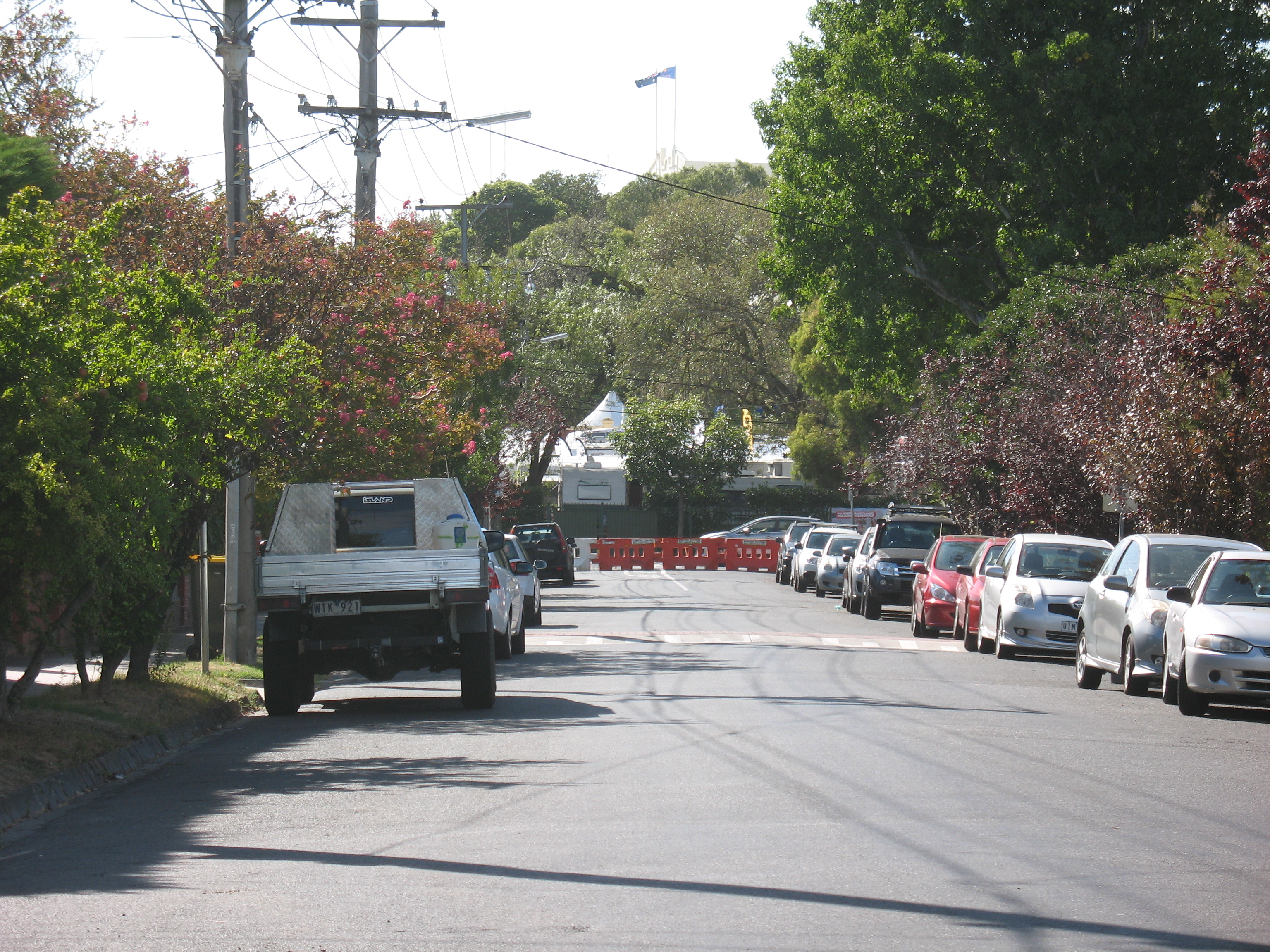
The other problem is the old perennial one of Road Closures on Major Events Days. As per usual the organisers have stuffed up and as per usual Council will presumably do nothing. A notice went out to residents that surrounding streets would be blocked off on the 8th March. Well, someone decided differently and local streets were blocked from early on today – that is the 6th March. Who makes these decisions, and how they accord with any parking management plan, has yet to be fully explained. Nor does the specific role that council plays in these continual stuff-ups! The following photo was taken early this morning.

roadblock

« Previous PageNext Page »