GE Governance


We’ve received the following comment from a reader and believe it deserves to be highlighted as a separate post. The issues that are raised are significant –

  • To what extent is Council ‘facilitating’ the C60 development with ratepayer funds?
  • How ‘competent’ is the traffic department’s report and when errors are pointed out these are totally ignored? Why?
  • Council’s ‘policy’ states that any traffic calming initiatives must first undergo ‘community consultation’. When 92% of residents in a local street state that suggested works are unnecessary, then why is Council so insistent that the works go ahead?
  • If councillors ‘decided’ to support officers, then again and again we have major governance issues relating to decision making behind closed doors.


The Redan Road bicycle lane installation smacks of collusion – everywhere else in the municipality installing bicycle lanes only involves painting a white line on either side of the road and adding some cycling symbols.

Not so Redan Road – it involved
– landscaped traffic calming treatments all along the street and which at one point reduced a wide four lane road to one lane
– a loss of about 15 on street parking spaces (a number of residences are single fronted Victorian/Edwardian that have limited on-site parking capacity and on-street parking is already in high demand) which was disputed by the Glen Eira/O’Brien Traffic Department who claimed only a loss 5)
– 93% of residents signed a petition against it – under the proposal several the landscaped traffic treatments would permanently prevent them from parking within 100 metres of their residence.
– Resident discussions with Ward Councillor/s and the Glen Eira/O’Brien Traffic Engineers proved several of the engineers claims blatantly wrong, described the cost of the installation as a waste of ratepayers money particularly as all residents wanted was a couple of speed humps and the cycling lanes.
– Residents and Councillor/s agreed the speed hump solution would be pursued.
– Residents have now been advised that at the last Councillor Assembly (despite the local law prohibits decisions being made in Assemblies) it was decided to implement the Glen Eira/O’Brien recommendation. No doubt the tactic of letting ward councillors off the hook on contentious issues by non-ward councillors (who have probably never seen the Road) out voting them on the basis of “greater good” for the community is once again being played.

Oh did I forget to mention
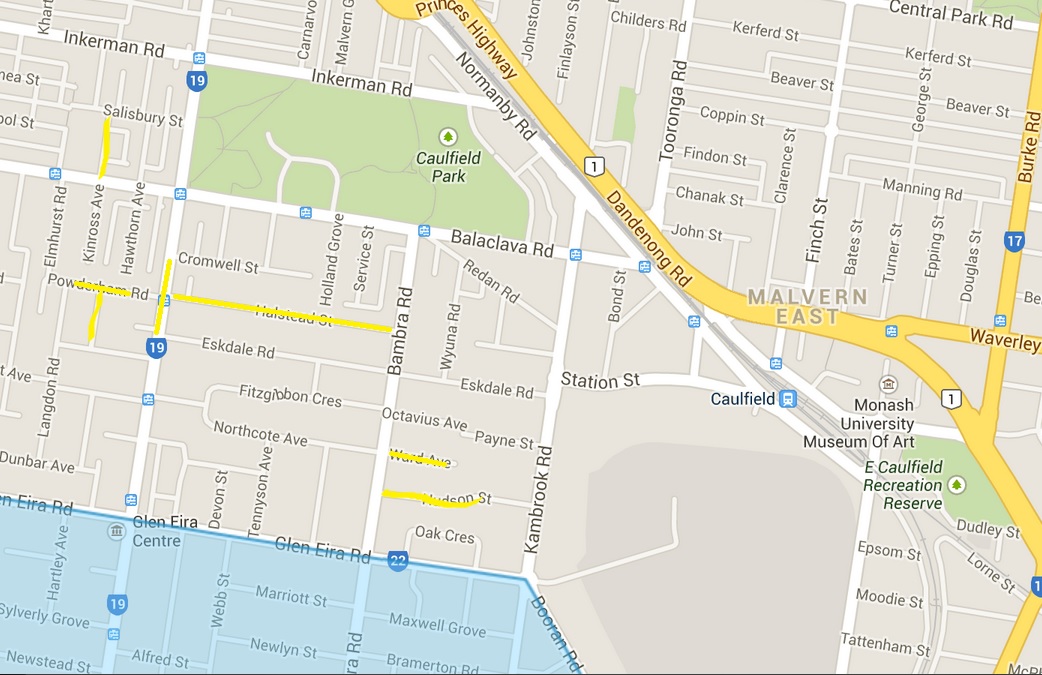
. Redan Road, North Caulfield, is an wide angled road (approx. 400 metres in length) that links Balaclava Road with Kambrook Road.
. The Balaclava junction is smack dab across from Caulfield Park next to the controlled Bambra and Balaclava Roads intersection.
. Kambrook Road end is smack dab opposite the MRC’s Caulfield Village’s main Kambrook Road pedestrian access point and that the MRC is going to undertake the installation of pedestrian safety treatments at the Kambrook Road/Redan Road intersection.
. That Redan Road residents do not have a major traffic volume/speed issue since the 40 k/h speed limit and combined the restricted left turn and pedestrian safety refuge (from Kambrook to Redan) was implemented in 2007/2008. Ditto with the Balaclava Road/Redan Road intersection.
. That the Caulfield Village Development Plans focus on Redan Road as a major pedestrian/cycling route to access Caulfield Park and a tram stop that is further away then the Kambrook/Balaclava tram stop.
. How lovely it would be for the Caulfield Village residents to stroll/cycle down a wide, landscaped, tree lined avenue on their way to the already “at capacity” Caulfield Park – not to mention a photo op for the Caulfield Village marketing materials.

No doubt the Redan Road residents are greatly consoled by the fact that their already Caulfield Village impacted amenity will be further reduced by unwanted traffic treatments, that will prevent them from parking near their residences and that are being partly funded from their rates.

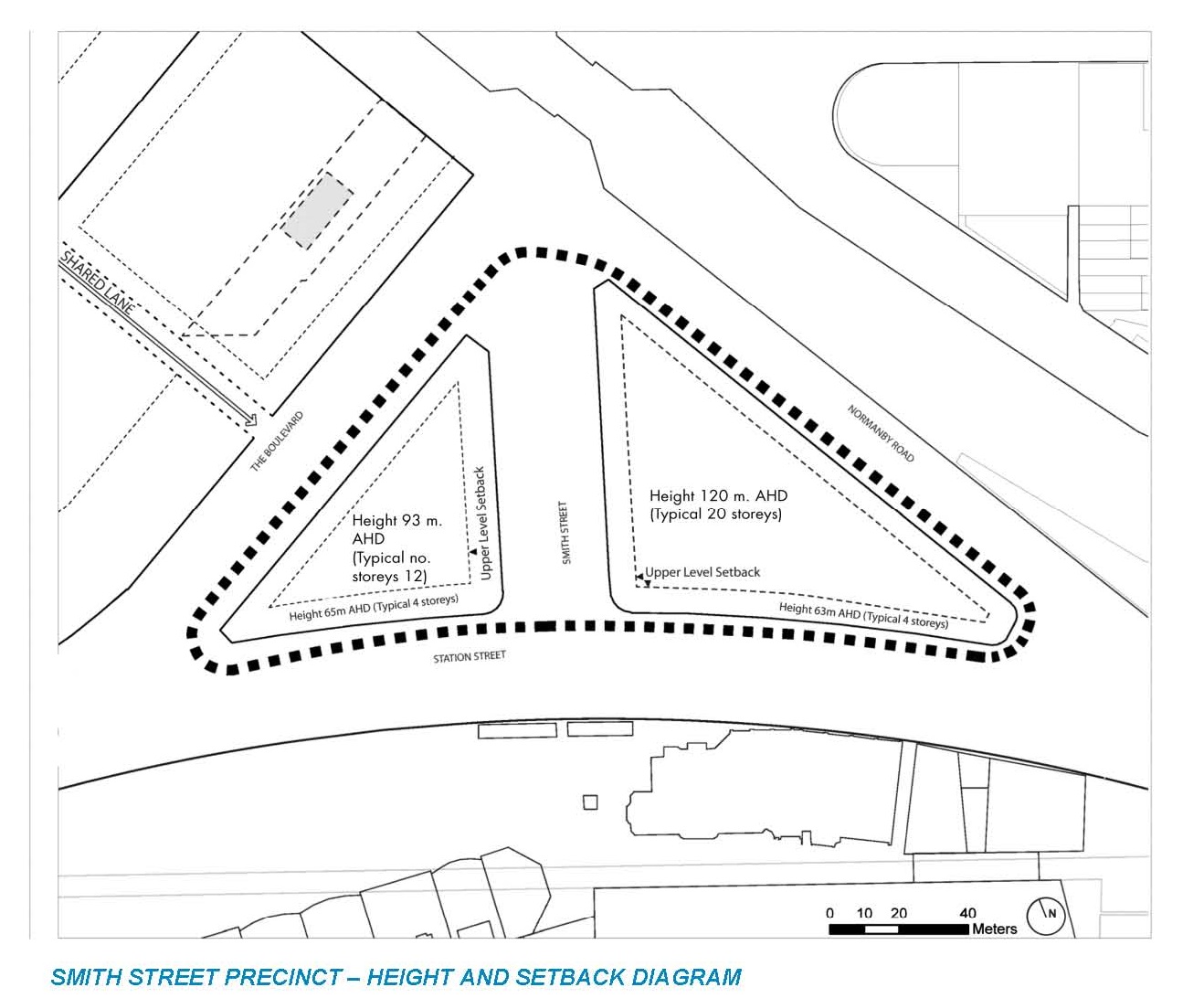
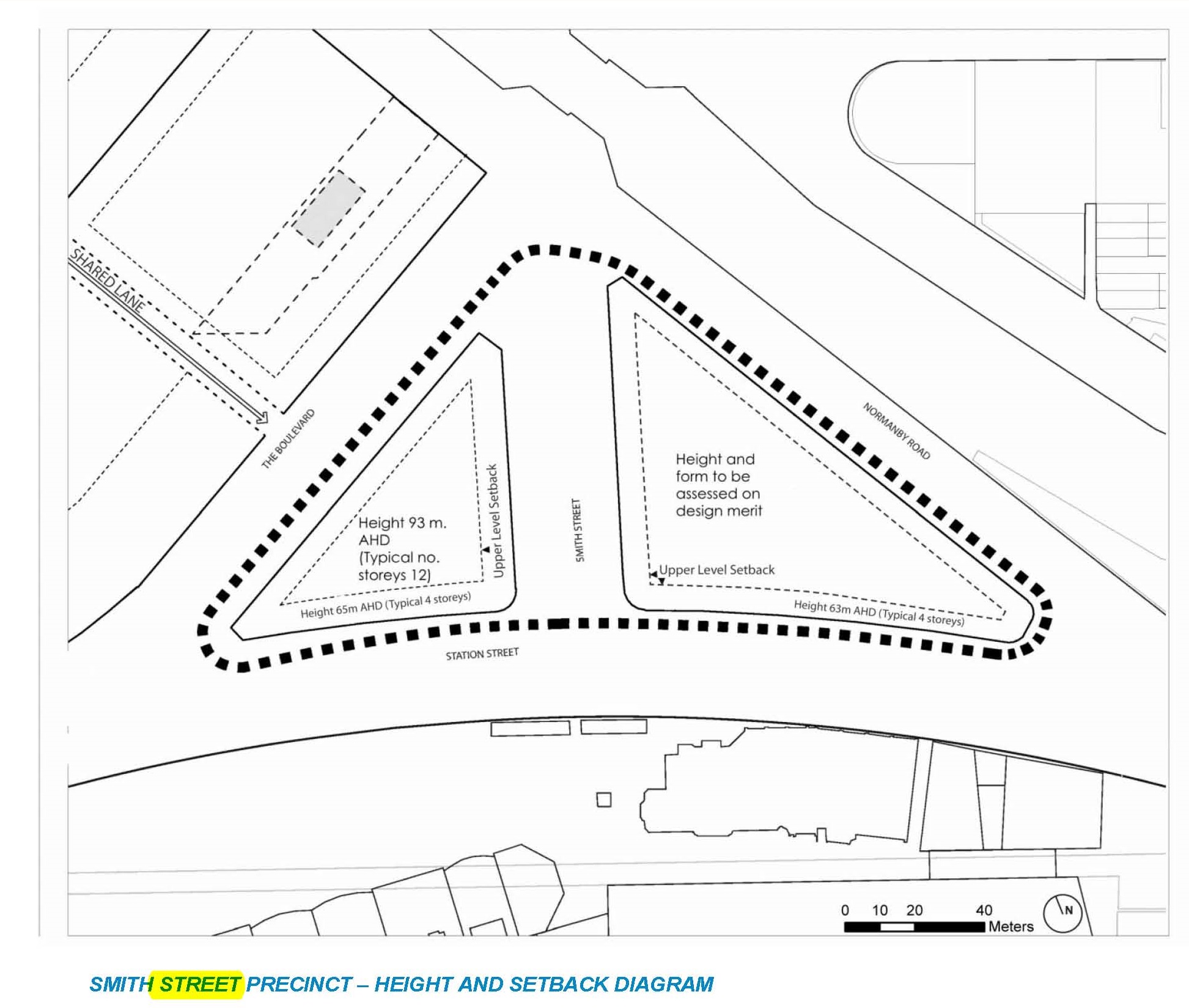
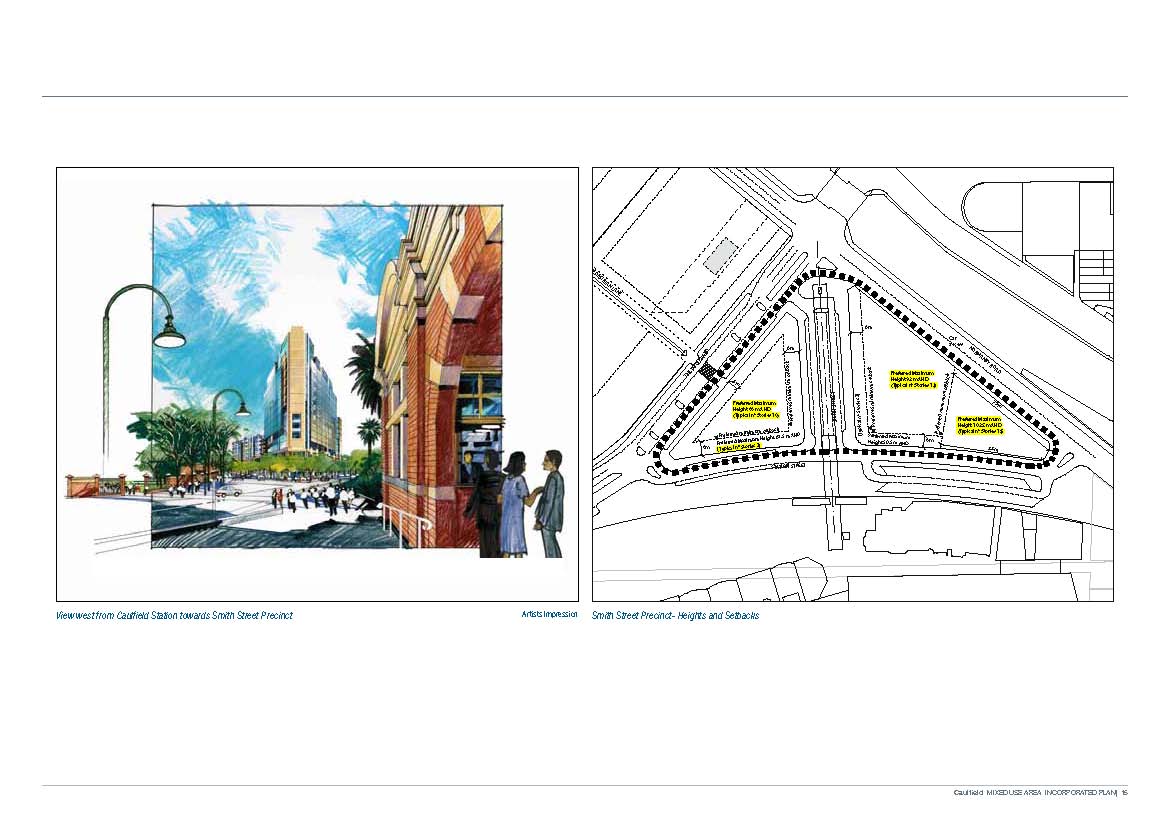
Presented below are a series of pages from the various versions of the Incorporated Plans for the (euphemistically labelled) ‘Caulfield Village’. They raise innumerable questions as to process and overall governance by this Council. The first set of plans clearly illustrate:

  • The April 2011 version which became the official C60 and which was never given to residents prior to the formal consultation process, and
  • The latest 2013 version which is again different to one that was extant several months previously (ie also in 2013)
  • Readers need to take careful note of the differences in ‘preferred heights’ from both documents.

april 2011

september 2010

Here’s an even earlier version that again shows the not so gradual creep of these plans and Council’s acceptance of these. In July 2008 we were told 15 storeys –

july2008What is even more farcical is that when we compare council’s own comments on the first MRC proposal for a Priority Development Zone/Amendment C60 (minutes of 4th September 2007) we find that nothing much has changed and that council’s comments then are still valid for the latest version of the Development Plan. We quote –
(k) The MRC envisages the amendment facilitating office development of 20,000 sq.m, retailing of 10,000 sq. m (including 4,500sqm supermarket) and cafes of 5,000 sq.m for a total of 35,000sq.m. This makes it three times the size of the Glen Huntly shopping centre, with less planning control than for a simple dual occupancy.
(l) It is also important to note, however, that the actual floor areas proposed are not articulated anywhere in the amendment documentation and have only been referred to obliquely in various technical reports supporting the draft masterplan lodged in November 2006. These floor areas have also been subject to change. For example, up to 10th August 2007 the office component of the development was quantified at 10,000sqm. On 10 August, Council was advised that it had increased to 20,000sqm.

Such (road) closures, however, will also be the subject of commercial negotiations with Council to ensure fair
return to ratepayers for Council-owned land.
(o) The amendment also proposes the downgrading of Station Street in order to provide on-street carparking, taxi ranks and access to the racecourse. In effect, this results in a discontinuance of this road in its current form. No
Road Closure Overlay, however, is being proposed to address this issue.

The most damning comment is –
This then becomes a problem of a flawed process. If the path of a priority Development Zone were to be followed, when the public has the opportunity to comment, there would be little to comment on; when details were available, there would be no opportunity to comment.

Readers should also keep in mind that the subsequent C60 Amendment is literally full of loop holes allowing the MRC in concert with Council to do whatever they like. It reads:

A development plan may be approved by the responsible authority:

 with or without conditions relating to the use and/or development of the land;

 which exceeds the preferred maximum heights or reduces the setbacks in the Preferred Maximum Height and Setback Diagrams in the Incorporated Plan; or which alters the Precinct Boundaries or the Staged Development Areas shown in the Precinct Plan of the Incorporated Plan and in this Schedule.

Given the history of this council’s acquiescence to the wishes of the MRC, and their failures to adequately consult and act in accordance with community wishes, the above clauses should be enough to set off many alarm bells for residents.

Ratepayers had better prepare themselves for humungous legal costs, on top of what has already been forked out, if our assumptions are correct.  Today’s agenda features the monthly ‘financial report’. Unlike previous versions, the notation about ‘mediation’ with Hansen Yuncken set down for 14th February is no longer present. Add to this the in camera  item about ‘legal advice’ and the GESAC construction contract, and we would bet our socks that mediation has failed and that we’re now all heading for a major court case. Lawyers are laughing their heads off at their windfall no doubt.

When this is seen in conjunction with the Duncan Mackinnon Maxstra contract and the mega bucks already spent on pursuing Penhalluriack, then real questions need to be asked about the way that this administration does business.

On wastage of public monies, it looks like there could be a repeat of the ‘try, try again’ farce that has occurred with the Caulfield Park conservatory. Readers will remember the three time attempt at public consultation over cafes in the park versus restoration. Now the Booran Road Reservoir is up for the same treatment judging by this little sentence buried in the Records of Assembly –

Former Glen Huntly Reservoir – Councillors asked that a second option involving passive and active use and not just passive use be prepared for public consultation

We simply ask: how much did the original ‘concept plans’ cost? How much did the ‘consultation cost’? And why can’t this council accept the over-riding public response that the vast majority of residents opted for PASSIVE space?

There’s also the tacit admission of a major planning stuff up due to the ungodly haste in ramming through as quickly as possible the Residential Zones. One application asks for a 4 storey development for a school – in other words coming under the ‘non-residential uses in residential areas’. The officer’s comments are illuminating –

A height of 13.9m is proposed with a 2.1m plant/lift overrun screening above. The school is located within the General Residential Zone Schedule 2 where a 10.5m height limit is imposed to residential buildings and dwellings only. As the proposal is non-residential, this height limit does not apply. Council recently agreed to review the Non-Residential Uses in Residential Zones Policy such that the height applicable to residential uses carries across to non-residential uses. This revised policy intention has no status at this time.

Last but not least, we have the full text of the Lipshutz Right of Reply. Such a pity that on other countless issues, the voices of residents remain muted, unacknowledged, and ignored!

Shortly prior to Christmas last year I saw a flyer from the Friends of Caulfield Park which described the Council contractors removing trees from Caulfield Park as “storm troopers”. I full well appreciate the passion some have in relation to Park and the issue of Council’s actions but the term “storm troopers” went beyond the pale.

Melbourne is the home to the largest number of Holocaust survivors per capita outside Israel and the vast majority of Jews in Melbourne are either Holocaust survivors or children and grandchildren of Holocaust survivors. Accordingly to equate Council’s actions with the actions of Storm troopers was highly offensive.

While the expression storm troopers has been used in the Star Wars movies I suggest that the FOCP were not using that analogy but clearly equating the actions of the Council with the actions of Nazi storm troopers.

I am former President of the Jewish Community Council of Victoria and  former Chairman of the Anti-Defamation Commission I have perhaps by that reason a fairly prominent profile in the Jewish Community. As such I received over 40 phone calls from people who effectively said that they were offended by what had been written. Many others approached me at Synagogue and other places making similar comment. When I returned home from overseas in January there were also voice messages making similar comment. One elderly lady asked me if FOCP really knew what storm troopers were and how they acted. She was a Holocaust survivor a person who had first hand experience.

I do not say for an instance that the authors of the flyer are anti-Semitic and I do not make any accusation as to racism; indeed knowing some of the people at FOCP I believe that the words used were rather an expression of their passion. Nevertheless the words used were insensitive given the connotation of storm troopers with Nazi Germany. The expression used was clearly over the top and indeed I believe was counter-productive.

Councillors unanimously agreed to proceed with the upgrade of Caulfield Park. We listened to representatives of FOCP and we questioned and queried Officers before proceeding. Council did nothing by stealth.

Those that oppose Council’s actions have every right in our democratic and free society to make their views known, however to describe Council contractors as storm troopers was excessive in the extreme.

In my experience in public life, going beyond my years on Council I have seen that most people who are able to present a reasoned, intelligent and unemotional argument bereft of abuse will be listened to. To exaggerate however and suggest that Councillors are stupid or are in the pocket It (sic) of Council officers doing their bidding as if puppets is not likely to endear themselves or win any argument. Similarly to describe Council contractors as storm troopers full well knowing the connotation that expression raises is either obtuse or thoughtless.

While no doubt there are some Jews who would not find that comment offensive there are many that have and it is therefore appropriate for the authors to apologise and retract that offensive innuendo.

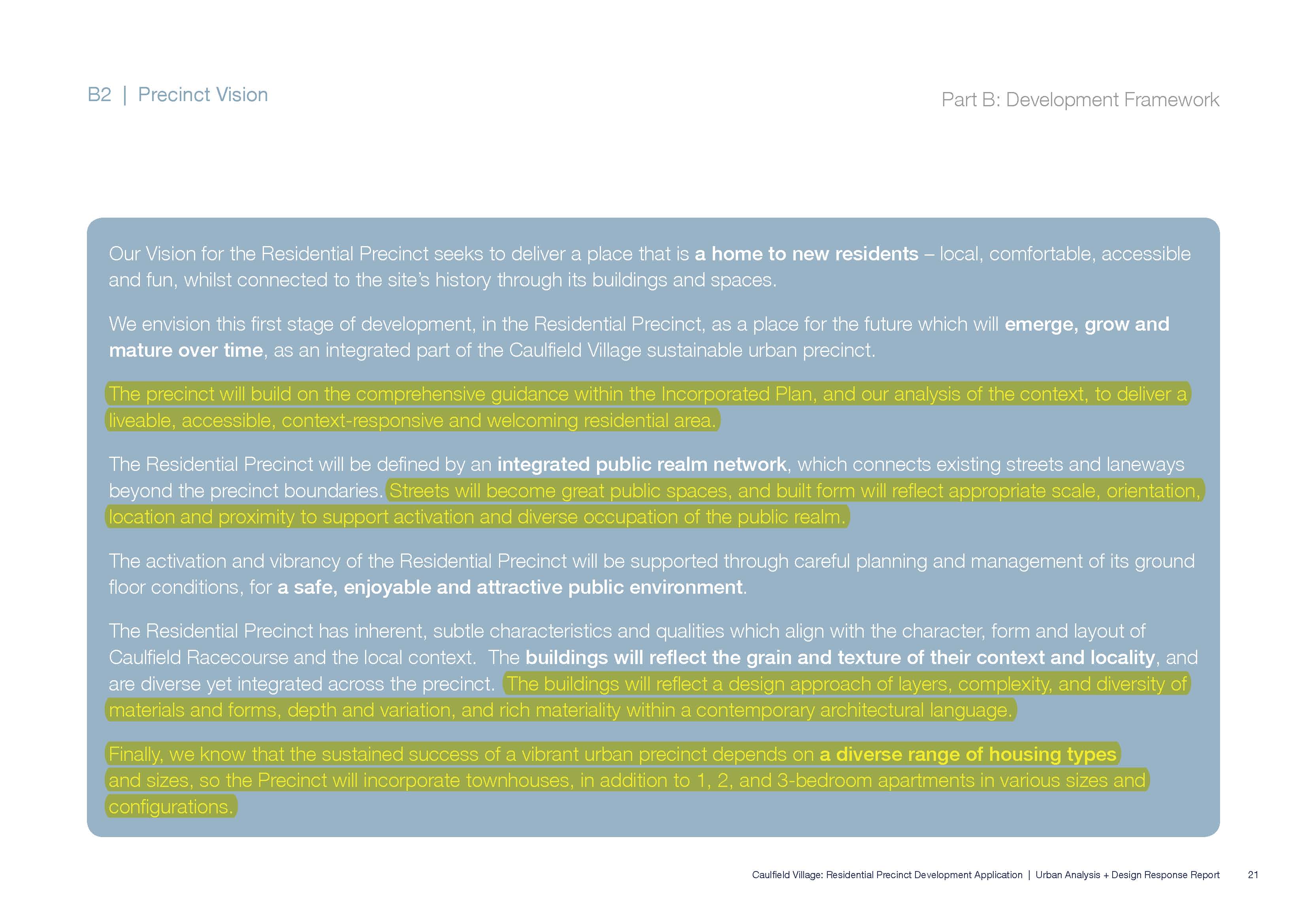
Pages from 8_Urban_Analysis_and_Design_Response_ReportApart from the above over-the-top market hype, readers should take careful note of the so called ‘green spine’ that is to serve as public open space and a pedestrian ‘carriage way’ to public transport. No amount of pretty drawings and promises can hide the fact that:

  • No figures are given for overall AMOUNT OF PUBLIC OPEN SPACE within the precinct
  • Width of entrance via Kambrook Road is barely enough to swing a couple of cats through – 9.6 metres which will in effect be reduced once ‘plantings’ go in.
  • No mention is made of the ‘canyon effect’ and resulting potential for wind tunnels
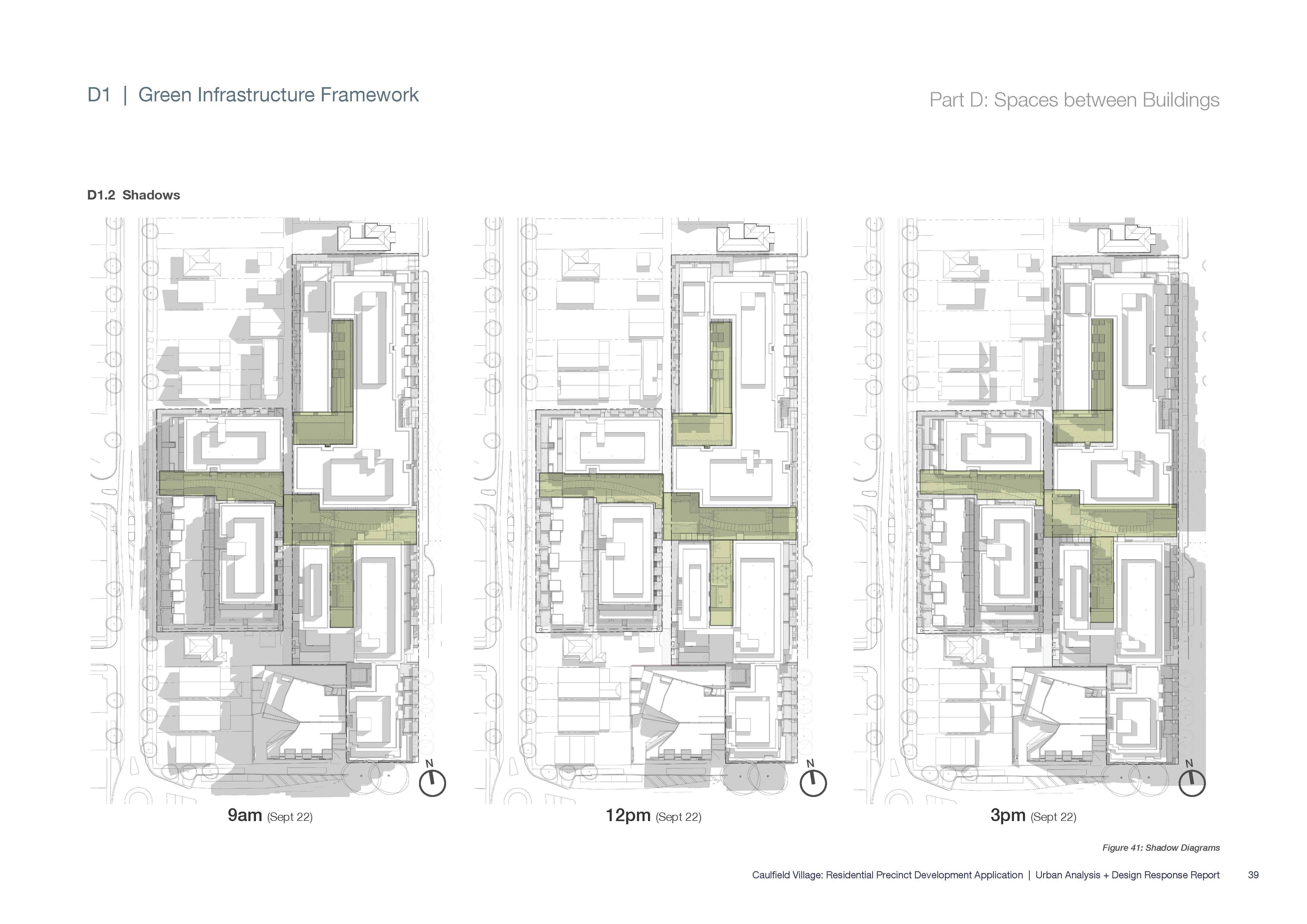
  • Glossy pictures of tall new vegetation leave us unimpressed given that much of this ‘green spine’ will be in shadow for much of the day – see diagram below.

Pages from 8_Urban_Analysis_and_Design_Response_Report-2

On the 28th April 2011, the select group of 4 councillors passed a resolution that a Section 173 Agreement be entered into with the MRC. It is our contention that:

  • This Agreement must be redrafted and renegotiated PRIOR to any approval of the Development Plan
  • The existing Agreement represents a financial windfall for the MRC and a burden on Glen Eira ratepayers.

Here is what the Agreement states:

  1. Certain infrastructure requirements are listed as ‘Required Infrastructure Projects’ and pertain almost exclusively to land within the boundaries of the Incorporated Plan – apart from traffic management at the corner of Koornang and Station Street and as listed in the works contained in Schedule 2.
  2. ‘Additional Infrastructure Projects’ is defined as being tied in with Part 3B of the Planning and Environment Act. Since this part of the legislation refers to Development Contributions, and Council has removed this section from its Planning Scheme, there is no way for council to exact payment from the MRC for anything ‘additional’ without the MRC’s agreement.

What the Agreement ensures is that approval for its Development Plan (even with conditions) comes first! Then there is the necessary argey bargey for ‘additional infrastructure’ works. In other words, Council is signing a blank cheque! Having approved the Development Plan, they would then need to go cap in hand and ask the MRC for ‘additional infrastructure works’. Nothing would compel the MRC to agree with any such request once they have got their Development Plan approved.

Here’s some extracts:

The development of the land within the parameters of the Incorporated Plan will generate a need for certain infrastructure to be provided. Some of that infrastructure is identifiable as at the date of this Agreement while the need for other infrastructure may only become apparent upon the approval of development plans under the Schedule to the Priority Development Zone.

Required Infrastructure Projects means infrastructure works not included in Schedule 2 that are fairly and reasonably required as a result of the development of the Subject Land under the Planning Scheme and which are included as a conditlon in the approval of a development plan or a planning permit pursuant to Schedule 2 of the Priority Development Zone.

We then get to Additional Infrastructure Projects with the wonderful ‘escape clause’ for the MRC –

the Additional Infrastructure Projects may benefit other land owners in the vicinity of the Subject Land and that it may be fair, just and equitable for contributions for the provision of this infrastructure to be provided by other persons in addition to the Owner.

if, at any time, Council introduces a development contributions plan, pursuant to Part 38 of the Act or otherwise, then any payment made by way of contribution for an Additional Infrastructure Project may be credited towards any payments required for works, services or facilities pursuant to the development contributions plan.

The Parties acknowledge and agree that:

7.1.1 the plans and specifications required for the Required Infrastructure Projects are intended to facilitate works to a standard required only by the development of the Subject Land within the parameters of the Incorporated Plan and not to a standard required to compensate for any inadequacy in the infrastructure that currently services existing developments or as a result of development on any other land.

7.1.3 the amount of contribution required for the Additional Infrastructure Projects will be determined as far as practicable having regard to the principles developed through relevant Victorian law which would apply to the assessment of a contribution pursuant to an approved development contributions plan under the Act.

COMMENTS

Approving any Development Plan without first analysing the overall potential impact on surrounding areas and demanding adequate compensation is sheer folly. It is simply not good enough that the Transport Plan only looks at a handful of adjoining streets and totally ignores the flow on effects of 2046 units and 13,500 square metres of retail/commercial space.

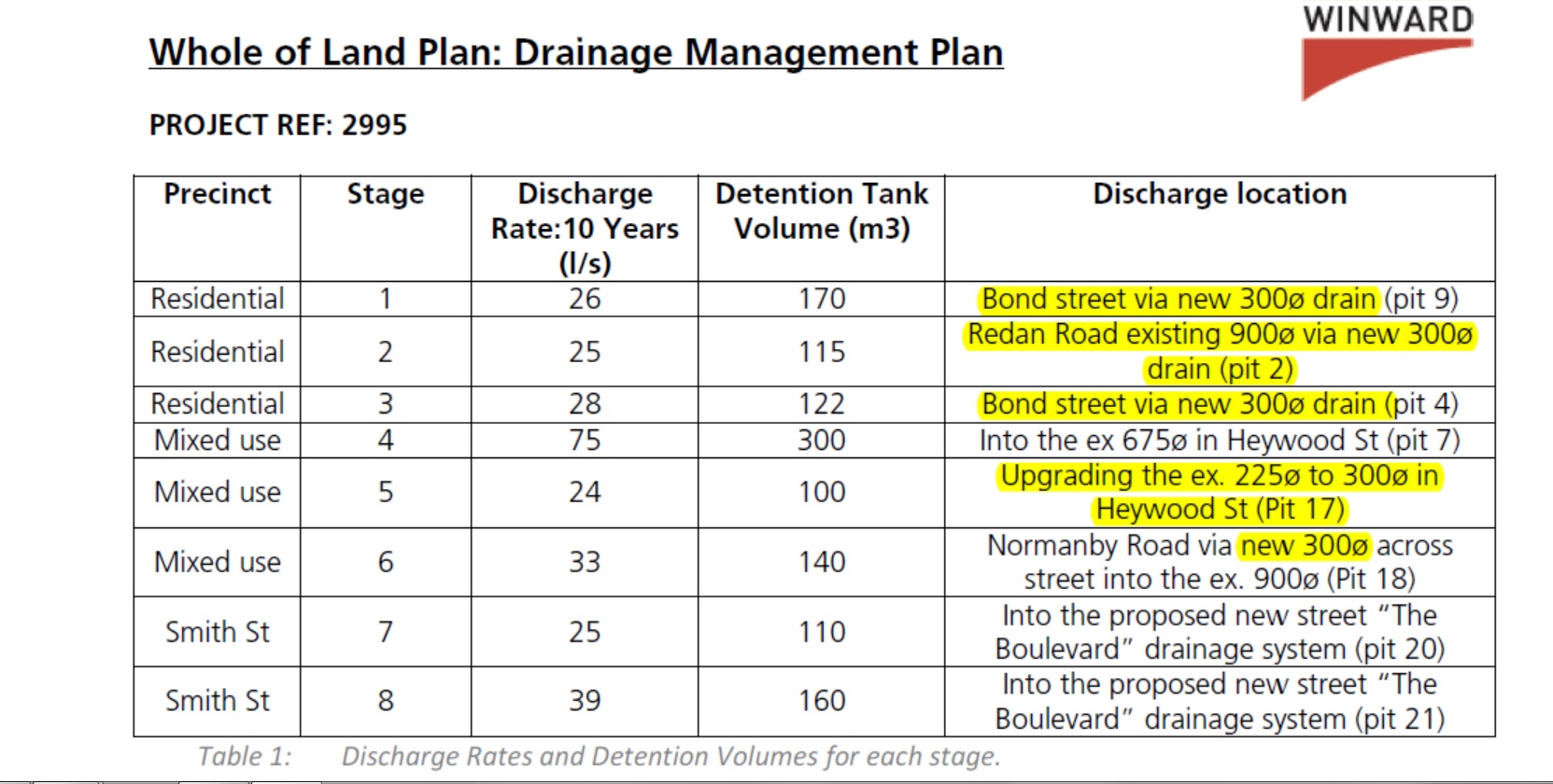
It is also not good enough that in catering for a possible 2046 units that the MRC be responsible for drainage and other service infrastructure ONLY within the bounds of the Precincts and expect residents to pay for the additional necessary upgrading of infrastructure that exists outside of the land’s borders.

Here we have a Section 173 that is not only reliant on the MRC agreeing to pay for anything that someone might struggle to define as ‘reasonable’ but is largely reliant on a Development Contributions Levy which does not exist and even if it did exist would not go anywhere in meeting the costs of the additional infrastructure that is undoubtedly required.

For this situation we can thank our brilliant ‘negotiating’ team of Newton, Pilling, Hyams, Esakoff and Lipshutz. Having stuffed up once before, it is imperative that this not happen again. Development Plan approval must come after a fully detailed and updated Agreement that itemises all necessary works throughout the entire 3 precincts and all the surrounding areas. Ratepayers should not be subsidising the profit making enterprises of any developer.

PRECINCT 1 (with more to come!)

442 dwellings comprising 5 buildings and 8 double storey townhouses that are either 3 or 2 bedroom.

BUILDING

HEIGHT

ONE BEDROOM

TWO BEDROOM

THREE BEDROOM

1A 6 storeys

29

27

1

1B 6 storeys

65

29

9

2A 5 storeys

36

24

0

2B 4 storeys

34

8

4

3A 5 storeys

88

66

14

TOTAL

252

154

28

THUS 58% OF PROPOSED NEW DWELLINGS ARE SINGLE BEDROOM! Only 28 dwellings (excluding the 8 townhouses) will be 3 bedroom apartments, equalling a paltry 6.45%!

How many of these little boxes will have direct sunlight is never clearly enunciated. Instead we have such qualifications as – Where possible, new dwellings have been orientated to achieve optimum solar access to balconies and internal living areas. We can only surmise that this means that most bedrooms will be devoid of natural light!

PS: For those with an eye for looking at plans, we’ve included a ‘snap shot’ from part of the Development Plan which is repeated throughout. Please note at the top right hand corner the size of apartment and the size of balcony – a miniscule 4.0 sq. metres. This should be read in light of the following Age article where the City of Melbourne is considering plans to ensure that apartments do not become chicken coops because of size and where London has enforced a 50sq.m minimum size for one bedroom places. See: http://www.theage.com.au/victoria/council-considers-minimum-floor-size-for-citys-shrinking-apartments-20130727-2qrhi.html

plan

This post concerns what happened at the final council meeting of last year (December 17th). In response to an earlier Request for a Report, the following motion was put and carried. We draw readers’ attention to the fact that Hyams, Esakoff and Lipshutz voted against the motion. We also highlight the fact that what purports to be the actual motion/resolution is NOT what Delahunty said. Two significant words have been omitted from 3 (a) and 3(b) thereby totally changing the outcomes and meaning of the resolution. The entire motion as presented in the now accepted and doctored minutes reads:

Crs Delahunty/Magee

That Council notes:

1. A further part of the process for the amendment of C60 is the consideration / approval of development plans which will involve further community consultation.

2. The first development plan has already been submitted to council and will be the subject of community consultation in early 2014.

3. The report sought to address the area surrounding the Caulfield Racecourse as a whole not just the area comprising C60 and as such further requests:

a. That the recent traffic study conducted on Queens Avenue, Caulfield East including the area around the Neerim Road intersection and the Sir John Monash Drive intersection,

b. That the recent traffic study conducted on Eskdale Road Caulfield East showing the impact, if any on the local street of the changed traffic conditions on nearby Kambrook Road; and

c. That any studies of pedestrian movement along Queens Avenue be examined for potential improvements to safety and accessibility.

4. That the Minutes of this Item incorporate the Resolution of 9 April 2013 in full and the Planning Conference held on 4 April 2011 in Attachment 2.

When Delahunty moved this motion she included in Clause 3 (a and b) the phrase “be provided”. In other words, Delahunty’s motion was asking that the traffic reports which have already been done be given to councillors, or possibly even be made public. By omitting these words from the minutes the entire resolution is exiled to some never-never land of inaction.  Yet, not one single councillor at last night’s meeting commented upon this omission. We have to wonder if Delahunty herself would have asked that the minutes be corrected.

The full significance of all this becomes obvious when one follows the ‘discussion’ that took place on the motion and the pathetic and duplicitous arguments proposed by Hyams, Esakoff and Lipshutz. Here’s what happened:

DELAHUNTY moved motion. Magee seconded.

DELAHUNTY: stated that some traffic studies had been done in the ‘Caulfield East area’ and that ‘a number of residents have contacted’ her about the traffic and she doesn’t want to be ‘dismissive’ of these people.  Said that she thought that residents need ‘actions now’ and that it’s ‘wise’ to understand ‘what might occur in the future’. Wanted this done in a more ‘informal discussion’ and ‘incorporated into community consultation’ and wanted the community consultation committee involved in this. For now, she just wanted that councillors ‘get more information about’ traffic studies on top of what was done in 2011.

MAGEE: Magee did not speak to the motion.

HYAMS: began by saying ‘it’s not so much the substance’ of the motion but the ‘timing’. Said that there would be lots of ‘changes’ to the area and that noone could say that they were ‘all right’ and that there were still going to be ‘a lot’ of changes in the next couple of years especially to the ‘road structure’ and that council had ‘put in’ a ‘lot of conditions’. Thought that all this ‘might be a bit premature’ and didn’t want to have ‘all this effort’ put into ‘producing reports’ when it could all be ‘out of date reasonably soon’. Conceded that it’s important to ‘keep an eye’ on things but wasn’t sure ‘whether this is really the time to do this’.

SOUNNESS: started off by saying that the C60 is ‘controversial’ and that residents were worried about what was ‘going to happen’ and how it was going to work. Said that the processes are ‘confusing to the community’ and therefore there was a ‘need for help to explain to the community’ what is happening. ‘It’s a process of being clear and transparent’ and that’s the role of council. Developers can work within their own area, but the changes and processes should be made clear. Thought that the motion was a ‘good way’ that ‘council does do its communication’ and that the community consultation committee would be ‘a very good place’ to explore all the options. Reiterated that this was ‘confusing’ and that there is ‘uncertainty, there is doubt’ and ‘Council has a role in trying to mitigate that fear’.

ESAKOFF: agreed with Hyams in that the motion is ‘too premature’.

LIPSHUTZ: agreed with Sounness that there was ‘angst’ in the community and although Delahunty’s motion is something that ‘should happen, but not right now’. Said that the ‘first step is to let the development plan come through’ so the community ‘can see’ what’s there. Only then should council ‘look at the whole precinct’. What’s happening now is that the motion proposes to look at roads without knowing what the whole precinct is going to look like. ‘When it does come in things may change’. Residents need ‘to know from an informed position’ and ‘doing it now is not an informed position’. ‘What we should be doing is allowing it to happen and then have consultation’ once the development plan is in so that then ‘everyone can become involved’.

PILLING: thought the motion had enough ‘merit’ for it to be passed.

DELAHUNTY: said that she had ‘changed what I originally wanted to ask’ as to whether there was an ‘additional work’ and there wasn’t because the traffic studies had already been done. Said that the motion isn’t asking for additional or any consultation but the methods of consultation are the focus. Wanted to ‘include the whole precinct’ and not just one area. Wanted to know how council or the consultation committee could ‘increase the scope’ of consultation. Wanted some ‘scope’ to ‘understand pedestrian movement’ along Queen’s Road because people had notified her about ‘safety’

MOTION PUT AND CARRIED – ESAKOFF, HYAMS, LIPSHUTZ VOTED AGAINST.

COMMENT

Residents should consider very carefully WHY Esakoff, Hyams and Lipshutz voted against a motion that requested information on traffic and parking. Their nonsense argument of ‘premature’ is an insult to the intelligence of residents. This is akin to saying ‘let’s wait til the tsunami hits and then see what our emergency plans are like’!!!! Utter rubbish! When the MRC proposes 2,046 units, with no provision for on site visitor parking, no real and plausible explanation of what is going to happen to the displaced MRC members’ car parks on race days, and when Monash is booted out of its current car parking arrangement at the racecourse and staff and students have nowhere to park, then residents have every right to ask that information is supplied BEFORE any of the disasters happen. Making matters worse, nothing in the MRC parking plan, and absolutely nothing from councillors, talks about the flow on effects of both parking displacements and the hordes of new residents congesting an already over-congested area.

Further, if council has actually done some traffic analysis of nearby streets then how can this be ‘premature’? The accompanying report states unequivocably that the Development plan was already in council’s hands. Hence, Lipshutz knows full well (if he bothered to read it) what the plan entailed. If by chance he wasn’t privy to it, then this is just another black mark against an administration that keeps its councillors (or some of them) completely in the dark until things are sufficiently ‘massaged’ and vital decisions are made on the basis of LACK OF RELEVANT INFORMATION.

Regardless of whether or not all councillors had clapped eyes on the Development plan by December 17th, any information that may shed further light on decision making must be available. Council will be deciding again in a piece meal fashion – development plan, by development plan. Who knows when the next Development plan for the second precinct will be forthcoming. But in the meantime, the MRC will already have ‘cemented’ the residential component of the project and the traffic mayhem will have been let loose on unsuspecting residents.

A truck could literally be driven through the gang’s arguments. Lipshutz wants to ‘wait’ for plans for the ‘whole precinct’. Somebody should tell him that the documents DO REVEAL the plans for the ‘whole precinct’ – however briefly! Also included in this first Development Plan are 3 documents relating to traffic management for the entire area. But, and this is a big BUT, the MRC have basically only looked at 4 streets and not Queens Ave, Sir John Monash Drive, Eskdale Road, etc. If council has done what the MRC ignored then this is crucial information that should be given not only to councillors, but provided to the public at large.

What Lipshutz, Esakoff and Hyams are in fact doing, in our view, is to push the MRC agenda. We have no idea when the subsequent development plans will be released. It could be years away, but in the meantime, the residential precinct will be underway and traffic chaos will ensue. And that’s what Lipshutz, Esakoff and Hyams are basically arguing for. Let’s wait and see they say. Our view is ‘forewarned is forearmed’. And once this particular development plan is rubber stamped by the gang, whatever follows will be too little, too late. The wheels will be set in motion and undoing what’s been done becomes an impossibility. You can’t undo something after the fact. Traffic analysis of all the area, especially those streets not included in the MRC development plans, are essential to decision making now. They are essential for the public to understand what will happen and will provide residents with the grounds for objections – that of course assumes that the council investigation is indeed ‘objective’ and honest. We have our doubts.

Governance overall continues to be a major problem. How many more times will minutes create fiction out of fact? How many more times will this councillor group allow inaccurate and distorted versions of what really occurred to enter into the formal record and thus aid and abet the continual rewriting of history?

But most important is the very fact that these three councillors are Trustees. This inevitably calls into question whether or not they really have the interests of residents at heart, or are basically MRC stooges. Remember, they and Newton are responsible for C60; they and Newton are responsible for setting up a Special Committee where 4 councillors (a minority!) decided the fate of thousands, and they are responsible for the failure to listen to the community. This latest incident is only further evidence of why their actions, their words, and their hidden agendas, require a full Royal Commission.

Buried in the fine print of several of these documents, some truths are finally revealed. Residents were repeatedly told by council and the MRC that the project envisaged 1200 dwellings, plus commercial and retail areas. It then burgeoned into 1500 units. Now we are looking at the possibility of 2040 of which the vast and overwhelming majority are SINGLE BEDROOM apartments! We can only wait with baited breath for stages 4 onwards, when height for the remaining buildings are revealed.

Below are the figures taken directly from the ‘Precinct Plan’ and the argument is that this is still in line with the Incorporated Plan!!!!! What bunkum and what collusion!

3

2

1

c601c602c603

PPS: All the documents are available from:

http://www.gleneira.vic.gov.au/Council/Planning_and_building/Planning/Caulfield_Village/Development_Plan_1

PS: From ‘The Age’ today!

Victoria’s racing industry pay rates run a distant last

Date: January 27, 2014 – 9:38PM

Illustration: Matt GoldingIllustration: Matt Golding

Strappers and stablehands in Victoria’s racing industry earn the lowest pay and have the worst conditions, according to the national workplace ombudsman.

An audit by the Fair Work Ombudsman of ?eastern seaboard racing tracks resulted in Victoria chalking up the worst performance in properly paying strappers and stablehands – the people who groom, feed and saddle racing horses and clean and maintain their stables.

Only a third were found to be paying their staff properly, far worse than in other states.

The audit followed the ombudsman receiving almost 100 complaints over pay and conditions from people in the industry, 35 from Victoria.

Of the horse-training businesses checked in Victoria, only 31 per cent complied with workplace laws. In NSW 86 per cent of businesses paid staff properly as did 76 per cent in Queensland.

In all, ombudsman inspectors checked the books of 86 horse trainers in metropolitan and regional NSW, Victoria and Queensland late last year.

A report to be released by the ombudsman on Tuesday cites the case of one horse trainer in Victoria whose business employed stablehands hired for periods of less than the legal minimum of three hours.

One Victorian trainer interviewed as part of the report said he was not aware there was a minimum amount for shift lengths and paid back $1985 to eight of his employees.

The correct rate of pay for strappers and stablehands is about $21 an hour depending on which state.

A trainer who was noted in the ombudsman’s report was found to be paying her casual staff a flat rate of $20 an hour, despite many working on Sundays when penalty rates applied.

The trainer back paid almost $16,000 to eight of her workers.

Of the 86 horse trainers audited, 34 were found to have underpaid a total of 61 employees almost $40,000.

Read more: http://www.theage.com.au/victoria/victorias-racing-industry-pay-rates-run-a-distant-last-20140127-31j5f.html#ixzz2rddD7MkD

Council can certainly get things rolling very quickly when they want to. The latest is the Lord Reserve car park development at the cost of $542,000. Tenders were advertised on November 16th and closed on 6th December. The decision was made on the 17th December. Quick as a wink, without telling residents exactly what is happening, the contractors moved in, and what a surprise, a further bunch of at least 8 mature trees were removed.

We do not for one instance believe that the speed and timing of this project is a coincidence. If you expect community opposition, and certainly questions, then January is the best time to get the ball rolling.

Please note: we are not suggesting that this section doesn’t require work. What we are questioning is:

  • Why were so many trees removed? Could any have been saved?
  • How much open space will be lost and turned into a bitumen car park?
  • Why can’t residents be given a clear picture of what is happening?

PS: By way of contrast, residents should take a look at how Bayside City Council deals with car park extensions and the value of trees and consultation. The following is taken directly from the agenda set down for January 28th.

The Beaumaris Reserve Masterplan was adopted by Council in September 2008. The masterplan identified a range of initiatives to be implemented over the lifetime of the plan, including works to the car park adjacent to the sportsground at the rear of the Reserve.

The design for the car park was subject to a period of community consultation between May and July 2013. Key design features reflected the endorsed 2008 masterplan and included; reducing the area available for car parking by turning the area behind the Arts Building into an extended Village Green, proposed removal of six trees to the north of the existing car park to facilitate additional car parking spaces and the installation of a rain garden. 

Following this phase of community consultation, it was evident from the comments received that the proposed design no longer met the needs of the community or the users of the Reserve. As a result, a revised design was developed to take into account issues raised by users, including retaining the existing car park footprint, retaining six trees proposed to be removed and reducing the extent of asphalt surface to the entry road. As the revised car park footprint differed significantly to the endorsed 2008 masterplan, a revision to the masterplan was required.

A revised masterplan detailing the amended car park footprint was presented to Council and adopted at its 29 October 2013 Ordinary Meeting detailed in Attachment 1.

Source: Agenda item 10.1 – 28th January 2014 – http://www.bayside.vic.gov.au/documents/governance/28_January_2014_Ordinary_Meeting_Agenda_without_confidential.pdf

lord

Here’s the ‘before and after’ –

Untitled

lord3

Untitled2

lord2

« Previous PageNext Page »