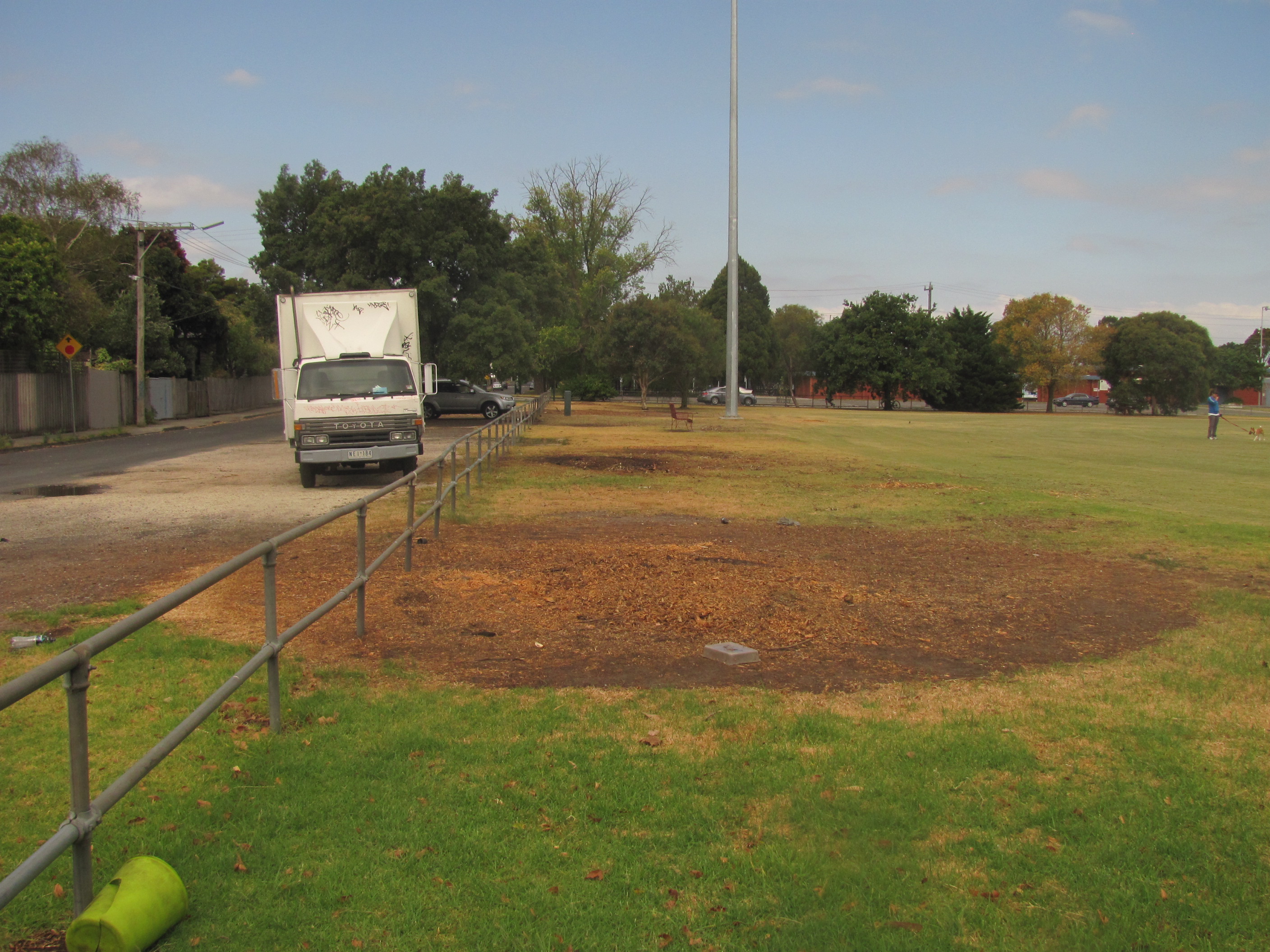
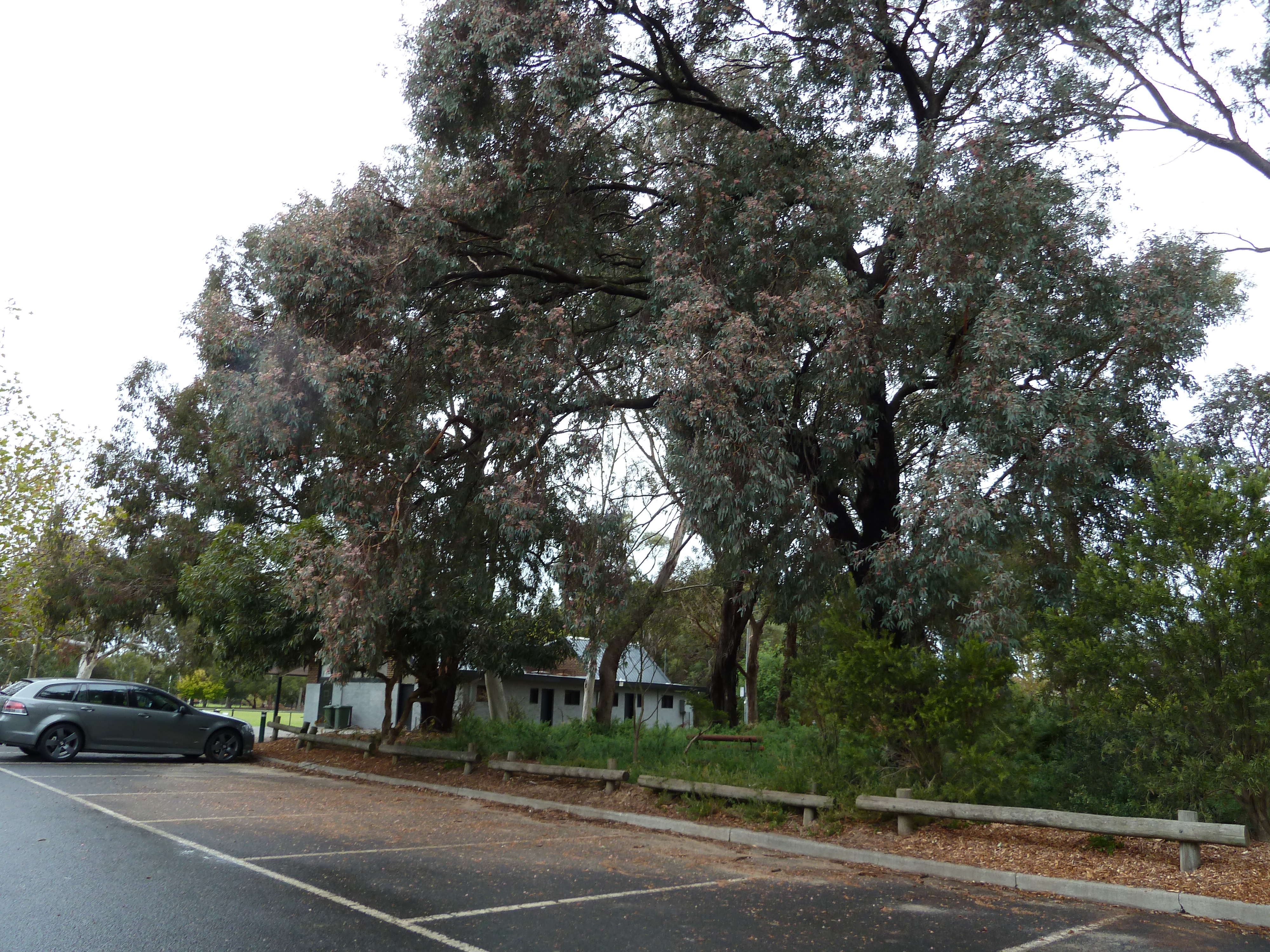
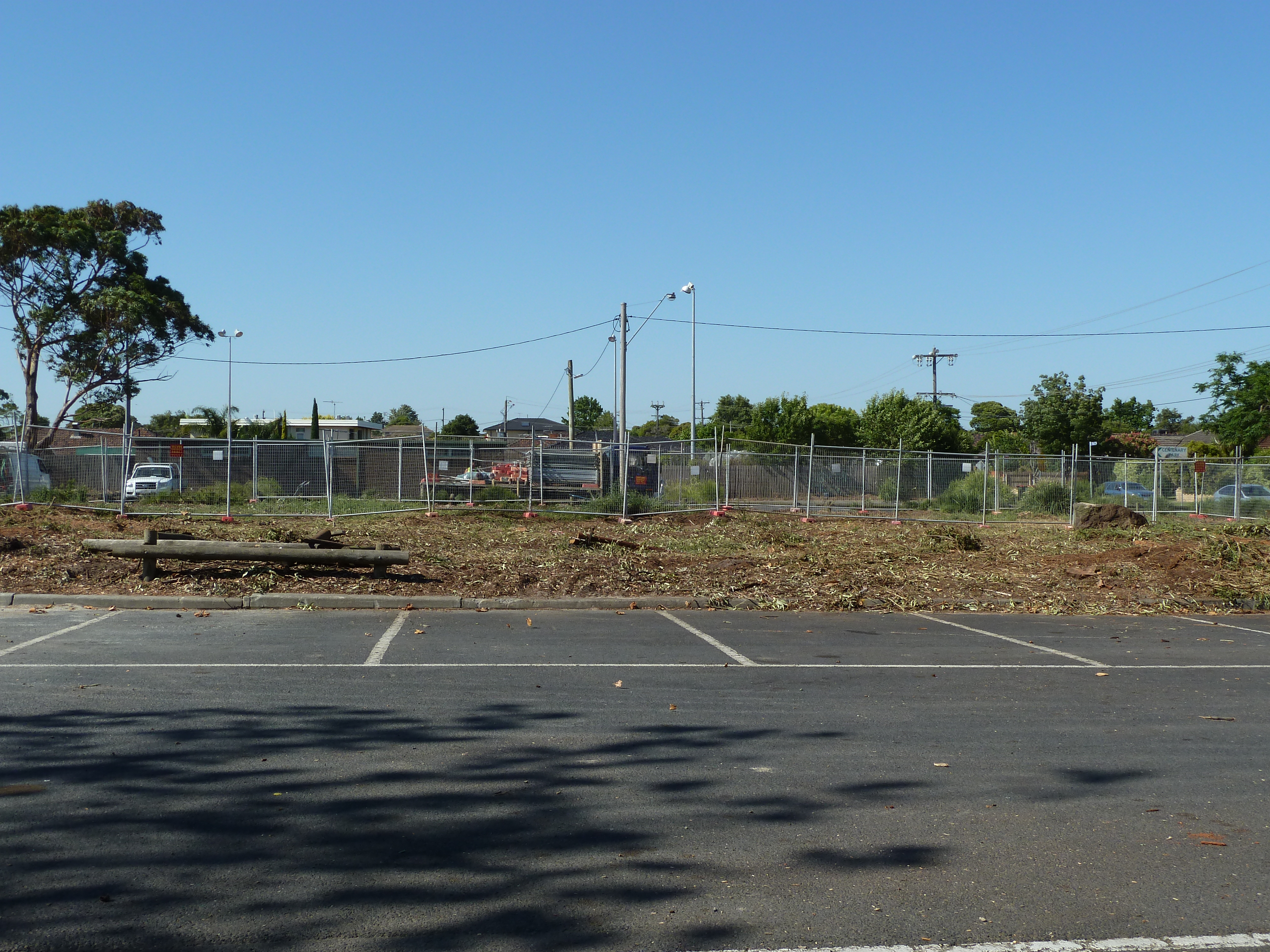
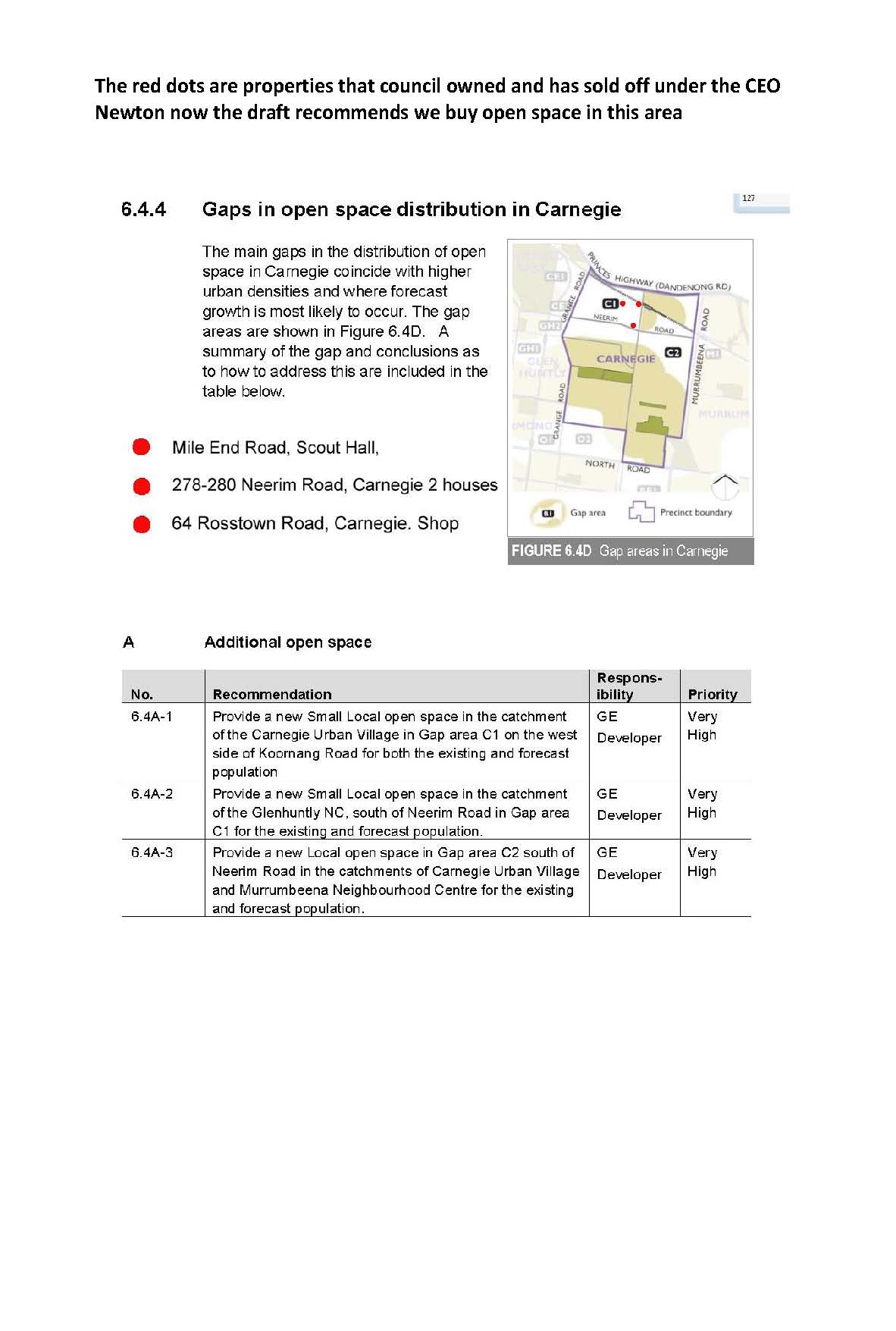
GE Open Space


We cite a public question that was asked at last Tuesday night’s council meeting as another example of too little done by council and too late!

Subject: Centre of Caulfield Racecourse Reserve

“Council’s stated position is for the development of various sporting grounds (ie baseball, soccer, basketball) in the centre of the Caulfield Racecourse Reserve. If these developments are to go ahead, then:

1. Will ratepayers be paying for these developments?

2. What is the estimated cost for these developments?

3. Has council, or any officer, had any discussions with either the MRC and/or the Trustees on these potential developments?”

The Mayor read Council’s response. He said:

“The Crown Land is reserved for “a racecourse, public recreation ground and public park”. Responsibility for using the land for these purposes rests with the Caulfield Racecourse Reserve Trust. Council has repeatedly stated that while the first use, a racecourse, is well satisfied, the other two are not.

In Council’s view, the Trust should be providing for the use of the land for public recreation and public park. The Trust could fund this by charging market rent for the land which is used as, or in support of, the racecourse. In that case, there would be no capital cost to ratepayers.

On 9 April 2013 Council adopted an indicative layout of the Crown Land, showing scope for sports grounds. Council sent that to numerous parties including the Trustees and the Minister.

Council officers have discussed matters with Councillors who also sit on the Trust as Trustees in their capacity as Councillors.”

COMMENT

What this answer makes 100% crystal clear is:

  • There is no ‘business plan’ and no costings for the development of all these sports grounds. All that this ‘vision’ represents are pretty little pictures drawn on a map.
  • Council has no intention of paying for any developments on this site – that’s assuming they even have the money.
  • Given the repeated ‘crying poor’ by the racing industry (especially the MRC) and the fall in crowd revenue, the prospect of the MRC/Trustees spending another cent on the centre of the racecourse is buckley’s and none. If the MRC has indeed spent $1.8m as claimed on cracked concrete paths, a woeful ‘playground’ and a toilet block, then how much would they have to spend to create synthetic soccer grounds, baseball diamonds, basketball courts, etc.
  • Given that the current ‘conditions’ clearly state ‘NO BALL GAMES’, then what is the likely response to baseball games for example, by the MRC?
  • What does all this say about council’s ‘position statement’ and its ‘advocacy’ program for more sporting grounds? Is it all on a wing and a prayer that either some rich sporting club, or government will cough up the necessary money? Are they hoping it is the State or Federal Government, the Trustees, or perhaps Maccabi?
  • Or is the publicity for more sporting venues just that – grandstanding with no real prospect of anything ever coming to fruition?
  • We also have to raise an eyebrow at the final sentence regarding ‘discussions’ between Lipshutz, Hyams, and Esakoff in their role as councillor representatives on the Trustees, and the pledge of ‘confidentiality’ (aka ‘secrecy’)! Were these ‘discussions’ with officers reported back to the entire councillor group? Were any of these ‘discussions’ actually raised at any trustee meeting? Was anything ‘resolved’? Or are these councillors simply taking ‘direction’ from officers rather than the entire council group? And there’s the big question – has the Minister even bothered to answer council? If so, then why isn’t this made public?
  • The most pertinent issue is how much of this so called vision is diversionary and as usual a couple of years too late? How genuine is the advocacy, when the ‘negotiations’ with the MRC were such a disaster in the first place and council can’t even hold them to the terms of the so-called ‘agreement’? And how much of it is for public consumption to convince everybody that there really is a need for more money to be spent on sport instead of drains, proper planning, consultation, and a million other services that this council is legally bound to supply and support?

Esakoff moved, and Sounness seconded the following motion on roof top gardens –

That Council:

1. Include the concept of Rooftop Gardens and Open Space in Council’s submission to ‘Plan Melbourne’, and

2. Commence the process of applying for a Planning Scheme Amendment to include this concept within our Residential Growth Zones and Commercial Zones on the basis that Glen Eira has the last (sic) amount of open space in metropolitan Melbourne.

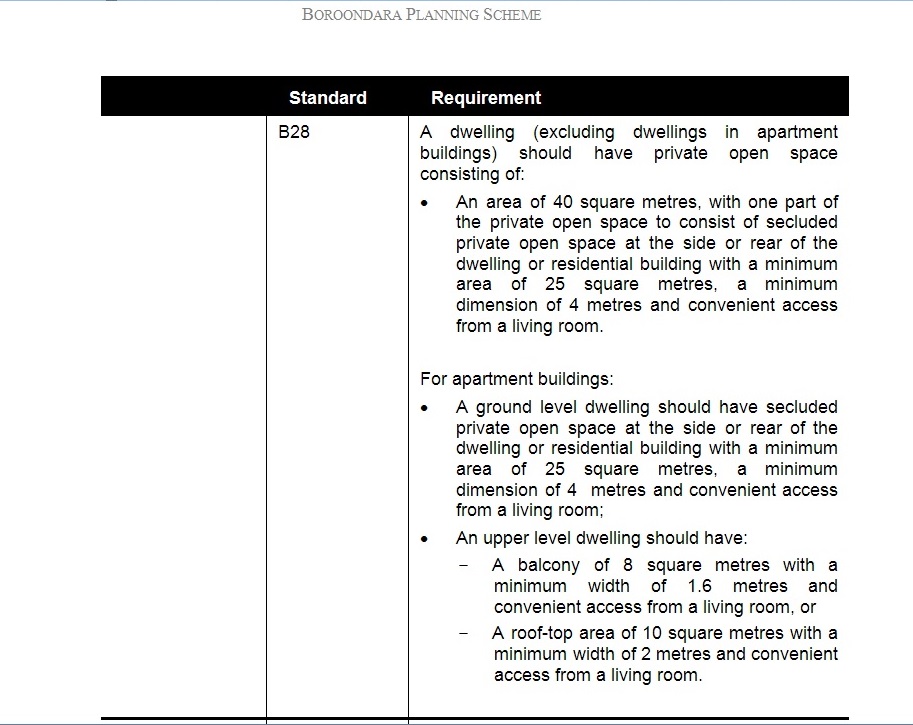
Ostensibly, this sounds terrific. But like most things done in Glen Eira it is too little too late and won’t be achieved (if at all) until years down the track. It is vital that residents appreciate what this administration and its councillors could have achieved if they really cared via Amendment C110 – the ‘reformed’ residential zones. Boroondara for example has 4 different schedules for its General Residential Zones. That means that they have looked at their neighbourhoods and carefully differentiated the respective areas. Glen Eira really only has 2 because the third schedule applies solely to the Alma Club site. Glen Eira has no limits on subdividing land less than 500m and sets a height limit in this zone of 10.5 metres. In contrast Boroondara believes that 9 metres is necessary and permits are required for land less than 500 metres in area.

What’s really important however is Boroondara’s emphases on open space. Glen Eira relies on the miniscule ResCode standards. Here’s what Boroondara stipulates in its GRZ zones –

boroondara

And it’s not only Boroondara. Kingston, Stonnington and others are ensuring that their schedules meet basic principles of non chicken coop living. Their permeability requirements, together with open space requirements (and the inclusion of increased open space levies in some schedules) put Glen Eira to shame. All of this could have been done with Amendment C110. It wasn’t. So now we have this cry for an amendment that in the end is meaningless. With no real urban design framework and no ESD mandates in its planning scheme, the prospect of forcing developers to do anything is pie in the sky in our view. This call for rooftop gardens is nothing more than an afterthought, designed to counter the mounting criticism and to give the appearance that council is actually doing something. But, with little hope of ever being legally viable, and potentially years down the track, it remains a pipe dream.

The opportunity to institute real reform has been squandered, or worse, never intended. The open invitation for unfettered development in Glen Eira still stands – only it’s much worse!

A very brief report on tonight’s marathon council meeting. Full coverage in the next few days.

  • Approximately 20 residents marched into the meeting after it started and stood there for several minutes holding placards about saving the Caulfield Park trees. Hyams couldn’t resist making a supercilious comment.
  • Lobo was the ‘conservatives’ target on the first item. Delahunty was the second target given her comments regarding Southwick’s involvement with the Elsternwick Plaza lease and the problems with VicRoads
  • More backsliding and more reports requesting more ‘information’ on audio/webcasting of council meetings
  • The sporting ground allocation policy deferred until next meeting. Talk of lack of transparency and Lobo laid the blame at the feet of one club – presumably Ajax.
  • Public questions went largely unanswered and on one point when challenged by Delahunty, Pilling continued his inauspicious debut as Mayor by fluffing the answer and having to be corrected by Hyams. Burke of course, rapidly interceded.
  • All in all a brain-numbing talk-fest that achieved practically nothing. On the Caulfield park trees the only concession was that the 2 elms would remain and that 13 would be ‘relocated’. We express deep concern for the survival chances of these 13 trees going on past record.

The ‘Sporting Grounds Allocations Policy’ is finally out for decision on Tuesday night.  It is a document that, if passed, will simply mean more of the same – namely:

  • Full control by officers
  • No prioritising in favour of local sporting groups
  • Review of policy placed in the ‘never-never land’ of some distant and non-specified future dependent on what happens at the racecourse
  • And of course, no ‘consultation’ whatsoever!

The first thing to note about the policy is its limited scope:This policy applies to the allocation of sports grounds and associated pavilions. It does not apply to Council land which is leased (eg to tennis clubs, bowls clubs or croquet clubs), indoor recreation facilities, Council tennis courts for hire or permits for commercial operators (eg personal trainers) etc.

‘Indoor recreation facilities’ would obviously include the GESAC basketball courts. With this single phrase, the whole contentious issue of the Warriors versus McKinnon Basketball will never be subject to full and transparent scrutiny by anyone – including councillors. We wonder if they even know the amounts that ratepayers are possibly forking out to cover the costs of courts standing empty. Do they have any idea as to whether or not the Warriors have handed over the $165,375 they ‘promised’ as their yearly payout in 2011?

All of the above leads to the central question that the policy, and Newton’s ‘report’ so neatly attempts to side-step. Should local sporting groups, and/or residents be given priority when it comes to any service provided by council – whether this be sporting grounds or places in child-care? We believe they should. Residents through their rates pay the major proportion of all these facilities. Councils are there to serve their residents first and foremost.

On this point, the policy includes the rather obvious, and innocuous list of criteria – ie incorporation, financial stability, good behaviour, previous tenancy, etc. All well and good. What is NOT INCLUDED AND WHICH FORMS A CENTRAL PLANK in other councils’ policies is this – taken from the Bayside document. “Where two or more sports clubs have applied for an available sportsground and officers are unable to facilitate shared use, the following assessment criteria shall be used, with the highest scoring club/s given priority allocation”.  A long list of criteria then follows, each broken down into clear ‘marks’ for each category. All Glen Eira can come up with are such guidelines as ‘1-20’ or ’20 points’. More important is the following component of the Bayside criteria and the emphasis on local sporting groups –

bayside

Newton’s introductory report is replete with the usual spin, obfuscation, and attempts to deflect the argument away from this crucial point. He relies on the legalese connotations of ‘discrimination’ as justification for all the above. The examples cited are either totally irrelevant or sheer nonsense. We ask readers to consider the following:

  • The Equal Opportunity Act defines ‘discimination’ in a very limited way – ie someone ‘disciminates’ on the basis of gender, race, religion, etc. There is nothing in the Act that prevents a council from assigning specific priorities to a policy.
  • Newton lists in his defence of the indefensible such examples as: lolly pop people; councillors not being residents; businesses, etc. Again this is codswallop. Heaps of councils have assigned specific priorities when it comes to offering child-care places and RESIDENTS of municipalities have first pick of the cherry in most of these policies. Kingston for example has as its primary objective: “To ensure the maximum number of children within the City of Kingston,receive a kindergarten preference”. If you live in Kingston, you’re first cab off the rank. According to the Newton implied argument this would be ‘discrimination’!!!!

The bottom line is that in so many services, other councils clearly insist that their residents, who pay for such services, are given priority over ‘outsiders’. Not in Glen Eira and not in this sporting ground allocation policy that seeks to cement the status quo of secrecy and lack of accountability.

Finally, we repeat our comment and this is acknowledged within the policy itself. It is councillors who set policy. They have the power to set the objectives and vision. Newton and his men must then be responsible for the implementation of this vision in a ‘timely manner’. Councillors can therefore resolve that it is they who determine sporting ground allocations; it is they who can resolve that local residents be placed higher on a list of priorities than outsiders; and it is they who have the power to ensure that the fiasco of GESAC basketball allocations never, ever, occurs again. But will they?

Here is Pilling’s response to the countless complaints that have come in regarding the Caulfield Park oval extension and the removal of 39 trees. We then feature the Friends of Caulfield Park’s answer to Pilling. In our view the writing is on the wall as to the kind of Mayor Pilling will be!

Thank you for your letter concerning the works to be undertaken to Caulfield Park ovals 3 and 4. I am responding on behalf of all of my colleagues.

I understand the genuine concerns that you have about the thirty-eight trees that are to be removed to allow these works to fully proceed. Whilst this is the case I feel it is important to emphasise twenty-five trees in the works area are to be retained as part of the proposed works and an additional forty trees will be planted in the area, including some indigenous trees that do not currently feature in the park.

Decisions like this aren’t taken lightly and all Councillors considered carefully the issues before coming to a similar view; that the long term benefits to all park users including reducing present risk issues significantly outweighed the short/medium term tree losses. Below is the background and reasons for this decision to proceed.

The Caulfield Park Master Plan  adopted over a decade ago and after extensive community consultation, envisages that works in the north east of the park would separate the two ovals. Masterplans have provided Council with designs and management direction for specific parks and in some cases implemented as a whole or progressively as in the case of Caulfield Park depending on funding availabilties. They also offer suggested solutions to risk issues such as in this case and are  reviewed regularly to ensure that the actions planned are still currently necessary. In this case Council concluded that the upgrading of Ovals 3 and 4 was still a much needed priority. In the 2013/14 budget $600k was allocated to install drought-tolerant grasses on these ovals and thus complete this successful program for Caulfield Park.

The two ovals currently do not make the best use of the available space.  The ovals overlap which presents a risk to players of running into each other or a ball from one game coming into contact with someone playing in the other game.  This identified risk puts a liability risk on Council.  In previously implemented park redevelopments, Council has taken the opportunity to eliminate these situations (eg Lord Reserve, Murrumbeena Park and Caulfield Park). This same approach and process was taken when Caulfield Park ovals 5, 6, and 7 along Balaclava Road were redeveloped in 2008/9. During that phase of implementation of the Master Plan, Council planted 320 trees whilst removing 13 trees. As is the case now the number of trees removed in 2009 were kept to as minimum as possible.

There is also an expectation amongst the community sports clubs that Council will take this action to eliminate any potential risk to players.

In short these ovals are compromised and the situation needs to be improved. The prospect of reconfiguring or combining the ovals that would essentially mean a reduction in playing surfaces is not supported by Council. Currently there are difficulties accommodating all forms of community sports on the limited number of grounds in the municipality especially in junior sport. To reduce is not a realistic option nor is to proceed spending $600k on an inadequate situation.

In relation to Caulfield Park whilst the western end is totally dedicated to passive use only, the eastern end is dedicated to both passive and active use and these uses sit harmoniously side by side.

The works to ovals 3 and 4 at the eastern end of Caulfield Park will lead to these ovals becoming safer by reducing risks to participants by reconfiguring the ovals to appropriate standards.

The ovals will be more environmentally sustainable with far less water used while providing a superior surface for players and passive users alike, even in drought like conditions which are in line with future climatic predictions. As well an upgraded irrigation system and the installation of sub-surface drainage will form part of the works.

I hope that provides a more comprehensive explanation of this issue, as always I am available to meet up onsite to further discuss your concerns.

Yours sincerely,

Cr Neil Pilling

Mayor

City of Glen Eira

FOCP’S REPLY

Dear Neil,

Thank you for your reply and your view of FoCP’s concerns.

I hope that you can see from the public response to this proposal that you have not made a fully thought through decision in this matter and that you will revise it to match the whole community’s expectations.

In your letter you make several points:

  • You mention that decisions like this “aren’t taken lightly”.  This seems farcical when there was no external consultation.  It flies in the face of Council’s purported consultation program.  If you were serious, why were we, the Friends of Caulfield Park, not asked for an opinion?  Were you trying to avoid finding out what it was?
  • How can you pretend that you all “considered carefully all the issues” when you did not find out what they were?  Which ones did you consider?  Please spell them out.
  • What are the “long term benefits to all park users”?  Please spell them out.
  • Please identify which park users, other than cricketers, fall under your description “all”.
  • “reducing present risk issues seriously outweighed the short/medium term tree losses”  What are the risk issues to which you refer?  You state that “The two ovals do not make best use of available space”.  You suggest that the overlap “presents a risk to players of running into each other or a ball from one game coming into contact with someone playing in the other game”.  Frankly, this probability is less than someone tripping over the concrete plinth. There are seven ovals set aside for cricket at Caulfield Park.  This whole weekend, at the height of the cricket season, three ovals were used for four half-day matches.  People running after balls will be running towards each other, so how could they collide?  Have you considered the risks to non-cricketers that Council is increasingly exposing itself to?  Will you be banning walking around the oval perimeters while sports matches are in progress in order to reduce risk on Council?  The bigger the oval, the bigger the games and the bigger the players and the greater the risk to non-participants (the majority of park users).
  • You state that “these ovals are compromised and the situation needs to be improved”  Why not reserve these ovals for junior cricket, or have one large and one small one?  Were these options considered?  Did you consider what could be done if the tree loss was to be minimised?  Tree loss seems to be at the bottom of the list you have considered.
  • You state that there is “an expectation amongst the community sports clubs  . . .to eliminate any risk to players” .   Do you know that the great majority of users of the park are not using it as part of a sports club?  There is an expectation amongst the members of the community that you will not cut down trees and that you will not increase risk to passive users of the park by taking sports arenas out to the pathways they use.
  • You mention the Master Plan as a justification.  The Master Plan is 15 years old.  Communities change and it does not reflect today’s users.  The imminent arrival of 1,000 new people from the C60 development was not on the horizon then.  To reduce passive space is like lowering the wall in front of a tsunami. As you know, the adherence to that Master Plan has been skewed many times, generally in favour of the sports groups.  Some instances are the far greater than planned Pavilion in the centre of the park, the relocation of the main path through the park (which now makes it possible for Council to seek to create larger ovals than are in the plan).  You will see that the Master Plan shows an extensive region of trees along the north-south path between the ovals (check the map you sent me).  Also, when is the amphitheatre to be removed if you are following the Master Plan so slavishly?
  •  You go on to state that whilst the western end is totally dedicated to passive use only, the eastern end is to both passive and active and that these uses sit harmoniously side by side”.  Actually the western quarter may be primarily passive, but the great majority of the park’s area is given over to organised sport (check the map you sent me).
  • You state that “there are currently difficulties accommodating all forms of community sports”.  The existing ovals are seldom used simultaneously.  If you want more sports areas, why doesn’t Council do something a bit more effective about using the centre of the Caulfield Race Track?  This is ideal for sporting activities as trees cannot be planted there as they would obstruct the view of the racing.
  • Further you state that “To reduce is not a realistic option nor is to proceed spending $600,000 on an inadequate situation”.  Firstly let me remind you that  the contract is for $450,000 and that if you were not enlarging the ovals and taking down trees, you would not be spending so much, so it would not be unrealistic.  In any case the budget provided $650,000 for grasses, not for enlarging ovals.  This is clearly a new idea as you are also planning to pull out about a dozen trees planted by Council in the last couple of years.
  • Because of climate change the need for shade is becoming paramount to make the park safe for passive users. The replacement of 39 trees, many of which provide shade, will both reduce the available shade and increase the heat profile of the park.  This exposes the park and the park users to increased stress.

We, the Friends of Caulfield Park, and the greater community who have been sending you emails hope that you will confer with your fellow Councillors and find out that there is a better outcome along the lines we have suggested.

The lack of consultation to date has been appalling.  Why are you only now offering to meet us on the site. What happened to last month or the one before?

Yours sincerely,

David Wilde

President

The lack of open space in Glen Eira is well known. So well known in fact that the 1998 strategy made no bones about the need for council to increase and improve its open space planning and to ensure that it was funded appropriately. Now, 15 years down the track, there is a new hefty document that to a very great degree regurgitates what has been known for the last decade and a half. That, of course, leads onto questioning:

  • Why have so few of the 1998 recommendations been carried out, or alternatively, been completely ignored?
  • What guarantee do residents have that the ‘high priority’ items of the 2013 strategy won’t go the same way as the recommendations of the previous plan?
  • To what extent has this new draft policy been ‘reverse-engineered’ by administrators to basically present only what they want to present? In other words – how autonomous were the consultants?

On this last point we note that this company has done strategies for numerous other councils. In some of these the consultation methodology involved community forums and/or focus groups BEFORE the release of any draft. Not in Glen Eira. Here the familiar top down approach is sacrosanct.

Perusing the draft document there are countless caveats and disclaimers that somehow manage to appear in the Glen Eira version, but which are significantly absent from other work produced by this company. For example: the phrase ‘where feasible’ appears nearly 50 times in the Glen Eira document. The term is totally absent in the Whitehorse strategy and in the Moonee Valley document it appears only 6 times and in Boroondara 7 times. The phrase ‘where feasible’ is thus a wonderful escape clause from doing anything. Who decides what is, or isn’t ‘feasible’ is another issue completely and we know, don’t we, what the answer to that is!

The 1998 strategy listed 14 specific and overarching criteria against which recommendations were to be assessed. The 2013 version has reduced this to a mere 6. Significantly, what is missing from the 2013 effort are such fundamental aspects as ‘management plan’, ‘community involvement’ and the emphases on structured and unstructured open space. In 1998 we were told how much open space was devoted to sport (53%). No such figures appear now.

We raise all these issues not to decry the 2013 effort as ‘useless’ but for residents to be aware of the pitfalls and the need for them to insist that councillors do their homework and commit to firm priorities. When a document lists 30 or 40 desirable actions, then prioritising is essential, a strict management plan is essential, and a financial plan together with a solid time line absolutely crucial. Mere waffle about a possible 4 to 5% open space levy contribution from developers does not address these questions. Given the lack of open space, will council impose a higher levy on businesses? On specific areas? And why wasn’t this option included together with the C110 Amendment as other councils are now doing? Instead Glen Eira will now have to go through an amendment process which, as Hyams always likes to tell us, could take years! That is not ‘strategic’ and timely planning in our view.

More on the open space strategy in the weeks ahead!

mayor

How ‘Green’ is Mayor Pilling, or has he turned a darker shade of Blue? Is Lipshutz’s ascendancy to Deputy Mayor primarily to be Pilling’s ‘minder’ and watchdog? Is the Mayoral position a ‘reward’ for complicity with the ‘conservatives’ on C60 and numerous other decisions? Only time will tell how truly committed Neil Pilling is to Green policy and turning Glen Eira into the ‘green’ and ‘gregarious’ community the publicity blurbs keep telling us it is. We start by asking a few questions:

  • How does the support for the removal of 39 established trees in Caulfield Park coincide with Green Policy?
  • How does the continued planting of exotics align with stated policy for native re-vegetation?
  • How does the reappointment of Newton without advertising the position accord with Green philosophy of open democratic processes?


The following are screen dumps taken directly from the Friends of Caulfield Park website. They do not require any further comment from us!

caulfield1caulfield2caulfield3caulfield4caulfield5

Why can’t this administration seem to get something right the first time around? Why is so much of public money recklessly wasted? Why is there so little concern for the environment, especially when it involves the expansion of sporting grounds or the building of mega palaces?

All of these questions relate to the announcement of ‘works’ in Caulfield Park (see below). The lowlights are:

  • The removal of 39 recently planted and now well established trees and then replanting new ones. How much does this cost?
  • Another ‘regrassing’ and sudden need for the extension of the cricket oval.

We note that this is now the second time that ‘corrections’ have been made to Caulfield Park ovals. They built a pavilion only to realise after the fact that ovals had to be ‘reconfigured’ and more concrete poured in. Now the same thing appears to be happening – another ‘reconfiguration’. Either this says that the ‘bible’ – ie Master Plan – was a dud to begin with, or decisions are again ad hoc, and ill planned.

Please click on the photos to view in greater detail the proposed new actions.

caulfield1

caulfield2


2

PS: Before we forget, we remind readers that the Mayoral ‘election’ is taking place tonight. Strong rumour has it that Pilling will get the nod, but the intrigue involves the Deputy Mayor. Again, the rumour is that Lobo will be supporting Lipshutz for Deputy instead of Delahunty. If true, how amazing! An individual who has been screaming ‘racism’ , who is a Labor man, will now support his nemesis? If Lipshutz is running for Deputy, then it is pretty clear in our view as to why – Pilling needs a ‘minder’ to ensure that he sticks to the gang’s agenda! If there is any credence to this rumour then what a sorry, sorry state of affairs!

« Previous PageNext Page »