GE Planning


Evidence is steadily mounting that the rate of over development is directly attributable to the introduction of the new residential zones. Council can continue bleating its ridiculous claims that all was possible before. The facts tell a different storey. Certain things may have been ‘possible’ before, but they didn’t occur except on the very rare occasion and generally in Carnegie. Now, with the introduction of the new zones this represents an open invitation to developers to ‘go for it’!

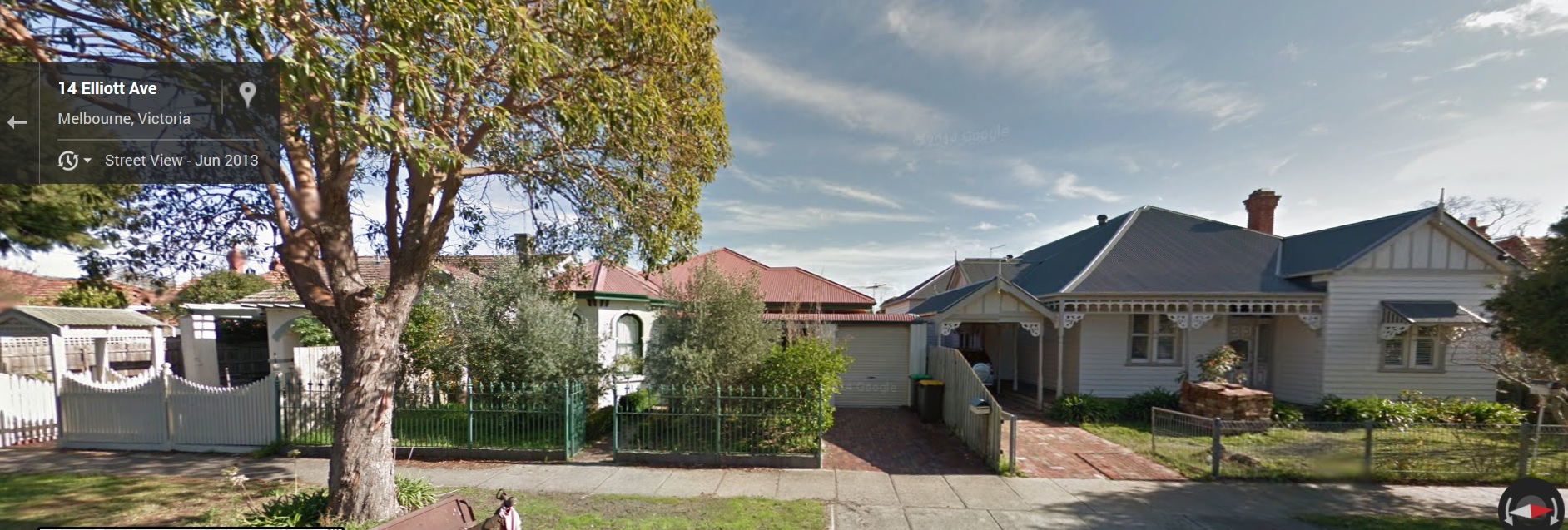
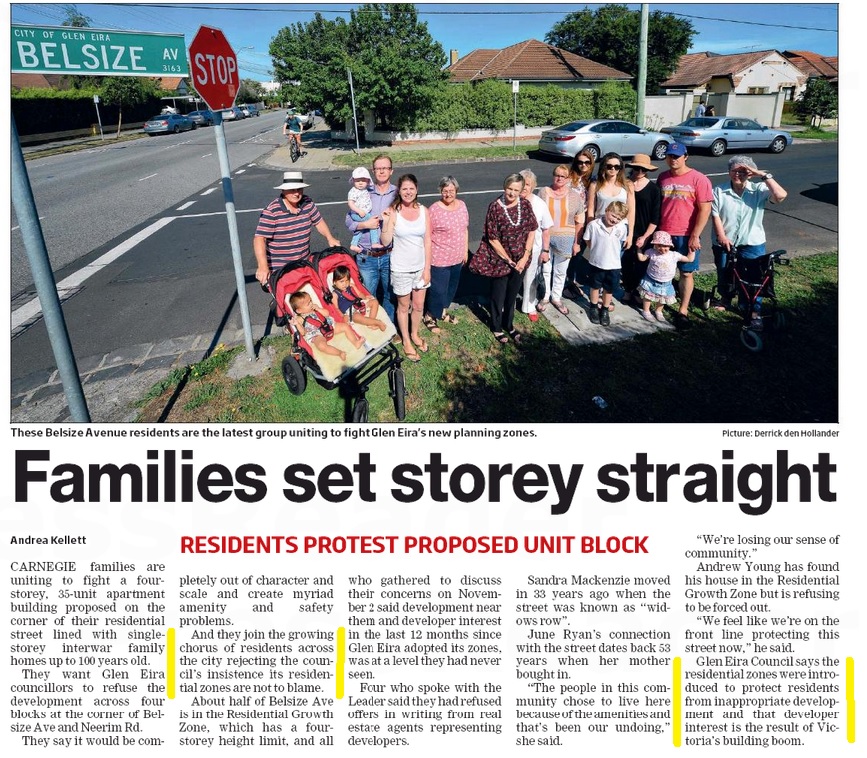
The latest evidence of this comes from 332 Neerim Road, Carnegie. An application went in on the 19/4/2013 – well before the zones were gazetted – for a THREE STOREY BUILDING AND 9 APARTMENTS. The permit was granted. Then on the 18/11/2013 (after the new zones) there is this new application –

Construction of a four (4) storey building comprising twenty six (26) dwellings above a basement car park; Reduction of the requirement for visitor parking; and Alteration of access to a Road Zone Category 1

The land is roughly 1100 square metres and of course a permit was granted.

We repeat – development and overdevelopment has everything to do with the generosity of this council to developers and its indifference to residents living in GRZ, RGZ zones.

Glen Eira zoning scheme has homeowners up in arms

Anger is mounting over the Glen Eira Council’s planning scheme with homeowners worried ab

Anger is mounting over the Glen Eira Council’s planning scheme with homeowners worried about the future of the suburb. Picture: Chris Eastman

GLEN Eira residents angry at the pace and density of residential development in their streets are demanding the council review the planning scheme.

Residents used a planning forum in Bentleigh to slam the city’s reformed residential zones and council’s lack of community ­consultation.

They now want councillors to review and amend the planning scheme.

To amend the residential zones the council must approach Victoria’s planning minister.

The four councillors who attended the forum, among them new mayor Jim Magee, were told the State Government and Glen Eira Council’s claims the zones would offer a new era of protection were a farce for those in the higher density General Residential Zone and Residential Growth Zone.

Others in the protected Neighbourhood Residential Zone said they were still adversely affected by three and four-storey developments just doors away.

“Why has Glen Eira Council identified areas even 1km away from transport corridors for this increased density?’’ a resident asked.

A Bentleigh resident of more than 30 years and traffic engineer said: “I can’t see streets coping with traffic and parking levels’’.

Concerns were raised for packed schools and others accused the council of siding with developers.

Cr Magee argued height limits were brought in to protect the city from inappropriate development and was heckled when he said the zones were not to blame for the pace of development in areas such as Carnegie, McKinnon and Bentleigh.

And last week Baysiders blasted their council’s management of residential growth at a special meeting.

About 120 people packed the Brighton chambers to voice concern over residential growth zones. The meeting was held to discuss a recent State Government about-face on zoning of parts of Highett, Cheltenham, Hampton East and Brighton East.

The Liberals have said they would now not demand the council ­include quiet residential streets such as Major St in Highett as areas for intense development. Labor plans to rejig the whole zoning system if they win power next week.

Kingston council has yet to adopt the new zones.

The Glen Eira Residents Association is petitioning the council for change at geresidents.wordpress.com

There are ostensibly some very strange goings on in the Glen Eira Planning Department. Up for decision on Tuesday night is an application for 7 storeys and 44 dwellings along Glen Huntly Road. 34 objections came in. The Torres report recommends 5 storeys and 33 dwellings, plus waiving of car parking for shop and loading bay.

We remind readers of a previous decision on a 6 storey Hawthorn Road application that was rejected outright. The argument there was that this height would be far too much for the neighbouring General Residential Zoning (ie 3 storeys) that abutted the site. The Glen Huntly Road application abuts NRZ properties (ie 2 storey) plus GRZ areas. It therefore seems that a three storey difference between the abutting zones is acceptable for Glen Huntly Road but not acceptable for Hawthorn Road as revealed by these contrasting comments from both reports –

Glen Huntly RoadLimiting the height of the building to 5 storeys will ensure there is a more appropriate transition in building heights between the subject site and neighbouring properties located within the Neighbourhood Residential Zone.

Hawthorn road – The General Residential Zoned land to the west has a known future height limit of 10.5m or 3 storeys. The transition of the 6 level proposal to the existing residential land to the west is considered to be too abrupt to the substantially single storey dwellings. This holds even if the land to the west is ultimately developed in accordance with the GRZ provisions.

But there’s more! On internal amenity (and please note that BALCONIES are equated with ‘internal’ amenity) we get the following –

Glen Huntly Road – The internal layout results in some balconies being perpendicular to the boundaries. This appears to be an architectural response to ensure uniformity with window locations and other elements within each elevation. In order to improve penetration of natural light and ventilation to each balcony, it is considered that a minimum width of 2.0m with area of 8m² should be achieved. This will provide a reasonable level of internal amenity for this commercial setting without detracting from the architectural integrity of the building.

Hawthorn RoadEach apartment is designed to maximise natural light to habitable areas in response to the east-west orientation of the site. The layout and design of the development will generally result in functional, well-proportioned dwellings with good access to daylight, direct sunlight and adequately proportioned balconies. The number of apartments with south facing balconies has been minimized and is considered acceptable for this commercial setting and the constraints of the east and west orientation of the site.

In the end we have to wonder why there should be such inconsistencies. Also worth mentioning is that the Hawthorn Road application had 15 objections and was rejected. The Glen Huntly proposal drew 34 objections and has had two storeys lopped off plus conditions imposed. We can only speculate as to the reasons behind these recommendations and wonder who perhaps knows who and whether or not North Caulfield (apart from the C60) is deemed as generally worthier of ‘protection’ than other suburbs?

Last night’s GERA’s forum was illuminating for several reasons:

  • The anger of residents was palpable
  • The impotence and unwillingness of the four councillors (Lobo, Okotel, Hyams and Magee) to commit to any possibility of change was damning
  • The most outrageous comments by these councillors included:
  1. The zones were a ‘neutral translation’ based on data dating back to 1996
  2. The minister would only make things worse if council attempted to amend anything
  3. Residents should ‘advocate’ to councillors about their concerns (never mind that 150+ people were already expressing their views directly!)

We’ve uploaded the audio of the Q and A session and ask that you listen carefully to the ‘answers’ provided by councillors.

PS: BAYSIDE CITY COUNCIL THROWS OUT ITS RESIDENTIAL GROWTH ZONES. WATCH THE SPECIAL COUNCIL MEETING AND RESIDENTS ADDRESSING COUNCIL AT – http://stream.bayside.vic.gov.au/archive/video14-1118-1.php#placeholder

Also refreshing to hear councillors apologising to their community for inadequate consultation. Pity it doesn’t happen from too many councillors in Glen Eira!

The following table illustrates like nothing else can, exactly what is happening throughout metropolitan Melbourne, and particularly in Glen Eira. This council can now adopt the mantle of ‘Leggo Land of the South’. The zones have been in for 15 months. Council admits to 1713 net new dwellings in the last financial year. Thus far (ie 4 months) another 1002 new dwellings have received permits. (Source: Planning Permit Activity – http://www.dtpli.vic.gov.au/planning/planning-applications/planning-permit-activity-in-victoria)

Prior to the introduction of the new zones, council’s ‘average’ number of new dwellings per year was stated as roughly 500 to 600. This figure has now tripled! By the end of the current financial year, if this trend continues, then residents should look forward to over 3000 new dwellings in one year! And yet, we are still assailed with the nonsense that this has got absolutely nothing to do with the introduction of the new zones and the open arms approach to development by Glen Eira.

JULY1

On July 1st 2014, the new zones came in everywhere. If councils had not as yet finalised their amendments, then the General Residential Zones were applied automatically to all areas previously zones Residential. The Age has run articles on how political the process has been, when western suburb and/or Labor dominated municipalities had their amendments knocked back by the Minister’s Standing Residential Zones Committee. Darebin, Moreland, and Kingston were the ‘victims’ of this process. Darebin and Moreland are still awaiting approval of their amendments. The upshot is that these two councils have now huge swathes of their municipalities zoned as General Residential Zones instead of Neighbourhood Residential Zones as they intended. It is no coincidence that they are the only two councils whose net new dwellings surpass Glen Eira’s.

There are other concerns too. Of these 1002 net new dwellings we have to ask:

  • How many are one bedroom units?
  • How many car parking spots have been waived?
  • How many of these permits have been resubmitted for bigger, higher, larger developments?
  • How many extensions has council handed out (practically willy-nilly)?
  • How many trees remain on any of these lots?
  • How many ‘standards’ have been overlooked per application?
  • What has council done about the cumulative impact for individual streets? Have they even bothered to consider any of this?
  • How much will ratepayers have to cough up to pay for the requisite improvements in drainage since developers won’t have to pay a cent since this benevolent council dropped its levy from the planning scheme?

Residents deserve answers to each and every one of these questions. The bigger question is whether councillors will dare to even ask them!


On the 1st July 2013 the Minister for Planning gazetted the amendment which gave councils one year to introduce the new residential zones into their municipalities. Prior to this, a draft of the new zones had been released (July 2012) and public submissions were called for. The closing date for these submissions was the 21st September 2012.

Whilst other councils had countless ‘information sessions’ for residents, plus detailed information up on their websites, Glen Eira had nothing. It was not until the council meeting of September 4th 2012 that residents had a chance to even see what council’s submission would be like. That left exactly 17 days before submissions closed. It also took several amended motions at this council meeting to even get anything up on council’s website.

Looking back at our report of this evening we remind readers of the following statements by councillors –

TANG: Foreshadowed an amendment because ‘this represents a discussion paper’….’missing community input directly’. Said that in his experience ‘people want to know’ whether something is going or not ‘and they want some input at an early stage’…..No reason we can’t facilitate the community giving their views as well’.

LIPSHUTZ: that since it’s taken officers a fair bit of time to understand them, he wasn’t ‘sure how in a very short period of time we’re going to have the public understand’. Worried that all this would ‘scare’ the public and be ‘misinterpreted’. The community should be involved only at the second phase.

Source: https://gleneira.wordpress.com/2012/09/05/patronising-paternalistic-pathetic/

A very important part of the resolution from this meeting read:

Council notes that this resolution only has effect insofar as it relates to Council’s submission to the Department of Planning and Community Development (DPCD) , and that Council will consider the details of the transition, to the extent that it is able, once the Minister has determined the new zones.

The implication of this resolution is clear. Council is endorsing the submission, but NOT THE FINAL INTRODUCTION OF THE ZONES. That is to come back to Council, (with a capital ‘C’) – denoting in anyone’s language that a formal Council resolution is required prior to the adoption of the new zones.

This of course did not happen. For all the spin about ‘consultation’ at ‘phase 2’ the zones were introduced in secret and without a single murmur. Council washed its hands of all its obligations to ‘engage’, ‘inform’ and ‘consider’ resident views, firstly in its submission to the draft, and then on its implementation. Here again we have evidence that resolutions do not mean a thing in Glen Eira. They can be ignored, not acted upon, and simply left to rot in the archives.

What makes matters even worse, is that the deplorable spin that accompanied the introduction of the zones included the furphy that Council had already consulted with residents on its 2010 ‘review’ of the Planning Scheme. There was nothing in the outcomes of the ‘review’, and certainly not in anything that council has done since, that were within a bull’s roar of having anything to do with reassessing the minimal change/housing diversity policies. In fact, 4 years down the track and most of the ‘recommendations’ coming from the ‘review’ have still to be actioned. All that has been done is the miniscule expansion of the Significant Character Overlay to a few areas and the introduction of amendment after amendment which rezoned tracts of land making them ‘suitable’ for residential development.

We’ve extracted the relevant ‘recommendations’ passed by Council and highlighted all that have not yet been attended to – and please note the ‘internal’ assessments rather than open, transparent, public consultation! After four years, this is indeed a dismal record and totally demolishes the argument that the review of 2010 had anything to do with what was to come.

It is now 4 years later and we still have not had a Planning Scheme Review! Oh, we forget, these have all been done ‘internally’!

Pages from 2010August10-2010-MINUTES2-2_Page_1Pages from 2010August10-2010-MINUTES2-2_Page_2Pages from 2010August10-2010-MINUTES2-2_Page_3Pages from 2010August10-2010-MINUTES2-2_Page_4


Untitled2Untitled

We have literally had a gut full of the dissembling, and mistruths, that emanate from council and its mouthpieces in regards to the residential zones. Here are some prime examples –

  1. The minutes of 13th August 2013 include the following sentence “Glen Eira has achieved improvements in town planning including:…..provision for increased permeable areas to reduce storm water runoff’. In the first place, the zones DID NOT provide any ‘improvement’ whatsoever. In fact, there is absolutely NO DIFFERENCE on permeability between the old system and the new. In contrast to this bogus claim, here are some facts about what other councils achieved for their municipalities, and not only in the equivalent areas of ‘minimal change’ but also in GRZ and RGZ zones.
  2. Greater Dandenong, which was second cab off the rank in introducing the zones, has for its GRZ1 zoning a “Minimum of 30%” in its schedule. In its NRZ1 zone it has a minimum of 40%. And Glen Eira pats itself on the back for MAINTAINING ITS PALTRY 25% AND 20% FOR GRZ AND RGZ ZONES! Whitehorse also has for its GRZ1 zone a permeability of 30% and its GRZ2 zone a permeability requirement of 40%. Even in its GRZ4 zoning there is still the requirement for 30%
  3. Next we are supposed to be grateful for the wonderful ‘site coverage’ achieved by council. It’s astounding when we consider that Glen Eira has simply opted for what was there before (ie 50% site coverage in minimal change and 60% in housing diversity) whilst other councils have again achieved much, much more. Banyule for example has a maximum site coverage of 40% in its GRZ2 ZONE; Bayside in 4 of its GRZ zones has a 50% site coverage; Whitehorse in its GRZ2 also has 40% site coverage.
  4. Council proclaims so proudly what it’s achieved in its allocations for private open space. How wonderful that only in minimal change has Glen Eira maintained its 60 square metres of private open space requirements. Residents in GRZ and RGZ have to be satisfied with the pathetic ResCode numbers. But once again, other councils put Glen Eira to shame on this aspect. Greater Dandenong, Maroondah and Manningham all have 80 square metres in their GRZ1 schedules; Monash in its RGZ2 zone has a 75 square metre requirement.
  5. Landscaping is another area totally neglected by our council. There is not a word about direct requirements for landscaping in any of the schedules. It’s quite amazing how the following councils first of all saw the importance of the environment and secondly managed to get some real substance into their zoning schedules. Banyule in its Low Residential Growth Zone states – “Landscape plans will provide 1 tree for every 400 square metres of site area, including 1 large tree in the front setback.”; Even Greater Dandenong in both its RGZ1 and GRZ1 zones includes – “70% of ground level front setback planted with substantial landscaping and canopy trees”; Whitehorse for its RGZ1 has – “Provision of at least one canopy tree with a minimum mature height of 8 metres. Development should provide for the retention and/or planting of trees, where these are part of the character of the neighbourhood’ and for its GRZ2 schedule there is this important inclusion – “Provision of at least two canopy trees with a minimum mature height of 12 metres. At least one of those trees should be in the secluded private open space of the dwelling. The species of canopy trees should be native, preferably indigenous. Development should provide for the retention and/or planting of trees, where these are part of the character of the neighbourhood.”
  • Glen Eira has achieved a ‘stunning’ 4 metre rear setback – but only for minimal change areas. So, if a two storey building goes up next door and it is 8 metres in height, the setback remains 4 metres. How wonderful! Others again show what can be done – Bayside for example in several of its GRZ schedules includes the following which once added up, the four metre setback that Glen Eira believes is ‘adequate’ is literally blown out of the water – ie “A new building not on or within 200mm of a boundary should be setback 2 metres from the side boundary and 3 metres from the rear boundary, plus 0.6 metres for every metre of height over 3.6 metres up to 6.9 metres, plus 2 metres for every metre of height over 6.9 metres.” Whitehorse for its GRZ2 states this – “Minimum 2 metre setback, plus 0.3 metres for every metre of height over 3.6 metres up to 6.9 metres, plus 1 metre for every metre of height over 6.9 metres”. Monash and other councils even have a front setback of 7.5 metres in its RGZ2 and NRZ1 schedules. Glen Eira has ResCode!

We’ve commented previously on the various height limits achieved by other councils in their numerous GRZ and RGZ schedules. (see: https://gleneira.wordpress.com/2014/09/25/what-could-and-should-have-been-done/)

CONCLUSIONS

There was so much that could have been achieved via the schedules and with proper strategic planning. Glen Eira basically did nothing expect rely on archaic data and an amendment that has well and truly seen out its time. This was more than laziness or even the inability to cope with all the new work required. It was basically we believe the total indifference to what might happen to people’s lives – and of course, not wanting to ‘inconvenience’ too many developers. The inequity was there before. It has now simply been reinforced and re-confirmed.

So what really went on in those secret meetings with Guy and his officers? How hard did our wonderful CEO and Mayor fight for their residents when all these other councils got so much more? What kind of deals were made where this council and its inept ‘negotiators’ were seemingly so prepared to sell out thousands of residents. If other councils could have their amendments with far greater protections ratified, then it remains a damning indictment of Glen Eira’s inability (or unwillingness) to do likewise.

PS

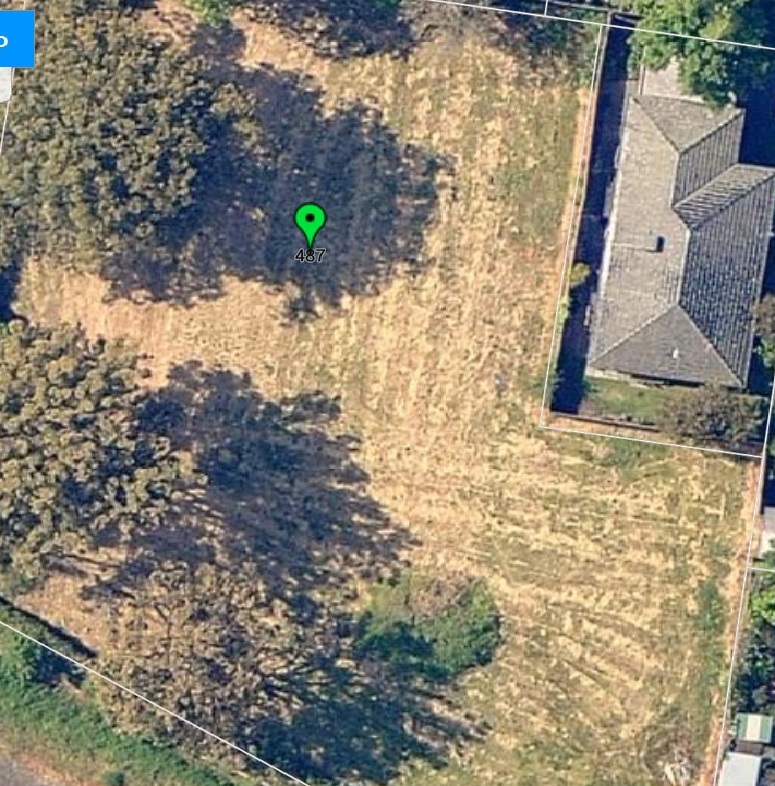
Council can continue to claim all it likes that the zones have not increased development. The facts tell a different story. Here’s one example for 90 Truganini Road, Carnegie

On 1/6/2011 an application went in for the construction of 2 double storey and one single story dwelling (ie 3 dwellings in total). Council granted the permit in 2011. Then followed a VCAT hearing where the member granted a permit for 3 dwellings (August 12th, 2012). What’s fascinating about this judgement is revealed in the following extract. It clearly shows how the current zoning of GRZ for this road has actually worsened the situation for residents. Instead of the 9 metres preferred by ResCode, 10.5 metres is now ‘mandatory’. We quote:

Building Height

  1. The maximum height of the development is proposed to be 7.25 metres. The site is located in a Special Building Overlay, and is subject to flooding. The proposal was referred by Council to Melbourne Water pursuant to Section 55 of the Act. Melbourne Water did not object to the proposal subject to the inclusion of conditions. Usually, where a site is subject to flooding, Melbourne Water specifies minimum finished floor levels above which the development must be constructed. However, in this instance, Melbourne Water have indicated that the site is not predisposed to flooding from their drains, and has not required a minimum height of the finished floor levels. As such, the maximum height of the building can be ‘capped’ at 7.25 metres, without further need for increases. I am satisfied that this height is appropriate in this instance for the following reasons:
  • The maximum height of the development is far less than the 9 metres referred to under ResCode.
  • The development includes reasonable wall heights of 5.5 to 5.7 metres, with the remainder of built form height to enable pitched roofs.
  • The development offers good internal amenity for the future residents in that floor to ceiling heights are reasonable at 2.6 metres at ground level and 2.45 metres at first floor.
  • The front 2 dwellings are proposed to be constructed to two storeys with the 3rd, rear dwelling (adjacent to secluded private open space) constructed to a single storey scale.

Source: http://www.austlii.edu.au/au/cases/vic/VCAT/2012/1213.html

But this isn’t the end of the story. The property was sold (with permit) in August 2014 to ‘private treaty’ (http://www.domain.com.au/property/sold/development-site/vic/carnegie/?adid=2011016621

The current owner has now put in a new application (11/11/2014) for, and we quote“Three storey multi unit dwelling development with basement car park”. Thus, we’ve gone from 3 dwellings to god knows how many because the Planning Register refuses to reveal the exact number, and to a height limit of 10.5 metres at least. There’s also the additional problem of an SBO and the planned underground car park. Land banking par excellence here and council still maintains that the new zones have got absolutely nothing to do with increased density, increased height, increased everything!

Bayside Council given green light to stop new high-rises

Date: November 13, 2014 – 6:57AM

One of Melbourne’s richest municipalities has been given the green light by Planning Minister Matthew Guy to virtually eradicate any new medium-density and high-rise housing development in its residential areas.

Mr Guy on Sunday, according to Liberal Party colleague Murray Thompson, visited his seat of Sandringham.

The seat takes in much of Bayside Council’s areas.

Mr Guy gave the go-ahead to the council – which covers suburbs including Brighton, Sandringham and Beaumauris – to block high-density development in residential areas.

Mr Guy was quoted, in a press release sent out by Mr Thompson, as saying the government would not force the council to put any part of its suburbs into a new “Residential Growth Zone”.

The Residential Growth Zone gives land owners and developers the right to build up to four levels on a site.

Previously Mr Guy’s office had, according to former mayor Laurie Evans, directed the council to put the controversial new zoning over at least three per cent of its areas.

The council had proposed putting the zoning on suburbs including Highett and Cheltenham in largely single-level streets.

It caused an outcry from residents in these areas, who were not consulted before the zoning was proposed to be applied to their areas

PS – BAYSIDE CITY COUNCIL MEDIA RELEASE

Council to re-evaluate residential zones in Bayside

12 November 2014

Bayside City Council has called an urgent Special Meeting of Council for 18 November following indications from the Napthine Government that it will not require a minimum quota of Residential Growth Zone in Bayside.

In a media release dated 10 November 2014, Member for Sandringham Murray Thompson quoted Planning Minister Matthew Guy saying that “the Napthine Government will not prescribe any minimum amount of land that must be zoned ‘Residential Growth” in the City of Bayside”.

And that furthermore “The Napthine Government will support the City of Bayside should it wish to make any changes to the proposed Residential Growth Zones in Highett and Cheltenham, particularly land that is not on a main road or within former industrial sites”.

Bayside Mayor Cr Felicity Frederico welcomed the announcement.

“Bayside City Council has always advocated the ability of Council to undertake planning decisions that reflect the desires, needs and expectations of our community,” Cr Frederico said.

“Council’s initial position was that 0.1% of Bayside was suitable for change to Residential Growth Zone,”

Council was then directed by the Office of the Minister for Planning to identify areas along the Frankston train line that could be allocated to the new Residential Growth Zone

“In response to the direction of the Office of the Minister for Planning, Council agreed that 3% of Bayside’s residential land along the Frankston train line should be referred to the Minister’s Residential Zones Standing Advisory Committee for consideration,” Cr Frederico said.

“This was undertaken in return for the initial position of Council being approved at the earliest possible time by the Minister using his direct powers of approval.

The Special Meeting of Council to re-evaluate the application of the Residential Growth Zone in Bayside will be held in the Council Chambers on Tuesday 18 November at 6:30pm prior to the regular Planning & Amenity Committee Meeting. The meeting is open to members of the public.

“Bayside City Council is pleased that the Napthine Government has agreed to work with Council and the community to ensure appropriate levels of development in our residential neighbourhoods” Cr Frederico said.

Details of the Special Meeting
Tuesday 18 November at 6:30pm
Council Chambers, Civic Centre, 15 Boxshall Street, Brighton

Source: http://www.bayside.vic.gov.au/about_the_council/media_release_council_reevaluate_residential_zones.htm

We feature two related items in this post that totally explode the Council propaganda and mistruths about the residential zones. Firstly, (over)development is very much a direct result of the zones and secondly Burke’s claims are shown as sheer bunkum via a resident’s analysis that came through as a comment and which we’ve repeated here.

Untitled

Untitled2

WHY OH WHY POLITICIANS LIE

“The Neighbourhood Residential Zone (NRZ) has been directly translated from the Minimal Change Areas and covers 78% of Glen Eira” is the current mantra from our Local and State politicians. A similar mantra was created in 2002 as shown below:

“Glen Eira’s housing diversity areas can meet the majority of its City’s demand for the next 20 years. The remainder of the demand will be met in the minimal change [housing] areas in the form of single dwellings and dual occupancies. Through this combined and balanced approach the City can meet its housing needs but also protect neighbourhood character of 80 per cent of its City.”

The quote is from the draft Housing_and_Residential_Development_Strategy still available on line. The statement is wrong in so many ways. Let’s enumerate them:
1. The statement is clearly about housing areas. The minimal change housing areas have never been at an 80% level. The misleading map and calculation includes all Glen Eira’s road network (465km), but conveniently excludes all VicRoads road network (51km in white). Can you imagine residing on your local road, planting a vegie patch on the nature strip or cutting a tree branch from the footpath? All roads, kerbs, nature strips and footpaths are for public use and not a residential zone;

2. Glen Eira local road network is 465km long and is about your average house property frontage wide. It makes up for at least 25 % of City’s land area. So, in 2002 the Minimal Change Housing Area was less than 55% of the City;

3. Not taken into account are laneways, as these are not recorded. But you try to use them for residential purposes and you will soon be fined. Glen Eira sells those frequently. The laneways are public use areas and should not be included in residential zone calculations. This further decreases the NRZ (Neighbourhood Residential Zone) area size;
4. By now, the minimal change areas is suggested to be 78% of the City as Virginia Park was excluded (Height_Controls_New_Zones_Guide_for_Community 2013). There were many other successful rezoning applications since 2002 e.g. Bentleigh, Caulfield. As well, unique sites multi dwelling developments in minimal change areas were substantial from 2006 to 2012 (~ 800 dwellings). Such sites are still shown as NRZ (see cnr Hudson St/Booran Rd 3 storey mansion). The area size of NRZ is further decreased;

5. The existing zone boundaries are not set in concrete. Developers can always ask for rezoning, particularly if several properties are combined to become unique sites within the current definition (e.g. recently sold Bentleigh, Glen Huntly sites) further decreasing the NRZ;

6. The City has 27 Local Activity Centres, all shown as part of NRZ. A number of such Centres have developed 3 storey buildings (e.g. Caulfield South, Bentleigh East) and should be classified as General residential Zone. This again further decreases the actual NRZ;

7. The City has also many sites with non-residential uses in residential areas. These public use and amenities like kindergartens, schools, hospitals, churches etc are needed in the City, but are not residences. They create traffic congestion and should not be counted towards NRZ protection;

8. The amazing assertion that “residentially zoned land comprises 95% of Glen Eira’s area” does not coincide with facts. The other 5% is assigned to 3% commercial zone and 2% industrial zone. No allowance is made for any of the white areas of the map (Amendment C110). The 54ha Caulfield Racecourse Reserve, all parks, Caulfield and Monash Hospitals do not have areas allocated to it or simply do not belong to Glen Eira City!

THE NRZ AREA IN DWELLINGS WHERE PEOPLE RESIDE IS BELOW 40% OF CITY AREA AND GOING DOWN

Let’s consider the implication of the new zones with a growing population and traffic.

9. “The housing diversity area is to meet majority of Glen Eira’s demand for housing i.e. population growth until 2021”. The predicted increase of population was from 126k in 2001 to 130k by 2021, a mere 3% in 20 years. The population has reached 137k by 2011, a whopping 8.9% increase from 2001. The population increase and housing needs has exceeded all forecasts at the time by a substantial amount. The population by 2021 is to be 150 k (forecast.id.com.au/glen-eira) nearly 20% increases from 2001;

10. Plan Melbourne, successor to Melbourne2030 expanded Melbourne growth to 7.7 million by 2050. As part of this Plan the population of Glen Eira by 2031 will be 163k, 20% more from 2011;
11. The neighbourhood character is changing substantially already, just ask your neighbours. Will your neighbourhood character, your suburb be protected with a further 26,000 population increase from 2011?;
12. The population increase means more cars on the roads, more parking spaces required on streets, in shopping strips and railway stations. Is your neighbourhood ready for it?

13. More population requires more kindergartens, schools, parks, sport grounds, and other amenities. Traffic will be increased within Glen Eira City and to other parts of Melbourne. The size of roads is not gong to change; only the traffic will increase. Will your suburb be protected from it?

14. Some population increases (http://forecast.id.com.au/glen-eira) are:
Caulfield North/East 29%; Elsternwick 17%; Carnegie 11.3%; Bentleigh East 9.8%; Caulfield 7.8%; Bentleigh 6.6%; Caulfield South 6.5%; St Kilda East 6.3%; Murrumbeena 5.9%. What it will actually be depends on developers and the non-targeted approach (liaise fair) by the Council. It seems residents have no influence;

15. Glen Eira Council knows and understands those issues (see Plan Melbourne Council Comments), but insists that 78% of the City is and will be protected!

Why bureaucrats make misleading presentations!

AND WHY OH WHY POLITICIANS LIE?

Save Our Suburbs, stir like hell and demand that State and Local politicians and Officers tell it how it is and ensure that the zoning system reflects the reality on the ground and can be understood by an ordinary citizen.

« Previous PageNext Page »