GE Planning


The Monash vision to redevelop the Caulfield Campus is now firmly set with the confirmation of its Master Plan. What is less well known is Monash’s vision for its sporting facilities – and in particular its plans that include the Caulfield East Reserve.

We believe that in recent times Monash people have had discussions with Council which included issues surrounding the redevelopment and use of the Caulfield East Reserve – owned by Council and leased to Monash.

Given the fact that Glen Eira is now facing a “cash crisis”, has been classified as “high risk” and GESAC is probably losing money hand over fist due to its failure to open in the summer season, residents have every right to be apprehensive about this valuable piece of real estate. Our fear is that under these circumstances, the Newton vision will be further sell offs and more public land lost to residents. What makes us even more suspicious is this sentence from the draft Monash sport plans – “Develop relationship with Glen Eira City Council and enhance facilities and management control at East Caulfield Reserve”. (Uploaded)

Watch this space we say!

PS: In order to illustrate the basis of our above comments we’ve uploaded the draft ‘Sports Vision’. Readers should pay careful attention to the highlighted sections and as always with such documents, possibly read between the lines!

So, you think you’re safe because you’re one of the lucky minority that happen to live in the designated ‘Minimal Change Areas’ listed in the Glen Eira Planning Scheme. Yes, you think that because you’re in the 20% of supposedly ‘protected’ neighbourhoods, your property, your lifestyle, your privacy, and your capital asset is safe from encroachment by (greedy) developers. Think again! Under the policies of this Council and the inconsistency in decision making, no-one is safe. Minimal Change Areas are not immune to rampant over-development. This is why. According to the Planning Scheme:

  • Single dwellings can suddenly metamorphasise into double houses/units. If the second unit is built at the back, then recent examples have them as double storeys – even though the planning scheme ‘recommends’ back units as being limited to only single storey
  • If the block is large then you’re in real trouble. Multiple storeys and multiple units are a real possibility because council states that it is not against high density in large lots – ie. “The proposal meets the tests of the Minimal Change Area Policy allowing consideration of a more intensive form of development. The Schedule to the Residential 1 Zone does not apply in this instance because Res Code does not apply to four storey proposals”. (Minutes – 3rd February 2009 – rest of quotes are from these minutes). We’re really in Catch 22 territory now!
  • Bad luck if you happen to sit right alongside a Housing Diversity area, or if council has already approved some 2 or 3 storeys down the road. Then you’re facing this predicament – “The prevailing development on abutting properties is characterised by multidwelling development of up to 3 storeys (in the form of developments constructed, and approved but yet to be constructed)”.
  • And don’t try to object by screaming about lack of open space and overshadowing because Council’s view is: “It is considered that the private open spaces are sufficient in the form of balconies. All dwellings are provided with balconies with adequate access to sunlight and daylight and provide an appropriate level of internal amenity for future occupiers”.
  • Finally, none of these ‘standards’ are set in concrete and applied consistently. Developers are merely ‘encouraged’ to do what’s right and permits are granted when only a couple of the requisite boxes are ticked off and others remain outstanding.

By way of example, we’ve gone through some of the minutes from 2008 until now and selected a few of the decisions on developments in Minimal Change Areas or those areas adjoining Minimal Change. Please note, these are only the ones that actually arrive for Council decision – we simply do not know how many others are rubber stamped by the officers under their delegated authority.  We’ve prepared a table which we hope is self explanatory

ADDRESS

DETAILS OF   APPLICATION OFFICER   RECOMMENDATION

COUNCILLORS’   DECISION

7-13 Dudley   St., Caulfield East A four storey building comprising 112 dwellings with two levels of basement car parking, and a reduction of the standard car parking requirement Permit – (three storey   building/up to75 dwellings)

Permit –   unanimous

846-848 Centre Rd, Bentleigh Construction of a two (2) storey building comprising fourteen (14) dwellings with basement carpark permit – allowing the construction of a two (2) storey building   comprising up to ten (10) dwellings

Permit –   carried

264-266 Grange Road, Carnegie Construction of four (4) double storey and two (2) single storey dwellings and alteration of vehicle access to a main road Permit – for the   construction offour (4) double storey and two (2) single storey   dwellings

Permit –   unanimous

29 Holloway street, Ormond A two storey building comprising 14 dwellings and basement carpark Permit – the construction   of a two storey building for up to 10 dwellings

Permit – on   casting vote of chairperson

332 Alma road, Caulfield Nth Construction of 10 dwellings Permit

Permit –   carried

19 Parker St., Ormond Construction of four dwellings (two double-storey dwellings at the   front of the site and two single storey dwellings at the rear) Permit – allowing the   construction of four dwellings (one double-storey dwellings at the front of   the site and three single-storey dwellings at the rear)-

Permit –   carried

56 Morgan St., Carnegie -Construction of two (2) double storey attached dwellings on land affected by a Special Building Overlay Permit

Permit –   carried

12 the Highway Bentleigh Addition (carport) to the existing dwelling and the construction of a double storey dwelling to the rear Permit

Permit –   unanimous

31-39 Anthony St., Ormond Subdivide the land into six (6) lots – Heritage Overlay Permit

Permit –   unanimous

The current ‘Community Plan Forums’ have consistently highlighted serious resident dissatisfaction with Council’s overall planning, traffic management and consultation practices. ‘Listening’ to the community is only part of Council’s task. Their job now is to implement radical change and to connect the dots between all three major issues.

It is a fallacy to see the above and other ‘problems’ such as flooding, parking, and ‘neighbourhood character’ as separate components or entirely State, Federal or Utility responsibility. There is much council can do via its planning scheme. All these problems are connected and solutions need to recognise this and provide answers that are not piece meal, ad hoc, and ineffectual. Amendments (such as C87) remain limited in scope and vision and in no way provide a remedy for the ills which currently beset the entire municipality. Yet, this has been council’s approach for the past decade – a little reactive and superficial tinkering here and there instead of a complete overhaul of its current housing strategy and activity centres policy.

Nowhere is this made more obvious that in the failed C49 Amendment where an independent Panel rejected Council’s meagre attempts at ‘control’ of the environment because the amendment lacked ‘strategic justification’. In other words, no grand integrated vision, and the lack of necessary homework. This is still true today. Many of the current policies that form the basis of the current Planning Scheme are not only outdated, but archaic. Housing dates back to 1996; open space to the same era; activity centres to 1999. This is not the way to plan for a community. Nor is the Glen Eira approach of continually tinkering with the edges such as the so called ‘transition zone’ amendment of last year that laughably is not a ‘zone’ at all. Now we have the C87 – again, an amendment that basically attempts to look after only 1000 or so properties.

We have in the past compared Glen Eira’s track record in planning with other councils – especially in relation to structure plans, height limits, parking precinct plans, public realm, etc. Glen Eira has none of these! Worse, residents have never been provided with any sound justification for the failure to include any of the above in the Planning Scheme.

We are not arguing that structure plans are a universal panacea that will solve all problems of overdevelopment. What we are arguing is that by refusing to go down this path, this administration and its councillors are not fulfilling their mandate to represent constituents and to ensure that development is planned, cohesive and embraces the principles of social, environmental and economic benefit to the community. We have to again ask why each of the following councils sees fit to have structure plans and either interim or permanent height controls, and why Glen Eira is again, and again, the odd man out? The list of these councils, and we’re sure there are plenty more, includes:

  • Bayside
  • Boroondara
  • Casey
  • Darebin
  • Frankston
  • Geelong
  • Hobson’s Bay
  • Hume
  • Kingston
  • Manningham
  • Moonee Valley
  • Port Phillip
  • Stonnington
  • Yarra City

Residents should start asking their councillors why this is so and demanding full and comprehensive answers.

Towers all the go

BY THE end of this decade, Dandenong Road, which runs through several sleepy  south-eastern suburbs, could be home to an abundance of  apartment towers.

Carnegie is the next suburb earmarked for a  project, with developers lodging  plans to build 173 flats within two apartment towers, the tallest rising 11  levels.

On the site of a rundown office at 1060 Dandenong Road, between Grange and  Koornang roads, the  development  would  include a commercial podium at the  lower level, facing the road. The apartment buildings will fill up  the  4152-square-metre block,  which backs on to the  train line between Caulfield  and Carnegie stations.

In the introduction of the application, lodged with the Glen Eira council two  months ago, the developer cites the Melbourne 2030 planning policy and  the Melbourne @ 5 Million amendment, which were annulled  by the  Baillieu government in 2011.

The design, it says, responds to the dense mixed-use nature of Carnegie.

Elsewhere in the area, a $500 million development including an office  building, and hotel, both rising about 12 levels, is  proposed for part of the   Chadstone Shopping Centre, in Dandenong Road.

Closer to town, plans are also advanced to develop apartment towers on the  Caulfield Racetrack, near the Caulfield station.

Read more: http://www.smh.com.au/business/daly-street-site-we-can-take-you-higher-20120217-1tejl.html#ixzz1mgPiOWkq

PS: There’s an informative new post up on GERA’s website analysing the history of council’s approach to neighbourhood protection, height limits, etc. See: http://geresidents.wordpress.com/

Stonnington Council has the following on its website (http://www.stonnington.vic.gov.au/whats-new-detail/?ID=30). We wish to highlight how this council has approached a major development in stark contrast to Glen Eira. Readers should note:

  • The impact on social amenity is emphasised
  • The existence of interim height regulations and now Council’s application for permanent controls
  • The joint effort with local community groups and the community at large

Glen Eira’s effort in the C60 debacle should be kept firmly in mind – especially the claim that Glen Eira actually set ‘limits’ to the development by its acceptance of 20 storeys.

590 Orrong Road

Planning Application

Stonnington Council refused a planning application by Lend Lease for a major development at 590 Orrong Road and 4 Osment Street, Armadale at a special meeting of Council on 30 January 2012, with over 200 people attending.

The planning application was for a development of 475 units, up to a height of 13 storeys.

Mayor, Councillor John Chandler said: “Council refused the planning application as it represents a significant overdevelopment of the site. There were a number of reasons for this including excessive height and bulk in an area that has much lower density, impact on the community and neighbourhood character, lack of quality open space, overshadowing, plus traffic and access issues. Council received over 600 objections for the development.

“The 2.5 hectare site at 590 Orrong Road and 4 Osment Street, located adjacent to Toorak Station and Toorak Park, is one of the most important redevelopment sites in Stonnington and it is important that the right balance is achieved to ensure an appropriate outcome for the site.”

Cr Chandler said Stonnington Council had initially refused to exhibit a planning scheme amendment for a major development from Lend Lease in December 2010, including a proposal for 480 dwellings with building heights up to 16 storeys at the subject site.

He said: “Over the past 18 months, Council has undertaken extensive consultation and received feedback from all stakeholders on this important strategic site.

“Stonnington recently sought interim planning controls, which, if approved by the Minister for Planning, would take effect immediately.  Council has also submitted a request to the Minister for Planning to exhibit an amendment to introduce permanent controls for the site. This would mean that any developer and VCAT would be obliged to take the controls into account with regard to development proposals. We’re eagerly awaiting the Minister for Planning’s approval to exhibit the Amendment.”

To view information on the planning application for 590 Orrong Road and 4 Osment Street, Armadale click here

Adopted Urban Design Framework – Planning Scheme Amendment

As quoted above, Council has submitted a request to the Planning Minister to apply permanent controls for the site through a planning scheme amendment which would go out for further consultation.  The permanent controls propose to restrict the height to 17 metres and a site yield of 250 units.

Council adopted the revised Urban Design Framework at Council on 21 November 2011 following community feedback.  For further information on the Urban Design Framework  and planning scheme amendment visit  www.stonnington.vic.gov.au/590orrongroad

Application Number

GE/PP-24358/2011

Date Received – 16/11/2011

Site Location 31 Station Street CAULFIELD EAST VIC 3145
Overriding Site Location Land to the rear of Heywood Street and Normanby Road
Proposal (i) To vest Reserve No 1 on LP2446, shown as Lot 1 in PS700473C, in the Glen Eira City Council (ii) To remove the Reserve status from Reserve No 1 on LP2446 shown as Lot 1 in PS700473C
Status Advertising Period Commenced
Planning Officer – Michelle Yu

Tonight’s community forum on the ‘Community Plan’ was in many respects a pleasant surprise. It was certainly much improved on what occurred several years ago. However, we will withhold judgement until the draft plan is published to see exactly the extent to which council has taken residents’ views to heart. The turnout of residents was excellent with approximately 60 attending.

The chronology of the evening was as follows:

  • Hyams gave a little speech emphasising how much Council had listened to the community on the last consultation. Examples of such ‘listening’ and action included – planting 600 trees every year; buying land at Packer Park; sporting fields re-turfing; graffiti removal. This lasted for approximately 10 minutes.
  • Mark Saunders introduced what the evening was about – ie ‘themes’ both in depth and that people can also listen to others and ‘valuing’ others’ views. Reminded audience that consultation doesn’t mean that people necessarily get what they want. (5 minutes)
  • Peter Jones went over the OCR consultant’s report and highlighted the methodology – ie. 500 telephone ’interviews’; focus groups, etc. Outlined when the draft plan would be released (April) and then sent out again for public consultation.

People were invited to sit around 6 tables and were provided with 3 different coloured note pads. They were asked to write down what they considered to be the three main issues or challenges facing the municipality or their neighbourhood. Each priority was to be written down on a separate sheet. These were then pinned up on a wall and collated. Each table assigned one speaker to report back on the priorities. (30 minutes).

The major issues identified were not surprising – Planning, overdevelopment, traffic management, parking, open space, trees, transparency/consultation in council; rubbish collection and street littering; racecourse; high rates.

The rest of the evening involved a ‘visionary’ exercise where people were asked to list things that they would like to see in Glen Eira in 20 years time and what they wanted to see go. Again, the lists were predictable: amenity protection; better uban design and development; open space; crime and safety issues; parking sorted out; better aged care and child care; more open space purchases.

As we’ve previously said, there can be no doubt as to the issues which are causing the greatest angst for residents – the lack of appropriate planning that covers traffic management and open space, as well as good governance. The ball is now firmly in Council’s court. They may have listened, but the question remains – will they act?

Tomorrow night will be the first ‘community forum’, ostensibly to seek residents’ input into the so called ‘Community Plan’. Problem is, that Glen Eira does not have a Community Plan. There are no two separate documents! What Glen Eira has is the Council Plan – although it is often conveniently labelled as a Community Plan. “Community” after all, is such a wonderful, heart warming word!

This isn’t a matter of neat semantics, or hair splitting over jargon. It goes to the very heart of what should distinguish a Community Plan from a Council Plan. Here are some definitions –

Banyule – “A Community Plan captures the community’s view of a vision, priorities and actions to enhance the physical, social and economic wellbeing of the local area. A key aspect of community planning is that the process and output is owned by the community”.

BAYSIDE – “The Bayside 2020 Community Plan expresses a vision for Bayside for the next ten years. Based on an extensive and ongoing community engagement process, it sits at the heart of Bayside’s planning framework, providing an essential reference for all of Council’s plans, policies and strategies and an orientation to community engagement, now and into the future”.

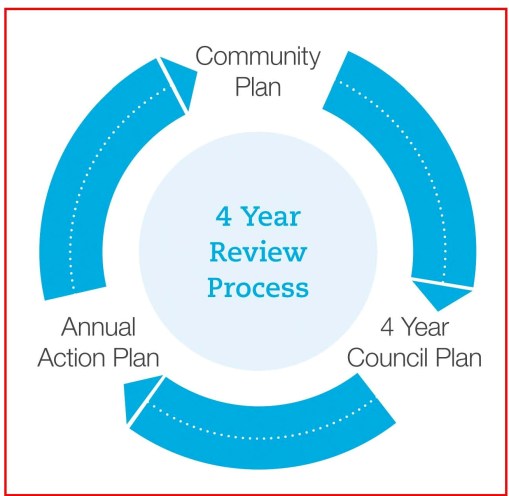
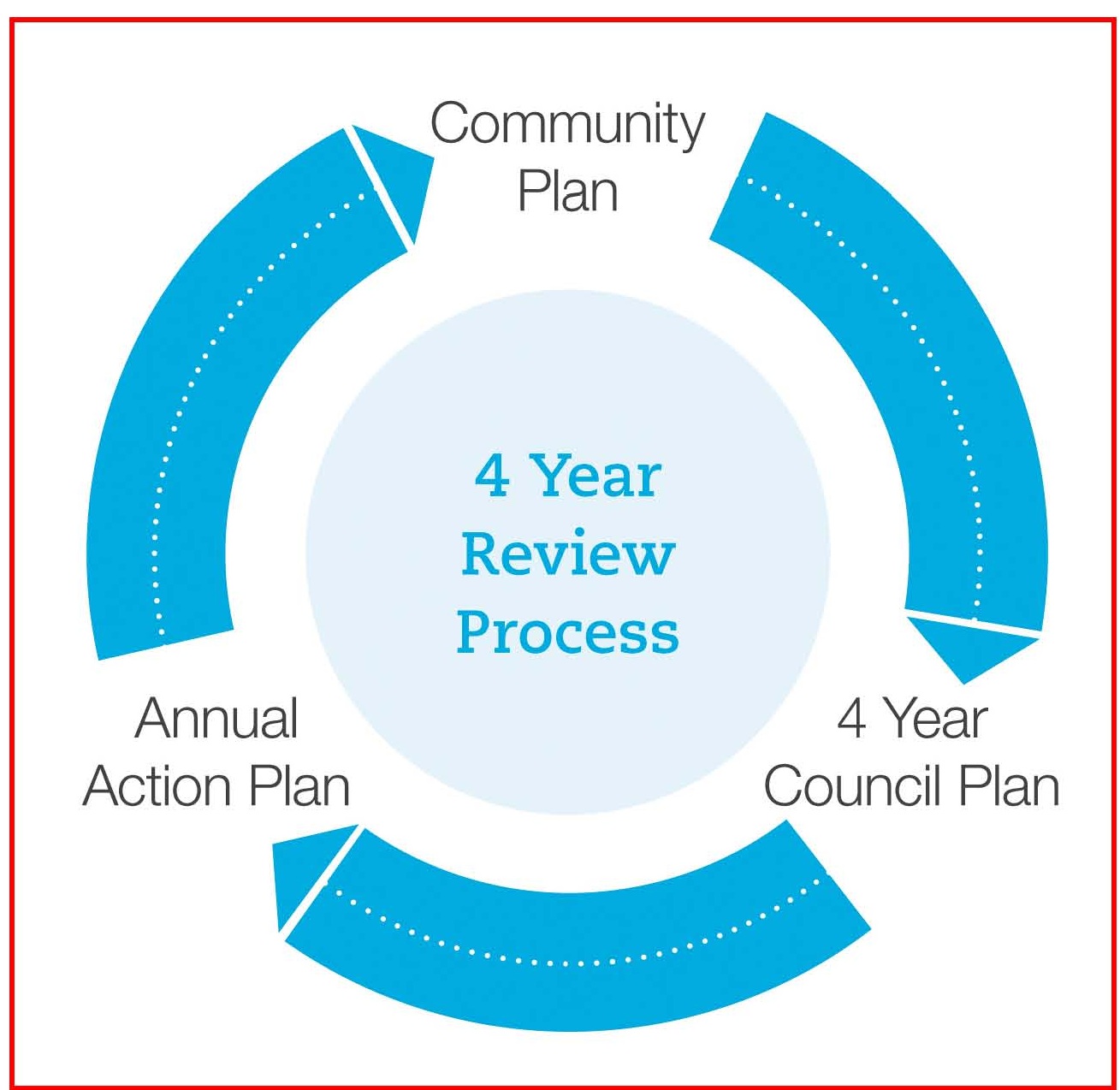
There are plenty more definitions but the following diagram from Bayside’s plan illustrates the relationship between the Community and Council Plan. Please note that the former feeds into the Council Plan which then leads on to the Action Plan.
 

So how does Glen Eira fit into this scenario? Do residents’ vision(s) ever sit at the heart of any policy, framework, or scheme devised and implemented by this council?

In both NSW and Queensland, a Community Plan is mandated by the respective Local Government Acts. In fact the Queensland guidelines state: “The corporate plan is drawn from the community plan…..the objectives, strategies and actions outlined in the corporate plan must be consistent with the vision of the community plan” (p.5) In Victoria, the legislation does not mention Community Plan. Section 125 simply talks about a Council Plan –“ A Council must prepare and approve a Council Plan within the period of 6 months after each general election or by the next 30 June, whichever is later”. This ‘plan’ must include ‘objectives’ and strategies for achieving the objectives as well as a means of monitoring and assessing the overall success of the implementation.

We bring all this to the attention of readers because it is vital that residents understand how Glen Eira is the odd man out when compared with some of our neighbouring councils. If this is really a genuine attempt to pinpoint what the community demands and expects, as well as to gauge their values, which subsequently inform the Council Plan, then many questions require answering:

  • Why was the Steering Committee not in force and operational PRIOR to the consultant’s report which has in the past formed the basis of the Council Plan? A report on setting up the Steering Group had been requested in March 2011 – nearly a year ago.
  • Why is there the need for another Council Plan review at this point in time rather than following the next election as required by the legislation and as Cr. Pilling has questioned on his blog? Why this ‘indecent haste’, especially since there has already been ‘consultation’ back in April, 2011?
  • Is this just more ‘smoke and mirrors’, designed to create the illusion of real consultation and the existence of a real ‘Community Plan’ when in fact the agendas have already been set via the inviolable Council Plan and its associated Strategic Resource Plan. A remarkable sentence appears in the minutes of the April 2011 item on the ‘consultation’ for the Council Plan: “Council proposes to retain the existing Council Plan”. More smoke and mirrors then, and perhaps now? Yes, let’s ‘consult’ but we won’t change a damn thing!

Obviously, this time around the proof will be in the eating. We sincerely hope that this is not just another expensive and orchestrated charade of ‘consultation’ – that the vision of the community will in the end become the foundation of the Council Plan.


This message was approved for distribution by the Office of the Campus Manager for and on behalf of Peter Marshall, Vice-President (Administration).
*****************************************************************************************************************************************************************************

Caulfield Campus – Concept Design for new Faculty of Law/Business & Economics building 

For many years the University has been proposing to develop the western end of the Caulfield campus; indeed over the last 10 years there have been a number of proposals put forward to bring about such a development.  The University’s Estates Committee of Council have now endorsed a Caulfield Campus Master Plan available to view at URL, which provides that any development of the western end of the campus should have as a centrepiece a major new academic building. 

http://www.monash.edu.au/study/campuses/campus-masterplan-caulfield.pdf 

It is presently proposed that such a building should accommodate staff of our Faculty of Law (currently based at Clayton) and Faculty of Business and Economics along with a range of revitalised retail offerings to service the local community and Caulfield campus staff and students. 

At this stage this is only a proposal, but the university has endorsed a major fundraising campaign, that if successful could provide a funding base to enable this proposed building to be constructed.  To support the fund raising campaign, the Monash Facilities and Services Division will shortly be calling for expressions of interest for architectural design services to produce a concept design for the proposed Law/Business building.  This design will be a major support component of the fund raising campaign. 

As you would appreciate the University can make no formal commitment or provide a clear time frame to undertake this building project, as, when and if the project moves forward is entirely contingent on the success or otherwise of the fundraising campaign.  Therefore, at this stage all we will be seeking to do is to develop the concept design over 2012. 

I hope this advice clarifies where we are with respect to this proposed facility, however if you have any questions regarding this concept design project please contact Bradley Williamson, Director, Strategic Planning and Development on bradley.williamson@monash.edu 

Helen Dunne
Campus Manager – Caulfield Campus
Monash University

The Planisphere Report recommends that approx 1000 homes in 17 streets and areas are worthy of greater protection.  Planisphere  also sees as dangers to “neighbourhood character” some of the following:

  • Loss of original buildings, particularly if replaced with new buildings that do not respond to the key characteristics of the street.
  • Incongruous building style, materials, colour or form of building and roof.
  • Painting or rendering of exposed clinker brickwork.
  • Buildings over one storey.
  • Second storey additions that are highly visible from the street.
  • Development that breaks the general rhythm of built form along the street.
  • Boundary to boundary development or reduced frontage setbacks.
  • Buildings with an overall rectangular or box form or extensive surfaces of unarticulated brick or masonry.
  • Carports or large scale garaging, particularly if constructed forward of the building line, or dominating the width of the frontage.
  • Change to the location of driveways.
  • Change to front fencing style, such as removal of a fence, a high fence or a fence of different material other than brick.
  • Extensive areas of hard paving – greater than existing driveway widths.
  • Development that breaks the general rhythm of built form along the street.
  • Boundary to boundary development.
  • Double storey buildings or second storey additions that are not designed to be in keeping with the form, massing, window proportions and setbacks of other buildings in the street.
  • Buildings with an overall rectangular or box form or extensive surfaces of unarticulated brick or masonry.
  • High front fences, or fences constructed of an impermeable material.
  • Loss of canopy trees in private gardens or street trees.
  • Removal of bluestone kerbing.

If these are all “dangers” to neighbourhood character then we submit that the current building stock within most of Glen Eira is susceptible to these exact same “dangers”. In fact, it would be extremely difficult to wander down any street that hasn’t already experienced some of the above. We have instances galore, especially in Minimal Change Areas where: box like structures, some of multiple storeys are acceptable; where trees are not protected; where driveways proliferate at the expense of street trees; where bluestone curbing is ripped out and not replaced.

We urge residents to consider the above dangers and why the current planning scheme, together with the proposed amendment only deems 17 areas as suitable for greater statutary control. We would also welcome contributions about specific streets – ie. do you regard the street you live in as “intact’ and having “significant character”? Let us know which streets YOU WOULD NOMINATE – especially since council does not appear to be interested in allowing residents to name these areas!

It’s also noteworthy that the advertisement for the C87 Amendment appeared in last week’s Leader Newspapers. This week there is no repeat ad. Bad luck if you happened to miss it last week – especially when Council’s home page is also totally silent on the C87. We can only again point to the lengths that other councils go to keep their communities informed and up-to-date. For example the Stonnington home page features these planning issues: Chadstone Planning Scheme Amendment; 590 Orrong Road and Mandatory Planning Controls for Chapel Street. Once again we remind Council that ‘community engagement’ can only happen when the community knows that their views are sought!

« Previous PageNext Page »