We are committed to facilitating genuine debate within Glen Eira. Your views on planning, environment, open space, CEO and councillor performance matter.
We acknowledge upfront that each activity centre is unique and different. But, there are surely certain planning principles which must be applied equally to each centre. In this post we focus on what council considers appropriate for sites located in the existing heritage overlays for both Elsternwick and Carnegie and the ensuing proposals for height limits and overshadowing.
Council’s planning for these two structure plans attempts to convince us that preserving and protecting heritage is vital. The planning scheme however, differentiates between ‘significant/contributory’ sites within each heritage overlay. Those sites designated as ‘non-contributory’ may be ‘developed’ whilst those deemed ‘contributory’ will hopefully have mandatory height limits assigned.
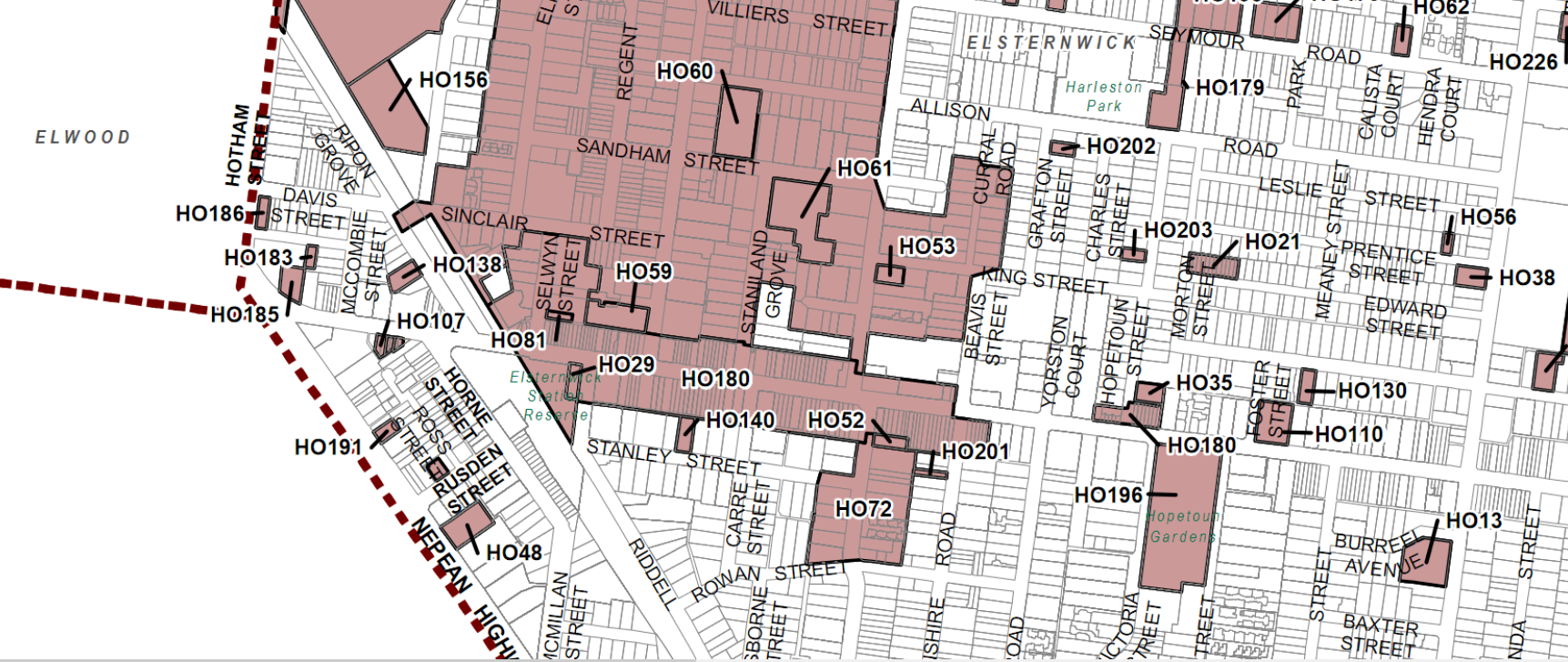
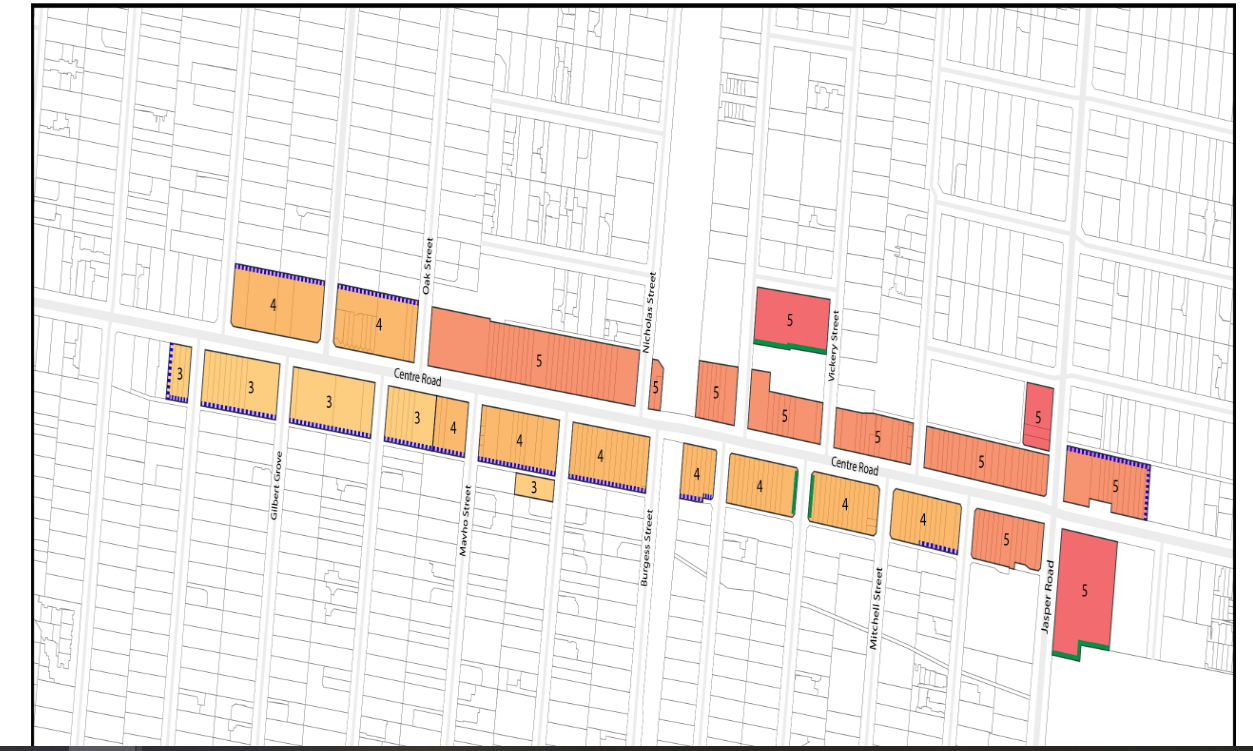
The following screen dumps show the existing overlays for both Bentleigh and Elsternwick. We have concentrated on the commercial spine of Glen Huntly Road and Koornang Road. Both shopping strips have a heritage overlay applied.
Given the above one should suspect that the resulting heights would be identical given the heritage overlays. But they aren’t! For the Koornang Road strip the proposed structure plan nominates a 5 storey height limit whilst the Elsternwick version includes height limits of 6 storeys (discretionary). The question then becomes: are all sites in Koornang Road deemed ‘contributory’? Here is the evidence that shows at least 11 sites that are designated as ‘non-contributory’.
Why then should Elsternwick’s non contributory sites be given leeway for a 6 storey discretionary height limit and Koornang Road’s non contributory sites be awarded a 5 storey height limit?
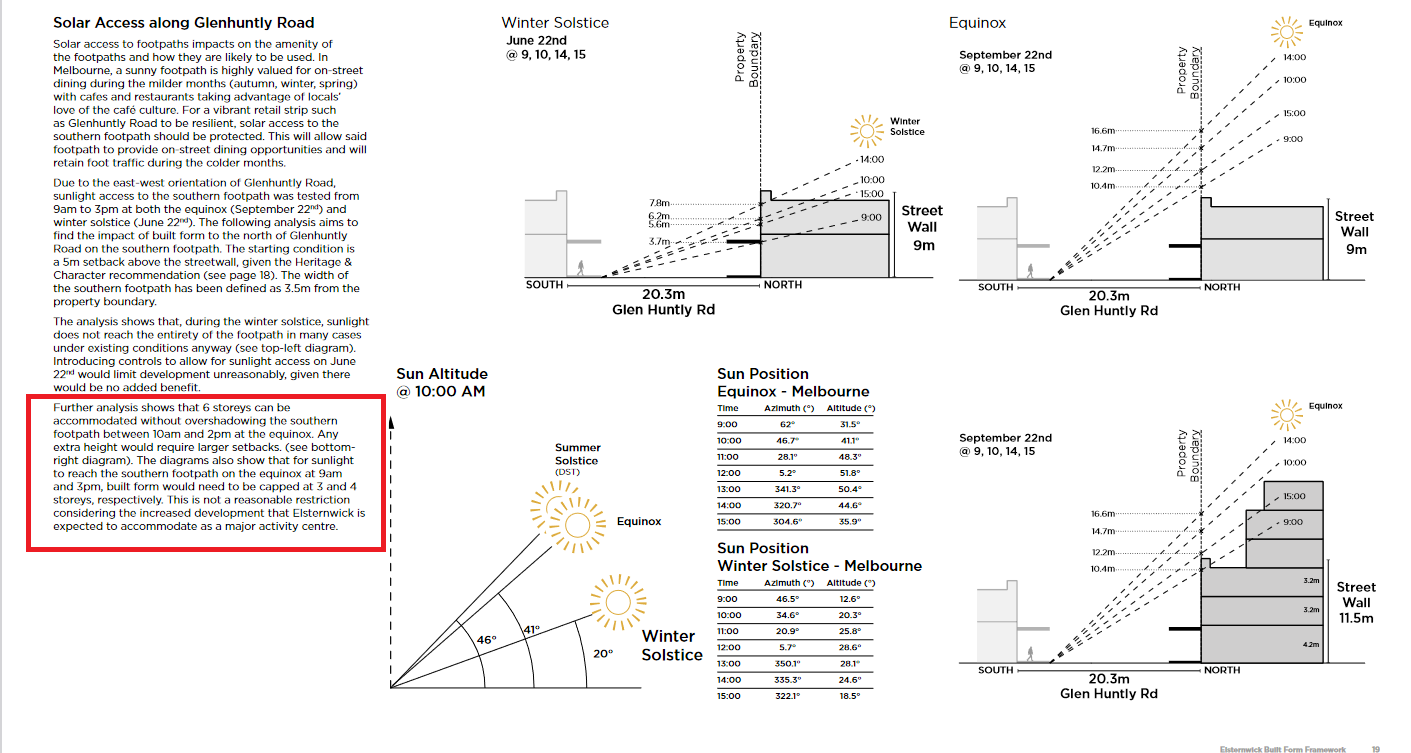
What must also be remembered is that Koornang Road runs in a north/south direction whilst Glen Huntly Road runs east/west. For Glen Huntly Road, as well as Centre Road, this means that at the winter solstice, and even the summer equinox at certain times, sunlight will not reach the southern footpaths where people are enjoying their lunches and coffees. We highlight this because the inconsistency between council’s planning is really unbelievable.
Here are screen dumps from both the Carnegie Urban Built Form Framework (page 20) and the Elsternwick one. Please note carefully the boxed sections and the introductory blurbs waxing lyrical about the importance of sunlight.
This raises a myriad of questions:
Why can a north/south running shopping strip have a 5 storey mandatory height limit and an east/west shopping strip be allowed a 6 storey discretionary height limit?
Why aren’t ‘non-contributory’ sites treated the same?
How reliable and accurate are the actual shadow diagrams presented in both cases?
Why the differences between both given that the Carnegie sunlight exposure reaches to the back footpath section and the Elsternwick one only reaches the front edge of the footpath. Given that both are the work of the same consultancy firm, then why the differences?
What we’ve presented are fair and legitimate questions and go to the heart of decent and consistent strategic planning. Our conclusion can only be that the consultant’s reports are simply there to confirm what has already been decided by this planning department. Again, transparency and accountability simply do not exist!
Last night’s debate on the Elsternwick structure plan would have made Machiavelli proud in terms of the chicanery that was enacted. This council has reached the nadir of good governance and accountability and obviously has no compunction in employing every dirty trick it can to further its agenda. Here are some of the lowlights of what happened.
Out of the blue a note suddenly materialised and was presented to Magee stating that Pennicuik had a ‘conflict of interest’. Who wrote the note, and when it was written remains undisclosed. Interesting, because when Magee asked for any conflicts of interests at the start of the meeting, there were none. Suddenly we get the Pennicuik one. The consequence of this was that only 8 councillors were permitted to vote and Magee therefore had a second, casting vote. A number of questions arise as a result. If this was a genuine conflict of interest (which we doubt) then why was Pennicuik permitted to vote previously on anything to do with this structure plan? And if it is a genuine conflict of interest, then why don’t the same principles and standards apply to Athanasopolous’ voting when it comes to Carnegie and the business he runs there? Does this mean that any councillor who owns a property in an area cannot be involved in decision making for that area and thus can’t represent his constituents? It is ludicrous that this is the standard that Glen Eira chooses to implement – but only when it suits of course!!!!!
Every effort was made by Magee to silence Cr Zyngier on numerous occasions, especially when he queried the accuracy of the data that the officers had provided to consultants and which all had a significant impact on the consultants’ ensuing recommendations.
Torres continues to mislead this council and it can only be deliberate. For example: when discussing the difficulty of enshrining winter solstice standards into the planning scheme, Torres also referred to council’s reliance on ResCode. What he does not say cannot be seen as an oversight since he knows full well that ResCode DOES NOT APPLY to buildings that are above 5 storeys. The issue here is 6 storey and higher buildings on Glen Huntly Road. ResCode is entirely irrelevant!!!!!
The gallery was told several times that there were several alternate amendment motions. Why it was the Cade amendment that was heard first (and thus was voted in on Magee’s casting vote, instead of the Zyngier proposal) raises further questions of manipulation to achieve the desired outcome. There was literally not even a nano-second, or pause for breath, between Magee asking for a motion and then immediately calling on Cade! Pre-arranged? You bet!!!!!There is no way that this could be seen as anything other than backroom orchestration designed to prevent the Zyngier proposed amendment!
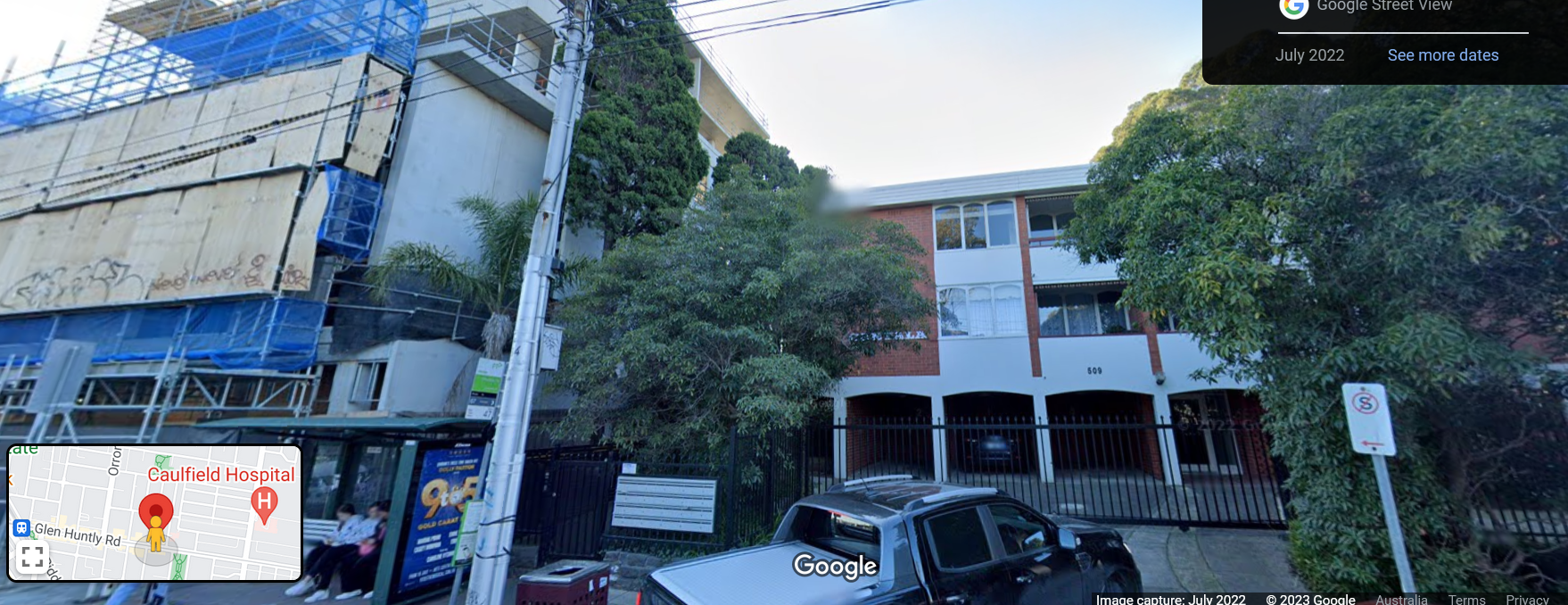
At one point Zyngier attempted to prevent the removal of Pennicuik, by proposing a ‘friendly amendment’. He suggested that 509 Glen Huntly Road be removed from the Cade amendment, which was the property causing the alleged conflict of interest. We note that 509 is: (1) a block of apartments; (2) it is not listed as a ‘significant’ heritage building and is very unlikely to be demolished and have a six storey dwelling erected in its place because of the sheer number of apartments and presumably individual owners.
Here is what it looks like:
Magee ruled that this was NOT a ‘friendly amendment’ since it is an ‘alternate’ recommendation! Further, he ruled that both the mover and seconder did not accept this – YET THEY WERE NEVER DIRECTLY ASKED WHETHER THEY WOULD ACCEPT THIS as is the normal custom. He simply made the decision to discount Zyngier’s attempt with the lamest of excuses! Furthermore council’s own governance rules state the following in regard to ‘friendly motions’ –
Clause 38(2): A friendly revision of a Motion may propose to alter a Motion by leaving out, inserting or adding words which complement the Motion.
The aim of last night’s meeting was to achieve by hook or by crook the ratification of the Cade amendment. It was designed to prevent council taking a position on protecting sunlight to the southern side of Glen Huntly Road because this would further limit the heights of development on the northern side. For all the rhetoric of giving a damn about heritage, and the ‘village feel’ of Elsternwick, the Cade amendment revealed how little council cares about these issues. 12 storeys still remains, and that’s supposed to be in line with the ‘village’ atmosphere. And we are supposed to take comfort in the fact that a 6 metre setback will now be sufficient to avoid additional overshadowing when no documentation/evidence has been supplied to justify this claim.
Residents need to hold such manoeuvring and councillors to account. We have a mayor whose only function appears to be to steam roll through anything that the planning department puts in front of him. It is indeed a very sad day for Glen Eira residents because this sets the precedent for Bentleigh, for Carnegie, and for every activity centre in the municipality.
Please listen very, very carefully to the following audio of the ‘debate’ and note Magee’s actions and words throughout this item.
Council has released its revised structure plan for Elsternwick.
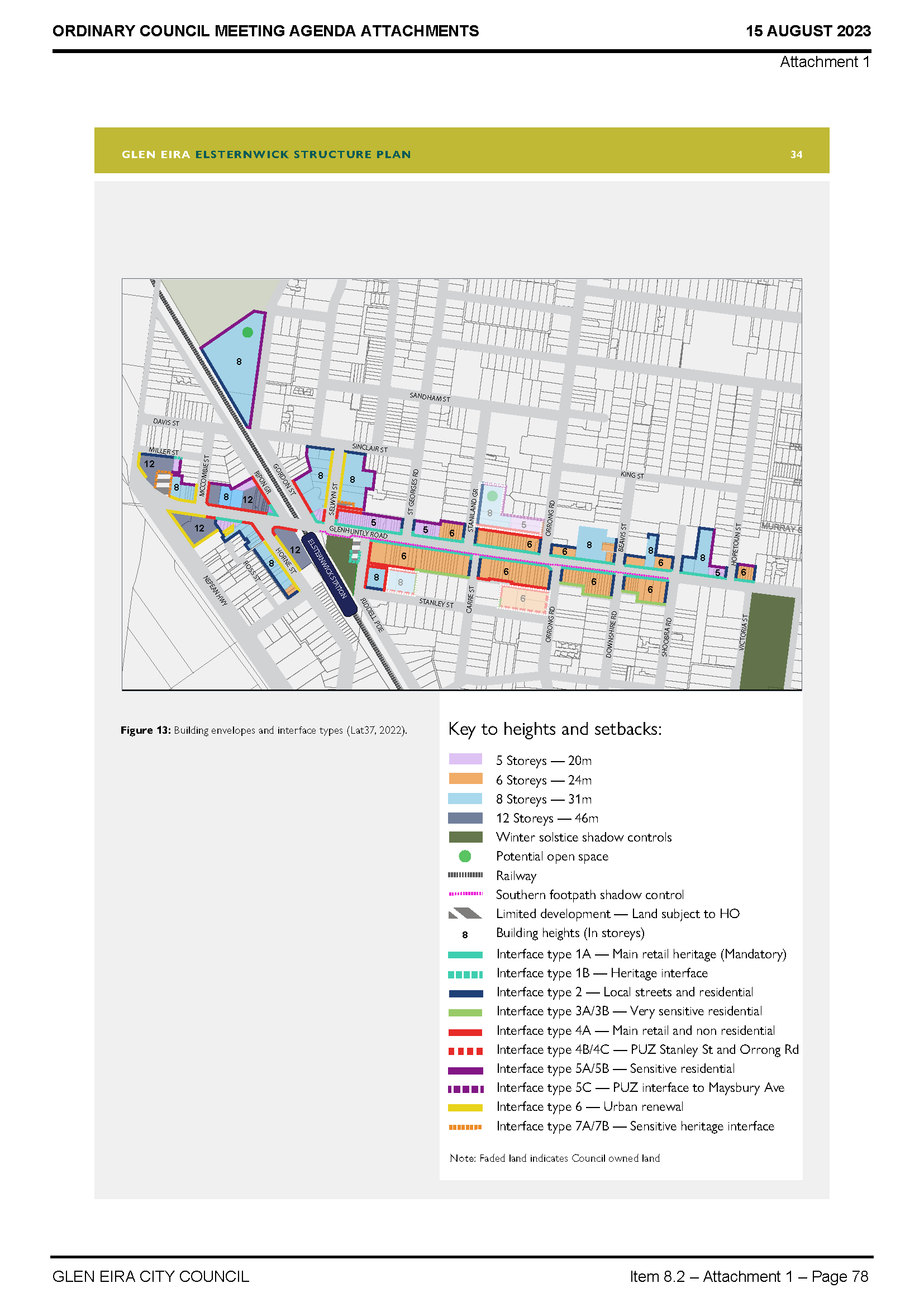
Here is what is now envisaged. Please note carefully the proposed heights (remembering that many are discretionary) and ask yourselves why the height in metres has increased dramatically from the current interim Design & Development overlay.
As expected, what we now have is nothing more than some minor tinkering from what was initially proposed. Despite the majority of community feedback opposed to the suggested (discretionary) heights, the need for sunlight on southern footpaths at the winter solstice, and the lack of sufficient open space, Council has seen fit to ignore all of these concerns. We still have:
No change to suggested building heights along Glen Huntly Road
No protection of southern footpaths at the winter solstice
Instead, council has simply changed some of the upper level setbacks for (some) heritage sites from 5 metres to 6 metres. Of course, we are not provided with any specifics or ‘evidence’ as to how this change will impact on overshadowing – especially to the southern side of Glen Huntly Road. We are supposed to take council at its word!
Yes, some originally proposed heights have been reduced – ie Horne Street from 12 storeys down to 8 storeys (discretionary). But they back onto Ross Street which is a tiny, narrow street consisting primarily of single storey homes. As with Bentleigh, council sees nothing wrong with having towers abutting single storey properties. This isn’t planning. It is literally a ‘f-ck you’ to residents!
The officer’s report makes the above sentiment absolutely clear when we are told the following:
The report outlines the revisions to the final structure plan in response to community comments, however there are components of the draft plan which remain unchanged. The consultation outcomes identified that proposed building heights were of concern for some but whilst making wholesale changes to building heights may seem popular, these cannot be justified or pursued based on community preference.
COMMENT: The question isn’t solely about ‘community preference’ but sound and valid strategic planning. Why and how can a 12 storey building be justified when the projected population growth is only 1400 residents by 2036. We’re told that population per dwelling will drop to 2.3 individuals in 2036. Even if we’re looking at 3 individuals per dwelling, or for that matter only 1 individual per dwelling, that means that we have a range of 460 to 1400 net new dwellings that are required over a period of 15 years. Council of course claims that they have to look beyond the 2036 date – the inference being that once adopted this structure plan will not be touched again for at least 20 years. That is council’s history and modus operandi! Whilst we’re promised a ‘review’ every four years, the results of this ‘review’ will only be to communicate what was been done in the intervening period we strongly suspect. We also have to laugh at council’s ‘implementation’ timelines. We find that ‘immediate’ means 1 to 5 years; ‘medium’ means 5 to 10 years and ‘long term’ blows out to over 10 years! Thus a Development Contributions Levy on developers could be 5 years down the track after it was ‘promised’ in 2016. Or, affordable housing, open space, and community uses might not happen for 10 years. But in the meantime of course, development will steam roll ahead!!!!!
The other amazing comment from the officer’s report is:
We are pursuing winter shadow protection for existing and potential future public open spaces including Elsternwick Plaza. However, winter shadow controls cannot be pursued for the southern footpath as many forms of redevelopment would be severely limited. This is contrary to the role of a MAC to accommodate future growth. For these areas, the equinox shadow is the standard to apply.
COMMENT: What the above makes absolutely clear is that anything that is likely to put a constraint upon development will not be pursued. Thus heritage and sunlight is expendable when it comes to the potential of facilitating more development. What is not stated is that ‘future growth’ can be accommodated according to what is required as shown above, and not what will benefit developers. Interestingly the Bentleigh traffic report provided figures on the net number of new dwellings anticipated by their draft structure plan which showed that over 2000 net new dwellings could be squeezed into Bentleigh. We do not remember seeing any such figure for Elsternwick. So if Elsternwick is proposing 12 storeys and Bentleigh 8, then we can only assume that Elsternwick is trying to ensure more than 2000 net new dwellings – regardless of whether we actually need this number in the ensuing 15 years!
CONCLUSION
Planning in Glen Eira continues to be driven by the development industry and by an administration that does not care one iota for its community and residential amenity. We have had consultations after consultations that are meaningless, ignored, and consultant reports that do nothing more than attempt to confirm decisions already made. Plus we have certain councillors who simply do not appear to care, or have the integrity to challenge such poor planning. Which leaves us with the question that if council is now claiming to have made changes in response to community input, and gone out again to so called ‘experts’, then why couldn’t these revised views and expensive ‘expert’ reviews been done initially? Or is it more of the same? – the pretending that we have listened to the community but in the end, done very little to ameliorate our concerns?
It’s time to call a spade a spade when it comes to this administration and its disregard of residents. To put it bluntly:
Resident views simply don’t matter, especially if they are opposed to council’s pro-development agenda and its predetermined decision making.
Council engages with residents, in the most minimalist manner on all important projects because the law says they must and NOT because there is any real intention to seek genuine resident feedback.
Only two conclusions are possible when it comes to evaluating council’s approach to seeking feedback from the community. Either we have some completely incompetent officers who are incapable of devising a survey/questionnaire that will deliver valid results, or the resulting surveys are designed with leading questions that can only be used to support already predetermined decisions. The latest example is the Bentleigh Structure Plan survey.
To avoid any meaningful input by either councillors or the community, the now released survey has been rushed through to publication. The original officer’s report stated that consultation would begin towards the end of the first week of August. It has been brought forward (without explanation) to July 31st. This doesn’t sound like much, but what it means is that councillors have had minimal time to evaluate the survey and that the Community Consultation committee has again been successfully bypassed!
It’s also worth remembering that originally this administration had no wish to include a survey in its consultation – as it has done with other structure planning. It was quite prepared for the ‘quick and dirty’ route of formal submissions, and ‘meet and greet’ with officers – with 3 out of the 4 proposed times being totally inappropriate for the vast majority of residents. It was only after councillors requested a survey that we get to this point.
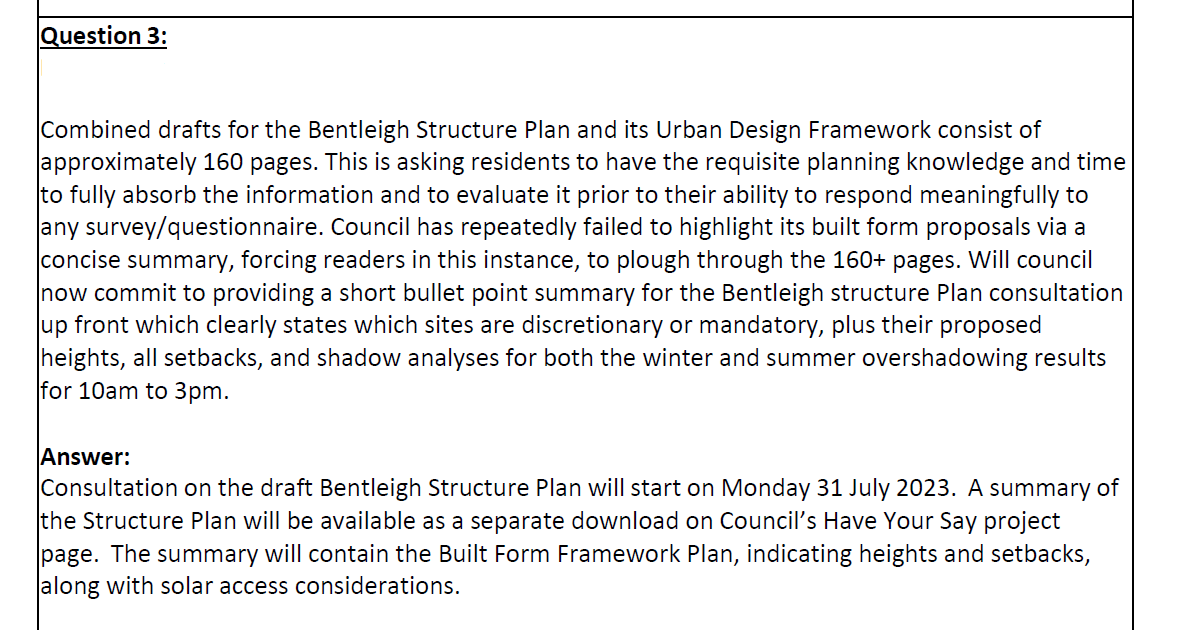
At the last council meeting one public question asked that a succinct bullet point summary of proposed heights, setbacks, and overshadowing analyses be part of the consultation process. The question and answer are below:
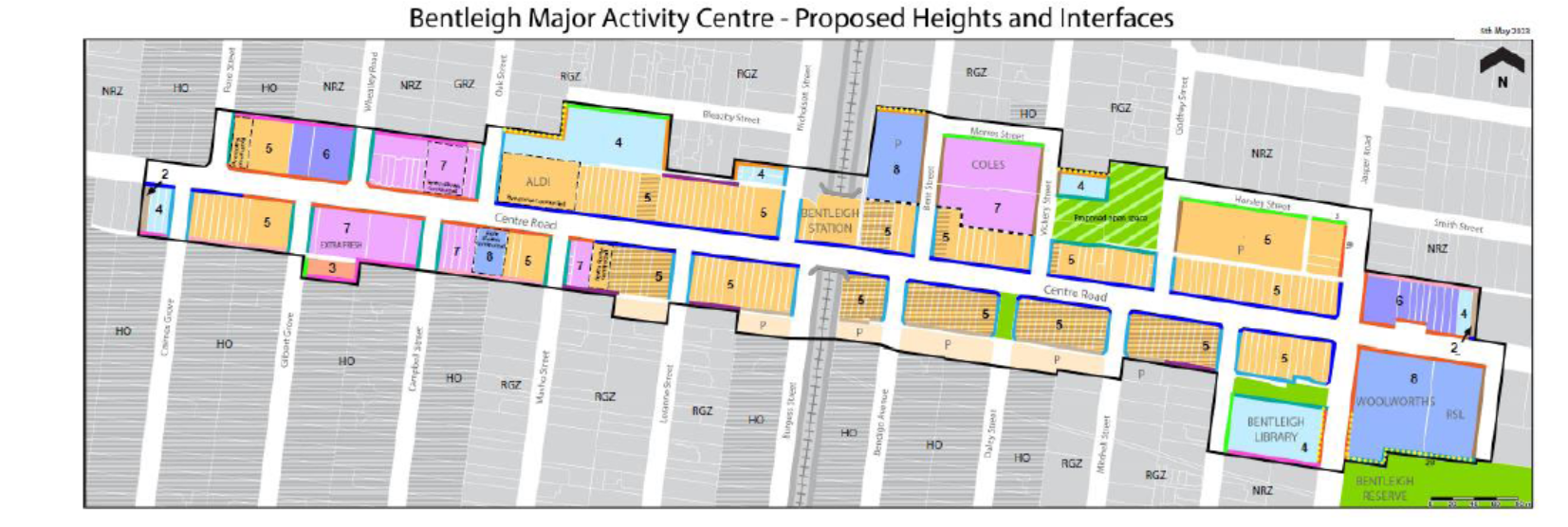
What we get is an 18 page so called summary, that is full of spin and guilty of the sins of omission! The ability to decipher exactly what is proposed from this document is impossible given that the full picture is never revealed in a concise and honest fashion. For example, when referring to proposed building heights, this administration chose to include the following map.
Why couldn’t this document include the following image that featured at the 25th July council meeting? Is it because this map is far easier to decipher?
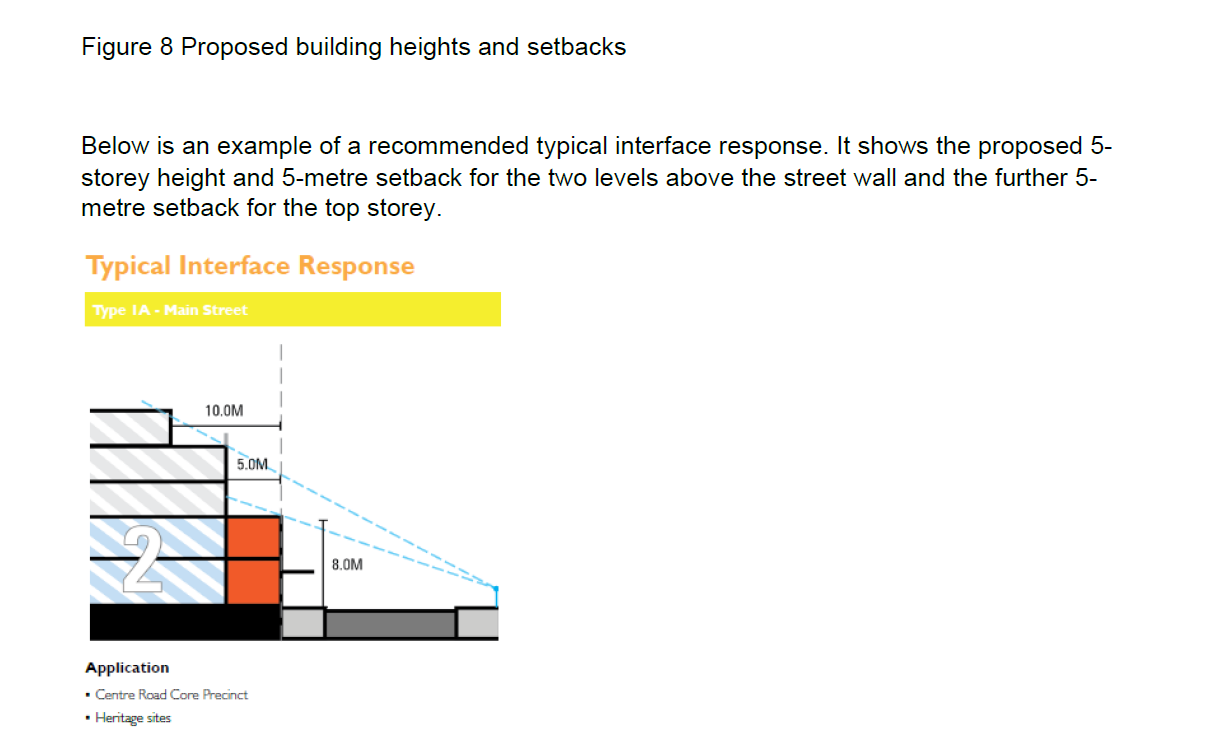
We then get only one example (for a heritage site) of the proposed setbacks as depicted below.
What we aren’t told is anything about rear and side setbacks, for a proposed 7 or 8 storey building that is NOT heritage listed.
In short, this ‘summary’ is a carefully manipulated document that fails to fully inform the community of what the draft structure plan intends to achieve.
THE SURVEY
Any decent survey should never include leading questions. This survey is replete with either useless questions of this ilk, or questions that don’t provide the necessary information in order to elicit fair and valid responses. Here are some examples:
Question: Do you agree that we should seek opportunities to create open space in the draft Plan?
Comment: Of course, nearly everyone would answer ‘yes’ to this question given Glen Eira’s lack of public open space. But does a ‘yes’ response to this mean that everyone is in agreement with the possibility of flogging off other council owned land for mixed use development? And will the additional open space of whatever size (since this is yet to be determined) be large enough to cater satisfactorily for the projected population increase?
Question: Do you think accommodating growth above the commercial strip is better than doing it in other parts of Bentleigh?
Comment: Even if the majority of responses are ‘yes’ to this question, it does not mean that those individuals who ticked the ‘yes’ box, are in favour of discretionary heights of 7 and 8 storeys! Without revealing the full extent of the ‘growth’ proposed any answer needs to be treated with caution. But of course, council can use the ‘yes’ responses to support their high rise agenda! Furthermore, the question fails to take into account issues of adequate infrastructure, parking, overshadowing, etc.
Question: The draft Plan recommends height limits and upper-level setbacks for new development. Do you agree that such measures would help to retain the character of Centre Road?
Comment: If respondents have no idea of what the height limits and the setbacks are for various sections of Centre Road, any responses given will be meaningless. Furthermore, unless they are au fait with which sites are heritage listed, then again the notion of ‘retaining the character’ of the area is nothing more than subterfuge. How on earth it is even possible to use the word ‘retain’ when discretionary heights of 7, and 8 storeys are nominated is obscene!
Question: The draft Plan identifies the western and eastern ends of the centre as the most suitable for higher density buildings as they would be away from the more sensitive heritage shops. Do you think this is a suitable approach?
Comment: Again, the question is deliberately misleading in that what is NOT mentioned is the fact that the highest proposed heights directly abutt either single storey dwellings in heritage overlays, or other residential areas. Nor are the proposed heights nominated. Plus, the recommendations fly in the face of council’s previous decisions on Bentleigh, that high rise should be located near the railway station and not at the extremes of the activity centre. Again, no explanation for this change in approach. Nor the question of whether this is indeed good strategic planning!
CONCLUSION
There are many other questions we could have commented upon, but the above should suffice. This is the latest example of how little respect is afforded to residents and how contrived and manipulated all community consultation processes are in this council. It is more than incompetence! It is a deliberate and disgraceful attempt to bypass the community, and even councillors, in order to achieve more and more development and to fill the pockets of developers and probably to earn more brownie points from the increasingly autocratic government.
The table included in the above however is the dead give away! On every single important variable council has gone backwards since last year – and in some instances, dramatically! For example:
Overall performance has dropped from 69 to 65
Making community decisions – 62 to 57
Community consultations 60 – 57
Overall council direction – 53-50
Value for money – 65-61
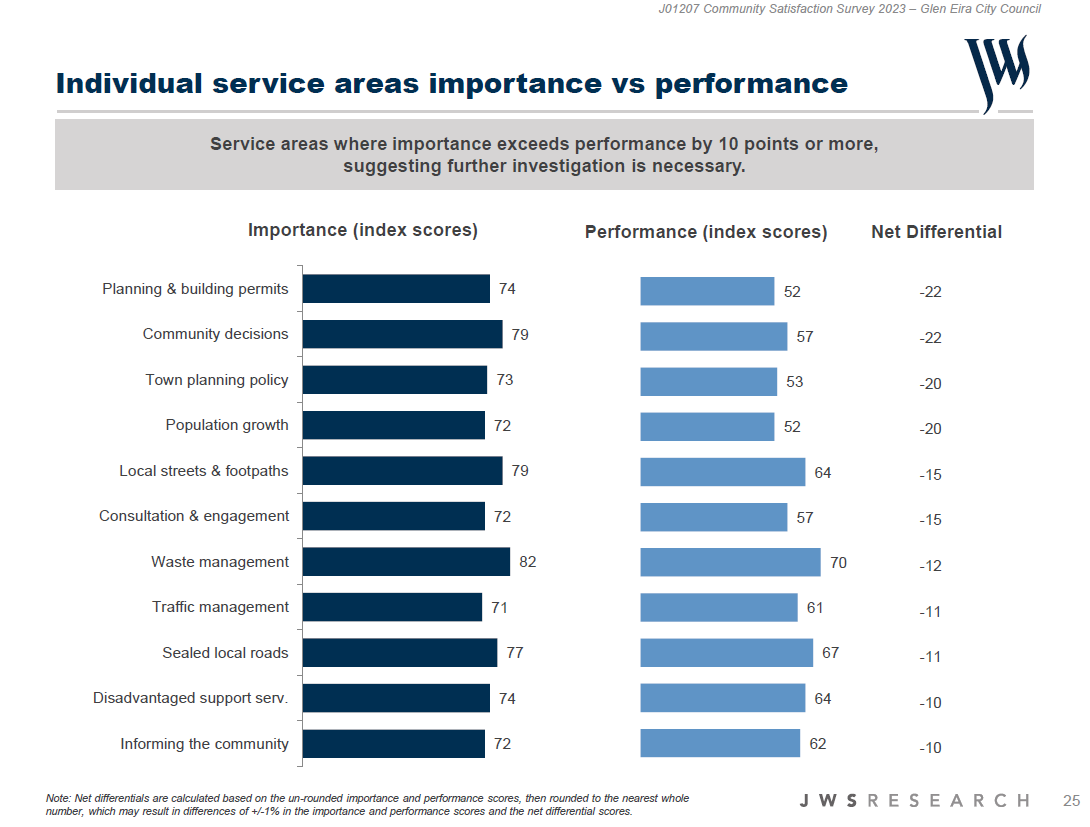
Whilst it is true that in comparison to the metropolitan and state average, Glen Eira does okay, that is irrelevant when we consider that for the past decade at least, town planning, population growth and consultation has shown the largest discrepancy between the importance that people place on these categories and their perception(s) of actual performance. Glen Eira excels in regularly having a 15 to 22 point gap for these categories. So knowing all the areas that council needs to improve on for at least the past decade, we are continuing to go backwards! Put bluntly, council has achieved nothing in terms of addressing its well known shortcomings!
The following screen dumps make this absolutely clear!
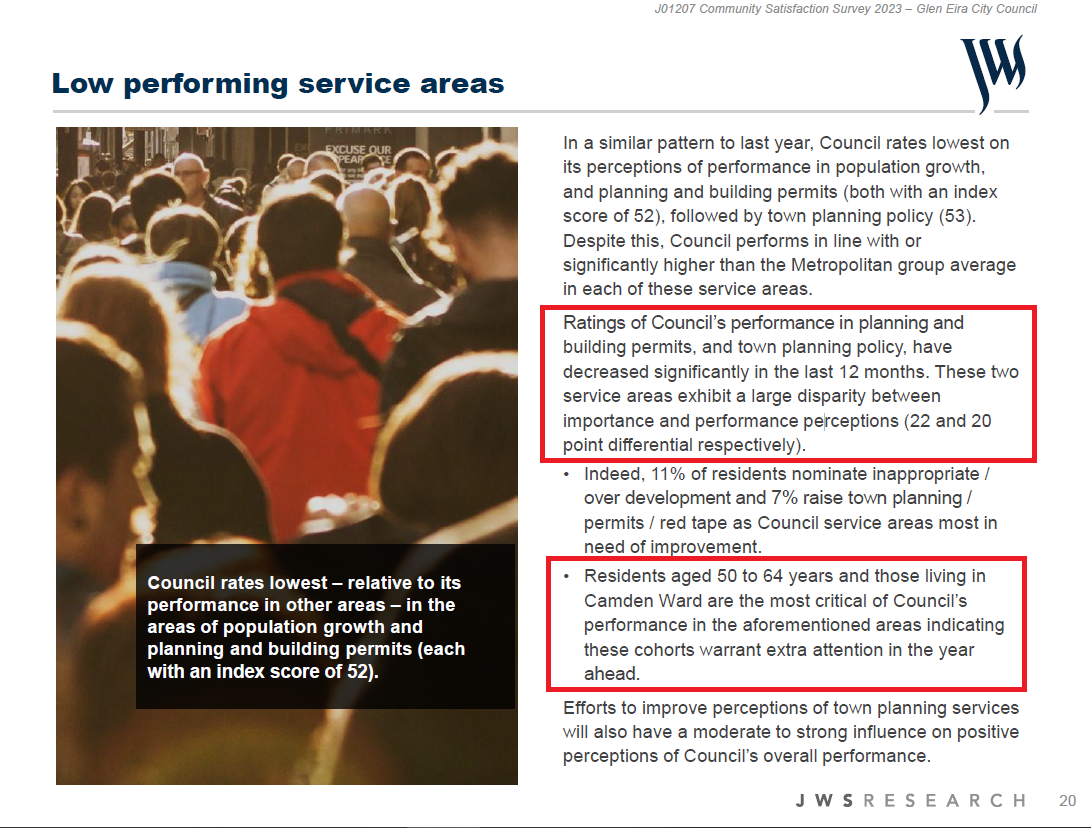
And there is also this ‘warning’ –
Nothing would be clearer! Residents are fed up with poor strategic planning, lack of genuine consultation, and importantly, the lack of ‘value for money’ that their hard earned cash is wasted upon!
Presented below are the comments made by Esakoff and Zyngier on the draft Bentleigh Structure Plan at the last council meeting. Unlike the majority of those who spoke in favour of the draft, at least in these comments the ‘problems’ are clearly identified instead of resorting to generalities and spin.
If one counts the number of times that various councillors used the phrase ‘better controls’ or ‘better managed growth’ or ‘better planning’ in terms of the draft Bentleigh Structure Plan, one should conclude that the draft is god’s gift to planning acumen and a truly wonderful improvement for residents. Nothing could be further from the truth.
We do currently have interim controls via a Design & Development Overlay in Bentleigh that will not expire until December 31st, 2024. Whilst Amendment C228 changed the DDO to only include the commercial and mixed use, it begs the question of why the current draft structure plan sees fit to include some residential rezonings in its borders. Surely this flies in the face of Amendment c228? Regardless of this anomaly, the existing DDO still represents a vast improvement on what is currently proposed. It stipulates:
Mandatory height controls along all of Centre Road
Lower heights in metres for equivalent number of storeys to what is now proposed
Far greater setbacks than in the current draft for certain conditions
Here is what the existing DDO consists of:
Readers will see: Nothing above 5 storeys. The current version is up to 8 storeys DISCRETIONARY
To therefore argue that the current draft structure plan will provide ‘better controls’ is beyond belief. Nor is it acceptable to argue that without rear setbacks for commercial sites that are not heritage listed that abutting heritage places will be better protected – as Athanasopolous would like us to believe.
So what has changed in the space of 15 months? Why is council so gung-ho on creating strategies that are far, far worse than what currently exist? What communication has taken place between officers and the department? Were councillors ever present at these meetings, or have they been privy to any of the communications? Why aren’t such communications made public or, at the very least, a report on what has taken place in such meetings?
Even if we accept that population will increase by approx 2000 over the next 15 years, how does this justify the proposed changes? And what guarantee is there that with increased apartments there will be more affordable housing? According to the latest census results, we already have 9+% of dwellings standing vacant across the municipality. Why? Are these properties that are already too expensive? Owned by foreign investors? Land banking until prices rise by developers?
No councillor at Tuesday night’s meeting had the courage to state the bleeding obvious! Zhang went on about how wonderful it was that streets currently zoned as RGZ (4 storeys) would now be reduced to 2 storeys because they are in a heritage overlay. She of course doesn’t mention how many four storey developments already exist in these streets, nor how many sites will be ‘upgraded’ to go from 2 storeys to 3 and 4 storey heights. When these are added up, they far exceed the number of properties that have had a reduction in height! What this also reveals is that the original introduction of the residential zones in 2013 was a disaster. No area under a heritage overlay should have been zoned for 4 storeys. And neither should all those properties that lie in the flood plain (SBO overlay) been zoned for three storeys or even included in the borders of the activity centre. . Of course, this was all ignored by the ‘guru’ of planning (Akehurst) and his complicit councillors!
The machinations and inconsistencies of this planning department continue unabated. There are numerous allusions to a ‘transport and assessment’ study and potential resulting actions. This document has not been made available and we doubt that even councillors have been provided with the opportunity to clap eyes on it. So once again, councillors are forced to make decisions without having all the information at their fingertips. The inconsistency is that for the Elsternwick structure plan, there was an accompanying traffic report. Why the difference? It simply is not good enough that residents will have all the requisite information only when the formal amendment is advertised. This approach entirely invalidates any attempt at genuine consultation. If other councils such as Port Phillip can publish all their documentation at the first stage of consultation, we see no reason why Glen Eira can’t – except of course to keep the plebs (and councillors?) as ignorant as possible until it is too late.
Much has to change in Glen Eira if this council is to live up to its stated charter of full ‘transparency’ and accountability.
PS: To put some historical perspective onto what’s been happening in Bentleigh, we’ve revisited an important VCAT decision (17th October, 2017) which granted a permit for a 7 storey development in Centre Road.
What’s fascinating about this decision, isn’t so much the outcome, but the arguments presented by the Council rep. The application was refused by council and thus ended up at VCAT. We quote verbatim what council had to say to support its refusal –
It was further put that guidelines relating to setbacks, height and amenity create further impetus to provide a more sensitive transition between the review site and the surrounding residential hinterland. Council put that Objective 5.1.2(a) of the Urban Design Guidelines seeks ‘To ensure the activity centre provides a graduated transition between different building scales and uses’. It was further put that it is Council’s view that the emphasis on the transitional role of buildings at the edge of an activity centre is greater in the Urban Design Guidelines.
· However, Council put to us that the proposed development is inappropriate at seven storeys because of the limitations imposed on the site due to the adjoining residential hinterland, the provisions of the DDO8 and the height and scale of development on the immediately abutting land.
· We make the observation that when assessed against broad strategic policies, the site is well located for redevelopment. However, Council put that the proposed development is in conflict with the vision of the DDO8 which establishes a preferred height of 5 storeys.
Council further submitted that the proposed development exceeds the maximum preferred height by 2 storeys and over 5 metres.
fails to perform a transitional function, which will necessarily cause a jarring impact at the edge of the Urban Village.
COMMENTS: So, in 2017 council was concerned about ‘transition’ – especially to the residential areas. With the draft Bentleigh Structure Plan this has gone out the window, where there is no problem with a potential 5 storey (and more if exceeding the preferred heights) of ‘transition’. How laughable! Furthermore, council’s preferred maximum height of 5 storeys has also gone out the winder by 2 storeys. That’s what ‘discretionary’ heights can produce!
Appropriate transitions remain relevant in all planning. In Glen Eira and with this draft, this no longer appears to be the case.
In August last year Cade voted against the Carnegie structure plan. She has also voted against the housing strategy but was absent for the determinative vote. On East Village she voted in favour of mandatory heights. So what has now changed? Why are we suddenly seeing a trend in Cade’s voting that largely supports the admin’s and planning department’s agenda of high rise and more and more development in our activity centres?
Cade’s voting patterns since being elected deputy mayor are very interesting. Together with Athanasopolous and Magee she voted AGAINST the refusal of a permit for an application in Grafton Street Elsternwick. Other interesting voting patterns include:
Cade moved the motion for the Bentleigh Structure Plan
She voted against reducing the height of one section in the Caulfield South Activity Centre
Admittedly she has voted against various permit applications (ie Bentleigh RSL in Huntley Road) but on all the recent major strategic planning strategies, she has been an ardent supporter – which contrasts strongly with her previous position(s) on these matters. So we have to ask: Could this possibly have anything to do with her election as deputy mayor and earning the princely sum of $59,659 PLUS 9.5% p.a for a grand total of just under $66,000? Or has she undergone some religious ‘conversion’? If so, then she needs to explain this.
Cade’s motion of support for the draft on Tuesday night, was staggering in its deception, the obvious pre-arranged Dorothy Dix questioning of Torres, and failure to disclose the full picture in so many instances – ie the sins of omission! Nor can it be seen as a genuine councillor contribution to the debate when much of Cade’s version of events mirrored precisely what appeared in the July edition of the Glen Eira News – basically, ‘don’t blame us, it’s all the government’s fault’! This has now become council’s escape clause for their repeated failures and refusal to (1) listen to the community and (2) adhere to sound strategic planning principles that actually enhance and preserve what residents see as vital aspects of residential amenity.
Here is what Cade stated. Please listen carefully.
“The Victorian government sets the agenda………”. True, but there is still plenty of scope within planning scheme for councils to create their own strategies. Approximately 25% of all planning schemes allow councils scope to introduce what they see as necessary for their communities. That’s why heaps of other councils have had structure plans for at least the past 15 years. That’s why other councils have implemented both ESD and WSUD (environment & water) in their planning schemes. Here in Glen Eira we are still waiting for a community infrastructure levy on developers, a car parking levy, or a WSUD policy – despite all being promised in 2016. In short, there is plenty that councils can do if they have the will. Whether or not a council’s proposed strategies will be approved by the Minister down the line is irrelevant at this early stage of structure planning. The focus should be on implementing sound strategic planning in line with community aspirations and which provides overall ‘community benefit’. There is no ‘community benefit’ in having potentially ten storey buildings overlooking single storey homes in a heritage overlay. Nor is there community benefit in flogging off council owned land for potential ‘mixed use’ development or for social housing. If council was really serious about social housing then it would not have endorsed a policy which seeks a meagre 5% of dwellings as social housing. It would have included a percentage of at least 10=20%! All of the above has nothing whatsoever to do with the government and everything to do with this administration and its lackey, pro-development councillors!
Cade’s question to Torres repeats past practice on the Carnegie/Bentleigh structure plans of several years ago. What happens if the draft isn’t passed Cade asks? Torres’ response once again resorts to straight out fear-mongering when he says: ‘If tonight’s recommendation did not get supported, our structure planning process for Bentleigh would not proceed’!!!!!!!!!! Why not? Why can’t improvements be made, or does council believe everything it sets out is perfect? There is nothing that stops a council from revisiting its drafts (as has happened previously) and ensuring that it is as sound and strategically justified as possible. Furthermore, the issue is not about abandoning the draft. Those councillors who voted against it simply wanted improvement and implied that this was not up to scratch. Given that council still has 18 months to get it right, the suggestion that everything will lapse or be abandoned is outrageous. Nor is it a valid argument to say that the community wants structure plans for ‘better controls’ and so council is providing structure plans. This of course ignores the central question as to whether the final plans do in fact offer ‘better controls’.
Torres then goes even further with the statement that if the motion fails, then the Minister could ‘quite possibly remove those (interim) controls’ from Bentleigh. Fear mongering at its best!!!!! And without a shred to evidence to support this claim. We know of no other instance in planning history where a minister has removed existing interim DDO’s in their entirety prior to the date nominated.
Cade then goes on to a supposed explanation as to why the draft hasn’t included the recommendations of the government’s Urban Design Guidelines. She says that the guidelines are a ‘background document’ and therefore aren’t in the planning scheme – so presumably council can ignore them is the implication. What is not stated is that STRUCTURE PLANS are also considered as background documents and are NOT IN PLANNING SCHEMES either!!!!!!! What does get into planning schemes are the amendments which introduce the Design & Development Overlays. In Glen Eira all of the most important strategic plans are ‘background documents’ –ie East Village structure plan; City PLan, Activity Centre plans; Urban Design Guidelines, etc.
Finally, Cade states that ‘I am not going to talk about building heights and setbacks’ or ‘parking’ because ‘I am sure my fellow councillors will address’ these issues. Really? How on earth can you move a motion to support a structure plan without even mentioning the most important aspects of it, and the most contentious? If you support something, then the onus should be on providing evidence as to why potentially 10 storey developments are appropriate, or why a 5 metre setback (discretionary) is okay when other councils have managed 6 metre setbacks in their major activity centres? But we guess it is easy to ignore the contentious issues and to simple promulgate more propaganda about everything being in the state’s control!
Cade’s conclusion is equally bizarre when she claims to want to hear from other councillors not only on what they like or dislike about the plan, but what they would ‘propose’ as an ‘alternative’. This is completely out of order since the possibility of an ‘alternative’ motion has already been rejected by Magee. Councillors are debating the motion as it stands and NOT what might be a feasible ‘alternative’.
Cade’s sudden ‘conversion’ is a concern. She is also doing the community a major disservice by simply regurgitating officer reports and presumably being complicit in staged Dorothy Dix questioning of officers only to provide them with the opportunity to further the set agenda. We remind her and our readers that stage managed debates are the antithesis of ‘robust’ discussion and serving the community with original thinking!
The following audio is taken from last night’s council meeting where once again the council was split in voting 5 to 4 to send the draft structure plan out for consultation. There were many criticisms of the current draft, plus some fear mongering from certain councillors and the administration. The final vote was – AGAINST: Esakoff, Szmood, Zyngier, Pennicuik. Those who voted FOR were: Cade, Zhang, Athanasopolous, Magee and Parasol. We note that not for the first time, Parasol did not utter a word as to the reasoning behind his vote. He simply put up his hand.
Here is what one resident had to say about the draft and its unbelievable shortcomings:
We will comment more fully on what transpired in discussion on this item in the days ahead.
PS: In the above audio, Torres tried to negate the potential for a ten storey development by referring to the ‘setbacks’. What he doesn’t state is that rear setbacks for commercial dwellings backing on to heritage areas are NOT MANDATORY. They are DISCRETIONARY – and we all know how little control DISCRETIONARY provides!
The agenda for Tuesday night’s council meeting includes our first look at the draft Bentleigh Structure Plan. The recommendation is to put this document out for public consultation for a period of 6 weeks. We know little about the nature of this consultation, except that it will include: a range of in-person and online opportunities for the community to provide comments, feedback and ask questions. In other words, we anticipate another mock consultation that only achieves the ‘consult’ range rather than the ‘involve’ stage recommended in the IAPP2 ladder for public participation.
Far more depressing are the actual recommendations contained in this draft. A short summary follows:
Discretionary heights of up to 8 storeys along Centre Road for non heritage buildings – which means developments could be even higher.
Only heritage buildings to have a mandatory 5 storey height limit (17.8 Metres) along Centre road
A discretionary 7 storey height directly abutting a two storey heritage overlay along Campbell and other streets
The real possibility of a reduction in onsite care parking requirements
No mandatory rear site setbacks for developments abutting residential/heritage
Discretionary front setbacks for non heritage properties
Potential sell-off of council owned land for mixed use development that might include social housing. Please remember that council’s policy as it stands only asks for a 5% component for large developments. Other councils have asked for as much as 20%!
Winter solstice considerations only to be taken into account at a measurement of 3.9 metres from the site boundary in side/local streets. How many of these streets have footpaths that are a bare 2.5 metres in width?
Here’s a run down of the proposed heights. CLICK TO ENLARGE THE IMAGE
Readers should note the following:
Only those hatched sites (ie with///////markings are heritage listed). Thus all other sites earmarked as 5 storeys could potentially be much higher.
The number of residential properties that are currently in NRZ that will have a discretionary 7 or 8 storey building backing onto them – ie Wheatley Road, Campbell street, Smith Street, etc. Clearly a difference of 5 or 6 storeys does not matter to our council planners!
Finally, what’s not shown in the above map are the proposed future rezonings of the residential hinterland.
We urge all readers to carefully consider the published documents and to partake in the upcoming consultation.






 Glen Eira Debates