GE Planning
Archived Posts from this Category
September 1, 2016
The Sky’s The Limit
Posted by gleneira under Councillor Performance, GE Planning, GE Service Performance[16] Comments
August 31, 2016
The ‘Interim Heights’ – Part 1
Posted by gleneira under Councillor Performance, GE Consultation/Communication, GE Council Meeting(s), GE Planning, GE Service Performance[6] Comments
Pilling moved motion to accept recommendations as printed. Sounness seconded.
PILLING: started off by going through the various height limits proposed in both amendments. Then said that this ‘came about’ because of the ‘extended consultation’ and how council ‘adopted’ residents views at last council meeting. Plus the motion to apply to the Minister. Claimed that the current motion ‘sets out’ what council ‘hopes to achieve’ via the interim height controls ‘while we do the work of the workplan‘. Called it a ‘targetted approach‘ and that council would ‘advocate strongly’ that the areas abutting residential zones ‘need more protection’. ‘We need to have more controls’ in those areas because they are the ‘most vulnerable’. The Minister has said that ‘mandatory’ height limits in commercial zones ‘will only be given in exceptional circumstances’ and council believes that ‘what we are doing tonight’ has ‘exceptional circumstances’. Said that ‘it is important that we do the work’ and in ‘putting in our reasons to the Minister which are quite reasonable’ and this ‘allows us in the interim to do the work’. Thought that ‘this addresses’ community concerns about ‘what will happen in the next couple of years’ and that this is a ‘good balance’ between ‘putting in some real protection’ and not putting in something that ‘will be rejected’.
SOUNNESS: stated that this ‘is a contentious issue’ for people and that they want ‘more security’. Council can ask for measures and then the Department and the Minister will make their responses. Fearful that the two areas (Bentleigh/Carnegie) amendments will be rejected because ‘not founded with sufficient cause‘. Other councils have applied and they ‘haven’t been successful’. He thinks that ‘having a relatively simple application’ over ‘part of Glen Eira’s development areas and not all of it’ will be ‘more sympathetically received by the Minister’. If ‘we were asking for something more’ then the chances of rejections are greater. Said ‘we don’t know until we apply’ but it’s better to aim for ‘what we can get’ and what ‘the community wants’. ‘There does need to be some development taking place in Glen Eira’ and council wants to be ‘able to control that’ but like with the Level Crossings Removal Authority, they do what they want and ‘council doesn’t have oversight over everything’. Saw this as a ‘fairly good attempt at getting a positive outcome’.
MAGEE: said that councillors had ‘sat around this table’ for 8 years and others 4 and there are two words that he has ‘come to dislike’ – ‘discretionary’ and ‘plan’. Said he’s ‘never seen’ either come ‘back in our favour’ from VCAT. When the VCAT member sees the word ‘discretionary’ then he says ‘great, leave it up to me’ and the same for plan, since ‘this isn’t law – it’s just a guide’. Council can only control things by ‘implementing mandatory height limits’ as they did with the new zones. ‘I’m more than happy with the 5 storey area’ but he is ‘unhappy with anything that is discretionary’ and gave the example of the 13 storeys around the Ormond Station where the ‘government has already made the determination that 13 storeys is acceptable’. With discretionary ‘we are leaving ourselves open to getting something we just don’t want’. These are interim while they do the structure planning and he’s not a ‘great fan of structure plans’ although they do ‘show where controls can be brought in’ and it’s just ‘what you think should be there going into the future’. For the Carnegie amendment ‘I don’t mind the 7 storeys’ but ‘again it’s got that word discretionary’. ‘There’s no win, there’s no gain for us having discretionary height limits’. They need mandatory especially when in ‘2 years time we’ve seen what the structure plan looks like’. The Minister has ‘asked us’ to do this not because ‘he thinks we are doing a bad job but because we actually wrote to him, asking could we do it’. Claimed council has got the ‘support’ of Staikos, the department and the Minister. Although there are car parks behind some of the discretionary 5 storeys in Bentleigh, who’s to say that this doesn’t become ‘6 or 8 storeys’ when applications come in. He again ‘cites what’s happening at Ormond’ where the government has ‘said that 13 storeys is acceptable’. So if it’s ‘acceptable there’ then Centre Road is ‘only a couple of hundred metres away’. He is worried that during the 2 years taken to do the structure plans ‘we’ve already got the sevens and eight’ storeys and ‘that becomes the pre-requisite’. They’ve got 2 years to do the structure plans which will ‘point us in the right direction’ for the next 10 or 20 years and ‘council has always done this’ since they were ‘one of the first to actually have different zones’ and that’s ‘why it was so easy to transfer over’ to the new zones. ‘Mandatory is the protection we need’ and ‘I believe we have the will of the Minister’ and ‘we’ve got a lot of people on our side’. Said he is a ‘firm believer in seize the moment. If the opportunity arises, grab it’.
HYAMS: wanted to go through some ‘history’ since people are asking ‘why’ council is only doing structure plans now and ‘not earlier’. Stated that they had Jeff Akehurst and he was the ‘doyen of town planning’ and he got the first ‘town planner of the year’. ‘So when Jeff said something about town planning, we listened’. Back then you ‘couldn’t get mandatory height limits’ but only discretionary and Akehurst told them that ‘discretionary height limits tended to be in those days’ ‘to act as a minimum’. That meant with 4 storey discretionary ‘they would start at 4 storeys and then go up’ and that council ‘had policies that would protect us from that sort of thing’. Claimed that ‘that worked well until recently’ when VCAT ‘changed its interpretation’ and ‘all of a sudden our policies didn’t work so well’. The policies of council hasn’t changed but ‘VCAT’s interpretation’ of them. Since many other councils have got height limits, and the other policies like ‘overshadowing and setbacks’ don’t count. Council then ‘found ourselves in a position where we had to play catchup’. Claimed that ‘about a year ago’ as a result of ‘various VCAT decision, I and others’ thought that council has to now do something about it and ‘that’s why we are where we are’. Thus even though ‘discretionary may not be so great’ it is still ‘better than the alternative’. Strcuture planning ‘takes a long time’ because ‘you need to provide justification’ for the plan. So there is these interim height limits but ‘anything we do as a council’ still needs government ‘approval’. And council has to ‘prove to the government that we have the capacity to cater for the population growth’. Council can’t say that there are other councils which can handle this and that ‘we’re not going to’. Said that ‘I would like to put mandatory protection over all these areas as well’ but that’s only allowed in ‘certain circumstances’. Read from the officer’s report about the ‘exceptional circumstances’. Spoke about Mentone’s mandatory heights and how they ‘were peeled back by the Minister’. Hoped that council ‘could get mandatory’ height limits for those commercial areas that backed onto Neighbourhood Residential zones. Went through what the amendments asked for. Said that Carnegie is ‘less linear, has more development’ is it is therefore ‘justified’ that they have 7 storeys. The amendments also include other things apart from height such as ‘streetscape’, ‘neighbourhood character and amenity and so on’. He would prefer mandatory but ‘there’s no point in asking for what we won’t get’. If they ask for everything to be mandatory ‘without discerning where we have a strong case and don’t ‘ then the Minister ‘is likely to come back and say I’ll give you the height limits but’ they will be ‘all discretionary’. Said ‘I firmly believe’ that council will get ‘a better outcome’ by putting the case that ‘this area is special’ so it should be mandatory and ‘this other area we can accept discretionary’. ‘If we ask for all mandatory we don’t have the opportunity to put that case’. Plus the minister ‘might throw it out all together’ because he might think ‘we are being unreasonable and tell us to do it all again’.
COMMENT
Wouldn’t it be wonderful if we could have councillors who stood up and revealed the truth, the whole truth and nothing but the truth? That of course requires an admission that Council’s planning over the years has been abysmal, and represents a dereliction of duty. Further it would tell residents that the zones are all wrong and that council sat back and did nothing, even when it knew things were going belly-up for residents over the past decade.
Things to bear in mind:
- Akehurst might have been the ‘doyen’ of planners – but did councillors ask for ‘evidence’ that their planning tools were working? When did they last ask? What answers were given? How many of them have even read the planning scheme?
- Could we please stop resorting to the ‘fear tactics’ that have become endemic in this council – first warning off objectors from going to VCAT, and now the Minister has become the bogeyman. Of course, any chance of ‘success’ relies on the contents of council’s planning scheme and any ‘strategic justification’ that has been put together. Recent history suggests that both are sub-standard.
- Hyams also neglects to include the basic point that with the introduction of the zones, Council did have the opportunity to have mandatory height limits on Mixed Use Zones. They didn’t of course!
- And what in the end is the real ‘council vision’ except to have more and more development coming into Glen Eira via the zones and prior to that the carving up of the municipality willy-nilly into housing diversity and minimal change?
- What on earth have our planners been doing for the past 8 months when the order from Wynne came in December 2015? The statistics and analyses of Bentleigh and Carnegie and Elsternwick should already have been well under way- besides, why spend a fortune on computer systems if they can’t provide the necessary data at the push of a button?
- Wynne did tell council to pull its finger out because it has had a deplorable history in planning and is so out of kilter with every other municipality that he was forced to act!
Finally we wish to comment on something we have written on peviously. VCAT HAS NOT CHANGED ITS INTERPRETATION AS HYAMS WOULD HAVE US BELIEVE. We could literally pinpoint hundreds of VCAT decisions prior to 2013 and even as far back as 2005/6, where the decisions in favour of permits refused by council could have been written yesterday by the VCAT member. The reason is clear: permits granted have had absolutely nothing to do with VCAT changing its interpretations and EVERYTHING TO DO WITH COUNCIL’S OWN PLANNING SCHEME. Below are just two more examples of this – both from 2006 and both concerning developments in the so-called Urban Villages. We challenge anyone to indicate how these comments are any different to what VCAT members are saying today!
it was put to me that the proposal is an over-development of the site in being too high and/or out of character with the locality, or alternatively that the proposal will have unacceptable amenity impacts on neighbouring occupants. The critical issue in this opposition was clearly the acceptability of having a four level building compared to a three level one. I conducted a view of the site and locality after the hearing.
3 In summary, subject to a proviso listed below, I am satisfied that the proposed four storey building can comfortably sit on the site. I rely here on the strong policy support for the higher density residential use of the site, the context of other 2/3 storey existing buildings nearby, the quality of the design, and my view that any amenity impacts on the neighbours is within acceptable parameters. While I can see his arguments, I am not convinced that it would be a good planning outcome to shave one storey off the proposal as put to me by Mr Fleming.
It is clear to me that Elsternwick Village is one of a relatively few places in the Glen Eira municipality where the Planning Scheme is actively encouraging a bolder approach to new residential development. That is, in light of the reality that the Planning Scheme classifies much of Glen Eira as areas where minimal or possibly moderate residential change is encouraged, it is very significant that Elsternwick Village is one of relatively few locations where the Planning Scheme sends a very different message. It follows that if Glen Eira is to play a legitimate role in accommodating the population growth of Melbourne as per Melbourne 2030 in the face of these constraints on residential development in much of the Glen Eira “residential hinterland”, this arrangement only makes planning sense if urban village locations in the municipality such as Elsternwick make a major contribution to urban consolidation.
36 In this important overall policy context, I have highlighted above those sections of clause 22.05 (Urban Villages Policy) and the draft “Design Vision for Elsternwick” document which seem most applicable here. The key text from these documents send a clear message that higher density residential development is being encouraged in Elsternwick Village.
37 In summary, there is strong policy support for robust residential development in this part of Elsternwick Village, rather than an inappropriately timid approach. This policy situation reinforces the general “rule of thumb” that residents who live in or near an activity centre such as this cannot just expect the built form character in this locality to remain static, and also cannot expect the same levels of residential amenity as persons living in the “residential hinterland”. http://www.austlii.edu.au/au/cases/vic/VCAT/2006/83.html (2006)
As indicated earlier, the Bentleigh shopping centre has been identified as the focal point of 1 of the 3 “urban villages” identified by the council. The MSS states that urban villages are based around the major shopping centres within the municipality. Further, the MSS states that the urban villages are the places where smaller scale office development and higher density housing is encouraged both within and around the commercial zoning.[12] The MSS specifically contemplates that the “Urban Villages Policy” will be used to “promote higher development densities”.
47 The “Urban Villages Policy” at clause 22.05 then goes on to say that these areas are the “preferred location for the municipality’s highest densities of residential development”.
Under the policy, the site is located within precinct 2 – “The Retail Hub”. Outcomes envisaged for this area include the strengthening of retail activity at ground level; offices and residential uses to be located on upper floors and buildings along Centre Road to increase in height. We acknowledge that “parameters” for increased height with respect to matters such as the impacts of shadows, building articulation and the provision of a transition with the surrounding residential area; however, the policy makes a clear statement that increases in building height are to be expected.
49 We acknowledge that the policies and strategies within the scheme call for built form outcomes that respond to the context and character of the area. However, in our view, there can be no escaping the fact that the thrust of the strategic approach advanced by Melbourne 2030 and supported by the council’s own policies is to encourage intense redevelopment and the highest densities in and around the Major Activity Centres and/or Urban Villages.
50 Increases in building height are an inevitable consequence if the intensity of development is to be increased in a particular area and this is acknowledged in the Urban Villages Policy.
We appreciate that the height of the proposed building represents a reasonably significant departure from 1 and 2 storey height buildings that have traditionally been found along Centre Road. However, we do not consider that the assessment of whether the height of the proposed building is acceptable or “fits in” can be solely based on a comparison with what now exists. To do so would present a somewhat confusing scenario whereby on the one hand, the scheme’s policies encourage higher densities, more intense development and therefore “change”; only for this to be stifled by the requirement that new development must “fit in” with what now exists
Part 2 will follow shortly!
PS – We thought it worthwhile to remind readers of the following resolution from the minutes of May 2015 – just a little over a year ago! Please note that the requested reports ‘in 12 months time’ did eventually come up and councillors again voted in their usual manner – let’s do nothing! Thus, when Hyams opens his mouth and starts telling the gallery that he and others were becoming ‘concerned’ about the zones and VCAT, about a ‘year ago’, it is even more remarkable that he could vote for a motion that mandates the ‘do nothing approach’ and how wonderful the existing planning policies are! The gulf between words and action are greater than the Grand Canyon!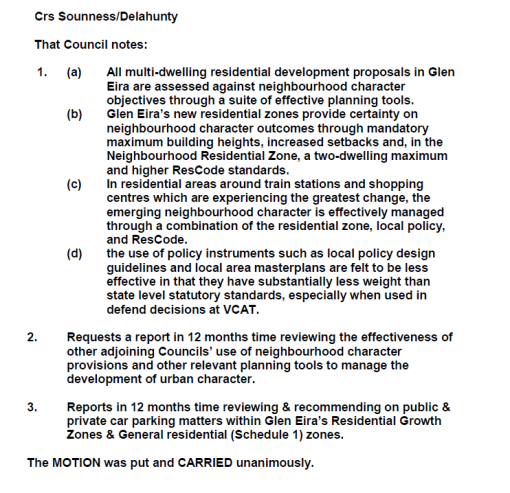
August 30, 2016
Council Meeting Short Report
Posted by gleneira under Caulfield Racecourse/C60, Councillor Performance, GE Consultation/Communication, GE Council Meeting(s), GE Planning, GE Service Performance[3] Comments
A quick report on tonight’s marathon council meeting:
- Development applications went according to officer recommendations
- Hard copy again different to online agenda in terms of the in camera item – more monumental stuff ups regarding potential purchase of open space with no explanation or apology offered
- Amendments C147/8 on interim height limits were passed with Magee and Lobo voting against on the basis that everything should be mandatory. Arguments (if they could be called that!) put up by Lipshutz, Hyams, Esakoff, and Pilling, were once more based on ‘trust us, we know what we are doing because if we went for all mandatory, then the Minister would be likely to make it all discretionary’.
- Caulfield Racecourse another monumental ‘let’s wait for the Minister to act, rather than have council reps resign now’ because there is a danger here in what the MRC could do!
- Public question time reminiscent of kindergarten playtime, where the CEO asked questioners to put up their hands if they were present in the gallery. By this stage, after 2 hours of councillor waffle and woeful debate, most people had left and who could blame them given the fact that most of these councillors simply like the sound of their own voices and the quality of ‘debate’ is totally underwhelming! Please remember that if the questioner was not present then the question nor answer was read out and neither will this appear in the minutes. Thus the wider community has no way of knowing what the issues are, nor council’s responses. This is called open, accountable and transparent government – for which we’ve got Lipshutz, Hyams, Esakoff, Pilling, Ho to thank!
- Magee being Magee – a useless request for a report on the Claire St VCAT decision. Asking what recourse council has – ie whether an appeal to the Supreme Court has any merit? No doubt the eventual report will come back and state that there is no grounding in law for an appeal and that it would cost hundreds of thousands. We suggest that the cheaper and quicker remedy would be to change the zones, which after all is what the community has been demanding for ages!
Full reports in the coming days.
August 28, 2016
A History Of Neglect & Negligence!
Posted by gleneira under Councillor Performance, GE Consultation/Communication, GE Governance, GE Planning, GE Service Performance[13] Comments
In 2004 all councils throughout Victoria were given the option of introducing interim height limits for Neighbourhood Centres as well as interim structure plans for their major activity centres. Glen Eira Council voted against doing a single thing to help ameliorate the problems identified by residents as far back as 2003. The issues of 2016 are a mirror image of what was stated way back then and raises the fascinating questions of :
- what would Glen Eira be like today if in 2005 Council had taken the opportunity to implement structure planning and interim height limits?
- Would we now be faced with the fact that it has taken an order from the Minister of Planning to ensure that Glen Eira falls into line with every other metropolitan council?
- To what extent would residents now be better off given the ineptitude of the proposed Amendments C147 and C148 simply because the necessary ground work has never been done and these amendments are merely the most minimalist response to the Minister’s demands?
One must wonder why in 2005 Council rejected the offer from the State Government. Was it because they realised that structure plans and height limits would hamper development? Was it because they simply didn’t have the competence to do a decent job of providing the necessary strategic justification? Has anything really changed in the past 11 years?
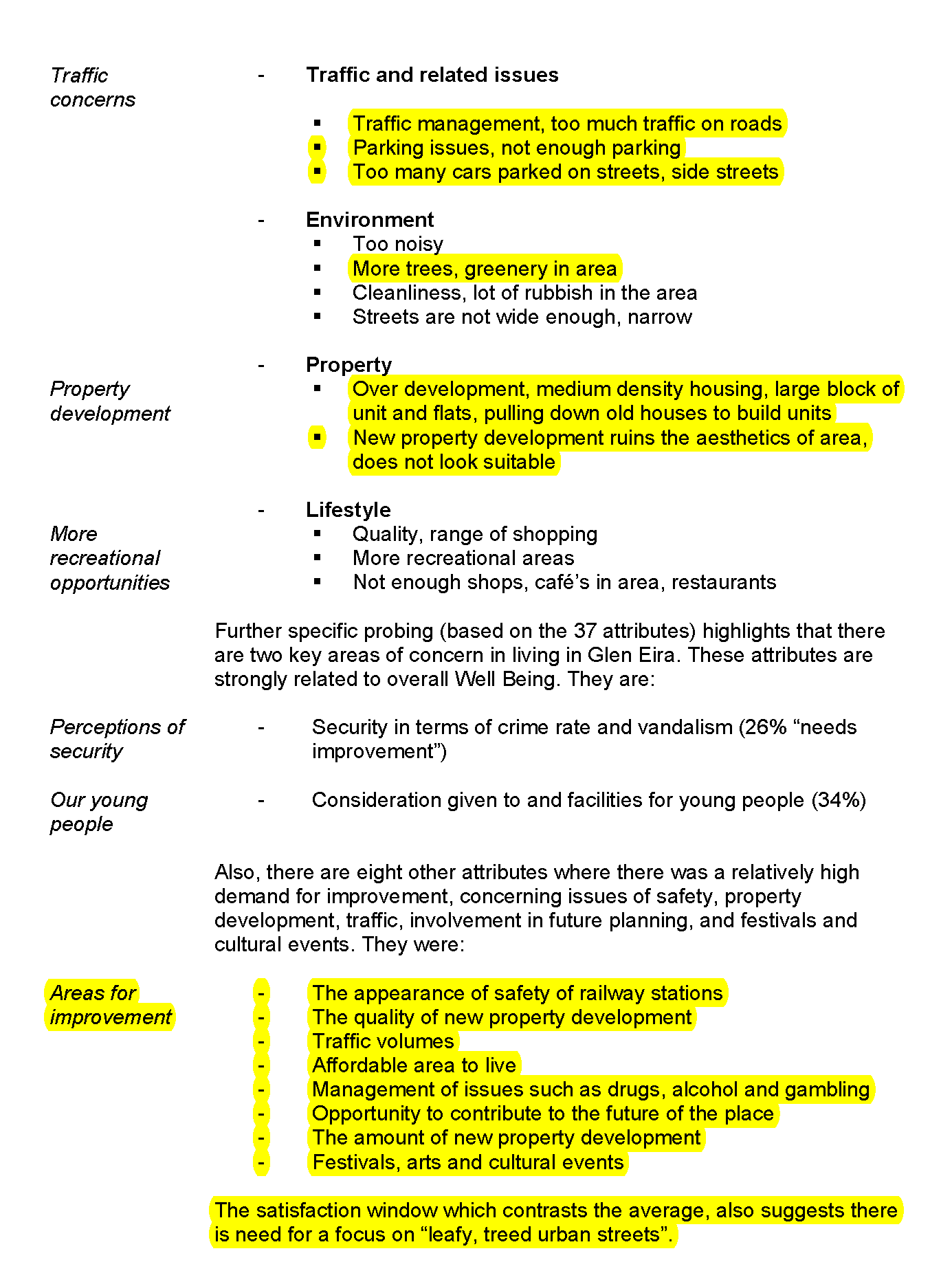
Below is one page from the Community Plan of 13 years ago that identifies in black and white the same issues that are still with us – plus another snippet which shows that today’s scapegoating of VCAT is also nothing new – but Council still didn’t address these concerns over 11 years. All that has happened is that we got the atrocious zones and the scapegoating of VCAT has become more vociferous!

So here is what residents could have had. On the 7th February 2005 an officer report was tabled which recommended no action be taken by council. The following are all quotes from this report which we’ve also uploaded in full (HERE). Two councillors who voted for this dereliction of duty are Hyams and Esakoff. They are still there, joined by their fellow pro-development councillors and turncoats such as Pilling.
The recommendations read –
That Council notes that following the approval of former Amendment C25, it now has policy protection in the Glen Eira Planning Scheme for Minimal Change Areas (80% of the geographical area of the city) and Neighbourhood Centres.
C) That Council continue to monitor the performance of its local policies particularly at VCAT. Should it become evident that Council policy is not offering adequate protection for our centres and established residential areas,then use of these tools could be considered
At this stage there does not seem to be the need to embark upon what would be an extensive public consultation and amendment process when a level of protection through local planning policy already exists (introduced by Amendment C25).
Options / considerations –
- There do not appear to be any neighbourhood centres under particular or immediate threat from inappropriate development which would warrant immediate application of a maximum height control.
- A certain amount of strategic work would be required to justify any proposed height limit in a neighbourhood centre, balancing the need to protect the amenity and character of a centre whilst not discouraging appropriately scaled development from occurring.
- The structure planning process needs to have commenced for this tool to be considered.
- Interim Structure Plans could be a useful tool for the Bentleigh, Carnegie and Elsternwick Urban Villages. It is considered the optimum time to use this tool is once Council has adopted the Urban Design Frameworks and agreed to commence the amendment scheme process. In this way the adopted Structure Plan in the form of an amendment, would be given statutory teeth up until final approval by the Minister. (This is the same mechanism that is always used associated with heritage controls)
- It is anticipated that the Urban Design Frameworks will be reported to Council mid-year
Local Policy Protection
Glen Eira is in the fortunate position of having local policies in place which limit development in our established or minimal change areas as well as guide development in our activity centres. With the approval of Amendment C25, a number of objectives and policy statements in our local policies now deal with the height of buildings. We thus have protection in both our minimal change areas and neighbourhood centres through policy wording. At this stage this degree of protection is considered appropriate.
The additional tools introduced by the State Government are a welcome addition to the suite of tools available for Councils to use where appropriate to improve their planning schemes. At this stage, however, there is no need or urgency for Glen Eira to apply any of these options.
Our established residential areas have policy protection through former Amendment C25, and there does not seem to be any such areas under threat from buildings higher than 9 metres.
Similarly, in neighbourhood centres, building heights do not seem to be a major issue and Glen Eira’s neighbourhood centres currently enjoy a level of protection introduced by Amendment C25 through the performance based requirements of Council’s Housing Diversity Areas Policy.
With regard to Interim Structure Plans, this tool may be useful when the Urban Design Frameworks for Bentleigh, Carnegie and Elsternwick have been adopted by Council and a planning scheme amendment is commenced.
It is important however that Council continue to monitor the performance of its local policies particularly at VCAT. Should it become evident that Council policy is not offering adequate protection for our centres and established residential areas, then use of these tools could be considered.
COMMENTS
- Had council taken decisive action in 2005, then development could have been contained
- Had council taken decisive action in 2005, then we would not have the need for the Minister to finally order Council to do what every other metropolitan council has done
- Had council taken decisive action in 2005, then we would not have the knee-jerk and substandard Amendments C147 and C148 because a lot of the groundwork would already have been done to produce planning that is of a sound standard.
And it is worth keeping in mind the following:
- Hyams and Esakoff were 2 of the councillors who voted for the ‘do nothing’ proposal in 2005.
- Promises of urban design frameworks have never eventuated. Why not?
- Monies for structure planning for Glen Huntly were handed back to the government. Council has simply refused to undertake and implement any structure planning
- The housing trends were already surpassing the 9 metres in minimal change areas – council itself has provided statistics which show that 3 and 4 storey developments were occurring in minimal change. Yet the argument produced in 2005 was that everything is ‘fine’ and that Glen Eira has adequate ‘protection’. Even the period between 2005 and 2010 showed the lack of real policy protection for residents – again met with silence by council.
- The Planning Scheme Review of 2010 (6 years later, when residents echoed the same concerns regarding overdevelopment) specifically noted that ‘no structure plans’ were to be done.
- In 2003 council was already complaining about VCAT. Yet in the 2010 Planning Scheme Review it stated on page 8 – As a general rule, Glen Eira has little difficulty defending local policy at VCAT, which is a good indication that the underlying philosophy of policies is sound. We remind readers that our analysis of published VCAT decisions for the years 2008-2010 showed that council had less than a 50% success rate at VCAT.
- The current mantra proffered by council is that with the new residential zones, resident demands for ‘mandatory height limits’ was implemented. Then why, oh why, is there not a single mention of this resident demand in the 2010 planning Scheme Review Report?
Nothing can excuse this council’s refusal to act. And the same culprits, especially Hyams and Esakoff, who were there in 2005 have been joined by the likes of – Magee, Pilling, Lipshutz, Sounness, Delahunty, Lobo. Ho is new, but with his developer links and history, we do not hold out much hope that he would be any different if elected!
These documents truly reveal a dismal history of neglect, failure, and indifference to resident concerns.
August 26, 2016
Giving With One Hand & Taking With The Other!
Posted by gleneira under Councillor Performance, GE Consultation/Communication, GE Council Meeting(s), GE Governance, GE Planning, GE Service Performance[19] Comments
Agenda Item 9.4: Interim Heights
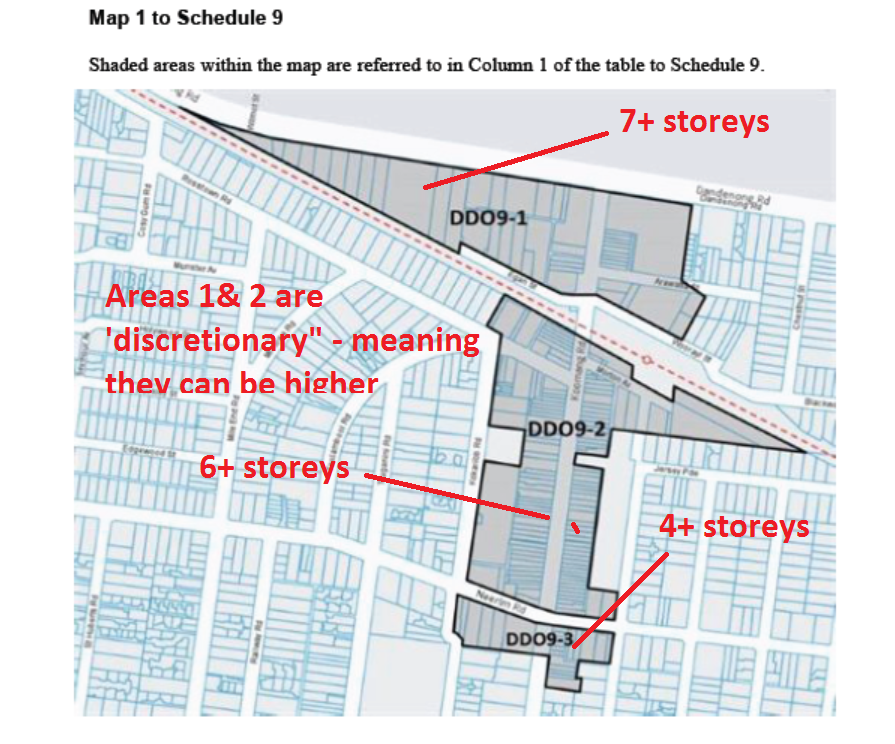
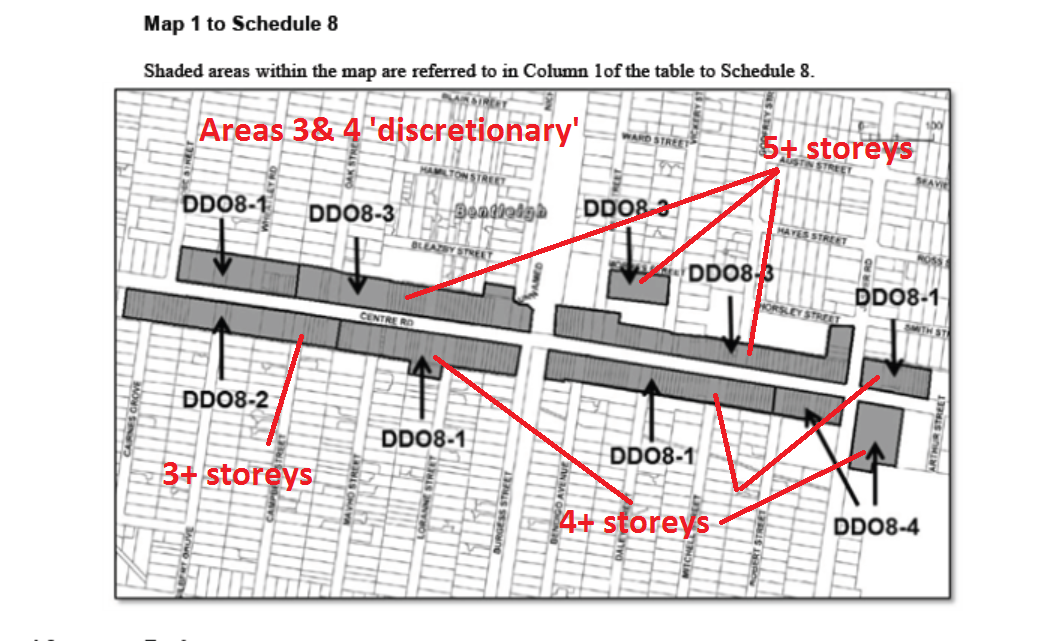
Council’s agenda features Amendments C147 and C148 which will go to the Minister seeking ‘interim height limits’ for the Bentleigh and Carnegie activity centres. The proposed amendments are for areas zoned commercial and mixed use.
Whilst Council is to be applauded for getting the ball rolling, there are many features of these amendments that are far from satisfactory and which will achieve very little in terms of protecting neighbourhoods. We have uploaded the full report HERE.
The concerns we have are:
- Many of the proposed height limits are ‘discretionary’ – meaning that developers can, and undoubtedly will, apply for much higher buildings.
- The metres nominated are highly questionable – given the residential zones. For example: In both amendments we have such schedules as “14 metres comprising up to 4 storeys”. If developers can now erect 4 storey buildings with a height limit of 13.5m, then surely they can cram 5 storeys into 14 metres. All that has to happen is a lowering of ceiling heights, or the slope of the land. Why hasn’t council stuck to the 10.5 and 13.5 height limit here?
- The amendments also allow a 4 metre extension (ie lift over-runs, antennaes, etc). 4 metres is extraordinary when the zones provide the developer with only a 1.5 metre leeway.
The most grating aspect of these amendments however is the failure to ask residents what they think are the appropriate heights in any of these areas. Now, with a resolution to go to the Minister under ‘fast track’, there will again be the exclusion of the public to provide a viewpoint. Nor is there one scrap of strategic justification provided as to why 7+ storeys is acceptable in Carnegie. Has council really done its necessary homework, or once again sat down at their computer desks and drawn lines on a map? And what of the requirements for setbacks? Why keep accepting ResCode when it has been such a dismal failure? We remind readers that when other councils introduce DDOs (Design and Development Overlays – even interim ones) these features are included. Not in Glen Eira! We suggest that once again this is lazy and poor planning and does not meet the community’s expectations.
Some aspects of these amendments are literally laughable.The Bentleigh one basically regurgitates what the current planning scheme contains – ie Buildings on the North side of Centre Road to be designed and articulated so that they do not overshadow onto the footpath on the southern side of Centre Road at the September equinox at noon. (amendment) and the current planning scheme has – Buildings on the north side of Centre Road are articulated, so shadow is not cast onto the footpath on the south side of Centre Road. We therefore wonder how on earth the potential for a 5 or 6 storey building on the North side of Centre Road will not cast a shadow!
FYI, we’ve summarised the proposals below:
PS: we wish to highlight some other anomalies in these proposed amendments. Here is the map of the zoning in Centre Road.
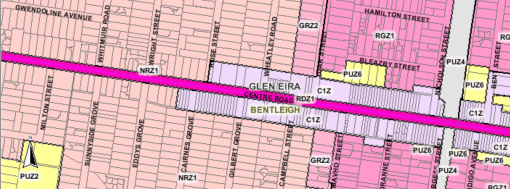
Please note:
- For the ‘northern’ areas of Centre Road where commercial sits alongside Neighbourhood Residential zones (ie Wheatley Road, Rose St) council has imposed a 4 storey MANDATORY HEIGHT. Thus for this side of the road it was deemed appropriate that the 4 to 5 storeys sit alongside an 8 metre mandatory height limit.
- On the other side of Centre Road (directly opposite) there is a mandatory height limit of 3 + storeys. Why? Admittedly there is a Heritage Overlay for these streets ( ie Sunnyside, Eddy’s Grove, etc) but this still does not excuse in our view why one side of the street should be given a different mandatory height when both abut NRZ homes.
- Things get even more crazy when we consider the proposals for Robert Street – A 4 storey mandatory height limit for commercially zoned land along the southern side of Centre Road between Mavho Street and Robert Street . Two streets up from Mavho, we have another heritage overlay. But these are zoned Residential Growth Zone. Thus, instead of changing the zoning, Council it seems has simply chosen to once again do nothing about the zones and to use these amendments to simply rubber stamp the existing zoning. When one side of Centre Road gets a 3 storey recommendation possibly because of its nearness to a heritage overlay, and up the road for streets that are in a Heritage overlay are assigned 5 storeys, then planning is awry and incompetent.
The bottom line is that council will do nothing that involves changing one single aspect of its atrocious zoning.
August 25, 2016
Promises, Promises – Why They Have To Go!
Posted by gleneira under Councillor Performance, GE Governance, GE Planning[13] Comments
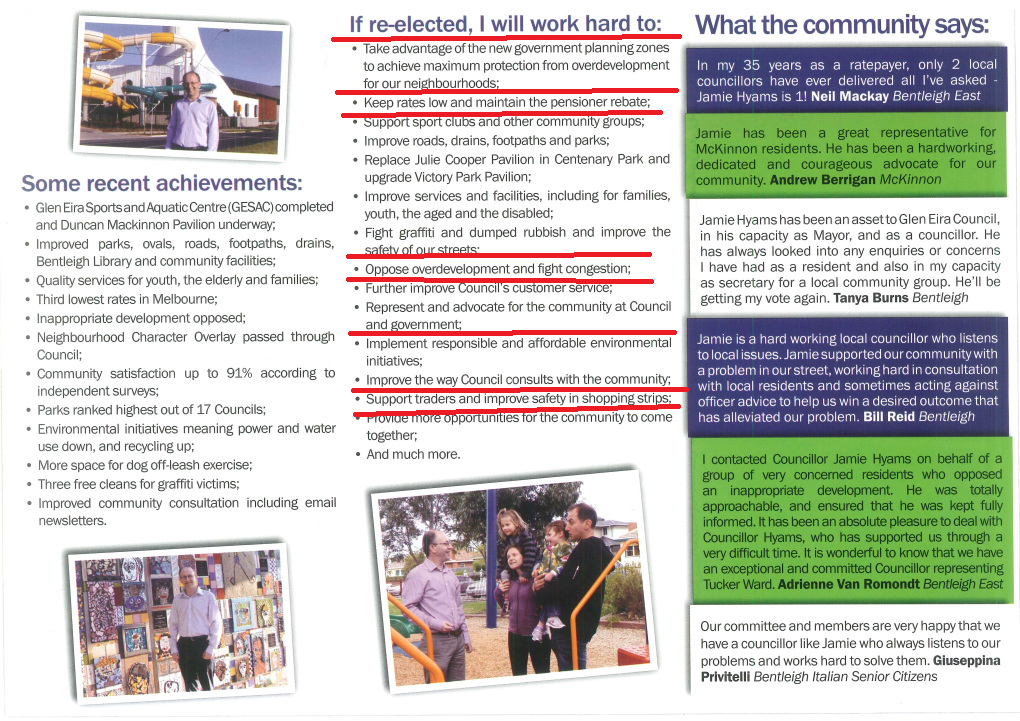 COMMENT
- ‘achieving maximum protection’ means keeping the community out of ‘consultation’ whilst hobnobbing it with Matthew Guy and signing away resident objection rights for the Caulfield Village!
- ‘Maintaining the pensioner rebate’ – NO! lowering council’s contribution so that pensioners pay more out of their pockets – ie government subsidies have increased, whilst Glen Eira’s have decreased ($58 last budget and $55 this budget).
- ‘Oppose development and fight congestion’ – that’s why Hyams has voted for so many developments and voted against immediate car parking/traffic analyses
- ‘Improve safety in shopping strips’ – again, why he’s voted against CCTV cameras & alcohol free zones in Bentleigh
- ‘environmental initiatives’ – that’s why the ‘no’ vote for a significant tree register, time and time again?
Conclusion? Ask yourselves how much this individual has contributed to council wasting hundreds of thousands of ratepayer dollars on lawyers? Ask yourselves how well this councillor has served for the benefit of all residents – ie Frogmore? Ask yourselves how much this councillor has contributed to the erosion of transparent government in Glen Eira when he has voted time and again against Notice of Motion and recently turning the public questions protocols into a farce? Last but not least, we have the ‘guns in park’ fiasco and of course his temper tantrums and foul language.
August 24, 2016
Claire Street – Gone!
Posted by gleneira under Councillor Performance, GE Consultation/Communication, GE Governance, GE Planning, GE Service Performance[11] Comments
Readers will remember the furore over Claire St., McKinnon and how this dead end street of 14 or so houses (zoned GRZ) has been bought out by developers. The first application was for 3 storeys and 34 apartments. Both council and VCAT refused the application. So now we have the new VCAT decision for 3 storeys and 33 apartments. The permit was granted!
The member’s decision should be compulsory reading for every single resident who has any doubt about the impact of the zones and what they mean for their streets and their suburbs. Magee can cry all the crocodile tears he likes at VCAT’s doorstep, but what has he and the other councillors done to review and amend the zones over the past 3 years? The continual lament that VCAT ignores council ‘policy’ is shown up again for the bogus and spurious claim it is. Claire Street and its development is part of council’s ‘local policy’ and thus another street is literally handed over lock, stock and barrel to developers!
Please see the following extracts:
In the Steller Elite decision (ie first application) I analysed the guidance provided by the Glen Eira Planning Scheme, which lead me to conclude that the outcome encouraged for the review site is one of increased housing supply that will constitute a marked change to the existing neighbourhood character. I set out below that analysis and rely on it given that no consequential changes have occurred to the Glen Eira Planning Scheme in the intervening period.
I understand this vision does not agree with the hopes and aspirations of the local community, including those that appeared at this hearing. I was moved by the emotional submissions made by a number of residents that have clearly planned their long term future here in this neighbourhood, and who see this future threatened by the type of development proposed for the review site. While I have been moved by these submissions, I must be guided in my decision making by the content of the Glen Eira Planning Scheme. This Planning Scheme has been drafted and adopted following extensive community consultation, thorough analysis by an independent panel of experts, and approval by successive Ministers for Planning. By law, I am required to consider the submissions that I have heard, and assess the plans that are before me, through the prism of guidance contained in the Glen Eira Planning Scheme.
In this proceeding, Mr & Mrs Menko lamented that most of the lots in Claire Street have now been purchased by developers, and are likely to be subject to forms of development like the one before me. They resist this level of change, and the likelihood that only two of the original single dwellings will remain. They also raise concerns about how this extent of development can be suitable for a dead-end street, with its only access point to McKinnon Road, and limited on-street car parking supply. They also question the ability of McKinnon Road to accommodate the additional traffic. I understand the frustrations and anger expressed by residents about the rate of change that might occur in Claire Street. However the extent of redevelopment that is likely to occur is a direct realisation of the very clear intent of the Glen Eira Planning Scheme, in particular the local policies created by the Glen Eira City Council.
The Glen Eira Planning Scheme clearly supports substantial development in Claire Street, McKinnon. This substantial development is not expected to imitate or reflect the style and form of the single dwellings that currently exist in this and other streets. Instead, a policy intent has been clearly been articulated for Claire Street, by the Glen Eira City Council, that encourages more intense and more diverse housing forms. Invariably this means that apartment buildings are strongly encouraged in this neighbourhood.
It is clear, when taking into account the policy framework as whole, that apartment style development is the undeniable future for Claire Street, McKinnon, as clearly identified and articulated by the local policies contained in the Glen Eira Planning Scheme, as drafted by the Glen Eira City Council.
In their submissions in this proceeding, the Council did not challenge my previous analysis of the relevant planning framework, and conceded that there were no consequential changes to the relevant policy framework in the intervening period. As such I find it appropriate to rely on my previous analysis in this proceeding, an analysis that identifies significant policy support for increased housing that represents significant change to the existing neighbourhood character in this locality.
Clearly this is a typology and scale of development that will still contrast to the surrounding single and double storey dwellings. That outcome is an intended result of the application of the clear policies pursued by the Glen Eira City Council for this housing diversity area. It is an outcome that will continue to prevail throughout this housing diversity area, as more and more sites are redeveloped for apartment style development. However I am satisfied that the revised development for the review site now mitigates the offsite impacts of the proposed built form to the streetscape, in a manner that is appropriate and acceptable.
I acknowledge that the proposed development will represent a significant change for the adjoining property owned by Mr and Mrs Menko. However it is an extent of change that is anticipated, and indeed encouraged, by the provisions of the Glen Eira Planning Scheme. For these reasons I not persuaded that the matters raised in the statement of grounds lodged by Mr and Mrs Menko should influence the proposed outcome for the review site.
The proposed development provides car parking for both residents and visitors at rates that either meet or exceed that required under Clause 52.06 of the Glen Eira Planning Scheme. Therefore as no permit is required to reduce the extent of car parking to be provided on-site, I have no means by which to review whether the extent of car parking provided is reasonable and appropriate, nor to require additional car parking to be provided on-site.
In their statement of grounds, Mr and Mrs Menko again raise concerns in relation to the traffic impact on Claire Street. In the absence of any new analysis of the current and proposed traffic levels within Claire Street, I must give significant weight to the independent assessment that has been undertaken by Council’s traffic engineers, who support the proposed development, including the extent of traffic increase that will occur to Claire Street. I do not doubt that the additional traffic from the development of the review site will increase delays for drivers exiting Claire Street. However that is an inevitable consequence of the deliberate and informed decision made by the Glen Eira City Council to identify Claire Street, McKinnon as a preferred location for this extent of housing change. For these reasons I find that there are no car parking or traffic grounds on which to withhold the grant of a permit.
I find that a number of the components as drafted by Council simply reiterate aspects of the proposal that are already shown on the plans. For example a condition requires the provision of car parking at certain rates when car parking is already provided at those rates, and another condition requires the development to have a specified maximum site coverage, when that site coverage is already achieved. I do not consider that an amended plans condition should be used in such a manner, and so have deleted parts of Condition 1 where I find that the requirements are already achieved.
Source: http://www.austlii.edu.au/au/cases/vic/VCAT/2016/1401.html
August 23, 2016
Secrecy, Secrecy, Secrecy!
Posted by gleneira under Councillor Performance, GE Council Meeting(s), GE Governance, GE Open Space, GE Planning, GE Service Performance[13] Comments
The Ombudsman recently met with the CEO and the Mayor in relation to her investigation into ‘secrecy’ and lack of transparency in council decision making. It is therefore astounding that the following has occurred so shortly afterwards.
1.The online and hard copy agenda published on the Friday before the last council meeting did not contain any items for in camera consideration
- On the evening of the council meeting (ie last Tuesday week) there was this ‘insert’ into the agenda – please note the in camera item.
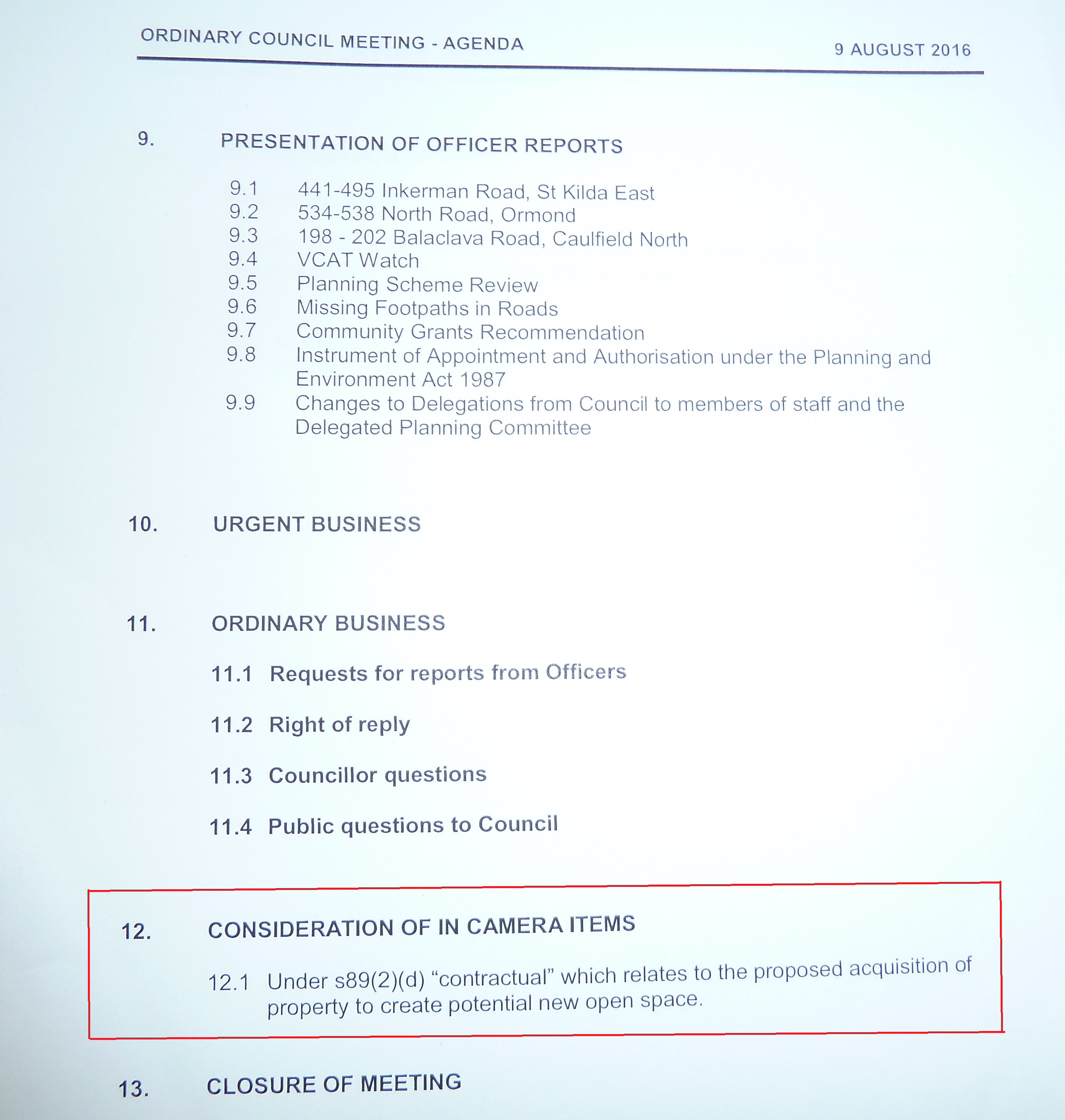
- The minutes have finally been published. Wonder of wonders, the above description has disappeared into the ether. All that residents are now told is this wonderfully uninformative single line –
12.1 Under s89(2)(d) “contractual”.
Then on ‘outcomes’ of the in camera discussion, the minutes state –
Item 12.1
Crs Lipshutz/Delahunty
That the recommendation in the report be adopted.
The MOTION was put and CARRIED unanimously.
What has happened to the far more expansive explanation regarding the open space item? Why was this edited down and by whom? Why is so much effort expended to keep residents uninformed? And why does this council continue to push the envelope when it comes to transparency and sound governance? Who is behind this latest attempt at secrecy? We would even suggest that given the resolution the item is no longer ‘confidential’, since the Local Government Act states on disclosure:
in relation to resolutions recorded in the minutes, incorporate relevant reports or a summary of the relevant reports considered in the decision making process.
Residents have no idea as to the ‘report’ much less any idea as to what this resolution concerns, or what its ramifications are? Will council be spending money for open space? If so, how much? Did the report recommend no purchase? Where is this potential open space? Is the location good value? We can only assume that if the wording of the item was changed then it is a deliberate attempt to conceal from the public what is really going on! What makes this even easier to conceal is that council sees fit to provide only half a dozen or so agendas in the chamber when the gallery over the past few meetings has at times contained 10 times this number of residents. Please remember that council has ‘promised’ several times over the years to consider displaying motions, amendments via some form of overhead, so that residents can follow what is going on. Nothing has eventuated!
We are confident that the ombudsman would be very interested in this latest example of Glen Eira’s approach to transparency and sound governance and non-adherence to the strictures of the Local Government Act!
August 18, 2016
Dudded Again – 6 Storeys!
Posted by gleneira under Councillor Performance, GE Planning, GE Service Performance[8] Comments
The trend of councillors lopping off a storey or two plus some apartments and then having the developer go to VCAT and winning has continued. The latest example concerns 600-604 North Road, Ormond. The application was for 6 storeys and 57 1 and 2 bedroom units, plus visitor car parking waivers. Officers recommended 5 storeys and councillors decided that 4 storeys was ‘acceptable’. VCAT allowed the 6 storeys and 57 units plus reduction in car parking waivers. Councillors just never seem to learn! They have failed miserably every single time where this ‘populism’ has occurred. Instead of addressing the real culprit (the Planning Scheme) councillors have been contact to continue with this pointless tactic. Of course, it allows them to use VCAT as the total villain.
Adding insult to injury in this case is the substandard performance of council at VCAT itself and the fact that of the 20 or so conditions imposed, the VCAT member overturned most of them. Here is some of what he stated:
VISITOR CAR PARKING
Whilst I understand the concerns of the residents, the evidence is that there is sufficient capacity in on-street car parking areas to accommodate the demands generated by visitors who are unable to secure a car space in the basement. I was not provided with any evidence or data to contradict that of Ms Dunstan (for developer), and also note the absence of an objection from the Council’s Traffic Engineers.
CROSSOVER WIDTH
The Council seeks to have the vehicle crossover to be 6.0 metres in width and in line with a 6.0 metre wide accessway to the basement car parking area, measured between a 300mm wide kerb on each side. This requirement was included upon the recommendation of the Council’s Traffic Engineers, and the Council’s submission did not include an explanation of why the proposed 5.5 metre width is unsatisfactory. ….. Ms Dunstan’s evidence is that the proposed 5.5 metre width is sufficient to allow for the simultaneous two-way traffic flow, and exceeds the 5.0 metre dimensions specified in Clause 52.06 for a passing bay. I accept this evidence and was not provided with any justification for the required 6.0 metre width. …..No justification for the required reduction in the width of the crossover was provided. I will delete Condition No. 1 d).
HEIGHT
As observed in the case of Rosenwald v Glen Eira CC – There is nothing in the Planning Scheme to indicate that a uniform height is sought for buildings within this centre. Indeed, as noted during the course of the hearing, the land within the activity centre is not affected by any overlays that regulate built form outcomes, such as a Design and Development Overlay or Heritage Overlay. Activity centres are commonly characterised by a varied skyline or building profile. Heights vary, and it is not unusual to find that one building is taller than the others. It may well be that this building will be the tallest in the activity centre. If this were to eventuate, we do not consider it to be an unacceptable planning outcome as, ultimately, it is likely that the disparity in the height with other buildings would be confined to something in the order of two storeys. We consider this to represent an acceptable graduation in height within this context. These observations equally apply here….The absence of a height control for the commercial area is an indicator that notably taller buildings than in the residential streets can be contemplated in these locations. I consider that a five-storey height as recommended by the Council’s officers would be reflective of this distinction. The question then becomes whether the additional (top) level should be approved. I have determined that it should be, based on its recessive siting and appearance.
Source: http://www.austlii.edu.au/au/cases/vic/VCAT/2016/1316.html
CONCLUSION
Merely a set of questions –
- When will councillors learn that until the planning scheme is changed (and quickly) their grandstanding is useless?
- When will officers and/or consultants front up to VCAT with a fully documented case of sound evidence, rather than continually relying on developer ‘statistics’. Unless this is done, it is simply a waste of ratepayers’ money to defend cases that don’t have a hope in hell of succeeding.
- When will council stop imposing farcical conditions that are doomed to failure because they simply do not accord with council’s own planning scheme? Does this mean that officers don’t even know what their planning scheme contains? That conditions are imposed willy-nilly?
- Why has it taken the Minister’s intervention for council to even contemplate changes to its planning scheme, when the past four years of this council alone, illustrate the futility of lopping off a storey when the developer decides to go to VCAT. Or has this been the plan all along?
August 16, 2016
A Little Quiz!
Posted by gleneira under Councillor Performance, GE Governance, GE Planning, GE Service Performance[5] Comments
PS: THE ANSWERS!
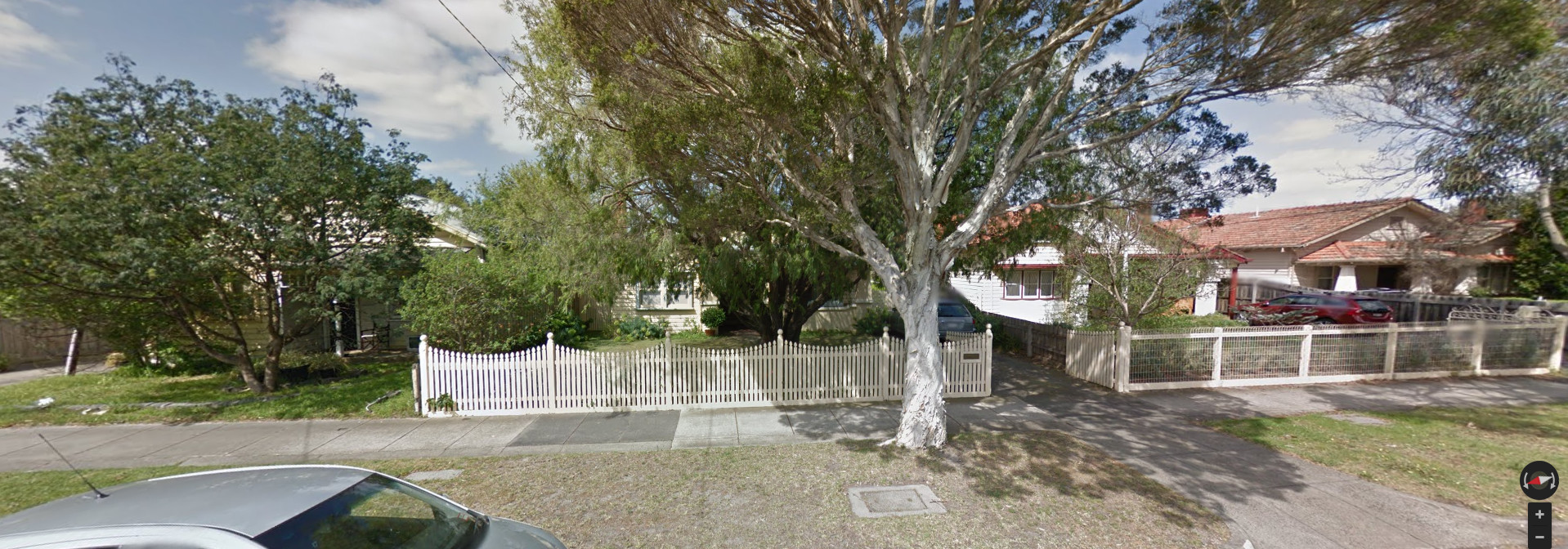
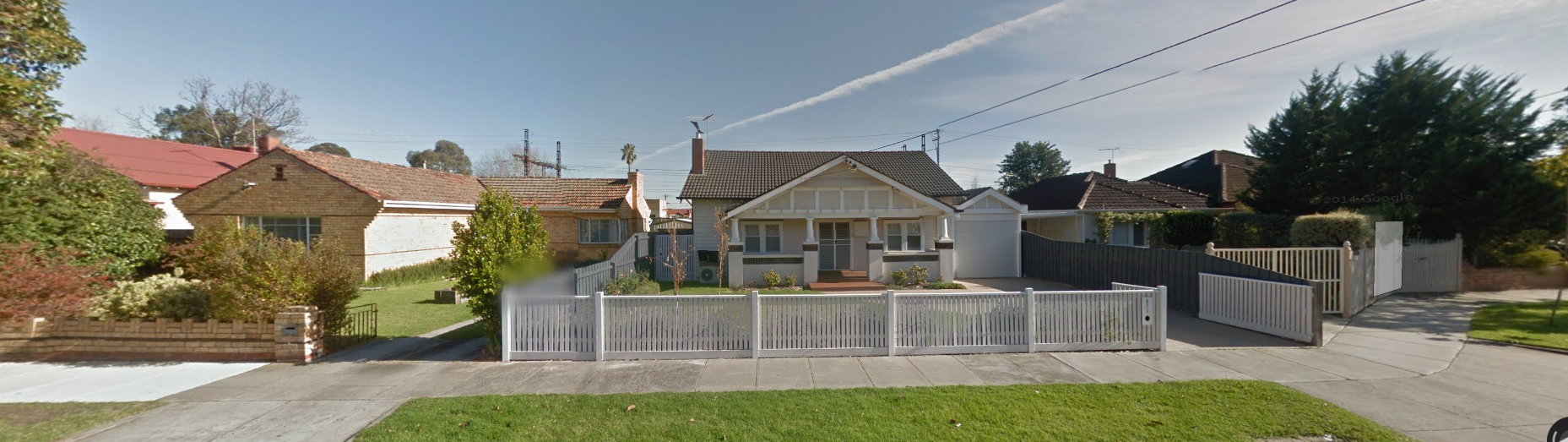
The top photo is Mimosa Road, Carnegie. The second shot is Bent St, Bentleigh. What both have in common is that the houses on the left are zoned Residential Growth Zone (ie 4 storeys); both middle ones are zoned General Residential Zone (ie 3 storeys) and the ones on the right are zoned Neighbourhood Residential Zone (ie 2 storeys). This is council’s version of a ‘transition zone’ and given that neither the RGZ or the GRZ1 have any decent setback requirements apart from the ‘optional’ ResCode, buildings at the back and the sides will be towered over – as many already are. This represents planning insanity and/or incompetence. Even developers for the current State Government Review of the zones recommended that streets do not have multiple zonings. In Glen Eira, countless streets have 2 or 3 zones within a 200 metre stretch. As one commentator pointed out, this is what happen when you sit at your desk and simply draw a circle on a map instead of undertaking a comprehensive analysis of your streets, your suburbs, your ‘neighbourhood character’, and the available infrastructure.
Prior to the introduction of the abysmal zones, all residentially zoned land was declared as R1Z with a preferred height limit of 9 metres. The zones changed all that with Council’s lazy and incompetent, ‘one size fits all’ approach. Areas zoned GRZ could now go to 10.5 metres and land zoned RGZ suddenly became 13.5 metres in height. Hyams in particular continues the myth that this represents a ‘neutral’ translation of previous conditions, whilst others such as Magee, Pilling, and Lipshutz have all stated how the zones are basically ‘superb’, or ‘positive’ or ‘very, very good’ and what a wonderful planning department we have.
We invite readers to comment on just how ‘good’ these new zones really are. The screen dumps below are parts of two separate streets in Glen Eira. The houses depicted are not mansions, but well kept period homes. Guess what they are zoned? We will reveal all shortly.