GE Planning


wynne

Caulfield Racecourse Reserve
Following petition presented to house:
To the Legislative Council of Victoria:
The petition of residents of Victoria draws to the attention of the house the potential conflict of interest of Caulfield Racecourse Reserve trustees in their commercial relationships with the Melbourne Racing Club.
The petitioners therefore request that the Legislative Council of Victoria take action to instigate a public inquiry into past commercial transactions between the trustees and Melbourne Racing Club, and call on the minister for environment and the Minister for Racing to end further alienation of this public land, ensure management by the trustees is transparent and accountable, and enforce the three uses of the reserve defined by the Crown grant.
By Ms PENNICUIK (Southern Metropolitan)
(794 signatures).
Laid on table.
Ordered to be considered next day on motion of Ms PENNICUIK (SouthernMetropolitan).

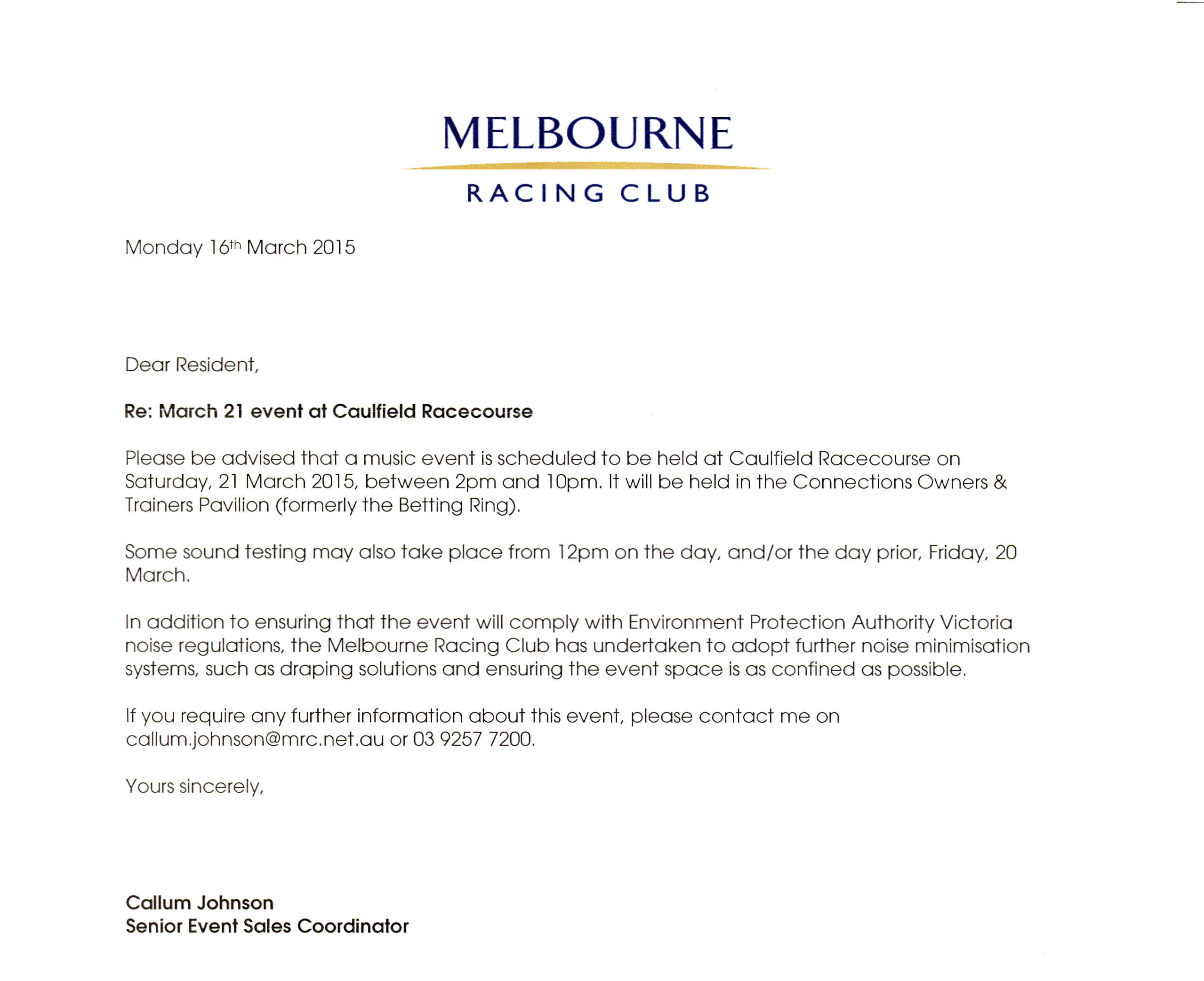
PS: we have received the following notice from a resident. Once again local amenity will be disturbed by the MRC money making ventures. We wonder:

  • has a permit been granted for this new event?
  • has a lease been signed as yet?
  • what guarantee do residents have that the sound will be within EPA limits? Who will supervise and ensure that the legal requirements are met?

2015 03 21 Concert0001

Here’s a brief rundown of council decisions this evening:

  • Tree Register ‘abandoned’ – moved Lipshutz. Final vote in favour of ‘abandonment’ was – Lipshutz, Esakoff, Lobo, Magee, Okotel. Voting against – Delahunty, Pilling, Sounness, Hyams
  • Virginia Estate Amendment – voted in unanimously with much grandstanding by Magee and others.
  • Glen Huntly Road – 6 storey, 117 units – permit. Voting for Delahunty, Sounness, Okotel, Magee, Pilling, Lipshutz. Voting against – Lobo, Esakoff, Hyams
  • Amendment to ‘legalise’ office use at 305 Kooyong Road. Motion put by Sounness and Lipshutz. Motion lost and new motion to abandon amendment put up by Hyams won out.

We will report on each of the above in full in the next few days.

On the 26th May 2003 a public question asked whether or not Council had a significant tree register and if one wasn’t in existence, when it would get off the ground. Twelve years later, residents are still waiting for any sign of a tree register. After numerous revisits to the issue, there is yet another officer report in this week’s agenda. Mind, not a report by the Local Law Committee which for the past 2 years has been charged with delivering the ‘framework’ for the introduction of a Local Law. Residents remain excluded from the documentation, the reasoning, any actual draft. What is now put into the public domain is an unnamed officer report that finally reveals the real agenda of council. One of the recommendations is designed to scuttle the issue of a tree register for good. – ie Resolve not to proceed with Item 7i in the Community Plan Action Plan for 2014-15. 

Given past voting on anything to do with this issue we anticipate that trees will continue to be an endangered species in Glen Eira and developers will continue to moonscape sites without fear of penalty. This judgement is based on previous councillor comments and, unless they have seen the light, we do not anticipate any change. (See: https://gleneira.wordpress.com/2013/10/16/still-going-round-the-mulberry-bush-10-years-on/ AND https://gleneira.wordpress.com/2013/10/14/the-saga-of-the-tree-register/

The other ‘advantage’ in killing off the idea for a tree register now is that it will then not proceed to be part of any ‘review’ of the Local Law. That means that there will be no public consultation on the issue since any amendment to the Local Law mandates public submissions. The intent in our view is clear – to do nothing and to prevent the community from having any say in the matter! This is again in spite of the specific resolution passed on the 27th April 2011. Another example of where resolutions in Glen Eira mean absolutely nothing! The resolution read:

Crs Pilling/Tang

That Council:

  1. Creates a classified tree register based on identification of trees whichmeet the criteria in attachment 1, and
  1. Drafts a Local Law to give effect to management and protection of trees listed on the classified tree register.

The MOTION was put and CARRIED.

It is quite unconscionable that the unnamed officer report can only manage two pages on an issue that is so contentious and when report after report (especially the recent Open Space Strategy) emphasises the importance that residents place on trees. Further, this report makes no mention of the above resolution. It refers only to the ‘aspirational’ component of the Council Plan! And of these two pages, the first page is nothing more than gobbledygook – short on truth, facts, and relevance. It again parades the nonsense of how well Glen Eira protects ‘200 valued trees’ via its planning application process. Given the admission that over 1200 applications come in each year (and one Magee claim is for over 1500 applications per annum and likely to be far more by now) then this surely represents a paltry figure of ‘protection’ – even granted that many applications will not have ‘valued trees’ on the property. What this also does not take into account is how many amended permits are submitted to REMOVE trees from a development and how many of these Council approves.

The greatest distortion of reality comes with this set of sentences – The ResCode mechanism is that any tree removed within 12 months of a town planning application being lodged must be assessed as though the ‘removed’ tree is still in place. This has proven to be somewhat of a defacto tree retention control because it has effectively removed any advantage a developer could gain from moonscaping. This means that any town planning application for medium density dwellings needs to consider existing tree/vegetation.

A truck could literally be driven through this nonsense – and it has. None of this takes into account land banking where a developer purchases a property, and possibly rents it out for years, BEFORE any planning application is lodged. In the meantime of course, every ‘significant tree’ is removed.

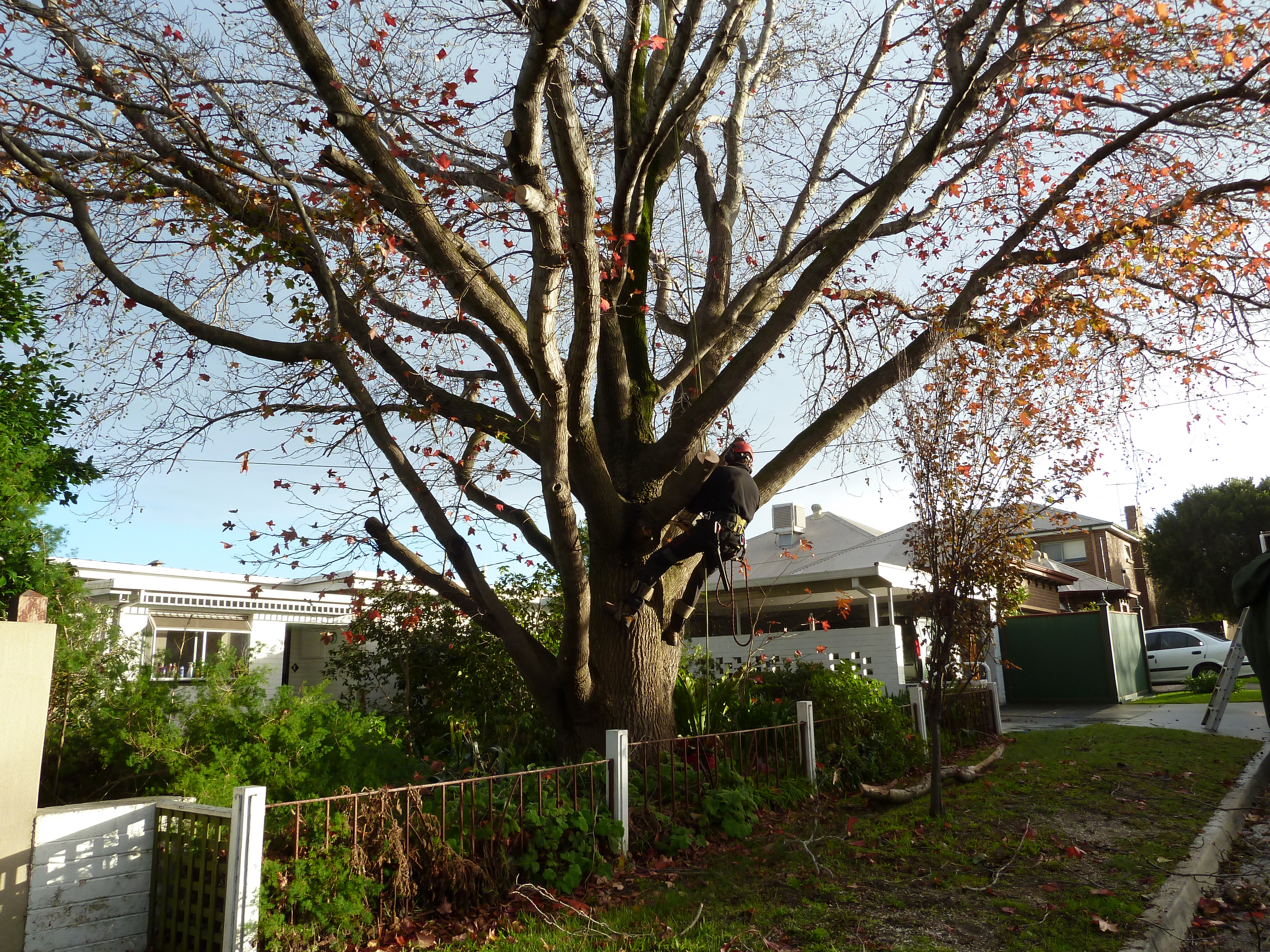
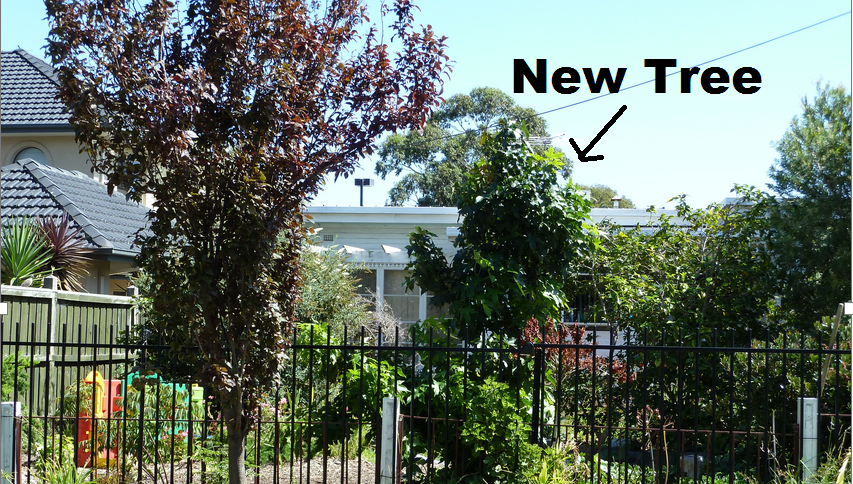
In June last year we featured a post where a healthy and huge tree sitting on the title border was destroyed after the property had been purchased by a developer. A new tree has now been planted in this exact spot. Thus, when the planning application eventually goes in, council will simply determine that this sapling is anything but a ‘significant’ tree and grant permission for its removal. The developer escapes unscathed, unfined, and literally untouchable since he has exercised the wonderful ‘escape loop’ in the far from ‘effective’ planning process.

Here are the BEFORE AND AFTER photos of this site –

P1000301

Untitled

We have commented numerous times on this ‘no action’ council and how often it flies in the face of community views. Resolutions are passed only to be ignored and reneged upon. We reiterate: the community values its trees – not just on public land, but also private land. Given the rate of development, it is incumbent on councillors to ensure that every single avenue is pursued to protect the environment. We would go even further and suggest that Local Law protection is basically limited to mere officer decision making with again no decision making capacity by councillors (unless specifically spelt out) or by residents. Plenty of other councils (ie Whitehorse, Moonee Valley) have tree registers as part of their Planning Scheme. Such an option is naturally ‘verboten’ in Glen Eira since it would impinge on the current power structures and involve far more transparent and accountable decision making.

If residents thought that the Caulfield Village was a mass overdevelopment then they should think again! Item 9.6 of the current agenda features the latest plans for the Virginia Estate on East Boundary Road, Bentleigh. In short, what is proposed is the following:

  • Rezoning all of the land to Commercial 1 – meaning that there is now the legal entitlement for far greater residential development
  • Buried in the documentation for this rezoning is this paragraph – At this stage any detailed information about the likely development for the estate should be regarded as indicative. It seems clear however that significant development is envisaged. Likely or possible developments are a shopping centre including a supermarket, office development and some 4,400 dwellings
  • As with the Caulfield Village, the same approaches are being used – namely, an Incorporated Plan, constant rezoning, and then we assume the eventual rubber stamping of a Development Plan!
  • The ‘magnanimous’ open space contribution by the developer is for a 20 metre width ‘open space link’ – specifically the developer has offered to provide a strategic open space link of approximately 20 metres width within Virginia Park Estate to connect Virginia Park Reserve and Marlborough Street Reserve. No 1 Barrington Street is owned by the developer and could form part of the open space link.
  • For a 12.5 hectare site and over 4000 dwellings the developer will only be required to pay 5.7% in an open space levy. Again laughable especially when other councils have successfully included in their open space schedules the options of exacting a higher levy than for ‘normal’ subdivision for ‘strategic development sites’. Glen Eira refused to entertain such an idea in its recent amendment.

We should also point out that in this current agenda, officer reports give the green light to a further 153 new dwellings.

There is also, after years and years of waiting, a two page report on the Significant Tree Register. Most of this is unmitigated waffle and the recommendations so limiting that they basically mean nothing – except in maintaining the current status quo! We will comment in detail in the days ahead.

For this post we feature two seemingly unrelated issues: quotes from the latest VCAT decisions which all overturned council refusals to grant permits and, an article from today’s Age, which addresses developers’ concerns about community voices at VCAT and Labor’s stated intention of ensuring that ‘community’ opposition to applications is enshrined in legislation and incorporated into VCAT’s decision making. What these two areas do have in common is that whilst community involvement is indeed welcomed with open arms, unless Councils’ planning schemes are amended and all the ‘loopholes’ closed off, then little will change in our view.

The following extracts taken directly from these latest VCAT hearings illustrate clearly why the Glen Eira Planning Scheme is currently failing its residents and is a boon to developers.

144-144A Hawthorn Road, North Caulfield – Zoned Commercial – The construction of a six-storey building (plus basement) accommodating two shops, 37 dwellings and associated car parking

There is nothing in the Planning Scheme to indicate that a uniform height is sought for buildings within this centre. Indeed, as noted during the course of the hearing, the land within the activity centre is not affected by any overlays that regulate built form outcomes, such as a Design and Development Overlay or Heritage Overlay. Activity centres are commonly characterised by a varied skyline or building profile. Heights vary, and it is not unusual to find that one building is taller than the others. It may well be that this building will be the tallest in the activity centre. If this were to eventuate, we do not consider it to be an unacceptable planning outcome as, ultimately, it is likely that the disparity in the height with other buildings would be confined to something in the order of two storeys. We consider this to represent an acceptable graduation in height within this context.

We acknowledge the Council’s concerns regarding the impacts associated with a series of incremental approvals that reduce parking requirements for new developments. We also recognise that this centre lacks an off-street public car park. Parking provision in the activity centre is a broader strategic planning issue that should be approached on a centre-wide basis. If warranted, such an exercise may lead to the introduction of a Parking Overlay, for example, that would assist the Council in achieving its objectives in respect of satisfying the car parking requirements of the centre over the longer term.

Source: http://www.austlii.edu.au/au/cases/vic/VCAT/2015/204.html

252-254 Tucker Road, MCKINNON – Zoned Neighbourhood Residential – To construct a two storey building over a basement, to use the land for a child care centre and to erect a business identification sign. The child care centre would accommodate up to 132 children and 33 staff.

Mr O’Leary advised that Council would not prosecute ground 6 on the Refusal to Grant a Permit as the trees referred to in the grounds of refusal have been removed.

  • The responsible authority says the child care centre should be located within a housing diversity area because it is a large centre. The responsible authority says that non residential uses such a child care centre in minimal change areas should be smaller, less intensive activities than this proposal, and the larger facilities should locate in housing diversity areas. Council says that clauses 21.08 and 22.11 encourage non residential facilities such as medical clinics and child care centres to be small and operate from existing dwellings. This approach would enable dwellings to be retained (possibly for housing choice and neighbourhood character reasons) and to limit possible off site amenity impacts.
  • While I accept the policy encourages the use of existing dwellings, I am not persuaded clauses 21.08 or 22.11 explicitly distinguish between small and large facilities. Policy does not contain any indicators of intensity such as number of staff, children, floor area, car parking spaces or the like that could distinguish a large centre from a small centre.
  • Furthermore, I note that Council has had the opportunity to distinguish between larger and smaller centres. Amendment C123 proposes to amend clause 22.11 but it does not refer to larger or smaller centres. The amendment does not seek to include conditions in the table to the NRZ that could prohibit larger centres from the zone.

Source: http://www.austlii.edu.au/au/cases/vic/VCAT/2015/201.html

10 Bolinda Street, Bentleigh East – Zoned Neighbourhood Residential – Construction of a two double storey dwellings above a basement level

The applicant pointed out that Council had incorrectly assessed the proposal against the Character Area 13 precinct and the review site is within Character Area 15 East Bentleigh, south of Centre Road.

Source: http://www.austlii.edu.au/au/cases/vic/VCAT/2015/199.html

THE AGE ARTICLE

Don’t give Victoria residents a bigger say – developers

Date: March 12, 2015 – 12:15AM

Residents should not be given a bigger say at Victoria’s planning tribunal because it would not be “fair”, according to a developer lobby group.

In a letter to the Premier and ministers, the Property Council’s Victorian executive director Jennifer Cunich said they opposed  “the Government’s plans to add additional weight to community opinion in regard to VCAT decision-making”.

“Such a move goes against the very basis of a just and fair legal system. We would consider any attempt to make such changes a fundamental deterioration of Victoria’s legal apparatus,” it said.

Labor has pledged to amend the Planning and Environment Act “so that, where appropriate, the Victorian Civil and Administrative Tribunal (VCAT) must take into account the extent of community opposition to planning proposals”.

“The changes would see significant community opposition – such as that in response to Tecoma McDonald’s or Prahran’s Orrong Rd Towers – formally taken into account,” Labor said in its election commitments.

Labor said the changes were not about appeasing a noisy minority and instead would give locals a fair hearing and recognise a community standing together.

James Larmour-Reid, from the Planning Institute, urged caution in relation to the proposed reforms.

“Community engagement is central to our planning system, but we need to make sure  that VCAT decisions are based on planning principles and policies,” he said.

While it was completely reasonable for the planning tribunal to take into account community sentiment, “sentiment alone cannot be allowed to drive the outcome”.

Opposition planning spokesman David Davis said the government’s promised tribunal changes were “light on detail”.

“What does it really mean and how will this actually operate?” he said.

“If the plan is to make the capacity of people to object more accessible in a reasonable way, we’re in favour of that,” he said.

The Property Council’s priorities letter also called on the government to sell Victoria’s share of the Snowy Mountain Hydro Scheme, old school sites and disused rail land to help fund new infrastructure.

It also calls for a flexible urban boundary – “a firm urban growth boundary will unnecessarily restrict supply” and calls on the government to continue support for the Victorian Energy Efficient Target Scheme to reduce energy bills and emissions.

Some of the former Coalition government’s planning actions were criticised in the letter.

“The former government’s decision to undertake rezoning prior to the release of the masterplan or vision for the precinct (Fishermans Bend) has caused widespread confusion and uncertainty,” the Property Council said.

On new housing zones, Ms Cunich said: “As they currently stand, the zones have caused much community angst, and will adversely affect Melbourne’s housing supply and affordability”.

Municipal housing targets should be set based on up-to-date population and demographic modelling.

A spokeswoman for planning minister Dick Wynne said: “The Andrews Labor Governnment promised it would give communities a fair go at VCAT, and this is what we will do.”

Source: http://www.theage.com.au/victoria/dont-give-victoria-residents-a-bigger-say—developers-20150311-141cq3.html
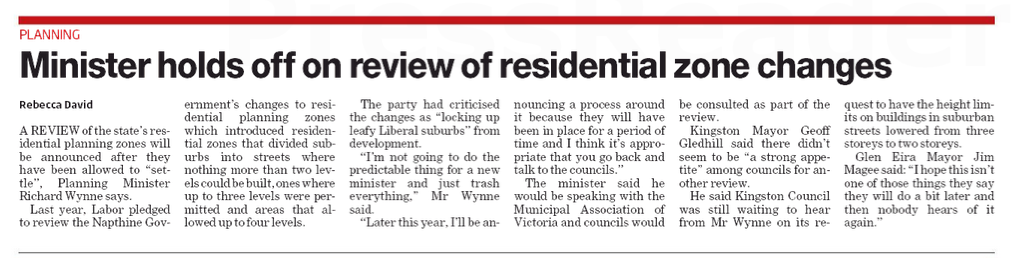
UntitledAND

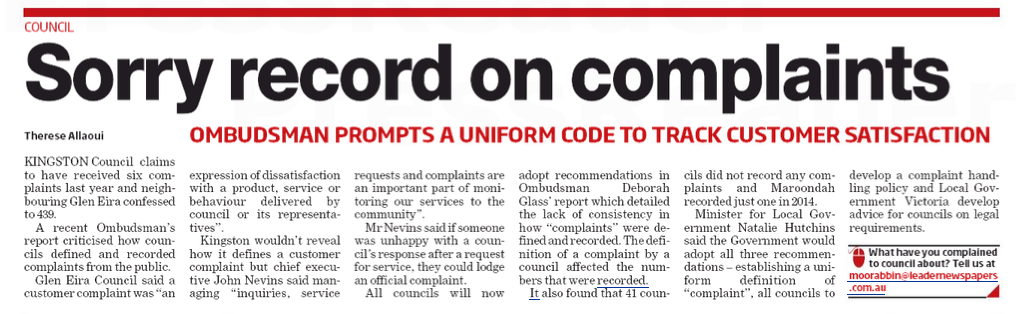
complaints

leader1

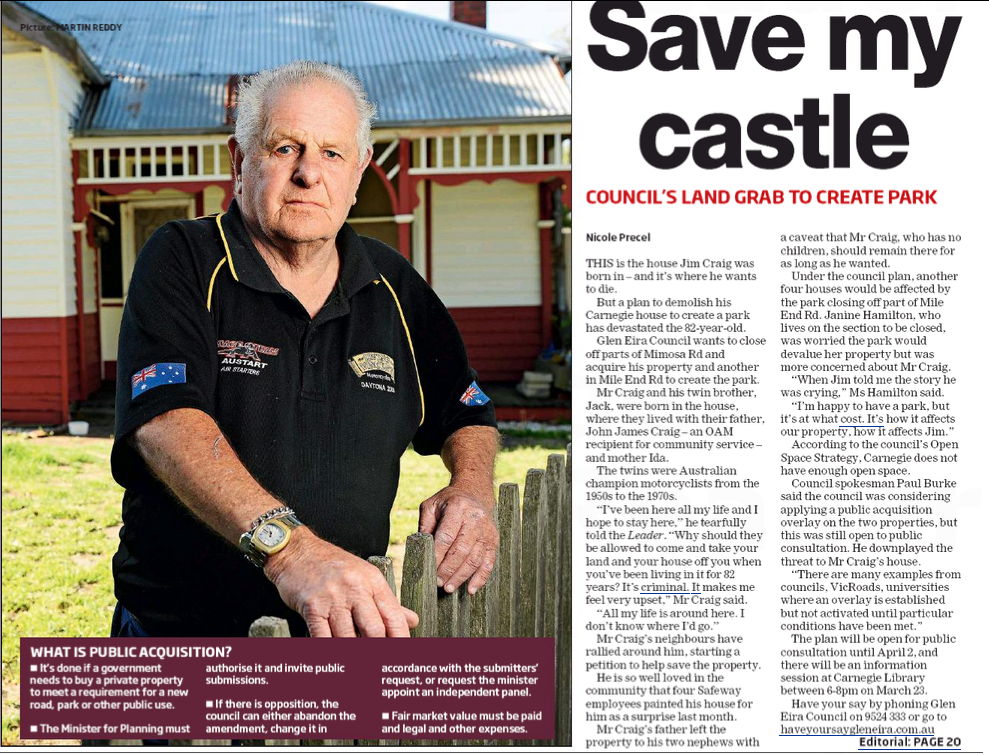
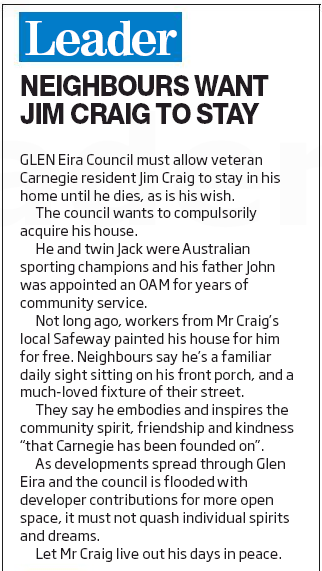
leaderPS: – CHANNEL TEN NEWS – http://tenplay.com.au/news/melbourne/2015/3/10/bulldozer-battle

PPS: CHANNEL SEVEN NEWS – https://au.news.yahoo.com/vic/video/watch/26586585/pensioner-wins-home-fight/

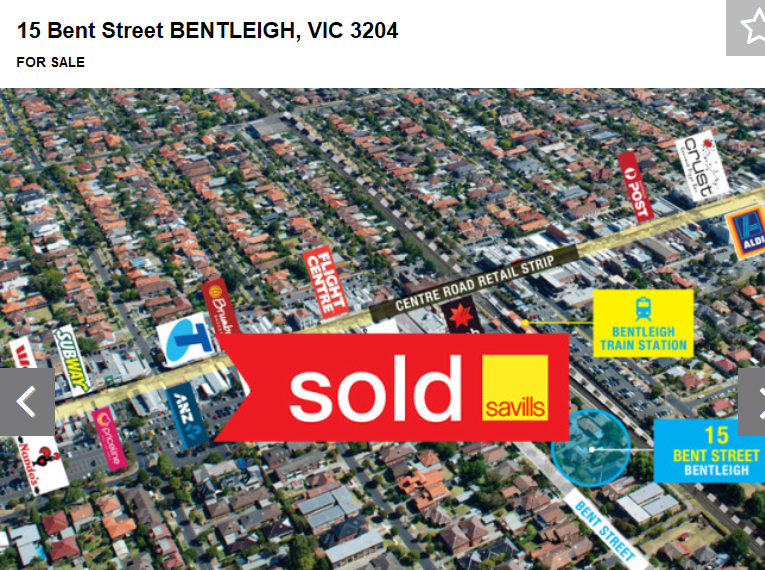
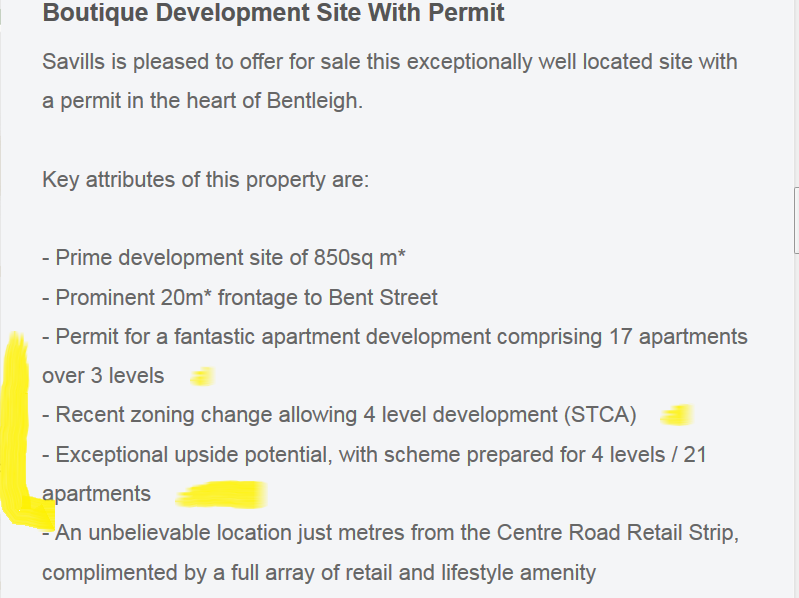
We have been noticing a very definite trend occurring throughout Glen Eira. Developments with existing permits are reselling. Some gained permits years ago and the property has either been rented out, stood empty, or simply allowed to accrue in value. This of course implies that there has been extension upon extension granted by the planning department.

The screen dumps below illustrate the trend completely. On the 22nd August an application was submitted for a 3 storey apartment block in Bent St. Bentleigh. That is ONE DAY prior to the gazetting of the new zones and hence was assessed under the ‘transitional provisions’. Cometh the new zones a day later, four storeys is now allowable.

Please note carefully the associated blurb in the following:

bentUntitled

On the 25th February 2015, both sides of politics passed this motion in parliament.

That in accordance with standing order 11.01, there be tabled in the Council, by 12 noon on Wednesday, 11 March 2015, a copy of the report prepared for the Minister for Planning by the Residential Zones Standing Advisory Committee concerning draft amendment C125 relating to the city of Bayside.

Amendment C125 relates in part to Bayside’s attempt to basically overturn the Residential Growth Zones in its municipality. We will refrain from commenting on the performance of this Standing Advisory Committee thus far and its previous recommendations concerning Kingston, Moreland, Moonee Valley and so on. What is of interest in the debate are the comments representing all sides of politics.

We also suggest that when reading the following, readers keep in mind what occurred in Glen Eira – that is: secrecy, no consultation, and deliberate obfuscation in response to various public questions.

MR DAVIS (Southern Metropolitan)…… This is about the shape of our suburbs. This about residential amenity. I put on record as a general principle my belief that there is great scope for transit-orientated developments with a focus on higher density in and around transport nodes, but it must be done in a way that brings the community with the proposals. It needs to have full community consultation, and councils and the community need to be working in harmony to see developments like that accepted and brought forward. They must be designed in a way that is sympathetic to the community.

This motion is a narrow one. It seeks to make public that report by the panel. I can indicate that the opposition will make some further decisions when we see that report, but it is clear that amendment C125 and the proposals around it need some significant further work. The panel report is a key document that should be in the public domain to inform public debate, and for that reason this motion is in the public interest.

Ms DUNN (Eastern Metropolitan)—In short, the Greens certainly support this motion. We support open and transparent government and of course we support the release of the planning panel report in relation to amendment C125 to the Bayside planning scheme. What is important in relation to this is what the community thinks about the nature and shape of their suburbs. It involves the character, amenity and built form of the area, and certainly planning scheme amendments provide ample opportunity for those matters to be picked up through design and development overlays and schedules attached to the planning scheme.

The planning panel report will provide an opportunity to see how those consultations went. It will be interesting to understand the length and breadth of the contributions and how many people had an opportunity to participate. The reality is that this is about the shape and nature of our suburbs and of Melbourne, so it is important that communities share that journey when we are talking about matters as important as planning scheme amendments and the difference between general residential zones and residential growth zones. Certainly the Greens support the release of this planning panel report, and we look forward to seeing what is contained within it.

Mr SOMYUREK (Minister for Small Business, Innovation and Trade)—The Residential Zones Standing Advisory Committee has prepared its report on amendment C125 to the Bayside planning scheme and has submitted it to the department for assessment. The Minister for Planning will shortly be briefed on the recommendations of the independent committee for his review. Once a decision has been made by the Minister for Planning the report will be released. It is in no-one’s interests to prolong the debate, and the Minister for Planning requires suitable time to assess the independent committee’s recommendations without interference. If the committee report is released prior to a decision being made, proponents and the community will continue to make submissions on the substantive matter and the panel report. This does not add to the quality or timeliness of the decision-making.

There is a clear and transparent process for consideration of these proposed amendments, and it is important that this process is honoured. While it is at the minister’s discretion as to whether to release the committee report, I can confirm that the minister will release the report once he has been briefed and a decision has been made.

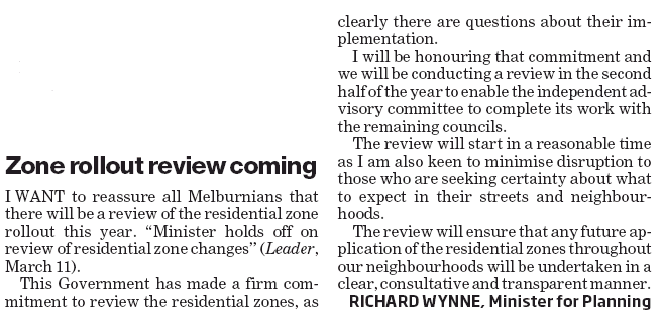
This government is committed to clear and transparent decision-making that takes into account the views of the community. We were very concerned about the mismanagement of the process for the rollout of the new zones and will be undertaking a full review.

Motion agreed to.

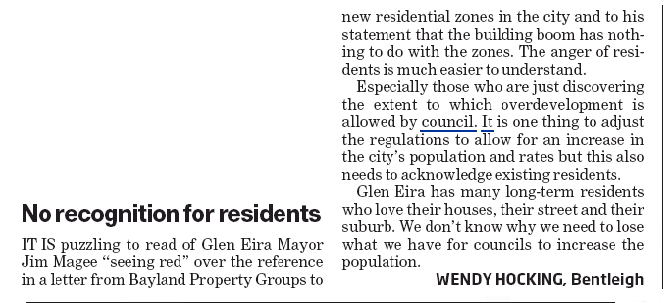
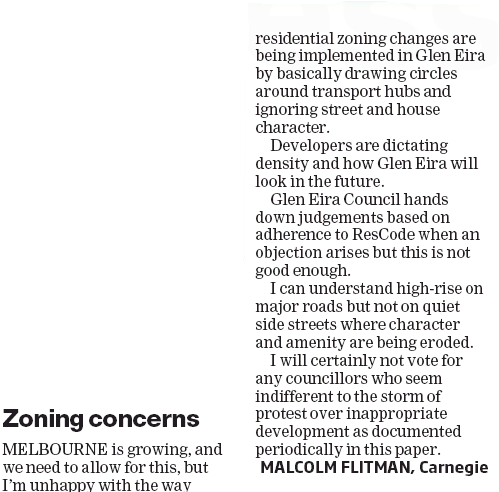
PS: From this week’s Leader ‘Letter to the Editor’.

Untitledletter

The MRC and/or its developers have submitted an ‘amendment’ to the approved Development Plan. We urge all residents to view the documentation at – http://www.gleneira.vic.gov.au/Council/Planning_and_building/Planning/Caulfield_Village/Amended_Development_Plan

The main points of this amendment, following a very brief perusal of the documents, are:

  • An increase in the number of dwellings from 442 to 463. This has been mainly achieved by reducing the number of three bedroom apartments and increasing the number of single bedroom apartments! So much for a ‘family’ oriented ‘village’!
  • Building envelopes will be increased for some of the housing blocks
  • Balconies will be ‘adjusted’ – meaning that they can be reduced in size, or be permitted to impinge even further into the declared setbacks

We also have to marvel at the sheer gall of the ‘summary’ (uploaded HERE) – in its continual use of euphemism and gobbledygook, as well as its insistence on the Incorporated Plan as the planning ‘bible’, rather than the Development Plan which surely is the equivalent of a set-in-concrete planning permit. We remind readers that council’s support for the Incorporated Plan included the argument that it was only a ‘conceptual’ document and that the Development Plan was the important one in terms of gaining planning approval.

We’ve dug up the Rocky Camera report on the Development Plan from December 2013 in which he stated:

This document gives certainty to the local community by precisely stipulating building envelopes; their heights, setbacks, and siting. It can be said that the Caulfield Village development is one of the most planned development sites in the municipality. The future development of this land has been “locked in” following a rigorous community consultation and amendment process, the community now has a high level of certainty in what to expect at Caulfield Village

Finally, here are some quotes from the proposed new amendment:

The amendment sought under this cover are a combination of necessary design refinements informed by these processes, as wellas realising an opportunity to optimise the efficiencies of the development within the general parameters of the approved Development Plan and prescriptive guidelines of the Incorporated Plan.

The majority of changes described in the Schedule are very minor cosmetic changes that will have no impact on neighbouring properties.

It is considered that the changed described above are so minor in nature as to be de minimis and entirely consistent with the approved development as endorsed.

Whilst it is acknowledged that most dwellings comprise one or two bedrooms, within each of the approved buildings there is a broad range of dwelling layouts, types and sizes provided ensuring that the development makes a meaningful contribution to dwelling diversity.

The increases to the building envelope at the fifth floor level are very minor and will servie to enhance the functionality of the apartment without compromising the usability of the balcony areas. The increases are so minor as to be negligible when viewed from Bond Street.

There’s much, much more that could be quoted. Interestingly, in a 7 page document the word ‘minor’ is repeated 17 times! As always, the ball is now in councillors’ court!


« Previous PageNext Page »