GE Service Performance
Archived Posts from this Category
May 19, 2015
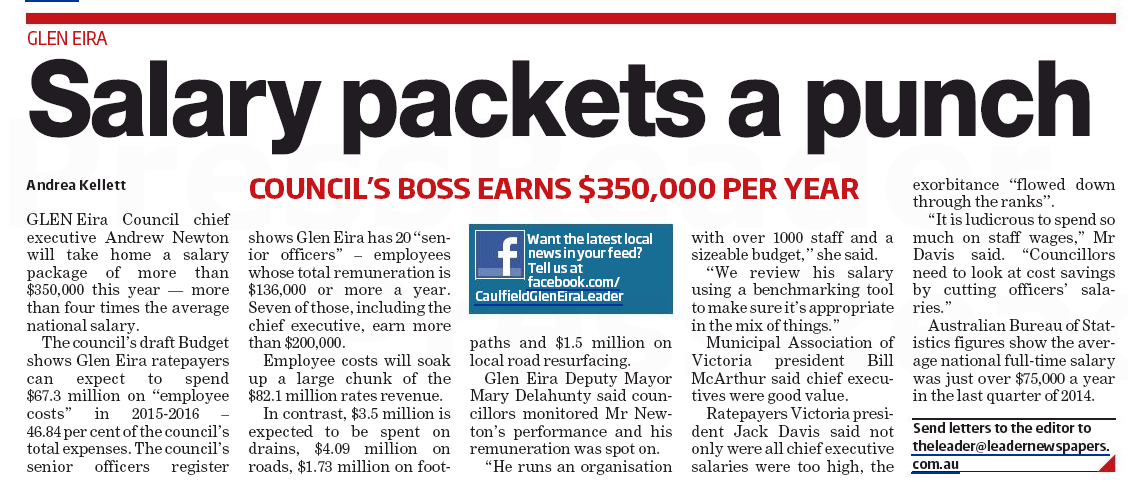
Too Many Fat Cats?
Posted by gleneira under Councillor Performance, GE Governance, GE Service Performance[5] Comments
May 18, 2015
Permit Extensions
Posted by gleneira under Councillor Performance, GE Council Meeting(s), GE Planning, GE Service Performance[2] Comments
Two long standing permits are now seeking additions to the number of dwellings. One on the corner of Orrong Crescent and Inkerman Road is asking for an increase of 10 dwellings. Council is prepared to grant them an extra 6 dwellings with only one being a 3 bedroom apartment. The other application is in Balaclava Road and the increase asked for is a ‘mere’ 14 dwellings. None are 3 bedroom.
What is staggering about these applications is that permit extensions have been granted time and time again. The Balaclava site permit goes back to 2005 and the Orrong Crescent one to 2010. In 2012 a council report admitted that no statistics are kept on how many permit extensions are granted, and that there is no need for council to even bother about such statistics. Thus, permits granted over ten years ago are rubber stamped and height and number of dwellings often increased. And it does matter if a council repeatedly grants 10% or 90% of requests for permit extensions – especially if the original permit goes back over a decade ago. What may have been acceptable ten years ago is likely to be ‘unacceptable’ to most people ten years on and with the increased development all around the site.
However, there is one new aspect to the officer report on the Orrong Crescent application. In July 2014 a report on dwelling sizes took the ‘let’s do nothing’ approach which was endorsed by councillors. In part it stated – The current system largely leaves dwelling size to the developer whose interest is in responding to the housing market. It is considered that it is difficult to argue that town planning is best placed and therefore should intervene in dwelling size to a greater extent than it currently does.
Now the Orrong Crescent report includes the following –
Dwelling 2.04, at 36sqm in floor area and with a balcony of 5sqm is considered to be undersized, will not offer future residents with a reasonable level of amenity and is not supported. It is recommended that this dwelling be incorporated into Dwelling 2.03 (and made into a two bedroom dwelling).
Whether or not this ‘shift’ is nothing more than a token response to recent publicity, knowing that the application will probably end up at VCAT, remains to be seen. It is, however, welcomed. What would be even more ‘welcome’ of course would be for council to introduce its own amendment to regulate ‘diversity’ and dwelling sizes and to stop rubber stamping all requests for permit extensions without a comprehensive appraisal of the cumulative impacts in surrounding areas.
May 15, 2015
God, We’re Perfect!
Posted by gleneira under Councillor Performance, GE Council Meeting(s), GE Planning, GE Service Performance[5] Comments
The agenda for Tuesday night is truly remarkable. Not only will it be another marathon, but the officers’ reports largely distinguish themselves once again with contradictions galore, selective ‘editing’, and to put it bluntly, sheer, unadulterated nonsense. We urge all readers to refer to the full officer reports in order to assess for themselves the ‘quality’ of these various efforts.
Item 9.13 – Neighbourhood Character and Effectiveness of Existing Planning Tools
This item is a response to the Sounness initiated Request for a Report. It reads –
That a report be prepared on the effectiveness of existing planning scheme tools addressing neighbourhood character, and consider the merits of a fresh publicly advertised scheme amendment, local policy and/or design guidelines to establish the preferred emerging neighbourhood character.
We remind readers that:
- Glen Eira has NO PREFERRED CHARACTER STATEMENTS for its housing diversity areas
- Other councils (ie Bayside) have current amendments documenting preferred neighbourhood character awaiting approval which covers their entire municipality – ie equivalent of minimal change and housing diversity.
- The Request for a Report SPECIFICALLY refers to ‘emerging neighbourhood character’. The focus of the Camera report is that this is answered because Council through its zones has designated certain areas for 2, 3, and 4 storey developments! In other words this equates to ‘preferred emerging neighbourhood character’. Height becomes the be all and end all of council’s definition of ‘neighbourhood character’ in housing diversity.
- In line with so many other officer reports the recommendations are designed to maintain the status quo – ie. Glen Eira is ‘perfect’ so we don’t need to introduce or change anything – as evidenced by the following – Neighbourhood character is an important consideration for any multi-dwelling residential development. Glen Eira’s suite of policies and controls, together with ResCode ensures that neighbourhood character is considered throughout the municipality, even in commercial areas. This framework provides an effective and transparent approach to managing neighbourhood character throughout the entire municipality. Camera knows very well, or should know that ResCode does not apply to buildings of 5 storeys or more. There are no height limits in Commercial areas or Mixed Use Zones. Further, how many times has Council or VCAT ignored ResCode in relation to shop parking, visitor parking, setbacks, etc? Far from being ‘prescriptive’ as is now the current terminology applied by Council to ResCode, it is anything but ‘prescriptive’.
- The State Government’s Practice Note on Neighbourhood Character is then cited – selectively of course! Camera then tells us that “neighbourhood character is not solely about dwelling density or the amenity of adjoining properties. It is the qualitative interplay between those characteristics that make a neighbourhood distinctive.” (page 247). Correct, but if ‘density’ and ‘amenity of adjoining properties’ aren’t that significant, then how can Council then claim – Glen Eira’s residential zones provide certainty about neighbourhood character through: Mandatory maximum heights. These ensure that future development has a consistent height and scale to the surrounding area.
- Suddenly ‘height’ becomes the over-riding factor in safeguarding neighbourhood character. Utter nonsense – especially in light of the what else the Practice Note states and which Camera chooses not to cite – The key to understanding character is being able to describe how the features of an area come together to give that area its own particular character. Breaking up character into discrete features and characteristics misses out on the relationships between these features and characteristics.
- More importantly Camera ignores the following paragraph entirely- If, for a broader range of considerations, a change in the character of an area is sought, then this must be achieved by setting out a preferred future character statement in the planning scheme.
- Yet Camera blithely goes on to write of housing diversity areas – “In residential areas around train stations and shopping centres which are experiencing the greatest change, the emerging neighbourhood character is effectively managed through a combination of the residential zone, local policy, and ResCode.”
- Returning to the previous comment about neighbourhood character having little to do with ‘the amenity of adjoining properties’ there is another bit of selective editing which Camera chooses not to reveal. The practice note specifically states (and this has been supported by numerous cases at VCAT) that neighbourhood character is determined as follows – In most cases, about five sites or buildings up and down the street, across the street and behind the site in question should be sufficient to identify the features of the neighbourhood that should influence the design. However, sometimes it may be necessary to look further than this, depending upon the individual circumstances of the site and the neighbourhood. Thus, neighbours current amenity should be pivotal in determining both current, emerging, and preferred neighbourhood character – which does not exist for housing diversity.
- The most devious sleight of hand and unsupportable aspect of this report comes in the following paragraphs –
‘The concept of preferred neighbourhood character applies to Glen Eira’s change areas; our Housing Diversity Areas where the Residential Growth zone and General Residential zone apply.
In a Residential Growth Zone, it reasonable to expect that two, three and four storey apartment buildings will become the ‘future’ or ‘emerging’ neighbourhood character in these areas. This aligns with Council’s longstanding Urban Villages Policy. This is a change to the existing neighbourhood character which has historically been single houses and dual occupancies. These are locations around train stations and large shopping centres.
The General Residential Zones are considered areas for diversity and change as per Council Housing Diversity Area Policy but at a lower scale than the Residential Growth Zone. In the General Residential Zone it is reasonable to expect a variety of housing types such townhouses and apartment buildings ranging from 2- 3 storeys in height.
Once again this is a change to the existing neighbourhood which has traditionally comprised single houses and dual occupancies”
After repeatedly stating that HEIGHT is only one determinant of neighbourhood character, we now have the argument that 2,3, and 4 storeys is enough to justify a preferred character statement’.
The final bit of hoodwinking comes with this gem – However the extent of change and preferred neighbourhood character will be appropriately managed by the mandatory heights achieved in the new residential zones. In other words Council is quite prepared to have every site in housing diversity ‘change’ into a 3 and 4 storey dwelling.
There’s much more that we could say about this item but we will refrain. What will be compulsory viewing on Tuesday night is how councillors respond to this biased, inadequate, and deliberately one sided report. Will they cave in or will at least some of them push for far greater protection of neighbourhood character in housing diversity areas? Will any of them bother to point out the inconsistencies? Will anyone have the courage to send this back to the drawing board and demand a report of quality. That after all is what these people are paid to deliver!
May 14, 2015
From Another Resident
Posted by gleneira under Councillor Performance, GE Governance, GE Open Space, GE Service Performance[26] Comments
In 1993 Council opened Gardenvale Park and established a Public Acquisition Overlay (PAO) on the adjacent property at 53 Magnolia Road, Gardenvale, with the aim of eventually acquiring it to extend the Park. Around 2008 however, adjacent residents supported a Council initiative to remove that PAO, on the basis that the land involved had by then become too expensive for Council to acquire, especially as it would only extend the Park by a relatively small area. As neighbors, we also felt that this would only be fair to the owners, who could then renovate, develop or sell the property without restriction. For reasons known only to the owners, over the last seven years, the property has been uninhabited, the utilities disconnected, the building has taken on a derelict appearance, with broken windows, open doors and an untidy, overgrown yard that receives only occasional rudimentary maintenance. This in turn has attracted the following anti-social behavior to the house and adjacent park, which has impacted negatively on the amenity of Gardenvale Park and the lives of nearby residents:
- Teenage groups, sometimes even in school uniform, regularly trespass inside the house for underage drinking, sexual activity and smoking, including marijuana (as evidenced by the alcohol containers, used condoms and cigarette packets they leave behind and the odor of marijuana).
- Graffiti gangs have covered every interior wall of the house with their efforts, not to mention inflicting some of their work on properties in nearby streets for the first time.
- Cars full of youths occasionally meet up in the early hours of the morning in the cul-de-sac next to the house, with one person from each car entering and then quickly returning to their respective cars, which then head off off in different directions – drug deals?
- Vagrants routinely squat at the property.
- Bags of rubbish, including food and human waste, are piled ceiling-high in some rooms, attracting flies and rodents
- Evidence that trespassers use candles and light small fires inside the building and at the rear of the property to keep warm, heightens the risk of a serious house fire.
Police have been called on several occasions and have promptly attended. They managed to catch one of the squatters and move him on, and some patrolling of the vicinity may act as a welcome deterrent, but police can only respond to reports of incidents of trespassing or possible criminal activity as they occur. A Glen Eira Civic Compliance representative has also inspected the property and some action may be taken to encourage the owners to tidy up, fence off or board up the property to deter trespassing, however the legalities involved if the owners prove uncooperative may result in a long, drawn out process before the property is secured.
On 17th March 2015, Council advised nearby residents that Amendment C135 was being proposed to establish a new PAO on 53 Magnolia Road, again with the intention of extending Gardenvale Park. While all local residents are obviously pleased with this development and support the Amendment, based on the indecision exhibited by the owners and Council during previous years, we are rightly concerned that further delays will see the situation regarding the house deteriorate further. With Council now cashed up to purchase more open space, thanks to the 5.7 per cent levy on developers, and the property owners due for a nice windfall, thanks to current land prices, we trust that this time around, the Public Acquisition will come to pass – very promptly one would think. However, should this not be the case, local residents are not going to look on patiently while the property attracts escalating anti-social elements and criminality and further erodes our right to the quite enjoyment of the area. It is time that this fiasco finally ends with the demolition of this uninhabitable eyesore and the promised extension of a very popular local park. It will have only taken 22 years to achieve!
Signed
Gardenvale Park Local
COMMENT
Given the above comments, we ask:
- Has council enforced its own Local Law to the limit? Under Section 412 of this Local Law council has the authority to order the demolition of any ‘building or structure’ that is deemed to be “detrimental to the amenity of the area’.
- Have infringement notices even been issued?
- Is the ‘lack of money’ a decent enough excuse for removing a Public Acquisition Overlay and then 7 years later replacing it, when millions are wasted elsewhere and when both the 1987 and 1998 Open Space strategy clearly identified the lack of public open space in the area?
- How much more will it cost to purchase the property at today’s prices compared to what it could have cost seven or eight years ago, much less 22 years ago?
- There is no mention of any potential 53 Magnolia Road purchase in the current draft budget. If Council can foreshadow capital works years down the track and allocate funds for these works, it is quite strange that no mention is made of this Public Acquisition Overlay, nor the much publicised Mimosa Road debacle. Admittedly this still has to go through the normal processes of Panels, ministerial adoption and gazetting. However, if planning is up to scratch, then funding needs to be put aside. The budget and SRP is the place to itemise these plans.
May 13, 2015
In The Still Of The Night!
Posted by gleneira under Councillor Performance, GE Planning, GE Service Performance[6] Comments
We’ve been sent a video of a construction site in Bentleigh East that would seem to have no regard for neighbours’ amenity, nor the law. No work is permitted prior to 7am weekdays, yet this video was taken at 6.15 am, several weeks ago. Please note the noise. Council does have the authority to fine and even to stop the work. Will they go to this extent? Or is the developer and his contractors more ‘important’ than local residents?
May 12, 2015
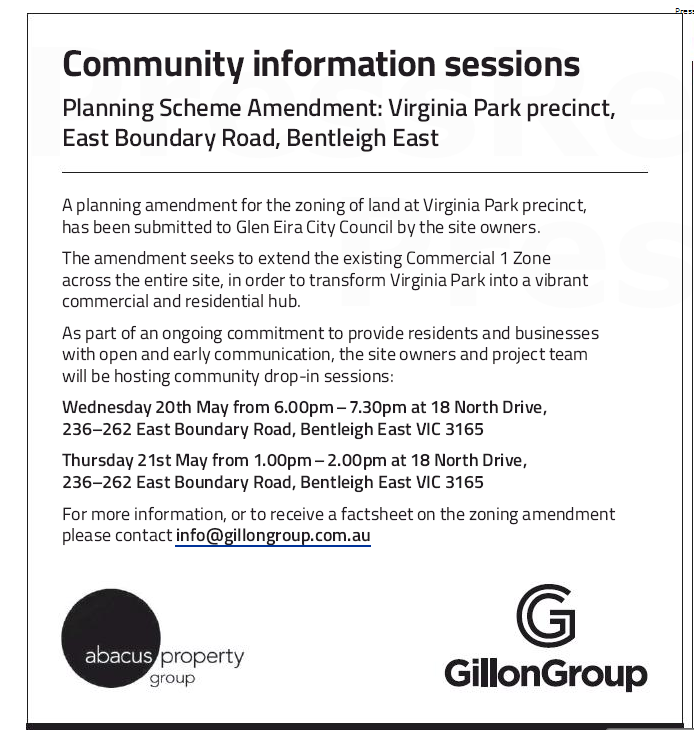
The ‘Sell’ Is On!
Posted by gleneira under Councillor Performance, GE Governance, GE Planning, GE Service Performance[7] Comments
May 11, 2015
Where 1 + 1 Does Not Make 2!
Posted by gleneira under Councillor Performance, GE Governance, GE Service Performance[8] Comments
The draft budget and Strategic Resource Plan are currently out for ‘consultation’ – ie those residents who can be bothered to plough through pages and pages of the incomprehensible, and capable of ignoring the spin, the waffle, and the obtuse. We have already commented on how council has ‘changed the goal posts’ in its declarations of rate increases. But there’s much, much more, that demands clarification and explanation to residents in these papers – especially in light of the recent demands to improve on ‘reporting standards’.
GESAC
In the 2014/15 adopted budget we were told that the expenditure on ‘GESAC plant and equipment’ was set at $86,000. In this current draft budget, these costs have suddenly risen to $222,000 – that is a 300% increase on a building that is barely three years old.
But it gets even worse with the following – Glen Eira Sports and Aquatic Centre (GESAC) – Cyclical Renewal Works $7.29m over 10 years and Replacement of Plant and Equipment $2.79m over 10 years. That’s another one million dollars per year for ‘renewal’ and ‘replacement’.
We also have some serious issues in regards to ‘rectification’ works. For example: the 2014/15 budget set aside $617,320 for this work. The 2015/6 budget we are told that there is another $200,000 to be spent on ‘rectification’ works. Perhaps this latter sum is a ‘carry over’ from the previous year or, perhaps it is simply costing another $200,000 on top of the $600,000+? Whichever, these sums are not explained and if simply a carry over then why can’t the works be completed on time?
The figures become even murkier when on page 68 of the current budget it is stated –
4.2.4 Maintenance ($680k increase)
Increases due to: GESAC defect rectification works $645k and provision for improved maintenance of parks and gardens $137k (for grounds and gardens, cleaning bbq’s, plumbing, irrigation and wetting agents.
$645,000 does not gel with any of the figures presented elsewhere. How can there be another $645,000 for ‘rectification works’ when the budget claims an allocation of $200,000 for the coming financial year? And even adding 645 plus 137 comes out at $782,000 and NOT $680,000!
Elsewhere in the budget we find this sentence – Other short-term projects $510k (includes GESAC furniture and plant replacement and defects rectification works). (page 8)
If anyone has any idea of the real figure to be spent on GESAC we would be all ears!
CARNEGIE POOL
Glen Eira City Council is currently undertaking community consultation on a concept plan for Carnegie Swim Centre. The project will revitalise the Swim Centre to ensure it can sustainably meet community needs into the future. Council has budgeted $2.5m in 2017-2018 and $2.5m in 2018-2019. This project is subject to the Sports Recreation Victoria Better Pools funding ($2.5m).
We have to ask – what happens if the government grant does NOT EVENTUATE? Does this mean that the Carnegie Pool will be allowed to disintegrate and then closed?
The same questions need to be asked for the athletic tract and basketball courts at Duncan Mackinnon – Duncan Mackinnon Athletics Track Upgrade – to provide new track surface and associated infrastructure (subject to $650k SRV funding)
Duncan Mackinnon Resurfacing of Netball Courts (subject to SRV funding) 2017 onwards –
The most significant question that needs answering however is –
HOW MUCH IS THE DUNCAN MACKINNON PAVILION OVER BUDGET? The 2011/12 adopted budget allocated $5.5 million for the redevelopment. The figure is now well and truly over TEN MILLION. Plus, given the fiasco with Maxstra, and more lawyer fees no doubt, another $1.36 million has been set aside in this budget to ‘complete’ the works.
This council has never come clean with any information on:
- How many major projects come in over budget?
- Why delays can equal years and years
- What are the legal costs in such projects?
It’s no wonder that rates in Glen Eira remain at an all-time high, when staff costs keep going through the roof year after year. The explanation? Additional positions for increased use of existing open space and for the Open Space Strategy implementation!!!!!!!!!
The above comments are intended to draw attention to the lack of clarity, explanation, and seemingly contradictory statements throughout this most important set of papers. Unless residents are provided with real category definitions, and full transparency, then the ability to really analyse and question is negated. Perhaps this, after all, is the real intention?
May 9, 2015
VCAT & Council
Posted by gleneira under Councillor Performance, GE Planning, GE Service Performance[5] Comments
In November last year council dealt with an amended application at 670 Centre Road Bentleigh East. The developer sought to increase the height of the development from four to five storeys and add another ten apartments – making a total of 50 units. Councillors resorted to their usual practice – ie lopping off a floor and reducing the number of units to 41.
Off course the applicant appealed to VCAT and has now been granted his wish – five storeys and 50 units plus reductions in visitor and shop car parking. What we find significant in this decision is the member’s comments regarding the Glen Eira Planning Scheme and its obvious shortcomings.
I further note that a recent approval of a five storey building at 730A Centre Road, Bentleigh East has been granted. I consider that there is nothing in the scheme that would suggest that a uniform height is required in centres such as this that have no mandatory height limit and provided that they can manage the interface with adjoining residential properties it is appropriate to grant this additional height.
Source: http://www.austlii.edu.au/au/cases/vic/VCAT/2015/554.html
Given the recent success of Boroondara in protecting its local shopping strips (including commercially zoned sites) with height limits set at three storeys, we ask again and again – what is Glen Eira doing? Why can other councils successfully push through amendments that limit overdevelopment and provide greater protection to their suburbs and neighbourhood centres? Why can other councils have countless Design and Development Overlays and Glen Eira only manages to basically facilitate further development or protect fence heights in a handful of streets via such overlays? Then there’s the lack of structure plans, parking precinct plans, urban design frameworks, preferred character statements – and the list goes on and on……
VCAT is not blameless by any means. But whether council likes it or not, it is the planning scheme that sets the parameters, and to a great degree, determines what can and can’t be built. Sounness has already stated that Glen Eira lacks the necessary ‘tools’. Delahunty has questioned the wisdom of the current zoning in East Bentleigh and Elsternwick. Lobo has been consistent in his lament over what is happening to Carnegie and Bentleigh. What residents should know is that the ‘tools’ to fix these issues exist. It just requires commitment, work, and a real concern for what is happening throughout Glen Eira. Such improvements would of course go against the underlying consensus that development upon development is ‘good for business’. We think that the ‘business’ of any council is to ensure that the amenity of residents is not sacrificed to the greed of a few. If councillors cannot understand this, or are unwilling to accept this basic premise and act upon it, then they do not deserve to be our so-called ‘representatives’.
May 7, 2015
Virginia Park to Dwarf Caulfield Village
Posted by gleneira under Councillor Performance, GE Governance, GE Planning, GE Service Performance[15] Comments
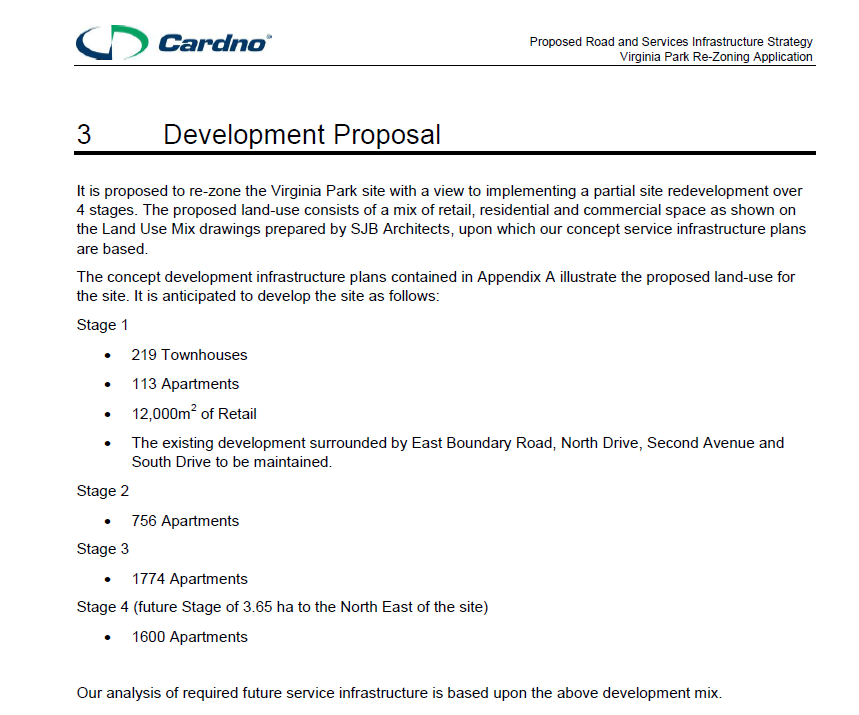
There are many hefty documents associated with this proposal. We will examine each in detail and comment in due course. For starters, we have uploaded the Retail Impact Statement which we are certain will go down like a lead balloon for all traders not only in East Bentleigh, but throughout Glen Eira. Document is available HERE
PS: Since Council doesn’t seem able to get its act together and publish all of the documentation on its website, we’ve taken the liberty of uploading the documents below.
May 6, 2015
Hansard & Carnegie & The Zones
Posted by gleneira under Councillor Performance, GE Governance, GE Planning, GE Service Performance[9] Comments
From yesterday’s Legislative Assembly sitting –
Glen Eira residential planning
Mr DIMOPOULOS (Oakleigh)—I raise a matter for the attention of the Minister for Planning. The action I seek is a commitment from the minister to visit Carnegie in the city of Glen Eira to see firsthand the impact of new dwellings on local residential areas. I further ask for the input of my local community to be considered in any future decision-making on Victorian planning matters.
Planning issues are generally very emotive for local communities, with many individual groups having input and/or being directly affected by the rules and regulations that are in place at any given time. This includes but is not limited to local residents, the local council, the Victorian Civil and Administrative Tribunal and VicRoads as well as developers. Many areas within the city of Glen Eira have undergone significant change in recent years, including Carnegie and Ormond. While these changes are not unique in Melbourne, there is a great level of community feeling about planning my local area.
I have personally been contacted by numerous local residents expressing their concern about what they believe to be overdevelopment in the neighbourhood.
While I recognise that some certainty has been provided in the past for many residents, others have not been so fortunate and have been built out or are subject to living next to large buildings which have not been in keeping with the neighbourhood or which create an impact on local facilities like roads and parking.
Carnegie has had more than its fair share of high-rise development, and residents are now rightly saying enough is enough.
We all understand that there is a need for appropriate housing, and it makes sense that many new dwellings are located close to important infrastructure like train stations, tram routes and shopping areas. However, I believe there has to be an appropriate balance between satisfying the demand for new housing and limiting the negative impact on existing neighbourhoods. That balance needs to start with the local council, but the state government also has a crucial role to play. I look forward to a visit by the Minister for Planning to my community and encourage him to meet on site with relevant parties to enable a more comprehensive awareness of local concerns.
Responses
MrWYNNE (Minister for Planning)—I thank the member for Oakleigh for raising an adjournment matter in relation to residential zones. As we know, this was an initiative of the previous government and the previous Minister for Planning, who sought to put in place a framework for the way in which we deal with issues of population and where people will be housed going forward. This is the great challenge for governments.
Population projections suggest that we will have to house a further 100 000 people a year in Victoria, within both broader metropolitan accommodation and regional cities.
The most recent regional showcase, the Regional Victoria Living Expo held last week, was again another overwhelming success. People are voting with their feet and looking for opportunities for quality housing and lifestyle in regional Victoria. Bendigo, Ballarat, Geelong and the Latrobe Valley, because of their significantly upgraded public transport links and fast train networks, provide people with the ability to commute between their homes and Melbourne or, with flexibility of employment, to balance their employment and family lifestyles.
When we came to government it was clear that for residents of many municipalities the residential zones process left a bad taste in their mouths. People felt shut out of the process and the response to their legitimate concerns about how the zones were implemented was less than satisfactory. On coming to government I indicated that we would allow the residential zones process to complete its work and that the independent panel process would be completed, and that has now happened. I also indicated that we would let the dust settle a little, because many communities have been over-planned, and then in the second half of this year we would look at it again to see how the housing strategies that were put in place have been outcomes right across the metropolitan area, and there are opportunities for us to review this in an independent way and to learn from what was, in many respects, a flawed process because it did not take communities along with it. Ultimately communities have to be part of the conversation, and they will always be part of the conversation with a Labor government. I have the honour of being the Minister for Planning, and I will always consult with communities about how we take these challenges forward, because a collective effort is required for us to house 100 000 people every single year.
I welcome the contribution of the member for Oakleigh, and I will take up his invitation to talk to his community and to the council, and that will be part of my early consultative work in thinking through how to establish in the second half of this year a further independent process to review the residential zones. I welcome the member’s intervention tonight.
 Glen Eira Debates